Friday, March 21, 2025

Trump and DOGE’s Attacks on CFPB Will Help Financial Industry Prey on Consumers


The Consumer Financial Protection Bureau is meant to protect us from predatory finance. That’s why Trump wants it gone.


March 20, 2025

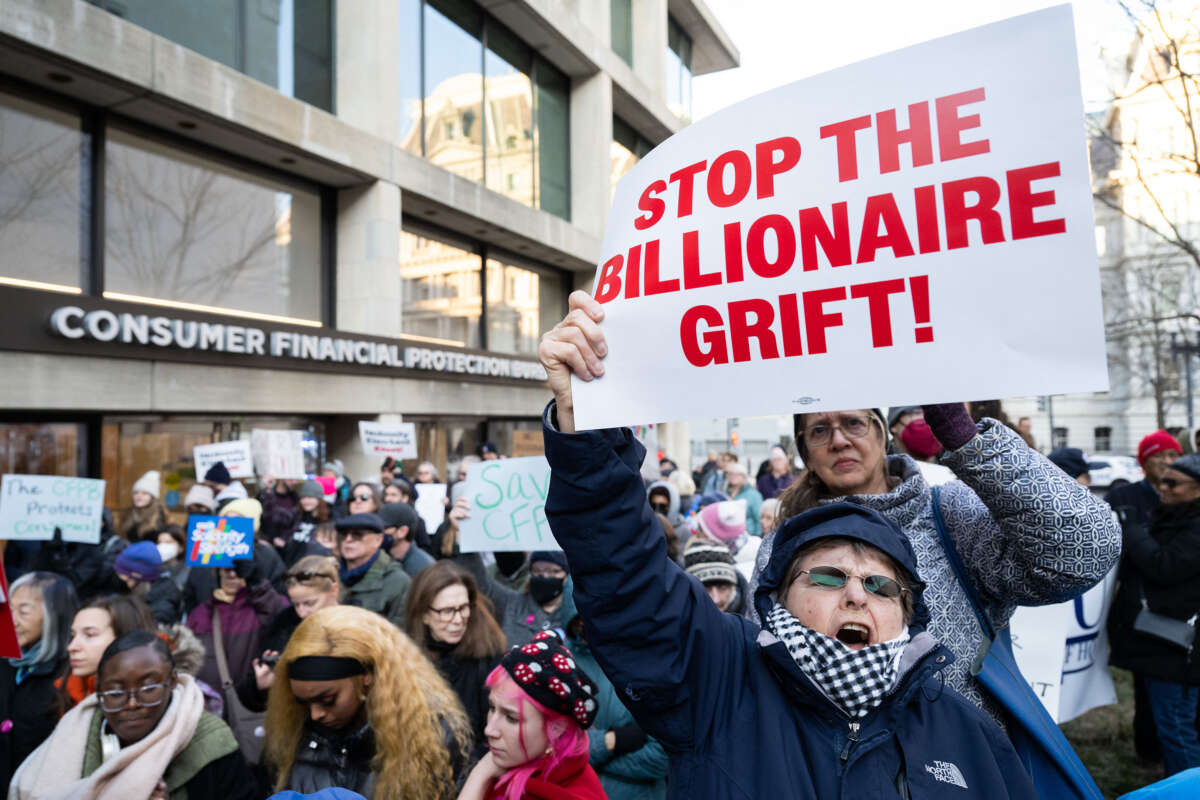
Demonstrators hold signs as they attend a protest against President Donald Trump and Elon Musk's anticipated plan to close the Consumer Financial Protection Bureau (CFPB) in front of the CFPB headquarters in Washington, D.C., on February 10, 2025.Saul Loeb / AFP via Getty Images

In the wake of the 2008 financial crisis, the destructive impact of predatory lenders on the well-being of individual borrowers and the health of the broader economy became increasingly clear. In response, a growing number of political figures, led by Sen. Elizabeth Warren, pushed for the creation of an agency that would represent consumer interests against predatory finance. The agency sought to ensure the enforcement of existing regulations and create new ones to rein in the financial industry.

Congress passed legislation that would establish the Consumer Financial Protection Bureau (CFPB) in 2010, and the newly minted agency began operations the following July. On its website, the CFPB explains its origin story this way: “Many Americans took on loans that they did not fully understand and could not afford. Although some borrowers knowingly took on too much debt, many Americans who behaved responsibly were also lured into unaffordable loans by misleading promises of low payments. Honest lenders that resisted the pressure to sell complicated products had to compete with their less responsible competitors.”

For the past 14 years the CFPB has protected ordinary Americans against credit card companies with misleading policy on interest rates and fees; against payday lenders, whose fees can add up to the equivalent of hundreds of percent interest per year; against banks for the charging of so-called “junk fees”; against lenders hawking misleading loans guaranteed by borrowers’ car ownership titles, and so on. In 2023 alone, it brought 29 enforcement actions, winning more than $3 billion in compensation for consumers, and bringing in nearly half a billion dollars in fines levied against companies.

This is, in other words, a modest example of the federal government putting its resources to work to benefit ordinary Americans against wealthy, exploitative corporations. For that very reason, it has long been in the crosshairs of the GOP and the party’s wealthy donor base. Trump’s first administration repeatedly tried to break the agency, with the Heritage Foundation lobbying for its demise and Trump appointing the fiercely pro-business Mick Mulvaney to head the agency. The administration also argued that the creation of the CFPB as an independent agency was in and of itself unconstitutional.

Ultimately, Trump 1.0 didn’t succeed in its efforts to incapacitate the agency, and in many ways the CFPB’s footprint, and its enforcement actions grew, or, at the very least, continued apace through 2021. When Biden became president, pushing a pro-consumer agenda, the CFPB continued to grow in importance, to the disdain of much of corporate America.

Related Story

Trump’s Budget Director Could Usher In an Age of Unfettered Presidential Power
Slated to head the Office of Management and Budget, Russell Vought was a lead figure in creating Project 2025.  By Sasha Abramsky , Truthout December 9, 2024


Now, under Trump 2.0, corporate America has its second chance to destroy a government outfit that offers modest protections for the vulnerable against the powerful and the rich.

In the weeks after Donald Trump’s inauguration on January 20, Elon Musk’s so-called “Department of Government Efficiency” (DOGE) tried to simply “delete” the CFPB, despite the fact that it was created by Congress and can thus only be legally abolished by Congress. In fact, after USAID, no part of the federal bureaucracy attracted the malignant laser-focus attention of DOGE as did the CFPB, which Musk took to regularly attacking on his X account.

On February 7, the oligarch, whose Tesla company had faced hundreds of consumer complaints to the CFPB, and whose efforts to create an X-Visa payment processing partnership were also likely to be flagged by the bureau, posted “CFPB RIP” on X. It was in keeping with DOGE’s efforts to go after the National Labor Relations Board, the Office of Federal Contract Compliance Programs, and other parts of the federal bureaucracy that had, at one point or another, stood in the way of the most predatory or unethical of Musk’s business practices.


For 14 years, the CFPB has stood for the little person against the oligarchs. Now the oligarchs are once again out in force.

The next day, newly acting head of the CFPB Russell Vought, who also is in charge of the powerful Office of Management and Budget, ordered agency staff to stop all work on developing new rules, on investigating corporate malfeasance, as well as all litigation and all public communication. He then informed the Federal Reserve, which funds the agency, that the CFPB won’t be taking any additional moneys for its operations the following quarter. The union representing workers at the agency also let it be known that they had reason to fear he was preparing to return its $711 million balance, thus essentially rendering it entirely defanged. This was followed up by another memo to the agency’s roughly 1,700 staff prohibiting them from engaging in any work at all, and to not come into the office — an office which Vought then reportedly sought to have the lease terminated on.

In the week surrounding February 14, dozens of probationary staff at the agency were fired. Vought also canceled $100 million in contracts that the CFPB had with companies that did things such as help process consumer complaints. At about the same time, DOGE operative and former pharmaceutical lobbyist Chris Young was brought in as a “senior adviser” to the bureau.

All of this prompted a fierce legal pushback. Days after Vought’s efforts to dismember the CFPB in all but name, the National Treasury Employees Union went to court alleging that Vought was planning to lay off 95 percent of the agency’s staff.

It didn’t take long for U.S. District Judge Amy Berman Jackson to side with the union in this case. She concluded that Vought and/or DOGE could not simply fire thousands of employees without cause and issued a temporary restraining order. In early March, the order was extended, and, as of publication, the agency’s corps of staff remains largely intact, albeit in the Vought-ordered deep freeze in which most of its daily work is no longer being carried out.

In recent weeks, the CFPB has dropped at least 10 cases against lenders, including, according to Reuters, a case against Capital One accusing the bank of withholding billions of dollars in interest payments from customers. Dozens of other cases are now on hold.

All of this shifts the burden of protecting consumers onto the states, privately funded lawsuits and ultimately consumers themselves. That doesn’t mean consumers have no protections left; but it does mean that under Trump, the federal government is basically washing its hands of even modest efforts to protect consumers — especially the low-income and/or borrowers of color who have most frequently ended up at the wrong end of particularly exploitative lending practices — thus further tipping the scales in favor of some of the worst players in the lending industry.

Given the other actions of this oligarchical administration, none of this should be a surprise. Part of DOGE’s mission seems to be to obliterate any system or agency that can stop Musk’s and Trump’s accumulation of power and wealth. For 14 years, the CFPB has stood for the little person against the oligarchs. Now the oligarchs are once again out in force, uprooting the systems that stand in their way and rapidly returning the lending industry to the worst practices of the pre-financial crisis days.
Israel's Takeovers of Gaza Hospitals Amount to 'War Crimes,' Says Human Rights Watch

"The Israeli military's denial of water and electricity left sick and wounded people to die, while soldiers mistreated and forcibly displaced patients and health workers, and damaged and destroyed hospitals."


Gazan teams investigate after Israeli forces destroyed al-Shifa Hospital in Gaza City, Gaza on April 17, 2024.

(Photo: Dawoud Abo Alkas/Anadolu via Getty Images)


Jessica Corbett
Mar 20, 2025
COMMON DREAMS

As the Israel Defense Forces continued a devastating assault on the Gaza Strip Thursday, a U.S.-based rights group said that the IDF "caused deaths and unnecessary suffering of Palestinian patients while occupying hospitals" there over the past 18 months, "amounting to war crimes."

"International humanitarian law provides that hospitals and their staff may not be deliberately attacked," states the new Human Rights Watch (HRW) report. "Parties to the conflict must at all times respect and protect hospitals and take all feasible precautions to minimize harm to patients, staff, and facilities during the hostilities."

Like previous publications exposing the IDF's systematic destruction of the Gaza health system, the HRW report lays out how Israeli forces who occupied hospitals neglected their legal obligations and instead "severely interfered with the treatment" of injured and sick Palestinians, including by denying doctors' pleas to bring in supplies and blocking access to facilities and ambulances, "leading to the deaths of wounded and chronically ill patients."


HRW interviewed patients and healthcare workers present for Israeli takeovers of al-Shifa medical complex in Gaza City, Kamal Adwan Hospital in Beit Lahia, and the Nasser facility in Khan Younis. According to witnesses, the IDF "denied electricity, water, food, and medicines to patients; shot civilians; mistreated health workers; and deliberately destroyed medical facilities and equipment. Unlawful forced evacuations put patients at grave risk and left desperately needed hospitals nonfunctional."

In the section on Israeli activities at al-Shifa in November 2023, HRW reported that "Ridana Zukhra, 25, said she left al-Shifa with her children, brother, and cousin when Israeli forces ordered people to evacuate. Despite holding white flags, a tank fired at the group, badly wounding her daughter, Ghazal, 5, whose leg had to be amputated."

The report also shares accounts from the hospital five months later:
Dr. Badr B., 28, who asked not to use his real name for his protection, said that electricity at the hospital was cut off at about 2:00 am on March 18. Israeli forces broadcast a message that no one could leave, he said, and they shot and wounded four healthcare workers near the entrance. A doctor told the BBC that two patients on life support died because of the electricity cut.

Israeli forces seized the complex with "military vehicles, snipers, quadcopters [drones], soldiers, everything," Dr. B. said. Israeli forces ordered the 72 healthcare workers left at the hospital to transfer about 180 patients from the third and fourth floors of the ICU in the specialized surgeries building to the ground floor and warned they would "start shooting at these floors" within two hours. Dr. B. said that they began "shooting as we were evacuating the last group, three [patients] on crutches and the rest in wheelchairs." Staff then transferred patients to the hospital's reception building.

HRW also detailed Israel's December 2023 assault on Kamal Adwan and the February 2024 raid at Nasser, "when 850 patients and up to 10,000 displaced people were sheltering there."

According to the publication:
Duaa D., who asked that her real name not be used for her protection, said her son Mohammed, 20, was a kidney patient in Nasser hospital at the time, where there was no fresh food, clean water, or medicine for Mohammed's hypertension. Her two younger children, sheltering in a tent in the hospital courtyard, went sleepless with fear. Mohammed said he could barely walk and had lost almost half his body weight due to vomiting and diarrhea, that the water was contaminated, and that he could not digest the canned food due to his chronic illnesses.

On February 13, Duaa saw Jamal Abu al-Ola, 25, who had been sheltering in the hospital, in a white hazmat suit with his hands bound. NBC and other media reported that Israeli forces had detained and beaten him and ordered him to warn the hospital to evacuate, threatening to kill him and others if he did not return. Duaa said al-Ola shared the warning and left the hospital, but soon after was carried back in and "shot, with a fountain of blood pouring." Witnesses told news media that Israeli forces shot and killed him near the hospital entrance.

Duaa told HRW that she saw a large number of bodies on the ground and recalled an "unbearable" smell. "We saw cats and dogs eating bodies," she said. "Once a dog brought a human hand and gave it to its puppies."

Bill Van Esveld, associate children's rights director at HRW, demanded accountability for Israeli troops' well-documented war crimes.

"Israeli forces repeatedly demonstrated deadly cruelty against Palestinian patients in hospitals that they seized," Van Esveld said. "The Israeli military's denial of water and electricity left sick and wounded people to die, while soldiers mistreated and forcibly displaced patients and health workers, and damaged and destroyed hospitals."

"The Israeli military's occupation of Gaza's hospitals has transformed sites for healing and recovery into centers of death and mistreatment," he added. "Those responsible for these horrific abuses, including senior officials, should be held to account."


The report was published just days after Israel fully abandoned a cease-fire that took effect in January. Gaza Ministry of Health spokesperson Khalil Al-Dakran toldAnadolu Agency on Thursday that "the bodies of 710 people were transferred to hospitals since Tuesday, in addition to over 900 others injured."

Al-Dakran said that 70% of the injured were women and children, and "many of the injured died due to the lack of urgent medical care amid an Israeli blockade on Gaza, which causes a severe shortage of essential equipment and medicine."

Since the Hamas-led October 2023 attack on Israel, the IDF has slaughtered at least tens of thousands of Palestinians—leading to an ongoing genocide case at the International Court of Justice. The International Criminal Court has also issued arrest warrants for Israeli Prime Minister Benjamin Netanyahu and his former defense minister, Yoav Gallant.
Economist Says Fed Warning Shows Trump Driving US Economy 'Toward Disaster'


"Launching chaotic trade wars with our allies and gutting Social Security, Medicaid, and other vital programs in order to fund tax breaks for his billionaire donors isn't making life more affordable for working-class families."


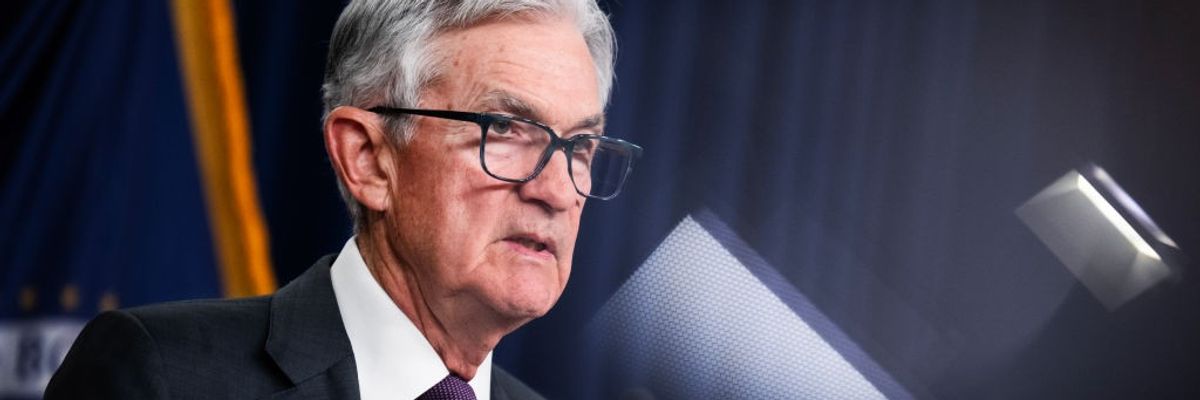
U.S. Federal Reserve Chair Jerome Powell speaks at a news conference after a meeting of the Federal Open Market Committee on Wednesday, March 19, 2025 in Washington, D.C.
(Photo: Tom Williams/CQ-Roll Call, Inc. via Getty Images)


Brett Wilkins
Mar 19, 2025
COMMON DREAMS

A former Obama administration economic adviser said Wednesday that the Federal Reserve's forecast of increased unemployment, accelerating inflation, and slower growth driven by President Donald Trump's economic policies could portend a return of the "stagflation" that plagued the nation in the 1970s.

The Federal Open Markets Committee, which sets U.S. monetary policy, downgraded its economic outlook for 2025 from an initial projection of 2.1% growth to 1.7%. FOMC also revised its inflation forecast upward from 2.5% to 2.8%.

While FOMC said that "recent indicators suggest that economic activity has continued to expand at a solid pace," the committee noted that "uncertainty around the economic outlook has increased."


Fears of an economic slowdown or even a recession have increased dramatically since Trump took office and imposed tariffs on some of the nation's biggest trade partners while moving to gut critical social programs in order to fund a $4.5 trillion tax cut that will overwhelmingly benefit wealthy Americans.

"Inflation has started to move up now. We think partly in response to tariffs and there may be a delay in further progress over the course of this year," Federal Reserve Chair Jerome Powell said during a Wednesday news conference, at which he said interest rates will remain unchanged. "The survey data [of] both household and businesses show significant large rising uncertainty and significant concerns about downside risks."

The economic justice group Groundwork Collaborative said the FOMC projections show that "Trump is steering our economy toward disaster," while warning of the possible return of stagflation, a combination of low or negative economic growth and inflation.

Alex Jacquez, the chief of policy and advocacy at the Groundwork Collaborative and a former adviser at the White House National Economic Council during the Obama administration, said in a statement that "the Federal Reserve's projections confirm what millions of Americans are already thinking: President Trump is steering our economy toward disaster."

"Voters elected President Trump to lower the cost of living, and instead, they continue to be saddled with persistently high inflation and interest rates," Jacquez continued. "Launching chaotic trade wars with our allies and gutting Social Security, Medicaid, and other vital programs in order to fund tax breaks for his billionaire donors isn't making life more affordable for working-class families. It is, however, a perfect recipe for stagflation."

Trump's economic policies—which some observers believe could be designed to deliberately tank the economy so that the ultrawealthy can buy up assets at deep discounts—have sent consumer confidence plummeting. Meanwhile, recent polls have revealed that a majority of voters disapprove of Trump's handling of the economy and inflation.

The latest FOMC forecast came as the world braces for yet another escalation of Trump's trade war, with the president threatening to implement worldwide reciprocal tariffs starting April 2.

The Organization for Economic Cooperation and Development (OECD) said Monday that Trump's trade war is likely to slow economic growth in the United States and around the world.

"The global economy has shown some real resilience, with growth remaining steady and inflation moving downwards," OECD Secretary-General Mathias Cormann said. "However, some signs of weakness have emerged, driven by heightened policy uncertainty."

"Increasing trade restrictions will contribute to higher costs both for production and consumption," Cormann added. "It remains essential to ensure a well-functioning, rules-based international trading system and to keep markets open."

Why Do Wealthy CEOs Love Trump? He’s Distracting From Their Own Grift


Corporate CEO paychecks continuing to go gangbusters while the corporations these execs run are—at best—just treading water.


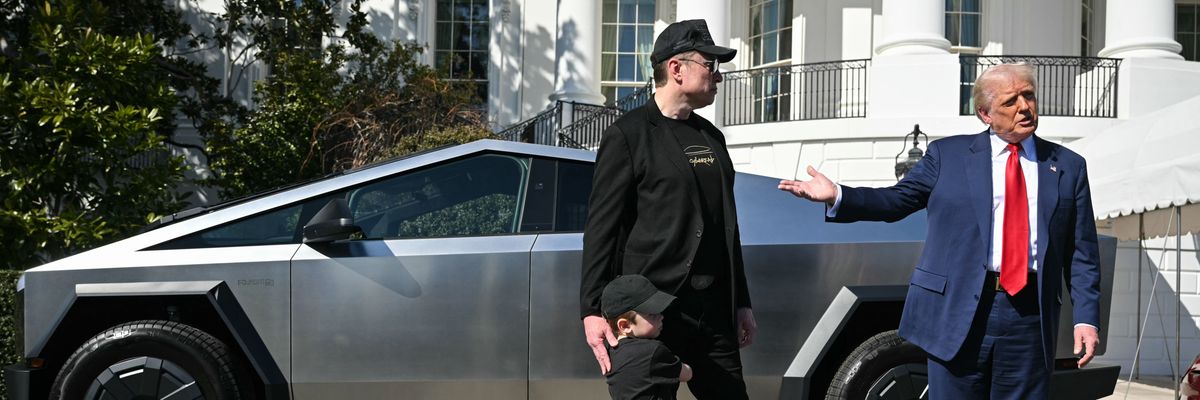
U.S. President Donald Trump and Tesla CEO Elon Musk (AND MINI ME MUSK) speak to the press as they stand next to a Tesla Cybertruck on the South Portico of the White House on March 11, 2025 in Washington, D.C.
(Photo: Mandel Ngan/AFP via Getty Images)


Sam Pizzigati
Mar 20, 2025
Inequality.org

Every day’s headlines now seem to bombard us with ever more outrageous Trumpian antics. Who could have possibly imagined, for instance, that a president of the United States would turn the White House lawn into a Tesla auto showroom?

But these antics actually do serve a useful social and political purpose—for President Donald Trump’s fellow deep pockets and the corporations they run. Trump’s kleptocratic arrogance and audacity have shoved the institutionalized thievery of Corporate America’s ever-grasping top execs off into the shadows.

Those shadows could hardly be more welcome. American corporate executive compensation, as the business journal Fortune has just detailed, is now “surging amid a roaring bonus rebound.”

Heads CEOs win, in other words, tails they never lose.

One example: Tyson Foods CEO Donnie King has seen his annual executive rewards leap from $13 million in 2023 to $22.7 million in 2024. To keep King smiling, Tyson’s board of directors has also extended his CEO contract into 2027 and guaranteed him “a post-employment perk that includes 75 hours of personal use of the company jet as long as he sticks around on the board.”

And what in the way of wonders has Tyson’s King been working to earn all this? Not much, concludes a new Compensation Advisory Partners analysis. Anyone who had $100 invested in Tyson shares at the end of fiscal 2019 today holds a nest egg worth just $80.54. Tyson’s most typical workers aren’t doing particularly well either. They took home $43,417 in 2024, 525 times less than the annual compensation that CEO Donnie King pocketed.

Over at Moderna, Big Pharma’s newest big kid on the corporate block, chief exec Stéphane Bancel saw his 2024 annual pay jump 16.4% over his 2023 compensation despite a 53% drop in Moderna’s annual revenue.

Back in 2022, at Covid-19’s height, Bancel personally collected over $392 million exercising stacks of the stock options he had been sitting upon. Between that year’s start and 2024’s close, Moderna shares plummeted from just under $254 each to under $42.

Moderna’s transition to our post-Covid world, the Moderna board acknowledges, has been “more complex than anticipated.” That complexity, the board apparently believes, in no way justifies denying Bancel his rightful place among Big Pharma’s top-earning CEOs. Bancel’s near $20-million 2024 payday is keeping him well within hailing distance of all his Big Pharma peers.

How can corporate CEO paychecks be continuing to go gangbusters while the corporations these execs run are—at best—just treading water? Lauren Peek, a partner at Compensation Advisory Partners and a co-author of the firm’s latest CEO pay analysis, has an explanation.

Corporate board compensation committees, Peek observes, want to keep their top execs adequately incentivized. These board panels simply cannot bear the sight of their CEOs getting down in the dumps. So what do these panels do? They exclude from their final CEO pay decisions any negative economic factors that CEOs can’t directly determine. But these same corporate panels never take into account unexpected positive economic factors that their CEOs had no hand in creating.

Heads CEOs win, in other words, tails they never lose.

Among those winners: Disney chief exec Robert Iger. His 2024 total pay jumped to $41 million, up nearly $10 million from his 2023 compensation. Disney’s total shareholder return, over that same year, didn’t even reach halfway up the total return that Disney’s peer companies recorded.

Disney hardly rates as an outlier among the 50 major publicly traded corporations that the recently released Compensation Advisory Partners report puts under the microscope. The median revenue growth of these 50 firms dropped to 1.6% in 2024, less than half their 2023 rate. Their earnings remained virtually flat as well. But their CEO compensation climbed an average 9%.

“With financial performance largely flat across these early Fortune 500 filers,” notes an HR Grapevine analysis of the Compensation Advisory Partners findings, “board-level decisions to maintain or raise executive bonuses may prompt further scrutiny from investors and stakeholders alike.”

“For ‘shop-floor’ employees,” adds the HR Grapevine, “news of CEO wage hikes despite average financial performances will undoubtedly prompt a good deal of rumination about their own levels of compensation.”

Equilar, an information services firm specializing in corporate pay, has also been busy analyzing the latest trends in CEO remuneration. Equilar’s latest look at corner-office compensation has found that median CEO pay within the corporations that make up the Equilar 500 jumped up from $12 million in 2020 to $16.5 million last year.

CEO-worker pay gaps have increased even more significantly. At the median Equilar 500 corporation, CEOs pocketed 186.5 times the pay of their most typical workers in 2020 and 306 times that pay in 2024. At America’s larger corporations—those companies sitting at the 75th percentile of the Equilar 500—CEOs made 307.5 times their typical worker pay in 2020 and last year collected 527 times more.

A key driver of this ever-widening CEO-worker pay gap? The sinking compensation going to typical corporate workers, as Equilar’s Joyce Chen concluded last week in an analysis for the Harvard Law School Forum on Corporate Governance. These median workers took home $66,321 in 2020, but just $57,299 last year.

But top execs aren’t just shortchanging workers at pay-time. They’re also pressuring those workers to squeeze and defraud clients and customers at every opportunity, as former Wells Fargo bank manager and investigator Kieran Cuadras has just vividly detailed.

Nearly a decade ago, Cuadras relates, a mammoth phony accounts scandal at Wells Fargo led to fines totaling $20 million against the bank’s then-CEO John Stumpf. But those fines, she points out, hardly made a dent in the estimated $130 million that Stumpf “walked away with in compensation when he resigned.”

Wells Fargo’s current CEO, Charles Scharf, appears to be doing his best to follow in Stumpf’s footsteps. Scharf’s gutted risk and complaint departments are cutting corners “to create the illusion of fewer complaints.” The reality: Those departments are closing complaint cases prematurely. In 2024, these and other sneaky moves helped Scharf pocket a sweet $31.2 million .

Our nation’s political leaders, says Wells Fargo employee and customer advocate Kieran Cuadras, need “to step up and do something about a CEO pay system that rewards executives with obscenely large paychecks for practices that harm workers and the broader economy.”

Where to start that stepping up? Lawmakers ought to be levying new taxes on corporations “with huge gaps between their CEO and worker pay,” Cuadras posits, and increasing an already existing tax on stock buybacks.

Moves like these, she astutely sums up, “would encourage companies to focus on long-term prosperity and stability rather than simply making wealthy executives and shareholders even richer.”


This work is licensed under a Creative Commons Attribution-Share Alike 3.0 License.


Sam Pizzigati veteran labor journalist and Institute for Policy Studies associate fellow, edits Inequality.org. His recent books include: The Case for a Maximum Wage (2018) and The Rich Don't Always Win: The Forgotten Triumph over Plutocracy that Created the American Middle Class, 1900-1970 (2012).
Full Bio >
'The Threat Is Extremely Real': Advocates Sound Alarm Over Trump 'Energy Emergency'

"We truly urge policymakers, stakeholders, and the public to see these executive orders for what they truly are: an unnecessary and counterproductive retreat to outdated energy strategies."


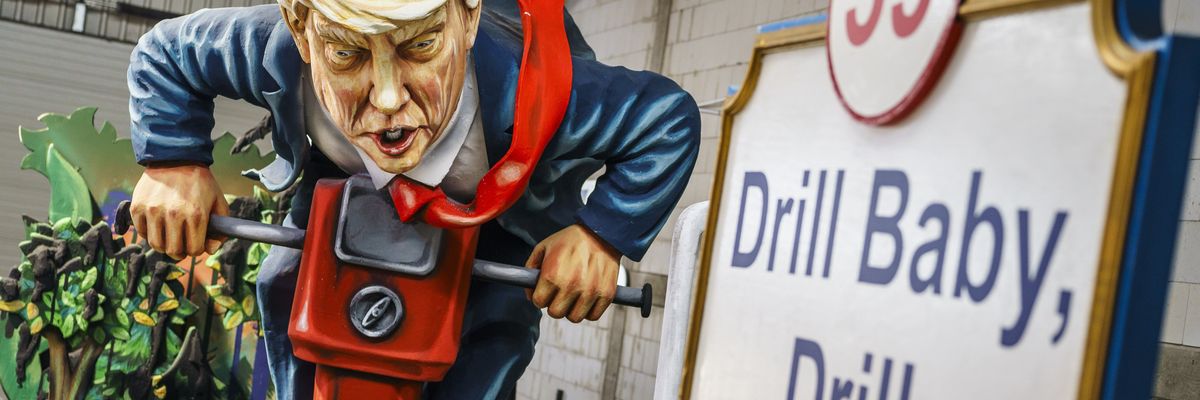
The "Drill, Baby, Drill" motif float shows a depiction of U.S. President Donald Trump with reference to the use of fossil fuels and the rejection of environmentally friendly energy production for the Rose Monday parade on March 3, 2025 in Rhineland-Palatinate, Mainz-Mombach, Germany.
(Photo: Andreas Arnold/picture alliance via Getty Images)

Olivia Rosane
Mar 19, 2025
COMMON DREAMS

On the first day of his second term, U.S. President Donald Trump announced he was fulfilling his campaign promise to "drill, baby, drill" by declaring a "national energy emergency." The declaration seeks to spur the "identification, leasing, development, production, transportation, refining, and generation" of every energy source except for wind, solar, battery storage, and improved efficiency.


But what exactly does this mean, and how much damage could it do to local communities, energy prices, the global climate, and the nation's leadership in the green energy transition? Quite a lot, a panel of energy policy experts warned on Wednesday.

"These executive orders and this administration are sending us down exactly the wrong path," said senior attorney at the Southern Environmental Law Center Megan Gibson. "By attempting to fabricate a national energy emergency, these orders set the stage toward increased fossil fuel extraction, transmission, use, and export. This is all over cleaner, more affordable technologies that we have and are commercially scalable."
The National Security Justification

Tyson Slocum, director of Public Citizen's Energy Program, warned that "the threat is extremely real, and here right now, that Trump is going to seek to push unneeded fossil fuel projects."

Trump gave himself a major tool to accomplish this in the declaration by evoking national security. Specifically, Section 7 orders Secretary of Defense Pete Hegseth to conduct an assessment of the department's access to the energy needed to "protect the homeland" and present it within 60 days, or by March 21. The report should examine any vulnerabilities, with a special emphasis on the Northeast and West Coast, where local and state Democratic governments have rejected new fossil fuel projects on climate grounds.

While Trump tried to use national security justifications to speed fossil fuel development during his first term, he was stymied in part by opposition within government agencies. That is less likely to be the case now.

"There is no question that when you add national security designations to civilian energy infrastructure projects, you're putting in the crosshairs any civil servant or citizen who seeks to deviate from Trump's line."

"He has now purged agencies of opposition and has much firmer control over the national security apparatus that he's going to need to use national security justifications for this energy emergency declaration," Slocum said.

Therefore, Hegseth's report could be used to, for example, claim that the energy needs of military bases in the Northeast require the revival of the Constitution pipeline that would bring fracked gas from Pennsylvania to New York, which state leaders had previously rejected.

"This is about a larger issue of attacking parts of the country that didn't vote for him and parts of the country that also have enacted a number of laws and regulations promoting action on climate change and promoting renewables," Slocum said. "And so this is part of a general attack on state leadership of those states that he sees as not being accommodating enough to fossil fuels."

At the same time, the emergency declaration could be used as part of a negotiating tactic with Democratic state leaders. To take New York as an example again, Trump might persuade Gov. Kathy Hochul to accept the Constitution pipeline in exchange for allowing offshore wind or ending opposition to congestion pricing.

"Trump will either force his agenda upon unwilling states, or he will use it as a club to bully them into doing it as part of a horse-trading maneuver," Slocum said.

Using the national security justification could also make it easier for the administration to crack down on not only civil society protests against these projects, but stubborn opposition from local leaders as well. Even elected officials who pushed back, Slocum warned, could be labeled terrorists.

"There is no question that when you add national security designations to civilian energy infrastructure projects, you're putting in the crosshairs any civil servant or citizen who seeks to deviate from Trump's line," he said.
Cutting Corners

Another provision of the emergency declaration being monitored by advocates is Section 4, which calls on heads of agencies to alert the Army Corps of Engineers to projects they want to see prioritized. The Corps plays an important role in issuing 404 permits for any infrastructure that is built through or beneath a body of water. It also has the authority to rush its permitting process—including by waving or truncating a National Environmental Policy Act (NEPA) review—in the case of an emergency.

Shortly after Trump's declaration, the Army Corps listed several "emergency"-designated projects on its website. However, David Bookbinder, director of law and policy at the Environmental Integrity Project, pointed out, "none of those projects, not a single one, meets the Corps' own definition of what an emergency is."

The Corps can rush a project through only if not doing so poses an immediate threat to life, property, or economic well-being, and it has historically only done so in the aftermath of natural disasters such as floods or hurricanes.

"In the long run, the question is how many times is the Corps going to make groups sue them?"

"No one has ever tried to speed up permitting on the basis of a national energy emergency, let alone a clearly fictitious one," Bookbinder said.

The Army Corps immediately removed the emergency designations of projects on its website once they were discovered, and groups including Bookbinder's have filed Freedom of Information Act requests with the Corps to find out what projects other agencies have told it to fast-track. Those requests are due around the beginning of April.

"As soon as they try permitting one of these projects, cutting the corners and speeding up a permit by designating it as, quote, an emergency, that permit will be challenged," Bookbinder said. "And in the long run, the question is how many times is the Corps going to make groups sue them?"

In the long-term, advocates say, the administration may attempt to use the Corps' ability to rush "emergency" projects in order to bypass NEPA altogether, ignore court orders that try to stop it, and undermine agencies that push back. While the Federal Energy Regulatory Commission (FERC) is supposed to be independent, for example, Trump on Tuesday fired the two Democratic commissioners on the Federal Trade Commission.

"We are very concerned that should Trump perceive any roadblocks at FERC to his energy emergency declaration that he would have no qualms forcibly removing independent FERC commissioners from their seats and replace them with compliant commissioners," Slocum said. "So this is not bluster."

Ultimately, Slocum added, "we are in an era right now where the only norm is Trump is going to violate it."
Who Benefits?

While the Trump administration is trying to rush through fossil fuel projects, the panelists were clear that his energy agenda will not benefit the majority of U.S. communities and ratepayers.

"If we continue down this path, this self-destructive path, we will miss out on an opportunity to build a vibrant, sustainable energy economy that benefits all Americans, that will actually secure our national energy independence, and would position our country for long-term economic success," Gibson said.

So who will benefit? The clue comes in part in a closed-door meeting the Trump administration held with oil and gas executives in the White House, also on Wednesday.

"Advocates must keep challenging approvals through litigation and public pressure—making the case that the project can and should be denied if there is no genuine need or if adverse impacts are overwhelming."

"After spending $450 million in the last election to elect Trump and install friendly lawmakers on Capitol Hill, fossil fuel executives are getting what they paid for," Slocum said in a statement about the meeting. "We know precisely what the oil industry will do with decreased costs stemming from Trump's deregulation: They will pocket the savings and shower executives and wealthy investors with bonuses and dividends."

"Under Trump, fossil fuel corporations will accelerate the transfer of wealth from consumers to billionaires while exposing millions of Americans to more pollution and delaying the transition to clean energy for as long as possible," he continued.

Slocum further told Common Dreams that "the fossil fuel industry's close ties to Trump and key Trump officials will play a role in decisions Trump has made and will continue to make on the energy emergency declaration and implementation."

Gibson said the emergency declaration was "perpetuating a pattern where major fossil fuel corporations reap substantial profits while the American public and communities have to deal with rising energy prices, higher utility bills, a weakened domestic energy system, not to mention extreme and lasting harms to our communities and our health."

In response, she called on "unlikely partners and coalitions to push for a modern, democratically grounded energy policy that benefits the public."

'It's essential that we continue to hold regulators accountable: Many of FERC's decisions have disregarded states' and communities' objections. Advocates must keep challenging approvals through litigation and public pressure—making the case that the project can and should be denied if there is no genuine need or if adverse impacts are overwhelming," she said.

"We truly urge policymakers, stakeholders, and the public to see these executive orders for what they truly are: an unnecessary and counterproductive retreat to outdated energy strategies," Gibson said. "The real emergency here isn't a lack of fossil fuel extraction, transmission, or export. It's lack of vision and courage, and competent governance to embrace the modern clean energy economy we know we need and deserve."

Trump Scheme Would Turn US Border Into Sprawling Military Base as Loophole to Detain Migrants


One journalist warned the proposal would create vast "buffer zone" in which "no normal U.S. laws apply."


United States Marine Corps troops patrol the U.S.-Mexico border area as seen from San Diego, California, on February 7, 2025.
(Photo: Carlos Moreno/NurPhoto via Getty Images)


Julia Conley
Mar 20, 2025
COMMON DREAMS

The Trump administration is considering plans to create a "buffer zone" controlled by the Pentagon along a large portion of the southern border—a move that would enable U.S. troops to immediately detain anyone who crossed the border into the militarized area, treating them as trespassers on a military base.

As The Washington Post reported, the White House has been evaluating the plan for several weeks as it pushes a crackdown on immigration at the U.S.-Mexico border, where more than 10,000 service members are now involved in border security.

Under the proposal, the Pentagon would assume control of a 60-foot-deep strip of the border in New Mexico, lying within the Roosevelt Reservation, which President Theodore Roosevelt set aside for border security in 1907. The land is typically under the jurisdiction of the U.S. Interior Department.

The militarized buffer zone could eventually stretch all the way across Arizona to California, according to the Post.

Journalist Harris Meyer said the satellite military base would serve as "an internal Gitmo," referring to the military detention camp, "where no normal U.S. laws apply."

If migrants—or U.S. civilians—were apprehended at the base, service members would be able to detain them indefinitely until law enforcement or immigration officials arrived.

The Trump administration has so far enlisted Customs and Border Protection and Immigration and Customs Enforcement agents to detain undocumented immigrants at the border, avoiding violations of the Posse Comitatus Act, which prohibits active-duty service members from participating in law enforcement work.

The plan, said Adam Isacson of the Washington Office on Latin America, "would be the first [U.S. military] mission that would put soldiers out front, in direct contact with civilians/migrants, on U.S. soil."


What the NYT and RFK Jr. Have in Common: Biological Racism


Working people with similar interests and goals have often been divided by bosses and a corporate power structure using language, religion, and ethnicity. Our goal should be to build solidarity and overcome those artificial distinctions, so that we can fight together for our best interests.


Merle Oberon and Frank Sinatra pictured at table during a Hollywood event in the 1950's.

(Photo by Screen Archives/Getty Images)


Les Leopold
Mar 20, 2025
Common Dreams


A recent story in the New York Times about Merle Oberon, an actress who was nominated for an Oscar in 1936, promotes a version of biological racism that is more severe than the anti-Semitic Nazi Nuremberg Laws enacted in 1935.

The article points out that Oberon, whose mother was Sri Lankan, became a star because “she decided to pass as white, hiding her South Asian identity to make it in an industry that was resistant to anything else.” But she really was “of color,” a term the Times uses without explanation.

We get it. Oberon was the child of a mother who we assume had darker skin color because of her ethnic heritage, and an Anglo father, who was definitionally “white.” So, even though Merle looked “white,” according to the newspaper, the article implies there was some kind “of color” trait in her blood.

The Nazis of the 1930s would not have accepted this “of color” definition, which is so casually used in the article. If Oberon’s mother had been Jewish, for example, Oberon would not have been classified as a Jew under the Nuremberg Laws, which required that three out of four grandparents be Jewish. Oberon would only have had two.

So why does the paper make such a big deal about Oberon “passing?” Why is it important that we consider her to be “of color?”

In the 1930s, the U.S. may have been even more racist than Germany. The U.S. then adhered to a very strict notion of biological racism. In the South, the “one drop rule” held that if you had any Black ancestry at all you were considered Black, no matter your skin color.

American “race scientists,” who were an inspiration to the Nazis, had determined that the hierarchy of biological races included country of origin and religion, as well as skin color. Each race was endowed with traits that could be ranked from best to worst, with Anglo White at the very top, of course. For the Nazis, make that Aryan on top. (See Wall Street’s War on Workers for a closer look at race hierarchies.)

To be sure, the New York Times today rejects that hierarchy. Yet it still runs stories that expect us to believe that there is something that defines “of color,” even if that “color” doesn’t meet the eye test. And they’re not talking about cultural traits or ethnic customs.

If Oberon is “of color” but has no “color,” doesn’t that imply some kind of biological difference that runs deeper than skin color, the one-drop kind that so obsesses biological racists?

This isn’t new for the New York Times. They continually use the word “race,” instead of “ethnic group.” for example, even though the word “race” conjures up a biological cause for difference. But after nearly two centuries of fruitless attempts, “race scientists” old and new have found no biological races.

The New York Times should stop using the word “race,” and instead point out that race is a sociological category, not the biological one which originally was devised to maintain hierarchies of power. How hard is it to say, ‘there is only one race, the human race?”

(By the way, that’s a quote from one of our worker-trainers, who doesn’t find it hard to say at all)
Bobby Kennedy Jr. Carries On the Torch of Biological Racism

Pseudo race science is alive and well in the head of the head of the Health and Human Services Department. In a 2023 New York Post video tape, Kennedy reveals that he, like the race scientists of old, believes that ethnic groups are races, and that races are biologically different.

Just watch how, in July 2023, he slides unselfconsciously between ethnicities, races, and biology:
Covid-19. There is an argument that it is ethnically targeted. Covid-19 attacks certain races disproportionately. Covid-19 is targeted to attack Caucasians and Black People. The people who are most immune are Ashkenazi Jews and Chinese.

During his confirmation hearings he denied that he said this, and instead, claimed he was simply quoting NIH studies. But that wasn’t true either.

But the senators grilling him missed the big point. They never asked if Kennedy believes that Jews, Chinese, Blacks, and Caucasians are biologically distinct races.
Wait! Did I join the Woke Word Police?

It’s true that I want people to stop using the word “race,” unless they make clear they are not talking about biology in any shape of form. (Falling into that biology rabbit hole, we are more susceptible to believing in phony—indeed, racist—differences in intelligence, athleticism, pain thresholds, violence, lust, and even penis size.)

But my point here is radically different from those focusing on the proper words we should use to show respect to different identities.

Working people with similar interests and goals have often been divided by bosses and a corporate power structure using language, religion, and ethnicity. Our goal should be to build solidarity and overcome those artificial distinctions, so that we can fight together for our best interests. Workers are only hurt by the idea of biological races, which reinforce the fictitious existence of a white race and a white identity. Who wants that?

As my colleague and friend, Tom McQuiston, pointed out to me, labor unions have a better idea – solidarity. By promoting and believing that “an injury to one is an injury to all,” any form of discrimination is a violation of the basic solidarity needed for working people to get a fair shake against corporate power. We fight all forms of discrimination because they are wrong and because they weaken our collective power, no matter who our ancestors are.

In a worker’s movement based on solidarity, Merle Oberon’s Sri Lankan ancestry would be an interesting story but nothing special, unless it had been used to discriminate against her. She, along with her fellow artists, should have been much more worried about how best to band together to get a fair shake from the movie moguls.

It’s almost understandable that biological racism would infest Bobby Jr.’s worm-addled brain. But 90 years after the Nuremberg Laws, shouldn’t the “Paper of Record” know better?

Our work is licensed under Creative Commons (CC BY-NC-ND 3.0). Feel free to republish and share widely.


Les Leopold is the executive director of the Labor Institute and author of the new book, “Wall Street’s War on Workers: How Mass Layoffs and Greed Are Destroying the Working Class and What to Do About It." (2024). Read more of his work on his substack here.
Full Bio >


Fighting the Neoliberal-Fascist Coup by Trump and Musk

Time is short during a fascist takeover attempt. And Trump and Musk are moving at breakneck speed. The stakes could not be higher.


Federal employees rally in support of their jobs outside of the Kluczynski Federal Building on March 19, 2025 in Chicago, Illinois. The rally was organized by the National Treasury Employees Union to voice concerns about the mass firing of federal workers by the controversial Department of Government Efficiency (DOGE) which is led by billionaire businessman Elon Musk.
(Photo by Scott Olson/Getty Images)

Common Dreams

At what junctures do Elon Musk and Donald Trump, each proceeding from a distinctive starting point, forge a new and hyper-dangerous coalition? Well, the Afrikaner refugee joins an extreme version of neoliberalism to a fascist drive to state takeover, and the fascist orange man, who demands unfettered state power and loves tariffs, nonetheless caters to neoliberal drives to concentrate wealth, income, and power even more extremely at the highest reaches of society. Together, they pursue what is best called oligopolistic fascism.

What's more, while both may have once believed the old Friedrich Hayek story of how market deregulation secures a robust economy of steady growth, each displays active signs today of no longer believing the very ideology he pedals. Musk does so through his project of planetary escapism and his obsession with driving Inspector Generals from governmental institutions; Trump does so through his constant lies and belligerent demonization of vulnerable people who disagree with him. Indeed, each contains within himself a minor voice sliding into the major voice of the other. They both now believe that the old order that has sustained their extreme privileges can now only be protected by fascist means.

So, let's define our terms a bit more closely. Neoliberalism was a market theory, most prominently developed by Friedrich Hayek in the 1960s and 1970s as a series of rejoinders to a Keynesian model of growth and social welfare. Neoliberalism promised rapid and sustained economic growth, if the state would radically reduce regulation of private corporations, subsidize them whenever needed, severely limit the power of labor unions, create a court system committed to neoliberal jurisprudence, and, most importantly (and too often less noted by critics), install a national ideology of regular individuals committed to a market regime--a national ideology saturating schools, unions, churches, the government, the media, think tanks, and universities.

In this ideology each individual and institution sees itself as first and foremost a participant and beneficiary of a privately owned market economy. Hayek himself emphasized these themes in his neoliberal social philosophy, a social philosophy that included an economic theory but extended well beyond it to include all other social and state institutions. This all found elaborate expression, for instance, in his 1970 book Rules and Order. In it he emphasizes how the Supreme Court must set rules beyond the powers of legislative revision to nurture the sinews of a neoliberal economy. And he says a neoliberal ideology "may well be something whose widespread acceptance is the indispensable condition for most of the particular things we strive for." (Rules of Order, p. 58). He knew that minority groups who refused or could not imbibe this ideology had to be controlled by other means. A neoliberal regime along Hayek’s lines, then, is one in which the prison population grows.

In fact the neoliberal order in the United States, supported actively by neoliberal Supreme Court justices, has pushed previously unheard of wealth concentrations to the top of the social hierarchy; supported a unitary President; increased economic insecurity for workers, the poor and mid-level professionals; encouraged hi-tech, super-rich bros to pour vast amounts of money into right wing electoral campaigns; restricted state efforts to fend off climate change and help the poor; and supported media gaslighting to deny the contributions a neoliberal economy makes to accelerating climate wreckage and periodic crises. You can take the 2008 economic meltdown, during the G. W. Bush administration, to be a notable instance of the latter.

What about fascism? Well, fascist movements seek to secure capitalist states by new means during hard times. This was true even in the most extreme instance, when Hitler in Nazi Germany protected large private industrialists as he attacked Jews, social democrats, labor unions, homosexuals, the Romani, and communists. In Mein Kampf, the Jews were defined to be the "red thread" that tied them, social democrats and communists together in one phalanx. To attack the Jews was thus to attack these other organizations and movements too. The regime was inaccurately called "National Socialism"; a closer label would be "National Capitalism," an economic regime of private profit in which a fascist state became the key definer and regulator of life.

How does a distinctive aspiration to fascism proceed today? It does so by promulgating "big lies" to mobilize hatred in its base; fostering an extreme version of white, Christian nationalism; ransacking state regulatory institutions; intimidating the media, courts, unions, localities, and universities; engaging in coups; mobilizing private militia to intimidate vulnerable elements of the populace; treating immigrants of color to be inferior and "vile" people; and joining with other autocratic states to weaken democracy and promote oligarchical rule. Indeed, today Trump treats immigrants of color and their liberal supporters to be the red threads tying all his enemies together. And he never acknowledges how the very anti-climate policies he promotes accelerate the desperate marches from South to North that he castigates so fervently.

As I previewed in a 2017 book, Aspirational Fascism, Trump has profound fascist aspirations, displayed prominently today in promulgating a battery of big lies, fostering a violent coup attempt after he lost an election, aligning with Putin in foreign policy, pardoning all those who participated in his 2021 violent coup attempt, attacking universities, insisting upon the hegemony of a unitary president who sidelines Congress, the states and (increasingly) courts, and unleashing Musk to reshape the state.
What draws Musk and Trump so closely together now?

Well, Musk shows signs of losing faith in the neoliberal ideology that informed his thinking hitherto, while continuing to deploy it strategically to clean out the federal government of officials—the "Deep State"—who could expose fraud and regulate corporate excesses. To take one instance, he has moved from an earlier stance of concern about accelerating climate wreckage to saying, even as he knows better, that climate change is real but moving at a very slow pace. Even after more extreme hurricanes, the Los Angeles wildfires, and other destructive events.

And Trump, who knew in fact that he had lost the 2020 election, has joined belligerently the project of heaping more and more wealth on the extremely wealthy at the expense of those working and middle class white nationalists who provide a key portion of his political base. The tax cut for the rich he is pushing through Congress shows that. He may well think he will not need to cater to that portion of his base so much, after he has silenced the media, universities, unions, progressive churches, and Democratic Party. He has already silenced critical Republicans and high rolling donors.

What about white working- and middle-class members of the Trump/Musk base? They have displayed signs not so much of believing all the Trumpian lies peddled to them as embracing the lies because of the ways they unsettle liberal elites on both coasts and activate racist impulses already there. Not too many Trump supporters believed the ugly story about Haitian immigrants eating dogs and cats. They merely loved to hear and repeat the story. That is why intense media efforts to expose Trump's lies have not penetrated the armored base. That protective armor itself was forged during a period when the democratic left had lost touch with the needs and insecurities of those constituents, while focusing only on their ugly racist and misogynist tendencies. In fact, curtailments of racism and misogyny need to be pursued in tandem with reductions in class inequality, if either agenda is to succeed. But it remains to be seen whether Democrats can learn this lesson.

Today, the neoliberal/fascist nexus is taking another turn. While it focuses white working class attention on violent immigrant deportations, it also plans to weaken Medicaid, Medicare, and Social Security severely, perhaps even to destroy them. Why? To give yet another huge tax break to the superrich who also finance their campaigns. Increasing numbers of the old base are now beginning to see through this scam by the scammer they used to love. It turns out the "Deep State" contains many essential services and protections, now on the block.

The Trump/Musk team hopes to complete dismantling and then reordering the Deep State before the base catches on. Then, once the media, universities and liberal donors have been intimidated sufficiently, it will be too late to protest effectively. That is the plan.

The urgent task today is to expose this nexus and its plan at every turn, in every possible venue, and by all democratic means necessary, from publicity to protest to electoral mobilization. For time is short during a fascist takeover attempt. And Trump and Musk are moving at breakneck speed. The stakes could not be higher, nor the urgency more acute.


Our work is licensed under Creative Commons (CC BY-NC-ND 3.0). Feel free to republish and share widely.


William E. Connolly  is Krieger-Eisenhower Professor Emeritus of Political Science at Johns Hopkins University. His most recent book is Stormy Weather: Pagan Cosmologies, Christian Times, Climate Wreckage (Fordham, 2024)
Full Bio >
Trump 2.0: A First-Class Shock-and-Awe Experience


It is remarkable that a single figure could become responsible for potentially the greatest bankruptcy of all—the ending of the American Century (as we once knew it) and even, after a fashion, humanity’s centuries on Planet Earth.


U.S. President Donald Trump looks down from the Presidential Box in the Opera House at the John F. Kennedy Center for the Performing Arts as he participates in a guided tour and leads a board meeting on March 17, 2025 in Washington, D.C.
(Photo: Chip Somodevilla/Getty Images)

Tom Engelhardt
Mar 20, 2025
TomDispatch

Yes, “shock and awe” is back in the second age of Donald Trump. His border czar, Tom Homan, used that very phrase to describe border policy from day one of the new administration and, whether the president has actually said it or not, it’s now regularly in headlines, op-eds, and so much else. If you remember, it was the phrase used, in all its glory, to describe America’s massive bombing and invasion of Iraq in 2003. (You remember! The country that supposedly threatened us with nuclear weapons but, in fact, didn’t have any!)

We Americans were, of course, going to shock and awe them. But from that moment on (if not from the moment, in the wake of the 9/11 attacks, when, rather than simply going after Osama bin Laden and crew, President George W. Bush launched a full-scale invasion of Afghanistan), you could say that it was we who were truly shocked and awed. After all, in their own disastrous fashion, our post-9/11 wars prepared the way for… yes!… Donald Trump to take the White House the first time around (shock and awe!)—and then blame the final disastrous retreat of the American military from Afghanistan in 2021 on the Biden administration. (“Kamala Harris, Joe Biden—the humiliation in Afghanistan set off the collapse of American credibility and respect all around the world.”) And of course, four years later, his reelection on a functional platform of Trump First, Americans Last, was distinctly a double shock and awe!

Tariff by tariff, tax by tax, act by act, Donald Trump stands a reasonable chance of taking this planet down with him.

And if you’ll excuse my being thoroughly repetitious, that was—or at least should have been seen as—the true definition of shock and awe. Donald Trump! Twice! Even now, can you truly take it in? In fact, more or less every moment since his reelection victory in November 2024 has been—pardon me for the turn of phrase—a first-class S&A experience.

And—shock, if not awe—I haven’t even mentioned Elon Musk yet, have I? I mean, who can take him in either? The richest man on Planet Earth (S&A!) and, at least until President Trump levied those massive tariffs on our three major trading partners (only to partially back off soon after), still making money hand over fist (wrist, pissed?)—about $224 billion extra dollars (S&A!) just between the November 2024 election victory of Donald Trump and the moment he actually took power again in January 2025—at the expense of the rest of us. Meanwhile, he’s been more or less running this country (into the ground) hand in glove with Donald Trump, who, by the way, is already talking about a possible third term in office! (“They say I can’t run again; that’s the expression… Then somebody said, I don’t think you can. Oh.”) Now, wouldn’t that be an all-American S&A first (or do I mean last?)!
An MMMW World

Phew, I’m already out of breath and exclamation points! No surprise there, of course, given the awesomely shocking and shockingly Trumpified (or do I mean Muskratted?) world we’re now living in and dealing with.

After all, we once again have a president who himself is (or may be—since you never know with him) a multi-billionaire and has at his side the DOGE-y man with a totally made-up position and an organization that nonetheless seems to have the power to dismantle whole parts of our government. (Science? Medicine? Who needs them? Veterans, who cares?) He could evidently even purchase Mars (and donate his sperm to help colonize that planet). And imagine this: Despite all the dough they and their billionaire pals possess—there are at least 13 of them in his administration, worth something like $460 billion—Elon and he seem intent on shoving through Congress a plan that would make his tax cuts for billionaires a permanent feature of American life (whatever it may cost the rest of us).

Don’t try to tell me that we’re not in a mad, mad, mad world (MMMW, if you prefer). And hey, the man who only recently set a record by spending more than an hour and 40 minutes giving the longest State of the (Dis)Union speech or speech of any sort ever to a joint session of Congress has done a remarkable job of foisting his version of an America First (Foist? Last?) policy on the rest of us and this world—a world that distinctly isn’t ours, but his. Think of us as now living in a Trump First World, or TFW. Of course, his version of America First includes those recent tariffs (some but not all of which have been delayed again) that, though officially levied against Canada, China, and Mexico, were actually being foisted on the rest of us. Count on one thing: In the end, we will undoubtedly pay through the nose for them. So, no question about it, we have certainly entered a distinctly S&A era.
The Double D of Donald

In truth, the 45th and 47th ( and 48th and 49th?) president of the United States is a genuinely remarkable figure. Truly historic—or do I mean hysteric? After all, who can’t bring some image of him to mind at any moment? That face, that stare, that glare, that red tie, that wave in his hair. Need I say more?

In his own remarkable fashion, he should be given full credit and a double capital D—for both Donald and Decline. Or just think of him as PD (for President Decline). And it is remarkable that a single figure, one man who once oversaw the bankruptcy of six different companies he had launched, could become responsible for potentially the greatest bankruptcy of all—the ending of the American Century (as we once knew it) and even, after a fashion, humanity’s centuries on Planet Earth.

I mean, who can even remember anymore the time in a distant century—the year was 1991, to be exact, the very moment when Donald Trump filed for bankruptcy for the Trump Taj Mahal and the year before he did the same for the Trump Plaza Hotel—when the Soviet Union went into the garbage pail, China had not yet truly risen, and this country was left alone as not just a great power but The Great Power or TGP, the only one left on Planet Earth? That, in retrospect, was a truly shock-and-awe moment. And isn’t it no less shock-and-awing to think that a mere 34 years later, that same country is now led by a raging maniac on an America First platform that could, in effect, prove to be an America Last one? In a mere two terms in office, he will have taken what was once known as the planet’s “sole superpower” into a world of chaos and, ultimately, disaster of a sort we still can’t really grasp. He will have been the monarch—and yes, that’s the appropriate word, not president—from hell. (In fact, the White House digital strategy team all too appropriately produced a portrait of President Trump with a golden crown and the phrase “LONG LIVE THE KING”!)

And if that (and he) isn’t the definition of shock and awe, what is?
Burn, Baby, Burn

Worse yet, tariff by tariff, tax by tax, act by act, Donald Trump stands a reasonable chance of taking this planet down with him. Think of it as little short of remarkable that, in a world in which every month, every year (and every decade) is hotter than the previous one in a record fashion, in a world in which the weather and its devastating effects—from fires to storms to floods—is only growing more extreme and more horrific, Americans freely voted in (a second time around!) someone whose election phrase of choice was “drill, baby, drill,” but might as well have been “heat, baby, heat” or “storm, baby, storm,” or simply “burn, baby, burn.”

And if his platform was America First (but truly Donald First), it distinctly should have been Planet Earth Last. (Of course—don’t be shocked—he also appointed as secretary of health a man who thinks that the way to fight measles outbreaks is with anything but a vaccine.) Yes, above all else, Donald Trump, who has called climate change both a “scam” and a “Chinese hoax,” continues to be focused on making sure that ever more oil, natural gas, and coal comes out of the ground and is indeed burned, baby, burned forever and a day.

Consider it a remarkable historical irony that America First has remained Donald Trump’s slogan all these years when, in reality (or what passes for it in his universe), it should certainly have been Trump First and, when it came to anything that truly mattered to him, America (not to speak of the rest of the world) Last!

Of course, no one should be surprised, given the way the fossil fuel companies funded his campaign. He’s already gone out of his way to cancel anything the Biden administration did to fight climate change and announced the country’s departure from the Paris climate accords (again). As The New York Timesput it recently, “In a few short weeks [of his second term in office], President Trump has already severely damaged the government’s ability to fight climate change, upending American environmental policy with moves that could have lasting implications for the country, and the planet.” What he’s doing is now considered a “deep freeze” on climate programs of all sorts (though it might better be thought of as a hot melt).

At one point, he was even talking about eliminating 65% of the employees at the Environmental Protection Agency (S&A!). Lasting implications indeed.

In any other era, President Trump would still undoubtedly have been considered a nightmare and a half, but not a potentially world-ending one (at least the world as humanity has known it all these endless centuries). The truth is that, once upon a time, if you had told anybody that this would be our S&A version of the future, you would have been laughed out of the room.
The Second Time Around with No End in Sight

And yet, there can be no question that, all these years later, despite bankruptcy after bankruptcy, and failure after failure, he remains the man of the second, minute, hour, day, week, month, and year. Give him credit. It’s a remarkable record not just when it comes to the success of failure but of putting Himself (and yes, under the circumstances, I do think that should be capitalized!), not America First.

Oh, and while all of this has been going on, the Democratic Party has not completely but largely been missing in action. Imagine that! And as for Congress, remind me what it is (other than an audience for You Know Who).

Consider it a remarkable historical irony that America First has remained Donald Trump’s slogan all these years when, in reality (or what passes for it in his universe), it should certainly have been Trump First and, when it came to anything that truly mattered to him, America (not to speak of the rest of the world) Last!

Worse yet, if all of us hadn’t actually lived through the Trumpian epoch (epic? toothpick?), I don’t think anyone could have made this up or, in a previous version of America, even imagined it happening. And if they could, there can be little question that they would simply have been laughed out of the room, if not institutionalized, not once but twice.

And yet here we are, the second time around with no end in sight, and a third time a history-breaking possibility, leaving us fully and thoroughly in another America on another planet. Phew! Talk about shock and awe!

I must admit, with at least three years and 10 months to go in the era of You Know Who, I find it hard to imagine our future, even if (as is certainly possible) the American and global economies go down the tubes and the Democrats are swept back into Congress—I’m sorry, where?—in 2026.

Nonetheless, for the (un)foreseeable future, we’re all living with Donald Trump in a genuinely shock-and-awe world of almost unpredictable strangeness. In some fashion, all of us are now Afghans or Iraqis.


© 2023 TomDispatch.com


Tom Engelhardt
Tom Engelhardt, co-founder of the American Empire Project, runs the Type Media Center's TomDispatch.com. His books include: "A Nation Unmade by War" (2018, Dispatch Books), "Shadow Government: Surveillance, Secret Wars, and a Global Security State in a Single-Superpower World" (2014, with an introduction by Glenn Greenwald), "Terminator Planet: The First History of Drone Warfare, 2001-2050"(co-authored with Nick Turse), "The United States of Fear" (2011), "The American Way of War: How Bush's Wars Became Obama's" (2010), and "The End of Victory Culture: a History of the Cold War and Beyond" (2007).
Full Bio >