Friday, March 21, 2025


How the brain responds to prices: Scientists discover neural marker for price perception


National Research University Higher School of Economics
Figure 1. Results of MEG experiment 

image: 

Evoked responses to the congruent and incongruent target words 'cheap' or 'expensive' in the price judgment task (A–C) and the semantic task (D). The graph shows responses to the target words following (A) relatively high prices, (B) relatively low prices, and (C) all price ranges combined.

view more 

Credit: Gorin A, Kuznetsova E, Kislov A, Levchenko E, Klucharev V, Moiseeva V, Yurchenko A, Luzhin A, Galkina N and Shestakova AN (2025) Neural correlates of the non-optimal price: an MEG/EEG study. Front. Hum. Neurosci.


Russian scientists have discovered how the brain makes purchasing decisions. Using electroencephalography (EEG) and magnetoencephalography (MEG), researchers found that the brain responds almost instantly when a product's price deviates from expectations. This response engages brain regions involved in evaluating rewards and learning from past decisions. Thus, perceiving a product's value is not merely a conscious choice but also a function of automatic cognitive mechanisms. The results have been published in Frontiers in Human Neuroscience.

Every day, people are faced with prices of food, technology, and services. Sometimes, a product seems overpriced, while other times, it appears suspiciously cheap. Do consumers consciously judge prices, or does the brain do it automatically? Researchers from HSE University and Neurotrend, a Russian neuromarketing company, set out to investigate how the brain responds to unexpected prices.

Participants in the experiment were shown images of mobile phones (iPhone, Nokia, Xiaomi), followed by their hypothetical prices. The prices could be above, below, or matching the actual market value of the products. Afterward, the target word 'expensive' or 'cheap' appeared on the screen, and participants had to determine whether the word matched the given price. Throughout the experiment, the researchers recorded participants' brain activity using EEG and MEG, methods that track changes in brain neuron activity. A total of 65 individuals participated in the study.

The findings reveal that perceiving prices significantly different from the actual market value triggered a strong N400 signal, an electrical impulse in the brain typically generated when confronted with unexpected information. Notably, prices perceived as excessively high triggered a stronger response than those seen as too low. The scientists explain this by suggesting that implausibly high discounts may be perceived with scepticism. Additionally, it appears that the brain's response can vary depending on the product's brand. For the Xiaomi mobile phone, the price range that triggered a strong N400 response was found to be broader. This may suggest that people did not have a clear enough understanding of the real market value of this product.

Andrew Kislov

'Back when I was in my bachelor's programme at HSE University, I wondered whether it was possible to determine from brain activity what price a person considers acceptable. Our experiments have confirmed that it is indeed possible,’ comments Andrew Kislov, doctoral student at the HSE Faculty of Social Sciences and co-author of the study. 'Globally, we are working to develop an objective method for assessing customer preferences. To what extent, in doing so, do we have the right to invade a person's inner world? This is a good question, but in this project, we simply aimed to determine the maximum price that would be comfortable for people, and this method does not pose any real threat to customers.'

To identify which regions of the brain respond to prices, the researchers analysed MEG data. They found that when perceiving 'non-optimal' prices, the frontal cortex and anterior cingulate gyrus—regions responsible for decision-making and assessing rewards—were activated. 

Vasily Klucharev

'The results demonstrate that when the price does not meet expectations, the brain responds almost instantly. Moreover, the response is linked to brain regions involved in assessing rewards and learning from past decisions. This means that the perception of a product's value is part of automatic cognitive mechanisms that are activated long before an individual consciously makes a decision,' explains the chief researcher Vasily Klucharev, Head of the International Laboratory of Social Neurobiology.

The study also provides marketers with new tools: instead of relying solely on surveys, they can gain insight into consumers' perception of prices at the neurocognitive level.

Anna Shestakova

'Marketers are increasingly saying that conventional consumer surveys don't provide a complete picture, as people cannot always explain why a certain price seems too high or too low to them. People often say what they think is expected of them. Therefore, we conducted this study in collaboration with a leading neuromarketing company, Neurotrend, and discovered that it is possible to examine an individual's brain and determine whether a specific product price meets their expectations. This approach can help predict how people will perceive the price of a new product even before it is released to the market,' explains the chief researcher Anna Shestakova, Director of the HSE Institute for Cognitive Neuroscience.


Nature’s warriors: How rice plants detect and defend against viral invaders


Peking University


Peking University, March 20, 2025: A groundbreaking study led by Li Yi, professor at the School of Life Sciences, was published in Nature on March 12, titled “Perception of viral infections and initiation of antiviral defence in rice”, uncovering a molecular mechanism by which rice cells perceive viral infections and initiate antiviral response, which significantly contributes to understanding of virus-host interactions for further disease resistance breeding.

Why it matters:
Viruses affecting rice, a staple food for more than half of the world population, pose persistent threats to crop production and could severely undermine global food security. Though recent discoveries have revealed how rice plants mitigate such threats by initiating immune responses against insect-borne viruses, the molecular mechanism by which plant hosts perceive viral infections and initiate defense remains elusive.

Key Findings & Methodology:
The research team introduced viruses to rice plants via insect vectors, employing natural infection methods that mimic real-world agricultural conditions to provide more accurate insights into plant-virus interactions. 
The study uncovered a complete antiviral immune pathway that sets off the following reactions in the plant’s immune system: 
1. Perception and recognition of viral coat proteins mediated by RBRL;
2. Degradation of jasmonic acid(JA) signaling pathway repressors;
3. Activation of RNA silencing core protein AGO18 expression via the jasmonic acid signaling pathway;
4. Upregulation of a synergistic defense mechanism involving AGO18-mediated RNA interference and reactive oxygen species (ROS), which strengthened the plant’s ability to fend off the virus.

Other key findings include:
1. The RING1-IBR-RING2 type ubiquitin ligase(RBRL) in rice can not only recognize the coat protein (CP) of the Rice stripe virus (RSV) but also the coat protein P2 of the Rice dwarf virus (RDV).
2. Further research indicates that the RSV CP not only induces an upregulation of RBRL expression but also activates the ubiquitin ligase activity of RBRL. This, in turn, promotes the ubiquitination and degradation of the jasmonic acid signaling pathway repressor NOVEL INTERACTOR OF JAZ 3 (NINJA3) mediated by RBRL, thereby activating the jasmonic acid signaling pathway in rice.


Significance
The discovery made by Li Yi's team, combined with their previous research findings, has elucidated a core antiviral pathway in rice. This pathway encompasses the entire chain of processes from the perception of viral infection by rice cells to the activation of the antiviral immune mechanisms in rice. This research represents a milestone in plant virology and crop science, bringing researchers closer to developing a multi-target strategy for antiviral breeding of crops. 

*This article is featured in PKU News' "Why It Matters" series. More from this series.

Click "here" to read the paper

Written by: Yang Yimeng
Edited by: Wu Jiayun, Chen Shizhuo
SourcePKU News (Chinese)


Racial and ethnic inequalities in actual vs nearest delivery hospitals


JAMA Network Open


About The Study:

 This cohort study found that American Indian and Black individuals delivered at lower-quality hospitals than white individuals. The disparity in care between Black and white birthing individuals would have been reduced if individuals had delivered at their nearest hospital.


Corresponding Author: To contact the corresponding author, Nansi S. Boghossian, PhD, email nboghoss@email.sc.edu.

To access the embargoed study: Visit our For The Media website at this link https://media.jamanetwork.com/

(doi:10.1001/jamanetworkopen.2025.1404)

Editor’s Note: Please see the article for additional information, including other authors, author contributions and affiliations, conflict of interest and financial disclosures, and funding and support.

#  #  #

Embed this link to provide your readers free access to the full-text article This link will be live at the embargo time https://jamanetwork.com/journals/jamanetworkopen/fullarticle/10.1001/jamanetworkopen.2025.1404?guestAccessKey=c0957767-f5eb-4d6d-88a4-15c747418b57&utm_source=for_the_media&utm_medium=referral&utm_campaign=ftm_links&utm_content=tfl&utm_term=032125

About JAMA Network Open: JAMA Network Open is an online-only open access general medical journal from the JAMA Network. On weekdays, the journal publishes peer-reviewed clinical research and commentary in more than 40 medical and health subject areas. Every article is free online from the day of publication. 


State earned income tax credits and firearm suicides


JAMA Network Open


About The Study: 

In this cohort study, the presence and generosity of state refundable earned income tax credits were associated with a decrease in firearm suicide rates, supporting the growing body of literature highlighting the importance of antipoverty policies for reducing firearm suicide.


Corresponding Author: To contact the corresponding author, Nicole Asa, MPH, email nasa3@uw.edu.

To access the embargoed study: Visit our For The Media website at this link https://media.jamanetwork.com/

(doi:10.1001/jamanetworkopen.2025.1398)

Editor’s Note: Please see the article for additional information, including other authors, author contributions and affiliations, conflict of interest and financial disclosures, and funding and support.

#  #  #

Embed this link to provide your readers free access to the full-text article This link will be live at the embargo time https://jamanetwork.com/journals/jamanetworkopen/fullarticle/10.1001/jamanetworkopen.2025.1398?guestAccessKey=c0957767-f5eb-4d6d-88a4-15c747418b57&utm_source=for_the_media&utm_medium=referral&utm_campaign=ftm_links&utm_content=tfl&utm_term=032125

About JAMA Network Open: JAMA Network Open is an online-only open access general medical journal from the JAMA Network. On weekdays, the journal publishes peer-reviewed clinical research and commentary in more than 40 medical and health subject areas. Every article is free online from the day of publication. 

How Should We Rethink Our Relationship to US Violence Around the World?


Democracy-destroying forces thrive off militarism. We have to resist both.

March 18, 2025

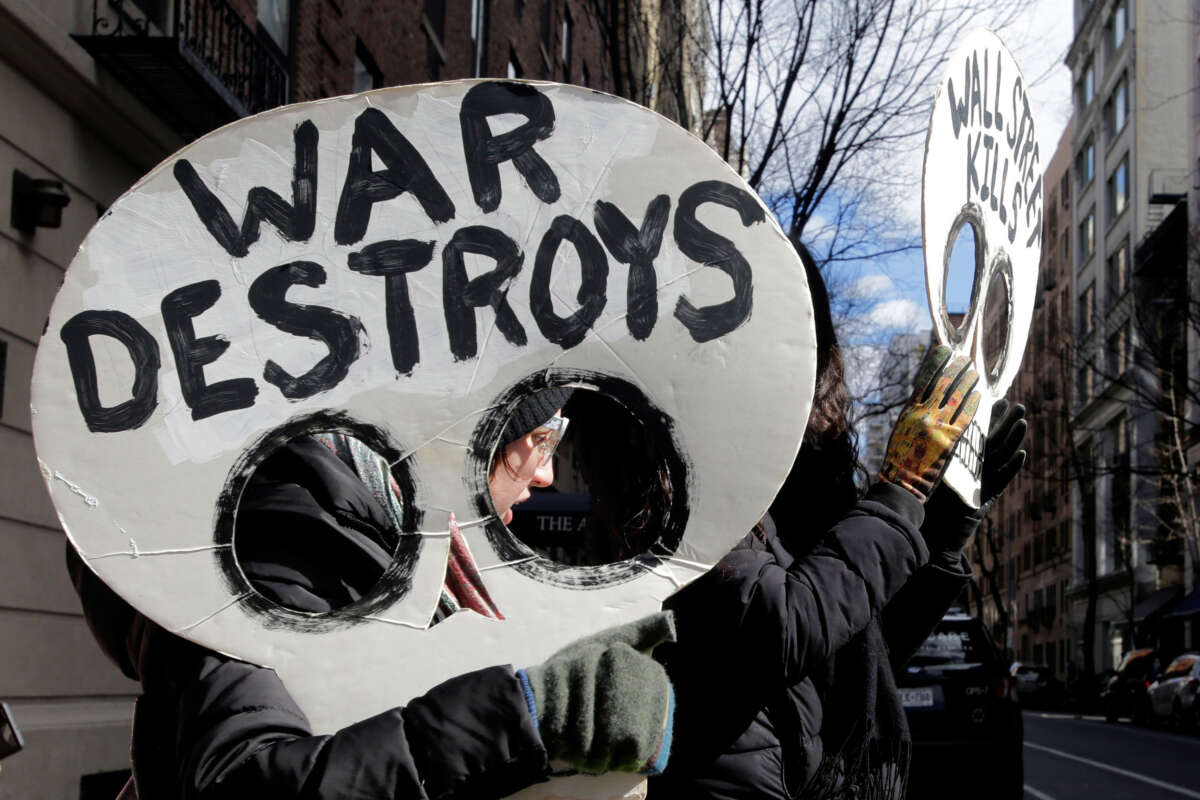
People hold an antiwar vigil on the 20th anniversary of the U.S. war in Iraq, on March 19, 2023, in New York City.Leonardo Munoz / VIEWpress

The outrages are raining down one after another: Trump’s suggestion that Ukraine is responsible for the war with Russia, which thus blames Ukraine for the deaths of its own people and implicitly supports Putin’s use of unrestrained military force. Trump’s proposal to forcefully relocate Palestinians from Gaza, which functions as an extension of ethnic cleansing. Trump’s exaggerated use of “invasion” to describe undocumented immigrants, which is a military term used to describe those “enemies” infiltrating a territory with the aim to conquer.

As news like this comes down, I often wonder just how far I am willing to go speaking against those power structures that are responsible for so much catastrophe, profound grief and actual and potential violent death.

Those power structures include what Martin Luther King Jr. called “the giant triplets of racism, extreme materialism and militarism.” It can be argued that those triplets constitute the raison d’être of the U.S. — the purpose for its existence.

Never miss another story

Get the news you want, delivered to your inbox every day.

Email*


Speaking out against the Vietnam War on April 4, 1967, King quickly became an unpopular figure. In fact, notes Brian Jones at Jacobin, “Opinion polls conducted just prior to King’s death one year later indicated that 72 percent of white people and 55 percent of black people disapproved of his opposition to Vietnam.” But King was convinced that it was time to speak out: “A time comes when silence is betrayal.

One fortifying source in our collective effort to speak out and resist the jingoistic nature of the U.S. is the courageous work of Norman Solomon, who is the national director of RootsAction and executive director of the Institute for Public Accuracy. His new book, War Made Invisible: How America Hides the Human Toll of Its Military Machine, demonstrates that the U.S. is driven by warmongering. Indeed, he writes, “The militarism that propels nonstop U.S. warfare is systemic.”

Related Story

There’s Much to Say About Economics of War, But Most Economists Won’t Address It
Traditional economics virtually ignores war, even though economic triggers directly contribute to conflicts. By C.J. Polychroniou , Truthout January 13, 2025


In this exclusive interview for Truthout, Solomon discusses the mainstream media silence around U.S. militarism. He articulates ways of resisting such silence, of rejecting denial. He provides deep insights regarding U.S. participation in Israel’s genocide in Gaza, reminding us that the U.S. is run by those who qualify as war criminals, and how the political economy and anti-democratic forces are linked to the U.S. being a war criminal system. Furthermore, Solomon links forms of racist othering and U.S. warfare. The interview that follows has been lightly edited for clarity and length.

George Yancy: In your book, War Made Invisible, I get the sense that many Americans would rather not know about the horrible atrocities that the U.S. has committed around the world via military violence. In what way are corporate media outlets in the U.S. (what you call “mainline American media”) responsible for maintaining many Americans’ willful ignorance regarding the ugly and dehumanizing realities of what happens in war?

Norman Solomon: Patterns of media silence and evasion are crucial. When empathy is very selective about victims of war, it’s easy to fall into the tacit assumption that some grief is profound and some is trivial — lives that really matter and lives that don’t. That’s usually implicit in what’s communicated from mainline U.S. media and even more routinely from U.S. government officials. They emphasize the humanity of some and ignore or downplay the humanity of others, and I do mean “others.” For Americans and for the society as a whole, the dynamic is deeply corrosive in realms that we might call moral, ethical, spiritual, political — and the results are foreign policy that serves the U.S.’s warfare state while relying on hypernationalism and what George Orwell called “doublethink.” Windows on the world are tinted red, white and blue.

The essence of propaganda is repetition, and it keeps reinforcing a kind of mass media wall. There are cracks in the wall — some exceptional journalism can happen in even the largest news outlets — but overall, the structural constraints are unyielding. So, in this century, fairly rigid taboos have prevented much candid reporting or commentary in major U.S. media about the horrors that the U.S. military has directly inflicted on a huge scale, in Afghanistan and Iraq, and elsewhere, as well as indirectly in many other places, including Yemen, Lebanon and Gaza.

When an official enemy of Washington is responsible for massive war atrocities, as with Russia in Ukraine, the U.S. media try hard to convey the horrors in human terms. But when Pentagon firepower is responsible, the empathetic coverage of its victims is ratcheted way down, if not nonexistent. And in medialand, if the perpetrators are at the top of the U.S. government, the narrative has victims without victimizers, just well-meaning American policy makers who sometimes make mistakes and miscalculate. In tandem with the nonstop flow of official pronouncements, a premise of mass media is that U.S. policies might be flawed at times but the impetus is basically to do good in the world.


When Pentagon firepower is responsible, the empathetic coverage of its victims is ratcheted way down, if not nonexistent.

In your book, you argue courageously about the necessity for changing mainline reporting in the United States. You point out how mainline reporting avoids telling the truth about the horrors of wars and how the U.S. explicitly engages in wanton violence. Furthermore, the U.S. military-industrial complex seems invested in perpetuating a narrative or a form of framing that “exculpates” it from charges of warmongering. Talk about the ways in which mainline reporting needs to be challenged.

The needed transformations are concentric: growing individual awareness, strengthening truly independent journalism, challenging corporate media outlets (as the media watchdog group FAIR does so well), freeing artistic expression from constraints of the profit motive, organizing for basic political change inside and outside electoral arenas, and developing mass movements against the corporate power that fuels the country’s runaway militarism along with countless destructive effects of neoliberal capitalism at home and abroad. In the process, I think it’s much healthier to shift away from emphasis on “speaking truth to power” and toward speaking truth about power. Realism about 24/7 class warfare is necessary for building vital capacities.

A straightforward look at U.S. military interventions in the last 80 years brings into focus clear pictures of methodical policies on several continents. And that means overcoming chronic avoidance. Few grow up comprehending that their government has been, and is being, run by people who qualify as war criminals. But that has been the case for many decades, not simply as a matter of individuals in power, but most importantly because of the political economy and the anti-democratic forces that are dominant. We could call it a war criminal system. Such understanding is at odds with acceptable discourse in mainstream media. One result can be cognitive dissonance. If people reject denial, they’re left facing inconvenient and often horrific truths — and, in the usual U.S. frameworks of media and politics, likely marginalization or excommunication for the sin of ethical realism. We need to expose these dynamics, bring them out into the open and confront them.

When finishing War Made Invisible, of course, I thought a lot about how to end the last chapter. I could do no better than quoting these words from James Baldwin: “Not everything that is faced can be changed; but nothing can be changed until it is faced.”

Speaking of warmongering, in my discussion with scholar Nurit Peled-Elhanan, she clearly points out how Israeli children are taught to perceive Palestinians/Arabs as “racially other,” as “primitive” and “disposable.” In War Made Invisible, you discuss how race (or racism) frames other human beings as “racialized enemies” within the context of war. As a philosopher who writes about race/racism, I am painfully aware of how this framing is used to “justify” the killing of human beings. Speak to how you understand anti-Palestinian or anti-Arab racism as a powerful and nefarious factor impacting the current and ongoing slaughter of innocent Palestinians by the State of Israel. I would be remiss not to mention that Martin Luther King Jr. spoke of the interrelationship between “the sickness of racism, excessive materialism and militarism.

It’s been chilling to see videos of Israeli children singing and waving Israeli flags at right-wing rallies for relentless war on Gaza while Palestinian children there are being bombed and starved along with their relatives. So many descriptive words come to mind: Racism. Ethnocentrism. Religious fanaticism. Spiritual rot. Fascistic cruelty. And parallel with the deadly hate is the nationalism of Israel that strives for Jewish supremacy and a warped sense of superiority over Arabs in general and Palestinians in particular. Meanwhile, in the United States, strong currents of such attitudes can be discerned in the claims of America’s Jewish Zionists, and the more numerous Christian Zionists for that matter. Twisted religious passions get tangled up in racist pathologies and belief in serving God by extinguishing the lives of those perceived to be obstructing the purity of holy agendas.


Few grow up comprehending that their government has been, and is being, run by people who qualify as war criminals. But that has been the case for many decades

Racial and religious toxins are constantly swirling around U.S. politics, as personal biases combine with functionality within the U.S. warfare state, which is tightly synced up with Israel’s military. Last year — even though polls showed that a majority of Americans opposed shipping weapons to Israel as long as its war in Gaza continued — Congress kept approving huge arms shipments to Israel while it went on with ethnic cleansing and genocide. The conformity that took hold was stark from the outset in October 2023, and there was a racial aspect. Here’s a telling fact: Two weeks after Israel’s siege of Gaza began, just 4 percent of the House of Representatives had signed on to a resolution calling for “an immediate de-escalation and ceasefire in Israel and occupied Palestine”; the sponsor and all 18 co-sponsors were legislators of color. The speed and intensity of their response stood out. As the war on Gaza continued, not a single white House member’s name went onto the resolution.

For almost a quarter of a century, the racial subtext embedded in the “war on terror” has been hidden in plain sight. Beginning with the invasion of Afghanistan in October 2001, virtually all the victims of Pentagon firepower have been people of color. Countries aren’t bombed because people of color are living there — but the fact that people of color are living there makes it easier to start and continue wars on them. While the liberal establishment is apt to concede that systemic racism is at work in a wide range of domestic institutions and policies, scarcely a word gets said about the systemic racism at work in foreign policy. Meanwhile, the powerful military of the Israeli apartheid state is a close partner with the Pentagon. When I was working on the afterword about the Gaza war for the paperback edition of War Made Invisible, I realized that the book’s subtitle directly applies: “How America Hides the Human Toll of Its Military Machine.” The Israeli military is a major adjunct to the U.S. military machine. The command structures are different and the national leaders might differ about tactics at times, but their missions and operations remain firmly aligned.

Clearly, it is in the interests of the U.S. to keep the human toll of war invisible. The invisibility helps to construct the U.S. (and I would also include the State of Israel here) as a “victim,” and as “innocent.” This narrative of “victimhood” and “innocence” also enables U.S. citizens to see themselves as far removed from being complicit with U.S. violence. Because I grapple with this question constantly, I want to pose it to you: How should U.S. citizens rethink their relationship to U.S. violence around the world? There is a remark that you make in your book where you’re discussing “the hellish realities in Gaza” and you state how this is “largely courtesy of U.S. taxpayers.” I am ethically consumed by this issue of complicity, my own complicity. How do you think about this?

Silence is complicity. Inaction is complicity. In the Middle East and elsewhere, people’s homes have been on fire, sometimes literally, courtesy of U.S. taxpayers and civic acquiescence. Much of the U.S.’s entire culture revolves around buying things and looking out for real or imagined self-interest. For sure, many Americans are preoccupied with their personal struggles, whether financial, health, family troubles, all kinds of distress. Yet to the extent we can be more aware of the very real forms of violence and deprivation that the U.S. government is causing to be inflicted in many parts of the world, we have opportunities to escalate nonviolent opposition to the actual roles of “our” government on this beautiful and tormented planet.

While it is hard to admit, Donald Trump is now at the helm of the U.S. and head of its military might — yet again. I disdain Trump’s ethical ineptitude, his fascistic tendencies and his indifference to truth-telling. I recall he once said that he would not take the nuclear option off the table regarding Europe and the Middle East. When I think about the fact that we are now 90 seconds to midnight on the Doomsday Clock, a Trump presidency ought to scare all of us. Or perhaps motivate us to resist the possible consequences of his administration. Any thoughts on Trump and war?

Instead of “crackpot realism,” we now have crackpot egotism in control of the executive and legislative branches. As bad as many of Joe Biden’s cabinet members were, comparing them to Trump’s cabinet ought to make clear the absurdity of claims we’ve heard over the years that there is no significant difference between the Democratic and Republican parties. Noam Chomsky was correct when he described the Republican Party as the most dangerous organization in human history. This doesn’t let “Genocide Joe” and the neoliberal Democrats off the hook for their horrendous crimes and terrible policies.

We need to acknowledge simultaneous truths. While militarists are running both parties, one of them is emphatically racist, misogynist, resolutely anti-democratic and determined to crush virtually every major facet of social progress since the New Deal. The Trumpist Republican Party is hellbent on dismantling the remaining elements of democracy in this country. Militarism thrives on the destruction of democracy, and vice versa. To what extent Trump will be a war president remains to be seen, but his political agenda is clearly fascistic. Our responsibilities include fighting against militarism, racism, sexism and predatory corporatism — along with all the intermeshed evils — while also fighting for a truly progressive future to nurture life instead of destroying life.


This article is licensed under Creative Commons (CC BY-NC-ND 4.0), and you are free to share and republish under the terms of the license.


George Yancy is the Samuel Candler Dobbs professor of philosophy at Emory University and a Montgomery fellow at Dartmouth College. He is also the University of Pennsylvania’s inaugural fellow in the Provost’s Distinguished Faculty Fellowship Program (2019-2020 academic year). He is the author, editor and co-editor of over 25 books, including Black Bodies, White Gazes; Look, A White; Backlash: What Happens When We Talk Honestly about Racism in America; and Across Black Spaces: Essays and Interviews from an American Philosopher published by Rowman & Littlefield in 2020. His most recent books include a collection of critical interviews entitled, Until Our Lungs Give Out: Conversations on Race, Justice, and the Future (Rowman & Littlefield, 2023), and a coedited book (with philosopher Bill Bywater) entitled, In Sheep’s Clothing: The Idolatry of White Christian Nationalism (Roman & Littlefield, 2024).
Hungary Bans LGBTQ Pride Events, Approves Facial Recognition to Track Attendees


Thousands protested the ban outside Hungary’s parliament, blocking traffic and defying police orders to disperse.
Truthout 
March 19, 2025

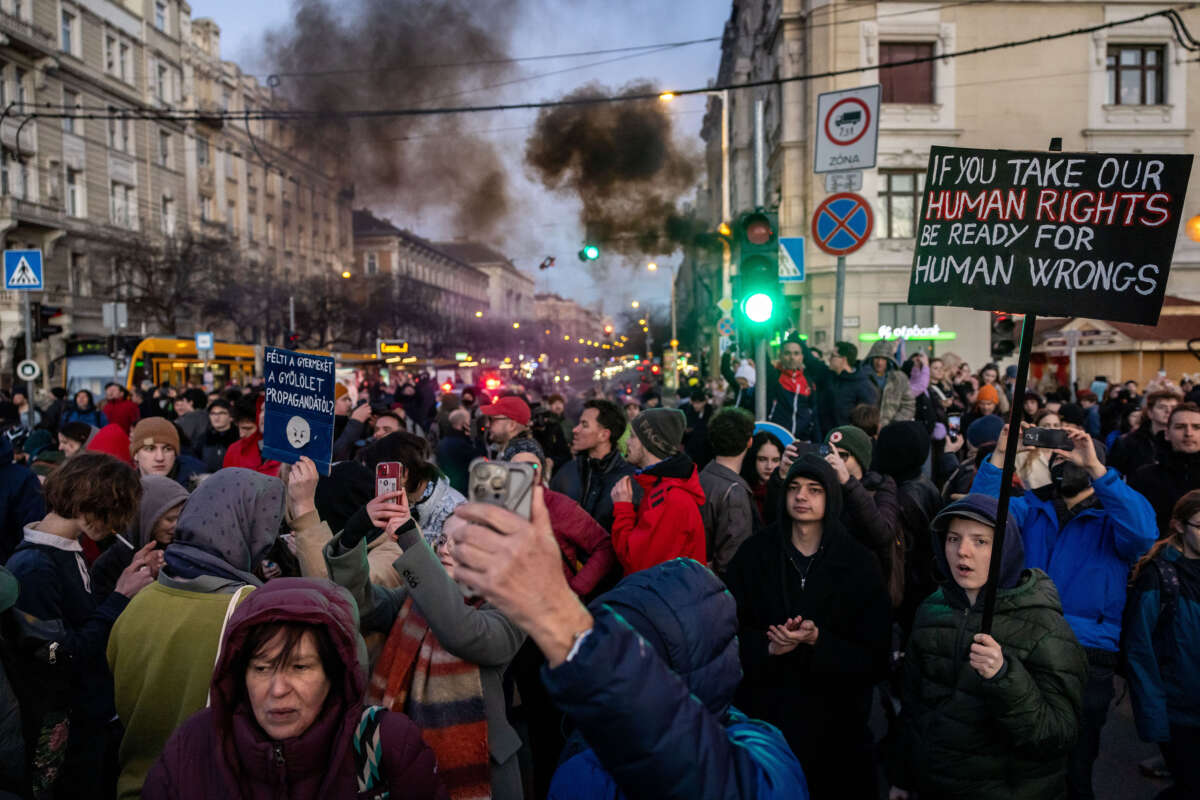
Demonstrators hold banners during a protest on March 18, 2025, in Budapest, Hungary.Janos Kummer / Getty Images


Truthout is a vital news source and a living history of political struggle. If you think our work is valuable, support us with a donation of any size.

Thousands of demonstrators filled the streets of Budapest after Hungarian President Tamas Sulyok approved a law prohibiting LGBTQ Pride events and authorizing the use of facial recognition technology to monitor attendees.

“This law is a full-frontal attack on the LGBTI community and a blatant violation of Hungary’s obligations to prohibit discrimination and guarantee freedom of expression and peaceful assembly,” Dávid Vig, director of Amnesty International Hungary, said in a statement.

According to Amnesty International, the law was introduced on March 17, rushed through Parliament without public consultation, and is set to take effect on April 15. Opposition lawmakers staged a dramatic protest in the legislature, releasing rainbow-colored smoke bombs, but the measure passed by a vote of 136 to 27.


“In targeting Budapest Pride, [Prime Minister Viktor] Orbán is both making a powerful statement about what kind of people he and his party think Hungarians (and all people) should be in terms of their gender and sexual expression, and making it much less possible for all Hungarians to express social and political dissent of any kind,” Hadley Renkin, a gender studies professor at Central European University, told Truthout.

The law amends Hungary’s Act on the Right of Assembly, criminalizing the organization of events and penalizing attendance at gatherings that violate the country’s “Propaganda Law,” which forbids the “depiction or promotion” of homosexuality to minors. LGBTQ advocates argue that far right politicians are exploiting concerns about minors’ safety as a pretext to target LGBTQ people.

Related Story

Growing Alliance Between Orbán, Trump and the US Far Right Is Very Disturbing
Viktor Orbán is isolated in Europe and needs a friend in the White House in order to fulfill his larger agenda. By Heather Digby Parton , Salon  March 11, 2024


“This is not child protection, this is fascism,” the Budapest Pride organizers said in a statement.

Under the law, people who participate in a banned Pride event could be identified by facial recognition software and face fines of up to 200,000 HUF (around 550 USD). Andrea Peto, gender studies professor at Central European University, explained to Truthout that this marks the first instance in which Hungary has approved facial recognition technology to track participants and impose fines.

Critics of the law warn that Hungary’s approach closely mirrors that of Russia, where in December 2022, President Vladimir Putin expanded the country’s ban on “propaganda of nontraditional sexual relations” to include adults, effectively criminalizing public support for LGBTQ rights.

“This isn’t a new form of power (or hate) at all, but it’s very clear that this kind of politics places the human body (and its gender, sexuality, race, class, etc.) and its surveillance and control at the center of the struggle for absolute power. And this is, in fact, one of — if not the most — iconic signs of true fascism,” Renkin said.

Renkin also highlighted how Trump’s recent attacks on civil liberties and transgender people in the U.S. may be emboldening far right leaders in Hungary and across the world. “Although this isn’t a surprise and was really pretty much expected, it’s clear that Orbán and people like him, and the anti-queer right wing not just in Hungary but throughout the world, has been greatly emboldened by Trump and everything he’s been doing,” Renkin told Truthout.


In response to the Pride ban, thousands of protesters gathered outside Hungary’s Parliament after the vote, chanting anti-government slogans. The demonstration later moved to the Margaret Bridge over the Danube River, where protesters blocked traffic and defied police orders to disperse.

“The attack on Pride is a nationalist, neo-conservative response to the crisis of the neoliberal global order, so it’s not just about LGBTQ people, it’s about everyone who is committed to human rights and democracy,” Peto told Truthout. “It is an attack on liberalism and therefore indirectly on democracy.”

Since returning to power in 2010, Orbán and his right-wing government has systematically eroded LGBTQ rights under its nationalist agenda. Early in his tenure, Hungary’s constitution was rewritten to consolidate power while restricting civil liberties. Marriage was defined strictly as “the union of a man and a woman,” excluding same-sex couples, and the definition of family was limited to heterosexual partnerships. In 2020, Hungary revoked legal recognition for transgender and intersex people, preventing them from changing their names or gender markers on official documents.

The following year, the government enacted a “propaganda law,” banning LGBTQ representation in educational materials and media accessible to minors. This led to censorship in schools, legal action against booksellers, and restrictions on LGBTQ content in television and media. Renkin notes that the Pride ban is an extension of this law and “is exactly what many of us feared when the media representation law was first passed — though the facial recognition provision is a new and frightening twist.”

Renkin and Peto told Truthout that this marks a dangerous escalation in Orbán’s attacks on civil liberties. “The right to assembly was changed and the parliament voted yesterday and the president approved today,” Peto emphasized. “The fact that the media is discussing Pride even [as] the Basic Law formerly known as Constitution is being amended to allow the introduction of ‘child protection’ for this ban is a good antiliberal political communication strategy.”

Despite the ban, Budapest Pride organizers have said that they plan to move forward with this year’s march on June 28.

“This law has a major impact on the LGBTQ people in Hungary and globally, as this is just the beginning,” Peto continued. “Hungary is a laboratory so if this law happens, the other countries will follow this example.”

“I think we should expect more of this, in Hungary and elsewhere,” Renkin added.