It’s possible that I shall make an ass of myself. But in that case one can always get out of it with a little dialectic. I have, of course, so worded my proposition as to be right either way (K.Marx, Letter to F.Engels on the Indian Mutiny)
Friday, March 21, 2025
Argentine Navy Rescues Chilean Supply Vessel off Antarctica
Last week, the Argentine Navy carried out a challenging rescue tow for a Chilean supply vessel that had lost power off Livingston Island, north of the Antarctic Peninsula.
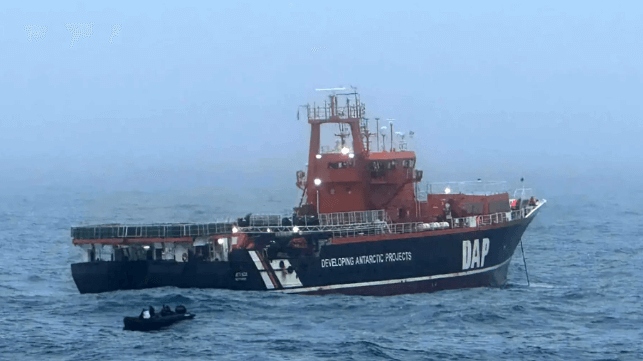
On March 13, the newly-established Maritime Rescue Coordination Center at Argentina's base on Dundee Island received a distress call from the Chilean supply vessel Betanzos, operated by logistics company DAP. The Betanzos had lost propulsion and gone adrift north of Livingston Island, in the notoriously rough Drake Passage. The Argentine Navy dispatched the icebreaker ARA Bahia Agradable to assist, and the Argentine vessel was on scene by the early hours of the next morning.
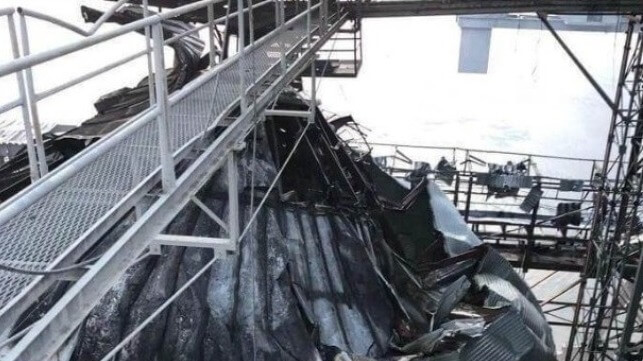
Courtesy Argentine Navy
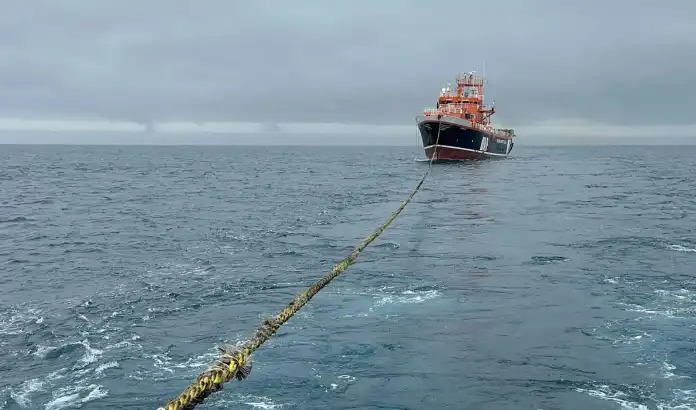
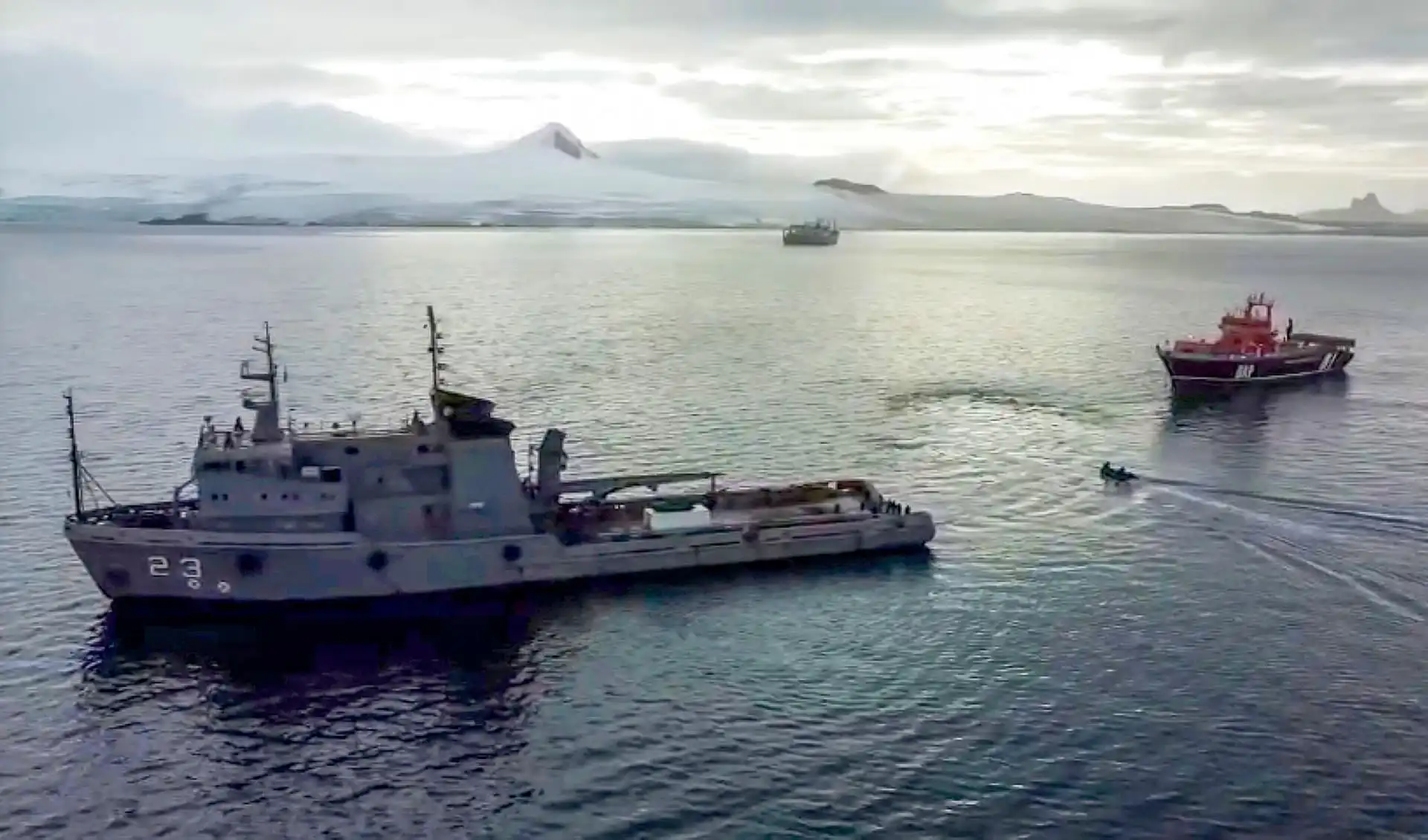
In difficult surface conditions, the Agradable approached Betanzos and rigged a tow. Over the course of 24 hours, Agradable towed the smaller vessel for 130 nautical miles, passing icebergs in low visibility conditions.
Betanzos was delivered safely to a sheltered anchorage in Discovery Bay, Greenwich Island; her 19 passengers were transferred to the Chilean base on King George Island, 30 nautical miles to the east, for a repatriation flight.
Agradable resumed her seasonal Antarctic patrol, part of Argentina's contribution to regional SAR duties and Antarctic base support.
NTSB: Maryland Highway Agency Failed to Prevent Baltimore Bridge Collapse
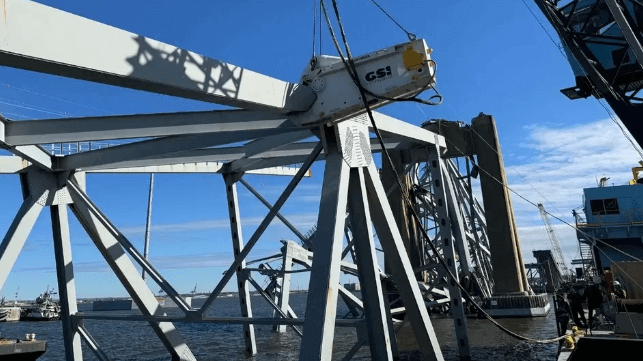
Salvors remove wreckage of the Francis Scott Key Bridge with hydraulic shears (USCG)
In a public briefing Thursday, the National Transportation Safety Board (NTSB) said that the Maryland Transportation Authority (MDTA) should have performed a standard engineering risk analysis on the Francis Scott Key Bridge, which collapsed in March 2024 after it was hit by the boxship Dali. The MDTA was on the national panel that came up with updated ship strike engineering standards in 1991, and it had three decades of well-informed advance notice to evaluate the Key Bridge, according to NTSB chair Jennifer Homendy.
MDTA couldn't even provide the underlying data to perform the analysis when NTSB asked, so NTSB worked with the National Highway Administration to gather the needed information and do the engineering work itself. NTSB's analysis found that the Francis Scott Key Bridge's risk of collapse from a ship strike was 30 times higher than recommended by existing federal guidance, and 15 times higher at the pier that the boxship Dali hit on March 26, 2024.
"We were very surprised that they were so high, almost 30 times greater than the threshold that AASHTO sets, and 15 times for pier 17 and pier 18. That was a surprise to all of us. But you know, it's something that MDTA could have known and should have known," Homendy said.
If MDTA had carried out the risk analysis anytime after 1991, the year that MDTA helped create the national standard, the state agency would have concluded that the bridge needed protection from a ship strike, Homendy said - and it could have prevented the collapse by making infrastructure improvements.
"There's no excuse," said Homendy.
She noted that as of late 2024, MDTA has still not performed the same risk analysis on the Chesapeake Bay Bridge, which was designed in the same era as the Francis Scott Key Bridge and experiences the same ship traffic, but at higher vessel speeds.
NTSB has issued an urgent recommendation to 30 bridge owners around the country to perform the standard ship strike risk analysis on 68 bridge spans, including both spans of the Chesapeake Bay Bridge.
"We are saying there is a safety deficiency here, a potential safety risk, and you need to take immediate action," said Homendy. "It shouldn't take an urgent safety recommendation to get action, and we expect that to be done now, and we'll follow up."
Maryland's transport agency had decades of advance notice. In addition to the 1991 AASHTO recommendation, which MDTA helped draft, a senior Maryland pilot raised concerns about the risk of an allision between a big ship and the Francis Scott Key Bridge at least as early as 2006 - and continued to discuss the matter in local safety meetings for years, according to detailed records uncovered by the Washington Post.
The documents also show that at the staff level, the Maryland Transportation Authority was aware that their bridge was "not designed to withstand collisions from large vessels," and that the cost of protecting it would be high.
In neighboring Delaware, a state agency has shown that safety upgrades are possible - and costly. Ten years ago, in 2015, Delaware's bridge transport authority set aside $2.5 million to design new protective dolphins for the Delaware Memorial Bridge to defend against ship strikes. The agency bundled the dolphin project into a large package of renovations, secured a permit from the Corps of Engineers, raised tolls on motorists, convinced two state governors to sign off on the cost, and issued bonds to raise funds. Construction started on the eight protective steel-and-rock dolphins last year, and should be done by the end of 2025.
NTSB will release its final report later this year, including the findings of its maritime investigative team on the factors aboard the Dali.
Hapag’s Earnings Outlook Sets Tone for Down Year in 2025
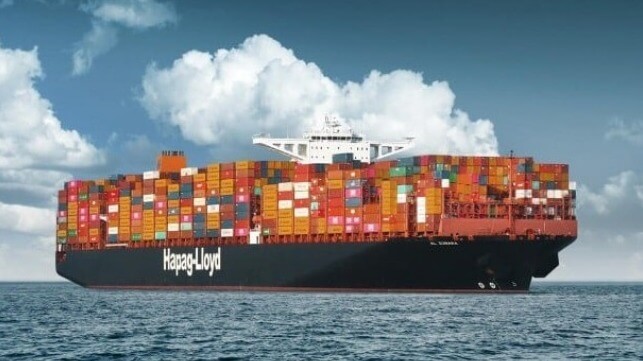
Hapag forecast declines in the financial results for 2025 (file photo)
Hapag-Lloyd reporting what it called “solid results” for 2024, outlined what it sees as another challenging year ahead. It became the latest of the major carriers to highlight the uncertainties and predict that the industry would continue to experience declines in profitability in the year ahead.
“We anticipate earnings in 2025 to be lower than in 2024,” CEO Rolf Habben Jansen told investors. “The economic and geopolitical environment remains fragile.” He highlighted a long list of challenges to the industry including an expectation that the outlook for U.S. economic growth is now reduced. Hapag was the first of the major carriers to discuss its outlook after Trump’s tariffs and trade war began.
Outlining the results for 2024, Jansen said they had been confronted with “a challenging market environment.” Container volumes however were up 4.7 percent to 12.5 million TEU while he said that freight rates overall remained stable for the year. As a result, Hapag reported revenues increased to just over $20 billion.
The carrier said that earnings increased slightly on an EBITDA basis to $5 billion, but the bottom line profitability was down versus 2024 to $2.6 billion. It sighted lower interest income, higher tax expenses, and higher transportation costs as it rerouted ships around the Cape of Good Hope. While the company remained strongly profitable, the board however is proposing a greater than 11 percent cut in its annual dividend reflecting the lower profitability.
Hapag’s results were largely in keeping with the other major carriers. Analysts at Sea-Intelligence yesterday forecast the sector would have total profitability on an EBIT basis of around $60 billion in 2024. That represents a significant decline from the peak of nearly $200 billion each in 2021 and 2022 according to the report.
“The 2024 level of profitability is still significantly higher than the pre-Covid years,” noted Alan Murphy, CEO of Sea-Intelligence. “In fact, the EBIT recorded in 2024-FY is higher than the combined EBIT of 2019, 2020, and 2023.”
Hapag pointed to its efforts to consolidate and expand its terminal business in 2024 and its efforts to further improve processes which it said would yield results in the future. While saying it would keep “a very close eye” on unit costs while focusing on increasing efficiency, Jansen pointed to the implementation of the Gemini network with Maersk and continued efforts to develop its terminal business in 2025.
Noting the “considerable uncertainty,” Hapag forecasted that earnings on an EBITDA basis would decline to a range between $2.5 to $4.0 billion. On an EBIT basis, Hapag predicts it will be between breakeven and $1.5 billion in 2025
Despite the forecasts for 2025, Hapag continues to have a longer-term positive outlook. Jansen highlighted that it has 24 new ships ordered and financed to be built in China. He noted it was the largest newbuilding program in the history of the company. With approximately 300 containerships and a capacity of 3.7 million TEU, Hapag-Lloyd also is operating the largest fleet in the history of the company.
UK Calls for Safety Rules, Training After Stevedores Die in Enclosed Space
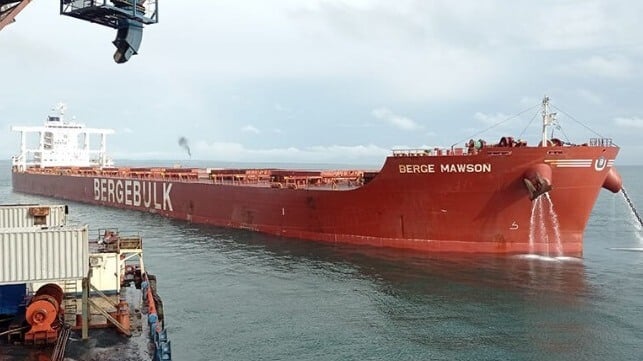
Accident happened aboard the dry bulk carrier Berge Mawson while it was anchored in Indonesia (Image courtesy of Komite Nasional Keselamatan Transportasi)
Nearly three years after an enclosed space incident that claimed the lives of three stevedores, the UK’s Marine Accident Investigation Branch issued a detailed report while calling for enhanced training and safety rules incorporating shoreside personnel into the efforts for enclosed space management. The recommendations take the unusual step of calling on the trade organizations to become involved in developing a minimum operational safety standard for stevedores conducting cargo operations aboard member vessels.
Despite international and industry guidance on the training stevedores should receive before working on bulk carriers, MAIB highlights InterManager data that shows of the 257 enclosed space fatalities reported between 1999 and 2023, 67 (26 percent) of which were stevedores or shore workers. It concludes after investigating the 2022 incident that training and drills for emergency scenarios need to include the possible presence of shoreside staff.
The report details an incident in June 2022 aboard the Berge Bulk dry bulk carrier Berge Mawson (181,000 dwt) built in 2015. The vessel was in the Bunyu Island anchorage in Indonesia loading coal from barges using a floating crane. Stevedores were leveling the coal in hatch no. 7 using a bulldozer but the operation was paused and all the hatches were closed due to heavy rain.
Once the rain stopped, MAIB believes one of the stevedores made several attempts to gain access to the bulldozer. It concludes that unsupervised the worker descended into the cargo hold no. 8 access space where he collapsed. While the Berge Mawson’s crew was getting its rescue equipment, two other stevedores attempted to rescue their colleague and they two collapsed.
“It is evident that the stevedores did not have a sufficient understanding of the hazards posed by coal cargos,” says Chief Inspector of Marine Accidents Andrew Moll. He also highlights that the shore personnel did not have training about the dangers associated with entering enclosed spaces and the crew aboard the ship did not prevent their access.
MAIB concludes that the oxygen was depleted in the area creating a noxious atmosphere. As a result, all three men died.
It lists a series of failures saying that the atmosphere was not routinely tested before stevedores entered a compartment. The stevedores were not adequately supervised and had not been trained on the dangers of enclosed spaces. Further, they were unable to understand the safety labels and warnings posted on the ship.
While it finds that the crew aboard the ship was trained, they were not trained for consideration of shoreside personnel working aboard the vessel and their safety drills did not involve scenarios with shore workers. As they rushed to get the safety equipment, the ship’s crew did not block or guard entry into the space.
“To help prevent further loss of life it is essential that bulk carrier and terminal operating procedures, practices, and training equip shore workers to operate safely on board the vessels,” writes MAIB.
The report recommends reviewing and revising the Code of Safe Working Practices maintained by the Maritime and Coastguard Agency. In addition to also making safety training recommendations to both the terminal operator and the shipping line, it is calling on Intercargo, InterManger, and RightShip to develop a minimum operating safety standard for stevedores conducting cargo operations on board their member’s vessels. It also says the trade groups should encourage members to introduce minimum operational safety standards for stevedores.
Report: Germany Moves to Seize Russian Oil Cargo from Detained Tanker
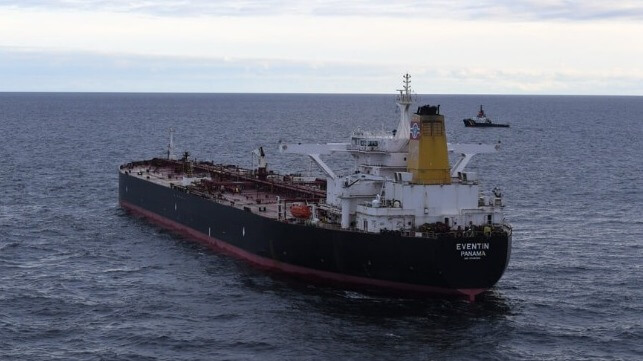
Two months after detaining the shadow fleet tanker German has decided to confiscate the Russian oil cargo (Havariekommando)
More than two months after the German authorities rescued a stranded tanker in the Baltic reports are that the government has decided to seize the vessel and its cargo. The German news outlet Der Spiegel reports the government will confiscate the shadow tanker and its cargo rather than let it go.
The customs authorities started the legal confiscation on March 14 reports Der Spiegel after the government and various ministries had discussed how to handle the laden tanker. According to the report, the government decided on the action as a demonstration to Russia and the shadow fleet after the European Union sanctioned the vessel in February 2025 for violations of the G7 price cap on Russian oil.
The tanker Eventin (152,000 dwt) is loaded with approximately 100,000 tons of crude oil valued at over $43 million. Der Spiegel says the authorities are now planning how and where to offload the oil and what should happen to the vessel.
Eventin drew international attention in January when German response authorities deployed multiple tugs to rescue the stranded vessel. It was said to have lost power and navigation and to have been drifting in the Baltic off the coast of Ruegen, Germany. The vessel was brought to an anchorage and that’s where the story began to unravel.
Built in 2006, it became clear that the tanker registered in Panama was part of the shadow fleet servicing the Russian oil trade. It had loaded in Ust-Luga departing on January 7 with a declared destination of the Suez Canal. Three days later the vessel was drifting in the Baltic.
A review of its documentation showed it has been owned by the mysterious Laliya Shipping since May 2024 with no known address. The vessel was being managed out of Dubai. Reports link the tanker to Fractal Marine DMCC, the Dubai-based tanker firm also involved in the Russian trade.
Within days, the captain of the vessel reportedly filed for permission to depart Germany after the Federal Ministry of Transport was informed the engine had been repaired. The ministry however said that it was detaining the tanker and inspecting the vessel’s documentation. It also sent a sample of the oil for testing.
Russian officials told Reuters today that they have no knowledge of the vessel and its ownership. Der Spiegel reports that the state government in Germany is anxious to be rid of the ship and encouraging the federal government to act quickly.
Argentine Navy Rescues Chilean Supply Vessel off Antarctica
Last week, the Argentine Navy carried out a challenging rescue tow for a Chilean supply vessel that had lost power off Livingston Island, north of the Antarctic Peninsula.
On March 13, the newly-established Maritime Rescue Coordination Center at Argentina's base on Dundee Island received a distress call from the Chilean supply vessel Betanzos, operated by logistics company DAP. The Betanzos had lost propulsion and gone adrift north of Livingston Island, in the notoriously rough Drake Passage. The Argentine Navy dispatched the icebreaker ARA Bahia Agradable to assist, and the Argentine vessel was on scene by the early hours of the next morning.
Courtesy Argentine Navy
In difficult surface conditions, the Agradable approached Betanzos and rigged a tow. Over the course of 24 hours, Agradable towed the smaller vessel for 130 nautical miles, passing icebergs in low visibility conditions.
Betanzos was delivered safely to a sheltered anchorage in Discovery Bay, Greenwich Island; her 19 passengers were transferred to the Chilean base on King George Island, 30 nautical miles to the east, for a repatriation flight.
Agradable resumed her seasonal Antarctic patrol, part of Argentina's contribution to regional SAR duties and Antarctic base support.
NGOs Try to Recover Funds from Bolloré Logistics Sale, Alleging Corruption
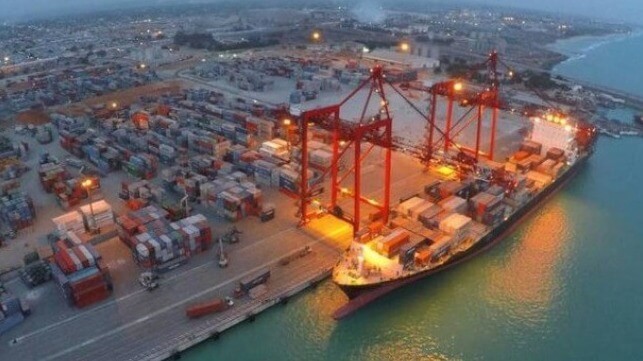
The former Bollore terminal at Lome, Togo, now owned by MSC (Bollore Group)
France's Bolloré Group has been dogged by allegations of corruption in its African ports division for more than a decade, and even the unit's sale in 2022 has not stopped the controversy. A collective of 11 NGOs from West Africa have filed a complaint with the French National Financial Prosecutor's Office, demanding that Bolloré pay restitution for alleged corrupt practices that secured allegedly noncompetitive concession terms for the company's port operations.
Bolloré Africa Logistics - now known as AGL - got its start in the 1920s and grew into a ports empire across West and Central Africa. Bolloré Group sold the division to MSC for $6 billion in late 2022, and MSC retained the unit's separate identity and kept its longtime president at the helm. At the time of the sale, Bolloré had built up a presence in 47 countries with 16 container terminals, seven ro/ro terminals and two wood terminals, and it had 21,000 employees across the continent.
Along the way, Bolloré Group racked up complaints for allegedly corrupt dealings in West Africa. In 2018, French authorities put then-president Vincent Bolloré under investigation for allegedly using his media empire to help the election campaigns of leaders of Guinea and Togo, providing them with advertising at below-market rates in 2010. These politicians later granted lucrative container terminal concessions to Bolloré Logistics at Conakry, Guinea and Lome, Togo, respectively. Bolloré Group settled the matter with French authorities in a 2021 plea agreement and paid a fine.
On Wednesday, a coalition of African NGOs from Togo, Guinea, Ghana, Ivory Coast and Cameroon accused Vincent Bolloré, his son Cyrille Bolloré, and Bolloré Group of securing the right to operate ports in the region illegally, then later profiting from these arrangements by selling the business to MSC. The accusations relate to the Togo and Guinea cases, but also to activities at Tema, Ghana; Abidjan, Ivory Coast; and Douala and Kribi, Cameroon. The coalition - “Restitution for Africa” (RAF) - accused Bolloré of money laundering and fraud, and called for a full criminal prosecution.
"The continued ownership and operation of these assets until 2022 constitutes the offense of receiving stolen goods, which punishes the possession, use, or profit derived from fraudulent property," RAF argued in its complaint.
RAF hopes to leverage a recently-enacted French law that allows the assets recovered from foreign corruption investigations to be returned to the countries affected, for use in economic development projects.
Next Ukraine Ceasefire Talks Will Focus on Black Sea Shipping
Damage to a Ukrainian grain silo near Odesa after a Russian missile strike, 2023 (Operational Command South)
When talks on the possibility of a ceasefire in Ukraine resume on Monday, the safety of Black Sea navigation will be on the agenda, according to both Ukraine and Russia.
On Monday, U.S. officials will be meeting with a Ukrainian delegation in Riyadh, then separately with a Russian delegation. Ukrainian President Volodymyr Zelensky told media on Thursday to expect "some shuttle diplomacy" as the Trump administration attempts to negotiate a maritime ceasefire deal.
Yuri Ushakov, aide to Russian President Vladimir Putin, said that the talks would include a discussion of the safety of shipping in the Black Sea. A conversation about sponsoring a safe navigation corridor began during Tuesday's phone call between Putin and Trump, according to Kremlin spokesman Dmitry Peskov.
"There're a lot of nuances there, which need to be discussed. Hence, [negotiations would be necessary] to discuss these nuances, among other things," Peskov told Interfax.
Russian attacks on merchant vessels in Odesa have recently resumed after a long lull; despite Ukraine's success in deterring the Russian Black Sea Fleet with drone and missile strikes, the Odesa port complex remains in range of Russian ballistic missile attacks.
The most recent strike occurred last week, and reportedly claimed the lives of four seafarers aboard a Greek-managed bulker loading grain at Odesa. Three of the dead were foreign nationals. Two other individuals were injured, including one seafarer and one port employee.
A Black Sea ceasefire has been attempted before. In July 2022, Russia, Ukraine and Turkey negotiated a "Black Sea Grain Initiative" that would pause Russian strikes on Ukrainian bulk food shipping, so long as all parties could inspect all Ukraine-bound ships. Russia repeatedly threatened to abandon the deal, and Russian officials slowed the inspection process to a near-halt, according to the unified command responsible for implementation. In July 2023 the Kremlin walked away from the arrangement, blaming the West for banking sanctions that allegedly made it hard to export Russian fertilizer. Ukraine implemented its own safe navigation corridor by force, sinking or damaging more than a dozen Russian warships and driving the remainder to the safety of the sea's northeastern corner.
Trump mutes Voice of America, makes space for Russian and Chinese influence
US President Donald Trump last week cut funding for international public radio stations Voice of America and Radio Free Europe, which broadcast programmes aligned with “democratic values” to millions of listeners around the world. In their absence, Russia and China are now set to fill the gap with their own state media offerings.
The decision was met with dismay in Europe and delight in Beijing, Moscow and Tehran. Trump on March 14 decided to cut funding for the US Agency for Global Media (USAGM) – home to international radio stations Voice of America (VOA) and Radio Free Europe/Radio Liberty (RFE/RL).
Hundreds of staff members – categorised as “radical left crazy people” by Trump ally and advisor Elon Musk – were placed on leave at the decades-old media outlets which, together, broadcast in more than 60 languages to 420 million listeners in more than 100 countries.
They are among “the few credible sources in dictatorships like Iran, Belarus, and Afghanistan", said Czech Foreign Minister Jan Lipavsky at a meeting in Brussels on Monday as he urged EU leaders to stump up funds to save RFE/RL.
But in Russia, China and Iran, media outlets celebrated the news. “This is an awesome decision by Trump!” said Margarita Simonyan, editor of Russia’s RT network. “We couldn’t shut them down, unfortunately, but America did so itself."
The Kremlin did not comment but current and former Russian officials told independent media outlet The Moscow Times that it was glad to see the outlets go.
In recent years, the Kremlin was “especially irritated” by RFE/RL’s attempts to undermine “the wartime censorship Moscow imposed after the full-scale invasion of Ukraine” in Russia and former Soviet countries, the news outlet said.
An editorial in China’s Global Times branded VOA a “lie factory” that was “widely recognised as Washington's carefully crafted propaganda machine”.
“When it comes to China-related reporting, VOA has an appalling track record,” it said, criticising its coverage of China’s treatment of the Uighurs, tensions in the South China Sea and Beijing’s economic difficulties.
In Iran, some media outlets said Trump had put a stop to “wasting money” to pay “corrupt” journalists who wanted to overthrow Tehran’s regime. Soft power
Silencing VOA and RFE/RL “is not just like any other news organisation closing”, says Martin Scott, professor of media and global development at the University of East Anglia in the UK.
Both organisations are symbolic of the US itself, and its position in the world order, Scott adds. “They are an expression of US values in relation to press freedom and democracy."
VOA was founded in 1942 to promote democratic ideas in Nazi Germany, including sharing content like American music programs as a form of cultural diplomacy. During the Cold War, RFE began broadcasting to Soviet satellite states while its sister station RL focused on the Soviet Union.
VOA, especially, is “a soft power tool that has been used since the Second World War”, says Jack Thompson, a lecturer in the American studies department at the University of Amsterdam. “It has been part of US foreign policy for the entire post-World War II era."
Its success in building global reach was due, in part, to its annual budget of $267.5 million – a large sum compared with other public service international broadcasters.
“Voice of America had the means and the scale,” says Scott. “It was effective because of its massive reach in so many different languages to so many hard-to-reach precarious parts of the world.”
Both radio stations had undeniably political aims. “Their entire job was to highlight aspects of regimes that are run counter to what you might call liberal democratic values," Thompson says.
The impact of their loss will be “enormous”, Alsu Kurmasheva a Radio Free Europe journalist who was freed from detention in Russian as part of a prisoner exchange in August 2023, told CNN. “How is America going to tell its story?” A ‘democratic disaster’
Why would Trump want to silence pro-US media? Their government-funded but independent stance goes against the project 2025 plan to reshape the US federal government put forward by conservative think tank the Heritage Foundation and endorsed by members of the Trump administration.
“The idea is that the president is the sole repository of all democratic authority, and there should not be democratic checks and balances against him – including independent federal agencies like the USAGM," says Kate Wright, senior lecturer in media and communications at the University of Edinburgh and co-author with Martin Scott of "Capturing News, Capturing Democracy: Trump and the Voice of America".
The president has attacked the USAGM since his first term and has been spurred on by new advisor Musk, who is in charge of overseeing sweeping government cuts.
Musk “is one of the first people that started saying the US needed to get rid of Voice of America", says Thompson, “in part because he is an economic libertarian and he wants to dramatically shrink the size of the US government, and in part because he and a lot of others on the right viewed VOA and FRE/RL as essentially being captured by extreme left-wingers. They thought that too much of their content was woke.”
But as the US decreases its media footprint, it risks ceding influence to other global powers. Around the world, “authoritarian countries are pushing more and more money into international media networks”, says Wright. “Media is the first and most consistent target for would-be autocrats.”
Amid a global wave of democratic backsliding, she says “the decision to withdraw a course of credible and independent journalism is a democratic disaster".
If sources such as Voice of America disappear, their vast audiences will not stop seeking out news – they will get it from the few alternative sources they have available to them. “Often all you're left with is news and information that is perhaps unreliable, untrustworthy, or not independent," says Scott.
American think tank the Lowry Institute found that in Asia in 2024, VOA was the number one ranked foreign media radio broadcaster by a considerable margin. But in second place was Russia’s Sputnik.
The average listener may not be able to distinguish much difference between the two says Thompson, meaning that if one becomes unavailable, “they will get their information from another source. And if the next best source is Sputnik, then they are going to get their information from Sputnik."
“There can’t be empty space in media,” adds Kurmasheva. Without organisations like RFE/RL, she says, “Russian and Chines propaganda will fill [the gaps]."
She hopes her organisation will find a way to survive with its values intact. “We are still in business. Nobody quit. Nobody resigned. Our leadership is working on it and we hope we will stay in business one way or another,” she said.
But the Trump administration may have other plans for its diminished global networks. “It may be that their intention is to replace these journalists with perhaps more compliant journalists,” says Wright, “or to create a new network, which perhaps would not be bound by the sort of legal restrictions that protects Voice of America from political interference. We can't assume this is the end of the road.”
Tunisia's national guard rescued 612 migrants and recovered 18 bodies off its Mediterranean coast, following multiple boat capsizings in the Sfax region. The rescued people, all from sub-Saharan African countries and including women and children, were attempting to reach Europe.
Tunisia's national guard said on Monday its forces had rescued 612 migrants and recovered the bodies of 18 others in several operations overnight off the country's Mediterranean coast.
Sharing images of some of those rescued, including women and children, after their boats capsized, the force said they were all migrants from sub-Saharan African countries attempting to cross the sea to Europe.
The survivors were rescued in several operations in the Sfax region to the east of the centre of the country after their boats capsized or broke down, according to the national guard.
Exhausted people including women and children, some of whom appear to be dead, can be seen in the images. Some are pictured clinging on to large buoys.

 President Donald Trump signed an executive order reducing the scope the US Agency for Global Media, which oversees Voice of America, as part of his campaign to downsize the US government. © Algi Febri Sugita, ZUMA Press Wire via Reuters

