Friday, March 21, 2025


Venterra UXO Team Highlights Safety Risk Amid Paris WW2 Bomb Incident
Venterra Group

Published Mar 20, 2025 12:43 PM by The Maritime Executive


[By: Venterra Group]

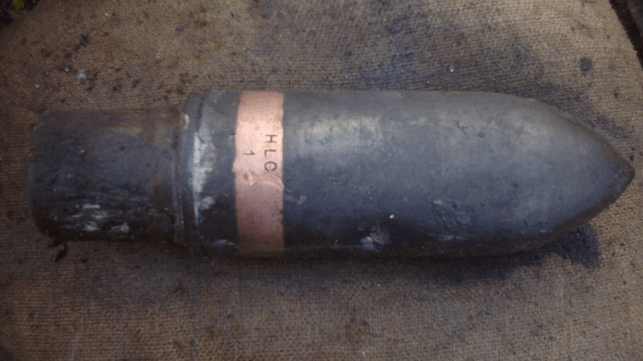
The discovery last week of a World War II bomb near Paris' busy Gare du Nord train station, which caused significant disruptions to rail services including Eurostar, highlights the persistent dangers of unexploded ordinance (UXO) not only on land but critically beneath our seas. Venterra's UXO team, with its industry-leading technical expertise and vast data resources, highlights the essential role of UXO mitigation in the rapidly expanding offshore wind industry.

The Paris incident is a stark reminder of the hidden legacy of past conflicts. However, the scale of UXO risks offshore is equally daunting. An estimated 500,000 items, equating to 100,000 tonnes of UXO, lie on the seabed surrounding Great Britain alone. For the offshore wind sector, these hidden dangers present significant challenges that could disrupt surveying operations, cause costly delays, damage equipment and threaten the life & safety of those operating offshore.

"While land-based UXO incidents are concerning, they pale in comparison to the sheer volume of unexploded ordnance in our seas," said Richard Pike, Director of Venterra Geoscience. "Our dedicated UXO team, comprising former military specialists with decades of experience, provides critical advisory services to many of the largest offshore wind projects around the globe. From site assessments and geophysical surveys to meticulous cable route planning, we ensure safety and efficiency by reducing UXO risks to As Low As Reasonably Practicable (ALARP) levels."

A cornerstone of Venterra's approach is its proprietary database, The Vault 2.0. Developed over the last 15 years, this invaluable tool represents a multimillion-pound investment in UXO data collation. It contains thousands of primary historical sources, including mine maps from both World Wars, ship logs, handwritten air raid reports, and bespoke UXO desktop studies. These
resources have been painstakingly gathered by Venterra's dedicated team of UXO data archivists and military historians, who continuously seek new information from national and local archives, libraries, armed forces, and museums worldwide.

"Our commitment to data quality and investment in The Vault 2.0 gives us a unique edge," added Keith Higgins Venterra UXO advisor. "It enables our team to offer clients unparalleled and up-to-date insights, helping them make not only informed but quicker decisions that keep their projects on track and their teams safe."

As the offshore wind industry pushes forward with ambitious development goals, Venterra Geoscience continues to lead the way in UXO risk management, delivering safe and sustainable outcomes for renewable energy projects worldwide.

For more information about Venterra Geoscience and its UXO risk management services, please visit www.venterra-group.com.

The products and services herein described in this press release are not endorsed by The Maritime Executive.

 

NGOs Try to Recover Funds from Bolloré Logistics Sale, Alleging Corruption

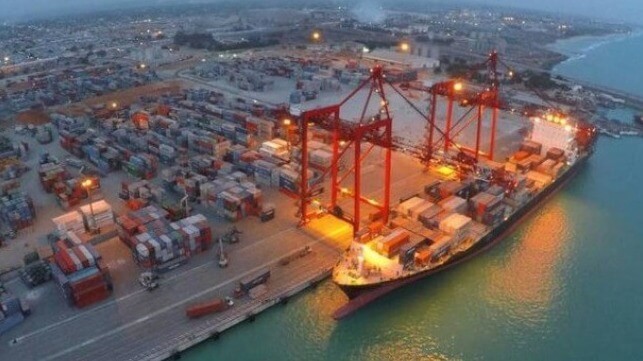
The former Bollore terminal at Lome, Togo, now part of MSC (Bollore Group)
The former Bollore terminal at Lome, Togo, now owned by MSC (Bollore Group)

Published Mar 20, 2025 10:40 PM by The Maritime Executive


France's Bolloré Group has been dogged by allegations of corruption in its African ports division for more than a decade, and even the unit's sale in 2022 has not stopped the controversy. A collective of 11 NGOs from West Africa have filed a complaint with the French National Financial Prosecutor's Office, demanding that Bolloré pay restitution for alleged corrupt practices that secured allegedly noncompetitive concession terms for the company's port operations. 

Bolloré Africa Logistics - now known as AGL - got its start in the 1920s and grew into a ports empire across West and Central Africa. Bolloré Group sold the division to MSC for $6 billion in late 2022, and MSC retained the unit's separate identity and kept its longtime president at the helm. At the time of the sale, Bolloré had built up a presence in 47 countries with 16 container terminals, seven ro/ro terminals and two wood terminals, and it had 21,000 employees across the continent.

Along the way, Bolloré Group racked up complaints for allegedly corrupt dealings in West Africa. In 2018, French authorities put then-president Vincent Bolloré under investigation for allegedly using his media empire to help the election campaigns of leaders of Guinea and Togo, providing them with advertising at below-market rates in 2010. These politicians later granted lucrative container terminal concessions to Bolloré Logistics at Conakry, Guinea and Lome, Togo, respectively. Bolloré Group settled the matter with French authorities in a 2021 plea agreement and paid a fine.

On Wednesday, a coalition of African NGOs from Togo, Guinea, Ghana, Ivory Coast and Cameroon accused Vincent Bolloré, his son Cyrille Bolloré, and Bolloré Group of securing the right to operate ports in the region illegally, then later profiting from these arrangements by selling the business to MSC. The accusations relate to the Togo and Guinea cases, but also to activities at Tema, Ghana; Abidjan, Ivory Coast; and Douala and Kribi, Cameroon. The coalition - “Restitution for Africa” (RAF) - accused Bolloré of money laundering and fraud, and called for a full criminal prosecution.  

"The continued ownership and operation of these assets until 2022 constitutes the offense of receiving stolen goods, which punishes the possession, use, or profit derived from fraudulent property," RAF argued in its complaint. 

RAF hopes to leverage a recently-enacted French law that allows the assets recovered from foreign corruption investigations to be returned to the countries affected, for use in economic development projects. 


Trump Threatens Houthis With "Annihilation"

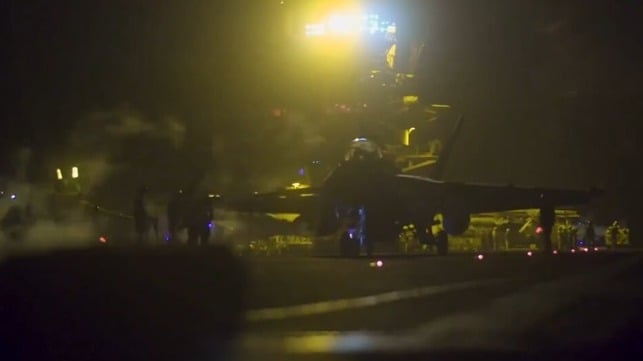
Crew of the carrier USS Harry S. Truman launch another round of airstrikes on Houthi positions, March 19 (USN)

Published Mar 19, 2025 9:02 PM by The Maritime Executive


U.S. forces continued airstrikes on Houthi positions in Yemen for the fifth day on Wednesday, hitting targets in Sanaa and al-Bayda, according to Houthi media. The strikes followed one day after Houthi forces launched a ballistic missile at Israel; the attempt was not successful, and the missile was shot down by Israeli air defenses. 

In a statement on his social media platform, U.S. President Donald Trump threatened the Houthis with destruction if they did not cease attacks on international shipping. 

"Tremendous damage has been inflicted upon the Houthi barbarians, and watch how it will get progressively worse — it’s not even a fair fight, and never will be," Trump said. "They will be completely annihilated!"

He added that the U.S. believes that Iran has ceased sending major weapons systems to the terrorist group, but continues to send "supplies" - unacceptable to the Trump administration.

"Iran must stop the sending of these supplies immediately," he said. "Let the Houthis fight it out themselves. Either way they lose, but this way they lose quickly."

Houthi leaders claimed that they shot down another U.S. Air Force MQ-9 drone over Yemen, and threatened to continue attacks on U.S. interests. 

"[Houthi forces] will escalate their military operations against the Zionist enemy unless the brutal aggression on Gaza stops and the blockade is lifted," Houthi leadership said in a statement on Tuesday.

The U.S. Navy says that Houthi forces have yet to hit an American warship after more than a year of drone and missile engagements in the Red Sea and Gulf of Aden. However, the service's successful defense has come at a high cost in the form of expensive, hard-to-replace Standard Missiles, used to shoot down Houthi threats at long range. The U.S. Air Force has adapted the use of a small laser-guided rocket munition - developed for counterterror/counterinsurgency airstrikes - to destroy Houthi drones more economically, U.S. Central Command announced Wednesday.   


Iraqi Navy Arrests Captain and Crew of Fuel-Smuggling Vessel

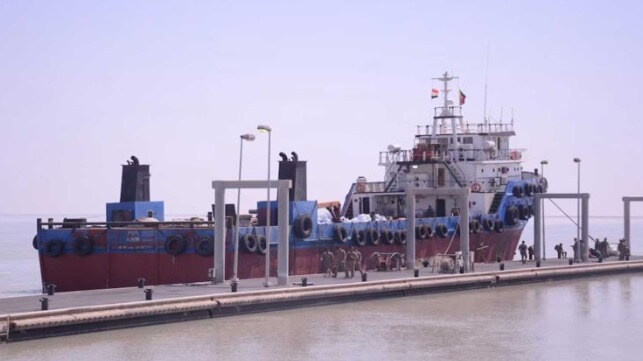
Fuel smuggling vessel
Courtesy Iraqi Navy

Published Mar 19, 2025 9:41 PM by The Maritime Executive


Iraq's navy has announced the rare arrest of a foreign vessel on fuel-smuggling charges, the first such public statement in recent years. 

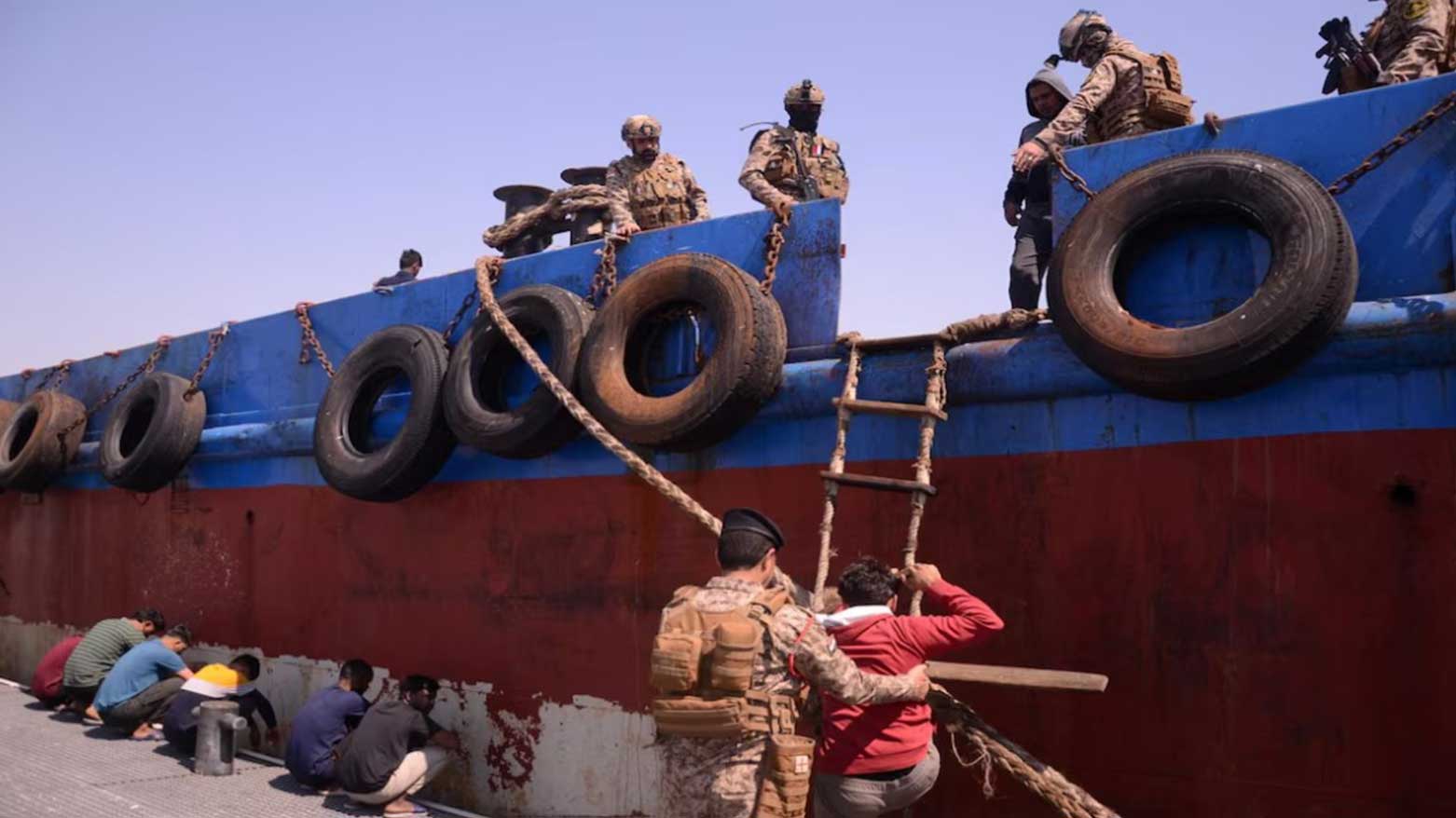
The Iraqi Navy said that the vessel seized on Tuesday was arrested near the Basra petroleum port complex by the Iraqi Navy’s 1st Marine Battalion. Based on images provided by the service, the unnamed vessel was an older OSV, not a tanker, indicating a small-scale smuggling operation. It appeared to be flying the colors of the Iranian flag; the master was Iranian, and the rest of the crew were Iraqi and Indian nationals. 

The custody of the crew has been transferred to civilian authorities for further investigation, and the vessel has been towed to the naval base at Umm Qasr. 

Courtesy Iraqi Navy

The source of the fuel was not disclosed, but illicit smuggling networks siphon government-subsidized diesel and gasoline out of Iran in substantial quantities, paying pennies on the dollar domestically and receiving far higher black-market prices in neighboring countries. Most of this illegal trade crosses Iran's land borders, but a portion of the illicit exports leave Iran by ship - typically aboard aging coastal tankers and other small vessels ill-suited for large-scale foreign trade. Iran's security forces routinely intercept these vessels in and around the Strait of Hormuz, but rarely are the smuggling vessels arrested in a destination market like Iraq. 


Trump Sanctions First Chinese Refinery and Tankers in Iranian Oil Trade

Sanctioned Chinese oil refinery
U.S. designated its first Chinese "teapot" refinery as part of the campaign of maximum pressure on Iran (Chinese media)

Published Mar 20, 2025 12:47 PM by The Maritime Executive


The U.S. State Department and Treasury working concurrently launched the next round of sanctions targeting Iran’s oil trade. In addition to listing additional tankers and their operators, the U.S. made its first designation of a so-called “teapot refinery” in China as well as the operator of a Chinese oil terminal for buying and storing Iranian crude oil from sanctioned vessels.

“Teapot” refiners according to the U.S. Department of State are private Chinese refineries that are the primary purchasers of Iranian oil.  It noted that China is by far the largest importer of Iranian oil saying that these sanctions are “being imposed pursuant to President Trump’s maximum pressure campaign to drive Iran’s oil exports, including to China, to zero.”

The U.S. asserted that Shandong Shouguang Luqing Petrochemical Co. in Shandong Province, China was identified in mid-2022 as a buyer of Iranian oil associated with the Iranian military and Iranian military forces. 

It reports that Luqing Petrochemical has purchased millions of barrels of Iranian oil worth approximately half a billion dollars. The oil was transported by shadow fleet vessels, some of which have been sanctioned for their role in transporting Iranian petroleum linked to the Houthis. It specifically identified the tankers Mehle (Panama flag) and Kohana (renamed Limas and sailing under the flag of Guyana) which were sanctioned by the Biden administration in January 2024 as transporting oil to the refinery.

The U.S. Department of State today also designated Huaying Huizhou Daya Bay Petrochemical Terminal Storage, an oil terminal in China. It is reported to be buying and storing Iranian crude oil from a sanctioned vessel.

The tanker listing was expanded with eight more vessels that the U.S. reports are transporting Iranian oil to teapot refineries and usually engaging in deceptive shipping practices, including automatic identification system (AIS) manipulation. The Office of Foreign Assets Control (OFAC) sanctioning the vessels Natalina 7 (Comoros-flagged), Catalina 7, Aurora Riley and Viola (each Panama-flagged), Montrose (San Marino-flagged), Volans and Brava Lake (each Barbados-flagged), and Titan (currently unflagged).

The U.S. is linking some of the oil transactions to supplying funds to the Houthi militants in Yemen that are backed by Iran. Other transactions are reported to have funded the Iranian Ministry of Defense of Armed Forces Logistics (MODAFL).

OFAC in total imposed sanctions on 19 entities and vessels. It also included shipping companies and operators incorporated in Hong Kong, Liberia, China, the Seychelles, Panama, and the British Virgin Islands.

Trump issued a National Security Presidential Memorandum 2 on February 4 ordering a campaign of maximum pressure on Iran. Since then, the State Department has announced sanctions on networks funding Iran, oil traders, tankers, and Iran’s recently appointed Oil Minister. Over the weekend, Trump also launched a new bombing campaign against the Houthis citing their 2024 attacks against merchant shipping.


Colombian Drug Gang Bribed Navy Staff to Place GPS Devices on Navy Ships

Colombian patrol boat
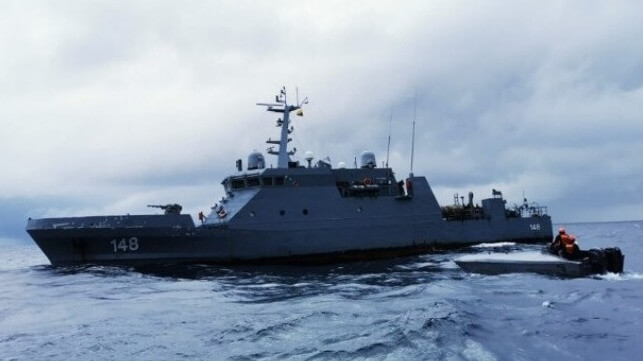
Patrol boat Punta Espalda (seen during 2021 interdiction) was one of the vessels reportedly tracked with a hidden GPS device (Armada de Nacional)

Published Mar 20, 2025 2:32 PM by The Maritime Executive


The indictment of two former employees of the Colombian Navy has revealed an elaborate plot by one of the country’s most notorious drug gangs to use GPS devices to evade capture by Colombian warships. The details of the effort showing the depths of the efforts by the drug gang are contained in a new indictment filed by the U.S. Attorney’s Office in Florida.

The U.S. extradited two former employees of Colombia’s Armada Nacional to Florida to stand trial for a conspiracy to distribute cocaine. The U.S. contends there is “reasonable cause to believe” the cocaine would have been illegally imported into the United States.

According to the indictment and news reports in Colombia, Alberto Alvarez Valenzuela, age 54, worked for Armada Nacional as a civil electromechanical engineer at a base in Uraba, Colombia until he retired in 2022. Luis Carlos Diaz Martinez, age 32, worked for the Colombian Navy until 2012, according to the newspaper USA Today. Both individuals arrived in the U.S. on March 13 to stand trial while the court filing indicates that other former Navy officials were also involved in the scheme. A sergeant, ensign, and other low-ranking officers were named in the indictment.

The U.S. contends that in exchange for money from the drug traffickers, the individuals recruited active-duty members of the Colombian Navy to plant GPS tracking devices on the navy’s vessels. It says that the frigate ARC Antioquia and three patrol boats, ARC Punta Espalda, ARC 11 de Noviembre, and ARC Toledo, were tracked by the drug cartel between November 2022 and March 2023. The vessels were used for patrols and interdictions.

By tracking the movements of the vessels, the drug traffickers hoped to route their vessels around the patrols and avoid detection. The tracking was going on while the vessels were in the Caribbean, including spots near Panama, and approaching Cartagena, Colombia.

The U.S. highlights that drug runners from Colombia move more than 1,000 metric tons of cocaine via the Caribbean and Pacific, often on go-fast semisubmersibles. This latest case illustrates the lengths the drug cartels are going to in moving the drugs to the United States. Previous reports said the cartels have also bribed fishermen to act as spies and report the movement of naval vessels.

The U.S. Attorney’s office reports the two individuals extradited to the U.S. will be prosecuted as part of the Organized Drug Enforcement Task Forces Strike Force Initiative. If convicted, both defendants face a maximum penalty of life in federal prison.


Ukraine Releases Video of Drone Boat-Launched Drone Attacks

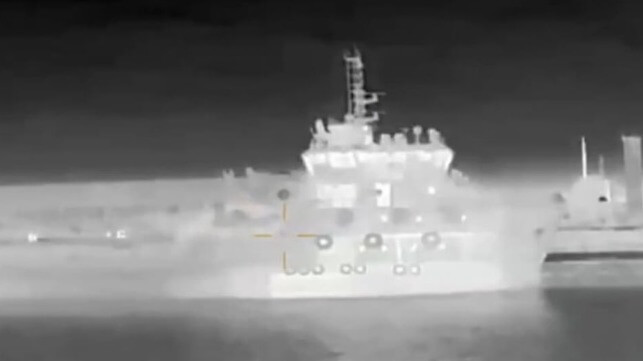
An FPV drone approaches the starboard side of the Fedor Uryupin (GUR)

Published Mar 19, 2025 7:33 PM by The Maritime Executive


Ukraine's military intelligence division has released a new video of drone attacks on multiple targets in Crimea, including what appears to be a confirmation of a previously-reported attack on an offshore tug that Russia captured from Ukraine in 2014. 

The three-minute video is a compilation of first-person-view drone footage from strikes on Russian equipment in occupied Crimea, primarily Russian military radar and air defense sites. Notable targets include S-300 and Pantsir surface-to-air missile systems, giant Nebo-M mobile air defense radars, and an Mi-8 helicopter. 

Also shown was an attempted attack on the Fedor Uryupin, first reported by partisan channel Crimean Wind in December 2024. According to the channel, the UAV struck the Uryupin above the waterline, causing damage but not sinking the vessel. The video shows the drone approaching the tug, but cuts out before impact (common for video feeds from weaponized FPV drones). 

The Uryupin was built in 2010 and operated by Ukrainian state-run oil and gas company Chornomornaftogaz in a commercial offshore services role. The vessel was captured by Russia in the 2014 occupation of Crimea. 

Open source analyst Oliver Alexander identified the Ukrainian attacks as the work of drone boat-launched first person view (FPV) drones - unmanned aerial drones launched by miniature unmanned "aircraft carriers." Because of the long distance from Ukraine's front lines to Crimea, and the short range of human-controlled FPVs, multiple analysts suggest that the attacks likely originated from platforms off the coast, meaning Ukrainian drone boats.

Ukraine has used FPV drone-launching drone boats in previous strikes, according to Russian war analysts. 

Worker Killed in Crane Accident Aboard Norwegian MPSV

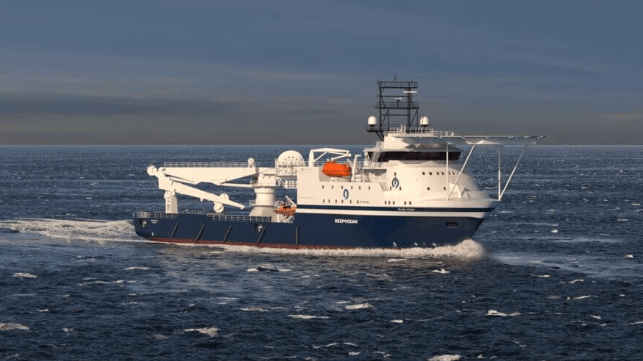
Island Ocean (concept image courtesy DeepOcean / Island Offshore)

Published Mar 20, 2025 2:58 PM by The Maritime Executive


Norwegian authorities are investigating the death of a worker who was crushed by a crane on an offshore MPSV last week. 

On the morning of March 12, police at the small port of Hareid, More og Romsdal received a report that a man had been killed aboard the MPSV conversion Island Ocean (ex name Island Condor). According to an interim report by the Norwegian Maritime Administration, the worker was repairing a platform under one of the vessel's cranes, and he was crushed against the railing when the crane started up. 

An investigation by the Norwegian Labour Inspection Authority is under way, and the agency has not yet released its findings.

"Until [the investigation] is concluded, I think we should not go into details about the course of events," Island Offshore CEO Tommy Walaunet told NRK. 

The Seamen's Church helped provide support for the rest of the crew after the casualty, he said. The firm is cooperating with police and national investigators, and it has changed its safety policies about working with the crane on deck to ensure that no one is in the path of the machine. 

Island Ocean is a 2014-built OSV flagged in Norway and operated by Island Offshore. In 2024, it was chartered by DeepOcean and converted into an MPSV, with a 150-tonne crane and two work class ROVs rated to 3,000 meters water depth. It was lengthened by 11 meters and received a large battery pack for hybrid power operations. Post-conversion, the vessel is designed to support inspection, maintenance and repair (IMR) work and light subsea construction for offshore oil and gas and renewables. 


Crews from Solong and Stena Immaculate Return Home as Salvage Continues

crew of Stena Immaculate tanker
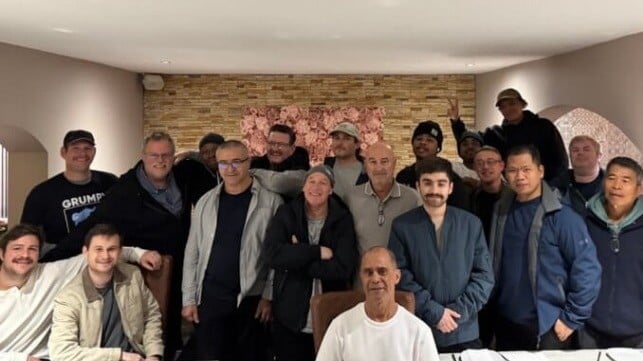
Crew saved from the Stena Immaculate in the UK (Crowley)

Published Mar 20, 2025 4:42 PM by The Maritime Executive


Officials in the UK and the Philippines confirmed that the crewmembers of the containership Solong and tanker Stena Immaculate have been repatriated as the investigation into the incident continues. HM Coastguard gave its last daily update this morning, March 20, while a government minister traveled to the area to thank the brave first responders and civilian crews that saved the seafarers as the vessels were engulfed in flames.

UK Transport Minister Mike Kane visited Grimsby Docks meeting with personnel from HM Coastguard as well as the teams from offshore wind operator RWE and Windcat which provides the crew transfer services from the port. He praised the actions of the commercial crews and thanked everyone for their efforts which saved the crews. 

"As the minister for aviation, maritime, and security, I wanted to come as soon as humanly possible after the initial response to the incident to come and thank everybody involved," said Kane.  He called the efforts "an astonishingly brilliant operation."

Kane highlighted that Windcat, contracted by RWE to assist with the transport of its technicians to RWE's Humber Gateway offshore wind farm, was first on the scene. The Windcat crew transfer vessel had completed taking technicians out to the wind farm and was 12 minutes away when the Mayday calls were issued.

The Solong crew was in a lifeboat when the Windcat vessel arrived, took them aboard, and brought them ashore. A second vessel repeated the same process rescuing the crew of Stena Immaculate which had also abandoned the tanker aboard its lifeboat.

The 36 individuals were triaged at Grimsby Dock. They were treated on scene and one person who had been injured declined further medical assistance. Kane reported that the crews have now been repatriated. The UK’s Marine Accident Investigation Branch reported that it was conducting interviews and gathering information as part of its investigation into the incident.


Philippines released a picture reporting eight crewmembers had returned (DMW)


The Philippines’ Department of Migrant Workers (DMW) reported today, March 20, that eight crewmembers from the Solong had returned to the country on March 18. It said it was in contact to provide financial assistance and ensure that all the necessary government assistance and support would be provided. Migrant Workers Secretary Hans Leo Cacdac previously said the DMW is also mulling taking legal action against the manning agency of the Filipino seafarers. He said they were also assisting the family of the seafarer who was lost during the incident.

The other crewmembers from the Solong were reported to include Russian nationals. There was no indication where they are or how many Russians were working on the containership.

UK prosecutors confirmed that the captain of the Solong, Vladimir Motin, 59 years old, of Primorsky, St Petersburg, Russia, was charged with Gross Negligence Manslaughter on March 14. He is being held in jail waiting for his next court appearance in April.

U.S. operator Crowley has also issued a statement expressing its “heartfelt thank you” to the 23 mariners from the Stena Immaculate for their bravery and quick action during the allision. It said that their actions helped safeguard lives, the vessel, and the environment.

Salvage teams have now been aboard both vessels to conduct surveys and plan the next steps. At the same time, UK officials highlighted that counter pollution retrieval operations remain ongoing. HM Coastguard said that aerial surveillance flights continue to monitor both vessels and the retrieval operation.


ALT. FUEL

LR: Lack of E-Fuel Supply is Delaying Adoption of Methanol Engines

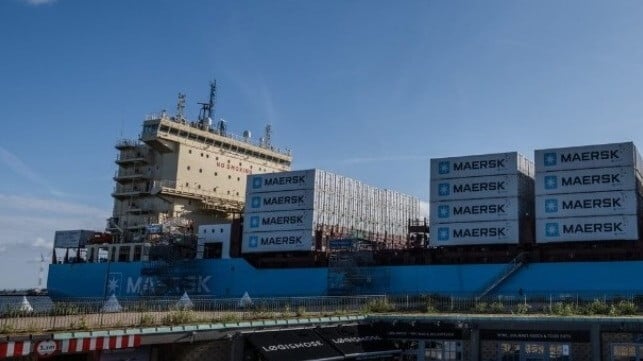
The methanol-fueled boxship Laura Maersk on her maiden voyage (iStock)

Published Mar 19, 2025 10:46 PM by The Maritime Executive


Lloyd's Register (LR) has updated its 2023 study on clean-fuel engine retrofits to account for changes in the green energy market. The low availability of e-fuels will delay the expected timeline for methanol-fueled engine adoption, according to LR, and more vessels will have to retrofit later if the fleet is to meet IMO emissions goals. 

"A key assumption of the [previous] modeling was that all vessels built beyond 2027-2030 would be capable of using zero- and near-zero emissions fuels. Without further effective drivers to take up these fuels or visibility on alternative fuel availability, that date could be pushed back – meaning that more vessels need to be retrofitted in a shorter timeframe, exacerbating strains on retrofitting capacity," the class society said in an update. 

So far, only Europe has enacted regulations that could motivate shipowners to make the costly switch to zero-emissions fuels, and carbon-tax discussions at IMO are still ongoing (with changing U.S. government views on climate change a wild card). Until IMO's deliberations are completed, shipowners will have difficulty picking the right investments to meet future targets. For now, owners are favoring conventional bunker-fueled propulsion or dual-fuel LNG engines, and orders for green fuel-capable vessels have taken a back seat, LR reported.  

"Over 2024, increasing numbers of shipowners turned to LNG to reduce exposure to carbon pricing. More than 305 LNG-fueled ships were ordered, far outpacing growth in the methanol- and ammonia-fueled fleet. This included major shipowners, such as Maersk, that had previously touted progressive decarbonization plans based around methanol fuel," LR noted.

Methanol conversions are just getting started but are expected to pick up over the next four years, primarily in the container segment. Methanol accounts for most of the planned conversions through 2029, but the numbers are small, in the single digits per year. 

If the IMO adopts a regulatory structure to drive the uptake of zero-carbon fuels, as is expected, shipyard capacity for future alternative fuel retrofits might not be enough to meet the demand. LR has identified 16 yards that have the experience to carry out the work, and MAN has highlighted an additional 11. Taken altogether, these yards could handle about 465 conversions per year, less than the 1,000 per year that LR expects at the peak of demand. 

"In 2025, there will be many more conversions based on existing orders, offering vital experience for the fledgling market. Whether the growth in order numbers themselves will accelerate will depend largely on the signals that both alternative fuel producers and shipowners receive from regulators," LR concluded.


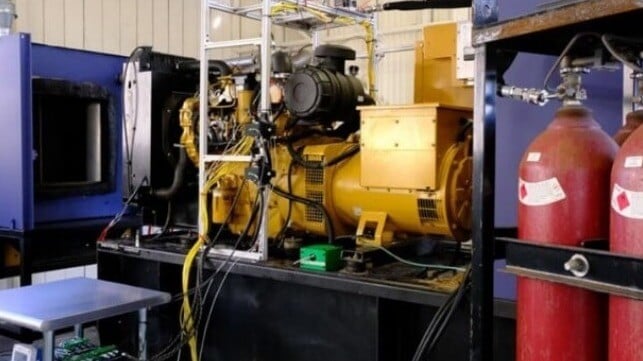
Project for Hybrid Hydrogen-Diesel Engine Retrofits to Start Tests in 2025

hydrogen hybrid diesel engine
Lomar is working with a startup on a concept to retrofit diesel engines to a hyrbrid with hydrogen (Lomar)

Published Mar 19, 2025 6:06 PM by The Maritime Executive


As the maritime sector works toward meeting IMO decarbonization targets, shipowners are searching for solutions to extend the service lives of their existing vessels. A new partnership between the innovation arm of Lomar Shipping, lomarlabs, is launching a partnership with a startup called Newlight to develop hydrogen retrofits to solve the challenge.

“Hydrogen has enormous potential as a maritime fuel, but transitioning entire fleets to pure hydrogen is a long-term challenge,” said Haran Cohen Hillel, CEO of Newlight. “By taking immediate steps with the current fleet, we can decarbonize ship by ship—delivering real impact today.”

Newlight reports it has developed a dual-fuel retrofit technology that will be a low Capex solution that enables existing vessels to integrate hydrogen as a fuel source. According to the company it on average should reduce fuel consumption by 20 percent. 

By retrofitting existing diesel engines to operate on a hydrogen blend, the companies believe it can provide an immediate, scalable solution that cuts emissions without requiring a complete overhaul of the propulsion systems.

Lomarlabs announced a strategic collaboration that will make it possible to test the concepts using a vessel within the Lomar Shipping fleet. It reports that savings of up to 30 percent were demonstrated in workshop trials and through the collaboration will seek to replicate the results onboard vessels.

“Decarbonization isn’t about waiting for the perfect fuel; it’s about acting now with every viable tool at our disposal,” said Stylianos Papageorgiou, Managing director of lomarlabs. Newlight’s dual-fuel retrofit technology promises an immediate, scalable, and cost-effective way to reduce fuel consumption and emissions. This is exactly the kind of practical innovation that will bridge the gap between today’s operational realities and the long-term vision of a net-zero maritime industry.“

The collaboration will focus on retrofitting conventional diesel engines to operate on a hydrogen-diesel mix. Lomarlabs and Newlight report they will conduct a pilot installation scheduled for summer 2025 on board a Lomar vessel to collect data and carry out harbor and sea trials.

This is one of several projects that lomarlabs has in its portfolio. Others include an effort to capture CO2 emissions from a vessel’s funnel or another technology to convert it to natural sea salts. It is also supporting a technology to reduce methane from the atmosphere and to develop autonomous magnetic crawler robots for hull cleaning. It is also involved in AI for autonomous navigation and the CargoKite, a concept to transport goods on autonomous ships propelled by a high-altitude wind kite system.