Friday, March 21, 2025

'Deplorable': French scientist denied US entry over text messages criticising Trump

French officials have expressed their dismay after a French scientist was denied entry into the United States because immigration officers found text messages containing a "personal opinion" about the Trump administration and its policies on scientific research.


Issued on: 20/03/2025

 International travellers wait in line to have their passports checked at O'Hare International Airport in Chicago, Illinois, on September 19, 2014. © Scott Olson, Getty Images North America, AFP/ File picture

The French foreign ministry said its consulate had been informed of the incident, adding that it "deplored the situation".

However, the ministry said the United States had the "sovereign" right to decide who could enter or remain on its territory.

In a statement issued on Wednesday and sent to the AFP news agency, France's Minister of Higher Education and Research Philippe Baptiste said he had “learned with concern” that a space researcher working for the French National Center for Scientific Research (CNRS) was stopped for a random check at an unspecified US airport and expelled due to critical text messages about US President Donald Trump.

“This measure was apparently taken by the American authorities because the researcher’s phone contained exchanges with colleagues and friends in which he expressed a personal opinion on the Trump administration’s research policy,” the minister said.

The researcher was reportedly en route for a conference in Houston when the incident took place on March 9.

According to an unnamed source cited by AFP, US authorities labelled the messages as “hatred towards Trump” that “could be qualified as terrorism”.

An FBI investigation was also reportedly launched into the matter, but the charges were dropped before the researcher was put on a plane home to France.

The US government maintains that border agents are allowed to examine electronic devices as part of a random security check. Rights groups including the American Civil Liberties Union (ACLU) sued the US government over these warrantless searches in 2017, arguing they were "unconstitutional". The ACLU won the case in federal court but it was overturned on appeal, prompting the group to ask the Supreme Court to hear the case.
‘Welcome to France’

Baptiste said the incident was an affront to liberal values.

“Freedom of opinion, free research, and academic freedom are values ​​that we will continue to proudly uphold, he said, adding: “I will defend the right of all French researchers to be faithful to them in accordance with the law.”

Since Trump took office in January, Baptiste has been vocal in his critique against the administration’s huge cuts in funding for the scientific community, leading to the dismissal of hundreds of federal workers working on health and climate change issues.

Aside from the cuts – overseen by close Trump adviser and Tesla billionaire Elon Musk – the US president has also withdrawn the US from the World Health Organization (WHO) and the Paris climate agreement.

Trump’s appointment of vaccine sceptic Robert F. Kennedy Jr., who is not a doctor, as the head of the Department of Health and Human Services has also angered many scientists.

Earlier this month, Baptiste sent a letter to French research institutions, urging them to take in American scientists who were looking to leave the United States in light of Trump's budget cuts.

"Many well-known researchers are already questioning their future in the United States," the minister of research wrote, saying that France "would, naturally, wish to welcome a certain number of them".

He also asked the institutions to send him "concrete proposals on the topic, both on priority technologies and scientific fields".

The French government, he said, was "committed" to the effort, and "will rise to the occasion".

Aix-Marseille University in southern France has already heeded these calls by setting up a special programme dedicated to welcoming US researchers working on climate change.

In announcing the programme, it said the invitation was directed at researchers who "may feel threatened or hindered" in the United States and want to "continue their work in an environment conducive to innovation, excellence and academic freedom".

A day after the French researcher was reportedly expelled from the United States, Baptiste posted a photograph on X, showing a virtual meeting with an American researcher who, along with “several dozens” of others, had decided to take the university up on its offer.

“We need to continue to propose new solutions to welcome the researchers who need or want to leave the United States in the near future,” the minister wrote.

Un dialogue très intéressant cet après-midi avec Andrea Buchwald, chercheuse à University of Maryland School of Medicine, attachée à une recherche libre. Elle a choisi, avec plusieurs dizaines d’autre chercheurs, de répondre à l’appel de l’Université Aix-Marseille, prête à… pic.twitter.com/3PdEc0xrFI— Philippe Baptiste (@PhBaptiste) March 10, 2025

Last week, he also appeared on French news channel France Info, slamming the Trump administration’s cuts to critical sciences like health, climate change, renewable energy and AI.

“Research is being chain-sawed in the United States!” said Baptiste.

“This is not only a serious blow for American research, it’s a serious blow to global research in which the United States up until now has played a pivotal role.”

He also took aim at Musk for his involvement in haphazardly dismantling the US research community, questioning why the tech billionaire was making decisions about the future of the ISS when he runs a parallel – and possibly competing – space exploration firm.

“I heard Elon Musk saying that the International Space Station needs to be shut down in 2027,” Baptiste posted, going on to question Musk's role.

Is Musk the head of SpaceX or the head of America's public administration, Baptiste asked, adding: “None of this makes any sense.”

US judge blocks deportation of Indian researcher accused of Hamas ties

Virginia District Judge Patricia Tolliver Giles ordered that Georgetown University scholar Badar Khan Suri, who is of Indian origin, could not be deported for allegedly "spreading Hamas propaganda" until a new court ruling is issued.


Issued on: 21/03/2025 -
FRANCE 24
Protesters gather at Foley Square on March 10, 2025 in New York City. © David Dee Delgado, Getty Images/AFP

US judge ordered Thursday that an Indian researcher at a top American university not be removed from the country, following his arrest and threat of expulsion for alleged Hamas ties.

The detention of Badar Khan Suri, a postdoctoral fellow at Georgetown University in the US capital, came as fears mount in the academic world that freedom of research and speech is being challenged two months into US President Donald Trump's new term.

Suri's lawyer demanded his release and denounced the arrest as a "targeted, retaliatory detention" that was intended "to silence, or at the very least restrict and chill, his speech" as well as that of others who "express support for Palestinian rights".

Early Thursday evening Judge Patricia Tolliver Giles of the Eastern District of Virginia Court ordered that Suri "shall not be removed from the United States unless and until the court issues a contrary order".


Read moreTrump mutes Voice of America, makes space for Russian and Chinese influence

The American Civil Liberties Union (ACLU), which has also filed an emergency motion to stop the deportation, said Suri was being held at an immigration detention center in Louisiana.

"Ripping someone from their home and family, stripping them of their immigration status, and detaining them solely based on political viewpoint is a clear attempt by President Trump to silence dissent," said ACLU immigrant rights attorney Sophia Gregg.

"That is patently unconstitutional."

On Wednesday, the French government condemned the expulsion of a French space scientist meant to attend a conference in Houston, after officials searched his smartphone and found what they called "hateful" messages against US policy.

Read more'Deplorable': French scientist denied US entry over text messages criticising Trump

"Dr Khan Suri is an Indian national who was duly granted a visa to enter the United States to continue his doctoral research on peacebuilding in Iraq and Afghanistan," Georgetown University said in a statement.

"We are not aware of him engaging in any illegal activity, and we have not received a reason for his detention."

Neither Secretary of State Marco Rubio "nor any other government official has alleged that Mr Suri has committed any crime or, indeed, broke any law whatsoever", his lawyer said in the court filing.

The filing accused the US government of having detained Suri "based on his family connection and constitutionally protected free speech".
Fellow arrested

Suri – a fellow at Georgetown's Alwaleed Bin Talal Center for Muslim-Christian Understanding, according to the university website – was arrested Monday at his home in Arlington, Virginia, according to Politico, which first reported on the story.

Tricia McLaughlin, a spokeswoman for the Department of Homeland Security, said on X that Suri was "a foreign exchange student at Georgetown University actively spreading Hamas propaganda and promoting anti-Semitism on social media".

07:46
PRESS REVIEW © FRANCE 24


McLaughlin accused him of having "close connections to a known or suspected terrorist, who is a senior adviser to Hamas".

The State Department decided the researcher was subject to deportation under a provision of immigration law that allows for expulsion if the visa holder's presence in the United States is determined to threaten US foreign policy, she added.

Hamas is a US-designated terror organisation.

Georgetown University said it backs its "community members' rights to free and open inquiry, deliberation and debate, even if the underlying ideas may be difficult, controversial or objectionable".

Citing a petition filed by Suri's lawyer, Politico reported that Suri's wife is a US citizen of Palestinian descent, and that the couple believes they are being targeted because the government suspects they oppose US policy on Israel.

(FRANCE 24 with AFP)


Indian researcher detained in US over alleged Hamas ties

Politico reported that Suri’s wife is a US citizen of Palestinian descent, and that the couple believes they are being targeted because the government suspects they oppose US policy on Israel.


By AFP
March 20, 2025


A researcher at Georgetown University in Washington has been arrested and threatened with expulsion
- Copyright AFP/File Robyn BECK

An Indian researcher at a top university in the United States with a valid visa has been arrested and is under threat of expulsion, according to his employer and US authorities, who accuse him of ties to Hamas.

The arrest of Badar Khan Suri, a postdoctoral fellow at Georgetown University in the US capital, comes as fears mount in the scientific world that freedom of research is being challenged two months into US President Donald Trump’s new term.

On Wednesday, the French government condemned the expulsion of a French space scientist meant to attend a conference in Houston, after officials searched his smartphone and found what they called “hateful” messages against US policy.

“Dr Khan Suri is an Indian national who was duly granted a visa to enter the United States to continue his doctoral research on peacebuilding in Iraq and Afghanistan,” Georgetown University said in a statement.

“We are not aware of him engaging in any illegal activity, and we have not received a reason for his detention.”

Suri — a fellow at Georgetown’s Alwaleed Bin Talal Center for Muslim-Christian Understanding, according to the university website — was arrested Monday at his home in Arlington, Virginia, according to Politico, which first reported on the story.

His lawyer told Politico he had demanded his release, but did not immediately respond to an AFP request for comment.

Tricia McLaughlin, a spokeswoman for the Department of Homeland Security, said on X that Suri was “a foreign exchange student at Georgetown University actively spreading Hamas propaganda and promoting anti-Semitism on social media.”

McLaughlin accused him of having “close connections to a known or suspected terrorist, who is a senior advisor to Hamas.”

The State Department decided the researcher was subject to deportation under a provision of immigration law that allows for expulsion if the visa holder’s presence in the United States is determined to threaten US foreign policy, she added.

Hamas is a US-designated terror organization.

Georgetown University said it backs its “community members’ rights to free and open inquiry, deliberation and debate, even if the underlying ideas may be difficult, controversial or objectionable.”

Citing a petition filed by Suri’s lawyer, Politico reported that Suri’s wife is a US citizen of Palestinian descent, and that the couple believes they are being targeted because the government suspects they oppose US policy on Israel.


Trump can't deport Georgetown scholar rounded up in crackdown on 'terrorist sympathizers'

Daniel Hampton
March 20, 2025
RAW STORY

FILE PHOTO: U.S. Department of Homeland Security Secretary Kristi Noem wears an ICE vest during a briefing with law enforcement agents ahead of immigration raids in New York City, U.S., January 28, 2025 in this image obtained from social media. X/@Sec_Noem via REUTERS THIS IMAGE HAS BEEN SUPPLIED BY A THIRD PARTY/File Photo

A federal judge has ruled that the Trump administration cannot deport a Georgetown University scholar who is living in the country legally but was seized by federal agents as the administration targets "terrorist sympathizers."

Masked agents arrested Badar Khan Suri outside his home in Rosslyn, Virginia, on Monday night. Khan Suri is an Indian national and postdoctoral fellow who was studying and teaching on a student visa. He was informed by agents with the Department of Homeland Security that his visa was being revoked.

Tricia McLaughlin said in a Wednesday post on X that Khan Suri was “actively spreading Hamas propaganda and promoting antisemitism on social media. Khan Suri has close connections to a known or suspected terrorist, who is a senior advisor to Hamas.”

But on Thursday afternoon, U.S District Judge Patricia Tolliver Giles said the administration cannot deport him unless she rules otherwise while she reviews Khan Suri’s petition challenging his detention.

Khan Suri is married with children, according to the report.

Suri’s petition for release said he was placed in deportation proceedings under a rarely used immigration law enforcement mechanism that allows the head of the State Department to deport noncitizens if they're deemed a threat to U.S. foreign policy.

Suri’s lawyer, Hassan Ahmad, has said his client was targeted because his wife is of Palestinian heritage and is not a U.S. citizen. Authorities believe he and his wife oppose the United States' support of Israel, said Ahmad.

“We’re trying to speak with him. That hasn’t happened yet,” Ahmad told Politico on Wednesday. “This is just another example of our government abducting people the same way they abducted Khalil.”

Trump has explicitly said his administration is targeting people he refers to as "terrorist sympathizers." In multiple public statements, including on his social media platform, Trump vowed to "find, apprehend, and deport these terrorist sympathizers from our country — never to return again."

His rhetoric has been tied to recent actions, including the arrest of Palestinian activist Mahmoud Khalil, a legal permanent U.S. resident who played a major role in protests that rocked Columbia University last year.


Georgetown Academic 'Abducted by Masked DHS Agents' at Risk of Deportation

One of Badar Khan Suri's lawyers called the case "emblematic of a broader strategy by the Trump administration to suppress voices—citizens and noncitizens alike—who dare to speak out."


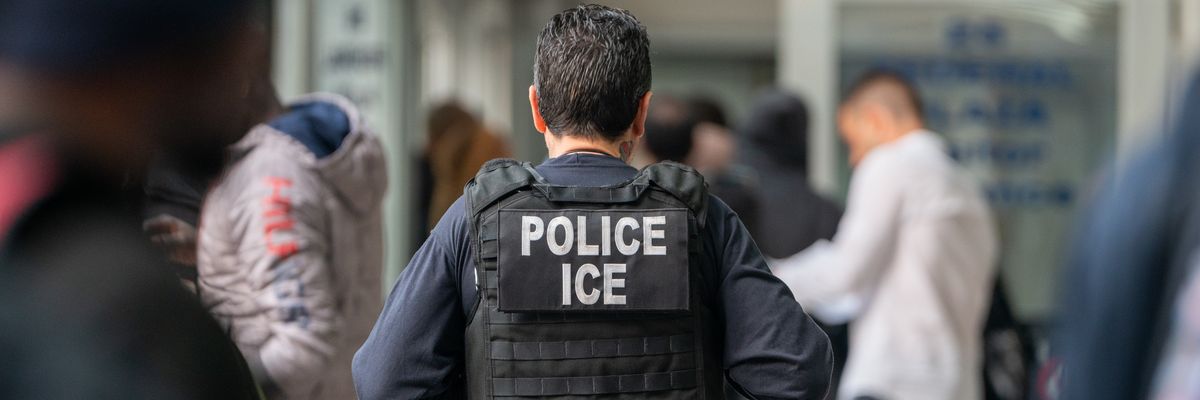
An Immigration and Customs Enforcement agent monitors hundreds of asylum seekers being processed upon entering the Jacob K. Javits Federal Building on June 6, 2023 in New York City.
(Photo: David Dee Delgado/Getty Images)

Eloise Goldsmith
Mar 20, 2025
COMMON DREAMS

The Trump administration was accused of "abducting" a postdoctoral fellow at Georgetown University, following reporting thatBadar Khan Suri, who was studying and teaching at the school on a student visa, was arrested by masked immigration authorities on Monday night.

Following his arrest, a spokesperson with the U.S. Department of Homeland Security said that Secretary of State Marco Rubio had determined that Suri's "activities and presence" in the United States "had rendered him deportable."

Agents who identified themselves as being with the U.S. Department of Homeland Security (DHS) arrested Suri, an Indian national, outside his home in Virginia, per Politico, which was first to report on Suri's arrest. The immigration officials told Suri that his student visa had been revoked, the outlet reported, citing court papers.

The news comes days after immigration agents arrested green-card holder Mahmoud Khalil, a graduate student at Columbia University until this past December who was involved in pro-Palestine demonstrations on the school's campus last year. U.S. President Donald Trump said that Khalil's arrest would be the "first of many."

"Another student who's legally in the U.S. was arrested for deportation, without a crime—allegedly for opposing U.S. foreign policy," said Nancy Okail, the head of the Center for International Policy. "If this absurdity continues, it won't be limited to specific groups. Any form of opposition will be punished and criminalized."


Nermeen Arastu, a member of Suri's legal team and an associate professor of law at the City University of New York similarly told the outlet Drop Site, "Mr. Suri's case is emblematic of a broader strategy by the Trump administration to suppress voices—citizens and noncitizens alike—who dare to speak out against governmental policies."

Tricia McLaughlin, assistant secretary for public affairs at DHS, wrote on X on Wednesday evening that Suri was "rendered deportable" under section of the Immigration and Nationality Act.

That is the same provision of immigration law that the Trump administration has invoked in its effort to Mahmoud Khalil.

"Suri was a foreign exchange student at Georgetown University actively spreading Hamas propaganda and promoting antisemitism on social media," McLaughlin also said. In the post, she did not add anything to bolster this claim. McLaughlin also wrote that Suri has connections to a "known or suspected terrorist, who is a senior adviser to Hamas."

Suri has not been charged with a crime, per his lawyer's petition for a writ of "habeas corpus," or an order demanding that he be brought to court to determine if he is lawfully detained,according Politico.

Suri's petition, filed on Tuesday in federal court by his lawyer Hassan Ahmed, argues that his arrest violates his First and Fifth Amendment rights, according to Drop Site, and also "challenges the legality of his detention under U.S. immigration law."

Politico reported that "Suri is being punished because of the Palestinian heritage of his wife—who is a U.S. citizen—and because the government suspects that he and his wife oppose U.S. foreign policy toward Israel," citing the petition.

Drop Site reported that Suri is currently being held at an Immigration and Customs Enforcement facility in Louisiana, though it is reportedly not the same facility as where Mahmoud Khalil is currently located.

Suri's wife, Mapheze Saleh, is a Georgetown graduate student in the Walsh School of Foreign Service's Center for Contemporary Arab Studies.

Her father, Ahmed Yousef, is a former adviser to the Hamas leader, Ismail Haniyeh, who was assassinated last year by Israeli security forces, according to The New York Times. Yousef told the Times that he departed his position as part of the Hamas-led government in Gaza over 10 years ago, and that his son-in-law is not involved in any "political activism." Yousef has also criticized Hamas' attack on Israel on October 7, 2023, per the Times.

Drop Site reported that Suri's arrest came after pro-Israel groups targeted Saleh with an "exceptionally public media campaign." The petition notes that Saleh and Suri have been targeted online due to their support for Palestinian rights, per Politico.

In February, the group CAMERA on Campus—which according to its X account helps students share "accurate education" and "correct misinformation" about Israel on campus—called Saleh a "Hamas affiliate" and alleged she "glorifie[d]" Hamas on social media. Also in February, the outlet Jewish News Syndicate published an opinion piece alleging that Suri "repeatedly endorsed Hamas terror and actively spreads its propaganda."

On Wednesday night, a Georgetown University spokesperson issued the following statement: "Dr. Khan Suri is an Indian national who was duly granted a visa to enter the United States to continue his doctoral research on peacebuilding in Iraq and Afghanistan. We are not aware of him engaging in any illegal activity, and we have not received a reason for his detention."

"We support our community members' rights to free and open inquiry, deliberation and debate, even if the underlying ideas may be difficult, controversial or objectionable. We expect the legal system to adjudicate this case fairly," the spokesperson wrote.
Glacier preservation 'a matter of survival' after largest three-year loss on record

The last three years have seen the largest glacial mass loss on record, the UN's meteorological agency said Friday in a report marking the first World Day for Glaciers. The agency warned that glaciers from Canada to New Zealand "will not survive the 21st century" at current rates of melting.

Issued on: 21/03/2025 - 
By: FRANCE 24

Five of the last six years have seen the most rapid glacier retreat on record. © Olivier Morin, AFP file photo


All 19 of the world's glacier regions experienced a net loss of mass in 2024 for the third consecutive year, the United Nations said on Friday, warning that saving the planet's glaciers was now a matter of "survival".

Five of the last six years have seen the most rapid glacier retreat on record, the UN's World Meteorological Organization said, on the inaugural World Day for Glaciers.

"Preservation of glaciers is a not just an environmental, economic and societal necessity: it's a matter of survival," said WMO chief Celeste Saulo.

Beyond the continental ice sheets of Greenland and Antarctica, more than 275,000 glaciers worldwide cover approximately 700,000 square kilometres, said the WMO.


But they are rapidly shrinking due to climate change.

"The 2024 hydrological year marked the third year in a row in which all 19 glacier regions experienced a net mass loss," the WMO added.
Annual change in glacier mass worldwide since 1976. © Sylvie Husson, Paz Pizarro, AFP

Together, they lost 450 billion tonnes of mass, the agency said, citing new data from the Swiss-based World Glacier Monitoring Service (WGMS).

It was the fourth worst year on record, with the worst being in 2023.
Huge loss over 50 years

"From 2022-2024, we saw the largest three-year loss of glaciers on record," said Saulo.

A general view of the melting Lewis Glacier, with a pool of meltwater at its base, in Mount Kenya National Park. © Luis Tato, AFP

Glacier mass loss last year was relatively moderate in regions such as the Canadian Arctic and the peripheral glaciers of Greenland – but glaciers in Scandinavia, Norway's Svalbard archipelago and North Asia experienced their worst year on record.

Based on a compilation of worldwide observations, the WGMS estimates that glaciers – separate from the continental ice sheets in Greenland and Antarctica – have lost more than 9,000 billion tonnes since records began in 1975.

"This is equivalent to a huge ice block of the size of Germany with a thickness of 25 metres," said WGMS director Michael Zemp.

At current rates of melting, many glaciers in western Canada and the United States, Scandinavia, central Europe, the Caucasus, New Zealand "will not survive the 21st century", said the WMO.
Melting glaciers: major differences across regions. © Sylvie Husson, Sabrina Blanchard, AFP

The agency said that together with ice sheets, glaciers store around 70 percent of the world's freshwater resources, with high mountain regions acting like the world's water towers. If they disappear, that would threaten water supplies for millions of people downstream.
'Ignoring the problem'

For the UN, the only possible response is to combat global warming by reducing greenhouse gas emissions.

"We can negotiate many things in the end, but we cannot negotiate physical laws like the melting point of ice," said Stefan Uhlenbrook, the WMO's water and cryosphere director.

He declined to comment on the return to office in January of US President Donald Trump, a climate change sceptic who has pulled the United States out of the landmark 2015 Paris climate accords.

However, Uhlenbrook said that "ignoring the problem" of climate change "is maybe convenient for a short period of time", but "that will not help us to get closer to a solution".

For the inaugural World Day for Glaciers, the WGMS named a US glacier as its first Glacier of the Year.

The South Cascade Glacier in Washington state has been monitored continuously since 1952 and provides one of the longest uninterrupted records of glaciological mass balance in the western hemisphere.

(FRANCE 24 with AFP)

Women in Syria: Could the future be female?


12:36
THE 51 PERCENT © FRANCE 24
From the show
The 51%

In a special edition, we focus on Syria, a nation emerging from decades of a brutal dictatorship. The country's interim leader Ahmed al-Sharaa has signed a constitutional declaration, laying out rights for women and freedom of expression. This after his Islamist-led rebels toppled Bashar al-Assad's government last December. Yet sectarian violence still threatens to split the country apart as we saw recently with those attacks directed at the Alawite community, treated as associates of Assad. We report on the fears of Syrian women that their new-found freedoms may be under threat with the rise of religious observance. Annette Young also talks to Mariam Jalabi, a co-founder of the Syrian Women's Political Movement, an umbrella organisation representing women from all communities and pushing for them to have a seat at the table.


Top U.S. markets regulator SEC to see exodus as hundreds take Trump’s buyout offers, sources say

By Reuters
March 21, 2025 

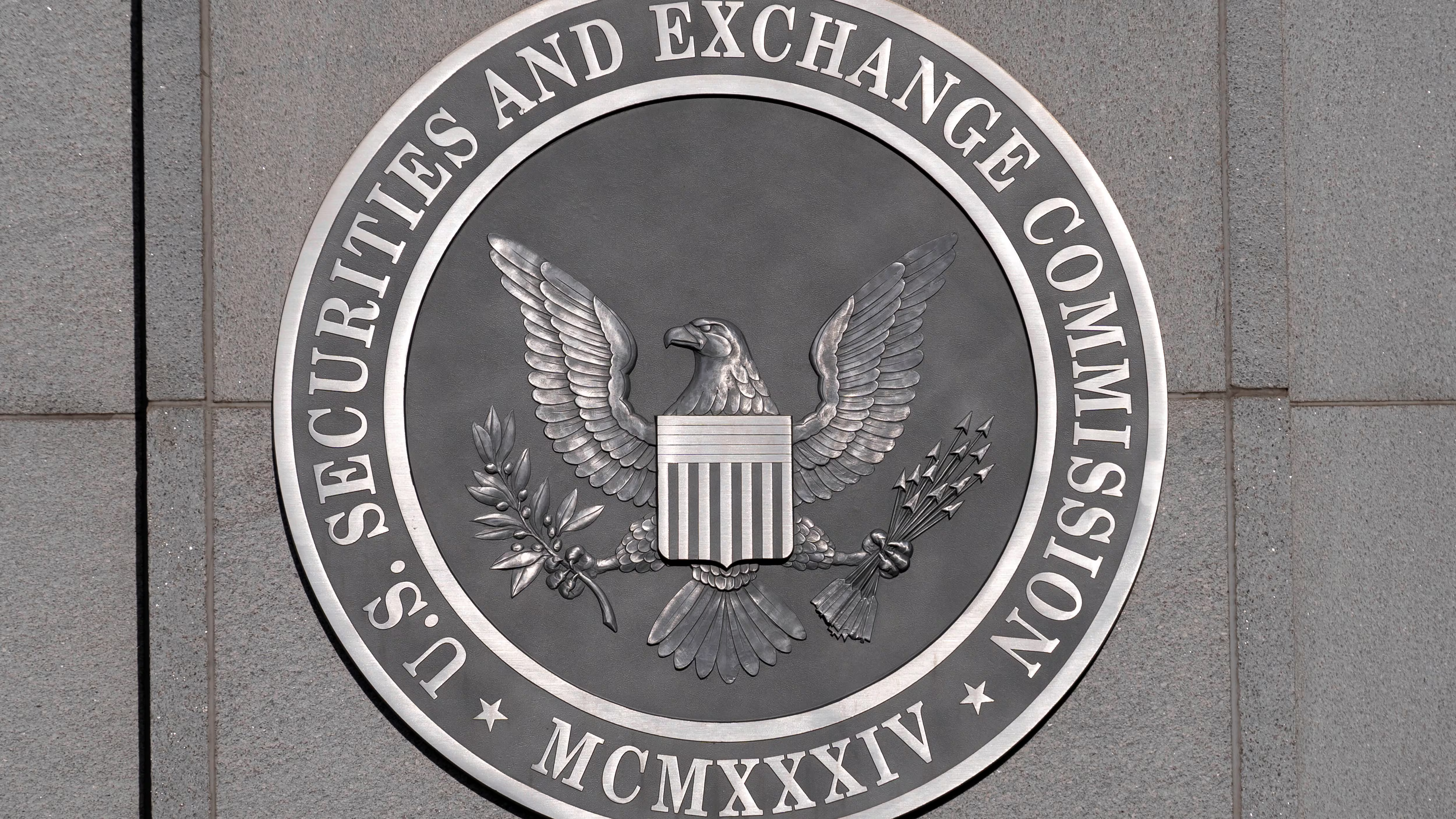
The seal of the U.S. Securities and Exchange Commission is seen on the building in Washington on Dec. 3, 2024. (Jose Luis Magana / AP Photo)

WASHINGTON — Wall Street’s top regulator is facing a staff exodus across key departments as hundreds have agreed to take resignation offers amid U.S. President Donald Trump and Elon Musk’s efforts to remake the U.S. government, five people familiar with the matter told Reuters.

Departures from the U.S. Securities and Exchange Commission, including by senior staff and enforcement lawyers, could significantly hamper the watchdog’s efforts to police markets and protect investors, the sources said. The exits stem from Trump and Musk’s efforts to slash the federal workforce.

Since the White House began offering voluntary departures across the civil service in January, more than 600 people have agreed to leave the SEC, said two sources with direct knowledge and two people briefed on the matter. Friday is the deadline for the SEC’s latest resignation incentive programs.

Trump gave agencies until March 13 to draw up plans for a second wave of mass layoffs as part of his rapid-fire effort to reshape and downsize the federal government, which he has called bloated and inefficient.

The estimates put the voluntary departures at more than 12 per cent of the SEC’s staff, according to overall staff numbers included in the agency’s latest budget report to Congress.

An SEC spokesperson declined to comment. Reuters could not determine exactly when those people would leave the agency.

Spokespeople for the White House and Musk did not respond to requests for comment.

Areas of the agency hardest hit include the Division of Enforcement and its Office of General Counsel, said two of the sources.

Some departures may be unrelated to the voluntary measures and some who had offered to resign may change their minds, one person said. Employees have until the end of Friday to tender their resignations, meaning the number is sure to rise.

The Trump administration has offered to pay staff to retire early or resign to encourage workforce reductions. Some at the SEC hope the incentives will reduce calls from Musk or Trump for mass layoffs at the agency, said one of the sources.

The efforts began under SEC acting chairman Mark Uyeda, a Republican, even before the arrival of Trump’s nominee for his replacement, Paul Atkins, who is slated to testify before Congress next week.

SEC rank and file have already faced changes, realignment, possible office closures and shifting priorities in recent weeks.

(Reporting by Chris Prentice and Douglas Gillison; editing by Pete Schroeder and Richard Chang)

Article written by Chris Prentice and Douglas Gillison, Reuters
ELECTION CALLED
Prime Minister Mark Carney’s government terminates consumer carbon price
THE CONSERVATIVES MAIN PLANK GONE


By The Canadian Press
March 18, 2025 


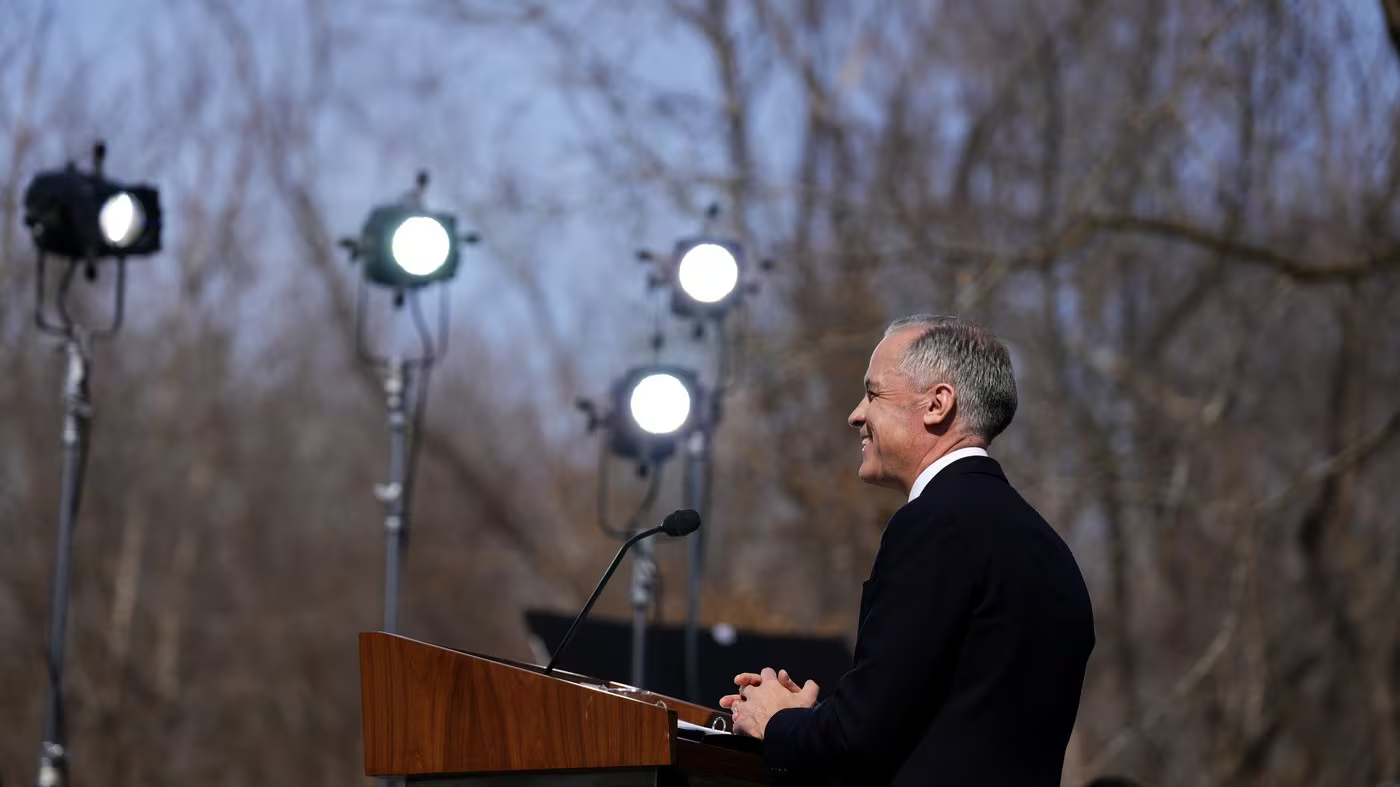
Prime Minister Mark Carney speaks at a news conference following a cabinet swearing in ceremony at Rideau Hall in Ottawa, on Friday, March 14, 2025. THE CANADIAN PRESS/Justin Tang

OTTAWA — Prime Minister Mark Carney’s first move after taking office on Friday was to eliminate the consumer carbon price, undoing Justin Trudeau’s signature climate policy.

Carney addressed members of the media after the Friday afternoon cabinet meeting, saying the government is “focused on action.”

“We will be eliminating the Canada fuel charge, the consumer fuel charge, immediately, immediately,” he said.

The decision note Carney signed in front of cabinet ministers and the press actually stipulates that the “the fuel charge be removed as of April 1, 2025.”

That’s when the price was scheduled to rise again. Instead, it will be eliminated for consumer purchases.


The price for big industrial emitters remains in place.

Carney also said people who have been getting rebates on the carbon price will get one final payment for the next quarter in April.

Carney had pledged to end the consumer price during the Liberal leadership race and said he would bolster the industrial price paid by big polluters.

Agriculture Minister Kody Blois said he thinks “it’s a really good move” because the policy has become very divisive.

He noted the Atlantic Liberal caucus had pushed for changes to the carbon price in the past, and secured a carve-out for home heating oil in 2023.

The consumer carbon pricing policy had been the focus of Conservative attacks on the Liberals for more than two years and had become a symbol of Canadians' struggles with the high cost of living.

Conservative Leader Pierre Poilievre, whose rallying cry of “axe the tax” had him riding high in the polls until about six weeks ago, claimed on Friday that Carney can’t really abolish the carbon price without recalling Parliament to repeal the law.

“What he might do is hide the carbon tax by telling (the Canada Revenue Agency) to stop collecting it for two months before the election,” Poilievre said, brandishing a copy of the law at a press conference in Ottawa.

He asked reporters whether they really believe Carney’s cabinet ministers, who have voted in favour of the carbon price for years, will actually end the policy. He suggested the Liberals would bring it back “two days after the election.”

The government is able to end the consumer carbon price without repealing or amending the law.

The Greenhouse Gas Pollution Pricing Act, which was passed in 2019, sets out a framework for both the consumer carbon price and the industrial price.


The law allows the fuel price to be set by regulation, which means cabinet can set the price through an order-in-council, as it did over the weekend.

The federal government initially set a minimum price on carbon pollution of $20 per tonne, which rose annually. It was set to rise another $15 per tonne in April to $95.

Eliminating the charge will reduce the cost of a litre of gasoline by 17.6 cents, and reduce the cost a cubic metre of natural gas by a little more than 15 cents.

The federal government was not keeping any of the money collected through the consumer carbon price. It was being sent directly to people through the Canada Carbon Rebate, and returned to territorial or Indigenous governments or businesses and non-profit organizations.

Steven Guilbeault, who was Trudeau’s environment minister and a staunch supporter of the carbon price, was named minister of Canadian culture and identity and Carney’s Quebec lieutenant on Friday.

He told reporters the industrial price “gives us three times more emission reduction than the consumer portion of carbon pricing.”

The Liberals have insisted the carbon price is sound policy that was plagued by poor communication and Conservative attacks.

Greenpeace Canada’s senior energy strategist Keith Stewart said in a statement on Friday that Poilievre had “successfully poisoned the well on consumer carbon tax by spreading false information.”

He added that the industrial carbon price was the source of the bulk of carbon pollution reductions in Canada.

“We are pleased to see that our new prime minister has promised to strengthen it and call on him to maintain and strengthen other key climate and biodiversity protection policies,” Stewart said.

Poilievre has pledged that a Conservative government would end the consumer carbon price. He has not said what he would do with the industrial price. Last week, he told reporters they would have to wait until the election campaign begins to see detailed policies.

He has said “axe the tax” will continue to be part of his message to Canadians in the next election.

By Sarah Ritchie

This report by The Canadian Press was first published March 14, 2025.
Why the fight for ‘critical minerals’ is heating up

By Bloomberg News
March 21, 2025 

Oil companies spent more than a century developing a vast industrial network to extract, refine and deliver their product to customers around the world. Sourcing the materials needed to build an alternative, less carbon-intensive economy presents a whole new set of challenges.

China has been tackling these successfully for more than a decade, making it the undisputed leader in the “critical minerals” used in equipment such as electric vehicle batteries, solar panels and wind-turbine magnets.

If other nations are going to have a chance of challenging its dominance in these clean technologies, they need to catch up fast. The race has taken on greater urgency now that China is curbing exports of several critical minerals in response to U.S. President Donald Trump’s trade tariffs.
What are critical minerals?

Nations have long sought to secure supplies of materials they deem vital to their industrial and military capabilities. About 50 metallic elements and minerals have met those criteria in the U.S. and European Union, including lithium, graphite, cobalt, manganese and rare earths — elements with unique chemical behaviors that make them indispensable to the manufacture of some electrical, electronic, magnetic and optical products. Most critical minerals were chosen for their role in building the infrastructure required to reduce carbon emissions blamed for climate change, a mission that’s backed by hundreds of billions of dollars in subsidies and tax breaks. Some are also used in semiconductors for civil and military communications.
Why is sourcing them a challenge?

While many critical minerals can be found in a raw state in large quantities across the globe, extracting and refining them into a usable form can be technically complex, energy intensive and polluting. China has come to dominate the value chain for many of these products. Even in the case of more abundant metals such as copper, massive demand growth means there might not be enough to go around. In 2023, the EU categorized copper and nickel as critical raw materials for the first time, even though there are lots of places where they can be found.

Why is relying on China a problem for western nations?

Manufacturers try to avoid over-dependence on supplies from any single country because it leaves them exposed when that nation’s industrial output is disrupted by things like power shortages, epidemics or social unrest.

With China, there’s also a strained relationship with the U.S. to consider, especially now that longstanding tensions are spiraling under Trump into a deeper trade war involving punitive tariffs and tightening export restrictions.

China banned the export of antimony, gallium and germanium to the U.S. in December, citing national security concerns, after Washington restricted China’s access to some sensitive technologies. The move is likely to raise costs for some U.S. manufacturers of electronic and optical equipment. Beijing also placed tighter conditions of sales of graphite, an ingredient in EV batteries. In early February, in response to Trump’s latest tariffs, China added export controls on tungsten, bismuth and other niche metals used in electronics, aviation and defense, sending prices of some of those products soaring.
How did China get so dominant?

As early as 1992, Chinese leader Deng Xiaoping was highlighting his country’s potential to lead the world in critical minerals, saying “The Middle East has oil. China has rare earths.” As its economic growth accelerated, Chinese demand for industrial commodities began to far outstrip local reserves. It responded with heavy investments in mining assets overseas and came gradually to dominate the refining and processing of many industrial commodities, as well as a host of obscure byproducts. As China stepped in, Western companies withdrew, happy to outsource the production.

Today, China is the leading producer of 20 critical raw materials, as measured by its share of global mined or refined production. In the case of the rare earth element dysprosium, used in lighting and lasers, China is responsible for 84% of mined supply and 100% of refined production, according to an EU analysis. It’s also the largest producer of refined forms of cobalt and nickel, and Chinese companies have been investing heavily in cobalt and nickel mines in countries such as Congo and Indonesia.
What are China’s economic rivals doing about it?

Former U.S. President Joe Biden’s Inflation Reduction Act of 2022 aimed to help the U.S. meet its climate goals through job-creating investments in renewables and EVs and ease reliance on unreliable or hostile overseas suppliers.


While Biden’s successor Trump has disparaged his climate policies and ordered federal agencies to stop disbursing IRA funds, a complete repeal of the legislation appears unlikely. Republican lawmakers whose districts and states are benefiting from investments spurred by the IRA have pressed the president to maintain its provisions.

In March, Trump took the Biden administration’s effort to reduce U.S. reliance on minerals from China a step further, invoking emergency powers to boost domestic production and processing of the materials.

In the EU, a Critical Raw Materials Act aims to ease financing and permitting for new mining and refining projects at home and strike trade alliances to reduce Europe’s dependence on Chinese suppliers. The bloc is also pushing through a Clean Industrial Deal that will include a mechanism enabling companies in the region to pool their demand for critical materials.

China’s rivals have been trying to strike supply deals and investment partnerships with producing nations. However, China’s established position in many of those countries gives it an early advantage. For example, more than half of the cobalt mines in the Democratic Republic of Congo are owned or controlled by Chinese companies. Beijing is consolidating relationships with African nations that are set to be among the world’s biggest producers of the metal by the end of the decade.

---

Mark Burton, Bloomberg News

--With assistance from Jack Ryan and John Ainger.

©2025 Bloomberg L.P.

Canada rushes to fund its neglected military after Trump threats

DROP THE F35, BUILD SOCIAL HOUSING INSTEAD

By Bloomberg News
 March 21, 2025 

A Canadian soldier takes part in an announcement regarding the arrival of new ambulance variants to the armoured combat support vehicle fleet at Garrison Petawawa in Petawawa, Ont., on Thursday, Oct. 19, 2023. THE CANADIAN PRESS/Sean Kilpatrick

Three decades ago, Canada published a report about its future military plans. “The Cold War is over,” its first chapter began, before outlining the government’s massive budget pressures and proposing cuts to personnel and defense spending.

Then came a warning: “Canada should never find itself in a position where the defence of its national territory has become the responsibility of others.”

Surrounded by three oceans, with an allied superpower on its southern border, Canada took its peace dividend — and let its military atrophy. It has recently been absent from patrols and war games with allies.

A hostile U.S. President Donald Trump is changing that. He has imposed tariffs and reproached Canada for being too dependent on the U.S. for security, and his repeated talk of making it the 51st state has spark both fury and alarm in the nation of more than 41 million people. Further shocking Europe and Canada into planning for self-reliance, Trump has threatened U.S. support for Ukraine’s fight against Russia.

With a snap election call just days away, Canadian politicians are now jockeying to explain how they’d ramp up defense spending — and disentangle themselves from the U.S. at the same time. Two days after he was sworn in as prime minister, Mark Carney flew to Paris and London to talk with allies and make the pitch for more defense industry cooperation with Europe. His government is reviewing an earlier deal signed with the US’s Lockheed Martin Corp. for F-35 jets.


With melting Arctic ice drawing interest in the far north from Russia and China, Canada had already acknowledged it needed to do better. But it’s well short of its North Atlantic Treaty Organization commitment to spend 2% of gross domestic product on defense: In 2024, it was on track to spend 1.37%, one of nine laggards in the 32-member alliance.

“Trump isn’t wrong on everything,” Eric Martel, chief executive officer of Canadian jet-maker Bombardier Inc., said this week. “We’ve been hiding behind our big brother for a while.”

Former Prime Minister Justin Trudeau tried to allay criticism at last year’s NATO summit by committing to hit 2% by 2032. But he didn’t allocate the funds needed, and to get there, current spending would almost need to double, Canada’s budget watchdog said.

Anyway, 2032 looks far too slow. Trump’s administration has said NATO members should hit 2% as soon as June, NATO Secretary General Mark Rutte has talked about a 3% goal, and Trump has talked about a 5% target, and darkly suggested the U.S. wouldn’t come to NATO allies’ defense if they are “delinquent.”

In January, Defence Minister Bill Blair said it’s “absolutely achievable” for Canada to hit 2% as soon as 2027, five years faster than the current plan and which, depending on economic growth, could work out out to between C$10 billion ($7 billion) and C$13 billion in additional annual spending.

Canada hasn’t explained how it’ll do that, but experts interviewed by Bloomberg News say there are plenty of options.

Canada’s military is in dire need of replenishment. Its fighter jets and frigates are several decades old. It’s 6,800 people short of its full “authorized force” of 71,500 due to recruitment and retention problems that the defense minister warned could start a “death spiral,” so it’s opened entry to permanent residents as well as citizens.

The government could green-light or accelerate purchases it’s currently exploring, like upgraded missile defense, tanks, artillery and drones. But procurement is slow — it can take “too long,” a defense ministry spokesman acknowledged by email. The system is “broken,” a union representing procurement personnel told a parliamentary committee last year.

For example, the process to choose new warplanes took more than a decade. The White House is setting ultimatums that will force NATO allies to move much faster.

A direct route to 2% would be opening the spigot for existing lines of spending, according to David Perry, president of the Canadian Global Affairs Institute think tank, and former Defense Minister Jason Kenney, who served under Conservative Prime Minister Stephen Harper. That could mean boosting salaries for soldiers, spending more on airbases, buildings, ports and infrastructure, military housing, upping maintenance and support for existing equipment like ships, and reversing cuts to things like travel.

The armed forces are underpaid, former Vice Chief of Defense Staff Mark Norman said by phone, and its infrastructure needs are huge, with some “literally crumbling.”


“The backlog and everything associated with it would well exceed the 2%,” he said, warning against too much focus on “the big shiny objects” of new procurement. “We hang on to things way too long, which then creates a whole bunch of problems.”

At a February event in Washington, the premiers of Canada’s northern territories spoke about the benefits defense-related investments could bring their regions. A NATO official in the audience called their remarks “music to my ears.”

“We have a lot of zombie capabilities” as a consequence of perennially low spending, Macdonald-Laurier senior fellow Richard Shimooka said by phone. “We’ve just maintained the overhead and the minuscule amount of capability — not great.”

Canada is slowly building up its navy, which has to guard the world’s largest coastline, with manufacturers including Irving Shipbuilding Inc. and Chantier Davie Inc. A planned fleet of as many as 12 submarines would increase defense spending, and may come from suppliers in Europe or Asia. Germany’s Thyssenkrupp GmbH and South Korea’s Hanwha Ocean Co Ltd. have registered lobbyists for that contract. But the first submarine is many years away.

Canada has promised to acquire a global military satellite communications system. Dan Goldberg, CEO of Ottawa-based Telesat Corp., says his company wants that work and says it’s “pivotal” for air defense modernization, too. Lobbyist filings indicate Brampton, Ontario’s MDA Space Ltd. is also interested in defense programs.

“They should be looking at any current project that’s within the pipeline, that they’ve already identified, that has a Canadian sovereign component, or any unsolicited proposals — perhaps for goods, services where Canadian industry has seen a gap in our sovereign capabilities,” said Christyn Cianfarani, president of the Canadian Association of Defence and Security Industries. Officials should expedite those projects with the urgency seen during the COVID-19 pandemic, she said.

Canada is also the world’s second-largest uranium producer, but it mostly exports the metal, and both Canada and the U.S. have relied on Russia for enrichment. Canada should start enriching the nuclear fuel itself, according to Erin O’Toole, a former captain in the Royal Canadian Air Force who led the Conservative Party during the 2021 election.
U.S. reliant

The awkward part is how many of Canada’s plans depend on U.S. contractors — like a C$19 billion deal signed in 2023 for 88 F-35 fighter jets from Lockheed Martin, or a C$10.4 billion deal for P-8A Poseidon aircraft from the Boeing Co. Armored vehicle manufacturing happens in Canada, but one of the top players is Reston, Virginia-based General Dynamics Corp.

During the Cold War in 1959, Canada canceled a project to make its own fighter jet, the Avro Arrow. Today, Quebec’s Bombardier Inc. makes surveillance jets, but not fighting ones. Now the country is seamlessly integrated with the U.S.: It supplied 40% of the Allies’ aluminum and 95% of the nickel in the Second World War, and in 1956 struck a special deal that means the U.S. Department of Defense treats Canadian suppliers as equivalent to American ones.

CADSI’s Cianfarani said it’s not clear what protection that pact, called the DPSA, offers businesses facing 25% tariffs, including steel and aluminum products, which might balloon costs.

To be sure, while Canada has grown too reliant on the U.S. for security, its troops also supported American solidiers in Afghanistan, Korea and other U.S.-led missions. Trudeau made this point while pushing back on Trump’s tariffs on Feb. 1, saying: “We have fought and died alongside you during your darkest hours.”

The U.S. is increasingly being treated as hostile by Canadian politicians, a dynamic evoking Canada’s 19th-century origins, when three British colonies joined forces to form a new nation partly out of a fear of U.S. invasion.

Canada must “protect our Arctic, which is under threat not just now from the Russians and the Chinese, but from potential U.S. incursions,” Carney said last month, before he was prime minister. “I will spend defense dollars in Canada, not the 80% that this government has spent in the United States up until now.” His decision to ask for a review of the F-35 contract on his very first day in office was deliberate.

But calls to replace the F-35 with an alternative like the runner-up Saab AB Gripen from Sweden, whose makers promised to bring more manufacturing to Canada, could entail big sunk costs and delays, especially given the technological complexity of modern militaries, said Andrea Charron, director of the University of Manitoba’s Centre for Defence and Security Studies. Canadian pilots and technicians are already training in the U.S. for the F-35, she said.

Although the U.S. itself has also cooled on collaboration — Trump has questioned a pact to collaborate with Canada and Finland on icebreaker production — the president’s plans look ungainly without Canadian involvement.

On Jan. 27, he issued an executive order to build “the Iron Dome for America,” invoking the name of Israel’s missile defense system, to neutralize aerial attacks amid fears that new hypersonic missiles could slip through current defenses.

“We can’t think of this Iron Dome system like what the Israelis have, because we’re talking about a huge area,” Charron said. “We know the missiles are going to come over us,” she added, referring to Canada.

Trump’s order doesn’t mention the North American Aerospace Defense Command — the world’s only bi-national military command, run by the U.S. and Canada, responsible for scanning and guarding North America’s airspace. But it does refer to working with “allies” and to the U.S. unit responsible for their part in NORAD.

NORAD leaders recently met “for meaningful discussions on joint priorities.” The unit’s official social media hashtags include #StrongerTogether. One of Carney’s first visits as prime minister was to Iqaluit, capital of the Arctic territory Nunavut, to share more detail about investments in the region, including over-the-horizon radar for NORAD.

Carney is expected to call an election in days, and the question of how Canada can assert its sovereignty against an aggressive U.S. seems certain to be a central issue.

Carney has promised to meet 2% NATO target by 2030 at the latest, without saying how. Pierre Poilievre, leader of the Conservative Party, has said he’d redirect money to the armed forces from Canada’s foreign aid budget — which was about $8 billion in 2023, according to the OECD. He has pledged a new base and more rangers for the Arctic, and two more icebreakers. He has said meeting the NATO commitment is a goal attainable if the U.S. deepens trade ties.
Trade offs

Whoever wins faces choices to meet these pledges: redirecting money from other programs, borrowing more or raising taxes. And that’s as the government already expects to run a C$48 billion deficit in the coming fiscal year and has numerous other spending demands, including buffering citizens against the trade war with the US, addressing a housing crisis and boosting productivity.

Canadians are divided on the best way to increase defense spending, according to new polling by Nanos Research for Bloomberg. But the proportion who said Canada shouldn’t increase it at all has dropped to 15% in 2025 from 26% last year.

Canadians may even be willing to pay a special “Canadian military tax,” former Bank of Canada Governor Stephen Poloz said in February, suggesting 3% on purchases, offset for low-income residents by sales tax relief.

“People pay that tax knowing it’s going straight to the people in uniform and they’ll be proud to pay it. And I think Donald Trump would say: ‘Now that’s a teammate.’”

Kenney, the former defense minister, said Trudeau’s government “put their fiscal firepower on new domestic entitlement programs like pharmacare and dental” to secure an alliance with the New Democratic Party that kept them in power for longer. “National security was subordinated to short-term domestic political interests.”

For now, Canada is trying to show it’s a good partner, as it tries to avert punishing tariffs. On Feb. 23, it announced it would conduct its biggest in a series of armed operations in the Arctic territories since 2007, called “Nunalivut,” meaning “Land that is ours.”

---

Thomas Seal, Bloomberg News

--With assistance from Erik Hertzberg, Brian Platt and Laura Dhillon Kane.

©2025 Bloomberg L.P.
Carney, premiers seeking plan for national energy, trade corridor

By The Canadian Press
March 21, 2025 

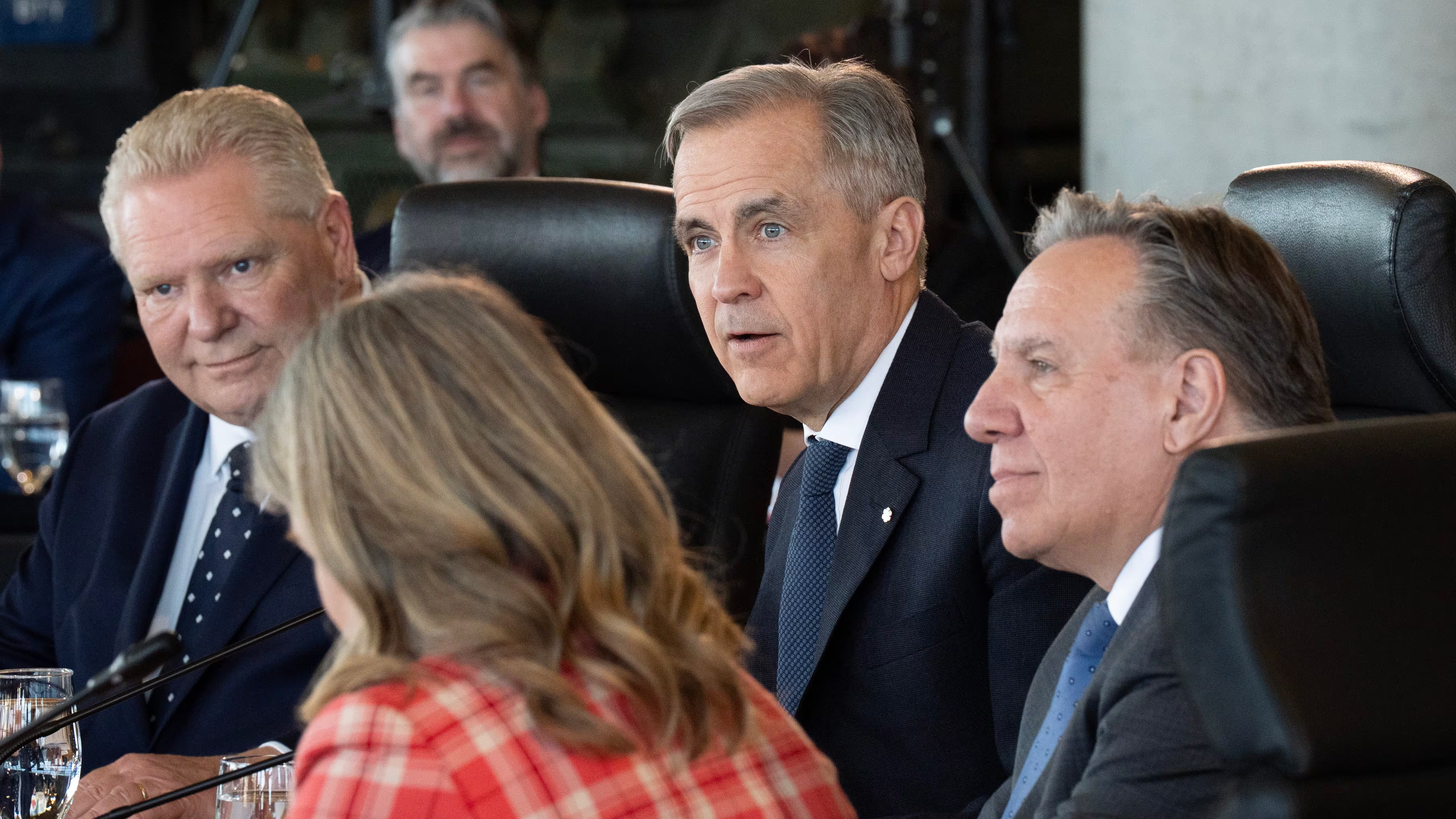
Prime Minister Mark Carney, centre, Ontario Premier Doug Ford, left, and Premier of Quebec Francois Legault, right, PREMIER OF ALBERTA LEFT IN COWBOY DRAG, take part in the First Minister Meeting at the National War Museum in Ottawa on Friday, March 21, 2025. THE CANADIAN PRESS/Adrian Wyld

OTTAWA — Canada’s new prime minister and its premiers agreed Friday to pursue plans to move more energy across the country, tear down internal trade barriers and build big projects faster.

“It is high time to build things that we never imagined, and to build them at a speed that we have never seen,” Prime Minister Mark Carney said in French at the closing news conference following a meeting with the premiers in Ottawa. “We need to unite to build the strongest, fairest and freest country in the world.”

The meeting between Carney and the premiers came just one week after Carney was sworn in as prime minister and about 36 hours before he is expected to call a federal election.

Carney said he and the premiers are looking to build a framework for growth in response to the tariff crisis triggered by U.S. President Donald Trump.

“We are in a crisis, not of our own making, but that is the case now,” he said. “And we need to come together and focus on it, which is what first ministers were doing today and I salute them for it.”


Carney and the premiers discussed finding ways to move energy and critical minerals across the country more efficiently, and to improve digital connectivity.

Asked by reporters whether his government would spend federal tax dollars to build an oil and gas pipeline, Carney said the matter is not “black and white” but didn’t rule out federal participation in the future.

The first ministers also talked about moving quickly to eliminate trade barriers between provinces and with the federal government.

Carney said Ottawa will waive the one-week waiting period for employment insurance for those who lose their jobs to U.S. tariffs, and will temporarily allow Canadian businesses to defer income tax and GST and HST payments to help boost their liquidity.

“These measures as a whole will help our workers, help keep our businesses running and protect our economy during this phase of the trade war,” Carney said.

Carney said his government is committing to removing all exemptions under the Canadian Free Trade Agreement to spur interprovincial trade.

He promised to introduce a “First Mile Fund” to provide capital to build transmission and transportation networks to link natural resource extraction sites to rail lines and roads.

Carney said removing barriers to the free movement of workers, goods and services across the country would increase the size of Canada’s economy by $250 billion.

Ahead of the meeting, several premiers called for the elimination of interprovincial trade barriers.

Ontario’s Doug Ford said premiers agreed with Carney on the need to cut red tape and “streamline approvals to get big things built faster” -- although not all are ready to quash interprovincial trade barriers.

Speaking to reporters after the meeting at the Canadian War Museum in Ottawa, Ford said his province and Nova Scotia are moving ahead with legislation to remove interprovincial trade barriers.


Asked by reporters if all premiers are on board with that effort, Ford said “one or two” are not.

Saskatchewan Premier Scott Moe, who attended the meeting virtually, said Thursday that his priority for the meeting with Carney was to discuss China’s tariffs on Canadian canola oil and meal.

Beijing imposed the tariffs in response to Canada’s levies on Chinese-made electric vehicles, steel and aluminum.

Speaking to reporters after the meeting Friday, Manitoba Premier Wab Kinew said Carney committed to reaching out to the Chinese president before calling a federal election.

Carney said his government would table legislation by July 1 to allow goods to travel across the country barrier-free. He said his government would also remove labour mobility restrictions in federally regulated professions and eliminate duplication by recognizing provincial assessments for major projects.

“We will work with the provinces and other stakeholders, Indigenous groups, to identify projects of national significance and accelerate the time frame to build them,” Carney said, citing the Cedar LNG and LNG Canada projects in British Columbia and the Port of Churchill project in northern Manitoba.

“Together, we can give ourselves more than any foreign government can ever take away,” Carney said.

To encourage Indigenous participation, Carney said his government would double the Indigenous Loan Guarantee to $10 billion.

“We will keep working with our provincial partners to build out national interest projects that cross interprovincial boundaries so they can be prioritized and accelerated,” he said.

“Our vision is one where goods, services and workers can move seamlessly from coast to coast to coast.”

This was the first time all the premiers met with Carney.

Ford told reporters after the meeting that Carney is an “extremely bright business person” who “gets it” and “wants to get it done.”

Kinew said he sees Carney as “a dealmaker.”

Article written by Catherine Morrison and Nick Murray.

Weekslong lockups of tourists at U.S. borders spark fears of travelling to America

By The Associated Press
March 21, 2025 

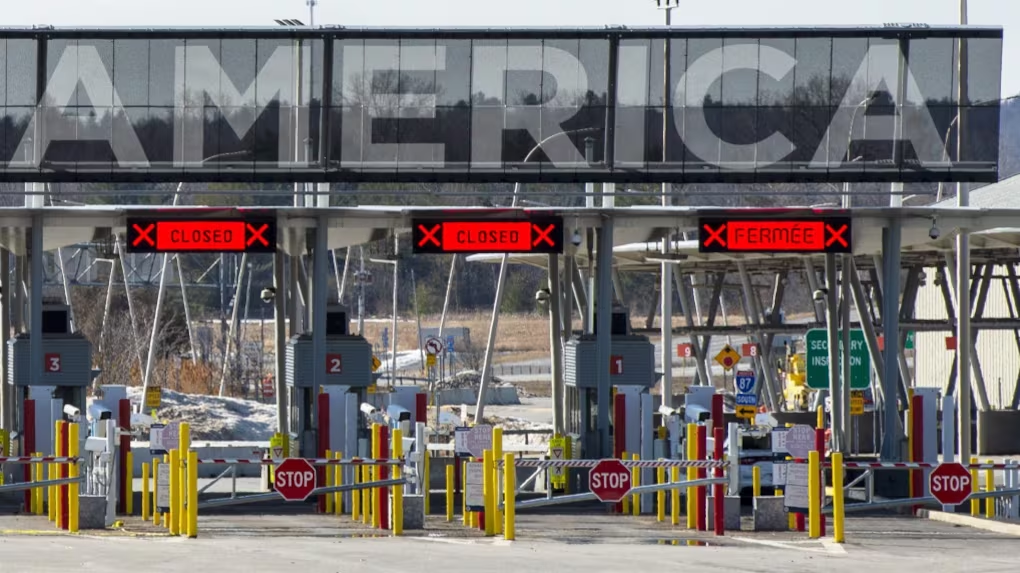
 The United States border crossing is seen Wednesday, in Lacolle, Que. 
(Ryan Remiorz / THE CANADIAN PRESS)

SAN DIEGO — Lennon Tyler and her German fiancé often took road trips to Mexico when he vacationed in the United States since it was only a day’s drive from her home in Las Vegas, one of the perks of their long-distance relationship.

But things went terribly wrong when they drove back from Tijuana last month.

U.S. border agents handcuffed Tyler, a U.S. citizen, and chained her to a bench, while her fiancé, Lucas Sielaff, was accused of violating the rules of his 90-day U.S. tourist permit, the couple said. Authorities later handcuffed and shackled Sielaff and sent him to a crowded U.S. immigration detention centre. He spent 16 days locked up before being allowed to fly home to Germany.

Since U.S. President Donald Trump took office, there have been other incidents of tourists like Sielaff being stopped at U.S. border crossings and held for weeks at U.S. immigration detention facilities before being allowed to fly home at their own expense.

They include another German tourist who was stopped at the Tijuana crossing on Jan. 25. Jessica Brösche spent over six weeks locked up, including over a week in solitary confinement, a friend said.


On the Canadian border, a backpacker from Wales spent nearly three weeks at a detention centre before flying home this week. And a Canadian woman on a work visa detained at the Tijuana border spent 12 days in detention before returning home last weekend.

Sielaff, 25, and the others say it was never made clear why they were taken into custody even after they offered to go home voluntarily.

Pedro Rios, director of the American Friends Service Committee, a nonprofit that aids migrants, said in the 22 years he has worked on the border he’s never seen travelers from Western Europe and Canada, longtime U.S. allies, locked up like this.

“It’s definitely unusual with these cases so close together, and the rationale for detaining these people doesn’t make sense,” he said. “It doesn’t justify the abhorrent treatment and conditions” they endured.

“The only reason I see is there is a much more fervent anti-immigrant atmosphere,” Rios said.

Of course, tourists from countries where the U.S. requires visas — many of them non-Western nations — have long encountered difficulties entering the U.S.

U.S. authorities did not respond to a request from The Associated Press for figures on how many tourists have recently been held at detention facilities or explain why they weren’t simply denied entry.
Weekslong lockups fuel anxieties about tourist travel to U.S.

The incidents are fueling anxiety as the Trump administration prepares for a ban on travelers from some countries. Noting the “evolving” federal travel policies, the University of California, Los Angeles sent a notice this week urging its foreign-born students and staff to consider the risks of travel for spring break, warning “re-entry requirements may change while you are away, impacting your return.”

Immigration and Customs Enforcement said in an email to the AP that Sielaff and Brösche, who was held for 45 days, “were deemed inadmissible” by Customs and Border Protection. That agency said it cannot discuss specifics but “if statutes or visa terms are violated, travelers may be subject to detention and removal.” The agencies did not comment on the other cases.
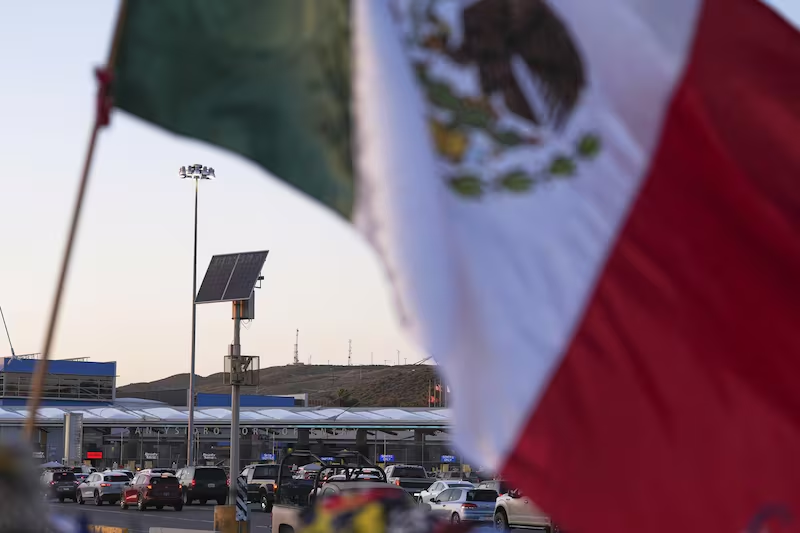
Vehicles wait in line to cross the border into the United States at the San Ysidro Port of Entry, Tuesday, March 18, 2025, in Tijuana, Mexico. 
(AP Photo/Gregory Bull, File)

Both German tourists were allowed into the United States under a program offered to a select group of countries, mostly in Europe and Asia, whose citizens are allowed to travel to the U.S. for business or leisure for up to 90 days without getting a visa in advance. Applicants register online with the Electronic System for Travel Authorization.

But even if they are authorized to travel under that system, they can still be barred from entering the country.

Sielaff arrived in the U.S. on Jan. 27. He and Tyler decided to go to Tijuana for four days in mid-February because Tyler’s dog needed surgery and veterinary services are cheaper there. They figured they would enjoy some tacos and make a fun trip out of it.

“Mexico is a wonderful and beautiful country that Lucas and I love to visit,” Tyler said.

They returned Feb. 18, just 22 days into Sielaff’s 90-day tourist permit.

When they pulled up to the crossing, the U.S. border agent asked Sielaff aggressively, “Where are you going? Where do you live?” Tyler said.

“English is not Lucas' first language and so he said, ‘We’re going to Las Vegas,' and the agent says, ’Oh, we caught you. You live in Las Vegas. You can’t do that,‘” Tyler said.

Sielaff was taken away for more questioning. Tyler said she asked to go with him or if he could get a translator and was told to be quiet, then taken out of her car and handcuffed and chained to a bench. Her dog, recovering from surgery, was left in the car.

After four hours, Tyler was allowed to leave but said she was given no information about her fiancé’s whereabouts.

During questioning, Sielaff said he told authorities he never lived in the U.S. and had no criminal history. He said he was given a full-body search and ordered to hand over his cellphone and belongings. He was put in a holding cell where he slept on a bench for two days before being transferred to the Otay Mesa Detention Center in San Diego.

There, he said, he shared a cell with eight others.

“You are angry, you are sad, you don’t know when you can get out,” Sielaff said. “You just don’t get any answers from anybody.”

He was finally told to get a direct flight to Germany and submit a confirmation number. In a frantic call from Sielaff, Tyler bought it for $2,744. He flew back March 5.
‘A blatant abuse’ of U.S. border authorities' power, victims say

“What happened at the border was just blatant abuse of the Border Patrol’s power,” Tyler said.

Ashley Paschen agrees. She said she learned about Brösche from a TikTok video asking anyone in the San Diego area for help after her family learned she was being held at the Otay Mesa Detention Center. Paschen visited her several times and told her people were working to get her out. Brosche flew home March 11.

“She’s happy to be home,” Paschen said. “She seems very relieved if anything but she’s not coming back here anytime soon.”

On Feb. 26, a tourist from Wales, Becky Burke, a backpacker travelling across North America, was stopped at the U.S.-Canada border and held for nearly three weeks at a detention facility in Washington state, her father, Paul Burke, posted on Facebook. She returned home Tuesday.

On March 3, Canadian Jasmine Mooney, an actress and entrepreneur on a U.S. work visa, was detained at the Tijuana crossing. She was released Saturday, her friend Brittany Kors said.

Before Mooney’s release, British Columbia Premier David Eby expressed concern, saying: “It certainly reinforces anxiety that ... many Canadians have about our relationship with the U.S. right now, and the unpredictability of this administration and its actions.”

The detentions come amid legal fights over the Trump administration’s arrests and deportations of other foreigners with valid visas and green card holders, including a Palestinian activist who helped organize campus protests of the war in Gaza.

Tyler plans to sue the U.S. government.

Sielaff said he and Tyler are now rethinking plans to hold their wedding in Las Vegas. He suffers nightmares and is considering therapy to cope with the trauma.

“Nobody is safe there anymore to come to America as a tourist,” he said.

___

Associated Press writer Rob Gillies reported from Toronto.

Julie Watson, The Associated Press