Sunday, March 30, 2025

Trump's tariffs won't just hit your wallet


Fresh produce being sold in August 2024 (Jason Wells/Shutterstock.com)

March 30, 2025

Spring has sprung, and you can tell by looking at Dig’s online menu. The fast-casual chain known for its bountiful salads and bowls is promoting a new sandwich for the spring — the “avo smash,” wherein a hearty piece of chicken or tofu is embraced by a brioche bun, pesto aioli, and plenty of bright-green avocado.

The lunch spot’s seasonal menus are planned at least three months in advance, said Andrew Torrens, Dig’s director of supply, meaning the avo smash has been in the works for a while. However, if the United States decides to escalate a global trade war next month, Dig will have to come up with a backup plan fast.

“If avocado prices explode, what’s our backup? How do we pivot?” said Torrens on a recent phone call.

Since his inauguration in January, President Donald Trump has repeatedly threatened tariffs on imports from Mexico and Canada — creating confusion for restaurant owners, food distributors, grocers, and consumers who rely on the United States’ neighbor to the south for fruits and vegetables year-round. On February 1, the president signed an executive order levying a 25 percent tariff on goods from Canada and Mexico. However, he has twice pushed back the start date; earlier this month, he paused tariffs on most goods coming in from Mexico and Canada until April 2. What will actually happen on that date — which Trump has dubbed “Liberation Day” — is still largely unclear.

A tariff on goods from Mexico, the single largest supplier of horticultural imports to the U.S., would almost certainly mean higher prices at the grocery store. It could also, according to experts, increase food waste along the supply chain.

Dig sources most of its avocados from Mexico, where the warm climate is ideal for growing these fruits. This is common — in fact, about 90 percent of avocados consumed in the U.S. come from Mexico, according to the U.S. Department of Agriculture. “We rely on imports, from Mexico in particular, on things like fresh fruit and vegetables in order to meet year-round consumer demand,” said David Ortega, a professor focused on agricultural economics and policy at Michigan State University. Tariffs have the potential to send those prices soaring by raising the cost of production. But the lack of clarity around U.S. trade relations is already impacting operations in the food and beverage industry.

“There’s so much uncertainty, you don’t know how to operate your business and you don’t know how to plan for it,” said Torrens. “If you knew what the new reality was, you’d adapt to it.”

Other food chains are reeling from the Trump administration’s policies. In an annual filing with the U.S. Securities and Exchange Commission, the salad chain Sweetgreen listed “international trade barriers” as one factor that could spike the cost of ingredients like avocados; it also mentioned the threat of mass deportation of undocumented workers as a supply chain disruption. Asked about tariffs, Scott Boatwright, the CEO of the Mexican-inspired burrito giant Chipotle, told reporters that the company would not pass on higher costs to the customer. “It is our intent as we sit here today to absorb those costs,” Boatwright told NBC Nightly News on March 2, just days before Trump announced a one-month pause in tariffs for goods covered by the U.S.-Mexico-Canada Agreement, or USMCA, the trade agreement he negotiated during his first term.

Much has been written and said about the economic impacts of tariffs. One lesser-known side effect — which could also have environmental consequences — is the potential for more food loss and waste. This can happen at various points along the food supply chain, from the farm to the U.S.-Mexico border to grocery store shelves. “I think tariffs are a bit of a supply chain disruption,” not unlike the ones felt during the pandemic, said Brenna Ellison, professor of agribusiness management at Purdue University. The trouble stems from the fact that fruit and vegetables are highly perishable.

“If we’re having trouble getting them in the country because it costs more, if that creates more hesitation among U.S. buyers to get those products into the country, the clock is ticking really fast,” said Ellison. Items that normally would make their way to U.S. consumers will “go to waste quickly unless we can find some alternate use for them.”

Food loss and waste are measured by looking at how much edible food grown for human consumption doesn’t end up feeding people — whether that’s at the harvesting and processing stage or further along the way to the consumer, like in stores or kitchens. When organic matter, like fruits and vegetables, is thrown out, it often winds up in landfills — where it emits methane, a powerful greenhouse gas, as it rots. In the U.S., a majority of wasted food — about 60 percent — goes to landfills, according to the Environmental Protection Agency. The EPA also found that every year, 55 million metric tons of carbon dioxide equivalents are emitted from food waste in landfills.

During the pandemic, there were reports of farmers leaving food to rot in the fields, as restaurants shut down and growers lost access to their regular customers. Ellison states this could happen again, if tariffs raise the price of agricultural goods to the point that growers are not confident they’ll be able to sell as much product as they’re used to and recoup the cost of harvesting.

But she noted that it does not necessarily mean those crops are sent to a landfill. “In some cases, depending on the crop, it can be tilled back into the soil,” sending plant nutrients back to the earth, said Ellison.

However, more waste can happen further along the supply chain — on the way to market or in grocery stores. If tariffs lead to delays in processing at the border, that could lead to more produce spoiling before or as it meets the consumer, said Ortega. He also mentioned that when the Trump administration first announced tariffs, “a lot of importers started to do what we call ‘front-loading’; they started to get as much product over the border in an effort to beat the tariff.”

Ordering fresh produce in excess means you have to sell it. Multiple Whole Foods Market stores in New York City in mid-March had a promotion on Mexican produce, including avocados and mangos. Whole Foods did not respond to a request for comment about whether the sale was related to tariff announcements. United Natural Foods Inc. — the importer for Whole Foods — had no comment, said Kristin Jimenez, the corporation’s vice president of corporate communications.

When food is left on grocery store shelves, it can also lead to food waste, said Ellison at Purdue. That can happen when retailers over-order produce and can’t sell all of it — or when prices go up and “people just can’t afford” to buy it, Ellison added.

There’s also a chance that consumers could end up seeing more limited availability of goods as retailers try to switch up their sourcing to avoid tariffs.

While Trump campaigned on lowering the cost of goods at the grocery store, a 25 percent tariff on goods from Mexico could make basics like fruits and vegetables even more expensive. That has hunger relief organizations worried, too.

“We’re obviously concerned that anytime there’s a potential disruption in the supply chain, particularly with fruits and vegetables, it could impact our ability to feed those in need,” said Jen Cox, the chief development officer at Food Forward, a food rescue operation focused on redistributing fresh produce to food banks, after-school programs, and more. She added that tariffs could exacerbate an already challenging cost-of-living situation for many people in the U.S., leading to an increase in hunger.

The U.S. set a goal of cutting food waste in half by 2030 — we’re nowhere near that. Should tariffs drive an increase in food sent to landfills, it will be one of multiple knock-on effects that trade barriers will have on consumers. “It’s sort of a conflation of all of these situations,” said Cox. Those compounding crises — economic, social, and environmental — mean that organizations like hers could have their hands full in the coming months, working to fill the gaps that “America First” trade policies will likely create.


Grist is a nonprofit, independent media organization dedicated to telling stories of climate solutions and a just future. Learn more at Grist.org
Trade War

U.S. car buyers face higher prices, less choice under Trump’s tariffs

By Reuters
March 28, 2025 

'Sale' is spelled out in the open hoods of used cars at a Toyota dealership 
(AP / Reed Saxon)

LONDON/WHITE LAKE, Michigan — Major automakers can deal with U.S. President Donald Trump’s tariffs on U.S. auto imports in a number of ways, but all of them lead to higher prices, fewer choices of models or limits on features for consumers, industry experts said.

Trump announced 25 per cent tariffs on car and auto parts on Wednesday, sending global automakers’ shares down and raising fears of job losses in big auto-exporting countries. He says the levies will ultimately boost production in the United States, but analysts say the immediate effect will be on automakers’ choices that will hit consumers’ wallets.

“Most car makers can’t eat 25 per cent, they just can’t,” said Andy Palmer, former CEO of Aston Martin. “That means car makers will pass on as much of the cost of tariffs as they can,” including by removing features to lower their costs while also raising prices.Latest news & updates on tariffs and the trade war here

Automakers may spread that cost between U.S.-produced and imported models, cut back on features, and in some cases, stop selling affordable models aimed at first-time car buyers, as many of those are imported and less attractive if they carry a higher price tag.

The changes could price more Americans out of the market. S&P Global Mobility estimated Thursday that tariffs will cause annual U.S. vehicle sales to fall to a range of 14.5 million to 15 million in coming years from 16 million in 2024. Cox Automotive estimates tariffs will add US$3,000 to the cost of a U.S.-made vehicle and US$6,000 to vehicles made in Canada or Mexico without exemptions.


While luxury sellers like Bentley or Ferrari say they will pass on costs, major automakers’ typical margins of 6 per cent to 8 per cent leave little wiggle room.

Affordable models most likely to be affected include the Honda CR-V, Chevy Trax, Subaru Forester, Chevy Equinox and Honda HR-V, said Erin Keating, executive analyst at Cox.

“Car makers know they have certain vehicles in their portfolio that can tolerate lower profit margins,” Keating said. “Some vehicles may just prove to be too expensive, and most of those are affordable models manufactured outside the U.S.”

After 10 per cent of the car-buying population was priced out of the market during the coronavirus pandemic, affordability still remains high on consumers’ minds, Keating said.

“Would tariffs bite into another 10 per cent of people who would be priced out?” she said. “Potentially.”

U.S. auto dealers currently have plenty of inventory - about 90 days worth - but prices could start to rise after that. In recent weeks, Eric Mann, sales manager at the Szott M-59 Jeep dealership in White Lake, Michigan, 45 minutes northwest of Detroit, noticed more customers purchasing out of fear of higher prices.

Loretta Acosta, 55, of Macomb, Michigan, was checking out a Jeep Grand Cherokee at the Szott dealership on Thursday and said it “might stink” if car prices rise because of tariffs. “But I do feel like sometimes stuff stinks, and you got to put up with it for the betterment of the country,” Acosta said.
‘Everyone hurts’

European and Asian car makers, deprived of the largest auto importing market, could cut production. If automakers stop shipping a model to the U.S., that would translate into lower production at those factories. Lower volumes mean higher costs per vehicle, “which ultimately will be passed on to consumers” in those markets, Palmer said.

On Thursday Jeron Reed, 46, of Warren, Michigan, went to Matick Chevrolet in Redford, 20 minutes west of Detroit, to finalize a lease on a 2025 Equinox EV because of the tariff threat.


“What I’m hearing within the next couple of weeks (is) prices are probably gonna jump, and they’re already high,” Reed said.

Some companies selling U.S.-made cars with a high percentage of tariff-exempt parts could raise prices to boost profits but still keep them low enough to take market share from tariff-affected rivals. Longer-term, major automakers would have to decide whether to ride out tariffs on a bet that they won’t last, or spend two to three years moving production and supply chains under the expectations that tariffs would last beyond Trump’s presidency, said Mark Wakefield, global automotive market lead at consultancy AlixPartners.

“Those ones could be big winners in three or four years if the tariffs really stay in,” Wakefield said. “Or they could be losers if it somehow unwinds and they’re stuck with higher costs.”

Newer automakers like INEOS Automotive do not have that luxury. The France-based manufacturer started selling its off-road Grenadier model in the United States early last year at an average price of around US$85,000, said CEO Lynn Calder. INEOS has since sold 8,000 vehicles in the U.S., or 60 per cent of its total.

“I don’t think it’s possible to pass a price increase in the range of 25 per cent onto a consumer,” she said. “But equally, it’s also very clear that we can’t absorb it all.”

She said INEOS will split the burden between the company, its dealers and consumers, a hybrid solution where “everyone hurts.”

---

Reporting By Nick Carey; additional reporting by Nora Eckert in Detroit; Editing by Leslie Adler.

---

U.S. President Donald Trump’s reciprocal tariffs on trading partners are set to take effect on April 2, a day he has proclaimed as “Liberation Day” for American trade. CTV News will have extensive coverage across all platforms:CTVNews.ca will have in-depth coverage, real-time updates, and expert analysis on what the tariffs will mean for Canadians.
CP24.com will report on any developments out of Queen’s Park and what the tariffs means for the people of the GTHA.

BNNBloomberg.ca will explain what this means for the business community, investors, and the market.

Noted economist honoured by Trump warns his 25 per cent tariffs could add US$4,711 to the cost of a vehicle

By The Associated Press
March 28, 2025 

An aerial view shows auto dealerships in Cerritos, Calif., Thursday, March 27, 2025. (AP Photo/Jae C. Hong)

WASHINGTON — Noted economist Arthur Laffer warns in a new analysis that U.S. President Donald Trump’s 25 per cent tariffs on auto imports could add US$4,711 to the cost of a vehicle and says the proposed taxes could weaken the ability of U.S. automakers to compete with their foreign counterparts.

In the 21-page analysis obtained by The Associated Press, Laffer, whom Trump awarded the Presidential Medal of Freedom in 2019 for his contributions to economics, says the auto industry would be in a better position if the Republican president preserved the supply chain rules with Canada and Mexico from his own 2019 USMCA trade pact.

The White House has temporarily exempted auto and parts imports under the USMCA from the tariffs starting on April 3 so that the Trump administration can put together a process for taxing non-U.S. content in vehicles and parts that fall under the agreement.

“Without this exemption, the proposed tariff risks causing irreparable damage to the industry, contradicting the administration’s goals of strengthening U.S. manufacturing and economic stability,” Laffer writes in the analysis. “A 25 per cent tariff would not only shrink, or possibly eliminate, profit margins for U.S. manufacturers but also weaken their ability to compete with international rivals.”

In a Friday interview with The Associated Press, Laffer said the report had caused a “kerfuffle” and cautioned that it only applied to the economics, rather than Trump’s negotiating skills and strategic approach to trade.


“The report shows the economics of what would happen were the tariffs to be put in place,” he said. ”This is about facts, not how we feel.”

The economist was quick to also praise Trump as a negotiator who has deep knowledge of trade issues, indicating that the tariff threats could be used as they had during Trump’s first term to ultimately lower barriers to trade and improve outcomes for the U.S. economy.

“Donald Trump is more familiar with the gains from trade than any politician I’ve ever talked to in my life,” Laffer said. ”Do not take this paper in any way, shape or form as criticizing Donald Trump and what his strategies are."

He added that he trusts the president and sees him as exceptionally competent.

While Trump’s tariff plans have frightened the stock market and U.S. consumers, Laffer’s analysis and other reports show the possible economic risks if the threat of import taxes is unable to produce a durable set of deals with other countries. The paper reminds Trump that it’s not too late to change course, specifically complimenting the USMCA negotiated in his first term as a “significant achievement.”

“The United States-Mexico-Canada Agreement (USMCA) has served as a cornerstone of President Trump’s first term and has quickly become a dominant feature of North American trade policy, fostering economic growth, stabilizing supply chains, and strengthening the U.S. auto industry,” Laffer writes.

The analysis says that the per vehicle cost without the USMCA exemption would be US$4,711, but that figure would be a lower US$2,765 if the exemptions were sustained.

Trump honored Laffer with the highest civilian honor 45 years after the economist famously sketched out on a napkin the Laffer curve, showing that there’s an optimal tax rate for collecting revenue.

The bell-shaped curve indicated that there’s a tax rate so high that it could be self-defeating for generating tax revenues. Many Republicans embraced the curve as evidence that lower tax rates could generate stronger growth that would lead to higher tax revenues.

“Dr. Laffer helped inspire, guide, and implement extraordinary economic reforms that recognize the power of human freedom and ingenuity to grow our economy and lift families out of poverty and into a really bright future,” Trump said in awarding him the medal.

Laffer served on the economic policy advisory board of President Ronald Reagan, in addition to being a university professor. He has his own economic consultancy, Laffer Associates. In 1970, he was the first chief economist of the White House Office of Management and Budget.


Laffer also advised Trump during his 2016 presidential campaign and co-wrote a flattering book, “Trumponomics: Inside the America First Plan to Revive Our Economy.”

Trump maintains that 25% tariffs will cause more foreign and domestic automakers to expand production and open new factories in the United States. On Monday, he celebrated a planned US$5.8 billion investment by South Korean automaker Hyundai to build a steel plant in Louisiana as evidence that his strategy would succeed.

Trump said the 25 per cent auto tariffs would help to reduce the federal budget deficit while moving more production into the United States.

“For the most part, I think it’s going to lead cars to be made in one location,” Trump told reporters on Wednesday. “For right now, the car would be made here, sent to Canada, sent to Mexico, sent to all over the place. It’s ridiculous.”

---

Josh Boak, The Associated Press
'Going to raise prices': Bartiromo hits Trump adviser for enacting 'tariffs on screws'


David Edwards
March 30, 2025
RAW STORY


Fox News/screen grab

Fox News host Maria Bartiromo pressed White House economic adviser Kevin Hassett about how President Donald Trump's "tariffs on screws" were "going to raise prices" for consumers.

During a Sunday interview, Hassett admitted that he had little idea what new economic policies Trump would impose in the coming week.

"I can't give you any forward-looking guidance on what's going to happen this week," Hassett said. "The president has got a heck of a lot of analysis before him, and he's going to make the right choice, I'm sure."

Bartiromo noted that it could take companies two to three years to shift manufacturing to the U.S. despite the tariffs.

"But what do you want to say to people who are questioning this as they see the stock market sell off?" she asked Hassett. "How long would you expect this disruption to last? The Wall Street Journalout with a piece this morning."

"Tariffs on screws are already hitting manufacturers, meanwhile, meaning that they're going to raise prices," the host remarked.


For his part, Hassett argued that Republicans would pass tax cuts to help the economy in the coming months.

"We've got the biggest, most pro-worker tax cut in history that's moving forward at a breakneck speed," he asserted. "And I think the naysayers will be proven wrong if they're a little bit nervous about the blips from this week to next."

"Well, there are also questions about the tax extensions," Bartiromo replied. "How will the Congress get it done?"

"It feels like the odds of this passing sometime in the summer are extraordinarily high," Hassett insisted. "It's a golden age."

"Well, look, if you're talking about the middle of the summer, that we'll actually see this begin to materialize, we may need it by that time because it feels like the economy is slowing," Bartiromo observed.


Watch the video below from Fox News or at the link.


'How exactly?' Fox News host grills Peter Navarro after he says 'tariffs are tax cuts'

David Edwards
March 30, 2025
RAW STORY


Fox News/screen grab

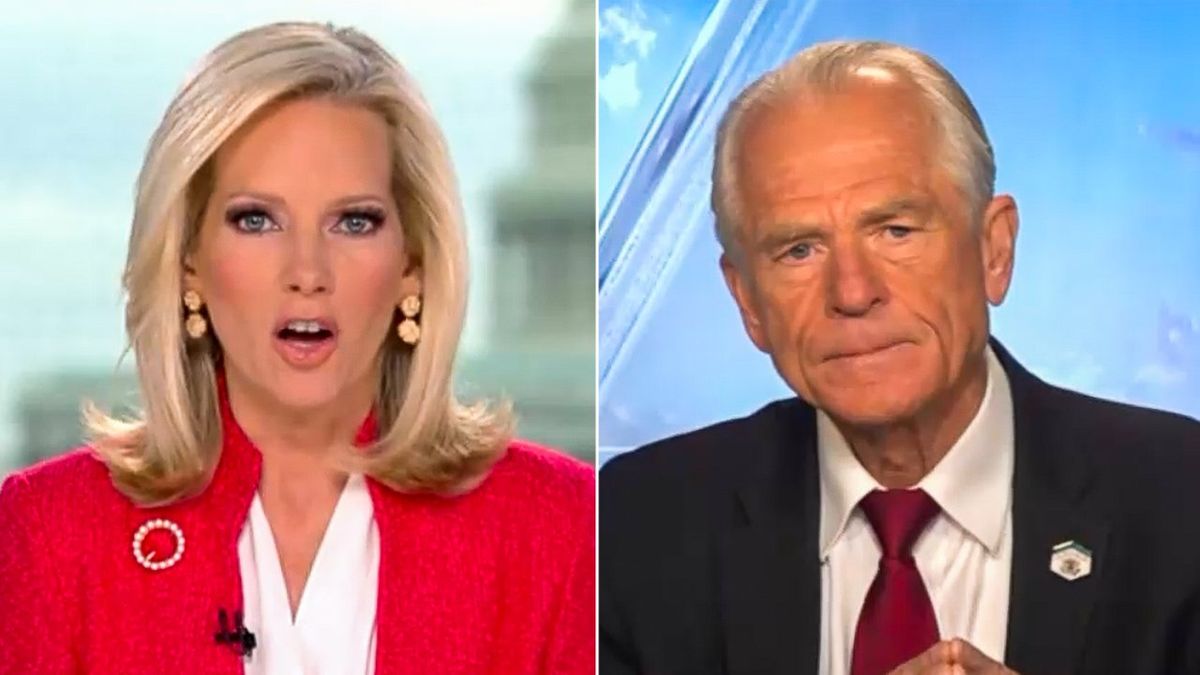
Fox News host Shannon Bream challenged White House trade adviser Peter Navarro after he insisted that President Donald Trump's tariffs were "tax cuts."

During an interview on Fox News Sunday, Bream noted that Trump had said he "couldn't care less" if car prices increase because of his tariffs.

"The U. S. Consumer message is that tariffs are tax cuts," Navarro insisted. "Tariffs are jobs. Tariffs are national security. Tariffs are great for America. Tariffs will make America great again."


"I want to clarify," Bream interrupted, "when you say a tax cut, how exactly is that going to work?"

"First of all, we're going to raise about a hundred billion dollars with the auto tariffs alone," Navarro replied. "What we're going to do is, in the new tax bill that has to pass, it absolutely has to pass, we're going to provide tax benefits, tax credits to the people who buy American cars."

ALSO READ:'Not much I can do': GOP senator gives up fight against Trump's tariffs


"This is a genius thing that President Trump promised on the campaign trail," he added. "In addition, the other tariffs are going to raise about six hundred billion dollars a year, about six trillion over a ten-year period, and we're going to have tax cuts."

"Trust in Trump," Navarro said.

Watch the video below from Fox News or at the link.


Trade War

$18 billion a year dip in US tourism expected — thanks to Trump

Photo by Adrián Valverde on Unsplash


The United States is one of the top three most visited countries in the world. The big draw cards – cities such as San Francisco, New York and Chicago and national parks such as Yosemite – have attracted international tourists for decades. This combined with its role as a global business powerhouse meant it had 66.5 million visitors in 2023 – and the 2024 figure is expected to be higher still.

But a lot has changed in recent months, and 2025’s figures may not be as strong. The 2024 reelection of Donald Trump as the president of the United States and the consequential changes in foreign diplomacy and relations, alongside internal cultural shifts, are starting to change global attitudes towards the US – attitudes that appear to be affecting tourists’ desire to visit the US.

In a recent report by research firm Tourism Economics, inbound travel to the US is now projected to decline by 5.5% this year, instead of growing by nearly 9% as had previously been forecast. A further escalation in tariff and trade wars could result in further reductions in international tourism, which could amount to a US$18 billion (£13.8 billion) annual reduction in tourist spending in 2025.

There is already some evidence of travel cancellations. Since Trump announced 25% tariffs on many Canadian goods, the number of Canadians driving across the border at some crossings has fallen by up to 45%, on some days, when compared to last year. Canada is the biggest source of international tourists to the US. Air Canada has announced it is reducing flights to some US holiday destinations, including Las Vegas, from March, as demand reduces.

According to a March poll by Canadian market researcher Leger, 36% of Canadians who had planned trips to the United States had already cancelled them. According to data from the aviation analytics company OAG, passenger bookings on Canada to US routes are down by over 70% compared to the same period last year. This comes after the U.S. Travel Association warned that even a 10% reduction in Canadian inbound travel could result in a US$2.1 billion (£1.6 billion) loss in spending, putting 140,000 hospitality jobs at risk.

An unwelcoming environment?

Some would-be visitors have cited an unwelcoming political climate as part of a concern about visiting the US – including angry rhetoric about foreigners, migrants and the LGBTQ+ community. The Tourism Economics report also cited “polarizing Trump Administration policies and rhetoric” as a factor in travel cancellations.

There are other factors that may influence travellers from, for instance, western Europe, which represented 37% of overseas travel to the US last year. These include US tariffs pushing prices up at home and the US administration’s perceived alignment with Russia in the war in Ukraine.

Canadian trips to the US are going down.

Research by YouGov in March found that western European attitudes towards the US have become more negative since Trump’s reelection last November. More than half of people in Britain (53%), Germany (56%), Sweden (63%) and Denmark (74%) now have an unfavourable opinion of the US. In five of the seven countries polled, figures for US favourability are at the lowest since polling began in November 2016.

Border issues

Some high-profile cases at the US border could also be putting off tourists. In March, a British woman was handcuffed and detained for more than ten days by US Customs Enforcement after a visa problem. In the same month, a Canadian tourist was detained after attempting to renew her visa at the US-Mexico border. During the 12-day detention, she was held in crowded jail cells and even put in chains.

Mexico is the US’s second largest inbound travel market. Tourism Economics suggests that issues around new border enforcement rules will raise concerns with potential Mexican tourists. During Trump’s first term in office, Mexican visits to the US fell by 3%. In February this year, air travel from Mexico had already fallen 6% when compared to 2024.

Many countries including Canada have been updating their travel advice for the US. For instance, on March 15 the UK Foreign and Commonwealth Office updated its advice for the US, warning visitors that “you may be liable to arrest or detention if you break the rules”. The previous version of advice, from February, had no mention of arrest or detention. Germany has made similar updates to its travel advisory, after several Germans were recently detained for weeks by US border officials.

Multiple European countries, including France, Germany, Denmark and Norway have also issued specific travel warnings to transgender and non-binary citizens, as US authorities demand tourists declare their biological sex at birth on visa applications. This comes as the US has stopped issuing of passports with a X marker – commonly used by those identifying as non-binary – for its own citizens.

Alternative destinations

As thousands of travellers cancel their trips to the US, other destinations are seeing a spike in interest. Hotels in Bermuda have reported a surge in enquiries as Canadians relocate business and leisure trips away from the US, with some predicting a 20% increase in revenue from Canadian visits.

Europe too has reported increased bookings from Canada, with rental properties experiencing a 32% jump in summer reservations when compared to last year, according to some reports.

There are already growing concerns that visa and entry restrictions will disrupt fans and athletes from enjoying 2026 men’s Fifa World Cup, held on sites in the US, Canada and Mexico. Visitors from some countries, such as Brazil, Turkey and Colombia, could wait up to 700 days to obtain visas. The International Olympic Committee has also raised concerns over the 2028 Olympics Games in Los Angeles, although US officials have insisted that “America will be open”.

With mounting visa delays, stricter border enforcement and growing concerns over human rights and anti-minority rhetoric, the United States risks losing its appeal as a top holiday destination. The long-term impact on its tourism industry may prove difficult to reverse.The Conversation

Ross Bennett-Cook, PhD Researcher, Carnegie School of Sport, Leeds Beckett University

This article is republished from The Conversation under a Creative Commons license. Read the original article.


Canadians spurn flights to U.S. as trade war resistance grows

By Bloomberg News
 March 28, 2025 

Fewer Canadians are flying to the U.S. as an escalating trade war between the nations alters vacation habits.

Air Canada has seen the transborder market soften, and WestJet bookings have shifted from the U.S. to other destinations, according to spokespeople from Canada’s top two passenger air carriers.

Bookings made from Canada to the U.S. fell by 13 per cent in February and March compared with a year ago, according to data from Canadian website FlightHub.com. Searches for travel within Canada surged over the same period, toppling the U.S. as the most-searched destination.

“The timing and magnitude of the booking decline, especially following the February 1 tariff announcement, suggest consumer confidence in cross-border travel was significantly impacted by geopolitical uncertainty,” FlightHub Chief Executive Officer Henri Chelhot said in a statement.

The change in travel patterns is part of a larger boycott of American products in response to U.S. President Donald Trump’s tariffs on Canadian goods and his desire to annex Canada. “Donald Trump wants to break us so America can own us,” Prime Minister Mark Carney warned at a campaign rally this week.

For airlines, the drop in U.S. flight demand could hurt profits at a time when their bottom lines are already under pressure from weakness in the Canadian dollar and recession fears.

Air Canada, the country’s largest air carrier, said in an email that it’s responding to softer transborder demand by using smaller aircraft or reducing route frequency. For example, its previously non-stop flight between Vancouver and Washington, DC, now includes a stopover in Toronto. The airline also reduced capacity for routes to U.S. leisure destinations such as Florida, Las Vegas and Arizona, it said in its latest earnings call.

WestJet has adjusted its schedule to fly more to Mexico, the Caribbean and transatlantic destinations, a spokesperson said by email.

Jet travel isn’t the only mode of transportation affected by Canadians’ boycott. Cross-border road trips by Canadian residents in February plunged 23 per cent year over year, according to Statistics Canada.

Chunzi Xu, Bloomberg News

©2025 Bloomberg L.P.
Trade War

Buzzkill: Trump's trade wars threaten America's craft brewers already reeling from changing tastes
 March 30, 2025 

A bartender pours a craft beer at the Liquid Love Brewing in Buffalo Grove, Ill., Thursday, Feb. 9, 2022. (AP Photo/Nam Y. Huh, File)

America’s craft brewers already have enough problems. Hard seltzers and cocktails are muscling into beer sales. Millennials and Gen Z don’t drink as much as their elders. Brewpubs still haven’t fully recovered from the shock of COVID-19 five years ago.

Now there’s a new threat: President Donald Trump’s tariffs, including levies of 25 per cent on imported steel and aluminum and on goods from Canada and Mexico.

“It’s going to cost the industry a substantial amount of money,” said Matt Cole, brewmaster at Ohio-based Fat Head’s Brewery. Trump’ trade war “will be crippling for our industry if this carries out into months and years.”

The tariffs, some of which have been suspended until April 2, could impact brewers in ways big and small, said Bart Watson, president and CEO of the Brewers Association, the trade group for craft beer. Aluminum cans are in Trump’s crosshairs. And nearly all the steel kegs used by U.S. brewers are made in Germany, so a tariff on finished steel products raises the cost of kegs. Tariffs on Canadian products like barley and malt would also increase costs. And some brewers depend on raspberries and other fruit from Mexico, Watson said.

At Port City Brewing in Alexandria, Virginia, founder Bill Butcher worries that he’ll have to raise the price of a six-pack of his best-selling Optimal Wit and other brews to $18.99 from around $12.99, and to charge more for a pint at his tasting room.


“Are people still going to come here and pay $12 a pint instead of $8?‘’ he said. “Our business will slow down.‘’

For Port City, the biggest threat comes from the looming tariff on Canadian imports. Every three weeks, the brewery receives a 40,000-pound truckload of pilsner malt from Canada, which goes into a 55,000-pound silo on the brewery’s grounds. Butcher said he can’t find malt of comparable quality anywhere else.

Trump’s tariffs also hit Port City in a round-about way: The levy on aluminum, which went into effect March 12, is causing big brewers to switch from aluminum cans to bottles. Port City, which bottles 70% of its beer, found itself unable to get bottles.

“Our bottle supplier is cutting us off at the end of the month,‘’ Butcher said. “That caught us by surprise.‘’

Fat Head’s Brewery gets its barley from Canada. Cole said it could shift to sources in Idaho and Montana, but the shipping logistics are more complicated. And Trump’s tariffs, by putting Canadian barley at a competitive disadvantage, would allow U.S. producers to raise domestic prices.

Fat Head’s is trying to mitigate the impact of the tariffs. Anticipating higher aluminum prices, for instance, the brewery stockpiled beer cans — which it gets from a U.S. supplier — and now has 3 million cans in its warehouse, 30% of what it needs annually. It has also shifted production to painted cans, which are cheaper than those with shrink-wrapped film sleeves.

In Arizona, some brewers are already eliminating or reducing the beers they offer in aluminum cans to cut costs, said Cale Aylsworth, the director of sales and relations at O.H.S.O. Brewery and Distillery and president of the Arizona Craft Brewers Guild.

“This is a blow to Arizona craft. I hate to see less local options on the shelf,” Aylsworth said.

Some brewers have also lost access to store shelves from one big customer: Canada, which is the top foreign market for U.S. craft beer, accounting for almost 38% of exports. But Canadians are furious that Trump targeted their products, and Canadian importers have been cancelling orders and pulling U.S. beer off store shelves.

The tariffs come at an already difficult time for brewers.

After years of steady growth — the number of U.S. breweries more than doubled to 9,736 between 2014 and 2024 — the industry is struggling to compete with seltzers and other beverages and to win over younger customers. In 2024, brewery closings outnumbered openings for the first time since the mid-2000s, Watson of the Brewers Association said. He estimates that U.S. craft beer production dipped 2% to 3% last year.


“Craft brewing had a period of phenomenal growth, but we are not in that era anymore,” he said. “We’re in a more mature market.”

Port City’s production peaked in 2019 at 16,000 barrels of beer — equivalent to 220,000 cases. Then COVID hit and hammered the company’s draft beer business in bars and restaurants. The comeback has been slow. Butcher expects Port City to produce 13,000 barrels this year.

The brewery seeks to set itself apart by emphasizing its award-winning brews. In 2015, Port City was named small brewery of the year at the Great American Beer Festival. But it isn’t easy with import taxes threatening to raise the cost of ingredients and packaging.

“It’s hard enough to run a small business when your supply chain is in intact,‘’ he said. And the erratic way that Trump has rolled out the taxes — announcing them, then suspending them, then threatening new ones — has made it even more difficult to plan.

“The unpredictability just injects an element of chaos,‘’ Butcher said.

Aylsworth, in Arizona, said big brewers have whole teams of people to calculate the impact of tariffs, but smaller brewers must stretch their resources to navigate them. That’s on top of the other complexities of running a brewery, from zoning laws to licensing permits to labor shortages.

But for many brewers, the heaviest burden right now is lower sales as customers cut back on beer, Aylsworth said. That’s why many brewers are trying hard not to raise prices.

“In today’s world, with the economy and the high level of uncertainty, people are spending less,” Cole said. “Beer is an affordable luxury, and we want to make sure we don’t lose that.‘’

Dee-ann Durbin And Paul Wiseman, The Associated Press

Elbows up, Canada: Musical responses to Trump’s Canada threats


Photo by Jason Hafso on Unsplash

Some Canadian musicians and content creators are reflecting a sudden surge in patriotism as they listen anxiously to the crescendo and decrescendo of United States President Donald Trump’s rhetoric against their country.

The pro-Canada songs currently spreading across social media, including some by Canadian celebrities, reveal a range of reactions to Trump’s tariffs and annexation threats, while also contributing to the national mood.

These songs are striking, because Canadians have in recent decades been relatively uninterested in loud assertions of nationalist sentiment, outside of sporting events.

Shared identity

When shared identity has been emphasized, it has often been to promote provincial separatism or the rights of Indigenous Peoples. Uncritical Canadian nationalism has, to some, felt inappropriate since the 2015 findings and recommendations of the Truth and Reconciliation Commission.

Patriotic feelings were further complicated during the pandemic, when the flag was co-opted by people opposing public health restrictions.

In these contexts, many commentators have for some time struggled to locate a shared Canadian attitude toward the nation.

Terms such as “multicultural nationalism,” “plural nationalism” or even “a postnational country” are perhaps the best descriptors of nationalist sentiment when it’s expressed in Canada.

In music, Canadian nationalism is only rarely articulated, beyond performances of the anthem. The pop songs that tell particularly Canadian stories tend to be more sentimental than nationalistic — songs like Gordon Lightfoot’s “Canadian Railroad Trilogy” or Anne Murray’s “Snowbird.”

Yet something has shifted since Trump’s verbal and economic attacks on Canada began, as the reactions of sports fans to performances of the U.S. anthem have also demonstrated.

Songs on the trade war

As a scholar of music and nationalism, I’m interested in what the several dozen songs about the trade war that I have located might suggest about that shift.

The patriotic songs by apparently Canadian creators that I discuss here are all drawn from Facebook and Instagram feeds and searching YouTube using English-language terms such as “Canada tariffs song,” “51st state song,” and “Canadian patriotic song.” A deeper dive into Québec-specific, francophone and multilingual responses would be additional significant ways of looking at this.

They represent an array of musical styles, including rock, metal, reggaecountryfolk and pop.

Most of the songs I found have original music: those setting new lyrics to existing copyrighted tunes are not included here. I also excluded the few songs with potentially slanderous material. A number make use of AI. Indigenous and self-identified immigrant perspectives so far seem under-represented.

Patriotism, Canadian-style

An explicit patriotism is the most striking — and new — feature of this repertoire. What is clear in this sampling, however, is that Canadians still remain allergic to jingoistic nationalism — blindly professing or adhering to belief in the virtue of one’s nation.

TV host and comedian Tom Green’s “I’m a Canadian”, for example, is a humorous, self-deprecating song that celebrates Canada’s uniqueness without being exclusionary or making claims of exceptionalism.

Tom Green’s ‘I’m a Canadian.’

This gentle Canadianism is also reflected in stereotypically polite refusals of Trump’s offer to join the United States: “Thanks, but we’re already great! We don’t need to borrow your stars or your fate!

These songs celebrate politically benign features of Canada — its natural world, its cold winters, its food and its love of sports.

Canadian values, meanwhile, are presented as compassionate, noble and good: “We stand for truth and kindness, and we help those in need.”

Where Canadians are the primary audience, resilience is often foregrounded. The soothing singer-songwriter style of “Canada’s Home,” for example, gently encourages strength and fortitude. Again, strong moral values are emphasized: “Canada’s integrity is what bullies can’t stand.”

Songs for the U.S.

Many songs seem aimed at an American audience, in addition to a Canadian one.

In “We Used to Be the Best of Friends” by Jim Cuddy, a Canadian Music Hall of Famer and Blue Rodeo frontman, the listener is politely reminded of the long friendship between the U.S. and Canada. Cuddy uses a charming folk style to remind Americans of cultural and political experiences shared with Canada, and of challenging times when Canadians had their back.

Jim Cuddy’s ‘We Used to Be the Best of Friends.’

Cuddy’s wistfulness for a threatened friendship contrasts with songs that take a more assertive stance, especially in response to Trump’s 51st state threats. With titles like “Canada is Not For Sale,” such songs emphasize the flag and the rights of Canadians.

A few songs go further still, abandoning traditional courtesies for sarcasm and even rudeness.

Assertions of Canadian strength recur repeatedly. The “elbows up” movement, inspired by the moment Canadian comedian Mike Myers mouthed this hockey phrase associated with Gordie Howe on Saturday Night Live, has produced several songs about Canada’s readiness to resist American actions.

Although songs of this type are more defiant, they nevertheless hold true to traditional Canadian values. “Elbows Up Canada!” celebrates unity and “holding the line” together. Using AI-created video imagery, this song juxtaposes images of early settlers with a brief image of Indigenous people in traditional dress or regalia standing with a Canadian flag, reflecting the lyrics, “side by side”.

‘Elbow’s Up Canada!’ video.

I’ll note that this song’s brief depiction of Indigenous presence is unusual among songs I found. In meditations about national unity, most of these creators make no allusions to Indigenous Peoples, or Canada’s ethnolinguistic or racial diversity.

In so doing, these songs minimize identities that are important to many Canadians in order to bolster national identity. They implicitly encourage all citizens to put aside what separates them to address an external threat.

In a cross-border context, these songs do not articulate hatred of Americans as a people. The frustration they express is consistently directed at Trump, not the U.S. as a whole.

But with a looming election in Canada and the actions and rhetoric of both countries shifting every day, it’s possible this may change. Will the music and the cultural conversation become more hostile? Will Canadians themselves grow concerned if their country’s patriotic turn becomes belligerent?

As Cornell University political scientist Benedict Anderson argued in 1983, a nation is ultimately an “imagined community,” because we can never know everyone within it. The feeling of national belonging happens solely in our minds and is reinforced by the stories we tell ourselves.

Music has a unique capacity to participate in this reinforcement, building shared identity across vast and varied spaces. It can also allow us to differentiate ourselves from others. Both capacities are being fully exploited in this challenging moment.The Conversation


Emily Abrams Ansari, Associate Professor of Music History, Western University

This article is republished from The Conversation under a Creative Commons license. Read the original article.

ITS THE TRUMP  Federal Election 2025

Mark Carney’s Liberals leading Pierre Poilievre’s Conservatives by 5 points in latest Nanos tracking

By Phil Hahn
Published: March 30, 2025 

CTVNews.ca will have exclusive polling data each morning throughout the federal election campaign. Check back each morning to see the latest from a three-day rolling sample by Nanos Research - CTV News and the Globe and Mail’s official pollster.

The federal Liberals are emerging as frontrunners in a tightly-contested election with a five-point lead over the Conservatives, who have maintained steady support as both parties are locked in a two-horse race on Day 8 of the federal election campaign.

The first three-day sample of this election campaign by Nanos Research, CTV News’ and the Globe and Mail’s official pollster, has Mark Carney’s Liberals at 42 per cent — leading Pierre Poilievre’s Conservatives, who are at 37 per cent, by five points.

The New Democratic Party is at 11 per cent, followed by the Bloc Quebecois (five per cent), Green Party of Canada (three per cent) and the People’s Party of Canada (two per cent).

Support for the Liberals has “surged,” according to Nanos Research Chief Data Scientist Nik Nanos.


“Strategic voting appears to be the driving force behind the Liberals’ five-point advantage, as voters rally to counterbalance the Conservative challenge. This dynamic is reshaping the political terrain, squeezing smaller parties out of the spotlight,” said Nanos in a release.Full coverage of federal election 2025

Regional data shows the Liberals with the highest support in Quebec, at 47 per cent, with the lowest support for the party coming from the Prairies, at 35 per cent. For the Conservatives, it’s the exact opposite, with their highest support in the Prairies (43 per cent) and lowest support in Quebec (21 per cent).

Who is preferred prime minister?

When it comes to who Canadians prefer to become prime minister, the Liberals also lead the way with 48 per cent choosing Carney, compared to 32 per cent who chose Poilievre. NDP Leader Jagmeet Singh is far behind, at four per cent.

(Nanos Research)

“In a world disrupted by Trump-era politics, Canadians are laser-focused on who will steer the nation through these turbulent times,” said Nanos. “The stakes are high, and the campaign is just beginning to unfold.

Methodology

CTV-Globe and Mail/Nanos Research tracking survey, March 27 to 29, 2025, n=1,285, accurate 2.7 percentage points plus or minus, 19 times out of 20.

Phil Hahn

Special Projects Producer, CTVNews.ca


IT'S A BUNCH OF DUDES

Poilievre pitches Tories as best choice to stand up to Trump as Singh heads to B.C.

By The Canadian Press
Published: March 30, 2025 

This composite image shows, left to right, Liberal Leader Mark Carney on March 21, 2025; Conservative Leader Pierre Poilievre on March 4, 2025; NDP Leader Jagmeet Singh on Jan. 22, 2025; Bloc Leader Yves-Francois Blanchet on March 5, 2025; Green Party co-leader Jonathan Pedneault on March 5, 2025, in Ottawa.
 THE CANADIAN PRESS/Sean Kilpatrick, Adrian Wyld, Justin Tang

OTTAWA — Conservative Leader Pierre Poilievre brushed off suggestions of campaign turmoil Sunday as he pitched his party as the best choice to stand up to U.S. President Donald Trump.

As the second week of the federal election campaign begins, another round of U.S. tariffs expected on Wednesday threatens to overtake the political conversation in Canada.

And Poilievre is still facing questions about growing concerns in Conservative circles over his messaging and polls that now show him trailing Mark Carney’s Liberals.

Poilievre visited a plastics factory in the Toronto suburb of North York Sunday, where he promised to allow investors to defer capital gains tax if they reinvest those earnings in Canada.

NDP Leader Jagmeet Singh planned to campaign in British Columbia on Sunday, while Carney had no public events scheduled.


Bloc Quebecois Leader Yves-Francois Blanchet had planned to spend much of the day in Victoriaville, Que., while Green co-leaders Elizabeth May and Jonathan Pedneault were scheduled to attend the Juno music awards in Vancouver.

Poilievre dismissed the suggestion that he should focus his campaign more squarely on the U.S. threat, saying the promised reinvestment tax cut would bring billions of dollars into the economy to help Canada fight Trump’s unfair tariffs “from a position of strength.”

“We will be a nation that rewards strivers, builders, entrepreneurs and workers -- an economic fortress that will allow us to be stronger, self-reliant ... stand on our own two feet and stand up to Donald Trump,” he said.

While Sunday’s announcement acknowledged the dangers posed by waves of U.S. tariffs, Poilievre’s campaign has largely focused on familiar Conservative themes of cutting taxes and fighting crime.

Polls indicate Trump’s threats of levies and annexation have become the key concern for Canadians, and more than one poll has put Carney, a former Bank of Canada governor, at a significant advantage among voters when it comes to handling Trump.

Carney’s campaign has focused heavily on responding to the U.S. tariffs.

Following his first phone call with Carney on Friday, Trump appeared to soften his tone toward Canada, agreeing that the two countries would begin negotiating a new economic and security plan after the election.

With files from Dylan Robertson

This report by The Canadian Press was first published March 30, 2025.


Colliers Canada’s head of research outlines 5 key tariff impacts on commercial real estate

By Daniel Johnson
Published: March 30, 2025


BNN Bloomberg is Canada’s definitive source for business news dedicated exclusively to helping Canadians invest and build their businesses.

One real estate expert says there are five key impacts U.S. tariffs are having on Canada’s commercial real estate industry, while highlighting some silver linings for industry.

U.S. President Donald Trump is expected to bring about sweeping new reciprocal tariffs on April 2 coupled with previously delayed tariffs on Canadian and Mexican goods. On Friday Trump thanked Prime Minister Carney for an “extremely productive call.” On Thursday, Carney said in a news conference that it is clear the U.S. is “no longer a reliable partner” and that successive governments in Canada will have a “different relationship” with the U.S.

As tariffs loom over the Canadian economy, Adam Jacobs, head of research at Colliers Canada, outlined five key impacts on the commercial real estate industry in an interview with BNNBloomberg.ca on Thursday. He said the impact of tariff threats is having cascading effects across the Canadian dollar, interest rates, industrial real estate and uncertainty, with uneven impacts across regions.

However, Jacobs highlighted certain silver linings that could partly insulate Canada’s commercial real estate industry.

“Real estate isn’t an export industry. You don’t package it up to sell it to the U.S. …everything’s local,” he said.


Jacobs added that he thinks commercial real estate will not be immune to the downside impacts of tariffs but could fare better than industries that are more entangled with the global economy and exports.

“Toronto real estate doesn’t get exported anywhere it has a certain value and a certain level of demand, and tariffs will be a negative, but I don’t think they’re going to be quite the negative that maybe they are in some other industries,” he said.Loonie

Given more than 75 per cent of Canadian exports move to the U.S., Bloomberg News reported Thursday that tariff threats have had an outsized impact on the loonie, trading around 0.70 cents U.S. on Friday.

Jacobs highlighted that the Canadian dollar had been moving lower but has since stabilized.

“But that is another one of those mixed blessing situations, the weaker the dollar gets, it causes us (commercial real estate) some problems in terms of inflation, the cost of materials,” he said.

“But we have seen a fair bit of interest from German investors, Japanese investors, if you’re transacting in a currency that isn’t the Canadian dollar that can actually weirdly be helpful for the market.”Interest rates

On Wednesday, the Bank of Canada signalled it would have likely paused its interest rate easing cycle earlier in March absent the downside threat to Canada’s economy from tariff uncertainty. The central bank elected to cut its key policy rate by 25 basis points on March 12 to 2.75 per cent.

Jacobs highlighted much of the economic environment cuts both ways for real estate.

“We’re one of those industries that weirdly benefits from economic bad news,” he said.


Lower borrowing costs can be a tailwind for the commercial real estate sector, according to Jacobs, as the industry requires “so much debt.”

“The big question for us is interest rates, that’s been the story of the last five years basically in real estate. Nobody thought rates can get that low, nobody thought rates can get that high,” he said.

“We’re now, we’re on the path back down to normal. But nobody knows what normal is. And I think this is throwing a bit of a wrench in that.”

Going forward, Jacobs said uncertainty around further cuts is “stalling things” in the market. He pointed to seven rates cuts that have occurred since June alongside some expectations of further reductions in borrowing costs.Industrial downside

According to Jacobs, the industrial real estate sector, including the warehouse logistics market, has largely “carried” commercial real estate during the last four to five years, adding the sector has been “kind of unstoppable.”

“It seems like everything that happens tends to benefit that area, like (a) global lockdown and school closure, that’ll be great for Amazon and Costco and home delivery and same day grocery and all that…So population growth fed into it, COVID-19 fed into it, the expansion of just all these same day delivery things,” he said.

Given the current tariff concerns, Jacobs said the industrial real estate sector is tied to things like agriculture, automotive resources, oil and more, which are all “big export industries.”

“That’s why we’re keeping our eye out. We still have a pretty strong industrial market, but more than many other sectors, it’s quite tied to these physical export type of industries. So, I think that’s the downside that we’re most worried about,” he said.Uncertainty kills deals

Downside impacts from tariffs are likely to be unevenly distributed, according to Jacobs.

“There’s certain areas that probably aren’t going to feel much impact (from) tariffs at all,” he said

“Whereas (areas) like southwestern Ontario, because of auto manufacturing, because of auto parts and assembly that’s probably going to take, unfortunately, an outsized hit in terms of all this, as well as areas that are maybe more dependent on oil refining, aluminum manufacturing, that sort of thing.”

Silver linings

Given downside impacts of tariff fears, Jacobs said there are also likely to be silver linings.

Specifically, he pointed to Canadian retailers, manufacturers or food producers that could benefit from buy Canada sentiment, saying they might have their “best year ever.” Additionally, the hospitality industry could benefit from increased domestic travel, which could benefit hotels and restaurants.

The current circumstances might also spur infrastructure improvements, according to Jacobs, which would benefit real estate broadly.

“Real estate is kind of dependent on a lot of these big infrastructure projects that take forever and they’re so expensive and they’re always getting stalled,” he said adding that if Canada responds to tariffs with infrastructure investments it could “be very beneficial to real estate.”

“It’s partly just the sentiment aspect of people feeling like this is happening. People feel like the dam is broken and things are possible, we’re sort of back in growth mode,” Jacobs said.

U.S. President Donald Trump’s reciprocal tariffs on trading partners are set to take effect on April 2, a day he has proclaimed as “Liberation Day” for American trade. CTV News will have extensive coverage across all platforms:CTVNews.ca will have in-depth coverage, real-time updates, and expert analysis on what the tariffs will mean for Canadians.

CP24.com will report on any developments out of Queen’s Park and what the tariffs means for the people of the GTHA.

BNNBloomberg.ca will explain what this means for the business community, investors, and the market.


Daniel Johnson

Journalist, BNNBloomberg.ca