Sunday, April 06, 2025

'There will be blood': JPMorgan hikes odds of Trump-triggered recession to 60%


Jessica Corbett
April 05, 2025
COMMON DREAMS

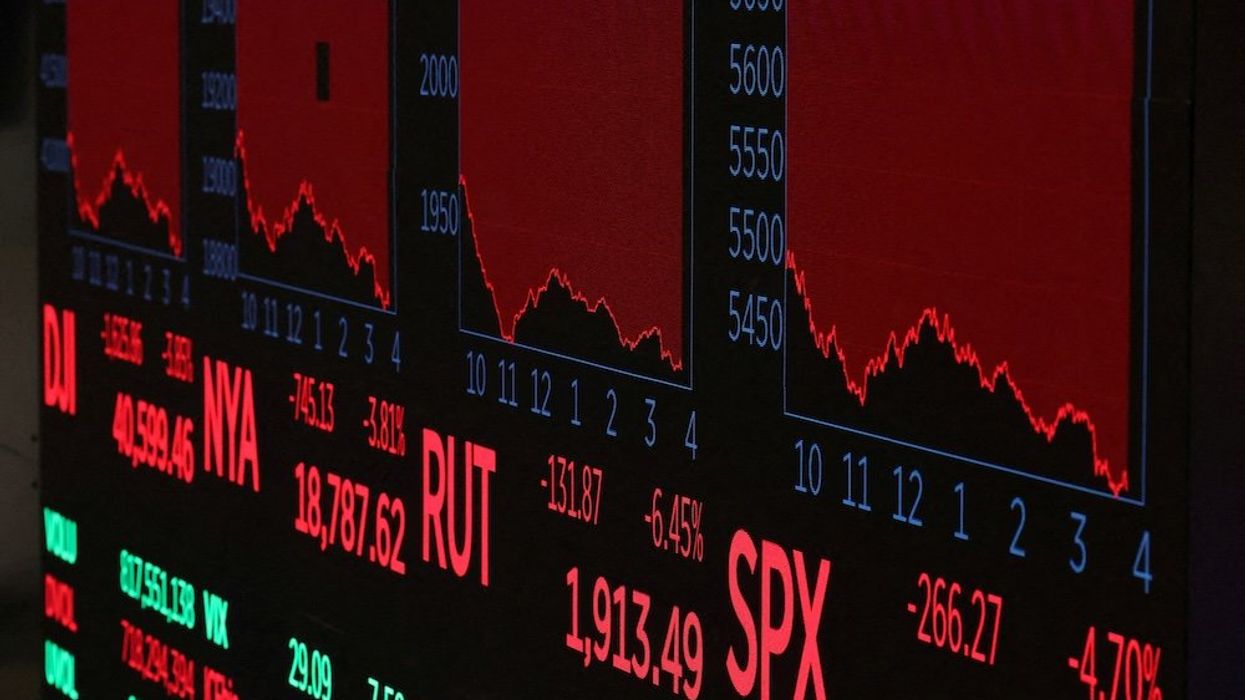
Alarm over U.S. President Donald Trump's tariffs continues to grow, with stocks plummeting and JPMorgan warning that "the risk of recession in the global economy this year is raised to 60%, up from 40%."

After China announced new 34% tariffs on all American goods beginning next week, The Associated Press reported Friday that "the S&P 500 was down 4.8% in afternoon trading, after earlier dropping more than 5%, following its worst day since Covid wrecked the global economy in 2020. The Dow Jones Industrial Average was down 1,719 points, or 4.3%, as of 1:08 p.m. Eastern time, and the Nasdaq composite was 4.9% lower."

Noting the state of Wall Street this week, Groundwork Collaborative executive director Lindsay Owens declared in a Friday statement that "Trump has officially brought the economy to its knees."

"The president single-handedly wiped out Americans' retirement savings overnight and subjected businesses to intense whiplash with his increasingly erratic and chaotic policies that continue to drive consumer and business uncertainty," she said. "To call this an economic downturn is an understatement; Trump is marching us straight into a depression."

Political and economic observers have been publicly wondering for weeks if Trump is intentionally crashing the economy. Further fueling those fears, he ramped up his trade war on Wednesday by announcing a minimum 10% tariff for imports, with higher levies for dozens of countries. Although he claimed those steeper duties are "reciprocal," his math "horrified" economists and has been called "crazy."

Responding in a Thursday note titled, There Will Be Blood, head of global economic research Bruce Kasman and other experts at JPMorgan wrote that "if sustained, this year's ~22%-point tariff increase would be the largest U.S. tax hike since 1968."

"The effect of this tax hike is likely to be magnified—through retaliation, a slide in U.S. business sentiment, and supply chain disruptions," states the note, which came before China's announcement.

Several Wall Street firms on Thursday warned of a U.S. recession, with some making it their base case, after... Trump announced major levies on goods imported from countries around the world. Other economists, including those at JPMorgan, said the hit could be big, though they are taking a wait-and-see approach before revising their projections. The announcement rocked global financial markets, and the S&P 500 suffered its worst day since 2020. Trump, speaking on Air Force One on Thursday afternoon, said he was open to reducing tariffs if trading partners were able to offer something "phenomenal."

"We are not making immediate changes to our forecasts and want to see the initial implementation and negotiation process that takes hold," the JPMorgan note says. "However, we view the full implementation of announced policies as a substantial macroeconomic shock not currently incorporated in our forecasts. We thus emphasize that these policies, if sustained, would likely push the U.S. and possibly global economy into recession this year."

The team also pointed out that the United States is in potential danger no matter how other countries are ultimately impacted, calling a "scenario where rest of world muddles through a U.S. recession possible but less likely than global downturn."

As Common Dreams reported last week, in anticipation of Trump's tariff announcement, Goldman Sachs published a research note projecting that the odds of a recession in the next year are 35%, up from 20%.

Other financial industry research firms that have recently warned of a possible recession include Barclays, BofA Global Research, Deutsche Bank, RBC Capital Markets, and UBS Global Wealth Management, according toReuters.

"This is a game-changer, not only for the U.S. economy, but for the global economy. Many countries will likely end up in a recession," Olu Sonola, head of U.S. economic research at Fitch Ratings, said in a late Wednesday note about the levies. "You can throw most forecasts out the door, if this tariff rate stays on for an extended period of time."

Experts have made similar comments to the press in the wake of the president's Rose Garden remarks on Wednesday. Time on Friday shared some from Brian Bethune, a Boston College economics professor:

"[Consumers] are not even going to the grocery store and paying more for vegetables because there's none available from Mexico, or going to Whole Foods, for example, and finding the big sections of fresh fruit are being shut down. They haven't really felt the full impact [yet], and they're already saying something isn't right," Bethune says. However, while some economists... are more cautious in their discussion about a possible recession, Bethune says it's "inevitable." The question, he says, is just how long until it happens and for how long will it occur? He sees Trump's admission of there being " some pain" on the horizon as only proof of the inevitability.

"At least they [the Trump administration] are not pretending that it's not disruptive, but they're basically soft-selling it, reflecting their ignorance about the way business operates," Bethune claims.


Also on Friday, the Bureau of Labor Statistics released the latest U.S. jobs data. Although the unemployment rate rose from 4.1% to 4.2% in March, the economy added 228,000 jobs, which was better than expected.

However, economists warn of what lies ahead. As University of Michigan economics professor Betsey Stevenson put it, "Today's jobs report is like looking at your vacation photos after you had a horrible car crash on the way home."

'Buckle in': Expert warns of 'classic inflationary spiral' as Trump move forebodes 'disaster scenario'
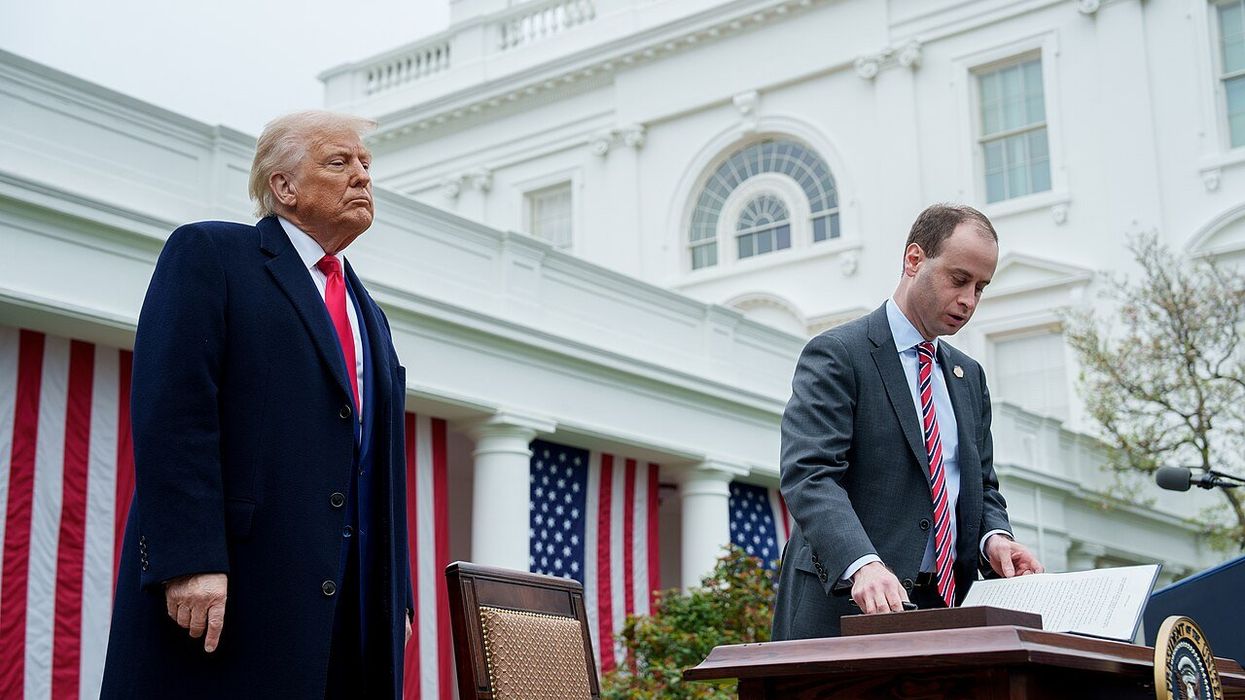
President Donald Trump announcing tariff plans outside the White House on April 2, 2025, Photo via White House / Flickr.
April 04, 2025
ALTERNET

Global economic analyst Rana Foroohar said Friday the markets have never seen anything like the Trump administration's recent policy actions, warning of a "classic inflationary spiral" and a "disaster scenario."

"Trade war is overshadowing everything," she said during an appearance on CNN Friday morning. "The markets have never seen anything like the policy actions that we have just seen."

"We have a tumbling dollar. We have a tumbling market. At the same time, we could see a sharp uptick in inflation," Foroohar said.

Foroohar, who is an associated editor at the Financial Times, noted that people are going out and buying cars because they think the price will increase dramatically in the next few days, weeks, and months. "That's a classic inflationary spiral. Now, that would mean that even with a weakening economy, the Fed might have to raise rates that would just put things into a complete tailspin," she said.

The analyst further warned that this potential situation could make President Donald Trump try to fire Jay Powell, the Fed chair.

"If that happened, and you saw a sense that the entire central banking system was being compromised... Buckle in, because that's when investors see this is the U.S acting like an emerging market," she said.

"And the world is in a complete full blown economic crisis."

On Wednesday President Trump disrupted the global trading system on by introducing a sweeping set of global tariffs. He argued that the United States is experiencing a serious economic crisis due to trade imbalances with various countries around the world. But some economic experts disagree.

Scott Lincicome, vice president of general economics at the Cato Institute, told the New York Times in a report published Thursday that declaring the current trade deficit a national emergency is “beyond a stretch" and that "these numbers are just made up."

Watch this video here or at this link.

The Great Gatsby at 100: The Jazz Age novel that helps explain Trump’s America

Photo by Marvin Meyer on Unsplash

The Conversation
April 01, 2025

F. Scott Fitzgerald’s The Great Gatsby, a top contender for the title of Great American Novel, turns 100 on April 10.

A century later, it is invoked to help make sense of a world that still confuses “material enterprise with moral achievement” – as critic Sarah Churchwell wrote in the foreword to Gatsby’s centennial edition.

A Meta insider’s memoir takes its title, Careless People, from Fitzgerald’s novel. The same phrase circulated on social media and in The New York Times during Donald Trump’s first presidency, referring to his administration’s downplaying of COVID-19.

In 2018, The Atlantic compared Trump to Tom Buchanan, one of Fitzgerald’s “careless people”, describing “an eerie symmetry […] as if the villain of F. Scott Fitzgerald’s 1925 novel had been brought to life in a louder, gaudier guise for the 21st century”. More recently, others have compared Trump to Gatsby himself.

The Great Gatsby tells the tale of a lovesick man striving for social acceptance, believing personal reinvention and riches can help to rewrite the past. It is a story of longing: not just for lost love, but for an unattainable ideal.

The centenary couldn’t be more timely for this literary masterpiece, preoccupied by the same things we are: immense affluence, privilege, the limits of social mobility and the hidden underbelly of the American Dream. The Great Gatsby, while a relative literary failure in Fitzgerald’s lifetime, is enduringly popular today, with at least 25 million copies sold to date, numerous film and stage adaptations (and literary riffs), and a staple position on school and university reading lists.

“What we think about Gatsby illuminates what we think about money, race, romance and history,” wrote The New York Times’ A.O. Scott recently. “How we imagine him has a lot to do with how we see ourselves.”

The Great Gatsby is set against the backdrop of Roaring Twenties America: an era Fitzgerald famously dubbed the Jazz Age.

Fuelled by the infectious rhythms of jazz, driven by the economic forces of market prosperity and mass consumerism, and heady on the alcoholic vapours and illicit thrills associated with Prohibition-era nightlife, the 1920s were a decade where American fortunes were made and lost.

It was also, as Fitzgerald’s novel outlines, a period where individual ambition burned as fiercely as desire

.


Picryl

The plot follows the enigmatic Jay Gatsby, a spotlight-eschewing, self-made millionaire whose seemingly breezy approach to life masks a singular obsession: the rekindling of a lost romance with a beautiful woman from his past.

Born James Gatz, Fitzgerald’s charismatic protagonist reinvents himself in the hope of winning back the love of his life, wealthy socialite Daisy Buchanan. Taken at face value, Gatsby’s world is one of incredible luxury and dazzling excess – lavish parties, fast cars and ostentatious attire – all designed to lure Daisy back into his arms.

But as we begin to scratch beneath the surface, the glittering facade Gatsby has constructed gives way to something far more fragile and tragic: an impossible fantasy driven by jealously, obsession and self-deception.

As the reader comes to appreciate, Gatsby’s accumulated gains may grant him partial access to the world of old money, but he will never truly be accepted by America’s elite. No matter how hard he might try, he cannot surmount the barriers of class and entitlement.

Ultimately, Gatsby’s misguided belief that he can somehow crowbar his way into the upper echelons of high society while simultaneously turning back the hands of time leads to his downfall. In Fitzgerald’s words, he ends up paying “a high price for living too long with a single dream”

.
F. Scott Fitzgerald’s novel is still invoked to help make sense of a world that often confuses ‘material enterprise with moral achievement’.  Nickolas Muray/Picryl

F. Scott Fitzgerald, literary celebrity

Francis Scott Key Fitzgerald was born in St. Paul, Minnesota, on September 24 1896. The son of middle-class Catholic parents, he spent much of his youth living in upstate New York. In 1913, he enrolled at Princeton University, where he formed a lasting friendship with future literary critic Edmund Wilson.

More absorbed in literary and dramatic endeavours than his studies, Fitzgerald’s grades suffered and he dropped out in 1917 – though not before falling deeply in love with Ginevra King, an heiress who would leave an indelible imprint on his writing. She would inspire many of his fictional female characters, including Daisy Buchanan.

Fitzgerald first encountered King during a winter vacation in St. Paul in January 1915. The debutante daughter of a wealthy Chicago stockbroker, she quickly became the object of Fitzgerald’s intense devotion (much to the disapproval of her family, who thought him beneath her)

.
F. Scott Fitzgerald in uniform.Picryl

In the wake of his heartbreak after the relationship broke down, Fitzgerald enlisted in the United States Army, earning a commission as a second lieutenant. During his military service, he met Zelda Sayre, the woman he would eventually marry. Meanwhile, he began work on his first novel, This Side of Paradise.

Released in 1920, Fitzgerald’s formally adventurous debut was a critical success and cultural sensation, capturing the restless energy and shifting moral landscape of a cohort coming of age in the wake of World War I.

The novel’s transparently autobiographical narrative centres on Amory Blaine, a young Midwesterner whose intellectual and romantic adventures at Princeton – especially a doomed affair with the beautiful, elusive Isabelle BorgĂ© – struck a chord with readers. It turned Fitzgerald into a media celebrity and unofficial spokesman for his generation.


F. Scott and Zelda Fitzgerald
.Alfred Cheney Johnston/Picryl

Two years later, Fitzgerald published The Beautiful and Damned. It details the disintegration of a wealthy, aimless couple – Anthony and Gloria Patch – whose hedonistic lifestyle and misplaced belief in their own brilliance leads to ruin.

Fitzgerald’s tonally pessimistic second novel was again shaped by his own experiences, drawing heavily on his tempestuous marriage to Zelda, who was exhibiting symptoms of profound mental instability.

However, in stark contrast to This Side of Paradise, The Beautiful and Damned sold well, but received a lukewarm reception from reviewers. Some found its characters unappealing and its plot depressing.

By then, the Fitzgeralds had grown accustomed to the finer things in life. Which meant they needed money. Lots of it. To keep up with their lavish spending, Fitzgerald started to churn out short stories for popular magazines at a rapid pace. While this move provided him with a degree of financial security, some critics and contemporaries questioned whether he was squandering his literary gifts. Ernest Hemingway, for one, was “shocked” by his friend’s willingness to pander to commercial tastes and imperatives.
‘I want to write something new’

That said, while he was generating copy for mass-market publication, Fitzgerald was also hard at work on The Great Gatsby. In July 1922, he declared:
I want to write something new – something extraordinary and beautiful and simple + intricately patterned.


Determined to prove his worth as an artist, Fitzgerald, who wanted “to write a novel better than any ever written in America”, began to play with “form and emotion”. As his ideas for the new novel – which at one point bore the working title Trimalchio – took shape, Fitzgerald set up shop in Great Neck, Long Island. This location became the inspiration for East and West Egg, the fictionalised island communities that are the novel’s primary setting.

Fitzgerald, clearly not lacking in confidence, set his sights high for his third novel, taking inspiration from James Joyce’s Ulysses and T.S. Eliot’s The Waste Land.

Departing from conventional realism, Fitzgerald experimented with modernist techniques, layering his narrative with symbolic depth, synesthetic imagery, fragmented storytelling and complex characterisation.

The result was a work both lyrical and impressionistic. Here’s a vivid, illustrative excerpt:
The lights grow brighter as the earth lurches away from the sun, and now the orchestra is playing yellow cocktail music, and the opera of voices pitches a key higher. […] The groups change more swiftly, swell with new arrivals, dissolve and form in the same breath; already there are wanderers, confident girls who weave here and there among the stouter and more stable, become for a sharp, joyous moment the center of a group, and then, excited with triumph, glide on through the sea-change of faces and voices and color under the constantly changing light.


Fitzgerald’s Midwestern narrator, Nick Carraway, is describing one of Gatsby’s legendary West Egg parties. He is renting the house next to Gatsby’s mansion, “a colossal affair by any standard”, with “a marble swimming pool, and more than forty acres of lawn and garden”.

At first, Nick is fascinated by his enigmatic neighbour, drawn in by the sheer force of Gatsby’s optimism and his unrelenting faith in the transformative power of love and the trappings of wealth. But as the novel progresses, events lead Nick to reevaluate. He describes his charming friend as possessing “one of those rare smiles with a quality of eternal reassurance in it, that you may come across four or five times in life”.

He continues, outlining attributes essential to a good confidence man:
It understood you just so far as you wanted to be understood, believed in you as you would like to believe in yourself, and assured you that it had precisely the impression of you that, at your best, you hoped to convey.


When he isn’t with Gatsby, Nick is often with his cousin Daisy and her husband, Tom, the embodiment of American aristocracy and snobbery. They are, in Nick’s damning estimation, “careless” and “rotten” people.

An unreconstructed white supremacist prone to casual displays of extreme prejudice and physical violence, the adulterous Tom – who wouldn’t be out of place in the more dismal real-world and online recesses of today – is, in particular, deeply suspicious of Gatsby, regarding him as an interloper with dubious intentions.

The Atlantic wrote that Tom, “the Yale man, the football star, the spender of old money, the scion of what he calls the Nordic race – embodies the peak of social status in his century”. And that “Trump – the former Playboy-cover subject, the billionaire celebrity, the most powerful man in America – does the same for his”.
And their shared personality traits are the product of their shared relationship to power – the casual unreflective certainty that comes from inheritance, and enables its holders to wield its blunt force as both a weapon and a shield.


Tom’s “little investigation” into Gatsby’s background and finances reveals they are not what they seem. This leads to unintended, disastrous consequences.

Nick, our disillusioned observer, doesn’t quite know what to make of it all. We take leave of him at the end of the novel, on “the beach and sprawled out on the sand”, reminiscing about “Gatsby’s wonder when he first picked out the green light at the end of Daisy’s dock”.
‘A flying leap into the future’

Fitzgerald knew he had achieved something special with The Great Gatsby. His peers did too. T.S. Eliot considered it “the first step” forward “American fiction has taken since Henry James”. Edith Wharton concurred, calling it “a flying leap into the future.”

Yet, for all this critical acclaim, The Great Gatsby failed to resonate with the reading public – much to Fitzgerald’s dismay. By October, the book had sold less than 20,000 copies. (By comparison, This Side of Paradise had sold nearly 50,000 copies, across multiple printings.) As his biographer Arthur Mizener observed, by February 1926, “a few thousand more copies had been sold and the book was dead”. It was a blow the writer never really recovered from

.
A first edition of Tender is the Night.Biblio

Fitzgerald’s personal life was tumultuous, marred by alcoholism, Zelda’s mental health issues and financial debt. This had a negative effect on his work. While he completed one more novel in 1934 – the excellent, darkly romantic Tender is the Night, arguably his best book – Fitzgerald struggled to be productive.

Following several failed suicide attempts, in 1940 he died of a heart attack, believing himself an abject failure and his career a total write-off. His most recent royalty cheque had been for $13.13. He was 44.

In the immediate aftermath of his death, writers and critics began to reassess Fitzgerald’s accomplishments. This effort was initially spearheaded by his friends, notably Edmund Wilson, who, in 1941, organised a series of tributes to be published in The New Republic.

In 1945, Viking Press released The Portable F. Scott Fitzgerald, edited by Dorothy Parker, which brought Fitzgerald to the attention of a new generation of readers. At the same time, the US military distributed 150,000 copies of The Great Gatsby to American servicemen during World War II as part of their Armed Services Editions.

Before long, The Great Gatsby made its way into the classroom, where it remains a staple of countless high school and university syllabuses. It continues to inspire readers, many of whom encounter it at a formative stage in their lives

.
Amazon

It has been adapted for the screen on multiple occasions – with mixed results. Jack Clayton’s 1974 version, starring Robert Redford as the eponymous Gatsby, was faithful to Fitzgerald’s vision, but utterly lifeless, while Baz Luhrmann’s 2013 adaptation, a hollow exercise in audiovisual bluster, failed to do justice to the novel’s subtleties. For all their shortcomings, these films helped cement Gatsby’s place in the popular imagination.
An ‘uncannily prescient’ enduring classic

Novelist Jesmyn Ward suggests Fitzgerald’s novel is
a book that endures, generation after generation, because every time a reader returns to The Great Gatsby, we discover new revelations, new insights, new burning bits of language.

I agree – and I think Fitzgerald would have had rich material to work with, had he been alive today. Ours, lest we forget, is a world where ersatz robber barons hoard nearly all our shared available assets and resources, where racist discourse resounds, and where rampant consumerism remains unchecked.

Last year America magazine argued Gatsby himself “gives the greatest insight into why Mr. Trump is still popular”, comparing Trump’s “fraudulent real estate deals” to Gatsby’s nefarious way of making his money, and Gatsby’s huge parties to Trump’s rallies. Both, the writer argued, are nouveau riche outsiders, “hell-bent on being accepted by the Manhattan set”, and scorned by the elites. (Though Trump’s second presidency seems to be ushering in a new elite.)

Thinking aloud, perhaps it’s more accurate to say Trump is a weird combination of characters. On one hand, he resembles Gatsby: a self-mythologising social climber, nostalgic for a past that never really existed. On the other, he shares much with Tom Buchanan: unscrupulous, self-interested and protected by his wealth.

In a historical moment that mirrors his own in many ways, Fitzgerald’s essentially tragic masterwork, which ends suggesting we are all forever “borne back ceaselessly into the past”, strikes me as uncannily prescient and relevant today.

Alexander Howard, Senior Lecturer, Discipline of English and Writing, University of Sydney

This article is republished from The Conversation under a Creative Commons license. Read the original article.
A deadly mosquito-borne illness is rising in the US as Trump cuts health funding


Photo by Syed Ali on Unsplash


April 04, 2025

Last week, the Centers for Disease Control and Prevention, or CDC, issued an urgent alert about dengue fever, a painful and sometimes deadly mosquito-borne illness common in tropical and subtropical parts of the world. Some 3,500 travelers from the United States contracted dengue abroad in 2024, according to the CDC, an 84 percent increase over 2023. “This trend is expected to continue,” the agency said, noting that Florida, California, and New York, in that order, are likely to see the biggest surges this year.

On Thursday, the United Kingdom Health Security Agency put out a similar warning, noting that there were 900 cases of travel-related dengue in the U.K. in 2024, almost 300 more infections than the preceding year. The two reports relayed a similar array of statistics about dengue, its symptoms, and rising caseloads. But the U.K. Health Security Agency included a crucial piece of information that the CDC omitted: It noted why cases are breaking records. “The rise is driven by climate change, rising temperatures, and flooding,” it said.


In the past, the CDC has readily acknowledged the role climate change plays in the transmission of dengue fever — but the political conditions that influence scientific research and federal public health communications in the U.S. have undergone seismic shifts in the months since President Donald Trump took office. The new administration has purged federal agency websites of mentions of equity and climate change and sought to dismantle the scientific infrastructure that agencies like the CDC use to understand and respond to a range of health risks — including those posed by global warming.

Last week, ProPublica reported that the National Institutes of Health, or NIH — the largest source of funding for medical research in the world — will shut down all future funding opportunities for climate and health research. It remains to be seen whether ongoing grants for research at this intersection will be allowed to continue. A few days later, U.S. Secretary of Health and Human Services Robert F. Kennedy Jr. announced his agency plans to cull 10,000 people from its workforce, including new cuts at CDC, an agency that was established in 1946 in order to prevent a different mosquito-borne illness, malaria, from spreading across the U.S.

Taken together, the suite of directives will prevent the U.S. and other nations whose scientists rely on NIH funding from preparing for and responding to dengue fever at the exact moment when climate change is causing cases of the disease to skyrocket. The abrupt subversion of the personnel and institutions tasked with responding to a threat like dengue bodes poorly for future health crises as climate change causes carriers of disease like mosquitoes, fungi, and ticks to expand their historical ranges and infiltrate new zones.

“The disease pressure in the last couple of years is very dramatic and it’s going in one direction — up,” said Scott O’Neill, founder of the World Mosquito Program, a nonprofit organization that infects mosquitoes with a naturally occurring bacteria to fight disease in 14 countries. For example, Brazil — the country that consistently registers the highest number of dengue cases — recorded a historic 10 million cases last year. The country reported 1.7 million cases in 2023.

The two types of mosquitoes that most often infect humans with dengue, Aedes aegypti and Aedes albopictus, thrive in the warm, moist conditions made more prevalent by rising atmospheric temperatures caused by fossil fuel combustion. The vast majority of annual dengue cases are asymptomatic, but about 25 percent of people infected, depending on the population, develop symptoms like fever, headache, and joint pain. A small percentage of those cases result in severe sickness, hospitalization, and even death.

The number of severe dengue infections corresponds roughly to the size of the pool of people infected every year. In 2023, when there were 6 million total dengue infections, 6,000 people died. In 2024, a year when there were more than 13 million cases registered globally, over 8,000 people died.

There is no cure for dengue. Patients in wealthier countries generally fare better than patients in developing regions with limited access to medical interventions like blood transfusions and places where waves of dengue patients overwhelm already-strained healthcare systems. Two dengue vaccines are available in some countries, but both have serious limitations in terms of efficacy and how long they confer immunity.

The NIH began taking climate change and health research seriously in 2021, and the institutes have funded dozens of studies that probe every aspect of the climate-dengue connection since. NIH-funded researchers have sought to understand how warmer temperatures shift the geographic ranges of Aedes mosquitoes, which factors predict dengue outbreaks, and how communities can protect themselves from dengue following extreme weather events.

These studies have taken place in the southeastern U.S., where dengue is becoming more prevalent, and internationally, in countries like Peru and Brazil, where dengue is a near-constant threat. The NIH has also funded studies that bring the world closer to finding medical and technological interventions: more effective vaccines and genetically engineered mosquitoes that can’t develop dengue, among other solutions.

“Disease doesn’t have national borders,” said an American vector biologist who has received funding from the NIH in the past. She asked not to have her name or affiliated academic institution mentioned in this story out of fear of reprisal from the Trump administration. “I’m worried that if we’re not studying it, we’re just going to watch it continue to happen and we won’t be prepared.”

Americans aren’t just bringing cases of dengue fever home with them from trips abroad; the disease is also spreading locally with more intensity in warmer regions of the country and its territories. Last March, Puerto Rico declared a public health emergency amid an explosion of cases on the island. By the end of 2024, Puerto Rico registered over 6,000 cases — passing the threshold at which an outbreak officially becomes an epidemic. More than half of the known infections led to hospitalization. Close to 1,000 cases have been reported there so far this year, a 113 percent increase over the same period in 2024. California and Florida reported 18 and 91 locally-acquired cases of dengue, respectively, last year. California registered its first-ever locally-acquired case of dengue in 2023.

“Dengue is already found in many places in the U.S. that have never seen this disease before,” said Renzo Guinto, a physician and head of the Planetary Health Initiative at the Duke-NUS medical school in Singapore. “To combat this emerging climate-related health threat, U.S. scientists must collaborate with others working in dengue overseas. With no resources and capacity, how can such collaboration occur?”

There are limited non-government sources of funding for climate and health research. The money that is available to American researchers is primarily offered by private foundations like the Gates Foundation and the Wellcome Trust. The grants these philanthropies offer annually pale in comparison to the $40 million Congress made available annually through the NIH for climate and health research in the two years before Trump took office. Researchers will be forced to compete for a small pool of funding in the coming years, which will likely lead to fewer studies and less innovation in the years to come. “The end result will be that much less of this work would be done — we would all tell you to the detriment of Americans long term,” said the vector biologist.

As dengue spreads with more intensity in the countries where it is already common and slips across borders into zones like North America where the disease is still comparatively rare, it’s clear countries need to expand their arsenals of disease-fighting weapons. But the U.S. appears to be leading a charge in the opposite direction, with thousands of lives at stake.

“We’re at a time when we need acceleration of innovation and solutions to very pressing global problems,” said O’Neill, whose organization receives funding from governments around the world, including the U.S. “It’s not the time to let ideology drive science rather than let science drive itself.”

Grist is a nonprofit, independent media organization dedicated to telling stories of climate solutions and a just future. Learn more at Grist.org
UK Legal case reveals far-right evangelicals turning a blind eye to 'disturbing' allegations'


Alex Henderson, 
AlterNet
April 5, 2025 

Faithful pray and sing during a mass of the Ministry of the Faith church in Brasilia, Brazil September 26, 2018. REUTERS/Ueslei Marcelino


On Friday, April 4, British comedian/actor Russell Brand was charged with multiple counts of sexual assault by the UK Metropolitan Police. Brand, despite these charges, continues to proclaim his devotion to Christianity. And he is still bonding with the MAGA movement in the United States.


In a biting article published on April 5, Salon's Amanda Marcotte argues that the MAGA movement and far-right evangelicals are oblivious to the "disturbing" allegations Brand is facing.

"A collaboration between The Times, The Sunday Times, and Channel 4, conducted over years, produced exhaustively documented allegations of rape and other sexual abuses," Marcotte explains. "They spoke with hundreds of sources, including four accusers. They collected medical records, texts, e-mails, and internal documents from employers, all showing a pattern of alleged sexual abuse that is often frightening in its violence. The report came out in September 2023."

Marcotte continues, "Shortly thereafter, Brand was kicked off YouTube. He then swiftly joined the MAGA-affiliated Rumble network. In the next few months, he moved to the U.S. and got baptized, fully rebranding himself as a right-wing Christian influencer. This timeline doesn't seem to have given Brand's new MAGA audience a single moment's doubt that he might have ulterior motives. On the contrary, his fans encouraged the conspiracy theory that paints him as a political prisoner and the charges as 'a political prosecution,' as Charlie Kirk complained."

Brand, according to Marcotte, underscores the dangers of "MAGA Christianity" and shows "the willingness, in the era of Donald Trump, of right-wing Christians to scrape the absolute bottom of the barrel."

"Christianity emphasizes redemption, making it an attractive framework for a celebrity needing to rehab a bad image," Marcotte observes. "In theory, however, there is supposed to be repentance before redemption. But this is the era of Trumpian Christianity, so skipping the part where you say you're sorry is optional."

Marcotte adds, "After all, Trump is treated not just as a fellow Christian, but something closer to a savior figure by the Religious Right…. Being a bully is admired in the MAGA movement. In MAGA Christianity, actual repentance would be dismissed as 'woke.' No wonder it was the perfect landing spot for Russell Brand."

Read Politico's full article at this link.
SPACE/COSMOS

'We weren't stuck': Astronaut pushes back after Fox News host suggests Biden marooned them

David Edwards
March 31, 2025 
RAW STORY


Suni Williams and Butch Wilmore (Fox News/screen grab)

Astronaut Butch Wilmore pushed back after Fox News host Bill Hemmer suggested President Joe Biden's administration left him "marooned" on the International Space Station

During a Monday interview on Fox News, Hemmer spoke to Wilmore and Suni Williams about their failure to return to Earth on Boeing Starliner, leaving them in space months longer than expected.

President Donald Trump has claimed that the astronauts were "virtually abandoned" and that he had tasked Elon Musk's SpaceX with bringing them home. However, plans were in place to bring the two back on a SpaceX capsule before Trump took office.


"I just wanna put a fine point on this because, Butch, you said, we don't feel abandoned," Hemmer told Wilmore. "We don't feel stuck. We don't feel stranded. Could I use the word maroon?"

Wilmore politely disagreed with the Fox News host.

"Okay, so any of those adjectives, they're very broad in their definition," he explained. "So, okay, in certain respects, we were stuck. In certain respects, maybe we were stranded."

"But based on how they were couching this, that we were left and forgotten and all that, we were nowhere near any of that at all," the astronaut continued. "In the big scheme of things, we weren't stuck. We were planned and trained."

Watch the video below from Fox News.


Panama wants 'respectful' ties with US amid canal threats

Agence France-Presse
April 5, 2025 

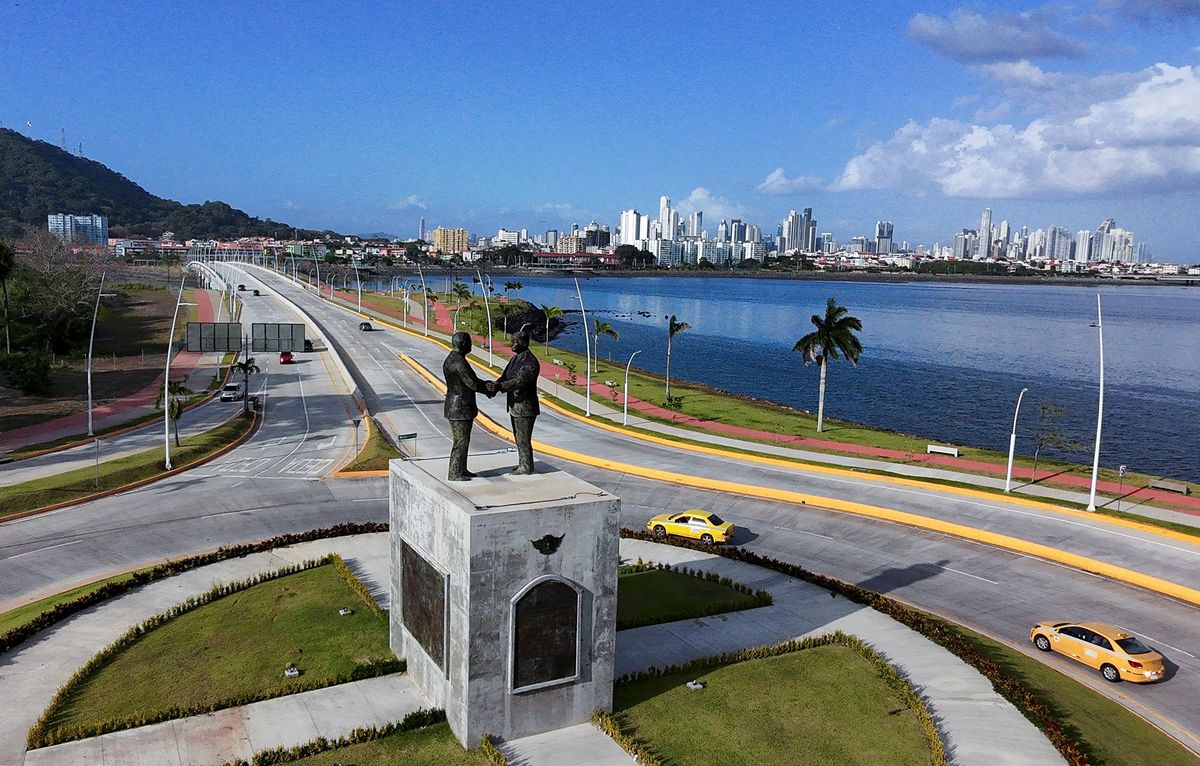
A drone view shows the statue of Panama's late President Omar Torrijos and late U.S. President Jimmy Carter shaking hands in honour of the signing of the Panama Canal Treaty and the Neutrality Treaty, which sealed the U.S. handover of the waterway, standing in the Amador Causeway, in Panama City, Panama January 24, 2025. REUTERS/Enea Lebrun

Panama hopes to maintain a "respectful" relationship with the United States, even as President Donald Trump has repeated threats to retake the Panama Canal, Foreign Minister Javier Martinez-Acha said Saturday.

His comments came ahead of a visit next week by US Defense Secretary Pete Hegseth, a trip made more urgent against the backdrop of Trump's threats and his allegations of Chinese interference in the canal.

"We discussed illegal migration, organized crime, drug trafficking and (other issues)," Martinez-Acha wrote on X of a call Friday with US Deputy Secretary of State Christopher Landau. "It was a cordial and constructive exchange."

"I reiterated that all cooperation from Panama will take place under the framework of our constitution, our laws, and the Canal Neutrality Treaty," he wrote. "Relations with the US must remain respectful, transparent and mutually beneficial."

The US State Department said Landau had "expressed gratitude for Panama's cooperation in halting illegal immigration and working with the United States to secure a nearly 98 percent decrease in illegal immigration through the Darien jungle," an arduous path northward followed by many migrants.

The two officials also discussed the sale last month by the Hong Kong company CK Hutchison to giant US asset manager BlackRock of its concession in ports at either end of the Panama Canal, Martinez-Acha added.

Panama's comptroller has been conducting an audit of Hutchison since January.

Landau "recognized Panama's actions in curbing malign Chinese Communist Party influence," the State Department said.

The deal was set to close on April 2 but has been held up as Chinese regulators pursue an investigation.

The United States and China are the two biggest users of the Panama Canal, which handles five percent of global maritime trade, giving it vital economic and geostrategic importance. It was inaugurated by the United States in 1914 and has been in Panamanian hands since 1999.

bur-hma-gw/bbk/acb

© Agence France-Presse

'How do we come back from this?' Expert says this is why countries 'don’t trust America'


President Donald J. Trump attends a White House Listening Session on Youth Vaping and Electronic Cigarette Epidemic Friday, Nov. 22, 2019, in the Cabinet Room of the White House. (Official White House Photo by Joyce N. Boghosian)

Carl Gibson
ALTERNET
April 05, 2025

The United States' reputation internationally has taken a massive hit in recent weeks, partially as a result of both President Donald Trump's rollout of sweeping new tariffs and by the Trump administration taking a radically different approach to European and Middle Eastern policy compared to his predecessors. Now, one former national security official has a theory about the root cause of this antipathy — and how it actually goes beyond the current administration.

During a Friday segment on MSNBC, Ben Rhodes — who was deputy national security advisor to former President Barack Obama — pointed out that Trump was elected to the presidency twice. And that during his 2024 campaign for the White House, he ran on "mass tariffs, mass deportations [and] destruction of the U.S. administrative state." And Rhodes observed that Trump was elected again in spite of his turbulent first term, signifying to the international community that the American public actively chose "chaos."

"What the rest of the world has watched is, after the chaos of the first Trump presidency, after the chaos of January 6th ... he got elected on that platform with a bigger margin than he won eight years ago," Rhodes said. "And so the hard thing that we all have to reckon with is, it's not like Donald Trump is just doing this. He was elected to do these things."

Rhodes went on to argue that Trump's reelection has broken the "trust" other countries previously had in the United States, and that regaining that trust will take more than one election cycle. He proposed that regaining that trust and retaking power would require a "regeneration of American politics" in which Democrats embrace their identity as an opposition party and leadership is handed off to an entirely new generation.

"They don't trust the president of United States and Donald Trump, and they don't trust America because we elected Donald Trump twice, and we have to deal with that now," he said.

"So how do we come back from this? ... We're kind of waiting for the Democratic Party to come up with some formula in a laboratory in Washington. We're waiting for some politician to emerge with the right talking points or messaging strategy or the right electoral strategy every four years in Wisconsin," he continued. "It's going to have to involve people that are not in politics getting involved. It's going to have to be people looking out for one another. It's got to be people standing up for things that they believe in."

Rhodes emphasized that "the rest of the world isn't just seeing Trump," but seeing American businesses "capitulate" to the administration, tech CEOs "become lackeys of Trump," law firms "fold" for the sake of profit and American universities "get rolled." He concluded that the international community is still "waiting to see whether there's a different America" than the one that elected Trump twice.

Watch the full segment below, or by clicking this link
'My policies will never change': Trump says 'it’s going very well' after market meltdown


April 04, 2025
THE NEW CIVL RIGHTS MOVEMENT


In a series of unhinged missives, President Donald Trump is declaring victory—ignoring the toll on American families and businesses of all sizes after U.S. markets lost $3.1 trillion on Thursday. The plunge, one of the largest in history, has been widely attributed to his heavily criticized tariff package, which has triggered outrage both domestically and internationally.

“To the many investors coming into the United States and investing massive amounts of money, my policies will never change. This is a great time to get rich, richer than ever before!!!” Trump proclaimed Friday morning in an all-caps post, just before the markets again took a massive nose dive, and after China announced it would impose a 34% tariff on U.S. goods.

Politico’s Meredith Lee Hill described China’s tariffs as “crippling.”

Trump’s promise that his policies will “never change” is an apparent walk-back of his (and his son’s) suggestion that he would be open to negotiation, something the White House spent much of Thursday denying.

“This is… definitely not the message investors wanted from the President this morning,” wrote CNBC’s D.C. correspondent Megan Cassella.

Trump’s vow to stay the course came after Fox News pundits and guests had spent much of Thursday insisting Trump would negotiate on tariffs, and urging him to do so on Friday morning.

The President, who has been vacationing in Florida, attended a LIV golf tour dinner Thursday and is hosting the Saudi-owned professional men’s golf tournament this weekend, was quick to falsely suggest his tariffs were responsible for what analysts see as the surprisingly good jobs report that was released Friday morning.

“Great job numbers, far better than expected. It’s already working. Hang tough, we can’t lose!!! Trump wrote just before the Dow opened and quickly dropped another 1000 points. The jobs report, which is reflective of the month of March, has nothing to do with Trump’s tariff imposition on Thursday.

“I think it’s going very well—The MARKETS are going to BOOM…” Trump posted Thursday, minutes before the Dow closed down nearly 1700 points.

The panic was obvious on Fox Business Friday morning.

“The economy was good. Everything was fine,” lamented Gerald Storch, CEO of Storch Advisors. “Now there’s this blinding light, like a giant searchlight, staring at everyone with these tariffs, and these are these numbers aren’t gonna make any difference at all,” he said, apparently referring to the jobs report.

“What’s, what the market is worried about is what’s gonna happen in the future. Who’s gonna hire now in this uncertain environment? I think people are very, very concerned, and that’s why, again, we need to get to work. We need to act on negotiating now. We need to get tax cuts now. We need to get deregulation now to make a difference before this gets out of control the other way.”

Economic pundit Stephen Moore, a Trump 2016 campaign advisor, agreed, saying, “We want as quick a deal on this as soon as possible, because every country would benefit.”

Watch the video below or at this link.

'Turned the lights out': Maddow explains how close stock market came to going 'off a cliff'


MSNBC host Rachel Maddow on April 4, 2025
April 05, 2025
ALTERNET

Financial markets have been taking a nosedive since President Donald Trump announced double-digit tariffs on every country and territory in the world this week. But on Friday, the trading floor of the New York Stock Exchange (NYSE) almost got so calamitous that an emergency measure nearly kicked in.

During her monologue on Friday night, MSNBC host Rachel Maddow showed two metrics that illustrated how volatile the stock market became on the second day of post-tariff chaos. She explained that the NYSE's "trading curbs" — which she characterized as "circuit breakers" were nearly activated due to the rapid decline in the S&P 500 Index.

"The markets have circuit breakers that kick in when things go off a cliff," Maddow explained. "They're these shut-offs that kick in automatically and basically stop the market. They stop people from trading for 15 minutes when things have gone unbelievably wrong. And where those circuit breakers kick in — like the threshold of how bad it has to be before the circuit breakers kick in, is when the S&P drops 7% from the previous day's close."

"Today, the S&P dropped 6%. Had we got to seven, we would have hit the circuit breaker," she continued. "They would have turned the lights out on the market to try to save us from ourselves. That's one way to understand the severity of what's happened here.

Maddow also illustrated the precipitous nature of the stock market by referencing Friday's spike in the VIX volatility index, which is run by the Chicago Board Options Exchange. The MSNBC host described VIX as a ticker in which a sharp increase can often precede a major financial disaster. She showed a graph that with three distinct jumps — one at the onset of the 2008 financial crisis, one as the Covid-19 pandemic shut down the global economy and one that is now jumping in response to the panic triggered by Trump's tariffs.

"That [spike] not caused by the biggest financial catastrophe since the great depression or a global pandemic that's killing millions of people, that one caused simply by Donald Trump being president. Again. With his great ideas," she said.


Major bank now predicting Trump policies will drive US into a recession by end of 2025


A screen shows trading indexes at the New York Stock Exchange (NYSE) in New York City, U.S., April 3, 2025. REUTERS/Brendan McDermid

Carl Gibson
April 04, 2025
ALTERNET

One leading American bank has now adjusted its economic forecast for the remainder of 2025 to be far more bearish following President Donald Trump's new tariffs.

On Friday, Bloomberg reported that JPMorgan Chase chief economist Michael Feroli told the bank's clients that real GDP growth is now likely to contract by the fourth quarter of the year "under the weight of the tariffs," and that this would likely impact Americans' jobs and personal finances. He estimated that rather than the previous forecast of 1.3% GDP growth this year, the U.S. economy would now shrink by a third of a point.

"The forecasted contraction in economic activity is expected to depress hiring and over time to lift the unemployment rate to 5.3%," he wrote.

JPMorgan isn't the only bank forecasting a recession. According to Bloomberg, Barclays Plc also projected this week that the U.S. economy could soon take a dive, with GDP contracting "consistent with a recession." And while Citigroup stopped short of predicting a U.S. recession, it did adjust total GDP growth expectations this year to just 0.1%.

Most economists generally agree a recession has begun once there are two consecutive quarters of negative GDP growth. This week, the Federal Reserve Bank of Atlanta forecasted that GDP may contract for the first quarter of 2025 by anywhere from 0.8% points to 2.8% Should this trend continue this summer, the U.S. economy may officially be in recession territory by the fall.

Financial markets have been reeling since Trump's tariff announcement on Wednesday in which he imposed double-digit tariff duties on all countries, with higher import fees that will particularly impact certain products like cars manufactured overseas and foreign-made apparel. The Dow Jones Industrial Average closed roughly 2,200 points lower than it did yesterday, for a nearly 5% drop in 24 hours. This week has been the worst for stocks since the Covid-19 pandemic hit in 2020.

Trump has called on Federal Reserve Chair Jerome Powell to lower interest rates, though Powell responded to Friday's jobs report by saying "it feels like we don’t need to be in a hurry" to adjust interest rates. The Bureau of Labor Statistics found that while more than 220,000 jobs were added to the economy last month, the unemployment rate rose slightly to 4.2%, with public sector job cuts as a result of the Trump administration's slashing of the federal workforce serving as a major contributor to the jobless rate.

Click here to read Bloomberg's report in full (subscription required).


'This. Will. Not. End. Well': George Will slams Trump’s 'fanciful assumptions' on economy


George Will speaking at the 2014 Conservative Political Action Conference (CPAC) in National Harbor, Maryland on March 6, 2014 (Gage Skidmore/Flickr)

Alex Henderson
April 04, 2025
ALTERNET

When President Donald Trump detailed his far-reaching tariff plans on Wednesday, April 2 — the day he touted as "Libertarian Day" — much of the criticism came from Democrats. But some Never Trump conservatives are speaking out as well, from MSNBC host Joe Scarborough to former GOP strategist/consultant Stuart Stevens. And Trump critics on both the left and the right are warning that his new tariffs will make a variety of goods much more expensive without yielding the economic boom that Trump is promising.

Another Never Trumper who is vehemently critical of Trump's tariffs is veteran Washington Post columnist George F. Will. In his April 4 column, however, Will emphasizes that tariffs are only one of the reasons why Trump is problematic on the economy.

"Donald Trump's economic agenda, from taxes to tariffs — which are themselves taxes — is variable because he believes in the immediate translation of whims into policy proposals, without an intervening pause for study," the 83-year-old Will argues. "His conversation with a Las Vegas waitress quickly became his proposal to end taxation on tips. Commerce Secretary Howard Lutnick says Trump suddenly favors eliminating 'taxes' on people making less than $150,000 a year — in 2022, about 93 percent of Americans 15 and over."

Will adds, "Progressives want income taxation to be more progressive so the wealthy will pay 'their fair share.' Trump is more progressive still, wanting the wealthy to pay everyone else's share, too."

Trump's economic agenda, according to Will, fails to take into account the size of the United States' federal deficit.

"As, second by second, the government borrows substantial sums to pay interest on the money it has borrowed, remember: The national debt was $20 trillion when Donald Trump began his first administration, having vowed to eliminate the debt in eight years," Will writes. "It was $28 trillion when Joe Biden's presidency began. As Maya MacGuineas at the Committee for a Responsible Federal Budget notes, it reached $32 trillion on June 15, 2023; $33 trillion 92 days later; $34 trillion 105 days after that; $35 trillion in another 210 days; and $36 trillion in another 118. It will reach $37 trillion after Congress raises the debt ceiling sometime this summer."

The longtime Post columnist adds, "All of these numbers reflect the optimistic, perhaps fanciful assumptions that the post-'Liberation Day' economy does not sag into a recession. In any case: This. Will. Not. End. Well."

George Will's full column is available at this link (subscription required).


'Obama better get off the golf course!' CNN tees off with supercut as Trump works on swing

Daniel Hampton
April 4, 2025 
RAW ST0RY


CNN unloaded a devastating supercut of clips of Donald Trump declaring on the campaign trail he'd never golf because he'd be so busy — as the president once again leaves Washington, D.C., to hit the links.


s markets continued nosediving due to his steep tariffs, Trump departed the nation's capital and arrived at his golf course in West Palm Beach, Florida, on Friday morning. The president planned to attend a $1 million-a-plate fundraising dinner at his Mar-a-Lago estate Friday evening and host a LIV Golf tournament at his Doral property over the weekend.

According to TrumpGolfTrack.com, Trump spent 19 days golfing over his first 74 days in office, accounting for 25% of his second term.
LSO READ: 'We’ve made a mistake': Trump’s trade war sends GOP into frenzy

But CNN noted that during his candidacy for the 2016 election, the president repeatedly attacked former President Barrack Obama for hitting the greens.

Abby Phillip, anchor of CNN's "NewsNight," led off her show by repeating a quote from a White House official that "Donald Trump doesn't give a f---" about the spiraling markets.

"And it appears to be true," she continued. "As 401(k)s and companies suffered today, Trump and his allies, including many of whom cheered him on in the Rose Garden event, were MIA. The House is in recess, and as for Trump himself, he spent the day working on his golf swing."

Philip called the juxtaposition "interesting considering what he's said about Democratic presidents."

The network then played a supercut of Trump repeatedly bashing Obama for golfing while in the White House.


"Obama, it was reported today, played 250 rounds of golf," Trump rails at a December 2015 speech.

"Everything's executive order," Trump said in an October 2016 clip. "Because he doesn't have enough time because he's playing so much golf."

"Obama better get off the golf course and get down there," Trump demands in an August 2016 clip of a Trump rally.

In another clip that month, Trump declared, "I'm going to be working for you. I'm not going to have time to go play golf."

After several similar clips, CNN played a February 2016 clip of Trump saying, "If I were in the White House, I don't think I'd ever see Turnberry again. I don't think I'd ever see Doral again."

That same month, he insisted he would "not be playing much golf" if he won the election. The Washington Post reported, however, that Trump likely played 261 rounds of golf during his first term as president.


"This is just an estimate because, unlike Obama, his team often wouldn’t report whether he was playing golf at his properties. If accurate, though, that’s a round every 5.6 days. By contrast, Obama played 333 rounds of golf — over twice as many years. That’s about once every 8.8 days," the Post analysis found.