Sunday, April 06, 2025

Resistance Grows as Proposed Cuts Threaten Health Care for Over 79 Million in US


Planned cuts to Medicaid and CHIP will put more than 79 million people at medical risk. But resistance is mounting.
Published
April 6, 2025

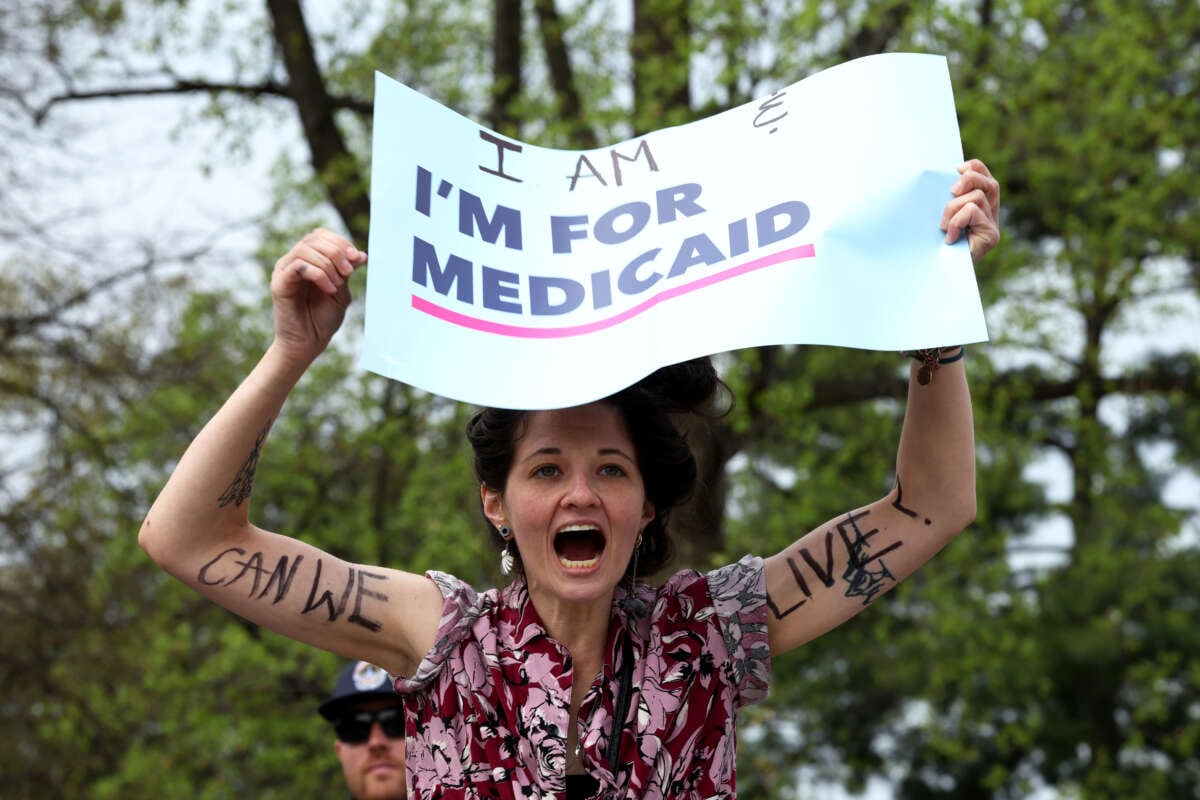
Medicaid recipient Emily Gabriella protests outside the Supreme Court as oral arguments are delivered in the case of Medina v. Planned Parenthood South Atlantic on April 2, 2025, in Washington D.C.Kayla Bartkowski/Getty Images

Kelly Smith, a 57-year-old New York City resident, is part of the Nonviolent Medicaid Army (NVMA), a growing national movement of poor people who are organizing to stop proposed cuts to Medicaid and promote health care as a human right.

“The need for health care unites us all,” Smith told Truthout. “Right now, I’m terrified of losing Medicaid and being unable to get injections for pain control. They’re the only thing that makes it possible for me to be on my game.”

Nonetheless, she says that her health is somewhat fragile. Not only is she a breast cancer survivor, but she also has severe scoliosis and takes medication for hypertension, high cholesterol and depression — all covered by Medicaid.

That this coverage might end or be reduced — a real possibility if Congress approves pending budget cuts to satisfy DOGE and the Trump administration — terrifies her and other members of the NVMA. Their work is twofold: They are mobilizing against recently announced threats to curtail Medicaid while also organizing to ensure that health care is recognized as a human right.

“We’re organizing call-in days to tell lawmakers our stories and let them know the value of Medicaid in our lives. We’re also attending town halls,” Smith said.

Related Story

Poll Finds Over a Third in US Can’t Access Quality Health Care — a New High
A new Gallup survey finds 11 percent of US adults can’t access quality care and can’t pay for care or medicine. By Sharon Zhang , Truthout April 3, 2025

“We have to eliminate the shame associated with disability and poverty.”

According to the Center on Budget and Policy Priorities, Medicaid currently covers 72.1 million people. The program was first established in 1965 as part of the “war on poverty,” and was initially meant to provide health care to recipients of Aid to Families with Dependent Children, a welfare program. In the 60 years since, it has expanded to cover low-income children and adults as well as those living in nursing homes or in need of home care.

Its reach is significant: KFF reports that in 2023, 41 percent of births were financed by Medicaid. Moreover, 1 in 6 adults aged 19-64, 2 in 3 nursing home residents and 1 in 3 adults with disabilities got their health care through a Medicaid program.

Children also benefit. The Children’s Health Insurance Program (CHIP) extended health coverage to families deemed over-income for Medicaid but still too poor to buy private health insurance. As of October 2024, more than 7 million children were enrolled.

All told, Medicaid and CHIP serve more than 79 million U.S. residents. And while these programs vary by state, as a joint federal-state partnership, the programs ensure that low-income children and adults have at least minimal access to care.

But it doesn’t come cheap. KFF reports that between October 1, 2023, and September 30, 2024, the government spent more than $860 billion, not including administrative costs, on Medicaid programs. Not surprisingly, this has put them squarely in the crosshairs of Elon Musk’s so-called “Department of Government Efficiency” (DOGE), which has pledged to slash the social safety net. As has been widely reported, the resultant “savings” will be used to finance tax cuts of $1.1 trillion, money that will benefit only the wealthiest 1 percent of the country — giving an average annual tax break of $62,000 to those with incomes of $743,000 or more through 2034.


“We all deserve health care. As poor and working-class people, we’re sick of being treated as if we don’t matter.”

Kelly Smith and the Nonviolent Medicaid Army call this abhorrent. And they’re far from alone in arguing that cuts to Medicaid and CHIP will worsen public health and cause enormous hardships for millions of U.S. residents.

Kym Clarine, a certified nursing assistant from the Bronx, told Truthout that if she loses Medicaid, she will have to forgo her annual physical exam, and neither she nor her 12-year-old daughter will be able to visit the dentist for regular check-ups. “Each visit costs $150 without insurance,” she said. “I can’t afford that.”

Sheila Bingham of Little Rock, Arkansas, will also be negatively impacted if the cuts come to fruition. The 47-year-old receives both Medicare and Medicaid and is being treated for a rare cancer, debilitating migraines, type 2 diabetes, erratic blood pressure and intense pain. “I rely on Medicaid to pay my Medicare premium of $106 a month,” she told Truthout. “I won’t survive if they start taking this out of my $1,400 disability check.”

Alex Fisher is in similar straits. A self-employed 63-year-old, Fisher has been on Medicaid since 2011. “Medicaid has covered three wrist surgeries, a breast reduction, and my dental and optical care,” they told Truthout. “I’ve been going to rallies and writing and visiting my legislators to express my outrage, but I’m scared that I might lose coverage. As I get older, I know that I’ll need more care, not less, and even when I become eligible for Medicare at age 65, I know that it won’t cover many of the services I need.”

Yet despite this escalating anxiety, Vania Leveille, senior legislative counsel at the ACLU, told Truthout that no one knows exactly how the budget cuts will unfold. “First, the House and the Senate had to pass their own budget resolutions,” she explains. “Both bodies are now moving to negotiate and reconcile the two bills. They will then lay out the specifics of the cuts they intend to make.”

But even before this is fully spelled out, opposition to Medicaid cuts is mounting. Already, groups including the National Conference of Mayors, the National League of Cities, The Council of State Governments, the National Association of Counties and the National Conference of State Legislators have told federal lawmakers that they oppose rollbacks of medical coverage. Similarly, the National Medicaid in Schools Coalition, a group of 65 organizations, has written a letter to Congress stressing that “children cannot learn to their fullest potential with unmet health needs.” The coalition adds that services to special education students — including occupational, physical and speech therapy; mental health counseling; and adaptive equipment — are often paid for by Medicaid. “A 2023 Congressional Budget Office analysis found that just one extra year of Medicaid coverage during childhood leads to higher earnings and better productivity as an adult, boosting the nation’s economy,” the letter notes.

Georges Benjamin, executive director of the American Public Health Association, told Truthout that in addition to stressing the value of Medicaid in keeping people healthy, the public needs to be reminded that Medicaid is an insurance program for people who need it. “Politicians who brand it as a program for low-income people who are unwilling to work are incorrect. The American people need to be armed with facts. Medicaid cuts will make more people sick, will make more people die and will close more rural hospitals,” he said.

Benjamin also predicts other impacts, including an increase in health insurance premiums for non-Medicaid recipients. “Hospitals will need to recoup the money they’ve lost so they will charge insurers more,” he said. He further denounces a proposal to impose “a per capita cap on care” — a maximum that can be paid for each person’s medical care — saying that it will lead to less health care.

Work requirements for Medicaid recipients, another idea being floated by the GOP, are also flawed, Benjamin adds. “The real goal of work requirements is to kick people off the rolls. These are people who are already struggling, those with the least money and the least internet access, making it hard for them to complete the required paperwork.” In addition, approximately two-thirds of Medicaid recipients are already working, he adds, with those who are not likely exempt because of age or infirmity.

Then there’s the idea that the state-federal funding balance should shift to make states pay a higher percentage of Medicaid costs. “Poor states, many of them red, receive a bigger match from the feds,” Benjamin said. “If the feds reduce the amount they give to the states, many will have to either raise taxes or reduce services.”

What’s more, he says that many health centers, particularly those in remote, rural areas, operate on a shoestring budget. “Many are two or three weeks away from not making payroll,” Benjamin reports. The likely result? The closure of clinics, hospitals and health centers in already underserved areas.

Elizabeth Zhang, research assistant for health policy at the Center on Budget and Policy Priorities, told Truthout that cuts to Medicaid are also likely to increase medical debt. The federal government mandates the type of care that Medicaid must provide (including transportation to medical care; inpatient and outpatient hospital services; lab tests and X-rays; nursing facility services and family planning), and which are optional (such as private-duty nursing; dental care; physical, occupational and speech therapy; dentures; prosthetics; eyeglasses and hospice). “If cuts go through, states will have to make difficult decisions about what they’ll do,” Zhang said. “There is already quite a lot of variation, with some states being pretty bare bones and others covering more services. Poorer states are lean, so if they cut services, it’s likely that more people will go into debt to pay for care.”

Sandy Santana, executive director of Children’s Rights, a 30-year-old group that works to protect abused and neglected children, says that an additional possible consequence of the proposed cuts — and cuts to the social safety net more generally — is that more people living in financial precarity may be judged as unfit parents. “A lot of why kids end up in foster care in the first place is a judgment of neglect,” he said. “This often conflates with poverty, and our biggest worry is that cuts to the social safety net will drive more kids into the child welfare system.” Moreover, he says, when there are insufficient kinship or home placements, children may be placed in congregate care settings that he calls “unhealthy for child development.” He also fears that legislation allowing children to stay on Medicaid until age 26 will be rescinded — something that will adversely impact those who age out of foster care at 21.

“There is such short-sightedness in all of this,” Santana told Truthout. “Studies show that Medicaid leads to reduced child welfare involvement. When children get early health care, they have better health outcomes that last into adulthood. This is not a niche program. Almost half of the U.S. population relies on Medicaid.”

This is especially evident in immigrant communities.

Paula A. Arboleda, director of health advocacy at Bronx Legal Services, told Truthout that the intersection of immigration crackdowns and budget cutbacks is making many noncitizens afraid to enroll their U.S. citizen children in Medicaid or CHIP, or to renew their eligibility. “During the pandemic, no one had to renew their coverage, but that policy has ended, and every Medicaid recipient now has to complete a nine-page renewal form. There is an online portal, or people can mail the form in, but we’re seeing a lot of noncitizens who are afraid to do this. They’ve heard that there are rules prohibiting them from becoming a public charge, but this only applies to benefits a noncitizen receives for themselves, not as a payee for a U.S. citizen child,” she says.

Nonetheless, Arboleda says that she understands the fear that she is seeing and hearing. Part of this rests with uncertainty since no one knows how the budget negotiations will play out.

Brooklyn, New York, parent Rachelle Kivanoski is the mother of a 42-year-old son who has an intellectual disability. He has been living in a four-person group home since 2020, and although he currently has both Medicare and Medicaid, Kivanoski told Truthout that she worries that changes might close some programs or diminish the services that he receives. “The expectation is that something truly catastrophic will happen,” she said. “So many services are provided by Medicaid here in New York — community day programs, group homes, employment projects. Everyone who can is going to demonstrations, signing petitions, and calling and visiting lawmakers at every level of government, but especially in Congress.”

Smith of the Nonviolent Medicaid Army says that this is imperative. “The time is now,” she said. “Unfortunately, Medicaid usually does not get talked about unless it’s under attack. We aim to change that and create long-term solutions by developing leaders among those who are directly impacted by the policies being considered. We all deserve health care. As poor and working-class people, we’re sick of being treated as if we don’t matter.”

This article is licensed under Creative Commons (CC BY-NC-ND 4.0), and you are free to share and republish under the terms of the license.

Eleanor J. Bader is a Brooklyn, New York-based freelance writer who focuses on domestic social issues and resistance movements. In addition to Truthout, she writes for The Progressive, Ms. Magazine, Lilith, The Indypendent, New Pages and other progressive blogs and print publications.
Child Care Funding Cuts Will Compound Crises for Generations to Come

Access to child care is already inadequate across the US. Trump’s funding cuts to Head Start will make it far worse.
April 3, 2025
Lourdes Balduque / Moment / Getty Images

Head Start normally isn’t considered a partisan issue. The early child care program, under the purview of the U.S. Department of Health and Human Services (HHS), was launched six decades ago as part of President Lyndon B. Johnson’s “war on poverty.” It’s historically had support from both sides of the aisle in Congress; after all, few would publicly argue with the program’s central mission of improving children’s emotional well-being, physical health and access to crucial education. Since 1965, nearly 40 million children from low-income families have been supported by Head Start programs.

But these are not, of course, normal times. And Project 2025, the Heritage Foundation’s draconian far right blueprint guiding Donald Trump’s second administration, calls for eliminating the Head Start program altogether. These wheels already seem to be in motion; on March 27, HHS announced it would be restructuring the Administration for Children and Families (ACF), which oversees Head Start. Mass layoffs of 10,000 employees across HHS began April 1, including personnel cuts that led to the immediate closure of at least five of Head Start’s 12 regional offices. The future of the program is now uncertain; a former senior ACF official said there does not seem to be a transition plan in place for how Head Start will be administered after the reorganization.

As Trump implements his far-reaching and haphazard disembowelment of the federal government, the cuts to early child care programs have gotten less public attention than some of his other actions. This is a mistake. Child and family advocates and policy experts are sounding the alarm — not only about the immediate impacts that these cuts will have on low-income children and families, but also about the grave long-term consequences. That’s because, in attacking child welfare programs, the cuts to ACF and Head Start are by their very nature attacks on our shared futures.

“Every cut you make now is directly affecting not just the person that got cut but everyone in their family kinetic chain, everyone in their community kinetic chain, everyone that their money is also tied to,” Tecoria Jones, a South Carolina-based parent advocate and board member at Be Strong Families, a nonprofit family support organization, told Truthout. Jones herself was heavily impacted by the state welfare system, growing up in foster care and congregate care, before becoming a single parent to six children. “We are really mucking up some human rights right now, and we are pretty much compelling the future to be less than it could be,” she said. “These cuts are maybe not forever, but the impact will be forever.”

Head Start programs run on a federal-to-local model in all 50 states, meaning the government funding is distributed through grants to a variety of nonprofits, schools, and other local organizations working across early childhood education and anti-poverty initiatives. In addition to educating young children and preparing them to enter the school system, Head Start programs provide nutritious meals to youth experiencing food insecurity; conduct crucial medical, vision and dental check-ups; connect children with mental health services; foster interpersonal skills; engage parents directly in their child’s wellbeing and education; and more. This multipronged approach to child welfare has been found to increase literacy rates, help keep children out of the criminal legal system and break the cycle of intergenerational poverty — contrary to the Heritage Foundation’s claims that Head Start hurts children.

Related Story

Expiration of Pandemic Aid Threatens to Deepen Child Care Crisis
The imminent end of cash infusions for child care could cause staff layoffs, increased tuition and programs to shutter. By Eleanor J. Bader , Truthout July 7, 2023


“These programs are not just babysitting,” Joe Dorman, the chief executive officer of the Oklahoma Institute for Child Advocacy, told Truthout. “It’s not just dropping your kid off and having somebody watch and play with them for the rest of the day until you pick them up. They provide wonderful programming to make sure the kids are learning, that they develop into good human beings by learning to play together.”

Jones emphasized that the Head Start closures will have a profound ripple effect, because access to child care provides parents with the ability to maintain regular employment hours. If that’s taken away, that leads to instability — not only in families, but in entire communities. “When people lose child care and when people become stressed as parents,” Jones said, “then we’re asking for an increase of child abuse and neglect cases.”

Head Start has already faced a rocky road since Trump took office. In January, the Trump administration’s federal funding freeze impacted grants to Head Start programs, forcing them to draw from their reserves to stay functional. Now, in light of the latest round of layoffs, local news outlets are reporting on the chaos ensuing across the country as the five regional Head Start offices have been forced to shutter.

In Seattle, Washington, all six employees were notified of their sudden termination on April 1, and immediately locked out of their offices. The Seattle Head Start regional office leads grant oversight, funding distribution and monitoring for programs in Washington, Alaska, Idaho and Oregon. Meanwhile, Jennie Mauer, the executive director of the Wisconsin Head Start Association, told the Wisconsin Examiner that the Chicago regional office had been shut down without any official word to Head Start providers.

“We have received calls throughout the day from panicked Head Start programs worried about impacts to approving their current grants, fiscal issues, and applications to make their programs more responsive to their local communities,” Mauer said.

Even before the Head Start cuts, support for early child care in the U.S. was far from adequate. While free universal preschool programs are widespread in parts of the United Kingdom and Europe, the U.S. lacks the same. In fact, the majority of U.S. residents, particularly in rural communities, live in child care deserts —neighborhoods with either no licensed child care providers or an insufficient number of slots for the children who need them.

The crisis worsened during the COVID-19 pandemic, Dorman told Truthout, which forced many daycare facilities and Head Start programs in Oklahoma to close their doors. “They were receiving payment on attendance rather than enrollment, so when kids weren’t going, they weren’t getting reimbursed for the portion that’s covered by the government,” Dorman said. “They have not reopened.”

Trump’s gutting of Head Start does not evince a basic understanding of why these programs were there to begin with. And while he paid lip service to supporting the working class on the campaign trail, it is of course low-income and working-class people who are going to be most adversely impacted by these latest cuts.

“We can’t afford to cut the good programs and then expect to put them back. We saw that happen with the pandemic, and they have not come back yet,” Dorman said. “If things like this continue, then we’re going to be in a very desperate situation, not only in Oklahoma, but across the United States.”

WAIT, WHAT?!

USDA Suspends Maine Education Funds Over State’s Support for Trans Athletes

Maine’s Democratic Gov. Janet Mills warned that the “rule of law in our country” is at stake.
Truthout
April 3, 2025
Maine Gov. Janet Mills speaks during the Maine Democratic convention at the Cross Insurance Center in Bangor on June 1, 2024.Carl D. Walsh / Portland Press Herald via Getty Images

The U.S. Department of Agriculture (USDA) announced Wednesday that it is suspending federal funding for select education programs in Maine, citing the state’s refusal to comply with President Donald Trump’s anti-trans directive to exclude transgender students from girls’ and women’s sports.

In a letter to Maine Gov. Janet Mills (D), Agriculture Secretary Brooke Rollins said the funding freeze would affect “certain administrative and technological functions in schools,” and warned that “[t]his is only the beginning.”

Rollins also noted that the USDA is reviewing Maine’s research and education-related funding to assess compliance with the U.S. Constitution, federal law, and the Trump administration’s anti-trans policy agenda. She specifically invoked Title IX — which the White House has weaponized against trans people — and Title VI, which the administration has distorted to go after diversity, equity, and inclusion (DEI) efforts.


Democratic Rep. Chellie Pingree, who represents southern Maine, condemned the move. “Let’s call this what it is: straight-up political blackmail,” she said. “The Trump administration is threatening the livelihoods of Maine students, educators, and researchers in a desperate attempt to punish our state for refusing to discriminate against transgender students.”

In January, Trump signed an executive order banning transgender athletes from competing in women’s sports. The following month, during a National Governors Association meeting at the White House, he publicly criticized Maine for allowing students to participate in sports consistent with their gender identity — a policy rooted in the Maine Human Rights Act, which prohibits gender identity discrimination in education, including athletics.

Related Story

Trump Demands Apology From Maine Gov. Janet Mills for Defending Trans Women
The two had a heated exchange over an executive order banning trans women and girls from playing in women’s sports. By Eloise Goldsmith , Common Dreams March 23, 2025


“Fortunately,” Maine Attorney General Aaron Frey wrote in a statement in February, “the rule of law still applies in this country, and I will do everything in my power to defend Maine’s laws and block efforts by the president to bully and threaten us.”

Despite that, the Trump administration quickly escalated its pressure campaign on states that refused to comply with his anti-trans agenda. In February, the Department of Justice issued letters to Maine, California, and Minnesota threatening legal action if they did not bar transgender students from women’s sports.

The Departments of Education and Health and Human Services (HHS) launched rapid investigations into Maine’s alleged violations of the administration’s anti-trans interpretation of Title IX. These probes moved unusually fast, even as both agencies experienced staffing and resource cuts by the “Department of Government Efficiency” (DOGE). According to The Maine Monitor, HHS issued its findings just four days after launching its investigation — without contacting or interviewing state officials. Mills called the investigations “politically directed.”

In March, the Department of Education issued a final warning to Maine, saying that the state would face consequences for refusing to comply with the Trump administration’s attack on transgender athletes. In March, the USDA suspended federal funding to the University of Maine due to its policies supporting transgender inclusion, but later reinstated it after the university adjusted its policies to align with federal demands.

On April 2, the USDA announced a freeze on certain educational program funds, citing Maine’s “Title IX violations.” Rollins warned that more funding freezes could follow if the state does not capitulate to Trump’s anti-trans agenda.

Rollins also stated that the USDA has “launched a full review of grants awarded by the Biden Administration to the Maine Department of Education.” She wrote that “[m]any of these grants appear to be wasteful, redundant, or otherwise against the priorities of the Trump Administration,” adding that the USDA would not support “a leftist social agenda.”

While there is no evidence that Maine intends to comply with Trump’s anti-trans executive order, which is currently embattled in the courts, in March Trump demanded on Truth Social that Mills issue a “full-throated apology” and publicly promise to never again “challenge the Federal Government.”

Mills rejected that demand, warning that the “rule of law in our country” is at stake.

“Maine may [be] one of the first states to undergo an investigation by his administration, but we won’t be the last,” Mills said. “Today, the President of the United States has targeted one particular group on one particular issue which Maine law has addressed. But you must ask yourself: who and what will he target next, and what will he do? Will it be you? Will it be because of your race or your religion? Will it be because you look different or think differently? Where does it end? In America, the president is neither a king nor a dictator, as much as this one tries to act like it — and it is the rule of law that prevents him from being so.”

“But do not be misled,” Mills continued. “This is not just about who can compete on the athletic field, this is about whether a president can force compliance with his will, without regard for the rule of law that governs our nation. I believe he cannot.” 


Trump Moves to Revoke Federal Funds From Brown University, Citing “Antisemitism”


Trump’s attacks on universities are “dangerous and politically motivated,” said New York Democratic Rep. Jerry Nadler.
Truthout
April 4, 2025

A student walks on the campus of Brown University on October 1, 2024.Jonathan Wiggs / The Boston Globe via Getty Images

Honest, paywall-free news is rare. Please support our boldly independent journalism with a donation of any size.

The White House announced Thursday that the Trump administration plans to withhold $510 million in federal funding from Brown University while it investigates the school’s response to alleged “antisemitism”— a term that is being weaponized to target protesters against Israel’s genocide in Gaza — as well as the university’s refusal to dismantle its diversity programs, which defy President Donald Trump’s broader effort to eliminate diversity, equity, and inclusion (DEI) initiatives.

“I strongly condemn former President Trump’s latest attacks on higher education cloaked under the guise of fighting antisemitism,” New York Democratic Rep. Jerry Nadler said in a statement. “Once again, the President is weaponizing the real pain American Jews face to advance his desire to wield control over the truth-seeking academic institutions that stand as a bulwark against authoritarianism.”

Brown is the latest in a growing list of universities under federal scrutiny. Columbia University and the University of Pennsylvania have already seen hundreds of millions in federal funding suspended over their campus policies.

In hopes of regaining funding, Columbia University agreed to sweeping changes, including banning masks at protests, increasing police presence on campus, and submitting certain academic departments to federal oversight. The university also revised its disciplinary procedures and appointed “special officers” authorized to detain or remove individuals from campus. A new oversight position — a senior vice provost — was created to evaluate area studies programs, beginning with those focused on the Middle East, and to advise leadership on potential academic restructuring. Despite these concessions, the Trump administration has not yet restored federal funding to the university, stating that the changes are “only the first step.”

The American Association of University Professors (AAUP) criticized these changes as “tantamount to receivership,” warning that the administration’s demands undermine departmental autonomy and academic freedom. “The Trump administration seeks to make Columbia University an example of its power over any college or university that resists its extreme political interference in institutional governance,” the AAUP stated.

Related Story

As ICE Jails Palestinian Protester, Universities Must Commit to Academic Freedom
Universities may sow their own demise if they continue to aid the suppression of pro-Palestine campus movements.
By Heba Gowayed & Jessica Halliday Hardie , TruthoutMarch 10, 2025


In an article for The Atlantic, the president of Princeton University, Christopher L. Eisgruber, wrote, “The Trump administration’s recent attack on Columbia University … [presents] the greatest threat to American universities since the Red Scare of the 1950s. Every American should be concerned.” The Trump administration has halted several of Princeton’s research grants — totalling $210 million — as part of its wider campaign against perceived ideological noncompliance.

Harvard University is also under threat. Similarly to Columbia, the Trump administration is demanding that Harvard implement a sweeping set of changes — including the dismantling of DEI programs, bans on mask-wearing at protests, “race-neutral” admissions and hiring, expanded collaboration with law enforcement, and federal oversight of departments accused of promoting “antisemitism.” If Harvard fails to comply, it risks losing up to $9 billion in federal funding.

The targeting of Ivy League schools is part of a broader, nationwide assault on higher education by the Trump administration. The Trump administration has cautioned around 60 universities that they could face the loss of federal funding if they fail to respond to reports of “antisemitism” on campus and opened investigations into 45 colleges accused of engaging in so-called “race-based exclusion”— a clear attempt to dismantle DEI programs.

Academics have condemned universities for their crackdowns on pro-Palestine student protesters, noting that this repression paved the way for the Trump administration’s current attacks on academic freedom.

“By their willingness to scapegoat and vilify the pro-Palestine student movement, these institutions have invited their enemies in, becoming testing grounds for the authoritarianism that threatens our nation,” CUNY professors Heba Gowayed and Jessica Halliday Hardie wrote for Truthout.

“We must all insist, vocally and without fear, that colleges and universities recommit themselves to the principles of academic freedom and free expression before it is truly too late,” they added.

Rumeysa Ozturk’s Abduction Threatens More Than Free Speech

The Trump administration is targeting “the best and the brightest” immigrants with SS tactics in broad daylight. Will we let them get away with it?


A little over 50 protesters, with the Service Employees International Union (SEIU), Coalition for Human Immigrant Rights of Los Angeles and community members march to denounce the Trump administration's recent attacks on free speech and immigrant rights including the arrest of Rümeysa Öztürk in downtown Los Angeles on April 1, 2025.
(Photo: Genaro Molina/Los Angeles Times via Getty Images)

Common Dreams


Almost no one who knew her can find a bad word to say about Rumeysa Ozturk, the doctoral candidate who was abducted by masked ICE agents on March 25. Tufts University President Sunil Kumar has come to her defense, as well as religious leaders such as Rabbi Dan Slipakoff, and numerous alumni. Her closest defender is her colleague and advisor Reyyan Bilge, who regards Ms. Ozturk’s abduction as “a betrayal of American values.” So do I—and for me, it’s personal. Not because I’m Turkish or an academic, but because I’m an American writer whose main subject is the anti-Nazi resistance in the Netherlands. And I live in Vermont, which shouldn’t have had anything to do with it.

The video of Ms. Ozturk’s abduction is the worst nightmare we might have about what could happen to someone we love, or to us. She is walking along the street in broad daylight, on her way to break the Ramadan fast at an interfaith center. It all happens so fast—first a few masked officers; she screams; then she is surrounded by both women and men who slip out of unmarked cars. They forcibly take her phone, and handcuff her behind her back to ensure that this dangerous scholar of child study and human development cannot harm them. A Fulbright scholar invited to the United States because of her exceptional abilities, Rumeysa Ozturk’s high, terrified voice tells us that she wasn’t watching for these thugs to come after her, on the clean streets near her university.

I’ve seen all this happen in historic photo after photo, but having it come to life in Medford, Massachusetts slips us in time from one era to another, from one place to another. It takes me back to an idyllic stay in Amsterdam in 2001, when I found a 1941 photograph showing Jewish neighbors being rounded up on my doorstep. That changed my relationship to the city forever, and launched 13 years of research and writing about how good people colluded with the Nazis by doing nothing, and how a courageous handful resisted.

The authoritarian playbook will target writers and thinkers first.

When one of the five masked officers who surrounded Rumeysa Ozturk said, “We’re police,” was that supposed to reassure her? Does any common criminal have the capacity to kidnap someone across state lines and hold her for days in prison? Would that not be a federal crime if the federal government were not committing it? What was it that made her say, “OK, OK?” Was she making the transition from fearing that she would be robbed or raped to realizing that these people, even if masked, might actually be legitimate? Are they?

Rumeysa Ozturk is being persecuted because she is a writer who exercised her right of free speech. The government which transported her from Massachusetts to New Hampshire, then to Vermont, then to Louisiana, has brought no specific evidence that she was supporting Hamas. Her only “crime” is coauthoring an op-ed urging her university to acknowledge the genocide of more than 50,000 Palestinians, and to divest from related investment. The piece does not mention Hamas. While these positions may be offensive to the Trump administration, they are examples of the free speech people come to this country to secure—and which our ancestors fought to establish. PEN USA has taken a stand along with free speech organizations, but even more individual writers and others should demand that Ms. Ozturk be released.

Within hours, thousands gathered to protest what happened right there, on their streets. In the background of the security video, someone seems to be asking, “Why are you wearing masks?” Now we know. There are so many steps where Ms. Ozturk was denied equal protection under the law: when her visa was revoked without her knowledge, when she was accosted by masked ICE agents, when she was abducted, and now that she is being held without her consent. No one has put forward evidence that Ms. Ozturk ever spoke at a rally or even attended one, although she would have been within her rights to do so. She simply wrote what she believed.

Because of a court filing, we know that her lawyer wasn’t quite fast enough to get a judicial order to prevent Ms. Ozturk from being moved out of Massachusetts until she was already gone—or so the government claims. They whisked her across multiple state lines almost immediately, no doubt with this very thing in mind. It’s less than 40 miles to the New Hampshire border, then about an hour and a half to Lebanon, where they held her temporarily. But within a few hours, she was 26 miles north of my city of Burlington, Vermont, in the ICE holding tank in St. Albans, Vermont. The next morning, they took her to the airport which is only two miles from my home, and transported her to Louisiana. The highway they took her on—to St. Albans and then back to the Burlington airport—is so close that I can walk there in 15 minutes. In summer, I can hear the cars passing on it.

Until the last few weeks, my biggest fear has been for people like Vermont’s dairy workers who don’t have the class privilege that will motivate others to take up their cause with resources and alacrity. People who don’t have a lawyer they can call. I still fear for them, but now I realize that the authoritarian playbook will target writers and thinkers first. They don’t even have to be brown to be persecuted. We see it across the country now: Russians, French, Turkish, Palestinian.

For years, I’ve been speaking about collusion and collaboration with the Nazis. Now I feel the weight of those dilemmas intimately and personally. Is it OK for me to enjoy a beautiful meal or the coming of spring? I must, if only for my own sanity. But I must also think every day of Rumeysa Ozturk and what I can do about and for her. Otherwise, I might as well be the woman who obeyed the Nazis and drew the curtains of my Amsterdam apartment as the Jews were being rounded up on her doorstep.


Jewish Students Chain Themselves to Columbia Fence to Protest Khalil Detention

"As Jewish students, we grew up learning about the rise of fascism, learning about how important it is to stand up when you see injustice in the world," said one protester.


Jewish students chain themselves to the gates of Columbia University, demanding accountability from the university's trustees following the arrest of Mahmoud Khalil on April 2, 2025 in New York City.
(Photo: Lokman Vural Elibol/Anadolu via Getty Images)


Julia Conley
Apr 02, 2025
COMMON DREAMS

Jewish Columbia University students had chained themselves to a fence on campus for 45 minutes on Wednesday, in protest of the school's cooperation with immigration agents to arrest a leader of last year's pro-Palestinian encampment, when New York City Police officers arrived to break up the nonviolent action.

One student identified as Shea, who was wearing a kippah with a watermelon design and a keffiyeh—symbols of Palestinian solidarity—told independent journalist Meghnad Bose that university trustees are "directly implicated" in Immigration and Customs Enforcement's (ICE) targeting of Mahmoud Khalil, a former student who helped lead negotiations demanding Columbia's divestment from Israel last year.

Shea said trustees handed over the names of Khalil and other pro-Palestinian students at Columbia to the government.

"We are here in protest of that to demand that the university tell us which trustees, which members of the university administration, are responsible for this so we can demand immediate consequences for them and hold them accountable for what they've done to our peer," said the undergraduate student.

Shea added that Jewish students were leading the protest because "the attacks on our international students, on students of color, have been so fierce, so dangerous, so disproportionate that we are the only students who can be here right now taking this risk."


Plainclothes ICE agents abducted Khalil last month as he was returning home to his apartment in a Columbia-owned building with his pregnant wife. The agents refused to identify themselves and ultimately Khalil was sent to an ICE detention facility in Louisiana. Khalil is an Algerian citizen of Palestinian descent and had a green card, which has reportedly been revoked by the Trump administration, while his wife—who is pregnant with their first child—is a U.S. citizen.

A federal court in New Jersey ruled Tuesday that the challenge to ICE's unlawful detention of Khalil should continue in the state. His wife responded that "this is an important step towards securing Mahmoud's freedom, but there is still a lot more to be done. As the countdown to our son's birth begins and I inch closer and closer to my due date, I will continue to strongly advocate for Mahmoud’s freedom and for his safe return home so he can be by my side to welcome our first child."

Khalil was detained days after the Trump administration announced it was canceling $400 million in grants and contracts for Columbia in retaliation for what it claimed was a failure to address antisemitism on campus. The Trump administration has conflated expressions of support for Palestinian rights on college campuses with attacks on Jewish students, as did the Biden administration before it.

Columbia oversaw an aggressive response to the protests last year, allowing NYPD officers to drag students out of a building they occupied and unofficially renamed Hind's Hall after Hind Rajab, a six-year-old girl who was killed by Israeli forces in Gaza.

An analysis of last year's pro-Palestinian campus protests, many of which were led by Jewish students, found that 97% of them were nonviolent.

A Barnard College student identified as Tali said Wednesday that "as Jewish students, we grew up learning about the rise of fascism, learning about how important it is to stand up when you see injustice in the world."

Campus security quickly cordoned off the area where students had chained themselves to the fence. After the NYPD arrived, security officers used bolt cutters to remove the protesters from the fence.


Bose reported that "in [a] sudden escalation, Columbia campus security aggressively [engaged] student protesters," and tried to take away a banner reading, "Free Mahmoud Khalil."

"Love and solidarity to these courageous Jewish students who have chained themselves to the gates of Columbia in protest of the university turning over their friend Mahmoud Khalil to a fascist administration," said Simone Zimmerman, co-founder of the Jewish-led group IfNotNow.

The students, said Zimmerman, "are taking risks today that they know most of their peers cannot."


Over 500K Refugees Could Face Deportation to Haiti, Which Is Gripped by Violence

A former US resident displaced by street violence in Port-au-Prince says Haiti is “not safe for anyone right now.”
April 4, 2025

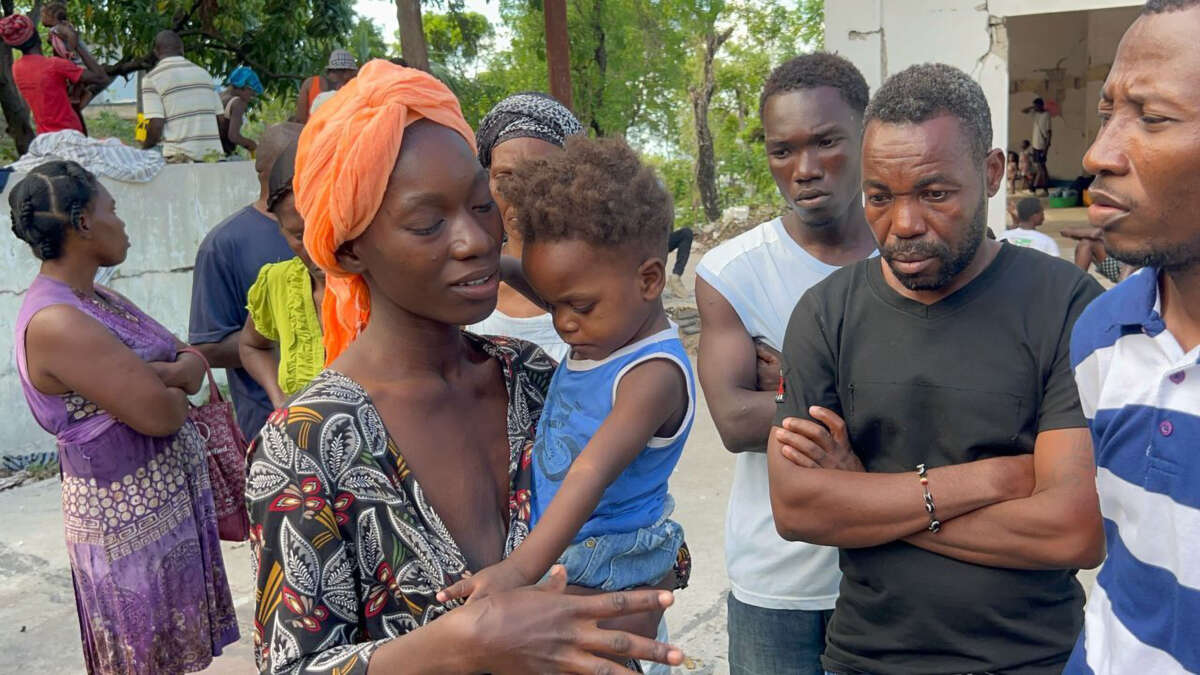
People gather in Port-au-Prince after fleeing their homes amid ongoing street violence.
Courtesy Steven Datus

The Trump administration’s immigration crackdown will soon leave more than 500,000 Haitian refugees vulnerable to deportation back to a country facing a spiraling political and security crisis as armed gangs and police continue to fight for control of the streets of Port-au-Prince, Haiti’s embattled capital city.

Both Haiti’s national police and a United Nations-backed security force have been unable to subdue an ongoing insurgency led by various armed groups in Haiti. Last week, residents warned that the fall of Port-au-Prince to gangs is imminent as the provisional government set up after the assassination of Haiti’s controversial president in 2021 struggles to maintain control.

Steven Datus, a former longtime U.S. resident who was deported to Haiti in 2022 after protesting conditions inside a notorious Florida immigration jail, told Truthout that gangs are currently overpowering the government where he lives in Port-au-Prince. Competing armed groups controlled about 80 percent of the city as of early March, according to reports.

“I have heard about the Trump movement on sending people back to Haiti, and it’s not safe for anyone right now,” Datus said in an interview. “It’s like, I don’t know who’s backing these gangs up, but it’s more than just street gangs just taking over neighborhoods. These ‘street gangs’ have more ammunition and more power than the police forces.”

Armed groups are burning homes and terrorizing residents as they take and hold territory, Datus said, and people with the ability to flee to other parts of the country are hemmed in by road blockades. Along with many neighbors, Datus said he was forced to abandon his home and is taking a big risk by reaching out internationally to speak with journalists and ask for support. “And as of right now, I don’t know how this is going to end. I don’t know how 2025 is going to end because things are just horrible,” Datus said.


Democrats in Congress, human rights groups, Christian charities and the U.S. Conference of Catholic Bishops are pleading with the Trump administration to restore immigration protections for Haitians escaping violence that were curtailed by Department of Homeland Security (DHS) Secretary Kristi Noem and are now set to expire on August 3.

Without these protections, known as Temporary Protected Status (TPS) and, in some cases, Humanitarian Parole, hundreds of thousands of people will soon become vulnerable to deportation. The administration has reportedly sent out notices to thousands of Haitian refugees, including legal residents, urging them to self-deport within weeks.

Immigrant rights groups filed legal challenges against the Trump administration on behalf of hundreds of thousands of people from Haiti and Venezuela, two nations that have sent waves of refugees abroad in recent years. A federal judge on Monday temporarily blocked the revocation of TPS protections for 350,000 people from Venezuela as the case moves forward, but the Trump administration has attacked the judiciary in the media and threatened to ignore its rulings, leaving experts terrified of a constitutional crisis.

Indeed, President Donald Trump and Stephen Miller, Trump’s anti-immigrant homeland security adviser, appear determined to include Haiti’s refugees in their plans for mass deportation after spreading racist lies about Haitian immigrants on the campaign trail.

Vice President J.D. Vance, a recent Catholic convert, has repeatedly doubled down on attacking and deporting immigrants despite intercession by the U.S. Conference of Catholic Bishops, which is warning Republicans that 80 percent of people vulnerable to deportation are Christian and 61 percent are Catholic. Up to 66 percent of Haitians identify as Catholic, and many refugees rely on assistance from Catholic churches and Christian charities when navigating the U.S. immigration system.

In 2024 alone, at least 5,601 people were killed in Haiti as a result of street violence, while a further 2,212 people were injured and 1,494 kidnapped, according to the UN Human Rights Office. In January, the UN’s migration office reported that more than 1 million people have been displaced by conflict in Haiti and are now homeless, a threefold increase in displacement since 2023.

Datus said the conditions in Port-au-Prince are deteriorating in his neighborhood and many others, and people are fleeing their homes with “nowhere to go.” Video Datus sent to Truthout show friends and neighbors gathering in crowded areas where they feel safer. Datus hopes people outside of Port-au-Prince will see the videos and help his displaced community find shelter away from the fighting.


“Where we’re at right now is horrible, it’s a hole in the wall,” Datus said. “The people that I’m with, they’re not really like just asking for food … but if you’re not in a place where you’re comfortable, safe, it’s like you won’t even have the appetite to eat.”

Datus was deported back to Haiti in 2022, after living with his family in the U.S. since he was 5 years old. Datus said he told U.S. immigration officials that he had no family or support networks in Haiti but was deported anyway. Deporting more people who have made lives in the U.S. and have few support networks in Haiti will only intensify the humanitarian crisis, Datus said.

“This is the worst time for deportations, because if you imagine sending somebody who left Haiti at 5 years old, and he gets sent back to Haiti with no family, he’s going to be walking in the streets,” Datus said. “Now he’s going to get to a neighborhood or somewhere [that is blocked off by] vigilantes because … police can’t defend the whole [of] Haiti right now. So, it is like mostly everybody’s turning into vigilantes to protect their own well-being.”

In response to ongoing violence in Haiti and pleas from human rights groups, in June 2024, the Biden administration extended TPS for refugees from Haiti until February 2026. (TPS holders must apply with the federal government and pay fees, while Humanitarian Parole is granted on a case-by-case basis.) This February, Noem reversed this decision, reducing the extension from 18 months to 12 months. For many Haitians covered by TPS or Humanitarian Parole, their protection will now expire on August 3 at the latest.

The U.S. has provided TPS for people fleeing violence and poverty in Haiti since 2010. Trump’s DHS reports that the number of people eligible for the program ballooned from 155,000 in 2021 to 530,000 by 2024, which the agency cites as evidence of fraud and abuse.

However, human rights groups say the U.S. has a responsibility to help Haiti because the Black-led nation has a long and deep history of struggling under foreign influence and economic domination.

“Let’s be clear: this is a war on poor, Black and Brown people who dared to seek safety,” said Guerline Jozef, executive director of Haitian Bridge Alliance, in a statement on March 21. “These families have followed the rules. Now they are being told they’re no longer welcome because Trump wants to rally his base with racist fear-mongering.”

In a February statement, a DHS spokesperson said the Biden administration had attempted to “tie the hands of the Trump administration” by extending TPS for Haiti “far longer than justified or necessary.” According to Datus and his neighbors in Port-au-Prince, the idea that refugees from Haiti no longer need protection from deportation flies in the face of the obvious facts on the ground.

“I’m risking it by basically even doing what I’m doing, but I have no choice because I have nowhere to go, I have no family in Haiti,” Datus said. “This is one of the main things that I was trying to tell my deportation officers and my judges and my lawyers … I had nobody down here. Now I’m in a position where I [have] had to flee my house.”
SCOTUS’ Next Move: Taxpayer-Funded Religious Schools?

A landmark case could force taxpayers to fund religious charter schools.


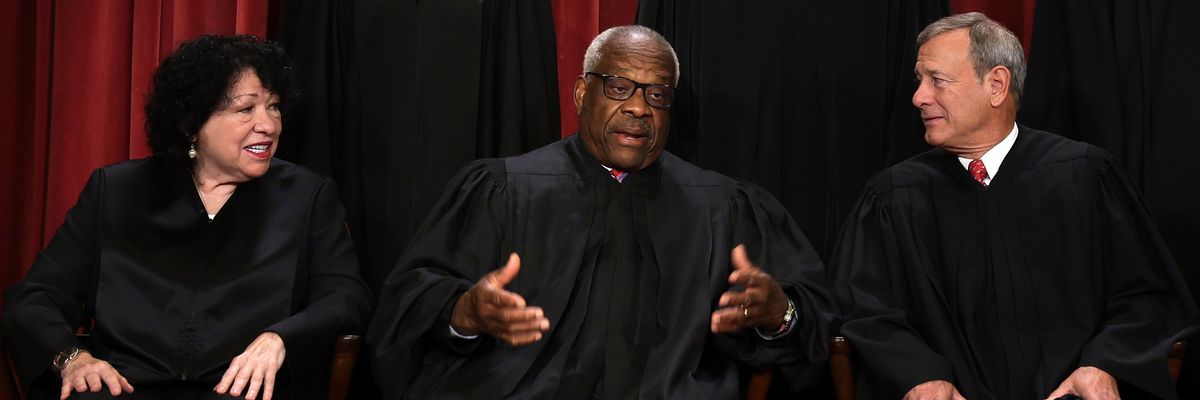
United States Supreme Court (L-R) Associate Justice Sonia Sotomayor, Associate Justice Clarence Thomas, and Chief Justice of the United States John Roberts pose for their official portrait at the East Conference Room of the Supreme Court building on October 7, 2022 in Washington, D.C.
(Photo: Alex Wong/Getty Images)

Chris Yarrell
Apr 02, 2025
On April 30, the U.S. Supreme Court will hear a case that could fundamentally reshape public education: Oklahoma’s controversial approval of the nation’s first religious charter school, St. Isidore of Seville Catholic Virtual Charter School. The case forces a critical question to the forefront—should taxpayers be compelled to finance religious schools while having no authority to regulate them?

The court’s decision could continue a pattern of rulings that have chipped away at the traditional separation between church and state, transforming the landscape of public education and public funding. If the justices side with St. Isidore, the ruling could mark a turning point in American schooling—one that may erode public accountability, alter funding priorities, and blur the constitutional boundaries that have long defined the relationship between religion and government.

This case builds on a series of decisions from the Roberts Court that have steadily eroded the wall between church and state. In Trinity Lutheran v. Comer, the court allowed public funds to be used for secular purposes by religious institutions. Espinozav. Montana Department of Revenue expanded this principle, ruling that states cannot exclude religious schools from publicly funded programs. And in Carson v. Makin, the court went further, mandating that state voucher programs include religious schools, arguing that exclusion constitutes discrimination against religion.

As the justices deliberate, they would do well to consider not just the legal arguments, but also the practical and moral consequences of their decision.

Chief Justice John Roberts, writing for the majority in Carson, stated, “[i]n particular, we have repeatedly held that a State violates the Free Exercise Clause when it excludes religious observers from otherwise available public benefits.” On its face, this reasoning frames the issue as one of fairness—ensuring religious entities are not treated unequally. But the deeper implications of this logic are far more radical.

As Justice Sonia Sotomayor warned in her dissent, this interpretation fundamentally redefines the Free Exercise Clause, equating a government’s refusal to fund religious institutions with unconstitutional religious discrimination. Justice Stephen Breyer took this concern a step further, pointing to the court’s own precedent to highlight the dangerous trajectory of its rulings:
We have previously found, as the majority points out, that “a neutral benefit program in which public funds flow to religious organizations through the independent choices of private benefit recipients does not offend the Establishment Clause.” We have thus concluded that a State may, consistent with the Establishment Clause, provide funding to religious schools through a general public funding program if the “government aid… reach[es] religious institutions only by way of the deliberate choices of… individual [aid] recipients.”

Breyer then underscored the significance of this distinction:
But the key word is “may.” We have never previously held what the court holds today, namely, that a State must (not may) use state funds to pay for religious education as part of a tuition program designed to ensure the provision of free statewide public school education.

Finally, he distilled the implications into a warning: “What happens once ‘may’ becomes ‘must’?”

That shift—from allowance to obligation—could force states not only to permit religious education in publicly funded programs, but to actively finance it, eroding any semblance of neutrality between public and religious schooling. This transformation threatens to unravel the Establishment Clause’s core protection: that government does not privilege or compel religious exercise.

Now, the Oklahoma case brings Breyer’s warning into sharp focus. The petitioners are asking the court to declare that charter schools are not state actors—meaning they would be free from public accountability and regulations, including those related to discrimination or special education. At the same time, they argue that public funds must be made available to religious charters. The implications of such a ruling could reverberate across the country, reshaping education in profound and troubling ways.
The May-to-Must Transformation and Its Far-Reaching Consequences

If the Court sides with St. Isidore, the ripple effects could be seismic, triggering a wave of religious charter school applications and fundamentally altering the landscape of public education. Here’s how:A Surge in Religious Charter Schools

Religious institutions, particularly those struggling to sustain traditional parochial schools, would have a financial lifeline. Charter subsidies, which often surpass voucher amounts, would incentivize religious organizations to enter the charter school market. For years, leaders in some religious communities have sought public funding to buoy their schools, and a decision in favor of St. Isidore could provide the legal green light. The result? A proliferation of religious charters, funded by taxpayers but largely free from public oversight.Erosion of Protections for Students with Disabilities

The implications for students with disabilities are especially concerning. Under the Individuals with Disabilities Education Act’s implementing regulations, a student with disabilities who is “placed in or referred to a private school or facility by a public agency…[h]as all of the rights of a child with a disability who is served by a public agency.” Yet, a ruling in favor of St. Isidore risks undermining these guarantees by creating a loophole for private religious charters to skirt IDEA’s requirements.

This concern is not just theoretical. As I’ve argued elsewhere, the hybrid nature of charter schools already complicates questions of accountability and state action, particularly when it comes to safeguarding student rights. Allowing religious charters to operate free from IDEA’s obligations would further erode the fragile legal protections students with disabilities rely on—protections that are already too often disregarded in practice.Undermining Public Health and Safety Policies

The pandemic underscored the challenges of balancing public health mandates with constitutional protections for religious freedom. In 2020, a federal judge in Kentucky struck down the state’s attempt to close religious schools during a Covid-19 spike, even as public and secular private schools complied. Extending public funding to religious charters could further erode the state’s ability to enforce neutral regulations, from health measures to curriculum standards. Such decisions privilege religious institutions over secular ones, creating a patchwork of inconsistent rules that could undermine public safety and equity.

Toward Transparency and Accountability

Can these challenges be mitigated? Some experts argue for stricter regulations to preserve the public nature of charter schools. Bruce Baker, a professor of education finance, suggests limiting charter authorization to government agencies and requiring boards and employees to be public officials. Such reforms could ensure that charters remain accountable to taxpayers and subject to the same constitutional constraints as public schools.

Other scholars, like Preston Green and Suzanne Eckes, propose requiring religious charters to forgo certain exemptions if they wish to receive public funding. Specifically, they recommend restructuring charter school boards as government-created and controlled entities to ensure they are unequivocally recognized as state actors subject to constitutional obligations. For example, this would require religious charters to comply fully with anti-discrimination laws and other public mandates, maintaining the balance between religious freedom and public accountability.


The Larger Threat to Public Education

Even with these potential safeguards, the broader implications are sobering. If the court rules in favor of religious charters, states will face difficult choices: increase taxes to fund an expanding universe of religious and secular schools, divert money away from public schools, or create new bureaucracies to regulate religious institutions. Taxpayers could find themselves funding schools tied to a bewildering array of faiths, from mainstream denominations to fringe sects.

As the justices deliberate, they would do well to consider not just the legal arguments, but also the practical and moral consequences of their decision. What happens to a society when its public institutions are splintered along religious lines? And what happens to the students and families who depend on those institutions for equity, opportunity, and inclusion?

The answers to these questions will shape the future of American education—and the values we choose to uphold.these potential safeguards, the broader implications are sobering. If the court rules in favor of religious charters, states will face difficult choices: increase taxes to fund an expanding universe of religious and secular schools, divert money away from public schools, or create new bureaucracies to regulate religious institutions. Taxpayers could find themselves funding schools tied to a bewildering array of faiths, from mainstream denominations to fringe sects.

As the justices deliberate, they would do well to consider not just the legal arguments, but also the practical and moral consequences of their decision. What happens to a society when its public institutions are splintered along religious lines? And what happens to the students and families who depend on those institutions for equity, opportunity, and inclusion?

The answers to these questions will shape the future of American education—and the values we choose to uphold.


RELIGION IN THE CLASSROOM


Watchdogs Warn Trump Pick for Interior Will Assist Corporate Attack on Public Lands

The Trump administration is "plotting to sell off America's national public lands to their billionaire friends, and Kate MacGregor is the perfect henchwoman."


Kate MacGregor testifies during her Senate confirmation hearing to be deputy secretary of the U.S. Department of the Interior on Tuesday, November 5, 2019.
(Photo: Tom Williams/CQ-Roll Call, Inc via Getty Images)


Eloise Goldsmith
Apr 02, 2025
COMMON DREAMS


Watchdog groups are warning that U.S. President Donald Trump's pick for deputy secretary of the U.S. Department of the Interior, Kate MacGregor—who they call a friend of the fossil fuel industry—will be an enthusiastic accomplice in the Trump administration's efforts to open up public land to oil and gas leasing.

Trump, Interior Secretary Doug Burgum, and Trump's billionaire adviser Elon Musk "are plotting to sell off America's national public lands to their billionaire friends, and Kate MacGregor is the perfect henchwoman," said Alan Zibel, a research director with the watchdog Public Citizen, in a statement on Wednesday.

MacGregor, an energy company executive who was deputy secretary of the Department of the Interior during the first Trump administration from early 2020 until January 2021 had her confirmation hearing Wednesday before the Senate Energy and Natural Resources Committee.

Oil Change International's U.S. campaign manager Collin Rees blasted MacGregor over her testimony, including support for legislation co-sponsored by Sen. Cindy Hyde-Smith (R-Miss.) that would require the Interior Department to hold two offshore oil and gas lease sales per year for 10 years.

MacGregor's previous time in the Interior Department, showed she "prioritized fossil fuel interests over the good of the American people."

"Her support for a decade of at least two offshore oil and gas lease sales is completely incompatible with avoiding the worst impacts of the climate crisis, as well as the Department of Interior's mandate to protect public lands and waters," Rees said.

In 2017, as an aide to then-Interior Secretary Ryan Zinke, MacGregor helped successfully fast track a permit for an oil firm to begin fracking on a patch of farmland in Oklahoma, according to 2019 reporting from the investigative outlet Reveal.

"While a senior staffer of the House Committee on Natural Resources, she developed strong ties to the energy industry and its lobbyists," according to Reveal. "In recent years, she has also built a public profile as an advocate of offshore oil drilling and a foe of any environmental rules that might limit energy production."

According to a record of her work calendar, which was obtained via a Freedom of Information Act request by the nonprofit publication Pacific Standard, MacGregor met over 100 times with extractive industry groups or representatives between January of 2017 and January of 2018, when she was at the Department of the Interior but not yet the deputy secretary.

Pointing to MacGregor's background, executive director of the watchdog Accountable.US Tony Carrk said that with MacGregor's nomination, Trump "continues to build a dream team of big oil and gas shills to ravage America's public lands, while taxpayers and our environment deal with all the fallout."

Zibel of Public Citizen also noted that "public lands belong to all Americans, not wealthy corporate executives."

Meanwhile, Public Citizen is also sounding the alarm on the expected appointment of Matt Giacona, a lobbyist for the National Ocean Industries Association—which represents oil, gas, and wind companies working offshore—to head the Department of Interior's Bureau of Ocean Energy Management (BOEM). The current person leading BOEM is retiring, according to Politico Pro.

In response to the potential appointment of Giacona to BOEM, which oversees offshore energy production in deep waters, director of Public Citizen's energy program Tyson Slocum on Wednesday said: "Trump Appointing a Big Oil lobbyist to oversee deep water oil drilling in the Gulf of Mexico shows that the administration's goal is to empower and enrich powerful corporations at the expense of everyone and everything else."

"This continues the clear trend of Trump turning federal agencies and the public good into profit opportunities for powerful corporate interests," he said.
Plummeting Global Tesla Sales Reveal Consumer Revolt Against Musk's 'Dangerous Far-Right' Antics

"Consumers all over the world are sick of Elon Musk's attempt to promote dangerous far-right leaders, policies, and movements," said one advocate.


Protesters demonstrate against Tesla CEO Elon Musk’s Department of Government Efficiency (DOGE) initiatives during a nationwide "Tesla Takedown" rally outside a dealership on March 29, 2025 in Pasadena, California.
(Photo: Mario Tama/Getty Images)


Julia Conley
Apr 02, 2025
COMMON DREAMS


On the heels of the news that Tesla CEO Elon Musk's investment of $20 million in the Wisconsin Supreme Court race—including offers of $1 million checks to individual voters—didn't manage to swing the election in the Republican Party's favor, the Trump administration adviser's electric car company learned of more trouble: Tesla's global sales declined by 13% in the first quarter of 2025, dropping to their lowest point in nearly three years.

The plunge in sales was evident across markets, even in countries where Musk hasn't sparked outrage by embedding himself into politics by bankrolling and supporting far-right candidates and groups.

In Norway, The New York Times noted, electric cars account for more than 90% of new car sales—but among Norwegians, whose prime minister recently rebuked Musk's involvement in the political systems of Germany and the U.K.—Tesla sales have nearly matched the global trend so far this year, declining by more than 12% in the first quarter.

Sales in other European countries were even more dire in the first three months of 2025—down 41% in France, 50% in the Netherlands, and 55% in Sweden, where consumers have Musk's anti-labor practices to contend with in addition to his political activities in Europe.

Sweden's largest insurer said Wednesday it had sold its $160 million stake in Tesla after investing in the company since 2013, saying Tesla's workers' rights position violates its investment guidelines.

"The American people have gotten a crash course in what happens when the richest man in the world gets the keys to our country."

Musk, whose net worth is $386.6 billion, has long refused to sign a collective bargaining agreement with fewer than 200 mechanics in Sweden to ensure they earn a fair wage. Unionized mechanics in the country have been on strike for over a year.

One Norway Tesla owner told the Times that he "would never drive a Tesla again."

"It's a question of ethics," said urban planner Geir Rognlien Elgvin.

After pouring nearly $300 million into the 2024 elections in the U.S. to help President Donald Trump and other Republicans get elected, Musk has spent the past two months boasting of his push to cut public spending and government jobs—attacking the popular anti-poverty Social Security program as a "Ponzi scheme"; gutting the Department of Education, the Consumer Financial Protection Bureau, and other federal agencies; and pushing tens of thousands of civil servants out of their jobs through the Trump-created advisory body the Department of Government Efficiency (DOGE).

Adam Zuckerman, senior clean vehicles campaigner with government watchdog Public Citizen's climate program, said Wednesday that Tesla's most recent sales numbers illustrate how anger over Musk's activities—which has also been expressed with protests at Tesla dealerships—extends past U.S. borders.

"Tesla's plummeting sales show that consumers all over the world are sick of Elon Musk's attempt to promote dangerous far-right leaders, policies, and movements," said Zuckerman. "They are fed up with DOGE's effort to gut life-saving services and aid. Consumers want electric vehicles, not cruelty, fascism, racism, and neo-Nazism. Unless Musk changes course, Tesla sales will continue to decline."

A poll by Yahoo News and YouGov late last month found that two-thirds of Americans said they would not drive a Tesla, with a majority saying Musk himself was the reason for their distaste.

"Musk is driving our country into the ground," said Zuckerman when the poll was released. "If he continues, he could take Tesla and America's urgent transition to an electric future with it."

Tesla's plummeting sales contrast with global electric car sales overall, which are on the rise. Ford Moter, BMW, and Mercedes-Benz are among the automakers planning to soon introduce new electric vehicles.

"Previously consumers might have struggled to find other options than Tesla that really competed," Will Roberts of research firm Rho Motion told the Times. "That's now not the case."

Trump has attempted to shore up his benefactor and ally's company, holding an event on the White House lawn last month during which he praised Musk's electric cars and condemned protests at Tesla dealerships. He also suggested people who are turning away from Tesla are "Radical Left Lunatics" who are "trying to illegally and collusively boycott" the car company.

His administration has since doubled down on threatening people for vandalizing the cars or dealerships, with the president saying he would send them to El Salvador, where hundreds of people accused of being gang members have been sent to a prison in recent weeks.

But despite the show of loyalty, Trump was reportedly considering pulling back on Musk's front-and-center presence in the administration Wednesday.

Economic justice group Groundwork Collaborative said Musk's impending exit—which Trump denied was coming—is likely in response to Musk proving "to be a liability," but cautioned that rights advocates will still have to fight the Trump agenda even without Musk in the White House serving as a "special government employee."

"The American people have gotten a crash course in what happens when the richest man in the world gets the keys to our country," said Lindsay Owens, executive director of the group. "Musk's threat to Social Security, Medicare, and Medicaid has pushed consumer confidence to new lows. Businesses are pulling back on investments, and markets have plunged. Americans can now celebrate Musk's exit."

"But Musk's ouster is only the first step in achieving true liberation," said Owens. "He is a symptom of a broader disease, which is that billionaires are tightening their grip on our democracy. To cure the disease, we must put our power back in the hands of the people."