Wednesday, April 09, 2025


'Wrongheaded Cruelty': Observers Bash Rubio Decision to Revoke All Visas Held by South Sudanese


"South Sudan is about to blow up into potentially another country-wide civil war, putting civilians at risk. But yea let's force people to go back now," wrote one professor.



Khaman Maluach, who was born in the South Sudanese city of Rumbek and now plays for the Duke Blue Devils, reacts with teammate after the second half in the Final Four game of the NCAA Men's Basketball Tournament against the Houston Cougars at the Alamodome on April 5, 2025 in San Antonio, Texas.
(Photo: Jamie Squire/Getty Images)

Eloise Goldsmith
Apr 07, 2025
COMMON DREAMS

U.S. Secretary of State Marco Rubio on Saturday announced that the United States is revoking visas for all South Sudanese passport holders, "effective immediately"—sparking criticism from several observers, including those who pointed out that the country could soon tip into another civil war.

Rubio announced on X that the move, which includes restricting any "further issuance" of visas, comes in response to the South Sudanese government's failure to return "its repatriated citizens in a timely manner."

"This is wrongheaded cruelty," wrote Rebecca Hamilton, a professor at American University Washington College of Law and executive editor at the digital law and policy journal Just Security, on X on Saturday. "The vast majority of South Sudanese in this country (or, frankly inside South Sudan, right now) have no say in what their government does. They are here working, studying, building skills essential for their nascent country."

Mike Brand, an adjunct professor at the University of Connecticut and Georgetown University who focuses on human rights and atrocities prevention, wrote on Saturday: "South Sudan is about to blow up into potentially another country-wide civil war, putting civilians at risk. But yea let's force people to go back now."

South Sudan is the world's youngest country, having only declared independence from Sudan in 2011 following two lengthy civil wars.

The young nation was once again plunged into civil war in 2013 due to violence between warring factions backing President Salva Kiir and his deputy, Riek Machar. A peace deal was brokered in 2018, though the country has still not held a long-delayed presidential election and Kiir remains in power today, according to Time.

Fears of full-on civil war returned when, last month, Machar was arrested and his allies in government were also detained. Machar's opposition political party declared the country's peace deal effectively over, per Time.

Shortly after Rubio's announcement on Saturday, Deputy Secretary of State Christopher Landau wrote on X that the government of South Sudan had refused to accept a South Sudanese national who was "certified by their own embassy in Washington" and then repatriated. "Our efforts to engage diplomatically with the South Sudanese government have been rebuffed," Landau wrote.

On Monday, the government of South Sudan released a statement saying that the deportee who was not permitted entry is a citizen of the Democratic Republic of the Congo, not South Sudan. The government also said it has maintained consistent communication and cooperation with the U.S. government regarding "immigration and deportation matters."

In the early 2000s, thousands of "lost boys" stemming from a civil war in Sudan that began in the 1980s and eventually led to South Sudan's independence were resettled in the United States.

John Skiles Skinner, a software engineer based in California, reacted to Rubio's announcement by writing on Bluesky: "I taught a U.S. citizenship class to South Sudanese refugees in Nebraska, 2006-2007. Fleeing civil war, they worked arduous jobs at a meat packing plant. Many had no literacy in any language. But they studied hard for a citizenship exam which many native-born Americans would not be able to pass."

In 2011, the Obama administration granted South Sudan nationals in the United States "temporary protected status" (TPS)—a designation that shields foreign-born people from deportation because they cannot return home safely due to war, natural disasters, or other "extraordinary" circumstances. The Biden administration extended it, but the designation is set to expire early next month.

As of September 2024, the U.S. provides TPS protections to 155 people from South Sudan.

In a Monday post for Just Security, Hamilton of American University and a co-author wrote that "while there has been no public determination by the secretary of homeland security regarding an extension of TPS for South Sudanese, Rubio's announcement presumably means [U.S. Department of Homeland Security] Secretary Kristi Noem is planning to terminate their TPS."

Observers online also highlighted that Duke University star basketball player Khaman Maluach, whose family left South Sudan for Uganda when he was a child, could be impacted by the State Department's ruling.
HEGEMONIC HUBRIS

Rubio security detail arrested in Brussels after 'behaving erratically' and fighting police: report


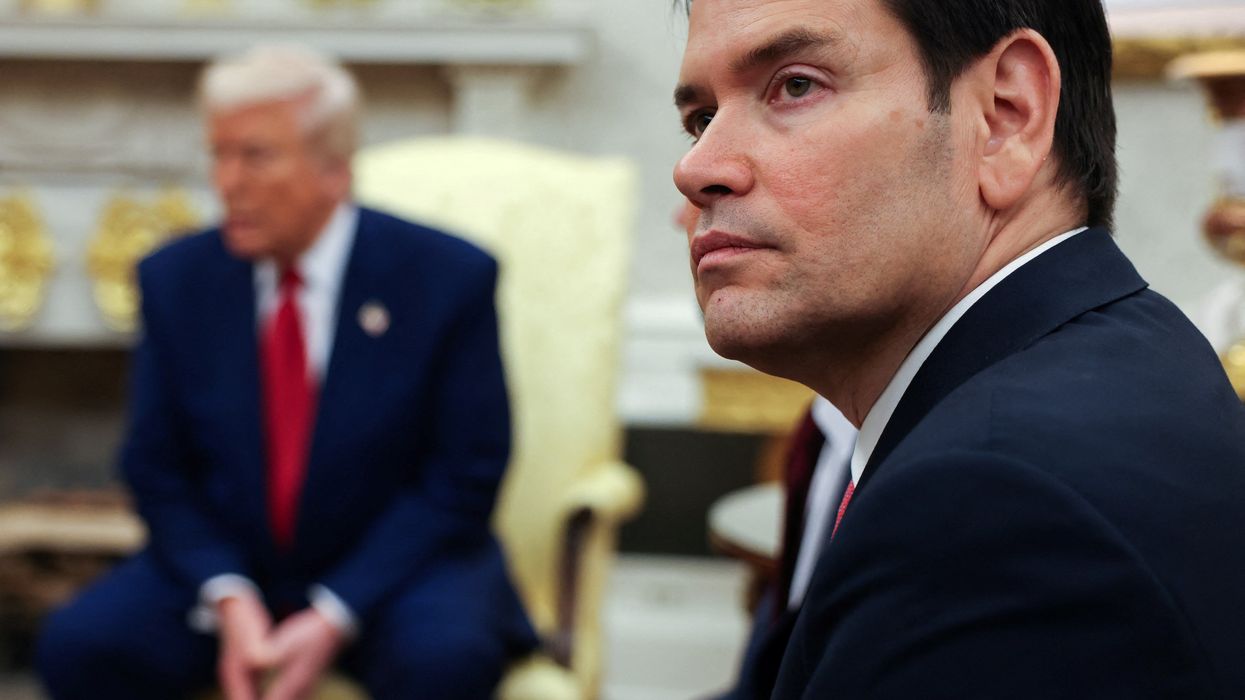
U.S. Secretary of State Marco Rubio looks on, as U.S. President Donald Trump meets with Israeli Prime Minister Benjamin Netanyahu (not pictured) in the Oval Office at the White House in Washington, U.S., April 7, 2025. REUTERS/Kevin Mohatt


April 08, 2025
ALTERNET

A shift supervisor from the Diplomatic Security Service (DSS), who was part of Secretary of State Marco Rubio’s security team, was reportedly taken into custody by Belgian authorities at a hotel in Brussels last week following a dispute with hotel personnel and a scuffle with the police who arrived at the scene.

The Washington Examiner reported Tuesday that the DSS staffer was “behaving erratically and became irate.” The incident took place in Hotel Amigo, per the report, where the secretary later stayed while participating in the NATO foreign ministers meeting.

The Department of State Security (DSS) is tasked with safeguarding American diplomats and their diplomatic facilities globally, as well as investigating offenses like passport and visa fraud.

According to the report, the individual became furious when hotel staff declined to extend bar hours. When staff members, including the night manager, tried to convince him to go back to his room, the agent became physically confrontational, per the report.

When police were called to handle the situation, the agent clashed with several officers, prompting them to arrest him.

The DSS veteran, whose identity the report did not disclose, served as a senior agent on the advance team in Belgium. This team was tasked with securing the hotel and making final security arrangements in various locations in Brussels for Rubio's visit.

He was released from custody later that same day after the United States Embassy intervened.

AlterNet has reached out to the State Department for comment.


Sucking up the oxygen: How Donald Trump has gatecrashed the upcoming election — in Australia


REUTERS/Nathan Howard
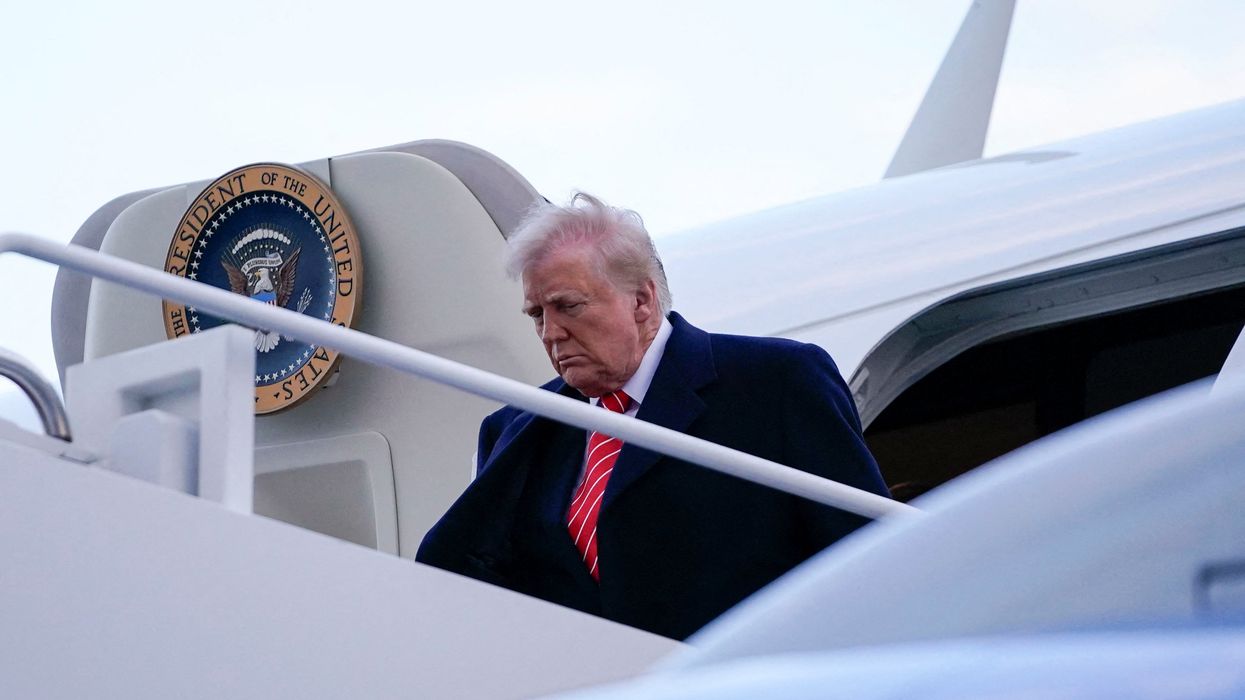
U.S. President Donald Trump arrives at Philadelphia International Airport in Philadelphia, Pennsylvania, U.S., March 22, 2025.

April 08, 2025

Much of the world is finding out it’s a very difficult time to be a friend and ally of the United States.

That includes the major parties vying for power at the May 3 Australian federal election. While voters may be preoccupied with the cost of living, it’s impossible to ignore the global tumult caused by the second Trump administration.

Who would have thought six months ago that the US would vote alongside Russia and North Korea on UN resolutions on Ukraine, while China abstained? Or that it would propose transforming Gaza into a Mediterranean resort?

Given the uncertainty reverberating across the globe, do we need to rethink our major foreign relations? Will the ANZUS alliance survive the second Trump presidency unscathed?

Whoever forms Australia’s next government must diversify its approach to foreign policy to include more engagement with partners in Asia and the Pacific. It does not mean abandoning the US alliance, but it does mean avoiding over-reliance.
Friends like these

US President Donald Trump’s widespread imposition of tariffs is unravelling the global economic order.

Australia was not specifically singled out for punishment. Nevertheless, the 10% slug on Australian imports prompted Prime Minister Anthony Albanese to condemn the tariffs as illogical:
they go against the basis of our two nations’ partnership. This is not the act of a friend.


Opposition Leader Peter Dutton was equally frank when he complained about Australia’s poor treatment:
We have a special relationship with the United States and it hasn’t been treated with respect by the administration or the president.


We have been let off relatively lightly compared with many other economies. But there may be an unforeseen strategic impact on Australia. For example, will other countries in our region decide that China is a more trustworthy partner than the US? What would that do for regional stability?

Dutton has questioned whether Albanese has the right character as leader to deal effectively with Trump.

It is unlikely any Australian prime minister could have done much to avoid the tariffs. We should consider the possibility that Trump doesn’t think much about Australia, which will shape the bilateral relationship for the foreseeable future.
US vs China

Trump himself remains the wild card. His administration has prioritised ending the war in Ukraine, alienating European allies along the way.

The question for partners in Asia, including Australia, is whether the US is clearing the decks in Europe so it can focus on its main competitor: China. There are plenty of Beijing hawks in the administration, and China has been slapped with the steepest tariffs, which total 54%.

In Australia, we often worry about being dragged into a great power conflict in the region. And we do appear to be entering a world of even more rapid militarisation, with all the security risks that would entail.

The signing of the AUKUS submarine agreement in 2021 was one of the clearest signals to date that Australia was siding unequivocally with Washington. In the same year, Dutton declared it “inconceivable” Australia would not join the US in defending Taiwan if it was attacked by China.

But now, there is an entirely different issue Australia needs to consider. The US rapprochement with Russia might be interpreted as a portent of future deal-making with other authoritarian leaders, including Xi Jinping.

We can’t rule out Trump and Xi cutting a highly transactional deal on Chinese annexation of Taiwan. While this is unlikely, the security calculus now needs to incorporate a diverse range of plausible futures that previously seemed off the table.

A Taiwan bargain would make regional partners, including Australia, extremely nervous. If the US is willing to abandon Taiwan, it might be willing to abandon other allies as well.
Higher defense spending

The recent transit through Australian waters by Chinese naval vessels focused attention on whether Australian defence capabilities are sufficient to protect our coastline – and whether the Albanese government’s response was too tepid.

Yet, it is the opposition that has tempered its rhetoric on China, notwithstanding its policy commitment to end the 99-year lease of the Port of Darwin to Chinese firm Landbridge.

Peter Dutton has declared himself to be “pro-China”:
the relationship with China will be much stronger than it is under the Albanese government


This reflects lessons learned from the last election when a stronger tone on China hurt the Coalition among Mandarin-speaking voters.

Rather than talking up the China threat, the narrative is instead around the need to increase defence spending.

The Trump administration wants Australia to share more of the burden by lifting defence spending above 3% of GDP. Such a ramp-up may not be feasible in financial terms.

While Australia does need to boost military capabilities, increased spending should be determined by independent, evidence-based assessments of Australia’s defence needs.
Alliance will endure

Neither major party is questioning the alliance, which will survive the second coming of Trump. Nor will there be any debate over the AUKUS submarines, for which there is bipartisan support.

Any difference between Labor and the Coalition is likely to be on the periphery. However, one important difference will be how the respective parties think about our region. As Dutton recently demonstrated, the Coalition is less focused than Labor on relations with Asia.

While Trump is sucking up much of the oxygen in Australia’s foreign relations, we simply cannot afford to forget about our partners throughout the Asia-Pacific.

This is the second article in our special series, Australia’s Policy Challenges. You can read the first piece in the series here.

Rebecca Strating, Director, La Trobe Asia, and Professor of International Relations, La Trobe University

This article is republished from The Conversation under a Creative Commons license. Read the original article.
Political neuroscientist details role 'ideological brain' plays in 'rigid' mindsets


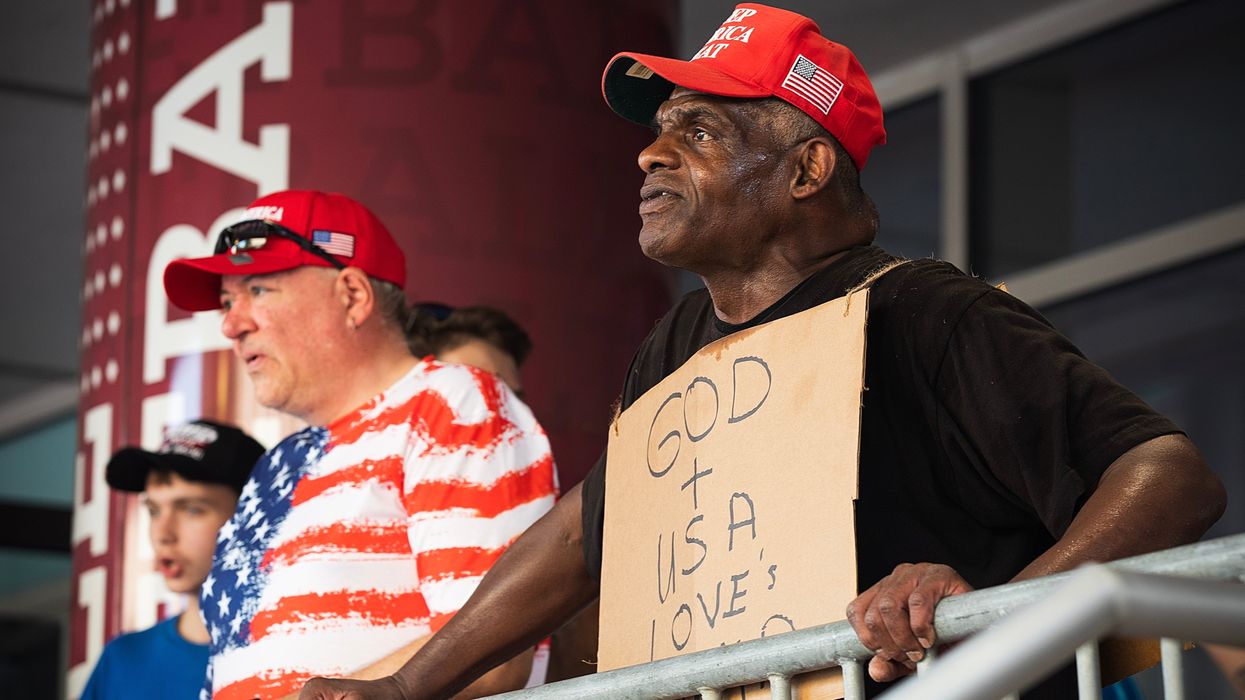
Donald Trump supporters in Philadelphia on June 22, 2024
 (Ann Kapustina/Shutterstock.com)

Alex Henderson
April 08, 2025
ALTERNET

In politics, the word "ideologue" can have a very negative connotation, describing someone who has an extremely rigid set of beliefs. An ideologue could be anyone from a far-right Christian nationalist to a far-left Maoist or Marxist-Leninist.

Politico neuroscientist Leor Zmigrod addresses that type of rigidity in her new book, "The Ideological Brain: The Radical Science of Flexible Thinking," which she discussed with the New York Times' Matt Richtel in a Q&A interview published on April 8.

When Richtel asked Zmigrod what "ideology" is, she responded, "It’s a narrative about how the world works and how it should work. This potentially could be the social world or the natural world. But it’s not just a story: It has really rigid prescriptions for how we should think, how we should act, how we should interact with other people."

Zmigrod continued, "An ideology condemns any deviation from its prescribed rules…. Ideologies satisfy the need to try to understand the world, to explain it. And they satisfy our need for connection, for community, for just a sense that we belong to something."

During the interview, Zmigrod described research on children.

"Liberal children," according to Zmigrod, "tended to recall more accurately the ratio of desirable and undesirable traits in the characters of the story" — whereas the "most ideologically-minded children incorporated fictions that confirmed their pre-existing biases."

"The people most prone to ideological thinking tend to resist change or nuance of any kind," Zmigrod told Richtel. "We can test this with visual and linguistic puzzles. For instance, in one test, we ask them to sort playing cards by various rules, like suit or color. But suddenly, they apply the rule, and it doesn't work. That's because, unbeknownst to them, we changed the rule."


‘Remake entire US economic order’: CNBC host predicts Trump won’t ‘back down'


David Badash, 
The New Civil Rights Movement
April 7, 2025 

U.S. President Donald Trump meets with Israeli Prime Minister Benjamin Netanyahu (not pictured) in the Oval Office at the White House in Washington, U.S., April 7, 2025. REUTERS/Kevin Mohatt

President Donald Trump is pursuing a sweeping new economic order and shows no signs of retreating from his aggressive tariff policies, according to a CNBC host. Meanwhile, Treasury Secretary Scott Bessent—calling it a “reordering” of trade and a “re-levering” of the private sector—says the administration expects thousands of fired federal workers will transition into the manufacturing jobs Trump aims to restore from overseas.

In an interview published by RealClearPolitics over the weekend, Secretary Bessent was asked if he thinks there are enough people in the U.S. workforce to fuel Trump’s goal of dramatically increasing manufacturing in the U.S.

Bessent explained that he believes factories will be automated and run by artificial intelligence, while the thousands of federal workers fired by the Trump administration will fill the manufacturing jobs.

“I think we do,” have the labor force to transition the U.S, from a mostly service economy to one with massively increased production, Bessent said.

“I think with AI, with automation, with so many of these factories are going to be new. They’re going to be smart factories that I think, we’ve got all the labor force we need,” the Secretary said.

“So what we are doing on one side, the president is reordering trade,” the Secretary continued. “On the other side, we are shedding excess labor in the federal government and bringing down federal borrowings? And then on the other side, that will give us the labor that we need for the new manufacturing.”

“And we’re going to relever the private sector. So the private sector, in essence, has been in recession during the Biden years,” he said — a claim disputed by experts and data. “And this is an opportunity to right-size the federal government and unleash the private sector again, because it’s been hemmed down by excessive regulation, and it’s been crowded out by the government.”

Political and investigative reporter Roger Sollenberger remarked that he thinks it’s “insane” that Bessent is “saying here is federal workers — the same people Trump et al describe as useless freeloading administrative bloat — are the people who will form the backbone of the new factory labor market.”


Others have noted that many of the fired federal workers held office and “white collar” jobs, whereas manufacturing jobs often require different skill sets.

Secretary Bessent, in fact, has been promoting the claim that the private sector has been in recession during the Biden years, for months.

Back in February, reporting that “Bessent has a gloomy economic view,” Axios noted that “Bessent said … the private sector has been in a recession, but official economic data shows ongoing growth and hiring among private businesses.”


In a “reality check,” Axios added that a “private sector recession is a regular recession by another name.” There was no recession during the Biden years.

“‘The secretary’s comment flies in the face of productivity, GDP, and jobs data,’ Jared Bernstein, the former Biden-era chair of the Council of Economic Advisors, told Axios.”

Bernstein also warned that it is “very important that the economics team sticks to the actual facts.”

CNBC’s Kelly Evans on Monday wrote, “I don’t think this White House is looking for opportunities to back down. I think they view this as a one-time shot to remake the entire U.S. economic order, with high tariffs being a necessary catalyst for that.”

“‘I believe that this is going to work,’ Bessent said,” Evans continued. “‘What I do know is that the old system wasn’t working. And if you look at a system that’s not working, you’ve got to be brave to change it.’ Does that sound like language from an administration looking for an exit route? Especially from Bessent, who has the most Wall Street experience of the bunch.”

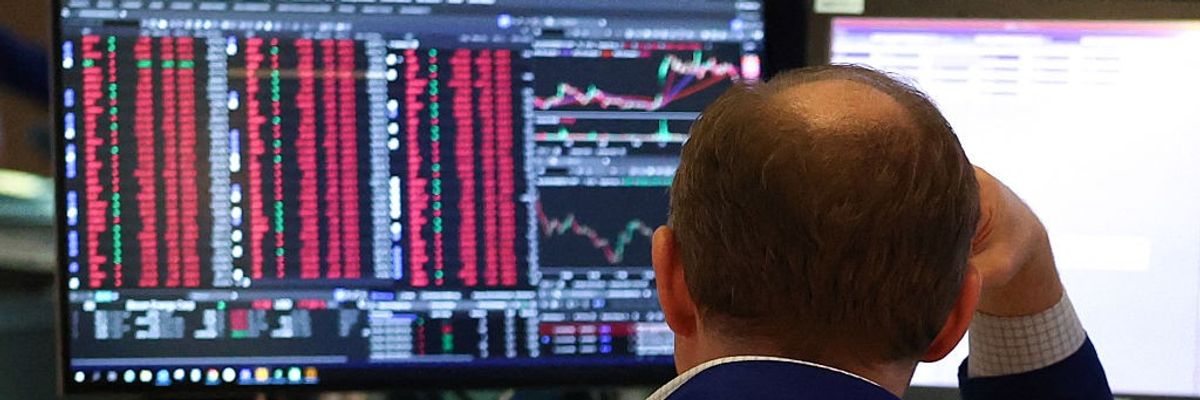
Trump Calls Tariff Madness a 'Beautiful Thing to Behold' as Global Markets Crater

"If the 4.8% fall in S&P 500 futures at the Asian opening isn't reversed, then it's on course for its worst three-day selloff since the Black Monday crash of October 1987."


A trader works on the floor of the New York Stock Exchange in New York City, on April 4, 2025.
(Photo: Timothy A. Clary/AFP via Getty Images)

Jake Johnson
Apr 07, 2025
COMMON DREAMS

U.S. President Donald Trump late Sunday openly embraced the global chaos sparked by his sweeping tariffs, careening headlong into a potentially catastrophic trade war as worldwide financial markets plummeted and American retirees began to panic.

In a post on his social media platform, Trump declared that his tariffs are "already in effect, and a beautiful thing to behold."

"Some day people will realize that Tariffs, for the United States of America, are a very beautiful thing!" Trump wrote as recent retirees and people near retirement expressed fear and astonishment at the swift damage the president's policy decisions have done to their investment accounts.

One retiree, a 68-year-old former occupational health worker in New Jersey, toldNBC News that she is "just kind of stunned, and with so much money in the market, we just sort of have to hope we have enough time to recover."

"What we've been doing is trying to enjoy the time that we have, but you want to be able to make it last," the retiree, identified as Paula, said on Friday. "I have no confidence here."

Trump's post doubling down on his tariff regime came as Asian markets cratered and U.S. stock futures opened bright red, signaling that Monday will bring another broad sell-off in equities. One of Trump's top economic advisers claimed in a Sunday interview that the president is not intentionally crashing the stock market, even as Trump—returning from a weekend golf outing in Florida—characterized the tariffs as "medicine."

"I don't want anything to go down," the president said. "But sometimes you have to take medicine to fix something."

Bloomberg's John Authers wrote early Sunday that "if the 4.8% fall in S&P 500 futures at the Asian opening isn't reversed, then it's on course for its worst three-day selloff since the Black Monday crash of October 1987."

Though the stock market and the economy are not synonymous, economist Josh Bivens recently noted that they are currently "mirroring each other: Stock market weakness is reflecting broader economic weakness."

"While the stock market isn't the economy, the stock market declines we have seen in recent weeks are genuinely worrying," wrote Bivens, the chief economist at the Economic Policy Institute. "They are a symptom of much larger dysfunctional macroeconomic policy that will likely soon start showing up in higher unemployment and slower wage growth for the vast majority."

Trump's Tariffs: Crony Capitalism and the New Economy of Obedience


These tariffs may be framed as populist, but they function as pipelines of wealth transfer from the working and middle classes to the ultra-rich.


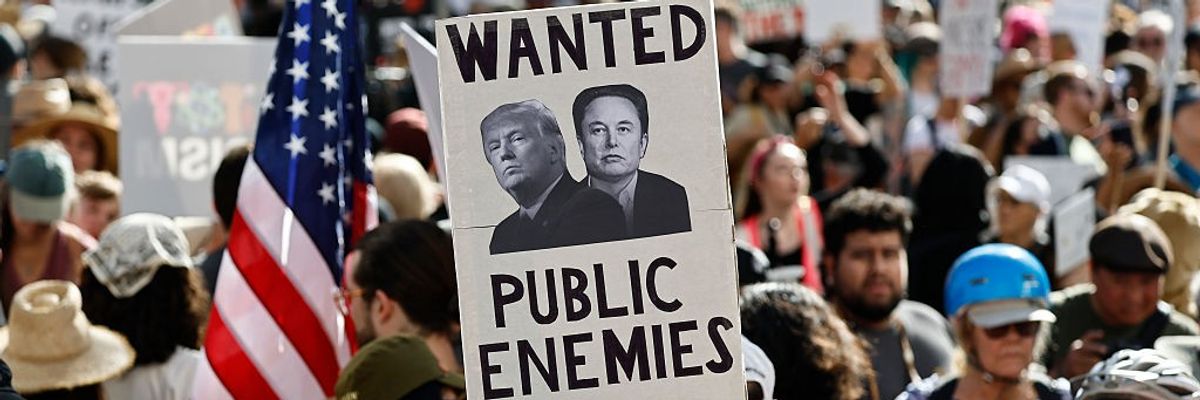
Protestors demonstrate at a 'Hands Off!' protest against the Trump administration on April 5, 2025 in Los Angeles, California. Protests against Trump administration policies and Elon Musk's Department of Government Efficiency (DOGE) are being held nationwide in what organizers are calling a National Day of Action.
(Photo by Mario Tama/Getty Images)

Peter Bloom
Apr 07, 2025
Common Dreams

Donald Trump's latest barrage of tariffs—levied against imports from China, the EU, Mexico, Canada, and the UK—has triggered a global wave of panic. Stock markets are tumbling, trade relationships are unraveling, and the threat of recession is once again stalking the global economy. JPMorgan recently raised its probability of a U.S. recession to 60%, while the BBC notes that U.S. consumers are already facing higher prices on cars, electronics, and everyday goods.

UK business groups have warned that the tariffs will cause "untold damage" to exports and jobs. Market observers describe the mood as “carnage,” with Wall Street plunging and currencies in freefall. Economists, bewildered by the self-inflicted harm, are questioning the logic. As The Guardian succinctly put it: “In economic terms, Trump’s tariffs make no sense at all.”

But perhaps the key is to stop viewing them as economic policy at all.

Behind the official rhetoric lies a more disturbing pattern: the weaponization of the global economy to reshape alliances, weaken opposition, and consolidate elite control.

Instead, what we are witnessing is a shift in how political and economic power is wielded. Trump's tariffs are less about economic advantage than they are about “power.” They are the instruments of a broader authoritarian project—one that uses economic coercion not as a last resort, but as a first principle.

The Trump administration has framed this crisis as a defense of “national sovereignty,” declaring a state of emergency in order to impose sweeping new trade restrictions. But behind the official rhetoric lies a more disturbing pattern: the weaponization of the global economy to reshape alliances, weaken opposition, and consolidate elite control.

Crony Capitalism Disguised as Protectionism

Trump’s tariffs are not random acts of economic aggression. They are carefully placed tools of political leverage—intended to punish dissent and reward obedience. Want your country's exports to avoid a crushing levy? Then align your foreign policy with Trump's vision. Need your factory spared from punishing steel tariffs? Show loyalty, cut a deal, make a donation.

This is not free market capitalism. It is feudalism with a corporate gloss—where tariff exemptions and trade deals are handed out not on merit, but on allegiance. Indeed even before the announcement, corporations with the right connections in Washington have already begun receiving favorable treatment. The message is clear: if you want to survive in this economy, loyalty to the throne is not optional—it’s the business model.

This isn’t just Trump’s strategy. It is the strategy of an emerging capitalist class that thrives in the dark.

This marks a dangerous transformation. Trump is not merely using tariffs to "bring jobs home"; he is building a new global order in which power is centralized around his persona, and economic access becomes a form of tribute. Allies are not negotiated with, they are enlisted. Enemies are not competed against, they are sanctioned into submission.

Countries like Mexico and Canada are being strong-armed into renegotiating deals that favor Trump’s domestic base. China, meanwhile, has responded with its own retaliatory tariffs and accusations of “economic bullying.” The global trade system is no longer rules-based—it’s relationship-based, and Trump is the gatekeeper.

This dynamic has a name – what I refer to as the rise of the “authoritarian-financial complex”: a hybrid of autocracy and capital, in which markets are no longer neutral platforms of exchange but battlegrounds of loyalty and domination. State power is weaponized not to serve the public good but to enrich a loyal elite through coercive economic tools and manufactured crises. It marks a shift from an imperialist market-driven global capitalist system to a new era where authoritarianism itself becomes profitable —an industry of control that turns state repression, economic chaos, and political loyalty into revenue streams for the ruling elite.

Manufacturing Crisis as an Investment Opportunity

If the tariffs seem irrational through the lens of traditional economics, they make perfect sense when viewed through the lens of crisis capitalism. This is the playbook: manufacture a disruption, create volatility, and let the well-positioned profit from the fallout.

This is not new. Neoliberal elites have long used crises—whether natural, financial, or geopolitical—as opportunities to restructure economies in their favor. The goal is not to prevent crises but to own them, to turn social and economic catastrophe into a series of privatized gains.

During the COVID-19 pandemic, this model was on full display. Private equity and hedge funds disproportionately bought up distressed housing, healthcare companies, and struggling small businesses, consolidating enormous power under the guise of “recovery.”

Trump’s tariff war extends this logic to the international stage. The goal is not to fix the global economy—it’s to turn it into a distressed asset. As markets crash and trade routes collapse, investors tied to the Trump network can scoop up undervalued assets, exploit government stimulus, and re-sell them at massive profits. It's asset stripping on a global scale.

This moment demands clarity. Tariffs that punish enemies and reward friends are not about economic justice—they are tools of elite extraction.

This is why financial markets are not merely reacting to trade uncertainty—they’re anticipating a redistribution of power. The market’s negative response reflects not just fear of economic pain, but recognition that policy now depends on political favor, not stability or reason.

And who pays the price? Ordinary people—through inflation, layoffs, decimated pensions, and rising costs of living. These tariffs may be framed as populist, but they function as pipelines of wealth transfer from the working and middle classes to the ultra-rich.

The New Economy of Obedience

So what are we really looking at? A trade war? A nationalist economic pivot? No. We are witnessing the consolidation of a new form of capitalism—one that fuses state violence, elite finance, and populist spectacle into a coherent, brutal system of control.

Trump’s tariff policies are the scaffolding of a much larger project: to reshape the world economy in a way that rewards loyalty, crushes opposition, and turns crisis into capital. They are not the exception. They are the future—unless they are stopped.

This moment demands clarity. Tariffs that punish enemies and reward friends are not about economic justice—they are tools of elite extraction. The markets are not crashing because Trump miscalculated. They are crashing because the system is being reset. And when the smoke clears, the question is not who will pay the price, but who will own the wreckage.

What is needed is more than hand-wringing about GDP or interest rates. It requires a reckoning with the fact that our economic future is being deliberately reshaped by those who view democracy itself as a distressed asset. The true cost of Trump’s tariffs isn't measured in trade deficits or consumer prices. It’s measured in the dismantling of a rules-based global order in favor of a patronage-driven, authoritarian regime of elite extraction.

This isn’t just Trump’s strategy. It is the strategy of an emerging capitalist class that thrives in the dark. And unless we confront it directly, they won’t just own the crisis—they’ll own us too.
The real reason we're in a national emergency


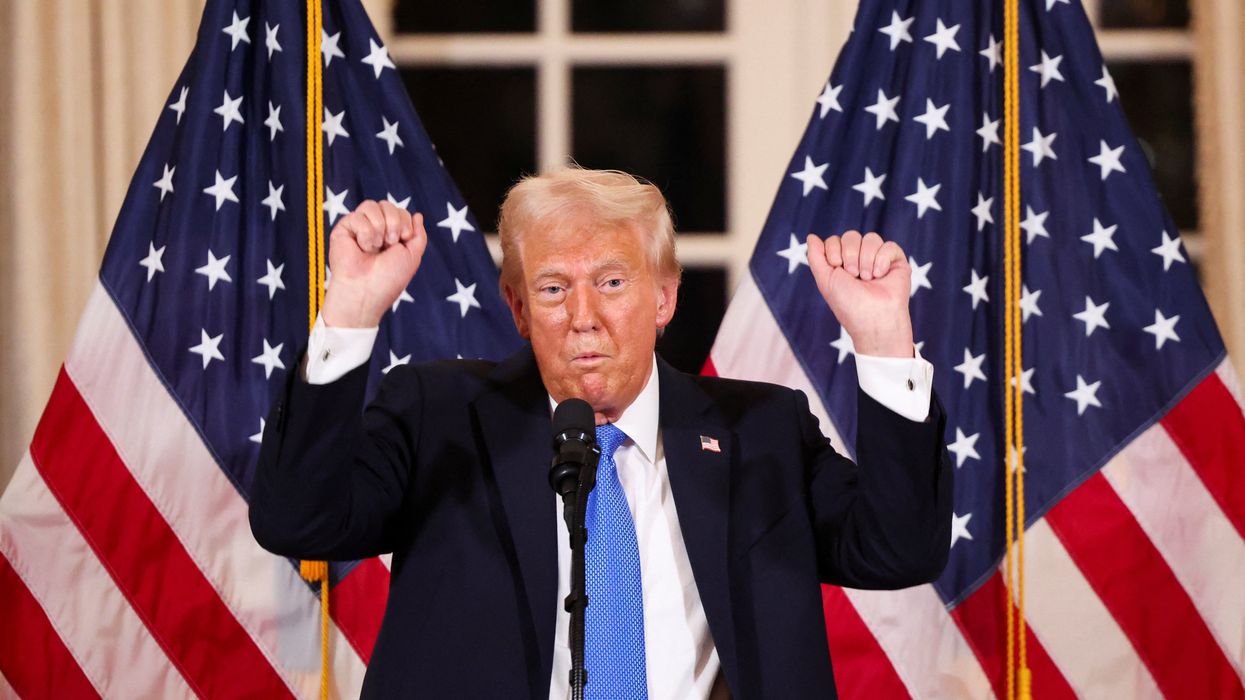
REUTERS/Kevin Lamarque
U.S. President Donald Trump mimics a weightlifter while he speaks at a dinner he hosts for Republican Senators at Mar-a-Lago in Palm Beach, Florida, U.S., February 7, 2025.

April 07, 2025

t’s hard to remember that only 10 weeks ago, the American economy was quite good, our foreign relations were on the whole positive, we were on the way to dealing with climate change with subsidies for wind and solar energy, and we still lived in a democracy.

Today, all that is disappearing. The economy is in acute danger, our relationships with traditional allies are collapsing, we’re subsidizing fossil fuel polluters, and we’re turning into a dictatorship.

This has happened in part because of Trump’s continuing creation of fake national emergencies.

He has declared foreign trade a national emergency and used the International Emergency Economic Powers Act of 1977 to raise tariffs to levels not seen since the disastrous Smoot-Hawley tariff of 1930.

During his 2024 campaign, Trump pledged to bring Americans immediate relief through lower prices. Scratch that. Americans now face higher prices for automobiles, groceries, clothes, and other goods.

He has declared immigration a national emergency and used the National Emergency Act and war power under the Alien Enemies Act of 1798 to authorize mass deportations.

Now, no one is safe — not even people legally in the United States, possibly not even American citizens.

Last week, Trump officials admitted they had made an “administrative error” in abducting a Maryland man whose wife and child are both American citizens and sending him to a notorious Salvadoran prison — despite a court order that he could remain in the United States because he might face torture in El Salvador. To make matters worse, the Trump regime says it has “no power” to get him out of that El Salvador prison.


What guarantee do we have that American opponents of Trump won’t be abducted and sent to El Salvador?

Once everything becomes an emergency, there’s no bottom.

All told, since taking office on January 20, 2025, Trump has declared six national emergencies, including a “National Energy Emergency” and an emergency declaration against Foreign Terrorist Organizations and Specially Designated Global Terrorists.

He has also in effect declared an emergency to justify his wholesale leveling of significant portions of the federal government and civil service and his virulent attacks on the pillars of civil society — our universities, the media, science, law, and the arts.

On Friday, Trump reposted a video saying he’s crashing the stock market on purpose — creating a national economic emergency in a “wild chess move” to “force” the Federal Reserve to lower interest rates and refinance a chunk of the federal government’s $36 trillion in debt “very inexpensively.”

To be sure, yields for U.S. Treasury notes, which are a starting point for loans from mortgages to corporate bonds, collapsed last week — as the benchmark 10-year Treasury fell more than 10 basis points to a six-month low of below 3.9 percent.

But that’s no cause for celebration. The economic collapse Trump is engineering is also pushing up prices and pummeling consumers, and it could easily tip America (and the world) into a recession.

Meanwhile, as Trump declares emergency after emergency to justify his reign of terror, he’s simultaneously eliminating America’s capacity to respond to real emergencies.

Just as vast swaths of Arkansas, Missouri, and Kentucky were underwater, Trump announced he’s ending a key program used by communities across the country to help prepare for natural disasters like flooding and fires.

By terminating the Federal Emergency Management Agency’s program for building resilient infrastructure, Trump has cut off funds to mitigate real disasters, such as raising roads to keep them out of floodwaters or building underground storage units to prepare for droughts.

Make no mistake about what’s really going on here. While the United States has plenty of real problems to deal with, Trump is ignoring them to manufacture the fake emergencies he needs to further enlarge and centralize his power.


Robert Reich is a professor of public policy at Berkeley and former secretary of labor. His writings can be found at https://robertreich.substack.com/.
'We'​re Turning Into a Dictatorship': Trump Tariffs Seen as Ploy to Further Consolidate Power

Democratic Sen. Chris Murphy called President Donald Trump's sweeping tariffs "a political weapon designed to collapse our democracy."

Jake Johnson
Apr 07, 2025
COMMON DREAMS

Analysts puzzling over the bizarre formula the Trump administration used to calculate its country-by-country tariff rates are wasting their time, U.S. Sen. Chris Murphy said in a response to the American president that has gone viral in recent days as global markets continue to nosedive.

"It's not economic policy, it's not trade policy," Murphy (D-Conn.) said in remarks recorded after Trump announced the sweeping tariffs last week. "It's a political weapon designed to collapse our democracy."

While President Donald Trump's universal tariffs on imports make no sense as an effort to rectify the failures of the status quo trade regime and bring back offshored U.S. jobs, they are comprehensible when viewed as "a tool to try to compel pledges of loyalty, this time from companies and industries in the United States," Murphy argued.

"You have to understand that everything Donald Trump is doing is in service of staying in power forever—either him or his family or his handpicked successors," the Democratic senator continued. "He's trying to destroy our democracy."


Murphy contended that the president designed the tariffs to be so widespread that corporations across private industry would have to come to the White House and "make an agreement with Trump in which he gives them tariff relief in exchange for a pledge of political loyalty."

"What could that pledge look like?" Murphy continued. "Well, maybe they agree to champion his economic policy publicly. Maybe they agree to make contributions to his political campaign. Maybe they agree to police their employees to make sure that nobody that works for that company works for the political opposition."

Politicoreported late last week that businesses across corporate America "fear Trump's wrath" and are thus declining to criticize the president's tariff policies even as they wreak havoc worldwide and threaten to spark a devastating recession.

"There is zero incentive for any company or brand to be remotely critical of this administration," one unnamed public affairs operative told Politico. "It destroys your ability to work with the White House and advance your policies, period."

"While the United States has plenty of real problems to deal with, Trump is ignoring them to manufacture the fake emergencies he needs to further enlarge and centralize his power."

Murphy is hardly alone in seeing Trump's tariffs as an instrument of power consolidation.

Robert Reich, the former U.S. labor secretary, wrote Monday that "we're turning into a dictatorship" as Trump conjures "fake national emergencies" to jack up tariffs, deport people en masse without due process, gut efforts to combat the climate crisis, and dismantle large swaths of the federal government.

"As Trump declares emergency after emergency to justify his reign of terror, he's simultaneously eliminating America's capacity to respond to real emergencies," Reich wrote. "Make no mistake about what’s really going on here. While the United States has plenty of real problems to deal with, Trump is ignoring them to manufacture the fake emergencies he needs to further enlarge and centralize his power."

One analyst, Zack Beauchamp of Vox, argued the tariffs are more a symptom of the decline of U.S. democracy rather than a cause of it.

"Trump's tariffs will, if fully implemented, be remembered as their own cautionary tale. While he campaigned on them, he wouldn't have been able to implement the entire tariff package had he gone through the normal constitutionally prescribed procedure for raising taxes," Beauchamp wrote. "The fact that America isn't functioning like a normal democracy, with public deliberation and multiple checks on executive authority, is what allowed Trump to act on his idiosyncratic ideas in the manner of a Mao or Putin."

"It's still possible that Trump steps back from the brink," he added. "But even if he does, and the worst outcome is avoided, the lesson should be clear: The long decay of America's democratic system means that we are all living under an axe. And if this isn't the moment it falls, there will surely be another."
Why Aren't You Supporting the Trump Tariffs?

Progressives and Democrats need a trade policy that makes sense, resonates with working people, and proves they understand the economy better than a know-nothing President Trump.


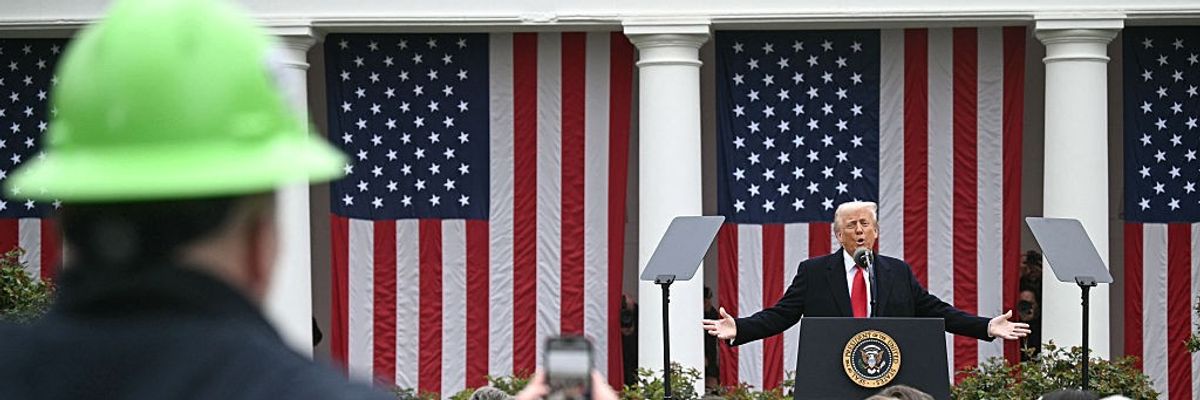
U.S. President Donald Trump delivers remarks on reciprocal tariffs during an event in the Rose Garden entitled "Make America Wealthy Again" at the White House in Washington, DC, on April 2, 2025. (Photo by BRENDAN S
(Photo by Brendan Smialowski/AFP via Getty Images)

Les Leopold
Apr 07, 2025
Common Dreams

On this question, you can take your pick:They will lead to a destructive trade war.
They will lead to a massive economic depression, like the 1930s.
They will make prices and unemployment rise at the same time, like in the 1970s.
They will disappear our savings and pensions as the stock market craters, like in 1929.
And to save democracy, WE SHOULD NEVER SUPPORT TRUMP ON ANYTHING!

The United Autoworkers (UAW), one of the most progressive unions in the country, isn’t buying any of this. For now, it fully supports the Trump tariffs. As the UAW puts it:
This is a long-overdue shift away from a harmful economic framework that has devastated the working class and driven a race to the bottom across borders in the auto industry. It signals a return to policies that prioritize the workers who build this country—rather than the greed of ruthless corporations.

For more than thirty years, the UAW and other unions and progressives have fought free trade deals like NAFTA, adopted in 1994, which in the succeeding decades have decimated American working-class jobs and communities, especially in the industrial areas of the Midwest.

The argument against free trade was simple: Allowing corporations to flee easily and rapidly to low-wage countries put them in a competitive race to the bottom in pursuit of cheaper wages and less costly working conditions. This was especially true in the better-paid U.S. manufacturing industries. Company negotiators threatened job relocation or reductions in virtually every collective bargaining effort with industrial unions.

Corporations said it again and again: “Accept wage and benefit concessions or we’ll move the plant to Mexico.” For labor unions that was a lose-lose proposition. Take less money and benefits and undercut your standard of living or hold fast and lose your job.

The Democrats, led by President Bill Clinton, put together enough votes to pass the deal, and they have been paying the price ever since. Sherrod Brown, the former U.S. Senator from Ohio, says that what he repeatedly heard in his failed senatorial campaign last year was how the Democrats destroyed jobs via NAFTA.

Allowing corporations to easily relocate abroad has been a key element of the neoliberal march to rising inequality. Free trade involves a trade-off, it was argued. More workers would get jobs in growing export industries than would be lost in manufacturing. And the rise of cheap imports would lower the prices of goods workers bought, effectively giving them a pay raise.

Of course, the reality was that the new non-union working-class jobs pay far less than the unionized ones that were lost, and the working-class knows it. And while cheaper goods from Walmart likely offset some of the material sting, moving down the socio-economic ladder is painful and contrary to the American dream.

After years of railing against this Faustian bargain, progressives are now watching Trump claim he is protecting U.S. industries through massive tariffs. The goal, he sometimes says, is to bring back the jobs that were lost.

Progressive Democrats are stuck with a painful dilemma. If they oppose the tariffs across the board, they will be siding with the financiers and CEOs who have profited wildly from low or no tariffs, and have ushered in runaway inequality and increasing job insecurity. (See Wall Street’s War on Workers.)

But Democrats on the left so detest Trump, that it’s nearly impossible for them to join with the UAW to support the tariffs. Unless a new path is forged, progressives will find themselves in an unholy alliance with the Wall Street neoliberals and against the working-class, sounding the death knell for any kind of progressive-worker alliance to build an alternative to Trumpism.
What is a Progressive Trade Policy?

Sen. Bernie Sanders (I-Vt.) is attacking the Trump tariffs by playing his Vermont card, since the state has extensive economic ties to Canada. His key is focusing on working-class jobs:
Given Vermont’s long-established economic ties with our Canadian neighbor, the impact on our state will be even greater. We need a rational and well-thought-out trade policy, not arbitrary actions from the White House. I will do everything possible to undo the damage that Trump’s tariffs are causing working families in Vermont and across the country.

But just what would a “well-thought-out trade policy” look like?
Boarder Adjustment Tax

The goal of a worker-oriented trade policy is to take wages out of competition. That could be most easily done through a tariff called a border adjustment tax. The tax covers the difference in wages between the low-wage and high-wage workers, something that is easily calculated. If wages are nearly identical there would be no need for a tariff.
Targeted Tariffs

When John Deere and Company announced last year it was moving approximately 1,000 jobs to Mexico, in effect to finance higher CEO pay and stock buybacks for Wall Street investors, Trump threatened to impose a 200 percent tariff on any subsequently imported Deere products from that country. That sent the exact message workers wanted to hear: You move our jobs away to fatten your pockets, you get hammered.

Hard to argue with that proposition, but the Democrats did just that. Instead of dealing with how the job shift to Mexico was being used to finance stock giveaways to Wall Street, they rolled out Mark Cuban, who called the tariffs “insane,” because they would hurt Deere.
What About Countries with High-wage Labor?

Workers in export industries in northern Europe, Canada, and Japan have wages and benefits as high or higher than U.S. workers. What’s the rationale, for example, to put tariffs on German-made cars? One reason would be to equalize tariffs in each country and in the long run move them towards zero. The other is to encourage them to increase production in the US.

Ironically, about 5,600 German corporations already have been moving to the U.S. as they seek access to bigger markets and lower production costs. As many set up in low-wage states in the U.S. South, they avoid the higher labor costs in Germany. Also, they have been taking advantage of lavish subsidies as states compete to attract jobs. Energy is also cheaper in the U.S. and transportation costs are lowered. And finally, Germany makes certain high-quality products, especially in green energy, that aren’t yet produced here.

This suggests that a “well thought-out trade policy,” a la Sanders, with Germany should be the result of negotiations, not unilateral actions.

But Trump doesn’t do “well-thought-out,” which means his tariffs are a colossal mess, perhaps even the product of quickly produced ChatGPT hallucinations.

Yet opposing Trump across the board isn’t a well-thought-out approach either. It leads to the tone-deaf reactions of people like Mark Cuban that protect the status quo and avoid dealing with actual job loss caused by plant relocations to low-wage countries and the impact of such threats on collective bargaining. Which, needless to say, is the real problem.

The UAW is trying to make the distinction between supporting pro-worker tariffs and opposing other anti-worker Trump actions. As UAW president Shawn Fain recently said:
But ending the race to the bottom also means securing union rights for autoworkers everywhere with a strong National Labor Relations Board, a decent retirement with Social Security benefits protected, healthcare for all workers including through Medicare and Medicaid, and dignity on and off the job. The UAW and the working class in general couldn’t care less about party politics; working people expect leaders to work together to deliver results. The UAW has been clear: we will work with any politician, regardless of party, who is willing to reverse decades of working-class people going backwards in the most profitable times in our nation’s history.

For progressive Democrats UAW’s approach will be hard swallow. First, it dilutes the all-out attack on Trump for every action he takes, each of which is viewed as an existential threat to democracy. And secondly, it forces the Democrats to deal with job destruction in the private sector, something they have failed to do for more than a generation.

A better approach would be for left politicians like Sanders to sit down with the UAW to hammer out a common progressive position. Where tariffs protect jobs and remove job relocation from negotiations, they should be supported. Where they kill jobs or simply attack high-wage countries for spite, they should be opposed and replaced by careful negotiations to create a low-tariff level playing field.

Let popular worker support for tariffs teach us that this issue requires problem solving, and support for any tariff should not signal failure on a leftist litmus test. The alternative, pure opposition to tariffs, which is where the entire Democratic Party and the left seems to be headed, is only likely to increase working-class support for MAGA.

Jesus, how did we get into this mess?

Maybe ask the Democrats who didn’t have the guts to challenge Biden’s decision to run again until it was far too late.
Rightwing group backed by Koch and Leo sues to stop Trump tariffs

New Civil Liberties Alliance says president’s invocation of emergency powers to impose tariffs is unlawful


Donald Trump and Charles Koch. Photograph: Getty Images

Robert Tait in Washington
THE GUARDIAN
Mon 7 Apr 2025 

A libertarian group that has been funded by Leonard Leo and Charles Koch has mounted a legal challenge against Donald Trump’s tariff regime, in a sign of spreading rightwing opposition to a policy that has sent international markets plummeting.

The New Civil Liberties Alliance filed a suit against Trump’s imposition of import tariffs on exports from China, arguing that doing so under the International Emergency Economic Powers Act (IEEPA) – which the president has invoked to justify the duties on nearly all countries – is unlawful.

The group’s actions echo support given by four Republican senators last week for a Democratic amendment calling for the reversal of 25% tariffs imposed on Canada.

Last Wednesday’s amendment passed with the support of Mitch McConnell, the former Republican Senate majority leader, and his fellow GOP members Rand Paul, Susan Collins and Lisa Murkowski, who argued that tariffs on Canada would be economically harmful.

The action from the alliance has the potential to be even more emblematic, given its past backing from Koch, a billionaire industrialist, and Leo, a wealthy legal activist who advised Trump on the nomination of three conservative supreme court justices during his first presidency, which has given the court a 6-3 rightwing majority. The group received money from organisations affiliated with Leo and Koch in 2022. A spokesperson for Stand Together, a group partially funded by Koch and that has supported the alliance, said it was not involved in the legal case.

The alliance has tabled its action on behalf of Simplified, a Florida-based home goods company whose business is heavily reliant on imports from China. It argues that the president has exceeded his powers in invoking the IEEPA to justify tariffs.

“This statute authorizes specific emergency actions like imposing sanctions or freezing assets to protect the United States from foreign threats,” the alliance said in a statement. “It does not authorize the president to impose tariffs. In its nearly 50-year history, no other president – including President Trump in his first term – has ever tried to use the IEEPA to impose tariffs.”

The alliance also argues that power to impose tariffs lies not with a sitting president, but with Congress, and warns that those imposed by Trump could run afoul of US supreme court rulings.

“His attempt to use the IEEPA this way not only violates the law as written, but it also invites application of the supreme court’s major questions doctrine, which tells courts not to discern policies of ‘vast economic and political significance’ in a law without explicit congressional authorization,” its statement said.

Mark Chenoweth, the alliance’s president, said the court in Pensacola – where the suit has been filed – would have to observe this legal precedent.

“Reading this law [IEEPA] broadly enough to uphold the China tariff would transfer core legislative power,” he said. “To avoid that non-delegation pitfall, the court must construe the statute consistent with nearly 50 years of unbroken practice and decide it does not permit tariff setting.”

The suit argues that there is no connection between the fentanyl epidemic – which Trump has cited as a reason for invoking the emergency powers – and the tariffs.

“The means of an across-the-board tariff does not fit the end of stopping an influx of opioids, and is in no sense ‘necessary’ to that stated purpose,” the complaint filed on behalf of Simplified argues.

“In fact, President Trump’s own statements reveal the real reason for the China tariff, which is to reduce American trade deficits while raising federal revenue.”

The legal case adds to rumbling disquiet on tariffs among some of Trump’s usually vocal supporters, including the billionaire hedge fund manager Bill Ackman.

Paul, a senator from Kentucky who has been one of the most consistent congressional anti-tariff voices, told the Washington Post that other Capitol Hill Republicans shared his concern.

“They all see the stock market, and they’re all worried about it,” Paul said. “But they are putting on a stiff upper lip to try to act as if nothing’s happening and hoping it goes away.”

Speaking in support of last week’s Democratic amendment, sponsored by the Virginia senator Tim Kaine, Paul said: “I don’t care if the president is a Republican or a Democrat. I don’t want to live under emergency rule. I don’t want to live where my representatives cannot speak for me and have a check and balance on power.”

Trump attacked Paul and the three other Republican senators who backed the amendment and suggested they were driven by “Trump derangement syndrome”.

In another sign of Republican concern, the GOP senator from Iowa Chuck Grassley – along with a Washington Democrat, Maria Cantwell – introduced a bill that would limit Trump’s ability to impose or increase tariffs by requiring Congress to approve them within 60 days. The White House budget office said on Monday that Trump would veto the bill.


Patriotic Millionaires Unveil Platform to 'Beat the Broligarchs'


"Our economy should be judged on how well it takes care of working people, not on how many billionaires it mints in a calendar day," said the founder of the economic justice group.


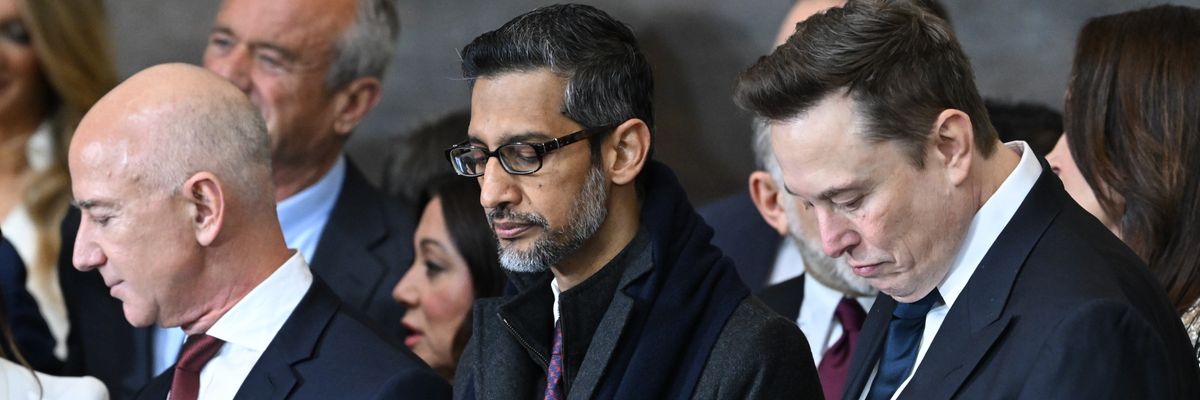
Amazon founder Jeff Bezos, Google CEO Sundar Pichai, and Tesla CEO Elon Musk attend the inauguration of President Donald Trump on January 20, 2025 in Washington, D.C.
(Photo: Saul Loeb-Pool/Getty Images)

Julia Conley
Apr 07, 2025
COMMON DREAMS

With economists warning that U.S. President Donald Trump's trade war will raise the cost of living for millions of American families and could soon fuel a recession, the economic justice group Patriotic Millionaires on Monday unveiled a "bold, surprisingly simple economic framework" to stop the oligarchy from amassing more power at the expense of working people and "permanently stabilize the economic lives of working people."

Four pieces of legislation would form the basis of America 250: The Money Agenda, which Patriotic Millionaires proposed at an "expert town hall" titled "How to Beat the Broligarchs."

The agenda would include:The Cost of Living Tax Cut Act, providing an exemption on federal taxes equal to the median cost of living for a single adult with no children—$41,600 per year—with the responsibility for those revenues shifted from the working class to the millionaire class with a millionaire surtax;
The Cost of Living Wage Act, raising the minimum wage to $21 per hour to match the cost of living for a single adult with no kids;
The Equal Tax Act, equalizing tax rates for capital gains and income over $1 million and closing the "stepped-up basis loophole" which minimizes "the tax obligations of the uberwealthy"; and
The Anti-Oligarch Act, implementing significant taxes on the intergenerational transfer of wealth, on large sums of trust-held wealth, and on the true economic income of America's ultrarich to prevent further wealth concentration at the top, and taxing the wealth of the ultrarich sufficiently—including through an amendment to the U.S. Constitution.

The latter proposal, said Patriotic Millionaires, "is a long overdue response to Supreme Court Justice Louis Brandeis' warning from a century ago: 'We can have democracy in this country or we can have great wealth concentrated into the hands of a few, but we can't have both.'"

"The extreme concentration of wealth has always, without fail, translated into an extreme concentration of political power. The stakes for the nation couldn't be more clear," said the group. "We must act immediately."

At the How to Beat the Broligarchs event on Monday, the group assembled experts including economist Stephanie Kelton, Helaine Olen of the American Economic Liberties Project, and historian Rutger Bregman to discuss how unchecked wealth in the U.S. has captured the political and judicial systems—with "broligarchs" like tech CEO Elon Musk and others "working to pull the strings of the government towards their interests at the expense of the American people."

"America's slide into oligarchy necessitates bold actions in order to reclaim democratic capitalism and forge a prosperous, equitable, and just future," said Erica Payne, founder and president of Patriotic Millionaires. "America 250: The Money Agenda is the only plan that will get us there. It will change not just our own lives, but the future and direction of our country. Our economy should be judged on how well it takes care of working people, not on how many billionaires it mints in a calendar day. By that measure, America is flunking its economics class. The only way to get better marks—and stop our country's slide into oligarchy—is by fixing our tax code."
Morris Pearl, board chair of the group, said that if Congress enacts the legislative agenda proposed on Monday, "we will build a community dedicated to the common purpose of improving the lives of all working people in our country—not just the ultrawealthy."

"America 250 will bring to account the politicians and their enablers who are sustaining our backwards status quo and demand better leaders to put us on a better, more sustainable path," said Pearl. "The time for economic exploitation is over."