Tuesday, May 20, 2025


'They Are Now Planning on Annihilating Khan Younis': New IDF Displacement Order Sparks Alarm

The United Nations human rights chief called Israel's intensifying assault on Gaza "tantamount to ethnic cleansing."


Victims of the Israeli attack are taken from the morgue of al-Nasser Hospital to be buried after funeral procedures, on May 19, 2025 in Khan Younis.
(Photo: Abed Rahim Khatib/Anadolu via Getty Images)

Jake Johnson
May 19, 2025
COMMON DREAMS


The Israeli military on Monday designated Gaza's second-largest city a combat zone and ordered all residents to evacuate ahead of an "unprecedented attack," the latest escalation of Israel's U.S.-backed genocidal assault on the enclave's besieged and starving population.

The forced displacement order came as Israeli tanks and troops pushed further into the Gaza Strip as part of a renewed ground assault on the territory, which has been decimated by relentless bombings that began in the aftermath of the Hamas-led October 7, 2023 attack.

The Euro-Mediterranean Human Rights Monitor said Monday that the rate of Israeli killings in Gaza has intensified significantly in recent days, crushing any lingering hope of an imminent cease-fire and heightening alarm over the rapidly deteriorating humanitarian emergency on the ground.

The group estimated that more than 300,000 Palestinians were forcibly displaced between May 12 and 18, with that number set to grow with the evacuation of Khan Younis.

"This surge in lethal attacks is part of a broader escalation by the Israeli military, marked by a scorched-earth policy and the systematic destruction of Gaza's remaining residential areas and infrastructure," said Euro-Med. "The ongoing campaign—now in its 19th month—has been characterised by mass killings, enforced starvation, and the deliberate dismantling of life-sustaining systems, with the explicit aim of eradicating the Palestinian population in Gaza and eliminating any possibility of return or reconstruction."

Avichay Adraee, a spokesperson for the Israeli Defense Forces (IDF), wrote in a social media post early Monday that "from this moment, Khan Younis governorate will be considered a dangerous combat zone."

"The IDF will launch an unprecedented attack to destroy the capabilities of terrorist organizations in this area," Adraee continued. "For your safety, evacuate immediately."

Video footage posted to social media showed Israeli airstrikes pounding the area and residents scrambling to evacuate their families, many of whom have already been displaced multiple times since late 2023.

"They are literally forcing all of Gazans into a concentration camp in what used to be Rafah in southern Gaza, after destroying it. They are now planning on annihilating Khan Younis," Elia Ayoub, a researcher based in the United Kingdom, wrote Monday. "There's never been a genocide so thoroughly documented as it was live-streamed straight to our phones."


Israeli Prime Minister Benjamin Netanyahu, who is facing an International Criminal Court arrest warrant for war crimes in Gaza, said Monday that the IDF is moving to seize "full control" of the "entire strip" while allowing in "minimal" humanitarian aid—remarks that deepened concerns about Israeli plans to starve out Gaza's population and annex the territory.

"If this means annexation, it violates international law," Swedish Foreign Minister Maria Malmer Stenergard said in response to Netanyahu's comments. "Sweden maintains that the territory of Gaza must not be changed or reduced."

"There needs to be a cease-fire and end to the fighting, and the hostages must be released," she added. "No more statements or plans from the Israeli government that exacerbate the situation for civilians in Gaza."

Over the past 24 hours, Israeli airstrikes have killed more than 130 people, bringing the official death toll since October 2023 to 53,486, according to Gaza's Ministry of Health.

In a statement late last week, United Nations human rights chief Volker Türk warned that Israel's "latest barrage of bombs" and "methodical destruction of entire neighborhoods"—as well as the cut-off of humanitarian assistance—signals "a push for a permanent demographic shift in Gaza that is in defiance of international law and is tantamount to ethnic cleansing."

"We must stop the clock on this madness," said Türk.
Amnesty Urges War Crimes Probe Into US Bombing of Yemen Migrant Jail


"The major loss of civilian life in this attack raises serious concerns about whether the U.S. complied with its obligations under international humanitarian law, including the rules on distinction and precautions."


African women hold photos showing the aftermath of a U.S. airstrike on a Yemeni detention center for African migrants during a protest outside the United Nations office in Sanaa, Yemen on May 11, 2025.
(Photo: Mohammed Hamoud/Getty Images)

Brett Wilkins
May 19, 2025
COMMON DREAMS

The human rights group Amnesty International on Monday called for an investigation of an April U.S. airstrike on a migrant detention center in Yemen that killed and wounded more than 100 people as part of a wider bombing campaign targeting Houthi rebels that has left hundreds of people dead.

The U.S.—which has been bombing Yemen since 2002 as part of the so-called War on Terror launched after the September 11, 2001 attacks—intensified strikes in March 2025 in response to Houthi resistance to Israel's annihilation of Gaza and countries who support it. U.S. airstrtikes on Yemen, which averaged around a dozen per month during the final year of the Biden administration, soared to more than 60 in March under President Donald Trump, according to the Yemen Data Project.

"Under international humanitarian law attacking forces have an obligation to do everything feasible to distinguish between military and civilian targets."

On April 28, U.S. forces bombed the detention center for African migrants in the city of Sa'ada. People familiar with the site told Amnesty that all but one of the migrants jailed at the facility at the time of the attack were Ethiopians, except for one Eritrean. One person told Amnesty that they spoke to survivors of the strike, who said that detainees were sleeping when the center was bombed at around 4:00 am local time.

"They said they woke up to find dismembered bodies around them," the person recounted. "You could see the shock and horror on their faces. Some were still unable to speak because of the trauma."

Another witness said victims "suffered from different fractures and bruises," with some "in critical condition... two had amputated legs."

According to Amnesty:
Under international humanitarian law attacking forces have an obligation to do everything feasible to distinguish between military and civilian targets, to verify whether their intended target is a military objective and to cancel an attack if there is doubt. When attacking a military objective, parties to a conflict must also take all feasible precautions to minimize harm to civilians in the vicinity.

"The U.S. attacked a well-known detention facility where the Houthis have been detaining migrants who had no means to take shelter. The major loss of civilian life in this attack raises serious concerns about whether the U.S. complied with its obligations under international humanitarian law, including the rules on distinction and precautions," Amnesty International secretary general Agnès Callamard said Monday.

"The U.S. must conduct a prompt, independent, and transparent investigation into this airstrike and into any other airstrikes that have resulted in civilian casualties as well as those where the rules of international humanitarian law may have been violated," Callamard added.

Other recent U.S. massacres in Yemen include the April 17 bombing of the Ras Isa fuel terminal in the Hodeida region, which Houthi officials said killed at least 80 people and wounded more than 170 others, and the April 20 strike on the popular Farwah market in the Shuub neighborhood of the capital Sanaa that killed at least 12 people and wounded 30 others.

"At a time when the U.S. appears to be shrinking efforts aimed at reducing civilian harm by U.S. lethal actions, the U.S. Congress should play its oversight role and demand information on investigations to date on these strikes," Callamard said. "Congress must further ensure that civilian harm mitigation and response mechanisms remain intact and robustly respond to this and other recent incidents."
Amnesty International Defiant After Russia Dubs It 'Undesirable Organization'

"We will not give in to the threats and will continue undeterred to work to ensure that people in Russia are able to enjoy their human rights without discrimination."


Amnesty International secretary general Agnès Callamard addresses a media interaction program organized in Kathmandu, Nepal, on May 24, 2024.
(Photo: Subaas Shrestha/NurPhoto via Getty Images)

Jessica Corbett
May 19, 2025
COMMON  DREAMS

A decade after Amnesty International warned that "Russia is set to bolster an ongoing draconian crackdown which is squeezing the life out of civil society by adopting the 'undesirable organizations' law," Russian authorities on Monday hit the human rights group with that designation.

Amnesty is a longtime Kremlin critic. Shortly after Russian President Vladimir Putin launched a full-scale invasion of Ukraine in Febraury 2022, Russia blocked the London-based group's Russian-language website and shut down its Moscow office.

The Russian Prosecutor General's Office on Monday announced Amnesty's new desigantion, claiming that "they justify crimes committed by Ukrainian neo-Nazis, call for an increase in their funding, and insist on Russia's political and economic isolation," as Russia's state-owned news agency TASSsummarized.

"You must be doing something right if the Kremlin bans you."

Responding in a Monday statement, Agnès Callamard, Amnesty's secretary general, said that "this decision is part of the Russian government's broader effort to silence dissent and isolate civil society. In a country where scores of activists and dissidents have been imprisoned, killed, or exiled, where independent media has been smeared, blocked, or forced to self-censor, and where civil society organizations have been outlawed or liquidated, you must be doing something right if the Kremlin bans you."

"The authorities are deeply mistaken if they believe that by labelling our organization 'undesirable' we will stop our work documenting and exposing human rights violations—quite the opposite," she stressed. "We will not give in to the threats and will continue undeterred to work to ensure that people in Russia are able to enjoy their human rights without discrimination. We will keep documenting and speaking worldwide about the war crimes committed in Ukraine by Russia. We will redouble our efforts to expose Russia's egregious human rights violations both at home and abroad."


"We will never stop fighting for the release of prisoners of conscience detained for standing up for human rights or for the repeal of repressive laws that prevent people in Russia from speaking up against injustice," Callamard continued. "We will continue to work relentlessly to ensure that all those who are responsible for committing grave human rights violations, whether in Russia, Ukraine, or elsewhere, face justice. Put simply, no authoritarian assault will silence our fight for justice. Amnesty will never give up or back down in its fight for upholding human rights in Russia and beyond."

According toThe Associated Press:
Russia’s list of "undesirable organizations" currently covers 223 entities, including prominent independent news outlets and rights groups. Among those are prominent news organizations like Radio Free Europe/Radio Liberty or Russian independent outlet Meduza, think tanks like Chatham House, anti-corruption group Transparency International, and Open Russia, an opposition group founded by Mikhail Khodorkovsky, an exiled tycoon who became an opposition figure.

After Open Russia was declared undesirable in 2021 and disbanded to protect its members, its leader, Andrei Pivovarov, was arrested and convicted on charges of carrying out activities of an undesirable organization. He was sentenced to four years in prison and released in 2024 in the largest prisoner exchange with the West since Soviet times.

The move against Amnesty notably comes as U.S. President Donald Trump is pushing for a cease-fire between Russia and Ukraine. After speaking with both Putin and Ukrainian President Volodymyr Zelenskyy on Monday, Trump said that the two countries "will immediately start negotiations."

Trump, in his post on Truth Social, highlighted opportunities for the U.S. to trade with both Russia and Ukraine, as well as the newly elected American pope's offer to host the negotiations at the Vatican. The president also said that he called key European leaders following the call with Putin.

Like Putin, Trump has generated concern by cracking down on dissent. As Common Dreamsreported Monday, the Knight First Amendment Institute at Columbia University led a letter that the coalition wrote "to sound a collective, unified alarm about the Trump administration's multifront assault on First Amendment freedoms, and to call on leaders of civic and other major institutions—including universities, media organizations, law firms, and businesses—to stand more resolutely in defense of these freedoms that are integral to our democracy."
Report Exposes Big Pharma Front Groups Posing as Patient Advocates


"When your board is stacked with industry insiders, your primary funding comes from pharma, and your talking points mirror those of drug lobbyists, you're not a patient advocacy organization—you're a PR operation."


A screenshot shows an ad paid for by Seniors 4 Better Care, a front group for the American Prosperity Alliance.
(Photo: Seniors 4 Better Care/YouTube)


Jake Johnson
May 19, 2025
COMMON DREAMS


A report published Monday reveals that a number of organizations claiming to represent the interests of patients are actually pharmaceutical industry front groups working against efforts to bring down drug costs in the United States, including by lobbying the Trump administration to scale back Medicare price negotiations.

The new analysis by Patients for Affordable Drugs Now (P4AD), which stressed that it doesn't take money from organizations that profit from the production or distribution of prescription medications, spotlights six groups: the Alliance for Aging Research, the American Action Forum, the Center for Medicine in the Public Interest, the Council for Affordable Health Coverage, the Pacific Research Institute, and Seniors 4 Better Care.

The featured organizations, according to P4AD, "are posing as independent patient or policy groups while acting as mouthpieces for the drug industry's agenda—all while raking in pharma cash, fighting Medicare negotiation, and pushing misleading claims to block reforms."

Seniors 4 Better Care, for instance, is a shell group of the American Prosperity Alliance, the president of which "has a history of lobbying for the healthcare industry, including for organizations at the Healthcare Association of New York and insurance providers such as MVP Healthcare," P4AD's report observes.

"The group's treasurer, Parker Hamilton Poling, is a former lobbyist for pharmaceutical companies like Roche and Cencora," the report notes. "Brian Berry, the organization's secretary, also has a history of lobbying for Chinese biotech companies like Complete Genomics."

Earlier this year, Seniors 4 Better Care bankrolled an ad that directly urged President Donald Trump to end the "pill penalty," a label the pharmaceutical industry has used to describe the treatment of small-molecule prescription drugs under the Inflation Reduction Act's Medicare price negotiation provisions.

Last month, in a major gift to Big Pharma and industry lobbyists, Trump signed an executive order aimed at delaying Medicare negotiations for small-molecule drugs, which represent 90% of prescription medicines currently in circulation.


Another group highlighted in P4AD's report is the Center for Medicine in the Public Interest (CMPI), which describes itself as "a nonprofit, nonpartisan research and educational organization that seeks to advance the discussion and development of patient-centered healthcare."

P4AD notes that "every single member" of the organization's board has ties to the pharmaceutical industry. Peter Pitts, CMPI's president and co-founder, "primarily worked at firms hired by the pharmaceutical industry following an 18-month stint at the Food and Drug Administration," P4AD's report states.

"While working at major firms, such as Porter Novelli, Pitts retained his role at CMPI and insisted it was not a conflict of interest," the report continues. "He also currently teaches at the University of Paris, Descartes School of Medicine, a department that is funded by AstraZeneca."

Merith Basey, P4AD's executive director, said that "when your board is stacked with industry insiders, your primary funding comes from pharma, and your talking points mirror those of drug lobbyists, you're not a patient advocacy organization—you're a PR operation."

"Polling shows that Americans are aware that pharmaceutical corporations are the primary drivers of high drug prices, which is why the industry funds front groups to mislead the public and protect its bottom line," said Basey. "Patients and policymakers deserve to know whose interests these groups truly represent."
'Enough Is Enough': Sanders Slams Redstone Over Ouster of CBS News CEO Amid Trump Suit

"Do not capitulate to Trump's attack on a free press," Sen. Bernie Sanders wrote. "Do not settle Trump's bogus lawsuit against '60 Minutes.'"


Shari Redstone, the controlling shareholder of Paramount Global, attends an event on September 18, 2024 in New York City.
(Photo: Bryan Bedder/Getty Images for Paramount+)

Jake Johnson
May 19, 2025
COMMON DREAMS

U.S. Sen. Bernie Sanders on Monday reiterated his call for the owner of CBS News' parent company to stand up to President Donald Trump following news that the outlet's CEO was forced to step down from her post.

"Bill Owens, the producer of CBS's '60 Minutes,' resigned in protest. Wendy McMahon, the head of CBS News, has now resigned," Sanders (I-Vt.) wrote on social media. "I say to Shari Redstone: Enough is enough. Do not capitulate to Trump's attack on a free press. Do not settle Trump's bogus lawsuit against '60 Minutes.'"

Redstone is the controlling shareholder of Paramount Global, which is currently in talks to settle Trump's lawsuit against CBS News. The suit, which experts have criticized as baseless and a threat to press freedom, accuses the outlet of deceptively editing an interview it conducted ahead of the 2024 election with then-Vice President Kamala Harris.

Redstone has advocated settling the Trump suit as she seeks federal approval of a merger deal between Paramount and the entertainment company Skydance. Semaforreported last month that Redstone, whose family stands to reap a large windfall if the deal goes through, had been keeping close tabs on "60 Minutes" segments to supervise coverage of Trump.

Redstone's monitoring triggered "a series of events that ended with the Tuesday resignation of the show's longtime producer," Bill Owens.

The New York Timesnoted Monday that "at the time, Ms. McMahon took pains to signal her support for Mr. Owens, saying that 'standing behind' the producer 'was an easy decision for me.'"

"Her embrace of Mr. Owens and '60 Minutes' put Ms. McMahon at odds with Paramount executives who were anxious about the show's reporting about the Trump administration," the Times added. "Within CBS News, some journalists expected Ms. McMahon to be gone within months. But the timing of her announcement, less than 24 hours after Sunday's season finale of '60 Minutes,' still raised eyebrows."

In a letter to Redstone earlier this month, Sanders and a group of Senate Democrats warned that settling the Trump lawsuit would "only embolden him to shake down, extort, and silence CBS and other media outlets that have the courage to report about issues that Trump may not like."

"Stand up for freedom of the press and our democracy," the senators urged Redstone. "Do not capitulate to this dangerous move to authoritarianism."
Trump’s Illiberal Democracy Threatens Our Foundational Moral Principles

This administration rejects American values as it embraces bribes from foreign dictators, harasses journalists, imprisons op-ed writers, and threatens judges.


Demonstrators rally against U.S. President Donald Trump, Tesla CEO Elon Musk, and their recent policies in Trafalgar Square on April 5, 2025 in London, England.
(Photo: Alishia Abodunde/Getty Images)

Thom Hartmann
May 19, 2025
Common Dreams

At its deepest level, government is a moral force grounded in a moral view of the world.

It may not comport with morality as most of us view it; the Saudi oppression of women, the Russian violence against the queer community, and the Iranian brutal suppression of that nation’s democracy movement are all examples of things most Americans consider immoral.

But each is grounded in a particular moral worldview that those governments and their leaders have adopted.

While America has experienced many dark moral episodes throughout our history, we’ve always held or at least espoused a basic set of moral principles:That all people are born equal under the law; that power should flow up from the people rather than down from elected leaders;
That a free press, free speech, and freedom from religion are essential to liberty; and
That defending the basic rights of all people to “life, liberty, and the pursuit of happiness” is the core function of a democratic republic.

Until now.

Republicans in the House of Representatives just inserted into their must-pass “Big, Beautiful” multi-trillion-dollar-tax-break-for-billionaires legislation a provision that would enable the president to designate any nonprofit—from Harvard to the American Civil Liberties Union to your local Democratic Party—a “terrorist-supporting organization” that then loses their tax-exempt status, effectively putting them out of business.

And who decides who gets that designation? The president. And he gets do to it in secret.

When we abandon our own stated principles in foreign relations, those first laid out in our Declaration of Independence and Constitution, the results are almost uniformly bad for us, for them, and for democracy around the world.

This is exactly how both Russian President Vladimir Putin and Hungarian Prime Minister Viktor Orbán first destroyed dissent and free speech in Russia and Hungary.

U.S. President Donald Trump has been pursuing this for a decade, from his trying to designate Antifa a “terrorist organization” to his attacks on our universities to his use of Stalin’s phrase “enemy of the people” to describe journalists and opinion writers like me.

One level above these core democratic principles—of free speech, the right to protest, and the power of the people in free and fair elections to change our leadership—are two major reformations that came about after major national upheavals.

The first was after the Civil War, when the nation (at least in principle) embraced the humanity and citizenship of nonwhite people with Reconstruction and the 13th through the 15th Amendments to the Constitution. The second was during the Republican Great Depression, when FDR rebooted our republic to become the supporter of last resort for the working class, producing the world’s first more-than-half-of-us middle class.

Now Trump, Elon Musk, and their cabal of right-wing billionaires are trying to dissolve virtually all of this, replacing it with the sort of “illiberal democracy” we see in Russia and Hungary, where there are still elections (but their outcome is pre-determined), still legal protections for the press and free speech (but only when that speech doesn’t challenge those in power), and only the wealthy can truly enjoy safety and security.

After the Saudi, Emirati, and Qatari governments each gave the Trump family massive gifts in the form of billion-dollar development and Trump hotel or golf course licensing deals, Trump made a speech in which he abandoned our 250-year history of advocating democracy around the world.

Of course, as mentioned, we’ve often failed at that mission in the past. Former President Ronald Reagan’s support for the death squads in Central America haunt our southern border to this day; former President Dwight D. Eisenhower’s embrace of the Shah of Iran still rattles the Middle East; and former President Richard Nixon’s tolerance of Chinese brutality led us to, in the name of capitalism, help that nation’s communist leaders create the most powerful and medieval surveillance state in world history.

But these exceptions prove the rule: When we abandon our own stated principles in foreign relations, those first laid out in our Declaration of Independence and Constitution, the results are almost uniformly bad for us, for them, and for democracy around the world. And it becomes even more destructive when this administration rejects American values as it embraces bribes from foreign dictators, harasses journalists, imprisons op-ed writers, and threatens judges.

This issue of morality in government has been at the core of our political debate for centuries. Then-President Harry Truman was explicit about it way back in 1952:
Now, I want to say something very important to you about this issue of morality in government.

I stand for honest government… To me, morality in government means more than a mere absence of wrongdoing. It means a government that is fair to all. I think it is just as immoral for the Congress to enact special tax favors into law as it is for a tax official to connive in a crooked tax return. It is just as immoral to use the lawmaking power of the government to enrich the few at the expense of the many, as it is to steal money from the public treasury. That is stealing money from the public treasury…

Legislation that favored the greed of monopoly and the trickery of Wall Street was a form of corruption that did the country four times as much harm as Teapot Dome ever did.Private selfish interests are always trying to corrupt the government in this way. Powerful financial groups are always trying to get favors for themselves.

Tragically, for both America and democracy around the world, this is not how Donald Trump was raised and does not comport with the GOP’s current worldview. Fred Trump built a real estate empire through racism, fraud, and deceit. He raised Donald to view every transaction as necessarily win-lose, every rule or regulation as something to get around, and every government official as somebody to be influenced with threats or money.

The GOP embraced a similar worldview with the Reagan Revolution as former Labor Secretary Robert Reich notes in his must-read Substack newsletter:
But starting with Reagan, America went off the rails. Deregulation, privatization, free trade, wild gambling by Wall Street, union-busting, record levels of inequality, near-stagnant wages for most, staggering wealth for a few, big money taking over our politics.

Stock buybacks and the well-being of investors became more important than good jobs with good wages. Corporate profits more important than the common good.

Greed is a type of moral stance. It’s not one that open, pluralistic, democratic societies embrace beyond their tolerance of regulated capitalism, but it is a position that expresses a certain type of morality, one most famously expounded by David Koch and Ayn Rand.

It’s inconsistent with the history of humanity itself, as I document in detail in The Hidden History of American Democracy: Rediscovering Humanity’s Ancient Way of Living. From Margaret Mead pointing out how healed leg bones in hundred-thousand-year-old skeletons show that ancient societies cared for their wounded to the ways Native American tribes dealt with people who stole or hoarded even without the use of police or prisons, the triumph of greed has historically been the exception rather the rule.

When Donald Trump said, “My whole life I’ve been greedy,” it was one of the few honest bits of self-appraisal he’s ever tendered. And it should have warned all of us.

Greed and hunger for power are, ultimately, anathema to our traditional American values.

And it’s high time we began to say so, and to teach our children the difference between a moral nation that protects its weakest citizens while promoting democracy around the world and an “illiberal democracy” like Russia, Hungary, and the vision of today’s GOP.

We’ve been better than this in the past, and it’s high time we return to those moral positions that truly made America great.

Our work is licensed under Creative Commons (CC BY-NC-ND 3.0). Feel free to republish and share widely.

Thom Hartmann is a talk-show host and the author of "The Hidden History of Monopolies: How Big Business Destroyed the American Dream" (2020); "The Hidden History of the Supreme Court and the Betrayal of America" (2019); and more than 25 other books in print.
Full Bio >
Trump Cares More About Growing Fossil Fuel Profits Than Shrinking Your Energy Bill


Many things the Trump administration does are simply designed to waste energy, because that is good for the incumbent producers, i.e. Big Oil.


The PEMEX Deer Park oil refinery is seen on April 8, 2025, in Deer Park, Texas.
(Photo: Ronaldo Schemidt/AFP via Getty Images)


Bill Mckibben
May 20, 2025
The Crucial Years

It would be tempting to dismiss U.S. President Donald Trump’s many functionaries as idiots, because many of them are. Here, for instance, is a transcript of leaked audio from a recent staff meeting led by acting Federal Emergency Management Agency director David Richardson, a man with no experience in disaster management (but who did write what the reliable Kate Aronoff described as a bad autobiographical novel with the inspired title War Story). Anyway, put yourself in the place of the FEMA staff hearing this highly relatable anecdote:

The other day I was chatting with my girlfriend, she's from Texas. She's got like huge red hair. Like, she's from Texas. And I said something and she said, well, you know, oh, I know what it was. I said, how come it takes so long to drive 10 hours from Galveston to Amarillo? And she said, well, you know, Texas is bigger than Spain. I didn't know that. So I looked at the map. Texas is huge! I mean, if you put it in the middle of Europe, it takes up most of Europe up. However, they do disaster recovery very, very well, and so does Florida, okay. So, we should be able to take some lessons learned on how Florida and Texas do their disaster recovery, we’ve got to spread that around and get other folks do it some way. And there should be some budgeting things that they have, I bet. I bet Gov. [Greg] Abbott has a rainy day fund for fires and tornadoes and disasters such as hurricanes, and he doesn't spend it on something else.

But if there’s endless idiocy at work (some of it as cover—if I was taking flak for my $400 million flying bribe I’d start tweeting about Taylor Swift and Bruce Springsteen too), there’s also a kind of underlying feral cunning. All the stupid stuff heads in the same direction.

For example, the administration announced earlier this month it would get rid of the Energy Star program, which rates various appliances by their efficiency so that consumers (and landlords and building owners) can make wise choices.
“The Energy Star program and all the other climate work, outside of what’s required by statute, is being de-prioritized and eliminated,” Paul Gunning, the director of the Environmental Protection Agency (EPA) Office of Atmospheric Protection, told employees during the meeting, according to the recording obtained by The New York Times. Mr. Gunning’s office itself is also slated for elimination.

This is a program begun by Republicans—former EPA administrator William K. Reilly wrote a fond reminiscence yesterday for The Washington Post, who pointed out that if you were actually worried about, say, waste, then this would be the last program to cut:
The program costs $32 million in annual federal outlays to administer but has saved consumers $200 billion in utility bills since 1992—$14 billion in 2024 alone. The averted air pollution, which was the EPA’s initial objective, has been considerable, equivalent to the emissions of hundreds of thousands of cars removed from the road.

But what if you wanted to burn more fossil fuel? What if you wanted to stretch out the transition to cheap, clean renewable energy? Well then it would make a lot of sense.

Or take last week’s news, from EPA administrator Lee Zeldin, who vowed that he would eliminate the “start-stop” technology in cars because “everyone hates it.” This feature keeps your car from idling at stoplights—when you tap the accelerator the car turns back on. It’s not mandatory for carmakers, and drivers can turn it off with a button. But, as Fox News points out,
The feature can improve fuel economy by between 4% and 5%, previous EPA estimates showed. It also eliminated nearly 10 million tons of greenhouse gas emissions per year as of 2023.

Meanwhile, Energy Secretary Chris Wright, according to excellent reporting in Heatmap News Friday, is taking federal money designed to convert a steel plant to electricity and hydrogen and instead using it to convert the steel plant to… the fossil fuel it’s already using. The company, its CEO explained, is working with the Department of Energy (DOE) to “explore changes in scope to better align with the administration’s energy priorities,” and those priorities, of course, are to use more energy.

Occam’s Razor, I think, would lead us to say that many things the Trump administration does are simply designed to waste energy, because that is good for the incumbent producers, i.e. Big Oil. That’s not a particularly sophisticated rule for understanding their actions, but remember: Trump was bankrolled by the fossil fuel industry, and that industry has always wanted us to waste energy. Remember all that endless Trump nonsense about low-flow shower heads? They cut the use of hot water by about 40%. Ditto incandescent bulbs, which use 75-90% more energy, and which Trump is trying to bring back. It’s strange to be pro-waste, but there you are. This administration is garbage in every way.

That all of this costs consumers money is obvious—but we don’t really pretend to care about consumers any more. Remember: two dolls and five pencils apiece. No, the ultimate customer for the Trump administration is the oil industry. And really for the GOP as a whole: It became increasingly clear this week that the Republican congressional majority is all too willing to gut the Inflation Reduction Act, even though that will come at a big price to consumers, in its effort to help Big Oil.

And Big Oil is in trouble. Power demand in New England hit an all time low in late April, because so many homes now have solar panels on top. In, um, Saudi Arabia solar arrays are springing up left and right. Bloomberg’s David Fickling chronicles the “relentless” switch toward spending on clean energy, albeit too slowly to hit the most important climate targets. A new global poll of business executives found that 97% were eager to make the switch to renewable energy for their companies, on the grounds that
Electricity is the most efficient form of energy, and renewables-generated electricity a value-add to businesses and economies. In many countries, fossil fuels, with their exposure to imports and volatility to geopolitical shocks, are a liability. For business, this isn’t just inconvenient. It’s dangerous. Volatility drives up costs, turns strategic planning into guesswork, and delays investment.

That’s how sensible people with sensible goals—like making their businesses work, think. But it’s exactly the opposite of how our government now imagines its role. The DOE put their strategy pretty plainly in a filing to the Federal Register last week: Their goal, they said, was “bolstering American energy dominance by increasing exports and subsequently the reliance of foreign nations on American energy.” If you’re a foreign government, that about sums it up: Either you can rely on the sun and wind which shine on your country, or you can rely on the incredibly unreliable U.S. China, meanwhile, is essentially exporting energy security, in the form of clean energy tech.

So the goal for the rest of us, as we resist Trump and resist climate change, is pretty clear: Do everything we can to speed up this transition to clean energy, here and everywhere. Solar works, solar is cheap, and solar is liberating.


© 2022 Bill McKibben

Bill Mckibben is the Schumann Distinguished Scholar at Middlebury College and co-founder of 350.org and ThirdAct.org. His most recent book is "Falter: Has the Human Game Begun to Play Itself Out?." He also authored "The End of Nature," "Eaarth: Making a Life on a Tough New Planet," and "Deep Economy: The Wealth of Communities and the Durable Future."
Full Bio >
Rights Groups Raise Alarm Over First US City's Broad Use of Facial Recognition Tracking


"This is the facial recognition technology nightmare scenario that we have been worried about," said one civil liberties campaigner.


A Project NOLA security camera keeps watch over the corner of Conti Street and Burgundy Street in New Orleans on May 8, 2025.
(Photo: Edmund D. Fountain/The Washington Post via Getty Images)

Brett Wilkins
May 19, 2025
COMMON DREAMS

Amid a Washington Post investigation and pushback from civil liberties defenders, New Orleans police recently paused their sweeping—and apparently unlawful—use without public oversight of a private network of over 200 surveillance cameras and facial recognition technology to track and arrest criminal suspects.

On Monday, the Postpublished an exposé detailing how the New Orleans Police Department (NOPD) relied on real-time facial recognition technology provided by Project NOLA, a nonprofit organization operating out of the University of New Orleans, to locate and apprehend suspects.

"Facial recognition technology poses a direct threat to the fundamental rights of every individual and has no place in our cities."

Project NOLA's website says the group "operates the largest, most cost-efficient, and successful networked [high definition] crime camera program in America, which was created in 2009 by criminologist Bryan Lagarde to help reduce crime by dramatically increasing police efficiency and citizen awareness."

The Post's Douglas MacMillan and Aaron Schaffer described Project NOLA as "a surveillance method without a known precedent in any major American city that may violate municipal guardrails around use of the technology."

As MacMillan and Schaffer reported:
Police increasingly use facial recognition software to identify unknown culprits from still images, usually taken by surveillance cameras at or near the scene of a crime. New Orleans police took this technology a step further, utilizing a private network of more than 200 facial recognition cameras to watch over the streets, constantly monitoring for wanted suspects and automatically pinging officers' mobile phones through an app to convey the names and currentlocations of possible matches.

This, despite a 2022 municipal law limiting police use of facial recognition. That ordinance reversed the city's earlier outright ban on the technology and was criticized by civil liberties advocates for dropping a provision that required permission from a judge or magistrate commissioner prior to use.


"This is the facial recognition technology nightmare scenario that we have been worried about," Nathan Freed Wessler, deputy director with the ACLU's Speech, Privacy, and Technology Project, told the Post. "This is the government giving itself the power to track anyone—for that matter, everyone—as we go about our lives walking around in public."

Since 2023, Project NOLA—which was paused last month amid the Post's investigation—has contributed to dozens of arrests. Proponents including NOPD and city officials credit the collaboration with Project NOLA for a decrease in crime in the city that had the nation's highest homicide rate as recently as 2022. Project NOLA has even been featured in the true crime series "Real Time Crime."

New Orleans Police Commissioner Anne Kirkpatrick said in an email last month that she is "sure that the use of [Project NOLA] meets all the requirements of the law and policies."

However, critics point to racial bias in facial recognition algorithms, which disproportionately misidentify racial minorities, as a particular cause for concern. According to one landmark federal study published in 2019, Black, Asian, and Native American people were up to 100 times likelier to be misidentified by facial recognition algorithms than white people.

The ACLU said in a statement that Project NOLA "supercharges the risks":
Consider Randal Reid, for example. He was wrongfully arrested based on faulty Louisiana facial recognition technology, despite never having set foot in the state. The false match cost him his freedom, his dignity, and thousands of dollars in legal fees. That misidentification happened based on a still image run through a facial recognition search in an investigation.

"We cannot ignore the real possibility of this tool being weaponized against marginalized communities, especially immigrants, activists, and others whose only crime is speaking out or challenging government policies," ACLU of Louisiana executive director Alanah Odoms said. "These individuals could be added to Project NOLA's watchlist without the public's knowledge, and with no accountability or transparency on the part of the police departments."

"Facial recognition technology poses a direct threat to the fundamental rights of every individual and has no place in our cities," Odoms asserted. "We call on the New Orleans Police Department and the city of New Orleans to halt this program indefinitely and terminate all use of live-feed facial recognition technology."


Nearly Half of US Kids—34 Million—Rely on Food, Health Programs Targeted by GOP


"Children and families across America are at risk of losing affordable health coverage and access to healthy meals to pay for a massive tax cut for billionaires and big corporations," said Congresswoman Kathy Castor.


A father shops with daughter his daughter in a supermarket.
(Photo: Tetra Images/Getty Images)

Jessica Corbett
May 19, 2025
COMMON DREAMS

On the heels of the U.S. House Budget Committee's Republicans striking a deal to advance their megabill following a failed vote last week, a trio of organizations on Monday released a report detailing how the legislation could negatively impact tens of millions of American children.

Published by the AFL-CIO, First Focus on Children, and UnidosUS, the report—Children Under Attack: How congressional assaults on health and food programs are endangering the youngest Americans—begins by pointing out that nearly 45% of the country's kids, or 34 million, rely on Medicaid for health insurance, the Supplemental Nutrition Assistance Program (SNAP) for food, or both.

"Put simply, budget reconciliation threatens to do severe and irreparable harm to millions of American children by terminating their health coverage and taking away help paying for food," the report states. "These cuts will leave children poorer, hungrier, and sicker."

"These cuts will leave children poorer, hungrier, and sicker."

Specifically, the document details, "14 million people would lose their health insurance, and millions would lose SNAP or see their benefits drop precipitously, compared to current law. All who participate in Medicaid and SNAP would be at risk, including people with disabilities, seniors, and low-wage workers at jobs without affordable health insurance—but children would be disproportionately hurt: 44% of all American children benefit from Medicaid or SNAP, compared to 23% of adults under age 65."

The publication notes that "these budget reconciliation proposals threaten children of all races and ethnicities, but Latino families and others from historically marginalized communities are in particular danger. Two-thirds of the children who participate in Medicaid or SNAP come from communities of color, placing them at heightened risk from proposed cuts."

"A cautionary note about the numbers in this report is important: They significantly understate the number of children who benefit from Medicaid and SNAP," the report adds. "Our estimates are based on the best available national survey data, but survey respondents significantly under-report their participation in Medicaid and SNAP. If administrative data from these benefit programs was available with enough detail to answer the questions posed in this report, our numbers would be both higher and more accurate."

The push for this megabill began in November, when the GOP won control of not only the White House but also both congressional chambers. Eric Rodriguez, senior vice president of UnidosUS, said in a Monday statement that "earlier this year, Republicans took control of the Congress and made three core promises: to bring costs under control for everyday people; to protect America's children; and to stand up for working-class families, including those in the Latino community who voted them into power."

"Today's report shows how their massive budget plan would break those promises," Rodriguez said. "It makes history's largest cuts to Medicaid and SNAP, taking away the healthcare and food assistance on which millions rely to help them work and make ends meet."


Trump—who is scheduled to meet with House Republicans on Capitol Hill Tuesday to promote the legislation—calls the package "one big, beautiful bill," a name that other GOP elected officials have adopted.

"There is nothing in this big bill that's beautiful for children," said First Focus on Children president Bruce Lesley, "but the gigantic cuts to Medicaid and the Supplemental Nutrition Assistance Program are particularly ugly. Children already are struggling with rising infant and child mortality, increased poverty, and growing rates of hunger, homelessness, and a lack of health insurance."

The GOP's evolving budget reconciliation package would cut programs like Medicaid and SNAP—plus add up to trillions of dollars to the national debt over the next decade—to build on Trump and congressional Republicans' 2017 tax giveaways to wealthy individuals and corporations, a point that critics, particularly Demcratic lawmakers, have highlighted.

"Children and families across America are at risk of losing affordable health coverage and access to healthy meals to pay for a massive tax cut for billionaires and big corporations," said Congresswoman Rep. Kathy Castor (D-Fla.), co-chair of the Congressional Children's Health Care Caucus, in the groups' Monday statement.

"It's wrong and fiscally unwise—and will set children back at a time that they need support," Castor continued. "When children have a healthy start in life, they are more likely to succeed in school, the workplace, and in life. The Republican cuts to care and food for kids could result in developmental delays, serious health problems like cancer that could have been treated successfully, learning losses, and barriers to a high school diploma."

"First Focus on Children and UnidosUS help shine the light on the long-term damage to kids that would result from the GOP billionaire tax giveaway," she added. "Their new report serves as a call to action to reject the billionaire tax giveaway and instead focus on what makes children across America healthy and strong. The fight is far from over."

Trump’s America First Agenda Threatens the Fight Against Global Poverty

As it retreats from multilateralism, the Trump administration is rejecting the U.N. Sustainable Development Goals, which provide a blueprint to eradicate poverty and pursue inclusive and environmentally responsible economic development.


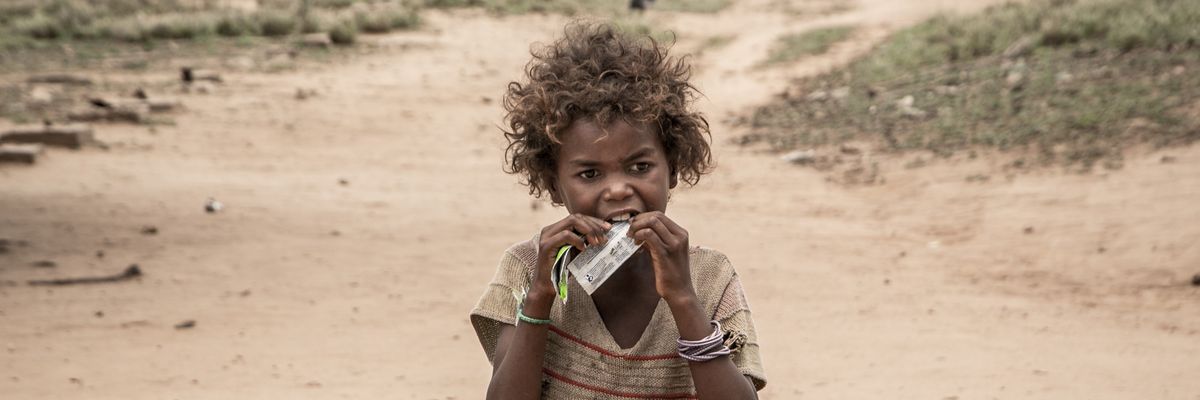
A girl eats a food supplement distributed during a malnutrition screening session organized by the NGO Action Contre la Faim and the World Food Program (WFP) in the municipality of Ifotaka, in southern Madagascar, on December 14, 2018.
(Photo: Rijasolo/AFP via Getty Images)
Foreign Policy In Focus


On March 4, 2025, Edward Heartney, a minister-counselor at the U.S. mission to the United Nations, remarked at the General Assembly that the Sustainable Development Goals “advance a program of soft global governance that is inconsistent with U.S. sovereignty” and interests.

This rejection of the SDGs aligns with President Donald Trump’s retreat from multilateralism and overall dissatisfaction with the U.N. For example, the Trump administration has moved to pull the United States out of the U.N. Human Rights Council, the Paris agreement on climate action, and the World Health Organization (WHO). In addition, the administration has frozen foreign aid, initiated a global trade war, and failed to pay its U.N. dues as of May 2025.

How can we remodel institutions and programs to be less dependent on American funds while also ensuring the continual engagement of the United States as a leader?

Although intended to prioritize the United States, these developments threaten progress on the SDGs, with negative implications for the global fight against poverty.
What are the Sustainable Development Goals?

The SDGs are a collection of 17 goals set for achievement by 2030, subdivided into targets and indicators. They form the core of the 2030 Agenda for Sustainable Development, adopted by all U.N. member states in 2015. They provide a blueprint to eradicate poverty and pursue inclusive and environmentally responsible economic development under conditions of peace and partnership.

Contrary to Heartney’s claims on sovereignty, the 2030 Agenda is voluntary and non-binding. They are a framework, not a prescription. In fact, the SDGs have not received nearly enough policy and financial support as evidenced by their lack of progress. Although there has been progress in some areas, only 17% of SDG targets are on track to be achieved according to the 2024 SDG report.

How, though, does the America First agenda impact global poverty? While many linkages can be draw, SDGs 3, 5, and 13 provide some examples.
SDG 3: Good Health and Well-Being

SDG 3 covers a wide range of health issues. There are strong correlations between a country’s income status and its performance on some SDG 3 indicators. For example, 2019 data places the cause of death by communicable diseases and maternal, prenatal, and nutrition conditions in low-income countries at 47%, versus only 6% for high-income countries.

Poor health is not only a symptom of poverty. It can compound cycles of poverty through inhibiting disabilities, crippling medical expenditures, and premature death. Meanwhile, the significance of American support for good health across the developing world cannot be overstated, and actions such as freezing foreign aid and cutting the UNAIDS budget are projected to cause the deaths of more than 200,000 people from AIDS and tuberculosis alone by the end of 2025.

However, on the positive side, in South Africa—the country with the highest number of people with HIV-AIDS—the government has committed to provide support for HIV-AIDS treatment in 2025 from the National Treasury, aiming to become a more self-sufficient country.

SDG 5: Gender Equality

There are positive links between improving girls’ and women’s access to health services, education, and economic opportunities and the overall living standards of a country. Hence, SDG 5 aims to end discrimination against girls and women and empower them with equal means. However, the Trump administration’s anti-diversity, equity, and inclusion (DEI) policy risks undermining work and advocacy for SDG 5. While this anti-DEI policy promotes merit-based systems and unity on its face, the administration is also using this campaign to target gender-related programs.

Additionally, by February 20, 2025, the freeze on humanitarian assistance resulted in more than 900,000 women per week being denied contraception around the world. Family planning activities were also not part of a limited waiver to the freeze, aligning with the administration’s overall anti-family planning policies. However, support for civil society organizations working on sexual and reproductive health and rights, and volunteerism, can help plug gaps. For example, 200 U.N. Volunteers recently worked with the WHO in the Republic of the Congo to raise awareness about HIV-AIDS and to challenge related stigma via a social media campaign.
SDG 13: Climate Action

The Trump administration’s rejection of the Paris agreement also aligns with support of an “overdue course correction on… climate ideology, which pervade the SDGs,” in the words of Heartney. The Paris agreement—the preeminent international treaty to combat climate change—is essential to SDG 13. Without the participation of the United States, which is the second largest emitter of greenhouse gasses in the world, the Paris agreement and SDG 13 are set to fail.

However, at this stage, climate action is not an “ideology” but a necessity, and the Green transition is not with its own economic opportunities that could advantage the United States.

Similar to the case of SDG 3, not only do low-income households experience the worst impacts of climate change, these impacts can compound poverty through property damage, income disruptions, displacement, and premature death. This further threatens progress on SDG 1.1 (extreme poverty), which has been one bright spot of success amid the ailing SDGs. For example, between 1990 and 2019, the prevalence of extreme poverty in developing Asia fell from 58% to 5%. Climate change, however, could push millions back into extreme poverty by 2030.

Fortunately, efforts like AMERICA IS ALL IN commit Americans to the Paris Agreement even as climate action is moving forward on other fronts. For example, Green bonds have seen rapid growth—rising from $40 billion in 2015 to more than $500 billion in 2023—with the United States being a top issuer in that period.
Looking Forward

In mid-July, New York will host the High-Level Political Forum on Sustainable Development (HLPF), which will review five SDGs, including SDGs 3 and 5. The HLPF provides an opportunity to have important conversations about these issues, and to find solutions.

For example, although the SDGs need the participation of the United States, how can we remodel institutions and programs to be less dependent on American funds while also ensuring the continual engagement of the United States as a leader? The recently adopted Pact for the Future—while not without flaws—also offers an impetus for discussions on why multilateralism is retreating. Finally, it is important to continue leveraging the potential of SDG localization in light of insufficient national action and leadership.

When it comes to multilateral action, the Trump administration is about to prove that the United States is not, in fact, an indispensable nation.


© 2023 Foreign Policy In Focus

Christian Mortelliti
Christian Mortelliti is a consultant working in international development, based in Bangkok. His work has primarily centered around sustainable development, environmental policy, and international security.
Full Bio >