Wednesday, May 28, 2025

Report: 
Commerce Sec. Lutnick’s Family Business Dumped At Least $300M More Into Largest Corporate Bitcoin Holder As Lutnick Helped Establish Trump’s Strategic Bitcoin Reserve


WASHINGTON - An Accountable.US review of Q1 2025 SEC filings posted this week for Cantor Fitzgerald – billionaire Trump Commerce Secretary Howard Lutnick’s family-run financial services firm – reveals that while Lutnick was playing a leading role in President Trump’s national Bitcoin reserve effort, Lutnick’s family business empire dramatically deepened its investment in Microstrategy (now called Strategy), the largest corporate holder of Bitcoin in the world. From Q4 2024 to Q1 2025, Lutnick’s family-run Cantor Fitzgerald increased its holding of regular Strategy stock by $304 million, to a total of $1.3 billion, even amid being publicly criticized for the egregious conflict of interest. Including puts and calls, Accountable.US found Cantor boosted its total investment by over $568 million to over $2.1 billion, representing 44.5% of the firm’s portfolio.

“President Trump’s billionaire Commerce Secretary has been playing the ultimate Washington insider game to pad his family’s riches,” said Accountable.US Executive Director. “From the White House, Howard Lutnick has played a leading role in orchestrating Trump’s Bitcoin reserve policy at the same time his family company was pumping hundreds of millions of dollars into the biggest corporate Bitcoin holder in the game – pushing up their stake by at least $300 million. While both the Lutnick and Trump families seem to be self enriching from positions of power with their massive crypto interests, their bumbling tariff policies and harsh budget plans stand to leave millions of working people with less health and financial security.”

WHAT YOU NEED TO KNOW:In early March 2025, President Trump held the first White House Crypto Summit, where industry leaders discussed “regulations, stablecoins, and Bitcoin’s potential role in the financial system.”
Ahead of the summit, Trump’s billionaire Commerce Secretary Howard Lutnick broke news by saying the summit would likely reveal a “unique status” for Bitcoin, the most popular cryptocurrency, in an unprecedented national crypto strategic reserve Trump announced days earlier. Then, the day before the summit, Trump signed an executive order establishing a “Strategic Bitcoin Reserve,” plus a separate “U.S. Digital Asset Stockpile” for other types of cryptocurrencies. Ahead of the policy announcement, critics called Trump’s crypto plans a “gift to the industry,” “open corruption,” and possibly a “blatant insider trading scam.”
Lutnick, who was CEO of “titan” financial firm Cantor Fitzgerald, helped lead Trump’s crypto reserve and sovereign wealth fund, which was expected to invest in crypto. After his confirmation, Lutnick gave control of the business to his two 20-something-year-old sons—though insiders said his “grip on his various businesses is bolted tight” ahead of his confirmation, and expressed skepticism about his ability to truly relinquish control.
In a new filing for Q1 2025, Cantor Fitzgerald revealed holding up to $2.1 billion in Microstrategy Inc. (now called Strategy), which has “the largest corporate Bitcoin holding in the world” and was seen as “‘a big beneficiary’” of Trump’s crypto reserve announcement, also made in Q1 2025. Ahead of Trump’s official announcement, Lutnick notably said the reserve would give Bitcoin a “unique status” over other cryptocurrencies.
From Q4 2024 to Q1 2025, Cantor Fitzgerald increased its total holding in Strategy by over 1.9 million shares valued at over $568 million, to a total of over 7.4 million shares valued at over $2.1 billion. Excluding puts and calls, Cantor still bought over 1 million more shares valued at $304 million in Q1 2025.
In Q1 2025, Strategy continued to be Cantor Fitzgerald’s largest holding, according to Fintel, with the company representing 44.5% of Cantor’s portfolio, including puts and calls.
CNN previously reported Accountable.US research revealing Cantor Fitzgerald’s total investment of $1.5 billion in Strategy in Q4 2024.
On March 7, 2025, the day after he established the Strategic Bitcoin Reserve, President Trump held a White House crypto summit—with Howard Lutnick and Strategy’s Executive Chairman Michael Saylor in attendance. Meanwhile, Cantor Fitzgerald’s holding in Strategy’s Class A shares soared by 20% from the day before Trump’s reserve announcement to the day Lutnick announced Bitcoin’s unique status in the fund.
In Q1 2025, Cantor Fitzgerald also reported nearly $88 million in other Bitcoin-related investments, including over $86 million in iShares Bitcoin Trust ETF.
In March 2025, after the Bitcoin strategic reserve announcement, Cantor Fitzgerald announced a new $2 billion Bitcoin financing partnership, with Cantor’s Head of Bitcoin Financing saying they “‘expect to substantially grow the operation over time.’” The move was seen as an expansion of Cantor’s bitcoin business “in the wake of Trump administration changes.”

Accountable.US has previously documented billions of dollars of interests Cantor Fitzgerald is involved in that could directly benefit from Lutnick’s role as Commerce Secretary – including urging a national television audience to “buy Tesla” stock in March while his family-run firm Cantor Fitzgerald reported holding nearly $840 million in Tesla Inc. in its most recent holdings report. Conveniently, Lutnick’s appeal to would-be average investors came on the same day Cantor Fitzgerald analysts upgraded Tesla to a “buy” rating.


Accountable.US is a nonpartisan watchdog that exposes corruption in public life and holds government officials and corporate special interests accountable by bringing their influence and misconduct to light. In doing so, we make way for policies that advance the interests of all Americans, not just the rich and powerful.


'Soft underbelly': Investigative reporterd detail 'biggest area of corruption for the Trump family'
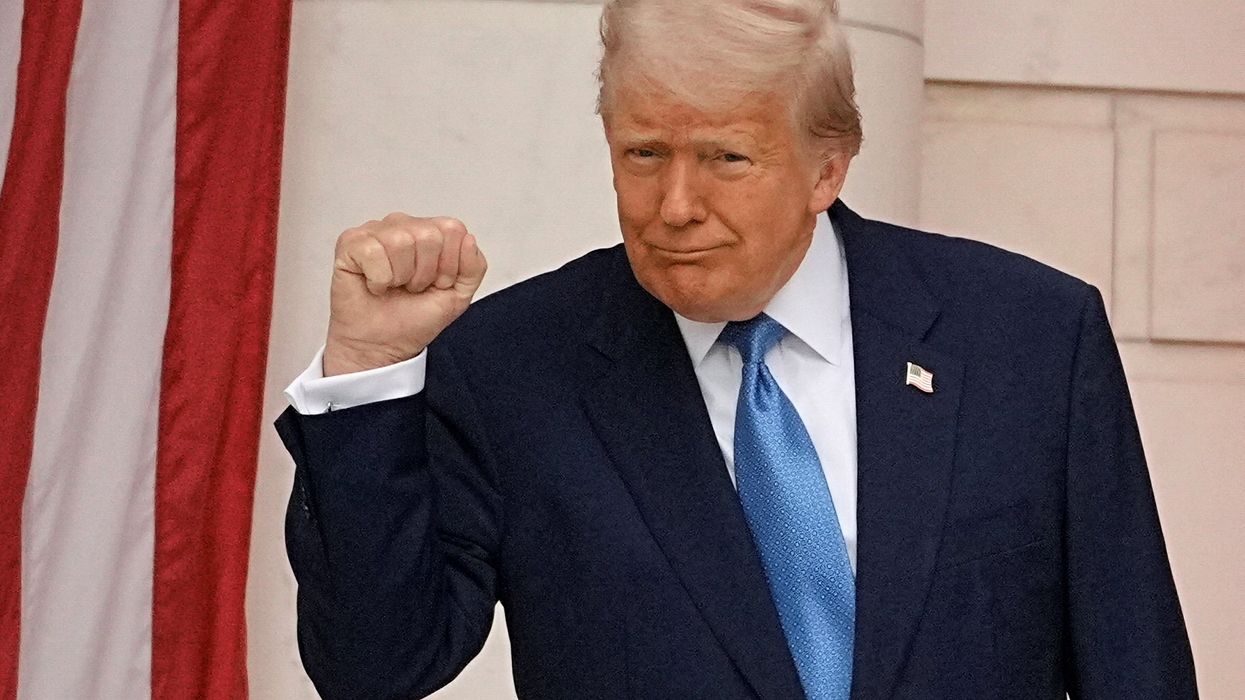

U.S. President Donald Trump gestures, as he attends the annual National Memorial Day Observance in the Memorial Amphitheater at Arlington National Cemetery in Arlington, Virginia, U.S., May 26, 2025. REUTERS/Ken Cedeno
May 28, 2025 
ALTERNET

New York Times reporter Ezra Klein spoke with Bloomberg reporter Zeke Faux about the “shocking” potential for corruption surrounding the Trump family’s involvement in the world of crypto.

“It’s like muzzle velocity for political corruption here,” said Klein. “There are so many stories that, on their own, seem like they should be era-defining political scandals. But the big picture— from Trump trading cards, where he looks like a firefighter or whatever, all the way to the Trump stablecoin, Trump media launching (exchange-traded funds) — is that the Trump family has been groping its way, evolving, learning how to open up a lot of avenues to let people invest in various crypto schemes of theirs.”

“They can’t deny that people are giving them money, but their claim is that they are still acting in what they believe to be the U.S.’s best interest. But the conflicts of interest are so obvious,” said Faux. “… And in fact, once Trump’s appointees took over at the S.E.C., they announced that memecoins were collectibles, like Beanie Babies, and that the rules did not apply.”

Faux estimates the Trump family has generated “at least $700 million” off crypto. It was not clear how much of this included purchases from foreign leaders and billionaires seeking favor.

World Liberty, for example, produces a coin that should not seem appealing to investors because Faux says they are “literally impossible to resell.” However, 75 percent of all the money World Liberty makes is paid to the Trump family as a fee, which provides a motivation all by itself. Chinese-born crypto billionaire Justin Sun, who is facing an S.E.C. investigation, bought $30 million of these “unresellable World Liberty tokens” right after the election, and then later bought another $45 million, “which meant that the Trumps were going to get something like $56 million in a payout based on just what he bought,” Faux said.

“A few weeks after Sun finished his $75 million purchase, his S.E.C. case was put on hold. No explanation was given,” Faux said

The controversy over people spending money at the Trump Hotel in D.C looks “quaint” by comparison, Faux added. “That was a couple hundred thousand dollars. Now people are sending millions to buy Trump’s coins.”

“Tens of millions,” said Klein. “The thing about the crypto play here is it’s so much more scalable. The number goes up."

"Yes. And they ended up selling out. They sold all the (World Liberty Financial) tokens that they had offered — a total of $550 million worth. So that meant $400 million to the Trumps, based on the terms of the offering as I read them,” said Faux.

A company called Freight Technologies also recently announced it was buying $20 million of Trump’s memecoin, phrasing it as “an effective way to advocate for fair, balanced and free trade between Mexico and the U.S.”

“So, what is a company like that doing, publicly announcing a multimillion-dollar investment in the Trump memecoin? What are they saying this memecoin investment is buying them?” asked Klein.

“It seems like those guys are talking about using it to buy access,” said Faux.

Klein said the U.S. system is still trying to find a way to deal with a figure so effortlessly corrupt, backed by a political party so willing to enable the corruption.

“This guy, with his bizarre genius for shamelessness, is just doing it all so unbelievably directly. The coin is called $TRUMP. He’s just promoting it himself. It’s all for him… He has control of the Republican Party, so they’re not going to do anything to him. And they control Congress,” said Klein. “He sort of overwhelms the system’s capacity to know what to do about him, because it never had any defense for something so over the line that the administration refuses to treat as a problem."

“The thing that is supposed to happen in government is somebody says: ‘Hey, you’re taking a bribe. You’re trying to make yourself rich off this,’" Klein added. "And he says: ‘Oh, of course I’m not. I would never do that. How dare you impugn my integrity. But Trump is instead like: ‘Yeah, I mean, wouldn’t you?’"

Read the full NY Times interview at this link. (subscription needed) 


'Rise' in white collar crimes: Expert warns of 'Golden Age of Scams' under Trump
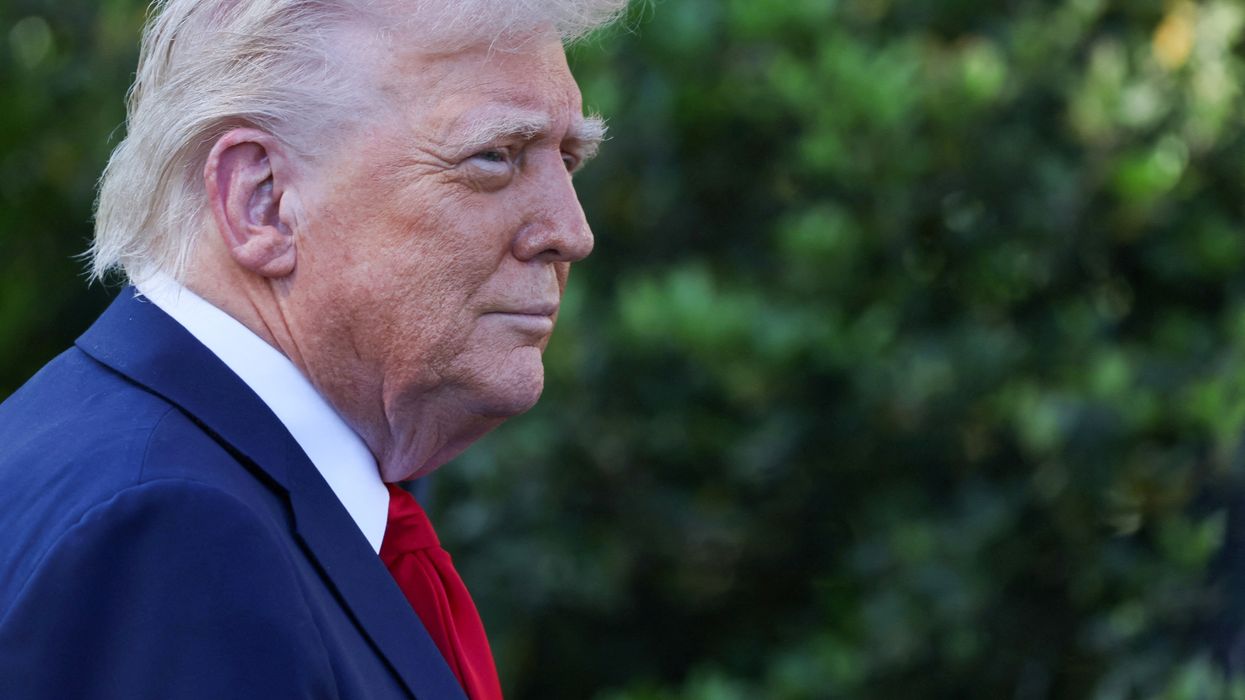

REUTERS/Leah Millis

May 27, 2025
ALTERNET

Sharing a series of articles published in The Prospect Tuesday, journalist and author David Dayen noted that the Trump administration has effectively ended white-collar crime enforcement, warning that "ripoffs, deceptions, and cons will rise as a result to part the public from their money."

Titled "The Golden Age of Scams," one of the pieces in the series, written by Dayen, who serves as the publication's executive editor, highlighted how President Donald Trump’s second term "will unleash dishonesty and abuse across the economy."

"Investigations into any business executive with even a passing relationship to Trump have been scotched, with beneficiaries ranging from the richest man in the world to the husband of the education secretary," the article noted.

"Over 100 active enforcement actions have been either paused or dropped across the executive branch. In March, Trump donor Trevor Milton was pardoned after being sentenced for lying to investors; in April, Trump issued a corporate pardon to BitMEX, a crypto exchange that had pled guilty to failing to prevent money laundering," it adds.

Dayen, author of the book Chain of Title: How Three Ordinary Americans Uncovered Wall Street's Great Foreclosure Fraud, further wrote in the piece that sectors of legal oversight — ranging from restrictions on American firms bribing foreign officials, to efforts aimed at curbing corruption and workplace discrimination — have largely disappeared.

He added that a sweeping deregulation effort, overwhelmingly favorable to corporate interests, is on the horizon.

Roughly $50 million in contributions to Trump’s inauguration came from corporations facing ongoing federal probes or litigation, per the report. This raises serious doubts that these cases will proceed to trial or that the involved executives will face consequences.

Another article in the series written by journalist Jacob Silverman warned that the Trump administration "is removing every financial guardrail from crypto, in order to enrich the first family and its tech and finance allies while destabilizing the economy."

"Since Trump introduced his meme coin, many observers (including me) have warned that it is an unprecedented vehicle for personal enrichment and potentially for bribery," Silverman wrote.

Trump’s aggressive efforts to roll back regulations on the cryptocurrency market have sparked major controversy, particularly as he and his sons have rapidly grown their involvement in crypto enterprises.

Ethics advocates, Democratic lawmakers, and even some Republicans are sounding the alarm over potential conflicts of interest. Much of the outrage centers on Trump’s promotion of a self-branded meme coin called $Trump — a digital token with no real utility.

Critics were especially concerned after Trump hosted an exclusive dinner last week at his Virginia golf resort for the top 220 purchasers of the coin, along with a private event for the top 25 investors.

From USAID to US Harms

Donald Trump’s sharp cuts to this country’s humanitarian aid will ensure that its soft power crumbles, doing lasting damage to its international standing.


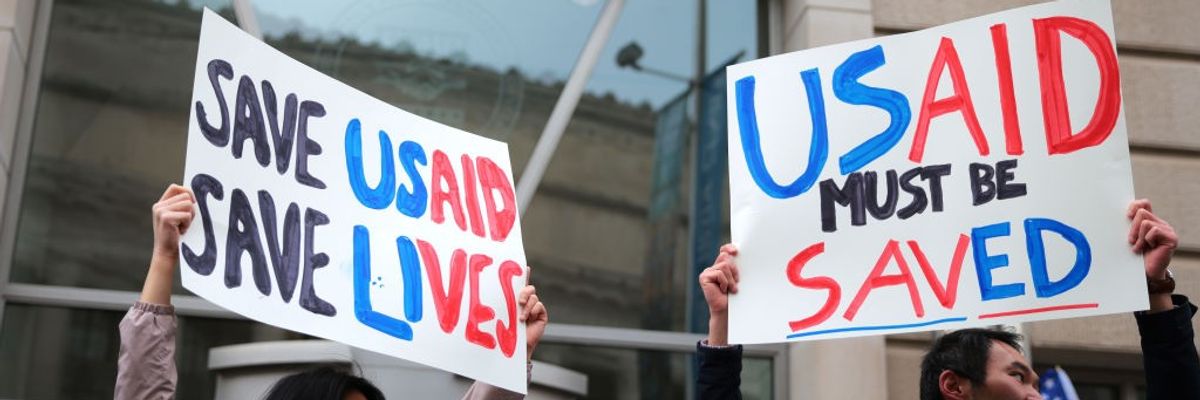
Protestors gather outside of USAID headquarters on February 3, 2025 in Washington, D.C.
(Photo: Kayla Bartkowski/Getty Images)


Alfred W. Mccoy
May 27, 2025
TomDispatch

With the Oval Office looking more like a middle school classroom every day, let’s recall the way, once upon a time, we responded to childhood taunts from a playground bully. You remember how it goes. Your nemesis says mockingly that you’re a this-or-that and you shout back: “Takes one to know one!” Indeed, it does. This month, Microsoft founder Bill Gates said of his fellow billionaire Elon Musk: “The world’s richest man has been involved in the deaths of the world’s poorest children.”

Elaborating, Gates explained that Musk, as head of his self-created Department of Government Efficiency (DOGE), had decided to put “USAID in the wood chipper” by cutting 80% of its global humanitarian programs and that, he pointed out, will mean “millions of additional deaths of kids.” To help undo the damage, Gates announced that he’ll be spending down his own $200 billion fortune over the next 20 years to promote public health in Asia and Africa so that “children [are] not being malnourished or women not bleeding to death or girls not getting HIV”

Amid the blizzard of executive orders and bizarre budgetary decisions pouring out of the Trump White House, Gates put his finger on the cuts that really matter, the ones that will do lasting damage—not just to their unfortunate victims but to America’s sense of global leadership as well.

In short, globally, the sharp cuts to USAID’s humanitarian programs represent a crippling blow to America’s soft power at a time when great-power competition with Beijing and Moscow has reemerged with stunning intensity.

In President Donald Trump’s transactional diplomacy, only the hard power of mineral deals, gifted airplanes, or military might matters. And yet, as we learned in the Cold War years, it’s much easier to exercise world leadership with willing followers won over by the form of diplomacy scholars have dubbed “soft power.” As the progenitor of the concept, Harvard Professor Joseph Nye, put it: “Seduction is always more effective than coercion. And many of our values, such as democracy, human rights, and individual opportunity, are deeply seductive.” He first coined the term in 1990, just as the Cold War was ending, writing that “when one country gets other countries to want what it wants,” that “might be called co-optive or soft power, in contrast with the hard or command power of ordering others to do what it wants.” In his influential 2004 book, Soft Power: The Means to Success in World Politics, Nye argued that, in our world, raw military power had been superseded by soft-power instruments like reliable information, skilled diplomacy, and economic aid.

Actually, soft power is seldom soft. Indeed, Spanish steel might have conquered the New World in the 16th century, but its long rule over that vast region was facilitated by the appeal of a shared Christian religion. When Britain’s global turn came in the 19th century, its naval dominion over the world’s oceans was softened by an enticing cultural ethos of commerce, language, literature, and even sports. And as the American century dawned after World War II, its daunting troika of nuclear-armed bombers, missiles, and submarines would be leavened by the soft-power appeal of its democratic values, its promise of scientific progress, and its humanitarian aid that started in Europe with the Marshall Plan in 1948.

Even in these uncertain times, one thing seems clear enough: Donald Trump’s sharp cuts to this country’s humanitarian aid will ensure that its soft power crumbles, doing lasting damage to its international standing.
The Logic of Foreign Aid

Foreign aid—giving away money to help other nations develop their economies—remains one of America’s greatest inventions. In the aftermath of World War II, Europe had been ravaged by six years of warfare, including the dropping of 2,453,000 tons of Allied bombs on its cities, after which the rubble was raked thanks to merciless ground combat that killed 40 million people and left millions more at the edge of starvation.

Speaking before a crowd of 15,000 packed into Harvard Yard for commencement in June 1947, less than two years after that war ended, Secretary of State George Marshall made an historic proposal that would win him the Nobel Peace Prize. “It is logical,” he said, “that the United States should do whatever it is able to do to assist in the return of normal economic health in the world, without which there can be no political stability and no assured peace.” Instead of the usual victor’s demand for reparations or revenge, the U.S. gave Europe, including its defeated Axis powers, $13 billion in foreign aid that would, within a decade, launch that ruined continent on a path toward unprecedented prosperity.

What came to be known as the Marshall Plan was such a brilliant success that Washington decided to apply the idea on a global scale. Over the next quarter century, as a third of humanity emerged from the immiseration of colonial rule in Africa and Asia, the U.S. launched aid programs designed to develop the fundamentals of nationhood denied to those countries during the imperial age. Under the leadership of President John F. Kennedy, who had campaigned on a promise to aid Africa’s recovery from colonial rule, disparate programs were consolidated into the U.S. Agency for International Development (USAID) in 1961.

At the outset, USAID’s work was complicated by Washington’s Cold War mission. It would sometimes even serve as a cover for CIA operations. Just a few years after the Cold War ended in 1991, however, USAID was separated from the State Department and its diplomatic aim of advancing U.S. interests.

Then refocused on its prime mission of global economic development, USAID would, in concert with the World Bank and other development agencies, become a pioneering partner in a multifaceted global effort to improve living conditions for the majority of humanity. Between 1950 and 2018, the portion of the world’s population living in “extreme poverty” (on $1.90 per day) dropped dramatically from 53% to just 9%. Simultaneously, USAID and similar agencies collaborated with the United Nation’s World Health Organization (WHO) to eradicate smallpox and radically reduce polio, ending pandemics that had been the scourge of humanity for centuries. Launched in 1988, the anti-polio campaign, the Centers for Disease Control and Prevention estimates, spared 20 million children worldwide from serious paralysis.

Behind such seemingly simple statistics, however, lay years of work by skilled USAID specialists in agriculture, nutrition, public health, sanitation, and governance who delivered a multifaceted array of programs with exceptional efficiency. Not only would their work improve or save millions of lives, but they would also be winning loyal allies for America at a time of rising global competition.
And Along Comes DOGE

Enter Elon Musk, chainsaw in hand. Following President Trump’s example of withdrawing from the World Health Organization on inauguration day, Musk started his demolition of the federal government by, as he put it, “feeding USAID into the wood chipper.” As his DOGE hirelings prowled the agency’s headquarters in the weeks after inauguration, Musk denounced that largely humanitarian organization as “evil” and a “viper’s nest of radical-left Marxists who hate America.” Without a scintilla of evidence, he added, “USAID is a criminal organization. Time for it to die.”

With head-spinning speed, his minions then stripped the USAID logo from its federal building, shut down its website, purged its 10,000 employees, and started slashing its $40 billion budget for delivering aid to more than 100 nations globally. The White House also quickly transferred what was left of that agency back to the State Department, where Secretary of State Marco Rubio spent six weeks slashing 83% of its global humanitarian programs, reducing 6,200 of them to about 1,000.

As USAID’s skilled specialists in famine prevention, public health, and governance stopped working, the pain was soon felt around the world, particularly among mothers and children. In Colombia, the agency had spent several billion dollars to settle a decades-long civil war that killed 450,000 people by mapping 3.2 million acres of uncharted lands so that the guerrillas could become farmers. That work, however, was suddenly halted dead in its tracks—project incomplete, money wasted, threat of civil conflict again rising. In Asia, the end of USAID support forced the World Food Program to cut by half the already stringent food rations being provided to the million Rohingya refugees confined in miserable, muddy camps in Bangladesh—forcing them to survive on just $6.00 a month per person.

Washington will soon be left with only the crudest kind of coercion as it tries to exercise world leadership.

In Africa, the aid cuts are likely to prove catastrophic. Departing USAID officials calculated that they would be likely to produce a 30% spike in tuberculosis, a deadly infectious disease that already kills 1.25 million people annually on this planet and that 200,000 more children would likely be paralyzed by polio within a decade. In the eastern Congo, where a civil war fueled by competition over that region’s rare-earth minerals has raged for nearly 30 years, the U.S. was the “ultra dominant” donor. With USAID now shut down, 7.8 million Congolese war refugees are likely to lose food aid and 2.3 million children will suffer from malnutrition. In war-torn Sudan, U.S. aid sustained more than 1,000 communal kitchens to feed refugees, all of which have now closed without any replacements.

With 25 million of the world’s 40 million HIV patients in Africa, cuts to USAID’s health programs there, which had reduced new infections by half since 2010, now threaten that progress. In South Africa, a half-million AIDS patients are projected to die, and in Congo, an estimated 15,000 people could die within the next month alone. Moreover, ending USAID’s Malaria Initiative, which has spent $9 billion since President George W. Bush launched it in 2005, essentially ensures that, within a year, there will be 18 million more malaria infections in West Africa and 166,000 more likely deaths.

On March 3, with such dismal statistics piling up, Elon Musk insisted that “no one has died as a result of a brief pause to do a sanity check on foreign aid funding. No one.”

Writing from Sudan just 12 days later, however, New York Times columnist Nicholas Kristof reported that Peter Donde, a 10-year-old child infected with AIDS at birth, had just died. A USAID program launched by President Bush called PEPFAR had long provided drugs that were estimated to have saved 26 million lives from AIDS (Peter’s among them) until Musk’s cuts closed the humanitarian agency. Kristof reported that the end of U.S. funding for AIDS treatment in Africa means “an estimated 1,650,000 people could die within a year without American foreign aid.” Why, he asked, should Americans spend even 0.24% of their Gross National Product on programs that keep poor children alive? Answering his own question, he wrote that the demolition of USAID “means that the United States loses soft power and China gains.”

Indeed, Dr. Diana Putman, USAID’s former assistant administrator for Africa, argues that the agency’s programs have been the chief currency for U.S. ambassadors in negotiations with developing nations. “Their leverage and ability to make a difference in terms of foreign policy,” she explained, “is backed up by the money that they bring, and in the Global South that money is primarily the money that USAID has.”
The Loss of Soft Power

In short, globally, the sharp cuts to USAID’s humanitarian programs represent a crippling blow to America’s soft power at a time when great-power competition with Beijing and Moscow has reemerged with stunning intensity.

In back-handed testimonials to USAID’s success, the world’s autocrats celebrated the agency’s demise, particularly the end of the $1.6 billion—about 4% of its annual budget—that it devoted to pro-democracy initiatives. “Smart move,” said former Russian Prime Minister Dmitri Medvedev. On X (formerly Twitter), Hungarian strongman Viktor Orbán announced that he “couldn’t be happier that @POTUS, @JDVance, @elonmusk are finally taking down this foreign interference machine.” Expressing his joy, Orbán offered a “Good riddance!” to USAID programs that helped “independent media thrive” and funneled funds to the “opposition campaign” in Hungary’s 2022 parliamentary elections. Similarly, El Salvador’s de facto dictator, Nayib Bukele, complained that USAID’s pro-democracy funds had been “funneled into opposition groups, NGOs with political agendas, and destabilizing movements.”

Offering even more eloquent testimony to USAID’s past efficacy, China has moved quickly to take over a number of the abolished agency’s humanitarian programs, particularly in Southeast Asia, where Beijing is locked in an intense strategic rivalry with Washington over the South China Sea. Writing in the journal Foreign Affairs, two public health specialists observed that “a U.S. retreat on global health, if sustained, will indeed open the door for China to exploit the abrupt, chaotic withdrawal of U.S. programs in… Southeast Asia, and it may do the same in Latin America.”

Last February, only a week after Washington cancelled $40 million that had funded USAID initiatives for child literacy and nutrition in Cambodia, Beijing offered support for strikingly similar programs, and its ambassador to Phnom Penh said, “Children are the future of the country and the nation.” Making China’s diplomatic gains obvious, he added: “We should care for the healthy growth of children together.” Asked about this apparent setback during congressional hearings, Trump’s interim USAID deputy administrator, Pete Marocco, evidently oblivious to the seriousness of U.S.-China competition in the South China Sea, simply dismissed its significance out of hand.

Although the dollar amount was relatively small, the symbolism of such aid programs for children gave China a sudden edge in a serious geopolitical rivalry. Just two months later, Cambodia’s prime minister opened new China-funded facilities at his country’s Ream Naval Base, giving Beijing’s warships preferential access to a strategic port adjacent to the South China Sea. Although the U.S. has spent a billion dollars courting Cambodia over the past quarter-century, China’s soft-power gains are now clearly having very real hard-power consequences.

In neighboring Vietnam, USAID has worked for several decades trying to heal the wounds of the Vietnam War, while courting Hanoi as a strategic partner on the shores of the South China Sea. In building a “comprehensive strategic partnership,” manifest in today’s close trade relations, USAID played a critical diplomatic role by investing in recovering unexploded American munitions left over from that war, cleaning up sites that had been polluted by the defoliant Agent Orange, and providing some aid to the thousands of Vietnamese who still suffer serious birth defects from such toxic chemicals. “It is through these efforts that two former enemies are now partners,” said former Sen. Patrick Leahy (D-V.T.). “People in the Trump administration who know nothing and care less about these programs are arbitrarily jeopardizing relations with a strategic partner in one of the most challenging regions of the world.”
A Global Turn Toward Hard Power

Although the demolition of USAID and sharp cuts to economic aid will have consequences for the world’s poor that can only be called tragic, it’s but one part of President Trump’s attack on the key components of America’s soft power—not only foreign aid, but also reliable information and skilled diplomacy. In March, the president signed an executive order shutting down the U.S. Agency for Global Media, including organizations like Voice of America and Radio Free Europe that had been broadcasting in 50 languages worldwide, reaching an estimated 360 million people in nations often without reliable news and information.

A month later, the White House Office of Management and Budget proposed a 50% cut to the State Department’s budget, closing diplomatic missions and completely eliminating funds for international organizations like NATO and the U.N. While the actual implementation of those cuts remains uncertain, the State Department is already dismissing 20% of its domestic workforce, or about 3,400 employees, including a significant number of Foreign Service officers, special envoys, and cyber-security specialists. Add it all up and, after just 100 days in office, President Trump is well on his way to demolishing the three critical elements for America’s pursuit of global soft power.

Already, the erosion of U.S. influence is manifest in recent criticism of this country, unprecedented in its bitterly acrid tone, even among longstanding allies. “Europe is at a critical turning point in its history. The American shield is slipping away,” warned veteran French legislator Claude Malhuret in a March 4 speech, from the floor of France’s Senate that soon won a remarkable 40 million views worldwide. “Washington has become Nero’s court, with an incendiary emperor, submissive courtiers, and a ketamine-fueled buffoon in charge of purging the civil service.”

With such cutting critiques circulating in the corridors of power from Paris to Tokyo, Washington will soon be left with only the crudest kind of coercion as it tries to exercise world leadership. And, as Professor Nye reminds us, leadership based solely on coercion is not really leadership at all.

Welcome to Planet Trump in the year 2025.


© 2023 TomDispatch.com


Alfred W. Mccoy is professor of history at the University of Wisconsin-Madison is the author of "In the Shadows of the American Century: The Rise and Decline of U.S. Global Power". Previous books include: "Torture and Impunity: The U.S. Doctrine of Coercive Interrogation" (University of Wisconsin, 2012), "A Question of Torture: CIA Interrogation, from the Cold War to the War on Terror (American Empire Project)", "Policing America's Empire: The United States, the Philippines, and the Rise of the Surveillance State", and "The Politics of Heroin: CIA Complicity in the Global Drug Trade".
Full Bio >
'Heartbreaking': 4-Year-Old Who Came to US Legally Could Die Within Days If Deported


"It's cruel and inexcusable," said Rep. Judy Chu.


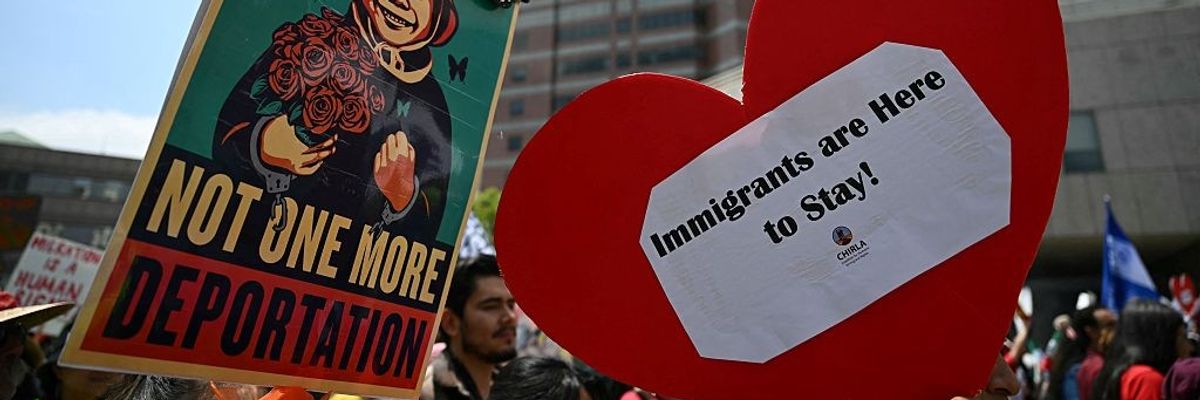
Protestors call for an end to deportations outside the Metropolitan Detention Center in Los Angeles, California, on May 1, 2025.
(Photo by Patrick T. Fallon/AFP via Getty Images)

Jessica Corbett
May 27, 2025
COMMON DREAMS


Yet another Trump administration deportation case is sparking outrage: This time, a 4-year-old Mexican girl and her parents face expulsion, despite the family coming to the United States legally and the child's risk of death if she loses the medical care she is receiving in California.

The Los Angeles Times on Tuesday shared the story of the family, which came to the United States on humanitarian grounds in 2023: the young girl, identified by her initials, S.G.V.; her mom, 28-year-old Deysi Vargas, who is also Mexican; and her 34-year-old dad, who is from Colombia.

They have been living in Bakersfield, and S.G.V. has been receiving care for her short bowel syndrome at the Children's Hospital Los Angeles (CHLA). However, the family received a letter last month stating that their legal status had been terminated and urging them to leave the United States of their own accord, to avoid deportation.

While spokespeople for U.S. Citizenship and Immigration Services as well as CHLA declined to comment, the Times reported on a letter written by Dr. John Arsenault at the family's request:
If there is an interruption in her daily nutrition system, called Total Parenteral Nutrition (TPN), the doctor wrote, "this could be fatal within a matter of days."

"As such, patients on home TPN are not allowed to leave the country because the infrastructure to provide TPN or provide immediate intervention if there is a problem with IV access depends on our program's utilization of U.S.-based healthcare resources and does not transfer across borders," Arsenault wrote.


"This is a textbook example of medical need," said the family's attorney, Rebecca Brown of the pro bono legal firm Public Counsel, who petitioned for continuation of their temporary humanitarian legal status. "This child will die and there's no sense for that to happen. It would just be a cruel sacrifice."

Readers of the reporting quickly called out U.S. President Donald Trump and other key officials in his administration, including Homeland Security Secretary Kristi Noem and Stephen Miller, the White House deputy chief of staff for policy, who was behind the family separation policy from Trump's first term.


"Heartbreaking: A 4-year-old came here legally with her family for lifesaving care. Yet Trump still seeks to deport her despite doctors warning she could die. It's cruel and inexcusable," said Congresswoman Judy Chu (D-Calif.), whose district is in Los Angeles County.

Adrian Carrasquillo, who writes the immigration-focused newsletter "Huddled Masses" at The Bulwark, an anti-Trump conservative outlet, stressed that "this is being done in our name."


The Trump administration has provoked legal battles and intense scrutiny for deporting various people in recent months, including multiple children who are U.S. citizens—among them, a 4-year-old cancer patient.
Why Does the US Press Ignore the Trauma Experienced by Palestinians in Gaza? 
Racism

Because we don’t see Palestinians as fully human, we fail to understand how destroying their lives, denying them a normal present and a hopeful future can result in deformities in their sense of self.


The victims of the Israeli attack are taken from the morgue of al-Nasser Hospital to be buried after the funeral procedures, on May 19, 2025 in Khan Younis, the southern Gaza Strip.
(Photo: Abed Rahim Khatib/Anadolu via Getty Images)

James Zogby
May 27, 2025
Common Dreams

One thing of which we can be certain is that there will be consequences to the genocide in Gaza.

It is difficult to wrap one’s arms around the excruciating pain being endured by Palestinians in Gaza. We only know the rough outline of the devastation. Tens of thousands have been murdered in aerial bombardments, over 100,000 have sustained serious injuries, the majority of homes have been demolished, and, as a result of Israel’s blockade, mass starvation is impacting more than one and one-half million people. In addition, hospitals and schools have been destroyed, and other essential services to provide support for births, illnesses, deaths and grieving, and treatment of the psychological wounds of war have been largely terminated.

We know that most of the dead and wounded are civilians, with the majority being women and children. We also know that upwards of 4,000 people have lost limbs. And many wounded children are the only survivors in their families, making them maimed orphans without a support network.

If we don’t demonstrate compassion and implement a comprehensive approach to rebuilding Gaza and restoring a sense of wholeness to its people, I fear what the future may have in store.

I’ve written before about the indecency of those “day after” discussions that focus exclusively on matters of governance or bricks-and-mortar while ignoring the human dimension and long-term consequences of this conflict. Of course, those governing and reconstruction issues are important, and it is gratifying that working papers are being developed to address them. But building housing and infrastructure and creating administrative structures should not be the sole considerations; attention must also be paid to addressing and healing the physical and psychological wounds of this war.

Consider the psychic wounds experienced by Gaza’s children. We know that significant losses produce trauma. Losing a parent, a sibling, or a friend, or even just moving to a new neighborhood can be unsettling and have an impact on behavior or mental stability. We also know that the degree of the shock can be mitigated by other factors. For example: the discomfort experienced by a child when their family moves to a new city and the child loses friends and a familiar environment can be somewhat offset by a supportive family.

But what if, as is the case in Gaza, your family has lost many loved ones (parents, children, and close extended family members), been forced to move multiple times, and is now living in a tent without food or water? And then imagine that during the last cease-fire, children, already traumatized by loss, joined the hundreds of thousands of Palestinians making the long trek northward to their old homes. What they find upon arrival is that not only their home but also their entire neighborhood is rubble and unrecognizable. And then they are forced to deal with hunger and the indignity of witnessing their parents begging for food.

We know that as we grow our brains organize our experiences so that they sense to us. We develop a mental map of our relationships and our place in the world in which we live. But what if, in the case of a 12-year-old returning to Gaza City, they find that there is no home, and the way to school, the neighborhood store, a friend’s home, or the mosque or school have all have been erased. The compounding of multiple losses and extreme dislocation can only be seen as profoundly traumatizing. Under these circumstances it is impossible to calculate the severity of the impact on this child’s well-being or future development. What will become of them, their older siblings, and their parents? How will their brains ingest and make sense of all of these losses?

Given the seriousness of this situation, it becomes imperative not only to end the conflict and make plans for reconstruction and governance, but also to create strategies to address psychic and developmental needs as well. The U.S. press focuses on the need to address the trauma of those young Israelis who’ve been held hostage in Gaza. This is obviously needed, but what is disturbing is the extent to which we’ve ignored the trauma experienced by Palestinians in Gaza. Why? In a word, racism.

Because we don’t see Palestinians as fully human, we fail to understand how destroying their lives, denying them a normal present and a hopeful future can result in deformities in their sense of self. If we don’t demonstrate compassion and implement a comprehensive approach to rebuilding Gaza and restoring a sense of wholeness to its people, I fear what the future may have in store.

Even now, neither Israel nor the U.S. have shown any interest in addressing the humanity of Palestinians and instead are advancing plans that see this much beleaguered people reduced to pawns to be moved about to help Israel achieve its goals.

The solution must come from a forceful and united stand taken by Arabs and key European states to sanction Israel for its crimes, force them to evacuate Gaza, and end their occupation of Palestinian lands. Then and only then, under an international mandate, can reconstruction begin that will rebuild Gaza and help to heal the wounds of the Palestinian victims of this war.

If we do not take this course, there will be hell to pay as the bitter seeds being planted today will be bearing fruit in future generations.


Our work is licensed under Creative Commons (CC BY-NC-ND 3.0). Feel free to republish and share widely.


James Zogby
Dr. James J. Zogby is the author of Arab Voices (2010) and the founder and president of the Arab American Institute (AAI), a Washington, D.C.-based organization which serves as the political and policy research arm of the Arab American community. Since 1985, Dr. Zogby and AAI have led Arab American efforts to secure political empowerment in the U.S. Through voter registration, education and mobilization, AAI has moved Arab Americans into the political mainstream. Dr. Zogby has also been personally active in U.S. politics for many years; in 1984 and 1988 he served as Deputy Campaign manager and Senior Advisor to the Jesse Jackson Presidential campaign. In 1988, he led the first ever debate on Palestinian statehood at that year's Democratic convention in Atlanta, GA. In 2000, 2008, and 2016 he served as an advisor to the Gore, Obama, and Sanders presidential campaigns.
Full Bio >
US- and Israel-Backed Gaza Aid Scheme Reportedly 'Being Used to Detain Civilians'

"Humanitarian assistance must not be politicized or militarized," said one humanitarian worker.


Displaced Palestinians receive food packages from a U.S.-backed foundation pledging to distribute humanitarian aid in western Rafah in the southern Gaza Strip on May 27, 2025.
(Photo: AFP via Getty Images)

Julia Conley
May 27, 2025
COMMON DREAMS

On the first day of operations for the U.S.- and Israel-backed foundation set up to provide aid to Palestinians in Gaza, reports Tuesday indicated that distribution sites descended into "chaos," with desperate people who have suffered increasingly from malnutrition in recent months "corralled" into metal enclosures for hours, U.S. and Israeli forces firing live ammunition, and at least one person reportedly being "kidnapped" by Israeli intelligence officers.

The Gaza Humanitarian Foundation (GHF), which is based in Geneva and staffed by private U.S. security contractors, said it had distributed 8,000 food boxes containing more than 460,000 meals on Tuesday, but some Palestinians said they were hesitant to approach the group's distribution points for fear of being targeted after going through the GHF's facial recognition technology screening process.

Israeli officials have said recipients of the aid will be screened so Hamas members don't obtain food packages, but Jeremy Scahill of Drop Site News said there was already a report Tuesday morning of a Palestinian man "being kidnapped when he went to get one of the small boxes of food" at the Muraj Crossing distribution point.


"To our shock, he called us under threat from Israeli intelligence officers, demanding information about one of our relatives with whom we've had no contact since the beginning of the war," said the man's family. "When we were unable to provide the information the army requested, communication was cut off, and we were later informed that he was transferred to a detention center. He is now considered missing."

A humanitarian coordinator in central Gaza toldDrop Site the distribution points are "being used to detain civilians."

The United Nations and aid groups that have long operated in Gaza have boycotted the GHF and warned against its plan to set up distribution points only in the southern part of the enclave, forcibly displacing Palestinians—90% of whom have already been forced from their homes since Israel began its bombardment of the enclave in retaliation for a Hamas-led attack in October 2023.

"Humanitarian assistance must not be politicized or militarized," Christian Cardon, chief spokesperson of the International Committee of the Red Cross, toldReuters.

Drop Site and Reuters reported that at a distribution point in Tel al-Sultan, west of Rafah, order quickly collapsed as Palestinians rushed toward the site to retrieve aid after "waiting for hours in the sun"—and following 86 days of Israel's total blockade on humanitarian aid, which has caused the risk of famine to rise across Gaza and has caused dozens of children to die of starvation, as Israel has also intensified its bombardment.

"This situation constitutes humiliation and degradation of the Palestinian citizen," said Eyad Amawi of the Gaza Relief Committees. "We are talking about tens of thousands across the Gaza Strip who will not be able to access these aid points. A single distribution location in Rafah, in the heart of the military incursion zone, poses significant danger and threat. It will not be effective unless aid distribution is returned to a system managed by U.N.-affiliated institutions—ensuring neutrality, fairness, and inclusivity in the process."

Images posted online showed Palestinians crowded into metal enclosures at the site.


The Israeli news outlet Ynet  published conflicting accounts, with an Israeli security source saying U.S. forces fired warning shots into the air after a "Gazan mob" entered a "sterile area." Another source said that American security forces "fled the scene" after Palestinians raced toward the distribution point. Channel 12 in Israel reported that an Israeli combat helicopter reportedly fired into the air to disperse the crowd—even though Israel has said its forces would not be involved in GHF's operations.

"No entity can manage the humanitarian scene in Gaza except for U.N. agencies, foremost among them the U.N. Relief and Works Agency for Palestine Refugees in the Near East," said Ramy Abdul, chairman of the Euro-Mediterranean Human Rights Monitor. "Any other parties are engaging in political blackmail and criminal acts, led by the U.S. and Israel."

Drop Site posted a video online showing a large crowd of Palestinian people rushing toward a distribution site without any humanitarian workers appearing to ensure order or provide aid.


"The Gaza Humanitarian Foundation has left Palestinians without food," said José Andrés, the chef who founded World Central Kitchen, which has provided aid in Gaza, even as Israel has killed some of its workers. "The people that created it are selfish. And now because people are really hungry [they] just stormed the distribution place damaging the fence. It seems a helicopter began shooting."

"The World Central Kitchen system of kitchens is the way," said Andrés. "Palestinians feeding Palestinians."

The GHF and Israel claimed without evidence that Hamas tried to block Palestinians from reaching the distribution centers.

Ismail Al-Thawabta, director of Gaza's Government Media Office, which is run by Hamas, told Reuters that "the real cause of the delay and collapse in the aid distribution process is the tragic chaos caused by the mismanagement of the same company operating under the Israeli occupation's administration in those buffer zones."

"This has led to thousands of starving people, under the pressure of siege and hunger, storming distribution centres and seizing food, during which Israeli forces opened fire," said Al-Thawabta.

The chaotic first day of operations for GHF came two days after its executive director, Jake Wood, resigned, saying the foundation's plan for aid distribution violated basic "humanitarian principles."

Jewish Voice for Peace (JVP) said that starving Palestinians were forced to walk an average of 9.3 miles to a distribution point near Al-Mawasi.

"This is the grim reality for Palestinians trapped under siege by the Israeli military: insufficient aid, poorly organized, delivered at gunpoint by military contractors in coordination with the Israeli military," said JVP. "Instead of GHF, established international organizations operating under the U.N. should be granted full, safe, and unlimited access to deliver aid effectively, impartially, and with dignity."

"There is no time to waste," said the group. "Stop funding the Israeli military. End the siege. Let in U.N.-coordinated aid. Demand an immediate cease-fire. End the occupation. Free Palestine."

Intensifying Israeli Onslaught Has Displaced 180,000 Palestinians in Just 10 Days

"They call places safe, then attack them," said one Palestinian aid worker. "I'd rather stay home with my family and face whatever comes, at least we all die together, rather than be separated."


A Palestinian boy is seen at the Fahmi Al-Jarjawi school after an Israeli airstrike in Gaza City on May 26, 2025.
(Photo: Rizek Abdeljawad/Xinhua via Getty Images)

Jake Johnson
May 27, 2025
COMMON DREAMS

A United Nations group said Tuesday that Israel's renewed ground offensive and continued airstrikes in the Gaza Strip displaced roughly 180,000 Palestinians in just 10 days this month, leaving desperate, starving families with nowhere to turn as Israeli forces target shelters and other civilian infrastructure.

The estimate from the International Organization for Migration's Global Camp Coordination and Camp Management (CCCM) Cluster came a day after the Israeli military bombed a school-turned-shelter in Gaza City, killing dozens.

CCCM said Tuesday that direct attacks on shelters for displaced people "have become common" in recent weeks as Israeli forces have moved ahead with Operation Gideon's Chariots, an expansion of Israel's devastating assault on the besieged Palestinian enclave. The official death toll from Israel's assault, which began in the wake of a Hamas-led attack in October 2023, surpassed 54,000 on Tuesday.

"Since the collapse of the cease-fire on 18 March, nearly 616,000 people have been displaced—multiple times, some as many as 10," said the U.N. group. "During the cease-fire, over half a million people went back to their homes, mostly in the north, to try to rebuild their lives. That fragile progress has now been reversed, as intensified military operations are once again displacing families away from the areas they had only recently returned to."

Citing humanitarian partners on the ground, CCCM noted that roughly 80% of the Gaza Strip is either under a displacement order or marked as a "no-go" zone, making most of the enclave's population vulnerable to Israel's ground and aerial onslaught.

"My sibling died in a 'safe' zone after they bombed it," one Palestinian aid worker told CCCM. "They call places safe, then attack them. I'd rather stay home with my family and face whatever comes, at least we all die together, rather than be separated."

CCCM also raised alarm over a newly launched aid scheme led by the Gaza Humanitarian Foundation (GHF), a private organization with ties to the U.S. and Israeli governments.

"These arrangements risk circumventing established humanitarian coordination mechanisms, undermining humanitarian principles, and putting civilians at further risk by promoting displacement without essential protection or adequate access to lifesaving services," the U.N. organization said.

The Euro-Mediterranean Human Rights Monitor echoed that warning, saying in a statement that "all available information about the new Israeli mechanism clearly indicates that it is designed as a tool of coercive control over the Gaza Strip's civilian population."

"It limits families to just one aid parcel per week under highly restrictive security conditions, thus violating the principles of non-discrimination, adequacy, and continuity in humanitarian aid," the group said. "Such limited distribution is not a genuine humanitarian response, but a deliberate policy aimed at barely managing hunger, rather than actually alleviating it."

Economic expert demolishes Trump's demand for companies to 'eat the tariffs'

Matthew Chapman
May 27, 2025 
RAW STORY


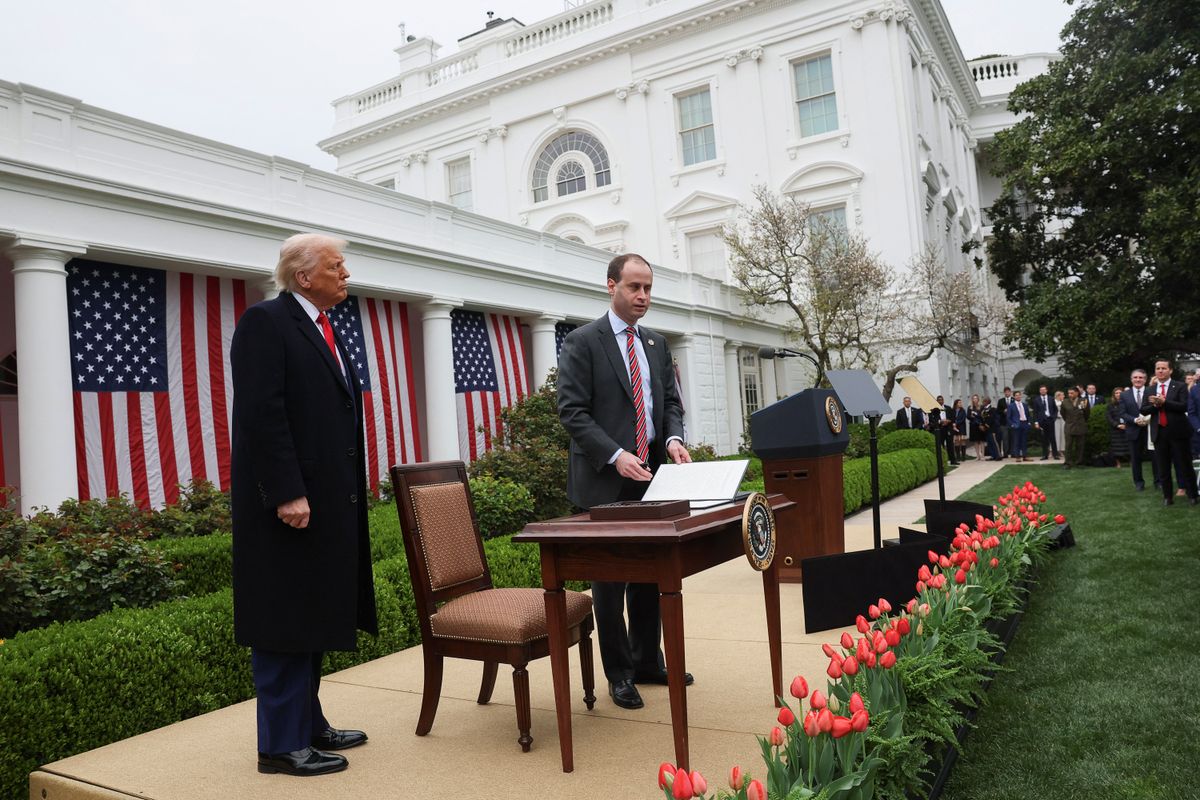
U.S. President Donald Trump stands, ahead of signing an executive order on tariffs, in the Rose Garden at the White House in Washington, D.C., U.S., April 2, 2025. REUTERS/Leah Millis

President Donald Trump is demanding that U.S. companies pay the entirety of his tariffs rather than raise prices and pass them to consumers — but even if they fully complied with Trump's orders, that doesn't actually make his tariffs any better of a situation for the economy, wrote a prominent tax policy expert on Tuesday.

As Republican lawmakers and entrepreneurs alike sound the alarm that the tariffs will stifle economic growth and supercharge inflation, Trump has picked fights with any company that suggests price hikes might be necessary, most notably demanding that Walmart "eat the tariffs" in response to reports they may raise prices on some items.

But in a series of posts on X this week, Erica D. York, vice president of tax policy for the conservative-leaning Tax Foundation, pointed out that forcing an American corporation to pay tariffs fundamentally comes to the same thing as forcing their customers to pay it.

"Here’s what 'eat the tariffs' looks like in the real world," wrote York, posting an excerpt from a story detailing a small business, Jeans Day Apparel, selling clothing in McCordsville, Indiana. This company faced a 3 percent increase in cost for supplies due to the tariffs, and they kept their prices the same — but that meant laying off the high schoolers they were paying part-time at $12-15 an hour to help them make their clothing.

When a commenter replied to her by saying, "You literally proved that overwhelming majority of the tariff was eaten and they didn’t pass anything to the consumer," York had a ready response on Tuesday.

"It's interesting that people seem to think 'eat the tariff' means it has no ill effect," she said, posting more supplemental material. "Eat the tariff means lower incomes. Pass the tariff means lower incomes. No matter which channel tariffs take, the result is a reduction in real, after-tax incomes."

Trump's 'scum' attack gave awful signal of what's coming

Thom Hartmann
May 27, 2025 
TRUTH OUT

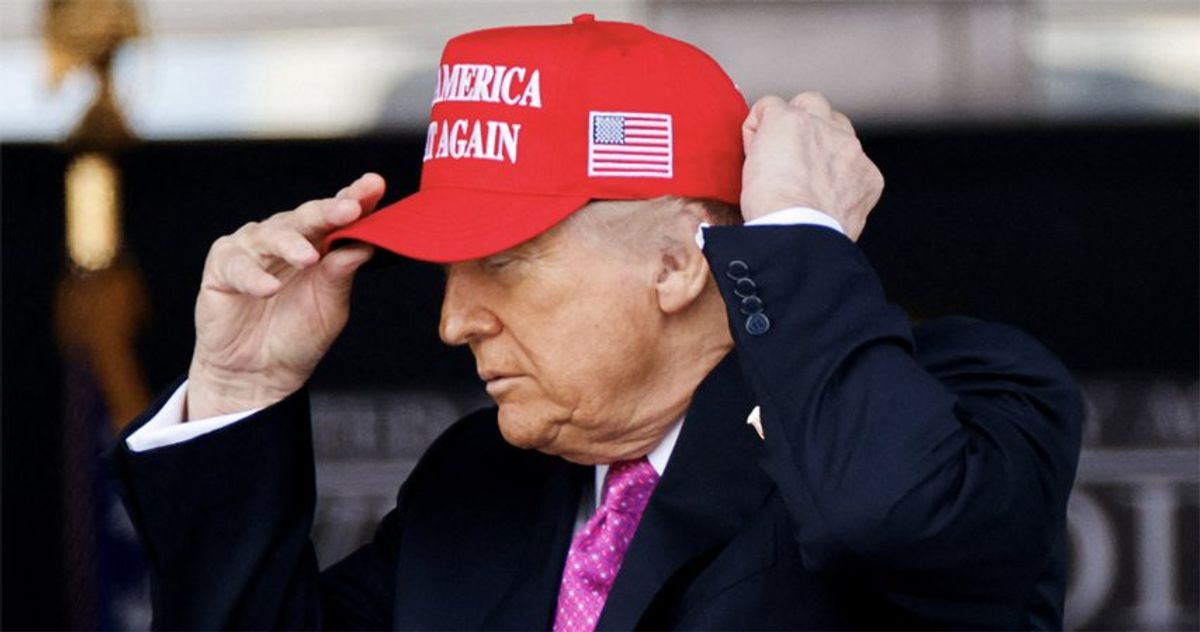
U.S. President Donald Trump wears a 'Make America Great Again' (MAGA) hat as he attends the commencement ceremony at West Point Military Academy in West Point, New York, U.S., May 24, 2025. REUTERS/Eduardo Munoz

Donald Trump opened Memorial Day in the most disgusting way possible, not by praising our fallen heroes but by attacking Democrats. He wrote on his Nazi-infested social media site on Monday morning:

“Happy Memorial Day to all, including the scum that spent the last four years trying to destroy our country through warped radical left minds…”

When the president of the United States calls members of the oldest political party in the world and a former president “scum,” it’s not just another ugly outburst that embarrasses America before the rest of the world: It’s a warning sign. A bright red flag.

It tells us that something far more sinister than partisan posturing is afoot. Something our media has already decided to overlook in their perpetual effort to normalize the abominable.

This kind of rhetoric isn’t new, and it’s not harmless. History has shown us — again and again — that when political leaders use dehumanizing language to vilify their opponents, they’re in actuality laying the groundwork for authoritarianism, repression, and violence.

In a healthy democracy, political disagreements are expected. Even fierce debates over policy and direction are part of the process. But a functioning democracy depends on a shared understanding that both sides, no matter how much they disagree, are legitimate participants in the system.

The moment that idea is tossed aside — when one side starts branding the other not as the loyal opposition but as enemies, traitors, or “scum” — democracy starts to fail.

When a president engages in this kind of language, he’s not just lashing out at critics. He’s explicitly trying to erase the legitimacy of any voice but his own.


This tactic is not original. It’s ripped from the playbooks of authoritarians throughout history.

— Hitler routinely referred to Jews, communists, and democratic socialists as “vermin” and “filth,” conditioning the German public to accept ever-increasing acts of brutality and repression.

— In Rwanda, Hutu leaders called Tutsis “cockroaches” on the radio for months before the genocide began.

— In Serbia, Slobodan MiloÅ¡ević labeled political opponents and ethnic minorities as “parasites” and “traitors” before launching ethnic cleansing campaigns.

Language like this isn’t about winning arguments. It’s about destroying opposition.

Trump has flirted with this disgusting sort of rhetoric for years, calling the press “the enemy of the people,” mocking disabled journalists, referring to immigrants as “animals,” and branding his political opponents as “radicals” or “traitors.”


But labeling Democrats — over 45 million American citizens — as “scum” is a different level of escalation. It’s not just name-calling. It’s a signal. A test balloon. A way of seeing how far he can go. And if there’s no consequence, he’ll go further.

What happens when a leader no longer sees himself as the president of all Americans, but only of those who worship him? What happens when one party becomes synonymous with the state, and all others are demonized?

You get systems like Vladimir Putin’s Russia, where opposition leaders are jailed, poisoned, or pushed out of windows. You get Viktor Orbán’s Hungary, where the ruling party rewrites the constitution to lock in power and crush dissent. You get a country where elections still happen, but they no longer mean anything.


Trump’s use of the word “scum” may seem like just another day in MAGA world, but it is, in fact, part of a much larger and more deliberate strategy. It’s designed to radicalize his base, to cast Democrats not as fellow Americans with different ideas but as dangerous enemies who must be defeated at all costs. It’s designed to terrify Trump’s opponents and paralyze the media.

When you convince people that the opposition is not just wrong but evil, the next logical step is to justify extraordinary actions to stop them, whether that’s purging them from government, throwing them in jail, or inciting paramilitary violence against them.

We’ve already seen where this leads.


January 6th, for example, wasn’t some spontaneous tantrum. It was the inevitable result of years of delegitimization and demonization of Democrats. The people who stormed the Capitol sincerely believed they were saving America from “scum” who had stolen the presidency. They were acting on the poisonous lie that only one side has the right to rule and that any electoral outcome that contradicts their will is illegitimate. A lie that came straight from Trump and his morbidly rich neofascist enablers.

This is how democracies die; not all at once, but in a slow, deliberate campaign of character assassination against political rivals, institutions, and the rule of law. It happens when a strongman convinces just enough people that he alone is the embodiment of the nation, and that anyone who opposes him is a threat to the country itself.

And once that belief takes root, atrocities become not just possible, but justified. And, in most cases, inevitable. We’re already seen this in the case of Kilmar Abrego Garcia and the Venezuelans who Trump deported to El Salvador and the Asians he deported to Africa, in both cases in defiance of court orders.


From Agustin Pinochet throwing small-d democrats he called “subversivos” and “terroristas” out of helicopters over the ocean, to Joseph Stalin using the phrase “enemy of the people” (враг народа) to describe democracy advocates, to Mao Tse Tung calling educated people monsters and demons” (牛鬼蛇神) as he killed an estimated 35 million of them, this is an old, old story.

It’s the same type of language that the Ku Klux Klan used for centuries here in America as they embarked on campaigns of terror and murder. And that the paramilitary groups that have largely replaced them in the 21st century continue to use.

It’s also important to note that when Trump calls people who didn’t vote for him “scum,” he’s not just talking about elected officials. He’s talking about more than half the country.

He’s talking about your neighbors, your coworkers, maybe your family members. He’s talking about teachers, nurses, scientists, union workers, veterans; millions of Americans who simply don’t buy into his brand of neofascist grievance politics. He’s trying to turn Americans against each other so he can seize even more power out of the chaos he creates.


This kind of dehumanization also serves a more practical political purpose: it undermines accountability. If Democrats are “scum,” then their investigations into Trump’s corruption are not legitimate. If the media is “fake news,” then any critical reporting is a hoax. If the courts rule against him, they’re “rigged.” It’s a classic authoritarian tactic: delegitimize all checks on your power and paint yourself as the sole source of truth.

In doing so, Trump is also poisoning the well for any future attempt at national unity or reconciliation.

Once you’ve labeled your opponents as subhuman, how do you work with them? How do you compromise to do what’s best for the country? You don’t.


And that’s exactly the point. He doesn’t want compromise. He wants domination. He wants a political system like in Russia or Hungary, where the only choice is himself.

We can’t afford to normalize this. We can’t laugh it off as Trump being Trump. We can’t wait and hope that someone, somewhere, will step in and draw a line. We have to be that line. We have to call this what it is: a deliberate, dangerous assault on the core of American democracy.

Words matter. In every fascist movement of the 20th century, it started with the words. Before the arrests, before the beatings, before the camps, there were the words. And in every case, those words went unchallenged until it was too late.

It’s not too late now. But we are closer than we’ve ever been. We must push back hard against this dehumanizing rhetoric, demand better from our leaders, and defend the democratic principle that every citizen, no matter their party, is entitled to dignity, voice, and full participation in the political process.

Because once a president gets away with calling fellow Americans “scum,” it’s only a matter of time before he treats them that way.
Trump accused of 'most blatant show of white supremacy in America in history'


Matt Laslo
Martin Pengelly
May 27, 2025 
RAW STORY


U.S. President Donald Trump arrives at the White House, following his attendance at ceremonies in commemoration of the Memorial Day holiday, in Washington, D.C. U.S., May 26, 2025. REUTERS/Ken Cedeno

WASHINGTON – Veteran members of the Congressional Black Caucus (CBC) say the Trump administration has moved from offensive to straight racist with its decision to welcome white South Africans as refugees.

Amid continuing controversy over President Donald Trump’s crackdown on immigration by people of color, one senior Black House Democrat lamented “the most blatant show of white supremacy in America in the history of the world.”

“It is a slap in the face to every African American and every person in this country who believes in the rule of law,” added Rep. Frederica Wilson (D-FL), ahead of Congress’ Memorial Day recess.

Afrikaners are the descendants of Dutch colonists who underpinned South Africa’s racist apartheid regime until 1994, when the African National Congress leader Nelson Mandela, who spent 27 years in prison, became his country’s first Black president.


Now, the Trump administration claims Afrikaner farmers are the victims of government-sponsored genocide — claims Trump spewed live on TV last week in a widely decried Oval Office meeting with South African President Cyril Ramaphosa.

Trump’s conspiratorial claims were rejected by Ramaphosa — and easily debunked.

A picture Trump claimed showed farmers being buried was from the Democratic Republic of Congo. An image Trump claimed showed “burial sites” of “over a thousand of white farmers” showed a memorial to one murdered couple.

One experienced observer, Dorothy Byrnes, a former head of news for the British TV network Channel 4, went viral when she told radio station LBC: “There is no genocide against Afrikaners, that was absolute drivel.”

Byrnes added: “Overwhelmingly, and this is covered, and I have covered it myself, the big problem of violence in South Africa inordinately affects Black people. South Africa has a terrible problem with violent crime, and the chief victims are Black people.”

Regardless, Trump plowed ahead.


“We're deporting thousands of people, and he's bringing in white Afrikaners who he says he's gonna uplift, get health insurance, get found jobs, resettle and housing,” Wilson said.

“I mean, what an insult, right? And also the foundation for his conspiracy theories, saying that there's this genocide happening, that is insane and none of it is true.

“I think that the way that he acted when the president of South Africa came, to try to embarrass … one of our African countries’ heads of state, was just an insult.”


Rep. Emmanuel Cleaver (D-MO), a minister and former CBC chair, called Trump’s meeting with Ramaphosa “embarrassing.”

“He was set up,” Cleaver said of Ramaphosa, who followed Ukrainian President Volodymyr Zelensky in enduring a White House harangue.

“You know, in some ways we should have known [Trump was] gonna do that when he met with African leaders,” Cleaver said.


“He's divisive in his spirit. And so I guess he can't help himself. I wonder who was orchestrating that stuff. Is it him, or is it Elon Musk?”

Musk, the Tesla and SpaceX mogul, is a Trump donor and adviser and attended the Ramaphosa meeting. A U.S. citizen, Musk was born in South Africa and has advanced claims of genocide against Afrikaners.

Rep. Alexandria Ocasio-Cortez (D-NY) had time for only a short word, as she rushed to a vote.


Trump’s Afrikaner policy was “Elon weirdo stuff,” the progressive phenom told Raw Story.
‘Stephen Miller probably came up with this’

On the other side of the Capitol, Sen. Peter Welch (D-VT) told Raw Story Trump’s policy was simply another instance of his “burning our alliances, eroding if not totally compromising trust.”

“As long as he's on top, he’s the bully,” Welch said.

The Afrikaner policy is an example of Trump “changing inherent policies to pick who's going to vote for him,” said Sen. Ben Ray Luján (D-NM.) “Rather than looking at policy, fixing the broken immigration policy and then let us all work towards finding these solutions and working together.”

Luján also said “the initial reaction and response that I've heard from constituents and from colleagues is a negative one. It just feels very overt. It's not a surprise coming from this administration but I would argue it's intentional. Stephen Miller probably came up with this.”


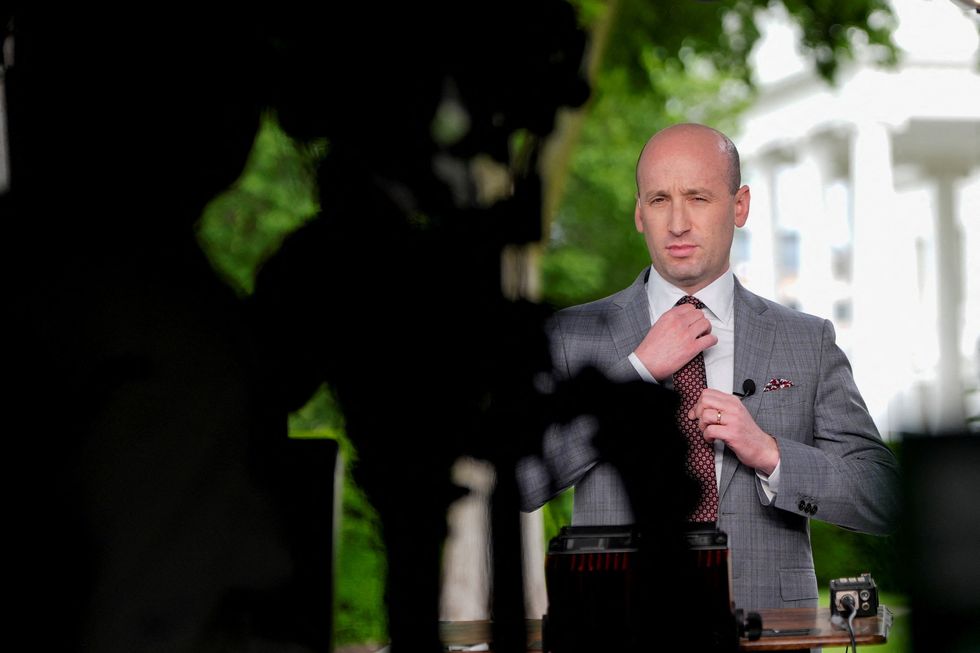
White House aide Stephen Miller. REUTERS/Kent Nishimura

Miller is an immigration ultra-hardliner and one of Trump’s closest advisers.

Earlier this month, Miller told reporters “what's happening in South Africa fits the textbook definition of why the refugee program was created. This is persecution based on a protected characteristic, in this case, race. This is race-based persecution.”

Miller claimed “a whole series of government policies specifically targets farmers and the white population in South Africa”, including “land expropriation.”


He added: “You even see government leaders chanting racial epithets and espousing racial violence.”

Miller said such policies and threats were “all very well documented.”

Experts disagree.

“The politicians quoted [as espousing racial violence] were not ANC politicians, one of them was a man who’d been specifically thrown out of the ANC and the other was an opponent of the ANC,” said Byrnes, the British expert.

The first 59 Afrikaner refugees arrived in the U.S. in mid-May. Before that, Miller predicted “a much larger-scale relocation effort, and so those numbers are going to increase.

“It takes a little while to set up a system and processes and procedures to begin a new refugee flow,” Miller said. “But we expect that the pace will increase.”
‘Against the ideals of our nation’

Sen. Cory Booker (D-NJ) has emerged as a leading Democratic voice against Trump, notably through a record-breaking Senate speech in April, when he spent 25 hours highlighting Trump’s threat to the Constitution.

Speaking to Raw Story, Booker said the Afrikaner refugee policy was a dereliction of moral duty.

“Why, at a time of ungodly ethnic cleansing, like in places like Darfur and Sudan, are we not allowing in people that are escaping legitimate threats?” Booker asked. “Why are we making it harder for them to get in?

“So this is, to me, unconscionable. It's against the larger ideals of our nation. It's morally unacceptable.”


Matt Laslo has covered Congress since 2006, bringing Raw Story readers the personalities behind the politics and policy straight from Capitol Hill. Based in Washington, D.C., Matt has been a long-time contributor to NPR, WIRED, VICE News, The Daily Beast, Rolling Stone, and Playboy.