Saturday, August 16, 2025

What Lies Behind Trump’s Attacks Against Venezuela?
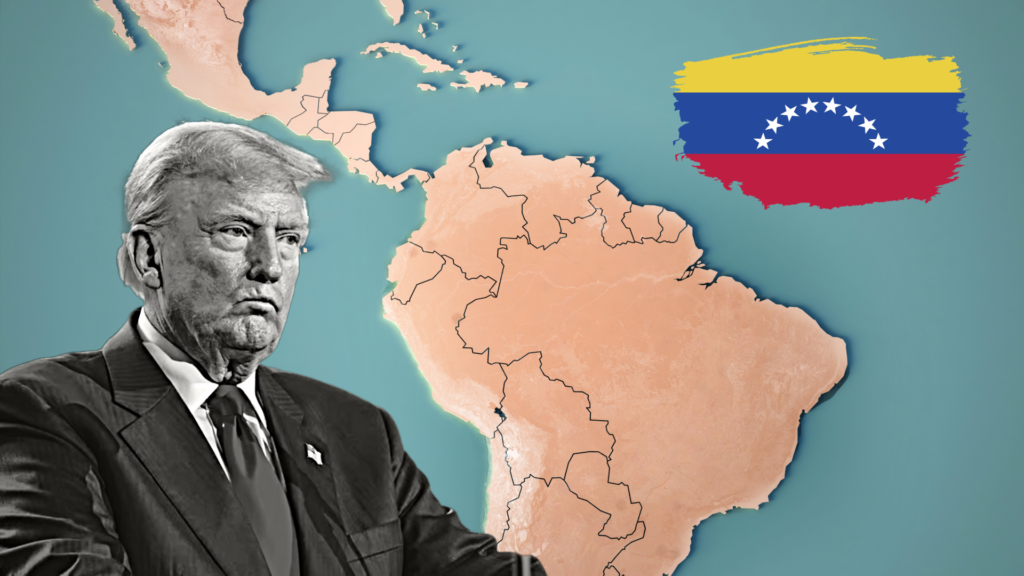
As if President Trump intended to meet professional US mercenary Erik Prince halfway, US Attorney General Pam Bondi increased the existing US bounty on President Maduro—originally set at $15 million—from $25 million to $50 million for anyone providing “information leading to his arrest or conviction.”

In late 2024, Prince, a professional mercenary, alongside Venezuela’s far right, promoted a plan to deploy a private army to Venezuela. He suggested that if the US raised the bounty on Maduro’s head to $100 million, targeting not only the president but also Diosdado Cabello and the entire government, they could “just sit back and wait for the magic to happen.” Prince and Venezuela’s far right even launched a crowdfunding campaign, Ya Casi Venezuela (“Almost There, Venezuela”), to collect the $100 million.

In November 2024, Prince declared that after 10 January 2025 (Maduro’s inauguration day), key figures—including Diosdado Cabello (Interior Minister), Jorge Rodríguez (National Assembly President), Delcy Rodríguez (Vice President), Vladimir Padrino López (Defence Minister), Tarek William Saab (Attorney General), Cilia Flores (Maduro’s wife), and Nicolás Maduro himself—would become “criminal objectives” with no diplomatic protection. On 12 January 2025, Prince sent a message of support to opposition leader María Corina Machado, urging her to “Stay resolute.”

Prince had pushed for the bounty to be raised to $100 million, but when the Biden administration ignored him, he secured backing from Senators Marco Rubio and Rick Scott, who share his objectives. On 20 September 2024, Scott and Rubio introduced the Securing Timely Opportunities for Payment and Maximizing Awards for Detaining Unlawful Regime Officials Act of 2024 (the STOP Maduro Act), allocating $100 million—taken from seized Venezuelan assets—to fund Prince’s efforts to depose Maduro.

The US charges against President Maduro are not only preposterous but entirely false and slanderous. He is accused of being one of the world’s largest drug traffickers, a threat to US national security, and the leader of the Cartel de los Soles, allegedly responsible for shipping hundreds of tons of cocaine into the US while collaborating with “narco-terrorists,” the Tren de Aragua gang, and Mexico’s Sinaloa Cartel. Venezuela’s Foreign Minister, Yván Gil, dismissed Bondi’s “pathetic” bounty as “the most ridiculous smokescreen we have ever seen.”

Despite persistent propaganda about the Cartel de los Soles, drug trafficking, and “narco-terrorism”—used to justify labelling Venezuela a “narco-state”—the US has never provided credible evidence to support these claims. The DEA itself reports that over 80% of cocaine entering the US comes via the Pacific, with only 7% passing through the Eastern Caribbean (see DEA maps; notably, Venezuela has no Pacific coastline). This confirms Colombia as the region’s true narco-state, while Venezuela is, at worst, a transit route. The US also falsely accuses Venezuela of money laundering, despite the country being almost entirely cut off from the international financial system. And Mexico’s President, Claudia Sheinbaum, has just declared that Mexico has no evidence linking Venezuela’s Maduro to the Sinaloa cartel.

Bondi’s bounty against Venezuela’s democratically elected president is part of a broader US strategy targeting Latin America, ostensibly centred on combating drug cartels but threatening far more drastic measures. The New York Times (08/08/25) revealed that Trump “secretly signed a directive ordering the Pentagon to use military force against certain Latin American drug cartels designated as terrorist organisations by his administration.” Mexican President Claudia Sheinbaum responded unequivocally: “The US will not send its military into Mexico. That is ruled out, absolutely ruled out.”

This outrageous US aggression against a Latin American head of state must be condemned unreservedly. The “pathetic” $50 million bounty consciously incentivises unsavoury actors to launch militaristic, murderous ventures—such as the 2020 mercenary incursion into Venezuela contracted by Guaidó. It marks an escalation in US efforts to overthrow a democratically elected leader, weaponizing bounties to force regime change.

Trump’s secret directive authorising military force against cartels—effectively threatening unilateral intervention in Latin America—must also be unequivocally rejected. While ostensibly targeting Mexico, the policy could easily be weaponised against governments the US seeks to topple, such as Venezuela, Cuba, or Nicaragua (or any other nation, for that matter).

The Trump administration is clearly intent on intimidating—and, given the opportunity, militarily intervening against—Latin American governments it opposes, using the “war on drugs” as a pretext. Worse, Bondi could issue similar bounties against other regional leaders. The US mercenary industry is well-developed, and such bounties would inevitably attract takers, further destabilising the region.

When we consider the US’s highly aggressive tariffs against Brazil alongside its hundreds of sanctions targeting Cuba, Venezuela, and Nicaragua, it becomes clear that Washington is testing a new cocktail of threats designed to force nations south of the Río Bravo into submission to US geopolitical demands. This is classic US behaviour—with one key difference under Trump: the abandonment of any pretence behind hollow justifications like ‘democracy’ or ‘human rights’, though such rhetoric still features in official statements.

The true objective is to stifle multipolarity and prevent Latin America from participating in it, all while reinforcing US hegemony in the Western Hemisphere under the guise of Make America Great Again. In reality, this is simply the Monroe Doctrine repackaged—an attempt to sever Latin America’s trade and exchanges with China, or more precisely, to expel Chinese influence from the region entirely. The abject capitulation of Panama’s President José Raúl Mulino, who withdrew from the Belt and Road Initiative under Trump’s threats of a US military takeover of the Canal—despite the economic costs to his nation—stands as stark confirmation of this strategy.

Trump’s objectives stand in direct opposition to what progressive movements and governments across Latin America have sought to build: a fairer world without social exclusion, with reduced inequality and poverty, where policies prioritise people over private interests, and where universal rights to education, healthcare, and housing are upheld—all within a framework of strong national sovereignty that has enabled the region to resist US imperialist bullying.

This vision entails:

· An end to US lawfare against President Maduro and all aggression toward Venezuela or any regional government;

· No arbitrary US tariffs against Brazil or any other Latin American nation;

· The cessation of US military threats—let alone interventions—in Mexico, Venezuela, or elsewhere in the region;

· A Latin America free from US meddling in its internal affairs.

The struggle, then, is not merely about resisting individual policies but defending the very principle of self-determination against a US administration intent on rolling back decades of regional progress.

Francisco Domínguez is a member of Executive Committee, Venezuela Information Centre. Read other articles by Francisco, or visit Francisco's website.

Defending Venezuela’s sovereignty from a working-class perspective
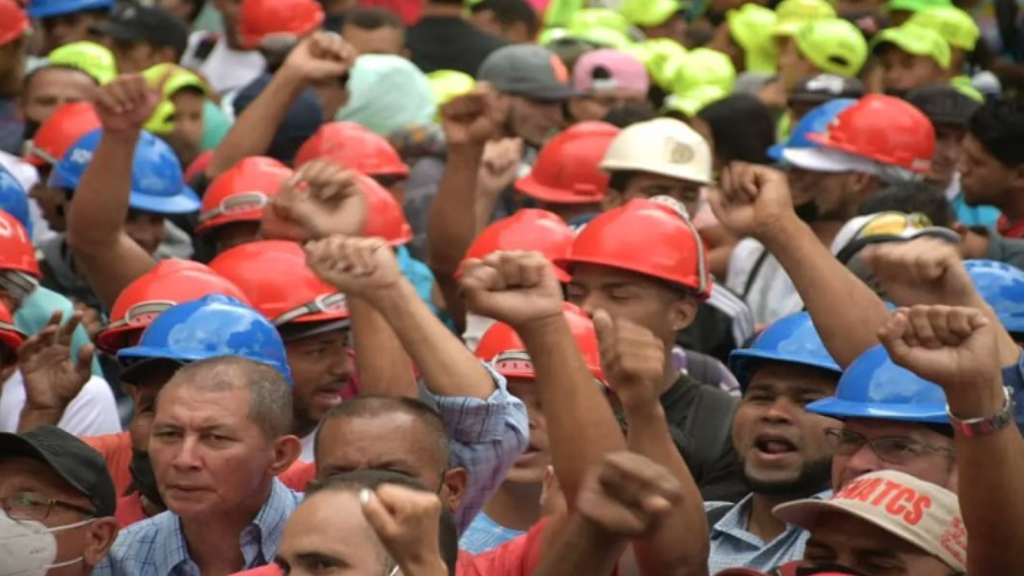

Venezuelan workers

Salvador De León is a member of the Comité Autónomo e Independiente de Trabajadores(as) (Autonomous and Independent Workers’ Committee, CAIT). Speaking with Federico Fuentes for LINKS International Journal of Socialist Renewal, De León looks at the situation facing Venezuelan workers and trade unions, the Nicolás Maduro government’s economic policies, and defending sovereignty from a working-class perspective.

Could you describe the economic situation facing Venezuelan workers?

There has been a tremendous decline in workers’ wages in terms of their value and purchasing power. This crisis has been worsened by the collapse of the entire social welfare system. Healthcare, education, everything allowing workers to enjoy greater dignity is in tatters. The loss of wages is most keenly felt, but workers suffer the consequences of a dismantled social welfare system, which has left the population impoverished.

To understand how we got here, we have to go back to the period before the waves of crises began to hit in 2014. In the 2000s, China’s huge industrialisation program led to a rise in raw material prices, which benefitted Latin American countries. This coincided with the election of progressive governments in Latin America — Hugo Chávez in Venezuela, Lula da Silva in Brazil, Nestor and Cristina Kirchner in Argentina, etc — and allowed them to redistribute wealth, to a greater or lesser extent. In Venezuela, there was a constitutional process in 1999 that laid the groundwork for further democratic and economic gains.

But after significant progress in redistributing wealth and expanding democracy, the commodity market collapsed and oil prices plummeted. Venezuela still has an unsustainable rentier economy given fundamental measures, such as nationalising the banks, were never taken. As part of a globalised capitalist economy in crisis, Venezuela was affected. Since then, crises have hit in waves, but it began with collapsing commodity prices.

During that time, the political will was not there to implement measures needed to deepen and sustain the revolutionary process. There is also a crisis in the trade union movement and the fact that the capitalist class has achieved its objectives. We got to where we are today because the government accepted its role of a Bonapartist regime [balancing off the major classes]. Today, like everywhere in the world, the government provides capitalists with all their needs and guarantees, while Venezuelan workers bear the brunt of the economic crisis.

What about democratic rights?

The crisis has led to the stripping of many democratic achievements enshrined in the constitution. Our constitution is highly democratic and inclusive, with profound democratic rights, but that are being violated and denigrated. For example, protests and union activity are criminalised. There are also political prisoners.

Part of the explanation is the actions of certain opposition forces, who have sought to carry out coups and disregarded institutions. The Venezuelan state engages in anti-democratic practices, but we must bear in mind that domestic far-right forces have always operated as satellites of imperialism.

They polarised politics and created conditions in which the state sought to protect governability through state of emergencies, allowing it to further disregard democratic guarantees. I am not justifying these actions, but we need to understand that the state of emergencies are a response to an opposition that ignored institutions and democratic participation, preferring coups.

There is a profound need, first and foremost, to restore wages in Venezuela. This implies a debate that goes far beyond a dignified wage to include rebuilding the entire social welfare system.

We also need to win back democratic rights. This requires ensuring everyone works within the established democratic framework and participates in any institution and space open to workers. Faced with the crisis of the globalised capitalist economy and imperialist threats, we need to restore the country’s governability, institutions, and the internal political life if we are to win back democratic rights.

Debates outside Venezuela focus on blaming either US sanctions or the government for the crisis. What is your opinion?

The two have interwinned. First, it is a fact that sanctions exist, there is a blockade, and US imperialism’s policy is to fracture the nation-state. Imperialism needs to fracture nation-states because the crisis of the globalised capitalist economy requires it to destroy any democratic gains, no matter how small, in order to take control of raw materials.

Our conception of sovereignty is based on people’s ability to exert their self-determination and defend working class gains within the framework of nation-states. That is why this is not about defending Maduro. Defending Maduro has never been our central focus; nor have we advocated for the president’s ouster. We understand that, under attack from imperialism, we must unite forces, whether we like it or not, to defend the integrity of the nation-state. We do so from the perspective of the 1999 Constitution and all the laws that we, as the working class, have won since then.

The sanctions clearly have significantly affected the economy — the numbers speak for themselves. Ultimately, it is the working class who have been affected, not those in power or their governability. But we also have the government’s poor economic decisions. They chose not to more effectively redistribute oil revenues through greater state planning, as others proposed.

So, there was a debate about what direction the government should take?

In 2017, President Maduro announced his proposal for an Economic Recovery, Growth, and Prosperity Program. Throughout that year, there was a debate among the grassroots, where certain left critics, such as María Alejandra DiazPasqualina CurcioTony Boza and other comrades, put forward proposals to ensure the vast majority were protected from the crisis. They said: yes there is a crisis and a blockade, but we can obtain funds through policies such as taxes on large transactions and the banks, to give a few examples.

Other comrades put forward different proposals, such as Jesús Farías who ended up spearheading the program that was ultimately implemented — a program based on deregulation, free market policies, and all the usual capitalist formulas. They argued fixing the economy required recreating conditions to attract foreign investment. Amid the internal crisis and state of emergencies, they enacted the Law on Foreign Investment, the Anti-Blockade Law, and other laws that, ultimately, promoted the free market and deregulation.

Since then we have had an economic recovery, but in capitalist terms. There has been economic growth, but Venezuela in 2025 is not the same as Venezuela in 2017. This is obvious when you go to a supermarket, where you can get whatever you want, but have to buy stuff on a pulverized salary and in a de facto dollarised economy. The economy is moving, unlike in 2017, but workers’ living standards are more precarious.

In the private sector, business groups are protected while anti-labour counter-reforms are increasingly likely. The few gains left face many threats. We are on the defensive, not the offensive. The situation has changed.

So, many elements came together. On the one hand, there is the blockade, there was a systematic economic war waged by the national capitalist class; but, on the other, the government lacked the political will, or rather shifted its policy toward more deregulation, more free market, and more policies in tune with the requirements of the globalised capitalist economy.

How should we understand US President Donald Trump’s policy toward Venezuela given the US government had talked about tightening sanctions and then extended Chevron’s license to exploit Venezuelan oil, and also sent a representative to meet publicly with Maduro only to then double the reward for Maduro’s arrest?

These constant twists and turns provide a glimpse into the volatile, unpredictable and anarchic nature of the crisis of the globalised capitalist economy. Confronted with this crisis, and various ongoing and potential wars, Trump may have a certain policy towards Venezuela but he also has to contend with capitalism’s crisis and intra-capitalist competition. We no longer live in a world of competition between national capitalisms. Instead we have different economic groups, including oil companies, competing to protect their own corporate interests. The crisis is so deep that in this competition, any group that fails to rapidly revalorise their capital disappears or is absorbed by another.

So, Trump can talk about tightening sanctions, but that comes with political costs and internal disputes. That is why he had to send a representative to meet Maduro. This was a response to the oil lobby’s demands, because Chevron has interests in continuing to exploit oil here. Now Chevron’s license has been approved but, at the same time, the Trump administration labelled Venezuela a terrorist state — this is the real issue and not so much the $50 million bounty on Maduro, because this status opens up possibilities for military intervention.

All this shows Trump has to contend with internal pressures.

Can we say, with the most recent measures, that one side or the other is winning the battle within the Trump administration?

We believe this latest move is more of an aggressive negotiation strategy than anything else. It is an attempt to apply pressure to maintain favourable negotiating conditions.

But the important thing is to recognise that Trump’s ambivalent, shifting, and contradictory policies towards Venezuela reflects the anarchic, chaotic world economy we live in.

There is no formula for predicting what might happen next. We do not know, for example, how Trump can sustain the oil sanctions, especially given the various ongoing and potential wars and competition with China and the BRICS, which could provide Venezuela with an alternative market.

Venezuela is in the eye of the storm because of our strategic geographic position, our proximity to the US, and the fact we have the world’s largest oil reserves. That is why Trump needs to ensure he is not burning any bridges to access Venezuela’s oil. But ultimately, not even he can guarantee what will happen.

What is certain, though, is that the Venezuelan workers will be the ones who continue to be affected by the sanctions and end up bearing the brunt of the crisis.

The main big business organisation, Fedecámaras (Federación de Cámaras y Asociaciones de Comercio y Producción de Venezuela/Federation of Chambers and Associations of Commerce and Production of Venezuela), along with other business federations, has abandoned its oppositional stance and begun to collaborate and even support the Maduro government. How did this happen?

Fedecámaras emerged in 1944, a year after then-president Isaías Medina Angarita publicly declared that no more money would be given to national business owners. Historically, the state has used oil revenue to finance the capitalist class, in the hope that this would help develop national industry. Instead, it led to the creation of a parasitic capitalist class. Fedecámaras was formed to defend these capitalists, and continues to defend those interests today.

When Chávez came to power, Fedecámaras immediately openly opposed his government. It took part in the 2002-03 oil industry lockout and promoted various coup attempts, because its underlying objective has always been defending the interests of the business community.

Once the government started implementing its policy of paying public sector salaries through non-salary bonuses, Fedecámaras saw the state doing what it had always wanted. The Economic Recovery Program contained two important measures for the public sector: Memorandum 2792, which suspended all collective bargaining agreements, and the ONAPRE Instruction, which flattened national pay scales. This is what Fedecámaras was proposing for the private sector. Add the government's bridge-mending efforts to attract investment, we can clearly see a rapprochement with the national business community.

Has the state at least enforced workers’ rights at the same time?

I will answer by giving you an example: Venezuelan law provides workers with job security, no worker can be fired [without prior approval from the Ministry of Labour’s Labour Inspectorate]. But workers do not trust state institutions, as the profound institutional crisis we face means Venezuelans no longer trust their institutions. So, workers simply do not go to the Ministry of Labour if they are fired.

Before this, when large companies laid off workers and the Ministry of Labour sought to intervene, the companies simply defied it. This was a tactic used by big business: Grupo Polar, Coca-Cola, Regional, Pepsi-Cola, Cargill. Some managers were jailed for a few days, but they had the economic power to deal with the fallout. There were no laws to punish them as these were socioeconomic crimes. We need laws that allow the state to go beyond the corporate veil, the legal fiction that protects shareholders, in order to mitigate and nullify these employer tactics by punishing them.

So, we need to look at the sequence of events that led us to this point. Fedecámaras stuck to its traditional strategy and managed to pierce the nation-state by simply refusing to obey the law. At the same time the state refused to go further.

At one point there was growing talk of workers' control, of expropriating businesses that were waging economic war — all this was debated in the grassroots and even inside the state. But the government opted to avoid further confrontations, arguing that imperialism would suffocate us and leave us worse off. The next step was the Economic Recovery Program where, again, it was argued that deeper and more radical steps were ill-advised, and instead we needed to be more inclusive towards the business community.

This demagogic rhetoric left us where we are today. Fedecámaras sees its policies and proposals being heard while continuing to do whatever they want. Today, capitalists have a greater capacity than workers to be heard, and greater political participation.

Would you say the government's economic policy is neoliberal?

The government has been adapting its policies to the demands of the globalised capitalist economy. I do not know if the best term is neoliberal. What we have, in economic and pragmatic terms, is opening up of the free market and deregulation. Under the pretext of the crisis, the state’s policy is that we need to attract investment to boost the economy — which has occurred, but in capitalist terms.

The national market has rebounded, businesses have reopened, there are more business owners, etc. Where I live, Maracaibo, you can find new pharmacy chains, new supermarket chains, but with workers on precarious contracts outside the protective framework of the Labour Law and constitution.

How has the union movement responded? What is the current state of the movement?

Venezuela’s trade union movement has been in crisis since before Chávez. The broader political crisis that erupted after the 1989 Caracazo uprising had its reflection in the union movement. One pillar of the old two-party system was the tripartite social dialogue between the government, Fedecámaras and the CTV (Confederación de Trabajadores de Venezuela/Confederation of Workers of Venezuela). The CTV was the most important union confederation and both main parties, Acción Democrática (Democratic Action) and COPEI (Partido Socialcristiano/Social Christian Party), were active in it. When the two-party system collapsed, so did the CTV. This is part of the history of the crisis we face today. There is also the fact that since the 1999 Constitution was adopted, we have never had a truly unified union confederation to accompany the revolutionary process under Chávez.

Today, there are several union confederations, but they are dispersed and polarised. There is the Central Bolivariana Socialista de Trabajadores (Socialist Bolivarian Workers’ Central, CSBT), which is important because it unites federations in the large state-owned industries. But it is limited by its lack of autonomy due to being aligned with the ruling party. Then there are union confederations that have been co-opted by opposition parties. Political polarisation has severely hampered trade union autonomy. No trade union movement truly understands the need for autonomy and operates accordingly.

On top of that, if you look at the health sector, you see many unions; if you look at the education sector, you will see many unions. There are some representative federations, but there is a lot of parallel unionism. Moreover, mass emigration took with it many union leaders. So, the crisis of the trade union movement is profound, serious and multifactorial.

A large number of union members and workers have been jailed for protesting. Why is this?

This issue has several aspects, especially the adoption of state of emergencies. The basis of any state of emergency is that the integrity of a nation is at risk. This is the case in any country, for example during the COVID-19 pandemic. In Venezuela, the state bases its actions on these exceptional decrees. Its actions are illegal and illegitimate, but are based on this criterion that arose from the attacks, for various reasons, facing the Venezuelan state.

We know that laws and justice are interpreted differently depending on your class. As workers, the danger is that our sovereignty is being eroded in terms of democratic gains. But the state sees it from the perspective of governability. For example, the government considers [the state oil company] PDVSA and [the state electricity company] CORPOELEC as strategic sectors and acts on the basis of precedents, such as the oil strike [that was part of the 2002-03 coup attempt], etc. This does not justify criminalising dissent, but we need to understand that, at one point, the opposition did try to carry out coups that ultimately empowered the state and government.

One specific example: if you look at the Law Against Organised Crime and Financing of Terrorism, or the Law against Hate, for Peaceful Coexistence and Tolerance, you can see that the state adopted these laws at the time when it confronted coup attempts by business sectors. But these laws became a double-edged sword, because just as they could be used against a bosses’ lockout, they have been used against union leaders under the same pretext of protecting the nation’s economy.

Most charges laid against the vast majority of these workers are based on laws created at a specific moment to confront coup attempts. These workers have been charged illegitimately, illegally, and often on trumped up accusations, using these laws.

What role does CAIT play in the face of all this?

CAIT takes as our starting point the need to use the democratic institutions and gains we have at hand. For example: we have frequently proposed creating a labour prosecutor's office to sanction and punish employers who disregard our rights and achievements.

We have also opposed the prosecution and criminalisation of union activity. Paradoxically, we have sought to do so through the Prosecutor's Office, using our political contacts. We have done it this way because of our position of respecting institutions. It is essential that workers participate in whatever space they can.

Defending our gains is central to us, and the constitution is our greatest gain. Using the constitution, we have always sought to defend gains under threat. Every time workers have been prosecuted or criminalised, we have highlighted these cases. We say that we must fight against criminalisation, but not by ignoring institutions or refusing to be proactive. The spirit of the constitution is participatory and protagonist democracy, which we always seek to enact.

The left in Venezuela is divided over the Maduro government. How do you characterise it?

We do not subscribe to the thesis that this is a dictatorial government or regime. Not because we justify its actions, but because it has to be understood in the framework of the opposition’s actions. The integrated structure of the nation-state, represented by the Maduro government, has been the target of coup plots. The opposition had a policy to prioritise coups while ruling out any avenues of democratic participation.

If you place a government in such a conflict, it will seek to hold onto power. The stance taken by María Corina Machado, Henrique Capriles, Leopoldo López, and the entire extreme right caused such a polarisation that the government ended up embracing it, justifying unjust actions based on precedents.

By saying this, I am not justifying arbitrary arrests or criminalising protests by workers or communities. We do not justify any measure that violates any democratic freedoms. We denounce them. But they are the result of a domestic conflict and foreign imperialist policies that have sought to fracture the nation-state.

Faced with the threat of the complete dismantling of the nation-state we must be clear on what we are defending. Because, ultimately, there are no possible gains, no possible democratic rights to defend or enjoy, if there is no nation-state. So, for us, sovereignty is the capacity to exercise those rights and gains within the framework of the nation-state.

More specifically, do you view the Maduro government as representing a continuation or a break with Chávez and the Bolivarian process?

The reality we face today is that the working class does not have its own political expression in Venezuela. For better or worse, the Maduro government represents Chavismo. We are represented by the Maduro government so long as the Constitution of the Bolivarian Republic of Venezuela is in force. It may not be complied with in practice, but that is another matter; we must ensure it is applied.

The moment this constitutional framework is annulled will be the moment we can say there has been a complete rupture between Chávez and Maduro. That is why we denounced the danger posed by Maduro’s constitutional reform when it was first announced. If the proposal is to deepen democratic rights, great. But if the proposal is to strip us of our rights, then we will not allow a comma to be touched. We must defend the Constitution.

That is our start point. For CAIT, the key is to embrace and defend these gains, and defend the nation-state and sovereignty from a working-class perspective. We recognise that there are other comrades and different groups, each with their own views and who raise very valid criticisms, such as the criminalisation and prosecution of dissent. They may have a different position to us, but we sit down with them, discuss and debate with them, and participate together in many different spaces. The Venezuelan left needs to again seek common ground on the basis of what unites us: our class position.

It is worth adding something important: after the July 28 presidential elections, the Maduro government finds itself in a position in which governability has been restored. There is no political crisis in Venezuela because the radical opposition has, in one way or another, been defeated. This means the government can take whatever action needs to be taken. But this brings with it the consequence that, if it fails to take needed actions, it will no longer have an excuse or a scapegoat to justify its lack of efficiency and effectiveness.

Many leftist organisations and individuals have worked for years in solidarity with the Venezuelan people. Given the changed situation, a debate has arisen over whether opposing imperialism requires supporting the Maduro government. How do you view this?

It is a complex issue. I will start by drawing an analogy with the position we have taken towards solidarity with comrades from other countries. A government that represents even a minimal defense of sovereignty, with all its contradictions and however ambiguous the concept of sovereignty can be, for us merits solidarity against imperialist aggression. As for what happens domestically, we can have the best intentions, but only the working class there can organise and respond to the challenges; we cannot substitute for it.

So, if there is imperialist aggression, we must oppose it. And in Venezuela’s case, imperialism’s attacks are evident: the sanctions, the blockade, and now the issue of migration. All of this merits international solidarity. Separate to this is how a government might seek to capitalise on it to legitimise its domestic policies. International solidarity does not mean a blank check for a government’s domestic politics.

But this is where the issue becomes quite complex. On the one hand, the priority is defending sovereignty, but on the other, there is the need for unconditional solidarity with comrades who are being prosecuted and criminalised for exercising their right to freedom of association, etc. Faced with this, there is no formula we can apply.

What is certain is that any solidarity must clearly state its support for sovereignty and explain that it is directly with those comrades and their organisations, distancing itself from any possible manipulation by other forces. We cannot offer solidarity that serves as a spearhead for imperialist policies.

The problem is that, as workers, we are scattered and disorganised when it comes to solidarity. We can see that Latin American governments are responding in a disjointed manner to imperialist aggression, especially with regards to the migration issue. Gustavo Petro in Colombia is going in one direction, Lula another, and Maduro yet another. There is no united action in response to these imperialist aggressions.

All of this confirms the need to consolidate spaces from which to confront imperialism’s interventionist policies from a working class perspective. That is why we, as CAIT, are part of organising a continental conference in Mexico in September that seeks to organise such solidarity at the Latin American-wide level.

We are promoting this conference to organise, channel and put forward proposals that establish our position not only against Trump’s immigration policies but also against his increasingly aggressive policies towards nation-states in the region. We can see this with the move to classify Venezuela as a terrorist state, and with his 50% tariffs on Brazilian products. It is vital for us as workers to meet and discuss how these imperialist policies affect the working class in different Latin American countries and organise our response.

How the Toxic Manosphere is Grooming Adolescent Boys


The Creation of a Teenosphere


A Russian poster urging open your eyes - against women being abused.-- image usage permitted under the Creative Commons Attribution-Share Alike 2.0 Generic license. Attribution: Denitza Tchacarova: A Russian poster urging open your eyes – against women being abused.

Over the past decade, the “Manosphere” — a loosely connected but increasingly influential network of blogs, forums, influencers, and online communities — has become a powerful vehicle for promoting traditional gender roles, male grievance politics, and opposition to feminism. Once considered fringe, its rhetoric has crept into mainstream politics, with some analysts crediting it with helping shape the cultural climate that helped elect Donald Trump in 2024. But its reach extends far beyond adult men: the Manosphere is now shaping how teenage boys think about gender, power, and identity — often before they’ve even had their first romantic relationship.

While the Manosphere’s impact on adult men has been widely studied, its encroachment into youth culture has received far less attention. Increasingly, Manosphere-aligned figures and communities are targeting boys aged 15 to 18, giving rise to what could be called the “Teenosphere”: a youth-focused, reactionary subculture that echoes the language, aesthetics, and grievances of its adult mentors. This emerging movement repackages anti-feminist and hypermasculine ideology in teen-friendly formats — viral TikToks, Discord memes, YouTube rants, and Reddit threads — making it both accessible and appealing to adolescent boys.

According to the Global Project Against Hate and Extremism (GPAHE), the grooming of adolescent boys is “mimicking the white supremacist Active Club (AC) movement.”

This “’Youth Clubs’ network, consisting of at least 19 chapters representing 42 states, engages in the same real-world activism as the ACs, including MMA training, spreading neo-Nazi propaganda in public spaces, and attempting to recruit members online, including on TikTok.”

“Emerging in 2022, the Active Club movement is a white supremacist transnational network of ‘sports clubs’ first conceptualized by American neo-Nazi Robert Rundo and Russian neo-Nazi Denis Kapsutin, the latter a key MMA organizer who is banned from the Schengen Area in the European Union for his track record of hate and violence,” GPAHE recently reported.

“Active Clubs are small white supremacist cells, operating under Rundo’s ‘White Nationalism 3.0’ model, working at the local level and collaborating with numerous racist groups, including those with a penchant for violence, such as the Proud Boys, White Lives Matter (WLM), and Patriotic Front in the United States, Action Française and Identitarian groups in France, and the Hammerskins in Canada, Sweden, and Germany, creating alliances that strengthen the white supremacist movement globally. Shortly before Donald Trump’s inauguration, Active Clubs across the country called on him to follow through on his promise to conduct a mass migrant deportation operation.” (For more on the Active Clubs network, see “Active Clubs and Transnational Far-Right Extremism in 2024 and Beyond” @ extremism.gwu.edu/…; and “’Active club’ hate groups are growing in the U.S. — and making themselves seen” @ www.npr.org/…)

GPAHE pointed out that “The majority of Youth Clubs created channels on Telegram between February and June 2025, with a few set up in 2024. According to a post by an umbrella account for Youth Clubs, titled ‘United Youth,’ created on February 24, 2025, Youth Clubs are a ‘network of pro social young white men nationwide’ that act as an ‘activist,’ ‘nationalist,’ and ‘fraternal and fitness network.’

“At the time of publishing, Youth Clubs indicate that they only accept members between the ages of 15 and 18, and operate under the belief that ‘our (white) people are dying off and we are growing up in a world which does not care for us,’ referring to the racist, and deadly, ‘Great Replacement’ conspiracy theory, which, like the regular Active Clubs, serves as an ideological framework for activism. Youth Clubs believe that ‘Jews,’ ‘liberal sycophants and homosexuals’ are all responsible for these supposed problems, and act to ‘fight back against these great globalist evils.’ United Youth also shared a quote by Rundo about starting the Rise Above Movement (RAM), a violent street gang which had members arrested for their actions during the racist Unite the Right riots in Charlottesville, Virginia.”

Some Youth Clubs are explicitly neo-Nazi, such as the Pacific North West (PNW) Youth Club and New England Youth Club.

GPAHE noted that the growing “Youth Club network serves as a sobering reminder of the ongoing radicalization of young men in the United States, particularly in this volatile political environment. These teenagers are drawing inspiration from violent neo-Nazis like Robert Rundo during a time when the Trump administration is mirroring policies advocated by neo-Nazis and galvanizing the far right to call for violence against their political enemies, making these Youth Clubs the manifestation of a new generation of hate.”

If we ignore the Manosphere’s growing influence on teenage boys, we risk allowing a generation shaped by misogyny, resentment, and grievance politics masquerading as empowerment. The online subculture is a recruiting ground for future ideologues, influencers, and voters. It will take a village made up of parents, educators, policymakers, and tech companies to be aware of and deal with the digital pipelines that funnel boys toward extremist content.

Bill Berkowitz is a longtime observer of the conservative movement. Read other articles by Bill.

Smoldering Syria: Ongoing Security Crisis Undermines the Country’s Future


The fall of Bashar al-Assad in Syria last December was so swift and surreal that the initial euphoria lingered both inside and outside the country despite public unrest turning to brutal arrests turning to executions turning to mass murder. These actions of the new Syrian authorities have been described either as efforts to “restore order” or “purges” involving war crimes, depending on the observer. The situation in Syria continues to develop rapidly and remains a subject of international interest.

The new Syrian government, led by Ahmad al-Sharaa, is acutely aware of the crucial nature of the current juncture and the threats it brings to the emergent state structure. In a bid to garner support from regional and Western powers, Damascus has pursued extensive diplomatic efforts. The United States, Germany, and France as well as key Arab states have already expressed interest in the reinvented Syria. High-level foreign delegations have paid numerous visits to Syria this year to hold talks on economic cooperation and discuss the possibility of lifting sanctions. Syrian leaders view these international contacts as a pivotal opportunity to attain broad foreign recognition and bolster their domestic legitimacy.

The country’s famed social and religious diversity has always been a challenge for Damascus. Under Bashar al-Assad, the Alawites were given a privileged position, while the Druze and the Kurds gained de facto autonomy. Although the opposition mainly consisted of Sunnis – the predominant majority of the Syrian population – it would be a mistake to equate the two, as plenty of Sunnis attempted to continue with their lives as normal within the government-controlled areas, served in the Syrian army and worked in state institutions. The December coup sparked a process of revising the status quo for all of these groups.

Newly formed security units started targeting Alawites, who were perceived as Bashar al-Assad’s main base of support and thus a potential threat. The Christians also faced persecution from jihadists hardened in armed clashes and ideological training for years. These communities became easy targets as they surrendered their areas to the new government and lacked external support.

In the summer, the authorities attempted similar actions against the Druze population in southern Syria. Unlike the Alawites and Christians, the Druze proved to be more unified, quicker to react, and, most importantly, received support from Israel, including both military action and media assistance. While extrajudicial killings of Christians and Alawites were largely silenced or framed as acts of just revenge, violent attacks in Suwayda exposed widespread abuse by the so-called General Security Forces.

Entire Druze families with no links to armed resistance were murdered solely because of their ethnicity. Executions of Druze with foreign citizenship, such as American Hossam Saraya and French citizen Firas Abu Latif, drew attention of the international media to the situation in southern Syria.

The events in Suwayda, especially the deaths of Syrians with foreign passports, raised serious concerns among those previously eager to cooperate with the new Syrian government. While the U.S. and France might have overlooked the persecution of Alawites, they cannot treat the killing of their citizens so lightly. One of the main conditions for full cooperation and Western investment in Syria is the assurance of security and stability, which Damascus can not or will not provide. In case of further escalation of internal turmoil Syria risks becoming another failed state and effectively losing any hopes for external investments.

Despite the hasty efforts by the new Syrian government, it continues to struggle to unify the plethora of unruly armed factions and curb abuses by security forces, as evidenced by demographic trends. Tens of thousands have left Syria since early 2025, including those who had returned after years abroad hoping for changes under the new leadership. This indicates a loss of support even among the Sunni majority, the core demographic of the Al-Sharaa government.

The ongoing unrest in Syria is bound to sour the attitude of Western leaders, especially those who, at the end of 2024, saw potential for cooperation. The U.S. and France will need to carefully analyze developments to avoid being associated with increasing violence and lack of security for their citizens. Furthermore, the aggression against the Druze has alarmed Israel, a key U.S. ally in the region, meaning that any rapprochement with Damascus will be closely monitored by the Israelis. Given the presence of Druze communities in both Israel and the United States, it is unlikely that normalization of ties with the new Syrian government will be met with unanimous welcome.

Ahmed Al Khaled, is a freelance Syrian journalist mainly focused on the Middle-East and North Africa. He's been covering various conflicts in the region and notable political events for the past 10 years. Read other articles by Ahmed.
Air Canada flight attendants officially begin strike

By CTVNews.ca Staff
Updated: August 16, 2025 

CTV National News: Battle over wages continues as strike officially begins

Air Canada flight attendants have official begun their strike after failing to reach a deal with the airline, the Canadian Union of Public Employees (CUPE) announced Saturday morning.

Air Canada said the impacts leading up to the strike have resulted in 294 cancelled flights, as of 12 p.m. ET Friday.

The airline said it will cancel around 500 flights leading up to the strike deadline in anticipation of the work stoppage.

Air Canada says the shutdown of the country’s largest airline impacts approximately 130,000 people each day.

All Air Canada and Air Canada Rouge flights have been suspended, the airline said. However, the regional Air Canada Express flights operated by Jazz Aviation and PAL airlines are not impacted.


“If your flight is cancelled, don’t go to the airport without a confirmed new booking,” Air Canada told customers on Friday.

The airline said it will get in touch with the customers by email or text if their flights were cancelled.

Passengers whose flights are impacted will be able to request a full refund on Air Canada’s website or the mobile app, the airline said.

On Aug. 11, the Air Canada Component of CUPE submitted a revised wage proposal to the airline, following around eight months of negotiations with the airline.

According to the union, entry-level Air Canada flight attendants’ wages have only increased by 10 per cent ($3 per hour) in the past 25 years.

Additionally, the union says workers “are not paid for a significant portion of their time on the job, including while they perform critical safety checks, attend to onboard medical and safety emergencies, and assist passengers with boarding and deplaning,” according to a press release on Aug. 5.

On Wednesday, the union gave the airline a 72-hour strike notice, in which Air Canada responded with a lockout notice that said it would prevent the flight attendants from being able to work Saturday.

Meanwhile, the union said the proposal from Air Canada was rejected because they preferred to negotiate and arrive at a deal the members could vote on.

According to Air Canada, the latest offer contained a 38 per cent increase in total compensation, including benefits and pensions over four years. But the union said that the proposal did not consider inflation in the proposed 8 per cent increase in the first year.

Federal Jobs Minister Patty Hajdu told The Canadian Press Friday that she is urging both the airline and the union to continue negotiating, saying it’s “critical” the two parties “return to the table” and hammer out a deal.

Earlier, in July the union put it to vote and 99.7 per cent of the members had backed the motion to strike.


Air Canada, flight attendant union must return to the table: jobs minister

By The Canadian Press
August 15, 2025 


Air Canada winding down operations in anticipation of strike


Expert urges Air Canada customers to 'stand their ground' as travel disruptions continue


‘Extremely frustrating’: Air Canada customer stranded in Spain


Jobs Minister Patty Hajdu is urging Air Canada and the union representing its flight attendants to get back to the negotiating table, suggesting she’s not ready to intervene in a dispute that has upended hundreds of flights.

In an interview with The Canadian Press, Hajdu said it’s “critical” that the two parties “return to the table” to forge a deal on their own.

The minister said the union has indicated many of its demands have been met, suggesting there is a path forward to a deal.

“The union said themselves that many of their demands have been met. However, right now, they’re not at the table,” she said.

“It’s very important that both the union and the corporation return to the table, roll up their sleeves and finish this deal.”

Hajdu’s comments came just hours before a deadline of 1 a.m. Saturday, when some 10,000 flight attendants were in a position to walk off the job without an agreement in place.

The country’s largest airline and CUPE have blamed each other for their bargaining impasse, with the union rejecting a request for binding arbitration and the company imposing a lockout.

The Air Canada component of CUPE said it is eager to avoid a work stoppage by sitting down to negotiate, while the airline has requested Hajdu step in and direct the parties to enter binding arbitration.

Business groups have meanwhile warned of the damage a protracted dispute will do to the economy and have called on the government to consider all its options for ending the dispute -- including imposing binding arbitration.

Hajdu acknowledged the economy is “stressed” and said this is a time for “Canadians to pull together -- and I expect corporations and unions to do that, too.”

She also said it’s not up to her to “resolve the issues in the collective agreement,” but the minister did not rule anything out, either.

“It’s very important that we stay focused on the two parties. They have the primary responsibility to solve this. This is a corporation and a union who have all the tools they need, as well as tools from the federal mediation service, to get this deal done,” Hajdu said.

“Canadians are watching with a high degree of empathy ... and a high degree of anxiety, and I think the country is depending on these parties to do their work and to be diligent about turning over every stone.”

Air Canada warned it is cancelling around 500 flights in anticipation of the looming work stoppage, with a full halt expected to start Saturday.

The airline has said that customers whose flights are cancelled will be offered a full refund.

Air Canada said it is also allowing customers to change their travel plans without a fee if they choose to do so.


By Kyle Duggan.

This is a breaking update. Below is The Canadian Press’ copy from earlier...
Air Canada strike deadline: 500 flights cancelled, flight attendants poised to walk off the job

More than 10,000 flight attendants are poised to walk off the job around 1 a.m. ET on Saturday, followed by a company-imposed lockout if the two sides can’t reach an eleventh-hour deal.

Air Canada warned it is cancelling around 500 flights previously scheduled to take off today in anticipation of the work stoppage, with a full halt looming Saturday.

It said it would notify customers of cancellations through email and text message, adding it recommends against going to the airport unless they have a confirmed booking and their flight still shows as operating.

Customers whose flights are cancelled will be offered a full refund. Air Canada said it is also allowing customers to change their travel plans without a fee if they choose to do so.


The Air Canada component of CUPE said it is eager to avoid a work stoppage by sitting down to negotiate, while the airline has requested federal Jobs Minister Patty Hajdu step in and direct the parties to enter binding arbitration.

Hajdu said Thursday she asked the union to respond to the company’s request for arbitration. The union formally rejected that option on Friday, instead maintaining its desire to resume bargaining.

It said Hajdu should also deny Air Canada’s request for intervention.

“Such a decision would reaffirm the principles of free collective bargaining and compel Air Canada to return to the bargaining table -- where it ought to be -- and engage meaningfully in negotiations, where it is likely that the parties may be able to reach an agreement,” the union said in a press release.

“Rather than continuing to negotiate in good faith, Air Canada appears to have anticipated government intervention and has opted to suspend meaningful discussions, contrary to its legal obligation to bargain in good faith.”

Arielle Meloul-Wechsler, Air Canada’s executive vice-president and chief human resources officer, has said the airline agrees that resolving the deadlock through negotiations would be the best outcome.

“Should that all not materialize, we do have to think about the very serious disruptions that would ensue,” she told reporters Thursday.

“We have asked for the government to consider intervening if we get to that point. But we are doing everything in our power to avoid getting to that point.”

Meanwhile, CUPE released new polling by Abacus Data on Friday, suggesting that 59 per cent of Canadians believe the federal government should respect flight attendants’ right to take job action, even if it causes travel disruptions.

The weighted survey of 1,500 respondents, conducted Thursday and Friday, said 88 per cent of Canadians believe flight attendants should be paid for all work-related duties including boarding, delays and safety checks -- a key sticking point in negotiations that has led to the impasse.

“Despite Air Canada’s campaign of half-truths against their cabin crew, Canadians clearly stand on the side of fairness -- with flight attendants,” said Wesley Lesosky, president of the Air Canada component of CUPE, in a press release.

“Minister Hajdu must stand on the side of workers’ rights and fairness, and reject Air Canada’s request to trample our Charter rights to bargain an end to unpaid work.”

The poll found 76 per cent of respondents support raising Air Canada flight attendants’ pay “to reflect the safety role of flight attendants in emergencies.”

Four-in-five respondents said they support raising flight attendant pay to meet the rising cost-of-living.

Air Canada said Thursday that its latest proposal includes a 38 per cent increase in total compensation over four years, including a new provision for ground pay “that is industry-leading in Canada.”

The proposal would provide “significant improvements” to health benefits and pension plans, an increase to paid vacation and measures to address union concerns about rest and work-life balance, the airline said.

“It will make Air Canada flight attendants the best compensated in Canada,” the company said, adding its cabin crew already earn up to $17 more per hour than their counterparts at Air Canada’s largest domestic competitor.

This report by The Canadian Press was first published Aug. 15, 2025.

Sammy Hudes, The Canadian Press


Business groups alarmed about potential Air Canada shutdown

By The Canadian Press
August 15, 2025 

Air Canada flight attendants hold a silent protest at Montreal-Pierre Elliott Trudeau International Airport in Montreal on Monday, Aug. 11, 2025. 
THE CANADIAN PRESS/Christinne Muschi

TORONTO — The potential shutdown of Canada’s largest airline because of a labour dispute has business groups warning of the damage it will do to an already fragile economy.

“Taking out the major national airline is just brutal, particularly right now,” said Dan Kelly, president of the Canadian Federation of Independent Business.

Air Canada has already started to cancel flights, warning some 500 would be cut Friday, as more than 10,000 flight attendants are poised to walk off the job around 1 a.m. ET on Saturday if the two sides can’t reach a deal.

The airline and union have blamed each other for the impasse.

A shutdown would mean disrupted travel for businesses trying to find new customers and trade partners amid U.S. tariffs, Kelly said.Latest updates on company news here

“Tons of businesses are working hard to diversify their markets within Canada, or to build new trade connections overseas and with other trading partners, and this could have a very direct impact on that,” Kelly said.

The tourism sector, still working to find stability, will feel an immediate hit, said Matthew Jelley, chair of the Tourism Industry Association of Canada.


“We’re in the peak season of tourism and many tourism businesses are seasonal, and so what may be a calendar day may in fact be the equivalent of a week in their business.”

He said the industry has already been navigating the effects of tariffs and shifting demand so the addition of a strike is especially hard to manage.

“Unfortunately the tourism industry has gone through a fair share of disruptions over the last number of years, and every time we think we get a clear moment, you know, something else comes in.”

He said he hopes all parties in the airline dispute can come together and find a resolution, and in the case of government officials, that they not leave anything off the table to protect businesses and keep things moving.

Business groups have broadly called for the government to be ready to step in, especially given the precarious economic situation.

“At a time when Canada is dealing with unprecedented pressures on our critical economic supply chains, the disruption of national air passenger travel and cargo transport services would cause immediate and extensive harm to all Canadians,” said Goldy Hyder, head of the Business Council of Canada in a Friday statement.

The Canadian Chamber of Commerce has made similar warnings and calls, as did the Toronto Region Board of Trade, pointing to the 130,000 travellers who fly on Air Canada daily, plus cargo operations, for the importance of its operations on the economy.

Along with passenger travel, a potential shutdown is affecting cargo shipments, with Air Canada warning any existing bookings are subject to delay or cancellation.

It says it is no longer accepting new bookings for a variety of cargo divisions including AC Horses, AC Pharmacair and AC eCommerce, while its AC Fresh division is still allowing bookings to several European capitals.

The airline says it is putting in place a modified freighter schedule to mitigate some of the disruption. It says the move will protect about 20 to 25 per cent of usual volumes, but not to all destinations usually served by Air Canada’s passenger network.

Air Canada has requested Jobs Minister Patty Hajdu step in and direct the parties to enter binding arbitration, while the Air Canada component of CUPE has said it is eager to avoid a work stoppage but has urged the federal government not intervene and allow collective bargaining to continue.

---

Ian Bickis, The Canadian Press

This report by The Canadian Press was first published Aug. 15, 2025.
Brazil in talks with Canada to revive Mercosur trade deal

By Reuters
August 15, 2025 

Minister of International Trade Maninder Sidhu arrives for a caucus meeting Parliament Hill in Ottawa on Wednesday, June 11, 2025. THE CANADIAN PRESS/Sean Kilpatrick

BRASILIA/MONTEVIDEO — Brazil is engaged in a “constructive dialog” with Canada to resume negotiations for a free trade agreement between South America’s Mercosur bloc and Ottawa, the Brazilian Foreign Trade Secretary said.

Canadian officials are due to visit Brazil in late August, according to Tatiana Prazeres, Brazil’s Foreign Trade Secretary, who shared details of the visit in a written response to Reuters this week.

Canada signaled renewed interest in restarting talks with Mercosur last month, as part of a broader push to diversify trade away from the United States amid uncertainty caused by tariffs imposed by U.S. President Donald Trump.

Sources from both Canada and Brazil told Reuters that Canada’s International Trade Minister, Maninder Sidhu, is expected to travel to Brasilia on Aug. 25.

Mercosur, which includes Brazil, Argentina, Uruguay and Paraguay, with Bolivia in the process of becoming a full member, is a major exporter of beef, soybeans and minerals.


Sidhu’s visit “will be an opportunity to assess the conditions for a possible relaunching of negotiations,” Prazeres said, although no formal date has been set to restart them, she added. Talks have been stalled since 2021 as South American countries focussed on local issues such as elections, before Trump’s radical policy shifts reset the trade agenda.

Two senior diplomatic sources said formal negotiations could resume in late September or early October.

Bilateral trade between the U.S. and Canada totaled US$727 billion last year while Canada’s trade with Brazil - the biggest Mercosur economy - reached $9.1 billion, with Brazil posting a $3.5 billion surplus.

One source monitoring developments said both sides view the Mercosur-Canada agreement as relatively obstacle-free and expect negotiations to take about a year.

Prazeres said any formal restart of negotiations, including setting a timetable for talks, would depend on internal coordination within Mercosur.

“Mercosur is willing to evaluate the next steps,” she said.

Uruguay’s Foreign Ministry told Reuters that “no new steps” had been taken regarding Mercosur-Canada talks, but confirmed the agreement remains on the bloc’s agenda.

Argentina’s Foreign Ministry declined to comment.

(Reporting by Lisandra Paraguassu in Brasilia, Lucinda Elliott in Montevideo. Additional reporting by Maximilian Heath in Buenos Aires. Editing by Alexander Villegas and Toby Chopra)


China files complaint with World Trade Organization over Canadian steel tariffs


By The Canadian Press
August 15, 2025

Rolled coils of steel sit in the yard at Algoma Steel Inc., the second largest steel producer in Canada, along the St. Marys River in Sault Ste. Marie, Ont., Thursday, July 24, 2025. THE CANADIAN PRESS/Nick Iwanyshyn

OTTAWA — China is taking its dispute with Canada over steel tariffs to the World Trade Organization.

Beijing filed a complaint Friday with the WTO in response to Canadian restrictions on imports that contain steel melted or poured in China.

Prime Minister Mark Carney announced last month that he was imposing the 25 per cent surtax on products containing Chinese steel to protect the domestic industry in the face of steep U.S. tariffs. Latest updates on commodities here

But China said those duties are “discriminatory,” according to a translation of a statement issued by the Chinese commerce ministry.

“This is a prototypical measure reflecting unilateralism and protectionism, which damages China’s legal rights and disrupts the global stability of steel product supply chains,” the translated statement said.


China said it is disappointed by the move to impose tariffs and urged Canada “to correct its erroneous actions.” The statement also made reference to protecting the multilateral rules-based system of trade and improving Canada-China trade relations.

The Canadian Press reached out to Global Affairs Canada for comment on Friday but has yet to receive a response.

Carney said at his announcement of new steel industry protections in July that some foreign competition “unfairly benefits” from non-market policies.

This can include companies exporting products at a lower price than they charge domestically - a practice known as dumping.

Canada’s trade dispute with China ramped up this week after Beijing imposed a tariff of nearly 76 per cent on Canadian canola seed starting Thursday - an apparent response to Canada’s ongoing tariffs of 100 per cent on Chinese-made electric vehicles.

China imposed the duties after what it said was an anti-dumping investigation into Canadian canola. Ottawa has denied that Canada is dumping canola.

Lawrence Herman, a Toronto-based international trade lawyer, said in an email to The Canadian Press on Friday that the WTO complaint is a “cynical ploy.”

China often offends “the very basis of the WTO agreement” with its use of state capitalism and aggressive takeovers of foreign markets through subsidized exports, Herman said.

China exploits and disregards the WTO’s own trade rules by “preventing foreign companies from fair and open access to its own market and, in one way or another, acquires western technology though various devious mechanisms,” he argued.

Herman said Canada can defend itself at the WTO by pointing out China’s own “egregious actions.”

Herman said that even if China’s case were to be proven, he questions the ability of the WTO dispute settlement process to produce a substantive penalty.

The organization authorizes members to impose sanctions based on a consensus finding of wrongdoing, but cannot hand out penalties unilaterally.

“The result is that while Canada will contest the Chinese claim, at the end of the day the dispute process can’t lead to any meaningful legal result,” Herman said.

---

Craig Lord, The Canadian Press

This report by The Canadian Press was first published Aug. 15, 2025.

Cleveland-Cliffs inks multiyear steel pacts with US automakers in tariff aftershock

Credit: Cleveland-Cliffs Inc.

Cleveland-Cliffs Inc. has signed fixed-price contracts to supply steel to multiple US carmakers for up to three years, an unusually long duration that signals the auto industry is guarding against potential inflationary pressures.

The new two and three-year accords are for industry-standard sheet steel, according to a person familiar with the matter, who asked not to be identified because the details haven’t been publicly disclosed. General Motors Co. is one of the carmakers to agree to a multiyear pact, according to another person familiar with the matter.

While it’s unclear what prices were agreed to, the duration of the agreements mark a notable change for Cliffs, the biggest supplier of automotive steel in the US, whose previous automotive contracts were usually signed in one-year increments.

Shares of the Cleveland-based steelmaker surged as much as 3.9% after the Bloomberg report. The stock traded 1% higher as of 1:17 p.m. in New York.

The move is a hedge for both parties. It indicates some automakers are solidifying multiyear prices of key steel input for their cars and trucks amid widespread concern that President Donald Trump’s tariffs will stoke inflation. It also shows that Cliffs, which has lost auto market share in recent years, is trying to capitalize on Trump’s steel sector duties.

Trump imposed 25% tariffs on US imports of foreign steel in March, and then increased the levy to 50% in June. Trump contends tariffs will help protect US jobs and encourage companies to invest more in the country, ​​as well as raise government revenue. But many economists say tariffs will hurt growth as higher prices for goods put a squeeze on household budgets. Trump’s broad-reaching tariffs policy — which includes sector-specific and country-level duties — are widely expected to push up vehicle prices by thousands of dollars.

Automakers are now taking the chance to lock in a fixed steel price as tariff costs risk sapping demand for new cars. While some companies have indicated they may raise consumer prices in the second half of the year, they are also constrained by the fear of losing market share to competitors with a bigger domestic footprint and lower costs.

It wasn’t immediately clear which carmakers entered into the longer-term supply agreements. Cliffs’ position makes it one of the most important suppliers to GM, Ford Motor Co. and Stellantis NV.

A Cleveland-Cliffs spokeswoman declined to comment.

GM had no immediate comment. Stellantis didn’t respond to a request for comment. Ford declined to comment.

Detroit automakers are particularly flummoxed that the Trump administration has negotiated trade deals with Japan, South Korea, and the European Union without hammering out accords with neighboring Canada and Mexico, saying the agreements put them at a disadvantage to foreign competitors.

US automakers face billions of dollars in tariff exposure from Trump’s duties on imported cars and parts as well as those on steel, aluminum and other goods.

Ford has said Trump’s tariffs on steel and aluminum are impacting the company, namely through price increases from its suppliers that purchase the raw materials. It expects a net $2 billion hit from tariffs this year.

Canada is the biggest foreign supplier of steel to the US, accounting for about 23% of American imports in 2024, according to US government data.

(By Joe Deaux, Gabrielle Coppola and David Welch)


Tsingshan to invest $800M in Zimbabwe steel plant

Credit: Dinson Iron and Steel Company

Chinese nickel producer Tsingshan Holding Group plans to invest $800 million in its steel plant in central Zimbabwe through its unit Dinson Iron and Steel Company, a top company official said at a media tour on Friday.

Tsingshan, one of the world’s leading nickel producers, has already made significant investments in Zimbabwe. Apart from the steel plant, Tsingshan also has ferrochrome, coking coal and lithium mining businesses in the Southern African country.

Project director Wilfred Motsi said on Friday the funds would be allocated towards a blast furnace and supporting infrastructure to lift capacity from the current 600,000 metric tons of carbon steel annually to 1.2 million metric tons.

But Motsi said the company would first assess whether market demand for carbon steel can absorb a sharp increase in output, adding that the funds would be used to build centering, rolling and steel plants and a blast furnace.

“We are ready for the next stage, but we will look closely at market conditions before committing. We need to be sure the market can take that much product,” said Motsi.

The first phase included a 50-megawatt thermal power plant to reduce reliance on Zimbabwe’s strained electricity grid. The plant will also generate additional power from furnace gas to cover about 20% of its needs, management said.

Zimbabwe’s Information Minister, Jenfan Muswere, said the plant would help reduce the country’s steel import bill, which he estimated at $1 billion annually.

(By Chris Takudzwa Muronzi; Editing by Sfundo Parakozov and Chizu Nomiyama)