Tuesday, August 19, 2025

Study Finds Cash Transfers Reduce Childhood Deaths by Nearly Half as Trump Cuts Threaten Direct Aid

"This is easily the biggest impact on child survival that I've seen from an intervention that was designed to alleviate poverty," said one researcher.


35-year-old Letebrahan sits outside the tent she shares with her one-year-old daughter, Zenehawit, in Mekele, Ethiopia, on March 20, 2025.
(Photo by Ximena Borraza/Middle East Images via AFP/Getty Images)

Julia Conley
Aug 18, 2025
COMMON DREAMS

With newly embraced direct cash assistance programs a casualty of the Trump administration's slashes to foreign aid, a study released Monday showed that such direct transfers had a "showstopping result" in reducing child mortality rates in low-income families in the Global South.

The National Bureau of Economic Research (NBER) on Monday released a study of cash transfers given to more than 10,000 households in Siaya County, Kenya between 2014-17 by the nonprofit group GiveDirectly.

The group provided $1,000 in three installments—without conditions on how it would be spent—over eight months to the families, covering about 75% of their expenses.

Researchers examined the effects over a decade, completing census surveys and collecting data on households that received the funds versus those that didn't.

Unsurprisingly, and as numerous previous studies have shown, the NBER found that the cash transfers dramatically improved the families' lives, helping them to sustain themselves even amid a drought and the coronavirus pandemic. Economic activity in the 650 villages the researchers examined also improved.

But the dramatic decline in infant and childhood mortality rates "became obvious almost immediately," the New York Times reported, and surprised the researchers and other observers.

"This is easily the biggest impact on child survival that I've seen from an intervention that was designed to alleviate poverty," Harsha Thirumurthy, an economist at the University of Pennsylvania who was not involved in the study, told the Times.

NBER found that the unconditional cash transfers led to 48% fewer deaths before a child reached age 1 and 45% fewer deaths in children under the age of 5.

The transfers appeared to help mothers take parental leave, with a 51% decline in women performing hard labor in the last months of their pregnancies and the three months after giving birth.

The direct infusion of cash also helped women receive prenatal care they might otherwise not have received.

"I have seen firsthand what it means when an expectant mother can't access timely care," said Dr. Miriam Laker-Oketta, a senior research adviser for GiveDirectly, in a video posted on YouTube by the group about the project's results. "I remember a time when a woman arrived after being in labor for three days. Sadly, by the time she arrived, her baby had already died. Our clinic was nearby, but she never had a prenatal visit where her condition might have been caught early."


Laker-Oketta told the Times that "when you come across an intervention that reduces child mortality by almost a half, you cannot understate the impact."

The research was released four months after US State Department spokesperson Tammy Bruce said in a press briefing that the Trump administration was terminating a number of foreign assistance awards "because they provided cash-based assistance, which the administration is moving away from given concerns about misuse and lack of appropriate accountability for American taxpayers here at home."

That announcement came just six months after the US Agency for International Development (USAID) signaled a long-awaited shift and said it would "include direct monetary transfers to individuals, households, and microenterprises... as a core element of its development toolkit."

"Critically, transfers respect the dignity of individuals, households, and microenterprises by allowing them to make spending and investing decisions, while also promoting efficient markets such that entire communities and regions, not just recipients benefit. In sum, direct monetary transfers provide USAID with a flexible and localized programming approach to achieve development objectives," said the agency in a position paper last October.

As Daniel Handel, a policy director at the foreign aid think tank Unlock Aid, told NPR this month, the embrace of direct monetary aid at the agency "was largely unheard of" a decade earlier.

"There was an amazing amount of handwringing about the idea," Handel told NPR, with officials concerned about families "misspending" the money. The shift last year was "a real sea change," he added.

As Common Dreams has reported, experts have warned that President Donald Trump's cuts to foreign aid will be a "death sentence for millions of people" in the Global South.

According to a study published in The Lancet last month, "projections suggest that ongoing deep funding cuts—combined with the potential dismantling of the agency—could result in more than 14 million additional deaths by 2030, including 4-5 million deaths among children younger than 5 years."

A federal court ruled last week that Trump can move forward with the cuts, including nearly $4 billion in funding for global health programs and more than $6 billion for HIV and AIDS programs.

NBER's study suggested the State Department's plan to abandon cash transfers could be a driving cause of the "death sentence" caused by the cuts; the researchers found that "infant and child mortality largely revert to pre-program levels after cash transfers end."

Ukraine and Gaza Confirm That the Post-War International Order Is Obsolete

Reflections on recent events in this dark and brutal world.


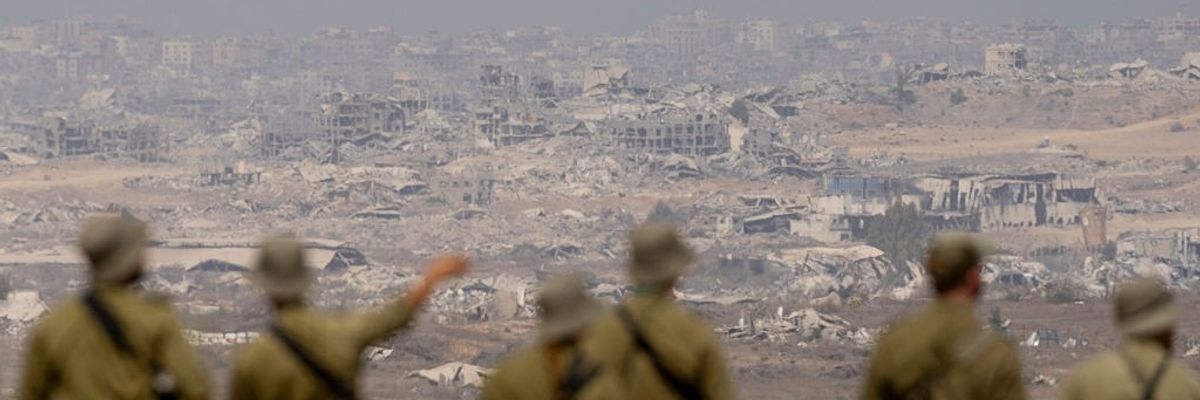
Israeli soldiers look at destructed buildings in the Northern Gaza Strip as they are standing at a view point on the Israeli side of the border on August 13, 2025 in Southern Israel, Israel. .
(Photo by Amir Levy/Getty Images)
Alexandra Boutri
Aug 18, 2025
Common Dreams

The war in Ukraine continues unabated and the international community has failed to stop Israel’s genocide in Gaza and its forced replacement campaign in the West Bank. As such, the limits of international law and the ever-declining influence of the United Nations (UN) are there for all to see. Indeed, we live in extremely dark times, and the need for a new world order architecture beyond the nation-state and capitalism is more urgent than ever before, says political scientist, political economist, author, and journalist C. J. Polychroniou in the interview that follows with the French-Greek independent journalist Alexandra Boutri.

Alexandra Boutri: Let me start by asking you about the Trump-Putin summit which ended without a concrete deal. What’s your take on it? Do you agree with the view that sees a Trump alignment with Putin?

C. J. Polychroniou: Among the major takeaways from the Trump-Putin summit in Alaska is that Trump’s image as a dealmaker has suffered yet another massive blow. Of course, we already knew that Trump is the ultimate bullshitter and the slickest con artist in modern political history. His position on the war in Ukraine has changed on numerous occasions, most likely out of frustration for his failure in fulfilling his promise to end the war between Russia and Ukraine, which is now well into its third year. But that’s because he lacks even a rudimentary understanding of how complex of a situation this is since the two sides, i.e., Russia and Ukraine, are diametrically opposed in their positions to end the war. In Alaska, Trump aligned with Putin by dropping his demand for a ceasefire in favor of pursuing a full peace accord. Russia had opposed US and European ceasefire proposals, so Trump’s shift to a peace deal is undoubtedly a win for Putin. In addition, no sanctions against Russia were announced, so the Alaska summit turns out to be a double win for Putin. But that’s not the end of the story. With the Trump-Putin summit, the U.S. has shown Europeans that it and it alone decides how to deal with Russia in ending the Ukraine war. Thus, we may speak of a third major win for Putin.

Alexandra Boutri: What does the Russia’s invasion of Ukraine tells us about the current world order architecture?C. J. Polychroniou: One may have thought that such aggression would be a thing of the past in the twentieth-first century, but the reality is that not much has changed in state behavior since the end of the Second World War. International law in establishing standards of behavior remains a weak law and collective security as a mechanism to prevent or resolve conflicts is something of an illusion. Ukraine and Gaza are striking examples of the failure of the current world order architecture.


Alexandra Boutri: Is there any justification for Putin’s war?

C. J. Polychroniou: The Russian position on Ukraine had been quite explicit for quite some time before the invasion. Putin had warned NATO against deploying its troops and weapons to Ukraine, saying that this represented a red line for Russia. But the U.S. was obsessed with bringing Ukraine into NATO and the Biden administration backed Ukraine for NATO membership just as strongly as the George W. Bush administration had done in 2008. Obama, of course, was also open to accepting Ukraine as a NATO member and had in fact urged NATO to increase its military support for Ukraine. The point here is that the West in general was always in favor of NATO’s eastward expansion since the end of the Cold War and did not take into account Russia’s security concerns. The US that is principally responsible for the Ukraine crisis although Putin’s invasion of Ukraine is unmistakably a criminal act of aggression.

Alexandra Boutri: Let’s move on to Israel’s barbaric assault on Gaza. What are the cold facts behind this terrible drama?

C. J. Polychroniou; The cold facts? That will require an extensive discussion of the Israeli-Palestinian conflict, which is impossible to offer here. The “terrible drama” doesn’t start with the atrocious attack and kidnapping by Hamas-led forces in Israel on October 7, 2023. Israel has a long history of occupation and dispossession, coupled with systematic violation of human rights against Palestinians. Anyone denying this “cold fact” is either ignorant of history or simply an Israeli propagandist. Nonetheless, it was the criminal and shockingly stupid cross-border raids by Hamas and other Palestinian armed groups on October 7, 2023, that led to Israeli vows of greater retaliation, which eventually took the form of ethnic cleansing and genocide. Another “cold fact” behind this terrible drama is that the Israeli occupation, dispossession, and killing of Palestinians would not have been possible without the backing and support of the US and major European powers. The western governments are fully complicit in Israeli crimes and the genocide taking place in Gaza today. Yet another “cold fact” is that the holy mantra of the “two-state solution,” cited for many years now by western powers and even so-called progressives in the western world as the only way forward for the Palestinian question, is a delusion as it has ignored the facts on the ground. Israel has always been bent on the creation of an ethnic state and a "greater Israel" and thus would never accept a Palestinian state near its own borders.Alexandra Boutri: You described the Hamas-led attacks of October 7 not only as criminal but also utterly stupid. Yet, there are many siding with the Palestinian cause who feel that the case for Palestinian self-determination stands now a better chance precisely because of the global condemnation against Israeli actions in Gaza.

C J. Polychroniou: This is utterly absurd. Complete rubbish, I must say. Palestinians in Gaza are faced with total extinction because of the Hamas-led attacks on October 7. Israel has killed tens of thousands of Palestinians (it’s more likely than not that the actual death toll in Gaza is much higher than what the Gaza health ministry has reported) and the number of injured exceeds 150,000. More carnage is sure to follow with Israel's plan to take control of all of Gaza. And bear in mind that most of Gaza’s infrastructure is totally destroyed as it has experienced one of the most intense bombardments in history. Israel has dropped more than 90,000 tons of bombs on the Gaza Strip, which happens to be one of the most densely populated territories in the world, exceeding World War II bombings in Dresden, Hamburg, and London combined. Indeed, it has been estimated that the Israeli bombardment of Gaza is the equivalent of six atomic bombs dropped in Hiroshima. How anyone can speak of “progress” on the Palestinian front in the midst of such immense human tragedy is mind-boggling to me. Israel is now more determined than ever before not to co-exist with Palestinians in its midst. You have a neo-Nazi government in power, actually using Nazi-like tactics against Palestinians, while a sizeable majority of Israeli citizens appear to be applauding the government’s campaign to liquidate them because they feel that “there are no innocent civilians” in Gaza. The fact that the western governments not only tolerate but support the actions of a neo-Nazi regime in Israel speaks volumes of their moral depravity. But, yes, Hamas’ actions have been not only criminal but utterly destructive for the Palestinian cause.


Alexandra Boutri: Under what circumstances can you imagine the restructuring of the current world order architecture and the end of capitalism?

C. J. Polychroniou: Unfortunately, I cannot imagine the restructuring of the world order architecture or the end of capitalism in my own lifetime. Such radical transformations would mandate, first and foremost, the end of the nation-state and the subsequent rise of cosmopolitanism. The driving force behind the formation of the nation-state was capitalism itself, so the two are deeply intertwined even though global capitalism gives the impression that it seeks to transcend the nation-state framework but, in reality, depends on it for its own expansion. Be that as it may, the point is that neither international law nor the UN collective security system work in preventing wars and resolving conflicts. Certain progress in human affairs notwithstanding, we continue to live in a dark and brutal world.


Our work is licensed under Creative Commons (CC BY-NC-ND 3.0). Feel free to republish and share widely.


C.J. Polychroniou
C.J. Polychroniou is a political economist/political scientist who has taught and worked in numerous universities and research centers in Europe and the United States. His latest books are The Precipice: Neoliberalism, the Pandemic and the Urgent Need for Social Change (A collection of interviews with Noam Chomsky; Haymarket Books, 2021), and Economics and the Left: Interviews with Progressive Economists (Verso, 2021).
Full Bio >

Alexandra Boutri
Alexandra Boutri is a freelance journalist and writer.
Full Bio >

Dark Lessons of Prewar Protectionism: From Tariff Wars to Global Fragmentation

The new Trump administration’s tariff wars are causing costly, even dangerous global fragmentation, with coercive unilateralism that’s fostering 1930s-like xenophobia and far-right nationalism.

by  | Aug 19, 2025 |

With its misguided tariff wars, the second Trump administration is not only fragmenting seven decades of globalization. It is also contributing to a kind of geopolitical climate that set the stage for the rise of fascism in the 1930s.

Times are different today, but like then, globalization is no longer at crossroads. It is unraveling. The White House has opted for an ominous path with a dark historical precedent.

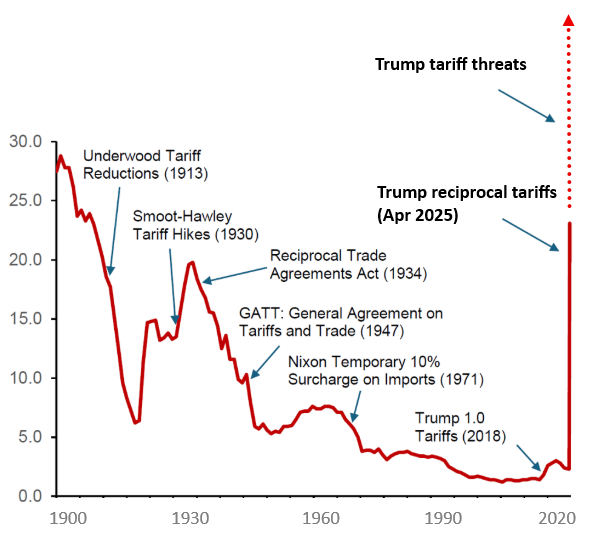
Dark legacies of the 1930 Smoot-Hawley Act

After the “Soaring Twenties,” US economy drifted into the Great Depression. Presumably to protect American jobs and farmers, two Republicans, Reed Smoot and Willis C. Hawley, pushed for a major tariff increase. This led to the enactment of the Smoot-Hawley Tariff Act, despite opposition by over 1,000 leading US economists. 

The ensuing tariffs were the second highest in US history. But instead of protecting American jobs and boosting US economy, the effect of the Act turned out to be precisely the opposite. 

Following the retaliatory tariffs of America’s major trading partners, it reduced US exports and imports by more than half during the Depression. In Germany, however, international friction paved the way to the rise of the Nazi party. 

The US economy recovered only with the war effort serving as a huge fiscal stimulus. 

The Act of 1930 was a grossly misguided response to the economic crash. What it gained in the short-term, it lost in the long-term. It delivered neither US stability nor prosperity. Instead, it contributed to instability and worsened the economic malaise. 

In brief, the Act made the Great Depression worse, compounding the chaotic international status quo that prolonged the lingering contraction, thus paving the way for World War II.  

The Trump tariffs

With the new Trump administration, the first round of tariffs built on traditional trade wars focusing mainly on Canada, Mexico and China. The tariff costs amount to more than $1.3 trillion; that is, over 3.5 times more than the 2017-18 tariffs. 

The second round began with President Trump’s “reciprocal tariffs.” It is an odd, Orwellian term for tariffs that are not multilateral, conceptually sound and appropriately estimated. Instead, the Trump tariffs are unilateral, flawed and mistakenly calculated – that is, coercive, illicit and miscalculated. 

Subsequently, the Trump White House boasted that “every country in the world wants to make a deal with America.” But that did not happen. Instead, the reciprocal tariffs were followed by a series of retaliations, which heralded the ongoing third round of tariff wars.

Nonetheless, under the US tariff attacks, many economies have been compelled to make deals with the Trump administration. In the short-term, they may contribute tens of billions of dollars to the US. But in the long-term, such intimidation tactics will cost US economy hundreds of billions of dollars, fragment globalization and erode the rules-based international trading regime.

Figure US tariff wars and Smoot-Hawley in history (stylized)

Source: White House, Bloomberg, MUFR GMR, author

Dark parallels

Global economic prospects have been fragile since 2008. A decade later, in 2018, the first Trump administration’s tariffs and deglobalization undermined a promising recovery, with the US imposing punitive tariffs on $400 billion worth of Chinese goods which affected more than 90% of the trade affected. 

Instead of building a multilateral front against trade protectionism, Western powers sought to appease the first Trump administration. That emboldened the Trump trade czars and contributed to the Biden administration’s fatal decision not to reverse his predecessor’s tariff decisions. 

Devoid of any meaningful economic rationale, the Trump tariffs go hand in hand with major austerity tremors, which are set to erode what is left of Roosevelt’s New Deal and Lyndon B. Johnson’s dream of Great Society. Perversely, the new focus is on massive rearmament, a new Cold War, and destructive geopolitics, including US complicity in the genocide in the Gaza Strip.

Once the tariffs’ full impact is felt, global economic prospects will suffer more shocks. Worse, the Trump administration is doing its best to obfuscate the destructive impact of its tariff stance by firing federal economists dedicated to monitoring economic data, in order to replace them with uber-conservative ideologues and data manipulation

The result is a darkening economic picture that could cause a “big correction” in US markets, as America’s big investment banks are now alerting their clients.

Global costs of fragmentation

Globalization fosters the flows of trade, investment and people. From 1950 to 2008, it reinforced integration among economies, thanks to technological progress, reduced transport costs, and offshoring of value activities across countries. Thereby, it also enabled the rise of the Asian dragons, China and India and more broadly the Global South.

Conversely, deglobalization reflects the retrenchment of such flows between countries. It fosters de-integration and fragmentation. During the first Trump administration, the Trump administration tried to exploit deglobalization to overcome the longstanding secular stagnation in the West, compounded by the US tariff wars.  

With the second Trump administration, the net effect is geoeconomic fragmentation, due to “a policy-driven reversal of global economic integration,” as the International Monetary Fund (IMF) calls it. It is neither automatic nor inevitable, but a US policy choice, with horrible economic and human consequences. With the resulting trade war contributing to the weakest global growth prospects in decades, geoeconomic fragmentation is feeding into another Cold War, which the world cannot afford.

In the late 2010s, deglobalization translated to slowing growth in the Global South. Today, global economic fragmentation is effectively curbing the rise of emerging and developing world

The original commentary was published by China Daily on August 12, 2025

Dr. Dan Steinbock is an internationally recognized visionary of the multipolar world and the founder of Difference Group. He has served at the India, China and America Institute (US), Shanghai Institutes for International Studies (China) and the EU Center (Singapore). For more, see https://www.differencegroup.net 

Tariffs: A Tax Increase Republicans Support Despite Pledges Never To Raise Taxes


Americans are afflicted with increasing economic inequality. We should therefore avoid regressive tax increases, which put the highest increase on poor or average Americans. But tariffs are highly regressive.


US President Donald Trump delivers remarks on reciprocal tariffs during an event in the Rose Garden entitled "Make America Wealthy Again" at the White House in Washington, DC, on April 2, 2025.
(Photo by Brendan Smialowski / AFP via Getty Images)
Common Dreams

For some decades most Republican members of Congress have taken the "Norquist Pledge" never to vote for tax increases. Many of them have carried this pledge even further by reducing the Internal Revenue Service budget, impairing the agency's ability to collect taxes that are already in the law books. Lately, however, these Republicans have supported major increases in federal taxes imposed by US President Donald Trump---high tariffs on goods imported into the United States.

Although Mr. Trump repeatedly speaks of "making Brazil pay, " "making China pay," etc., he is actually imposing a tax on goods imported into the US from those countries. This tax will either be passed along to American consumers in the form of higher prices, or it will be absorbed by the importing company, making it a tax on American business owners.

No money is coming in from Brazil or China.

These new taxes have been putting decent amounts of money into the federal treasury, which it certainly can use. But it is all coming in from Americans.

Congress clearly did not specifically authorize the president to impose tariffs on Brazil because it is prosecuting its former president for trying to remain in office after he lost an election.

I have often attacked the Norquist Pledge and accused politicians who take it of political malpractice, since changed circumstances may sometimes require tax increases to support needed spending or reduce out of control deficits. So why am I not happy that Republicans have found a way to weasel out of their pledge never to increase taxes?

Americans are afflicted with increasing economic inequality. We should therefore avoid regressive tax increases, which put the highest increase on poor or average Americans. But tariffs are highly regressive. Poor people must spend all of their meager incomes, mostly on goods. Better-off people save some of their income and spend more on services, which tariffs do not greatly affect.

Of course regressive taxes suit the interests of the wealthy, whose campaign donations politicians covet, and who also benefit from legislation impairing the ability of the IRS to audit them.

Unfortunately for Mr. Trump and his entourage, the claimed legal basis for his power to impose tariffs is extremely weak. Congress has authorized the president to adjust tariffs in unforeseen domestic or international emergencies. But Mr. Trump has pushed this authorization beyond all reasonable limits and has a propensity to declare emergencies that clearly are not emergencies.

In recent years the newly conservative US Supreme Court has invented a new "major questions" doctrine. This doctrine is not unreasonable. It says that when US Congress has authorized a government agency to regulate something, if that agency enacts a regulation that has large scale consequences, the court will strike that regulation down unless Congress has clearly and specifically authorized that kind of regulation.

The tariffs are a presidential action, not that of a government agency, but this is an even more appropriate case for applying the major questions doctrine. Government agencies can only impose new regulations after lengthy deliberations required by the Administrative Procedures Act. Unlike federal administrative agencies, the president—claiming congressional authorization—can just do things without any required procedures or consultation.

Congress clearly did not specifically authorize the president to impose tariffs on Brazil because it is prosecuting its former president for trying to remain in office after he lost an election. And it clearly did not specify that the president could increase tariffs in order to increase federal revenues, or to deal with imaginary emergencies that he himself dreamed up.

Presidentially imposed tariffs are obviously a case where the major questions doctrine would be an appropriate guide to the justices.

No doubt the court's conservative majority invented the major questions doctrine because it supported some decision that they wanted to make. Fair enough. But will they respect this doctrine when it requires a decision they do not want to make?

Our work is licensed under Creative Commons (CC BY-NC-ND 3.0). Feel free to republish and share widely.


Paul F. Delespinasse, who now lives in Oregon, is professor emeritus of political science at Adrian College in Michigan. He can be reached via his website, www.deLespinasse.org.
Full Bio >


House Report Warns Trump Tariffs Could Stymie US Manufacturing for 'Years to Come'

Democrats on the Joint Economic Committee said that "continued uncertainty" caused by the president's policies could reduce manufacturing investments by nearly half a trillion dollars by the end of this decade.


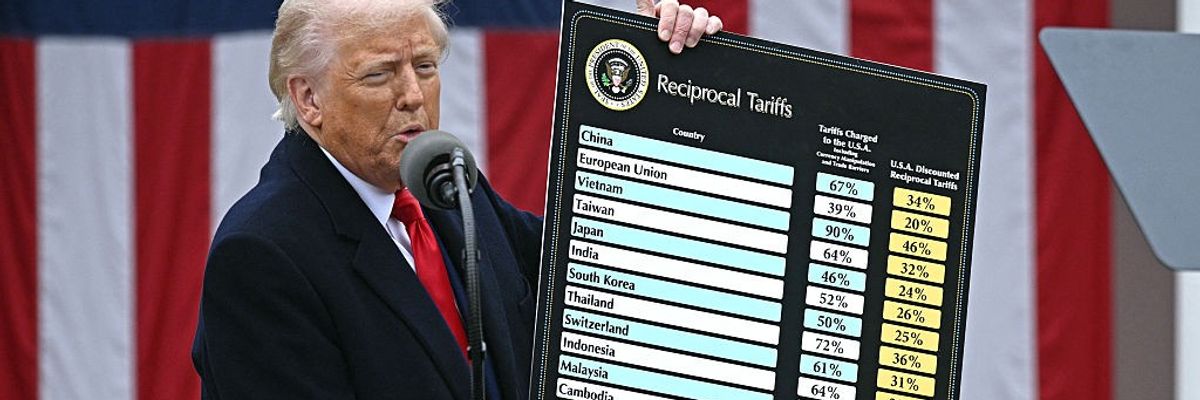
US President Donald Trump holds up a chart of "reciprocal tariffs" while speaking during a “Make America Wealthy Again” trade announcement event in the Rose Garden at the White House on April 2, 2025 in Washington, DC
(Photo by Brendan Smialowski/AFP via Getty Images)

Brett Wilkins
Aug 18, 2025
COMMON DREAMS


US President Donald Trump's tariff whiplash has already harmed domestic manufacturing and could continue to do so through at least the end of this decade to the tune of nearly half a trillion dollars, a report published Monday by congressional Democrats on a key economic committee warned.

The Joint Economic Committee (JEC)-Minority said that recent data belied Trump's claim that his global trade war would boost domestic manufacturing, pointing to the 37,000 manufacturing jobs lost since the president announced his so-called "Liberation Day" tariffs in April.

"Hiring in the manufacturing sector has dropped to its lowest level in nearly a decade," the Democrats on the committee wrote. "In addition, many experts have noted that in and of itself, the uncertainty created by the administration so far could significantly damage the broader economy long-term."

"Based on both US business investment projections and economic analyses of the UK in the aftermath of Brexit, the Joint Economic Committee-Minority calculates that a similarly prolonged period of uncertainty in the US could result in an average of 13% less manufacturing investment per year, amounting to approximately $490 billion in foregone investment by 2029," the report states.

"The uncertainty created by the administration so far could significantly damage the broader economy long-term."

"Although businesses have received additional clarity on reciprocal tariff rates in recent days, uncertainty over outstanding negotiations is likely to continue to delay long-term investments and pricing decisions," the publication adds. "Furthermore, even if the uncertainty about the US economy were to end tomorrow, evidence suggests that the uncertainty that businesses have already faced in recent months would still have long-term consequences for the manufacturing sector."

According to the JEC Democrats, the Trump administration has made nearly 100 different tariff policy decisions since April—"including threats, delays, and reversals"—creating uncertainty and insecurity in markets and economies around the world. It's not just manufacturing and markets—economic data released last week by the Bureau of Labor Statistics showed that businesses in some sectors are passing the costs of Trump's tariffs on to consumers.

As the new JEC minority report notes:
As independent research has shown, businesses are less likely to make long-term investments when they face high uncertainty about future policies and economic conditions. For manufacturers, decisions to expand production—which often entail major, irreversible investments in equipment and new facilities that typically take years to complete—require an especially high degree of confidence that these expenses will pay off. This barrier, along with other factors, makes manufacturing the sector most likely to see its growth affected by trade policy uncertainty, as noted recently by analysts at Goldman Sachs.

"Strengthening American manufacturing is critical to the future of our economy and our national security," Joint Economic Committee Ranking Member Maggie Hassan (D-N.H.) said in a statement Monday. "While President Trump promised that he would expand our manufacturing sector, this report shows that, instead, the chaos and uncertainty created by his tariffs has placed a burden on American manufacturers that could weigh our country down for years to come."