Wednesday, September 03, 2025


The CyberBoat Challenge: Cybersecurity Education for the MTS
Ship with digital elements
iStock / Suphanat Khumsap

Published Sep 2, 2025 10:00 PM by Dr. Gary C. Kessler, Dr. Jeremy Daily and Karl Heimer


The information security industry has lamented the lack of available skilled and talented workers for the last three decades. A common estimate today is that there are a million unfilled cybersecurity-related positions in the U.S. alone. The absence of skilled cybersecurity workers has a particular impact on the maritime transportation system (MTS) because "traditional" cyberdefense skills do not directly translate to the maritime information ecosystem, so we are even further behind.

The maritime domain is a highly intertwined system of systems, composed of a complex and interconnected collection of information technology (IT) and operational technology (OT). Maritime's information ecosystem is a mix of data centers, networks, sensors, communication systems, and end-user devices that are subject to the same cyberdefense requirements as the rest of the information universe. That said, the MTS has unique cybersecurity requirements, including the combination of many moving and stationary parts; smart ships, ports, and cargo; cyber-physical systems and operational technology; maritime-specific navigation and situational awareness systems; and human-machine interfaces.

The CyberBoat Challenge started in 2022 and has become an annual educational event, bringing together cybersecurity students learning about maritime systems, industry partners and government. It is a cooperative learning opportunity where students examine the maritime environment and maritime information systems in order to understand the protocols, operations and interfaces - and how they all relate to the real world.

Traditional methods of cybersecurity education, training, and workforce development benefit from new and innovative ideas in order to teach students about the many niche technical specialties that have emerged in last couple of decades and, in particular, to develop the next generation of cyberdefense professionals in the maritime industry. Maritime product vendors, ports, shipping lines, merchant mariners, and others in the maritime domain need to be creative in where we find people for cyber roles, which might include professionals from the engine room or the bridge.

The maritime industry must also engage more fully with academic institutions to channel students in understanding the unique needs within the maritime domain. A handful of colleges and universities in the U.S. and globally are already focusing on maritime in their computer science, computer engineering, cybersecurity, or other related programs. The CyberBoat Challenge provides one way in which faculty and students from these — and other — academic institutions can meet and network. The CyberBoat events specifically seek industry and government involvement to help create a miniature ecosystem which not only helps students understand the context of the material and problems, but also helps them form ties with potential mentors and potential employers regardless if their goals are industry, government, academia, or the security community.

There is an adage that engineers don't understand security. This is somewhat borne out by the fact that the most common software flaws reported today are the same as the most common software flaws reported 25 years ago. All too often, engineers work in solution space and not problem space; i.e., they work on solving known problems but they're not necessarily trained to go out and seek new problems hidden in our increasingly complex technology systems. Indeed, most undergraduate courses teach technical topics by assigning problem sets rather than assigning students to find problems.

By bringing together people with diverse academic and experiential backgrounds, students new to this information environment can exercise the critical thinking necessary to identify problems that we may not yet have recognized before they appeared in tragic ways. Every time an accidental event occurs in an IT or OT system on a ship or at a port, cyber processionals — and adversaries — look to see if there's a cyberattack vector that might deliberately cause the same outcome. Consider the failure of a microswitch in the steering control system on BBC Africa, causing her to collide with Common Faith in Houston in August 2023, or the tripped breaker resulting in a power failure on Dali, causing an allision with — and catastrophic failure of — the Francis Scott Key Bridge in March 2024.

CyberBoat is not a cyber competition. The event is pro-industry, and its raison d'être is to help industry understand and address cybersecurity challenges. It is a resource for participants to draw on in terms of augmenting education; making industry connections; understanding the needs, priorities, and remedies of sister organizations; understanding the perspective and role of governmental agencies; and as a recruitment resource for companies looking for interns and employees. It also helps to build a cohort of students learning a new way to think critically about problem identification and solution.

While this is a new approach within the maritime domain to address a long-existent problem, the CyberBoat Challenge is using a well-known engagement and education model which was pioneered by its "elder siblings" — CyberAuto Challenge since 2012 and CyberTruck Challenge since 2017 — which have served as a training and mentoring asset for industry, academia, government, and students, and has seen many hundreds of past participants enter the transportation cybersecurity field. This training system works and has had positive effects in the community of interest.

The next CyberBoat Challenge is in December and will be held at the University of North Carolina Wilmington. Faculty, students, academic institutions, vendors of maritime products, shipping companies, ports, and other interested parties can find more information at https://cyberboatchallenge.net/.

Dr. Gary C. Kessler is co-author of "Maritime Cybersecurity," 2/e and is a lecturer and advisory board member of the CyberBoat Challenge.

Dr. Jeremy Daily is a professor at Colorado State University and program organizer of the CyberBoat Challenge.

Karl Heimer is the founder and board chair of the CyberAuto, CyberBoat, and CyberTruck Challenges.

The opinions expressed herein are the author's and not necessarily those of The Maritime Executive.


Gibdock Becomes Major Focus for Offshore Support Vessel Work

Gibdock
BOKA Southern Ocean - Image credit: Gibdock

Published Sep 2, 2025 9:07 PM by The Maritime Executive


[By: Gibdock]

Gibdock has completed a series of high-profile offshore support vessel (OSV) projects in recent months to consolidate its reputation for delivering exceptional and timely service to the offshore industry.

In a significant and growing market for Gibdock, the Gibraltar-based ship repair yard has established itself as a trusted strategic partner to several major offshore players by consistently executing projects on time, within budget, and to the highest safety and quality standards.

As part of an ongoing relationship with Boskalis, Gibdock has completed works on the trailing hopper suction dredger Gateway, the construction support vessel BOKA Southern Ocean, and the multipurpose construction vessel BOKA Fulmar in recent months. Other significant OSV projects this year include the repair of Subsea 7’s construction/flex-lay vessel Seven Pacific and the repair and renewal of Technip’s specialised rigid pipelay vessel Deep Blue.

With Solstad’s anchor-handling tug supply vessel Normand Pacific currently in the yard for renewal, and many more projects in the pipeline for the year ahead, Gibdock’s outlook in the offshore support segment is strong.

“Offshore majors trust Gibdock because of our track record in delivering safe, high-quality, and on-time services at good value,” commented John Barnard, Commercial Director, Gibdock. “We work closely with these companies to provide bespoke projects and conversions within a timeline that suits them. Due to the strong and growing demand for our OSV services, we encourage proactive engagement: interested parties should approach us early, even when projects are planned for two or three years out, so we can ensure availability and provide tailored input.

The products and services herein described in this press release are not endorsed by The Maritime Executive.


Everllence Breaks Ground on New Danish HQ

Everllence
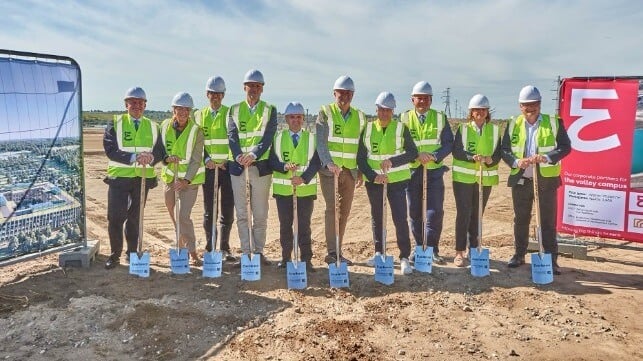
Pictured at the groundbreaking ceremony for the new Everllence Danish headquarters in Roskilde, Denmark

Published Sep 2, 2025 8:38 PM by The Maritime Executive


[By: Everllence]

Everllence has held a groundbreaking ceremony in Roskilde, Denmark to mark the commencement of the building phase of its new Danish headquarters. Called ‘The Valley’, the development is a joint venture between Everllence and Volkswagen Immobilien, the Volkswagen Group’s real-estate division.

The company states that its current base in Greater Copenhagen – and its Holeby, southern Denmark site – have given rise to many innovations that drive climate-neutral shipping, including such world-firsts as the high-pressure dual-fuel two-stroke engine, methanol-powered engines, as well as the first firing of a two-stroke engine fuelled by ammonia.

However, the sites’ current facilities – particularly at its Copenhagen location – are outdated with major renovations otherwise looming. The decision to relocate is driven then by strategic necessity with The Valley offering space for growth, both in terms of workforce and production capacity, and in an industrial setting that facilitates the testing of new fuel-technologies while ensuring safer logistics.

The ceremony was attended by members of the Everllence Executive Board and a number of prominent guests, including: Everllence CEO, Dr Uwe Lauber; Managing Director Volkswagen Immobilien, Hardy Brennecke; Everllence Head of Two-Stroke Business and Country Manager Denmark, Bjarne Foldager; and Mayor of Roskilde, Tomas Breddam.

Lauber said: “Today’s event marks a historic milestone in Everllence’s journey. As we turn the first sod in this exciting venture, we are laying the foundation – not just for a new campus, but for a new chapter in our company’s history. Our current facilities in Denmark have served us well but were not built for the future we are envisaging. This location is purposely designed for excellence, tailored to the unique needs of our people, our technologies, and our decarbonisation aspirations. The future starts here – and it starts now.”

Located on the site of a former gravel pit, The Valley campus lies 40 km west of Copenhagen and will comprise a 70,000 m² complex of buildings including office space for at least 1,500 workstations, a teaching academy, meeting centre and an employee club. Construction by general contractor, DS Flexhal, will also see the building of a production unit and warehouse, as well as a research centre with testing facilities.

Speaking on behalf of VW Immobilien, Brennecke said: “The traditional groundbreaking ceremony for ‘The Valley Campus’ marks the start of construction for a special real-estate project. Over the next few years, modern, sustainable office and production facilities, an academy, and meeting areas will be built on the approximately 175,000 m² site. With this sustainable construction project, Everllence is underscoring its successful business development. We wish everyone involved in the project a thriving and accident-free construction period.”

Foldager said: ”This project is also a strategic consolidation that brings together our teams from Copenhagen and Holeby, creating an environment where expertise meets collaboration, where two-stroke meets four-stroke – and with room to grow, free from the constraints of residential surroundings. Here, we can innovate safely, efficiently, and responsibly – especially as we work with new fuels like ammonia. Together, we are building more than a main location for Everllence in Denmark; we are building a legacy.”

The products and services herein described in this press release are not endorsed by The Maritime Executive.


Panama and Classification Societies Review Regulations to Align Strategies

Panama meets classification societies

Published Sep 2, 2025 7:06 PM by The Maritime Executive


[By Panama Ship Registry]


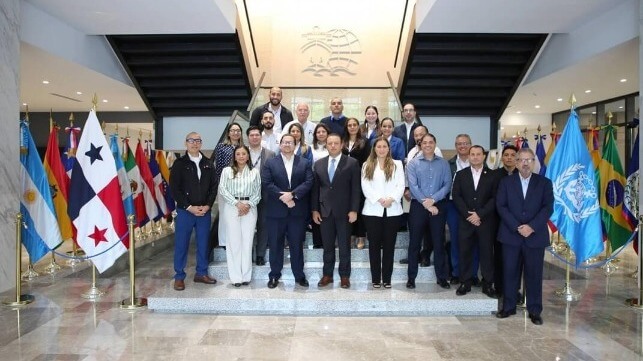
The Panama Maritime Authority (PMA), through the Directorate General of Merchant Marine (DGMM), held a roundtable with the International Association of Recognized Organizations (IARO) to review, update, and align Panama’s Ship Registry regulations with the demands of the global market.

The meeting brought together PMA officials and leading classification societies within the IARO, marking a decisive step toward modernizing Panama’s ship registration regime.

“We must see the Panamanian Registry as a single team. It’s not only the PMA’s responsibility, maritime lawyers and Recognized Organizations must also drive projects and new measures to strengthen competitiveness,” emphasized Ramón Franco, Director General of Merchant Marine.

For his part, IARO President Santiago Torrijos Oro highlighted that cooperation with the PMA will bolster Panama’s flag on the international stage. “The measures may seem drastic, but they are necessary to remain one of the world’s most prestigious flags,” he stated.

Discussions focused on key industry challenges, including maritime safety, environmental protection, and the need for a modern and transparent regulatory framework. These efforts aim to ensure that Panama maintains its global leadership while adapting to the evolving standards of the International Maritime Organization (IMO) and the growing demands of international trade.

The IARO brings together classification societies recognized by the PMA to inspect and certify vessels, making their role vital in ensuring the continuous improvement of the Panamanian flag.

Through this joint effort, Panama reaffirms its standing as a global leader in merchant shipping and strengthens international shipowners’ confidence in its flag. 
 

The products and services herein described in this press release are not endorsed by The Maritime Executive.


SOUTH KOREA

Survivor of Sewol Sinking Arrested After Tussle Outside Gov't Office

Korea Coast Guard
Korea Coast Guard file image

Published Sep 2, 2025 3:39 PM by The Maritime Executive


A man who claimed to be a survivor of the 2014 Sewol ferry sinking has been arrested outside a government office in Seoul after he demanded a meeting with the president's office. The man was allegedly in possession of a weapon in a public space, a chargeable offense in South Korea. 

On Tuesday, local police in Seoul said that they had arrested the man after he approached police officers outside of the ministry  of defense building in Seoul's Yongsan district. The building is currently the official residence of South Korean President Lee Jae-myung, and the man demanded to meet with the presidential office to petition for improved support for the survivors of the Sewol tragedy. 

The man scuffled with police for 20 minutes, and eventually officers used a taser to subdue him. He was given first aid for injuries sustained in the altercation, and was taken to a hospital for treatment. The authorities conducted and investigation and ultimately released him to return home. 

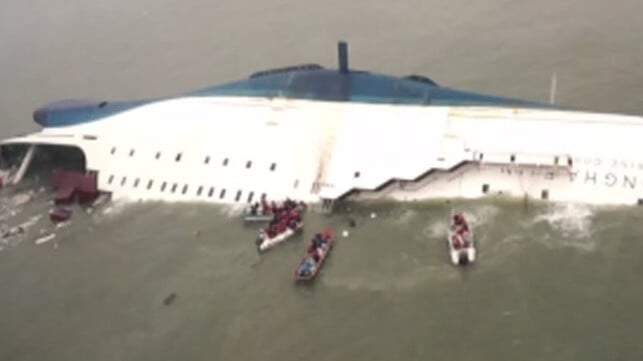
On April 16, 2014, the ferry Sewol was under way on a voyage to the southern resort island of Jeju. The majority of those aboard were high school students and their teachers on a school field trip, and there were several hundred teenagers on the ship out of a total of 476 passengers and crew. The ferry capsized unexpectedly, and 303 passengers died trapped inside, including 261 students. Many of the deceased obeyed crew instructions to remain in their cabins, even as crew members were seen on TV abandoning the sinking vessel. 

An investigation determined that Sewol was overloaded and under-ballasted on the casualty voyage; extensive structural modifications to her upper decks had reduced her GM, and the vessel capsized in a turn, then quickly sank. 

After a public campaign by the victims' families, the vessel was raised at great cost and transferred to the port of Mokpo for further analysis. In the political firestorm that followed, South Korean president Park Geun-hye's approval rating plummeted, damaging her prospects and eventually contributing to her ouster in 2016. Nine Korea Coast Guard officials were indicted in connection with the Sewol's certification and operation (though all were acquitted); the master received a sentence of life in prison for abandoning ship without his passengers. 

Students who survived the tragedy received extensive support, including 70 days of counseling and a special admissions program giving them privileged access to top universities. But in retrospective interviews with Korea Herald, survivors said that they are still haunted by the experience, and some still struggle with mental illness.  


Spill Temporarily Shuts Down a Tanker Mooring at the CPC Terminal

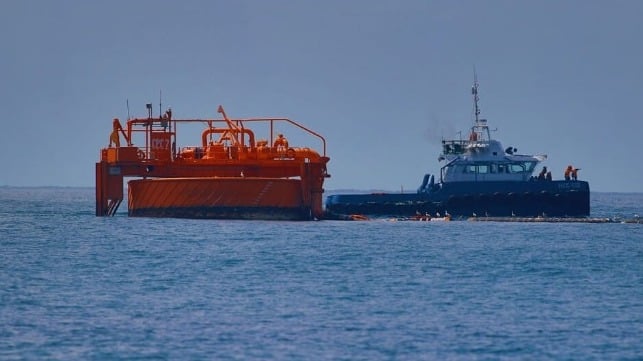
CPC SPM buoy (CPC file image)

Published Sep 2, 2025 4:58 PM by The Maritime Executive


A spill has been reported at the Caspian Pipeline Consortium offshore loading terminal near Novorossiysk, Russia, but accounts of its size and significance vary. 

On August 29, petroleum was released during loading operations at one of the CPC terminal's offshore mooring buoys (SPMs). Satellite imaging released by dissident news outlet Crimean Wind appears to suggest a slick measuring about 21 kilometers in length, extending eastward from the #2 SPM at the CPC site. The publication estimated the size of the release at 5-10 tonnes, equivalent to about 1,500-3,000 gallons.  

In a statement, the CPC operating consortium said that cleanup had been completed by August 30, and that post-remediation monitoring of air and water detected no excess in pollutant values. No shoreline contamination has been identified, and no sorbents were used for cleanup. Seawater monitoring continues on a twice-daily basis, using a third party laboratory; the total volume of the oil release has not been confirmed by the operator and remains under investigation. 

One of the terminal's SPMs was shut down after the spill, temporarily leaving only one mooring operational out of three. 

The CPC terminal is one of the world's most important oil facilities, handling more than one percent of the global crude supply. Though the loading port is located in Russia, little of the oil shipped through it is of Russian origin, as the pipeline's crude is produced in Kazakhstan by Western oil companies. Nonetheless, it has occasionally been affected by the ongoing war in Ukraine, including a drone strike attributed to Ukrainian forces in February.    


U.S. Sanctions Efforts to Blend Iranian and Iraqi Oil to Avoid Restrictions

Basra Iraq oil terminal
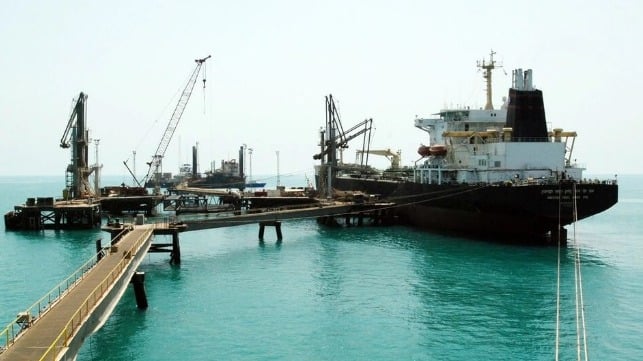
Tankers at Iraq's Basra oil terminal has been linked to the effort to blend the oil to hide its origins (US Navy file photo)

Published Sep 2, 2025 5:09 PM by The Maritime Executive


US Sanctions Efforts to Blend Iranian and Iraqi Oil to Avoid Trade Restrictions


The United States, through its sanctions program, is increasing the pressure on the Iranian oil trade and the efforts to obfuscate the origins of the oil by blending. New sanctions announced on September 2 by the U.S. the U.S. Department of the Treasury’s Office of Foreign Assets Control (OFAC) targeted the business network of a UAE-based businessman, Waleed al-Samarra’I, and nine Liberian-flagged tankers, which the U.S. says have generated millions of dollars in oil revenue.

The network, the U.S. contends, operates primarily by covertly blending Iranian oil with Iraqi oil, which is then marketed intentionally as solely of Iraqi origin.  Based on conservative estimates, the U.S. says al-Samarra’i’s network generates around $300 million of value to both Iran and its partners annually.

Waleed Khaled Hameed al-Samarra’i, a citizen of both Iraq and St. Kitts & Nevis, runs a network of companies managing vessels that have been involved in the sale of Iranian oil to international markets. To smuggle the Iranian-origin oil, al-Samarra’i uses a group of vessels to blend Iranian and Iraqi oil at sea, via ship-to-ship transfers in the Arabian Gulf, and in Iraqi ports. U.S.-sanctioned vessels publicly affiliated with Iran’s shadow fleet are being employed to distance the network from direct interactions with the Iranian petroleum sector. The vessels also engage in other obfuscation techniques to hide their activities, such as unsafe ship-to-ship transfers at night, Automated Identification System (AIS) spoofing, and conspicuous gaps in AIS location reporting.

Al-Samarra’i relies on his two UAE-based companies, Babylon Navigation DMCC and Galaxy Oil FZ LLC, to manage his network’s operations.  The tankers, Adena, Liliana, Camilla, Delfina, Bianca, Roberta, Alexandra, Bellagio, and Paola, are Liberian-flagged but owned by several Marshall Islands-based shell companies, the U.S. reports.

It is the second time the U.S. has sanctioned a network it says is involved in the blending efforts. In July, it sanctioned the network of Salim Ahmed Said. The U.S. says these efforts are part of its commitment to “eliminating Iran’s pernicious influence on Iraq’s economy and upholding a campaign of maximum economic pressure on Iran.”

Experts highlight that Iran continues to look for methods of working around the U.S. sanctions on its oil industry.

The U.S. has also been putting pressure on Iraq to crack down on the tankers. In July, Iraqi officials released a list of tankers that they were barring from their oil operations, accusing them of being involved in the obfuscation efforts.

Trump Administration to Target SouthCoast Wind in War on Wind Power

CUTTING NOSE TO SPITE FACE

offshore wind farm
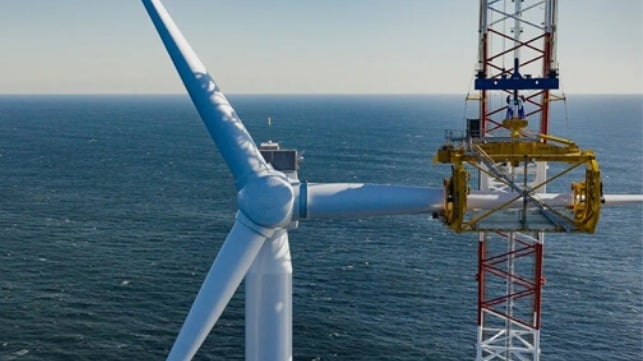
Trump administration is reconsidering construction permits for offshore wind farms

Published Sep 2, 2025 6:11 PM by The Maritime Executive


It was revealed in a court filing on Friday, August 29, that the Trump administration, through the Department of the Interior, plans to reconsider permits issued last year to the SouthCoast offshore wind project. It comes as the administration has sought to make good on Donald Trump’s opposition to “windmills” by issuing stop work orders, freezing new permits, reconsidering existing permits, and withdrawing tax credits and funding grants.

The Department of Justice filed a motion in a suit brought by the Town of Nantucket, Massachusetts, appealing the Bureau of Ocean Energy Management’s December 2024 approval of South Coast Wind as the nation’s 11th commercial-scale offshore wind energy project. The suit alleges flaws in the permitting process, saying that BOEN violated federal environmental law by approving the project without requiring the developer to properly mitigate harm from the efforts. 

Nantucket says it gave the project’s developers multiple opportunities to address the island’s concerns prior to filing suit on March 27. It alleges the approval “creates a dangerous precedent” that allows fossil fuel developers the opportunity to also fast-track projects and avoid safeguards. They contend the suit is to reinforce environmental and preservation laws.

The Department of Justice told the court on Friday that the suit “makes little sense” because it plans to formally move for reconsideration of the permit by September 18.  It is the same tactic DOJ and the Trump administration reported it is taking for Maryland’s first offshore wind project, which was also approved in 2024. They plan to file the reconsideration effort against the permits for US Wind’s Maryland wind farm project by September 12.

SouthCoast Wind is being developed by Ocean Wind North America, a joint venture between EDP Renewables and Engie. The project, which was then known as Mayflower Wind, won its lease in a December 2018 auction. The approved plan calls for the construction of up to 141 wind turbine generators and up to five offshore substation platforms with the potential to generate up to 2,400 MW. It would be located about 26 nautical miles south of Martha’s Vineyard and 20 nm south of Nantucket, Massachusetts.

The Town’s opposition is part of its broader efforts against the wind industry. They contend that if all the proposed projects were developed, there would be an estimated 743 wind turbines located off Nantucket’s coastline. A total of nine wind farm sites have been designated for the area.

The company filed a motion with the court opposing the government’s call for an extension while it pursues the effort to reconsider the permits. The motion says the effort is part of the government’s larger efforts to eliminate all offshore wind projects regardless of their impact.

The federal government has unleashed efforts on all fronts, including the president’s executive order to review the industry and freeze permitting. They briefly stopped work on the Empire Wind project in New York before it started offshore work, and now have stopped Resolution Wind in Massachusetts, which is 80 percent installed. Grants for port projects to support the industry have now been withdrawn, and the administration said it was launching a review of the offshore wind industry on the grounds of national security concerns. 

The governors of five states (Connecticut, Massachusetts, New Jersey, New York, and Rhode Island) issued a joint statement on September 1, calling on the administration to uphold the permits that have already been issued for offshore wind projects. The states had previously filed suit against the administration over the president’s executive order to review the industry.


Coast Guard Awards Contract to Begin Overhaul at Base Seattle

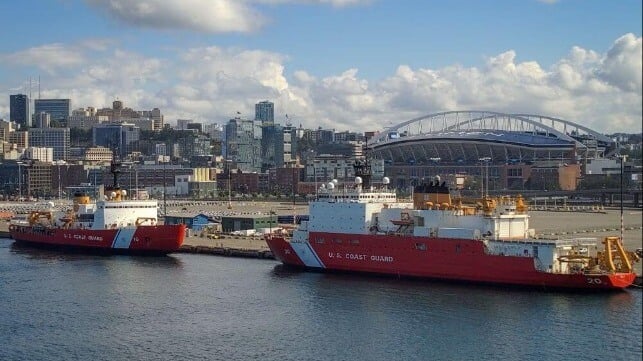
Icebreakers USCGC Healy and Polar Star at Terminal 46, Seattle, 2024 (USCG)

Published Sep 2, 2025 6:17 PM by The Maritime Executive


The U.S. Coast Guard has awarded a contract to start modernization works to prepare for homeporting its future Polar Security Cutters in Seattle. Whiting-Turner Contracting won an award worth about $140 million for the first phase of the project, to include construction of two large cutter berths and dredging of a slip to the depth required for the PSC hulls. 

The first phase (1A) will widen the slip between two berths, add upgraded utility installations, remove an existing building, and install waterfront stabilization structures. It will also see the renovation of Station Seattle's existing boathouse and small boat docks. 

After this phase and the next two are completed, Base Seattle will have four large cutter berths, enough to support a range of oceangoing vessels. In planning, the Coast Guard said that its preferred alternative is to acquire part of Terminal 46, just to the north of the base, and upgrade 1,000-plus feet of existing commercial wharfage to provide extra space for cutters. 

Seattle has been the home port for the service's medium and heavy icebreakers for years, and it benefits from the area's well-developed industrial base and the presence of a major shipyard nearby. It will continue to be the service's primary home port for icebreakers, with an exception for USCGC Storis, which will have a base of her own in Juneau.  

Coast Guard Base Seattle evolved organically as the service's needs grew in the region. After decades of berthing its cutters wherever there was space available along the commercial waterfront, the service acquired Piers 36 and 37 from the Army Corps of Engineers in 1966. That facility has been headquarters for Sector Puget Sound and Base Seattle ever since, and its infrastructure is aging. 

Base improvements have historically taken a back seat for the cash-strapped Coast Guard, which has long struggled to find funding to keep its shoreside infrastructure in working shape. After years of budget sequestration and deferred maintenance, the USCG received a major boost in the One Big Beautiful Bill Act, which provided a much-needed $4.4 billion for reconstructing shoreside facilities. USCG stations across the country can share a combined $2.8 billion appropriation for construction; Alaska is getting a congressionally line-itemed $300 million facility for USCGC Storis; the Coast Guard Yard is getting a new drydock for $500 million; and the service's enlisted bootcamp at Cape May is getting a $425 million revamp.

Shortly after announcing the Base Seattle contract award, the Coast Guard announced its first ever One Big Beautiful Bill expenditure, a smaller $15 million contract extension awarded to Whiting-Turner for pier renovation at Base Charleston in South Carolina. 


Investment Firm Carlyle Buys Altera Infrastructure Group’s FPSO Business

FPSO
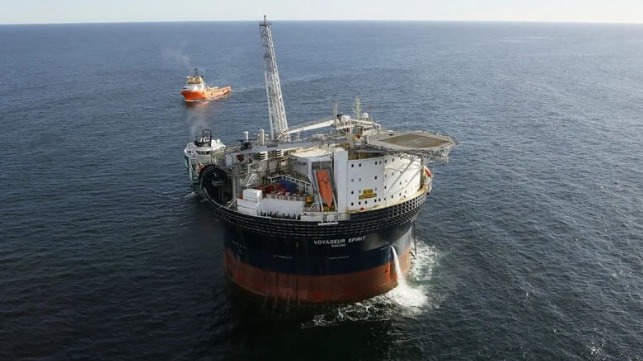
Altera is sellings its FPSO business to investor Carlyle Group (Altera Infrastructure)

Published Sep 2, 2025 6:40 PM by The Maritime Executive


Global investment firm Carlyle is jumping into the offshore energy sector reporting it has agreed to acquire the FPSO (Floating Production, Storage and Offloading) business from Altera Infrastructure Group, a leading offshore energy infrastructure company owned by Brookfield Asset Management’s private equity business. The investment group with $465 billion of assets under management has decided to enter the business due to the strong opportunities.

Altera currently has a fleet of six FPSOs deployed in Brazil, Dubai, and Cote d’Ivoire. It also has two FSOs operating off Cote d’Ivoire and in the Gulf of Thailand.

“This is a rare opportunity to acquire an established and high-quality FPSO business with a strong management team, operating track record and long-term cashflows,” said Bob Maguire, Co-Head of Carlyle International Energy Partners (CIEP). “This portfolio benefits from long-term contracts, strong FPSO market fundamentals, and exposure to world-class operators which position it well for success.” 

It is part of continuing efforts that have been reshaping the business of UK-based Altera Infrastructure. It reorganized through the US bankruptcy proceeding in late 2022. At the end of last year, it sold its  interests in Altera Shuttle Tankers, a fleet of 18 shuttle tankers in Brazil, Canada, and the North Sea, to Maistros Shiptrade, a company affiliated with the Angelicoussis Group.

The business being acquired by Carlyle includes ownership of the FPSOs and the FSO (Floating Storage and Offloading), which are underpinned by long-term contracts with major oil and gas companies. The portfolio includes the Petrojarl Kong FPSO and FSO Yamoussoukro, deployed in the Ivory Coast with Eni, which represents the first net-zero emission upstream project in Africa, the Piranema FPSO, as well as 50 percent of the Altera&Ocyan joint-venture asset Pioneiro de Libra FPSO, deployed in Brazil with Petrobras. Additionally, the business has a strong pipeline of future growth and redeployment opportunities.

Carlyle says it will support the Altera FPSO business through its sector-specific investment team. It promises available follow-on equity capital for accretive growth and M&A, building on the company’s track record in redeployments. 

MURDER ON THE HIGH SEAS

U.S. Military Eliminates 11 Drug Smuggling Suspects off Venezuela

Burning smuggling boat
Courtesy of the White House

Published Sep 2, 2025 8:48 PM by The Maritime Executive


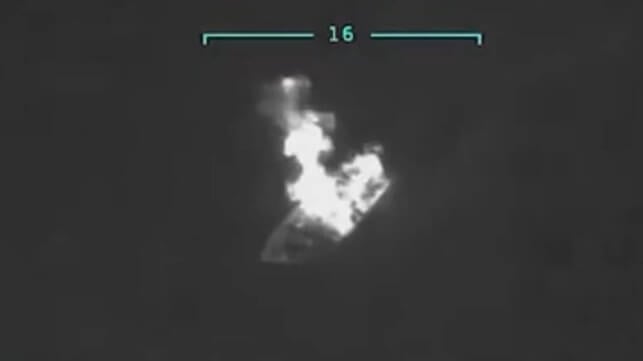
For the first time in years, the U.S. military has destroyed a suspected drug smuggling vessel and neutralized its crew, without conducting a law enforcement boarding. On Tuesday, the White House announced the elimination of 11 suspects who were allegedly transporting narcotics off the coast of Venezuela. 

"The president is going to be on offense against drug cartels and drug trafficking in the United States," Secretary of State Marco Rubio told reporters. "It destabilizes not just the country, but the entire Caribbean basin. These particular drugs were probably headed to Trinidad or some other country in the Caribbean."

In a statement on his social media platform, President Donald Trump said that he gave the orders to conduct a kinetic strike against "Tren de Aragua narcoterrorists" at a position in U.S. Southern Command. The strike occurred in international waters, resulting in 11 fatalities. 

"Please let this serve as notice to anybody even thinking about bringing drugs into the United States of America," Trump wrote.

The White House did not disclose if there were any survivors recovered for criminal prosecution, or if the drugs were retrieved from the scene of the interdiction. Historically, maritime smuggling intercepts have been handled by the U.S. Coast Guard using its law enforcement authority, with almost all suspects captured alive. 

The strike comes as the U.S. Navy and Marine Corps are surging assets into the southern Caribbean. According to Reuters, seven warships are in the vicinity of Venezuela or are on their way, bringing a combined force of 4,500 sailors and marines with them. 

The Trump administration considers the Venezuelan regime of dictator Nicolas Maduro to be illegitimate, and the White House has asserted links between Maduro and Tren de Aragua, which it has designated as a foreign terrorist organization. In April, the National Intelligence Council advised that Maduro's administration views Tren de Aragua as a threat, not a partner, and that the "Maduro regime probably does not have a policy of cooperating with [Tren de Aragua]."


Wreck of WWI U-Boat Raised From the Wadden Sea

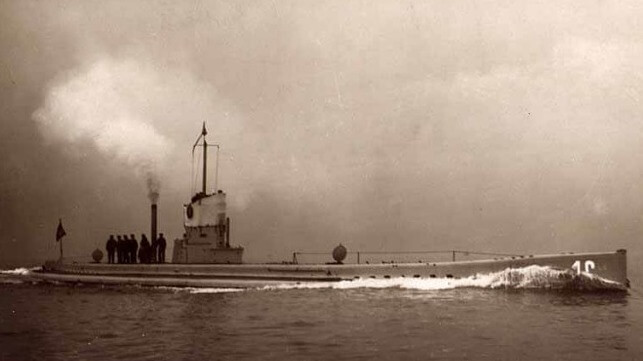
U-16 in the prewar period (public domain)

Published Sep 2, 2025 11:07 PM by The Maritime Executive


After a challenging salvage operation, the Dutch crane vessel Matador 3 has raised part of the German WWI-era submarine U16 from the waters off Germany's North Sea coast. It is unusual for a wreck of this vintage to be raised to the surface, but despite its rarity, the salvors do not have plans to preserve it.

U16 was built in 1911 and fought throughout World War I, sinking nearly 30 vessels and surviving about one dozen combat patrols. The vessel went down in 1919 off the coast of Scharhorn, a German-administered island at the mouth of the Elbe. At the time of the sub's loss, it was under way on  a delivery voyage to Britain, where it was to be handed over as part of Germany's postwar reparations. All crewmembers are believed to have survived the sinking. (A local historian, Jann M. Witt, told Tageblatt that it is likely that they scuttled their sub rather than hand it over to the British; another German sub met with the same fate earlier that year.) 

The wreck stayed at the bottom of the North Sea for more than 100 years before the decision was made to remove it. It has been surveyed more than once, and the latest visit was in 2023, when a vessel of the Federal Maritime and Hydrographic Agency (BSH) passed over the site. The sub's wreckage is within the Elbe federal waterway, according to NDR, and belongs to the Federal Directorate of Waterways and Shipping (WSV). It is not considered a protected war grave for legal purposes.  

The wreck's other half sits at a depth of about 60 feet of water, and is slated for removal this week, weather permitting. The wreckage itself is likely headed for demolition, despite the WSV's early attempts to find a new home for it. Parts of the sub may be preserved by German museums, but none have stepped forward to take the entirety of the wreck, NDR reports.