Thursday, September 11, 2025

Teck-Anglo deal could boost Canadian critical mineral output: experts


By The Canadian Press
September 11, 2025 

Teck's zinc and lead smelting and refining complex, left, is pictured in Trail, B.C.
THE CANADIAN PRESS/Darryl Dyck

TORONTO — Experts say the proposed merger between Teck Resources Ltd. and Anglo American PLC to create a $70 billion, critical minerals-focused giant could help Canada’s efforts to boost production of the metals that are key to the energy transition.

John Steen, director of the Bradshaw Research Institute for Minerals and Mining at UBC, says the size of the combined company could help it move faster to develop mines than Teck could alone.

Teck and U.K.-based Anglo American have also committed to spend $4.5 billion in Canada over five years as part of its pitch to regulators for the deal, with a focus on the critical minerals space that the federal government has made a priority.

A good chunk of that spending is already committed by Teck, including upwards of $2.4 billion to extend the life of its Highland Valley Copper mine, but the companies say they will also spend on exploration as well as development in areas like B.C.’s Golden Triangle.

Steen says having what would be the world’s fifth-biggest copper producer be based in Vancouver would especially help efforts to produce more of the metal that will “make or break” the energy transition.

He says the potential for the combined company to add to copper processing capacity at Teck’s smelter in Trail, B.C., is notable as Canada has a shortage of critical minerals processing capacity, but that the company’s talk of supporting new processing facilities seems like a longer-term prospect given the difficulty of building them.

This report by The Canadian Press was first published Sept. 11, 2025.

Anglo’s go-to banker drives Teck deal after seeing off BHP
Stock image.

Centerview Partners LLC banker James Hartop has his own badge to get into Anglo American Plc’s headquarters near London’s diamond district. Rival advisers wait to be called in. It’s a symbol of the dealmaker’s bond with the century-old miner, and his crucial role in protecting it – most recently just last year when BHP Group made a $49 billion bid for its smaller rival.

That relationship meant that Hartop took the lead for Anglo as it negotiated with the Canadian miner Teck Resources Ltd., according to people with knowledge of the negotiations. The deal, which would create a $50 billion copper giant, is one of the largest in the sector in years.

Over three decades, the 51-year-old has become Anglo’s go-to banker for advice in an industry with a constant backbeat of mergers, takeovers and restructurings. This kind of connection has become rare, as the business of advising on large M&A has become increasingly commoditized. But Hartop’s long-term association with the miner has given him, and Centerview, access to a mandate that several bankers with knowledge of the situation say is one of the most lucrative jobs in the mining industry.

This story is based on conversations with current and former employees of Anglo American, and other advisers and bankers who asked not to be identified in order to discuss sensitive information.

Centerview, Hartop and Anglo American declined to comment.

Hartop’s association with Anglo American started when he joined SG Warburg — which subsequently became part of UBS Group AG — as an M&A banker in 1995, following an internship at the firm. An Oxford theology graduate, he quickly moved up the ranks as a young banker who showed enthusiasm and a level of maturity beyond his age, according to one person who worked with him during that period.

Anglo American was one of UBS’s key clients at the time, and Hartop was brought into work on the firm’s sprawling global business, which spanned multiple geographies and had copper, gold, platinum and nickel assets, among others. In 1998, he lived in Johannesburg for six months as he worked to get a deal to consolidate eight gold mining companies into AngloGold over the line.

In 2009, Hartop helped ensure that a £41 billion ($66.7 billion) merger proposal from Xstrata Plc was left – according to the company — “dead and buried.”

He advised Anglo on the spinoff of packaging business Mondi Plc in 2007, the purchase of a controlling stake in De Beers Plc in 2012, and the sale of a minority stake in Anglo American Sur SA to a consortium led by Mitsui & Co Ltd. in the same year.
One mining banker at a rival firm said the ties between Hartop and Anglo were so strong that if he saw Anglo run a sell-side process without Hartop’s involvement, he thought the company wasn’t serious about a sale.

These deals propelled Hartop’s near two-decade career at UBS. He went on to become the co-head of European investment banking at the Swiss lender and was named the head of its coverage and advisory business for Europe, Middle East and Africa before leaving to join Centerview. The boutique advisory firm was cofounded by a former UBS colleague, Blair Effron, in 2006.

UBS’s advisory work with Anglo American dropped off after Hartop’s departure, according to data compiled by Bloomberg. In 2024, The bank worked as an adviser to BHP in its approach to Anglo, along with Barclays Plc.

When that bid was made, one of the first people Anglo called in was Hartop.

Anglo had suffered a series of major setbacks. Prices for some key products had plunged and operational difficulties had forced it to cut production targets, driving down its valuation and leaving the company vulnerable to potential bidders. BHP planned to break it up.

Along with counterparts at Goldman Sachs Group Inc. and Morgan Stanley, Hartop helped devise a turnaround at Anglo, which included exiting coal, diamonds and platinum and slowing down spending on a massive UK fertilizer mine. BHP eventually walked away last May after a five-week battle.

Since then, Hartop has been heavily involved in the simplification of Anglo, working on the demerger of its platinum business and an attempt to sell its steelmaking coal business to Peabody Energy, which was scrapped in August.

Discussions between Anglo and Teck started around a year ago, according to people familiar with the matter, and gained momentum a few months ago. On Anglo’s side of the table, Hartop was ever-present, the people said.

Outside of his mining work, Hartop has worked on some of the world’s largest M&A deals globally since joining Centerview — including Anheuser-Busch InBev’s purchase of SAB Miller for about $104 billion in 2016 and AstraZeneca Plc’s acquisition of Alexion Pharmaceuticals Inc. for $39 billion. Among his key clients is DSM-Firmenich.

Centerview ranks eighth among advisers on M&A deals announced this year with an 8% market share, ahead of rival boutiques, including Lazard Ltd. and Rothschild & Co., according to data compiled by Bloomberg. They have had a role on $226 billion of transactions, the data show. Centerview were the main adviser on the recent breakup of Kraft Heinz, and Sycamore Partners’ acquisition of Walgreen Boots Alliance in March.

People who have worked with Hartop describe him as unassuming, easy to deal with and straight to the point. He’s developed a strong rapport with the current Anglo CEO Duncan Wanblad, just as he did with previous leaders of the firm.

New CEOs often bring with them existing relationships with key advisers, but Hartop appears to have proved himself too valuable to Anglo. He’s been a constant even as five CEOs – Julien Ogilvie Thomson, Tony Trahar, Cynthia Carroll, Mark Cutifani and now Wanblad – have gone through the top office since he started working with Anglo.

The agreement with Teck doesn’t mean that Hartop’s job is done. There is still a chance that another bidder could attempt to derail the deal by coming in with an offer for Teck. And BHP, or another large miner, could still come back to make a bid for Anglo, meaning once again it will need someone to head up its defense.

(By Dinesh Nair and Thomas Biesheuvel)


Anglo-Teck Vancouver headquarters is a ‘perpetual’ commitment

Downtown Vancouver, British Columbia. Stock image.

Anglo American Plc and Teck Resources Ltd.’s plan to headquarter their merged company in Canada is “a perpetual commitment,” according to Teck chief executive officer Jonathan Price.

“The commitment that we are making to Canada and the presence of the global headquarters of Anglo Tech in Canada is an enduring commitment,” Price told BNN Bloomberg Television on Wednesday.

An agreement by UK-based Anglo to acquire Canada’s Teck in one of the biggest mining deals in over a decade will need regulatory approval in countries including Canada. Last year, Canada said it would only approve foreign takeovers of large mining companies involved in critical minerals production “in the most exceptional of circumstances.”

Establishing the global headquarters in Vancouver, with the presence of most senior executives, “is a great thing for the country,” Price said.

Asked if a string of setbacks at Teck’s copper mine in Chile was a driver for the transaction, Price said “we’re fully confident that we’ll overcome those challenges.”

“The reason for doing this transaction now is that these opportunities don’t come along very often,” he said. “When you see them, you have to seize them.”

If approved by regulators, the acquisition is expected to close in 12 to 18 months.

The two companies are speaking to investors all over the world, explaining the “incredible upside” and gathering feedback, Price said. While those conversations are very preliminary, “there is real recognition here for the industrial logic of this and the quality of the business we are creating.”

(By James Attwood)


Anglo American’s £36 Billion Merger With Teck Marks Blow to UK Business

  • Anglo American and Teck will merge in a $50bn deal, forming Anglo Teck with headquarters in Vancouver but retaining a London listing.

  • The merger will concentrate around 70% of the company’s portfolio in copper, alongside iron ore and zinc, while issuing a $4.5bn dividend to Anglo shareholders.
  • The move drew sharp criticism from UK opposition figures as a blow to London’s global business standing, though executives touted growth in critical minerals.

Anglo American will merge with Canada’s Teck Resources in a $50bn (£36bn) deal, shifting its headquarters to Canada and reducing its London presence in a move criticised by shadow business secretary Andrew Griffith. The Tory MP said it represents a blow to UK business and confidence in London.

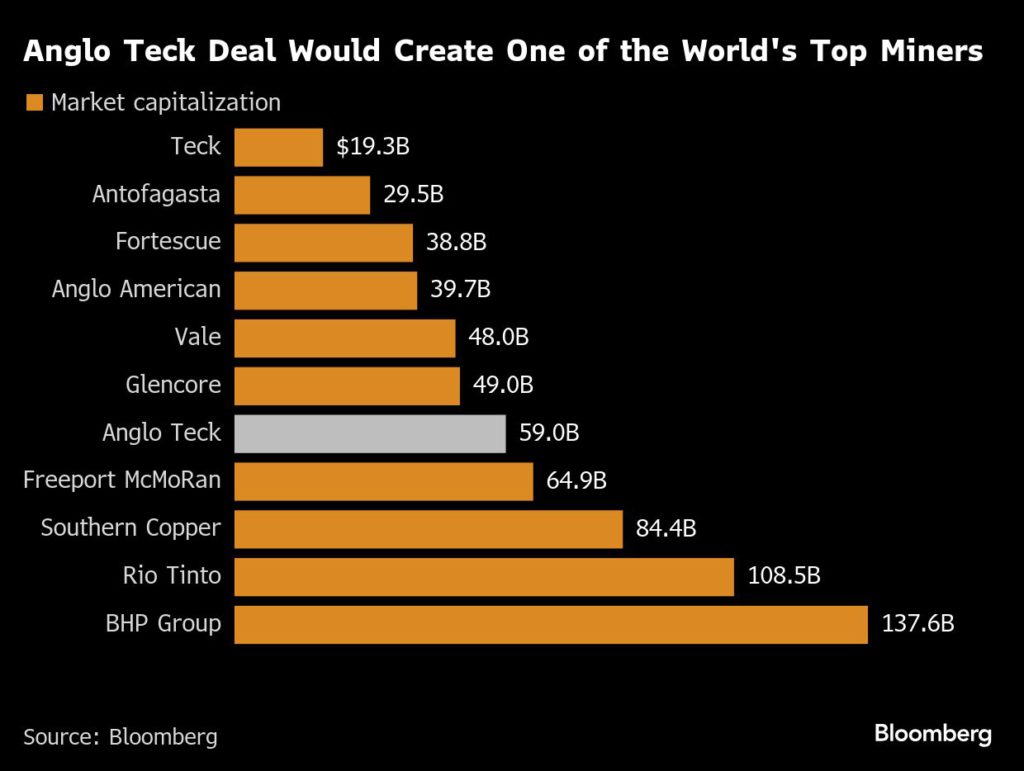
The new entity, to be called Anglo Teck, is expected to have roughly 70 per cent exposure to copper, as well as premium iron ore and zinc. Under the terms of the deal, Anglo will own 62.4 per cent of the combined group, with Teck shareholders owning the rest.

Anglo American’s share price rocketed up 7.75 per cent in early morning trading to £24.55, in response to the news.

HQ relocates to Canada

The company will be headquartered in Vancouver, but will retain its primary London listing with secondary listings in Johannesburg, Toronto and New York.

However, as a result, Anglo American’s London office, which employs up to 700 people, will be significantly downsized.

The merged company will be led by Anglo American chief executive Duncan Wanblad, while Teck chief executive Johnathan Price will move to the role of deputy CEO. However, the CEO, deputy CEO, CFO, and a “significant majority” of the executive management team will also be based in and reside in Canada.

Andrew Griffith told City AM, “If we want the UK to be the best place in the world to do business, Labour must wake up fast.”

He said: This is a clear signal that companies and investors are losing confidence in the UK and voting with their feet.”

“Taxing and regulating businesses into submission will not bring growth; it drives them away. What businesses need instead is a government that champions wealth creation and investment, not one that undermines our competitiveness.”

The fact that a historic British mining giant is moving its headquarters to Canada is yet another signal of decline under Labour,” the shadow business secretary added.

The deal, revealed to its shareholders on Tuesday, follows both companies rejecting takeover approaches from larger rivals, including BHP’s failed £39bn pursuit of Anglo in 2024.

Wanblad said: “Together, we are propelling Anglo Teck to the forefront of our industry in terms of value accretive growth in responsibly produced critical minerals.”

Price added: “This transaction will create significant economic opportunity in Canada, while positioning Anglo Teck to deliver sustainable, long-term value for shareholders.”

Shareholder decisions and dividends

The companies said the shareholder vote for the deal would take place in the coming months, and if approved, antitrust approval could take an additional 12 to 18 months.

Anglo will issue 1.33 shares to existing Teck investors for each share they hold in the company.

The London company is also set to issue a special $4.5bn dividend to its own shareholders ahead of the merger.

The merger is expected to generate annual cost savings and efficiency gains of $800m by the fourth year after completion.

Commenting on the deal, AJ Bell investment director Russ Mould said: ““It now remains to be seen whether it can complete the restructuring of its own business and then whether Anglo Teck delivers on its operational and financial targets, but at least the lowly valuation means there could be upside in the newly-formed company’s share price if it does so, all other things being equal and providing commodity prices do not nose dive in the meantime.”

By CityAM


BHP seen as unlikely to pounce on Anglo or Teck
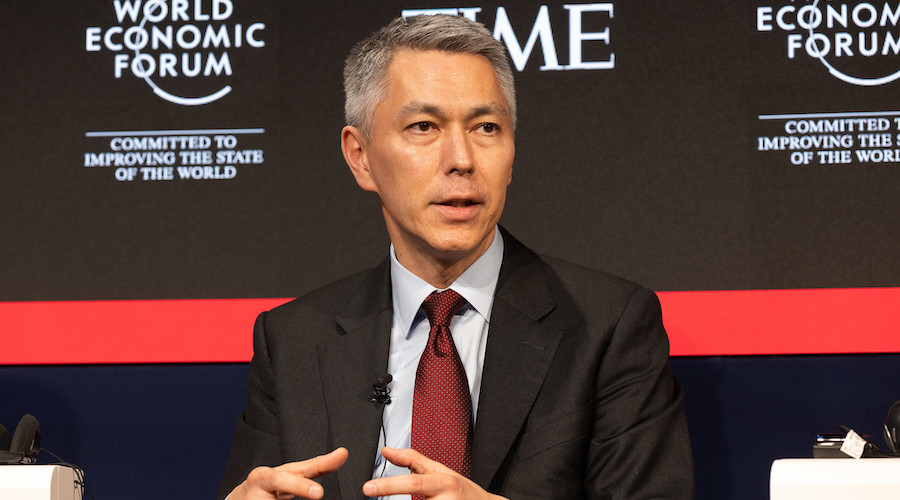
Mike Henry, chief executive officer of BHP Group. (Image by the World Economic Forum, Flickr.)

Top global miner BHP’s focus on expanding its own copper assets while it undergoes leadership change means it is unlikely to gatecrash the planned $53 billion tie-up of Anglo American and Teck Resources, investors and bankers said on Wednesday.

London-listed Anglo American and Canada’s Teck Resources announced a merger on Tuesday, marking the sector’s second-biggest tie-up ever, to forge a new global copper-focused heavyweight.

The deal came just over a year after BHP scrapped a $49 billion bid for Anglo that in one mega acquisition would have beefed up the Australian miner’s holding in the metal seen as essential to the energy transition.

After being rebuffed by Anglo three times, BHP opted instead to double down on a series of smaller projects where it sees better value, a strategy that investors said has been consistent and suggests it is unlikely to make a move on Anglo or Teck.

“Given BHP’s message, ‘We have moved on,’ any move by BHP for either of the companies would come as a surprise,” said Andy Forster, a portfolio manager at Argo Investments in Sydney, which holds BHP shares.

In the past year, BHP instead spent $2 billion for a stake with Canada’s Lundin in two Argentinian copper projects, including the Josemaria mine whose life was last month extended by six years. It has also pushed hard to eke out production gains at top copper mine Escondida in Chile.

BHP declined to comment on whether it might spoil the Anglo-Teck deal but pointed Reuters to recent comments by its chief executive saying that M&A was just one lever of many for growth.

“Frankly in current markets, it’s hard to see the right combination of the commodities that we like, the asset quality that we like, at a price where we can still unlock attractive value for BHP shareholders,” CEO Mike Henry said on a results call in August.

Despite its recent failure to offload its Australian coal assets, Anglo has worked hard to improve its share price from a year ago, one M&A banker said.

“Both miners are in play now. Anglo’s share price is up, they could probably put in a good defence like they did last time,” he said. Shares in Anglo have jumped 20% since before BHP’s bid in late April while BHP shares have dropped 8%.

The deal was smart in that several factors were favourable to Canada in a way that would be difficult to replicate for other majors who might want to buy Teck, such as relocating the new company’s headquarters to Canada, two people said.

Among the conditions for approving BHP’s merger with South Africa’s Billiton in 2001, the Australian government mandated that the holding company be headquartered in Australia.

Succession may be another stumbling block. BHP chair Ross McEwan replaced Ken MacKenzie in March, after the latter’s decade at the wheel, while CEO Henry is more than five years into a typical six-year term, meaning that BHP may be focused for now on replacing him rather than on big ticket M&A.

But bankers aren’t ruling out the possibility of BHP swooping in down the track, especially if the deal doesn’t go to plan.

“You’d have to have a serious think about it – the two most obvious targets in a nil premium deal,” said an M&A banker not directly involved in the deal, which the parties expect to take 12 to 18 months to complete.

“They have got time … A deal doesn’t have to be done tomorrow.”

(By Melanie Burton; Editing by Sonali Paul)


Panama to weigh First Quantum copper mine restart by early 2026

Cobre Panama mine was First Quantum Minerals’ largest copper operation. (Image courtesy of Cobre Panama.)

Panama is preparing to open talks with First Quantum Minerals (TSX: FM) on the possible restart of its shuttered Cobre Panamá copper mine, with discussions expected to begin late this year or in early 2026.

Commerce Minister Julio Moltó confirmed that a comprehensive environmental audit of the mine will start in the coming weeks. The review, conducted by SGS Panama Control Services, will assess environmental, social and economic impacts, including employment opportunities for Panamanians.

The mine has been closed since November 2023, after Panama’s Supreme Court declared its operating contract illegal. Moltó told local newspaper El Capital Financiero that the audit should take three to four months to complete. Once results are in, the government will begin talks with First Quantum.

President José Raúl Mulino has identified the reopening of Cobre Panamá as a top priority for his administration, following reforms to the country’s Social Security Fund pension system.

Minera Panamá, First Quantum’s subsidiary, and other companies tied to the project have suspended international arbitration proceedings against the government, clearing the way for talks.

Economic pillar

Before its closure, Cobre Panamá ranked among the world’s largest copper producers, yielding 350,000 tonnes in 2022, its final full year of operations. The mine contributed about 5% of Panama’s GDP, and First Quantum estimates the suspension has cost the country up to $1.7 billion in lost economic activity.

Mine workers, contractors, unions and nearby communities have publicly called for a restart, citing its economic importance. The government, however, has stressed that the audit must come first before any decision on reopening. 

First Quantum has maintained the facility to ensure it can resume operations if an agreement is reached.


Fatalities rise among gold miners in 2024, Metals Focus reports

Credit: Adobe Stock

Fatalities reported by gold mining companies rose last year, reversing a recent downward trend, according to a report published by precious metals consultancy, Metals Focus on Thursday.

Eight out of the 14 companies in the report recorded a combined 27 fatalities at mine sites in 2024, up from 24 in 2023.

Mining remains an inherently hazardous industry, with workers facing long-term health issues from noise, vibration and airborne particulates, Metals Focus noted in the report.

“More than half occurred in underground operations in Africa, where seismic and fall of ground incidents are more common due to the deep level nature of South African mining,” the report added.

However, six companies maintained zero fatality records, with Northern Star extending its fatality-free record to 11 years, while B2Gold marked nine years.

(Reporting by Anushree Mukherjee in Bengaluru; Editing by Alexandra Hudson)


Zambia backs Chinese mine’s assessment in acid spill disaster

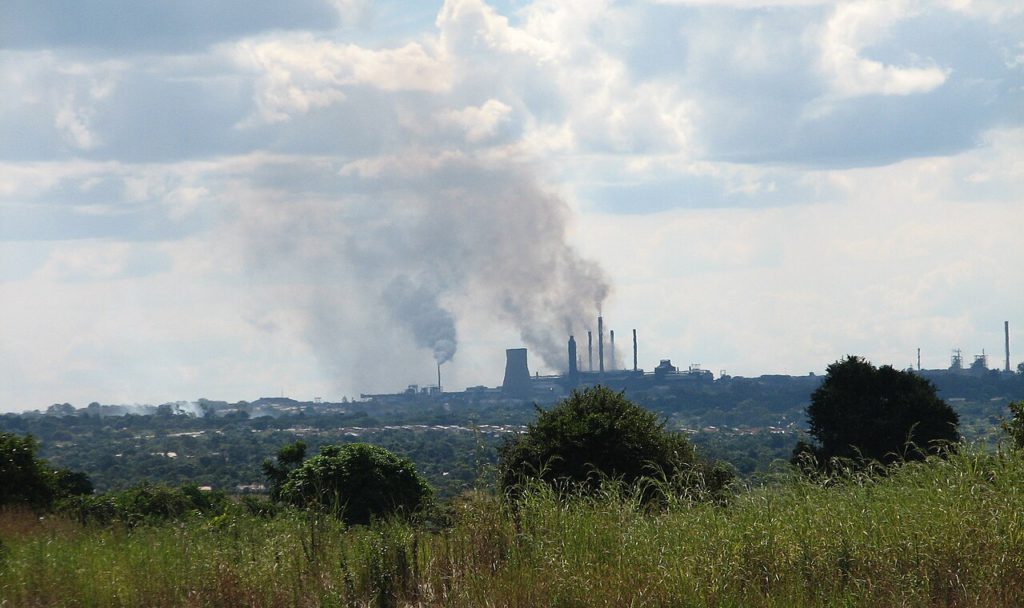
Kitwe, Zambia. Credit: Per Arne Wilson, Norway | Wikimedia Commons, under licence CC BY-SA 3.0

The Zambian government refuted an independent estimate of how much toxic acid spilled from a Chinese state-owned copper mine in the southern African nation in February, and said a cleanup had begun.

Responding to allegations that the disaster may have been 30-times worse than earlier reported, acting Minister of Green Economy and Environment Collins Nzovu backed Sino Metals Leach Zambia Ltd.’s estimate of the spillage volume. He said the government wasn’t trying to cover up the issue and the company has started operations to clean up the waste.

“Based on the records that we have, the estimated amount of the acid waste that was released in the open environment was 51,800 cubic meters (13.7 million gallons),” Nzovu said in a statement on Wednesday. That’s a fraction of what Drizit Zambia had estimated after it was contracted to conduct an environmental assessment. He added that the tailings — or waste — dams “are physical features which no one can hide.”

The disaster has raised concerns among residents in the affected area near Kitwe, Zambia’s second-biggest city, and triggered health warnings from embassies including the US and Finland. While the government has maintained that drinking water is safe for humans, it said last month it found dangerous levels of heavy metals in some samples from natural water bodies.

Sino Metals, in a statement last week, also refuted Drizit’s assessment that as much as 1.5 million tons of toxic material escaped, saying the estimate was “misleading and devoid of factual, scientific and technical basis.”

Sino Metals has begun removing visible pollution, and residue from an area stretching 8 kilometers (5 miles) from “ground zero,” or the point where the waste dam burst, Nzovu said.

Drizit Zambia, which Sino Metals hired to conduct the environmental assessment before terminating its contract, had warned that the communities living nearby faced daily exposure to hazardous materials, including arsenic, cyanide and uranium. Drizit said on Wednesday that it stands by its assessment.

Zambia will select a new environmental impact assessor by Sept. 15, and the company should start work by the third week of the month, Nzovu said.

“Sino Metals has been making all-out efforts to cooperate with the Zambian government in dealing with the tailings dam breach,” the Chinese embassy in Lusaka said in reply to questions. “We oppose any irresponsible and exaggerated narratives based on fabricated figures or ill-intended smear campaigns for geopolitical gains.”

(By Matthew Hill and Taonga Mitimingi)


Barrick executive switches sides to advise Mali president in gold dispute

Tongon gold mine – Côte d’Ivoire Image courtesy of Randgold Resources

A senior Barrick Mining executive who had been representing the company in tense negotiations with Mali’s government has switched sides to become an adviser to Mali’s president, a mines ministry official told Reuters on Wednesday.

Hilaire Diarra was general manager of Barrick’s Tongon gold mine in Ivory Coast before he was named special counsellor to Mali’s president in a decree signed in late August and seen by Reuters this week.

The mines ministry official confirmed the document’s authenticity on Wednesday.

The move represents a further blow to the Canadian mining company’s efforts to negotiate for control of its Loulo-Gounkoto gold mining complex, one of the most high-profile examples of resource nationalism among West African military governments seeking greater control over their gold and uranium wealth.

Diarra and a Barrick spokesperson did not respond immediately to requests for comment.

Mali’s government has been negotiating with Barrick since 2023 over the implementation of a new mining code that raises taxes and gives the government a greater share of its gold mines. It has previously enlisted former senior Barrick executives to try to outmanoeuvre the company.

A Malian court-appointed provisional administrator took control of the Loulo-Gounkoto site in June, six months after Barrick suspended operations there when negotiations reached an impasse. Former Barrick executive Samba Toure is now a member of the provisional administration running operations at the complex.

Loulo-Gounkoto produced 578,000 ounces of gold in 2024, Barrick’s financial statements show. Since the provisional administrator took control, it has sold 1 metric ton of gold, or about 35,274 ounces. Current production levels are about 25% of normal output, said a source close to the matter.

Diarra, a Malian citizen who began his career at the Loulo mine, had flown to Bamako from Ivory Coast this year to negotiate on behalf of the Canadian miner, the same source and two other people said.

(By Portia Crowe and Divya Rajagopal; Editing by Robbie Corey-Boulet, Veronica Brown and David Goodman)

GUINEA

Rio Tinto, partners score major tax break on Simandou


Ore from the Simandou mountains will be shipped overseas. (Image courtesy of Rio Tinto.)

Rio Tinto (ASX, LON: RIO) and its partners in Guinea’s Simandou iron ore project have reportedly secured corporate tax concessions worth more than half off the standard rate for key parts of their $23.5 -billion development, regulatory filings show.

Guinea’s ruling junta has approved a 15% corporate tax rate for the first 17 years of operations at the railway and port that will transport Simandou ore to global markets, the Australian Financial Review reports. That is well below Guinea’s usual 35% rate and less than half the 30% paid by major firms in Australia.

News of the deal come just days after the government signalled Rio Tinto may be required to build a local refinery for the mine, which is designed to produce 120 million tonnes of iron ore annually and ship its first cargo in November.

Rio disclosed its earlier tax agreements with Guinea’s former government in 2014, which included an eight-year tax holiday followed by a 30% rate. The company has not published the revised terms negotiated with the current junta.

Rival partners Winning and Baowu, which control blocks 1 and 2 of Simandou, filed documents in Singapore outlining the incentives for infrastructure they co-own with Rio Tinto, first offered to them in August 2023. The filings indicate the Rio-led consortium will still pay some tax during the first eight years of mining, though the structure remains unclear. Rio has declined to comment.

TransGuinean company

The documents submitted by Winning and Baowu suggest the tax rate for the railway and port companies will remain at 15% for 17 years, then rise to 25%, still below Guinea’s statutory 35%.

Rio’s consortium, which includes four Chinese partners, holds a 42.5% stake in La Compagnie du TransGuinéen (CTG), the entity managing the 600-kilometre railway and deep-water port on Guinea’s Atlantic coast. CTG was incorporated in March 2022.

Rio Tinto, partners score major tax break on Simandou
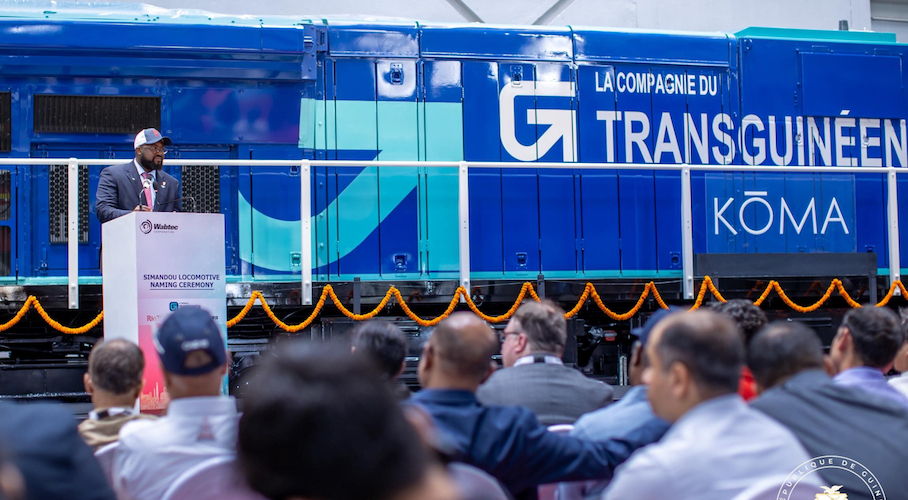
Simandou locomotive. (Image courtesy of Government of Guinea.)

Rio Tinto first secured an exploration license for Simandou in 1997. Since then, the project has weathered two coups, four heads of state, and three presidential elections. Development is now advancing, with Rio set to operate one of the project’s two mines.


Remembering 9/11: Lt. Michael Day and the Lower Manhattan Boatlift


Published Sep 10, 2025 9:01 PM by U.S. Coast Guard News


On September 11, 2001, Lieutenant Michael Day was working at Coast Guard Activities New York preparing to leave for a meeting at Tower One of the World Trade Center when the command center alert came in. A plane had hit one of the World Trade Center towers. Then another hit.

“We were unable to get any reports from lower Manhattan since all the communications systems failed. It was chaotic. People from multiple agencies were responding to the scene without any unity of purpose,” he said. “There wasn’t a pre-planned response; there was no CONOP for how to respond to two planes crashing into the Towers.”

Not having a specific response plan for this situation, Day grabbed the closest thing he could think of to help – the OPSAIL 2000 plan.

“I knew it had a lot of ambulance staging areas. We had a lot of evacuation points identified. Although it wasn’t necessarily a full-scale evacuation plan, it had information,” he said.

As Day rushed out the door to head to the waterfront, Andrew McGovern, pilot of the 100-foot pilot boat NEW YORK, showed up for the meeting. They grabbed a bunch of extra lifejackets, the OPSAIL plan, a Coast Guard Ensign and headed for the pilot boat.

“I remember listening to the radio because by this time we were underway on the boat and it was just… chaos. Every channel you clicked to people were screaming, ‘Help, people are here… I’ve got someone hurt here’,” he said.

With a front row seat to the collapsing buildings, frightened people and distressing devastation, Day only momentarily worried about his own safety. With thousands of citizens needing help, he didn’t have time to stop and think about what was happening.

Despite poor radio communication and unreliable cellular reception, Day began dispatching Coast Guardsmen with handheld radios to the piers to help coordinate a more organized evacuation effort. Meanwhile, he hoisted the Coast Guard Ensign on the pilot boat and began broadcasting to all available boats willing to help with the evacuation to assemble off the tip of Governors Island and await further assignment.

New Yorkers rushed to the Lower Manhattan water front to try to escape the collapse of the World Trade Center towers September 11. They were later evacuated by ferries and tugboats from all over New York harbor. (USCG photo by Chief Brandon Brewer)

The process of transporting the crowds of people from Manhattan to safety, one boat load at a time, continued into the evening. With the pilot boat docked in lower Manhattan, still flying the Coast Guard Ensign, first responders began asking them for help.

Establishing communications with the New Jersey Office of Emergency Management, he was able to start getting some supplies brought over to the pier… first water, then ice and meals. Soon, more specific items like tools, equipment and fuel began to arrive.

“We were quickly overrun with relief supplies,” he said. “It was just such a ‘can do’ effort. Everyone wanted to help.”

In what he called, “hands-on VTS,” Day and a Chief Boatswain’s Mate managed the hundreds of vessels bringing supplies to the pier.

“We set up three different staging areas because the supplies were coming in so fast and furious that we were running out of room, and we couldn’t distribute them fast enough,” he added.

The pure scope of the event and lack of communication with his superiors meant making decisions wasn’t always easy for Day, nor were his actions always by the book, but he looks at the response as great example of initiative and teamwork. Getting more than one hundred boats and dozens of response crews to work together cohesively is not an easy task. But for Day, it just sort of happened under what he describes as a “common purpose.”

A Coast Guard rescue team from Sandy Hook, NJ, races to the scene of the World Trade Center terrorist attack. (USCG photo by PA2 Tom Sperduto)

Day also learned valuable leadership lessons.

“One is the value of partnering and partnerships, and building your bridges before you need them,” he said. “Two, making your people feel empowered. I really felt when I worked for Admiral Bennis that I was totally empowered to do the right thing. And three, to have faith in your people and the power of the concept of unity of purpose.”

After four days of responding with only about three hours of sleep total, Day finally had some time to reflect on what had happened.

“And it’s when I had quiet time, you know, a little bit alone to myself that it really, really struck home,” he said. “I think being in the Coast Guard we kind of shut things off at times of stress; it’s like a defense mechanism.”

This article originally appeared in Coast Guard Compass and may be found in archived form here

The opinions expressed herein are the author's and not necessarily those of The Maritime Executive.


\


AAPA Continues Push to Expand Counter-UAS Authorities

Unmanned Aircraft Systems 

American Association of Port Authorities (AAPA)

Published Sep 10, 2025 5:16 PM by The Maritime Executive


[By: American Association of Port Authorities]

The American Association of Port Authorities (AAPA) sent a letter last week to House Transportation and Infrastructure (T&I) Committee leaders, urging bipartisan action to expand federal counter-unmanned aircraft systems (C-UAS) authorities and to ensure seaports are explicitly eligible for any pilot program. The letter was addressed to Chairman Sam Graves (R-MO), Aviation Subcommittee Chairman Troy Nehls (R-TX), and Ranking Member Rick Larsen (D-WA).

In the letter, AAPA President and CEO Cary S. Davis wrote, "Understanding that implementation will rely on partnership with SLTT law enforcement, we respectfully request that seaports be explicitly recognized as potential sites for pilot deployment, especially given their DHS-designated status as critical infrastructure."

Ports facilitate over 70 percent of U.S. trade and sustain more than 31 million jobs. Still, they face increasing threats from unauthorized drones flying over hazardous storage areas, sensitive perimeters, and critical operations. Several ports have reported incidents that disrupted activity and posed safety risks. Despite these threats, ports lack the legal authority and technical resources to respond in real-time.

In the letter, AAPA:

  • Expressed strong support for bipartisan counter-UAS legislation, including the reintroduction of the Counter-UAS Authority Security, Safety, and Reauthorization Act.
  • Called for explicit inclusion of seaports in the pilot program, consistent with their DHS-designated status as critical infrastructure and aligned with Executive Order 14305 on protecting U.S. airspace.
  • Encouraged legislative clarity, distinguishing detection technologies from active mitigation, enabling ports to develop lawful layered defense strategies.

AAPA is actively engaged with Congress, in coordination with its Security Committee and Board of Directors, to ensure ports are recognized as critical partners in national airspace security. The letter received positive feedback from professional staff, who noted the importance of industry support and clear operational use cases as the bill text is refined.

AAPA will continue to advocate that ports be included in any expanded pilot program and provide technical assistance to policymakers shaping this legislation.

Read the full letter from AAPA here.

The products and services herein described in this press release are not endorsed by The Maritime Executive.