Lessons From Burkina Faso’s Fight Against Al-Qaeda And The Islamic State – Analysis
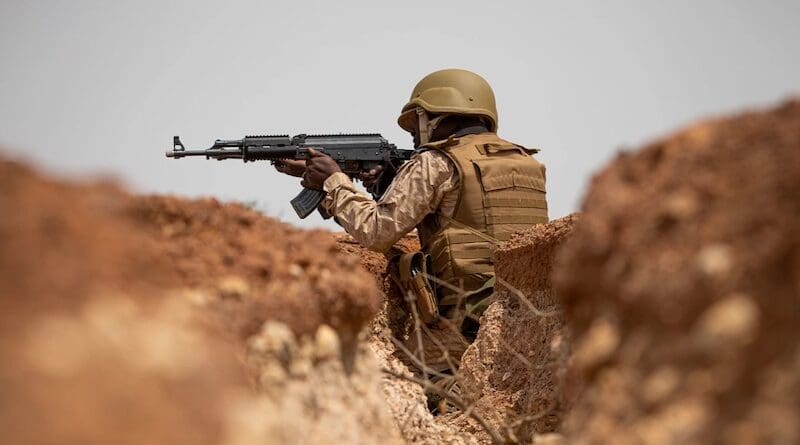
A Burkina Faso soldier. Photo Credit: Sgt. Steven Lewis, U.S. Africa Command
By Published by the Foreign Policy Research Institute
By Michael DeAngelo
Introduction
(FPRI) — Jihadist insurgencies in Burkina Faso began in 2016-2017 and have escalated dramatically since 2019. Between 2018 and 2024, jihadists killed more than 25,000 people. From 2022 to 2023, fatalities attributed to terrorism increased by 68 percent, making Burkina Faso the country most impacted by terrorism in the world on the 2024 Global Terrorism Index.
Ansarul Islam is the primary jihadist group. It was founded by Ibrahim Dicko and has been led by his brother, Jafar Dicko, since Ibrahim’s death in 2017. Dicko started Ansarul Islam’s insurgency after fighting in the Malian civil war for what is now al-Qaeda-aligned Jama’at Nusrat al-Islam wal-Muslimin (Support Group for Islam and Muslims or JNIM). Ansarul Islam has always been closely affiliated with JNIM, as they share resources and training and conduct operations together. Its insurgency can be viewed as the Burkina Faso theater of JNIM’s larger West African insurgency in Mali, Niger, Benin, and Togo.
Dicko took advantage of the instability caused by the Malian civil war and the subsequent deployment of security forces to Burkina Faso’s northern border with Mali. His message was tailored to marginalized groups, railing against state corruption, economic mismanagement, and security force abuses. It was particularly relevant to Dicko’s ethnic group, the Fulani, which is a heavily Muslim, pastoralist minority in Burkina Faso but a majority in some northern provinces. This includes Soum Province, which is Ansarul Islam’s birthplace. Due to their reliance on livestock herding, the Fulani often have land disputes with the agricultural majority Mossi ethnic group. State preference of the Mossi helps fuel Fulani grievances, which are then exploited by Ansarul Islam.
Islamic State-Sahel Province (ISSP) is the other notable jihadist group waging an insurgency in Burkina Faso. JNIM splinter groups in Mali and Niger formed ISSP to recognize Islamic State leader Abu Bakr al-Baghdadi’s declaration of a caliphate in Iraq and Syria. It exploits similar grievances as JNIM, including those held by the Fulani. JNIM and ISSP have the same goals—rooting out foreign, secular influence and establishing an Islamist state—but use slightly different tactics. JNIM mostly targets security forces, co-optslocal groups, and gradually implements Islamic law; ISSP is more likely to target civilians, coercing them into abiding by its extreme interpretation of Islamic law. Whereas JNIM operates in northern, western, eastern, and central Burkina Faso, ISSP is mostly confined to the northern Sahel region. However, they are more similar than different; both are seeking to supplant Burkina Faso’s government and impose their Islamist worldview on civilians by any means necessary.
The state’s inadequate presence in rural areas, where approximately 70 percent of its 20.3 million residents live, has allowed jihadists to make inroads in local communities. They exert some level of control over approximately 50 percent of its territory. Because the state is viewed as ineffective and even ill-intentioned, jihadists take advantage of the situation to provide security and governance. They have established justice systems and mediated disputes between local factions. Their gains have contributed to the poor morale of security forces, who have borne the brunt of the fighting and suffered increasing losses. As a result, the military used the worsening security situation to justify two coups in 2022. Despite the ruling junta’s focus on the insurgencies, jihadists are besieging and isolating urban areas closer to the capital, Ouagadougou. They are forcing populations to capitulate to their control. Thus, the state views the insurgencies as an existential threat.

Creation of the Volunteers for the Defense of the Homeland (VDP)
After Burkina Faso’s worst year of jihadist violence to that point, the state established the VDP in early 2020. Self-defense militias, some of which were based along ethnic lines, already existed to protect communities beyond the state’s purview. The VDP was intended to help overburdened security forces by subsuming preexisting militias and mobilizing new forces under state control. The state hoped to addressmanpower shortages, unite armed factions, and mobilize the civilian population against the insurgencies. The goal was to contest jihadists in afflicted areas, particularly in the northern provinces, without relying solely on the overstretched military.
The current government has placed the VDP at the center of its counterinsurgency strategy, aiming for a significant presence in every district of the country. While democratically elected President Roch Kabore (2015–2022) set a recruitment goal of 13,000 militiamen, the subsequent juntas vowed to boost recruitment. Current junta leader Ibrahim Traore has accomplished this, as estimates indicate there are now more than 50,000 militiamen. At their inception, VDP units were mostly concentrated in the northern provinces, but they now operate across the country.
The VDP’s mission is to recruit, train, arm, and deploy civilians to help the military protect their communities from jihadists. Militiamen have been split into two categories: national and local. National VDP are placed in military units to serve as a quick augmenter, directly assisting without going through the lengthier enlisting and training process. Many of these militiamen eventually become formal soldiers, making the national VDP an important recruiting tool as well. Local VDP defend their communities by patrolling territory and securing infrastructure with the police. They can also use their local ties to gather intelligence on jihadist activity. Both national and local VDP are economical means to raise the forces seemingly required to combat jihadist insurgencies.
The VDP is intended to be open to all ethnic groups. Prospective militiamen apply at their local VDP advisory committee, which is made up of volunteers from state security forces to supervise that locality’s VDP units. These committees report to regional military commanders under the command of the Army Chief of Staff. They are also designed to collaborate with local civilian authorities like district councils to ensure the VDP has community support. Once militiamen volunteer, the military is supposed to give them equipment and 14 days of training before declaring them combat-effective. Their training is meant to teach discipline and standard operating procedures, including rules of engagement, firearms handling, and simple combat maneuvering. The military oversees their subsequent deployment, and the government is responsible for compensating them. While the VDP has a formal structure with military and civilian oversight, state shortcomings and ethnic targeting have hampered its implementation.
Impact of the VDP
The VDP has contributed to short-term tactical successes against the insurgencies, but it has not had long-term strategic success, as evidenced by the worsening security situation. One such success was helping the military retake and defend several communities in the northern provinces, including Arbinda in Soum Province and Gorgadji in Seno Province. After the VDP’s creation in 2020, there was a reduction in jihadist attacks and related fatalities for one year. Some analysts have attributed this reduction partially to the VDP. It has also bolstered civilian engagement in the counterinsurgency campaign. More civilians from across the country are directly and indirectly involved than before through different means. These include joining the security forces and contributing to the Patriotic Support Fund, which was established in 2023 to enhance the VDP’s funding. In 2023, it met its fundraising target of approximately $162 million and was renewed for 2024.

Despite these limited positive impacts, the VDP has not reversed or even substantially slowed accelerating jihadist activity overall. Since the juntas began relying more on the VDP, jihadist violence and territorial control have increased. Jihadists are blockading urban areas like Djibo and advancing on main roads closer to Ouagadougou, effectively splitting the country. Structural and strategic shortcomings, particularly a lack of inclusivity, inconsistent training, resource shortages, and ineffective oversight, have negated tactical successes. Although the VDP is supposed to be open to all ethnic groups, advisory committees are excluding Fulanis from enrolling in some localities. This is counterintuitive, as Fulani-majority communities in the northern provinces are most affected by the insurgencies. Their exclusion makes these communities more vulnerable to jihadist aggression and coercion. In addition, not all militiamen complete training, even though it is mandated. This means that they are not trained by the military in tactics, rules of engagement, or human rights norms. This negatively impacts their combat effectiveness and ability to earn communities’ trust to gather intelligence. Furthermore, the military does not provide the requisite arms, compensation, and means of communication for the VDP to fulfill its mission. This has caused low morale and surrender in the face of jihadist pressure.
Such disorganization extends to the oversight provided by the military. Along with limited enforcement of human rights norms, the military often fails to effectively coordinate VDP operations. Sometimes, VDP units have the autonomy to retaliate against rival ethnic and socioeconomic groups unrelated to jihadists; at other times, they are deployed on offensive operations that they are ill-prepared for, leading to their defeat by jihadists. Poor coordination is evidence of a disconnect between national military leaders and local VDP advisory committees. At the national level, leaders are failing to evaluate the oversight provided by advisory committees. Consequently, some advisory committees are not consulting civilian authorities or monitoring the activity of VDP units. Ensuing operational failures give jihadists an advantage on the battlefield and undermine local support for the VDP. While the government made the VDP a strategic priority, its implementation has fallen short at every level.
The most significant negative impact of the VDP on the counterinsurgency campaign is its abuses against civilians. Since the first military coup in January 2022, the rate of civilians killed by security forces has more than tripled. One notable instance occurred in March 2025, when the VDP was involved in the killing of 58unarmed civilians in the western province of Banwa. These abuses can be attributed to ineffective military oversight at both the local and national level. The VDP does not respect human rights norms because the military has not consistently enforced them in training or operations. In fact, the military has covered up and even participated in abuses with the VDP. For example, military and VDP units executed several teenage boys on a military base in February 2023. Such abuses often target Fulanis due to the perception that they support the insurgencies. Abuses against civilians strengthen jihadists’ message that they protect vulnerable groups and are more just than the state. This bolsters their recruitment, thereby fueling the insurgencies. It also limits militiamen’s ability to use local connections to gather intelligence. Thus, the VDP’s inadequate implementation has undermined the government’s strategy, allowing jihadist groups to advance.
General Takeaways
State-sponsored militias can serve a purpose in counterinsurgency campaigns. Employing militias is a reasonable option for states that need more manpower to hold territory but face resource constraints. Militias are cheaper than traditional security forces but can still create a barrier between insurgents and communities. The VDP have been most effective when defending communities from jihadist incursions. If deployed effectively, militias can limit insurgents’ movement and access to population centers. Also evidenced by the VDP, militias that recruit broadly from the civilian population can mobilize society against insurgents. Militias can increase direct and indirect engagement in counterinsurgency, bolstering states’ manpower, intelligence, and financial capabilities while depriving insurgents of potential supporters.
However, state-sponsored militias come with significant risks. If they do not have the same training as traditional security forces, they will likely not have the same operational capabilities. Jihadists often ambushand rout the VDP during more aggressive operations like patrolling contested roads and clearing areas of jihadists. If possible, militias should not be relied upon for complex operations better suited for traditional security forces. Militiamen’s lack of training can also result in a lack of professionalism, begetting the abusesagainst civilians seen in Burkina Faso. This makes it more difficult for states to use the civilian population as a manpower, intelligence, and financial asset. Moreover, militias are often formed along ethnic, religious, or other socioeconomic lines. This creates issues when militiamen are more loyal to those cleavages than they are to the state. Some VDP units have carried out ethnic reprisals, which are counterproductive in a counterinsurgency campaign in which undermining civilian support for insurgents is necessary. If civilians face insecurity on behalf of militias, they might turn to insurgents for protection, as has occurred with some Fulani communities in Burkina Faso. The effectiveness of militias in counterinsurgency depends on how they are deployed.
Using the case of Burkina Faso, state-sponsored militias should only be used if traditional security forces do not have the capacity to combat insurgencies. States must subject them to close oversight, though. First, states should formally incorporate militias into their security forces. Doing so will make it easier for states to distribute resources to and evaluate the performance of militias. Burkina Faso pursued this policy when preexisting militias were absorbed into the VDP. As part of states’ formal security forces, militias should be inclusive. States should compel militias to recruit civilians regardless of their ethnic, religious, or socioeconomic identity. This will help prevent the marginalization of vulnerable groups, which jihadists have exploited in Burkina Faso’s Fulani communities.
In addition, states should fully train and supply militiamen. This investment is worthwhile, as militiamen will be more combat-effective and able to engage with civilians. To avoid Burkina Faso’s struggle with undertrained and undersupplied militiamen, states should only enroll as many militiamen as they can train and supply.
Lastly, traditional security forces should embed themselves in each militia unit so that they can coordinate operations and enforce rules of engagement and human rights norms. This is the only way to ensure militias’ activities are aligned with state strategy and their effectiveness is maximized. Because Burkina Faso does not properly oversee the VDP, some units carry out extrajudicial activities and fail to achieve their operational objectives. Subsequent jihadist advances and strained relations between civilians and the state harm the counterinsurgency campaign. Along with providing hands-on oversight, traditional security forces must model the norms they are enforcing. The VDP commits abuses against civilians is because Burkina Faso’s military also does so. Civilian relations are the cornerstone of counterinsurgency campaigns, and traditional security forces must set and uphold a high standard for lesser-trained militias.
- About the author: Michael DeAngelo completed his Master’s in Public and International Affairs with concentrations in Security and Intelligence Studies and African Studies from the University of Pittsburgh’s Graduate School of Public and International Affairs. He is currently a United States Department of Defense Boren Fellow based in Dakar, Senegal. He is studying Wolof and serving as Research Assistant at the Timbuktu Institute: African Center for Peace Studies.
- Source: This article was published by FPRI
Published by the Foreign Policy Research Institute
Founded in 1955, FPRI (http://www.fpri.org/) is a 501(c)(3) non-profit organization devoted to bringing the insights of scholarship to bear on the development of policies that advance U.S. national interests and seeks to add perspective to events by fitting them into the larger historical and cultural context of international politics.