Sunday, November 09, 2025

Lawsuit Charges That California Law Illegally Muzzles Students and Teachers on Palestine

The new law conflates criticism of Zionism with antisemitism and punishes educators for teaching truthful information.

November 5, 2025

A diverse coalition denounces the pro-Israel "classroom censorship" bill (AB 715) at a capitol press conference and rally.Courtesy of CAIR California

Beginning January 1, 2026, teachers in California classrooms will be looking over their shoulders to avoid running afoul of a frightening new “antisemitism” law. On October 7, despite widespread opposition from civil rights groups, teachers’ unions, and education advocates, Gov. Gavin Newsom signed AB 715, which amends the California Education Code to police what teachers can teach and what students can learn about Israel and Palestine.

“This problematic classroom censorship bill silences Muslim, Arab, Palestinian, Jewish, and other marginalized voices in California public schools by shielding a foreign government — Israel — from legitimate criticism and criminalizes honest discussions on Palestine and other global human rights issues,” the Council on American Islamic Relations said in a statement.

Under this law, educators could be charged with unlawful discrimination and disciplined “if they expose their students to ideas, information, and instructional materials that may be considered critical of the State of Israel and the philosophy of Zionism,” according to a lawsuit filed on November 2 by the American-Arab Anti-Discrimination Committee (ADC).

The lawsuit was filed in U.S. District Court for the Northern District of California, on behalf of California public school teachers and parents of students who teach and seek to learn about Palestine, Israel, and the Middle East. The defendants named in Prichett et al. v. Newsom et al. are Newsom, Attorney General Rob Bonta, and Superintendent of Public Instruction Tony Thurmond.

AB 715 Violates the First Amendment and Due Process

“Since California’s Education Code already prohibits discrimination on the basis of race, religion, ethnicity, and national origin, the only plausible inference to be made is that the new law seeks to alter or expand the definition,” the lawsuit says.

Related Story

News Analysis |
Education & Youth
Teachers and Unions Fight Back as UC Campuses Prepare to Fuel Trump’s Witch Hunt
A coalition of University of California faculty, students, staff, and labor unions is suing the Trump administration.  By Marjorie Cohn , Truthout  September 22, 2025

Although ostensibly aimed at preventing antisemitism in the classroom, AB 715 nowhere defines “antisemitism.” It instructs school districts to follow Joe Biden’s U.S. National Strategy to Combat Antisemitism, which adopts the definition of antisemitism in the International Holocaust Remembrance Alliance (IHRA).

The IHRA lists several examples of attitudes and speech that it identifies as antisemitic, including:


*Accusing Jewish citizens of being more loyal to Israel, or to the alleged priorities of Jews worldwide, than to the interest of their own nations.

*Denying the Jewish people their right to self-determination, e.g., by claiming that the existence of a State of Israel is a racist endeavor.

*Applying double standards by requiring of [Israel] a behavior not expected or demanded of any other democratic nation.

*Drawing comparisons of contemporary Israeli policy to that of the Nazis.

Both Biden’s National Strategy and the IHRA conflate criticism of Israel and Zionism with antisemitism. For example, they call it “antisemitic” to challenge Jewish people’s right to a majority state in an area inhabited by an equal number of Palestinians. They require “factually accurate” instruction but punish teachers professionally for making accurate statements – such as the fact that 750,000 Palestinians were forcibly expelled in 1948 during the creation of Israel. This conundrum places teachers in an untenable position.

Biden’s 60-page National Strategy, which nowhere mentions “Palestine” or “Palestinians,” says:


The U.S. Government, led by the Department of State, will continue to combat antisemitism abroad and in international fora — including efforts to delegitimize the State of Israel. As we confront antisemitism, we do so with profound respect for our democratic traditions, including free expression and speech protected by the First Amendment. We also do so with an unshakable commitment to the State of Israel’s right to exist, its legitimacy, and its security. In addition, we recognize and celebrate the deep historical, religious, cultural, and other ties many American Jews and other Americans have to Israel.

Nevertheless, ADC alleges, AB 715 violates the First Amendment rights of teachers by being overbroad and viewpoint-discriminatory because it suggests that criticism of Israel and Zionism constitutes antisemitic discrimination.


Under this law, educators could be disciplined “if they expose their students to ideas, information, and instructional materials that may be considered critical of the State of Israel and the philosophy of Zionism.”

In addition, ADC asserts, the new law violates the First Amendment right of students to receive information in the classroom. They will be prevented from learning about different perspectives on Israel, Palestine, and the Middle East.

“Our children’s rights are not negotiable. Compromised politicians in California do not have the right or authority to muzzle our children and strip away their First Amendment rights. AB 715 does exactly that, it rips up the First Amendment and hands classrooms to a foreign agenda,” ADC National Executive Director Abed Ayoub said in a statement announcing the filing of the lawsuit. “By signing this bill into law, Gov. Newsom has made it clear — he has sided with foreign interests instead of students and parents.”

ADC’s lawsuit also contends that AB 715 is unconstitutionally vague in violation of the Due Process Clause because it doesn’t define the terms it purports to regulate, opening the door to arbitrary and uneven enforcement. Thus, teachers can’t know what they can or can’t say, so they will self-censor to avoid punishment.

“AB 715 requires teachers to provide students with only ‘factually accurate’ information,” the lawsuit says. “Since ‘factually accurate’ instruction, in their opinions and experiences, includes ideas and information that may be interpreted as critical of the State of Israel and the project of Zionism, teachers cannot simultaneously adhere to the factual accuracy requirement while refraining from providing information that falls under the Biden National Strategy’s understanding of what constitutes antisemitism.”

AB 715 empowers anyone to anonymously file a complaint claiming that classroom content and instructional materials are critical of Israel and are thus antisemitic. The new law provides for the appointment of an “Antisemitism Prevention Coordinator” to review the curriculum and threaten school districts with fines and teacher dismissals for refusing to discontinue the dissemination of material considered “factually inaccurate.”


The Plaintiffs


Andrea Prichett, a middle-school history teacher at a public school in Berkeley, has many Palestinian students. As part of a class project, they research and interview their parents about events that led to their migration from Palestine. This often entails discussion about settlement, colonization, and genocide. There have been two complaints against Prichett, including when a student mentioned Israel and Palestine as examples of modern-day colonialism. Prichett responded that Israeli settlements in Palestine are an example of colonialism. After a long investigation, the complaints were dismissed.


The new law violates the First Amendment right of students to receive information in the classroom.

The lawsuit notes that once AB 715 goes into effect, Prichett “will be reluctant to teach about Israel and Palestine. Palestinian citizens of Israel do not have equal rights as Jewish citizens, and Palestinians in the West Bank have almost no rights at all under Israeli occupation. The international consensus is that Israel is illegally occupying Palestine. That is factually accurate, but also could be deemed antisemitic under AB 715, as illustrated by her previous experiences fielding complaints for saying similar things.”

In light of what happened to her in the absence of AB 715, Prichett said that “I have almost no doubt that I would be a target under the new law.”

Jonah Olson, a Jewish non-Zionist middle-school science teacher at a public school in Adelanto, distinguishes between Zionism and Judaism. He believes that Zionism is a political ideology premised on the notion that Jews are superior to non-Jews, and that they have a right to be a majority in land that was inhabited primarily by Palestinians for hundreds of years, and to occupy Palestine in order to maintain that majority. His students work on science projects. One was designed to provide food in war-torn areas after the student saw photos of moldy food delivered to Palestinians in Gaza. Another student focused on distilling water after seeing images of a Palestinian woman in Gaza being forced to distill her own water due to lack of access to clean water. Once AB 715 is in effect, Olson says he will be afraid to allow discussion of food preservation and water distillation in Palestine because it could be considered antisemitic by pro-Israel individuals.

Dunia Hassan, a high-school Spanish teacher at a public school in Santa Clara, was born to a Spanish mother and a Palestinian father. Her father came to Spain after being driven out of Haifa, Palestine, in 1948, when Israeli forces occupied his village and destroyed its homes and agriculture. She grew up hearing stories of her father’s life in a refugee camp. After the October 2023 Hamas attack on Israel, her students began seeing horrific images of violence and destruction in Gaza and the West Bank, and “a significant pro-Israel bias infiltrated her school district,” the lawsuit notes. Hassan says that after AB 715 becomes effective, she would be hesitant to assign the “My Name, My Identity” presentation that she has assigned in the past.

Kauser Adenwala, a high-school civics and economics public school teacher in Santa Clara, is a Muslim woman who wears a hijab. In December 2023, after her students asked about Palestine, she assigned a project to raise awareness of modern human rights violations. In March 2024, someone filed a complaint against her alleging that she had shown images and text that were “horrifying” and amounted to religious and/or ethnic discrimination. One was a photo of the apartheid wall Israel had built in the West Bank to segregate Palestinians from Jewish settlers. The investigation found insufficient evidence of unlawful discrimination but concluded that she had violated a rule requiring the teaching of diverse perspectives on controversial current events.

Another complaint against Adenwala followed a unit in which she showed a short video of an 87-year-old Holocaust survivor protesting Israel’s actions in Gaza. The survivor said she had been inspired by her Jewish ancestry. The complaint was not sustained. Adenwala says that she has been “left with a profound sense of disillusionment,” as AB 715 “deprives students of the chance to think critically by punishing teachers who simply attempt to address the complex questions their students bring forward.”

J.J. is a 16-year-old high school student in Granite Bay, and both of her parents are Palestinian, which is central to her identity. “As a Palestinian, she is aware that her mere existence is considered antisemitic or offensive to some, because it requires an acknowledgment that Palestinians lived in what is now Israel before creation of the modern state, and recognition that her ancestors were expelled against their will to create a Jewish majority state,” the lawsuit says. For her speech and debate class, J.J. discussed Palestine in extracurricular competitions and has had productive conversations with pro-Israel students. In J.J.’s words, AB 715 will discourage “meaningful discussions that are necessary to learn about different perspectives so that common ground can be reached.”

Linda Khoury-Umili, a plaintiff on behalf of her children Y.U. and L.U., who are attending and will attend a public elementary school, respectively, in San Mateo County, is a Palestinian-American woman. For Arab heritage month, she did a presentation in her daughter’s class where she wore traditional Palestinian attire, served traditional Palestinian food, and taught a traditional folk dance. “The students and teacher loved the presentation, and they all even ended up dancing at the end,” the lawsuit states. Khoury-Umili is worried about giving a similar presentation once AB 715 goes into effect. She is afraid “it could get her into trouble as Palestinians are frequently accused of being antisemitic or offensive simply for being, since their existence naturally calls into question the idea that Israel was established in a land without people,” the lawsuit says.

Alice Finen is a plaintiff on behalf of G.F., a tenth grader at a public school in Arcata. At her other daughter’s high school graduation, Finen and her daughter were part of a group that wore keffiyehs, a symbol of support for Palestinians. The police department received a report of disruption at the graduation. “The group had peacefully and lawfully exercised their right to show solidarity with the Palestinian people during a genocide,” according to the lawsuit. “G.F. would like to learn about the Palestinian-Israeli conflict from not only the Israeli perspective, but the Palestinian one as well. He would like to give presentations along the lines of the one his sister gave last year.” But Finen fears that G.F. wouldn’t be able to give such a presentation because it could be considered critical of Israel and thus hostile to Jewish students, subjecting the teacher to discipline.


Request for Injunction and Declaratory Relief


ADC’s lawsuit asks the federal court to declare that the AB 715 amendments to the California Education Code violate the Teacher Plaintiffs’ rights to Due Process under the Fourteenth Amendment to the U.S. Constitution because they are unconstitutionally vague.

It also seeks a declaration that the amendments violate the Teacher Plaintiffs’ rights under the First Amendment as they are overbroad and viewpoint discriminatory.

Moreover, the lawsuit requests a declaration that the amendments violate the Student Plaintiffs’ rights under the First Amendment because they are overbroad and viewpoint discriminatory.

Finally, it seeks an injunction preventing the defendants from enforcing the AB 715 amendments.

“AB 715’s intent and effect is classroom censorship. It — probably intentionally — does not define the conduct it targets, then points schools to federal guidance that blurs legitimate criticism of a foreign state with bigotry,” ADC National Legal Director Jenin Younes said in the statement. “That combination guarantees arbitrary punishment of educators, chills valuable classroom instruction and discussion, and deprives students of the vigorous debate the Constitution protects. We brought this case to keep classrooms free to teach the truth.”


Media that fights fascism

Truthout is funded almost entirely by readers — that’s why we can speak truth to power and cut against the mainstream narrative. But independent journalists at Truthout face mounting political repression under Trump.

We rely on your support to survive McCarthyist censorship. Please make a tax-deductible one-time or monthly donation.


This article is licensed under Creative Commons (CC BY-NC-ND 4.0), and you are free to share and republish under the terms of the license.

Marjorie Cohn


Marjorie Cohn is professor emerita at Thomas Jefferson School of Law, dean of the People’s Academy of International Law and past president of the National Lawyers Guild. She sits on the national advisory boards of Veterans For Peace and Assange Defense, and is a member of the bureau of the International Association of Democratic Lawyers and the U.S. representative to the continental advisory council of the Association of American Jurists. Her books include Drones and Targeted Killing: Legal, Moral and Geopolitical Issues.
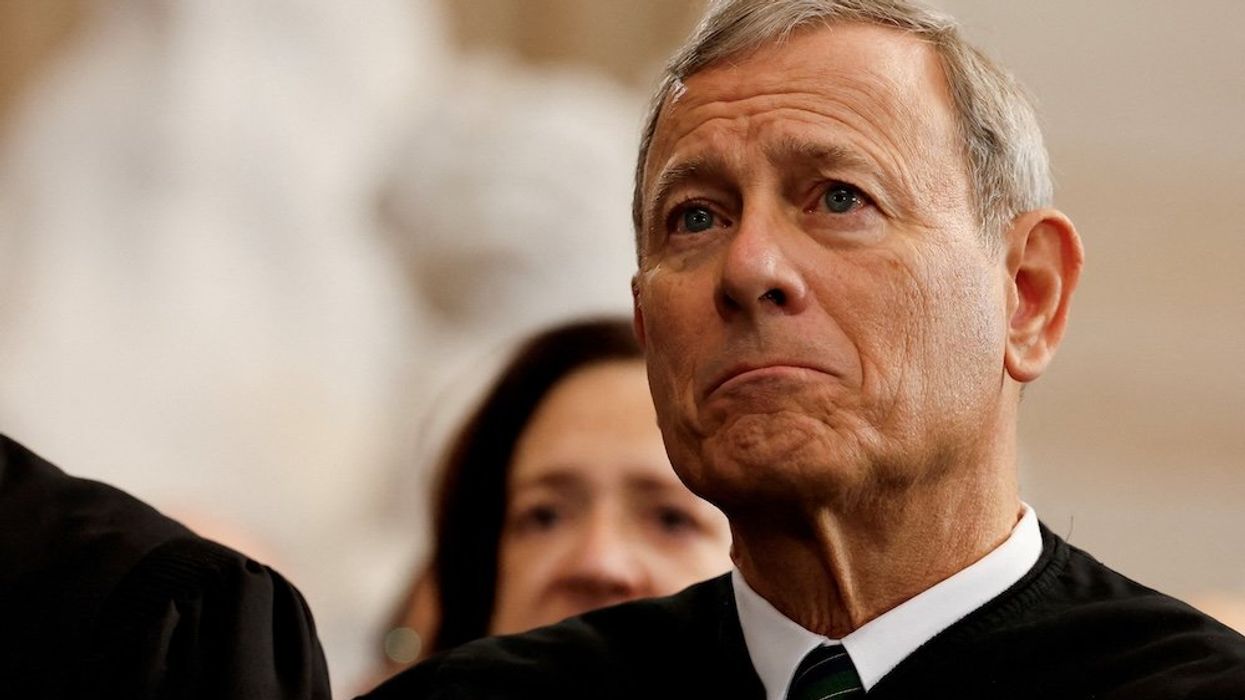
How 'reckless' John Roberts caused 'irreparable harm on the American people'

(REUTERS)

November 08, 2025 | ALTERNET


The Supreme Court heard oral arguments this week in a case challenging President Donald Trump’s tariffs, with plaintiffs arguing that his unilateral levies on imported goods violate the Constitution, which grants Congress the power to impose taxes and regulate foreign commerce. The Trump administration has justified his unprecedented use of tariffs under a 1977 law known as the International Emergency Economic Powers Act, but several justices seemed highly skeptical of that argument, potentially putting President Trump’s signature economic policy at risk.

“There is no genuine emergency. There is no war that is the precipitating basis for invoking IEEPA. And even if it were, it would not allow the imposition of tariffs,” says legal expert Lisa Graves, founder of True North Research and co-host of the podcast Legal AF.

Graves also discusses her new book, Without Precedent: How Chief Justice Roberts and His Accomplices Rewrote the Constitution and Dismantled Our Rights.

This is a rush transcript. Copy may not be in its final form.

AMY GOODMAN: This is Democracy Now!, democracynow.org. I’m Amy Goodman.

We’re staying on the subject of the Supreme Court but now turning to a major case before the court on President Trump’s authority to impose sweeping tariffs on foreign goods. The court heard oral arguments on Wednesday. Solicitor General John Sauer argued President Trump has the power to unilaterally impose the tariffs under a 1977 law known as the International Emergency Economic Powers Act, or IEEPA, which grants the president the authority to regulate commerce during wartime or other national emergencies. This is the solicitor general arguing.
JOHN SAUER: I want to make a very important distinction here. We don’t contend that what’s being exercised here is the power to tax. It’s the power to regulate foreign commerce. These are regulatory tariffs. They are not revenue-raising tariffs. The fact that they raise revenue is only incidental. The tariffs would be most effective, so to speak, if no — no — no person ever paid them.


AMY GOODMAN: Challenging the policy in the case is a group of small businesses. This is the plaintiffs’ attorney and former solicitor general, Neal Katyal, speaking outside the court.


NEAL KATYAL: Our message today is simple: The Constitution, our framers, 238 years of American history all say only Congress has the power to impose tariffs on the American people. And tariffs are nothing but taxes on the American people, paid by Americans. This case is not about the president; it’s about the presidency. It’s not about partisanship; it’s about principle. And above all, it’s about upholding the majestic separation of powers laced into our Constitution that is the foundation for our government. We thank the justices today for their extensive questioning in this case, and we look forward to the resolution.


AMY GOODMAN: The case has moved quickly through the federal courts. The court has heard roughly two dozen emergency appeals by the Trump administration, which the conservative majority has largely allowed Trump’s aggressive agenda to go forward. But this is the first time the court will make a final decision on one of those policies. On Wednesday, the justices, including conservative justices, appeared skeptical of the government’s argument. This is Chief Justice John Roberts.
CHIEF JUSTICE JOHN ROBERTS: You have a claim source, an IEEPA, that had never before been used to justify tariffs. No one has argued that it does until this, this particular case. Congress uses tariffs and other provisions, but — but not here. And yet — and correct me on this if I’m not right about it — the justification is being used for a power to impose tariffs on any product, from any country, for — in any amount, for any length of time. That seems like — I’m not suggesting it’s not there, but it does seem like that’s major authority, and the basis for the claim seems to be a misfit.


AMY GOODMAN: For more on tariffs and the Supreme Court, we’re joined by Lisa Graves. She is the director and founder of the policy research group True North Research. Her new book is titled Without Precedent: How Chief Justice Roberts and His Accomplices Rewrote the Constitution and Dismantled Our Rights. She’s also the former deputy assistant attorney general. And she’s joining us now from Superior, Wisconsin.

Welcome back to Democracy Now!, Lisa. So, in fact, the chief justice is the main focus of your book on the Supreme Court. Talk about the significance of this case. And did it surprise you, the skepticism of the conservative majority, including the three Trump appointees?

LISA GRAVES: Well, this is an important case. And I wish that I could have confidence in the — I suppose, the sincerity of those questions that John Roberts posed, but we know that just last year he invented immunity from criminal prosecution for a president, for President Trump, out of whole cloth, despite the fact that the Constitution does not provide that power. So, now here we are, over a year later, with this court deciding whether this president has the power to engage in tariffs, even though the Constitution expressly gives those powers to Congress. And this law, IEEPA, does not provide any tariff power to the president.

And as you know and your listeners know, tariffs are taxes that end up being paid by the American people in the costs of the goods that we ultimately purchase. And Trump has bragged about how these tariffs are supposedly producing so much revenue, billions and billions of dollars of revenue, and yet we had the administration argue before the court that the revenue was incidental, that this is just a normal regulatory power. It’s not. Nothing’s normal.


I do think this court, the Roberts Court, is going to strike this down, but that’s in part because this court, you know, occasionally will rule against this president. But as you note and noted at the top of this show, 24 times so far this year, this court has intervened to allow reckless and damaging actions to happen to the American people, irreparable harm on the American people. And in this instance, with the business community weighing in, perhaps it will decide against Trump this one time, and then try to use that as a shield to say, “Look, it’s fair,” when in fact this court, under John Roberts, has behaved in innumerable ways, in very unfair ways, in counter-constitutional ways and in ways that have decimated our rights, including our voting rights.

AMY GOODMAN: So, talk about who actually brought this case. The businesses are not corporate giants. They’re small and medium-sized. And when you say everyone knows that these are taxes, explain more fully who pays these tariffs, as President Trump says, you know, “We’re going to get these countries to pay.” That’s not, in fact, who pays.

LISA GRAVES: Yeah, that’s not who pays. So, the tariffs are tariffs on goods sold in the United States, imported in the United States, which means, ultimately, whether it’s businesses buying those goods as components for building products or whether it’s consumers buying things at the grocery store or a department store, it’s the American people who pays. Right now some of the businesses that are involved in these — in imports are not passing those tariffs on to the American consumers. They’re waiting to see what ultimately happens and absorbing those costs. But those costs are already being passed on to the American consumers in lots of ways. And so, it is — this idea that this is some sort of non or revenue incidental tariff, that it’s supposedly foreign-facing so it doesn’t affect us, that’s not true. It’s we, the American people, who ultimately pay the cost of those tariffs.

And Congress has the power to tax. Expressly, in the Constitution, it’s given to it, not the president. And simultaneously, in that same provision, Congress is given the power to impose tariffs. This statute that the Trump administration is hanging its hat on does not give the president the power to tariff or to tax. And there’s a good reason for that. It’s not just that it’s in our Constitution. Trump’s behavior is exactly why no president has ever been given this sort of power, because putting that power in the hands of one person allows for arbitrary, capricious, whimsical, vindictive action by one person, as we’ve seen Trump do. That initial round of tariffs was announced as including tariffs on Penguin Islands, but not North Korea and Russia. The tariffs are arbitrary. We’re seeing sort of a shakedown process in some of the efforts to try to get countries to appease Trump’s ego in exchange for dropping tariffs or limiting them. That’s not how tariff policy is supposed to go. It’s supposed to be passed by Congress through genuine deliberation. And more than that, because it’s a tax on the American people, it has to be something that only Congress can do, because Congress has the power of the purse, not the president. And we cannot have this president, you know, exercising all the powers, basically, of the legislative branch and the executive branch.


AMY GOODMAN: This is an exchange between Justice Elena Kagan and the Solicitor General John Sauer during oral arguments, speaking about emergency powers.
JOHN SAUER: The president has to make a formal declaration of a national emergency, which subjects him to particularly intensive oversight by Congress, repeated — you know, natural lapsing, repeated review, reports and so forth, that says you have to consult with Congress to the maximum extent possible.

JUSTICE ELENA KAGAN: I mean, you, yourself, think that the declaration of emergency is unreviewable. And even if it’s not unreviewable, it’s, of course, the kind of determination that this court would grant considerable deference to the — to the president on. So that doesn’t seem like much of a constraint.

JOHN SAUER: But it is a constraint.


JUSTICE ELENA KAGAN: And, in fact, you know, we’ve had cases recently which deals with the president’s emergency powers, and it turns out we’re in emergencies everything all the time about like half the world.


AMY GOODMAN: English, please, Lisa Graves.

LISA GRAVES: Well, so, this question under IEEPA is whether there is an emergency that’s the basis for regulation or sort of an embargo. And in this instance, there isn’t. The administration has claimed that the fentanyl crisis somehow allows it to impose these wide and arbitrary tariffs. It’s also claimed that the trade deficit, which has been part of our, you know, economy for decades, is some sort of national emergency. It’s not. We’ve seen Trump assert emergencies in Portland, in Los Angeles. Like, he basically just uses the word “emergency” to try to get away with anything.

And it is true, the Supreme Court has traditionally deferred to declarations of emergencies by presidents. But I don’t think it has any obligation to defer to this president’s claims of emergency, which are factless, which are baseless, and which are just another argument, the kind of argument John — that John Sauer tends to make in justification of his client getting to do whatever he wants. So, there is no genuine emergency. There is no war that is the precipitating basis for invoking IEEPA. And even if it were, it would not allow the imposition of tariffs.

AMY GOODMAN: So, Lisa Graves, you’ve written this new book. It’s called Without Precedent: How Chief Justice Roberts and His Accomplices Rewrote the Constitution and Dismantled Our Rights. If you can talk more about the major points in this book, as you specifically look at Chief Justice Roberts? Start with the whole issue of the Voting Rights Act. Talk about Chief Justice John Roberts’ origin story.

LISA GRAVES: Yes. So, John Roberts chose to clerk for Bill Rehnquist, who was one of the most notorious anti-voting rights people on the Supreme Court. He, in his personal capacity, sought to make it harder for Arizonans to vote, targeting Black communities in Arizona with voter suppression, himself personally, in Bethune, in the neighborhood of Bethune. Then, when he was on the court, right before John Roberts joined him, he issued a decision, the first decision trying to cut back Section 2 of the Voting Rights Act, to say that effects would not count.

So, then what happened was, Bill Rehnquist called Ken Starr, who was then the chief of staff for the new attorney general for Ronald Reagan, and urged him to hire John Roberts. John Roberts was hired by the Reagan administration and put in charge of voting rights. John Roberts had no experience in voting rights, no experience in litigation. The only experience he had was clerking for — basically, stodging for — the most regressive justice on Supreme Court when it came to voting rights. Rehnquist, by the way, actually urged that his justice he clerked for dissent from the Brown v. Board of Education decision. Rehnquist aided Barry Goldwater, the guy who — one of the, you know, senators who opposed the Civil Rights Act.

So, this is the origin story of John Roberts. He spent hundreds of hours trying to block Congress from repairing that, from overturning that ruling. And then, the Voting Rights Act was extended for more than 20 years, into 2007, and then, when John Roberts became the chief justice of the United States in 2005, as soon as there was a case teed up for him to do so, in the Shelby County case, he ruled against the Voting Rights Act. He struck down other key enforcement provisions of the Voting Rights Act, Section 4 and Section 5, that required preclearance of changes in jurisdictions that had a history of voter suppression or history of targeting Black voters. And that Shelby County decision unleashed this wave of voter suppression and voter restriction we’ve seen over the past decade. And now, right now, this court, the Roberts Court, is considering overruling Section 2 of the Voting Rights Act and allowing white-majority legislatures to dilute the Black vote in Louisiana and other states.

AMY GOODMAN: We’re talking to Lisa Graves. Her new book is just out. It’s called Without Precedent: How Chief Justice Roberts and His Accomplices Rewrote the Constitution and Dismantled Our Rights. As you observe this court right now, what are your biggest concerns? And how do the other justices feel about the chief justice?

LISA GRAVES: Well, I think this court is behaving illegitimately. These emergency orders overturning the well-reasoned, factually founded, legally grounded decisions to impose temporary restraining orders in the face of unilateral, extreme actions by this president, where the plaintiffs have shown irreparable harm, these are illegitimate actions by this court basically to aid Donald Trump. And it’s part two of what it did last year in effectively pardoning Donald Trump, preventing the trial, the trial around January 6th, to go forward, and basically paving the way for his return to power. And now, once in power, John Roberts has helped to empower Donald Trump further with the help of his fellow Republican appointees.

I think the Democratic appointees to the court, in the minority, are very frustrated, as you can see from the dissents in these cases, where the court is not describing why it is overturning these lower court rulings and allowing Trump to put his foot on the gas pedal to go forward with them while people are being harmed every day.

I think that this Roberts Court is out of control. It’s behaving arrogantly. It has aggressively intervened in those cases, just like with the immunity decision. It could have let the lower court rulings, which were based on well-grounded precedent, stand, but instead it has sought to aid Trump at almost every turn and, in doing so, has exposed itself as a hyperpartisan court that isn’t really behaving like a court but is behaving like an arm of the MAGA Trump presidency.

AMY GOODMAN: What most surprised you in doing the research for your book?

LISA GRAVES: Oh my goodness. Well, it was a small thing. But, you know, everyone knows that John Roberts talked about how he was going to be a fair umpire just calling balls and strikes. When I looked into his background, it turned out that he never played baseball in high school or college. He was actually a football player. And his coach told a right-wing dark money group that helped support his confirmation that John Roberts was particularly skilled as a tackler, as someone who studied his opponents and sought to find out ways to tackle them. That’s who we really have at the helm of the Supreme Court, is a player on the field who’s moving that right-wing, regressive, Reagan revolutionary agenda forward, not the fair umpire that he claimed to be and that he sought to put — plant into the American people’s minds as who he is. He’s not that umpire. I’ve actually decided to call him a “Trumpire,” because he’s been so willing to help Trump in almost every way as he expands the presidency far more than any other president has had such power. And in fact, that ruling really took out one of the key pillars of the checks and balances in our democracy, making the oath that John Roberts administered to Donald Trump, that he would faithfully execute the law, almost meaningless.

AMY GOODMAN: Lisa Graves, I want to thank you for being with us, director and founder of the policy research group True North Research. Her new book, Without Precedent: How Chief Justice Roberts and His Accomplices Rewrote the Constitution and Dismantled Our Rights. She was speaking to us from Superior, Wisconsin.
Drowning the 'lazy' media with Trump's lies is the point


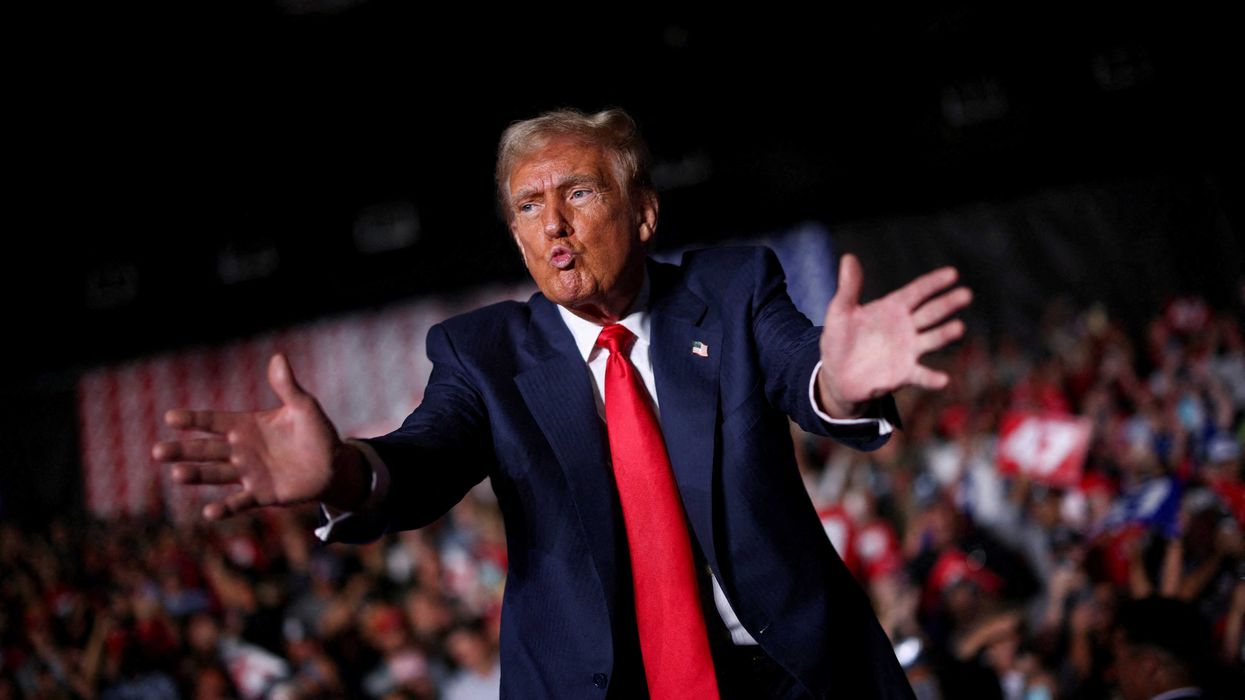
REUTERS PICTURES 40th ANNIVERSARY COLLECTION: Republican presidential nominee and former U.S. President Donald Trump reacts during a rally in Greensboro, North Carolina, U.S. October 22, 2024. REUTERS/Carlos Barria 
November 08, 2025 

The headlines documenting President Donald Trump’s plan to send federal troops to San Francisco followed a familiar arc. “Trump claims ‘unquestioned power’ in vow to send troops to San Francisco,” The Guardian reported on Oct. 20, 2025. The next day, the San Francisco Chronicle blared: “S.F. threatens to sue if Trump brings in National Guard.” Then, on Oct. 23, “Trump reverses his decision to send troops to San Francisco,” as ABC News put it, after Trump posted that conversations with the city’s mayor and tech moguls had swayed him.

It was another example of how Trump’s shifting policy positionsracially inflammatory statements and threats frequently fuel a flurry of headlines, reflecting what some psychologists are calling “media saturation overload” or “Trump stress disorder.”

This barrage of information may seem like overcommunication from a hyperactive administration. But it is much more than that.

Scholars have found that the constant, often conflicting and at times false information coming out of the White House and shared via social media posts and the conventional news media causes members of the public to see truth and fact as relative and makes them more likely to dismiss those who disagree with them as untruthful. This leaves doubt about what’s real and what isn’t.

This citizen paralysis creates what philosopher Hannah Arendt described in “The Origins of Totalitarianism” as a general public “for whom the distinction between fact and fiction … no longer exist.” When lies are truth and truth is derided as lies, Arendt wrote, ordinary people lose their bearings and can be manipulated for totalitarian objectives.

Meanwhile, many journalists have openly acknowledged fatigue with the pace and nature of the Trump administrations’ news cycles, amid frequent newsroom layoffs, mergers and closures.

I am a longtime journalist and now scholar of journalism and race, trained to see the methods and aims behind political leaders’ press operations. And as I show in my forthcoming book, the Trump administration’s rhetorical strategies echo the playbooks of authoritarian and white supremacist organizations such as the Third Reich and some factions of the modern alt-right movement. They are intended to narrow the scope of who belongs as an American.

Headlines at ‘muzzle velocity’

The Trump administration’s rhetorical strategies include claiming victim status while often laying blame on immigrants or other scapegoats in ways that I believe betray racist intent. At the same time it has overwhelmed journalists and the public with breaking news.

This strategy was laid out by Steve Bannon, an influential Trump supporter and strategist in his first administration, during a 2019 PBS “Frontline” interview, when he described the media as “the opposition party.”

“They’re dumb and they’re lazy, they can only focus on one thing at a time,” he said. “All we have to do is flood the zone. … Bang, bang, bang. These guys will never – will never be able to recover. But we’ve got to start with muzzle velocity.”

Bannon has long been associated with the alt-right, a movement known for rhetorical tactics that minimize and obfuscate its true aims.

A strategy forged in Trump’s first term

As I detail in my book, “American Otherness in Journalism: News Media Representations of Identity and Belonging,” Trump and his key advisers have been developing, refining and ramping up their news media manipulation for a long time.

An early example of this is the way the administration used these tactics through Trump’s public responses to the fatal violence at the August 2017 Unite the Right protest in Charlottesville, Virginia.

The two-day rally was organized by a white nationalist blogger and attended by members of neo-Naziwhite supremacist and far-right militias protesting the removal of a statue of Confederate Gen. Robert E. Lee from a Charlottesville park. They marched with tiki torchesflew Confederate and Nazi flags and chanted antisemitic and racist slogans.

Amid violent clashes with counterprotesters on the second day, a neo-Nazi sympathizer drove into a crowd, killing a 32-year-old woman and injuring many others.

My study of television news coverage of Unite the Right found that the majority of news reports focused on the contradictory and inflammatory statements that Trump made about the antisemitic and racist protesters. Trump’s Aug. 15, 2017, press conference remark about blame on both sides after what happened garnered the most news media attention: “I think there is blame on both sides,” he said. “You had some very bad people in that group. You also had some very fine people on both sides.”

Exploiting chaos

The uncertainty surrounding what he meant created a cycle of news stories implying and denying that he sympathizes with white supremacists.

This is-he-or-isn’t-he intrigue spurred a surge of what fits the description of Bannon’s “muzzle-velocity” news headlines: “Trump declares ‘racism is evil’ amid pressure over Charlottesville” followed closely by “Trump defends White-nationalist protesters” and “Why Trump can’t get his story straight on Charlottesville.”

With the focus on Trump’s comments and what he might have really meant, the news media ultimately missed covering at the time the long-term threat posed by these white supremacist and other extremist groups.

Echoing a playbook from the past

Scholars have identified the fascist roots of these “post-truth” strategies: strongmen leaders uninterested in establishing leadership through honesty and transparency.

A recent scholarly analysis of Trump’s leadership concludes that the second-term president is overwhelming the public into “organized despair” by pitting races against each other while targeting minority groups as scapegoats, a tactic that hearkens back to 1930s Germany.

A 2019 analysis of Trump’s narrative style describes how he presents himself as a “strongman” fighting invisible forces of censorship and suppression. It also points out that this was part of the appeal of fascist leaders such as Mussolini and Hitler.

Researchers of Nazi propaganda identified key tactics in the German press such as name-calling and lumping together groups seen as opposition – communists, liberals and Jews – until public understanding of those groups blur into phrases like “enemies of Germany.” The messaging was constant and immersive, carried in local and national newspapersradiofilm and posters.

A key part of Trump’s rhetorical strategy is using race without directly referring to it. For example, Trump has described cities with large nonwhite populations such as Washington, D.C., and Chicago as “out of control” or “dirty,” contrary to actual crime statistics. He’s also questioned Kamala Harris’ racial identity, suggesting she “happened to turn Black.” And referring to Black football players who had been protesting systemic racism by kneeling during the national anthem, Trump said, “Get that son of a bitch off the field right now,” which many observers interpreted as racist because he was insulting people of color for the act of protesting racism.

This racial coding has been used by white supremacist groups to mask their true intent. They also use less overt labels such as “alt-right” or “pro-white” as a “rhetorical bridge” to the mainstream public.

In the case of the NFL protesters, the plausible deniability became an actual denial. Trump perfected this move when, during a 2020 debate with Joe Biden, he said, “Proud Boys – stand back and stand by,” referencing another group accused of thinly veiled racism.

Drowning in headlines

I believe that the endgame for this strategy is authoritarian power that greatly narrows the scope of who truly belongs and has rights in this country as an American.

This media saturation – drowning the public with a thousand Trump-generated headlines – allows his administration to keep dominating and controlling national attention.

But the media-consuming public can use the tools they have to encourage news outlets to better inform the public by identifying the media saturation strategy and reporting on why leaders are using it.

Otherwise, if news consumers let the headline overload do what it’s intended to do, and become overwhelmed and paralyzed, they become pawns in what I consider a ploy to make America less egalitarian and less democratic.

Angie Chuang, Associate Professor of Journalism, University of Colorado Boulder

This article is republished from The Conversation under a Creative Commons license. Read the original article.


Behind the right-wing media’s big advantage: analysis


Fox News' Sean Hannity speaking at the 2015 Conservative Political Action Conference in National Harbor, Maryland, Gage Skidmore
November 08, 2025 | ALTERNET

Do you ever wonder why Republican propaganda appears to be everywhere while solid, informative news keeps going belly-up? It’s all about money, author Katherine Stewart tells Bulwark. Republican propaganda has it and news does not.

Fox News channels and amplifies rage at a carefully curated target, which never appears to be the Republican Party and that channeling “has worked overwhelmingly to the advantage of the authoritarian right wing,” Stewart said.

You can try to blame it on new technology, or the kind of reporters working in the industry, or the theory that the media has simply come to reflect the biases and polarization of the public. But it all really comes back to money and the moneyed interests who value driving the argument.

“Today … 40 percent of all local TV news stations are under the control of the three largest broadcast conglomerates: Sinclair Broadcast Group, Gray Television, and Nexstar Media Group,” said Stewart. “Their stations — each company now owns about 100 affiliated with ABC, CBS, FOX, or NBC — operate in more than 80 percent of U.S. media markets. A conglomerate with a distinct and well-documented right-wing bias, such as Sinclair, has an outsize footprint on our information ecosystem.”

And under the Trump administration, the concentration of the media business has accelerated.

“Consider that Trump cleared the way for [“Trumpy billionaire Larry Ellison, and his son, David”] to merge their Skydance Media company with Paramount in order to gain control of CBS News. Thanks to this preferential treatment, the Ellisons’ new media giant is now in the running to purchase Warner Bros. Discovery, which includes the crown jewel of the media marketplace: CNN,” said Stewart. “Other companies adapt swiftly to the new cronyistic landscape. Comcast, which previously drew scrutiny from the Trump administration for its own efforts to purchase Warner Bros. Discovery, recently donated up to $10 million to fund Trump’s White House “renovation.”

These major media executives feel little need to satisfy any mission to genuinely inform the public, said Stewart. What they want is profits, and hate-based rage-bait is generally more profitable than information.

“Fox News blazed the trail when it reconceived the product that cable news produces: Instead of the straight story, information became fodder for entertainment, persuasion, and grievance. Under the direction of Roger Ailes, the outlet applied all the tricks of demagoguery to expand and consolidate its reach, including a hand-in-glove coordination with the GOP,” Stewart said.

These same companies “protect their turf” by protecting governments that decline to regulate their anti-competitive moves.

A similar drive toward oligopoly profits is at play in the tech industry, Stewart warned. When a government grants and enforces an effective monopoly to some technologist, they are “likely to use just as much misinformation and manipulation as they can get away with to protect their privileged position.”

The corporations that own the tech industry are also in the hands of plutocrats, who generally favor right-wing governments “because they want to keep as much of their money as possible—and prevent the little people from telling them what to do with it, said Stewart.

“Consider Peter Thiel, who identifies those who wish to end tax exemptions for the super-rich as possible representatives of ‘the antichrist,’” said Stewart. “Or consider Jeff Bezos, who is undermining The Washington Post’s long tradition of exemplary journalism by turning the Opinion section into an regime-friendly advocate for ‘personal liberties.’”

There’s no pretending this can all be overcome “simply by reducing partisan divides and promoting civility,” said Stweart. “… We need to confront and challenge media and tech oligopolies and establish a system that produces journalism committed to the goal of any free press, which is to inform the public and promote the truth.”

Read the New Republic report at this link.

Consumer confidence in death spiral as Trump wrecks hope in the economy


November 08, 2025  
COMMON DREAMS

Consumer sentiment in the United States has fallen to a near-record low and Americans’ view of current economic conditions has deteriorated under President Donald Trump’s administration, which is overseeing and contributing to price increases, large-scale layoffs, looming insurance premium hikes, and devastating cuts to food aid.

The University of Michigan’s closely watched Surveys of Consumers released updated data on Friday showing that consumer sentiment has fallen over 6% this month compared to October as Americans increasingly fear that the government shutdown will have “potential negative consequences for the economy.”

“This month’s decline in sentiment was widespread throughout the population, seen across age, income, and political affiliation,” said Joanne Hsu, director of the Surveys of Consumers. “One key exception: consumers with the largest tercile of stock holdings posted a notable 11% increase in sentiment, supported by continued strength in stock markets.”

The latest consumer sentiment survey posted a reading of 50.3, the second-lowest level since 1978.

The university’s “current economic conditions” index, meanwhile, fell to an all-time low of 52.3 in November, down nearly 11% from last month.

“Middle-class and lower-income Americans are scared right now... about the shutdown, high costs, and potentially losing their jobs in the next 12 months,” wrote Heather Long, chief economist at Navy Federal Credit Union.

Alex Jacquez, chief of policy and advocacy at the Groundwork Collaborative, said in response to the consumer sentiment data that “Americans are losing faith in the economy because they’re losing ground.”

“Every day it becomes clearer that President Trump has no real interest in improving the lives of American families,” said Jacquez. “His economic mismanagement has left households buried under record debt and rising prices. It’s no surprise consumer sentiment is at its lowest point since 2022, and households are turning to leaders who didn’t just learn the word ‘affordability.'”


Saturday, November 08, 2025

While Trump Posts Marble Bathrooms, Americans Go Hungry

Trump plasters his social media with a floor-to-ceiling marble bathroom remodel while families across America wonder how they can keep their children from starving.


US President Donald Trump shared this image of a remodeled Lincoln Bathroom on October 31, 2025.
(Photo by Donald Trump/Truth Social)


Emese Ilyés
Nov 08, 2025
Common Dreams

I know what it means to be starved by those in power. As a little girl, if not for my grandparents’ ancient walnut tree that fed us, and not for my grandma’s beloved chickens who laid eggs and now and then were a very special Sunday soup, if not for my sister—just a few years older than me—standing in line at dawn to fight adults for bread, I would have been significantly malnourished. I would watch my sister come home exhausted from those pre-dawn battles with full-grown adults, clutching a loaf of bread that meant we might be a little less hungry than we were the day before.

I never thought I’d see that kind of chosen starvation—the kind that Romania’s Nicolae CeauÈ™escu was notorious for—in America. I was wrong.
Trump is Choosing to Starve Americans


With Food Aid Suspended for Millions of Families, Trump Brags of ‘Statuary Marble’ Bathroom Makeover


Failures of Trumponomics Glaring as Prices, Consumer Anxiety Climb Higher

On November 3, day 33 of a government shutdown, President Donald Trump’s administration said it would provide only partial Supplemental Nutrition Assistance Program (SNAP) food stamp benefits for November. This has a devastating impact on millions of Americans. And, this is after two federal judges ordered the administration to tap into emergency funds to cover food assistance. What’s worse is this partial aid Trump is willing to concede to give might not reach these families for months.

And what was Trump doing as families wondered how they’d feed their children? Posting 24 photos on social media of his newly renovated Lincoln Bedroom bathroom—covered floor to ceiling in black and white marble with (surprise, surprise) gold fixtures—as he headed to Mar-a-Lago for the weekend. He has already golfed multiple times during this shutdown and traveled internationally, something other presidents would have refused in order to focus on ending the shutdown that is devastating the country. Millions are unsure about what they’ll eat tonight, and Trump posts about the luxury renovations and packs his golf clubs while the government remains shut down.

Trump wants us to watch him build monuments to himself. Fine. We’re watching. And we’re remembering.

CeauÅŸescu was similarly fond of gold and glitz while the people starved. Like this Romanian dictator, Trump is demolishing the historic East Wing of the White House to build an over $300 million ballroom, removing commemorative magnolia trees planted in the 1940s for Presidents Warren G. Harding and Franklin D. Roosevelt. According to White House aides, Trump spends hours obsessing over marble choices and column styles, even fidgeting with 3D-printed models of the ballroom during tense moments. Watch me, he seems to say. Watch me build monuments to myself while you starve.

CeauÅŸescu built his lavish palaces that included a golden bathroom with gold plated fixtures while my sister, a child, stood in line to fight for a half a loaf of bread to feed her family. Trump plasters his social media with a floor-to-ceiling marble bathroom remodel while families across America wonder how they can keep their children from starving.
The Policy Behind the Cruelty

Yes, by now we know full well, the cruelty is the point, it’s policy. The “big beautiful bill” Republicans passed earlier this year delivers massive tax breaks to the ultra wealthy: Starting in 2029, those making $30,000 or less would see a tax increase, while the top 0.1% would receive an average $309,000 tax cut annually, more than three times what a typical American household earns in an entire year. Sixty percent of the tax cuts go to the top 20% of earners, while the bill is coupled with cuts to Medicaid and SNAP that leave low-income Americans worse off on net.

The bill kicks more than 15 million people off health insurance, makes the largest cuts to nutrition assistance in history, and makes higher education less affordable. Congressional Budget Office analysis shows this bill adds over $4 trillion to the national debt while worsening inequality.
Masked Agents, Militarized Enforcement

Meanwhile, billions of dollars are being poured into Immigration and Customs Enforcement (ICE) raids, with masked federal agents in unmarked vehicles conducting workplace sweeps and detaining our neighbors outside courthouses, with more than 75% of those booked into ICE custody in fiscal year 2025 having no criminal conviction other than immigration or traffic-related offenses. Trump is choosing to continue to fund, and even increase the funding, for the modern-day Gestapo, ensuring masked ICE agents can continue to brutalize our communities. But we do not have to look at other places to understand what is happening before our eyes. In the 1850s in the United States, the federal government enforced a policy to hunt down and “return” what the government dubbed to be “fugitive slaves,“ people who were formerly and brutally enslaved and who had escaped captivity to flee north. No, we do not have to look at Nazi Germany to understand what ICE is doing, we have to look at our own history.

All of us Americans, who love our neighbors, who care for our families, who love our cities and our country, should see Trump for who he is. He is making a choice. This is a choice about who gets to have resources and who gets to suffer. This is about billionaires running the government and watching the people who actually make this country run—the workers, the families, the communities—go hungry while they build their ballrooms.

When the wealthy choose to watch their neighbors starve, when they fund masked agents to terrorize communities while slashing food assistance, this isn’t leadership. This is corruption masquerading as governance. CeauÅŸescu did it. Now Trump is doing it. Sending social media messages from his golden toilet while we the people go hungry.
The Walnut Tree Didn’t Ask Permission

They want us to be too hungry, too tired, too scared to fight back. They want us watching marble-bathroom reveals while we worry about our own children’s empty stomachs.

We won’t give them that satisfaction.

Every community that’s ever survived oppression has known this truth: We have to take care of our beloved communities. You share what you have. You build networks of care that the powerful can’t dismantle because they’re not built on their permission.

Start a community fridge in your neighborhood, like many of us did during the pandemic. Organize a weekly soup kitchen. Form a food co-op. Create a network of families who share meals and resources. This is how we survive, this is how we resist.

And then, fed and strong, we organize politically. We vote out every representative who voted to starve their constituents to feed the rich. We primary the ones who won’t fight. We run our own people, people who remember what it’s like to be hungry, to watch your sister fight for bread, to rely on a grandparent’s walnut tree.

Trump wants us to watch him build monuments to himself. Fine. We’re watching. And we’re remembering. Every marble tile laid while children went hungry. Every gold fixture installed while families lost food assistance. Every historic symbol of American’s greatness lying in rubble while more Americans lost access to healthcare.

But we’re not just watching. We need to be building too. Building the mutual aid networks, the political power, the community resilience that will outlast any administration’s cruelty.

The walnut tree that saved my life didn’t ask permission to grow. Neither will we.


Our work is licensed under Creative Commons (CC BY-NC-ND 3.0). Feel free to republish and share widely.

Emese Ilyés
Emese Ilyés is a critical social psychologist and participatory action researcher whose work examines community resistance and collective survival in the face of authoritarianism. Her research focuses on grassroots movements and mutual aid networks.
Full Bio >

Trump’s White House Ballroom Is Being Bankrolled by Genocide and ICE Profiteers

The ballroom donor list also includes Wall Street and cryptocurrency firms that benefit from the president’s agenda.
November 6, 2025

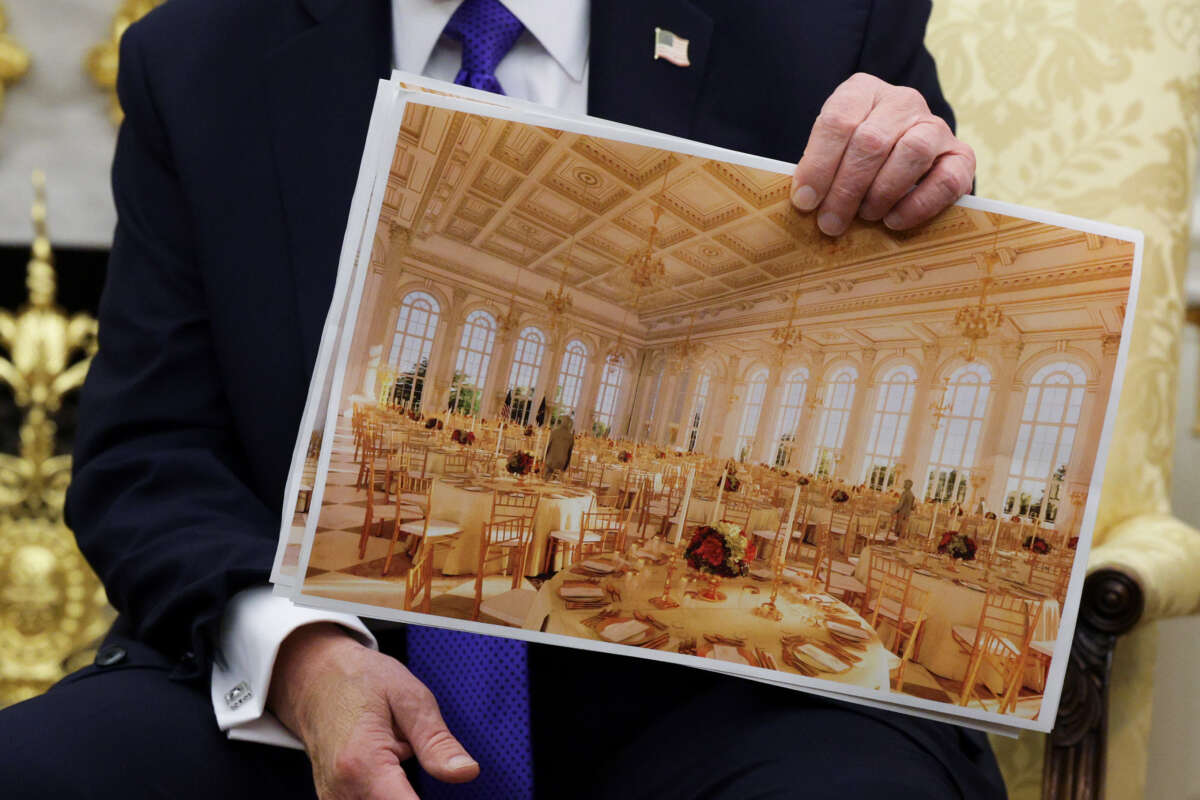
U.S. President Donald Trump displays a rendering of his proposed $250 million White House ballroom as he meets with NATO Secretary General Mark Rutte in the Oval Office of the White House on October 22, 2025, in Washington, D.C.Alex Wong / Getty Images

Money has always distorted U.S. politics, but the current Trump regime has entered new territory with an unabashed pay-to-play setup that’s stuffing the president’s political coffers while enriching him and his family.

Donald Trump’s coldly transactional dealings have been on full display as he’s tapped billionaire allies and major corporations to shower his administration with donations to pay for his latest vanity project: a 90,000-square-foot, $300 million ballroom set to be erected over the rubble of the White House’s now-demolished East Wing.

Trump has wined and dined dozens of corporate executives and mega-billionaires across industries, from cryptocurrency to fossil fuels and telecoms to tech, as he’s solicited donations for the ballroom. Many corporate donors have been disclosed; others have sought to remain hidden. For all, the game is clear. Many donors have direct business interests that Trump’s decisions will impact. Together, the ballroom donors benefit from at least $279 billion in federal contracts.

Together, the ballroom donors benefit from at least $279 billion in federal contracts.

What’s less apparent is that key donors are paying for Trump’s ballroom with profits culled from enabling the detention and deportation machinery of U.S. Immigration and Customs Enforcement (ICE) and Israel’s apparatus of occupation and genocide against Palestinians.

Other donors are among the most powerful Wall Street firms and their billionaire executives that are directly benefiting from Trump’s imperial posturing and his deregulatory agenda that’s opening up the retirement funds of tens of millions of workers to private equity profiteers.


UN Expert Exposes Companies Aiding Israel’s Genocide, Occupation in Palestine
Amazon, BlackRock, and Keller Williams LLC are some of the companies named in the report. 
By Sharon Zhang , Truthout July 1, 2025


Wall Street

Two Wall Street powerhouses have been identified as ballroom donors, and both are cashing in from their ongoing relationship with the Trump administration.

One is BlackRock, the world’s largest asset manager and a universal top shareholder of corporate capitalism. BlackRock’s assets under management recently hit a record $13.5 trillion, more than the combined GDP of Germany, Japan, and India.

In recent years, BlackRock has intensified its private capital spending spree, looking to gobble up data centers, utilities, and other critical infrastructure across the world.

In 2024, BlackRock acquired Global Infrastructure Partners (GIP), a massive private equity infrastructure firm led by Adebayo Ogunlesi, who sits on the board of OpenAI and, until recently, led the board of Goldman Sachs.

BlackRock and GIP made headlines in March 2025 when they struck a deal to acquire a huge global portfolio of shipping ports that included two Panama Canal ports. Referring to the acquisition, Trump boasted to Congress that his administration “will be reclaiming the Panama Canal, and we’ve already started doing it.”

The deal was a mutual victory for both Trump, who’s focused on reasserting U.S. imperial power across the Americas, and BlackRock, which snagged a chain of critical global infrastructure while entering Trump’s good graces.

Cozying up to Trump and MAGA conservatives appears to be a priority for BlackRock and its powerful billionaire co-founder and CEO, Larry Fink.

For a time, BlackRock became a poster child for the conservative backlash against diversity, equity, and inclusion efforts and against environmental, social, and governance in corporate America. In 2024, for example, Texas pulled billions out of BlackRock funds.

But since then, BlackRock and Fink have retreated from past postures of corporate responsibility, dropping diversity goals and pulling back from climate commitments. At a March fossil industry conference, Fink sported a “Make Energy Great Again” bracelet.

On November 3, Sen. Richard Blumenthal (D-Connecticut) sent Fink a letter demanding more information surrounding BlackRock’s donation to Trump’s ballroom, which the White House did not originally disclose.

Another big Wall Street donor to the ballroom is Stephen Schwarzman, one of the world’s wealthiest billionaires and the co-founder and head of Blackstone, the world’s largest private equity firm. Schwarzman is a longtime Trump ally and donor who chaired Trump’s CEO Council during his first term.

Stephen Schwarzman, one of the world’s wealthiest billionaires, once compared Barack Obama’s support for raising the carried interest tax rate to the Nazis invading Poland.

Schwarzman and Blackstone are major beneficiaries of Trump’s agenda of corporate tax cuts and financial deregulation, especially in two ways.

First, Trump’s “One Big Beautiful Bill Act” preserved the carried interest tax loophole, which allows private equity barons to avoid billions in tax payments. In fact, Schwarzman, who owns luxurious mansions and estates across the world, once compared Barack Obama’s support for raising the carried interest tax rate to the Nazis invading Poland.

Even more, Trump delivered a major boon to Blackstone and private equity firms in August by giving them access to trillions of dollars’ worth of 401(K) funds, a move that could supercharge risk and weaken oversight of savings for retirees.

Investors in private equity funds are mostly wealthy individuals and large institutions like universities and foundations that have resources to gauge investment prospects and can weather greater risks, unlike many ordinary retirees. Whereas government regulations previously put safeguards between private equity firms and millions of 401(K)s, Trump’s new policy dissolves that boundary.

Beyond Wall Street, cryptocurrency firms, which also populate the White House ballroom donor list, benefit from this regulation.

Senators Elizabeth Warren (D-Massachusetts) and Bernie Sanders (I-Vermont) recently sounded the alarm over Trump’s new policies that push “risky private market funds and cryptocurrencies into Americans’ retirement plans,” according to a press release.


ICE Profiteers


Major corporate interests that rake in profits through enabling ICE’s deportation machine are also bankrolling Trump’s ballroom.

One major ballroom donor is Palantir Technologies, the data management company overseen by billionaires Peter Thiel and Alex Karp that sits at the core of ICE’s surveillance apparatus.

Major corporate interests that rake in profits through enabling ICE’s deportation machine are bankrolling Trump’s ballroom.

Beginning with the so-called “war on terror,” Palantir has benefited from lucrative government contracts across both Democratic and Republican administrations. ICE uses Palantir’s software to integrate and store data on immigrants, collected through a vast surveillance system, that’s wielded to monitor, seize, and deport people.

Palantir has been a top corporate beneficiary of Trump’s rule, snagging more $322 million in government contracts during the first half of 2025 alone. This included a $30 million ICE contract to develop its “ImmigrationOS” surveillance platform that will use artificial intelligence to hypersurveil immigrants, select targets for seizures and raids, and track “self-deportations.”

Organizers across the U.S. have protested Palantir over its contracts with ICE as well as the Israeli military.

Amazon also donated to Trump’s ballroom and attended his fundraiser dinner, while Amazon founder and mega-billionaire Jeff Bezos has placated Trump through gestures like shifting The Washington Post, which Bezos owns, to the right, and paying $40 million for a documentary about Melania Trump featured on Amazon Prime Video.

As the immigrant rights group Mijente reported back in 2018, Amazon provides critical data storage services for ICE through its Amazon Web Services cloud business. The MIT Technology Review went so far to call Amazon the “invisible backbone” of ICE’s attacks on immigrants.

Amazon, as well as ballroom donors like Microsoft and Alphabet (the parent company of Google), continue to benefit from contracts with ICE and the Department of Homeland Security, though these are typically transacted through third parties that use their cloud services. In July, Amazon bragged that Customs and Border Protection is “using cloud computing, generative AI and machine learning to secure US borders.”

Google, along with Apple, another ballroom donor, have also removed ICE-tracking apps from their online stores.

Taken together, these Big Tech ballroom donors help undergird what the Mijente report called the “cloud industrial complex,” the checkered alliance between Silicon Valley and the state, wedded by a massive ensemble of government contracts, that props up ICE’s digital surveillance and data storage operation that guides its daily raids.

Other ballroom donors such as Booz Allen Hamilton and Comcast also have ICE contracts.

Genocide’s Corporate Backers


In July, UN Special Rapporteur Francesca Albanese published a scathing report, titled “From Economy of Occupation to Economy of Genocide,” that named key players composing the “corporate machinery sustaining the Israeli settler-colonial project of displacement and replacement of the Palestinians in the occupied territory.”

The report shows that many of the same corporations enabling and profiting from occupation and genocide in Palestine are also bankrolling Trump’s White House ballroom.

These include Big Tech companies like Google and Amazon that provide cloud storage and computing for Israel’s occupation and surveillance of Palestinians through the $1.2 billion “Project Nimbus” contract.

“Tech billionaires leading Google and Amazon are yet again currying favor with the Trump administration to ensure that their quest for profit and endless expansion of their monopoly power remains unchallenged by the federal government,” a spokesperson from No Tech for Apartheid, a campaign of Google and Amazon workers organizing against the Project Nimbus contract, said in a statement to Truthout.

Microsoft, which unsuccessfully bid for the Project Nimbus contract, has also provided technology for the massive surveillance operation that supports the Israeli military’s occupation of the West Bank and Gaza.

Albanese’s report also names other tech donors to Trump’s ballroom, including Palantir, with its long “tech collaboration” with the Israeli government and likely supplying of artificial intelligence systems and automatic predictive policing technology, and Hewlett Packard, which Albanese says has “long enabled the apartheid systems of Israel, supplying technology to the Coordination of Government Activities in the Territories (COGAT), the prison service and police.”

Additionally, Albanese’s report also named companies like Lockheed Martin, which supplies Israel’s military with weapons and aircraft, and Caterpillar, which sells Israel equipment to demolish Palestinian homes — both of which are donors to Trump’s ballroom.

The report also names BlackRock as a major purchaser of Israeli treasury bonds as well as a top shareholder in corporations like Palantir, Microsoft, Amazon, Alphabet, Lockheed Martin, and Caterpillar. The report concludes that BlackRock ranks “among the largest investors in arms companies pivotal to the genocidal arsenal of Israel.”

It should also be noted that the Adelson Family Foundation — the philanthropic arm of mega-billionaire Miriam Adelson, an ardent and hawkish Zionist with influence over U.S. policy toward Israel — was disclosed as a donor to Trump’s ballroom.

News reports suggest that Adelson supports Israel’s annexation of the West Bank, and she has referred to protesters of Israel’s genocidal campaign in Gaza as “our enemies.” Miriam Adelson and her late husband Sheldon Adelson also influenced Trump’s 2017 decision to recognize Jerusalem as Israel’s capital.


This article is licensed under Creative Commons (CC BY-NC-ND 4.0)
, and you are free to share and republish under the terms of the license.


Derek Seidman
Derek Seidman is a writer, researcher and historian living in Buffalo, New York. He is a regular contributor for Truthout and a contributing writer for LittleSis.