Sunday, November 09, 2025


Defunct Pennsylvania oil and gas wells may leak methane, metals into water


Penn State
abandoned well 

image: 

Researchers surveyed 18 abandoned wells, like this one, and found that they not only leak natural gases that contaminate the atmosphere but also release methane into the adjoining water table. Some of the sites also exhibited high concentrations of dissolved metals in nearby groundwater. 

view more 

Credit: Provided by Samuel Shaheen


UNIVERSITY PARK, Pa. — In the dense forests of northwestern Pennsylvania, hundreds of thousands of retired oil and gas wells — some dating back to the mid-1800s, long before modern construction standards — dot the landscape, according to geochemists in Penn State’s College of Earth and Mineral Sciences who recently led a study in the region. Left uncapped and exposed to air and erosion, they break down, leaching harmful chemicals into the atmosphere and, the researchers reported, into the groundwater.

Led by Susan L. Brantley, Atherton Professor of Geosciences and Evan Pugh University Professor Emerita in the Department of Geosciences and Earth and Environmental Systems Institute at Penn State, the researchers surveyed 18 abandoned wells in and near the Allegheny National Forest and found that they leak methane not only into the atmosphere but also into the adjoining groundwater. Some of the sites’ groundwater also exhibited high concentrations of dissolved iron and arsenic. Using a geochemical computer model, the team found that methane — a powerful greenhouse gas that traps more heat than carbon dioxide — interacted with the rock near wellbores to release metals into groundwater. The researchers published their findings this week (Nov. 1) in Geochimica et Cosmochimica Acta.

“As a greater portion of oil and gas wells worldwide are abandoned and their structural integrity declines, the issue of water quality will grow in importance,” Brantley said. “This is because as gas pipes rust and break down, gases infiltrate nearby underground aquifers and can dissolve toxic elements like arsenic into the water.”

After identifying the retired wells based on visual evidence of gas leakage, researchers — including a team of undergraduate research assistants from GeoPEERS, part of the Research Experiences for Undergraduates Program funded by the U.S National Science Foundation (NSF) — collected 36 samples of water near wellbores and from streams and underground aquifers over the course of between one to seven visits to each site.

Researchers in the Laboratory for Isotopes and Metals in the Environment at Penn State and collaborators at the University of Wisconsin analyzed each sample and identified their unique chemical signatures.

The team found that some of the sampled sites had an abundance of methanotrophs, microorganisms that consume methane, while others had an abundance of methanogens, which generate methane.

Both methanogens and methanotrophs create issues for their surroundings, according to first and corresponding author Samuel Shaheen, an NSF postdoctoral fellow at the University of Minnesota, who completed his doctorate in geosciences in 2024 at Penn State under Brantley.

“Methanotrophs grow and feed off methane, which then dissolve the red iron oxide of the metal pipes or surrounding rock, contaminating the nearby water table with metals like arsenic,” he explained. “Methanogens, on the other hand, produce more and more methane, which is also a problem for air pollution.”

Shaheen said the team thought the methane produced via natural gas drilling would attract methanotrophs, but they had to reassess once they found more methanogens in some of the sampled areas. Upon further investigation, they found that sites with more methanotrophs had another similarity: they also had high amounts of dissolved metals in the groundwater. One-sixth of the samples were over the Environmental Protection Agency’s (EPA) limit for arsenic in drinking water, and over half of the samples were over the EPA’s limit for iron in drinking water.

“The truth in nature is that wherever you have microbiology and geochemistry, it is a puzzle — some wells grow methanotrophs and others grow methanogens,” Brantley said. “Sam discovered that there was a ‘switch’ based on the rock in the aquifer and the speed at which the groundwater moves through the system that determined whether these microorganisms produced metal-rich or metal-poor groundwater.” 

To better understand their field results of different wells producing either methanogens or methanotrophs, the researchers created a geochemical model to simulate how methane migrates through abandoned wellbores into aquifers. The model helped clarify the role of iron and sulfur in interacting with methane to change groundwater chemistry, Shaheen explained.

“Pennsylvania is a powerhouse when it comes to production of hydrocarbon and fuel, but it comes at a toll: There are hundreds of thousands of wells around the state, and some of them leak,” Brantley said. “Though the state has been working very hard to plug them, there is no way to get to all of them; there are just too many of them.”

However, the researchers noted that though many studies have been conducted on atmospheric emissions, this is one of the first that studied how unplugged wells can pollute groundwater.

“There's a lot of discussion about how we prioritize which wells to plug,” Shaheen said. “Until this study, we have had a much less comprehensive picture on the groundwater impacts, which could influence decision-making around well plugging.”

In addition to Brantley and Shaheen, the co-authors include Max Lloyd, assistant professor of geosciences at Penn State, and Eric Roden, the Albert and Alice Weeks Professor of Geoscience at the University of Wisconsin-Madison.

GeoPEERS supported undergraduate students Logan Goulette and Israel Ruiz, who contributed to collecting samples at well sites. Katrina Taylor and Bridget Reheard, undergraduate geosciences majors, also contributed to collecting samples.  

The NSF and funds from the College of Earth and Mineral Sciences, including the Richard R. Parizek Graduate Fellowship and the Hubert L. and Mary Barnes Endowment, supported this research.

At Penn State, researchers are solving real problems that impact the health, safety and quality of life of people across the commonwealth, the nation and around the world.    

For decades, federal support for research has fueled innovation that makes our country safer, our industries more competitive and our economy stronger. Recent federal funding cuts threaten this progress.    

Learn more about the implications of federal funding cuts to our future at Research or Regress.

Bridget Reheard, an undergraduate geosciences major, takes samples at one of the well sites in the Allegheny National Forest. 

Abandoned oil wells from the late 1800s litter the landscape in the Allegheny National Forest of Northwest Pennsylvania. 

Credit  Provided by Samuel Shaheen


Scientists unveil new strategies to balance farming and ecological protection in Northeast China


Biochar Editorial Office, Shenyang Agricultural University
Core tensions and integrated strategies for balancing agricultural development and ecological protection in Northeast China 

image: 

Core tensions and integrated strategies for balancing agricultural development and ecological protection in Northeast China

view more 

Credit: Peng Hu, Zefan Yang, Huan Liu, Qin Yang, Xuanxuan Wang & Xin Yuan


As China’s most important grain-producing region, Northeast China plays a vital role in safeguarding national food security. Yet this agricultural powerhouse faces a growing dilemma: how to maintain high crop yields while protecting the fragile ecosystems that sustain long-term productivity. A new study published in Agricultural Ecology and Environment identifies the key conflicts between agricultural expansion and ecological protection in the region and proposes integrated strategies to achieve a more sustainable balance.

Over the past four decades, Northeast China’s farmlands have nearly doubled in area, while wetlands have shrunk by more than 25 percent. The large-scale conversion of natural wetlands into farmland, combined with intensive irrigation, has led to declining river flows, falling groundwater levels, and the fragmentation of vital habitats for fish and migratory birds such as the red-crowned crane.

“Rapid agricultural development has brought great benefits but also serious ecological challenges,” said Huan Liu, corresponding author from the China Institute of Water Resources and Hydropower Research. “Our goal was to identify practical ways to coordinate food production with ecological conservation.”

The research team combined satellite data, field monitoring, and advanced hydrological and hydrodynamic models to analyze changes across major river basins, including the Songhua and Liaohe Rivers. Their results revealed how excessive irrigation and drainage infrastructure have disrupted natural water cycles, altering flood patterns and cutting off connections between wetlands.

To address these challenges, the study outlines several key strategies. One is the creation of a wetland compensation mechanism that requires ecological restoration when natural wetlands are converted for agriculture. Another is establishing clear limits for agricultural water consumption to prevent groundwater depletion. The researchers also recommend developing long-term ecological water replenishment systems for wetlands and optimizing the spatial distribution of farmland and wetlands to maintain ecological balance.

In one case study, the team found that diverting water from nearby rivers helped restore 400 square kilometers of the Zhalong Wetland, one of China’s most important crane habitats. By carefully timing seasonal water releases, the project improved both water quality and habitat conditions for wildlife.

The study further identifies priority wetland areas that should be protected or restored to strengthen ecological connectivity across the region. These zones, concentrated around the Songnen and Sanjiang Plains, are essential stopover sites for migratory birds.

“Our findings show that agricultural and ecological goals can be aligned through science-based management,” said co-author Qin Yang. “With proper planning and water allocation, we can support both food security and biodiversity.”

The authors note that these approaches could guide similar efforts in other regions facing conflicts between agricultural intensification and ecosystem protection.


=== 

Journal Reference: Hu P, Yang Z, Liu H, Yang Q, Wang X, et al. 2025. Core tensions and integrated strategies for balancing agricultural development and ecological protection in Northeast China. Agricultural Ecology and Environment 1: e008  

https://www.maxapress.com/article/doi/10.48130/aee-0025-0008  


=== 

About Agricultural Ecology and Environment

Agricultural Ecology and Environment is a multidisciplinary platform for communicating advances in fundamental and applied research on the agroecological environment, focusing on the interactions between agroecosystems and the environment. It is dedicated to advancing the understanding of the complex interactions between agricultural practices and ecological systems. The journal aims to provide a comprehensive and cutting-edge forum for researchers, practitioners, policymakers, and stakeholders from diverse fields such as agronomy, ecology, environmental science, soil science, and sustainable development. 

Follow us on FacebookX, and Bluesky

Opinion

Who wrote this prayer? Discernment, trust and the spirit in the age of AI

(RNS) — The question isn’t whether a machine can pray, but whether we still know how to listen for the Spirit.


(Photo by Ric Rodrigues/Pexels/Creative Commons)


Michael DeLashmutt
November 5, 2025
RNS

(RNS) — I was recently invited to join an online webinar titled “AI & the Future of Episcopal Ministry: Living Case Studies in Sacred Innovation,” hosted by the Episcopal Parish Network. The series gathers clergy and lay leaders to explore how emerging technologies are reshaping ministry.

In the Q&A period, someone asked a question that has lingered with me: “I’ve read some beautiful prayers written by AI — deeply moving words that comforted someone I love. But are they really prayers?

What excites me about this question is that, at its core, it isn’t really about artificial intelligence: It’s about trust, authorship and the Holy Spirit. Christians have wrestled with these themes for centuries.

Anglicans inherit a tradition of humility about the sources of spiritual knowledge. The Reformation cry of “ad fontes” — “back to the sources” — was never merely antiquarian. It called the church to return to Scripture in its original languages and to the living tradition of the early church fathers, testing every authority against the word of God and the Spirit who illuminates. Later Anglican thinkers, following Richard Hooker, would frame this task as holding Scripture, tradition and reason in dynamic conversation — a posture of discernment rather than distrust.

In the 19th century, theologians such as Bishop Charles Gore extended this insight. In his writing, Gore described revelation as an ongoing process in which the Spirit guides the church’s reason as it engages new knowledge. That vision of “Spirit-filled reason” feels remarkably apt amid today’s digital upheaval. The challenge of AI is not new in kind; it’s another chapter in the perennial Christian task of discernment.

When people ask “Can we trust what AI says?” they’re echoing an old question: How do we know which voices to trust? For centuries, Christians have prayed words chosen by others, relied on translators and liturgists, and interpreted Scripture through editors, scholars, commentators and preachers. AI introduces a new kind of mediation, but the fundamental issue — discernment — remains.

In an algorithmic world, authority becomes ambient: Truth now arrives through feeds and search results. The Christian vocation is to keep asking what the New Testament’s First Letter of John commands: “Test the spirits.” Does this voice lead toward humility, compassion and truth, or toward vanity and domination?

Christian discernment has never meant rejecting the technological mediation of the gospel (whether the tradition of Roman-era letter-writing carrying the words of the first Christians to 19th-century radio sermons proclaiming the good news on the airwaves); it has meant faithfully sanctifying technology, recognizing that God often speaks through imperfect instruments while calling us to Spirit-led discernment.

So, can a prayer written by AI be “real”? Nearly every prayer we use is, in one sense, borrowed. The Psalms, Cranmer’s collects, hymnody: Our devotional life has always been mediated through the words of others. Christians pray with the voices of saints, poets and sometimes strangers.

From a theological standpoint, even our most spontaneous prayers are given to us. “The Spirit intercedes with sighs too deep for words,” St. Paul wrote in his letter to the Romans. Speech directed to God is itself a grace. As we confess in the Creed, God is “creator of all that is, seen and unseen.” That unseen realm now includes code and computation. If we adapt the principle of “ex opere operato” — the idea that sacraments are effective in themselves, not in the intentions of those performing them — to the 21st century, the holiness of a prayer does not depend on the holiness, or the carbon-based biology, of its author.

Of course, not every AI text is spiritually on target. Algorithms mirror the data that train them, including our own biases. Yet the possibility that digital language might sometimes serve as a vessel of grace should not surprise us. The church has long baptized the languages of its age: Israel reused Babylonian creation poetry; the early church adopted the Greek term Logos to understand the divine nature of Christ; missionaries translated the gospel into countless local idioms. Each act of translation was a wager that God’s truth can inhabit new media.

If we take that wager seriously, the question shifts from “Who wrote this prayer?” to “Which spirit does it express?” The Spirit who moved through prophets and poets is not confined to quills or keyboards. God may yet speak through the odd syntax of large language models, provided we have hearts attuned to grace.

Still, prayer is never merely text. It is relationship. Machines can help us form words, but only persons in communion can pray. The danger of AI spirituality is not that God won’t hear such words but that we might forget our own participation in them.


Perhaps the greater miracle is that God keeps answering prayers written by anyone (or anything) ever willing to speak words of grace, love and consolation to the beloved world God makes, sustains and redeems. Anglicanism has always held reason and mystery together. In an age of algorithms, that balance may be our gift to the wider church: cautious, curious and confident that the Spirit still moves where the Spirit will.


(The Rev. Michael W. DeLashmutt is dean of the Chapel of the Good Shepherd and senior vice president at the General Theological Seminary in New York City, where he also serves as associate professor of theology. His most recent book is “A Lived Theology of Everyday Life.” The views expressed in this commentary do not necessarily reflect those of Religion News Service.)
Century-old time capsule found at a Utah church evokes memories of a now fleeting Japantown

 Its contents tell the stories of early Japanese immigrants to an area now overtaken by urban sprawl.

Hannah Schoenbaum
November 7, 2025

SALT LAKE CITY (AP) — A historian’s hunch about what might lie hidden within the walls of a Japanese church in Salt Lake City led congregants to uncover a century-old snapshot of a once vibrant Japantown now fighting for survival.

Elders at the 101-year-old Japanese Church of Christ — one of two remaining buildings in the city’s Japantown — drilled through brick, concrete and rebar to extract a metal box from the building’s cornerstone. Its contents tell the stories of early Japanese immigrants to an area now overtaken by urban sprawl.

Community members got their first look at the artifacts over the weekend, pulling from the box hand-sewn flags, Bibles and local newspapers in both English and Japanese, the church’s articles of incorporation and a sheet of glitter-trimmed paper with the handwritten names of its Sunday school teachers.

“You see the thoughts, the hopes and the faith of people from a community over 100 years ago. What they hoped for is still continuing to happen in the heart of Salt Lake City,” the Rev. Andrew Fleishman said in an interview with The Associated Press.

The Japanese-language Bible had been given to founding member Lois Hide Hashimoto by her mother when she left her home country of Japan for the U.S. in the early 1900s. More than a century later, Hashimoto’s grandchildren, Joy Douglass and Ann Pos, held her Bible for the first time.

A handwritten inscription reads: “To Lois Hide from her mother when she started to America. 20th June, 1906. ‘The Lord is our strength and refuge.’” Also in the box was an English-language Bible placed in the time capsule by their father, a then-13-year-old Eddie Hashimoto.

Members of the Presbyterian church knew their chapel had been dedicated in the fall of 1924 but did not know the exact date, Nov. 2, until they opened the time capsule. It was discovered when Lorraine Crouse, a third-generation member and former historian at the University of Utah, pointed out that time capsules were popular at the time of the church’s construction. A radar scan later confirmed the presence of a trapezoidal box encased in the concrete foundation.

For Lynne Ward, a church elder, seeing the contents evoked childhood memories of walking the streets of a bustling Japantown full of fish markets, hotels, dry cleaners, restaurants and other Japanese-owned businesses. She recalled visiting a market with her mother where the merchant would give her chewy, citrus candies wrapped in edible rice paper that melted in her mouth.

Once 90 businesses strong, Salt Lake City’s Japantown formed in the early 1900s when a mining and railroad boom drew thousands of Japanese immigrants to northern Utah. The downtown neighborhood changed dramatically during World War II, when many community leaders were “harassed, detained and sent to internment camps,” according to the Salt Lake City Downtown Alliance

Japantown hung on until the city expanded its massive Salt Palace Convention Center in the 1990s, wiping out most remaining businesses and scattering residents into the suburbs.

Today, all that remains is a couple of street signs, a small Japanese garden and two religious centers — one Presbyterian, one Buddhist — surrounded by sports bars, hotels, the convention center and the home arena for Utah’s professional hockey and basketball teams.

For many church members, the time capsule recalls the history they’re fighting to keep alive as urban development threatens Japantown with extinction. It also documents the resilience of a minority ethnic and faith community in a state where The Church of Jesus Christ of Latter-day Saints, known widely as the Mormon church, is the largest religious group.

The single-story church, listed on the National Register of Historic Places, sits in the midst of a planned sports and entertainment district that promises to bring a modern flare to a rapidly growing downtown.

Developers with the Smith Entertainment Group have vowed to be respectful of the church’s needs as they build up the surrounding area. But church leaders worry the multibillion-dollar project could drive away what’s left of the Japanese community’s local history.

Ward said she left the recent time capsule unveiling feeling empowered to show people that the Japanese community is not only a valuable piece of the city’s past, but also its present.

“Our founding members believed that our community would still be around in 100 years to find that time capsule, and we can believe we’ll be around another hundred more,” she told the AP, noting members are already brainstorming what they might leave in a time capsule of their own.
POSTMODERN GODDESS

‘Only death can protect us’: How the folk saint La Santa Muerte reflects violence in Mexico

(The Conversation) — Since appearing as a public shrine in 2001, the female death deity’s popularity has exploded and is a frequent sight in public ceremonies such as the Day of the Dead.


A devotee carrying his daughter rests his hand on the glass to an altar to La Santa Muerte in Tepito in Mexico City. (AP Photo/Rebecca Blackwell)

Myriam Lamrani
November 3, 2025

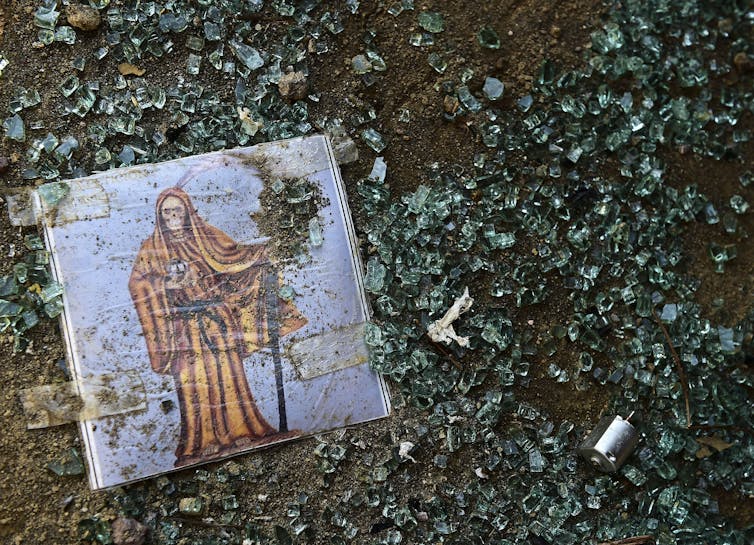
(The Conversation) — When a life-size skeleton dressed like the Grim Reaper first appeared on a street altar in Tepito, Mexico City, in 2001, many passersby instinctively crossed themselves. The figure was La Santa Muerte – or Holy Death – a female folk saint cloaked in mystery and controversy that had previously been known, if at all, as a figure of domestic devotion: someone they might address a prayer to, but in the privacy of their home.

She personifies death itself and is often depicted holding a scythe or globe. And since the early 2000s, her popularity has steadily spread across Mexico and the Americas, Europe and beyond.

The idea and image of death made into a saint is both unthinkable and magnetic. Her association with drug traffickers and criminal rituals makes many people wary of the skeletal figure. La Santa Muerte also faces significant opposition from the Catholic Church, which condemns her veneration as heretical and morally dangerous. High-ranking church figures such as Cardinal Norberto Rivera Carrera in Mexico have publicly denounced her devotion, warning that it promotes superstition and goes against Christian values.

This criticism highlights a profound tension between official religion and the grassroots devotion. Many Mexicans who feel abandoned by government and church institutions embrace her as a source of hope. Indeed, based on my research, La Santa Muerte represents strength, protection and comfort to her devotees, which include prisoners, police officers, sex workers, LGBTQ+ people, migrants, the working class and others among less vulnerable populations. Despite her fearsome appearance, she offers a form of care they are often denied elsewhere.

As an anthropologist who has studied La Santa Muerte in Mexico, I believe her power reflects a paradoxical Mexican understanding of death – not only as a symbol of fear but as an intimate part of everyday life that has become one of resilience and resistance amid the country’s chronic violence.
Death and the state

In my recent book, “The Intimacy of Images,” I examine how devotion to La Santa Muerte in Oaxaca – the state famed for its Day of the Dead tradition – draws on Mexico’s long-standing, often playful relationship with the image of death.


A person holds a picture during a visit to the Santa Muerte temple in Tepito, Mexico City, on April 1, 2025.
Gerardo Vieyra/NurPhoto via Getty Images

Based on over a decade of ethnographic fieldwork, I found how people’s prayers, offerings and promises to her are part of a desire for solutions to everyday problems such as illness, economic hardship and protection from harm. Her frequent representation in images such as altars, tattoos and artistic productions also reflects an evolving social understanding of death that has long been a pervasive symbol of Mexican culture, identity and the power of the state.

Following the Mexican Revolution in the early 20th century, death as a symbol of the new Mexican nation was popularized by artists such as José Guadalupe Posada, especially through La Catrina, the caricature of the dandy skeleton often associated with the Day of the Dead. Whereas death and its personification were once part of an ethos of celebration and fearlessness in the face of death, they have now become disturbing reminders of the mounting insecurity and violence in Mexico.

This transformation, and the role the skeletal saint plays in providing protection in this dangerous context, reflects Mexico’s broader descent into turmoil. In the 2000 national elections, the Institutional Revolutionary Party was unseated after 71 years of uninterrupted rule. The election of the conservative National Action Party, or PAN, in its place saw the fracturing of informal alliances between the state and criminal networks that had previously tamped down on crime through systems of patronage.

In 2006, newly elected PAN President Felipe Calderón launched a militarized war on crime after the yearslong evolution of these early criminal networks into ruthless organizations.

In the following decades, cartel violence has surged, civilian deaths and femicides have escalated, and state institutions have been accused of either direct complicity or a refusal to intervene. The 2014 disappearance of 43 students in Iguala – a case that revealed the degree of state and criminal organizations’ collusion and remains unresolved – only crystallized public outrage. Such rampant violence continues to this day.

Since the beginning of the Mexican drug war in 2006, an estimated 460,000 people have been murdered, and more than 115,000 people are officially listed as missing in the country – roughly one in every 1,140 residents. In heavily affected states such as Guerrero and Jalisco, that ratio is likely far higher, revealing the uneven geography of violence and disappearance across the country.

Claudia Sheinbaum, the country’s first female president – who took office in October 2024 – has promised to dismantle organized crime. Yet the violence and widespread public perceptions of insecurity persist.


A religious image of La Santa Muerte is pictured next to a truck damaged by gunfire in Mexico’s Durango state.
Ronaldo Schemidt/AFP via Getty Images


A violent mirror


For most devotees, La Santa Muerte is not an ally of the criminals, despite its use by cartel-linked groups. Instead, she is one of the few remaining forms of help amid a terrifying social reality. She offers no illusion that the situation of political dysfunction or rampant violence will improve – only presence and protection. Her image reflects a brutal truth: Survival is no longer guaranteed by a state whose ties to the cartels run deep.

This political and spiritual vacuum is seen in the rise of other lay figures of devotion – folk saints such as Jesús Malverde, more official ones such as San Judas Tadeo, or even devotion to the devil.

La Santa Muerte is distinct, however. She is death personified, the end of life, the ultimate judge and a symbol of shared mortality, regardless of status, race or gender. As one devotee told me: “If you open us, you’ll find the same bones.” La Santa Muerte is also imbued with care and love by her followers. Some address her as kin, an aunt or a revered mother incarnating maternal protection and a kind of strength more commonly associated with the masculine. As many say: “She’s a badass.”

In a country where state protection is scarce and the boundaries between authorities and cartels blur, she represents the people and also shields her believers through miraculous protection. Her followers turn to her because, as they say, only death can protect them from death.

Given her devotees’ vulnerability and the wholehearted trust they place in their skeletal saint, La Santa Muerte is more than mere folklore. She is the patron saint of the many in a country where death walks close. She is a figure of personal solace and collective resilience. Above all, she is a mirror – reflecting a society in crisis and engulfed in violence, and a people reaching for meaning, dignity and protection in the face of it all.

(Myriam Lamrani, Associate Researcher, Department of Anthropology, Harvard University. The views expressed in this commentary do not necessarily reflect those of Religion News Service.)


The Conversation religion coverage receives support through the AP’s collaboration with The Conversation US, with funding from Lilly Endowment Inc. The Conversation is solely responsible for this content.