Sunday, November 09, 2025

Column: Funds amass record bull bets on aluminum as market narrative turns
Stock image.

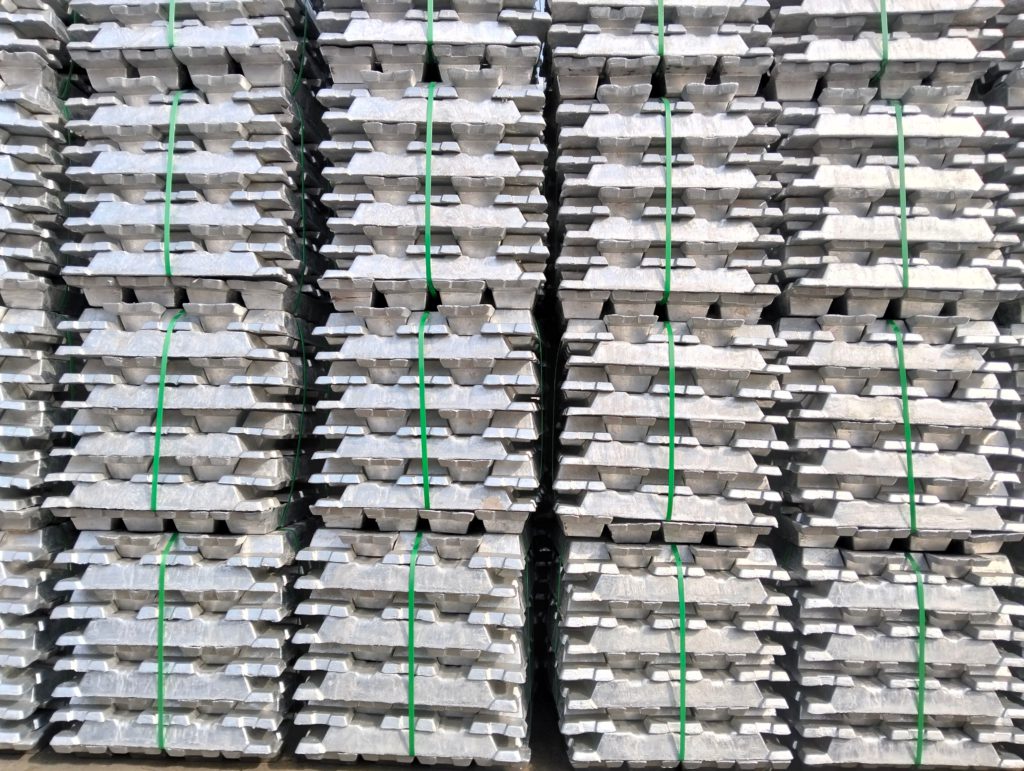
Fund money has surged into the London Metal Exchange (LME) aluminum contract over the past couple of months as investors bet that the market’s days of chronic oversupply are coming to an end.

Investors have built up record long positions, fueling a six-month rally that has seen the LME three-month metal trade this week above the $2,900 per metric ton level for the first time since May 2022.

The speculative inflows speak to a change of narrative in the aluminum market.

With production in China, the world’s largest producer, now running up against the government’s capacity cap, there is growing concern that the market may be heading towards a structural supply deficit for the first time in decades.

That may seem a strange statement, given a single-day 102,275-ton booster to LME inventory last week but, as is often the case with the aluminum market, LME stock movements can be very deceptive.

Investment fund positioning on the LME aluminium contract
Investment fund positioning on the LME aluminum contract

Turning bullish

Investment fund net positioning on the London aluminum contract has swung from neutral to full-on bullish in the space of six months.

The collective net long position has risen above 130,000 contracts for the first time since early 2022, when LME aluminum spiked to a record high of $4,073.50 per ton in the wake of Russia’s invasion of Ukraine.

Outright long positions of 198,744 contracts, equivalent to almost five million tons, are the largest collective bet on higher prices since the LME first started publishing its Commitments of Traders Report in February 2018.

Bear bets have been cut from over 100,000 contracts in April to 68,233, accentuating the swing in net positioning.

LME stocks of aluminium registered and off-warrant
LME stocks of aluminum registered and off-warrant

Stocks shuffle

You might have thought that the delivery of over 100,000 tons of aluminum onto LME warrant last Thursday might have damped bullish exuberance about an imminent shortage of metal.

However, the impact on outright price and time-spreads has been muted. True, the benchmark cash-to-three-months period is no longer in backwardation but the move to contango has been marginal.

That’s because this wasn’t fresh metal being delivered but rather a rotation of inventory from off- to on-warrant storage.

The jump in registered stocks at Malaysia’s Port Klang was accompanied by a similar-sized fall in off-warrant inventory held in the same location.

The stocks carousel has been turning a long time at Port Klang as traders and banks scrap for units to lock in lucrative rent deals. But the latest volumes are much diminished by comparison with past stock shuffles.

Crucially, total LME inventory, registered and off-warrant combined, actually fell by 14,225 tons in October with the headline figure hovering just above the 700,000-ton level for the fifth consecutive month.

It’s worth remembering that a significant part of what’s in the LME system is Russian metal, which is subject to an outright import ban in the United States and creeping sanctions ahead of a full ban next year in the European Union.

CME aluminium premium contracts
CME aluminum premium contracts

Premium power

This latest stocks shuffle has been of largely Indian-brand aluminum, which is now eminently more marketable than Russian material to Western buyers.

This is particularly so in the United States, where physical premiums have been steadily rising ever since US President Donald Trump hiked duties on imports to 25% in February and then doubled them to 50% in June.

Discover more
the LME
LME
The London Metal Exchange
Aluminum
aluminum
Aluminium
the London Metal Exchange
Sustainable mining certifications
Critical minerals report
Mining jobs board

The CME spot US Midwest premium , payable by US consumers over and above the basis LME price, is now at an all-time high of $0.89 per pound, equivalent to $1,938 per ton.

US delivery now costs 67% of the LME price, suggesting that inventory accumulated ahead of the tariff hike has been drawn down and the American market is running short of metal.

That pulling power is starting to see aluminum fall off the LME stocks roundabout in Port Klang and head westwards.

Trading house Mercuria, which has been running a dominant long position on the LME contract for many months, is shipping more than 30,000 tons of aluminum to the United States, Reuters reported last week.

Even LME warehouses cannot compete with the currently elevated premium for US delivery, which is why so little fresh metal has entered the LME system despite months of rolling squeeze on the London market.

And until it does, funds will have no reason to question aluminum’s newly-minted bull narrative.

(The opinions expressed here are those of the author, Andy Home, a columnist for Reuters.)

(Editing by Emelia Sithole-Matarise)

AU

Column: Gold price rally looks huge, but only ranks third in last 50 years

Stock image.

Gold’s recent retreat from a record high has led to questions as to whether the precious metal has run out of steam and is due for an extended period of sideways trading, as has happened in the past.

It’s certainly the case over the last 50 years that whenever gold has enjoyed a surge in prices it has then suffered long periods where it has generally trended weaker.

But it’s also worth noting that the current rally is only the third-strongest in terms of the percentage gain in the past 50 years, and is actually well behind the price increases recorded in the late 1970s and again in the 2000-2011 uptrend.

The current rally started in October 2022 when the spot price was around $1,617 an ounce and initially the uptrend was gentle, before accelerating dramatically from November 2024 onwards after the election of Donald Trump to a second term as US president.

The precious metal reached an all-time high of $4,381.21 an ounce on October 20, taking its gain since October 2022 to 170%.

It has since slipped back to end Wednesday’s trade at $3,978.63 an ounce.

The rally over the past three years looks impressive, but pales in comparison to the 518% jump between July 1976 and February 1980 and the 643% gain between February 2001 and September 2011.

Both of these extended rallies were followed by a long downtrend, but the losses were nowhere near enough to wipe out the gains.

From the peak of around $692 an ounce in February 1980, gold dropped about 63% to $256 by February 2001, while it retreated 44% from the top of around $1,902 in September 2011 to the low of $1,052 in November 2015.

What does this mean for the current price uptrend?

In historical percentage terms it is not actually that large, despite the massive increase in the US-dollar price.

This doesn’t necessarily mean the rally will extend for several more years, but it does mean that if it does, it would not be unprecedented.

Gold’s history also shows that when rallies do end, prices tend to drop back and then trade sideways for an extended period.

The final thing worth noting is that analysts have usually found it quite difficult to predict when an inflection point is being reached, and the current situation is little different to past experiences.

Diverging forecasts

There is now a wide range of forecasts for the gold price, with some analysts calling for it to fall back to levels closer to $3,000 an ounce, and others calling for further gains to above $5,000 on a one- to two-year view.

The key is to work out if the current bullish drivers are structural or more likely temporary in nature.

The compelling argument for a structural rally is the belief that investors and central banks are seeking alternatives to US assets such as Treasuries and Wall Street equities, and gold is one of the few viable alternatives.

Certainly the World Gold Council’s September quarter report did offer data supporting this view, with central banks buying a net 220 metric tons in the third quarter, up 28% from the previous quarter.

Central bank purchases started to rise rapidly in 2022 and have since been above 1,000 tons per year, with 2025 on target to become the fourth consecutive year.

Investment demand for gold bars and coins as well as exchange-traded funds reached 220 tons in the third quarter, up 47% from the same period in 2024, the council said.

The bearish note was that surging prices crimped jewellery demand, which dropped 19% in the third quarter to 371.3 tons from 460 tons in the same period a year earlier.

There are other risks to the bullish gold picture, such as a correction in global equities resulting in investors having to sell gold to cover losses elsewhere.

But the ongoing concerns over the US fiscal deficits and the threat to the independence of the Federal Reserve posed by Trump’s seeming determination to control monetary policy are likely to be enough to keep gold firmly on investors’ radar.

(The views expressed here are those of the author, Clyde Russell, a columnist for Reuters.)

(Editing by Jamie Freed)


“The Gold-Bug” was an early detective story that helped to establish the ... point, and a line of hard, white beach on the seacoast, is covered with a ...

Tungsten West produces first trial concentrate at Hemerdon mine in UK

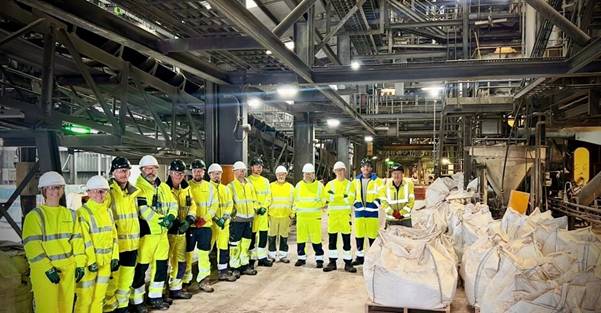
Tungsten West team at the Hemerdon Mineral Processing Facility with trial tungsten concentrate. Image: Tungsten West.

Tungsten West (LON: TUN) has successfully generated its first tungsten concentrate from the ongoing mineral processing trial towards restarting the Hemerdon mine in Devon, England.

The trial is being undertaken as part of a program focused on testing and optimizing the performance of key sections of the mine’s processing facility. The program is part of Tungsten West’s approach to de-risking operations and gathering technical data essential for the planned restart of full-scale production.

Tungsten is a smaller market, with an estimated value of around $5 billion in 2023. But the industries that depend on it are getting bigger, and it is the material of choice for a key defense application – what the military calls penetrators – high-density, armour-piercing projectiles.

Hemerdon, formerly known as Drakelands mine, or the Hemerdon Ball or Hemerdon Bal mine, has a history of mining activity. Operations date back to 1918, with production during both World Wars, according to the company’s website.

Further exploration and feasibility work were carried out in the 1980s. The site was later developed into a modern operation and produced tungsten and tin between August 2015 and October 2018 under previous operators. The mine is located 7 miles northeast of Plymouth, and is one of the largest tungsten resources in the world, the Plympton-headquartered miner said.

Tungsten West said the first concentrate production marks an important milestone in restarting operations at Hemerdon — a strategically important project to the UK and Europe that could provide a secure supply of tungsten outside of China, with restart of operations anticipated by late 2026.

The progress we are making in this processing trial is an important milestone in restarting operations at Hemerdon and provides confidence to our neighbours, the environment agency, our investors and off-takers that we are moving towards production,” Tungsten West CEO Jeff Court said in a news release.

“We have ensured that all activities throughout this trial have been conducted to high environmental and operational standards,” Court continued. “As the need for a diversified source of tungsten intensifies, Hemerdon becomes an even more important strategic asset.”

Tungsten West’s London-listed shares closed the day up 12%. The company has a £21.28 million ($28 million) market capitalization.


Cove Capital to mine Kazakhstan tungsten in Trump-announced deal

Assy Plateau, Kazakhstan. Stock image.

Mining investment firm Cove Capital will develop a large tungsten deposit in Kazakhstan with the state mining firm JSC Tau-Ken Samruk under a deal to be announced by the Trump administration on Thursday.

The agreement is part of a suite of deals announced between Washington and Astana to tighten economic partnerships between the countries.

Cove Capital will control 70% of a joint venture and sales of the metal, with Tau-Ken Samruk controlling the remaining 30%, according to a document seen by Reuters. Costs to develop the Northern Katpar and Upper Kairakty projects – in the country’s east – are estimated at $1.1 billion, while the US Export-Import Bank has issued a letter of interest to fund $900 million.

Tungsten, used to harden steel for a range of industries, is considered a critical mineral by the US government. The US has not mined the metal since 2015 and China is by far the world’s largest producer. Supplies of the metal from the Kazakhstan projects will be used “to prioritize US government and American commercial needs,” according to the document.

“This is a generational win for the US and its critical minerals needs,” Cove CEO Pini Althaus told Reuters.

Althaus, who was previously the CEO of USA Rare Earth, said US President Donald Trump and Commerce Secretary Howard Lutnick personally helped negotiate the deal to prevent Chinese companies from developing the asset.

“This has just been a very under-explored part of the world, from a US point of view, and vice versa,” Deputy Secretary of State Christopher Landau said at a C5+1 business conference event at the Kennedy Center on Thursday, which included Kazakhstan officials.

Mine construction should start within two years and production should commence within 3-1/2 years, with refining also occurring inside Kazakhstan, Althaus said.

(By Ernest Scheyder, Trevor Hunnicutt and Daphne Psaledakis; Editing by Rod Nickel)

RARE EARTHS

China lifts export ban on gallium, germanium and antimony to US


Stock image.

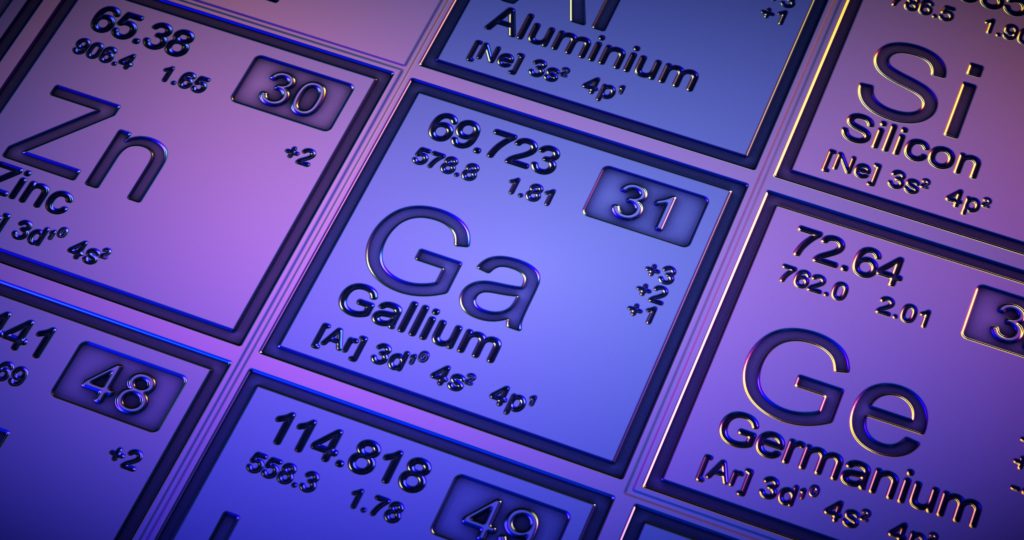
China has lifted a nearly year-long ban on exports of gallium, germanium and antimony to the US, in a further de-escalation of trade tensions between the world’s two largest economies.

In a statement issued on Sunday, China’s commerce ministry said it will pause its export ban on these minerals and related end-use items for about one year. The ban was first imposed in December 2024 in retaliation for US export controls on high-bandwidth memory chips into China towards the end of the Biden administration.

The US considers all three minerals to be critical to its national security and economy. Gallium and germanium are both essential for semiconductors, with the former also used in advanced radar technology and the latter in infrared technology, fiber optic cables and solar cells. Antimony is widely used in military applications such as flame retardants and primers for ammunition.

According to the consultancy Project Blue, China accounted for almost half of the world’s mined antimony in 2023, as well as nearly 60% of global refined germanium production and 99% of refined gallium output.

The US Geological Survey estimates that the ban on gallium and germanium alone could result in a $3.4 billion hit to the US economy. Around half of the decrease would come from the semiconductor sector, a key battleground between China and the US.

In its statement, the Chinese commerce ministry said the suspension of its 2024 export curbs will take place until Nov. 27, 2026, without providing further details.

The announcement comes just days after China agreed to suspend the additional export controls introduced in early October on rare earths and other battery minerals for one year.

China starts work on easing rare earth export rules but short of Trump hopes


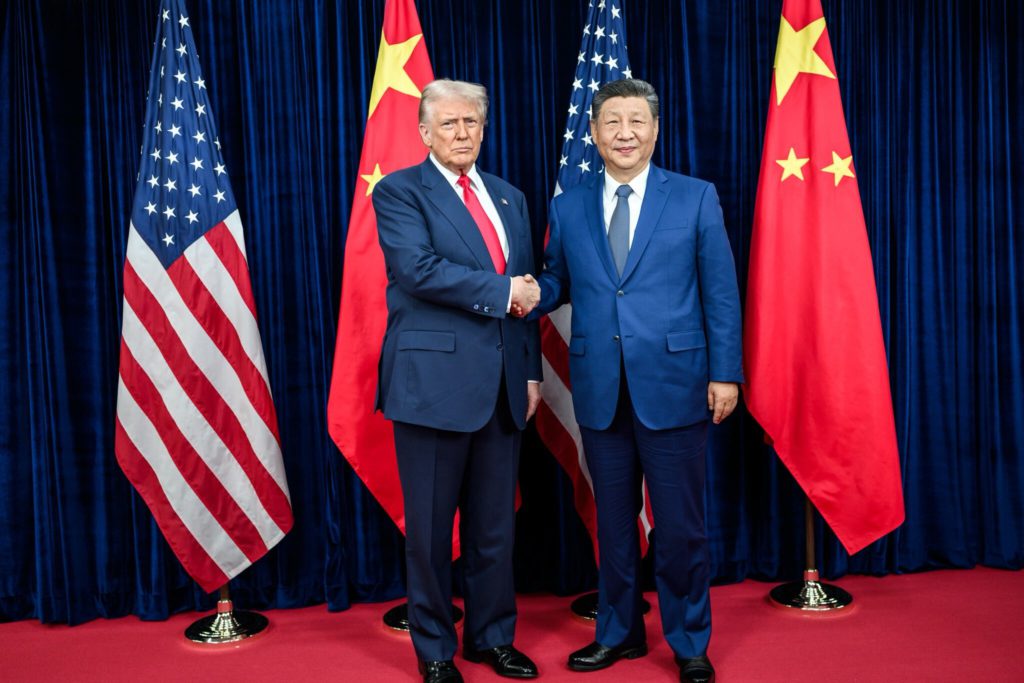
US President Donald J. Trump and Chinese President Xi Jinping meet in South Korea. Credit: The White House’s official X account

China has begun designing a new rare earth licensing regime that could speed up shipments, but it is unlikely to amount to a complete rollback of restrictions as hoped by Washington, industry insiders said.

The Ministry of Commerce told some rare earth exporters they will be able to apply for new streamlined permits in the future and in industry briefings outlined the documents that will be required, two sources familiar with the matter said.

The export curbs have become Beijing’s most potent source of leverage in its trade rivalry with Washington, as China produces over 90% of the world’s processed rare earths and rare earth magnets, vital in products ranging from cars to missiles.

Following the agreement reached between Presidents Donald Trump and Xi Jinping, China said last week it would pause for one year the restrictions it imposed in October.

However, China’s commerce ministry has said nothing publicly about a broader round of controls introduced in April that rattled global supply chains.

The White House said on Saturday that China had agreed to introduce general licenses and characterized such permits as the de facto end of China’s rare earth export controls.

In private, Chinese officials have said they are working on the licenses, three other sources briefed on discussions said, although one said it could take months.

However, other industry insiders said the new licenses do not mean China’s wide-ranging rare earth export controls introduced in April have been removed.

China’s Ministry of Commerce did not immediately respond to questions from Reuters.

One year, potentially higher volumes

The new licenses would be valid for a year and probably allow larger export volumes, the first two sources said. Companies are preparing documents, which will require more information from customers, they said.

The sources said they expect more clarity by the end of the year.

Some Chinese rare earth companies said they have not yet been informed of the change.

General licenses will likely be harder to acquire for users associated with defence or other sensitive areas, some industry sources said.

All sources spoke on condition of anonymity given the sensitivity of the matter.

Introduced in April and expanded in October, Beijing’s rare earth rules require exporters to obtain licenses for every cargo, an onerous and lengthy process customers complain is holding up exports. The restrictions created shortages in May which brought parts of the auto industry to a halt.

Of the 2,000 applications submitted by European Union firms since April, just over half have been approved.

(Editing by Sonali Paul)


China approves registration of platinum and palladium futures

Platinum bullions. (Stock image)

China has approved registration of platinum and palladium futures and options, moving a step closer to the launch of the derivatives trading of the metals used by automakers and other industrial sectors.

The China Securities Regulatory Commission said on Friday that it would supervise the Guangzhou Futures Exchange to ensure a smooth launch of platinum and palladium futures and options. The regulator did not disclose a date for the launch.

The Guangzhou bourse, which was established in 2021 and mainly focuses on products related to green energy, announced the plans in July last year, seeking to provide a domestic price-hedging mechanism for the metals.

The exchange had been communicating with futures companies, producers and traders on the design of the proposed contracts, industry insiders said.

Prices of platinum and palladium have spiked this year, driven by tight supply.

Analysts have raised price forecasts for platinum and palladium in 2026, citing tight mine supply, tariff uncertainty and rotation from investment demand for gold.

(By Amy Lv, Xiuhao Chen and Ryan Woo; Editing by David Goodman)

CATL sees progress in bid to restart key China lithium mine

Yichun city, China. Credit: Xwn0122, Wikimedia Commons, under licence CC BY-SA 4.0.

Contemporary Amperex Technology Co. Ltd. has been told how much it should pay for the rights to its key lithium mine in China, another sign of progress in the battery maker’s bid to restart the operation that’s been halted since August.

The Chinese company is required to pay 247 million yuan ($35 million) for the lithium mining rights at its Jianxiawo project in Yichun city, according to the website of Jiangxi province’s Department of Natural Resources, which shows a valuation report submitted by a government-appointed asset appraisal company.

The levy is necessary for CATL to get its mining license approved and is a precondition for Jianxiawo to restart, analysts at UBS Group said in a note.

CATL didn’t immediately respond to a request for comment.

Production at the mine has been suspended since CATL failed to get an extension on a permit that expired Aug. 9, creating uncertainty in the lithium market at a time when Chinese authorities are scrutinizing supply chains for the battery ingredient. CATL is the world’s biggest battery supplier for electric vehicles, with Jianxiawo forecast to account for about 3% of global lithium production.

The mining right transferral from the government was evaluated in 2022 based on kaolinite deposits, without considering other minerals including lithium, according to the valuation report on Jianxiawo dated Nov. 6. Previously, eight mines in the region were asked to submit reports on reserves, following an audit that uncovered administrative shortcomings.

CATL shares fell as much as 1.5% in Shenzhen on Friday, tracking broader weakness across Asian equity markets.

(By Annie Lee and Charlotte Yang)


US Coast Guard Reports Best Year Ever for Cocaine Interdiction

NO UNAUTHORIZED DRONE ATTACKS AND SINKINGS OF DRUG BOATS

Hamilton cocaine
Courtesy USCG

Published Nov 6, 2025 5:17 PM by The Maritime Executive


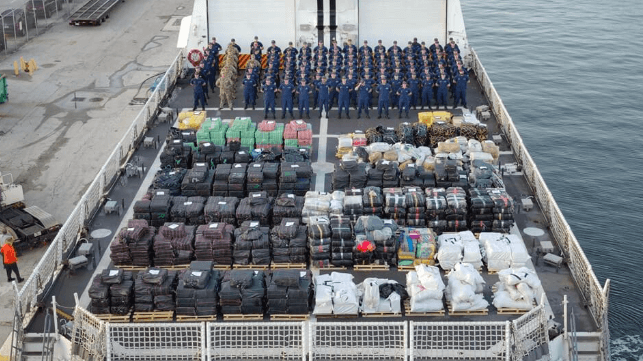
The U.S. Coast Guard has achieved a new record for cocaine seizures in a fiscal year, capturing more than 225 tonnes in the U.S. Southern Command area of operations between October 2024 and October 2025. The achievement is a testament to heightened patrol operations in the region, as well as the continued boom in cocaine production in Columbia and other countries of origin. Colombia alone manufactured an estimated 1,800 tonnes of cocaine in 2022, and output has been on a steep upward trajectory as the acreage covered by coca producers continues to rise. 

"The Coast Guard’s top priority is to achieve complete operational control of the U.S. border and maritime approaches," said Adm. Kevin Lunday, acting commandant and commandant nominee of the Coast Guard. "We own the sea, and this historic amount of cocaine seized shows we are defeating narco-terrorist and cartel operations to protect our communities and keep dangerous drugs off our streets."

The FY2025 effort resulted in the seizure of more than three times the annual average, normally about 75 tonnes. In August through October, the service was seizing an average of more than 1,500 pounds per day. 

The service's nonlethal interdiction operation runs in parallel with the military-led effort to destroy drug boats in transit in the Eastern Pacific and the Caribbean. Using airstrikes, the Trump Administration has eliminated 16 suspected smuggling craft, killed 67 suspects and rescued two known survivors. That campaign has drawn criticism from legal scholars and many judge advocates general, as well as a warning from UN High Commissioner for Human Rights Volker Türk. Last week, Türk called for an international investigation and described the strike campaign as a program of "extrajudicial killing" that "violate[s] international human rights law."

By contrast, the U.S. Coast Guard's drug boat intercepts have a long record of nonlethality, with few exceptions. One individual was accidentally shot and killed in January 2024 when a Coast Guard helicopter sniper team used force to disable his boat's engine off the Dominican Republic; the interdiction team made an effort to save his life, and he was flown to a shoreside hospital for treatment. An investigation followed to determine root causes and lessons-learned.  


Portuguese Navy Carries Out Long Range Drug Bust in Mid-Atlantic

Drug bust at sea
Courtesy Marinha

Published Nov 5, 2025 5:09 PM by The Maritime Executive


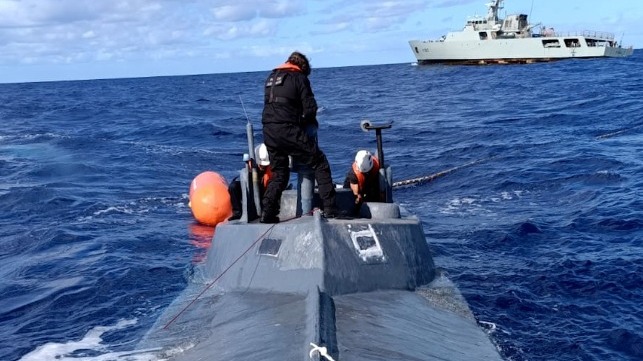
Portugal's navy has seized a drug trafficking semi-submersible in the mid-Atlantic, far off the coast of Lisbon. 

The Portuguese Navy (Marinha) detected the suspect vessel using its surveillance assets and worked in conjunction with the Judicial Police to plan an intercept. In an example of the significant scale required to mount such an operation, it dispatched a patrol vessel with more than 70 military personnel and sailed a total distance of about 1,500 nautical miles. 

Early in the morning of October 29, the team reached the intercept location and boarded the suspect vessel. They found more than 1,700 kilos of cocaine aboard, enough to fetch somewhere in the range of $30 million on the EU wholesale market. The semisubmersible itself - an improvised vessel intended for a one-way journey - was not robust enough to be towed back for investigation, and it sank. 

It was the second interdiction of a semisubmersible drug boat that the Marinha has carried out this year. The first was another ultra-long-distance bust at a range of about 1,200 nautical miles off Lisbon's shores, and resulted in a major haul of six tonnes of cocaine. 

European law enforcement may well see additional pressure from transatlantic cocaine traffickers due to the Trump administration's airstrike campaign, which has introduced the threat of lethal force into the calculations of cartels and drug vessel crewmembers. Organized crime experts predict that more volume will now be routed towards the EU via established routes, like the growing Brazil-West Africa-Europe trade lane. This may have the effect of further depressing already-declining cocaine prices in Europe, making the drug dangerously accessible to a broader range of users.

EU's Kallas urged adherence to international law concerning US attacks on vessels
Copyright EBUBy Sertac Aktan EURONEWS with EBU and AP 09/11/2025 - 

At the CELAC-EU summit in Colombia, leaders addressed US attacks on alleged drug-smuggling vessels. Mexico defended national sovereignty as the US strikes have reportedly killed 69 people.

The fourth summit of the Community of Latin American and Caribbean States (CELAC) and the European Union (EU) has kicked off today in Santa Marta, Colombia.

The EU's foreign policy chief, Kaja Kallas, is among the bloc's leaders attending the meeting.

Speaking at the event upon her arrival, Kallas said the EU's position on the US attacks in the Caribbean and the Pacific is to uphold international law, meaning the use of force is justified only in self-defence or under a UN Security Council resolution.

The Dutch Prime Minister, Dick Schoof, said it is important to restore calm in the Caribbean Sea and urged leaders to work towards reducing tensions.

The Mexican Secretary of Foreign Affairs, Juan Ramon de la Fuente, also commented on the US attacks on vessels on the Caribbean Sea, saying Mexico's position seeks to respect the "sovereignty of peoples and their self-determination."

According to the US defence secretary, Pete Hegseth, the US has reported carrying out 14 strikes since September on boats near the Venezuelan coast and also in the eastern Pacific Ocean.

The sources stated that 69 people have been killed in these attacks on alleged drug-smuggling vessels.

Colombian President Gustavo Petro has called the deaths “extrajudicial executions” and has identified at least one of the killed as a Colombian citizen. One of two known survivors of the attacks is also Colombian.

Absence of senior names might have downgraded the effect

With this summit, representatives of European, Latin American and Caribbean nations try to strengthen ties amid divisions in the Western Hemisphere over the US military operation targeting alleged drug-carrying vessels.

But the relevance of the two-day summit of the Community of Latin American and Caribbean States and the European Union has come into question due to the absence of heads of state and senior officials, including European Commission President Ursula von der Leyen and German Chancellor Friedrich Merz.