Let’s Shift Federal Subsidies to Loans After 1 Year, Starting With Oil/Gas Industry!
It’ll Reimburse Tax Revenue
 The origin of federal subsidies—to businesses, industries, farmers, national infrastructure—began with our country’s first Congress (1789) approving startup financing that banks and other sources couldn’t or wouldn’t provide. The idea then (and now) was that if these investments were successful, they would trigger other enterprises. Subsequent jobs would follow, feeding consumer spending, and, ultimately, federal tax revenues to run this new government.
Subsidies did rapidly build our country and, eventually, make us a world power. As a 1958 Congressional report said:
America’s infant industry, without the aid of subsidy laws in the early years after the formation of this independent Nation, would have been slow to develop and the emergence of the United States as a world power could have been retarded for many years…. Subsidy has had a substantial and beneficial role in the Nation’s overall industrial development. It has been important in aiding the economy and the people—especially in times of depression. It has been essential in stimulating vital production in wartime. It has financed scientific development. It has been used in efforts to balance the economic positions of vast segments of our total society.
The report cited examples of initially subsidizing our merchant fleet, to build canals, make river improvements, create railroads, air travel and military aircraft, as well as underpin agriculture’s costs/prices to sustain food production.
However those early lawmakers could scarcely conceive of, say, a much-troubled 133-year-old company like General Electric receiving $1,658,411,718 in federal subsidies from 2000-2025. Worse, in 2010 alone, GE hid its $14.2 billion profits offshore to avoid federal taxes.
So it’s one thing for taxpayers to cover initial expenses of a company to thrive, but quite another for the recipient to be at the federal teat after profits show it can stand alone. There’s a strong case for limiting government subsidies to one year. Pioneers like my Minnesota ancestors got only two years to plant and improve their “free” government land. Newly subsidized railroads needed crop cargos to survive.
After that one-year trial period today, why not shift subsidies to regular loans with interest (currently 6.6 percent) so that the U.S. Treasury is reimbursed by business taxes thereafter for a successful company.
Now, collectively, recipients’ “gifts” from the U.S. Treasury add up to big-time sums..
This year’s total federal subsidies are $34.8 billion—plus the $4 billion in Trump’s One Big Beautiful Bill Act, according to Oil Change International. That’s nearly $40 billion as hard times approach most Americans: significant unemployment (7.4 million), vast social services cuts (Medicaid/CHIP: $863.4 billion), rising costs of living (3% in September).
Further, we taxpayers are never told who gets subsidies, aside from farmers. For decades, the public anger has fallen upon them for taking its money forever and never giving it back.
(Somehow, producing the nation’s food supply apparently doesn’t count.) But what if Treasury snail-mailed an annual list of subsidy recipients and amounts to every taxpayer? For one thing, screening applicants might deny subsidies to those whose products are likely to cause death and destruction domestically and/or abroad. For another, political favoritism would be revealed. So would profitable subsidy “repeaters” crowding out s promising enterprises.
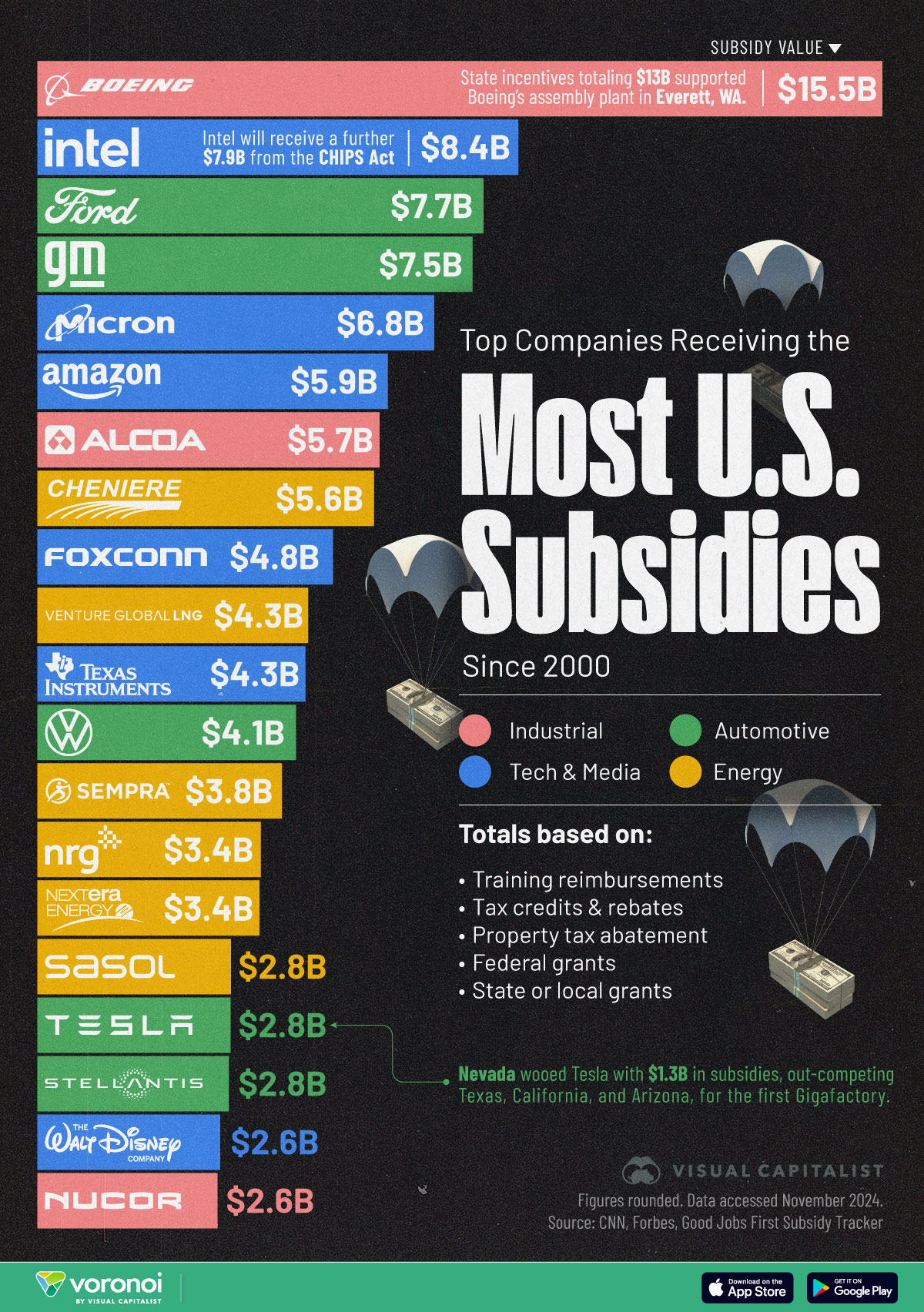
If that list had ever been done like online’s Subsidy Tracker, taxpayers would have learned that Boeing, for instance, has received 868 federal subsidies totaling $15,609,962,422 from 2000-2025. Its annual profits in those 25 years could easily do without continuing subsidies. Before its 2024 troubles, growing profits in 2022 were $3.53 billion; in 2023, $ 7.724 billion.
Perhaps the federal government should also prohibit subsidies and/or loans to companies whose products could cause death and destruction—like the top three gun and ammunition makers: Remington ($68.9 million), Sturm, Ruger ($12.6 million), Smith & Wesson ($105.1 million) up to 2019 .
Then, there’s the U.S. fossil-fuel industry polluting the air we breathe and being the principal cause of global warming. Our top four oil/gas corporations have been receiving significant annual federal subsidies during that 2000-25 period. Subsidies from 2000-25 and 2024 profits were:
Company 2000-25 Subsidies 2024 Profits
Shell $2,214,111,308 $23,700,000,000
Exxon Mobil 1,955,436,318 33,000,000,000
Chevron 619,839,444 17,700,000,000
Conoco Phillips 31,512,318 9,200,000,000
Interestingly, since President Trump’s inauguration, he has conducted an all-out war on wind and solar energy, issuing at least 23 actions —executive orders, agency rules, administration decisions— to strangle this cheaper, renewable, clean, non-harmful, and growing popular system. Ongoing projects have been cancelled, finances hobbled, starts prevented, farmlands restricted, and blocked Solar for All grants. Forget subsidies for the small, promising companies involved in this clean energy source, thousands of jobs scuttled, lower utility bills, and increase in public and business power needs.
Dozens of other firms are on the federal dole, according to Subsidy Tracker ‘s list of the first 100. To those started from scratch to become today’s billion-dollar corporations, subsidies are “chicken-feed,” yet income they count on year after year. Remington, the gun and ammunition maker, used its $68.9 million subsidy one year to move from its New York birthplace to Alabama, a much friendlier atmosphere.
Oil/gas interests are a monumental case in point. Their startup subsidies have led to demanding the government furnish financial and military support to seize reserves of countries like Iraq. That country played no role in the 9/11 attack on New York’s World Trade Center. But its immense oil reserves (2025:145 billion barrels ) provided an excuse for President George W. Bush’s administration to invade and especially to “secure” its oil fields.
Two decades have passed, but some 2,500 U.S. soldiers are still there purportedly to ward off oil raiders from ISIS, Syria, and other covetous sources. Too, at least five major American oil/gas companies —Chevron, ExxonMobil, SLB (formerly Schlumberger), Halliburton, Baker Hughes—are in Iraq busily exploring, drilling, and building infrastructure for their oil/gas exports.
Total cost of the Iraqi war to the American taxpayer on behalf of that industry by 2050 is expected to reach $3 trillion —not to mention the millions of dead and wounded and billions in destruction of that country.
Venezuela is next, of course, with the world’s greatest oil reserves (303.2 billion barrels).
A huge U.S. armada of ships, aircraft, men, and materiel stands at the ready to invade its Vietnam-like jungles and seize them—and topple its government.
A key point here is that only awakened and angry taxpayers can stop subsidy abuse if they speak up to shift startup subsidies after a year to government loans with monthly payments. Also by demanding that Treasury send us recipients’ annual list.
All it takes is lobbying their Congressional House/Senate members by phone, email, in person, or picketing their home offices. It’s guaranteed to get voters’ attention before the midterm elections.
