Tuesday, November 11, 2025


Ukraine Hits Port of Tuapse for a Third Time in Long-Range Strike

Tuapse strike
Via Russian social media

Published Nov 10, 2025 6:07 PM by The Maritime Executive


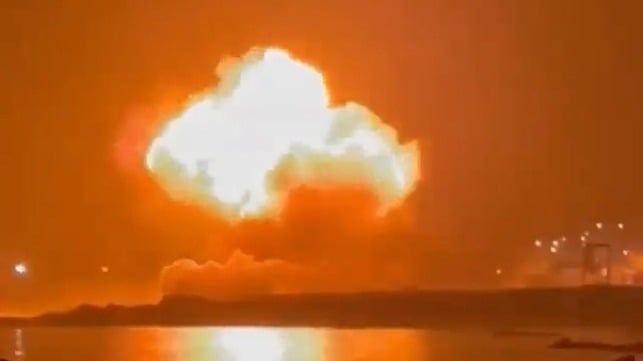
Ukrainian forces have conducted another long range drone strike on the port of Tuapse, Russia, the third such attack in as many months. One pier was hit and it is possible that a small product tanker was damaged, according to open source intelligence analysts, though official Russian sources deny that any infrastructure damage occurred. 

The port of Tuapse is home to a Rosneft-operated oil terminal, which serves a nearby refinery. It can handle Aframax tankers up to about 110,000 dwt, and it normally exports about 17 million tonnes of crude and refined product per year. It is the second-largest Russian oil port on the Black Sea, after Novorossiysk. 

Overnight Sunday, a flotilla of naval drones made a long-range attack run on Tuapse's oil terminal, according to Ukrainian media and military analysts. After reportedly departing the Odesa region and crossing the full width of the Black Sea, the drone force attempted to enter Tuapse. At least two explosions were recorded within the port's harbor in the early hours of Monday morning. 

Authorities in Tuapse reported the destruction of four drone boats at sea. Both naval and airborne drones were reported, and anecdotal reports indicate that heavy Flamingo or Neptune cruise missiles may have been deployed as well. Bystander videos from Tuapse show a large crater in the middle of a nearby public beach, and a flattened storage shed - signs of a heavy hit located well inland from where a seaborne drone could strike.  

According to Reuters, Russian rail operators have suspended train service to the port of Tuapse because there is not enough capacity to handle the volume. The terminal is reportedly shut down pending repairs, and satellite imaging shows that its oil terminal berths are empty.

Tuapse is far from the only target: Ukraine has hit oil and gas infrastructure across Russia since this summer, and has taken an estimated 20 percent of all Russian refining capacity offline with long-distance drone strikes. 

Ukraine Suffers Power Cuts After Russia’s Heaviest Air Barrage in Months

  • Massive Russian air and drone strikes on November 7–9 devastated Ukraine’s energy infrastructure, leading to blackouts in most regions.

  • Officials warned of rising nuclear risks after substations powering nuclear plants were hit, prompting calls for urgent IAEA action.

  • Ukraine responded with drone attacks on Russian energy sites, escalating the cross-border energy warfare as fighting intensified around Pokrovsk.

Kyiv and many Ukrainian regions faced extensive power cuts and outages as crews struggled to repair infrastructure battered by Russian air attacks.

Power was reduced in most regions for eight to 16 hours on November 9, state energy provider Ukrenergo said, adding that consumption restrictions were scheduled for November 10 as well.

"The reason for the introduction of restrictions is the consequences of massive Russian missile and drone attacks on energy facilities," the company said.

"It is difficult to recall such a [large] number of direct strikes on energy facilities since the beginning of the invasion," company spokeswoman Svitlana Hrynchuk told Ukrainian media.

Ukrainian President Volodymyr Zelensky said in his nightly video address that "repair crews are working almost around the clock in most regions."

"Restoration efforts are ongoing, and although the situation is difficult, thousands of people are involved in stabilizing the system and repairing the damage," he added.

Even before the onset of cold weather across Ukraine, Russia had intensified its campaign to take out the country's power grid, as well as natural gas facilities and pipelines, in an effort to freeze and demoralize Ukrainians.

At least seven people were killed and an unknown number of others wounded in the Russian attacks on November 7, prompting Zelenskyy to again urge Kyiv's allies to punish Russia and pressure President Vladimir Putin.

"Any [further] weakening…only encourages Putin to prolong the war, inflict more damage on our country, our people, and others around the world," he said on November 8.

Foreign Minister Andriy Sybiha said Russia had targeted substations that provided power to two nuclear facilities.

"These were not accidental, but well-planned strikes. Russia is deliberately jeopardizing Europe's nuclear safety," he said in a post to X. He called for an urgent meeting of the International Atomic Energy Agency, the UN nuclear watchdog, to respond to the "unacceptable risks."

IAEA director Rafael Grossi warned of the danger of military strikes on nuclear plant electrical substations.

"I continue to call for maximum military restraint in order to maintain nuclear safety and avoid an accident with serious radiological consequences,” he said in a statement.

Grossi also said Ukraine's biggest nuclear facility, in Zaporizhzhya, had regained access to back-up electricity from the grid for the first time in six months. The plant, which is under Russian control, has seen interruptions that have endangered critical plant infrastructure, like pumps that supply cooling water.

Russia launched more than 450 drones and 45 missiles in the November 8 barrage, Ukrainian officials said.

Russia's Defense Ministry, meanwhile, said it had launched "a massive strike with high-precision long-range air, ground and sea-based weapons" and claimed it targeted weapon production and energy facilities in Ukraine.

Power cuts were also undertaken in the Poltava region under a special emergency outage schedule ordered by Ukrenergo, with Kremenchuk -- a city of 200,000 people -- reporting a complete blackout, prompting the opening of temporary public hubs offering heat, power, Internet, water, and basic aid.

In Dnipro, a Russian drone strike hit a nine?story residential building, with at least three people reported killed. A two-day mourning has been declared.

Russian attacks also cut power to subway stations in Ukraine's second largest city, Kharkiv, Mayor Ihor Terekhov said.

Subways and trams have been fully stopped and water supplies have also been disrupted, he said in a post to Telegram.

Ukraine Hits Back At Sites In Russia

For its part, Ukraine has conducted its own near-nightly drone barrage of Russian energy facilities, a campaign that has sharply reduced Russia's ability to produce gasoline and other refined oil products.

In Russian border regions, like Belgorod and Kursk, Ukraine has hit electricity infrastructure, along with municipal heating plants.

More than 20,000 people were reported without power in several border regions on November 9, Belgorod Governor Vyacheslav Gladkov said.

Unconfirmed reports said that the municipal heating plant in Voronezh, about 200 kilometers east of the Russian border, had been hit by Ukrainian drones.

The Defense Ministry reported that more than 40 Ukrainian drones were downed overnight, mostly over the Bryansk region. The Defense Ministry made no mention of the Voronezh region.

Kyiv has urged the United States to supply long?range Tomahawk missiles to strike targets deep inside Russia but President Donald Trump has repeatedly rebuffed the requests.

Moscow warned Washington against sending Tomahawks, with Putin calling the move a "completely new stage of escalation" in US-Russia relations.

Pressure Heightens Around Pokrovsk

As Ukraine battled with the latest attacks on its energy sector, its forces were also struggling to hold the strategic Donetsk city of Pokrovsk.

Ukrainian authorities have acknowledged that the situation in the region is "difficult" but have denied Russian claims that Pokrovsk is surrounded.

The city has become the fiercest area on Ukraine's front line this year, with fighting there resembling some of the bloodiest and longest battles of the war.

Ukrainian military expert Oleksiy Hetman told RFE/RL that while the situation is growing difficult, Ukrainian forces still have strongholds prepared west of the city, which would allow them to repel further Russian assaults.

By RFE/RL


Oil Prices Slip Despite Lukoil Declaring Force Majeure in IraqBy Irina Slav - Nov 11, 2025


Crude oil prices opened lower today even after Russia’s Lukoil declared force majeure on its operations in one of Iraq’s biggest oil fields because of the latest U.S. sanctions.

At the time of writing, Brent crude was trading at $63.84 per barrel, with West Texas Intermediate at $59.89 per barrel, as reports suggest record high volumes of oil in floating storage, following Washington’s latest sanction salvo against Moscow.

Reuters reported on Monday, citing unnamed sources, that Lukoil had declared a force majeure on the West Qurna-2 field, which produces some 400,000 barrels of crude daily. Following the October 22 U.S. sanctions on Lukoil and Rosneft, Iraq had stopped all cash and crude payments to Lukoil, the sources told the publication. The Russian major has a 75% stake in the field.


Even so, the dominant sentiment on oil markets continues to be bearish thanks to projections of an oversupply. “As OPEC production increases grind on, global oil balances are acquiring an increasingly bearish hue on the supply side of the ledger with demand still trending lower in conjunction with a slowed economic growth path among major oil-consuming countries,” one outlet that shares the sentiment, Ritterbusch and Associates, said in a note as quoted by Reuters.
President Trump, meanwhile, said that he was close to closing a trade deal with India, noting that the latter had “stopped doing the Russian oil — it’s been reduced very substantially,” as quoted by Bloomberg.Now, oil traders would be awaiting OPEC’s latest monthly report, scheduled to be released tomorrow and coinciding with the International Energy Agency’s own monthly report. Both are likely to stick to their demand and supply projections, where OPEC sees demand as much stronger than the IEA, and the IEA expects a massive supply overhang, where OPEC sees a market more or less in balance.


By Irina Slav for Oilprice.com

Lukoil’s Iraq Exit Marks Major Sanctions Victory for the West

  • Lukoil is withdrawing from its core energy interests in Iraq, specifically the West Qurna 2 oil field, following a new wave of U.S. and E.U. sanctions targeting Russia's ability to fund the war in Ukraine.

  • The exit is considered a major geopolitical victory for the West, opening new opportunities for companies like ExxonMobil, BP, and TotalEnergies to expand their influence in Iraq's oil sector.

  • Lukoil’s departure was also driven by long-standing disputes with Iraq's Oil Ministry over the low remuneration rate of $1.15 per barrel and unmet production targets at the West Qurna 2 field

Russia’s second-largest oil producer Lukoil is withdrawing from its core energy interests in Iraq following the recent tightening of the sanctions noose around the country by the West. The latest prohibitions introduced by the U.S. on 22 October included measures directly aimed at Lukoil, and Russia’s top oil producer Rosneft. Between them, the two companies export approximately 3.1 million barrels of oil per day, which the West sees as vital to Russia’s ability to keep funding its war in Ukraine. Lukoil’s almost immediate capitulation of its huge West Qurna 2 oil field and Block 10 assets in Iraq marks a “major turning point” in the West’s fightback against increasingly aggressive Russia and Chinese moves against the allies, a senior Washington-based legal source who works closely with the U.S. Treasury exclusively told OilPrice.com last week. “It’s a big Russian major leaving two of its critical oil developments in one of its key areas of interest in the Middle East – it doesn’t get much bigger than that,” he added. Moreover, Lukoil’s exit from the major Iraq oil and gas sites opens new opportunities for Western firm to further extend the West’s resurgent influence across Iraq.

Washington and London are delighted with the news, according to the source, for three key reasons. First, Lukoil’s quick announcement of its exit underscores how effective the new set of sanctions on Russia is. The measures are part of a full range of blocking sanctions overseen by the U.S. Treasury’s Office of Foreign Assets Control (OFAC) including not just the two corporate entities of Lukoil and Rosneft (and their multiple subsidiaries) being added to the Specially Designated Nationals and Blocked Persons List but key individuals connected to the firms as well. Moreover, both firms’ interests in the U.S. are now blocked, and all the U.S.’s companies and citizens are barred from any dealings with either. Targeting Russia’s top two oil firms is a huge step up from what the previous sets of sanctions that encompassed lower-tier firms such as Gazpromneft and Surgutneftegas, which were in turn part of Washington’s gradual ‘tightening of the screws’ on Putin. The second reason is that the European Union (E.U.) continued to mirror such prohibitions against the cogs financing Russia’s war machine in Ukraine, as seen in its 19th sanctions package. These include additional measures targeting Russia’s shadow fleet of vessels used to evade current restrictions. And for the first time, the E.U. also targeted Russia’s crucial liquefied natural gas (LNG) sector, having earlier agreed to halt all Russian gas imports by 1 January 2027 – one year earlier than previously agreed. This was part of a broader 16 October vote to accelerate the union’s phaseout of Russian oil, gas, and LNG, which also saw the proposal to implement a full ban on Russian oil imports into the region from 1 January 2026. The third reason is how difficult Lukoil has so far found it to dispose of its Iraqi assets, which Washington and London are taking as a sign that the sanctions in place against Moscow now appear so strong and well-coordinated that they are a true deterrent to other actors who in the past may have looked to support Russia. Most notable in this context was that Swiss-based trading firm Gunvor has lost interest in pursuing such talks with Lukoil.

It is also the case, from Iraq’s perspective, that it was seeing diminishing returns in its ongoing relationship with Lukoil, not just from the geopolitical pressure the U.S. was bringing to bear, but also from a petro-economic one. On the first point, as analysed in full in my latest book on the new global oil market order, the battle for influence over Iraq’s oil fields is about a lot more than  just oil. Indeed, a source who works closely with the E.U.’s energy security apparatus exclusively told OilPrice.com at the time, that a very high-ranking official from the Kremlin said that: “By keeping the West out of energy deals in Iraq, the end of Western hegemony in the Middle East will become the decisive chapter in the West’s final demise.” On the second point, Baghdad had long endured problems with Lukoil on the site, which means it may have been happier than it has let on to yield to U.S. pressure regarding the firm. The original development plan for the West Qurna 2 field – with estimated recoverable oil reserves of around 13 billion barrels and one of the lowest lifting costs in the world at just US$2-3 per barrel -- was to produce 1.8 million barrels per day (bpd). However, this was amended in 2013 to a three-stage plan, with peak production set at 1.2 million bpd. Phase 1 would add around 120,000 barrels per day (bpd) to the early 30,000 bpd of production from the site’s Mishrif Formation. Phase 2 would add another 400,000 bpd from the full development of the Mishrif Formation. And Phase 3 would add another 650,000 bpd from the development of the deeper Yamama formation. 

However, it was around the time of the transition from Phase 2 to Phase 3, scheduled to start in the middle of 2017, that trouble began on the Russian side. Lukoil believed the level of remuneration it was receiving per barrel drilled was too low. It was being paid US$1.15 per barrel recovered—the lowest rate paid to any international oil company (IOC) in Iraq at that time — and dwarfed by the US$5.50 per barrel being paid to GazpromNeft for its development of the Badra oil field. Making matters worse for Lukoil at that point was that it had already spent at least US$8 billion in developing West Qurna 2, and compounding this grievance was the fact that Iraq’s Oil Ministry still owed it around US$6 billion in remuneration on recovered barrels and other development payments. In August 2017, a senior source who works closely with Iran’s Petroleum Ministry exclusively told OilPrice.com at the time, Lukoil was assured that Iraq’s Oil Ministry would very quickly pay the US$6 billion that it owed the company and that a higher compensation rate per barrel would be looked into as soon as was feasible. In addition, the Oil Ministry agreed to extend Lukoil’s from 20 to 25 years, so lowering the average yearly cost to the Russian firm. It was also agreed that Lukoil would invest at least US$1.5 billion in West Qurna 2 in the following 12 months with a view to raising production from the 400,000-bpd level closer to the 1.2 million bpd peak production target. 

Crucially for what followed, though, according to the Iran source, Lukoil knew back then that it was perfectly capable of producing at least 635,000 bpd on a sustained basis, having hit 650,000 bpd production over extended periods in August and September 2017, and with its engineers having assured senior management that 635,000-bpd production was achievable on an ongoing basis with no problems. Unfortunately for the Russians, the end of November 2017 saw Iraq’s Oil Ministry discover that Lukoil was holding out on it, followed by a subsequent threat to withhold all payments due to Lukoil until it began to increase production steadily up to the 635,000-bpd level that its own production tests had shown was perfectly achievable. In response, and after several IOCs withdrew from Iraq, Lukoil’s senior management believed the time was right to try again to force the Oil Ministry to honour its previous promises to increase its per-barrel compensation on the West Qurna 2 field. Surprisingly for the Russians, the Oil Ministry’s response was to say that it was fine if Lukoil wanted to leave but that before it did so it would pay compensation in lieu of the upfront investment that it promised in 2017 and promised again in 2019 as it was not meeting the time-sensitive oil production targets that it had agreed to. 

As it now stands, the way looks clear for any permutation of Western firms that have re-entered Iraq’s oil sector since Donal Trump began his second presidential term to take up where Lukoil left off in West Qurna 2. It might look like a good opportunity for U.S. oil giant ExxonMobil, given its longstanding involvement in the neighbouring West Qurna 1 field. Great Britain’s BP remains involved in the huge Rumaila field and following its strategy reset in February back to a more fossil-fuel focus it may be a good fit for them. Any Western company would also have the knowledge that France’s TotalEnergies is now also firmly established in country in its US$27 billion four-pronged deal aimed at improving the core infrastructure across Iraq’s oil and gas sector. Most notably here, the French firm is building out the vital Common Seawater Supply Project, aimed at boosting pressure in Iraq’s key field to increase and extend well productivity. 

By Simon Watkins for Oilprice.com 


Sanctions and Ice Hinder Russia’s Arctic Oil Exports

Russian crude oil deliveries to Asia via the Northern Sea Route have failed to increase as expected during the 2025 season, falling by 4.2% from 2024 levels.

According to figures reported by Kommersant daily, Russian oil exporters shipped 1.83 million tons of crude via the Northern Sea Route this year, equal to some 13.41 million barrels. Most of that went to China, with a small amount going to South Korea.

For context, last year saw shipments of 1.91 million tons of crude via the route, equal to around 14 million barrels. The volumes represented a 30% increase on the previous year. Expectations were that this year would see a further increase in deliveries, but now these have changed, and the Northern Sea Route is expected to account for a fraction of total Russian oil exports in 2026 as well. This year, shipments via the NSR accounted for just 1% of all exports.

The Northern Sea Route has been seen as a cheaper channel between Russia’s oil fields and Asian buyers, as the journey through it is ten days shorter than the route via the Suez Canal. Use of the route is limited to warmer months, however.

Earlier this month, reports said that Russian LNG deliveries to Asia via the NSR were also on course to drop as winter advances, making the route unusable. The Buran vessel, which offloaded a cargo at a Kamchatka floating storage unit on October 26, reached the Northern Sea Route north of the Bering Strait on October 29, maritime news outlet gCaptain reported last week, citing satellite data and tanker-tracking service providers. Images from Maritime Optima suggest that the Buran has been trying since October 29 to find a path through the Northern Sea Route through early winter ice.

Novatek, the operator of the Arctic LNG-2 plant, was starting to reroute its vessels via the Suez Canal, separate ship-tracking data showed. Novatek’s LNG plants are under Western sanctions.

By Irina Slav for Oilprice.com


Nigeria Eyes 1.7 Billion Barrels in New Oil Supply

Nigeria could tap 1.7 billion barrels in new oil supply as well as 7.7 trillion cu ft of natural gas after the approval of 43 field development plans this year.

The figures were reported by the chief executive of the Nigerian Upstream Petroleum Regulatory Commission, Gbenga Komolafe, as quoted by Nigerian media. The executive added that the field plans involved the commitment of some $20 billion in investments.

Komolafe also reported that three final investment decisions made this year—for Bonga North, for Ubeta Gas, and for HI Gas Project—would tap into some 2 trillion cu ft in new natural gas supply. The FIDs total $7.5 billion, of which $5 billion is for Shell’s Bonga North, another $2 billion for the HI Gas Project, also run by Shell, and $500 million for TotalEnergies’ Ubeta Gas project.

Nigeria’s national oil company is set to increase oil production to 2 million barrels daily over the next two years, its executive vice president for upstream said. By 2030, NNPC will be pumping 3 million barrels daily, Udy Ntia also said earlier this month. Current production averages between 1.7 and 1.83 million barrels daily, after reforms enacted by President Bola Tinubu, aimed at stimulating more investments into the industry.

Meanwhile, an audit commissioned by Nigeria’s parliament found that the state had lost some $300 billion to oil theft and pipeline vandalism. The findings are interim, and the final tally could end up being even higher.

Pipeline vandalism and oil theft have been two reasons for Nigeria’s oil production decline as they discourage additional investments that are much needed for a reversal in production trends. Another reason has been Big Oil's strategy that has seen the supermajors curb their presence in Nigeria in favor of other locations with better prospects. Nieria’s government is hoping to reverse these trends with the legislative reforms and the prosecution of pipeline theft and vandalism.

By Irina Slav for Oilprice.com


Oil Discounts Deepen Venezuela’s Financial Freefall

  • Venezuela's economy is in a deep crisis, with the IMF forecasting that inflation will surge past 500% in the current year and the Bolivar is expected to lose about 80 percent of its value.

  • The economic collapse, worsened by US sanctions and oil price issues, has led to a major humanitarian crisis, with approximately 8 million people having left the country since 2014.

  • Growing domestic desperation and the US desire to harness Venezuela's natural resources and reduce Chinese influence are increasing the incentives for a potential regime change, although a direct military invasion is considered unlikely by analysts.

Venezuela’s economy is in tatters, putting additional pressure on the country’s embattled leader, Nicolas Maduro, at a time when the U.S. Administration is increasing its military presence in the Caribbean region and striking alleged drug boats offshore the world’s largest crude oil reserves holder.   

The economic collapse of Venezuela, exacerbated by the U.S. sanctions on its oil industry and exports, has left many Venezuelans increasingly disillusioned with the regime and supporting an ousting of Maduro. 

This year, Venezuela’s economy is expected to edge up by 0.5%, but inflation will surge to 548.6%, from 47.2% last year, the International Monetary Fund (IMF) forecast in its Regional Economic Outlook for the Western Hemisphere last month. GDP will sink by 3% next year when inflation is set to hit 628.8%, the IMF has estimated. Projections of government expenditure, primary balance, and general government gross debt were not made, considering the lack of reliable data and the deep economic crisis.  

“In Venezuela, growth is forecast to decelerate to 0.5 percent in 2025 amid mounting macroeconomic challenges. Trade and political uncertainty have increased, reigniting economic distortions and weighing on domestic demand,” the fund said in the October report. 

Despite the sanctions, Venezuela’s oil sector has held relatively stable so far this year, at about 1 million barrels per day (bpd) of crude oil production. 

However, “lower oil prices, larger price discounts, and logistical issues have weakened oil export proceeds, triggering a generalized FX scarcity,” the IMF noted. 

The Venezuelan currency has crumbled this year and is expected to continue tumbling, further pressuring most households that struggle to pay for necessities.  

“Fiscal deficit has widened, leading to a larger monetary financing of the deficit. Against this background, the depreciation of the Bolivar exchange rate is expected to continue, with the Bolivar losing about 80 percent of its value in 2025,” the IMF said. 

“Despite larger FX interventions and efforts to control price increases, inflation will reverse its 6-year downward trend and rise to about 549 percent. Venezuela remains in a deep economic, political, and humanitarian crisis, which has led to about 8 million people (25 percent of the population) leaving the country since 2014.” 

Many people in Venezuela’s capital city, Caracas, are so desperate that they wouldn’t mind a U.S. intervention. 

“If the gringos are going to intervene, let them do it already,” a shopper at the supermarket told the Financial Times

“We tried voting and they threw us in jail, and now we’re scraping by, so what else can we do?”

According to Erik Meyersson, chief EM strategist at Nordic bank SEB, “A trifecta of factors strengthens US incentives for promoting regime change in Venezuela. These include domestic US political incentives, the benefits of harnessing Venezuela’s vast natural resources, and a chance to reduce China’s geopolitical influence in the region.”  

The economic opportunities that could arise from a regime change include Venezuela’s previously untapped investment and export opportunities in crude oil and downstream products, with the possibility of significant revenues for U.S. firms. 

“Both President Maduro and opposition leaders have reportedly courted Trump with competing offers to reap the benefits of Venezuela’s energy and mineral wealth,” Meyersson said.  

Last week, the U.S. Senate rejected a resolution that would have required Congressional approval for any military action by President Trump on the ground in Venezuela. 

However, an invasion looks unlikely, analysts say. 

“US voter opinion leans against large-scale intervention, and markets see a low likelihood of either invasion or US boots on the ground, but the probability of a direct military engagement between the two countries’ armed forces is effectively a coin-toss, even though the corresponding probability of the incumbent’s exit this year remains low,” SEB’s Meyersson said. 

By Tsvetana Paraskova for Oilprice.com