Friday, November 14, 2025

Google on Christmas Island: Data Centres 

and Imminent Militarisation


Google has become something of a fixture in digital infrastructure in the Pacific. In late 2023, Canberra announced a joint project with the US, Google and Vocus, an Australian digital infrastructure firm, to deliver the A$80 million South Pacific Connect initiative. The object: to link Fiji and French Polynesia to Australia and North America, with the hopeful placement of landing stations in other South Pacific countries.

Interest in Google’s relationship with the Australian government was also piqued this month by promised activity on Christmas Island, located 350 kilometres (220 miles) south of Indonesia. The Indian Ocean outpost of exquisite environmental beauty has often been sinister in its secrecy. Unwanted refugees and asylum seekers have periodically found themselves as detainees on the island, victims of Australia’s sadistic approach to undocumented naval arrivals. In August 2016, the Asylum Seeker Resource Centre claimed that the Christmas Island Detention Centre had all the brutal features of “a high security military camp where control is based on fear and punishment and the extensive internal use of extrajudicial punishment by force and isolation is evident.”

The goal of the Silicon Valley behemoth lies elsewhere. Occasioned by the signing of a cloud deal with Australia’s Department of Defence earlier in July, the company promises to build what Reuters describes as “a large artificial intelligence data centre” on the island. Advanced talks are being held on leasing land near the island’s airport that will be used for the site. This will include an arrangement with a local mining company to deal with any necessary energy needs for the 7-megawatt facility, which will be powered on diesel and renewable energy.

The scale of the project, let alone its broader significance, is not something the company or government wonks wish others to know about. “We are not constructing ‘a large artificial intelligence data centre’ on Christmas Island,” came the sharp response from a Google spokesperson to Data Center Dynamics. “This is a continuation of our Australia Connect work to deliver subsea cable infrastructure, and we look forward to sharing more soon.” Planning documents further show the company’s vision for an “additional future cable system” that will connect Christmas Island to Asia.

The Australian Department of Infrastructure has confirmed the Google project, which includes plans to link the island to Darwin using the services of US-based contractor SubCom. The bureaucrats were also quick to gloss over what disruptions might arise to the 1,600 residents heavily reliant on diesel to patch up inadequate renewable sources. “The department is in discussions with Google to ensure energy requirements for the proposed project are met without impacting supply to local residents and businesses.” A spokesperson also stated that, “All environmental and other planning requirements will need to be met for the project to succeed.”

The same cautionary note has not been struck by enthusiasts who see the military potential of the island outpost. Former US Navy strategist Bryan Clark, fresh from being involved in a tabletop war game involving personnel from the US, Japanese and Australian militaries, was keen to inflate the importance of the data centre. That importance, he stresses, lies in the field of conflict. “The data centre is partly to allow you to do the kinds of AI-enabled command and control that you need to do in the future, especially if you rely on uncrewed systems for surveillance missions and targeting missions and even engagements.”

He considers the use of subsea cables more reliable in frustrating any mischief that might arise from China (who else?), notably in attempts to jam Starlink or any satellite communications. Such cables also provided more bandwidth for communication. “If you’ve got a data centre on Christmas, you can do a lot of that through cloud infrastructure.” Again, American power uses Australian territory as a conduit to maintain the imperium.

Google’s ties with the military tendrils of several nations continues the ongoing penetration of Big Tech companies into the industrial complex. The circle between military Research and Development pioneered by government agencies and their partnering with private contractors is complete. Indeed, digital-military-industrial complexes are now battling in steady rivalry (the two most prominent being China and the United States). “This is contributing to the blurring of state-corporation boundaries even more than what was observed during the second half of the twentieth century with the rise of transnational corporations,” write Andrea Coveri, Claudia Cozza and Dario Guarsacio in Intereconomics.

This blurring has served to diminish company accountability and government independence, however well-dressed the issue of planning approvals is. Christmas Island residents will be left to the mercies of unimaginative officials easily seduced by the promise of investment and returns. “There is support for it,” says a convinced Steve Pereira, Christmas Island Shire President, “providing this data centre actually does put back into the community with infrastructure, employment and adding economic value to the island.” As for the military dimension? “We are a strategic asset for defence.” What a comfort for the local citizenry.

Binoy Kampmark was a Commonwealth Scholar at Selwyn College, Cambridge. He lectures at RMIT University, Melbourne. Email: bkampmark@gmail.comRead other articles by Binoy.


Out of Time


If sleep is the apogee of physical relaxation, boredom is the apogee of mental relaxation. Boredom is the dream bird that hatches the egg of experience. A rustling in the leaves drives him away.

Walter Benjamin   “The Storyteller,” 1936

Today’s rustlers are stealing the silence needed to allow stories to percolate in our minds. They are noisy speedsters, gunning down the highway of regret, constantly pushing us to abandon any sense of living deliberately and relaxed for the bait of faster internet speed and 24/7 lives in which no one is ever “off.” Like our machines, we are barely sleeping in “sleep mode” and always ready for a fast wake-up to jump into action before our use-by-date is up. Run as fast as you can. Vamoose.

You can be sure that those who send and receive the most cell phone messages and emails have not heard from themselves in a long time.

Walter Benjamin was a German-Jewish writer who knew that doing nothing and reposing into boredom was the secret to creativity and wisdom. He knew that silence was an endangered species whose extinction would eradicate boredom. He knew, of course, with WW I and then Hitler’s rise to power in Germany, that the times were out of joint.

“Contrary to many interpretations of Nazism, which tend to view it as a reactionary movement,” writes Modris Eksteins in Rites of Spring: The Great War and the Birth of the Modern Age, “as, in the words of Thomas Mann, an ‘explosion of antiquarianism,’ intent on turning Germany into a pastoral folk community of thatched cottages and happy peasants, the general thrust of the movement, despite archaisms, was futuristic.”

As with its lightning fast warfare – Blitzkrieg – and emphasis on “breaking out” to the future – Aufbruch – it was technocratic and progressive, with an emphasis on speed. Its romantic visions of returning to a conservative past were pure propaganda, used to fool Germans into thinking the country was on its way back while it was hurtling forward to a nihilistic, mechanized future based on violence, nationalism, and demagoguery. Its future was futuristic.

What Benjamin didn’t and couldn’t know was that sound sleep, silence, and tranquility would, with the rise of digital technology, cell phones, and the internet, become very rare as speed and a general mood of constant emergency would dominate people’s subconscious lives; that permanent busyness would become the norm; that technique and machines, in the service of creating the machine mind, would come to dominate societies, no matter what the political rhetoric.

Wendell Berry’s 1968 poem, “The Peace of Wild Things,” seems quaint these days.

When despair for the world grows in me
and I wake in the night at the least sound
in fear of what my life and my children’s lives may be,
I go and lie down where the wood drake
rests in his beauty on the water, and the great heron feeds.
I come into the peace of wild things
who do not tax their lives with forethought
of grief. I come into the presence of still water.
And I feel above me the day-blind stars
waiting with their light. For a time
I rest in the grace of the world, and am free.

Berry is now an old man, a farmer-poet, a naturalist, a prodigious writer who has written all his work on a manual typewriter.  He is a slow man; out of step with today’s speed time and being 91 years-old is nearing the end of his life as the world frantically races on faster and faster.

Hustler or idler, getting things done or leaving things undone? For myself, such a choice may be a bit extreme. But I know that I’m not going to read the Tao Te Ching for wisdom since the Tao doesn’t reside in books. Nor does sapience depend on a podcast or an encounter with God depend on reading the holy books. I don’t need any more studies or conferences on social issues whose truths have been long apparent. How many details are necessary to grasp the obvious once you are acquainted with the principle? “It is so hard to forget what is worse than useless to remember,” said Thoreau in his essay “Life Without Principle.” Few were listening then and fewer now.

The modern view of time asserts it is an objective measurement; it ticks away and for everyone ends in death. So fight the clock; fight death. Hurry, hurry! Run, Rabbit, run. The clock is running out.

But despite this view that clock time measures one’s journey toward death, I have experienced another dimension of time that is “timeless.” I am sure you have, also. It is timeless and exists alongside clock time. It is rooted in love and takes different forms – God, sex, art, moments playing basketball, and human solidarity against evil forces being a few.

This variation in the experience of time is also natural. Clocks “tell us” one thing, but our experience of time tells us another. Even now here in New England as winter comes on, our experience of time is slowing down as nature goes dormant until the spring. Then time speeds up for us as over one night in spring the vegetation grows exponentially. We wake up and feel our hearts beating faster and a spring in our step. Excitement pulses through our veins.

All the while throughout the seasons, the clocks – now mostly digital – click their sad numbers so monotonously as if they are telling us something.

I am considering starting a movement to create “do nothing days” by announcing the movement has started and immediately bowing out to do exactly nothing.

Things have gotten so bad these days that if you ask a retired person how they are doing, they will proudly tell you they keep very busy, as if that is a badge of honor. Any thought of the contemplative life is an anathematic kiss of death.

At the risk of boring you and putting you to sleep and not to hatch the egg of experience, I will tell you a weird story appropriate to our most weird times. That it occurred on the night between Halloween and All Saints Day, Nov. 1, and on the weekend when eidolons and spooky images of death perambulate the streets and byways of our imaginations, might be significant if you believe in conspiracy theories and all that way-out nonsense. I can attest to its factual nature only, not to its significance. Doing so could leave egg on my face.

On this recent Halloween night, my wife and I went to sleep at our usual early hour. In the morning when we awoke, the ugly little digital clock on the table by the window read 5 A.M. So we got up, this being our normal waking time. As we passed another room, we noticed that the clock in that room said the same. But when we got downstairs, we saw that a numbers of clocks reported it was 4 A.M. We checked all the clocks in the house and four said it was 4 A.M. and four plus the telephone said 5 A.M. Naturally we were confused. Daylight Savings Time was not scheduled to end until the following day and then the clocks were to be set back an hour, not forward, and yet four of ours jumped forward, as if to tell us to hurry up, time’s running away and we’re late, we’re late for an important date. Like Alice in Wonderland, we wondered if we had gone mad, and these lines popped to mind: “‘Have I gone mad?’ ‘I am afraid so, you are entirely bonkers. but I will tell you a secret… all the best people are.‘”

There was no technological answer for this strange occurrence.

Were we “losing time” or “maintaining time” or “conquering time” or was some comedian sending us a message that despite clocks we had no control over time, that it was a mystery, as we are, that the line between then and now and tomorrow, between life and death, dreams and reality is so thin as to be ghostly?

Despite this spooky reminder that we all live “out of time,” my wife synchronized all the clocks to pretend she was reasserting control and was not too bonkers.

I decided to do nothing.

Edward Curtin: Sociologist, researcher, poet, essayist, journalist, novelist....writer - beyond a cage of categories. His new book is At the Lost and Found: Personal & Political Dispatches of Resistance and Hope (Clarity Press). Read other articles by Edward, or visit Edward's website.

Inversion of Reality

The BBC: A ‘Leftist Propaganda Machine’?


George Orwell at the BBC

The resignations of Tim Davie, BBC director general, and Deborah Turness, BBC head of news, after an intense, right-wing campaign led by the Daily Telegraph reveals much about the state of British ‘mainstream’ media.

Before we discuss the latest scandal, consider first some relevant facts about BBC coverage of the Middle East. In June 2025, a devastating indictment of BBC ‘impartiality’ was published by the Centre for Media Monitoring (CfMM) in the form of a detailed report into the BBC’s coverage of Israel and Gaza. The stated aim of CfMM is to ‘promote fair, accurate and responsible journalism about Muslims and Islam through verifiable evidence and constructive engagement.’

The report examined BBC content from 7 October 2023 to 7 October 2024. A total of 3,873 BBC articles and 32,092 segments broadcast on BBC television and radio were analysed. CfMM’s key findings were:

  • Palestinian deaths treated as less newsworthy: Despite Gaza suffering 34 times more casualties than Israel, BBC gave Israeli deaths 33 times more coverage per fatality and ran almost equal numbers of humanising victim profiles (279 Palestinians vs 201 Israelis).
  • Systematic language bias favouring Israelis: BBC used emotive terms four times more for Israeli victims, applied ‘massacre’ 18 times more to Israeli casualties, and used ‘murder’ 220 times for Israelis versus once for Palestinians.
  • Suppression of genocide allegations: BBC presenters shut down genocide claims in over 100 documented instances whilst making zero mention of Israeli leaders’ genocidal statements, including Netanyahu’s biblical Amalek reference (see below).
  • Muffling Palestinian voices: The BBC interviewed significantly fewer Palestinians than Israelis (1,085 v 2,350) on television and radio, while BBC presenters shared the Israeli perspective 11 times more frequently than the Palestinian perspective (2,340 v 217).

These findings suggest that the BBC values the lives of Israelis considerably more than the lives of Palestinians. This appalling revelation was apparently not a resigning matter for senior BBC figures.

At the parliamentary launch of the CfMM report, Richard Burgess, the BBC director of news content, was challenged by Peter Oborne, the former chief political commentator of the Daily Telegraph. The exchange was filmed by a participant at the meeting. Oborne robustly confronted Burgess with as many as six ways in which BBC News has misled its audiences:

1. The BBC has never mentioned the Hannibal directive, implemented by Israel on 7 October 2023, that permitted the Israeli killing of Israeli civilians to prevent them being taken captive by Hamas. See our media alert from February 2025.

2. The BBC has never mentioned Israel’s Dahiya doctrine which underlies Israel’s murderous ‘mowing the lawn’ Gaza strategy over the past two decades: repeated devastating assaults on the Palestinians to weaken their resistance to the brutal and illegal Israeli occupation, and to make it easier to ethnically cleanse them.

3. The BBC has not reported the many dozens of genocidal statements from Israeli officials. In particular, the BBC buried Israeli prime minister Benjamin Netanyahu’s biblically-inspired comparison of the Palestinians to ‘Amalek’; a people the Jews were instructed by God to wipe from the face of the earth.

4. By contrast, on more than 100 occasions when guests tried to refer to what is happening in Gaza as genocide, BBC staff immediately shut them down on air.

5. The BBC has largely ignored Israel’s campaign of murdering Palestinian journalists in Gaza.

6. Finally, Oborne observed that the distinguished Israeli historian Avi Shlaim, who lives in the UK and teaches at Oxford University, has never been invited to appear by the BBC.

Burgess gave a feeble, bureaucratic response excusing himself, saying that, ‘My role is to direct the journalists and I’m not a Middle East expert’. When Hamza Yusuf of Declassified UK challenged Burgess to explain why the BBC was not reporting British spy planes operating over Gaza from RAF base Akrotiri on Cyprus, the BBC editor gave this bizarre and misleading answer:

‘I don’t think we should overplay the UK’s contribution to what’s happening in Israel.’

Why did Burgess say ‘in Israel’? Why did he erase Palestine? Was he actually unaware that Gaza is an occupied Palestinian territory? Nobody was asking the BBC to ‘overplay’ what the UK is doing; but simply to report its role, rather than bury it to the point of invisibility. Whitewashing genocide as ‘what’s happening in Israel’ is wretched BBC newspeak.

But there was no national scandal, no media outrage and denunciations. As far as we could tell, the exchanges with Richard Burgess were not reported anywhere in the UK national press. Only the National newspaper in Scotland reported it. No BBC heads rolled.

The BBC Is a ‘Leftist Propaganda Machine’?

This time it is different. The hard-right Daily Telegraph, famously antagonistic towards the supposed lefty-liberal-biased BBC, was leaked an internal BBC memo written by Michael Prescott, a former external adviser to the BBC’s editorial guidelines and standards committee. Prescott had previously been a journalist, including a decade at the Rupert Murdoch-owned Sunday Times, where he was the chief political correspondent and later the political editor.

Prescott’s 8,000-word report said that a BBC Panorama documentary, broadcast in October 2024, edited a Donald Trump speech so that he appeared to explicitly encourage the Capitol Hill riots of January 2021.

In his speech in Washington DC on 6 January 2021, Trump had said:

‘We’re going to walk down to the Capitol, and we’re going to cheer on our brave senators and congressmen and women.’

However, in the Panorama edit he was shown saying:

‘We’re going to walk down to the Capitol… and I’ll be there with you. And we fight. We fight like hell.’

The two sections of the speech that were edited together were more than 50 minutes apart. The ‘fight like hell’ comment was taken from a section where Trump alleged how ‘corrupt’ US elections are.

More widely, Prescott accused the corporation of ‘serious and systemic’ bias in its editorial coverage, including BBC Arabic’s reporting of ‘the Israel-Gaza war’ which was supposedly anti-Israel and pro-Hamas. All of this was catnip to the right-wing media and commentators who immediately used it as a weapon to attack the BBC.

The Telegraph led with a front-page story headlined: ‘BBC’s Trump bias exposed in memo leak’

The following day, the Telegraph headlined on its front page Tory leader Kemi Badenoch’s call that: ‘Heads “should roll over BBC bias”’.

The Telegraph also published a comment piece from Danny Cohen, former director of BBC television, under the headline:

‘Now we have the evidence. The BBC knowingly helped spread Hamas lies and hate’

The sub-headline was: ‘The rot has spread far beyond the infamous Arabic service’

Cohen claimed: ‘An internal report reveals that the BBC has knowingly spread Hamas propaganda and anti-Semitic hate.’

A few days after the leaked memo was reported by the Telegraph, Trump’s press secretary Karoline Leavitt described the BBC as ‘100% fake news’. She added that British taxpayers were being ‘forced to foot the bill for a leftist propaganda machine’. The notion that the BBC is a ‘leftist propaganda machine’ is an exotic, bizarre reversal of reality.

report in the Guardian quoted an anonymous BBC insider saying that the BBC board member that ‘led the charge’ over Prescott’s claims was Robbie Gibb, Theresa May’s former communications chief who also helped to found the right-wing news channel GB News. Gibb is a controversial figure even among BBC journalists, where he has been accused of interfering in stories where he perceives the editorial line to be left-leaning or ‘woke’. Reportedly, Gibb, a friend of Prescott’s, was the driving force behind then prime minister Boris Johnson’s appointment of Prescott to the BBC’s editorial committee.

In 2020, Gibb led a consortium to buy the right-wing Jewish Chronicle, an ardent supporter of the state of Israel, whose journalism has been repeatedly discredited, even leading to several long-time columnists resigning. Alan Rusbridger, former Guardian editor, observed last year that the Jewish Chronicle’s editor, Jake Wallis Simons, appointed by Gibb, is ‘bitterly critical of the BBC’s reporting of the war’ for supposedly being anti-Israel. Again, a reversal of reality.

As Rusbridger noted:

‘How can Gibb possibly back his own editor while sitting on the board of the BBC, which is said by the same man [Wallis Simons] to actively hate Israel?’

After Davie and Turness had resigned, Trump responded that they had left the BBC: ‘because they were caught “doctoring” my very good (PERFECT!) speech of January 6th.’

He added:

‘These are very dishonest people who tried to step on the scales of a Presidential Election. What a terrible thing for Democracy!’

Trump has now threatened a $1 billion lawsuit against the BBC if they do not withdraw the offending Panorama documentary.

Political columnist Steve Richards, a regular presenter of BBC Radio 4’s Week in Westminster, observed:

‘It’s ironic but predictable that the BBC duo – who tried so hard to please the right wing papers – are removed by the right wing papers.’

The poet, author and academic Michael Rosen noted wryly:

‘Tim Davie was privately educated, went to Cambridge and was a Tory candidate and deputy chair of a local Conservative Party Association. Clear case of left-wing bias. If the left wing rot’s gotta stop, then we need to start with private schools, Cambridge and the Tory Party.’

Pro-Israel Impunity at the BBC

Richard Sanders, an award-winning producer who has made over fifty films in history, news and current affairs, including Al-Jazeera’s ‘October 7’ and ‘The Labour Files’ documentaries, noted via X:

‘BBC Panorama’s Trump gaff was shockingly poor.

‘But the contrast between the furore it’s caused and the silence over their far more egregious 2019 doc on Corbyn reveals the reaction to these scandals is all about the interests at stake – not the scale of the crime.’

Sanders is referring here to the notorious Panorama documentary, ‘Is Labour Antisemitic?, by John Ware, who had previously made clear his antagonism towards Corbyn’s politics. As we wrote in a media alert at the time, it quickly became clear that the programme makers were not interested in a serious appraisal of the supposed evidence and that the question was merely rhetorical.

The entire thrust of the programme was that Labour under Jeremy Corbyn was antisemitic. The Panorama broadcast was immediately followed by BBC News at Ten which gave it extensive coverage, pumping up the propaganda value of the bogus ‘investigation’.

At the time, Peter Oborne, mentioned above, said via Twitter:

‘I proposed to the BBC a documentary on Tory Islamophobia three years ago [in 2016]. Zero interest.’

In a carefully researched and detailed series called ‘The Labour Files’, produced by the Al Jazeera Investigative Unit, Sanders exposed the multiple deceptions of the Panorama documentary. One of these concerned Ben Westerman, a Jewish member of Labour’s disputes team. He claimed to Ware in the documentary that he had personally encountered antisemitism during a face-to-face disciplinary meeting with a Labour activist. He claimed that the person had asked him where he was from and, when Westerman refused to say, had asked him if he was from Israel.

As Al Jazeera revealed, Westerman had been interviewing Helen Marks, a Jewish Labour party activist who had been accused of antisemitism. She had been accompanied to the meeting by her friend, Rica Bird, also a Jewish woman. It was Bird who had asked Westerman where he was from. But she had actually asked him which local branch of the Labour Party he was from. She had never asked him if he was from Israel. The women had a tape recording to prove their version of events. As far as we are aware, Panorama has never issued an apology for this appalling misrepresentation.

As we observed in our media alert on 5 October 2022, there was a shocking, if entirely predictable, mass media blanket of silence in response to ‘The Labour Files’.

Sanders added on the current scandal:

‘Whatever you think of the BBC today is a bleak, bleak day for British broadcasting. The Trump gaffe was poor – but it happened a year ago, and no-one in Trump’s team had noticed.

‘Equally worrying, Prescott clearly had an agenda where coverage of Gaza was concerned. His principal criticism of BBC Arabic was that it wasn’t similar enough to BBC English – which, by any objective, purely journalistic criteria is a good thing.

‘Today’s events lay bare the immense pressures operating behind the scenes and help explain why the BBC’s coverage of Gaza has been so abject over the last 2 years. It’ll now get worse.’

He continued:

‘Ironic this should happen on same day this excruciating video emerges of Mossad fan boy Raffi Berg. Yes – this really is the person who has been BBC Online’s Middle East News Editor throughout the assault on Gaza.’

Sanders then linked to a clip where Berg was interviewed about his book Red Sea Spies: The True Story of Mossad’s Fake Diving Resort. Berg said that, in writing the book, he had been ‘accepted into a circle of trust among the people who belonged to, some of whom still work for, the Mossad’. He added: ‘as a Jewish person and an admirer of the state of Israel’, Mossad’s ‘fantastic operations’ made him ‘tremendously proud… talking about it still gives me goosebumps’. The public is to understand that Berg is an impartial BBC news editor on issues related to Israel and Palestine.

Berg has now launched legal proceedings against Owen Jones and Drop Site News. This is in response to a long and detailed article, including interviews with anonymous former and current BBC journalists, that Jones published last December titled, ‘The BBC’s Civil War Over Gaza’.

When the BBC refused to show the powerful documentary, Gaza: Doctors Under Attack, it compounded its complicity in Israel’s genocide. The Corporation’s earlier withdrawal of ‘Gaza: How to Survive a Warzone’, had already epitomised how much the UK’s national broadcaster is beholden to the Israel lobby (see our media alert here).

Gaza: Doctors Under Attack detailed how Israel has systematically targeted hospitals, health care centres, medics themselves and even their families. Doctors told the filmmakers of how they had been detained, beaten and tortured by the Israelis, confirmed by an anonymous Israeli whistleblower. The nonsensical reason given by the BBC for cancelling the film, which it had itself commissioned from Basement Films, was the risk that broadcasting it would create ‘a perception of partiality’. Reporting the truth about Israel’s crimes would be ‘partial’? Such inversion of reality has become standard for the national broadcaster.

The film was instead shown by Channel 4 on 2 July. After watching it, Gary Lineker, who had essentially been pushed out of the BBC for his honesty on Gaza and other issues, said that, ‘The BBC should hang its head in shame.’

Ben de Pear, the documentary’s executive producer for Basement Films and a former Channel 4 News editor, accused the BBC of trying to gag him and others over its decision not to show the documentary. In a statement that he posted to LinkedIn, de Pear said the film had passed through many ‘BBC compliance hoops’ and that the BBC were now attempting to stop him talking about the film’s ‘painful journey’ to the screen:

‘I rejected and refused to sign the double gagging clause the BBC bosses tried multiple times to get me to sign. Not only could we have been sued for saying the BBC refused to air the film (palpably and provably true) but also if any other company had said it, the BBC could sue us.

‘Not only could we not tell the truth that was already stated, but neither could others. Reader, I didn’t sign it.’

At a conference in Sheffield, de Pear criticised Tim Davie, then still the BBC director-general, over the BBC’s decision to drop the film:

‘All the decisions about our film were not taken by journalists, they were taken by Tim Davie. He is just a PR person. Tim Davie is taking editorial decisions which, frankly, he is not capable of making.’

How ironic that quote sounds now.

Meanwhile, BBC News daily regurgitates Israeli propaganda bullet points with impunity. Last week, BBC newsreader Clive Myrie announced on News at Ten:

‘Now, it’s almost a month since the ceasefire in Gaza came into effect. And, despite claims of violations, the truce is still holding.’

As B’Tselem, the Israeli human rights organisation, has pointed out, since the ceasefire agreement took effect on 10 October 2025, Israel has killed at least 241 Palestinians in Gaza, 117 of them children. More than 600 people have been injured. If 241 Israelis had been killed over the past month, the BBC would certainly not have reported that ‘the truce is still holding’.

The latest events reveal that the BBC bends all too easily to sustained pressure from established power and the right-wing press.
Media Lens is a UK-based media watchdog group headed by David Edwards and David Cromwell. The most recent Media Lens book, Propaganda Blitz by David Edwards and David Cromwell, was published in 2018 by Pluto Press. Read other articles by Media Lens, or visit Media Lens's website.


BBC apologises to Trump for edited speech but refuses $1 billion compensation claim

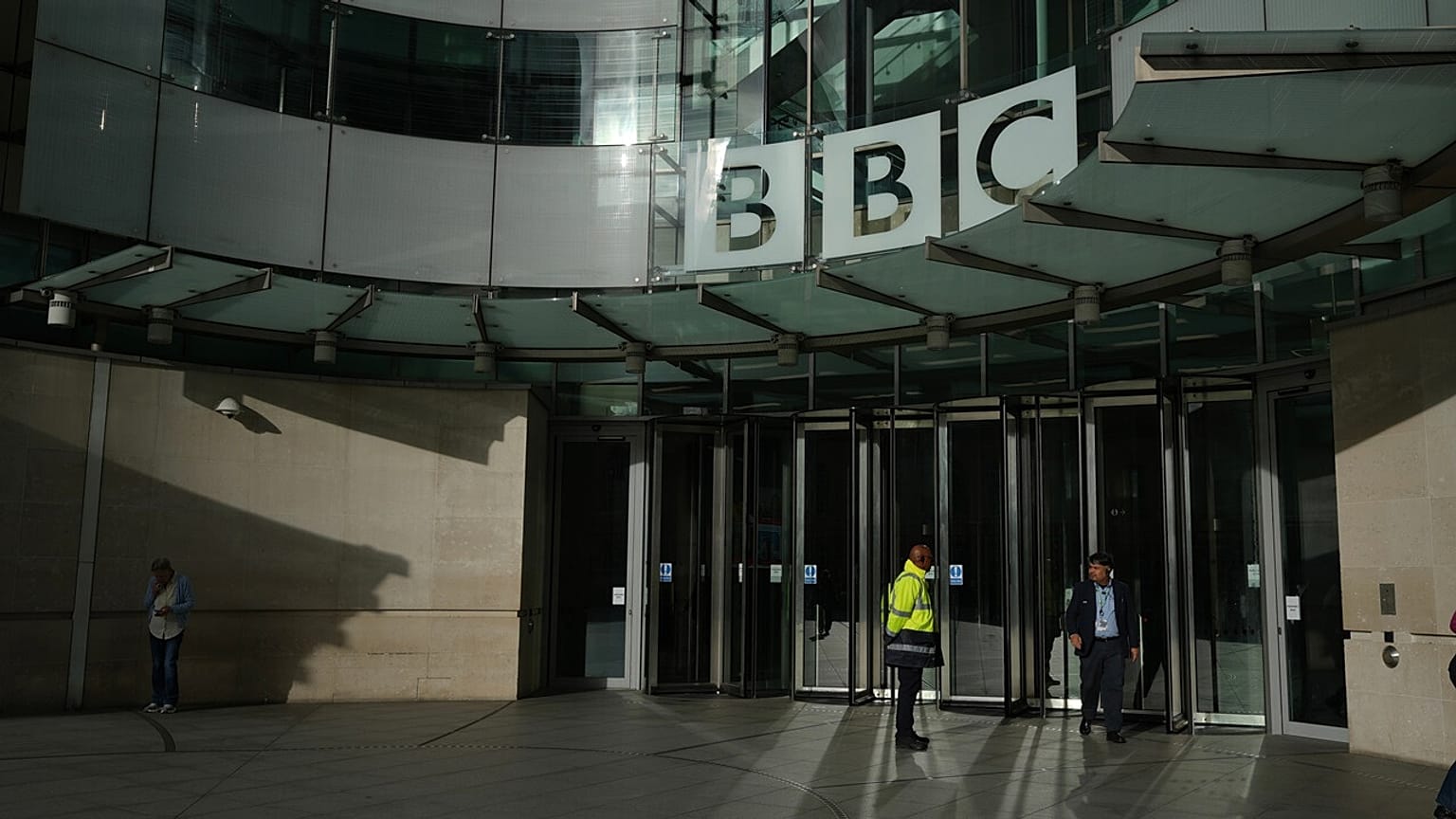
A man walks out from the BBC Headquarters in London, Wednesday, Nov. 12, 2025.
Copyright AP Photo/Kin Cheung

By Emma De Ruiter
Published on 

The BBC said Chair Samir Shah sent a personal letter to the White House saying that he and the corporation were sorry for the edit of the speech Trump gave before some of his supporters stormed the US Capitol.

The BBC apologised to US President Donald Trump on Thursday for editing his 6 January 2021 speech in a Panorama documentary, but said it had not defamed him.

The BBC said Chair Samir Shah sent a personal letter to the White House, saying he and the corporation were sorry for the edit of Trump's speech that preceded some of his supporters storming the US Capitol as Congress was poised to certify President-elect Joe Biden’s victory in the 2020 election.

The British public broadcaster rejected Trump's demands for compensation in a $1 billion lawsuit threat sent by the US president's administration earlier this week. It had set a Friday deadline for the BBC to respond.

“We accept that our edit unintentionally created the impression that we were showing a single continuous section of the speech, rather than excerpts from different points in the speech, and that this gave the mistaken impression that President Trump had made a direct call for violent action," the BBC wrote in a retraction.

While the BBC statement doesn’t respond to Trump’s demand that he be compensated for “overwhelming financial and reputational harm," the headline on its news story about the apology said it refused to pay compensation.

It added that there are no plans to rebroadcast the documentary, which had spliced together parts of his speech that came almost an hour apart.

Documentary aired before 2024 US election

The dispute was sparked by an edition of the BBC’s flagship current affairs series “Panorama,” titled “Trump: A Second Chance?” broadcast days before the 2024 US presidential election.

The third-party production company that made the film spliced together three quotes from two sections of the 2021 speech into what appeared to be one quote in which Trump urged supporters to march with him and “fight like hell.”

Among the parts cut out was a section where Trump said he wanted supporters to demonstrate peacefully.

Director-General Tim Davie, along with news chief Deborah Turness, quit Sunday, saying the scandal was damaging the BBC and “as the CEO of BBC News and Current Affairs, the buck stops with me.”

Legal experts have said that Trump would face challenges taking the case to court in the UK or the US. They said that the BBC could show that Trump wasn’t harmed because he was ultimately elected president in 2024.

Deadlines to bring the case in English courts, where defamation damages rarely exceed £100,000, expired more than a year ago. Because the documentary was not shown in the US, it would be hard to show that Americans thought less of him because of a programme they could not watch.