Sunday, November 16, 2025


At Manila Dialogue, Contemplating UNCLOS Rights and China's Might
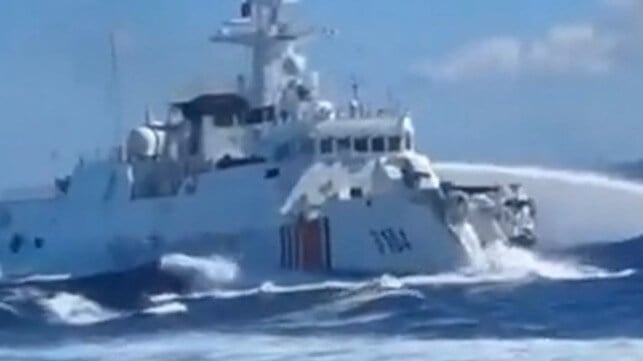
A damaged China Coast Guard cutter after its collision with a PLA Navy warship (PCG)
A damaged China Coast Guard cutter after its collision with a PLA Navy warship during pursuit of Philippine vessels, August 2025 (PCG)

Published Nov 14, 2025 3:45 PM by The Strategist


[By Euan Graham]

Last week’s Manila Dialogue demonstrated that the Philippines is far from cowed or isolated in the face of China’s continued bullying in the South China Sea. But it also highlighted the limitations of transparency as a stand-alone strategy against Beijing’s maritime encroachment. The dialogue’s focus on international law has broader relevance for Australia.

This annual meeting about the South China Sea is a fairly new addition to the regional conference scene. Last week’s iteration, which I attended, was only the second.

It serves, in part, to promote the transparency campaign led by the Philippine Coast Guard, which for more than two years has systematically publicized China’s sustained harassment of Philippine vessels and aircraft within Manila’s exclusive economic zone. Dialogue participants included practitioners and experts from around the region, including several non-government representatives from China.

The transparency campaign has been highly effective at generating international sympathy and support for the Philippines as it grapples with encroachment and harassment by Chinese paramilitary and military forces on a daily basis. In the court of global public opinion, the campaign has provided an effective informational counter to Beijing’s bullying tactics, which are designed to subdue the Philippines and other Southeast Asian states into a state of strategic quiescence.

Australia, Canada, Japan, New Zealand and several European countries have stepped up security cooperation with Manila under the administration of President Ferdinand Marcos. In parallel, Manila seeks to build up the Philippines’ conventional defenses while deepening military cooperation with like-minded partners. On 2 November, Canada became the latest country to sign a visiting forces agreement with the Philippines. By providing for the presence of signatories’ forces on each other’s territory, such agreements strengthen military cooperation and deterrence.

Sympathy and support for Manila’s plight have been in conspicuously shorter supply in Southeast Asia. Next year, however, the Philippines will host the Association of Southeast Asian Nations summit and other meetings as the grouping’s rotating chair. This gifts Manila a decadal, diplomatic opportunity to channel intra-mural support for its frontline stand in the South China Sea. ASEAN’s external credibility will ride on the grouping’s ability to maintain unity on this internally divisive issue.

At the same time, the Philippines can be under no illusions that transparency has dented China’s determination to continue pressing its claims. In early August, the fratricidal collision of a Chinese destroyer and coast guard vessel in close proximity to a Philippine patrol ship off Scarborough Shoal confirmed Beijing’s willingness to pressure Manila to a reckless degree. Even in the face of clear video evidence to the contrary, poker-faced Chinese participants at the Manila Dialogue maintained that China was exercising restraint, merely reacting to the provocations of others. China is unswayed by reputational damage, relying instead on demonstrations of power and dominance.

A related conference theme was the tension between the United Nations Convention on the Law of the Sea (UNCLOS), as a legal and normative framework that supports the Philippines’ sovereign equities in the South China Sea, and China’s might-over-right approach despite the illegitimacy of its dashed-line claims. One of UNCLOS’s guiding principles, that land dominates the sea, naturally favors Southeast Asia’s maritime geography over China’s as a basis for jurisdiction in the South China Sea. International law gives maritime Southeast Asia its best shot at inoculation from the alternative of an expansionist China dominating its strategic future.

The key shortcoming of international law is weak enforcement. Even without a law-of-the-sea police force to patrol the South China Sea, littoral states in Southeast Asia can still improve their position by bringing national laws into conformity with UNCLOS. Vietnam has already made progress here. So too has the Philippines, last year enacting two new laws delineating its maritime zones and designating sea lanes for international passage through its archipelago. These laws involved compromises on the part of Vietnam and the Philippines, as coastal states. But conformity with international law enhances their collective stake in the rules-based order and simplifies the problem of enforcement for national agencies, and potentially for international partners.

The defense of international law and UNCLOS have become key points in Australia’s strategic policy and regional narrative—something that resonates with Minister for Defence Richard Marles. Close partners such as the Philippines, Indonesia, Fiji and Papua New Guinea, as archipelagic states, owe not only their exclusive marine resource rights, but their basic territorial integrity and sovereignty over water, to UNCLOS’s existence. UNCLOS is a key pillar of the regional rules-based order, not only for Western countries interested in freedom of navigation, but also for developing, formerly colonized states for which maritime porosity was historically their main strategic weakness.

This helps to explain why Australia emphases UNCLOS to the extent that it does in its definition of the regional order. As a signatory to UNCLOS, China doesn’t ignore it. Rather, Beijing picks the principles that suit its national interests and ignores the parts that don’t. If China tramples on the sovereignty of large, archipelagic states, such as Indonesia and the Philippines, it could face a more concerted response than it has bargained for.

However, just as the Philippines needs to think beyond its transparency campaign, Australia should be careful not to wrap its strategic narrative too tightly around international law. Coercive and destabilizing behavior can still be consistent with international law. China’s military air and sea patrols around Taiwan have demonstrated this, along with its near-encirclement of Australia earlier this year. Applying a law-enforcement or excessively legalistic mindset to a strategic problem such as China may be a losing game from a deterrence perspective.

Euan Graham is a senior analyst with ASPI’s Defence Strategy program. This article appears courtesy of ASPI and may be found in its original form here

The opinions expressed herein are the author's and not necessarily those of The Maritime Executive.

 

Two Congressmen Want the Federal Gov't to Support Museum Ships

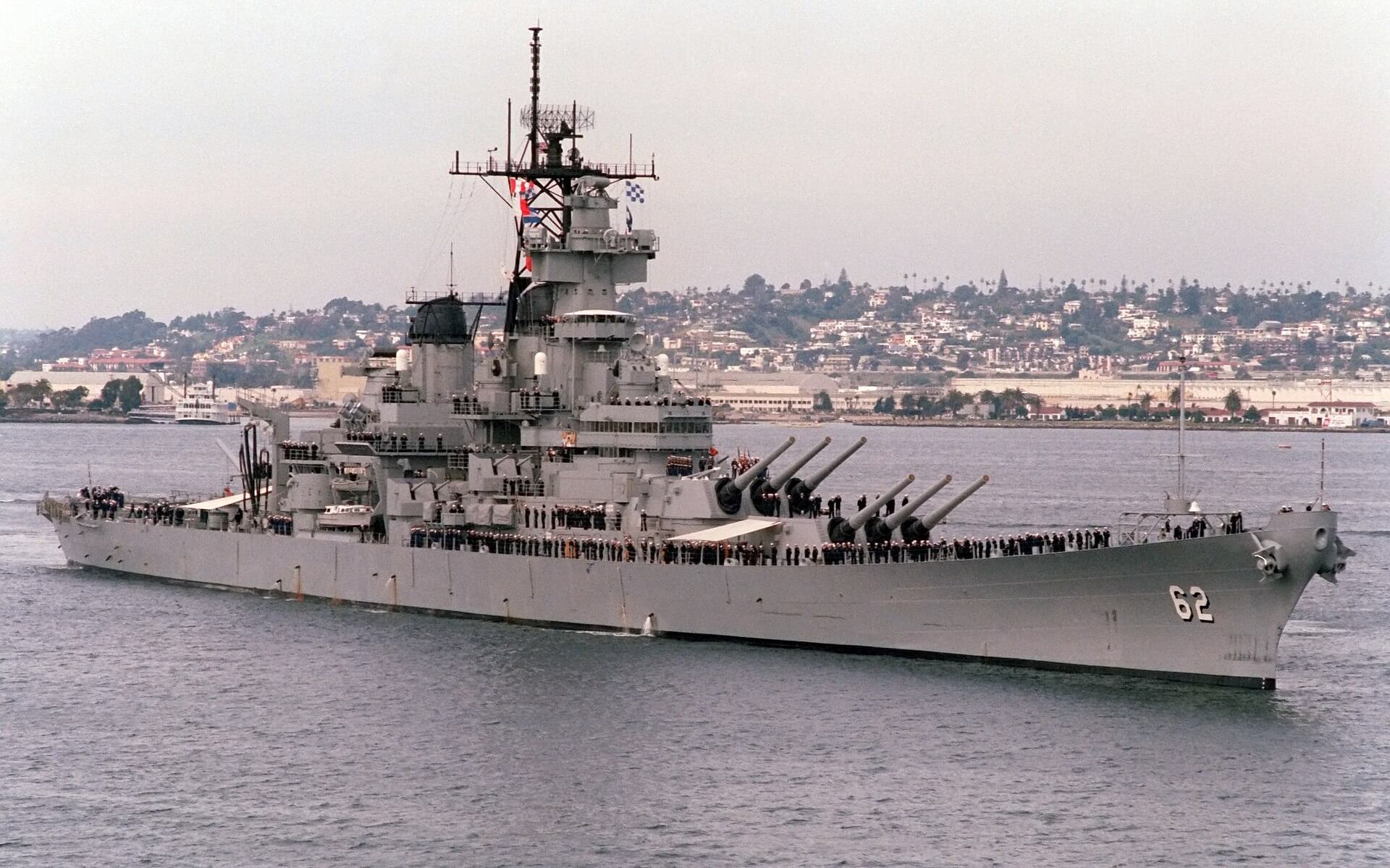
USS New Jersey
USS New Jersey, seen here in 1985, needed a $10 million drydocking last year (USN file image)

Published Nov 14, 2025 3:28 PM by The Maritime Executive


Two legislators in the U.S. are pushing for the enactment of a law that will compel the federal government to allocate funds to preserve historic military vessels, something that is critical in ensuring the continuous availability of the ships to the public for education purposes and inspiring future maritime endeavors.

Congressmen Donald Norcross (D-NJ) and Don Bacon (R-NE) have reintroduced the Save Our Ships Act, which if enacted will require the federal government establish a grant program to help fund the preservation of historic U.S. Navy and Coast Guard ships and submarines for use in museums and memorials.

Through the Historic Naval Ship Preservation Grant Program, the federal government will be compelled to allocate at least $5 million every fiscal year to fund the preservation of the ships. The program will be domiciled in the Department of Interior and will provide grants on a competitive basis to nonprofit, state, and local government entities operating historic naval ship museums. It will also conduct physical upkeep and repair of historic ships and mitigate environmental hazards or damage to the vessels.

The push for a new act emanates from the fact that the current method of funding has proven to be ineffective. The Maritime Heritage Preservation Grant Program has previously provided some funding for preservation activities. However, its source of funding is mainly through the sale of obsolete vessels from the National Defense Reserve Fleet. For this reason, the program has proved to be highly unstable and not a reliable source of assistance for ship preservation. In addition, its resources are split among a large number of recipients, including those outside the grant program.

Owing to lack of a clear stream of funding, the preservation of the historic vessels has largely been left to well-wishers through donations, an approach that is proving to be unsustainable. Just recently, the U.S Coast Guard cutter McLane - part of the USS Silversides Submarine Museum exhibits in Muskegon, Michigan - was towed away and scrapped after efforts for her preservation became untenable. The cutter was part of exhibits attracting visitors to the museum for over three decades, having been moored at Muskegon's harbor since 1993.  

The two Congressmen now want to ensure that other historic military vessels do not face the same fate. They note that historic naval ships exist in museums, memorials, and parks across 29 states, providing educational programs for over half a million young people and supporting over 2,000 enlistments, retirements, and commissionings annually. Apart from the value of preserving and sharing U.S. naval heritage, the ship museums contribute $1 billion annually to the country’s economy.

Despite their importance, the historic ships face a growing challenge, particularly when it comes to physical preservation and maintenance. For ships moored in water, hull preservation and responding to both routine and emergency structural repair needs cost millions of dollars. Often, ship museums are forced to close for months or years while the vessels are placed in dry dock.

A case in point is the decommissioned USS New Jersey (BB-62). Last year the ship - among the most decorated in the history of the U.S. Navy - spent 60 days in drydock undergoing major maintenance, repair and repainting works that cost $10 million.

Apart from preservation of current historic ships, another big concern is the limited rate at which ships are being turned into museums.

“The educational opportunities that come from preserving these historic vessels are priceless. We must ensure students and families can learn about the rich history of our Navy and Coast Guard and inspire the next generation of shipbuilders and service members,” said Norcross.


Study: Seafarers Boost Philippines' Economy by $17B Per Year

Seafarer
iStock

Published Nov 14, 2025 3:13 PM by The Maritime Executive


The Philippines prides itself as a leading shipping nation, with its seafarers representing more than a quarter of the world’s maritime workforce. However, the economic impacts of the manning industry on the country’s economy has largely remained a matter of conjecture. A new study is now creating a clear picture of the industry, and has gone ahead to challenge authorities to ensure the global merchant shipping industry does not lose confidence with its seafarers.

The study reckons that one of the biggest engines of the Philippine economy is not on land but at sea, with the country’s seafaring industry generating a total of $17 billion in economic activity in 2024. The industry, which supports nearly 400,000 jobs directly, contributes about four percent of the country’s gross domestic product, with shipowners spending $923.3 million in the country. More critically, seafarers provide $2.5 billion in household income.

The study titled “The Overseas Seafarers’ Industry Profile, Structure, and Impact on the Philippine Economy,” contends that by providing workers to the global shipping industry, Filipino seafarers are also a major source of boosting foreign reserves. In 2024, remittances from seafarers amounted to $5.6 billion, resources that flowed into local communities with the ripple effects of stimulating consumption, business growth and tax revenues.

Conducted by the economic think tank Center for Research and Communication (CRC) of the University of Asia and the Pacific and the Association of Licensed Manning Agencies (ALMA Maritime Group), the study also shows the diverse impacts on the economy. Specifically, the industry supports a wide range of onshore jobs cutting across crewing and logistics to training, insurance, and maritime services.

“For every peso a Filipino seafarer sends home, nearly three pesos ripple through the economy,” said Winston Padojinog, CRC President. He added that owing to the fact that the Philippines is a leading maritime labor provider, the country needs to ensure the industry’s sustainability. In particular, the country must ensure global shipowners do not lose confidence in Filipino manpower.

The European Commission has in the past threatened to ban Filipino seafarers working on ships flagged in the European Union owing to issues related to substandard maritime training and failure by Filipino seafarers to meet international standards for maritime safety.

In recent months, the U.S. has been carrying out a crackdown on Filipino seafarers after the Trump administration imposed restrictive immigration and visa policies. Reports indicate that at least 130 Filipino seafarers have been arrested by Customs and Border Protection agents and deported, something that has ignited protest by the Philippine Embassy in Washington, DC.

The CRC study highlights that the economic impact of the seafaring industry depends heavily on maintaining global confidence in the Filipino workforce. If shipowners lose confidence, whether due to policy instability, skills gaps, or global competition, the consequences are bound to be swift and severe.

“Good policy doesn’t protect companies, it protects Filipino jobs and families,” noted Padojinog.


China's New Catapult-Equipped Amphib Heads Out on Sea Trials

Hudong Zhonghua
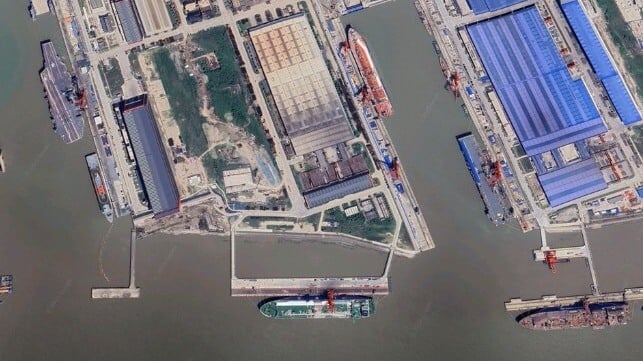
The Type 076 amphib Sichuan (center right) in outfitting at the brand new CSSC Hudong Zhonghua complex on Changxing Island, 2025. A blue canopy covers her catapult trench (Google Maps / Airbus)

Published Nov 14, 2025 5:59 PM by The Maritime Executive


The PLA Navy's new flat-deck amphibious assault ship Sichuan has departed shipyard for sea trials, barely two years after her keel was laid and just 11 months after her launch ceremony. 

The sea trials will involve standard testing of ships' systems; mooring trials and equipment commissioning have been completed smoothly and as planned, the PLA Navy said in a social media statement. Testing of the diesel-electric power system that runs both the propulsion and the ship's power-hungry combat systems will be a particular area of focus, according to Global Times. 

Sichuan is the world's largest amphib, and the first ever outfitted with an electromagnetic aircraft launch catapult, a technology that first premiered aboard the American supercarrier USS Gerald R. Ford in 2017. But Sichuan's deck is small by the standards of modern carrier aviation, and China already has full-size carriers, so the catapult is widely believed to be purpose-built for more compact aircraft - unmanned combat aerial vehicles (UCAVs), which the PLA's suppliers have been developing. This would make Sichuan the first "drone carrier" ever built specifically as a platform for UCAVs. 

Previous satellite imaging shows that the open, rectangular flight deck measures about 850 feet long by 170 feet wide, making it about an acre larger than the U.S. Navy's America-class "big deck" amphibs. It has dual elevators, port and starboard, to handle a high volume of fixed-wing aircraft traffic in and out of the hangar. As a fully equipped amphib, Sichuan also has a well deck at the stern for launch and recovery of landing craft.

A trench in the flight deck was spotted during construction and identified by open source intelligence analysts as a clear indication that the ship would have a catapult. It is electromagnetic, Chinese state media has confirmed, as is its arresting gear.

The ship was built at the new expansion yard for CSSC Hudong Zhonghua on Changxing Island, and illustrates the powerful economies of scale of China's integrated civil-military shipbuilding industry. In videos taken by Chinese state media of the vessel's departure (above), a brand new methanol dual-fuel boxship for CMA CGM is visible off her starboard bow, and a second CMA CGM boxship is moored across the yard, far off the starboard quarter. A newly-built LNG carrier sits to port and another new LNG carrier is directly astern - all normal pierside activity at , a prolific builder of boxships and LNG carriers for international shipowners. These commercial orders underwrite the infrastructure, supply chain, research, training and labor pool that all underpin CSSC's warship construction program for the PLA Navy. 

As a sign of the maturity of China's complex shipbuilding capabilities, Sichuan went from keel laying to sea trials in 25 months. The closest analogue in American service, the smaller first-in-class USS America, took 53 months from keel laying to the start of builder's trials (in 2014). The most recent analogue, Flight 2 America-class amphib LHA-8 (future USS Bougainville), was laid down in March 2019 and on track to deliver in August 2026, a span of 89 months. 


Years-Long Pollutant Cleanup Completed for Historic Carrier USS Yorktown

USN
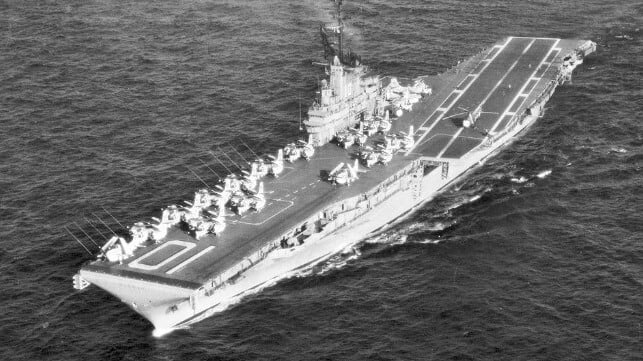
USS Yorktown circa 1963 (USN)

Published Nov 14, 2025 4:44 PM by The Maritime Executive


A famed U.S. World War II aircraft carrier is all set to continue attracting tourists at the Charleston Harbor in South Carolina after contractors completed a herculean task of removing toxic pollutants, a project that took two years and cost $31.6 million.

The USS Yorktown, a National Historic Landmark moored at Patriots Point in Charleston Harbor, had become a ticking environmental time bomb owing to years of corrosion of her hull. Two years ago, the state government made a decision to remove gallons of hazardous fuel, oil and contaminated water from the ship’s belly to avert a potential disaster, protect the environment and ensure the ship remains a popular tourist attraction.  

Gov. Henry McMaster, who issued an executive order for the clean-up in 2022 in order to preserve the ship’s history, is now hailing the completion of the task after salvors managed to remove about two million gallons of toxic waste and nine tonnes of asbestos.

The clean-up was carried out in two phases, with phase I involving the removal and safe disposal of 569,000 gallons of oily water and 8.88 tonnes of sludge/mud. It also involved the cleaning of 18 tanks and four compartments while 47 tanks were dewatered and 90,260 of fresh water transferred internally. Also removed and disposed were 4.5 tonnes of asbestos waste.

In the second phase, salvors from Hepaco LLC, Shipwright and Isla Maritime managed to remove 1.4 million gallons of legacy residual fuel and the remaining asbestos.

McMaster reckons the removal of the pollutants has averted a catastrophe at the Charleston Harbor had the material leaked. Apart from destroying marshes and estuaries, a spill would have resulted in massive deaths of marine life and risks to industries that support thousands of jobs.

“The USS Yorktown was a ticking environmental time bomb, with the risk of disaster increasing each year, and now it has been safely and successfully defused,” said Gov. McMaster.

Commissioned in 1943, Yorktown is one of 24 Essex-class aircraft carriers built during WWII for the U.S Navy. The aircraft carrier was built in a record 16 months at Newport News, Virginia, and was initially named Bonhomme Richard but was renamed Yorktown after the previous USS Yorktown (CV-5) was sunk at the Battle of Midway.

During WWII, the ship participated in the Pacific offensive that began in late 1943 and ended with the defeat of Japan in 1945, a conquest that went on to earn the ship the famous title of the “Fighting Lady”.

Though initially built as an aircraft carrier, she was converted in 1950 to an attack aircraft carrier, something that saw the addition of blister tanks that were faired into the existing hull and an angled deck was added in 1955. Apart from WWII, Yorktown also participated in the Vietnam War, and is remembered for picking up the Apollo 8 crew and spacecraft in 1968 after the first human mission to the moon.

Yorktown was decommissioned in 1970 and donated to the State of South Carolina in 1975 for use as a museum ship. She is maintained by the Patriots Point Development Authority and serves as a tourists’ attraction at the authority’s naval and maritime museum facility, which receives more than 300,000 visitors annually.


Ukraine Takes One of Russia's Largest Oil Terminals Offline

Fires, phosphorus flares and tracer fire from air defense guns at Novorossiysk, Nov. 13 (Russian social media)
Fires, parachute flares and tracer fire from air defense guns at Novorossiysk, Nov. 13 (Russian social media)

Published Nov 14, 2025 9:38 PM by The Maritime Executive


The Ukrainian strike on the port of Novorossiysk, Russia has damaged oil loading berths and taken about two percent of the global oil trade temporarily offline, according to multiple reports. Inside sources claim that a moored tanker was hit in the attack as well, injuring three seafarers, Reuters reports.

The strike has forced the Sheskharis export terminal to shut down, and has prompted midstream operator Transneft to temporarily halt crude deliveries on the pipeline that feeds the facility, sources told Reuters. Video taken by a crewmember on a vessel at the port's container terminal shows that one STS crane was also hit by an incoming drone. 

Battle damage assessment imagery is still pending on open source channels, but infrared fire detection data from NASA FIRMS suggests that the large fires that broke out during the strike have likely been extinguished. 

Brent crude futures ticked upwards on news of the strike, rising two percent to close at $64, within the trading range for the past 30 days. 

Ukrainian officials confirmed to Kyiv Post that the country's military intelligence services were responsible for the attack, with involvement by the SBU, HUR, Special Operations, Border Guards and Ukrainian Navy shore battery teams. Neptune anti-ship cruise missiles (the extended-range "long Neptune" configuration) were used in the attack. 

In addition to hits on the terminal, the strike destroyed pipelines, pumping stations, and the city's air defense battery. Open-source intelligence analysts have suggested that air defense missile launchers were hit, based on the size and location of one of the blasts captured in bystander videos. The elimination of the battery would have opened up the harbor to successive waves of incoming Ukrainian cruise missiles. 

Analyst MT Anderson has identified the air defense system as a high-end S-400 battery with seven launchers. It had only recently been upgraded from an S-300 battery.  

"Every oil refinery or oil terminal that is hit means millions of dollars less for the Kremlin’s war machine. We will continue to deprive the aggressor of resources until it loses the ability to wage this war," an SBU source told Kyiv Post. 

Two industry sources informed Reuters that the tanker Arlan (IMO 9227443) was hit in the strike, resulting in the injury of three crewmembers. Arlan is a 23-year-old tanker of 165,000 dwt, and is sanctioned by the UK and EU for its role in the Russian oil trade. It is also suspected of violating sanctions on Iran, according to advocacy group UANI. It is currently flagged in Sierra Leone. 

AIS data provided by Pole Star shows that Arlan transited the Bosporus on November 8 and headed for Novorossiysk, arriving off the port on the following evening. Heavy AIS spoofing in and around the port city makes her subsequent movements impossible to verify without satellite imaging. 


Fishermen, Residents Concerned About Weather Damage to MSC Baltic III

MSC Baltic III aground
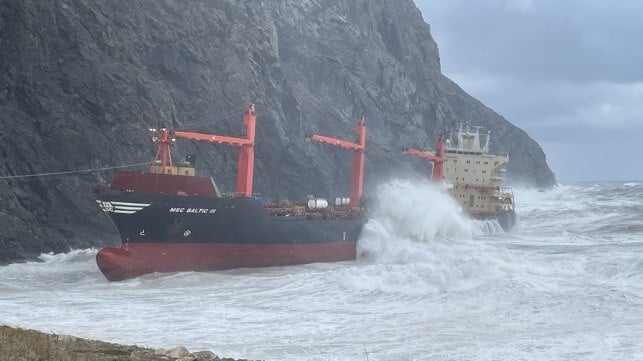
MSC Baltic III in heavy waves, Nov. 7 (CCG)

Published Nov 14, 2025 10:19 PM by The Maritime Executive


Residents and fishermen in Newfoundland are growing concerned about the deteriorating state of the boxship MSC Baltic III, which ran aground on a rocky shelf in Lark Harbour on February 15. The North Atlantic's winter weather has arrived in earnest, and heavy wave action is smashing the ship upon the rocks, causing more damage by the day. The concern, local stakeholders say, is that the ship will break up and release debris and pollutants into coastal waters.  

"This wreck is now a ticking environmental time bomb, and the lack of urgency to address it has put our fisheries, our coastlines, and our communities at serious risk," a spokeswoman for the Fish, Food and Allied Workers union told CBC in a statement.

A major storm system hit the western coast of Newfoundland last week, with sustained heavy effects on the wreck site. Salvage work on the ship was paused due to severe conditions, which were causing "significant movement in the bow and stern" and "noticeable change in the condition of the port side." Images from the scene show that the vessel's hull has buckled upwards amidships, with a clear crease visible below the painted "S" in "MSC" on the port side. 

https://www.saltwire.com/newfoundland-labrador/taking-a-beating-msc-baltic-iii-further-damaged-in-worst-conditions-since-its-grounding

On Wednesday, after the storm had passed, a Canadian Coast Guard crew boarded the wreck to assess its condition. The agency said that structural damage was visible below deck, affecting framing and bulkheads in way of a water ballast tank. The contracted salvor, T&T Salvage, is conducting a thorough survey of the vessel, including an assessment of the salvage equipment that had been stowed on board - some of which was damaged or washed away. 

Some local residents have questioned if the salvage project would have progressed further by this point if an access road had been built more quickly to enable movement of equipment and personnel to the wreck site. Work on the road began in early May, more than three months after the grounding. At this point, a full-scale wreck removal is unlikely to be attempted before the arrival of fair weather in the springtime, CCG response officer Bruce English told the CBC. 

Most of the fuel oil has been pumped off the vessel already, and as of late October, salvage crews were flushing out the last dregs from the bunker tanks whenever conditions were good enough to allow work to proceed. 


Stranded Livestock Carrier Gets Under Way at Last

BAN LIVE ANIMAL CARRIERS

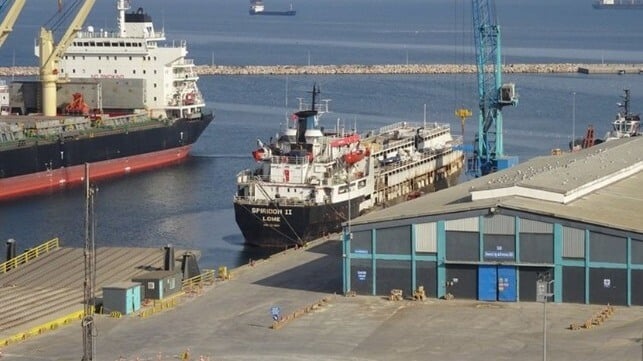
Spiridon II
Courtesy Animal Welfare Foundation

Published Nov 14, 2025 11:08 PM by The Maritime Executive


Animal advocacy groups have been raising the alarm over the situation aboard livestock carrier Spiridon II, which was stranded off the Turkish coast for weeks due to irregularities in paperwork. 58 cows have already died, with another 140 pregnant cows suffering miscarriages. Shortly after publication of a report on the situation by Sky News, the vessel weighed anchor and got under way.

Spiridon II was stranded in the Turkish waters for 24 days, and the authorities refused permission to unload the animals due to discrepancies in ear tag documentation. Rights groups called for the intervention of the European Union.

The carrier was anchored off Bandirma Port in Turkey, having left Uruguay on September 19 loaded with 2,901 animals and arriving in Turkey on October 22. As of Saturday morning local time, the vessel was finally under way again, making 10 knots and declaring her destination as Uruguay. 

According to the rights groups, the animals have endured stress, hunger and exhaustion resulting in the deaths of 58 cows. Observers have counted 50 newborn calves on board, but 90 more remain unaccounted for, meaning their fate cannot be determined.

As Turkish authorities hold their ground, residents have begun to complain of odors. Rights activists are concerned that the animals have been deprived of adequate fodder, bedding, and potable water and are being forced to endure heat stress, dehydration and fatigue.

The Animal Advocacy & Food Transition (AAFT), together with Animal Welfare Foundation, Animals International and livestock shipping expert and veterinarian Dr. Lynn Simpson demanded EU authorities’ intervention. The groups sent letters to both the European Commission and the World Organization for Animal Health to push Turkish authorities to allow the unloading of the animals. (The fact that Turkey is not a member of the bloc means the EU lacks jurisdictional powers to force the unloading.)

“The tragedy aboard Spiridon II is yet just another example of the inherent risks of long-distance sea transport. Inadequate oversight, poorly maintained vessels, unpredictable port procedures, and weak enforcement combine to create an environment where animal suffering is routine and preventable deaths are inevitable,” said AAFT in a statement.

Built in 1973, the 4,000-dwt Spiridon II was converted to a livestock carrier in 2011. It is listed as having 4,000 square meters of space for animals. Its ownership is registered in Honduras, with management by a Lebanese firm. The ship has been registered with the Paris MOU "black list" flag of Togo since 2018.


Beasts of burden - Antagonism and Practical History. An attempt to rethink the separation between animal liberationist and communist politics. (Published ...


Mystery Surrounds Iran's Seizure of Tanker in Gulf of Oman

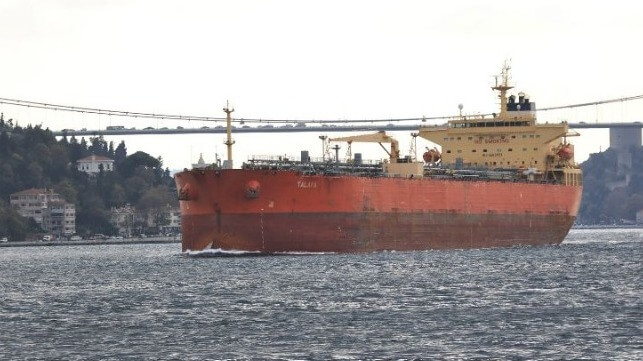
Talara (file image courtesy Cengiz Tokgoz / VesselFinder)

Published Nov 15, 2025 9:30 PM by The Maritime Executive


Mystery still surrounds the seizure by Iran's Islamic Revolutionary Guard Corps (IRGC) of the Marshall Island-flagged 73,000 dwt oil tanker MV Talara (IMO 9569994). The ship was seized 22 miles off the coast of Khor Fakkan in the United Arab Emirates on November 14, and was quickly taken out of the Emirati EEZ area into that belonging to Iran.

Mehr News carried an IRGC statement that the seizure was "in line with safeguarding the interests and resources of the Iranian nation," suggesting by reference to the safeguarding of resources that the seizure could have been an anti-smuggling operation. The IRGC's own X account posted a statement that "whoever has aggressed against you, aggress against him like he has aggressed against you," not linking it directly to the seizure but suggesting it could have been a retaliatory action.

The Talara is owned by Pasha Finance Inc., a subsidiary of the Pasha Group, which has been thoroughly Californian for three generations (and with no known connections to the Pasha Group associated with the family of the President of Azerbaijan). The ship is managed by Columbia Ship Management, a Cyprus-registered company owned by long-term Cypriot resident Captain Heinrich Leopold Felix Schoeller, a member of an aristocratic Austro-Czech dynasty. The antecedents of both owner and management makes it extremely unlikely that the ship had hidden Israeli owners, which could have served as an IRGC excuse for seizing the vessel.

One of two reasons, or a combination of the two, could be behind the seizure.

The first possibility is a counter-smuggling operation. Iran has long conducted "law enforcement" operations to clamp down on oil smuggling, which Iran could classify as resource theft. Most of the Talara's movements in the last two years have been trips within the Gulf area and to India, with one trip to Brazil. The ship last visited Singapore in 2020. Nonetheless, the pattern of Talara's activity observed, and the size of the tanker, is generally inconsistent with regional oil smuggling activity, although the Fars news agency later said that those suspected of criminal activity which precipitated the interception were Iranian nationals. 

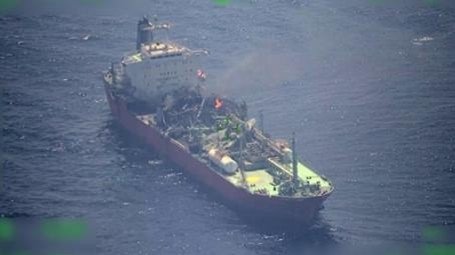
The second - which would irritate the IRGC, and provoke their retaliation - would have been the loss of the tanker Falcon and its valuable cargo of LPG on October 18. Falcon was loaded in Iran's Assaluyeh shipment terminal and was under way to the Houthi-controlled port of Ras Isa.

TankerTrackers.com reported at the time that the MV Falcon was part of the Iranian shadow fleet and noted that it had no known insurer. Without any need to do so, the Iranian National Tanker Company took the unusual step of denying that it owned or controlled the ship, suggesting in fact that it did. 

The Falcon was abandoned after an explosion and fire (French Armed Forces General Staff)

The reluctance of navies who had assisted with the rescue of the surviving crew members of the MV Falcon to comment on first reports of a missile attack, and then of an accident, fueled speculation at the time that the LPG shipment could have been attacked by one of a number of parties who are opposed to Iran and the Houthis. This would have been consistent with an attack mounted a month earlier on September 16, when Israel had launched an attack on the Pakistani-crewed MV Clipper (IMO 9102198), which was delivering LPG to the Houthi-owned terminal at Ras Isa.

If both factors contributed to the IRGC's decision to conduct the interception of the Talara, it would be a seizure of a cargo of equivalent value, at the expense of the parties (or their allies) they believe were responsible for the attack carried out on the Falcon. The crew of the Talara are likely to be released quickly, but not the value of its 30,000-ton cargo.

The Iranian action also suggests that hardliners within the IRGC still retain the authority to undertake politically-provocative actions, even at a delicate time when opinions are sharply divided within Iran's ruling elite on how to respond to the evident weakness and unpopularity of the regime. 

In recent days, the regime's fragility has been particularly exposed by President Masoud Pezeshkian's astonishing statement that Tehran may have to be evacuated within the next two weeks if there is no rainfall (none is forecast for the next two weeks), and by the willingness of two uniformed Army officers to sacrifice themselves to likely death by displaying the Iranian flag used during the rule of the Pahlavis. The IRGC's petulance in seizing Talara is a reminder that rash actions on their part could at any time threaten the maritime community.

Top image: Talara (file image courtesy Cengiz Tokgoz / VesselFinder)


DESANTISLAND

Eastern Shipbuilding Suspends Work on Offshore Patrol Cutter Program

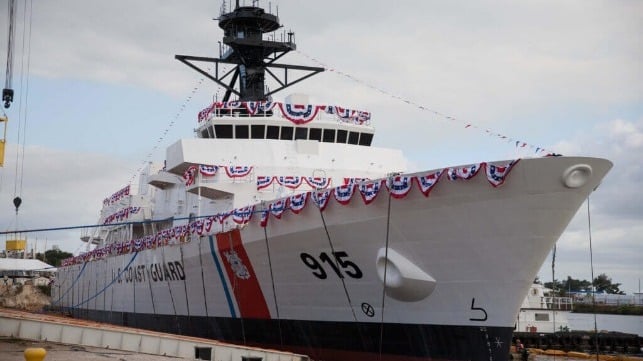
USCGC Argus at her launch ceremony (ESG file image)

Published Nov 14, 2025 11:29 PM by The Maritime Executive


Florida-based Eastern Shipbuilding Group (ESG) has finally made the tough decision of suspending work on the troubled Offshore Patrol Cutters (OPCs) program, a development that comes six months after the Trump administration announced partial termination of the contract owing to delays and cost overruns.

ESG CEO Joey D’Isernia announced that owing to the significant financial strains caused by the program’s structure and conditions, the company has opted to suspend work on its in-construction Heritage-class OPCs, resulting in layoffs.

The OPC vessels, which are 360 feet in length with a top speed of 22.5 knots, are designed to bridge the capabilities of the oceangoing 418-foot national security cutters and the 154-foot fast response cutters. With an endurance of 60 days, the Heritage-class is needed to replace the 270-foot and 210-foot medium endurance cutters, many of which are past retirement age.

The decision has immediate effects for the first and second OPC hulls. The first, USCGC Argus, was launched in 2023 and was in outfitting for delivery in 2026. The unfinished Argus' fate has not been clarified, but there had long been concerns: Congressman Mike Ezell complained earlier this year that Argus was delivering "four years late, and with a host of non-compliant parts."

The Trump administration has already terminated the orders for the third and fourth hulls in the series. The Coast Guard put these hulls on hold in June this year, even though early stages of work had started on both of them, and then the Department of Homeland Security formally canceled the orders in July. 

The OPCs program began in 2016 when the Coast Guard selected the detailed design from ESG and went on to award the contract the following year, anticipating the first cutter would be delivered in 2021. The USCG has plans to acquire 25 OPCs, and the program promised long-term prosperity for ESG. But the yard suffered setbacks, starting with a category five hurricane in 2018, and could not catch up. The Coast Guard split the original contract and awarded hulls five through 11 to competitor Austal USA, leaving ESG with four. 

ESG has now opted to suspend the program altogether, according to a statement sent to media outlet WMBB News 13.

“ESG has made the difficult decision to suspend work on the OPC program due to significant financial strain caused by the program’s structure and conditions. Despite our best efforts, continuing under the current circumstances is not sustainable,” said ESG President Joey D’Isernia in a statement to local media. “Unfortunately, we also had to reduce our workforce — an extremely hard step, as our people are the strength of this company.”

He went on to say that the action will allow the company to remain financially stable and focused on delivering it other contractual obligations. “We’ve overcome a major hurricane and a global pandemic, and we will overcome this challenge as well,” he noted.


Eastern Shipbuilding Group Launches Falcon For Fisher Island Community

Eastern Shipbuilding Group

Published Nov 14, 2025 3:07 PM by The Maritime Executive


[By: Eastern Shipbuilding Group]

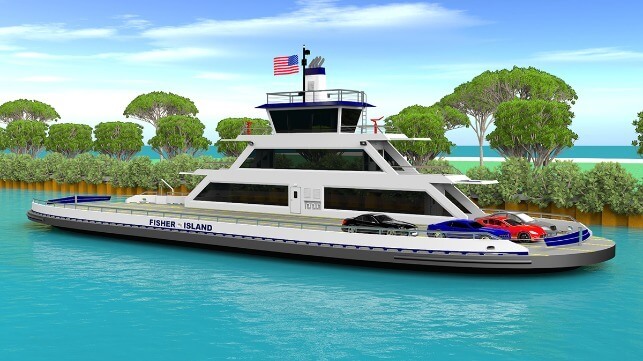
Eastern Shipbuilding Group, Inc. is proud to announce the successful launch of the vehicle-passenger ferry FALCON, being constructed for the Fisher Island Community Association (FICA). The launch marks the next major milestone in the partnership, positioning FALCON to provide reliable and modern transportation service to the Fisher Island community.

The state-of-the-art ferry is designed to meet the unique needs of the Fisher Island route, combining enhanced vehicle capacity and passenger comfort with ESG’s proven vessel-construction expertise. FALCON is scheduled for delivery in Spring 2026 and is being constructed at ESG’s Allanton facility in Panama City, Florida.

“Completing the launch ahead of schedule speaks volumes about the talent and commitment of our workforce. Their drive keeps this project moving forward and ensures FALCON will serve Fisher Island with the reliability its community deserves. Our longstanding partnership with FICA continues to be a source of pride for our team, and this milestone reflects the shared commitment we bring to every phase of the project,” said Joey D’Isernia, CEO of Eastern Shipbuilding Group, Inc.

“FALCON will set a new benchmark for our community’s ferry service—delivering higher vehicle capacity, smoother operations, and a more comfortable experience for residents and guests,” Roberto Sosa, President & CEO of the Fisher Island Community Association. “We thank Eastern Shipbuilding Group and EBDG for their continued partnership and collaboration.” 

"Elliott Bay Design Group is honored to partner with Fisher Island Community Association on another addition to their ferry fleet," said Steve Carlson, Principal in Charge at Elliott Bay Design Group. "Our relationship with Fisher Island is built on trust and collaboration, and we're proud that their fleet continues to grow with vessels designed by EBDG. As engineers, it's incredibly rewarding to see our designs come to life, and this new ferry, currently being built at Eastern Shipbuilding Group, represents the strength of that partnership and our shared commitment to quality and innovation."

Last fall, ESG commenced steel-cutting for FALCON at its Allanton yard, marking the start of physical construction. With launch now complete, the vessel will proceed through outfitting, systems integration, sea trials and final commissioning ahead of delivery to FICA.

The products and services herein described in this press release are not endorsed by The Maritime Executive.