Friday, December 12, 2025

 RUSSO UKRAINE WAR AT SEA

Ukraine Expands Caspian Sea Strikes Hitting Russian Vessels Carrying Arms
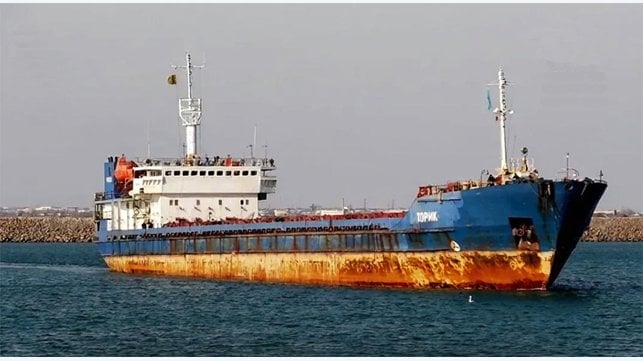
Russian cargo ship
Askar Sarydzha was previously sanctioned for transporting arms (Ukraine SOF)

Published Dec 12, 2025 3:20 PM by The Maritime Executive


Days after Ukraine claimed its first-ever strike on an oil platform in the Caspian Sea, the Special Forces are reporting that they have expanded the attacks. They are claiming strikes on two Russia-flagged cargo ships reported to be carrying arms and military equipment.

The Special Operations Forces released reports saying that with the aid of resistance fighters, it had been able to track the two vessels. It did not say how the vessels were struck or provide details on the damage.

They claimed strikes on the Kompozitor Rakhmaninov (IMO: 8606616), a Ro-Ro cargo ship operating under the Russian flag, and the Askar Sarydzha (IMO: 9082142), a General Cargo, also sailing under the Russian flag. The Rakhmaninov is a 4,600 dwt vessel built in 1986, while the Askar Sarydzha is 6,200 dwt. Both vessels are owned by MG-Flot.
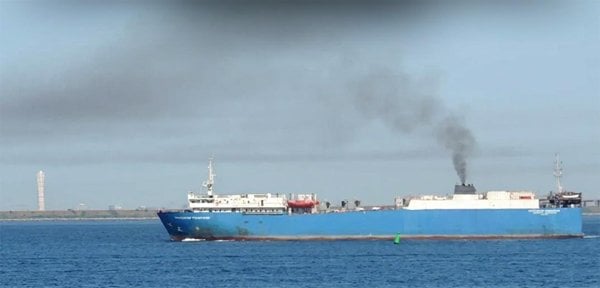
 

Kompozitor Rakhmaninov was sanctioned in 2024 (Ukraine SOF)


The United States imposed sanctions in September 2024 on the Rakhmaninov as property of the sanctioned MG-Flot. They said the vessel regularly operated on the Caspian Sea, transported cargo between Iran and Russia. The Askar Sarydzha was sanctioned by the United States in May 2022 for transporting weapons for the Russian Federation.

Ukraine reported that the “Black Spark” resistance movement provided detailed information about the routes and cargo of the two vessels. 

Separate, unconfirmed reports indicated that Ukraine had also staged a second wave of attacks on the Russian oil platforms in the Caspian Sea. It said that the Lukoil platform Filanovsky had been struck for the second time and that attacks expanded to the Korchagin platform.

It comes as Ukraine has asserted that it is expanding the geography of its attacks, with experts pointing out that the Caspian Sea is more than 450 miles from the Ukrainian border. Ukraine has said it is increasing its focus on Russia’s oil operations to choke off the revenues used to maintain the war.


Turkish-Owned RoPax on Fire After Russian Attack on Odesa Region
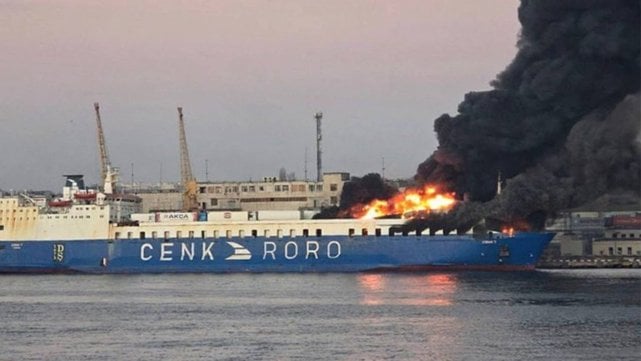
cargo ship on fire
RoPax on fire after a Russian attack on the port region of Ukraine (Telegram)

Published Dec 12, 2025 2:18 PM by The Maritime Executive


A Turkish-owned RoPax transporting cargo to Ukraine was set on fire during a midday Russian attack on the Great Odesa region. Reports indicate that one person, possibly a dockworker, was injured, but there are no fatalities.

The Ukrainian Air Force had issued the alert at around 1500 local time, reporting high-speed targets coming from the south. It is believed that at least two ballistic missiles had been fired, as well as a launch of drones. It followed an overnight barrage on the same region, which reportedly left more than 90,000 families without electricity. The missiles were targeting Odesa and Chornomorsk, while the drones also targeted Pividennyi. 

The Turkish Foreign Ministry confirmed a vessel strike, reporting that the crew and truck drivers were being evacuated. Pictures and videos posted online show the forward section of the vessel ablaze with Ukrainian firefighters working to control the fire.


The vessel is the Cenk T, owned by Turkey’s Cenk RoRo. Built in 1978, the vessel previously operated for Stena and has been owned by the Turks since 2021. It is 21,000 GT / 8,400 dwt with a capacity to transport up to 130 trucks. Security consultants Vanguard quotes the vessel's owners as saying the ship was carrying "essential food supplies."

The Turkish ministry, in its statement, reiterated its “concerns regarding maritime security and freedom of navigation, as the ongoing war in our region is spreading to the Black Sea… we once again emphasize the importance of urgently ending the war between Russia and Ukraine, and we recall the need for an arrangement to ensure navigation safety in the Black Sea and for the parties to suspend attacks targeting energy and port infrastructure in order to prevent escalation.”

Vanguard quotes the Ukrainian Navy as reporting a total of three ships were damaged in today's attacks at two of Ukraine's ports. The details on the other ships have not been confirmed, and the damage appears to be minor compared to Cenk T which continued to burn into the night.


Tanker Operator Quits Russian Trade After Suspected Ukrainian Strike

Besiktas-operated tanker Mersin trimmed heavily by the stern off Senegal, Nov. 2025 (Senegalese social media)

Published Dec 9, 2025 10:50 PM by The Maritime Executive


After one of its vessels was hit and damaged in a suspected Ukrainian attack, Turkish tanker owner Besiktas Shipping has decided to quit all trade with Russia. The business decision suggests that Ukraine's covert and overt strikes have created a strong perception of ongoing risk to Russia-linked energy shipping, and not just in the Black Sea. 

On the night of November 27-28, the Besiktas-owned tanker Mersin was at anchor off the coast of Senegal when flooding occurred in the engine room. The Senegalese Navy responded to the scene and the crew were all safely rescued, but photos showed the tanker's stern riding low in the water. Besiktas later reported that Mersin had been struck by four "external explosions."

AIS data provided by Pole Star Global shows that the vessel had previously called at multiple Russian ports in the Black Sea, including some as recent as August. The attack on the Mersin occurred at almost the same time as the Ukrainian drone boat strikes on two tankers in the Black Sea, the Kairos and the Virat. Both are known "shadow fleet" vessels with opaque ownership and ties to the Russian energy trade, and Ukraine claimed responsibility for strikes on both vessels - but not the strike on the Mersin

In a statement, Besiktas said that it has not violated any international sanctions, and said that it has maintained "full compliance with the G7/EU price cap mechanism and all relevant trade restrictions." In the same message, without naming Ukraine directly, the company said that regional security risks have grown too high to continue trading to Russia. 

"We have decided to cease all shipping operations involving Russian interests," Besiktas said in a brief update on its site. "After a thorough assessment, we have concluded that the risks posed to our vessels and crew have become untenable." 

Besiktas Shipping has been in the tanker business for six decades, and it also manages dry bulk vessels. It has about three dozen ships under management, primarily product tankers. Two of these vessels - Esentepe and Kocatepe - were previously sanctioned by the government of Ukraine for alleged involvement in deceptive shipping practices with Russian cargoes. 

Third Shadow-Fleet Tanker Hit by Suspected Ukrainian Drone-Boat Attack
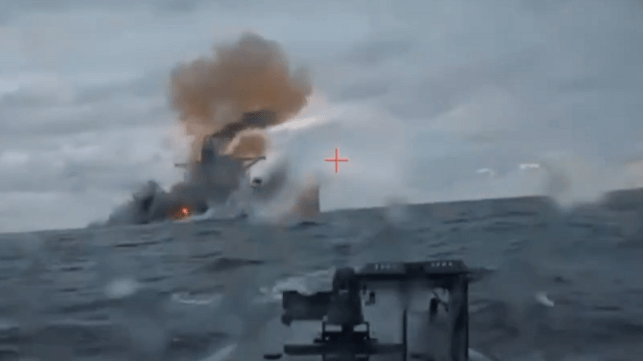
Dashan
Smoke and flame envelop Dashan's stern (Via Ukrainian social media)

Published Dec 10, 2025 3:06 PM by The Maritime Executive


Russian and Ukrainian sources report that Ukraine's covert operations agency has attacked another Russia-facing "shadow fleet" tanker in the Black Sea. If accurate, it would be the third strike on a foreign-flag tanker in a month by Ukraine's drone-boat units.  

The target vessel has been named as the Dashan (ex name Mianzimu, IMO 9299666), a 2005-built Suezmax of 165,000 dwt. According to Ukrainian accounts, the vessel was under way for Novorossiysk to take on a load of Russian oil. 

Dashan is associated with the former Gatik Ship Management fleet, and is sanctioned by the European Union and the UK for suspicious transactions involving Russian oil. Previously flagged in Gabon and Comoros, the vessel is currently stateless and flying a false flag, according to IMO database Equasis. 

Video feed footage appearing to show the drone-boat attack has emerged on social media, and it suggests that Dashan was hit at least two times in way of the engine room. The video footage shows a Ukrainian drone edging up to the tanker's port quarter as the vessel was under way, then driving under the counter of the stern and making contact with the hull. (The vessel was in ballast, exposing the counter and other areas normally submerged.) The blast was recorded by another drone. 

A second video clip shows a similar drone approaching and making contact with the starboard quarter in approximately the same area, just forward of the rudder. The final clip shows smoke and flame enveloping the transom, and appears to show that the vessel was slightly trimmed by the stern after the strikes. 

Ukraine has not claimed formal responsibility for the strike, but its leaders have made clear that stopping Russian tankers is a high priority, and confirmed the two previous tanker strikes. Off the record, a Ukrainian official told Ukrinform that the 13th Main Directorate of the SBU and the Ukrainian Navy were responsible for the attack on Dashan

Surface conditions were calm in the footage, and the Dashan was under way at a slow bell with minimal wake - factors that would have facilitated the boat handling required for such a precision attack. The target selection - aft, under the counter - matched previous Ukrainian attacks and would favor flooding the engine room without causing a major spill or a sinking. Likewise, the selection of an unladen tanker would minimize the potential magnitude of any spill or fire; it also maximizes the target vessel's reserve buoyancy, with positive implications for its odds of staying afloat and odds of crew survival. 

Ukraine Damages Russian LPG Export Terminal on Sea of Azov

Fire
ExileNova / Telegram

Published Dec 9, 2025 7:13 PM by The Maritime Executive


Ukraine's armed forces have hit a fuel terminal at the Russian port of Temryuk, a small harbor on the Sea of Azov. The port is home to a liquefied petroleum gas (LPG) export terminal, which is designed to move 400,000 tonnes of gas per year. 

The Maktren-Nafta LPG terminal has a total of 30 storage tanks for up to 6,000 tonnes of LPG storage. It was built by Ukrainian contractor Ukrgazproekt in the years before the war, and was the first purpose-built transshipment terminal of its kind in Russia.

A Ukrainian special forces strike on December 5 destroyed 20 tanks, or two-thirds of onsite storage capacity, according to Ukraine's SBU service. The fire reportedly burned for three days, based on social media reports from within Russia. The extent of the damage could not be independently confirmed, but could potentially reduce Russian revenue from petroleum exports until repairs are made. 

It is not the first time that Ukraine attacked the port. In May 2024, Ukrainian drones and missiles hit petroleum storage tanks at Temryuk, causing a large fire. 

The Maktren-Nafta LPG terminal was also indirectly linked to the two-ship LPG carrier fire in the Kerch Strait six years ago, according to Ukrainian outlet Liga. The Turkish-operated LPG carriers Maestro and Candy caught fire during a ship-to-ship transfer operation in January; Maestro had been refused entry to the Maktren-Nata terminal because of U.S. sanctions shortly before the fire. The blaze left about 23 crewmembers dead or lost at sea, and the fires burned for weeks after. 


 KOREA

Five Crewmembers Rescued After Going Overboard from Cargo Ship

Korean Coast Guard
Coast Guard is still investigating hoe five people from one cargo ship ended up in the water (file photo)

Published Dec 12, 2025 6:09 PM by The Maritime Executive


The Korean Coast Guard is reporting the rescue of five crewmembers from one cargo ship that somehow all ended up in the water. There were no details on the unusual circumstances for so many crew to end up in the water, especially when the vessel was not reported to be in distress.

The Coast Guard station off the southwest coast of Sepgwipo on Jeju Island received the call at around 4:45 p.m. local time. It said that five crewmembers from an 8,580-ton cargo ship were reported overboard. The ship was only identified as being registered in Sierra Leone with a total crew of 15.

The ship was about 20 miles southwest of the island. The report did say there was a strong breeze blowing at 22 to 31 mph and seas running over six feet.

The Coast Guard dispatched five patrol boats and two rescue boats well as a helicopter. A navy vessel and a ship operated by the South Sea Fisheries Management Service also responded the the request for aid.

The Coast Guard reports that by the time it reached the scene at approximately 5:30 p.m. local time, all five of the crewmembers were in a life raft. The Coast Guard proceeded to hoist them into its helicopter. They were transported to a local hospital to be checked out.

The Coast Guard said it was still investigating the circumstances of how five people from the same ship ended up in the water and needed to be rescued.

  Newfoundland

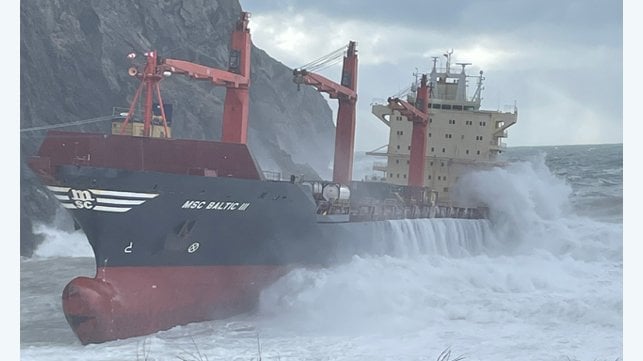
Winter Storms Are Taking Toll on Wrecked MSC Baltic III and Salvage Efforts

grounded containership in heavy weather
MSC Baltic III was pounded by high surf and winter conditions in November and again in December (Canadian Coast Guard)

Published Dec 12, 2025 7:04 PM by The Maritime Executive


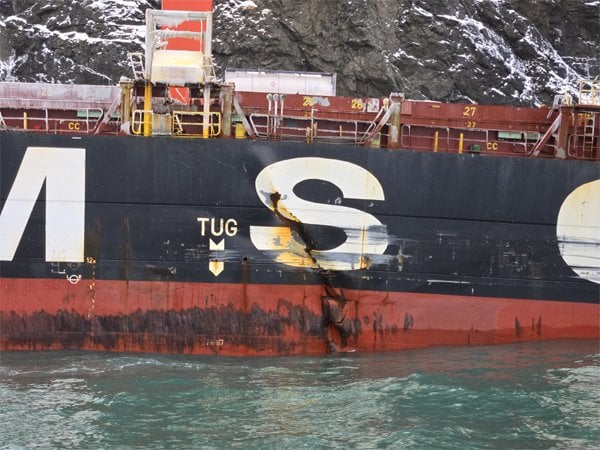
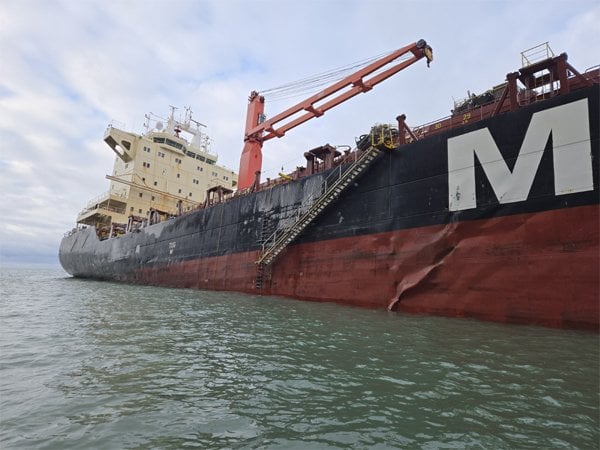
The Canadian Coast Guard released a series of pictures showing the damage to the hull of the MSC Baltic III, which has been grounded in a remote part of Newfoundland since February 2025. The hull shows significant additional damage after having been pounded by the high surf during a storm in early November and again in early December.

It was the same high surf and winter weather which had driven the ship ashore in February after it lost power while bound for Corner Brook, Newfoundland. Canadian forces organized a daring helicopter rescue to safety remove the crew from the ship. However, it was driven ashore on the rocky coast and the Coast Guard since then has said it would be difficult to remove. It has been overseeing an effort by T&T Salvage, which was retained by MSC Mediterranean Shipping Company.

After the early November storm, the Canadian Cost Guard reported there was visible damage in a number of areas, including below deck, in the framing, and bulk heads in the area of a water ballast tank. Anticipating the onset of winter weather and the dangers to the ship, the salvage teams had determined to add ballast water to the grounded vessel earlier in the fall to help keep it stable in preparation for winter and worsening weather conditions. A cableway was also completed from shore to provide access after they had previously been dependent on access from the waterside, which was more dependent on conditions.

The ship was again subjected to severe winter conditions on December 5 and 6. Canadian Coast Guard and salvage crews boarded the MSC Baltic III on December 7 and 8 to assess the storm damage. 


“The hull has sustained significant additional damage, including a noticeable change in the condition of the steel plate buckling on the starboard and port sides of the vessel,” reports the Coast Guard. “The stern portion of the vessel is also visibly lower in the water. Some small salvage equipment onboard was also found damaged.”

They were attempted to do a shoreline survey, but it was being hampered by the weather. Some residual amounts of oily debris had been found. After the last round of winter weather, they said a tar ball had also been found.


The focus in September and October had been to complete a washing of the fuel tanks and to remove as much residual oil as possible from the vessel. They reported that 1665.7 cubic meters of heavy oil and other pollutants had been removed as of early September. 

In addition, a few containers had remained in the holds of the ship, which were flooded. Spoiled food in some of the cargo had been causing fluctuating levels of hydrogen sulfide gas meaning that precautions had to be taken by crews working on site. The flooding also slowed the removal of the remaining containers as they needed to be dewatered in a controlled fashion not to create additional pollution. As of late September, the Coast Guard said there were 65 containers remaining onboard the vessel, below deck and submerged in water.

As the severe conditions subside, the crews will get back aboard for further damage surveys, and they will continue to clean up the debris being washed from the hulk. It is anticipated that winter storms will continue to impact the area with the Coast Guard saying additional reports will be provided should the vessel incur other damage.

It had always been anticipated that it would be difficult to remove the vessel. The increasing damage raises the likelihood that they will scrap the vessel in place.


Maryland Calls for Offshore Wind Proposals Days After Court Victory

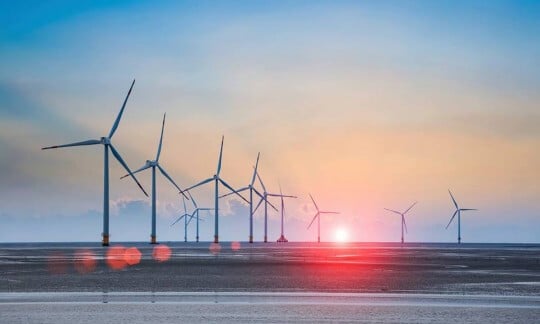
offshore wind farm
Maryland opened a call for proposals from license holders of offshore wind projects (file photo)

Published Dec 12, 2025 8:04 PM by The Maritime Executive


The State of Maryland celebrated the victory in the courts against the Trump administration's order halting licensing for wind energy projects by launching a new call for Power Purchase Agreements (PPA) from the licensed developers. The state reiterated its commitment to wind energy despite the ongoing struggles with federal regulators.

Maryland published the details of the call open to leaseholders. The state will be conducting an information conference this upcoming week. Proposals are due by January 16.

At the beginning of the week, the 17 states and the District of Columbia, which had filed a complaint in May, won a court order that vacated Donald Trump’s Executive Order halting sales and licensing for the wind power industry. The January order had directed federal agencies to pause their effort and to begin an open-ended review of the process. The administration argues that wind power was unfairly advantaged by the Biden administration and that licensing was rushed without full consideration of the impact of the projects.

A U.S. District Court Judge, however, found that the order was “arbitrary and capricious.” U.S. District Court Judge Patti Saris in Massachusetts found that the Executive Order violated the Administrative Procedures Act that governs how agencies administer programs.

“This decision is a clear victory for Marylanders,” said Governor Wes Moore. “Despite the president’s unlawful actions, this ruling means we can continue doing the work that helps families keep more of the money they earn. Lowering energy costs requires investing in solutions that work, and expanding clean, reliable wind power is one of the most effective tools we have.”

Maryland and the other states had argued that the actions of the federal agencies were blocking the state’s efforts to secure reliable, diversified, and affordable sources of energy to meet their increasing demands for electric power. They said the federal government was overstepping its authority and also threatening billions of dollars that the states had already invested in renewable power, and specifically wind power. 

State law requires Maryland to reach net-zero carbon emissions by 2045, with wind power serving as a cornerstone of this effort. Maryland asserted that it has invested heavily in wind energy as part of its plan to fight climate change. In 2023, Maryland set an ambitious goal to develop 8,500 megawatts of offshore wind energy by 2031.  

Currently, only one developer, US Wind, which is a partnership of Apollo Global Management and Renexia, is licensed. It has proposed a two-phase project known as Marwind and Momentum Wind. Originally, it was proposing 300 MW with 22 turbines in the first phase and 800 MW with 55 turbines in the other project. It later upped its proposal to a project with 840 and 870 MW and received its federal approval of its Construction and Operations Plan in December 2024.

US Wind has all its major licenses in place, but is currently in court fighting the Trump administration. The Department of the Interior is attempting to rescind the approval and review the license. The project has also been the subject of a fight between the state and federal environmental protection authorities over jurisdiction of licensing.

Two other developers are in an early stage in Mary, but could also participate in the new PPA call. Ørsted has Skipjack Wind, a combined 966 MW project off the coast of the Delmarva peninsula. In January 2024, however, it withdrew the project and said it would be repositioning the project as the power purchase prices were too low to make the project economical. It was also working with the Bureau of Ocean Energy Management to gain approval of its Construction and Operations Plan.

In August 2024, a federal lease auction was held in the mid-Atlantic. Equinor was the winner of an approximately 2 GW offshore wind lease in the U.S. Central Atlantic. This project is in the earliest stages of the three developers in Maryland.


Judge Vacates Trump’s Order Stopping Review and Approval of Wind Farms

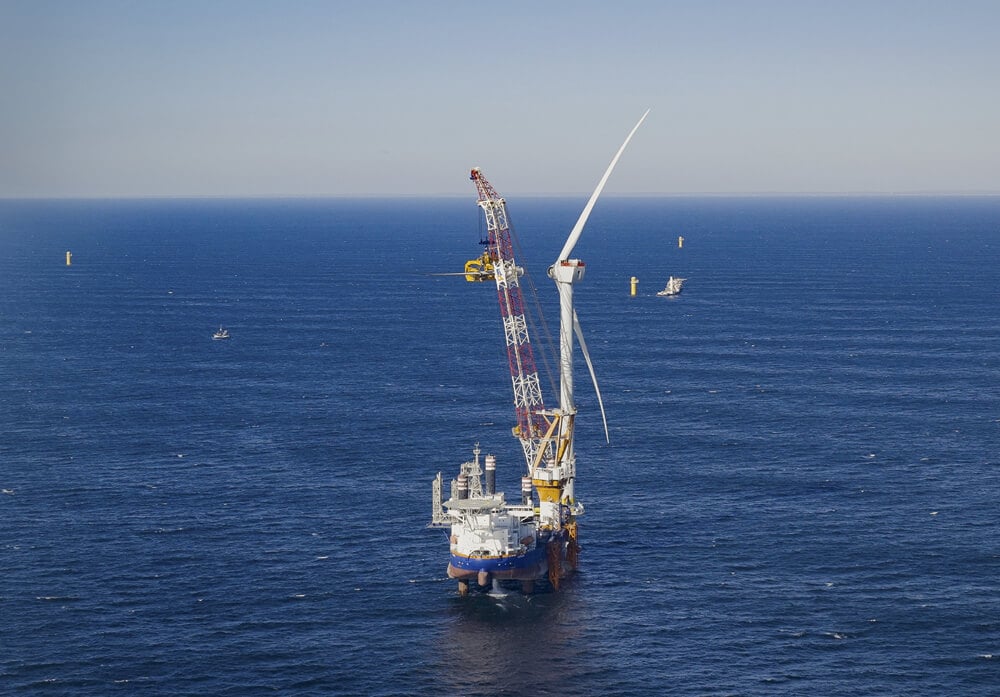
offshore wind farm installation
Court sided with the states in a suit against Trump's review of permitting for wind farm construction

Published Dec 9, 2025 2:05 PM by The Maritime Executive


A U.S. federal judge found for the states in a complaint filed against the Trump administration regarding Donald Trump’s January 2025 executive order placing the wind energy industry under review. While the decision is being hailed as a key victory by advocates, it may in reality do little to end the administration's assault on wind energy and other elements of renewable energy.

A coalition of 17 states and Washington, D.C., had sued earlier this year seeking to overturn the executive order, which placed the approval process for wind energy projects under review. The order signed on Trump’s first day in office directed U.S. departments to suspend additional licensing and to review the permitting process, contending that there are negative effects on national security, transportation and commercial interests, and that the leases “may lead to grave harm.” The administration has also argued that there were deficiencies in the reviews under the Biden administration and that approvals were rushed.

The order, however, was found to be “arbitrary and capricious” by U.S. District Court Judge Patti Saris in Massachusetts. She issued an order on December 8, vacating the executive order, writing that it is contrary to U.S. law. The judge rejected the arguments that the order is unconstitutional, but found that it violates the Administrative Procedures Act that governs how agencies administer programs.

Judge Saris said the Department of the Interior had failed to provide a “reasonable explanation” of the policy stopping the reviews and approval. The agencies had argued they were following the president’s order in stopping the reviews. They told the court that it is a policy disagreement with the states and outside the court’s jurisdiction.

The states had argued that it was an over step of presidential authority to halt the entire permitting process. They said it jeopardized state policies and large investments already made into renewable energy.

The order, which had also been a key issue in other efforts by the Trump administration, had previously been questioned by other courts, which noted that the review was open-ended. The Department of Justice cited the order in other cases where it had said previously issued permits and approvals would be reviewed in part due to the order. A court hearing a case against one of the Massachusetts wind farms had ordered the administration to provide regular updates on the review, saying it could not continue indefinitely.

The challenge to the executive order was being led by state attorneys general, including those from New York and Massachusetts. New York’s Attorney General Letitia James quickly issued a statement thanking the court for blocking the “reckless and unlawful crusade against clean energy.” Massachusetts Attorney General Andrea Joy Campbell said the court’s decision protects the large investments made by the state to support wind energy projects.

A White House spokesperson responded, repeating the allegations that the Bid administration had favored renewable energy. The statement said offshore wind projects were given “unfair, preferential treatment,” and that the Biden administration had hindered the energy industry with “burdensome regulations.”

The Natural Resources Defense Council said the executive order had caused at least seven major offshore wind projects to be paused. Major developers such as Shell and BP cited the uncertainties and said they were withdrawing their plans in the U.S.

Experts, however, noted that while it is a victory for the advocates, it would do little to change the broader effort by the administration to stop offshore wind development. The courts, it was noted, cannot compel the administration to approve projects or resume the lease sales. 

The administration attempted to stop offshore construction of the Empire Wind project in New York and the partially completed Revolution Wind in Massachusetts. It agreed to let the New York project proceed while a court placed an injunction against the efforts to stop the Massachusetts project. The Department of Justice has also been involved in cases against permitted wind farms in Massachusetts and Maryland, telling the courts the permits were being reviewed by the administration and likely to be revised or revoked.


Norway Approves Applications for Two Floating Wind Projects

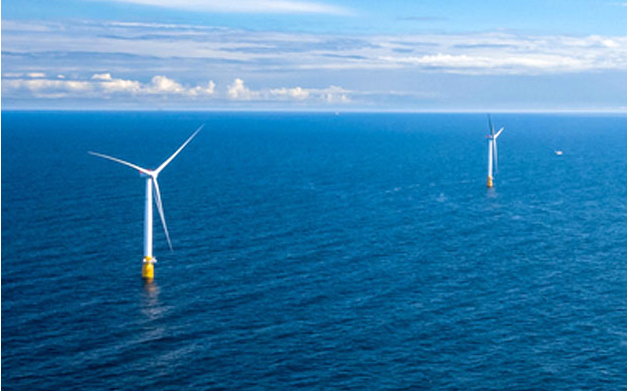
floating wind turbines
Norway took a key step selecting two groups to proceed with proposals for large floating offshore wind projects

Published Dec 11, 2025 7:32 PM by The Maritime Executive


Norway’s Ministry of Energy reports that it will award two project areas in the Utsira Nord region off the coast of Stavanger after having reviewed the applications received in the award program. Norway previously reported that two consortia had been formed and each submitted bids, which have now been confirmed.

The area which is 1,010 square kilometers, would place wind turbines at least 7 km (4.3 miles) from shore.  Because of the water depth and the challenges along the west coast of Norway, the projects will require new floating technology for the wind turbines. One of the groups is being led by Equinor, and the other includes EDF Renewables. 

Minister of Energy Terje Aasland said they were pleased to be able to move forward with two strong applicants. He predicted that the projects would contribute to developing floating offshore wind technology.

“Offshore wind is one of the government’s key focus areas to ensure sufficient power supply in the years ahead,” said Aasland in September after confirming the receipt of the two applications. “During the development phase, floating offshore wind in Utsira Nord will play an important role in advancing technology and reducing costs. By investing in offshore wind, we are also laying a solid foundation for Norwegian suppliers to compete in the development of future offshore wind projects.”

The companies will now be able to submit proposals for project-specific impact assessment programs and conduct their full assessments at the site. They will have two years to submit applications for their licenses after the approval of the impact assessments. 

Equinor has said that a floating offshore wind farm at Utsira Nord could be the next project in Norway with a size to drive industrialization of floating offshore wind and create new opportunities for the Norwegian offshore industry. During the application process, it said it was eager to contribute to a new chapter in Norway’s energy legacy and position floating offshore wind as a new industry contributing to the energy transition.

The government will also allocate NOK 35 billion (US$3.5 billion) as the maximum level of support available for the projects. The companies will be entitled to participate in a competition for state aid. Norway said that if both groups apply, one will receive support based on requiring the least state aid to develop the project.


Study: Marine Carbon Removal Needs More Thought Before Scaling Up

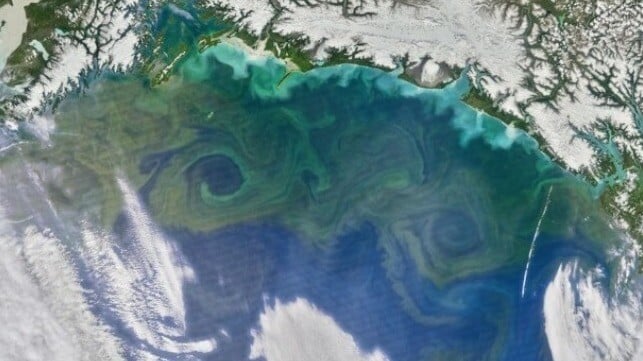
Marine carbon
Gulf of Alaska plankton blooms, 2016. Ocean fertilization technologies attempt to stimulate this natural plankton growth (NOAA file image)

Published Dec 7, 2025 7:36 PM by Gemini News


[By Nancy Bazilchuk]

The oceans have to play a role in helping humanity remove carbon dioxide from the atmosphere to curb dangerous climate warming. But are we ready to scale up the technologies that will do the job? The answer, according to an expert group reporting to the European Union, is no.

At least, not yet – not until there are measures in place to ensure these technologies, called marine carbon dioxide removal technologies, are doing what they are supposed to do and won’t do more harm than good.

Marine carbon dioxide removal technologies build on the ocean’s ability to absorb carbon. They can be biological, like encouraging the growth of plankton or seaweed that take up carbon dioxide as they grow, or they can be chemical or physical, such as directly removing carbon dioxide from the ocean.

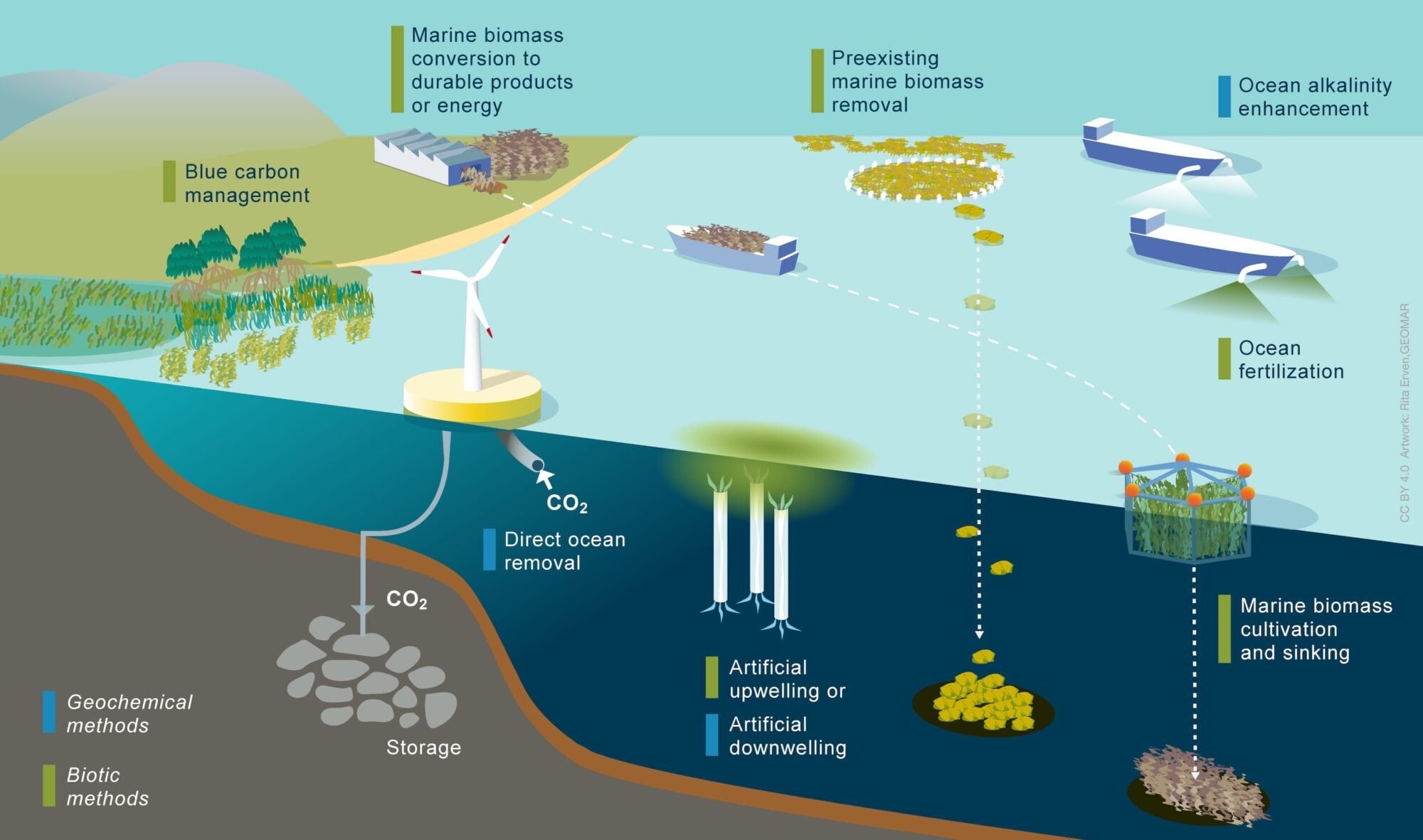
After these technologies remove the carbon from the air, it can be stored at the ocean floor and sediments, or the deep ocean, or in geological reservoirs or long-lived products (see below).

Marine Carbon Dixode Removal Technologies

Two main categories are currently being explored to remove carbon dioxide from the ocean.

Biotic methods rely on photosynthesis, in which marine organisms, particularly phytoplankton, take up CO2 and convert it into biomass. When these organisms die, some of their organic matter sinks, carrying the carbon with it. This is a process that removes carbon from the atmosphere and transports it to the ocean’s depths, where it is stored as part of long-term carbon sequestration.

Six approaches fall under this category:

  1. Preexisting marine biomass removal, where naturally occurring marine algal biomass can be transferred to the deep ocean where the biomass and degradation products can be stored out of contact with the atmosphere on climate-relevant timescales (>100 years). A key candidate for this is Sargassum, a genus of free-floating, fast-growing macroalgae, that grows in temperate and tropical seas.
  2. Marine biomass cultivation, where marine macroalgae (kelp and seaweed) are intentionally cultivated to take up CO2 through photosynthesis. They are then cultivated and sunk to the deep ocean.
  3. Marine bioproducts for durable products and energy, where seaweed can be made into bioplastics and construction composites. Seaweed can also be converted into bioenergy where the CO2 produced can be captured and stored underground.
  4. Ocean fertilization is where nutrients are supplied to phytoplankton to enhance their growth and thus their CO2 uptake. This carbon is sequestered in the deep ocean when the phytoplankton die and sink.
  5. Artificial upwelling relies on the ocean’s natural nutrient cycles by pumping cold, nutrient-rich deep water to the surface to stimulate phytoplankton growth. This approach is not technically feasible yet.
  6. Coastal blue carbon management involves replanting and restoring coastal vegetated ecosystems such as mangroves, salt marshes and sea grasses.

Geochemical methods capture and store atmospheric CO2 through non-biologically mediated chemical processes. These methods are inspired by natural carbon cycles and chemical weathering of rocks.

  1. Ocean alkalinity enhancement uses different methods to enhance the ocean’s capacity to take up CO2 from the atmosphere by changing the dissolved CO2 into bicarbonates or carbonates. This allows the ocean to take up even more CO2 from the air.
  2. Artificial downwelling creates a downward flow of upper ocean waters to enhance the transport of both dissolved and particulate carbon deeper into the ocean to enhance long-term storage
  3. Ocean carbon removal extracts carbon from seawater in a designated facility by using electrochemistry powered by renewable energy. This CO2 is stored underground in geological formations, mineralized into stable carbonate rocks, or used in products with a long lifetime.

(excerpted from Monitoring, Reporting and Verification for Marine Carbon Dioxide Removal, Future Science Brief No 13, Nov. 2025)

Schematic overview of marine carbon dioxide removal (mCDR) methods from the Future Science Brief from the European Marine Board. Graphic: Rita Erven, GEOMAR (CC BY 4.0).

“This is about safeguarding the oceans for a common good. The oceans can be part of the climate solution, but we need to strengthen the way we safeguard them before we scale things up,” said Helene Muri, a senior researcher at NILU and the Norwegian University of Science and Technology.

Muri was chair of an expert group commissioned by the European Marine Board to study the issue.

European Marine Board

The European Marine Board (EMB) is the leading European think tank in marine science policy. It provides a platform to advance marine research and to bridge the gap between science and policy.

The board is a unique strategic pan-European Forum for seas and ocean research and technology. It provides a strategic forum to develop marine research foresight, initiate state-of-the-art analyses and translate these into clear policy recommendations to European institutions as well as national governments.

Their new report, “Monitoring, Reporting and Verification for Marine Carbon Dioxide Removal,” is released in conjunction with the UN’s climate change meeting, COP30, being held in Brazil.

Emissions cuts first priority

The Earth is getting warmer, and much faster than the nations of the world had hoped a decade ago when they pledged in Paris to limit global temperature increases to 1.5°C above “pre-industrial levels”.

We know how to cut emissions, and we have lots of methods that work. That has to take top priority.

In his opening remarks to the COP30 Leaders’ Summit on November 6, UN General Secretary António Guterres confronted his audience with the urgency of the situation.

“Science now tells us that a temporary overshoot beyond the 1.5°C limit – starting at the latest in the early 2030s – is inevitable,” he said. “Let us be clear: the 1.5°C limit is a red line for humanity. It must be kept within reach. And scientists also tell us that this is still possible.”

The European Marine Board report underscores the need to act now with tools that are known to work – namely cutting emissions.

“We know how to cut emissions, and we have lots of methods that work,” Muri said. “That has to take top priority.”

Net zero and residual carbon

So why talk about removing carbon dioxide from the ocean at all, if the goal is to cut carbon dioxide emissions to zero?

None of these methods are mature to use if you cannot verify impacts or where the carbon goes, or how long it stays away from the atmosphere.

Here’s where reality comes in. Cutting emissions from burning fossil fuels for energy, while difficult, is doable because we have alternative energy sources, such as solar and wind energy, that can do the job.

However, some products and technologies we rely on are difficult to make carbon free. There’s plenty of research being done to reduce carbon emissions from air travel, for example, but carbon-free flight has proved elusive. And even as people are encouraged to fly less, there are still times when air travel is the only option.

Societies across the globe need to achieve something called net zero by 2050. That’s when all the CO2 emissions are zeroed out by removing the exact same amount of emissions.

Reaching the 1.5°C level requires reaching net negative emissions. That’s where societies cut all emissions that are possible to cut but then find ways to compensate for “residual” emissions, those that simply can’t be eliminated.

“We must have a net removal of carbon dioxide from the atmosphere to get to 1.5°C and that means that you will likely have some residual emissions from some sectors, such as shipping and aviation, and some industries,” Muri said. “And then you will have relatively large scale removal of carbon dioxide from the atmosphere as well, so that the net is at about between 5 to 10 gigatons of CO2 removed per year towards the end of the century, according to scenarios by the IPCC.”

To put those numbers into context: Total global CO2 emissions were 42.4 gigatons of CO2 in 2024, according to CICERO, the Oslo-based Center for International Climate Research.

Land-based technologies to remove this “residual” carbon are already underway – the main method is through afforestation. Another example are the Climeworks direct air capture plants in Iceland, where giant fans suck air through a filter that removes the CO2, which is then mixed with water and injected into bedrock, where it turns to stone.

There have been quite a few field tests of different kinds of marine carbon dioxide removal, but many of the technologies remain in their infancy. Others are gaining more traction. Here is why setting standards now, for monitoring, reporting and verifying what is being done, is important.

The challenge

Some marine based approaches to removing carbon dioxide from the ocean are similar to land-based mitigation options.

If you’re storing carbon in the ocean, in some form or another, not in a geological reservoir, it’s a lot harder to govern it and also monitor it. The ocean doesn’t stay put.

Planting lots of trees or protecting rainforests because they soak up carbon are two examples of land-based mitigation.  In the same way, some marine carbon dioxide removal technologies involve protecting and enhancing coastal areas, such as mangrove swamps.

Other approaches are more interventionist, such as fertilizing the ocean with iron or other nutrients to fuel plankton growth. These huge plankton blooms absorb carbon dioxide. When they die, they carry the carbon into the deep ocean, far from the atmosphere.

That’s the theory, at least.  The problem, Muri says, is knowing how well these different technologies actually work.

For example, how does a company actually prove how much excess carbon dioxide is being removed by the technology in question?

If we send carbon to the deep ocean, do we know how long it will stay there?

And while there are a number of different government and international agencies, along with international treaties and protocols, which ones should take the lead role? And how do they verify what is actually being done?

Ideally, “you monitor what is the background state of carbon (in the ocean) and then you implement your project and make sure that you have removed carbon from the atmosphere. And you try to monitor how much carbon that you have removed and how long it is staying away from the atmosphere.  And then you report that to some independent party and then it verifies that what you’re saying is correct,” Muri said.

The twist? “If you’re storing it in the ocean, in some form or another, not in a geological reservoir, it’s a lot harder to govern it and also monitor it. The ocean doesn’t stay put,” she said.

Credits and environmental impacts

Addressing these issues will be critical as technologies mature to the point where they are used by governments or companies to claim credit for removing carbon dioxide. Some companies have already begun to do so, Muri says.

“None of these methods are mature to use if you cannot verify impacts or where the carbon goes, or how long it stays away from the atmosphere,” Muri said.

“If we want to be serious about figuring out if you can do marine carbon dioxide removal in responsible ways that can make meaningful contributions, then we have to get serious about the monitoring, reporting and verification aspects,” she added.

“The credit part of it also has to work right. You have to have reliable and transparent and scientifically defensible crediting systems.”

Reporting will also have to include any environmental impacts, Muri said.

The way forward

In spite of the many uncertainties surrounding marine carbon dioxide removal, “all future scenarios are showing us that we will need carbon dioxide removal in order to reach our most ambitious temperature goal,” Muri said.

That’s the conclusion of the IPCC from any number of the organization’s reports, but particularly in a special report from 2018 on Global Warming of 1.5°C.

“We don’t know all the threats of these immature methods yet, but it’s a bit hard to just take them off the table because they’re uncomfortable to think about,” she said.

Nevertheless, marine carbon dioxide removal will not be a “miracle ocean fix to climate change,” she said.  “Some people are really hoping to find an answer in the ocean, but in our opinion, we’re not there yet.”

“And there’s a question of whether it can be a scientifically governed climate solution, and we don’t have the answer to that yet. But if we want to go in that direction, then we need to clear up all of these standards and establish these properly before we can scale things up,” she said.

This article appears courtesy of Gemini News and may be found in its original form here

The opinions expressed herein are the author's and not necessarily those of The Maritime Executive.


The Southern Ocean is "Sweating" as Heat Rises, With Effects on Weather

Hullwarren
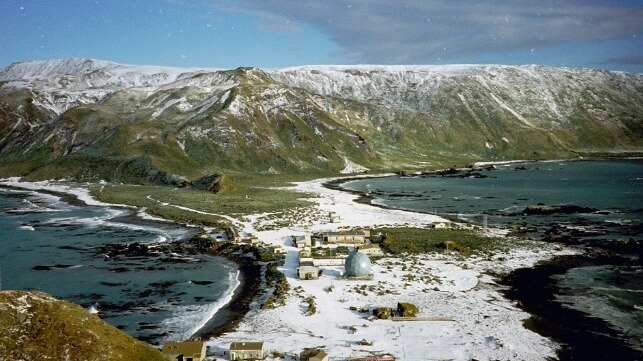
Macquarie Island (Hullwarren / CC BY)

Published Dec 7, 2025 9:17 PM by The Conversation


[By Steven Siems and Zhaoyang Kong]

If you ever find yourself on Macquarie Island – a narrow, wind-lashed ridge halfway between Tasmania and Antarctica – the first thing you’ll notice is the wildlife. Elephant seals sprawl across dark beaches. King penguins march up mossy slopes. Albatrosses circle over vast, treeless uplands.

But look more closely and the island is changing. Slopes are becoming boggier. Iconic megaherbs such as Pleurophyllum and Stilbocarpa are retreating.

For years, scientists suspected the culprit was increasing rainfall. Our new research, published in Weather and Climate Dynamics, confirms this – and shows the story goes far beyond one remote UNESCO World Heritage site.

A major – but little observed – climate player

The Southern Ocean plays an enormous role in the global climate system. It absorbs much of the excess heat trapped by greenhouse gases and a large share of the carbon dioxide emitted by human activity.

Storms in the Southern Ocean also influence weather patterns across Australia, New Zealand and the globe. Yet it is also one of the least observed places on Earth.

With almost no land masses, only a handful of weather stations, and ubiquitous cloud cover, satellites and simulations struggle to capture what is actually happening there.

That makes Macquarie Island’s climate record from the Bureau of Meteorology and the Australian Antarctic Division exceptionally valuable, providing one of the very few long-term “ground truth” records anywhere in the Southern Ocean.

These high-quality records of the observed daily rainfall and meteorology date back more than 75 years and are commonly used to validate satellite products and numerical simulations.

Rising rainfall

Earlier work has found rainfall at Macquarie Island had risen sharply over recent decades, and ecologists documented waterlogging that harms native vegetation.

But no one has explained how the island’s weather patterns are changing, or directly compared the field observations to our best reconstructions of past weather to assess Southern Ocean climate trends.

To fill this gap, we analyzed 45 years (1979–2023) of daily rainfall observations and compared them to a widely used reconstruction of earlier weather, known as the ERA5 reanalysis.

We wanted to understand the meteorology behind the increase in rainfall – that is, whether it was caused by more storms or more intense rainfall during storms. To do this we placed each day in the dataset into one of five synoptic regimes based on pressure, humidity, winds and temperature.

These regimes included low pressure systems, cold-air outbreaks and warm-air advection (the warm air that moves poleward ahead of a cold front).

Storms are producing more rain

Our analysis showed that annual rainfall on Macquarie Island has increased 28% since 1979 – around 260 millimeters per year.

The ERA5 reanalysis, in contrast, shows only an 8% increase — missing most of this change.

The storm track’s gradual move toward Antarctica is well established, and our results show how this larger change is shaping Macquarie Island’s weather today. Crucially, we found that these changes are not causing the increase in rainfall, as one wet regime (warm air advection) was largely replacing another (low pressure).

Instead, storms now produce more rain when they occur.

Why does this matter beyond one island?

If the rainfall intensification we see at Macquarie Island reflects conditions across the Southern Ocean storm belt – as multiple lines of evidence indicate — the consequences are profound.

A wetter storm track means more fresh water entering the upper ocean. This strengthens the different layers in the oceans and reduces the amount of mixing that occurs. In turn, this alters the strength of ocean currents.

Our estimate suggests that in 2023 this additional precipitation equates to roughly 2,300 gigatonnes of additional freshwater per year across the high-latitude Southern Ocean – an order of magnitude greater than recent Antarctic meltwater contributions. And this difference continues to grow.

More rainfall will also affect the salinity of water on the ocean’s surface, which influences the movement of nutrients and carbon. As a result, this could change the productivity and chemistry of the Southern Ocean – one of the world’s most important carbon sinks – in still-uncertain ways.

This increase in rainfall requires a matching increase in evaporation, which cools the ocean, just like our bodies cool when our sweat evaporates. Over the cloudy Southern Ocean, this evaporation is the primary means of cooling the ocean.

Our analysis indicates the Southern Ocean may be cooling itself by 10–15% more than it did in 1979 – simply through the energy cost of evaporation that fuels the extra rainfall. This evaporation is spread over the broader Southern Ocean.

In effect, the Southern Ocean may be “sweating” more in response to climate change.

The next challenge

Macquarie Island is just one tiny speck of land in Earth’s stormiest ocean.

But its long-term rainfall record suggests the Southern Ocean – the engine room of global heat and carbon uptake – is changing faster and more dramatically than we thought. The next challenge is to determine how far this signal extends across the storm track, and what it means for the climate system we all depend on.

The authors would like to acknowledge Andrew Prata, Yi Huang, Ariaan Purish and Peter May for their contribution to the research and this article.

Steven Siems is a Professor in Cloud Microphysics at Monash University.

Zhaoyang Kong is a PhD Candidate at the School of Earth, Atmosphere and Environment at Monash University.

This article appears courtesy of The Conversation and may be found in its original form here

The Conversation

The opinions expressed herein are the author's and not necessarily those of The Maritime Executive.