Friday, December 12, 2025


Stranded Shadow Tanker to be Towed to Secure Location
fire-damaged tanker
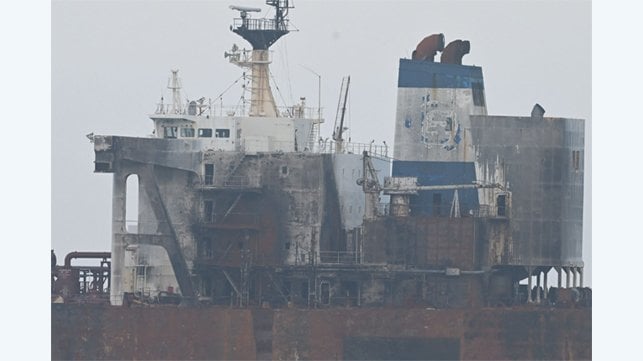
Fire-daamged tanker is expected to be towed to a secure anchorage on Sunday (Bolgarian Ministry of Transport)

Published Dec 12, 2025 1:02 PM by The Maritime Executive


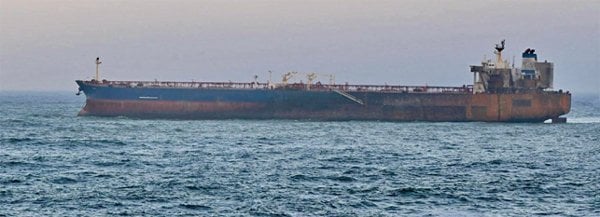
Bulgarian officials expect the standard shadow tanker Kairos will be towed on Sunday, December 14, from its position off the coast to a more secure location, while a long-term determination of the vessel’s fate remains unclear. The government had said it expected to sign a contract on Friday for the removal of the tanker, but the situation may be complicated by the collapse of the government and the resignation of the Prime Minister.

The Ministry of Transport reported that the government had agreed to provide approximately US$720,000 necessary to implement the towing operation. It said a contractor had been selected and that equipment and team mobilization were already underway.

The Maritime Administration Agency and the Border Police boarded the damaged tanker on Wednesday, December 10, to inspect its condition. They reported that the stern of the vessel is heavily damaged from the drone strike, explosion, and fire. Ukraine took credit for attacking the vessel on November 28 while it was underway north of Turkey. It drifted near the Bulgarian shoreline on December 5 after being released from a tow.

The Bulgarian authorities reported that water entered the engine room due to a hole caused by the drone strike. The engines, mechanical systems, and an emergency diesel generator are not working. Further, the port side anchor jammed when the crew attempted to release it last week to stop the movement toward the Bulgarian shore. The vessel is, however, holding 150 to 200 meters off the coast on its starboard anchor. 

They confirmed the tanks are empty and that there has been no pollution of the Black Sea so far. It is unclear how much bunker fuel and other oils are onboard. Three crewmembers have remained aboard after the Bulgarian Navy airlifted seven to shore. Media reports indicate the crew onboard was changed after the initial evacuations.
 

Bulgarian officials confirmed the ship was heavily damaged by the drone strike (Bulgarian Ministry of Transport)


The Ministry reports a specialized generator is being brought in to help with the salvage operation. The team plans to use the generator to restart the vessel’s hydraulic system to raise the starboard anchor. Three tugs will aid in the salvage and move the vessel to the anchorage off Burgas.

Because the vessel is under sanctions from the EU, as well as the UK and the U.S., Bulgarian officials note they cannot assist with the repairs of the ship. They can only assist the owners to secure and then remove the vessel.

Bulgaria has also requested information about the original tow and how the vessel ended up drifting towards shore last week. They want to know the plans of the original tow, its destination, and why the vessel was released in Bulgarian waters.

The tanker was built in 2002 and had been cited for its runs between Russia and India. It is 274 meters (899 feet) in length and approximately 150,000 dwt, putting it in the Suezmax class. It is reported to be owned and managed from China and claimed registry in Gambia, which is believed to be a false flag. The Bulgarian officials initially reported the vessel was registered in Benin, while Equasis lists the flag as unknown.

Turkey Pledges Investigation into Movements of Damaged Shadow Tanker
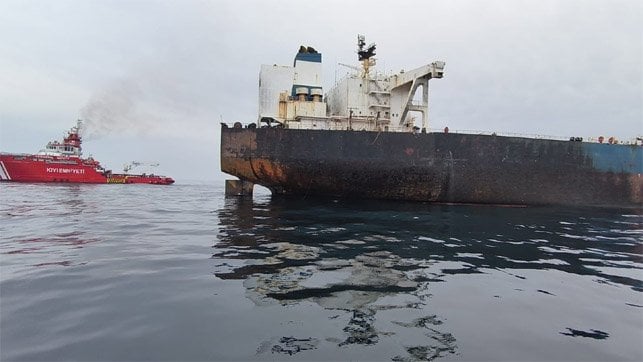
fire damaged tanker and rescue vessel
After putting the fire out on the tanker, Turkey says it was not informed of the plans for the tow (Turkish Ministry of Transport)

Published Dec 9, 2025 12:33 PM by The Maritime Executive


Turkish and Bulgarian officials have met to discuss the case of the fire-damaged tanker Kairos, which drifted off the Bulgarian coast at the end of last week and required a rescue operation. Bulgaria wants to know what the intentions were for the tanker that had been damaged during an attack by Ukraine, while reports from Turkey say the Turkish authorities had also not been informed about the movements of the tanker.

Bulgaria’s Deputy Prime Minister and Minister of Transport and Communications, Grozdan Karadjov, and Minister of Foreign Affairs, Georg Georgiev, met with the Ambassador of the Republic of Turkey to Bulgaria, Mehmet Uyanak, to discuss the situation and requested information about the tow of the tanker and its destination. Minister Karadjov presented detailed information on the movement of the tugboat Timur Bey from Turkish to Bulgarian territorial waters. The Bulgarian government contends the data clearly indicate a purposeful movement towards the Bulgarian coast, entry into Bulgarian territorial waters, and abandonment of the tanker six miles from the coastline.

The Turkish ambassador reported that the tow of the tanker had been arranged with a private Turkish company without the knowledge of the Turkish authorities. Ambassador Uyank reported that Turkish authorities have already started an investigation into the case and are committed to providing the Bulgarian authorities with full information.

Bulgaria says that after the tug released the tanker, it was told the tug was returning to Turkey. They were told the tug had “completed the task with the ship Kairos and is returning to the port of Ineada.” They are asking who ordered the tow and what the assigned task was.

Turkish law did not require notification of the operation, and according to the reports, Turkey was unaware of the operation before it commenced. On November 30, Turkey’s Ministry of Transport had said that the fire was extinguished aboard the vessel and that they were in discussions with the shipping company regarding towing the vessel. Turkey had removed all 25 crewmembers from the ship after the drone attack.

Early reports had suggested the vessel would be towed to Tuzla, Turkey. Later reports had said the vessel might be heading to another shipyard in the Black Sea. The salvage of the damaged tanker was the responsibility of the Chinese owners of the tanker.

The Kairos remains at anchor less than 1,000 yards from the Bulgarian town of Ahtopol. Bulgarian officials have reported that the ship was stable on one anchor and posed no immediate danger. However, at the owner's request, the Bulgarian Navy airlifted seven crewmembers from the ship to shore, leaving only three people aboard. Bulgaria also delivered supplies, including food, water, communications equipment, and a diesel generator and fuel to the ship. They report conditions aboard are difficult with no electricity or heat despite the winter weather.

Bulgaria’s Ministry of Transport said moving the tanker would require a break in the weather, which has been complicating the rescue operation. They were in contact with the Chinese owners and had been discussing a plan for towing the Kairos. Reports had said the vessel might be moved to the anchorage near Burgas. 


German Courts Debate Seizure of Russian Oil and Shadow Fleet Tanker
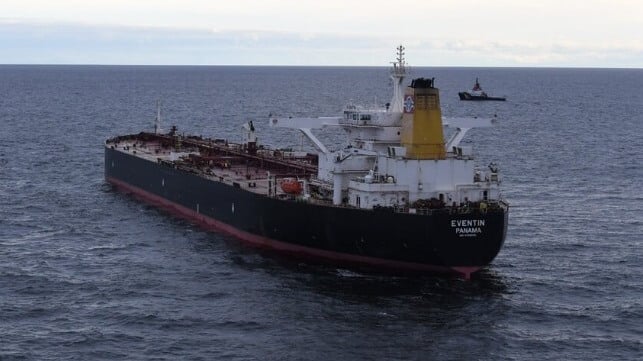
shadow fleet tanker detained in Germany
Shadow fleet tanker Eventin remains detained off Germany while the courts debate the seizure of its cargo (Havariekommando)

Published Dec 11, 2025 2:54 PM by The Maritime Executive


Eleven months after the German customs authorities first moved to seize a shadow fleet tanker and confiscate its cargo of Russian oil, the courts continue to debate the intricacies of the law in this unusual case. Germany’s Federal Fiscal Court on Thursday, December 11, upheld a lower court's decision suspending the ordered confiscation and sale.

The tanker Eventin remains under detention off the German coast in the roadstead near Sassnitz on the island of RĂ¼gen. The 152,000 dwt is the subject of a legal appeal by the time charterer of the tanker, attempting to block the confiscation and sale of the cargo, while has also seen the German Senate become involved. 

The vessel was loaded in Russia and traveling the courts report to India when it broke down on January 9, 2025, in the Baltic. Due to the power outage, it became unmaneuverable, drifting into German territorial waters. It was eventually towed by the German authorities to the anchorage, and four days later, the Customs Office issued the detention order for an inspection, citing possible violations of the embargo on the export of Russian oil.

The owners of the vessel have remained a mystery even through the court proceedings. Built in 2006, the tanker was renamed Eventin in June 2022, with ownership listed as a shell company in the Marshall Islands. The vessel was registered in Panama. At the time the vessel broke down, it was not sanctioned, but was later added to the EU, UK, and US sanctions. Panama removed the ship from its registry in March as a result of the sanctions.

The German Customs office consulted with the European Commission’s Legal Service. In February, it received an opinion that the ship was in violation, and the only way it could leave Germany was to unload the cargo. The Customs Office issued the seizure order at the end of February and, in March, ordered the cargo seized and to be sold.

The charterer files an objection to the confiscation order in March. It sought legal protection from the Finance Court. The court suspended the confiscation order in May.

The federal court found today that the Finance Court had “well-founded doubts.”  It says the definitions of the sanctions and possible exemptions are seriously doubtful in this case.

The appeal is based on the fact that the ship was under its legal right to seek refuge in a port after it became disabled. Further, they note the ship did not intend to enter the German EEZ, but instead was carried there by forces outside its control, ie, the currents and winds. The sanction regulations do contain an exception for vessels in distress to provide access to EU ports, but they point out that the ship was not sanctioned when it entered the German EEZ.

The court also writes that the German authorities actively prevented the ship from re-registering with another state’s flag after Panama withdrew its flag. Based on the confiscation order and a corresponding flag certificate, the court concludes the ship would be entitled to sail under the German flag.

The customs authority appealed the initial suspension order to the higher court. The court said the appeal is admissible but unfounded and therefore must be dismissed, due to the unresolved issues. The government continues to pursue its case and awaits a decision on the broader issue of whether the ship was exempt, as it was seeking refuge, or it was a violation of the ban on the export of Russian oil regardless of the circumstances. The court also said that the Senate must independently examine a request from the charterer to release the vessel and its cargo.

Experts point out that the case could have broader implications, as the EU this fall said it would move to stop more shadow fleet tankers. France held a shadow fleet tanker for several days at the end of September before releasing it, while French President Emmanuel Macron called for the EU to follow the same strategy to disrupt the economics of the Russian oil trade.


 

Billionaire "Dark Fleet" Oil Traders Weigh In on Iran's Succession Battle

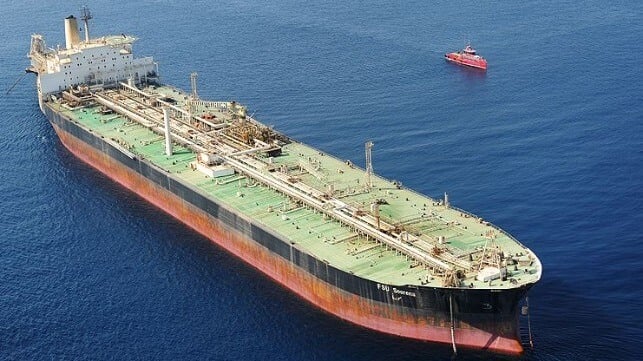
Iranian floating storage tanker (NIOC file image)

Published Dec 11, 2025 3:09 PM by The Maritime Executive


Iran's Supreme Leader Ali Khamenei is aging and his health is now openly discussed within Iran, raising the prospect of a succession battle over the future of religious rule - with implications for wealthy Iranian oil traders who provide the workarounds needed to circumvent Western sanctions.

Iran's religious rulers derive support from corruption and criminal networks, which both prop up the regime but which also make enormous profits for those connected to the inner circle. Two particular characters have weighed into the debate over who should succeed Ali Khamenei, both of whom have made enormous wealth from dark fleet activities shipping Iran's oil exports, and who have been sanctioned for doing so.

The record of their activities may not be wholly in the public domain, thanks to their skill in managing to hide their brokering activities within semi-legitimate businesses. But the information known to governments has been sufficient to see them sanctioned, even though they are both able to operate in some jurisdictions where the profit motive is regarded as more important than observation of Western-led sanctions.

Regime diehard Ali Shamkani at his daughter Fatemeh's wedding in Tehran. His son Hossein, resident in Dubai, has become rich by trading in sanctioned oil on behalf of the Iranian government (Instagram).

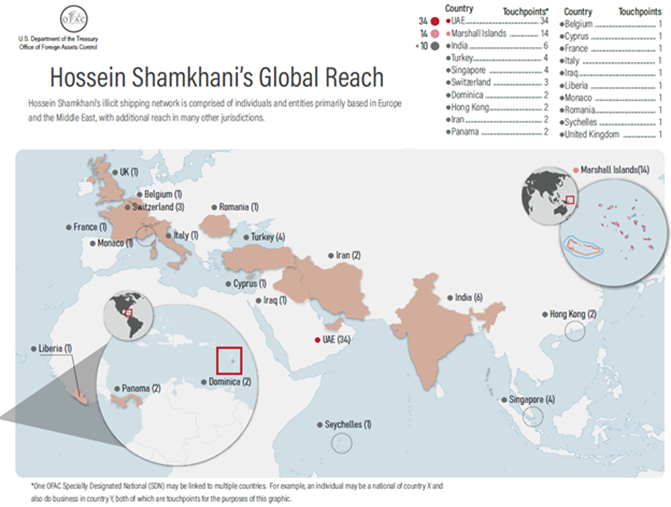
Mohammed Hossein Shamkani is the son of former Iranian National Security Advisor Ali Shamkani, still a close and hardline advisor to the Supreme Leader Ali Khamenei.  Shamkani's companies Admiral, and Milavous based in Dubai, are alleged since 2011 to have blended Iranian and Russian oil and falsified origins, purportedly managing for many years to sell such cargoes to reputable Western oil majors.  Shamkani was sanctioned by the EU in 2011, and was described in a recent EU sanctions update as being a "key player in Russia's shadow fleet operations".  Notwithstanding EU sanctions, Shamkani has denied being associated with Milavous or being involved in the shipments of Iranian-manufactured drones to Russia.  He was sanctioned by the US Treasury on July 30, 2025, a listing which linked him to Marvise SMC DMCC, Armada Global Shipping DMCC,  Koban Shipping LLC, Crios Shipping LLC, and Fractal Marine DMCC, all based in the UAE.   The US Treasury listing described Shamkani's empire as covering 'more than 50 vessels'.


US Treasury graphic of the Shamkani business empire (US Treasury)

Babak Zanjani is similarly well-connected.  Arrested for corruption in 2013, but not often found thereafter in jail, Zanjani was sentenced to death in 2021, accused of spreading corruption on earth, but more particularly for purloining $2.7 billion owed to the Ministry of Petroleum for oil exports conducted through his business empire.  By order of the Supreme Leader, his sentence was commuted in 2024 to 20 years in prison, but he was soon out and back to work.   

Zanjani's Sorinet Group is based in the UAE, and trades in cosmetics, finance and banking, hospitality, commercial aviation, infrastructure, building material, information technology and international real estate development. The company operates in Turkey, Tajikistan, Malaysia, and China, and in 2013 Zanjani estimated his net worth as $13.5 billion.  By 2013, his business activities had earned him sanctions listings from the EU ("a key facilitator for Iranian oil deals and transferring oil-related money") and the US ("helping Iran evade sanctions by moving billions of dollars and channeling funds to IRGC-linked entities"). In particular, Zanjani was linked to ship-to-ship oil transfer activity off Malaysia's east coast. 

Zanjani's post-penal business empire is flourishing, now known as the Avan Group, which has multiple dealings with IRGC and government entities. On December 2, he launched a blistering attack on X (to which only regime insiders have access), attacking the leading moderate in the Supreme Leader succession battle, ex-President Rouhani.

Both Shamkani and Zanjani still seem able to travel freely, but appear to have chosen to spend more time in Iran recently, presumably because of fears for their personal safety.

While those convicted of corruption on earth thrive for the time being, at least 5,000 Iranian oilfield workers have begun a series of well-supported strikes in the South Pars gas complex area, the largest for years, and despite intimidation from the authorities.  The worker solidarity seen so far suggests that the strikes will continue, which will inevitably affect export shipments on which the regime depends for revenue. A constant irritant of many such as the striking oil workers is that while they are struggling to survive, corrupt and supposedly religious regime insiders get rich.


Royal Navy Tracks Russian Submarine’s Transit of English Channel

UK shadowing Russian submarine
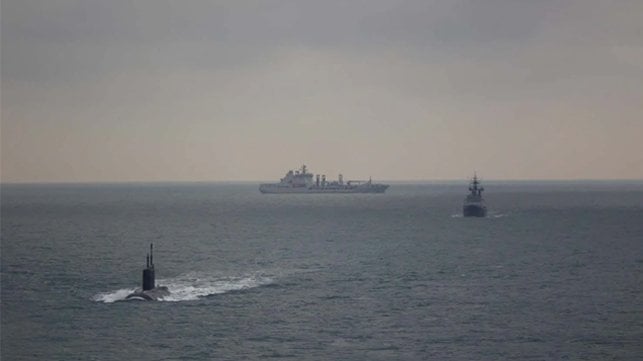
Tidesurge tracking the Russian vessels as they headed for the English Channel (Royal Navy)

Published Dec 11, 2025 3:52 PM by The Maritime Executive


The UK’s Royal Navy is highlighting that it once again tracked the movements of a Russian submarine and its escorts traveling through the English Channel in recent days. According to the Royal Navy, there has been a 30 percent increase in Russian vessels transiting UK waters in the past two years.

The latest effort took place over three days and involved shadowing the Russian Kilo-class submarine Krasnodar. Commissioned in 2015 as part of the third flight of the class, the submarine is 74 meters (242 feet) and displaces between 2,350 and 3,950 tons. It normally has a complement of 50 aboard and carries both Cruz and surface-to-air missiles. 

The vessel was sailing westward from the North Sea through the Strait of Dover and into the English Channel. It was accompanied by a tug Altay (3,000 tons). Naval Lookout reports the corvette RFS Viktor Veliky and tanker General Skobelev were also sailing as part of the grouping.

“Maintaining an overt presence and continued over watch of Russian vessels in UK waters is vital for national security,” said Lieutenant Commander David Emery, Flight Commander of 814 Naval Air Squadron’s Atlantic Flight. “The flexibility and professionalism of the crew of RFA Tidesurge allows us to project our helicopter wherever, day or night, in the maritime environment.”

RFA Tidesurge (37,000 tons displacement), a replenishment tanker of the Royal Fleet Auxiliary, was tasked with the job of shadowing the Russians. The Royal Navy also reports that a specialist Merlin helicopter from 814 Naval Air Squadron was also assigned and remained aboard the Tidesurge throughout the operation. 

The aircrew of the helicopter was prepared to pivot to anti-submarine operations, the Royal Navy said, if the Krasnodar had dived below the surface. The Russian sub, as is normal protocol, remained on the surface through the Channel, despite encountering stormy weather conditions.

The Royal Navy continued to track the Krasnodar and Altay until the Russians reached the northwest of France. It then handed over the shadowing task to a NATO ally.

It is not the first time the Tidesurge has been used in the shadowing operations. In February, it was assigned to shadow a Russian Navy task group as they sailed close to the UK.

Another one of the Kilo-class submarines caused a stir in October as it made the eastbound transit. There were reports that the submarine was limping back to Russia after having sustained damage. NATO was closely following the vessel, and the Dutch dispatched a vessel to ensure the sub was not in its coastal waters.

The UK’s Ministry of Defence also recently highlighted the increased Russian vessel activity. In November, it reported on a series of efforts to track Russian vessels, including an incident where the UK accused a Russian spy ship of lingering near the UK and directing lasers at RAF planes.


Svitzer to Build Next-Generation Electric Tugs in India

Cochin Shipyard India
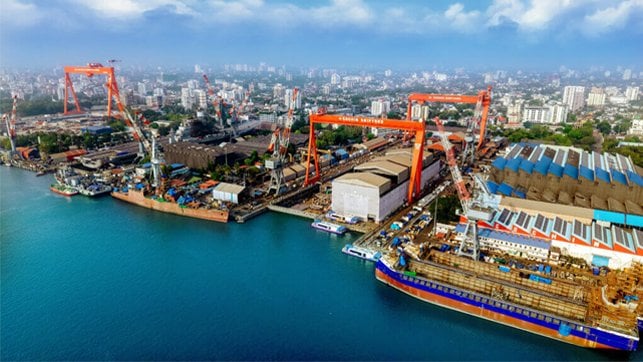
Cochin Shipyard won the order for the next-generation tugs as India kicks off its efforts to expand its shipbuilding industry (CSL)

Published Dec 10, 2025 4:32 PM by The Maritime Executive


Svitzer confirmed that it has entered into a shipbuilding order with India’s Cochin Shipyard to build at least four next-generation electric tugs. The shipyard labeled the financial value of the order as “significant,” while it is noted as a critical step in the “Made in India” maritime vision, which calls for the country to become a leading international shipbuilder.

The companies had previously announced in October a letter of intent and now report the order has been finalized for four TRAnsverse 2600e tugs built to Svitzer’s design. The company, which is owned by AP Moller Holdings, also has an option for four additional tugs while saying further vessels may follow in line with Svitzer’s fleet renewal plans and customer demand.

Svitzer reports the tugs will be for international deployment and in keeping with plans to advance its operations worldwide. The company is pursuing a fleet renewal strategy.

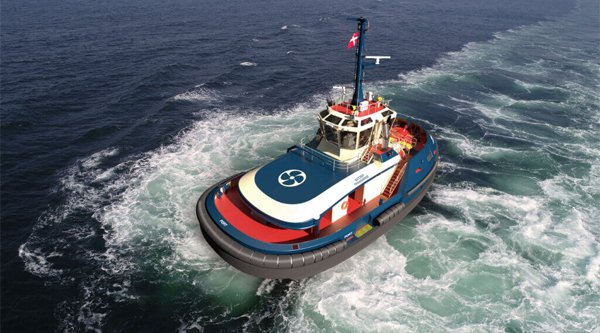
The new tugs are electric versions of a design already deployed by the company. It calls them the “most advanced and efficient tugs,” highlighting that the design can operate in complex and close-quarter operating situations, with all ship types and sizes. They can also operate in challenging weather and tidal conditions. Cochin reports they will have 70-ton bollard pull capacity.


Rendering of Svitzer TRAnsverse 2600e (26m electric TRAnsverse tug)


The tugs use a patented double-ended hull and in-line propulsion with omni-directional thrust. Svitzer says this design expands the operating envelope in towage by up to 50 percent. The new vessels will feature battery-electric propulsion. 

Cochin Shipyard reports delivery of the tugs is targeted to commence in late 2027. It will continue into early 2028, subject Svitzer says to detailed design, yard scheduling, and regulatory approvals. 

The order follows news that CMA CGM intends to build containerships in India. Other major carriers are also reported to be exploring opportunities in India, while South Korea’s HD Hyundai Heavy Industries announced an agreement to explore building a shipyard in southeast India.


Uber Pioneers First Fully Electric Zero-Emissions Ferry in London

electric ferry London
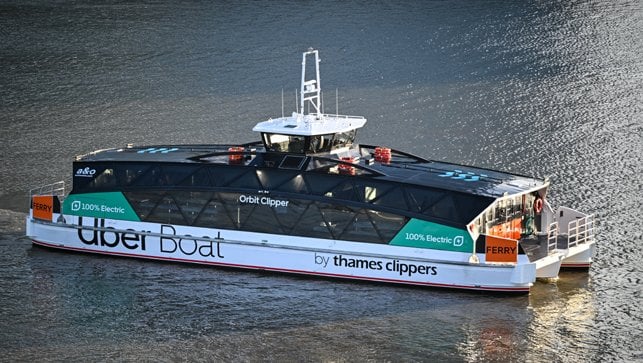
Orbit Clipper is London's first fully electric ferry (Uber Boat by Thames Clipper)

Published Dec 12, 2025 8:22 PM by The Maritime Executive


Ferry transport in London is entering a new phase, focusing on sustainability following the launch of a zero-emission vessel. The boat is being promoted as transforming the experience of passengers travelling along the Thames.

Four years after committing to introducing high-speed and eco-friendly vessels to operate on the Thames, Uber Boat by Thames Clippers is launching Orbit Clipper, the UK’s first fully electric zero-emissions ferry. On December 5, the new vessel completed its first passenger trip on the Thames, ushering in what is being described as a new era for sustainable transport in London.

Uber Boat by Thames Clippers reckons that the Orbit Clipper is a groundbreaking vessel in many aspects. The 150-passenger ferry with capacity for 100 bicycles features a roll-on/roll-off design that enables automated docking on both sides owing to its double-ended, self-docking, auto-mooring features. The vessel will operate between London’s Canary Wharf on the north side of the Thames and Rotherhithe on the south, offering an efficient and eco-friendly service for cross-river transport.

Built by UK’s Wight Shipyard Co, Orbit Clipper was partly funded by the UK government through the Department for Transport and Innovate UK. The 25-meter (82-foot) vessel with a maximum speed of 12 knots forms a major component of Uber Boat by Thames Clippers drive towards sustainable transport in London.

In recent years, the operator has added three hybrid high-speed vessels to its main fleet of River Buses, each cutting emissions by up to 90 percent and contributing to its ambitious target of reducing carbon emissions by 50 percent by 2035 and achieving net-zero by 2050. The boats operate on battery power while in Central London and recharge while using biofueled power on the rest of their journey.

“The launch of Orbit Clipper is a significant milestone for sustainable transport in London. As the UK’s first all-electric, zero-emissions vessel, it represents our commitment to reducing the city’s carbon footprint while continuing to provide reliable and efficient river transport,” said Sean Collins, Uber Boat by Thames Clippers CEO.

The new vessel is expected to replace the current cross-river ferry service, continuing to serve the growing number of passengers. Estimates indicate the vessel will, on average, ferry more than 20,000 passengers daily.

In operation for over 25 years, Uber Boat by Thames Clippers has spearheaded innovations in the marine sector, consistently supporting the Thames' role in London's sustainable transport future. As part of its mission, the company has also been exploring advanced fuel options, including compressed hydrogen gas, liquid hydrogen, and methanol.


Japan Licenses Its First Autonomous Navigation Ro-Pax Ferry

ferry equipped for autonomous navigation
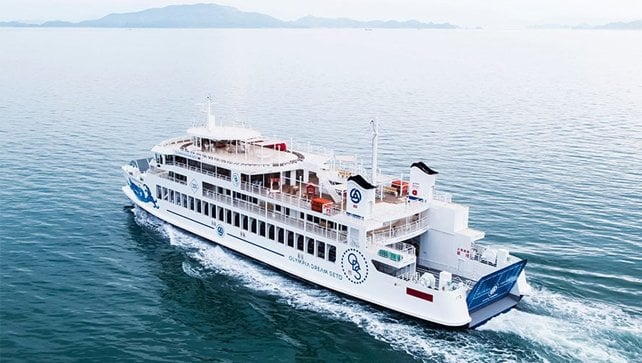
The 500 passenger Ro-Pax ferry will start autonomous navigation on Japan's Iland Sea (Nippon Foundation)

Published Dec 10, 2025 3:47 PM by The Maritime Executive


Japan is set to launch service aboard its first autonomous navigation ferry. The vessel Olympia Dream Seto recently completed the licensing process and will start sailing with the autonomous system on Thursday, December 11, as part of an ongoing government-sponsored project to advance autonomous navigation technology.

The Nippon Foundation hosted a demonstration of the autonomous system on Wednesday, highlighting it as a major milestone in the development of the technology. Reporters said the 60-meter (197-foot) ferry “gently pulled away from the pier and proceeded through calm waters. It also showed its ability to detect a ship ahead and reroute,” reported Kyodo News.

The nearly 1,000 gross ton ferry, which was built in 2019, is the first vessel successfully completed by the MEGURI 2040 project, which was launched in 2020. The ferry runs an approximate 70-minute route between Shin-Okayama Port and Shodoshima's Tonosho Port on the small islands off the coast of Japan. The ferry crosses the Seto Inland Sea and has a capacity for up to 500 passengers and 60 cars, or 10 buses. It operates at a speed of 13 knots with a crew of 10.

The MEGURI project was launched to advance autonomous navigation to the commercial stage. The Foundation highlights that it will help to reduce accidents caused by human error and will also address the growing shortage of seafarers. The project’s set a goal of achieving 50 percent unmanned operations of domestic ships by 2040.

The project conducted demonstration testing between January and March 2022. This included sailing in Tokyo Bay, which was designated as a congested waterway for the tests, with the Foundation highlighting the high vessel traffic in the region. It also completed a long-distance demonstration sailing approximately 750 km (over 460 miles).

Japan’s Ministry of Land, Infrastructure, Transport and Tourism established a study group in 2024 to consider the safety standards and inspection methods for autonomous shipping. The results were released in June 2025, setting the way for the Olympia Dream Seto to proceed.

The vessel’s systems were required to undergo an inspection before it was installed. This was completed in July and earned the vessel the “early-stage autonomous ship” designation. The second phase was completed on December 5, after the vessel demonstrated autonomous operations, and it received its certificate.

The ferry’s operator, Ryobi Ferry Company, says it will start using the system as the crew becomes more familiar with its operations. 

At the same time, the MEGURI project is moving forward with additional vessels. The containership Mikage (749 gross tons) was also used in the first stage demonstrations and is being prepared for certification. In addition, the RoRo ship Hokuren Maru No. 2 is being prepared for demonstration voyages in areas where it could encounter both congestion with fishing boats and fog. Additionally, the newly-built domestic containership Genbu was built anticipating unnamed operations. These demonstrations are scheduled to be completed by April 2026.


Norwegian Ferry Overshoots Pier and Hits Old Post Office

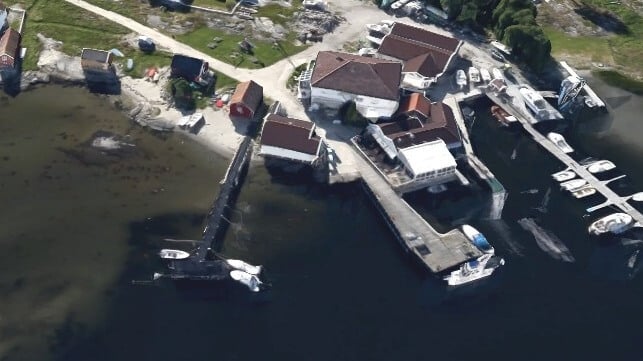
Ferry pier at Herfol, center right, and old post office, center (Google Maps / Airbus)

Published Dec 11, 2025 7:26 PM by The Maritime Executive


On Thursday, a ferry overshot its berth and crashed into an old building alongside the pier on the island of Herfol, Norway. 

At about 0930 hours on Thursday morning, operator Norled confirmed that the ferry connection for Herfol was temporarily suspended due to an operational incident. The suspension notice has since been lifted and is not mentioned on the firm's site. 

On arrival at the port, the ferry Ternen kept going too far alongside the pier. It appears to have missed its unloading pier, passing it to starboard, then allided with a retail store occupying the town's former post office. Local police were not immediately aware of the damage, according to VG, but sent someone out to inspect after asked by the press. Initial reports from the scene had indicated a grounding, not an allision, VG reported. 

The half-dozen passengers aboard the ferry were not at risk and disembarked safely after the allision, Norled said. No injuries were reported. 

Local mechanic Erik Wydahl was on scene and told Aftenposten that the casualty was caused by a technical problem. The crew attempted to stop, but could not slow down, Wydahl said. 

The Hvalerferga ferry route serves Herfol and other islands in the Hvaler archipelago, located in the southeastern corner of Norway. It is an essential transport link, and passenger transits are free of charge (and vehicle transits in the winter season). 


French Senate Adopts Environmental Tax on Cruise Passengers

Le Havre port
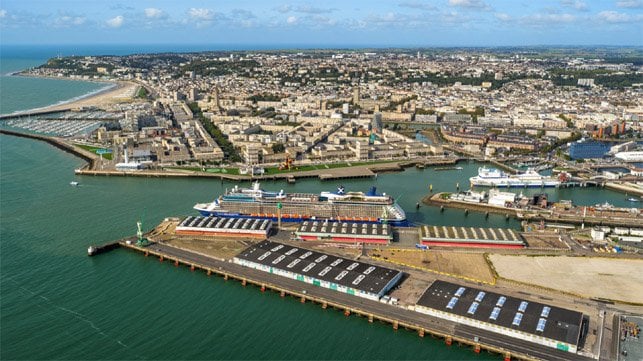
Passengers would pay a port at each port under the Senate's proposal (Haropa)

Published Dec 8, 2025 1:58 PM by The Maritime Executive


Lawmakers in France were successful in adding a new tax on cruise passengers to the proposed 2026 French state budget. They contend the tax is to counter the environmental impact of cruises on coastal France.

The senators presenting the measure assert it is a “polluter pays” tax, singling out the emissions of cruise ships while in ports. They argue that it would not harm the attractiveness of the sector but would provide additional finances to protect and enhance the coastlines of France.

Under the proposal, the tax would be €15 per passenger ($17.50) for each port the cruise ship visits in France. Estimates are that the tax could raise €75 million ($87 million) each year.  The proposal, which was put forth by the Republicans, was narrowly adopted in the draft budget with the support of the left.

Critics point out that the proposal is incomplete and will need to be further amended before it is adopted as part of the ongoing budget debate. At issue contends the Minister for Public Accounts, Amelie de Montchalin, is a lack of distinction between cruises and ferries. The Minister worries that if adopted, it would negatively affect the ferries operating to Corsica and crossing the English Channel.

The cruise industry trade group Cruise Lines International Association is also critical of the tax. They contend it would be a double tax as the cruise industry is already paying the fees under the European Union’s Emissions Trading Scheme. They assert that cruise ships comply with all regulations and are being unfairly singled out, while commercial shipping accounts for a larger portion of carbon emissions.

France is a popular destination for cruises both in the Mediterranean and Northern Europe. Government estimates set cruise visitor counts at approximately 4 million annually. River cruising on the Seine is a popular part of French tourism. 

The tax is the latest in a series of efforts by activists in France to limit the cruise industry. They have staged various protests to call attention to the emissions of cruise ships. Elected officials on the French Riviera have been responsive to the claims and the impact of overtourism. 

There were several attempts to limit the number of cruise ships and the size of cruise ships visiting the popular French Riviera ports, including Nice and Villefranche. The regional administration adopted new rules starting in 2026 that will limit cruises going forward.

France’s tax mirrors efforts in other destinations that have also sought to impose a “polluter pays” fee on cruise ships. The cruise industry recently sued the state of Hawaii, which also adopted a head tax on cruise passengers, which they said would be used to protect the state’s environment. Greece also adopted new port fees for the most popular islands in its efforts to manage the influx of cruise passengers and the environmental impact from the growing number of large cruise ships.

The debate over the French tax will continue as the government works in December to finalize the federal budget for 2026.

Fincantieri Floats New Luxury Cruise Ship for Regent Seven Seas

cruise ship in dry dock
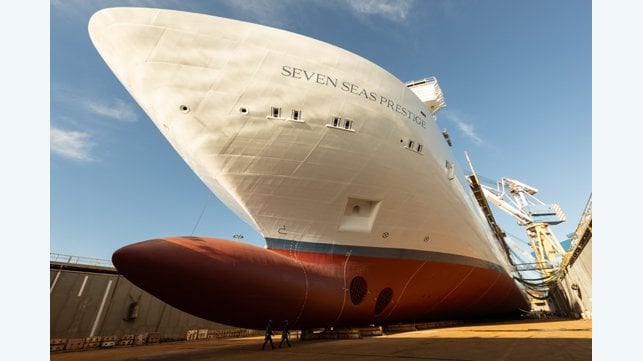
Seven Seas Prestige was floated in late November as the newest entrant in ultra-luxury cruising (Fincantieri)

Published Dec 10, 2025 6:36 PM by The Maritime Executive


Fincantieri’s shipyard in Marghera, Italy, recently completed the float-out of a new luxury cruise ship for Norwegian Cruise Line Holdings’ Regent Seven Seas Cruises. The ship, which is the first of a new class of ultra-luxury cruise ships for the brand, is part of the continuing growth of the segment and expands on the long-standing relationship with the shipyard.

Named Seven Seas Prestige, the ship will be 76,550 gross tons when completed with an overall length of 257 meters (843 feet). Regent Seven Seas highlights that while the ship is 40 percent larger than its previous ships, it will only accommodate 10 percent more passengers. Total capacity will be 822 passengers and 630 crew, giving the ship one of the highest crew-to-passenger ratios in the industry. 

The ship will boast the largest suite yet placed aboard a cruise ship, the Skyview Regent Suite, which will be nearly 9,000 square feet and include a spa bath, private gym, an in-suite elevator, and more. The ship will have a total of 411 suites, including introducing four new categories of suites. It will also introduce new dining options, including a Mediterranean concept, and will have a total of 11 dining options, including seven specialty restaurants.

“This newbuild order continues our measured, strategic expansion within the luxury space,” said Jason Montague, Chief Luxury Officer at Norwegian Cruise Line Holdings (NCLH). “It reflects our confidence in the growing demand for Regent’s best-in-class offering and reaffirms our long-standing partnership with Fincantieri, one rooted in craftsmanship and shared pursuit of perfection.”


Rendering of the first new class of cruise ship for the brand in a decade (Regent Seven Seas)


NCLH is working to keep up with the rapid growth in the ultra-luxury segment of the industry, which includes the entry of well-known luxury hotel brands, including Ritz-Carlton and Four Seasons, into the business. The Seven Seas Prestige is the first new class of cruise ship for Regent Seven Seas in a decade, following on from the Explorer Class also built by Fincantieri. The Explorer class, which is 55,500 gross tons with accommodations for 746 passengers, began with Seven Seas Explorer in 2016, followed by Seven Seas Splendor in 2020, and Seven Seas Grandeur in 2023.

Work on Seven Seas Prestige began with the steel cutting in October 2024 and the keel laying in March 2025. The float out began on November 27, and the ship has now been repositioned to the outfitting dock to complete construction. Delivery is set for late 2026, with the ship’s maiden voyage in December 2026.

Confident of the opportunities in the ultra-luxury space, Regent initially ordered two ships, with the next one originally scheduled for 2029. It has been delayed to 2030, but last month, even before the float out of Seven Seas Prestige, the company announced an order for a third sister due in 2033.

These orders build on a long-standing relationship between NCLH and Fincantieri. The yard has already built a total of 10 cruise ships for the company’s three brands, Norwegian Cruise Line, Oceania Cruises, and Regent. NCLH placed a large order in 2024 for two ships each of Oceania and Regent and four ultra-large, 200,000-plus gross ton cruise ships for Norwegian Cruise Line. In total, Fincantieri is set to build 13 additional cruise ships for NCLH for delivery between 2026 and 2036.

PortMiami Starts Winter Cruise Season with New Daily Record

PortMiami cruise ships
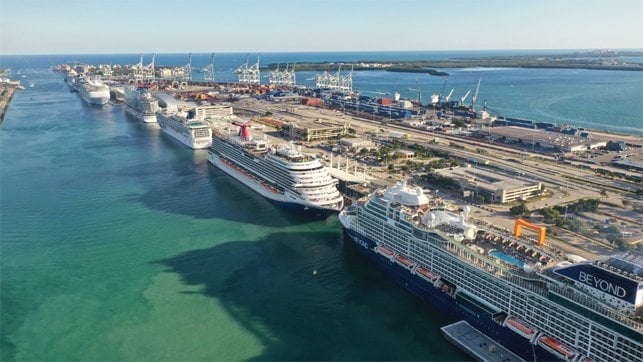
PortMiami had its third record day of 2025 at the end of November as it starts the winter cruise season (PortMiami)

Published Dec 12, 2025 5:34 PM by The Maritime Executive


The 2025-2026 cruise season started with a bang for PortMiami, with the port, which likes to call itself the cruise capital of the world, setting its third record this year for the number of passengers handled in a single day. It is the start of what promises to be a very busy season as the cruise industry continues its dramatic growth.

The port highlights that on November 30, it set a new daily passenger record with 75,201 passengers (embarking and disembarking). It would be impressive in itself, but it follows two records during last winter’s record season. PortMiami handled 10 cruise ships on February 8 and set two passenger records in the early spring. On March 30, it had its busiest yet cruise day with 72,008 passengers, and less than a month later, the record fell. On April 20, PortMiami handled 72,401 passengers in a single day.

November 30 again saw a total of 10 cruise ships with a combined double occupancy of over 35,000. In port that day were: Carnival Sunrise (2,984 passengers), Carnival Horizon (3,960 passengers), Carnival Celebration (5,374 passengers), Celebrity Beyond (3,260 passengers), MSC Divina (3,500 passengers), Norwegian Aqua (3,571 passengers), Symphony of the Seas (5,518 passengers), Independence of the Seas (3,634 passengers), Scarlet Lady (2,770 passengers), and Azamara Onward (684 passengers). It was pointed out that these are not even the highest occupancy cruise ships sailing from PortMiami.

Helping the port to continue its expansion was the opening in the spring of the new AA Terminal that primarily handles MSC’s cruise ships, including the arrival of the ultra-large 215,863 gross ton MSC World America, which entered service in April. Work is currently underway on yet another new terminal as a replacement for an existing facility at the western end of Dodge Island.

PortMiami also highlights that it will add 10 cruise ships to its roster this season. Cunard, for the first time, is homeporting the Queen Elizabeth at PortMiami, as is Holland America with the Zuiderdam, and MSC Grandiosa also made a port call before homeporting in Port Canaveral. In 2026, it will also host Holland America’s Eurodam and Silversea Cruises' Silver Nova. The brand-new cruise ships calling Miami home this season include Virgin Voyages’ Brilliant Lady, Oceania Cruises’ Allura, and, arriving in March 2026, Norwegian Cruise Line’s Norwegian Luna.

All of this continues to fuel the growth of the cruise business at PortMiami. In the fiscal year, the port reported 4 percent growth in its passenger totals, handling a record 8,564,225 cruise passengers. The prior FY it handled a record-breaking 8.2 million passengers, which was a nearly 13 percent increase.

With the Caribbean remaining the most popular destination for cruises, PortMiami continues to expect growth. However, for only the second time in the modern cruise industry, Port Canaveral topped the passenger totals of PortMiami. The Central Florida port handled 8,602,047 passengers, a better than 13-percent increase over the prior FY.

The same growth is showing at the other large homeports. Port Everglades in Florida reported it welcomed 4,773,873 cruise passengers (preliminary count) in Fiscal Year 2025. Also rising quickly is Galveston in Texas, which expects nearly 4 million cruise passengers this year.