Sunday, December 14, 2025

Iran deploys military aircraft for cloud seeding operations across drought-hit regions

Iran deploys military aircraft for cloud seeding operations across drought-hit regions
Iran deploys military aircraft for cloud seeding operations across drought-hit regions / bne IntelliNews
By bnm Tehran bureau December 10, 2025

Iran has deployed military aircraft for eight cloud seeding missions over 48 hours, Defrapress reported on December 10.

The rain-making programme targeted Lake Urmia and drought-prone central provinces in an escalating effort to combat the country's worsening water crisis, which has seen dams across the country run dry in recent months.

Cloud seeding is a form of weather modification where tiny particles are added to existing clouds to encourage more rain or snow to fall.

Iranian military planes conducted three flights on December 10, concentrating firepower on Lake Urmia basin in the northwest, which has lost roughly 90% of its water volume since the 1990s.

Two missions focused exclusively on Urmia, whilst a third swept across Tehran, Alborz, Zanjan and Qazvin provinces.

Additional sorties targeted Yazd province, extending precipitation efforts into Iran's central desert belt.

The operations mark the latest chapter in Tehran's aggressive pursuit of weather modification technology as the Islamic Republic grapples with mounting water scarcity.

Iran has experienced decades of drought exacerbated by dam construction, agricultural mismanagement and climate change, leaving major water bodies, including Lake Urmia, on the brink of ecological collapse.

Hamed Tabatabaei, engineer and head of the cold cloud seeding team, said forecasting teams identify priority areas one to two days ahead, with operations leaders communicating directly with pilots to determine routes, altitudes and timing for silver iodide discharges based on real-time sensor data inside clouds, according to Tabnak.

Unlike conventional high-altitude flights, cold cloud seeding requires pilots to penetrate cloud formations and navigate in near-zero visibility conditions.

Cloud seeding offers only marginal gains and cannot substitute for comprehensive water policy reform.

Iran has conducted cloud seeding programmes for years with mixed results, though officials rarely publish independent assessments of effectiveness.

The cloud-seeding programme comes as Tehran's reservoirs hold just 3% of capacity excluding Taleghan dam, with rainfall 97% below long-term averages in the worst drought on record, the head of Tehran's water and sewage company said on December 5.

The region should have received at least 75mm of rain by this point but has recorded only 3-4mm, compared with 43mm in the same period last year.


Slovak President Pellegrini says he won’t sign legislation dismantling Whistleblowers Protection Office

Slovak President Pellegrini says he won’t sign legislation dismantling Whistleblowers Protection Office
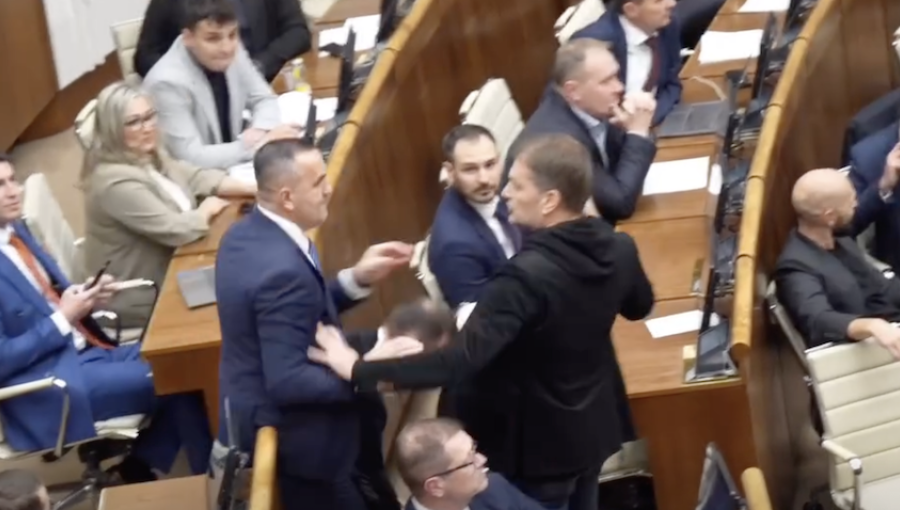
Opposition leader Igor Matovič scuffles with ruling party MPs during heated parliament session. / Igor Matovič via Facebook
By Albin Sybera in Prague December 12, 2025

Slovak President Peter Pellegrini has refused to sign legislation dismantling the Whistleblowers Protection Office (ÚOO), which the ruling left-right coalition led by populist Prime Minister Robert Fico passed in the parliament earlier this week.

Pellegrini made the statement in a video message uploaded to his Facebook social media profile after the ruling coalition broke Pellegrini’s swift veto of the legislation and after a turbulent December 11 session at the parliament, which included a scuffle between some of the ruling coalition and opposition MPs, daily DennikN reported.

"I am determined not to sign the legislation dismantling the ÚOO not even after the breaking of the veto for the reasons which persist," Pellegrini said.  

The country’s president, whose presidential campaign last year was backed by Fico’s ruling coalition, vetoed the legislation citing the EU’s objections to the dismantling of the Whistleblowers Protection Office as well as the shortened legislative procedure under which the move was passed, and for which there was no objective reason.  

Pellegrini, who is often viewed by the country's liberal media and opposition as Fico's ally, also stated his decision is to be "guided by legal and democratic principles and the building of such reputation of Slovakia, which will be respected by partners at international institutions."

Fico slammed Pellegrini for his decision not to sign the legislation and stated this his Smer party would review its support for Pellegrini "in the next elections." Pellegrini's critics pointed out that the swift veto and its immediate override could, in fact, rush in the dismantling of ÚOO. 

Pellegrini opened the video by stating that “I sharply condemn the way parliament approached the discussion of the amendment to the criminal code as well as the presidential veto regarding the dismantling of the Whistle-blowers Protection Office.”

Pellegrini was referring to the unrest at the parliamentary premises, caused by the narrow passing of the amendments to the criminal code, which includes controversial measures such as restricting collaboration with cooperating defendants, and introducing criminal offences such as defying World War II peace outcomes, or the “sabotaging of political campaigns”, which watchdogs fear could target journalists and online influencers.

Demonstrators marched through the streets of the capital Bratislava on December 11 protesting against the criminal code amendments, seen by critics as safeguarding officials from Fico’s Smer party against criminal investigations and as giving Fico’s coalition a tool to harass its critics.

The passing of the amendments was met with loud protests inside the parliament as well, including whistling from the opposition ranks. 

Ruling coalition MP Erik Vlček (Hlas) threw an empty plastic bottle at populist leader Igor Matovič after Matovič recorded the unrest on his mobile phone, and placed a poster by the seat of Smer legislator Tibor Gašpar stating that “the accused Gašpar is voting for his amnesty”.

Gašpar faces criminal investigation over his ties to a criminal ring which is also alleged to involve Gašpar’s relative, the Nitra-based oligarch Norbert Bodor.

Daily SME reported, referring to a respected lawyer Peter Kubina, that the restrictions on collaboration with cooperating defendants passed by the parliament will affect all the criminal cases in the country in which any cooperating defendant testified, including the investigation into the 2018 murder of investigative journalist Ján Kuciak and his fiancee Martina Kušnírová, which sparked mass demonstrations that forced Fico’s previous cabinet from power.


BOOKS: Uzbekistan’s reforms meet old habits of control

BOOKS: Uzbekistan’s reforms meet old habits of control
/ bne IntelliNews
By Clare Nuttall in Glasgow December 14, 2025

Nearly ten years after the death of long-time ruler Islam Karimov, Uzbekistan looks like a country transformed, but the political system remains tightly controlled, and hopes of meaningful democratic reform are fading, according to journalist and author Joanna Lillis.

In an interview based on her new book

 Silk Mirage: Through the Looking Glass in Uzbekistan, Lillis described a country with a modernising economy and more open public sphere, that contrasts with continued intolerance of political opposition, sporadic arrests of critics and “lingering fear” among citizens.

“It definitely feels like a different country,” Lillis told bne IntelliNews. “While we can criticise President [Shavkat] Mirziyoyev for the things he hasn’t done, there’s a very sharp contrast between how it was under Karimov and how it is now.” She detailed changes in how people live, how the economy functions, how people speak and what they dare to talk about.

One of the clearest changes, Lillis said, is economic liberalisation. “If we look at the economy, there are some very basic things that make it look different to me,” she said. “One example is the loosening of currency restrictions which were absolutely draconian under Karimov. That has aided businesses enormously — people tell me that again and again.”

She also recalled that under Karimov, for example, foreign bank cards did not function and there was a thriving black-market currency trade. “You used to see the black-market traders hissing at you in bazaars. Now, you just go to a bank or cashpoint. Under Karimov, Uzbekistan didn’t even have ATMs that could take foreign cards.”

More broadly, the economy is a lot more open and vibrant, and it has become easier for businesses to operate. “There were always small businesses in Uzbekistan — Uzbeks are very entrepreneurial people — but now I see a lot more happening.”

Cautious opening 

On the other hand, while Uzbekistan’s media and online debate have become more open, there are limits on the space for criticism.

“Socially, I think it’s very different,” Lillis said. “Obviously people remain wary of talking. The initial euphoria of the opening of the media and the loosening of the screws has worn off a bit, especially as people are now being arrested for critical remarks on social media.” She pointed too to the decision to criminalise criticising the president, but still argued the contrast with Uzbekistan under Karimov, who ruled from 1989 until his death in 2016, is undeniable.

"The kind of debates that take place in the public domain, the kind of conversations that take place would never have taken place under Karimov,” she said. “Just look at the thriving blogosphere. There is a lot of self-censorship and there are risks to crossing red lines, but there are thriving conversations.” 

According to Lillis, Uzbekistan today remains contradictory: colourful, welcoming and outward-facing, yet still capable of harsh crackdowns.

“Uzbekistan is dazzling and charming and beautiful and vibrant. I think anyone who visits will come back with that impression,” she said. 

That was also the case under Karimov, when the outward charm was in stark contrast to the harsh treatment of Uzbekistan’s population. The difference today, she argued, is one of degree.

“There is still that dichotomy, because there are still terrible things happening,” she said. “There is still repression. But it’s not as extreme as it was under Karimov. The contrast isn’t as stark.”

Red lines remain

Despite rhetoric about openness, Mirziyoyev has shown no willingness to allow political competition, according to Lillis. “Opposition is completely forbidden, at pretty much any level,” she said.

Among Lillis’ interviewees for the book are Khidirnazar Allakulov, the country’s best known opposition politician. “He has serious ideas — he has a programme, a manifesto — and he has tried multiple times to set up a party,” she said. “He told me he faced harassment and even violence because of that. That’s an example of where the red line lies.”

An attempt by popular singer Jahongir Otajonov to run for president in 2021 was also quashed. “He was kidnapped off the roadside, subjected to violence and threats of sexual violence, and told to stay out of politics. To me, that shows how nervous, even paranoid, the authorities remain about any political alternative emerging.”

Lillis was the only foreign journalist to reach the Karakalpakstan region immediately after the July 2022 unrest, sparked by proposed constitutional amendments that would have reduced the autonomy of the region. 

She described the situation when she arrived as “very tense” with a “fearful population”. Moreover, she argued, the events were entirely avoidable. “Had the government simply consulted people, had there been open discussion, the unrest could have been prevented. But instead, there was a top-down approach, no explanation and then a heavy-handed response.”

Despite similarities to Kazakhstan, where protests in early 2022 spiralled into nationwide unrest, Lillis does not see a high likelihood of an imminent repeat in Uzbekistan.

“I think the government keeps a tight grip on things partly to prevent any outbreaks of public unrest. Public protest is a complete no-no in Uzbekistan because they are afraid of what it might spiral into,” she said. 

She warned that suppressing people can create a “pressure cooker situation where suddenly the lid blows off as it did in Kazakhstan in 2022”. However, she does not see any sign of that in Uzbekistan. 

“People are afraid to protest, especially after witnessing what happened in Karakalpakstan,” she said. On top of that, “Mirziyoyev is popular in some quarters for having brought change to the country, a little bit more freedom, as well as a better economy.” 

Between reform and control

In one positive step, Mirziyoyev has brought in younger technocrats and encouraged Uzbek experts abroad to return, a change Lillis welcomes. She described a “massive influx of fresh blood into the structure of power” under the new president. 

“One thing Mirziyoyev has done is encourage talented Uzbeks living abroad to return home and work in the administration. That’s positive,” she said. “And he has brought in a lot of young blood. [Some ministers] are younger than in the Karimov era, they’re technocrats, they’re obviously passionate about doing a good job.” 

But elements of the old system remain firmly intact. As Lillis pointed out, the prime minister, Abdulla Aripov, held high-ranking positions in the telecoms sector during a period marked by major telecom bribery scandals involving the former president’s daughter Gulnora Karimova. “There hasn’t been a decisive break — either with the system or with the personnel,” she said.

Karimov’s legacy also remains politically untouchable. “His grave in Samarkand has become a place of pilgrimage in Samarkand,” Lillis said. “Mirziyoyev acts as if he’s trying to dismantle the dictatorship, but he is also encouraging public reverence for the dictator.”

Asked whether she is ultimately hopeful about Uzbekistan’s future, Lillis commented: “I can’t see Mirziyoyev loosening the screws; he’s actually tightening them now … That doesn’t inspire confidence. Allowing people more freedoms would benefit the people and the country.” At the same, she does think “he will continue with economic reforms and that will support growth, which will be good for the people”.

Overall, she said, she is optimistic because “Uzbekistan is already a better country than it was under Karimov”. Moreover, "whatever the leaders do, there are always the Uzbek people. They are talented, creative and dynamic, and they will always make a go of their country.”

ICE Raids Against Farmworkers Expose the Pretense of Border Security

When the state hunts its most essential—and most exploited—workers to meet deportation quotas, the myth of border security collapses.


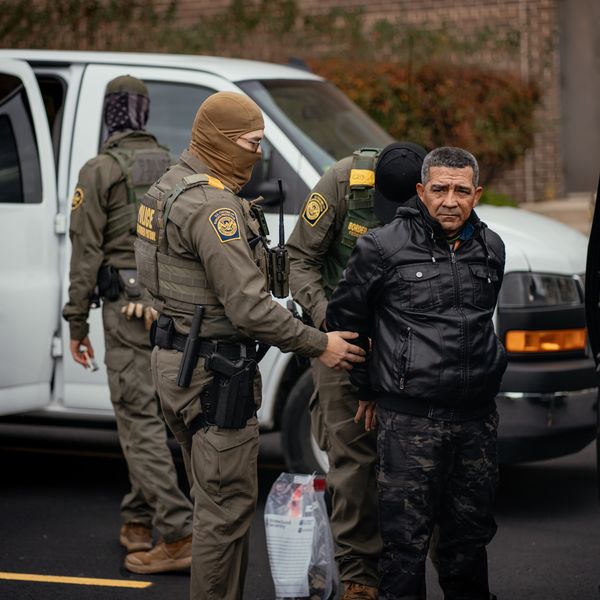
ICE agents stand at a farm in Ventura County, California.
(Photo via Congresswoman Julia Brownley)

Julia Norman
Dec 14, 2025
Common Dreams

The targeting of farmworkers by US Immigration and Customs Enforcement lays bare the true intent and interests motivating the Trump administration’s mass deportation policy agenda. It also exposes the fundamental contradictions that shape the US political economy. The nature of the state’s abductions, caging, and deportations of those doing the backbreaking work of harvesting fields, is not only revealed by the fact that those detained are not “criminals.“ It is the paradox, in which farm sustainers—pillars of the food system whose livelihoods feed communities within and beyond our borders—are being systematically expelled.

While ICE raids rage on in neighborhoods across the country, they are also notably taking place in the very heart of the food system: in labor camps and homes, fields and orchards, packing sheds, outside of schools and labor centers, and across small towns whose economies depend entirely on the people the state targets. ICE is taking advantage of the fact that farmworker communities are often rural and structurally marginalized.
RECOMMENDED...


‘This Is the Scandal’: DHS Data Show ICE Mostly Targeting People With No Criminal Convictions


Senate Report Shares Stories of US Citizens Assaulted, Unconstitutionally Detained by DHS

A state that capitalizes against workers it labels as essential in times of crisis yet simultaneously categorizes as “illegal”—especially the moment deportation quotas prove profitable—shows how racial capitalism depends on legal precarity to function. In the agrifood system in particular, the precarity of farmworkers has underpinned how corporations and landowners increase their margins, while keeping the cost of food artificially low.

As activist and award-winning author, Harsha Walia, argues in Border and Rule, borders function not merely to exclude, but to produce a workforce that can be exploited precisely because its existence has been criminalized. The US government, whose imperialist record of consequential trade policies and debt agreements, exporting dumping under in the name of trade or “aid,” imposition of sanctions, and military interventions in or with foreign nations, has made significant contributions to producing crises of migration. At the same time, the state determines the rights and protections those same migrants might have—migrants it requires as a key labor force. For migrant farmworkers in particular, this vulnerability and legal precarity is even more stark given the historical double standards within agriculture. Farmworkers are routinely carved out of basic labor protections, including being denied overtime rights and robust health and safety regulations. Their disposability is not accidental; it is legislated and maintained with the underlying political and economic assumption that those who are forced to look for work across borders can, or even should, remain unprotected and exploited.

To criminalize those who feed you is more than a contradiction. It is an indictment, revealing a society willing to squeeze labor while kidnapping and expelling the people who provide it.

So, even as US farmworkers are those whose skill and sweat stabilizes and maintains US agriculture—a foundation of public health and our economy—under President Donald Trump’s deportation siege, they find themselves under regular threat because of their supposed legal status.

According to US Department of Agriculture data, over 40% of US farmworkers are undocumented migrants. In California, that percentage is even higher, with estimates ranging from nearly half to upwards of 70%. This means that the state that grows approximately half of the US vegetables and over 75% of the country’s fruits and nuts is an easy target for ICE raids. Residents of Kern County, which has the highest concentration of agricultural workers in the state, recently witnessed the opening of California’s newest and largest migrant detention facility this fall. This facility is another signal to farmworkers that the state’s surveillance and criminalization of their community is becoming an inescapable part of daily life.

Additionally, in early October, the Department of Labor announced a new rule that slashes the wages of H-2A workers between $5 to $7 per hour, thereby transferring $2.46 billion dollars in wages from workers to employers each year. Crucially, US agriculture has become increasingly dependent on the H-2A program to address chronic labor shortages, as it permits eligible employers to recruit foreign workers for temporary agricultural jobs. The administration’s decision therefore not only undermines the wage protections intended to make the H-2A program a lawful and regulated alternative to undocumented labor, but also exposes its willingness to undercut the very workforce the program is purported to support. A coalition of California attorneys general led a letter noting the various consequences of the new rule, which they claim “abandons reliable farm-specific data,” and exacerbates “the roots of farmworker poverty for both H-2A workers and domestic farmworkers alike.” United Farm Workers (UFW) has also launched a lawsuit intended to reverse the administration’s decision, which they claim reflects, “one of the largest wealth transfers from workers to employers in US agricultural history.”

In essence, the administration’s pursuit of farmworker communities serves no legitimate economic or social goal. Instead, it enacts government scapegoating: the creation of a rhetorical problem (“illegal workers”) and the violent pursuit of that manufactured threat in order to justify the ever-expanding profitability of the border-security apparatus. It is an exercise of racialized state theater, and a manifestation of a food system left to the logic of deregulation and cheap, disposable labor—labor the border itself ensures under the guise of protecting national security or state sovereignty. Reports from the federal Department of Labor indicate that ICE’s siege is already contributing to labor shortages and supply consequences, as farmworkers are too afraid to leave their homes. Farmer organizations have also expressed solidarity with farmworkers, noting their importance in keeping the food economy afloat.

The fear and suffering imposed on farmworkers should neither be reduced to the specter of a labor shortage. It is a fear that fractures community life, determines whether someone seeks medical care, and dictates whether a child goes to school. In the aftermath of raids, it leaves mothers, fathers, children, and their families terrorized and often unaccounted for. It also compounds the daily struggles of working in systems that maintain unsafe labor conditions and unfair wages, such as mounting food insecurity and chronic health issues.

These communities are not peripheral cogs in some vast, anonymous agricultural machine. They are the harvesters of our food. To criminalize those who feed you is more than a contradiction. It is an indictment, revealing a society willing to squeeze labor while kidnapping and expelling the people who provide it. It does not reflect lawfulness or the interests of “public safety.”

While the going after farmworker communities in such a concentrated manner might be relatively new to the Trump administration, farmworkers’ long-standing legal precarity and fight for basic protections—while holding up such a huge portion of the food economy—is not. If targeting workers whose status is defined not by the role they play in feeding the nation or sustaining the economy, but by their documentation, does not underscore the structural flaws inherent in our entire economic system, it at least reveals the insincerity of Trump’s war on im/migrants and the choreography of the militarized border project. As ICE raids against farmworkers continue nationwide, the entire pretense of border security reveals itself as utterly transparent.

Our work is licensed under Creative Commons (CC BY-NC-ND 3.0). Feel free to republish and share widely.

Julia Norman
Julia Norman is an independent writer and researcher from Los Angeles, California.
Full Bio >


It’s Time for an All-Out Food Fight With Trump

How can ordinary grocery shoppers organize and become part of the movement that is endeavoring to protect society against Trump’s authoritarian juggernaut?


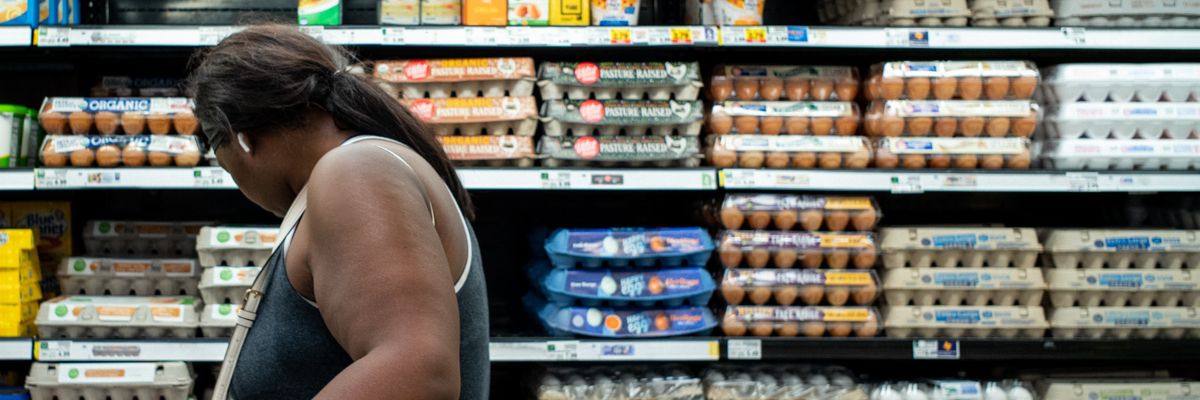
A customer shops for eggs in a Kroger grocery store in Houston, Texas.
(Photo by Brandon Bell/Getty Images)

Jeremy Brecher
Dec 14, 2025

LONG READ


Hunger has a funny way of concentrating the attention.

The cost of food and cutbacks in the provision of food for those who need it have been drivers of mass protest throughout much of history:One of the events initiating the French Revolution was the Women’s March on Versailles, which began among women in the marketplaces of Paris protesting the high price and scarcity of bread. Their demonstrations quickly became intertwined with the activities of those who were seeking an end to autocracy and had just issued the Declaration of the Rights of Man.
The 2008 Egyptian general strike over rising food costs provided inspiration for the overthrow of Egyptian dictator Hosni Mubarak three years later.
In 2022 in Sri Lanka, rising food prices among other grievances led to protests that culminated in the overthrow of the ruling regime.

Recent months have seen the emergence of a powerful movement-based opposition to President Donald Trump and MAGA, manifested in the 7 million participants in No Kings Day and the unprecedented on-the-ground opposition to Immigration and Customs Enforcement (ICE) and National Guard occupations of American cities. At the same time, the price of food for Americans of every class has soared: A survey this summer by the Associated Press and NORC found the cost of groceries has become a major source of stress for just over half of all Americans—outpacing rent, healthcare, and student debt.

What are sometimes belittled as “pocketbook issues” like the cost of food, housing, and medical care have become critical issues for a majority of Americans. So far, the hundreds of millions suffering from inflated prices have not found a way to organize themselves and fight back. Nor has the movement-based opposition taken up their cause. But a rarely remembered consumer boycott half a century ago indicates how such self-organization against high food prices might emerge.
“America’s Largest Protest”

Ann Giordano, 33, described herself as “just a housewife.” She recalled that she was never particularly conscious of food prices; her Staten Island kitchen didn’t have enough shelf space for her to buy in large quantities. But one day when she had put the groceries away there was still space left on the shelf. She vaguely wondered if she had left a bag of food at the store. Next time she came home from shopping, she looked in her wallet and concluded that she had accidentally left a $20 bill behind. When she went back to the supermarket and found out how much her food really cost, she suddenly realized where the shelf space had come from and where the money had gone.

It was early spring in 1973. Inflation was rising, food prices were soaring, and millions of shoppers nationwide were having similar experiences. Mrs. Giordano called some of her friends and discussed the idea of a consumer boycott—an idea that was springing up simultaneously in many places around the country in response to rising food prices. Soon a substantial network of women was calling homes all over Staten Island, spreading word of the boycott. They called a meeting at a local bowling alley to which over one hundred people came on two days’ notice. They named themselves JET-STOP (Joint Effort to Stop These Outrageous Prices) and elected captains for each district. Within a week they had covered the island with leaflets. picketed the major stores, and laid the basis for a highly effective boycott.

Mrs. Giordano and her friends were typical of those who gave birth to the 1973 consumer meat boycott, “a movement which started in a hundred different places all at once and that’s not led by anyone.” As a newspaper account described it:
The boycott is being organized principally at the grassroots level rather than by any overall committee or national leadership. It is made up mainly of groups of tenants in apartment buildings, neighbors who shop at the same markets in small towns, block associations, and—perhaps most typical—groups of women who meet every morning over coffee. All have been spurred into action by the common desire to bring food prices back to what they consider a manageable level.

The 1973 consumer meat boycott was undoubtedly the largest mass protest in American history. A Gallup poll taken at the end of the boycott found that over 25% of all consumers—representing families with 50 million members—had participated in it. Large retail and wholesale distributors reported their meat sales down by one-half to two-thirds. The boycott was strongest among what the press referred to as “middle income” families—those with incomes around the then-national average of $10,000 to $12,000 a year. It represented, in the words of one reporter, “an awareness that, for a whole new class of Americans like themselves, push has finally come to shove.”

In low-income neighborhoods, sales fell less during the boycott, largely because, as retailers pointed out, the residents, who couldn’t afford much meat at any time, had been cutting back for weeks due to high prices. As one Harlem merchant said, “How much can these people tighten their belts when they don’t have too much under their belts in the first place?”

Some advocates of the boycott made the dubious argument that it would bring meat prices down by reducing the demand for meat. Most participants, however, saw the movement as a protest, a way of communicating to politicians and others what they felt about the rising cost of living.

President Richard Nixon responded by putting a freeze on meat prices, but his move was met by scorn among many boycotters, who felt that prices were already far too high (“They locked the barn door after the cow went through the roof,” commented one housewife).
“We Ain’t Buying It!”

The meat boycott did not prove to be an effective tactic for combating high prices. Lacking a further strategy for meeting its participants’ needs and failing to hook up with the other mass insurgencies of the time, the movement soon lost momentum. Participants stopped coordinating their activity and returned to more individual strategies. But it did show the tremendous capacity of ordinary people to organize themselves on a massive national scale around issues of mutual concern—in this case the price of food.

Recent months have seen the emergence of the consumer boycott as a powerful vehicle for combating the Trump regime and undermining its “pillars of support.” Today’s boycotts are far more effectively targeted on specific institutions and realizable demands. For example, when the “Tesla Takedown” challenged Elon Musk’s role demolishing federal agencies and jobs, sales plunged and company stocks fell 13% in three months. A boycott campaign against Target initiated in January by the local Black community in Minneapolis over its reversal of its diversity, equity, and inclusion (DEI) policies has now cut sharply into its sales, helping lead to its stock falling 33%, a $20 billion loss in shareholder value, and replacement of its CEO. When Disney took late-night host Jimmy Kimmel off the air over comments he made following the murder of Charlie Kirk in September, the Working Families Party helped put together a toolkit that explained how to cancel a Disney subscription. The Wall Street Journal reported that customers ditched Disney+ and Hulu at double the normal rates in September. Disney brought Kimmel back within days, and Hulu soon followed suit.

The 1973 meat boycott illustrates the way what are sometimes dismissed as “pocketbook issues” can be drivers of self-organization and massive outpourings of public discontent.

Today’s boycotts are also much better aligned with other forces. For example, in the days following Thanksgiving, major organizations that had backed the millions-strong national No Kings and MayDay2025 days of action, including Indivisible, 50501, and MayDayStrong, swung behind the boycotts of Target, Amazon, Home Depot, and other major corporations. Some national coordination was provided by a group that called itself “We Ain’t Buying It.”

This action is taking direct aim at Target, for caving to this administration’s biased attacks on DEI; Home Depot, for allowing and colluding with ICE to kidnap our neighbors on their properties; and Amazon, for funding this administration to secure their own corporate tax cuts.

These groups and many others are backing the boycott in support of striking Starbuck’s workers under the slogan, “No contract, no coffee!”

Like the Tesla Takedowns, these boycotts are coordinated with and often spearheaded by demonstrations and other forms of direct action at physical locations. And they are finding ways to stimulate other forms of pressure on their targets: The Amazon protest group Athenaforall, for example, is encouraging local groups to demand an end to local contracts with Amazon, permission for Amazon expansions, and public subsidies for Amazon.

Today’s boycott actions are better targeted and better allied than the 1973 meat boycott, but so far, they have not drawn in much of the population that is directly harmed by Trump and his corporate backers. The 1973 meat boycott shows that pocketbook issues, such as inflation and most notably food prices, can be a basis for self-organization and action beyond the electoral arena among the wide swath of people they affect.

The 1973 meat boycott illustrates the way what are sometimes dismissed as “pocketbook issues” can be drivers of self-organization and massive outpourings of public discontent. Such examples from the past are unlikely to provide us the specific programs or tactics we need to meet today’s food crises. But they do demonstrate the power that people can mobilize when they are driven by food deprivation.

Food Facts


The US currently has two overlapping food crises. One is the elimination of food programs for the poor. According to the Center for American Progress:
Project 2025 and the Republican Study Committee budget envisioned a transformative dismantling of federal nutrition assistance programs. In January, the Trump administration chaotically froze federal funding, leaving farmers reeling and nonprofits serving the needy worrying about steady access to support from SNAP and Meals on Wheels. In March, the administration cut more than $1 billion of funding from two programs that supply schools and food banks with food from local farms and ranches. These cuts affected schoolchildren and small farmers in all 50 states.

Despite the end of the government shutdown, millions face cutoff of food assistance right now. The GOP’s “Big Beautiful Bill,” passed earlier this year, cuts SNAP by roughly 20%. The cuts may affect people in every state. According to the Congressional Budget Office, the addition of new work requirements alone will cause 2.4 million people to lose benefits in an average month.

There is also another food crisis that affects everyone—poor and less poor—the fast-rising cost of food.

As you may have noticed, the price of food in American supermarkets has soared. As surveys indicate, the cost of groceries has become a major source of stress for American consumers.

Many consumers compare food prices now to five years ago. According to the Department of Agriculture, five years ago the average cost of groceries for a family of two working adults and two children ranged between $613 and $1,500 per month. In 2025, such a family is spending between $1,000 and $1,600 per month at the grocery store.

Food prices have continued rising through Trump’s presidency. In September 2025, banana prices were up 7% from a year before, ground beef had risen 13%, and roasted coffee rose 19%, according to the most recent Consumer Price Index (CPI) data available. (At that point the Trump administration stopped releasing CPI data—perhaps on the theory that no news is good news, or that what you don’t know won’t starve you.) As of September, the average cost of a pound of ground beef was $6.30, according to Federal Reserve data—the highest since the Department of Labor started tracking beef prices in the 1980s and 65% higher than in late 2019. The average retail price of ground roast coffee reached a record high of $9.14 per pound in September, more than twice the price in December 2019 when a pound of ground coffee cost just over $4.

Discontent over inflation was a principal cause of Trump’s 2024 election victory. It was also a principal cause of the Republican rout in 2025. But there is little public confidence that either Democrats or Republicans will rectify it. And neither has much in the way of a program to fix it—beyond each blaming the other.

The Fight for Food


In the 1973 meat boycott, households with 50 million members found a way to protest high food prices without waiting for elections. Today, the hundreds of millions of victims of exorbitant food prices may be enraged, but they have not yet found a way to organize themselves and fight back. Nor has the movement-based opposition that has challenged Trump’s galloping autocracy yet found a way to address food and other affordability issues. Food deprivation presents an opportunity for the movement to defend society against Trump’s depredations to bring a new front—and a new constituency—into that struggle.

While food inflation has multiple causes, our current food crises are in considerable part a result of actions by Trump and MAGA’s would-be autocracy. For example, Trump’s tariffs, a significant cause of rising food prices, represent an unconstitutional usurpation of the exclusive authority of the legislative branch to levy taxes. The violent attacks by ICE on immigrant workers—especially on farm workers—have driven workers from the fields, leading to farm labor shortages and rising food prices. And of course the cuts in SNAP and other food support programs make food immensely more expensive for tens of millions of people. While long-term solutions to food prices and food security will require major reforms in agricultural and other policies, reversing Trump’s tariff, anti-immigrant, and anti-SNAP policies could help a lot right now.

The anti-autocracy movement has the opportunity to raise the issues of food and other consumer prices as a fundamental part of the way MAGA autocracy is hurting ordinary people. The message can be: The destruction of democracy is hurting you. This can open a way to the convergence of “pocketbook” concerns and the “No Kings” struggle for democracy. The movement-based opposition can serve as an ally to help people organize themselves and fight for themselves—as households with 50 million members did in the 1973 meat boycott.

While food inflation has multiple causes, our current food crises are in considerable part a result of actions by Trump and MAGA’s would-be autocracy.

The 1973 meat boycott grew out of the daily life conditions of millions of people; mass response to today’s food crises will similarly depend on the experiences, feelings, reflections, discussions, and above all experimental action of those suffering their consequences. But one of the limits on the meat boycott’s success was the difficulty it had formulating concrete demands and a program which could actually realize its objectives. Today, there are proposals “in the wind” to bring down food prices that are well worth discussing and testing. They include:

End all tariffs on food: Trump’s tariffs contribute significantly to the high cost of meat, coffee, bananas, and other groceries—tariffs on Brazilian beef imports are more than 75%, according to the American Farm Bureau Federation. Whatever the Supreme Court decides about current challenges to the constitutionality of Trump’s tariff programs, he will almost certainly try to continue his tariff powers using different legal justifications—and the impact on consumers will continue. Yet his recent reduction of some tariffs on food shows how politically vulnerable he is on this issue—and indicates that pressure could force even more reductions.

The Yale Budget Lab recently estimated that tariffs will cost households almost $2,400 a year. In a recent poll, three-quarters said their regular monthly household costs have increased by at least $100 a month from last year. Respondents identified the tariffs as the second biggest threat to the economy. Only 22% supported Trump’s tariffs. A demand to end all tariffs on food might win quick and massive support—and find allies among the public officials and corporate leaders who are turning against Trump’s tariffs. Sen. Jacky Rosen of Nevada recently introduced the No Tariffs on Groceries Act, saying, “Donald Trump lied to the American people when he promised to bring prices down ‘on day one.’ His reckless tariffs have done the opposite, raising grocery costs and making it harder for hardworking families to put food on the table.”

Restore all food programs: The hunger-producing cuts in nutrition programs like SNAP are immensely unpopular. In October, Republican Senator Josh Hawley, of all people, introduced two bills to reinstate Supplemental Nutrition Assistance Program (SNAP) benefits and critical farm programs during the government shutdown. Despite the end of the government shutdown, cuts in SNAP and other nutrition programs are burgeoning. A campaign to cancel all cuts in all food programs would have wide popular support and could be spearheaded by those who have lost or will lose their benefits. Legislation to do so was introduced in Congress in late November.

Provide free school meals: Free school lunch programs represent a widely accepted form of support for all families—without demeaning means tests. In Colorado voters just passed statewide ballot measures which would raise $95 million annually for school meals by limiting deductions for high income taxpayers. The measures will support Healthy School Meals for All, a state program that provides free breakfast and lunch to all students regardless of their family’s income level. Excess receipts can be used to compensate for the loss of federal SNAP funds. Nine states and many cities already provide free meals for all students. Such programs can directly reduce the money families have to pay for food.

Expand SNAP to all who need it: A proposal by food insecurity expert Craig Gunderson would provide SNAP benefits to all those with incomes up to 400% of the poverty line. If benefits were also expanded by roughly 25%, it would reduce food insecurity by more than 98% at a cost of $564.5 billion. While such a program is not likely to be instituted all at once, the demand to expand SNAP eligibility could win wide popular support and directly benefit tens of millions of people. According to Gunderson, states can and have set higher eligibility thresholds of up to 200% of the poverty line. Given the wide public outrage over the soaring wealth of the wealthy, surely a tax on high-income people to pay for such a program could win popular support.

Support community gardens, local farms, and food mutual aid: The Trump administration has eliminated two programs that provided schools and food banks $1 billion to buy food from local farms. This has directly impacted food banks, schools, and farmers by cutting off a key market for local produce and reducing the amount of fresh food available to those in need. People don’t have to wait for government programs to start growing their own food to fight hunger—in fact, they are doing so already, for example, through community gardens. But state and municipal programs can provide essential support for expanding these efforts.

Open public grocery stores: New York Mayor-elect Zohran Mamdani has proposed a network of city-owned grocery stores focused on keeping prices low, rather than on making a profit. They would buy and sell at wholesale prices, centralize warehousing and distribution, and partner with local neighborhoods on products and sourcing.


“Don’t Starve—Fight”


Historically it has often been hard to find the levers of power to affect food prices. The 1973 meat boycott was powerful enough to bring about token action by President Richard Nixon. But it was unable to parlay participation by families with 50 million members into an effective way to reduce food prices. Around the world food riots have often been more successful in bringing down governments than in bringing down the price of food.

Targeted boycotts have recently proved effective where they could seriously affect a powerful target—witness the Tesla Takedown causing Elon Musk to withdraw from his DOGE disaster and Disney’s rapid rehiring of Jimmy Kimmel. Targets might include food companies that have supported Trump.

Today’s boycotts are highly effective at generating new and creative tactics: Consider the anti-ICE activists in Los Angeles, Charlotte, and elsewhere who swelled long lines to buy 17-cent ice scrapers, then again swelled long lines to return them—to send a message to Home Depot “to scrape ICE out of their stores.”

A movement against the failure to bring down high food prices could be a natural ally for the emerging movement to defend society against Trump and MAGA.

Boycotts are only one vehicle that could be used for food protests. Local demonstrations and “hunger marches” can be vehicles for dramatizing the issue and mobilizing people around it. Food banks, unions, churches, and other local institutions are in a strong position to initiate such actions. There is no way to know in advance what actions will achieve traction, but that is a good reason to start “testing the waters.”

Under public pressure, many states are stepping up to replace SNAP funding to compensate for federal cuts. A special session of the New Mexico legislature, for example, authorized $20 million weekly to provide state nutrition assistance benefits to the 460,000 New Mexicans who rely on SNAP.

But states will only be able to fill in for the federal government for a limited period of time. The New Mexico program, for example, only provides funding through the week of January, 19, 2026. At some point, even Republican governors and legislators may well begin demanding “re-federalization” of food programs.

Such a dynamic can be seen in the federalization of relief in the early days of the Great Depression. The entire American establishment, led by President Herbert Hoover, abhorred the idea of federal help for the poor and hungry, maintaining it was exclusively the responsibility of local governments and charities. But “hunger strikes” and other protests, often under the slogan “Don’t Starve—Fight!” created disruption and fear of social upheaval. In response, many cities and states created emergency relief programs, but soon many of them were on the verge of bankruptcy. Once-conservative city and state leaders began trooping to Washington to ask for federal support. As Richard Cloward and Frances Fox Piven put it, “Driven by the protests of the masses of unemployed and the threat of financial ruin, mayors of the biggest cities of the United States, joined by business and banking leaders, had become lobbyists for the poor.”

Under such pressure, the Hoover administration developed a program of loans to states to pay for relief programs. With the coming of the New Deal, this became an enormously expanded program of federal grants. The New Deal also began to buy surplus commodities from farmers and distribute them to families with low income.

While the details are different, this basic dynamic of pressure from people to cities and states to the federal government is still relevant today. Pressure to expand local and state programs is not an alternative to federal programs, but a step to forcing their expansion.

One weakness of the 1973 meat boycott was its isolation from the other burgeoning movements of the time, including the civil rights movement; the movement against the Vietnam War; and the large-scale wave of strikes, many of them wildcats. This made it less powerful than it otherwise might have been. A food movement today would have the opportunity for powerful alliances. Like consumers, farmers are being devastated by Trump’s tariffs and would benefit from expanded food programs. Like food consumers, farmers are also being hurt by the ICE policies driving farm workers away from the fields.

Food inflation might seem to be a middle-class issue, but poor people spend a substantially higher proportion of their total income on food, so rising food prices affect them even more. In 2023, the fifth of the population with the lowest incomes spent nearly 33% of their income on food; the highest-income fifth spent barely 8%. The rising cost of food means the poor can buy even less with whatever small funds they have. So low-income and better-off food consumers are natural allies.

High food prices were an important reason for Donald Trump’s election; he promised to reduce prices on “day one” of his presidency. Spooked by rising consumer anger at high food prices, on December 6 Trump established two task forces to investigate “whether anti-competitive behavior, especially by foreign-controlled companies, increases the cost of living for Americans.” An accompanying fact sheet stated, “President Trump is fighting every day to reverse Biden’s inflation crisis and bring down sky-high grocery prices—and he will not rest until every American feels the relief at the checkout line.” The task forces are instructed to report their findings to Congress within 180 days and present recommendations for congressional action within a year.

A movement against the failure to bring down high food prices could be a natural ally for the emerging movement to defend society against Trump and MAGA—what I have called “Social Self-Defense.” Conversely, the emerging movement-based opposition to Trump and MAGA has everything to gain by encouraging the development of a movement that allows millions of people to fight, not starve.


Our work is licensed under Creative Commons (CC BY-NC-ND 3.0). Feel free to republish and share widely.


Jeremy Brecher
Jeremy Brecher is a historian, author, and co-founder of the Labor Network for Sustainability. His book, "Climate Insurgency: A Strategy for Survival," or free download at his personal website. His other books include: "Save the Humans? Common Preservation in Action" (2020), "Strike!" (2020), and, co-edited with Brendan Smith and Jill Cutler, "In the Name of Democracy: American War Crimes in Iraq and Beyond" (Metropolitan/Holt).
Full Bio >