Thursday, December 18, 2025

Iran curbs women's rights further by changing dowry law
DW
December 17, 2025

Iranian lawmakers have pushed through changes to the dowry law, further weakening women's rights and aggravating gender discrimination in the Islamic Republic.


The dowry remains the only legal tool to provide a modicum of financial security for women in Iran, in the event of divorce and in inheritance law
Image: Morteza Nikoubazl/NurPhoto/IMAGO

The Iranian parliament has adopted changes to the dowry law, with members of parliament describing them as "urgently necessary."

The proposal's swift passage stands in stark contrast to other legislative measures, such as the draft bill for better protection of women against domestic violence, which has been under discussion for 14 years.

In Iran, a groom or his family usually pays a dowry, or "Mehrieh," to his wife. It often takes the form of gold coins, but it can also include cash, property and other items. The dowry, which is negotiated before marriage and legally treated as debt, can be claimed by the wife at any time during a marriage or when getting divorced.

The new, more lenient policy sharply lowers the threshold for the amount a man must pay his wife in the event of divorce to avoid imprisonment — from 110 gold coins to just 14 coins. Each coin is about 8 grams of gold.

The dowry, which is voluntarily agreed upon before marriage, remains the only legal tool to provide a modicum of financial security for women in Iran, in the event of divorce and in inheritance law.


'Deeply misogynistic system'

In the event of divorce, unlike in the West, Iranian law does not provide for the division of property. If the husband dies, the wife receives only one-eighth of his movable property.

Real estate such as houses or land goes to the children or, if there are none, to the parents of the deceased. If there are neither children nor parents, the wife receives one-quarter of the property, with the remainder taken over by the state.

"We are dealing with a system that is deeply misogynistic in its ideology," women's rights activist Mahdieh Golrou told DW.

The 40-year-old, who has been living abroad since 2019, has been arrested several times in Iran for her campaigning in favor of women's rights and democracy.

Golrou underscored how Iranian women have been resisting the Islamic theocratic regime and fighting for self-determination since the death of 22-year-old Jina Mahsa Amini in police custody and the resulting nationwide protests under the slogan "Woman, Life, Freedom” in 2022.

Women who refuse to wear the mandatory headscarf in public have had a major impact on the image of women in Iranian society.

"Their struggle and civil resistance are far from over, because this system is always finding new ways to undermine women's rights, such as through the reform of the dowry law," said Golrou. "Women's desire for more rights is in fundamental conflict with the ideology and identity of the Islamic Republic's political system, which does not recognize women as equal citizens."


Iranian women lack protection against domestic violence

The draft bill on domestic violence is a case in point. For 14 years, Iranian lawmakers have been debating a bill designed to protect women from violence in the family.

The draft has been amended and watered down several times, but has still not been passed.

A tragic case is that of journalist Mansoureh Ghadiri Javid, who was brutally murdered in November 2024 by her husband, a lawyer.

Ghadiri Javid was known for her well-researched articles on women's rights.

Her family says she had been subjected to domestic violence for years.

If she had taken legal action, she would have lost custody of her only child, as in Iran, custody of children is generally granted to the father.

Due to a lack of state support, many victims do not even report incidents to authorities, making it difficult to compile reliable statistics on domestic violence.

"There is surprisingly quick agreement within the political system when it comes to the oppression of women," Nasrin Sotoudeh, human rights lawyer and Sakharov Prize winner, told DW. "The women's issue is one of the few points on which all political camps agree and a means by which the government seeks to consolidate its authority," she added.

The lawyer, who lives in Tehran and has not worn a headscarf in public for a long time, said that Iran's clerical regime has repeatedly shown how it demonstrates its power in times of crisis. "When the government faces unsolvable problems, it turns to issues it considers controllable. The oppression of women has become a central instrument of state power demonstration."


Resisting patriarchal norms


Making changes to the dowry law should also be seen as a signal to conservatives who support the theocratic system for religious and traditional reasons.

Iranian women have been resisting these norms for years, which is also reflected in the rising divorce rates in the country.

According to the ISNA news agency, around 42% of marriages in Iran currently end in divorce. In the capital Tehran, the rate is over 50%. By comparison, the divorce rate in Germany stands at around 35%.

In the event of divorce, many women use the agreed dowry as a bargaining chip, for instance to obtain custody of the children.

At the same time, according to Iranian sources, the proportion of women who actually receive the dowry is extremely low, at around 3%. And the number of men currently imprisoned for non-payment of the dowry stands at less than 3,000.

Still, Iranian parliamentarians deemed it necessary to change the dowry law and lower the threshold for criminal enforcement in case of non-payment to 14 gold coins.

Although the husband still owes his wife the full agreed dowry, he no longer faces imprisonment for non-payment above this level.

In practice, however, it now remains unclear when and how these debts will be settled.

Mitra Shodjaie contributed to this report.

This article was originally written in German.

Shabnam von Hein German-Iranian journalist at DW's Asia department

Women's health suffers, bearing the brunt of household labor
DW
18/12/2025


Even as economic roles shift in romantic partnerships, women still shoulder most of the labor at home. Research suggests this is a burden affecting women's health, leading to emotional fatigue and depression.

Women do all the work and men "aren
't even aware of the things that are being done."
Image: picture alliance/United Archives


We've heard it all before: Women do more in the home. They spend more time cooking, cleaning, planning, and caring for children.

Science shows that this is not just about women being too sensitive or tired. In fact, more than 20 years of research shows that women's disproportionate share of domestic and mental labor has measurable consequences for their health and wellbeing.

Marriage (for the purposes of this article: between a woman and a man) is often framed as a source of stability and health.

Yet studies increasingly show that its benefits are conditional — shaped by the quality of the relationship, fairness, emotional support, and the mental and emotional load each partner carries.

"It's important to talk about how much 'invisible' and emotional labor women carry through domestic tasks and caregiving roles," said Annie, a woman in her 40s, living in Thailand. "This 'mental load' often goes unacknowledged."


Psychotherapist Ben Yalom, who has written about the complexities of human relationships and whose father, Irvin Yalom, a psychiatrist who has also written extensively about the topic, emphasizes that the bulk of domestic tasks fall on women due to cultural reasons, rather than personal failings.

"Much of the imbalance in the roles of men and women [comes from] how we're raised. With men, there's a certain kind of masculinity training that we are generally unaware of," said Ben Yalom.

Women, added Yalom, are trained to be caretakers and emotionally attuned. "And men, as a result, don't take on that role, don't learn it, and that is a problem."


The mental load of domestic tasks


Even when both partners work, women carry most of the mental load. Researchers describe this as "invisible cognitive and emotional labor" that keeps a household running — managing schedules, planning meals, and organizing tasks.

A population-based study in Sweden, involving 14,184 adults, found that women spend almost twice as much time on unpaid domestic work as men: About 1 in 10 women versus 1 in 20 men reported doing more than 30 hours of domestic work per week.

The women in the study were also significantly more likely to experience depressive symptoms or be diagnosed as having depression. The strain of managing this workload is considered a strong predictor of depression.

Remi, a full-time working mother in Germany, said the imbalance begins almost unconsciously. "This was standard for me — to work and take care of the house," she said.

After long workdays, Remi said she was often the one to cook by default: "I love cooking, but sometimes it takes a toll on me [when] I didn't have a great day."

Many women interviewed by DW said they had noticed a pattern: Their husbands often helped only when asked.

Early in her marriage, Remi said she found herself giving constant reminders to her husband: "This needs to be done, can you please do it?" This so-called mental tracking, as she called it, "is also part of the stress we carry."

Motherhood intensified the sense of imbalance for Remi. "You wake up, get ready, the child depends on you — not the father," she said, noting that her husband stepped in only after she communicated her needs.

Other data from 2005 found this as well. Researchers followed 128 first-time parents, before the birth of their child and six months after birth. Their study showed that after childbirth, women's domestic workload rose sharply, while men's workloads remained largely unchanged. The mothers reduced their time spent on paid work to take on more childcare, and reported lower satisfaction as a result.


Making 'invisible' domestic labor visible

Counselling psychologist Ishita Pateria, based in India, works with couples to make — what she called — this 'hidden' burden tangible.

Pateria often asks men to take over all household tasks for a month. "This helps them cultivate empathy," she said. "At the end of the month, many male partners start contributing more once they see the workload."

A discussion paper published in 2025 underscored the need for approaches such as Pateria's to cultivate empathy, regarding household labor, in men.

Women across the US and Europe, including Italy, where the researchers were based, were found to consistently perform most of the mental labor in households.

That mental labor was linked to higher levels of stress, lower feelings of satisfaction, and greater effects on the women's careers as compared to men.

Yalom noted that many men simply lack understanding for the mental labor that women do: "Often, a man, to varying degrees, won't even be aware of the things that are being done."

Even in households where both partners work, women often take on an invisible, second shift, and that can have real consequences for their wellbeing, stress, and long-term health.

"Women put in a lot of extra effort to not only take care of their male partners, but also the children and the household. It's a greater load, greater stress. But stress causes health outcomes for women," said Yalom.


Creating balance in modern relationships


Economic roles in relationships have shifted over the past 20 years, with women increasingly becoming equal or primary earners. But cultural expectations have not caught up.

For women, the cost of this imbalance is measurable and serious, affecting mental health, stress levels, and long-term wellbeing, as the studies we've mentioned have shown.

"The patriarchal expectations of 'self-erasure' […], we are often taught to love through self-erasure," said Annie. But love, she added, is a choice, not an obligation.

Realizing that, Annie said, "helped me resist emotional exhaustion and redefine care beyond patriarchal expectations. I'm very clear that I hate doing laundry — I would rather hire someone to delegate that task."

Combining clear boundaries, such as these, with exercises, like Pateria's empathy-building approach, offers a model for modern relationships: Couples can consciously share both emotional and domestic responsibilities to improve fairness, communication, and support.

Edited by: Zulfikar Abbany


Kaukab Shairani DW reporter and editor


France marks International Migrants Day amid growing pressure on migrant workers


Issued on: 18/12/2025 - FRANCE24

On International Migrants Day, hundreds of groups across France are mobilizing to highlight migrants’ contributions and struggles as immigration rules tighten and expulsions rise. Migrant workers remain vital to sectors like restaurants and construction, even as many face years of insecurity, with expulsions up sharply in 2024.

Video by: Olivia BIZOT


Spanish police evict hundreds of migrants from squat deemed safety hazard


By Christina Thykjaer & Gavin Blackburn
Published on 17/12/2025 - AP

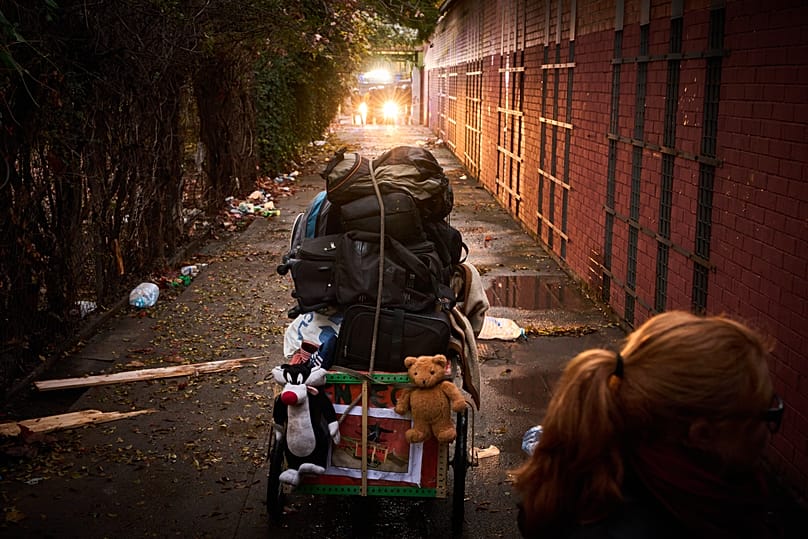
The Badalona town hall had argued that the squat was a public safety hazard. In 2020, an old factory occupied by around 100 migrants in the Catalan city near Barcelona caught fire, killing four people.

Police in Spain carried out eviction orders on Wednesday to clear an abandoned school building where around 400 mostly undocumented migrants were living north of Barcelona.

Many sub-Saharan migrants, mainly from Senegal and Gambia, had moved into the empty school building in Badalona — a working-class city that borders Barcelona — since it was left abandoned in 2023.

Badalona Mayor Xavier GarcĂ­a Albiol announced the evictions in a post on X.

"As I had promised, the eviction of the 400 illegal squatters in the B9 school in Badalona begins," he wrote.

Albiol, of the conservative Popular Party (PP), has built his political career on an anti-immigration stance.

A migrant's belongings are packed before he leaves as police in the background prepares to carry out eviction orders at an abandoned school in Badalona, 17 December, 2025 
AP Photo

Knowing that the eviction in the middle of winter was coming, most of the occupants had left the squat to try to find other shelter before police in riot gear from Catalonia's regional police Mossos d'Esquadraentered the school’s premises early in the morning under court orders.

Those who had waited left peacefully.

The judicial order made the Badalona town hall provide the evicted people with access to social services, but it did not oblige local authorities to find alternative housing for all the squatters.

Lawyer Marta Llonch, who represents the squatters, said that many people would likely end up without shelter in the cold.

"Many people are going to sleep on the street tonight," Llonch said. "Just because you evict these people it doesn’t mean they disappear. If you don’t give them an alternative place to live they will now be on the street, which will be a problem for them and the city."

Many of the squatters lived from selling scrap metal collected from the streets. Others had residency and work permits but were forced to live there because they could not afford housing during a cost-of-living crunch that is making it difficult even for working Spaniards to buy or rent homes.

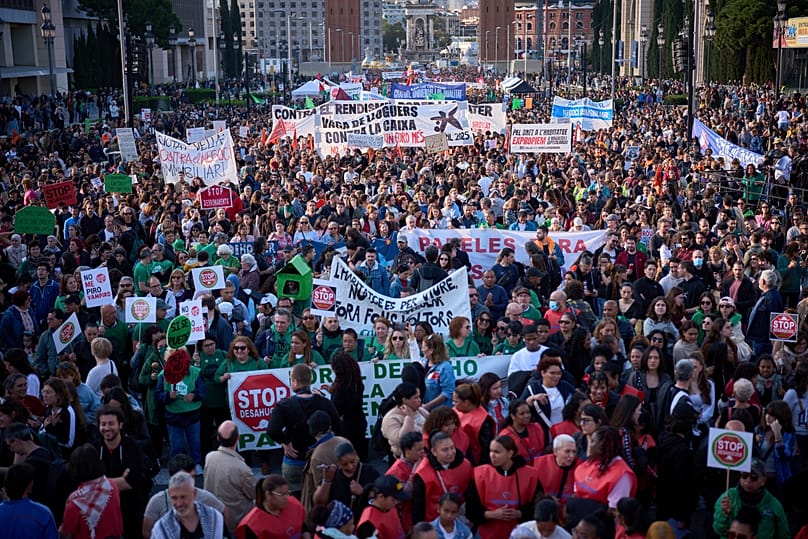
That housing crisis has led to widespread social angst and public protests.

People gather during a demonstration to protest high housing costs in Barcelona, 5 April, 2025 AP Photo

The Badalona town hall had argued that the squat was a public safety hazard. In 2020, an old factory occupied by around 100 migrants in Badalona caught fire, killing four people.

Like other southern European countries, Spain has for more than a decade seen migrants come to the country after risking their lives crossing the Mediterranean or Atlantic in small boats.

While many developed countries have taken a hard-line position against migration, Spain’s left-wing government has said that legal migration has helped its economy grow.


Trial of NGO workers accused of assisting 'illegal' migration opens in Tunisia

Aid workers accused of assisting irregular migration to Tunisia went on trial on Monday, as Amnesty International criticised what it called "the relentless criminalisation of civil society" in the country.


Issued on: 15/12/2025 - RFI

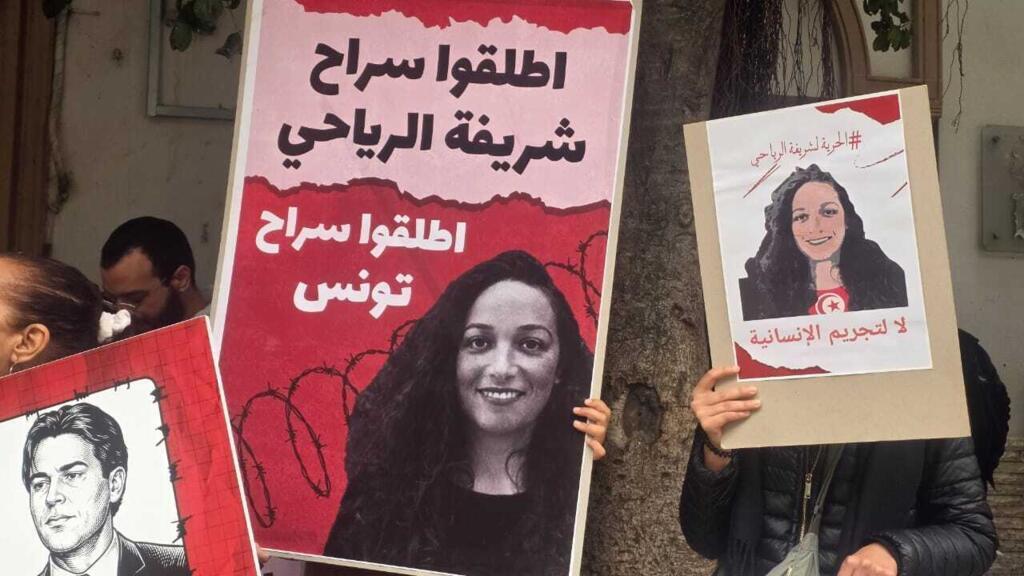
People hold placards bearing the image of Sherifa Riahi, former director of Terre d'Asile Tunisie, on 15 December 2025 in Tunis. © Lilia Blaise/RFI


Six staff members of the Tunisian branch of the France Terre d'Asile aid group, along with 17 municipal workers from the eastern city of Sousse, face charges of sheltering migrants and facilitating their "illegal entry and residence".

If convicted, they face up to 10 years in prison.

Migration is a sensitive issue in Tunisia, a key transit point for tens of thousands of people seeking to reach Europe each year.

A former head of Terre d'Asile Tunisie, Sherifa Riahi, is among the accused and has been detained for more than 19 months, according to her lawyer Abdellah Ben Meftah.

Two years on from EU deal, violence against migrants in Tunisia remains rife


'Bogus criminal trial'


"The only thing I'm sure of is that Sherifa and the other members of the association did nothing wrong. I'm certain they'll be released sooner or later. Will it be this Monday or at another hearing? I don't know, it's 50-50," Ben Meftah told RFI.

He also told French news agency AFP that the accused had carried out their work as part of a project approved by the state and in "direct coordination" with the government.

Amnesty denounced what it described as a "bogus criminal trial" and called on Tunisian authorities to drop the charges.

"They are being prosecuted simply for their legitimate work providing vital assistance and protection to refugees, asylum seekers and migrants in precarious situations," Sara Hashash, Amnesty's deputy MENA (Middle East North Africa) chief, said in the statement.

The defendants were arrested in May 2024 along with about a dozen humanitarian workers, including anti-racism pioneer Saadia Mosbah, whose trial is set to start later this month.

Driven from camp to camp, Tunisia’s migrants still dream of Europe

Illegal migrants

In February 2023, President Kais Saied said "hordes of illegal migrants", many from sub-Saharan Africa, posed a demographic threat to the Arab-majority country.

His speech triggered a series of racially motivated attacks as thousands of sub-Saharan African migrants in Tunisia were pushed out of their homes and jobs.

Thousands were repatriated or attempted to cross the Mediterranean, while others were expelled to the desert borders with Algeria and Libya, where at least a hundred died that summer.

This came as the European Union boosted efforts to curb arrivals on its southern shores, including a 255-million-euro deal with Tunis.

(with newswires)


Page 1. MULTITUDE. WAR AND DEMOCRACY. IN THE AGE OF EMPIRE. MICHAEL HARDT. ANTONIO NEGRI ... pdf. 33. Richard Haass, for example, the U.S. State Department ...

Empire / Michael Hardt and Antonio Negri. p. cm. Includes bibliographical ... 4.3 The Multitude against Empire. 393. Notes. 415. Index. 473. Page 11. PREFACE.


Wealthy nations curb labor migration as


demand surges


DW
17/12/2025 


Even before Donald Trump returned to the White House, anti-immigration politics were reshaping migration flows to high-income countries. Borders have been tightened despite economies facing urgent labor shortages.


Around 600,000 Indian workers moved abroad in 2024
Image: Adnan Abidi/Reuters


The world's wealthiest economies are crying out for foreign workers, despite rising anti‑immigration sentiment, particularly in the United States and Europe. Yet a little-discussed report released last month shows labor migration is falling globally, even as ageing societies face mounting shortages.

The decline began well before the reelection of Donald Trump, who campaigned last year on a promise to sharply curb immigration.

According to the Organisation for Economic Cooperation and Development (OECD), which tracks global economic and social policy, work-related migration to its 38 member states dropped by more than a fifth last year (21%).

The OECD's International Migration Outlook 2025 report found the drop was driven less by demand than by rising political opposition to immigration and tighter visa regimes in other advanced economies. Temporary work migration continued to rise.

Decline driven by two countries

"Most of the ... decline in permanent labor migration was driven by policy changes in the United Kingdom and New Zealand," Ana Damas de Matos, senior policy analyst at the OECD, told DW. "In both cases, permanent labor migration remained above 2019 levels."


In New Zealand, the drop was tied to the end of a one‑off post‑pandemic residence pathway that had allowed more than 200,000 temporary migrants and dependents to settle permanently. The country's largest one-off residency scheme closed in July 2022.

Post-Brexit, the UK reformed the Health and Care Worker visa route, tightening employer eligibility and barring dependents, resulting in a sharp reduction in visa applications. The OECD singled out health care as a sector where curbs risk deepening labor shortages.

Seeta Sharma, a migration specialist who has advised the United Nations as well as India's national and state governments, warned that the UK's reforms, including a move to tighten eligibility for international students hoping to work after graduation, could backfire.

"The student‑to‑work pathway is now being curtailed," Sharma told DW. "When that happens, applications will slow, because Indians, for example, are not going to spend large sums on education abroad if there’s no clear return on investment."

The OECD report showed that India was by far the largest country of origin for migrant workers settling in its member countries at 600,000 last year, followed by China and Romania.

US curbs on high-skilled visas threaten tech sector

In the US, stricter caps on H‑1B visas — the main program that allows foreign professionals in fields like technology, engineering and medicine to work in the country — were introduced under the Biden administration. Trump has since substantially increased the visa cost for employers to $100,000 (€84,800), up from $2000-$5000. His broader agenda has focused on limiting permanent pathways.

Australia, meanwhile, raised salary thresholds for skilled visas, while Canada adjusted pathways for temporary workers, also contributing to the wider decline in job-related migration. Nordic countries also saw large declines, with Finland recording a 36% drop compared to the previous year.

In Germany, former Chancellor Olaf Scholz's tighter immigration policies helped a 12% fall in permanent migration inflows last year, when 586,000 foreign workers entered the country. The number of people arriving on work visas was 32% lower than the previous year. These reforms have been expanded by his successor, Friedrich Merz's government.

Herbert BrĂĽcker, professor of economics at Berlin's Humboldt University, thinks the declines are storing up trouble for the German economy.

"For many years, Germany benefited from an average migration of 550,000 people per year," BrĂĽcker told DW. "We need migration to replace retiring workers. Without it, we cannot hold the labor supply stable."

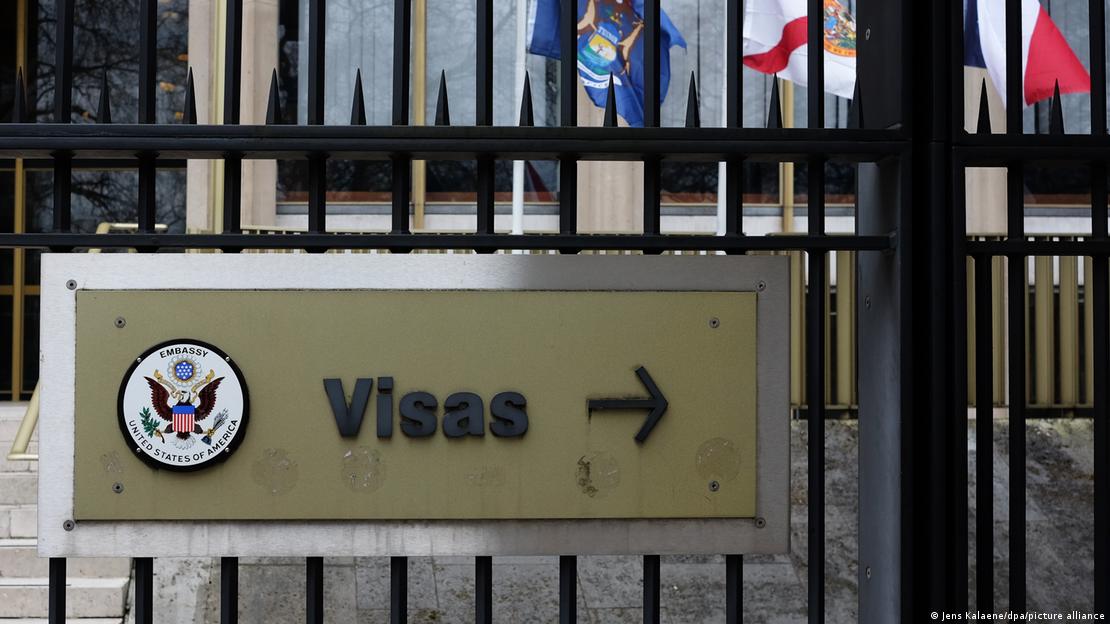
Several OECD countries have raised criteria for work-based visas for foreign nationals
Image: Jens Kalaene/dpa/picture alliance


Strong demand for migrants in Europe

Across the European Union, around two‑thirds of jobs created between 2019 and 2023 were filled by non‑EU citizens, according to the International Monetary Fund (IMF), underscoring how dependent Europe has already become on migrant labor.

Globally, there were 167.7 million migrant workers in 2022, according to International Labor Organization (ILO) estimates. This accounted for 4.7% of the total global labor force. More than two-thirds of them (114.7 million) lived in high-income countries.

Despite last year's drop, global work-related migration remains above pre-pandemic levels. But the OECD report reveals how those inflows can be abruptly curbed by political resistance, stoked by fears over illegal migration, rather than economic demand, which remains at record highs.

Trump's second‑term agenda has amplified that dynamic, with executive orders enacted since he returned to office in January aimed at curbing both legal and illegal immigration. The Trump administration argues these are necessary to safeguard US workers and ensure a skills‑based system.

Taiwan: Migrant workers face bias in booming chip industry  02:44

Temporary visas over permanent pathways


Temporary or seasonal labor migration held steady last year even as permanent inflows declined, according to the OECD report, reflecting governments' preference for short-term schemes they can expand or contract at will.

"The appetite is: 'Let's get in people when we want them and close the doors when we don't. But let’s not have these "different" people in our land permanently,'" Sharma lamented.

Seasonal and temporary worker programs remain in demand across Australia, Europe and North America, where employers in the agriculture, care and construction sectors have plugged gaps in their workforce.

The OECD notes that temporary migration programs are increasingly used for technology and other high‑skilled workers, too.

\
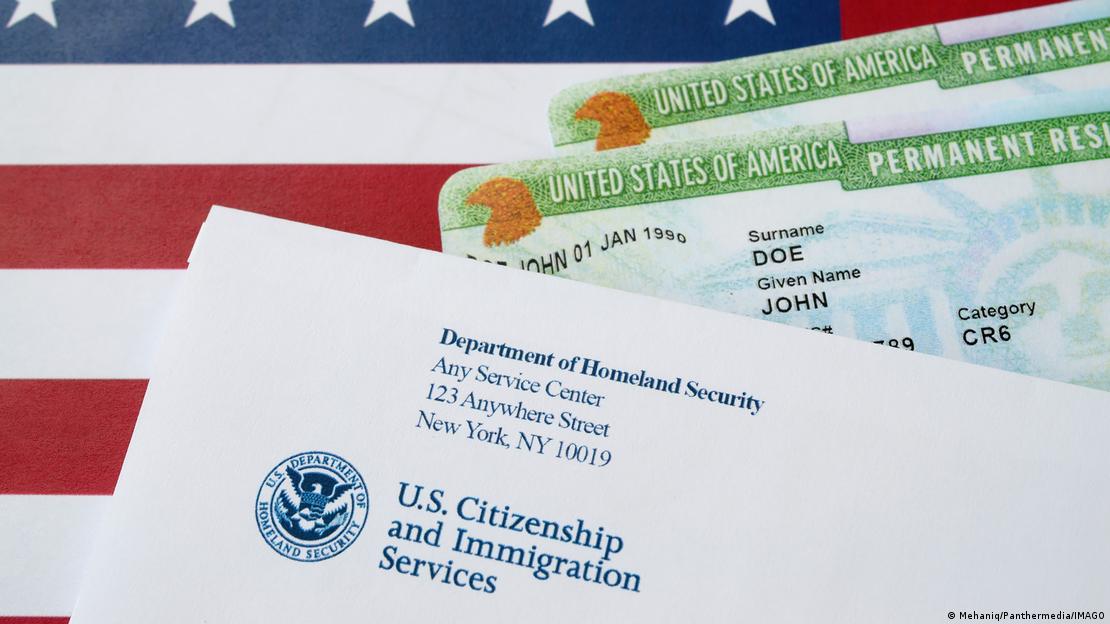
Biden restricted access to US permanent residence; Trump has gone further
Image: Mehaniq/Panthermedia/IMAGO


Red tape keeps migrants in lower-skilled jobs

As well as attracting more work-based migrants, the OECD urged advanced economies to focus on better integrating them into the labor market. The club of advanced economies cited language training and access to social services as key requirements, along with the recognition of skills and qualifications to help foreign workers contribute fully in their host countries. Often, they're employed in much lower-skilled jobs than they trained for.

BrĂĽcker, who is also head of migration research at Germany's Institute for Employment Research (IAB), noted that reforms intended to make Europe's largest economy more attractive have not worked due to a slow and bureaucratic approval process.

"The recognition of degrees and vocational training takes years and that makes it difficult for skilled workers to come," he told DW. As a result, we are now short of around three million workers."

Policymakers are also being urged to create clearer pathways that allow temporary migrant workers to transition into permanent status, ensuring their skills are fully utilized and reducing labor shortages.

While Trump often speaks positively about the need for skills‑based migration, his first year back in the White House has been marked by efforts to dismantle these avenues, reinforcing the divide between economic need and political will.

Sharma noted that often-angry rhetoric by Trump and other right-wing politicians over immigration sends "shock waves" internationally, shaping perceptions in India and beyond.

"The story coming back is that this is an unfriendly country, where it’s tough to get a job … those narratives play a huge part in migration movements," Sharma told DW, adding that if the US continues to curb work-related immigration, it could lead to more illegal migrant flows.

Edited by: Uwe Hessler

Nik Martin is one of DW's team of business reporters.


With Christmas just a week away, LabourStart is currently hosting 7 campaigns in support of workers around the world fighting for the basic human right to join and form trade unions of their choosing.

Those campaigns -- in Guatemala, Lesotho, the Netherlands, the Philippines, Serbia, Sri Lanka and TĂĽrkiye -- can win rights for our brothers and sisters, but only if thousands of us send messages and spread the word.

Want to know which of those campaigns you supported and which ones you might have missed?  Click here to find out.

And this week -- in keeping with the holiday season spirit -- we released our second 60-second long podcast.  This time it's on the subject of Christmas shopping -- and what shop workers want all of us to know.  Listen to it here.

Thank you!

Eric Lee

LabourStart

Cheaper, cleaner energy drives Germany's balcony-solar boom
DW
18/12/2025

The home-fitted renewable-energy sources are inexpensive and easy to install, and reduce electricity costs. Here's what can be learned from their surging popularity in Germany.


Falling prices, improved technology and political support have helped drive a German balcony-solar boom
Image: Hendrik Schmidt/dpa/picture alliance

Transitioning to renewables is critical when it comes to confronting the climate crisis, and Germany is seeing this advance at the household level.

Small solar devices that can be plugged into household sockets are growing ever more popular in the country, with more than 1 million installed in the past three years.

The modules are usually about 2 square meters (21.5 square feet) in size, with up to four included in a minisystem, and easily installed on areas such as balconies, where they work as safely as other household appliances — only in reverse. The electricity flows from the solar module via an inverter through the household socket back into the power grid.

Increasingly, these systems also include battery storage, meaning that excess electricity can be saved for later use.

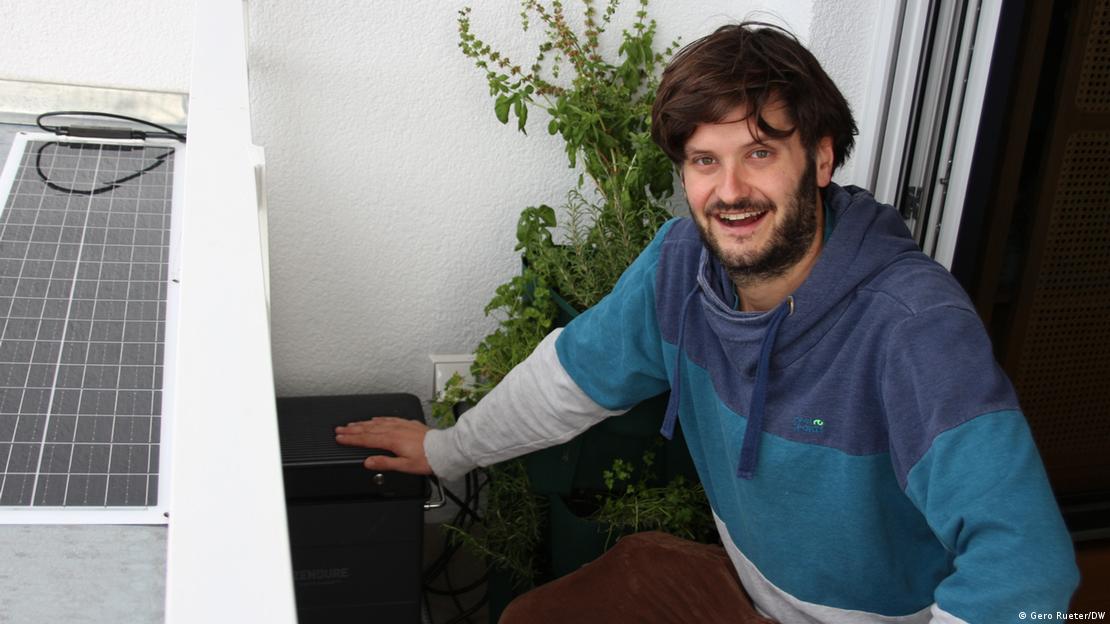
A resident of Cologne hopes his solar installation will cover most of his electricity needs
Image: Gero Rueter/DW


Electricity from your own balcony

The rapidly falling cost of solar power and battery storage is a major climate success story of recent years, helping renewables overtake coal for the first time in global electricity generation in 2025.

The plummeting prices have filtered down to the household level in Germany. The price of solar panel systems for balconies has halved in the last two years, with small models available from around €200 ($233) and large ones that include storage costing under €1,000 ($1166). In Germany, they generate electricity for less than half the cost of electricity from the grid.

According to the Berlin University of Applied Sciences (HTW), the purchase usually pays for itself within four to seven years. After that, the electricity households generate for themselves is free.

Solar modules can keep working for over 30 years, and the batteries "can be expected to have a service life of 10-15 years," said Volker Quaschning, professor of renewable energy systems at HTW. With four modules and storage, about half of the electricity requirements of a two-person household in Central Europe can be covered.
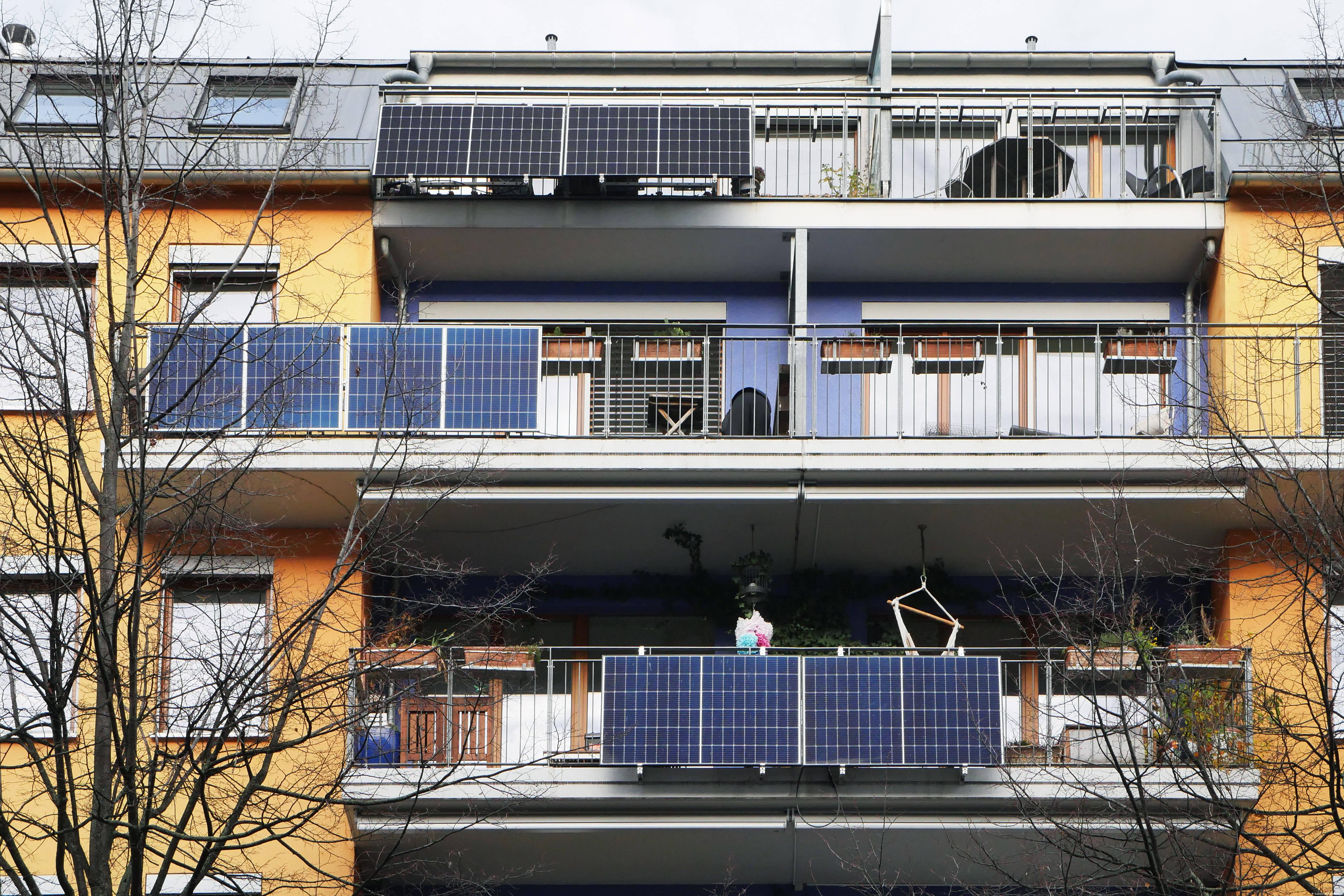
Plug-in solar systems with storage significantly reduce electricity costs in homes
Image: Sabine Gudath/IMAGO


Germany leading the pack


"Most plug-in solar devices are still sold in Germany, far ahead of the rest of the world," says David Breuer, managing director of Yuma, a German-based company selling plug-in solar devices.

Though sunnier regions elsewhere have the potential to generate far more electricity, in Germany falling prices, improved technology and political support have helped drive a solar balcony boom.

Since 2023, private solar installations in the country have been exempt from VAT, and, since autumn 2024, tenants and apartment owners have been allowed to install solar modules on their balconies themselves.

Devices with a module output of up to 2,000 watts are permitted in most EU countries, and the devices are allowed to feed up to 800 watts of electricity directly into the residential grid. This limitation protects the power lines in the home from overload, making it safe to use.

Interest is now spreading to other countries, including many in the EU, as well as Brazil, the United States and Japan.

"We just had a delegation from Tokyo visiting. They want to introduce plug-in solar devices and were gathering information about technical safety," Thomas Seltmann, an expert on plug-in solar devices at the German Solar Industry Association, told DW.

Reducing energy costs

Germany is aiming to be climate-neutral by 2045. Plug-in solar devices could cover up to 2% of electricity demand by then, Claudia Kemfert, head of the Energy, Transportation, Environment Department at the German Institute for Economic Research, told DW. So far, most solar power in the country comes from rooftop installations, followed by large solar parks.

For many customers, a plug-in system for the balcony is just the beginning. "They are a gateway to other measures such as larger photovoltaic systems or the purchase of an electric car or a heat pump," says Christoph Kost, head of energy systems analysis at the Fraunhofer Institute for Solar Energy Systems ISE, a German research organization.

"Plug-in solar devices enable people to become part of the energy transition themselves, reduce their electricity costs and make themselves less dependent on energy price fluctuations," Kemfert said.


Get advice before buying

It is important to be well-informed before buying, said Tobias Otto, from the German Solar Energy Association, which provides independent advice.

This should start with considering first how many modules will fit on a balcony, terrace or roof and at what angle they can be installed, as well as how the sun hits the location.

For those with three to four modules, a battery storage unit with intelligent control is often worthwhile. This means electricity demand can be measured at the meter or at sockets and then ensures the battery supplies the exact amount needed. "Without such measuring devices, the storage system cannot usually be controlled effectively," Otto told DW.

Some battery-powered plug-in devices also have an emergency supply that helps in the event of a power failure. Many can also be set up outdoors, although they do consume power themselves when placed in very cold or warm temperatures.

Experts also advise sticking to reliable suppliers. "There's a lot of dodgy stuff on offer," Seltman said. "We therefore recommend buying from specialist retailers."

This article was originally written in German.


Gero Rueter Reporter on topics related to the environment, climate protection, energy, transport and agriculture
Brazil Senate backs bill cutting Bolsonaro's jail term, setting up clash with Lula

Brazil’s Senate has approved legislation that could sharply reduce the prison sentence of former far-right president Jair Bolsonaro, convicted over an alleged coup plot after his 2022 election defeat, in a move that President Luiz Inacio Lula da Silva has vowed to veto.


Issued on: 18/12/2025 
By: FRANCE 24

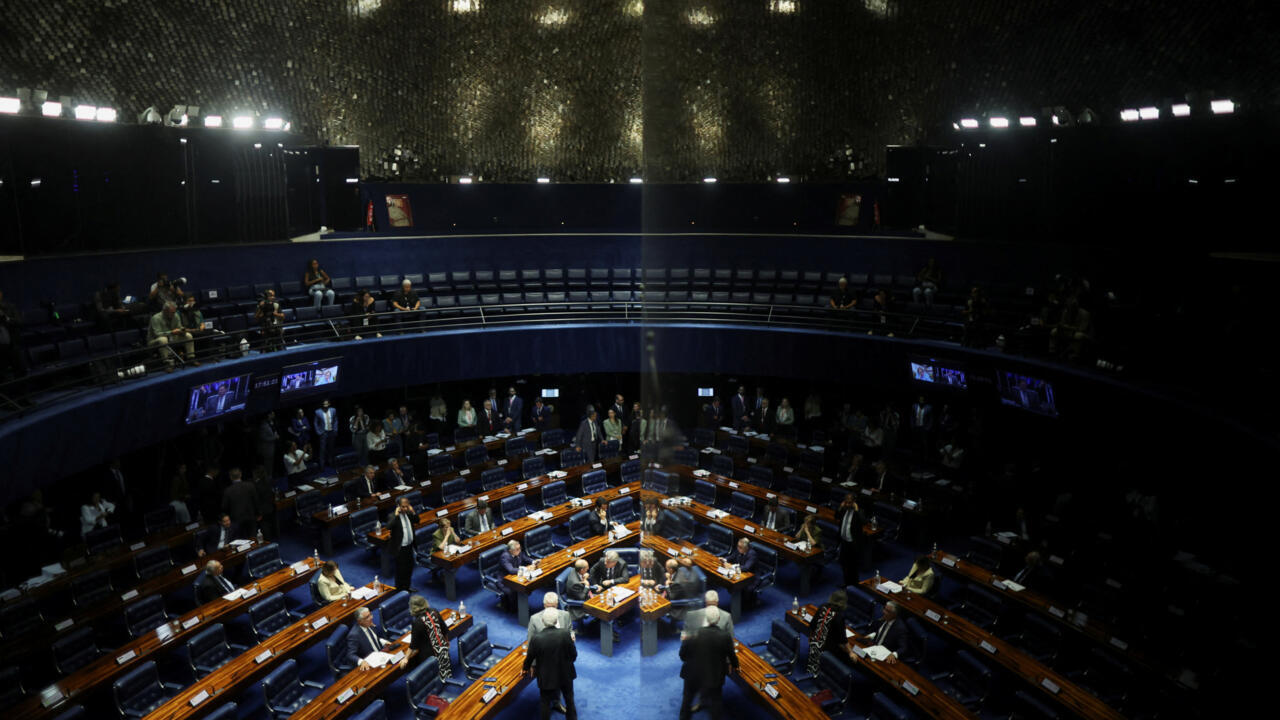
A general view of a session to vote on a bill in the Brazilian Senate, which proposes reducing the sentences for January 8, 2023, riot convictions, including former President Jair Bolsonaro's. © Adriano Machado, Reuters

Brazil’s Senate on Wednesday passed a bill to slash the prison term of far-right ex-president Jair Bolsonaro, who was convicted of plotting a coup after losing re-election to left-winger Luiz Inacio Lula da Silva.

Passed by the lower chamber last week, the bill now heads to Lula, whose expected veto could eventually be overridden by Congress.

Bolsonaro, 70, began a 27-year prison sentence in November and, under current rules, was expected to serve at least eight years behind bars before becoming eligible for a looser regime.

The new legislation, which changes how sentences are calculated for certain crimes, could, however, see Bolsonaro serve a little over two years in prison.

Following months of jockeying by Bolsonaro’s supporters in Congress for some form of amnesty, the bill moved surprisingly quickly through both the conservative-controlled lower chamber and the more evenly balanced Senate.

Bolsonaro’s oldest son, Senator Flavio Bolsonaro – whom the former president has anointed as the candidate of the right in the 2026 elections – had called on the upper chamber to “address this issue once and for all”.

The bill provoked protests in cities across Brazil on Sunday, where demonstrators chanted “no amnesty” and held up banners reading: “Congress, enemy of the people.”

Though political forces are more evenly balanced in the Senate, the bill was approved 48–25.

Centrist Senator Renan Calheiros slammed the vote as a “farce” and walked out of the session, accusing the government’s allies in parliament of allowing the vote to take place in exchange for support for a budget initiative as part of a backroom deal.

‘Must pay’ fo
r his crimes

The author of the legislation, lawmaker Paulinho da Forca, said it was a “gesture of reconciliation” in a polarised country.

Senators amended the wording of the bill to limit its scope after fears it could ease punishment for a wide range of criminals.

It is specifically aimed at benefiting those convicted as part of the coup plot, as well as more than 100 Bolsonaro supporters imprisoned for their role in the January 2023 riots against seats of government in Brasilia, shortly after Lula took office.

Senator Sergio Moro, Bolsonaro’s former justice minister, welcomed the fact that the bill would manage “to get those people out of prison, which is the most important thing right now”.

Bolsonaro is serving his sentence in a special room at a police facility in the capital, Brasilia, following a dramatic start to his jail term when he took a soldering iron to his ankle monitoring bracelet while under house arrest.

Lula has vowed to veto the bill, saying Bolsonaro “must pay” for his crimes.

“This bill is destined to be vetoed” by Lula, said Senator Randolfe Rodrigues of Lula’s leftist Workers’ Party (PT).

However, Congress has the final word and can overturn the president’s veto.

Bolsonaro was convicted over a scheme to prevent Lula from taking office after his razor-thin loss in the bitter 2022 election, which highlighted deep political divisions in Brazil.

The plot allegedly involved plans to assassinate Lula, his vice-president Geraldo Alckmin and Supreme Court Justice Alexandre de Moraes.

Prosecutors said the scheme failed because it lacked the support of the military’s top brass.

(FRANCE 24 with AFP)
 WHITES ONLY 

Trump slaps full travel ban on seven more countries, including Syria


US President Donald Trump on Tuesday added Burkina Faso, Laos, Mali, Niger, Sierra Leone, South Sudan, and Syria as well as Palestinian Authority passport holders to a full travel ban. The decision to include Syria, a country Trump has moved to rehabilitate internationally, came days after three US nationals were killed in an attack in the central town of Palmyra.


Issued on: 16/12/2025 
By: FRANCE 24


President Donald Trump on Tuesday expanded a US travel ban by barring nationals of seven more countries including Syria, as well as Palestinian Authority passport holders, from entering the United States.

Trump, who has long campaigned to restrict immigration and has spoken in increasingly strident terms, moved to ban foreigners who "intend to threaten" Americans, the White House said.

He also wants to prevent foreigners in the United States who would "undermine or destabilize its culture, government, institutions or founding principles," a White House proclamation said.

Trump's move comes days after two US troops and a civilian were killed in Syria, which Trump has moved to rehabilitate internationally since the fall of longtime ruler Bashar al-Assad.


Syrian authorities said the perpetrator was a member of the security forces who was due to be dismissed for "extremist Islamist ideas."

The Trump administration had already informally barred travel from Palestinian Authority passport holders as it acts in solidarity with Israel against the recognition of a Palestinian state by other leading Western countries including France and Britain.

Other countries newly subjected to the full travel ban came from some of Africa's poorest countries – Burkina Faso, Mali, Niger, Sierra Leone and South Sudan – as well as Laos in southeast Asia.

In a series of new actions, the White House said that Trump was also imposing partial travel restrictions on citizens of other African countries including the most populous, Nigeria, as well as Black-majority Caribbean nations.
Ramping up anti-immigrant tone

Trump in recent weeks has used increasingly loaded languages in denouncing African-origin immigrants.

At a rally last week he said that the United States was only taking people from "shithole countries" and instead should seek immigrants from Norway and Sweden.

READ MORETrump ramps up hard-line rhetoric against immigrants from 'sh*thole' countries

He also recently described Somalis as "garbage" following a scandal in which Somali Americans allegedly bilked the government out of money for fictitious contracts in Minnesota.

READ MORETrump launches tirade against ‘garbage’ Somali immigrants in US

Trump had already banned the entry of Somalis. Other countries remaining on the full travel ban are Afghanistan, Chad, Democratic Republic of the Congo, Equatorial Guinea, Eritrea, Haiti, Iran, Libya, Myanmar, Sudan, and Yemen.

Trump last month made the ban even more sweeping against Afghans, severing a program that helped bring in Afghans who had fought alongside the United States against the Taliban, after an Afghan veteran who appeared to have post-traumatic stress shot two National Guards troops deployed by Trump in Washington.

The countries newly subject to partial restrictions, besides Nigeria, are Angola, Antigua and Barbuda, Benin, Dominica, Gabon, The Gambia, Ivory Coast, Malawi, Mauritania, Senegal, Tanzania, Tonga, Zambia and Zimbabwe.

Angola, Senegal and Zambia have all been prominent US partners in Africa, with former president Joe Biden hailing the three for their commitment to democracy.

In the proclamation, the White House alleged high crime rates from some countries on the blacklist and problems with routine record-keeping for passports.

The White House acknowledged "significant progress" by one initially targeted country, Turkmenistan.

The Central Asian country's nations will once again be able to secure US visas, but only as non-immigrants.

(FRANCE 24 with AFP)


US Congress ends Assad-era Syria sanctions, opening door to investment

The US Congress has voted to permanently repeal sweeping sanctions imposed on Syria under former leader Bashar al Assad, clearing the way for foreign investment and marking a significant shift in Washington’s policy towards the war-ravaged country following the rise of a new government.


Issued on: 18/12/2025
By: FRANCE 24

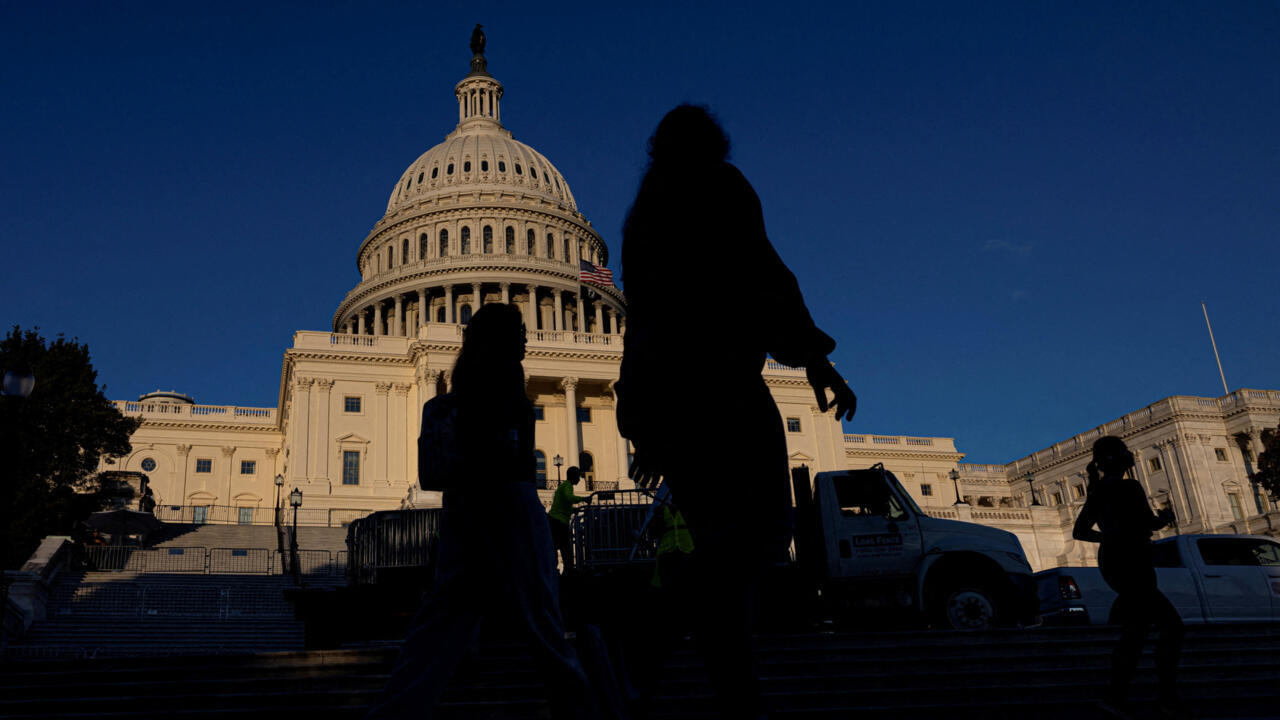
FILE PHOTO: A view of the U.S. Capitol in Washington. © Kevin Mohatt, Reuters


The US Congress on Wednesday permanently ended sanctions imposed on Syria under ousted leader Bashar al Assad, paving the way for the return of investment to the war-ravaged nation.

US President Donald Trump had already twice suspended the implementation of the sanctions in response to pleas from Saudi Arabia and Turkey, allies of the new government headed by former jihadist Ahmed al Sharaa.

However, Sharaa had sought a permanent end to the measures, fearing that as long as they remained on the books they would deter businesses wary of legal risks in the world’s largest economy.

The Senate passed the repeal of the 2019 Caesar Act as part of a sweeping annual defence package, voting 77 to 20 in favour of the legislation. The bill had already been approved by the House of Representatives and is expected to be signed by Trump.

The repeal, broadly backed by lawmakers from both parties, “is a decisive step towards giving the Syrian people a real chance to rebuild after decades of unimaginable suffering,” said Senator Jeanne Shaheen, the top Democrat on the Senate Foreign Relations Committee.

The Caesar Act, named after an anonymous photographer who documented atrocities in Assad’s prisons, severely restricted investment and cut Syria off from the international banking system.

The law was intended to prevent an influx of foreign businesses rebuilding Syria at a time when it appeared Assad had prevailed after more than a decade of brutal civil war. The conflict triggered a massive flow of refugees towards Europe and helped fuel the rise of the Islamic State extremist movement.

Sharaa’s fighters seized Damascus a year ago in a lightning offensive.

Sharaa – now dressed in a business suit and seeking improved relations with the West – has impressed Trump, including during their first meeting on the US leader’s May trip to Riyadh.

(FRANCE 24 with AFP)


AI-generated reconstructions of ancient Rome turn out to be full of errors

A number of videos and images created by artificial intelligence that claim to accurately depict ancient Rome have been circulating online. However, these images are far from historically accurate, says one historian
.


Issued on: 16/12/2025 
By: The FRANCE 24 Observers/Quang Pham  

This video generated by artificial intelligence claims to show an accurate depiction of ancient Rome but is, in actuality, full of errors. It was posted on YouTube on November 9, 2024. © YouTube


"A Journey Through Time with Artificial Intelligence,” reads the caption on a video posted on YouTube on November 9, 2024. The video, called "Ancient Rome | AI generated video", promises viewers "a dive into the fascinating world of the Roman Empire". The author further claims that AI can help transform our understanding of the past by uncovering “incredible details about Roman society, architecture, warfare and daily life".

In recent months, there have been an increasing number of AI-generated videos and images posted online that purport to offer historically accurate glimpses into the past, especially of the Roman Empire. However, while they may appear spectacular, these reconstructions don’t correspond to historical reality.

Our team spoke to Sarah Kourdy, a professor in Art History and Archaeology at the University of Bordeaux Montaigne, who specialises in ancient Greek and Roman culture. She demonstrated to us just how inaccurate some of these images are.
An ancient Roman landscape, complete with a 20th-century building

It turns out that the "Ancient Rome” video is far from an accurate reconstruction; it actually contains some major errors. At 0'47, for example, you can see a Roman soldier standing in front of what is meant to be a backdrop of ancient Rome.

There is a 20th-century building in this scene meant to show ancient Rome in the YouTube video "Ancient Rome". © YouTube


However, one of the buildings in the image is from another era entirely.


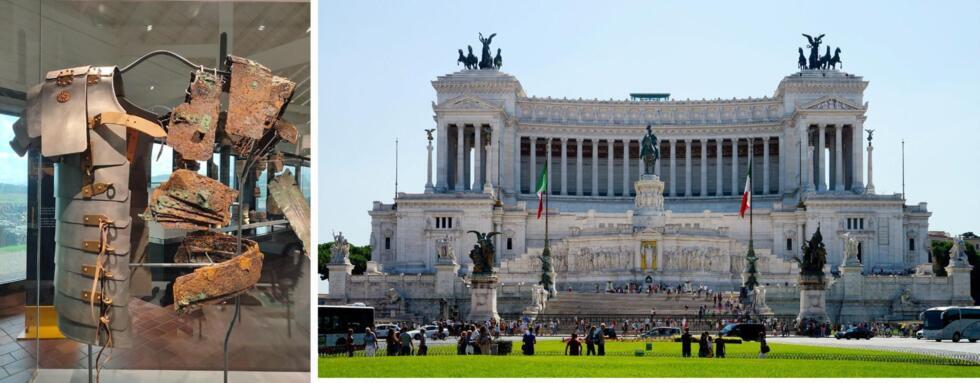
"The building in the background looks a lot like the monument to Victor Emmanuel II, [Editor’s note: built in 1911 to honour the first king of a united Italy], which is clearly anachronous.”

The soldier is wearing what’s called a lorica segmentata, a jointed breastplate worn by Roman legionnaires. However, Kourdy says that there are also issues with this uniform:


"The metal bands are too thin and are arranged vertically. Usually, they are of a decreasing size and arranged parallel and horizontally to better protect the soldier.”

At left is a lorica segmentata, where you can see that the metal bands are horizontally placed. At right is the monument honouring Victor Emmanuel II, which was inaugurated in 1911. Corbridge Museum; Wikipedia / Alvesgaspar

The hippodrome with erroneous architecture

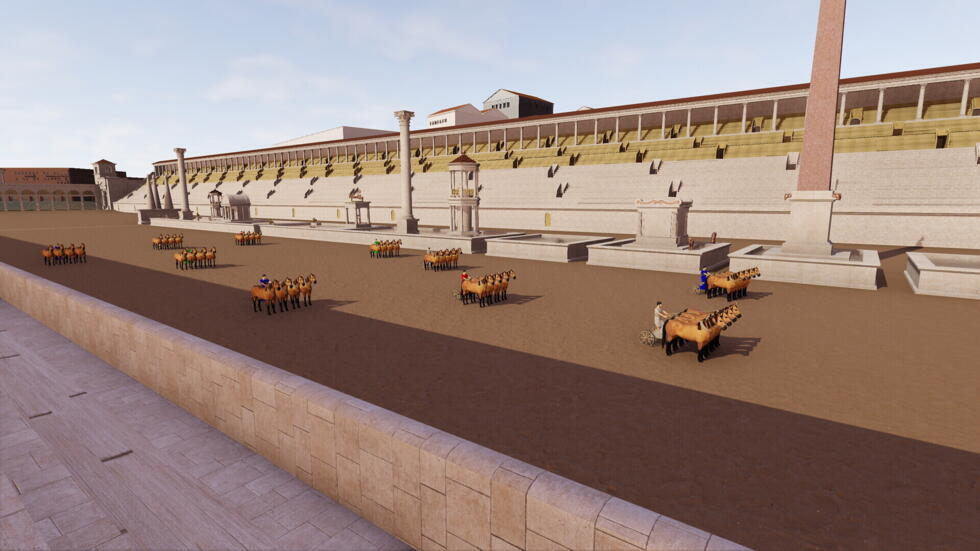
There is also a chariot race in the YouTube video: a scene firmly planted in our imaginings of the Roman Empire since the film Ben-Hur. The race, in this case, seems to take place in Circus Maximus, the biggest hippodrome in the eternal city.


This pretend chariot race features in the AI-generated “Ancient Rome” video posted on YouTube. The video has a number of errors. © YouTube

However, once again, the architecture doesn’t correspond with the historical reality, Kourdy says:

"The tiers seem particularly high and weren’t topped with a double row of arches. While the image is undoubtedly based on Circus Maximus, the largest edifice of its kind in Rome, the architecture in the background looks like an aqueduct. Moreover, real Roman chariots had two wheels while, in this image, they have four.”

A scientific reconstruction of the Circus Maximus created by the University of Caen. © Authors: ArchĂ©ovision - 3D modelling: ArchĂ©ovision - Interactivity: Plan de Rome, 2013.


Baroque touches to the Baths of Caracalla

An image said to represent the Baths of Caracalla has garnered 592,000 views on X. It was also shared on a number of Facebook groups dedicated to ancient history. These baths, which were some of the most luxurious and grand in the history of the Roman Empire, were constructed by the Emperor Caracalla in 216 AD. The image shows what seems to be the natatio – or swimming pool – set beneath a decadently ornate ceiling of white marble and gold.

This AI-generated image of the Baths of Caracalla, shared online on November 19, 2025, is completely historically inaccurate. © X


Kourdy says that this image of the Baths of Caracalla is also historically inaccurate.

First, the AI-generated image depicts the Roman baths in a Baroque style. The baroque artistic movement didn’t begin until the 16th century.

Moreover, the baths weren’t made out of white marble but “out of bricks held together by a mortar similar to cement". The historian also added that the baths were, of course, “humid” spaces, and the gilding that appears abundantly in the illustration wouldn’t be compatible with this kind of atmosphere. Only salons and libraries – rooms dedicated to rest, reading or gatherings – would have been decorated this luxuriously.

Finally, the image simply doesn’t match the real dimensions of the baths:


"The archaeological digs at the Baths of Caracalla have revealed that the imperial baths did have imposing dimensions. But the image created by artificial intelligence goes beyond that: depicting an immense swimming pool filled with giant columns whose bases sit in the water, which just wasn’t the case."
This is an exact scientific reconstitution of the Baths of Caracalla created by the University of Caen. © Authors: Ph. Fleury, S. Madeleine, M. Bizet - Infographics: N. Lefèvre, C. Morineau, A. Tillier, R. Rolland, A. Gillet, S. MarĂ©chal, 2013.

In summary, Kourdy laments the historical inaccuracies in these AI-generated images:

"Anachronism, accuracy and misleading proportions are the main themes in these AI-generated images.”

This article has been translated from the original in French by Brenna Daldorph.