DW
18/12/2025
The home-fitted renewable-energy sources are inexpensive and easy to install, and reduce electricity costs. Here's what can be learned from their surging popularity in Germany.

Image: Hendrik Schmidt/dpa/picture alliance
Transitioning to renewables is critical when it comes to confronting the climate crisis, and Germany is seeing this advance at the household level.
Small solar devices that can be plugged into household sockets are growing ever more popular in the country, with more than 1 million installed in the past three years.
The modules are usually about 2 square meters (21.5 square feet) in size, with up to four included in a minisystem, and easily installed on areas such as balconies, where they work as safely as other household appliances — only in reverse. The electricity flows from the solar module via an inverter through the household socket back into the power grid.
Increasingly, these systems also include battery storage, meaning that excess electricity can be saved for later use.
Transitioning to renewables is critical when it comes to confronting the climate crisis, and Germany is seeing this advance at the household level.
Small solar devices that can be plugged into household sockets are growing ever more popular in the country, with more than 1 million installed in the past three years.
The modules are usually about 2 square meters (21.5 square feet) in size, with up to four included in a minisystem, and easily installed on areas such as balconies, where they work as safely as other household appliances — only in reverse. The electricity flows from the solar module via an inverter through the household socket back into the power grid.
Increasingly, these systems also include battery storage, meaning that excess electricity can be saved for later use.
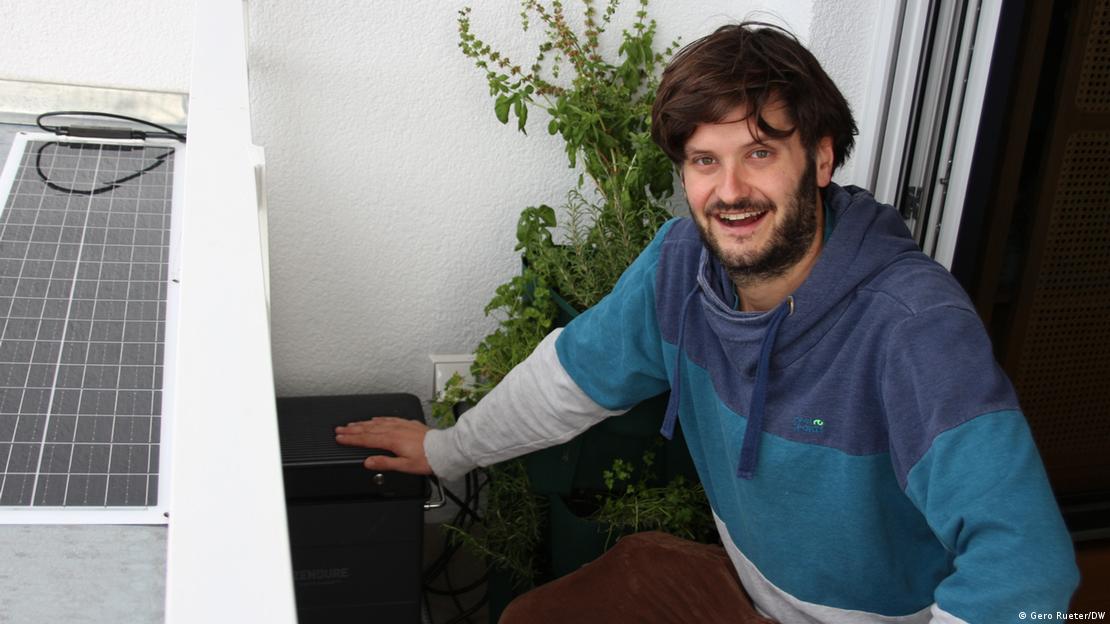
A resident of Cologne hopes his solar installation will cover most of his electricity needs
Image: Gero Rueter/DW
Electricity from your own balcony
The rapidly falling cost of solar power and battery storage is a major climate success story of recent years, helping renewables overtake coal for the first time in global electricity generation in 2025.
The plummeting prices have filtered down to the household level in Germany. The price of solar panel systems for balconies has halved in the last two years, with small models available from around €200 ($233) and large ones that include storage costing under €1,000 ($1166). In Germany, they generate electricity for less than half the cost of electricity from the grid.
According to the Berlin University of Applied Sciences (HTW), the purchase usually pays for itself within four to seven years. After that, the electricity households generate for themselves is free.
Solar modules can keep working for over 30 years, and the batteries "can be expected to have a service life of 10-15 years," said Volker Quaschning, professor of renewable energy systems at HTW. With four modules and storage, about half of the electricity requirements of a two-person household in Central Europe can be covered.
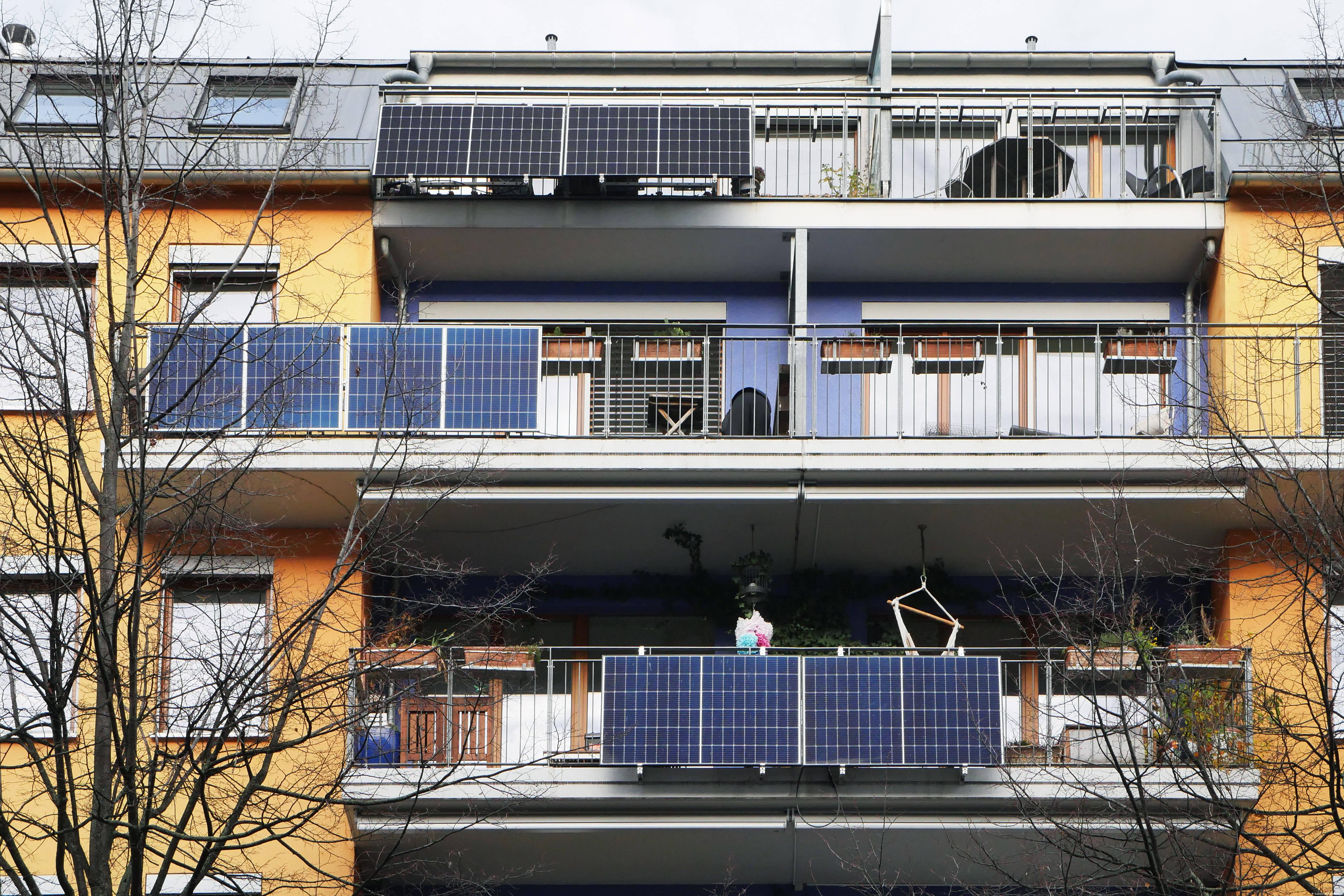
Plug-in solar systems with storage significantly reduce electricity costs in homes
Image: Sabine Gudath/IMAGO
Germany leading the pack
"Most plug-in solar devices are still sold in Germany, far ahead of the rest of the world," says David Breuer, managing director of Yuma, a German-based company selling plug-in solar devices.
Though sunnier regions elsewhere have the potential to generate far more electricity, in Germany falling prices, improved technology and political support have helped drive a solar balcony boom.
Since 2023, private solar installations in the country have been exempt from VAT, and, since autumn 2024, tenants and apartment owners have been allowed to install solar modules on their balconies themselves.
Devices with a module output of up to 2,000 watts are permitted in most EU countries, and the devices are allowed to feed up to 800 watts of electricity directly into the residential grid. This limitation protects the power lines in the home from overload, making it safe to use.
Interest is now spreading to other countries, including many in the EU, as well as Brazil, the United States and Japan.
"We just had a delegation from Tokyo visiting. They want to introduce plug-in solar devices and were gathering information about technical safety," Thomas Seltmann, an expert on plug-in solar devices at the German Solar Industry Association, told DW.
Reducing energy costs
Germany is aiming to be climate-neutral by 2045. Plug-in solar devices could cover up to 2% of electricity demand by then, Claudia Kemfert, head of the Energy, Transportation, Environment Department at the German Institute for Economic Research, told DW. So far, most solar power in the country comes from rooftop installations, followed by large solar parks.
For many customers, a plug-in system for the balcony is just the beginning. "They are a gateway to other measures such as larger photovoltaic systems or the purchase of an electric car or a heat pump," says Christoph Kost, head of energy systems analysis at the Fraunhofer Institute for Solar Energy Systems ISE, a German research organization.
"Plug-in solar devices enable people to become part of the energy transition themselves, reduce their electricity costs and make themselves less dependent on energy price fluctuations," Kemfert said.
Get advice before buying
It is important to be well-informed before buying, said Tobias Otto, from the German Solar Energy Association, which provides independent advice.
This should start with considering first how many modules will fit on a balcony, terrace or roof and at what angle they can be installed, as well as how the sun hits the location.
For those with three to four modules, a battery storage unit with intelligent control is often worthwhile. This means electricity demand can be measured at the meter or at sockets and then ensures the battery supplies the exact amount needed. "Without such measuring devices, the storage system cannot usually be controlled effectively," Otto told DW.
Some battery-powered plug-in devices also have an emergency supply that helps in the event of a power failure. Many can also be set up outdoors, although they do consume power themselves when placed in very cold or warm temperatures.
Experts also advise sticking to reliable suppliers. "There's a lot of dodgy stuff on offer," Seltman said. "We therefore recommend buying from specialist retailers."
This article was originally written in German.

Gero Rueter Reporter on topics related to the environment, climate protection, energy, transport and agriculture

No comments:
Post a Comment