Thursday, January 01, 2026

Electric Vehicles and Nuclear Power Are Fighting Over One Obscure Mineral

  • The market for ultra-high-purity (UHP) graphite, essential for EV anodes and nuclear reactors, is projected to hit $1.43 billion by 2030, masking structural friction in the global energy transition.

  • The vast majority (86% in 2024) of UHP graphite is synthetic, requiring a massive industrial footprint of fossil fuel feedstock and staggering amounts of electricity for high-heat graphitization furnaces.

  • Two massive, well-funded industries—transportation and power generation (SMRs/nuclear)—are competing for the same narrow, geopolitically sensitive supply of high-purity carbon, which is primarily controlled by Asia Pacific's refining capacity.

The energy transition is often sold as a story of ethereal "green" progress, but if you look at the balance sheets of the companies actually building it, the story is written in soot and high-voltage electricity. While the financial press spends its time obsessing over the price of lithium or the latest solid-state battery breakthrough, a much more grounded, and expensive, reality is setting in.

We are entering the era of the engineered anode.

New data suggests the market for ultra-high-purity (UHP) graphite is on a trajectory to hit $1.43 billion by 2030. On the surface, a 10.5% compound annual growth rate looks like a healthy, if predictable, industrial expansion. But for those of us who track the friction between a digital climate pledge and the physical hardware required to meet it, that number masks a massive structural shift in how we power the world... and who holds the keys.

The Synthetic Subsidiarity

The narrative usually starts with mines. We imagine excavators pulling natural graphite out of the earth to save the planet. But the data tells a different story: 86% of the UHP market in 2024 was synthetic.

Synthetic graphite isn't "mined" in the traditional sense…it is manufactured. It is the byproduct of the oil refining process, specifically needle coke, baked in furnaces at temperatures exceeding 3,000°C for weeks at a time. This is the first "Reverse-Polish" realization of the graphite trade. To create the "purity" required for a clean EV battery, you need a massive amount of fossil fuel feedstock and a staggering amount of electricity to run the graphitization furnaces.

I find it's best to think of a battery anode not as a lump of coal, but as a finely tuned semiconductor.

Natural graphite is too messy for the modern gigafactory. It has impurities that lead to "hot spots" and premature battery failure. So, the industry is pivoting toward the synthetic variety because it offers structural uniformity.

The cost of this uniformity is energy. Lots of it.

When we talk about a 10.5% growth in this sector, we aren't just talking about more material. We are talking about a massive new load on industrial power grids. Every ton of synthetic graphite produced is, in essence, a stored unit of the massive industrial heat required to create it. We are trading the volatility of mining for the volatility of electricity prices and petroleum coke availability...

The "purity" the market demands is a luxury item with a heavy industrial footprint.

The $1.4 Billion Squeeze

If $1.43 billion sounds like a small number in the context of a global energy transition, you’re looking at the wrong end of the telescope.

This isn't about the total value of the graphite…it’s about the "value at risk" for the industries that depend on it. 

An EV battery typically requires 50 to 100 kilograms of graphite. Without that $500 worth of carbon, your $50,000 vehicle is a very heavy driveway ornament.

The data indicates that the lithium-ion sector holds 40% of the market share. But there is a secondary, more "inelastic" demand coming from the semiconductor and solar PV industries.

The Scale of the Friction

  • The EV Weight: 100kg of graphite per car.
  • The Grid Burden: Synthetic production requires roughly 3-5 MWh of electricity per ton.
  • The Projected Gap: Demand is outpacing new refining capacity outside of Asia.

We are seeing a shift from public service infrastructure to private platforms. Governments are subsidizing the "green" transition through the Inflation Reduction Act (IRA), but the equity is being collected by the few firms capable of reaching 99.95% purity.

If you aren't one of the incumbents like Ningbo Ruiyi or Superior Graphite, you are essentially locked out of the next decade of growth...

The barrier to entry isn't just capital; it's the permits for high-heat industrial processing.

The Nuclear Renaissance’s Dirty Secret

There is a quieter, more desperate buyer entering the UHP market: the nuclear sector.

As we move toward Small Modular Reactors (SMRs) and high-temperature gas-cooled reactors, the demand for "nuclear-grade" pyrolytic graphite is set to lead the market in growth. This material is produced via chemical vapor deposition (CVD)—an even more complex and expensive process than standard synthetic graphitization.

In a nuclear core, graphite is a structural necessity that must survive extreme radiation and heat without absorbing neutrons.

The report highlights that this "unrivaled ability" makes it indispensable. But here is the friction point: the standards for nuclear-grade purity are even higher than battery-grade.

We are effectively seeing two massive, well-funded industries—Transportation and Power Generation—fighting over the same narrow pipe of high-purity carbon...

It is a zero-sum game played with atoms.

The Geopolitical Chokepoint

I’ve spent enough time looking at supply chains to know that "diversification" is usually a euphemism for "we're in trouble."

The data confirms that the Asia Pacific region is expected to grow at an 11.5% CAGR, faster than the global average. China currently controls the vast majority of the refining capacity. While Western politicians talk about "de-risking," the actual hardware—the furnaces, the chemical vapor deposition chambers, the needle coke supply chains—is still firmly rooted in the East.

The IRA mandates domestic sourcing for tax credits, but you cannot legislate a high-heat furnace into existence overnight.

Building a synthetic graphite plant in North America or Europe involves navigating a thicket of environmental regulations regarding carbon emissions and energy use—the very things the graphite is meant to eventually "save."

Who Pays and Who Collects?
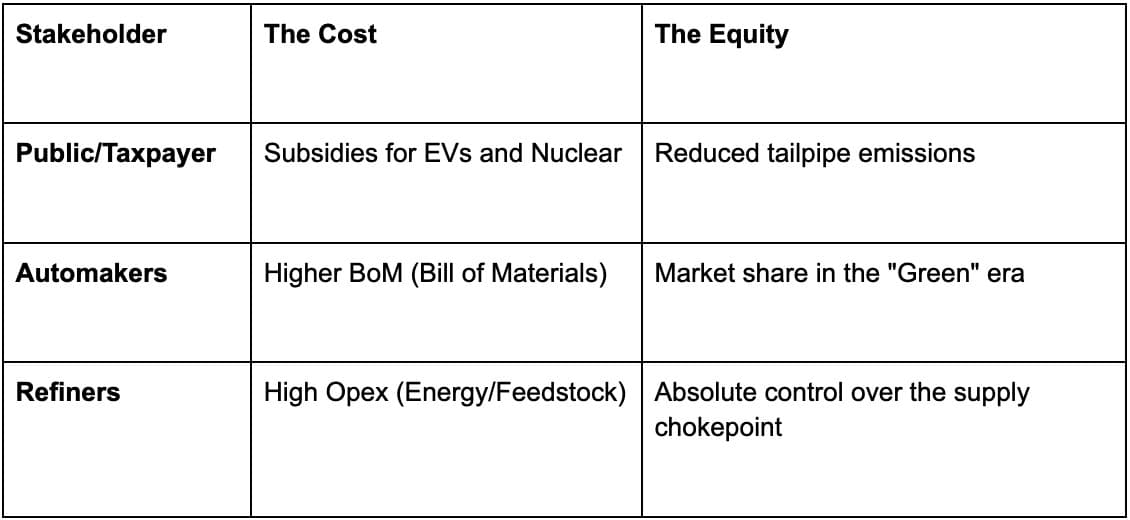
The public is paying for the transition, but the private platforms—the refiners—are the ones collecting the rent on every kilogram of purity produced.

The Final Reckoning

We have to ask: is this $1.4 billion market a sign of a leap forward, or is it just the mounting bill to keep the lights on in a post-fossil-fuel world?

To get the "limitless" energy promised by solar and nuclear, we are requiring more and more specialized, high-energy-input materials. We are replacing a liquid fuel (oil) with a solid-state supply chain (graphite, lithium, cobalt) that is significantly more brittle.

A disruption in the supply of ultra-high-purity graphite doesn't just slow down the "future"; it halts the production of the present.

The pivot to synthetic graphite is a move toward consistency, but it is also a move toward a higher floor for energy costs. You cannot have cheap, high-purity anodes if you have expensive industrial electricity.

The "Green Revolution" is being built on a foundation of grey soot and intense heat.

As we move toward 2030, the gap between the digital promise of an emissions-free world and the physical reality of the graphitization furnace will only widen.

The winners won't be the ones with the best marketing. They'll be the ones who own the furnaces.

I’ll be watching the next round of capital expenditure reports from the major refiners. If they aren't breaking ground on new high-heat facilities outside of China, the $1.43 billion forecast is less of a target and more of a warning.

By Michael Kern for Oilprice.com

Europe’s Auto Industry Faces an Existential Test From China’s EV Surge

  • Chinese automakers have rapidly surpassed European competitors on cost, scale, and increasingly on quality, despite EU tariffs.

  • Subsidies, economies of scale, and global price wars have enabled Chinese cars to undercut European brands across multiple segments.

  • With jobs, industrial know-how, and strategic autonomy at stake, Europe faces dwindling time to mount an effective response.

Two decades into a successful career manufacturing interiors for the world’s leading auto brands, Tomas, a former senior manager with an Italian multinational company, walked away from the car industry in the autumn of 2025.

“I think it's doomed,” the Czech man told RFE/RL, explaining the main reason he walked away from the business. “The industry is doomed.” Tomas has asked that his surname not be used in this story.

Europe’s storied car industry is under threat from a flood of high-quality Chinese vehicles with impossibly aggressive price tags -- some as low as 10,290 euros ($12,141) in specific markets -- that began arriving on the continent especially after the COVID pandemic. Experts warn the influx endangers an industry that has served as the foundation of European manufacturing for decades.

Despite tariffs introduced by Brussels in 2024 of up to 35 percent on some Chinese electric vehicles (EVs) on top of a 10 percent import dutyChinese vehicle sales into Europe nearly doubled between 2024 and 2025, with more than half a million Chinese models sold in the first nine months of this year.

Chinese EV giant BYD reported a year-on-year sales increase of 225 percent to become the top-selling electric vehicle maker in the EU through some months of 2025 despite tariffs. Other manufacturers dodged the EU trade barriers on EVs by shipping combustion engine vehicles and hybrids not subject to the same duties.

Beijing's car industry dates back to the 1950s, but its manufacturers have long been dogged by a reputation for poor quality and clunky style, which kept their international footprint to a minimum. That all changed recently.

Before the world’s economy ground to halt in 2020 amid the coronavirus pandemic, Tomas said that technical professionals in the European car industry dismissed Chinese brands, saying, “they’re horrible, they can’t build. They’ll need 20, 30, 40 years to come to our level and we will be much further ahead by then.”

“What happened is basically in five years, they exceeded us,” he said. “Now their cars are actually amazing.”

A Perfect Storm

Chinese manufacturers have long enjoyed a cost advantage for the country’s use of cheap, mostly coal-fired energy, and a labor force with minimal bargaining power, but a recent perfect storm of factors has allowed Chinese cars to be priced far below Western competitors.

In response to the Kremlin's 2022 invasion of Ukraine, the EU banned steel imports from Russia. China, meanwhile, has massively increased its imports of high-quality metals from the country.

Additionally, China’s car industry has been able to leverage unprecedented economies of scale through the past decade.

The country’s car industry was already the world’s largest by 2009, but manufacturers were mostly focused on the country’s oversaturated domestic market. That changed as intense price wars within China pushed manufacturers to look outwards. In 2023, China overtook Japan to become the world’s largest car exporter, producing tens of millions of vehicles each year.

Then, there are alleged subsidies.

China has denied it props up automakers, but an EU investigation in 2024 found that public money was “detected across the entire supply chain,” from mines extracting raw materials to the ships hauling finished electric vehicles to Europe.

The United States imposed a 100 percent tariff on Chinese electric vehicles in 2024 after their own investigation concluded that the US auto industry was being "materially injured" by some subsidized Chinese models.

Paul Bennet, a managing partner at the UK-based automotive advisory firm Madox Square, told RFE/RL that the blitzkrieg entry of Chinese vehicles into the European market may be about more than business.

“Overall, while the economic benefits are clear, the geopolitical aspects of this strategy shouldn't be overlooked,” he said. “In my opinion, it's likely part of China's broader efforts to reshape global economic dynamics and enhance its position on the world stage.”

While some insiders say that Europe may still have opportunities to counter, time is running out. Bennet wrote in September that the future of the continent's auto industry, which employs some 13.2 million people, and supports millions more jobs in dependent businesses, now “hangs in the balance.”

Hedging Against Tariffs

Under current market rules, a Chinese vehicle produced inside the EU would not be subject to the same tariffs as those imported from outside the bloc. Chinese manufacturers are moving fast to exploit that condition.

China’s BYD is in the process of establishing a $4.6 billion factory in Hungary, and in
Barcelona, cars are already being produced by a joint venture between Spain’s Ebro-EV Motors and China’s Chery brand. There are ongoing talks for further manufacturing bases in other EU countries, including in Italy and Poland. Additionally, manufacturing sites have been established by Chinese auto brands in Serbia.

Bennet told RFE/RL that Serbia was likely chosen for a range of factors, including Belgrade's free trade agreements with Russia and the EU, and Serbia's potential future European Union membership, making the country, "an attractive long-term investment potentially offering easier access to EU markets in the future."

Many of Europe's car brands, meanwhile, are facing a shrinking consumer base for their cars in China -- once a key market -- as well as on home soil amid the surge in imported Chinese car sales in Europe.

Bennet has called for carmakers to pressure the European Commission into mandating joint ventures that are majority owned by European brands wherever Chinese companies establish a manufacturing footprint inside the EU.

Others have called for the EU and the United States to open their markets to one another, while blocking out China. Beijing and Brussels have also restarted negotiations over a minimum price floor for Chinese EVs on the European market to limit how severely local automakers can be undercut.

Industry veteran Tomas worries that if current trends continue, Europe’s wider industrial base may be in danger. He fears “much bigger consequences than we can think of now, like the loss of industrial self-sufficiency and know-how, leading to huge security risks in the future.”

The auto sector, he says, remains “the biggest industrial driver and crib for young engineers, with careers in defense, researchand development.”

Tomas says he struggles to imagine a political solution to the economic threat to Europe’s auto makers.

But, he adds, “I hope I am wrong, I really hope I am wrong.”

By RFE/RL


China’s BYD logs record EV sales in 2025


By AFP
January 1, 2026


BYD has come to dominate China's new energy vehicle market -- the world's largest - Copyright AFP/File Idrees MOHAMMED

Chinese auto giant BYD sold 2.26 million electric vehicles last year, a company statement showed Thursday, setting a new record for any firm globally.

The figure puts BYD in pole position to outstrip Elon Musk’s Tesla in the annual category for the first time, with the lagging Texas-based firm having previously announced 1.22 million in 2025 EV sales by the end of September.

Tesla is expected to announce its total EV sales for last year on Friday.

Shenzhen-based BYD, which also produces hybrid cars, announced the data in a statement published to the Hong Kong Stock Exchange, where it is listed.

Known as “Biyadi” in Chinese — or by the English slogan “Build Your Dreams” — BYD was founded in 1995, originally specialising in battery manufacturing.

The automotive juggernaut has come to dominate China’s highly competitive new energy vehicle market — the world’s largest.

Now it is seeking to expand its presence overseas, as increasingly price-wary consumption patterns in China weigh on profitability.

BYD and its Chinese competitors face hefty tariffs in the United States.

But its success is growing in Southeast Asia, the Middle East, and even Europe — to the consternation of traditional industry heavyweights from the continent.

Tesla narrowly beat BYD in annual EV sales in 2024, with US company’s 1.79 million just outpacing the latter’s 1.76 million.

This year, Musk’s firm has seen sales struggle in key markets over the CEO’s political support of US President Donald Trump and far-right politicians.

Tesla has also faced rising EV competition from BYD and other Chinese companies, as well as from European giants.
Canada’s auto sector is hitting a structural reckoning


By Jennifer Kervin
December 31, 2025
DIGITAL JOURNAL


Photo by Getty Images on Unsplash Plus

Before Canadians start comparing prices, powertrains, or brand badges, they are sending a clear signal about the auto sector itself.

A new consumer automotive survey from KPMG Canada shows that 72% of Canadians say it is very or somewhat important that their vehicle is assembled or built in Canada.

That data point reframes the broader debate facing the industry.

Manufacturing footprint has become a proxy for trust, economic contribution, and long-term commitment when the sector is under pressure from trade uncertainty and rising costs.

“With U.S. tariffs disrupting the industry, Canadians in the market for a new vehicle are looking to the brands they trust at prices they can afford in models they want, and increasingly, on where those vehicles are built,” says Dave Power, partner and national automotive sector leader at KPMG in Canada.

Power points to Toyota and Honda, which both maintain large manufacturing operations in Ontario, as brands that continue to resonate with Canadian buyers. At the same time, trust in the Detroit Three appears to be eroding as Canadians perceive less commitment to keeping jobs in Canada amid U.S. trade pressures.

For business leaders and policymakers, the survey shows that manufacturing location, affordability, public investment, and EV ambition are increasingly tied together, narrowing the range of viable choices ahead.

That convergence becomes most visible when the conversation turns to price.

While manufacturing location has emerged as a trust marker, affordability remains the pressure point that exposes whether the system can hold. Survey data suggests Canadians are reaching the limits of what they are willing and able to absorb as costs rise across the automotive value chain.
Affordability is now a structural signal

Price still dominates decision-making, but the margin for error has narrowed.

Sixty-two percent of Canadians say they will not spend more than $50,000 on a new vehicle, down from 75% in KPMG’s 2022 survey.

Nearly three-quarters (76%) worry that ongoing trade tensions and tariffs will push prices even higher. Almost a quarter (23%) say tariffs have already priced them out of the new vehicle market, while another 38% say a further 10 to 15% increase would do the same.

For manufacturers and suppliers, rising costs tied to trade policy, supply chains, and production decisions are colliding with increasingly constrained willingness to pay, putting pressure on volume assumptions and long-term planning.
Subsidy expectations are shifting away from incumbents

One of the clearest signals in the survey is how Canadians believe public investment should be directed.

Only seven percent support continued subsidies for the Detroit Three (GM, Ford, and Stellantis).

Instead, 37% want funding directed toward Canada’s auto parts supply industry, and 58% support diversification into defence manufacturing as a way to protect jobs and build resilience.

“People want long-term strategy, not short-term patches,” says Power. “Canadians are calling for strategic investments that safeguard manufacturing jobs while strengthening the foundation for the entire automotive ecosystem.”

The implication is a shift from firm-specific support toward system-level capacity, challenging long-standing assumptions about how governments stabilize the sector and what success should look like.
Trade risk is shaping strategic decisions

With CUSMA set for review in 2026, 72% of respondents worry vehicle prices will rise if Canada loses protection under the agreement. Half (51%) believe Canada’s automotive industry cannot survive without trade protections or a new agreement with the U.S.

Joy Nott, partner in trade and customs at KPMG, says potential changes to rules of origin could force a restructuring of supply chains.

“If the CUSMA rules of origin change substantially to require even more North American content, this could have a dramatic impact on existing automotive supply chains,” she says. “This disruption would require a search for new North American suppliers to replace overseas manufacturing. While disruptive and likely to increase costs, this change could also create opportunities for Canadian manufacturers to expand and diversify their business.”

That uncertainty shows up in everyday decisions, like whether to expand a plant, lock in a supplier, or wait another year before committing capital.
EVs are the execution test, not the solution

More than half of Canadians (55%) believe the country could become a global leader in electric vehicles and battery production, and 52% want governments to make that a priority.

Governments have already committed billions toward that ambition.

The survey suggests support is conditional, with affordability a central concern and infrastructure and domestic supply chains top of mind.

Canadians are questioning whether the system can deliver them at scale and at a price that works, not rejecting the idea outright.

“With all the turmoil in the auto sector, Canada has a real opportunity to invest at home and diversify into EV battery production to protect jobs, attract investment, and build long-term resilience,” says Power.

“What’s needed is a clear roadmap to accelerate Canada’s leadership, bearing in mind that building affordable EVs will be essential, particularly to compete with lower-cost models from foreign manufacturers, as will significant investment in a robust charging infrastructure.”
The roadmap is the real issue

Taken together, the survey outlines the boundaries within which Canada’s auto strategy will succeed or fail.

Manufacturing location matters.

Prices cannot keep rising.

Public investment is expected to strengthen ecosystems, not just incumbents.

EVs and batteries sit at the centre of this transition, as the clearest test of whether Canada can align policy, capital, and execution.

The signals in the survey are consistent. Canadians expect vehicles they can afford, production that supports the domestic economy, and a transition to EVs that holds together in practice.

Delivering on all three is now the real test.
Final shots

• Manufacturing footprint has become part of competitive positioning, not a secondary consideration.
• Affordability is now a structural constraint shaping demand and investment decisions.
• EV leadership will depend on execution across supply chains, pricing, and infrastructure, not ambition alone.


Written ByJennifer Kervin
Jennifer Kervin is a Digital Journal staff writer and editor based in Toronto.

 Kazakhstan set to climb gallium production ranking after ERG, Mitsubishi deal

Kazakhstan set to climb gallium production ranking after ERG, Mitsubishi deal
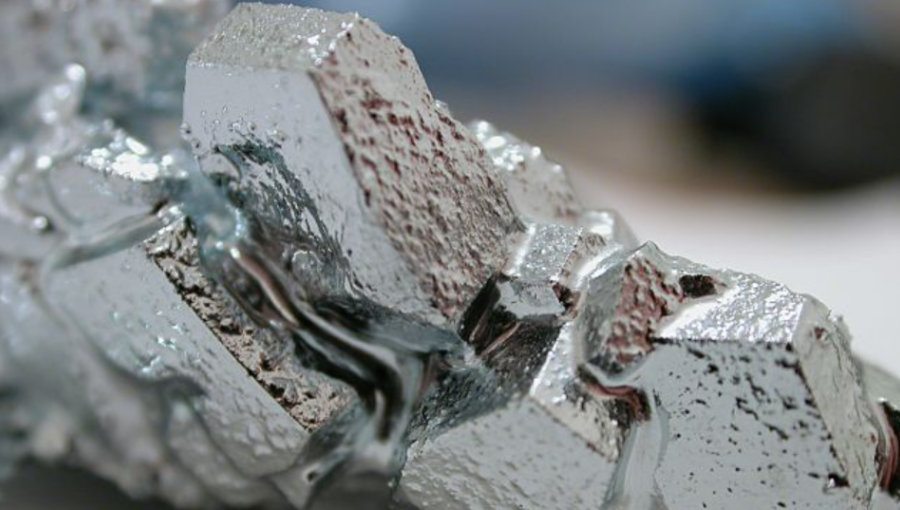
Crystals of 99.999% gallium. / Foobar, cc-by-sa 3.0
By bne Eurasia bureau December 30, 2025

Kazakhstan is set to become the number two producer of critical mineral gallium globally, according to a deal announcement from Eurasian Resources Group (ERG).

ERG said it inked a long-term deal to supply gallium to Mitsubishi Corporation RtM Japan (8058:TYO) during a state visit paid to Japan by Kazakh President Kassym-Jomart Tokayev just prior to Christmas.

Gallium, a soft, silvery metal, is used in the manufacturing of semiconductors and other technologies in electronics. As an Atlantic Council think tank article reported in October, in defence production, the obscure metal is crucial, for instance, in making advanced electronic warfare systems. The US produces no domestic gallium and lacks a government stockpile to cushion against Chinese weaponisation of the commodity through export licensing, it added.

Under the deal, ERG will invest more than $20mn in the construction of a production site with the capacity to produce 15 tonnes of gallium per year.

Production is expected to start in the third quarter of 2026, ERG said. 

Shukhrat Ibragimov, CEO at ERG, said that during an address made by Tokayev during his time in Japan, “the Head of State emphasised the vital importance of rare-earth metals and critical minerals, and the need for close integration into global production and supply chains.

“Gallium is crucially important as it is an integral part of modern technologies, especially electronics. Thus, our project is fully aligned with the goals set by the President. As we launch gallium production and start to supply it to Mitsubishi Corporation RtM Japan Ltd. in the future, this will demonstrate that, by developing domestic operations, we can transform strategic resources into competitive products and strengthen Kazakhstan’s position on the market for high-technology materials.”

The gallium will be produced from process solutions of Pavlodar Aluminium Plant, part of Aluminium of Kazakhstan JSC.

The production will use technology developed in-house by ERG Research and Development.

The technology is said to help improve the quality of the core product, alumina, reduce material losses and recover gallium from extremely low-grade ores to produce a high-purity metal.

ERG, with mining operations in countries including Kazakhstan, Brazil, the Democratic Republic of the Congo and Zambia is headquartered in Luxembourg and 40%-owned by the Kazakh state.

On December 23, the Financial Times reported that a little-known Kazakh businessman, Shakhmurat Mutalip, had staged a bid to acquire 40% of ERG, setting up a confrontation with CEO Ibragimov, the son of one of ERG’s now-deceased oligarch founders, who made a similar offer earlier in the year.

Mutalip owns Kazakh building group Integra Construction KZ.

ERG was founded as Eurasian Natural Resources Corporation (ENRC) in the 1990s with formerly state-owned mining assets privatised by the Kazakh government following the collapse of the Soviet Union.


As gold hits records, Indians opt for bars and coins over jewelry

Stock image.

For nearly two decades, Mumbai homemaker Prachi Kadam marked every festive season with a gold jewellery purchase, blending tradition with personal style. This year’s record rally in prices, however, led her to choose a 10-gram gold coin instead of necklaces or bangles.

“I like jewellery because it can be worn during functions, but it’s hard to justify paying an additional 15% in making charges,” said Kadam, who, like millions of Indians, considers buying gold during festivals to be auspicious. “So I settled for a 10-gram coin this time,” she added.

Her decision reflects a broader shift in India, one of the world’s largest gold markets and where the metal holds deep cultural and financial significance. With prices heading for their biggest annual gain in 46 years, consumers are increasingly turning away from jewellery toward small coins and bars.

Strong demand for safe-haven assets, US interest rate cuts and a weaker dollar drove global gold prices up 67% so far this year and saw them hitting a record high of $4,549.7 per troy ounce on December 26.

Indian domestic gold prices climbed 77% this year, outpacing the Nifty 50 index’s 9.7% gain, aided by a 5% fall in the rupee against the dollar.

Price surge reshapes buying habits

Analysts say the trend is cushioning a drop in overall demand and is likely to persist into 2026, echoing a global slowdown in ornament purchases as bullion prices soar.

For others, the adjustment means buying less gold rather than abandoning jewellery altogether.

Kolkata-based Nibedita Chakraborty said her household budget has not kept pace with rising prices, prompting her to switch to lightweight designs.

“Even reducing the weight of a gold necklace by six or seven grams can save more than 100,000 rupees ($1,114),” Chakraborty said.

As prices rise, consumers are becoming more design- and value-conscious, said Saurabh Gadgil, chairman of P N Gadgil Jewellers, which launched a new sub-brand for lightweight and lower-carat jewellery in June.

“Buyers want pieces that allow them to participate in gold ownership without feeling price pressure, and modern craftsmanship has made lightweight jewellery aspirational rather than entry-level,” Gadgil said.

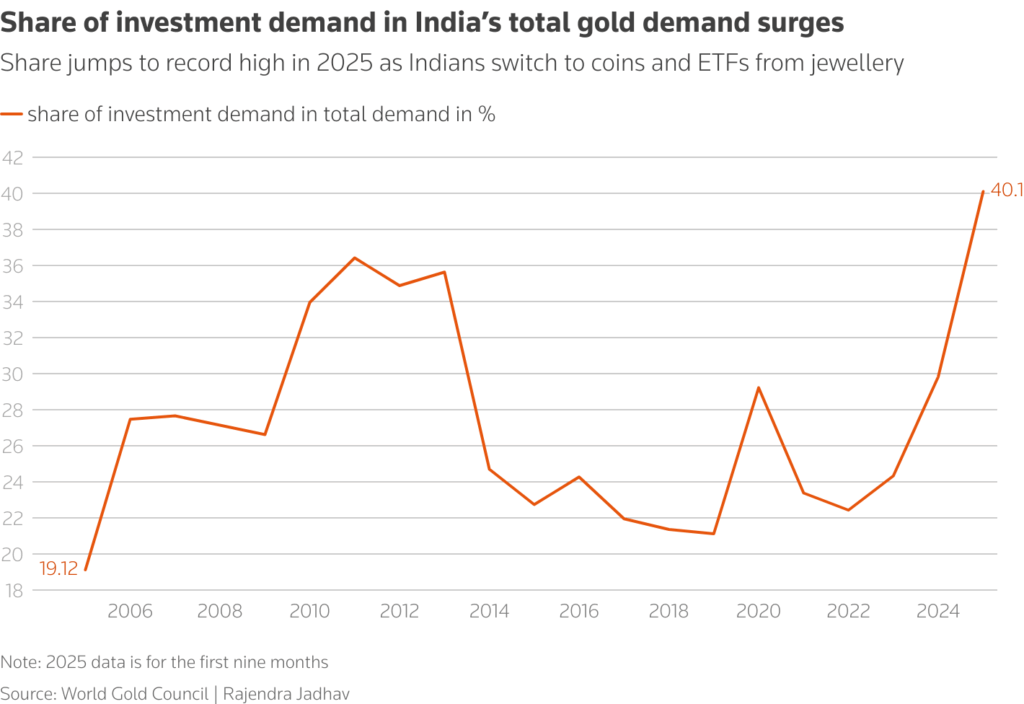
India’s total gold demand fell 14% year on year in the first nine months of 2025, with jewellery consumption down 26% to 278 metric tons and investment up 13% to 185 tons, the World Gold Council (WGC) said. Investment made up a record 40% of total demand during the period underscoring gold’s enduring role as a store of wealth in Indian households.

The shift toward investment gold and away from jewellery is expected to persist through 2026, as the metal continues to outperform other asset classes, Prithviraj Kothari, president of the India Bullion and Jewellers Association (IBJA), said.

“Consumers are purchasing gold in the form of coins, bars, or gold ETFs, assuming that the rally will continue,” Kothari said.

India-listed gold-backed exchange-traded funds (ETFs) saw an inflow of $3.3 billion, equivalent to 28.7 tons so far this year, which raised their holdings to 86.2 tons, according to the WGC.

Leading industry consultancy Metals Focus expects the softness in India’s jewellery demand to carry into 2026, with full-year jewellery consumption projected to decline by a further 9%. With gold becoming less affordable, jewellery consumption has seen a structural shift where consumers are opting for lower caratage and lighter-weight designs, it added.

There is growing acceptance of lower-carat jewellery, including 18-carat and 14-carat options, particularly among younger customers and working professionals, said Santosh Kataria, chairman of DP Abhushan Ltd.

“These pieces allow buyers to manage budgets while still enjoying appealing designs, making them suitable for everyday wear,” Kataria said.

(By Rajendra Jadhav and Polina Devitt; Editing by Veronica Brown and Louise Heavens)


Critical Metals expects to close Greenland supply deals in Q1 2026, CEO says

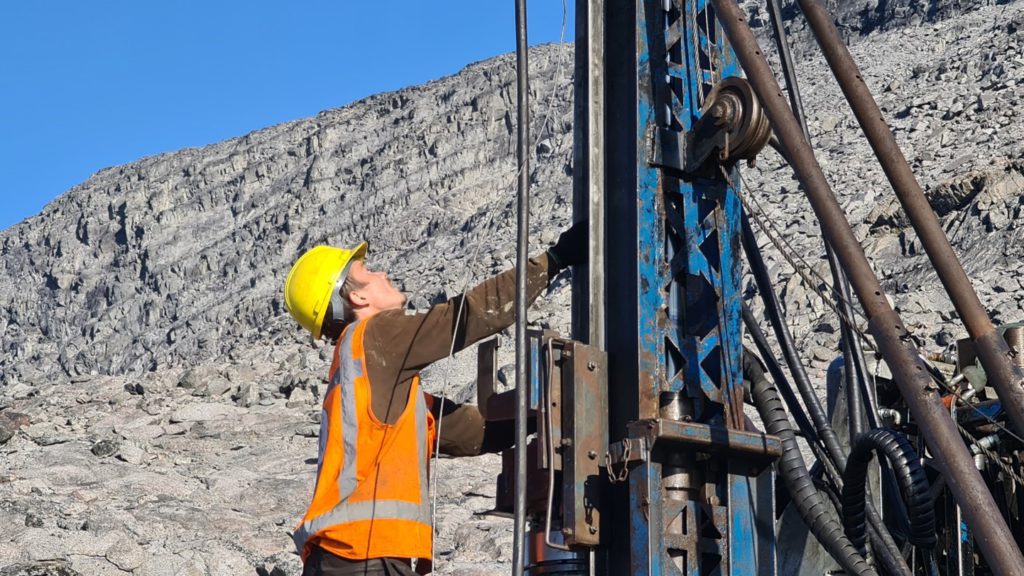
Drill rig at Tanbreez project. Credit: Critical Metals Corp.

Critical Metals expects to finalize the remaining 25% of offtake agreements for its Tanbreez rare earth project in Greenland by early 2026 and will be open to an investment from Washington, its top boss told Reuters.

CEO Tony Sage said interest from the Middle East, including potential processing partners in Saudi Arabia, Qatar, Bahrain, Oman and the UAE, reflects efforts by energy-rich states to build rare earth processing capacity, supported by lower power costs and faster permitting than in the US and Europe

The company has already pre-sold 75% of planned output, split between the US and Europe, and aims to keep supply diversified to limit geopolitical risk, Sage said.

The Trump administration has intensified efforts to secure US supply chains for critical minerals, including shifting some federal support from grants to direct equity stakes, as Washington seeks to reduce reliance on market leader China.

Trump said last week that the US needs Greenland for its national security and that a special envoy he had appointed to the island would “lead the charge.”

Trump administration officials have discussed taking a stake in Critical Metals, four people familiar with the matter told Reuters in October.

“Would welcome it, even though we didn’t ask for it. We asked for a grant under the Defence Production Act,” Sage said. Reuters reported that the Trump administration had considered converting that grant, should it be awarded, into equity.

The White House did not respond to a request for comment.

Critical Metals plans to begin mining in 2027, with first production targeted for mid-2028, Sage said.

Capital costs are expected to total about $500 million in Greenland, while downstream processing facilities are likely to cost more than $1 billion.

Separately, Sage said the company’s Austrian lithium project remains on hold until prices for the battery metal recover.

(By Arunima Kumar and Ernest Scheyder; Editing by Veronica Brown and Anil D’Silva)