Geeta Pandey and Abhishek Dey
BBC
Hindustan Times via Getty Images
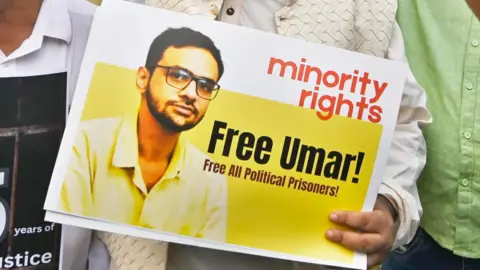
Protests have been held to demand release of Umar Khalid and other student activists
Two prominent student activists in India have been denied bail after being held in prison for more than five years without trial.
India's Supreme Court on Monday rejected pleas of Umar Khalid and Sharjeel Imam, who were arrested after the 2020 Delhi riots.
Police accused them of conspiracy to incite deadly clashes in the capital that killed 53 people, mostly Muslims. They were held under strict anti-terror laws that make bail difficult. They denied the charges and unsuccessfully applied for bail in courts over the years.
The court, however, granted bail to five other activists who were also arrested in the same case.
The riots occurred amid months-long protests against a citizenship law that the United Nations called "fundamentally discriminatory".
In its order on Monday morning, the two-judge bench said the bail petitions of all the seven accused had to be examined individually since they were not on "equal footing as regards culpability", reported legal website Bar and Bench.
The judges said they were making a distinction between the charges that were levelled against Khalid and Imam from the others while denying them bail.
The court added that the petitioners could apply for bail again only after one year.
Khalid completed his PhD in 2019 from Delhi's Jawaharlal Nehru University. Imam was a doctoral scholar at the time of his arrest at the same university. Both men are 37.
The case of the jailed activists has attracted a lot of attention in India and globally.
Protests have been held to demand release of Umar Khalid and other student activists
Two prominent student activists in India have been denied bail after being held in prison for more than five years without trial.
India's Supreme Court on Monday rejected pleas of Umar Khalid and Sharjeel Imam, who were arrested after the 2020 Delhi riots.
Police accused them of conspiracy to incite deadly clashes in the capital that killed 53 people, mostly Muslims. They were held under strict anti-terror laws that make bail difficult. They denied the charges and unsuccessfully applied for bail in courts over the years.
The court, however, granted bail to five other activists who were also arrested in the same case.
The riots occurred amid months-long protests against a citizenship law that the United Nations called "fundamentally discriminatory".
In its order on Monday morning, the two-judge bench said the bail petitions of all the seven accused had to be examined individually since they were not on "equal footing as regards culpability", reported legal website Bar and Bench.
The judges said they were making a distinction between the charges that were levelled against Khalid and Imam from the others while denying them bail.
The court added that the petitioners could apply for bail again only after one year.
Khalid completed his PhD in 2019 from Delhi's Jawaharlal Nehru University. Imam was a doctoral scholar at the time of his arrest at the same university. Both men are 37.
The case of the jailed activists has attracted a lot of attention in India and globally.
Umar Khalid: Indian activist languishes in jail without bail or trial
In October 2022, a former Supreme Court judge, three retired high court judges and a former federal home secretary wrote in a report on the riots that they found no substantiating evidence to warrant the imposition of terrorism charges against the activists.
Just last week, a group of US Congressmen and Senators wrote a letter to the Indian ambassador in Washington expressing "continued concern" over the activists' "prolonged pre-trial detention".
The activists have so far been unable to get bail as they are charged with the Unlawful Activities (Prevention) Act, or UAPA - a stringent anti-terror law that makes it exceptionally challenging to get bail and often results in years of detention until trial concludes.
Khalid's bail pleas have been rejected on at least five separate occasions in different courts over the past five years. He was granted two short outings in 2024 and 2025 to attend weddings in his family. Imam's bail pleas have been rejected at least twice before.
In October 2022, a former Supreme Court judge, three retired high court judges and a former federal home secretary wrote in a report on the riots that they found no substantiating evidence to warrant the imposition of terrorism charges against the activists.
Just last week, a group of US Congressmen and Senators wrote a letter to the Indian ambassador in Washington expressing "continued concern" over the activists' "prolonged pre-trial detention".
The activists have so far been unable to get bail as they are charged with the Unlawful Activities (Prevention) Act, or UAPA - a stringent anti-terror law that makes it exceptionally challenging to get bail and often results in years of detention until trial concludes.
Khalid's bail pleas have been rejected on at least five separate occasions in different courts over the past five years. He was granted two short outings in 2024 and 2025 to attend weddings in his family. Imam's bail pleas have been rejected at least twice before.
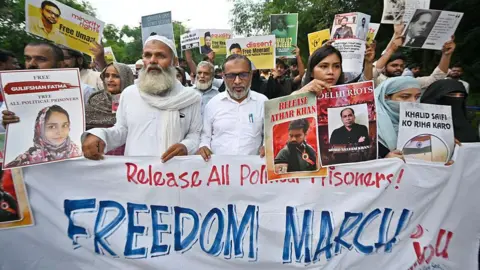
The case of the jailed activists has attracted a lot of attention in India and globally
The five activists who were granted bail on Monday include Gulfisha Fatima, Meeran Haider, Mohd Saleem Khan, Shadab Ahmed and Shifa ur Rehman.
Ms Fatima, 32, is a business administration graduate from Delhi University, while the others are human rights activists who protested against the Citizenship Amendment Act.
Khalid, Imam and the others had approached the Supreme Court in September 2025 after being denied bail by the Delhi high court.
The activists told the court they had spent more than five years in jail without any evidence proving their involvement in the violence, arguing that their continued detention amounted to "punishment without trial".

No comments:
Post a Comment