Friday, January 02, 2026

ANTI TERRORISM IS ANTI FREE SPEECH

Pakistan sentences journalists to life over links to protests after Imran Khan arrest

The Pakistani journalists and commentators were sentenced under anti-terrorism laws to crack down of people perceived to be supporters of Imran Khan.


The New Arab Staff & Agencies
02 January, 2026

The Pakistani court ruled that those convicted promoted 'fear and unrest' in society online

A Pakistani anti-terrorism court sentenced eight journalists and social media commentators on Friday to life imprisonment in absentia after convicting them of terrorism-related offences linked to online activity in support of jailed former prime minister Imran Khan.

The convictions stem from cases registered after violent protests on 9 May 2023, when Khan’s supporters attacked military installations following his brief arrest. Since then, the government and military have launched a sweeping crackdown on Khan’s party and dissenting voices, using anti-terrorism laws and military trials to prosecute hundreds accused of incitement and attacks on state institutions.

In its ruling, the court said actions by the accused "fell within the ambit of terrorism" under Pakistani law and that their online material promoted "fear and unrest" in society.

Most of those convicted are believed to be outside Pakistan and did not appear during the proceedings, court documents showed.

The convicted include former army officers-turned YouTubers Adil Raja and Syed Akbar Hussain, journalists Wajahat Saeed Khan, Sabir Shakir and Shaheen Sehbai, commentator Haider Raza Mehdi, and analyst Moeed Pirzada, according to the court’s decision.

Reuters was unable to reach the journalists or their lawyers for comment.

The Committee to Protect Journalists said in 2023 the investigations amounted to retaliation against critical reporting. “Authorities must immediately drop these investigations and cease the relentless intimidation and censorship of the media,” CPJ Asia programme coordinator Beh Lih Yi said.

The court handed down life sentences along with additional prison terms and fines, ordering further jail time if the fines are not paid. All sentences are subject to confirmation by the Islamabad High Court.


Subscribe now to The New Arab V
EU contributing to violations of Sudanese refugee children’s rights: NGO

"It is unbelievable that EU not only allows this (violation) to continue but also actively contributes to it," says Save the Children official.

Verheul said that children are being locked up, arrested, and sent back to countries that are "completely unsafe, even to Sudan." / AA


November 26, 2025


The EU is "partly responsible" for the violation of Sudanese children's rights due to the "one-sided focus" on strict border control, according to a rights group.

The rights of Sudanese refugee children are being systematically violated on a large scale, and the EU is "partly responsible," Julia Verheul from Save the Children said about the group's recent research on the experiences of 66 children who fled Sudan.

"We launched this research to map the physical and psychological harm children endure before they arrive in the EU," she was quoted by the Dutch broadcaster NOS on Wednesday as saying.

According to the group, children are paying the price for the increasingly strict EU policy, as "the one-sided focus on strict border control" is driving the most vulnerable unaccompanied children into the hands of smugglers and making them invisible to aid workers."

Speaking to the broadcaster, a 15-year-old girl from Sudan, who is currently in Egypt, said she fled Sudan after her father was murdered.

She said that she is happy to be safe now, and added that if possible, she wants to return to her country to become a doctor.

Not checking whether children's rights are being respected

An 18-year-old Sudanese, who fled soon after the start of the war in Sudan, said: "The rebel army raided our neighbours' house and took the children away. Some of them never returned."

Verheul said that children are being locked up, arrested, and sent back to countries that are "completely unsafe, even to Sudan."

The EU invests hundreds of millions in border control without checking whether children's rights are being respected, she stressed, noting that the violations of these children's rights are becoming increasingly serious.

"It is unbelievable that the EU not only allows this to continue but also actively contributes to it," Verheul added.

The conflict in Sudan between the army and the paramilitary Rapid Support Forces, which began in April 2023, has killed at least 40,000 people and displaced 12 million, according to the World Health Organization.


Syrian church says Christians are partners in protecting and building the homeland

January 2, 2026 


Faithful attend the Christmas mass at Church of Saint Francis of Assisi 
in Aleppo, Syria on December 25, 2025. 
Kasim Yusuf – Anadolu Agency


The Greek Orthodox Patriarch of Antioch and All the East, John X Yazigi, has affirmed that Christians in Syria are partners with their fellow citizens in protecting and rebuilding the country, stressing the principle of shared citizenship.

Speaking during New Year’s Mass at the Mariamite Cathedral in Damascus, Patriarch Yazigi said the occasion marked a turning point for the country and the wider region.

“Today we turn a page in our lives on this earth,” he said. “We turn this page in Damascus and in the East, which Jesus Christ, the Lord of the Easts, intended to be the place where humanity meets its Creator.”

He stressed that Christians in Syria are not seeking protection from others. “We, as Christians in this land, are not asking to be protected,” Yazigi said. “Together with our fellow citizens, we protect and build this land.”

READ: Over 177,000 Syrians returned home voluntarily from Jordan in 1 year: UN

The patriarch added that prayers during the service were offered for peace in Syria and Lebanon, as well as for peace across the Middle East and the wider world. He also prayed for those abducted during the conflict, including the two bishops of Aleppo, Youhanna Ibrahim and Paul Yazigi, who were kidnapped in 2013.

In a related development, the Syrian state news agency SANA reported on Wednesday that a member of the Internal Security Forces was killed and several others wounded in a suicide bombing that targeted a police patrol in the Bab al-Faraj area in the centre of Aleppo.

The attack underscored continuing security challenges in parts of the country as religious leaders called for unity, peace and shared responsibility in rebuilding Syria.
Pakistan archaeologists discover ancient coins and decorative stones at UNESCO site near Taxila

These latest discoveries affirm that Taxila reached the zenith of its political, cultural, and economic influence under Kushan rule, particularly between the 1st and 3rd centuries AD


PTI Published 02.01.26

Pakistani archaeologists have uncovered rare decorative stones and ancient coins during excavations at a UNESCO-listed site near the historic city of Taxila, offering fresh insight into the earliest urban settlement of the vast ancient civilisation.

The finds were made at the ancient Bhir Mound, where experts discovered decorative stones dating back to the 6th century BC along with coins from the 2nd century AD.

According to Dawn, officials described the discovery as the most significant at the site in the past decade.

The report said archaeologists recovered fragments of metamorphic decorative stone identified as lapis lazuli, along with rare bronze coins attributed to the Kushan dynasty, significantly advancing the material understanding of ancient Gandhara.

Aasim Dogar, deputy director of the Punjab Department of Archaeology and head of the excavation team, confirmed the preliminary assessment of the artefacts.

“The decorative stones are lapis lazuli, a prized semi-precious stone, while the coins belong to the Kushan period,” Dogar said.

The excavation team sought specialised forensic support to date the metal artefacts. Dogar said detailed numismatic analysis carried out by experts from the University of Peshawar confirmed that the coins bear the image of Emperor Vasudeva, whom historians recognise as the last of the ‘great Kushan rulers’ to govern the region.

Dogar explained that the obverse side of the recovered coins depicts Vasudeva, while the reverse shows a female religious deity. He described this imagery as a defining feature of Kushan-era religious pluralism, which frequently integrated diverse theological traditions.

The artefacts were unearthed on the northern side of the site, specifically in the B-2 trench — one of 16 trenches currently under excavation. Dogar said surrounding evidence indicates that the area functioned as a residential zone.

The latest discoveries reinforce the view that Taxila reached the height of its political, cultural, and economic prominence during Kushan rule, particularly between the 1st and 3rd centuries AD. “Under emperors such as Kanishka the Great, Taxila emerged as a major administrative, commercial, and intellectual centre,” Dogar said.

He added that extensive Kushan patronage of Buddhism during this period resulted in the construction of stupas, monasteries, and large religious complexes. The era also witnessed the flourishing of Gandharan art — a unique fusion of Greek, Roman, Persian, and Indian influences — with Taxila at its centre.

Malik Tahir Suleman, a leading numismatist, told Dawn that Kushan coins are among the most important historical sources for studying ancient South and Central Asia.

“Issued between the 1st and 4th centuries AD, Kushan coins evolved from Indo-Greek imitations into a sophisticated imperial currency system,” Suleman said. “Struck mainly in gold, copper, and bronze, they reflect the empire’s economic strength and vast trade networks, including links with Roman markets.” He added that Kushan coinage is noted for its elaborate iconography and multilingual inscriptions.

Suleman explained that the coins typically depict rulers in Central Asian attire on one side, with a wide array of deities — including Helios, Mithra, Shiva, Nana, and the Buddha — on the other.

In addition to the coins, the discovery of deep-blue lapis lazuli fragments sheds light on ancient trade networks.

Dogar noted that the stone has been highly valued across civilisations for thousands of years.

“Its presence at Taxila points to long-distance trade links, particularly with Badakhshan in present-day Afghanistan, a historic source of lapis lazuli,” Dogar said.
Venezuela releases 88 jailed after post-election protests
DW with Reuters, AFP, EFE

The ‍New Year's Day announcement marks the second mass release in a week amid US pressure on President Nicolas ⁠Maduro's government.


Around 2,400 people were arrested for protesting President Nicolas Maduro's disputed July reelection [FILE: November 18, 2025]Image: Federico Parra/AFP

Venezuela's government on Thursday announced the release of 88 people jailed for protesting President Nicolas Maduro's claimed victory in the July 2024 elections.

In a statement published on Instagram, the Ministry of Penitentiary Service said that there had been "88 new releases" of people detained "for crimes committed during violent actions by extremist groups."

"These actions are part ‌of the comprehensive review process of cases ordered ‌by ⁠President Nicolas Maduro," it added.

The ‍New Year's Day release comes after Maduro's government decided to free 99 people on Christmas Day as "a concrete expression of the State's commitment to peace, dialogue and justice."

Venezuela's disputed 2024 re-election of Maduro

In July 2024, mass protests erupted in Venezuela after Maduro was declared to have won a third six-year term.

The country's opposition claimed victory for the now-exiled former ambassador Edmundo Gonzalez Urrutia.

Around 2,400 people were arrested, but nearly 2,000 have since been released.

Venezuelan NGOs estimate that about 900 political prisoners remain in detention in the country, including individuals arrested before the election.


US increasing pressure on Venezuela

Amid the threat of military action from the Trump administration, Maduro has lately been keen to show a more conciliatory side.

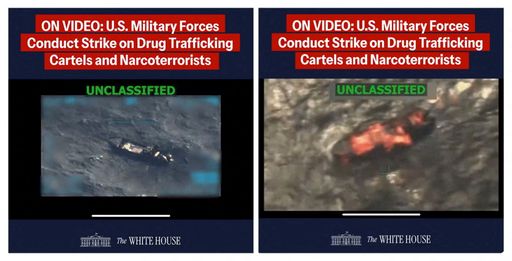
In recent months, the United States has ramped up pressure on Caracas, amassing a ‌huge military presence in the Caribbean, carrying out strikes near the Venezuelan coast on suspected drug boats off the coast of Venezuela and seizing tankers transporting Venezuelan oil.

This week, US President Donald Trump announced that US forces had hit a docking area for alleged Venezuelan drug boats, the first known land strike on Venezuelan soil to counter narcotics trafficking from Latin America.

On Thursday, Maduro said that he was open to dialogue with the United States "wherever they want and whenever they want."

He did not confirm or deny the US strike on the docking area, instead saying it "could be something we talk about in a few days."

Venezuela has accused the US of trying to oust Maduro to get its hands on the country's oil reserves, the largest in the world.

Last week, Trump said it would be "smart" for Maduro to step down.


Edited by: Saim Dušan Inayatullah

Emmy Sasipornkarn Multimedia journalist with a focus on Asia

Maduro says open to talks with US on drug trafficking


Venezuelan President Nicolas Maduro declines to comment on a CIA strike on Venezuelan docking area, saying he will address it in a few days.


Asked about the operation on Venezuelan soil, Maduro said he could "talk about it in a few days." / Reuters

Venezuela is open to negotiating an agreement with the United States to combat drug trafficking, the South American country's President Nicolas Maduro said in a pre-taped interview aired on state television, but he declined to comment on a CIA-led strike last week at a Venezuelan docking area that the Trump administration believed was used by cartels.

Maduro, in an interview with Spanish journalist Ignacio Ramonet, reiterated on Thursday that the US wants to force a government change in Venezuela and gain access to its vast oil reserves through the monthslong pressure campaign that began with a massive military deployment to the Caribbean Sea in August.

"What are they seeking? It is clear that they seek to impose themselves through threats, intimidation and force," Maduro said, later adding that it is time for both nations to "start talking seriously, with data in hand."

"The US government knows, because we've told many of their spokespeople, that if they want to seriously discuss an agreement to combat drug trafficking, we're ready," he said.

"If they want oil, Venezuela is ready for US investment, like with Chevron, whenever they want it, wherever they want it, and however they want it."

Chevron Corp. is the only major oil company exporting Venezuelan crude to the US. Venezuela has the world's largest proven oil reserves.


US strikes


The interview was taped on New Year's Eve, the same day the US military announced strikes against five alleged drug-smuggling boats. The latest attacks bring the total number of known boat strikes to 35 and the number of people killed to at least 115, according to numbers announced by the Trump administration. Venezuelans are among the victims.

President Donald Trump has justified the attacks as a necessary escalation to stem the flow of drugs into the United States and asserted that the US is engaged in an "armed conflict" with drug cartels. The strikes began off Venezuela's Caribbean coast and later expanded to the Eastern Pacific Ocean.

Meanwhile, the CIA was behind a drone strike last week at a docking area believed to have been used by Venezuelan drug cartels, according to two people familiar with details of the operation who requested anonymity to discuss the classified matter.

It was the first known direct operation on Venezuelan soil since the boat strikes began, a significant escalation in the administration's pressure campaign on Maduro, who has been charged with narco-terrorism in the US.

Asked about the operation on Venezuelan soil, Maduro said he could "talk about it in a few days."

The Trump administration has provided no evidence that the targeted boats were involved in drug trafficking, prompting debate about the legality of these operations.

International law experts and rights groups say the strikes likely amount to extrajudicial killings, a charge that Washington denies.


Italy calls for diplomacy, international law amid Latin America tensions

Antonio Tajani stresses 'importance of cooperation among states to combat drug trafficking'

Melike Pala |01.01.2026 - TRT/AA


BRUSSELS

Italian Foreign Minister Antonio Tajani emphasized Thursday Italy's commitment to international law and diplomacy amid rising tensions in Latin America.

"In the delicate context of tensions affecting the Latin American region, Italy reaffirms the primacy of international law and the preeminence of diplomacy in resolving disputes. We stress the importance of cooperation among states to combat drug trafficking and safeguard human lives," Tajani said on US social media platform X.

Tajani's remarks come amid heightened regional tensions following Washington's military buildup in the Caribbean, justified as an effort to combat drug trafficking.

US attacks on vessels alleged to belong to drug trafficking groups, coupled with President Donald Trump's threats to invade Venezuela, have significantly escalated the situation.

In response, Venezuelan President Nicolas Maduro warned he could mobilize a militia force of 4.5 million people, putting Latin America at the center of global political and security debates over the past five months.

The foreign minister reiterated that Italy continues to advocate for multilateral solutions and dialogue to address these challenges effectively.

Opinion


‘Pirates’ of the Caribbean: Letters of marque and Trump’s drug war against Venezuela

A Republican Congressman’s efforts to revive a 16th-century mechanism could spread chaos in the region.

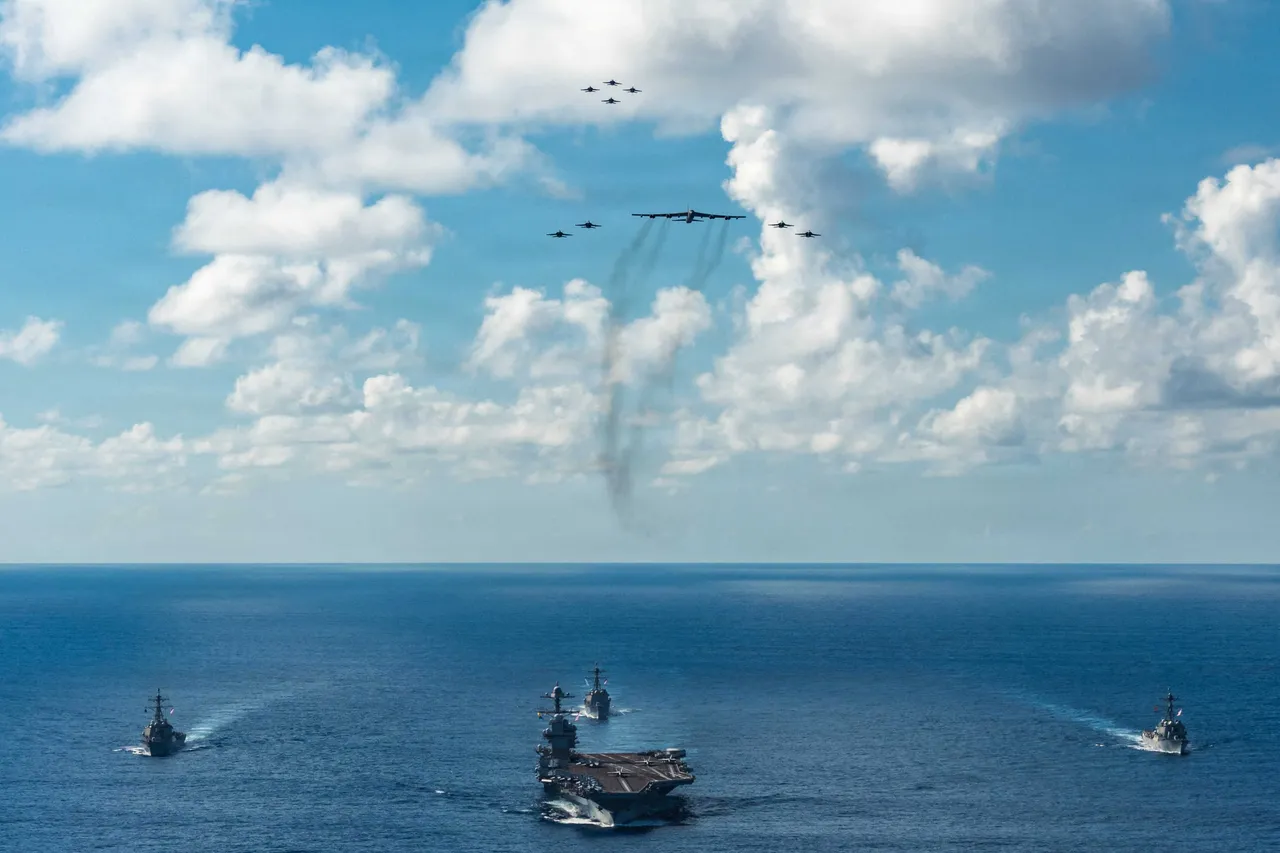
US Caribbean military buildup with 11 warships, including USS Gerald R. Force, aims to force Nicholas Maduro Maduro out of office. / Reuters


Alexander Stoan
TRT WORLD


Republican Congressman Tim Burchett recently introduced the Cartel Marque and Reprisal Authorization Act of 2025, a legislation that would allow US President Donald Trump to authorise private citizens to attack foreign ships.

To put the issue in context, the bill – if approved – will allow anyone to act as legally approved privateers or ‘pirates’. In simple terms, bounty hunters of the high seas.

The bill reached Congress eight days after the first US Coast Guard seizure of an oil tanker servicing Venezuela as part of Trump’s so-called war on drug cartels.

Should this bill pass, it would mark a severe escalation of conflict in the Caribbean Sea and hostilities against Venezuela, besides risking Chinese commercial interests operating in the region.

At the same time, the scandal involving Navy SEAL strike teams killing suspected traffickers on speedboats triggered a congressional probe into the legality of these executions, followed by the premature retirement of Admiral Alvin Holsey under unusual circumstances.

Letters of marque would further obscure accountability by shifting coercive violence from state forces to the private sector, shielding decision-makers from the human rights scrutiny they currently face.

RelatedTRT World - Trump’s offensive on Latin America is an attempt to redraw global power structure


What is a letter of marque?

Letters of marque are 16th-century legal instruments issued by states granting private actors the authority to capture enemy vessels, a right otherwise reserved for nationally flagged military ships.

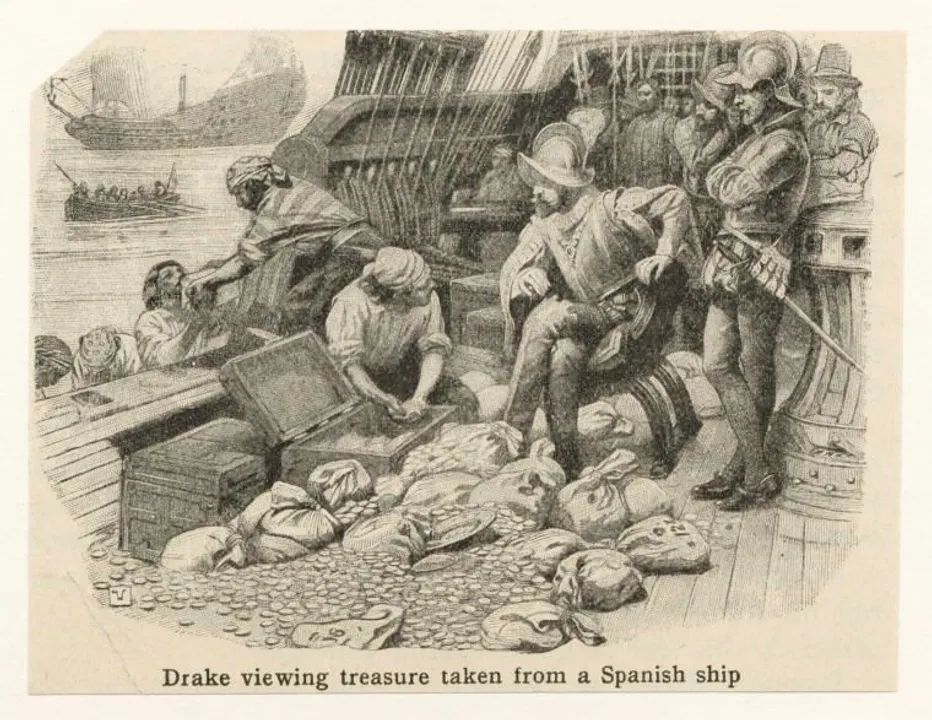
The most famous example comes from Queen Elizabeth I’s ‘Sea Dogs’, including Sir Francis Drake, who raided the Spanish treasure fleet under royal authorisation.

Historically, letters described the vessels under the holder’s command, required a security bond, and meticulously outlined which ships and enemy flags constituted lawful targets.

Once a privateer seized a vessel, they had to bring the prize before an Admiralty Court. If the court ruled the capture legitimate, the privateer received the ship and its cargo. If the seizure violated the letter’s terms, the court returned the vessel to its rightful owners and exposed the privateer to condemnation as a pirate.

For sailors, privateering was a gamble. Cargo contents were never certain, high-value targets were heavily defended, and even a successful capture could be invalidated in court.

The scholarly consensus holds that letters of marque thrived because they were tools that were ideal for states with low naval production capacity. For early modern war-making states, privateers could act as force multipliers and be extremely disruptive to intercontinental enemy supply lines.

Given that the US came into being during the 18th century, the Constitution explicitly grants Congress the power to issue letters of marque alongside its authority to declare war.

Their use peaked during the War of 1812, when Congress issued roughly 500 letters. The last American-issued letter of marque was in 1815, during the Second Barbary War.

By the 19th century, advances in military naval technology and industrial production made the state more capable of producing warships, thus the demand for privateering substantially declined.

In 1856, the Declaration of Paris formally outlawed privateering. Although the US never signed the declaration, its provisions became customary international law.

Despite this, many have reached for the esoteric letter of marque clause as a panacea for solving contemporary security challenges.

From Republicans Ron Paul’s proposal for their use to curb Somali pirates to Lance Gooden’s pitch to issue letters to seize Russian assets, the latest bill follows the same pattern.


Sir Francis Drake was one of the most famous privateers who attacked the Spanish treasure fleet under Queen Elizabeth's orders in the 16th century. (Photo: Wikipedia)

Chaos in the Caribbean?

Given Congressman Burchett’s public record – he believes chemtrails are poisoning us, but when it comes to school shootings, he takes a “we’re not gonna fix it” stance – it is tempting to dismiss his proposal as another gimmick.

Yet the idea has institutional backing.

In 2024, the Center for Maritime Strategy, a think tank sponsored by the Navy League of the United States, published Reviving Letters of Marque​. The report argues that “[l]etters of marque offer a low-cost, flexible option to address lower priority and unconventional national security challenges, such as pirates or transnational drug cartels.”

How would letters of marque work if drug cartels are the targets?

The core problem with applying letters of marque to drug trafficking is targeting. Early modern privateers targeted ships by flag. Drug traffickers, however, do not operate under sovereign flags.

Burchett’s bill targets cartels rather than states. A cartel is defined based on two other pieces of legislation – specific cartels conforming to the legal definition of transnational criminal organisations and Trump’s expansive definition, which includes actors embedded within other states, in the Designating Cartels executive order.

If Trump is given the power to issue letters of marque by Congress, then we could see a situation where Venezuelan Navy vessels are designated targets.

The legislation offers no clarity on how privateers would distinguish cartel vessels from civilian shipping.

Already, civilian vessels flying the flags of Panama, Guyana, and Colombia have been seized or struck in the Caribbean Sea by the US.

If private military companies with poor human rights records, such as Blackwater, become the primary recipients of these letters, the stakes of misidentification rise dramatically.

Beyond human rights abuses, this targeting ambiguity threatens to disrupt Caribbean trade and tourism by flooding the region with legally sanctioned freebooters. And hence, ushering in diplomatic blowback in the Western hemisphere.

A second, more existential problem lies in adjudication.

Letters of marque historically depended on admiralty courts to legalise captured cargo. In the early modern era, courts routinely authorised the transfer of seized gold and commodities. Today, no US naval court would authorise privateers to take possession of shiploads of prohibited narcotics.

However, given that the US Coast Guard is seizing oil tankers now, we can surmise that lawful transfers constituting cargo in mineral wealth would be within the realm of the possible.

With Trump’s letters of marque, history is poised to repeat itself at a slight incline: the gold is coming from the same place, but it’s American privateers instead of Brits.

US-China power game

Historically, states resorted to letters of marque when they lacked the industrial capacity to field sufficient warships. For the Center for Maritime Strategy, privateering can buy time for the US to upgrade conventional military capacities in preparation for a potential conflict with China.

The appeal is obvious. China’s naval expansion has been historic.

As of 2024, the People’s Liberation Army Navy operates 234 warships compared to the US Navy’s 219. More strikingly, US Navy estimates suggest China’s shipbuilding capacity is 232 times greater than that of the United States.

Yet using letters of marque to close this gap misunderstands their function. Privateering is not a technical solution to industrial decline. Blackwater contracts will not revive American shipbuilding.

Letters of marque are politico-military instruments that necessarily presuppose a state of war and operate through low-intensity conflict.

Geopolitically, Washington and Latin American governments alike view confrontation with Venezuela and conflict in the Caribbean Sea as a revival of the Monroe Doctrine and US hemispheric dominance.

The Caribbean has become, again, a testing ground for renewed American power projection.

In the case of the letters, the centre also notes that they can counter unconventional Chinese threats like its illegal fishing fleets.

Once Trump gets letters of marque power from Congress, nothing can stop him from issuing letters targeting massive Chinese fishing operations off the coasts of countries, from Mexico to Argentina, that he deems transnational criminal organisations.

If letters of marque succeed in closing the Caribbean to Venezuela, they could also serve as a precedent for restricting the Malacca Strait to vessels servicing China.

Concentrating such de facto war powers in the hands of Trump risks accelerating American decline by provoking a conflict with China from a position of inferior industrial capacity rather than reversing it.


SOURCE:TRT World
U.S. interventions in Latin America and the Caribbean haven't always gone as planned

January 2, 2026
NPR


An April 1961 file photo shows a group of CIA-backed Cuban counterrevolutionaries after their capture in the Bay of Pigs, Cuba.Miguel Vinas/AFP via Getty Images

President Trump's pressure campaign against Venezuelan leader Nicolás Maduro is the latest chapter in a long history of U.S. intervention in the Caribbean basin, rooted in the 1823 Monroe Doctrine but fully realized in the 20th century — ostensibly to protect U.S. interests and counter communism.


Trump's Venezuela Moves Follow Long History Of Intervention In Latin America

In recent months, U.S. strikes on boats that the White House says were transporting Venezuelan drugs, the seizure of Venezuelan oil tankers, and most recently, a CIA strike on a Venezuelan dock reflect a "Big Stick" approach to regional policy that dates back more than a century to President Theodore Roosevelt. In it, Roosevelt built on the Monroe Doctrine, which was formulated originally by President James Monroe to warn European powers away from interfering in the region.

Roosevelt, who himself fought against Spain in Cuba in 1898, expanded that doctrine to assert a U.S. right to act unilaterally as a regional policeman — using military force to reinforce diplomatic pressure to advance its interests.

Following World War II, and especially since the Cuban Revolution that brought Fidel Castro to power in Havana, that focus shifted primarily to stopping what Washington said was the potential spread of communism in the region.

"During the Cold War, intervention was mostly covert. In the 1980s, you begin to see more overt actions," says Eduardo Gamarra, a professor of politics and international relations at Florida International University.

U.S. policy in the region was one of strategic denial, Gamarra says. That meant deterring non-American actors in the region.

"In the 1800s, that meant Europeans; in the 20th century, especially after World War II, it meant the Soviet Union," he says.


The U.S. is interested in Venezuelan oil, but that's not all

This led to a shared post-World War II notion between the U.S. and many right-wing governments in Latin America that communism "was not indigenous to the Americas," says Edward Murphy, a professor of history at Michigan State University. "They justified this through the logic of the Monroe Doctrine, because this was a foreign ideology that needed to be extirpated from the Americas."

By the mid-1980s, the U.S. "transitioned from the Cold War to the drug war" in the region, according to Gamarra.

U.S. policy, underpinned by the Monroe Doctrine, has shaped the region in the decades since World War II, leading to overt and covert interventions that have often — but not always — resulted in bad outcomes and unintended consequences.

Here are five examples:

The overthrow of Guatemala's government


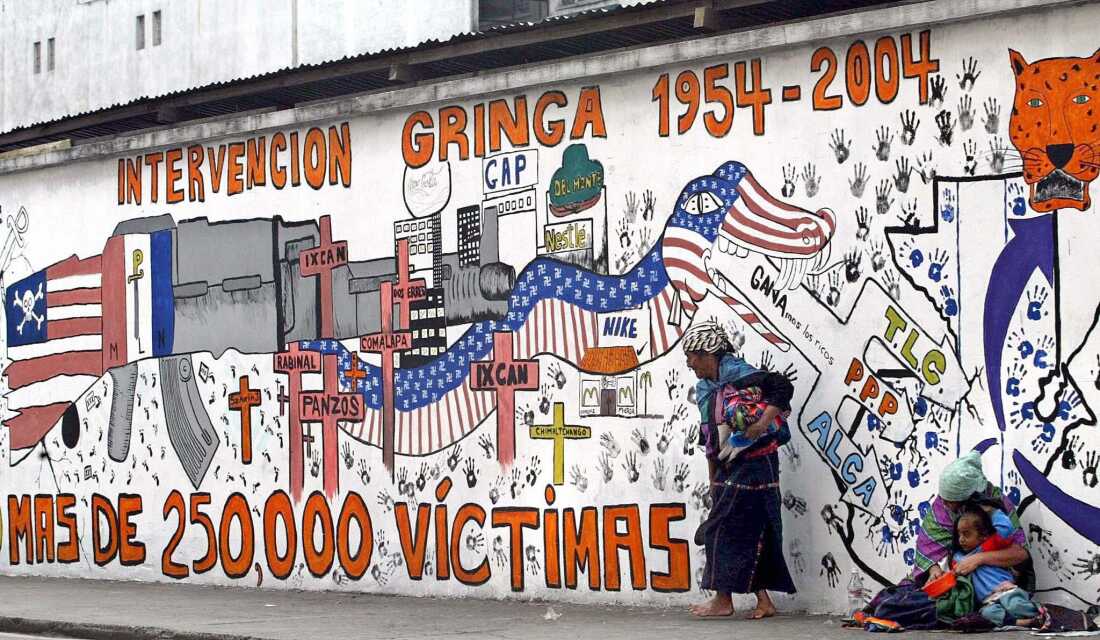
By 1954, President Dwight D. Eisenhower was concerned about a Guatemalan land-reform program that nationalized property owned by the U.S.-based United Fruit Company (now Chiquita Brands International). The initiative was carried out under Guatemalan President Jacobo Árbenz, the nation's second democratically elected leader, whose term began in 1951. Secretary of State John Foster Dulles accused Árbenz of establishing what he described as a "communist-type reign of terror."


Indigenous women beg in Guatemala in June 2004 in front of a propaganda mural that speaks against U.S. interventions in the region.
Orlando Sierra/AFP via Getty Images

The U.S., Gamarra says, "responded by undermining Árbenz and supporting a military coup."

The CIA launched a successful covert plan of psychological warfare designed to destabilize the Árbenz government while backing a coup to topple it. Coup leader Carlos Castillo Armas, who came to power after Árbenz, was the first in a series of brutal U.S.-backed authoritarians to rule Guatemala before civilian rule returned in the mid-1980s.


Mario Vargas Llosa explores 1954 Guatemalan coup in new novel

The U.S. overthrow of Árbenz emboldened right-wing elements in the country to engage in a campaign of repression, Murphy says. "What the overthrow of Árbenz really did was fortify illiberal forces in Guatemala."

Murphy says what happened in Guatemala became a model for other repressive right-wing governments in the region, such as Chile, to follow.


The Bay of Pigs invasion


Fidel Castro's soldiers at Playa de Giron, Cuba, after thwarting the ill-fated U.S.-backed Bay of Pigs invasion in 1961.
Graf/Getty Images/Hulton Archive

Shortly after taking office in 1961, President John F. Kennedy approved a covert plan to overthrow Cuban leader Fidel Castro, who had grown increasingly aligned with the Soviet Union since seizing power two years earlier. The secret operation, originally developed under the Eisenhower administration, relied on a force of about 1,400 CIA-trained Cuban exiles who were expected to seize the Bay of Pigs on Cuba's southern coast and spark a popular uprising against Castro.


50 Years Later: Learning From The Bay Of Pigs

Instead, the Bay of Pigs invasion ended in disaster. Castro ordered some 20,000 troops to the beach, forcing most of the U.S.-backed invasion force to surrender. More than 100 were killed. The incident became a major embarrassment for the United States.

The Bay of Pigs convinced Castro and Soviet leader Nikita Khrushchev that the United States would attempt another invasion of Cuba. Castro convinced Khrushchev he needed Soviet nuclear weapons in Cuba to deter further U.S. aggression, precipitating the Cuban Missile Crisis in 1962. The resulting confrontation over the missiles brought the U.S. and the Soviet Union to the brink of nuclear war before Kennedy and Khrushchev worked out a delicate compromise that averted a direct conflict between the two superpowers.


60 years after the Cuban missile crisis, Russia's threats reignite Cold War fears

It was an extreme Cold War confrontation that came close to a nuclear catastrophe, Gamarra says. The long-term consequences, he says, resulted in "a misguided embargo that hasn't changed the regime and instead consolidated Cuba's relationship with the Soviet Union and now Russia."

The U.S. invasion of Grenada

By 1983, the southern Caribbean island of Grenada was undergoing a period of political instability after the 1979 overthrow of Prime Minister Eric Gairy by Maurice Bishop, a socialist leader aligned with Cuba and the Soviet Union

"Cuba was making inroads across the Caribbean," Gamarra says.

President Ronald Reagan's White House was suspicious of Havana's involvement in the construction of a large international airport in Grenada, which had only gained independence from Britain in 1974.

In its first major combat deployment since the end of the Vietnam War, U.S. forces landed on Oct. 25, 1983, as part of Operation Urgent Fury. Reagan cited regional security concerns and the need to protect U.S. medical students attending the island's St. George's University School of Medicine as justification for intervention.


U.S. soldiers arrest suspected Marxist activist in St. George's, the capital of the Grenada Island, on Oct. 30, 1983, three days after American forces invaded the island, ousting the Marxist government.
AFP/via Getty Images

Although U.S. forces encountered stronger resistance and more logistical difficulties than expected, military operations took only a few days. The U.S. helped install a provisional government and elections were held in 1984.

Since then, Grenada has experienced stable, democratic governance, with elections and peaceful transfers of power. Today, it is generally regarded as more politically stable than most of its Caribbean neighbors.


U.S. support for the Nicaraguan Contras


After decades of U.S. support for the oppressive and corrupt Somoza family that ruled Nicaragua, Anastasio Somoza was overthrown in 1979 during a popular uprising led by the Sandinista National Liberation Front (FSLN). Daniel Ortega, a committed Marxist at the time and prominent FSLN leader, assumed control of the government.

President Reagan opposed the Sandinistas and in 1981 issued a covert directive for U.S. aid to support a group of anti-Sandinista insurgents known as the Contras.

In 1982, the U.S. Congress passed the Boland Amendment to block U.S. support for the Contras. Despite these restrictions, the Reagan administration secretly continued aiding the group through a scheme that illegally sold weapons to Iran and funneled the proceeds to the Nicaraguan rebels. When the operation was exposed, it became one of the most significant scandals of Reagan's presidency: the Iran-Contra affair.


U.S. Army Lt. Col. Oliver North, former aide to National Security Adviser John Poindexter, is sworn in on July 7, 1987, before the House and Senate Foreign Affairs Committee hearing in Washington, D.C., on arms sales to Iran and diversion of profits to Nicaraguan Contra rebels.
Chris Wilkins/AFP via Getty Images

"The Contra war was devastating — socially, economically, and politically," says Murphy.

Despite efforts to topple him, Ortega remained in power and won a decisive electoral victory in 1984. He lost in 1990 to Violeta Chamorro, a wealthy, U.S.-educated newspaper owner who served as president until 1997.

"In the end, it was … soft power that led to the Sandinistas' loss in the elections and the victory by Chamorro," Gamarra notes.

Subsequently, Ortega's political stance evolved away from Marxism, and he won elections in 2006, 2011, 2016 and 2021. Today Ortega is president of Nicaragua along with his wife, co-President Rosario Murillo.

Murphy says it's a different Ortega now — one that "looks more like a Somoza government than a Sandinista government because it's a family dictatorship."

Ortega and Murillo, who Murphy calls "the power behind the throne," have "followed almost to the letter what Somoza was doing."


The U.S. invasion of Panama


Although brutal and corrupt, Panama's Gen. Manuel Noriega was useful to the U.S. in the 1980s, due to the de facto leader's cooperation with the CIA in providing a base of operations for the Contras in Nicaragua.

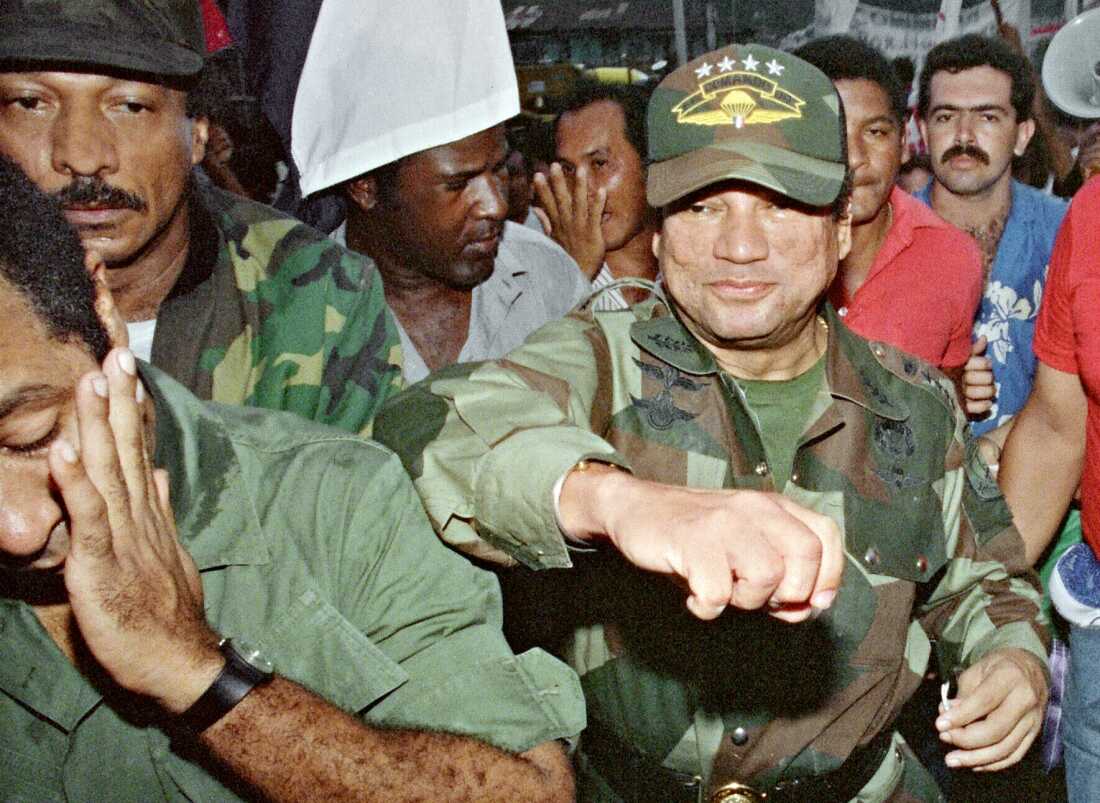
But Noriega's drug trafficking, which included a relationship with notorious Colombian narcotrafficker Pablo Escobar, soon transformed him into a net liability for the U.S. By 1986, mounting evidence of his ties to drug cartels, extrajudicial killings and selling of U.S. secrets to Eastern European governments was an embarrassment. In 1988, federal grand juries in Miami and Tampa indicted Noriega on racketeering, drug smuggling and money laundering charges.


Panamian leader Gen. Manuel Antonio Noriega, right, fakes a punch to a supporter on May 2, 1989, at the laying of the foundation of a group home in the neighborhood of Panama City where boxer Roberto Duran was born. Months later, Noriega would be driven from power by a U.S. invasion of Panama.
Manoocher Degahti/AFP via Getty Images

The following year, President George H.W. Bush took office. Bush was briefly CIA director in the 1970s, when Noriega was considered a valuable intelligence asset. But in 1989, Bush decided that Noriega needed to go. The administration backed a failed coup attempt in October. But two months later, Bush launched Operation Just Cause, an invasion by 20,000 U.S. troops that ultimately overthrew Noriega and took him into U.S. custody.

Since Noriega's ouster, Panama has maintained a stable democracy with regular, peaceful elections and significant economic growth.

Gamarra says Panama is a rare example of a successful American intervention in the region. "We went in there, we got rid of Manuel Noriega," he says.

"We had a clear exit plan, which is not something the U.S. is very good at anywhere else," Gamarra says, referring to the emphasis on capturing Noriega in a quick and limited military operation. Today, he says, "at least in terms of its economic system, [Panama] is still extraordinarily successful."

However, Murphy is less sanguine.

"I don't think the invasion is responsible for anything positive that comes later," he says, "other than the fact that Noriega was no longer in power."
THE DONROE DOCTRINE

America's Strategy for the Western Hemisphere


January 01, 2026
Policy Office
VOA


After years of neglect, the United States will reassert and enforce the Monroe Doctrine to restore American preeminence in the Western Hemisphere, and to protect the U.S. homeland and its access to key geographies throughout the region.

The Western Hemisphere is a top priority region for President Donald Trump’s National Security Strategy.

After years of neglect, the United States will reassert and enforce the Monroe Doctrine to restore American preeminence in the Western Hemisphere, and to protect the U.S. homeland and its access to key geographies throughout the region.


The U.S. will deny non-Hemispheric competitors the ability to position forces or other threatening capabilities, or to own or control strategically vital assets, in the Western Hemisphere. This “Trump Corollary” to the Monroe Doctrine is a common-sense and potent restoration of American power and priorities, consistent with American security interests.


America will enlist established friends in the Hemisphere to control migration, stop drug flows, and strengthen stability and security on land and sea. It will expand by cultivating and strengthening new partners while bolstering its appeal as the Hemisphere’s economic and security partner of choice.

The U.S. will reward and encourage the region’s governments, political parties, and movements broadly aligned with our principles and strategy. But America must not overlook governments with different outlooks with whom we nonetheless share interests and who want to work with us.

The United States must reconsider our military presence in the Western Hemisphere. This means a readjustment of our global military presence to address urgent threats in our Hemisphere, especially the missions identified in this strategy, and away from theaters whose relative import to American national security has declined in recent decades or years.

It means targeted deployments to secure the border and defeat cartels, including where necessary the use of lethal force to replace the failed law enforcement-only strategy of the last several decades.

And it means establishing or expanding access in strategically important locations. The United States will prioritize commercial diplomacy, to strengthen our own to strengthen our own economy and industries, using tariffs and reciprocal trade agreements as powerful tools. The goal is for our partner nations to build up their domestic economies, while an economically stronger and more sophisticated Western Hemisphere becomes an increasingly attractive market for American commerce and investment.

As we deepen our partnerships with countries with whom America presently has strong relations, America must look to expand its network in the region. We want other nations to see us as their partner of first choice, and we will through various means discourage their collaboration with others.

The United States must be preeminent in the Western Hemisphere as a condition of our security and prosperity — a condition that allows the U.S. to assert itself confidently where and when it needs to in the region.
‘The deepest sort of spiritual disorientation’ Historian Joseph Kellner on the zeitgeist of the Soviet collapse and its lessons for today’s democracies

January 1, 2026
Source: Meduza


For decades, Russia’s “wild 1990s” have been remembered for economic hardship, libertarian freedoms, and rampant crime. Historian Joseph Kellner suggests another defining feature of the era: profound spiritual disorientation. In his book, The Spirit of Socialism: Culture and Belief at the Soviet Collapse, Kellner tells the cultural story of the “end of history” and argues that the USSR’s disintegration was the final blow to a centuries-old European idea of progress. He also describes what emerged from the ruins as a “seeking phenomenon” — an explosion of mystics, astrologers, and fringe sects in Russia in the early 1990s. For Meduza, journalist and author of the Playing Civilization research project Georgy Birger spoke with Joseph Kellner about what drove post-Soviet Russians toward radical new worldviews, how this spiritual crisis paved the way for Putinism, and why the West — now facing its own crises of meaning and truth — might be walking a similar path.

The following Q&A has been lightly edited and abridged for length and clarity.

Joseph Kellner

— For those unfamiliar with your work, can you briefly describe what your book is about?

— The book is, I believe, the first cultural history of the Soviet collapse. There are many good studies of late-Soviet culture; it’s a booming field right now. Previously, historians would have called it the Era of Stagnation and said that nothing significant happened in the 1970s and 1980s. Now, there’s a major effort by many scholars to reverse that and reassess late-Soviet culture. There are also histories of the collapse — roughly 1989 to 1993 — that focus, for good reasons, on the economic crisis and the various traumas of transition.

Instead, I focus on a spectacular and visible flourishing of new and radical worldviews, spiritualities, and orientations that cropped up all at once around the time of the collapse. That includes the popularity of Hare Krishnas, astrologers, apocalyptic sects, and [Anatoly] Fomenko’s New Chronology. I see all these things together as an acute manifestation of the cultural crisis that comes with the collapse.

What’s all this about?


The book takes up the people I collectively call “the seekers” and looks at two things. First, why did they come to believe the things they did? For instance, why was astrology so credible to so many people all at once? Or “extrasensory healing” [by TV psychics] like Kashpirovsky and Chumak? And second, why the seeking? Why in this period do you see this amazing public searching? Because not every crisis brings this kind of cultural ferment.

Essentially, I find that what unites all these people is a set of deep questions about the world. They are looking for orientation in a world where it has been lost. There are questions of intellectual authority: who can we believe, and where does true knowledge derive? Then, [there are] questions of identity: what does it mean to be a Russian at this time? In Russia, the identity question often takes this form of East versus West: are we Europeans, or are we not? And finally, questions about the direction of historical time — where it is headed and where it has been. There is a deep spiritual orientation to all this: how do we affix ourselves to something permanent when so much of our world has eroded?

— The question about time was probably tied to the concept of the “end of history.”

— Certainly. The concept of the “end of history” didn’t survive very long, but the notion was a triumphal one in the West and in the United States, where it was coined. In the Soviet Union, there was another, real sense to this concept. Soviet ideology was fixated on history, historical meaning, and the “right” direction of history. So, when that great vision collapsed completely, it left people afraid and unsure where anything was headed.

That is why people were looking to astrology, for instance; it offered a cyclical understanding of the world, putting the crisis in a much larger context. Or they looked to nostalgic worldviews — Hare Krishnas are, in fact, very nostalgic. They looked for different golden ages because the Soviet one so obviously failed.

— How did those questions about the direction of historical time manifest?

— When I look at these different groups — like the one around Fomenko’s New Chronology — I see a fixation on time. Fomenko is a Soviet mathematician who, in the 1990s, came out with this extraordinary revision of history, claiming all history happened in the last 1,000 years. He shifted all of history around and made a total, psychedelic new understanding of time.

I think the reason everyone was so fixated on time was that, during the crisis, there was a sense that the past was now unknown. Glasnost and the revelations of the Soviet press of the 1980s were all about uncovering Soviet crimes. Everything you learned in history class turned out to be untrue. History teachers were writing to the newspapers saying, “I can’t believe I’ve been lying to my students all this time.” There was no consensus anymore about what the past was.

Then, when the crisis is so acute, the future becomes equally dark. There is no natural “bottom” to the crisis, no sense of when it will end. People feel isolated and completely lost in time. That lends the sense of temporal displacement — of being nowhere. That is the deepest sort of spiritual disorientation.

— The way I understand it is that the loss of the Soviet timeline was, in a way, more psychologically damaging than the loss of the Soviet economy.

— The two things are hard to compare. The material crisis was staggering — male life expectancy dropped six years, murder and suicide rates spiked. But I do think the spiritual crisis is a meaningful compounding factor. After all, you can have an economic crisis of a similar scale — like the Great Depression — without this fundamental loss of orientation or this desperate attempt to reimagine everything about the world.

The spiritual crisis came from how certain Soviet ideology was about the big questions. Knowledge derived from reason along Western scientific lines; Soviet identity was a fixed thing with a clear place in world history. Even if people didn’t literally believe in communism per se by the 1970s and 1980s, it was the water they swam in. It was in the media and the education [system]: the values of Soviet society still rested on these Enlightenment values and the sense of progress. Seeing it collapse in a couple of years was spiritually jarring.

Perhaps the book’s biggest claim rests on the fact that Soviet communism and its value system were an heir to the Enlightenment and saw itself explicitly as carrying that mantle. And in this way, Soviet communism derived from the same time and place as 19th‑century liberalism. So, the collapse represented the end point of a very long, shared European arc of history, thought, and philosophy — a major, and perhaps the final, blow to the broader idea of historical progress, that shared 19th‑century belief among liberals and socialists that progress was effectively a law of history. Even after World War II, both sides of the Cold War remained fundamentally optimistic about progress, whereas 1989 and the Soviet collapse marked the end of this centuries‑long arc. This is an event whose consequences are still unfolding, including in the West, and whose full scale will be hard to grasp without greater historical distance.

In this sense, the “seekers” of the late-Soviet and early post‑Soviet period are like the canary in the coal mine: they are the first to go out actively searching for entirely new worldviews once this big idea of history has died.

— One thing I’ve found surprising is the claim that figures like Chumak or Fomenko were not just anti-rational charlatans, but also a way to preserve a scientific way of thinking. Can you explain that?

— Certainly. Kashpirovsky, for example, claimed authority as an educated psychiatrist; it was his medical background. The astrologers I focus on almost all have backgrounds in the hard sciences, such as mathematics, astronomy, or physics. At no point do they forsake that education; they still put enormous value on science. The dispute was over who defined science. And the truth is that it’s impossible to define pseudoscience. It is defined by whoever holds the scientific authority to do so.

In a time when official Soviet authorities were losing credibility, these people offered alternatives, but they did it in the language of science because there was still a deep understanding that science is a powerful window to the world. Even the Soviet Hare Krishnas, unlike their American counterparts, tried to demonstrate the scientific validity of their beliefs. It demonstrates a deep, lasting Soviet respect for science, even while, from the outside, it looks like unscientific ideas coming to the fore.

— Can you recall any immediate impact of seekers on Russian politics in the 1990s?

— It’s interesting because the seekers themselves were almost universally not invested in politics. They considered politics to be superficial and were not after political solutions. That is an important thing that gets lost. People try to draw lines from the 1990s to the Putin era to explain Putinism, and while one helps explain the other, these seekers were not necessarily proto-Putinists.

Rather, political fatigue was almost universal in the early 1990s. Having invested so much hope in Gorbachev’s reforms and seen them fail, then seeing [Russian President Boris] Yeltsin as an inspiration and quickly hating him — there was no sense that the political system was going to save people. So, as they had in the 1970s and 1980s, they looked elsewhere for meaning. They looked outside the official political world.

— But did this movement still affect the current state of Russia?

— Yes. What is remarkable is that Putinism has concrete, confident answers to the driving questions of the 1990s: the shape and direction of history, what it means to be Russian, and who you can trust. It has a clear view of the West and where Russia stands. The questions that plagued the 1990s are now “settled” in a somewhat frightening mode that is hostile to pluralism. That may be one reason for the appeal of Putinism — it provided answers in a very uncertain world. The right wing always has a very simple story to tell, and it can be a very compelling story.

— So, did these fringe theories of the 1990s simply migrate from the grassroots to the Kremlin?

— I think most of these specific currents that I wrote about subsided by the end of the 1990s. The energy behind extrasensory healing, astrology, and the Hare Krishnas was in retreat by the time Putin came on the scene. However, there are still mystical currents within Russian culture — for example, people often see Eurasianism as a mystic, quasi-scientific nationalism. So, there are continuities you can find, and I think Eurasianism is probably the easiest one to point out.

— In an article for Jacobin, you argue that similar things are happening in the U.S. now. Who would be the Kashpirovsky or Fomenko of this process?

— I don’t think we have them yet. We don’t have an equivalent seeking phenomenon, although we certainly have a lively world of conspiracy thinking. We don’t have a similar cultural crisis, at least not in the form that I described in the Soviet case. And we haven’t had a big economic crisis yet — though everyone is expecting it, whether from the debt ceiling games, an AI bubble, or fossil fuels. I wouldn’t be surprised if such a crisis caused a dramatic spiritual seeking or “Great Awakening.”

For now, the major cultural figures setting trends are more explicitly political and tend to be on the right wing — people laying out visions that get a lot of followers. People like [white nationalist] Nick Fuentes and [right-wing blogger] Curtis Yarvin. But I don’t know anyone who I would draw parallels directly to Kashpirovsky and Chumak.

[Billionaire Peter Thiel’s theories about the Antichrist] might be as close as we get — the merger of reactionary politics and fundamentalist evangelical Christianity with tech utopianism/dystopianism. That is the making of a frightening ideology. All the ingredients are here. If an American “Fomenkoism” were to emerge with a charismatic leader, I think it’s easy to imagine millions of readers because there is nobody in America who has the authority to dispute such a theory anymore.

— Historians rarely draw parallels between Russia’s case of de-democratization and current worldwide and U.S. trends. The usual explanation is that democracy was too young and fragile in Russia, and that’s why it crumbled. What arguments do you have in favor of learning from post-Soviet Russia’s experience?

— Well, I can’t dismiss out of hand that democracy requires institutional memory. Imagining a democratic Russia is a very difficult task, especially compared to the United States, where there is a deeply rooted sense of popular power. But the common feature of both countries, as they move in the opposite direction of democracy, is the current state of capitalism. In the 1990s, Russia got the business end of capitalism — the sharpest and most aggressive form of the system — applied to a country that, coming out of the Soviet experience, simply could not compete on the world market and was picked apart by foreign capital and by its own state through corrupt privatization under Yeltsin. The rise of the oligarchs in a state with weak institutions and a huge concentration of wealth in a small circle of people is very hard to square with democracy, because those people end up functioning as a kind of pseudo‑government, producing the mafia state of the 1990s.​

The Yeltsin government attempted to install neoliberal capitalism as it existed in the United States: eliminating subsidies, leaving no real space for unions, keeping taxes low, and placing great faith in markets to solve every problem. In Russia [this was a] catastrophic and very fast [process], whereas in the U.S., it has been a slower, forty‑year process with similar results. In both countries, this has meant huge inequality, a dramatic loss of faith in the political system and in democracy, and a concentration of power in a very small set of oligarchs — though Americans are allergic to that word, even as today’s billionaires surpass the Rockefellers and Carnegies of their time. These shared developments make the similarity of the reaction unsurprising, and what we are seeing now is the long‑standing conflict between capitalism and democracy becoming extremely sharp.