Saturday, January 03, 2026


The US War on Venezuela Began in 2001


Vijay Prashad | 


The current US attacks against Venezuela are part of a two-decade process led by the US and the Venezuelan right wing to undermine the Bolivarian project and its bold decision to use the country’s oil wealth for the betterment of its people.


Former PDVSA President Rafael Ramírez with former Venezuelan President Hugo Chávez.
Photo: Wikimedia Commons

The United States had no problem with Venezuela per se, not with the country nor with its former oligarchy. The problem that the United States government and its corporate class have is with the process set in motion by the first government of Venezuelan President Hugo Chávez.

In 2001, Chávez’s Bolivarian process passed a law called the Organic Hydrocarbons Law, which asserted state ownership over all oil and gas reserves, held upstream activities of exploration and extraction for the state-controlled companies, but allowed private firms – including foreign firms – to participate in downstream activities (such as refining and sale). Venezuela, which has the world’s largest petroleum reserves, had already nationalized its oil through laws in 1943 and then repeated in 1975. However, in the 1990s as part of the neoliberal reforms pushed by the International Monetary Fund (IMF) and by the large US-owned oil companies, the oil industry was substantially privatized.

When Chávez enacted the new law, it brought the state back into control of the oil industry (whose foreign oil sales were responsible for 80% of the country’s external revenues). This deeply angered the US-owned oil companies – particularly ExxonMobil and Chevron – which put pressure on the government of US President George W. Bush to act against Chávez. The US tried to engineer a coup to unseat Chávez in 2002, which lasted for a few days, and then pushed the corrupt Venezuelan oil company management to initiate a strike to damage the Venezuelan economy (it was eventually the workers who defended the company and took it back from the management). Chávez withstood both the coup attempt and the strike because he had the vast support of the population. Maria Corina Machado, who was awarded the Nobel Peace Prize in 2025, started a group called Sumaté (“Join Up”), which placed a recall referendum on the ballot. About 70% of the registered voters came to the polls in 2004, and a large majority (59%) voted to retain Chávez as the president.

But neither Machado nor her US backers (including the oil companies) rested easy. From 2001 till today, they have tried to overthrow the Bolivarian process – to effectively return the US-owned oil companies to power. The question of Venezuela, then, is not so much about “democracy” (an overused word, which is being stripped of meaning) but about the international class struggle between the right of the Venezuelan people to freely control their oil and gas and that of the US-owned oil companies to dominate Venezuelan natural resources.

The Bolivarian process

When Hugo Chávez appeared on the political scene in the 1990s, he captured the imagination of most of the Venezuelan people – particularly the working-class and the peasantry. The decade was marked by the dramatic betrayals by presidents who promised to secure the oil-rich country from IMF-imposed austerity and then adopted those same IMF proposals. It did not matter if they were social democrats (such as Carlos Andrés Pérez of Democratic Action, president from 1989 to 1993) or conservatives (such as Rafael Caldera of the Christian Democrats, president from 1994 to 1999). Hypocrisy and betrayal defined the political world, while high levels of inequality (with the Gini index at a staggering 48.0) gripped the society. The mandate for Chávez (who won the election with 56% against 39% for the candidate of the old parties) was against this hypocrisy and betrayal.

It helped Chávez and the Bolivarian process that oil prices stayed high from 1999 (when he took office) till 2013 (when he died at 58, very young). Having taken hold of the oil revenues, Chávez turned them over to make phenomenal social gains. First, he developed a set of mass social programs (misiones) that redirected oil revenues to meet basic human needs such as primary healthcare (Misión Barrio Adentro), literacy and secondary education for the working-class and peasantry (Misión RobinsonMisión Ribas, and Misión Sucre), food sovereignty (Misión Mercal and then PDVAL), and housing (Gran Misión Vivienda). 

The state was reshaped as a vehicle for social justice and not an instrument to exclude the working-class and peasantry from the gains of the market. As these reforms advanced, the government moved to build popular power through participatory instruments such as the communes (comunas). These communes emerged first out of popular consultancy assemblies (consejos comunales) and then developed into popular bodies to control public funds, plan for local development, generate communal banks, and form local, cooperative enterprises (empresas de producción social). The communes represent one of the Bolivarian process’ most ambitious contributions: an effort – uneven but historically significant – to construct popular power as a durable alternative to oligarchic rule.

The US-imposed hybrid war on Venezuela

Two events took place in 2013-14 that deeply threatened the Bolivarian process: first, the untimely death of Hugo Chávez, without doubt the driving force of revolutionary energy in the country, and second, the slow and then steady collapse of oil revenues. Chávez was followed as president by the former foreign minister and trade unionist Nicolás Maduro, who tried to steady the ship but faced a severe challenge when oil prices, which peaked in June 2014 at roughly USD 108 per barrel, fell dramatically in 2015 (below USD 50) and then by January 2016 (below USD 30). For Venezuela, which relied upon foreign crude oil sales, this decline was catastrophic. The Bolivarian process could not revise the oil-dependent redistribution (not just within the country but in the region, including through PetroCaribe); it remained trapped by dependence on oil exports and therefore by the contradictions of being a rentier state. Equally, the Bolivarian process had not expropriated the wealth of the dominant classes, which continued to lean heavily on the economy and society, and therefore prevented a full-scale transition to a socialist project.

Before 2013, the United States, its European allies, and oligarchic forces in Latin America had already forged their weapons for a hybrid war against Venezuela. After Chávez won his first election in December 1998 and before he took office the next year, Venezuela saw accelerated capital flight as the Venezuelan oligarchy took their wealth to Miami. During the coup attempt and the oil lockout, there was more evidence of capital flight, which weakened the monetary stability of Venezuela. The United States government began to lay the diplomatic groupwork to isolate Venezuela, characterizing the government as a problem and building an international coalition against it. This led, by 2006, to restrictions on Venezuela for access to international credit markets. Credit rating agencies, investment banks, and multilateral institutions steadily raised borrowing costs, making refinancing more difficult well before the US placed formal sanctions on Venezuela.

After the death of Chávez, and with oil prices lowered, the United States began a focused hybrid war against Venezuela. Hybrid war refers to the coordinated use of economic coercion, financial strangulation, information warfare, legal manipulation, diplomatic isolation, and selective violence, deployed to destabilize and reverse sovereign political projects without the need for full-scale invasion. Its objective is not territorial conquest but political submission: the disciplining of states that attempt redistribution, nationalization, or independent foreign policy.

Hybrid war operates through the weaponization of everyday life. Currency attacks, sanctions, shortages, media narratives, NGO pressure, judicial harassment (lawfare), and engineered legitimacy crises are designed to erode state capacity, exhaust popular support, and fracture social cohesion. The resulting suffering is then presented as evidence of internal failure, masking the external architecture of coercion. This is precisely what Venezuela has faced since the US illegally placed financial sanctions on the country in August 2017, these were then deepened with secondary sanctions in 2018. Because of these sanctions, Venezuela has faced the disruption of all payment systems and trade channels and forced overcompliance with US regulations. Meanwhile, media narratives in the West systematically downplayed sanctions, while amplifying inflation, shortages, and migration as purely internal phenomenon, reinforcing regime-change discourse. The collapse of living standards in Venezuela between 2014 and 2017 cannot be divorced from this layered strategy of economic asphyxiation.

Mercenary attacks, sabotage of the electrical grid, creation of a conflict generated to benefit ExxonMobil between Guyana and Venezuela, invention of an alternative president (Juan Guaidó), provision of the Nobel Peace Prize to someone calling for a war against her own country (Machado), attempted assassination of the president, bombings of fishing boats off the Venezuelan coast, seizure of oil tankers leaving Venezuela, buildup of an armada off the coast of the country: each of these elements is designed to create neurological tension within Venezuela leading to the surrender of the Bolivarian process in favor of a return to 1998 and then an annulment of any hydrocarbon law that promises the country sovereignty.

If the country were to return to 1998, as Maria Corina Machado promises, all the democratic gains made by the misiones and the comunas as well as by the Constitution of 1999 will be invalidated. Indeed, Machado said that a US bombing of her fellow Venezuelans would be “an act of love”. The slogan of those who want to overthrow the government is Ahead to the Past.

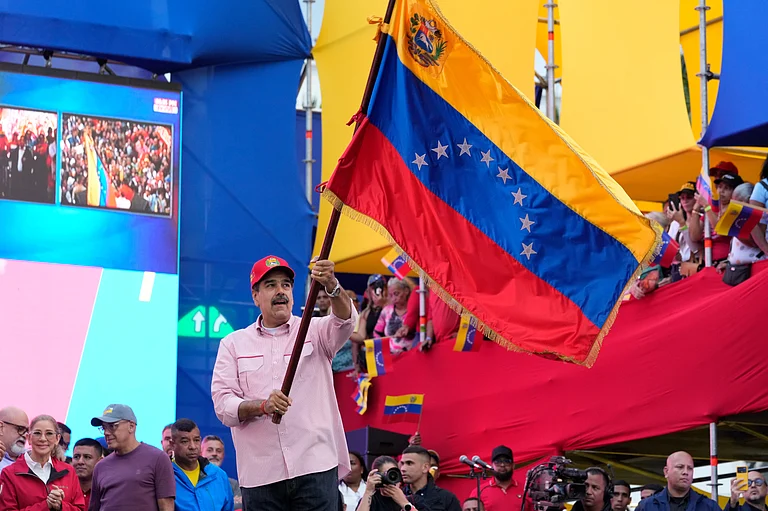
In October 2025, meanwhile, Maduro told an audience in Caracas in English, “listen to me, no war, yes peace, the people of the United States”. That night, in a radio address, he warned, “No to regime change, which reminds us so much of the endless, failed wars in Afghanistan, Iraq, Libya, and so on. No to CIA-orchestrated coups d’état.” The line, “no war, yes peace”, was taken up on social media and remixed into songs. Maduro appeared several times at rallies and meetings with music ablaze, singing, no war, yes peace, and – on at least one occasion – wearing a hat with that message.

Courtesy: Peoples Dispatch

Why Trump’s Curbs on Venezuela Oil Tankers Tests Limits of International Law


Atul Alexander | 


The US blockade of Venezuela implicates aggression, self-defence, and the prohibition on the use of force under international law.

On December 16, the United States (US) announced measures to block oil tankers entering and leaving Venezuela. The Trump administration alleges that Nicolás Maduro’s regime is engaged in drug trafficking and human trafficking. The U.S has expanded its naval presence in the region, ostensibly to interrupt the drug-smuggling boat.

According to TankerTrackers.com, more than 30 out of 80 vessels in Venezuelan waters or approaching Venezuela are under US sanctions. Over time, Trump's position has shifted from allegations of drug trafficking to claims that the Maduro government is using stolen oil to finance, what he terms, “drug terrorism” and human trafficking. In response, Venezuela has accused Washington of illegally expropriating its resources. 

Considering Venezuela’s over-dependence on oil, the move carries far-reaching geopolitical implications. China has expressed its displeasure over the “unilateral bullying,” and Mexico has urged the United Nations to intervene to diffuse the tensions. Meanwhile, Deputy Chief of Staff Stephen Miller claimed in a post on Xt  that the “tyrannical expropriation” by Venezuela amounted to “the largest recorded theft of American wealth and property.” Joaquin Castro, a Democrat from Texas, has termed these measures “an act of war.” Maduro has characterized the move as an attempt at regime change and an assertion of US control over Venezuelan territory and resources. 

The total blockade by the US has left the scholars divided. According to NYU professor Ryan Goodman, “[t]here is no legal justification for a military blockade based on the grievances President Trump listed.” Writing for Just Security, Michael Schmitt and Rob McLaughlin argue that the US actions amount to a threat or use of armed force against oil tankers entering or leaving the territorial waters of Venezuela. They characterise blockade as the use of force, even prior to the actual use of force under Article 42 of the UN Charter, which expressly lists blockade as a coercive measure when non-forcible means have failed. They further argue that a blockade constitutes aggression within the meaning of United Nations General Assembly (UNGA) Resolution 3314.

This post contends that the act of blockade constitutes a violation of jus cogens or peremptory norm of international law, foreclosing any defence that the US might otherwise invoke. Such a violation would attract a higher degree of international responsibility under the law of State responsibility. The analysis is confined to jus ad bellum and does not probe into jus in bello

Can blockade be an act of ‘aggression’?

The UN Charter does not authorise the unlawful use of force amounting to aggression. Rather, it vests the United Nations Security Council (UNSC) with authority to act against acts of aggression. Unlike other forms of use of force, aggression involves a particularly grave use of force. This distinction is found in the introductory paragraph of UNGA Resolution 3314, which characterizes aggression as the “most serious and dangerous form of the illegal use of force.”

Although the UNSC is competent to determine acts amounting to aggression beyond the non-exhaustive list provided in Article 3 of Resolution 3314, according to Mary Ellen O'Connell, this determination is often shaped by political considerations. Moreover, such determinations are vulnerable to a permanent member blocking a resolution on aggression. Article 3(c) expressly recognizes the blockade of a State's ports or coasts by the armed forces of another State as an act of aggression. Hence, the US blockade of ships entering and exiting Venezuela, while falling within this definition, is unlikely to attract formal UNSC censure given the possibility of a US veto. 

Although the UNSC is competent to determine acts amounting to aggression beyond the non-exhaustive list provided in Article 3 of Resolution 3314, according to Mary Ellen O'Connell, this determination is often shaped by political considerations. Moreover, such determinations are vulnerable to a permanent member blocking a resolution on aggression.

A ‘peacetime blockade’ would qualify as a use of force even before any kinetic engagement with the ships, since Article 42 of the UN Charter provides for blockade as a measure which the UNSC can authorise when non-forceable actions fail. By implication, the unilateral imposition of a blockade, without the UNSC’s authorisation, breaches the prohibition on the use of force.    

US officials have justified these actions on grounds of self-defence, a claim decipherable from Trump’s Truth Social post in the face of the drug threat. However, the shift in Trump’s position from interdicting drug-boats to claims over oil and other assets significantly weakens any claim of self-defence. Additionally, for invoking self-defence, the threshold of ‘armed attack’ is high; for instance, in the Nicaragua case, the ICJ categorised an armed attack as “the most grave” form of the use of force. On this reasoning, the US blockade would itself constitute a grave use of force, and potentially trigger Venezuela's right to self-defence. Finally, blockade cannot be justified on political, economic, military, or any other grounds, as affirmed by UNGA Resolution 3314. 

Aggression as a violation of jus cogens

Jus cogens are peremptory norms of international law from which no derogation is permitted. In the hierarchy of norms, these are placed higher than treaties and customary international law. Scholars like Katie A. Johston and Corten identify prohibition of aggression as a jus cogens norm. Aggression is commonly used alongside the unlawful use of force, but its classification depends on the gravity and character of the force employed. In this context, in the Oil Platforms case, the ICJ did not exclude the possibility that the mining of a military vessel might be sufficient to bring into play the “inherent right of self-defence.” 

Similarly, the blockade of the port of Mariupol and the Sea of Azov was regarded as constituting aggression; accordingly, scholars like James A. Green et al. regard the invasion of Ukraine as an act of aggression and a violation of jus cogens. Several authoritative international instruments identify aggression as a jus cogens norm. For instance, the International Law Commission’s (ILC) Draft Conclusion on Identification and Legal Consequences of Peremptory Norms of General International Law (jus cogens) in its non-exhaustive list locates prohibition on aggression as jus cogens; likewise, the ILC report on fragmentation identifies prohibition on aggression as the most frequently cited candidate for jus cogens status. 

First, the supreme status of the prohibition of aggression as a jus cogens norm would entail an obligation erga omnes, wherein States not directly affected by the acts of the US could bring claims against it. This could be achieved through third-party countermeasures (sanctions) or by taking the US to the International Court of Justice. Furthermore, domestic jurisdictional claims would be strengthened if the prohibition on aggression were categorised as jus cogens, as States like Germany, Ukraine, and Switzerland have criminalised aggression in their domestic laws. 

Second, States cannot be precluded from responsibility for jus cogens breaches. As Article 26 of the ILC Draft Articles on Responsibility of States for Internationally Wrongful Acts (ARSIWA) states: “Nothing in this chapter precludes the wrongfulness of any act of a State which is not in conformity with an obligation arising under a peremptory norm of general international law.” As Norman Finkelstein notes, “we’re upping the ante in order to try to get them to engage in an act of aggression that would then justify an act of self-defence on our part.” Further, the Pentagon officials view the blockade as a “quarantine,” a language employed during the 1962 Cuban Missile Crisis to cordon off weapon shipments from the Soviet Union. Such framing does not, however, alter the legal character of the act under international law. Hence, any justification, like self-defence, cannot be used to justify a blockade. 

The ICJ’s position on self-defence for acts of aggression is evident in the Nicaragua case. There, the US attempted to justify collective self-defence for Nicaragua’s alleged aggression against El Salvador, Honduras, and Costa Rica; the argument was dismissed, as El Salvador’s request was not supported by an armed attack capable of triggering self-defence.

Jus cogens are peremptory norms of international law from which no derogation is permitted. In the hierarchy of norms, these are placed higher than treaties and customary international law.

Third, the jus cogens nature of the act means an additional layer of responsibility, beyond reparations. Third States have obligations to cooperate to end the serious breaches within the confines of the UN Charter; therefore, as confirmed in Legal Consequences of the Separation of the Chagos Archipelago from Mauritius, “all member States to co-operate with the United Nations to end the breach in question.” Accordingly, the UNGA could pass resolutions condemning US actions and recommend the UNSC to take coercive actions.

If this fails, as I have argued, suspension of the US could be contemplated from the United Nations. Moreover, third States are under an obligation not to assist in the commission of an unlawful act. Venezuelan Vice President Delcy Rodríguez has claimed that Trinidad and Tobago actively participated in the seizure of the US oil tankers off the country’s coast. If substantiated, facilitation of logistical access, such as permitting the use of airspace or airports, could amount to assistance in an unlawful act. Thus, third States, like Trinidad and Tobago, could be equally complicit in violating jus cogens

The Trump administration has been repeatedly accused of breaching international law norms through unilateral economic sanctions, use of force in the Middle East, violations of non-refoulement, arbitrary detention, etc. Seen in this light, the recent actions are an extension of established US foreign policy practice. This is perhaps reflected in the US National Security Strategy which states: “The purpose of foreign policy is the protection of core national interests.” Nevertheless, the present blockade tests the outer limits of the international legal order and the continuing viability of the prohibition on the use of force.

The views are personal.

Courtesy: The Leaflet


URGENT - Venezuela

Stop the imperialist aggression against Venezuela!

Saturday 3 January 2026, 
by Fourth International Bureau


The Donald Trump administration has carried out a military air strike against surgical targets in Venezuelan territory, that is, bombing attacks on official buildings and military bases in the country. The event, unprecedented on the continent for almost three decades, constitutes a flagrant violation of Venezuelan sovereignty, of Latin America as a whole, in total disregard for international law.

During the early hours of Saturday, January 3, bombings and explosions in Caracas and two other states in Venezuela created a smokescreen to capture and kidnap President Nicolás Maduro, as Trump himself confessed on his Truth Social account. The president’s fate has not yet been confirmed, much less whether and which internal sectors may have collaborated in Maduro’s capture.


The uncertainty about the country’s future makes it more urgent than ever for all progressive, democratic, socialist, and revolutionary forces to launch an international movement against imperialist aggression and for the Venezuelan people’s right to decide their destiny autonomously and sovereignly. Regardless of one’s opinion or position on the regime of the apparently deposed president, imperialist intervention is not a solution for the long-suffering people of Venezuela, the peoples of Latin America, or any of those oppressed by imperialism around the world. Such intervention has always been and continues to be contrary to their interests. It can only lead to death, repression, and injustice.

The necessary global campaign must include demonstrations and rallies in front of US embassies in every country, as a show of unity among the peoples against imperialist aggression, such as the present one.

The Fourth International stands in solidarity with the Venezuelan people and working class, demanding the immediate withdrawal of the military deployment that has maintained an immense US military force in the Caribbean in recent months. We demand the release of Nicolas Maduro and his wife Cilia Adela Flores – it is up to the Venezuelan people to judge and elect whom they want. We demand an end to the military aggression and respect for the territorial and political sovereignty of Venezuela and Latin America!

3 January 2026


Attached documentsstop-the-imperialist-aggression-against-venezuela_a9339.pdf (PDF - 902.4 KiB)


Fourth International Bureau
The executive bureau is a subcommittee of the Fourth International’s international committee. It is mandated to organise the implementation of the decisions of the IC, the good management of the International’s practical components (press, education, regional and sectoral co-ordinating bodies), the preparation of meetings of the IC and the work of the International staff.


INDIA

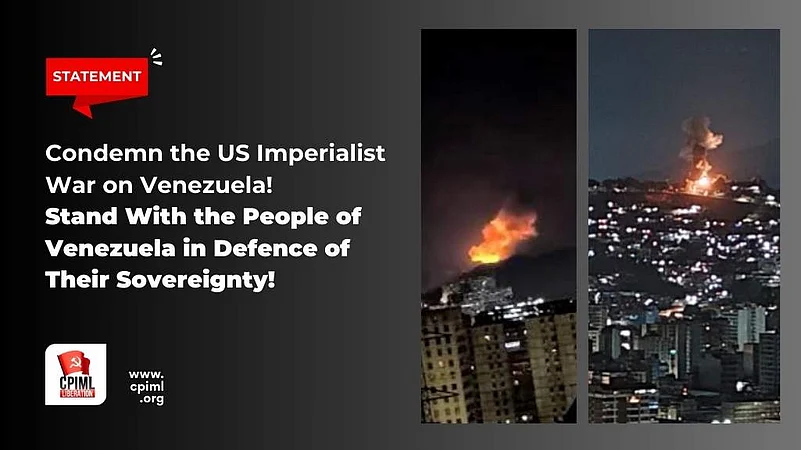
Left Parties Condemn US Attack on Venezuela, Say Real Target Is Oil

CPI(M), CPI(ML) Liberation and CPI accuse the US of aggression, regime change attempts and violating international law

Outlook News Desk
Curated by: Saher Hiba Khan
Updated on: 3 January 2026 


In a statement issued in New Delhi, the CPI(M) demanded an immediate end to what it described as US aggression. Photo: CPIM Website

Summary of this article


Left parties accused the US of launching military attacks to enforce regime change in Venezuela.


CPI(M), CPI(ML) Liberation and CPI said Venezuela’s oil reserves were the real target.


Parties called for UN action and global opposition to what they termed US aggression.


Left parties on Saturday condemned the United States’ military action against Venezuela, alleging that the attack was aimed at asserting control over the country’s oil reserves, according to PTI.

In a statement issued in New Delhi, the CPI(M) demanded an immediate end to what it described as US aggression and called for the withdrawal of all American troops from the Caribbean Sea, PTI reported.

The party said it “strongly condemns the blatant act of US aggression on Venezuela by bombing various sites in the country”. It alleged that Washington had, over the past several weeks, mobilised military and naval forces around Venezuela to enforce regime change.

“For the last few weeks the US has mobilised its military and naval forces around Venezuela in order to enforce regime change. This is the real face of the US National Security Strategy 2025, announced in the first week of December 2025,” the CPI(M) said.


Trump Claims Maduro Captured After Reported US Strikes On Venezuela

The party said the build-up of US forces across the Western Hemisphere and the open declaration of intent to bring the region under American control reflected what it termed the “Trump corollary to the Monroe Doctrine”. The Monroe Doctrine is a long-standing US foreign policy principle that declares the Americas off-limits to future European colonisation or interference.

Related Content


Red Flags, Old Struggles: CPI Marks 100 Years in Mumbai


Trump Orders Complete Blockade Of Sanctioned Oil Tankers Linked To Venezuela


Minimum Marxism: Reclaiming Class Politics


The Ruins Of An Idea: Capturing Shades Of The Left Across The Country


“Latin America should be declared a zone of peace and the US should not be allowed to interfere in the internal affairs of sovereign countries,” the CPI(M) said. It also urged the UN Security Council to pass a resolution condemning the attack and called for international pressure on Washington to immediately halt its actions, according to PTI.


The CPI(ML) Liberation also issued a statement condemning the attack, saying it was aimed at imposing a US-backed colonial order. Referring to a social media post by Donald Trump, the party said it claimed that Venezuelan President Nicolas Maduro and his wife had been captured and flown out of the country.


World Reacts After US Strikes In Venezuela And 'Capture' Of President Nicolás Maduro

“This war is not just against Venezuela, but an open threat against every people in the region and across the world who strive to determine their own future free from imperialist dictates,” the CPI(ML) Liberation said.

It alleged that the justification for the attack echoed earlier US claims used during the invasion of Iraq. CPI(ML) said the same lies used to justify the invasion of Iraq, the seizure of its oil, and the devastation of its people were now being recycled as so-called “narco-terrorism” to justify a regime-change operation against President Maduro and the plunder of Venezuela, which it described as the country with the largest oil reserves in the world.

“Trump's war on the people of Venezuela aims to impose a US-backed colonial order. It seeks to crush the Bolivarian Revolution that overthrew a US supported oligarchy and returned the nation's oil wealth to the people. The war is to seize Venezuela's oil once again for US multinational corporations and install a puppet government to serve imperialist interests,” the statement said.

The CPI(ML) Liberation described the attack as part of a longer pattern of US intervention in Latin America and the Caribbean, citing past actions in Guatemala, Chile, Grenada and Panama. It said the Monroe Doctrine, which it accused Washington of treating as a claim over its “personal backyard”, had historically meant subjugation, exploitation and repression, denying people in the region their right to sovereignty and self-determination.

The party said it stood in “unyielding solidarity” with the people of Venezuela and called on democratic and peace-loving forces worldwide to oppose what it termed imperialist aggression and efforts to impose a new colonial order under the Trump administration.

The Communist Party of India also strongly condemned the attack, calling it a gross violation of the UN Charter, international law and universally accepted principles of sovereignty, territorial integrity and non-interference, PTI reported.

“Such imperialist adventurism gravely threatens peace and stability in Latin America and the Caribbean and endangers the lives of millions of Venezuelan people. The CPI unequivocally denounces this aggression, which once again exposes the aggressive nature of US imperialism and its contempt for international norms,” the party said.

The CPI expressed “firm solidarity” with the government and people of Venezuela and said the real objective of the attack was to seize the country’s oil and mineral resources. It called on peace-loving people, democratic forces and progressive governments around the world, including in India, to raise their voices against the aggression and to stand in active solidarity with the Bolivarian Revolution and the Venezuelan people in defence of peace, sovereignty and self-determination, according to PTI.

Published At: 3 January 2026
Sudan: War ‘Between 2 Wings of Comprador Parasitic Capitalist Class’

Pavan Kulkarni | 01 Jan 2026

The war in Sudan is not simply “between two generals, but between two wings of a comprador parasitic capitalist class,” fighting each other against the backdrop of a regional and global contest over Sudan’s land, resources, and geostrategic location on the Red Sea, argues Sidgi Kaballo of the Sudanese Communist Party (SCP).


Rapid Support Forces (RSF) on a patrol as part of "border protection". Photo: RSF Website


As the war in Sudan that has unleashed the world’s worst humanitarian crisis nears a thousand days, “a cessation of hostilities, a humanitarian truce going into the new year” is an “immediate goal” of the US, said its State Secretary, Marco Rubio, in his year-end press conference.

Donald Trump, he insisted before the US cabinet earlier this month, is “the only leader in the world capable of resolving the Sudan crisis.”

But only two weeks before, Trump himself had explained that he had no understanding of the war. “I thought it was just something that was crazy and out of control,” he said in his address to the US–Saudi Investment Forum in Washington on November 19. “I viewed it as being just sort of a freelance, no government, no this, no that,” he went on to articulate.

But Saudi Arabia’s crown prince, Mohammed bin Salman (MBS), “explained the whole culture and the whole history,” to Trump on the sidelines of an investment summit, “and it was very interesting to hear, really amazing.”

Over 150,000 have been killed in the over two and a half years of this war that has hurled half the population into “extreme levels of hunger”, as parts of the country are in the throes of the world’s first officially declared famine since 2020. Deadly diseases like cholera stalk the population weakened by hunger, especially the Internally Displaced People (IDPs) who crowd in camps with no sanitation.

Even after more than three million people forced to flee amid the war recently returned to their homes, over 9.3 million people remain displaced within Sudan, while an additional 4.3 million refugees have fled to neighboring countries – the largest displacement crisis in the world.

“Sir, you’re talking about a lot of wars, but there’s a place on earth called Sudan, and it’s horrible what’s happening,” Trump recalled MBS telling him. To stop this war “would be the greatest thing you can do,” greater even “than what you’ve already done.”


Goaded by the flattery, Trump committed to work for peace in Sudan, because “I just see how important that is to you, and to a lot of your friends in the room,” he told MBS and wealthy Saudi investors attending the forum.

But until MBS told him “there’s a place on earth called Sudan” and gave him a history and culture lesson during this forum, Trump claimed that Sudan “was not on my charts.


US President Donald Trump on a state visit to Saudi Arabia in May 2025. Photo: The White House


A long history of US involvement in Sudan

It may well not have been on Trump’s chart, but the US state has been involved in Sudan for over half a century, starting with the military coup in 1958, only two years after independence.

It was a part of the Cold War efforts to entrench itself in Sudan to use its territory against the northern neighbor, Egypt, whose government, then led by Gamal Abdel Nasser, had tilted toward the Soviet Union. Nasser, at the time, had “entered into an agreement with Russia to build the high dam – a project the US and World Bank” were eyeing, explained Sidgi Kaballo, a prominent Sudanese academic and central committee member of the Sudanese Communist Party (SCP).

After Nasser died in 1970, the new Egyptian regime, firmly on the side of the US, joined its tripartite military exercises in northern Sudan. These exercises, meant to train US troops in the hot desert conditions to ready them for a potential invasion in the Gulf, continued for nearly a decade from the mid-70s to 80s, under the military rule of Gaafar Nimeiry.

After Islamists came to power under Omar al-Bashir after the 1989 coup, the US designated Sudan as a “state sponsor of terror” in 1993. However, after Sudan began cooperating with the US intelligence and assisting its counterterror operations in the aftermath of 9/11, the US State Department’s Country Reports on Terrorism described Sudan as “a strong partner in the War on Terror.”

However, Sudan remained on the “state sponsor of terror” list until it signed the Abraham Accords in 2020, normalizing ties with Israel after cutting off diplomatic relations with Iran earlier in 2016, aligning with the US-Saudi-UAE axis in foreign policy.

“The US interests in Sudan have been mainly geopolitical,” Kaballo said, adding, even today, it is invested in stopping Russia from securing a military base in eastern Sudan on the Red Sea coast and blocking China’s Belt and Road Initiative from passing through the country.

Land grab under the cover of Liberalization

But the US allies in the region – namely Egypt, Saudi Arabia, and the UAE, which together have formed the Quad that has taken charge of negotiating an end to the ongoing war – have a direct economic stake in Sudan.

The food processing plants in northern neighbor Egypt depend on Sudan’s agricultural produce, especially meat and oil seeds like sesame and groundnuts, not mainly for food, but for export, Kaballo said, adding, it is crucial “for its balance of trade.” Cultivation of export crops and fodder “is a waste of land and water that should be used for producing food crops” to feed the Sudanese people, argued Kaballo.

The scramble is not only for the produce, but for the agricultural land itself. Watered by the Nile, the North African country has the largest acreage of arable land on the continent.

Vast tracts were handed over to foreign countries under the IMF-prescribed neoliberal restructuring, even as the UN Food and Agriculture Organization (FAO) was warning about “worsening hunger and malnutrition crisis.”

Egypt was allocated at least 100,000 acres of Sudanese land for direct cultivation in 2014.

Egypt’s ambition over Sudanese land, however, was dwarfed by the Gulf members of the Quad. Saudi Arabia, which had already acquired over 100,000 acres in 2010, was granted over a million more acres on a cheap lease for 99 years in 2016. Earlier in 2015, the UAE’s Al-Dahra Holding had expressed interest in acquiring 2.4 million acres of land.


December Revolution

However, before completing these large transfers, the dictatorship of Omar al-Bashir was toppled by the December Revolution. What started as protests against the tripling of bread prices on December 19, 2018, snowballed into a mass pro-democracy protest across the country. Sustaining for months despite violent repression, the mass movement forced the ouster of Bashir in April 2019.

Removing him in a coup, his confidants, Abdel Fattah al-Burhan, head of the Sudanese Armed Forces (SAF), and Muhammad Hamdan Dagalo, aka Hemeti, head of the paramilitary Rapid Support Forces (RSF), formed a military junta together.

Refusing to relent, demanding the handover of power to a civilian government, protesters continued to occupy streets and squares. The center of the protest movement was the mass sit-in demonstration by hundreds of thousands occupying the square outside the army HQ through the days and nights for months.

Then, on June 3, 2019, the RSF was deployed to disperse the sit-in. The notorious paramilitary force was formed in 2013 by coalescing the Janjaweed militias used by Bashir’s regime to commit mass atrocities on civilians with SAF’s support during the Darfur civil war in the 2000s.

The US had accused Sudan of committing genocide in Darfur at the time. While disputing the “genocide” accusation, the European Union (EU) had maintained, nevertheless, “it is clear there is widespread, silent and slow killing and village burning of a fairly large scale.”

Nevertheless, in 2015, the very militias committing these atrocities, then organized as the RSF, were deployed on the EU’s behalf to intercept African asylum seekers en route to Europe as part of a USD 200 million migration deal it had entered with Sudan.

The RSF further enriched itself from the three billion dollars payment by Saudi Arabia and the UAE for the deployment of 40,000 of its fighters between 2016 and 2017 for their US-backed war on Yemen, alongside a small contingent of the SAF troops.

This battle-hardened force, notorious for its atrocities on civilians, was then deployed in the country’s capital to evict the protesters outside the SAF’s HQ.

Surrounding their sit-in demonstration, the RSF wounded over 500 and killed over a hundred, opening fire, hacking with machetes, raping, and then dumping scores of bodies, weighed down by the tied rocks, into a stream of the Nile flowing nearby.

The New Arab reported that the massacre was unleashed “shortly” after the top generals of the SAF and the RSF visited Saudi Arabia, the UAE, and Egypt, whose interests had been derailed by the December Revolution. Several observers had argued this meant the junta had “received a green light from the three powerful Arab states” to commit this massacre.

Nevertheless, the December Revolution continued, then taking the form of a general strike, with thousands of workers staying home, bringing the junta-led state to a halt. They called for a reorganization of the economy to free the industries from the stranglehold of the military elite to benefit the masses of workers and consumers.

The movement also insisted on the dissolution of the RSF and the formation of a single professional national army, subjugated to a civilian government. It further called for the withdrawal of Sudanese troops from Yemen, and a re-orientation of its foreign policy, away from the US-Saudi-UAE axis, and in line with the interests of the Sudanese people.


Members of the Rapid Support Forces with Mohamed Hamdan Dagalo at the center
. Photo: RSF Website

Undermining these demands, radical for the Sudanese conjuncture, the US and the UK maneuvered diplomatically behind the scenes of the Ethiopia-led negotiations to coalesce together a ‘joint civilian-military transitional government’ in August 2019.

Its civilian component consisted mainly of technocrats backed by centrist and right-wing parties of the Forces of Freedom and Change (FFC), a broad-based civilian coalition formed during the Revolution. Protesting against their compromise with the military junta, the SCP, which had played a key role in the December Revolution, broke away from FFC.

The new government, in which FFC shared power with the junta, was quick to resume dealing in Sudanese land with Gulf powers. Less than a year after its formation, it ceded 100,000 acres to the UAE’s largest publicly traded firm, the International Holding Company (IHC). It was also negotiating a deal to hand over the management of the South Port Container Terminal of Port Sudan to the logistics giant, Dubai Ports World.
Red Sea access

Located on the Red Sea with Saudi Arabia across the water body to its east and a coastline that runs north into Egypt, it is a geopolitically sensitive coastline. UAE, which is further away from Sudan to the east of Saudi Arabia, has a lesser direct geopolitical stake. But, for commercial reasons, it is actively seeking Sudanese Red Sea ports in Africa, explained Kaballo.

However, the government was unable to hand over the terminal of Sudan’s national port in the face of opposition by the trade unions. Resisting privatization under Bashir, the trade unions were a well-organized force in the country and had spearheaded the December Revolution.

Although the civilian face of the government had placated sections of the protest movement, the December Revolution was still a force to be reconciled with on the streets, able to draw hundreds of thousands to demonstrations.

With “the revolutionary forces and the trade unions” standing in the way, the government was forced to retreat, recalled Kaballo. However, the section of the government that was more susceptible to pressure from the streets – the civilian component – was removed in late 2021 in a coup as the SAF chief Burhan and the RSF chief Hemeti concentrated all power in the junta again.

A year later, in December 2022, the junta signed away a vast stretch of coastal land, about 200 km north of Port Sudan, to a UAE-based consortium including its state-owned Abu Dhabi Ports Group and Invictus Investment to develop the Abu Amama port.

The six billion dollar project was envisioned to have an airport, over 400,000 acres of agricultural land, a free trade zone, with a 450 km long road west to the UAE’s vast agricultural project in the River Nile state of Sudan.

Effectively, it was to lay down an infrastructure for a more seamless extraction of Sudan’s agricultural produce to the UAE, while almost a quarter of the Sudanese population was suffering acute hunger at the time.

UAE agribusinesses are also heavily invested in other African countries, including Chad, Cameroon, Central Africa, and South Sudan, added Kaballo. The new port in Sudan was also to serve as the exit point from the continent for the produce extracted from these countries.

Civil war

However, the project could not take off. Only months after signing this agreement, in April 2023, the power struggle brewing within the junta between the Burhan and Hemeti erupted into a civil war with the SAF and RSF turning on each other, unleashing the world’s worst humanitarian crisis in Sudan.

But “this is not simply a war between two generals, but between two wings of a comprador parasitic capitalist class,” fighting each other against the backdrop of a regional and global contest over Sudan’s resources and geostrategic location, argues Kaballo.

Later in November 2024, the SAF-led government, based in Port Sudan after shifting its administrative seat from the capital Khartoum in the early days of the war, scrapped the port deal with the UAE, complaining of its support for the RSF.

But then, the RSF had overrun SAF bases in Darfur, taking over most of the region, except North Darfur state’s capital, El Fasher. Laying siege in May 2024, RSF tightened the noose around the city by building a wall by mid-2025, starving it of food supply, before breaking through its defenses in late-October.

What followed was a depopulation of the city, with the RSF massacring its civilians in likely tens of thousands. British weapons sold to the UAE were found to be in use by the RSF in its El Fasher campaign.

After thus consolidating its control over Darfur, the westernmost region of Sudan, its troops are now advancing east into the Kordofan region, where the center of the fighting has now shifted.

The Gold Rush


Gold illegally mined from Darfur and smuggled to the UAE is a key source of RSF’s income, weapons, and vehicles. Although the largest buyer of Sudanese gold since 2010, the gold from Sudan is not the UAE’s main interest, clarified Kaballo. It adds up to only a “small percent of the UAE’s overall gold trade.”

He added further that the “SAF generals are also big traders and exporters of gold.” The Ministry of Minerals of the SAF-controlled de facto government started talks with the Saudi Gold Mining Refinery amid the fighting earlier in August this year.

“The emerging war economy has seen an increased dependence on the production, smuggling, and exportation of the mineral sector – mainly gold to the Gulf – which is extracted from both SAF- and RSF-controlled territories,” reported S-RM, a global corporate intelligence and cyber security consultant.

The country’s gold production has almost doubled since the start of the war. While the Darfur region, under RSF’s control, “is a significant gold-producing region, the Red Sea State,” under SAF’s control, “stands out as the largest gold producer in the country,” the Swissaid reported.

“Egypt is also interested in Gold,” said Kaballo, adding that unprecedented quantities of gold were exported from Sudan to Egypt amid this war, during which its Central Bank increased its gold reserves.

Sudan is also endowed with copper, uranium, manganese, and rare earth minerals, which the US is trying to acquire from Africa.

Under the cover of peace process

It is these economic and geopolitical interests of the US and its three regional allies that the Quad is trying to ensure, under the cover of the peace process it has initiated, maintains Kaballo. There are competitive and conflicting interests within the Quad. It is these intra-block contradictions that the Quad is taking time to resolve, essentially to reach an agreement amongst themselves on “how to divide the cake,” he argued.

“Since the outbreak of the war, the US administration has not stopped issuing successive statements and holding rounds of negotiations – from Jeddah to Switzerland, and finally to the Quad meetings in New York – in a series of maneuvers that do not conceal their essence: managing the crisis rather than solving it, and controlling its trajectories in a way that serves the American strategy in the region. The farce reached its peak when the US president claimed he would ‘take care of’ the Sudanese crisis based on what he described as the ‘inputs’ and ‘appeals’ of the Saudi Crown Prince,” read an editorial in the SCP’s newspaper, Al Maydan.

“After more than two years since the outbreak of war,” SCP maintains, “it is no longer hidden that the Quad’s initiative is not a serious attempt to end the crisis, but rather an effort to contain its outcomes and re-balance influence in the region.”

Pointing out that “all the principal supporters of the warring parties in Sudan are” US allies, it added, “Washington’s [own] track record in dealing with Sudan proves that” the Quad’s peace process is aimed at “sustaining dependency and facilitating the extraction of resources”.

Nevertheless, the SCP will welcome any ceasefire that might result from the Quad’s initiative, added Kaballo. It is necessary to stop more deaths and supply life-saving aid for civilians in both the SAF and the RSF-controlled territories.


People in the northern rural villages of Omdurman celebrating upon hearing about the liberation of a part of Khartoum by the Sudanese army
. Photo: Wikimedia Commons

Moreover, an end to the fighting “will allow” the popular forces of the December Revolution to mobilize once again and take the streets “to defend the interests of the Sudanese people and shape its future.”


War as counter-revolution

Enduring massacres and machinations of a technocratic government with a civilian face, the December Revolution had continued even after the 2021 coup in which the SAF and the RSF consolidated power and intensified repression.

Under the leadership of the Resistance Committees, a decentralized network of activists organized in neighborhoods across the country, hundreds of thousands took to the streets after this coup on a near-weekly basis, facing bullets, batons, tear gas, arrests, and torture. The mass demonstrations continued right up until April 2023, when the SAF and the RSF turned on each other, hurling the country into civil war.

The war proved to be a counter-revolution so fierce that the popular forces could no longer exert power on the streets. The Resistance Committees, which had led the protests, then occupied themselves with organizing relief and rescue for civilians, with survival becoming the central task amid this cataclysm.

Although the Quad cannot bring peace to Sudan, Kaballo is emphatic that any ceasefire to silence guns will provide an opening for the popular forces to resume mass actions to assert the radical path envisioned by the December Revolution to address the structural causes of the war.

However, the forces vested against the December Revolution are many and mighty. “Aborting the path of radical change in Sudan” is a central objective of “American imperialism”, uniting Saudi Arabia, Egypt, and the UAE, despite the conflicting interests amongst themselves, argued the SCP.

To accomplish this abortion, the Quad is resorting to “its old project: a fragile ceasefire, top-down settlements, and a nominal civilian government arranged outside the will of the Sudanese.”

Jockeying at the Quad-led negotiations for their share in this government are the same centrist and right-wing political parties that had entered into a power-sharing agreement with the military junta back in 2019, forming the “joint civilian-military government” that unraveled two years later.

Today, they are positioning themselves to be part of what the SCP describes as an externally propped-up “subordinate civilian regime that guarantees American interests and, after that, the interests of” the regimes in Egypt, Saudi Arabia, and the UAE.

Effectively, it will mean the continuation of the extraction of Sudanese resources, the grabbing of its agricultural land, and geopolitical exploitation to serve US interests.

“In this decisive moment, the real wager remains on the power of the masses and their ability to impose their will and wrest their future from the hands of those attempting to engineer it on their behalf.”

“The path out of the crisis” cannot “be drafted in the rooms of the Quartet, nor in the deals of hesitant civilian groups, but only through a national democratic project grounded in the radical” vision of the December Revolution.

Courtesy: Peoples Dispatch


INDIA


Flexibility to Insecurity: Gig Workers’ New Year’s Strike


Shirin Akhter 


This strike is significant because it exposes the myth that platforms are technological entities, it shows clearly that without labour, there is no delivery, no convenience.

Over the past few years, critiques of the gig economy have warned that gig platforms market worker insecurity as flexibility. That algorithms do not eliminate either control or biases, these strengthen them. That the language of partnership masks the erosion of labour rights. Those warnings emerged from workers’ testimonies of falling pay, sudden deactivations, dangerous delivery targets, and lives lived under constant uncertainty. The nationwide strike by gig workers on New Year’s Eve is the clearest confirmation that these warnings were not teething problems of a new sector, but structural features of platform capitalism.

As people across the world prepare celebrate the arrival of the New Year, orders surge, delivery timelines shrink, algorithmic pressure intensifies, and the risks borne by workers multiply: long hours, reckless speeds, winter fog, fatigue, and unpaid waiting time. The strike, timed deliberately on this night of abundance, is a direct challenge to the conditions under which platform profits are extracted. On this very eve, tens of thousands of gig workers across India logged off delivery apps in protest.

The call of the strike is simple, workers demand dignity. This strike is a call for an end to the 10-minute and ultra-fast delivery model; minimum and predictable earnings; protection against arbitrary ID blocking; social security; and legal recognition as workers. Mere demands for survival. In an economy that celebrates convenience and speed, gig workers are asking for safety and stability.

Read Also: India's Gig Workers Need Labour-Sensitive Data Protection Law

Gig workers do not occupy work places, their labour is dispersed, individualised, and algorithmically managed. Their only collective weapon is withdrawal. Logging off is both a refusal and a revelation. This strike is significant because it exposes the myth that platforms are technological entities, it shows clearly that without labour, there is no delivery, no convenience. When the invisible labour refuses to be compliant, the platforms’ promise of seamless convenience crashes.

Platform capitalism represents a new technological form of surplus value extraction, it extracts value not only by extending working hours but also by intensifying labour within time itself. The 10-minute delivery promise is a classic example of labour-time compression. Workers are forced to deliver more, faster, and under riskier conditions, without commensurate compensation. The cost of accidents, health deterioration, and exhaustion is externalised to workers and their families, while profits are internalised by capital.

Algorithms function as capital’s new foremen. They allocate tasks, set pay, impose penalties, and discipline refusal, all while maintaining the illusion of neutrality. The worker appears free, able to log in and out, but this freedom is hollow. Refusal is punished through ratings, reduced visibility, or deactivation. A blocked ID is not a technical glitch; it is a financial penalty. The labour process is tightly controlled, but responsibility is endlessly deferred.

As the world celebrates, this contradiction becomes painfully visible. In some homes, food is ordered in excess, consumed and wasted without thought. In others, families wait anxiously for the night’s earnings to determine whether rent can be paid, fuel purchased, or meals stretched another day. While fireworks light the sky, many delivery workers return home calculating losses rather than gains. Celebration and hunger coexist in the same city, sustained by the same economic system.

The guise of self-employment allows this system to persist despite all flaws. Terms like ‘partners’ effectively exclude gig workers from labour law, obligations of social security, accident compensation, maternity benefits, and income protection. The policy acceptance of this guise reflects a broader alignment with a growth model that privileges platform capital and consumer convenience over worker welfare. Informalisation here is not a leftover of underdevelopment; it is a deliberate outcome.

Read Also: Gig Workers Amid Rising Air Pollution

This strike marks a moment of class assertion in a sector designed to prevent collective identity. By withdrawing their labour on the most profitable night of the year, gig workers expose the fragile foundations of a system that promises convenience while normalising exploitation of the worker.

The structural problems that these workers face, namely, income volatility, algorithmic punishment, unsafe speed mandates, and legal invisibility, have been documented repeatedly. Earlier discussions on platform labour, including analyses of gig pensions and social security, bring out that voluntary codes, incentive tweaks, and festive bonuses cannot repair an employment model built on systematic risk transfer and regulatory evasion. What is required is a decisive policy shift that recognises gig work as work, and gig workers as workers.

The issue that needs to be urgently addressed is the steady withdrawal of collective responsibility for worker welfare. Pensions without income security, health cover without employment protection, and insurance without accountability merely convert social rights into private risks. They do not address precarity; they manage it.

The New Year’s Eve strike pushes the debate beyond tokenism. It demands a framework in which social security is treated as a public good, not a market opportunity. At the least, the resolution requires bringing platform labour squarely within the ambit of labour law, instituting minimum pay floors indexed to time and distance, banning arbitrary deactivations, mandating platform contributions to health insurance, accident compensation, maternity benefits, and old-age security; and regulating delivery timelines in the interest of worker safety. Algorithmic management must be made transparent and contestable, with mechanisms for individual appeal and collective representation.

Saying that platform workers juggling precarious jobs and uncertainties are self-employed partners of the gigantic platform operators is a farce, and it must be recognised as one. This farce has become the central instrument through which insecurity is normalised. Workers must be recognised as workers and their welfare should be prioritised via policies that assure that a fair part of value created by the workers go back to them.

The strike also signals something deeper. By withdrawing their labour on the most profitable night of the year, gig workers are no longer merely reacting to hardship; they are naming the system that produces it. This protest is not only against speed or falling pay, but against a growth model that celebrates convenience while tolerating exhaustion, and fear among those who sustain it. This is a moment of class assertion in a sector designed to prevent collective identity.

The question before policymakers is, therefore, no longer whether platform capitalism needs regulation, but whose lives policy is willing to protect. Until social security is reclaimed as a right rather than an individual gamble, and labour dignity is placed above consumer convenience, such strikes will become the language through which the new working class of the digital economy speaks.

Shirin Akhter is Associate Professor at Zakir Husain Delhi College, University of Delhi. The views are personal.

Climate reckoning

Published January 3, 2026 
DAWN

The writer is chief executive of Civil Society Coalition for Climate Change.


TEN years after the Paris Agreement, the global climate report card is brutally honest and painfully incomplete. The system we built — from the UN Framework Convention to Kyoto’s binding targets and Paris’s nationally determined contributions — was meant to turn moral responsibility into collective action. Paris sealed a compact of solidarity: keep warming well below two degrees Celsius, pursue 1.5°C, and require those most responsible to do more. A decade on, that compact is fraying under political expediency, weak finance and geopolitical distraction. The result is not a technical failure but an ethical one, leaving millions in the Global South exposed to floods, heat and hunger.

That history matters because treaties create obligations. The UNFCCC embedded “common but differentiated responsibilities”. Kyoto operationalised it through binding commitments for rich countries. Paris softened legal categories but reaffirmed the same moral claim: those with greater historical responsibility and capacity must lead through deeper emissions cuts and sustained finance. That principle remains the benchmark against which today’s record must be judged.

By that standard, the financial gap is indefensible. UN assessments estimate developing countries will need roughly $310–365 billion annually by the early 2030s for adaptation alone. Yet international public adaptation finance reached only about $26bn in 2023. This is not a marginal shortfall; it is a moral chasm. Vulnerable countries are being asked to absorb escalating climate shocks without the means to protect their people.

The contrast with other spending priorities is stark. Global military expenditure exceeded $2.4 trillion in 2023. These sums dwarf adaptation needs many times over. The issue is not technical feasibility but political choice. Governments mobilise vast resources for deterrence and warfare, while investments in survival — flood defences, resilient agriculture, early warning systems, cooling infrastructure — remain chronically underfunded. That imbalance reveals what the international system values.


A decade on, the Paris compact is fraying.

Why has the world fallen so far short? Fossil-fuel interests continue to delay transition. Short electoral cycles reward incrementalism where systemic change is required. Climate finance relies heavily on loans and private capital, shifting risk onto the poorest and deepening debt distress. Meanwhile, wars and rivalries crowd out climate urgency, sustaining the illusion that security can be separated from survival.

These explanations clarify behaviour, but they do not excuse it. Fiscal constraints are invoked selectively. When political will exists, governments find the money.

The human cost is already visible. In South Asia, repeated floods erase livelihoods faster than recovery finance arrives. In Pakistan, climate-amplified monsoons and heatwaves have pushed food systems and infrastructure beyond design limits. When keeping warming to 1.5°C — a threshold that would spare hundreds of millions from extreme harm — remains narrowly possible, continued delay by wealthy nations amounts to knowingly condemning poorer populations to harsher futures.

What must change is clear. Public, grant-based adaptation finance and loss-and-damage funding must scale up rapidly. Loans cannot substitute for predictable support. Loss and damage must be fully operationalised with reliable, additional funding. Multilateral development banks must expand concessional finance, ease punitive conditionalities and link debt relief to resilie­nce. New revenue str­eams — including windfall levies on fossil fuels and selective redirection of milita­­ry spending — must be mobilised. Accou­ntability must be str­engthened through transparency and rights-based approaches that centre affected communities. The solutions must be fair, timely and result-based. Words without matching actions don’t merely sound hollow, they erode trust in the multilateral system and its credibility as an honest broker. With 1.5ºC in jeopardy, the world needs to focus on staying below 2ºC. The beginning of 2026 should serve as a wake-up call for global negotiators, national policymakers and regional leaders to look at the future through the lens of climate and take action before it is too late.

The world does not lack capital or technology. It lacks the moral courage to align spending with survival. Paris was never just a technical deal; it was an ethical recognition of shared humanity and unequal responsibility. If wealthy nations continue to fund weapons without hesitation while delaying climate obligations, they are making a choice. That choice defines the climate reckoning of our time.

aisha@csccc.org.pk

Published in Dawn, January 3rd, 2026