Sunday, January 04, 2026

Trump-brokered Ukraine deal could unsettle Balkans, analyst warns

Trump-brokered Ukraine deal could unsettle Balkans, analyst warns
Analyst warns any settlement that rewards Russia for using force would send a powerful signal far beyond Ukraine, including in the Western Balkans.
By bne IntelliNews January 4, 2026

A US-brokered peace deal in Ukraine that legitimises Russian territorial gains would risk reopening old fault lines in the Western Balkans, emboldening Serbia and weakening the European Union’s credibility as a guarantor of regional stability, according to a new report by the European Council on Foreign Relations (ECFR).

The analysis, written by ECFR senior policy fellow Engjellushe Morina, argues that the outcome of the war in Ukraine is no longer just a question for Kyiv and Moscow but a test case for how borders are treated across Europe – including in fragile regions such as Kosovo, Bosnia & Herzegovina and the wider Balkans.

“A Russia-Ukraine peace deal that capitulates to Putin risks destabilising the Western Balkans, emboldening Serbian territorial claims and undermining EU credibility,” the report said.

With US-led diplomacy intensifying as 2025 draws to a close, Morina warns that any settlement that rewards Russia for using force would send a powerful signal far beyond Ukraine. “Any settlement that legitimises Russia’s use of force to alter its borders would further destabilise Ukraine and have negative repercussions in the Western Balkans,” she wrote.

Ukraine’s President Volodymyr Zelenskiy has insisted that Kyiv will not give up more territory to Russia, a position Morina says is firmly rooted in international law, which holds that “borders cannot be changed by force”.

But she argues that the current US approach to negotiations risks sidelining those principles. The talks have “hardly mentioned multilateralism, or the rules and regulations which govern international order”, instead focusing on “handing Russia the territorial changes it has achieved by force”. (The paper was published before the US military operation in Venezuela, which sparked accusations that Washington had breached international law.)

Such an outcome, the report said, would have dangerous knock-on effects for Europe’s “eastern neighbourhood” – including Georgia and Moldova – as well as in unresolved disputes in the Western Balkans, particularly between Serbia and Kosovo.

“If Russia ‘wins’ in Ukraine, the Western Balkans will be in trouble,” Morina wrote. In that scenario, Serbia could be encouraged to revive territorial claims, urging countries that recognise Kosovo’s borders to instead see the Serb-dominated north as part of Serbia.

She added that Serbia’s president, Aleksandar Vucic, might also be tempted to push for Bosnia’s Serb entity, Republika Srpska, to be folded into Serbia.

Kosovo in the crosshairs

At the centre of those concerns is northern Kosovo, a Serb-majority area that has long been a flashpoint. The EU is trying to broker a normalisation of relations between Belgrade and Pristina, but Morina warned that this delicate process could unravel if global norms on borders are weakened.

“If the US allows a peace deal that gives Russia more Ukrainian territory, or if the EU fails to stop US president Donald Trump from inflaming regional tensions, Vucic might be emboldened to pursue a land grab in Kosovo’s north,” the report said.

Such a move would “undermine Nato and weaken the EU” and would likely enjoy “Putin’s support”, Morina added.

The north of Kosovo remains “in limbo”, she wrote, with Serbia seeking to maintain influence over the local Serb population and Kosovo’s government insisting that the area must be governed under Pristina’s authority. That standoff has helped keep the region volatile, highlighted by a deadly Serb paramilitary attack in the village of Banjska in September 2023.

The report also takes aim at the changing role of the United States under President Donald Trump’s second term. Washington, once the main architect of peace in the Balkans through Nato and diplomacy, is now more focused on commercial interests, according to Morina.

The latest US National Security Strategy says “the United States will prioritise commercial diplomacy”, a shift that she argues puts economic gains ahead of geopolitical stability.

Trump, who has repeatedly portrayed himself as a global “peacekeeper”, has even claimed he “managed to stop the war between Kosovo and Serbia”, with US strategy documents listing the dispute among conflicts he has supposedly resolved.

Morina said this raised the risk that Trump could push for a quick, headline-grabbing deal in the Balkans, just as he did during his first term, when his envoy backed a controversial “land-swap” proposal between Kosovo and Serbia.

That plan, which would have traded Serb-majority areas in northern Kosovo for Albanian-majority areas in southern Serbia, ultimately failed. But Morina warned that similar ideas could resurface if Washington again prioritises speed and optics over long-term stability.

EU under pressure

The report argues that the EU remains “indispensable” in stabilising the Western Balkans, largely because of its power to offer membership. But that leverage is weakening as enlargement stalls and public trust in Brussels erodes.

“Without delivering tangible benefits, the prospect of further European integration will lose its remaining credibility among candidate countries,” Morina wrote, pushing them to look instead to Washington or Moscow for support.

She said EU member states now face a strategic choice: either “retain ownership of Balkan geopolitics” or “stand by as Washington steps in”. Decisions taken in 2026, she argued, would be “decisive” for the future of Kosovo, Serbia and the wider region.

France and Germany, in particular, need to keep pressure on Belgrade and Pristina to implement the EU-brokered “Agreement on the path to normalisation”, while also demonstrating that Europe can still deliver on security and integration.

Suriname’s Oil Dreams Collide With Geological Reality

  • GranMorgu will deliver Suriname its first major offshore oil production, but years later and at a far smaller scale than Guyana’s Stabroek-led boom.

  • Recent drilling results suggest the most prolific petroleum fairway lies largely within Guyana’s waters, limiting Suriname’s upside.

  • High costs, mixed exploration outcomes, and decarbonization pressures may constrain future investment beyond GranMorgu.


Suriname’s government, in the capital Paramaribo, has been hungrily eyeing neighboring Guyana’s massive world-class oil boom since before the 2020 pandemic. Both impoverished South American nations of less than one million share the Guyana Suriname Basin. The offshore basin is delivering an oil boom that is exceeding all expectations, making Guyana, based on GDP per capita, one of the wealthiest nations in the world. Suriname, which is one of South America’s poorest countries and is experiencing a deep, long-running economic crisis, is hungering after the rapid economic growth such a hydrocarbon boom will deliver.

In a stunning development, neighboring Guyana went from first discovery to first oil in a mere four years in an industry where that can take a decade or more. The former British colony is after a decade South America’s third largest oil producer pumping around 900,000 barrels per day. This along with Guyana’s gross domestic product (GDP) soaring nearly nine-fold over the last decade caught the attention of Paramaribo. By 2021, President Chan Santokhi, who was under pressure from a deep economic crisis, was convinced a world class oil boom would lift Suriname out of poverty. This saw the president hopeful the Block 58 discoveries would be developed and operational by 2025.

There was, however, a moment when Suriname’s much-anticipated oil boom wavered. During 2022, TotalEnergies, the operator of Block 58, and 50% partner APA Corporation chose to delay the final investment decision (FID) for developing the Sapakara and Krabdagu oil discoveries. The energy companies made this decision due to poor drilling success, the high gas-to-oil ratio of some discoveries, and a mismatch between seismic data and drilling results. This delayed the prospect of first oil, and consequently Suriname’s urgently needed world-class oil boom, by years. Nonetheless, by October 2024, TotalEnergies announced the $10.5 billion FID had been approved.

The deepwater project, named GranMorgu, is targeting reservoirs containing nearly 760 million barrels of crude oil. The facility will be operated by an all-electric floating production, storage, and offloading unit (FPSO) with a capacity to lift 220,000 barrels per day. First oil from GranMorgu is expected in 2028. This is some years after 2025, which was the initial prediction, but the latest news from TotalEnergies confirms GranMorgu will be a groundbreaking energy project for Suriname. The project will be a model for low-carbon extraction of crude oil in an industry dogged by high emissions. 

You see, aside from the FPSO being all-electric, there will be no routine flaring with all associated gas produced injected into tanks on the vessel. As a result, less than 16 kilograms of carbon are produced per barrel of crude oil lifted. This is less than the global average of 60kg per barrel produced reported for 2015, with industry analysts claiming it has fallen to as low as 18 kg per barrel as big oil strives to become carbon neutral. For these reasons, GranMorgu is viewed with excitement by many in an industry under considerable pressure to reduce greenhouse gas emissions. 

The successful start-up of the TotalEnergies project will go a long way to boosting Suriname’s crisis-riven economy. The International Monetary Fund (IMF) predicts the former Dutch colony’s GDP will grow by a stunning 55% during 2028 when production starts. Nonetheless, there is a long way to go before the former Dutch colony experiences the rapid growth experienced by Guyana. Overall drilling results were not particularly positive despite the view that the oil potential of the Guyana Suriname Basin is far greater than the United States Geological Survey (USGS) initially believed. While APA reported the discovery of oil with the Baja wildcat well in Block 53 offshore Suriname during late 2022, there have been very few such announcements since.

Malaysia’s state-controlled energy company Petronas made a series of hydrocarbon discoveries in offshore Block 52, which is contiguous to Block 58. These are the Sloanea, Roystonea, and Fusaea discoveries. Despite those discoveries, ExxonMobil, which was a 50% partner in Block 52, relinquished that interest, handing it over to Petronas in November 2024. Since then, only Sloanea, which is a natural gas discovery, has been declared commercially viable. The other two discoveries have yet to be fully appraised, with doubts existing as to whether they are commercially viable. Even if they are, it may take a decade or longer for them to be developed and brought online. 

The results of Petronas’ latest multi-well drilling campaign in Block 52 were not stellar. The Caiman-1 wildcat well, the first of four wells to be drilled in 2025 and 2026, was spudded on July 21, 2025, in the western portion of Block 52. The exploration well was plugged and abandoned on December 6, 2025. While Petronas described the results as encouraging, there were no announcements that the well found commercially viable hydrocarbon reservoirs for possible exploitation. Petronas will continue with its planned drilling campaign as it seeks to delineate resources in Block 52 and determine whether the Sloanea natural gas discovery can be developed and brought to production.

This news comes on the back of APA and its partners in Block 53 relinquishing most of the petroleum acreage to Staatsolie, Suriname’s national oil company and industry regulator. That is despite the August 2022 Baja-1 discovery, where oil was discovered in the same depositional system of the Krabdagu discovery in Block 58, seven miles (11.5 kilometers) to the west. Indeed, the Krabdagu discovery forms part of the GranMorgu project. During June 2025, TotalEnergies acquired a 25% working interest in the remaining area of Block 53 around the Baja-1 discovery from Moeve, formerly known as CEPSA.

The acreage relinquished by APA during February 2024 was repackaged by Staatsolie and offered as a new offshore oil block. During June 2025, Suriname’s petroleum regulator awarded that acreage to Petronas as Block 66. Malaysia’s national oil company signed a production sharing contract with Staatsolie, giving it an 80% working interest in the block, with Paradise Oil Company, a wholly owned subsidiary of the national oil company, acquiring the remaining 20%. That deepwater oil acreage is contiguous to Petronas’ 80% controlled Block 52, where the company is the operator, and Paradise Oil is also a 20% partner.

There are signs, as illustrated by recent drilling results, that the petroleum fairway passing through the prolific Stabroek Block in offshore Guyana does not extend as far into Suriname’s territorial waters as initially speculated. For some time, analysts reasoned that the hydrocarbon fairway extended through Block 58 into adjacent Blocks 52 and 53. Indeed, recent drilling results indicate the lion’s share of petroleum held in the Guyana Suriname Basin is primarily located in offshore Guyana rather than in the former Dutch colony.

Offshore Suriname may be the hottest frontier oil and gas exploration in South America, but there are signs that time is running out for the country to explore that vast offshore petroleum potential. While the development of GranMorgu will deliver an economic windfall, the facility’s successful operation may not be sufficient to attract the tremendous capital needed to develop the vast oil potential thought to exist in Suriname’s territorial waters. A combination of uncertain drilling results, high development costs, and pressures to curb carbon emissions, coupled with the threat of peak oil, is weighing heavily on investment in offshore frontier oil basins.

By Matthew Smith for Oilprice.com


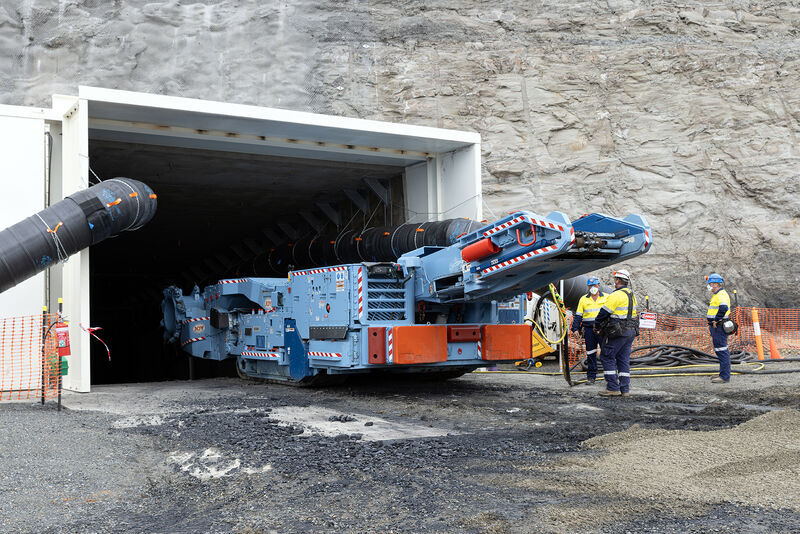
Coronado’s Curragh mining suspension adds to financial woes

Coal mining across Coronado Global Resources Inc.’s Curragh complex in Australia’s Queensland state was halted after a worker was killed, adding to woes for the company that’s already dealing with slumping prices.

A roof collapse occurred at about 3 p.m. local time Friday at Curragh’s Mammoth Underground Mine. One worker was safely recovered while teams worked through the night to stabilize the site and access a second worker who was unable to be saved, the Queensland government said in a statement late Saturday.

Curragh, which opened in 1983 and spans about 256 square kilometers (63,260 acres), is one of Australia’s largest sources of metallurgical coal used in steelmaking. Mammoth, which began mining coal a year ago, was expected to add to production from the Curragh North and Curragh South open-cut mines.

“As a sign of respect, production activities will be paused in the Curragh North and Curragh South open-cut mines to remember our fallen colleague and to ensure necessary support is provided to those who require it,” Shaun Newberry, Curragh’s vice president of operations, said in a memo to staff.

‘Cross road’

The disruption at Curragh comes at a sensitive time for Coronado. The Mammoth underground project was one of the company’s key growth plans, targeting output of up to 2 million tons of high-grade metallurgical coal a year, even as the miner cuts spending to preserve cash amid weaker prices and higher costs.

Coronado’s balance sheet and liquidity was at “the cross road,” Jefferies analysts said in a report in October, adding that progress at Mammoth “remains critical to recovery.”

Total debt at the company has almost doubled and market value has fallen 80% over the past two years amid a slump in metallurgical, or coking, coal prices. Brisbane-based Coronado has total debt of about A$928.4 million ($621 million), compared with total debt of A$468.1 million at the end of 2023, according to data compiled by Bloomberg.

Fitch Ratings withdrew its CCC- long-term issuer default rating and CCC+ rating on Coronado’s US dollar senior secured notes in November after the mining company chose to stop participating in the rankings process. Fitch had cut its rating three times from an initial B+ in September 2024. Both Moody’s and Standard and Poor’s have a “negative” outlook on Coronado’s debt.

Miner deaths

The death at Curragh is the third since Coronado bought the complex in 2018. One worker died from a crush injury in November 2021, while a man was killed by a fallen mine truck tire in January 2020, according to data from the Mine Safety Institute of Australia. An earlier fatality occurred in 2010 when a worker died after a vehicle overturned at the site.

Coronado reported the death of a worker on Dec. 18 at its Lower War Eagle mine in West Virginia, an incident that also led to a temporary suspension of its Logan operations.

Prices for seaborne steel-making coal have slid to near a four-year low, prompting shutdowns across Australia’s coal industry. BHP Group said in September it would close its Saraji South mine and curb further coal investment under Queensland’s royalty regime, a move followed by other producers.

(By Jason Gale and Paul-Alain Hunt)


Botswana to open embassy in Moscow, open up to Russia in rare earths and diamonds

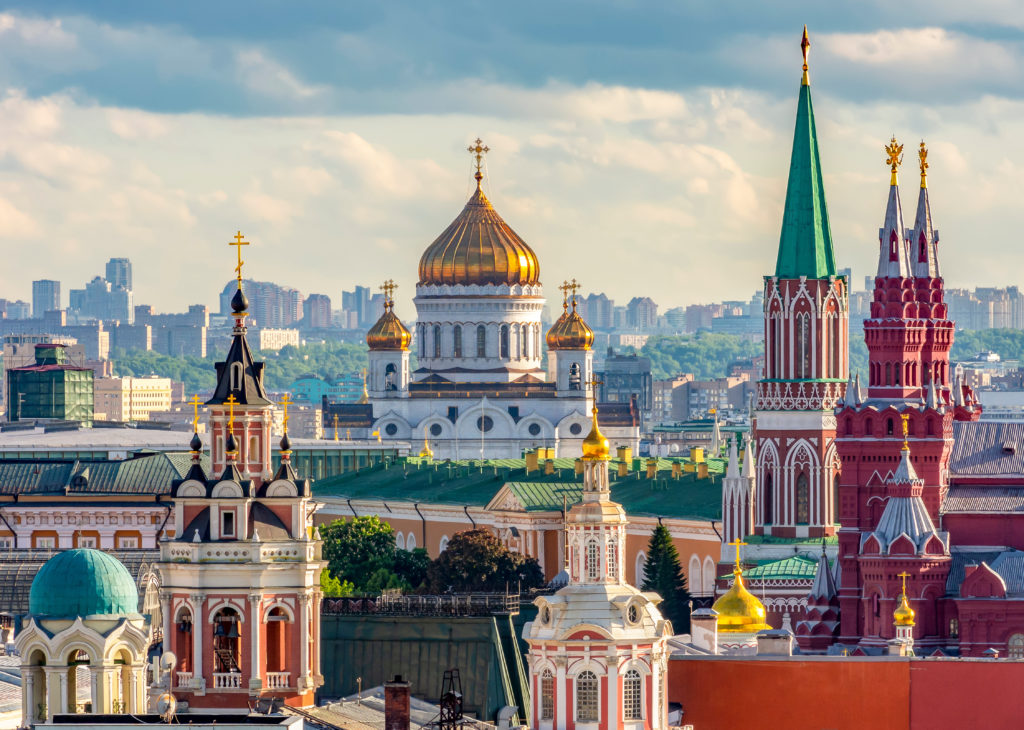
Moscow, Russia. Stock image.

Botswana plans to open an embassy in Moscow soon and has invited Russian investors to cooperate on rare earths and diamonds, Russia’s TASS state news agency quoted Botswana’s foreign minister as saying on Sunday.

Russia is seeking to strengthen its foothold in Africa amid the wider confrontation with the West.

“We firmly believe that Botswana is the best place for investment, considering its political and economic stability. Therefore, we strongly encourage Russian investors to come to Botswana,” Botswana’s Phenyo Butale was quoted as saying by TASS.

Diamonds normally contribute around one-third of Botswana’s national revenues and three-quarters of its foreign exchange receipts.

Russia’s Norilsk Nickel, the world’s largest producer of palladium and high-grade nickel, settled its dispute with the government of Botswana and BCL Group in 2021 about a transaction for the sale of Nornickel’s assets in Africa to BCL Group.

(By Vladimir Soldatkin; Editing by Guy Faulconbridge)

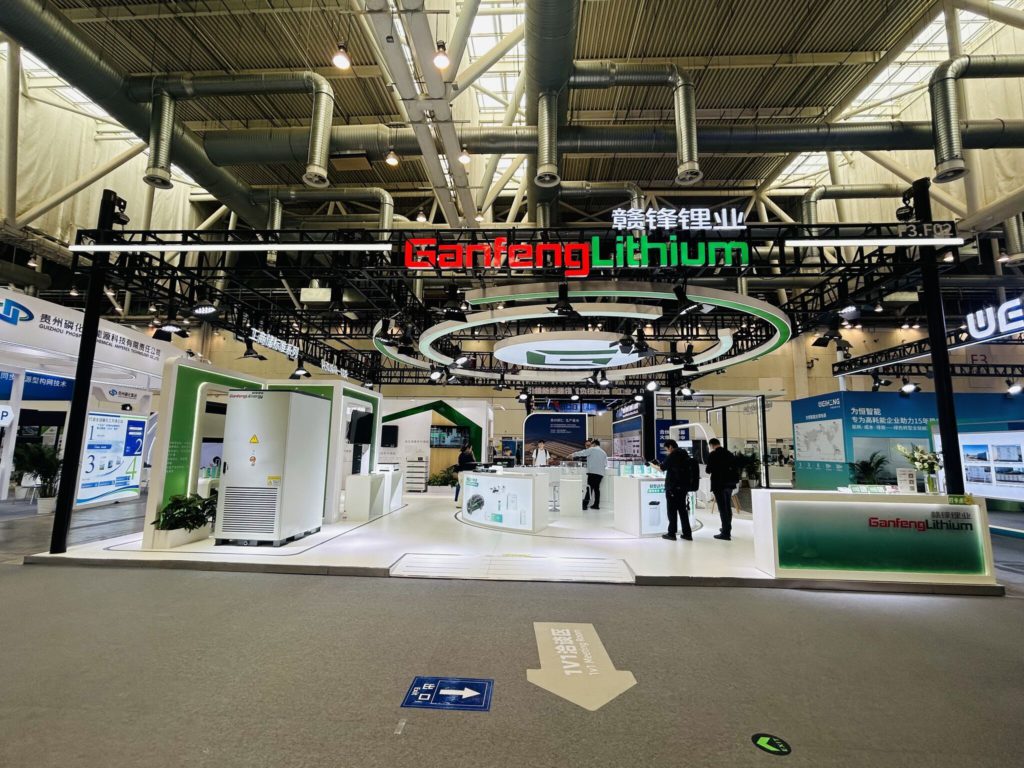
Ganfeng Lithium says it may face insider-trading charges


Ganfeng Lithium Group Co., a major Chinese producer of the battery material, said it faces possible charges related to an ongoing insider-trading case.

The company’s operations, mainly in Jiangxi province, are continuing as normal and are not likely to be affected by the case, Ganfeng said in a filing to the Shenzhen Stock Exchange on Monday evening. The company’s shares fell as much as 5.8% in Hong Kong on Tuesday.

A public prosecutor will review the charges after police in the city of Yichun – a major lithium-mining hub – transferred the case, according to the filing. In 2024, Ganfeng was fined 3.32 million yuan ($473,880) for insider trading by the China Securities Regulatory Commission.

The company, among the world’s biggest lithium producers, said it had rectified the issues raised last year. In a statement published in July 2024, Ganfeng said it had traded shares of Jiangxi Special Electric Motor Co. in 2020 using insider information, resulting in illegal gains of 1.1 million yuan.


Indonesia's Sea Lanes Give it Strategic Leverage Over China

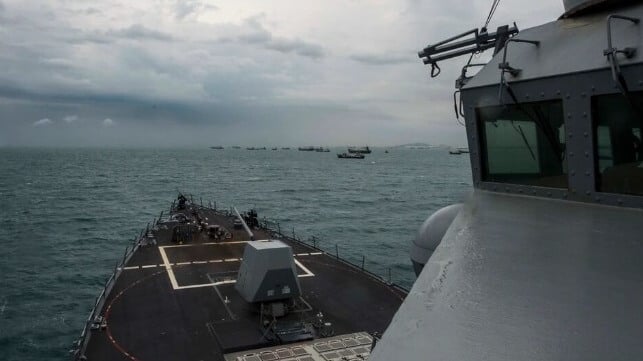
USS Sampson transits the Strait of Malacca (USN file image)

Published Jan 4, 2026 2:02 PM by The Strategist


[By Alfin Febrian Basundoro and Trystanto Sanjaya]

The power dynamic between Indonesia and China is more complex than the one-way economic dependence that some experts assume, since China depends on Indonesian waters for ships carrying its exports and imports between the South China Sea and Indian Ocean.

If the United States blockaded China in response to an invasion of Taiwan, for example, continued access through the Malacca Strait and Indonesia’s archipelagic waters would be vital to the Chinese economy. To maintain this access, Beijing must preserve Jakarta’s goodwill.

This means Jakarta has considerable latitude in confronting Beijing’s intransigence in the part of the South China Sea where China’s nine-dash line intrudes on Indonesia’s exclusive economic zone. Jakarta does not need to worry much about offending Beijing to preserve its economic relations with China.

This power dynamic has already been tested. In 2016 and 2017, Jakarta took a hard line on illegal fishing by Chinese fishing vessels, detaining and scuttling captured Chinese fishing vessels and, on one occasion, opening fire on a Chinese vessel. This all occurred in the part of the EEZ that China vaguely claims, waters that Indonesia calls the North Natuna Sea.

Despite this action, trade between the two countries kept rising. Indonesian exports to China were worth US$16.79 billion in 2016 and US$27.13 billion in 2018, while its imports from China increased by 50 percent in the same time period, from US$30.8 billion to US$45.84 billion.

The reason, clearly, was the unequivocal economic importance of continued access through Indonesian sea lanes. Ships going to Europe, the Middle East and Africa from China, and vice versa, need to pass through the Malacca Strait, between Indonesia and Malaysia, or the Sunda, Makassar and Lombok straits within the Indonesian archipelago. In 2023, 53 percent of China’s energy imports, those from the Middle East, passed through the Malacca Strait or wholly Indonesian waters. China’s dependence on the Malacca Strait alone is so severe that two-thirds of all Chinese maritime trade (by value) needs to passes through it, while shipping lines send other ships through the archipelago.

If these routes were blocked, vessels traveling to China from the Indian Ocean could only take a much longer route south and east of Australia and through the Pacific Ocean, or queue to get through the narrow Malaysian side of the Strait of Malacca, which they would congest. Both alternatives would disrupt China’s trade.

China’s dependence on Indonesian waters would become even more acute if it tried to invade or blockade Taiwan and the US responded with a counterblockade. The Strait of Malacca and Indonesian archipelagic waters would be the main arenas for US attempts to strangle China’s maritime trade in the hope of punishing it and convincing it to abandon its Taiwan invasion. In fact, a US military planner told journalist Gideon Rachman, ‘If there was a war, that’s where we’d get ’em’. There is every possibility that the counterblockade operation would extend into Indonesian waters to completely block ships bound for China.

In such a scenario, Beijing would become dependent on Jakarta and, to a lesser extent, on Kuala Lumpur, to make concrete foreign policy decisions to prevent US counterblockade operations in their waters and to allow Chinese-bound ships to continue passing through. China’s goodwill towards Indonesia is therefore vital also for improving the chance that Jakarta would consider Chinese interests in wartime. Peacetime animosity, on the other hand, would help push Jakarta into Washington’s orbit.

AI has contributed no ideas to this article. Alfin Febrian Basundoro is a junior lecturer of international relations at Universitas Airlangga in Surabaya, Indonesia. Trystanto Sanjaya is a visiting fellow at the Norwegian Institute of International Affairs in Oslo.

This article appears courtesy of The Strategist and may be found in its original form here

The opinions expressed herein are the author's and not necessarily those of The Maritime Executive.


Indonesia's Sea Lanes Give it Strategic Leverage Over China

USS Sampson transits the Strait of Malacca (USN file image)

Published Jan 4, 2026 2:02 PM by The Strategist


[By Alfin Febrian Basundoro and Trystanto Sanjaya]

The power dynamic between Indonesia and China is more complex than the one-way economic dependence that some experts assume, since China depends on Indonesian waters for ships carrying its exports and imports between the South China Sea and Indian Ocean.

If the United States blockaded China in response to an invasion of Taiwan, for example, continued access through the Malacca Strait and Indonesia’s archipelagic waters would be vital to the Chinese economy. To maintain this access, Beijing must preserve Jakarta’s goodwill.

This means Jakarta has considerable latitude in confronting Beijing’s intransigence in the part of the South China Sea where China’s nine-dash line intrudes on Indonesia’s exclusive economic zone. Jakarta does not need to worry much about offending Beijing to preserve its economic relations with China.

This power dynamic has already been tested. In 2016 and 2017, Jakarta took a hard line on illegal fishing by Chinese fishing vessels, detaining and scuttling captured Chinese fishing vessels and, on one occasion, opening fire on a Chinese vessel. This all occurred in the part of the EEZ that China vaguely claims, waters that Indonesia calls the North Natuna Sea.

Despite this action, trade between the two countries kept rising. Indonesian exports to China were worth US$16.79 billion in 2016 and US$27.13 billion in 2018, while its imports from China increased by 50 percent in the same time period, from US$30.8 billion to US$45.84 billion.

The reason, clearly, was the unequivocal economic importance of continued access through Indonesian sea lanes. Ships going to Europe, the Middle East and Africa from China, and vice versa, need to pass through the Malacca Strait, between Indonesia and Malaysia, or the Sunda, Makassar and Lombok straits within the Indonesian archipelago. In 2023, 53 percent of China’s energy imports, those from the Middle East, passed through the Malacca Strait or wholly Indonesian waters. China’s dependence on the Malacca Strait alone is so severe that two-thirds of all Chinese maritime trade (by value) needs to passes through it, while shipping lines send other ships through the archipelago.

If these routes were blocked, vessels traveling to China from the Indian Ocean could only take a much longer route south and east of Australia and through the Pacific Ocean, or queue to get through the narrow Malaysian side of the Strait of Malacca, which they would congest. Both alternatives would disrupt China’s trade.

China’s dependence on Indonesian waters would become even more acute if it tried to invade or blockade Taiwan and the US responded with a counterblockade. The Strait of Malacca and Indonesian archipelagic waters would be the main arenas for US attempts to strangle China’s maritime trade in the hope of punishing it and convincing it to abandon its Taiwan invasion. In fact, a US military planner told journalist Gideon Rachman, ‘If there was a war, that’s where we’d get ’em’. There is every possibility that the counterblockade operation would extend into Indonesian waters to completely block ships bound for China.

In such a scenario, Beijing would become dependent on Jakarta and, to a lesser extent, on Kuala Lumpur, to make concrete foreign policy decisions to prevent US counterblockade operations in their waters and to allow Chinese-bound ships to continue passing through. China’s goodwill towards Indonesia is therefore vital also for improving the chance that Jakarta would consider Chinese interests in wartime. Peacetime animosity, on the other hand, would help push Jakarta into Washington’s orbit.

AI has contributed no ideas to this article. Alfin Febrian Basundoro is a junior lecturer of international relations at Universitas Airlangga in Surabaya, Indonesia. Trystanto Sanjaya is a visiting fellow at the Norwegian Institute of International Affairs in Oslo.

This article appears courtesy of The Strategist and may be found in its original form here

The opinions expressed herein are the author's and not necessarily those of The Maritime Executive.


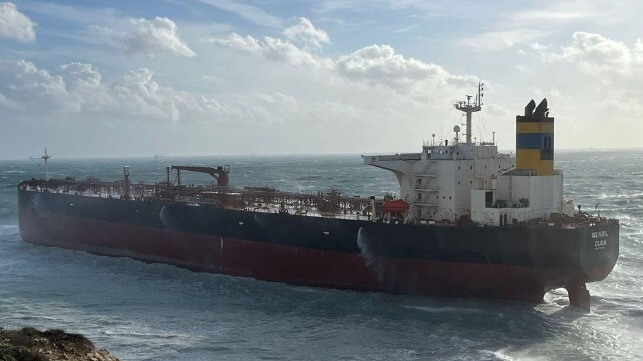
Sanctioned Oil Tanker Goes Aground on the Rocks in Aegean

Qendil
Handout photo courtesy KEGM

Published Jan 4, 2026 2:50 PM by The Maritime Executive


A tanker has run aground off the coast of Bozcaada, Turkey, prompting a large-scale emergency response. 

According to Turkish maritime safety agency KEGM, the 250-meter tanker Qendil was en route from Aliaga to Yalova when it drifted onto a rocky shore at Bozcaada (Tenedos), a scenic island in the Aegean just south of the Dardanelles. The area is popular with tourists and filled with small islands, both Greek and Turkish-controlled. 

AIS data provided by Pole Star shows that Qendil went to anchor just southwest of the island on December 30, in about 40-50 meters of water. It held a relatively steady position at anchor through January 3. At approximately 1030 hours GMT on January 4, the ship departed her anchorage downwind for reasons as yet not known. She reached an unusual speed for a ship gone adrift - four knots - and came to rest about 100 meters offshore. Wind 

Two tugs, Kurtarma-10 and Kurtarma-16, have been dispatched to the scene to assist. 

No pollution or injuries have been reported. 

Qendil (IMO 9310525, ex names Spark, Oilstar, Ionia) is a 115,000 dwt oil tanker built in 2006. It is currently flagged in Oman, owned in India and managed by a firm in China.

Qendil's last PSC entry was made three years ago under previous long-term ownership. In the intervening three years, the vessel has changed owners three times and registered under six different flags. The vessel's age, management, operating route and registration pattern align with Russia-serving shadow fleet participation, and it has been sanctioned by some (but not all) allies of Ukraine. 

According to OpenSanctions,the ship was formerly part of the sanctioned Oceanix Management FZE fleet and the former Gatik Ship Management fleet. It has itself been sanctioned by Canada, Australia, Switzerland and New Zealand. Ukraine has sanctioned both the vessel and its master, identified by the GRU as Russian national Andrei Chumakov. 

As Electricity Bills Rise, Activists Are Demanding Public Control of Utilities

“Public power” organizers are pushing for democratized control and truly public ownership of our energy system.
January 2, 2026

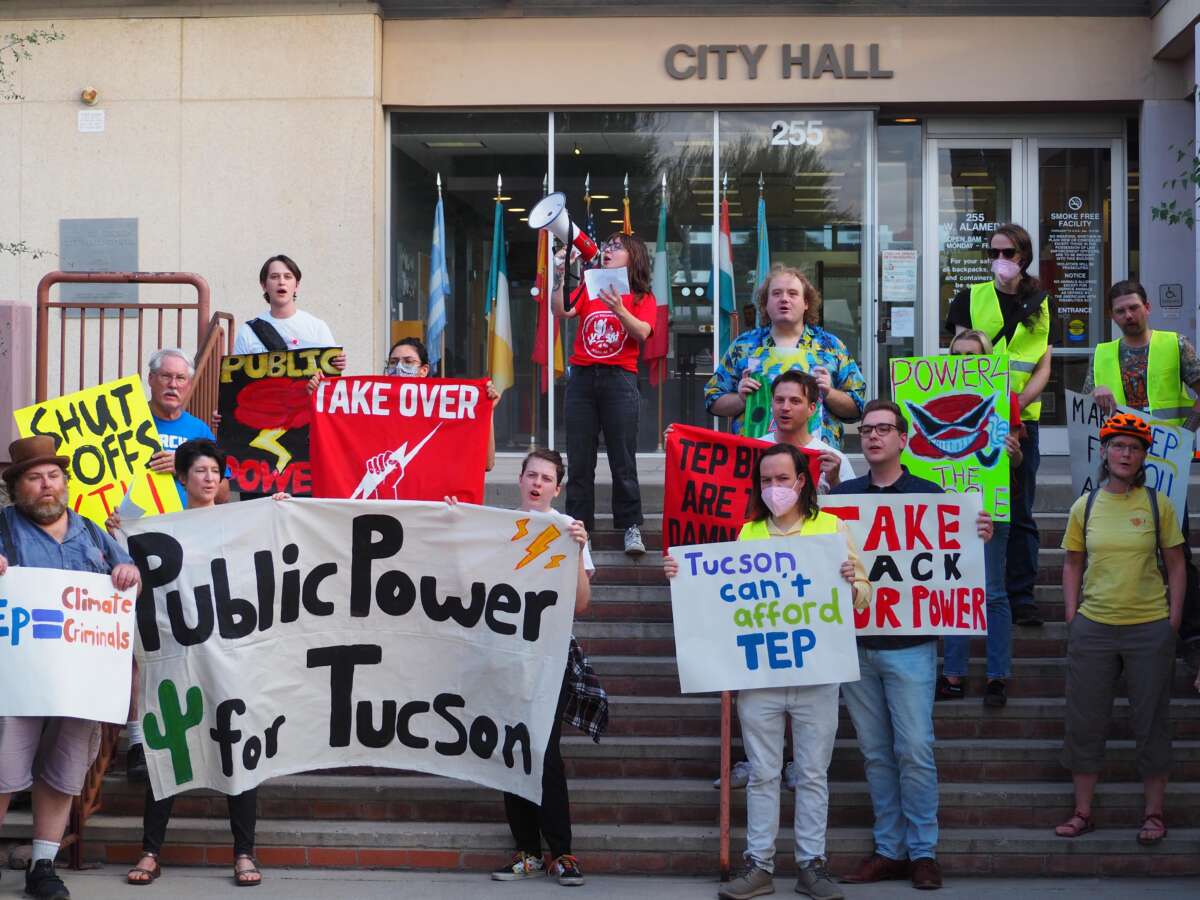
Community members rally at Tucson City Hall.Cameron Capara


Did you know that Truthout is a nonprofit and independently funded by readers like you? If you value what we do, please support our work with a donation.

Electricity bills for millions of utility customers are skyrocketing across the U.S. while the number of households facing extreme utility debt is mounting. Energy costs are being turbocharged by the AI data center boom, which is prolonging the burning of fossil fuels in the face of intensifying climate chaos. Overseeing all this is a powerful regime of investor-owned utilities that dominate our energy system. These for-profit corporations own and control the basic infrastructure we all depend on. Their executives and shareholders profit by raising electric rates or skimping on maintenance. And now, private equity firms are gunning for utilities.

But over the past few years, a vibrant movement for public power has emerged and grown.

Public power means public ownership and democratic control of our energy system. It’s an alternative to corporate-owned, profit-driven utilities. Public utilities in the U.S. are not new, and recent campaigns — from Tucson to Milwaukee, from San Diego to Ann Arbor — seek to expand and improve on this precedent, creating a truly democratic public utility system that serves human needs over profits. A notable victory for public power came with the 2023 passage of New York’s Build Public Renewables Act, and a campaign for public power in New York’s Hudson Valley has been gaining momentum.

Public power means public ownership and democratic control of our energy system. It’s an alternative to corporate-owned, profit-driven utilities.

This Truthout roundtable explores what public power means and why it’s needed, how it intersects with other issues and struggles, organizing lessons from ongoing campaigns, and more. Lee Ziesche is a climate justice organizer, co-chair of the Tucson Democratic Socialists of America (DSA), and a core organizer in Tucson’s public power campaign. She was also involved in Public Power NY’s successful campaign to pass the Build Public Renewables Act. Matt Sehrsweeney is a climate justice organizer and Metro DC DSA member who co-chairs We Power DC, Washington, D.C.’s campaign for public power. Sandeep Vaheesan is the author of the recently published book Democracy in Power: A History of Electrification in the United States and the legal director at the Open Markets Institute.

This roundtable has been lightly edited for length and clarity.


Derek Seidman: What is public power? Why’s it worth fighting for?

Matt Sehrsweeney: The priorities of investor-owned utilities (IOUs) are fundamentally at odds with those of rate payers. IOUs are obligated to maximize their profits for their shareholders, which usually means raising rates as high as possible. Operating a crucial service like providing electricity as a profit-seeking business leads to terrible outcomes for rate payers. In D.C., nearly a quarter of households are in debt to Pepco, their utility.

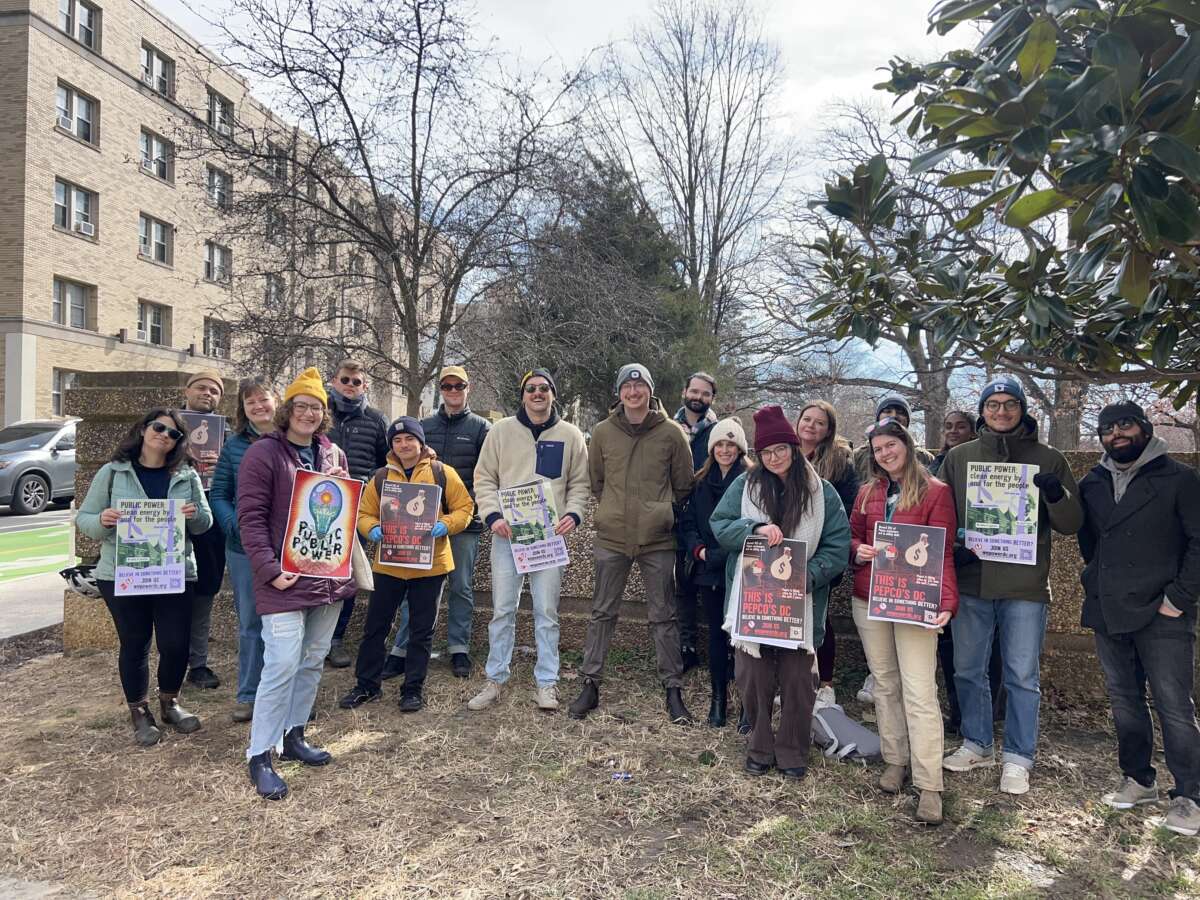
We Power DC organizers put up posters to spread the word about their campaign.
Matt Sehrsweeney

Publicly owned and operated utilities, on the other hand, are more accountable to the needs of communities and can better prioritize things like more affordable rates and reliable service. There’s also IOUs’ reliance on fossil fuels. If we want to address the climate crisis at the speed that is necessary, we need utilities that are responsive to climate goals.

Sandeep Vaheesan: Electricity is an essential service. It’s hard to imagine modern life without electricity. Given this, it’s quite odd that the financial sector and shareholders have so much power over our electricity. In the U.S., about three out of four power customers are served by an investor-owned utility. These private monopolies prioritize profits, which is antithetical to high quality, affordable, and clean electric service.

Public power offers a more promising path where public service is truly front and center. Publicly owned utilities are focused on high quality, affordable, and sustainable electricity. They’re not pressured to deliver big profits to shareholders. Public power also offers community control over things like rate design and infrastructure siting and ways to get to net zero. Public power offers the promise of bringing a more systemic, holistic approach to decarbonization.

Why is public power a core struggle for the left specifically?

Lee Ziesche: Public power is a way to actually improve the lives of working-class people. Electric bills are absurd. People are racking up debt. This is a chance to show people that socialism can work. We’ve talked to many people who aren’t socialists but whose bills are so high that they’re ready to support a socialist solution. We can prove that a public good can serve the people and be more affordable.

It makes no sense that profit-seeking corporations own the poles and wires that bring electricity into our homes. People need electricity to survive, especially in places like Tucson, where we have extreme heat. It should be a public good. That’s what public power is all about.

Sehrsweeney: These campaigns also represent an attempt to expand small-d democracy in our everyday lives. It’s about enhancing local democratic control over everyday institutions that provide basic public services. Expanding democracy is a huge part of the project of the left.

What are some important lessons you’ve learned from campaigning for public power?

Sehrsweeney: Harnessing peoples’ latent anger against utilities is crucial. People are fed up with rising electricity bills. Here in D.C., we’ve seen Pepco’s profits skyrocket. People are pissed off. Capitalizing on that anger has been a key part of our campaign.


“It’s not a natural fact of life that our bills have to go way up. Our government should be intervening to prevent these rate hikes.”

Politicizing rate hikes has been an entry point for getting people involved. It’s not a natural fact of life that our bills have to go way up. Our government should be intervening to prevent these rate hikes. We’ve pressed regulators and politicians to do their job. Rate hikes have been an important organizing site for us.

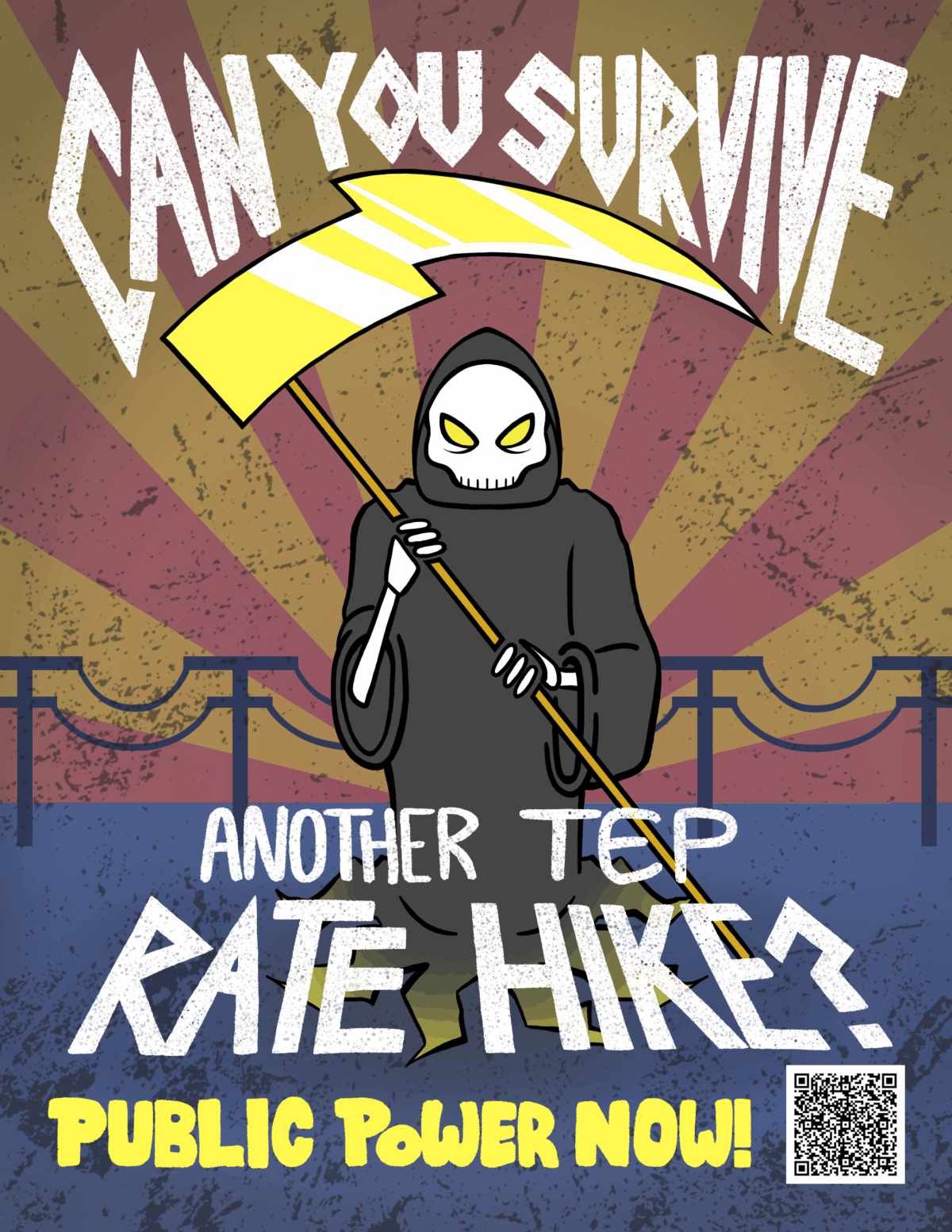
Ziesche: We’re also doing that in Tucson. Tucson Electric Power (TEP) filed for another rate hike this summer, so we put up posters around town featuring a grim reaper that say “Will you survive another TEP rate hike?”

Poster designed by Trisha Smith

Be prepared to talk to a lot of people about their electric bills. Anytime there’s a major festival we’re out talking to people or asking them to sign a petition.

You should also be ready to make politicians a little uncomfortable. You have to build the power to challenge them and, if necessary, primary politicians who aren’t on board. DSA chapters waged multiple primary challenges across New York State, and we’ve done the same here in Tucson. When we were out door-knocking for Sadie Shaw, we also talked about public power. Our politicians often have cozy relationships with these powerful utilities. You need to build a big enough base to get elected officials on your side.

The public power campaign in New York was really impressive. What lessons did you take from it?

Ziesche: We built a huge statewide coalition that reflected all of New York to win the Build Public Renewables Act. A lot of the organizing originated from DSA chapters, and we got environmental justice groups and labor on board. We really built a massive movement. Thousands of people did things like submitting comments or calling the governor when we needed it.

We primaried elected officials and also challenged them in creative ways that made them incredibly uncomfortable. We made gigantic Venmo boards showing the donations that elected officials received from utilities or fossil fuel companies.

Can you talk about how the fight for public power intersects with struggles for racial and housing justice?

Sehrsweeney: In D.C., the parts of the city hardest hit by rising electricity prices and energy shut offs are predominantly Black, poor and working-class wards. Over 50 percent of Pepco’s low-income customers are in utility debt. The burden of energy injustice falls most acutely on Black and Brown communities and people facing housing insecurity. The folks most likely to be evicted are also the folks most likely to face energy shut offs.

Ziesche: Our public power campaign in Tucson merged this summer with a fight against a massive Amazon data center. Our city voted against it, but TEP is moving forward with it anyway. We know that Amazon Web Services works with Palantir to target immigrants. We have this potential monster being built in the Sonoran desert where we have almost no water. This will send our electricity through the roof and could be used to target immigrants in our community. [Note: Since this interview was conducted, Amazon pulled out of the data center project, though developers are still trying to advance it.]

Community members march to Tucson Electric Power headquarters in downtown Tucson, Arizona. Cameron Capara

We’ve also done multiple events with the Tucson Tenants Union. They have members who lose housing because they can’t afford their electric bills. Overall, we’re trying to approach our organizing more like a tenants union. How do we actually build enough power together as customers? If TEP won’t sell us back our grid at a fair price, maybe the people of Tucson can go on a bill strike and collectively stop paying our bills.

What about public power campaigns and the labor movement?

Vaheesan: The relationship between labor and public power campaigns is tricky and challenging. Most unionized workers in the power sector are represented by the International Brotherhood of Electrical Workers (IBEW), which tends to have a more conservative outlook that doesn’t necessarily embrace alternative forms of ownership. In the U.S. today, it’s also better to be a member of a private sector union than a public sector union, which often have no right to strike and now have a harder time collecting dues.

But I think these challenges can be overcome. Investor-owned utilities are under shareholder pressure to increase profits through rate hikes and cutting costs. This will become more acute as private equity enters the utility industry on a large scale. They are going to cut wages and benefits and rely more on outside contractors. The good wages and benefits that many power industry workers have long enjoyed are poised to change.

There’s an opportunity for public power campaigners to make the case to unions that public ownership shouldn’t be seen as a threat. Public power can actually be a way of maintaining and even improving the standards for workers and their unions. Further, public ownership offers the opportunity for real economic democracy, where not only communities, but the workers of the utility themselves, have a say in how the enterprise is run.

Ziesche: In New York, getting labor, especially the IBEW, to a neutral position was important, and they actually now support building renewable public energy. You need to figure out how to structure your campaign and public utilities to not hurt labor.

What are some major challenges you’ve faced? What do you wish you knew when you started out organizing that you know now?

Sehrsweeney: The goal of public power can also feel unattainably large. So you need to break things down into steps toward long-term goals. Maybe that’s opposing a data center or organizing against a rate hike. Building towards long term goals with reforms that put power back into the hands of the people is crucial.
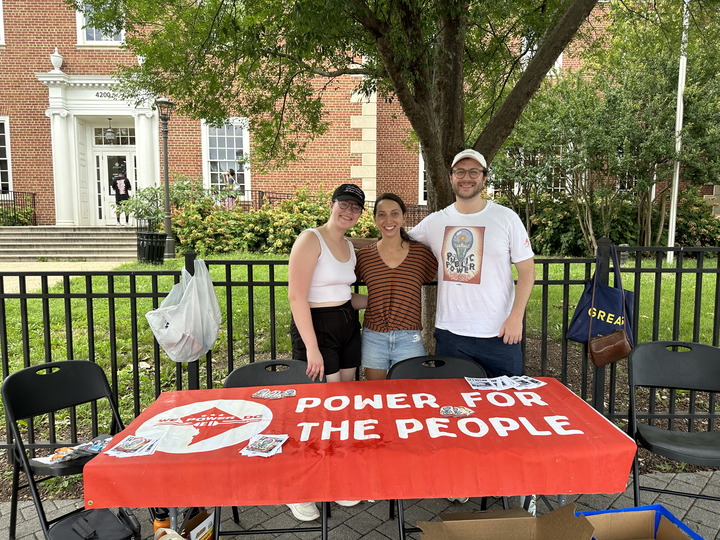
We Power DC organizers set up a table at a community event to talk to neighbors about their issues with Pepco, Washington, D.C.’s electric utility.
Matt Sehrsweeney

Figuring out how to translate these wonky issues into something that people can understand is also important. Be prepared to talk to people about their utility bills, because that’s one of the best entry points. We recently produced a white paper report on municipalization in D.C. that goes through how Pepco has failed people and has recommendations on how a public utility would be better. This study built our credibility and made legislators take us more seriously. It’s also been a good political education tool for our coalition partners and for lawmakers.

Ziesche: We are 100 percent volunteer-run, so building the capacity to take on a gigantic corporation is a challenge. We have to be our own experts and do our own research. It’s also a challenge to get taken seriously when you’re first starting out. Public power seems like a radical thing to some people. But this is actually the common sense solution. You need to explain that.

Vaheesan: The resource issue is a major obstacle to successful public power efforts, which entail taking on some of the most powerful corporate interests. On one side, you have investor-owned utilities with tens of millions of dollars to spend against municipalization, and on the other side you have a small group of hard working, dedicated volunteers who are also badly outgunned.

Also, power systems are complex and highly technical. There’s a lot of jargon. It’s easy for investor-owned utilities to say this is simply too hard for ordinary people to understand. We saw this in Maine in 2023. We need to hammer home that public utilities are a well-established institutional form. Around 54 million people in the U.S. get their electricity from publicly owned utilities. When you factor in consumer-oriented rural electric cooperatives, you’re talking about 100 million people. It’s a proven model, and we need to keep repeating that.

What’s making you feel hopeful or optimistic right now?

Sehrsweeney: At a time when the federal landscape for climate policy is so bleak, it makes sense for organizers to focus locally. Also, in addition to promoting energy justice, the fight for public power advances democracy by putting power into the hands of regular people and bringing them into the democratic project.

Vaheesan: I feel a renewed sense of possibility because of what’s happening in places like D.C. and Tucson and the mid-Hudson Valley. After many decades, public power is on the agenda again. This is a real moment of opportunity to push for public power at the state and local level and to lay the groundwork for eventual federal support. The energy affordability issue is not going away. Rate increases of 15 percent or 20 percent are becoming common. If we’re serious about energy justice and affordable rates, building public power is really the only way forward.

Tucson community members rally on Earth Day for public power after feasibility study results were released showing a public power utility would save customers hundreds of dollars.  Vivek Bharathan

Public power used to be the stuff of popular politics. If we do the organizing, advocacy, and public education now, we could be in a good position in three to five years to push for a major expansion of public power again.

Ziesche: When we’re out there talking to people, they’re so grateful that we’re taking on this fight. Those conversations give me a lot of hope.

Also, those of us waging different public power fights are getting connected nationally as a movement. There’s a new organization, Public Grids, that’s bringing people together. This will help our individual fights. It’s incredibly hard to take on a gigantic corporation, but together we’re showing that the entire system across this country is not working. The unaffordability crisis around electricity is also being supercharged by the massive data center build out. We’re reaching a crisis point. It’s going to be clear to most people that this current system cannot continue.


This article is licensed under Creative Commons (CC BY-NC-ND 4.0), and you are free to share and republish under the terms of the license.

Derek Seidman is a writer, researcher and historian living in Buffalo, New York. He is a regular contributor for Truthout and a contributing writer for LittleSis.