Monday, January 05, 2026

AMERIKA

Fraud, Drugs, and Hope for 2026


January 5, 2026

Photo: Jeffrey St. Clair.

The year 2025 ends the way Donald Trump began his foray into politics: full-fledged, unapologetic racism. Team Trump is pushing his anti-Somali campaign for three big reasons.

First, insofar as he succeeds, it justifies his mass deportation. He has explicitly attacked Somalis as a people and imposed new bans on their entering the country. The immediate cause is that some were involved in committing fraud against government programs, sort of like white people. Remember, as Trump always says, no one knows more about fraud than he does. Anyhow, by highlighting and exaggerating the actual fraud committed by some Somalis in Minnesota, Trump is making the case for his deportation policy.

The second reason is that it is a weapon against Minnesota governor Tim Walz. Walz is a popular two-term governor running for re-election in November and a potential 2028 presidential candidate. By blaming Walz for the fraud, and also Biden, Trump is helping to build up the absurd image of Democrats corruptly coddling immigrants with government handouts. (The fraud was discovered and prosecuted under Biden.)

While this line is regularly pushed by Elon Musk and other whack jobs, it has little basis in reality. There is a long way between immigrants entering the country and then voting in elections. And contrary to what Musk keeps asserting, there are almost no instances of immigrants voting before they are citizens.

Furthermore, when immigrants do become citizens and vote, many vote Republican. According to a poll shortly before the 2024 election, Harris was beatingTrump by 15 percentage points among naturalized citizens. But in many important states the margin was considerably smaller: In Florida it was less than 12 points, in Texas less than 10, and in Michigan it was just 1.4 points. If the Democrats’ strategy is to bring immigrants into the country, so that a decade or so later they will give their candidates a modest voting margin, it doesn’t seem like a very smart one.

But tying Democrats to fraud committed by immigrants is a major Republican election theme. The Republicans will play this tune as often as possible.

The third reason for pushing the Somali fraud story is that it gets the Trump-Epstein scandal off the front pages. The Epstein story has been disastrous for Trump. While most of the country has long known he is a sleazy sexual predator, the Epstein story had been weaponized among his base as an account where Democrats were protecting child sex traffickers.

Now it is clear that Trump was good buddies with Epstein and is doing everything he can to block release of the documents and photos that prove this. That is hard to take for even many hard-core MAGA types. Anything Trump can do to change the topic is great for him and playing the racist card with Somalis seems an obvious route.

As far as the truth of the story, clearly there was fraud committed by people of Somali origin, which was being pursued and prosecuted under Biden, as in not protected. It is also almost certain that the Trumpers are hugely exaggerating the extent of the fraud.

For example, Trump-appointed First Assistant US Attorney Joe Thompson claimedthat more than $18 billion (roughly the current year’s Medicaid budget) in Medicaid payments since 2018 might have been fraudulent. This seems implausible for the simple reason that Minnesota’s per capita Medicaid spending is not obviously out of line with other states.

It spends somewhat more than red states like Ohio and Missouri, but considerably less than blue states like Massachusetts and New York. It would take a more thorough analysis of relative health care costs and the age distribution of the populations to say anything definitive about relative spending and the potential impact of fraud, but the headline numbers don’t make a clear case for widespread fraud.

As far as the credibility of the Justice Department in making claims about Somalis committing fraud in Minnesota, remember Pan Bondi said that she had the Epstein files on her desk back in February. We are now up to 5.2 million pages.

Trump Rx Is Not Likely to Save Us Money on Drugs

We all know that Trump likes boasting about he is bringing drug prices down 500 percent, 600 percent, 800 percent. As a practical matter, it doesn’t seem as though his negotiations with the drug companies are likely to produce substantial savings for almost anyone.

This is unfortunate, since we waste an enormous amount of money paying for drugs. We spent more than $730 billion this year on prescription drugs and other pharmaceutical products. That comes to more than $5,800 per household.

The really tragic part of the story is that drugs are almost invariably cheap to manufacture and distribute. If we paid for the research upfront, as we already do to the tune of $50 billion a year at NIH, we could sell the drugs without patent monopolies or related protections. In that case, we would likely spend around $150 billion a year if drugs were sold in a free market.

This would mean that doctors could prescribe the best drugs for their patients, without being concerned about the cost. And patients wouldn’t have to do GoFundMe’s to pay for their drugs.

Allowing drugs to be sold in a free market would also remove the enormous incentive for corruption, where drug companies lie about the safety and effectiveness of their drugs. The most extreme episode of this corruption was the opioid crisis, but it is always a problem.

Unfortunately, despite ranting about corruption in the pharmaceutical industry, RFK, Jr. seems determined to go the opposite direction. He is cutting back government funded research, making the country more dependent on patent monopoly supported research.

As far as Trump’s negotiations with the drug companies, we got the answer in the stock prices of the big drug companies. They have risen sharply over the last six months. Stock investors can often be irrational, but if they expect drug prices to be substantially lower in coming years. This would mean a substantial reduction in profits, the expectation of which surely would cause stock prices to plunge. Obviously, the big money folks don’t believe Trump has lowered drug prices by 1,000 percent.

In fact, Trump has arranged for a relatively small group of people, those who don’t have insurers or the government paying for their drugs, to get discounts. That’s a nice gesture, but TrumpRx duplicates services that already exist, including some discounts provided directly by the drug companies. But the important thing is that Trump got his name on something.

Hope on Climate in 2026

Many people were disappointed that the climate summit in Brazil last month didn’t lead to any serious commitments to reduce greenhouse gases. While this is disappointing, it should not be surprising. The petulant 10-year-old in the White House made it clear that he sees efforts to slow global warming as an act of aggression that could lead to retaliation.

Given this reality, it is understandable that government leaders would not want to put a target on their backs by making bold commitments on transitioning to clean energy. But what matters more than commitments, which are not binding anyhow, is what countries actually do. And here the story is very good.

The New York Times had a major article yesterday about how South Africa and other Sub Saharan countries are rapidly adopted solar power. This is not a matter of policy, rather it is now the cheapest most reliable form of energy available. That is now the story in much of the world.

There is a similar story with electric vehicles. Close to 60 percent of new cars sold in China are now electric and in some developing countries the share is even higher. Chinese EVs are now much cheaper to buy and operate than fossil fuel powered cars. People who want to save money will buy EVs, regardless of their feelings about global warming. It is only high protectionist barriers that keep them out of the US market.

It would be good if the United States were leading the transition to clean energy, but Trump is doubling down on the horse and buggy industry at the dawn of the automobile age. That’s bad news for our economy, but it is good news that China has stepped up to take the lead.

And if we’re being serious, cheap electricity and cars are worth a thousand times more than vague unenforceable commitments at climate summits. The transition may still not go fast enough to prevent major damage to the planet, but at least things are turning in the right direction.

Will US Democracy Survive 2026?

Ultimately that is the biggest question to be answered in the year ahead. There are definitely some encouraging signs. The huge Democratic shift in pretty much all the elections and special elections in 2025 is a big deal. If that persists into the fall, the Democrats will retake the House by a large margin, and possibly the Senate as well.

We are also seeing more people willing to stand up to the Trump clown show, starting with some prominent Democratic politicians, like governors Pritzker and Newsom, and even late night comedians like Stephen Colbert and Jeffrey Kimmel. And the No Kings marches have been some of the largest days of protest in the country’s history.

Perhaps most importantly, it looks like the MAGA gang may be breaking up. Some of the people who just want tax cuts are getting a bit disgusted with the open racism, antisemitism, and outright craziness of the hard-core MAGA types. It’s too early to know whether this will cause a full-fledged split, but the signs are promising. No one wants to be on the losing team, and if we have fair elections next fall, Team Trump looks like a big loser.

Dean Baker is the senior economist at the Center for Economic and Policy Research in Washington, DC. 


Captain America for Sale: $72 Billion


Nika Dubrovsky


January 5, 2026


On 5 December 2025, Netflix announced it would buy Warner Bros — including the film studio, TV studio, HBO, HBO Max, and the entire DC Comics universe — for $72 billion. The deal is expected to close, despite interest from Paramount, in the third quarter of 2026.​

Everyone is talking about higher subscription fees, tighter political censorship, and monopoly. All of that matters, of course, but none of it is the main story.​

Dream factory as political institution

From its inception, Hollywood has been, above all, a dream factory; and, precisely in this capacity it has functioned as one of the key political institutions of the twentieth century, far more significant than most parliaments or universities. This factory’s production was less about stories as about desires, habits of dreaming in a certain pattern, images of the future, of love, of freedom, of what it might mean to “really live.”​

Unlike today’s platform feudalism, early Hollywood functioned as almost the opposite of an aristocracy. It was a club of shtetl kids, small traders, circus and circus people and carnies running what was then considered to be something halfway between a sideshow and a cheap thrill. Movie theaters were treated roughly the way circuses were: migrants congregated there, workers too; people with no political voice went to the movies, and, for the first time, they were invited to imagine themselves as the protagonists.​

It is no coincidence that one of the very few genuinely popular geniuses of silent comedy, the working-class south Londoner Charlie Chaplin, was eventually officially kicked out of the self‑styled “citadel of freedom” for his subversive beliefs. States tend to understand very quickly that a factory that produces laughter can also become a factory of dangerous ideas.​

Compared with Soviet Socialist Realism this paradox is almost insulting. Censors in Moscow or Warsaw could endlessly rewrite scripts and ban “ideologically harmful” films, but when it came to manufacturing actual desires they remained minor players. Politburos and Volkskammers produced pale, over-administered versions of the “aspirations of the masses,” while the masses themselves preferred to watch Hollywood action films and sugary melodramas across the globe. it was Hollywood that calibrated the world’s desires: a brand selling imagination as a commodity, drilling to perfection plots of success, heroism, and catastrophe.​

Unlike the Soviet system, Hollywood often operated closer to the realm of magic and rarely openly impose ideology. It created procedural rituals by which human biographies were rewritten into genre formats: I’m not just living. I’m in the third act of my biopic. Hence the peculiar power of even the most formulaic teen drama: it offers a script for turning pain, awkwardness, and excessive sensitivity into a story, thus making that pain bearable.​

News of Hollywood’s impending demise therefore sounds to many of us more alarming than chatter about stock market crashes. A market crash is just a reshuffling of numbers in an abstract system; a year later, the indices maybe rising again, as it is a controlled game. The collapse of an institution that, for decades, offered the planet a coherent vision of the future and a participatory dramatization of the relationship  between “desire – technology – progress” comes as a blow to the very capacity to imagine a radically different world. The technology of producing dreams may have served Western empire more reliably than aircraft carriers and missile silos.​

What Netflix is buying: total bureaucratization

Netflix, a company that started in 1997 by mailing DVDs to subscribers, now owns one of the most iconic film studios in cinema history. It controls a century of Warner Brothers films — from Casablanca and The Wizard of Oz to late‑model blockbusters, to the comic franchises Batman, Superman, Wonder Woman, and the entire DC superhero universe. It owns the Harry Potter franchise. It owns the prestige back catalog of HBO too: Game of ThronesThe SopranosThe Wire.​

Warner is the same studio that once offered audiences worldwide theatrical heroes saving the world on a big screen, born from a time when movies were cultural events, not algorithmically optimized binge “content”. Its characters were more than simply entertainment; they embodied ideals, dreams, and the myth of American exceptionalism.​ Now, they have been rebadged as IP assets in a streaming portfolio, evaluated in terms of retention metrics and franchise‑development potential. Expect endless sequels to sequels. Captain America 502, Part 48, Subsection 4: The Codicil War.​

How we arrived here follows a pattern. Like universities and NGOs, Hollywood was long ago pulled into a regime of totalized bureaucratization: the shift from production to finance, from experiment to compliance. In such a system the only truly rational strategy is to make pre‑tested   “sequels” and “threequels” for predictable returns, to hire actors who are easy to insure and easier to replace, and to minimize any inconvenient imaginings that cannot be quantified on a spreadsheet.​

Just as late‑Soviet nomenklatura ran cultural output through directives from above, late‑capitalist studios run the imagination itself through budgets and quarterly reports. The only fundamental difference is the letterhead: one bureaucracy used Central Committee forms, the other uses investor slide decks.​

In this respect Hollywood’s downfall does indeed resemble the death of the late-stage USSR. All decisions about what counts as “art” are made by people personally terrified of risk; the outcome is almost guaranteed: endless continuations, familiar, safe faces on screen, and the quiet extinction of surprise. Soviet officials at least openly called themselves censors. Today the flattening is attributed to disembodied “market analytics”.​

An accidental herald of multipolarity

Before getting to the central irony, it is worth noting how Netflix, quite unintentionally, became a herald of a multipolar world.​

The streaming format — liberated from theatrical “windows” and rigid broadcast schedules — created a space for the strange and unexpected. Netflix started life as a niche service with a simple promise: watch what you want, when you want.​

That niche positioning blew open doors that the old studio system held firmly shut. Suddenly, national cinemas — films and series rooted in specific languages, histories, and cultural traditions, long confined to their domestic markets and festival circuits — found global audiences.  La Casa de Papel from Spain became a worldwide phenomenon. Lupinfrom France charmed viewers across continents. Dark from Germany acquired a dedicated cult. Indian films such as RRR and a wave of Korean cinema reached viewers who would never have encountered them via traditional distribution.​

The centralized, Anglophone Hollywood empire built the infrastructure for its own obsolescence. Netflix’s “watch what you want” model turned out to be ahead of the curve not only in terms consumer choice, but for the geopolitical shift away from American cultural hegemony. When people are allowed to choose freely, they do not always choose American stories. Often, they choose stories that dismantle American mythology.​

Squid Game and the magic circle of debt

Which leads us to Squid Game.

The 2021 Korean series became the most-watched show in Netflix’s history. Hundreds of millions watched desperate, indebted people forced to play children’s games to the death for the amusement of bored billionaire spectators placing bets on who would survive.​

With Squid Game, director Hwang Dong‑hyuk delivered a brutal critique of late capitalism. The series metaphorizes how a neoliberal economy traps people in unpayable debts, and how the promise of meritocracy masks a rigged game, as well as how the rich turn human suffering into spectacle. The show attacks the “American dream” narrative from the vantage point of South Korea, which had embraced neoliberal reforms after its 1997 IMF crisis.​

The structural background of the series is familiar. In late capitalism almost all money is someone’s future income, pre‑captured as debt. “Freedom” is defined by the degree to which one is allowed to own a slice of one’s own future exploitation. In that sense Squid Game is not really an allegory; it’s merely a narrativization of a world where people run in circles servicing interest payments while the rules are changed behind their backs.​

Netflix’s role is not simply to commodify criticism of itself, however. The platform ultimately turns the scenario into a recurring ritual. Viewers recognize their own lives in the games of debt all while validating the rent-seeking process, by maintaining their Netflix subscriptions — one more tiny tithe into the wider system.​

This fits neatly into the neo‑feudal picture Yanis Varoufakis sketches: digital platforms as new Lords of the Manor, skimming profits from other people’s labor, imagination, and reliance on platforms based on intellectual property. Netflix, like Amazon, no longer “produces” in the sense of the industrial economy. It simply builds fences around existing flows of creativity and attention, and converts these into private fiefdoms.​​

An immigrant club of fairground impresarios once made movies for workers and fellow migrants; that ecosystem has hardened into a digital manor house demanding rents on imagination itself. Critique of this circumstance has turned out to be more marketable than propaganda — and it comes from outside the American cultural core, proving that the multipolar world Netflix enabled is ready to tell very different stories.​

Now Netflix is buying the studio that created the Superman franchise, the supreme embodiment of American exceptionalism and heroic idealism. The company whose signature cultural product demolished the American dream now holds the primary franchise that existed to celebrate it.​​

Genre shift: from superheroes to debtors

Old Hollywood did not die solely from monopolistic mergers — though Marx would have reminded us that monopoly is the soul and natural endpoint of capitalism. In this case, monopoly plus political censorship (far from unknown in Hollywood) became the precondition for a change of genre.​

The epic universalism of the superhero — Captain America saves the world, Superman defends truth, justice, and the American way — has shattered into a kaleidoscope of local story‑streams. Streaming then ruthlessly separated the “mainstream” from everything else.​

Netflix’s acquisition strategy makes this rupture obvious: it buys mainstream-branded content, evergreen retro‑American franchises such as Captain America and exhausted IPs that have had their souls bled out through repetition. Managers plan to monetize these dried husks, squeezing out sequel after sequel.​​

Meanwhile, the real creative energy — the stories that actually seize the global imagination — comes from elsewhere. From Korean dramas about the violence of capitalism, from Spanish heists, from German time‑travel puzzles, and beyond. The universal superhero who saves everyone has been replaced by specific stories from specific places that somehow resonate universally because they speak honestly about power, suffering, and survival.​

Squid Game, therefore, is not just Netflix’s biggest hit; it is an obituary, and not only for Netflix’s own business model (which involves selling critique while embodying that which is being critiqued). It is also an obituary for Captain America, and for the United States.​

The end of a regime of imagination

One epochal systemic shift already took place in the 1970s: investment and technological imagination were consciously redirected from material space to informational space. Instead of flying cars and Mars bases we got interfaces, corporate reports, access codes, and an endless stream of series designed to persuade us we already live in the age of unprecedented technological wonder.​

The “death of Hollywood” is the formal acknowledgment that the dream factory is no longer a strategic sector. This is more significant than any crash in share prices, because it is not just another loop in the capital cycle; it signals a shift in the regime of the imagination. Where there was once a centralized machinery for generating stories, there remains a vast bureaucratic apparatus for managing data, credit, and security. The future ceases to be a stage to step onto and becomes a corridor where the only action available is filling out forms and awaiting algorithmic verdicts.​

The next step in the process is already under way: now, even centralized dream production becomes superfluous. It is more profitable to keep people in a state of fractured attention, perpetually oscillating between short clips, workplace interfaces, and debt obligations.​

Squid Game is not just Netflix’s biggest hit; it is an obituary for a specific vision of America—the hero who rescues the world, the nation that spreads freedom. But that vision was already dying long before a Korean series replaced it on the balance sheet. The dream factory had stopped producing dreams decades earlier.

Auctioning off the props

The figures tell the story: $72 billion in stock consideration, $82.7 billion in enterprise value, regulatory approvals pending, unions protesting, movie theater owners horrified. Paramount reportedly floated a $108 billion rival bid. Comcast also tried to get in. Netflix won.​

The underlying story is simpler. The most successful critique of capitalism in popular culture has come from within the machine. Netflix demonstrated that you can sell people explanations of their own exploitation, and they will pay for the privilege on a monthly basis.​

So perhaps we are not at a funeral so much as at a prop auction after an overlong show. The question is who will drag these costumes offstage, and for what future performance. A larger question remains, however:

Is there any collective capacity left to imagine something that is not a spectacle at all, but something altogether different?

Nika Dubrovsky is an artist and writer. She is the founder of the David Graeber Institute and the editor of Graeber books.


My Briefing to the UN Security Council Regarding US Aggression Against Venezuela


The issue before the Council is whether any Member State—by force, coercion, or economic strangulation—has the right to determine Venezuela’s political future or to exercise control over its affairs.


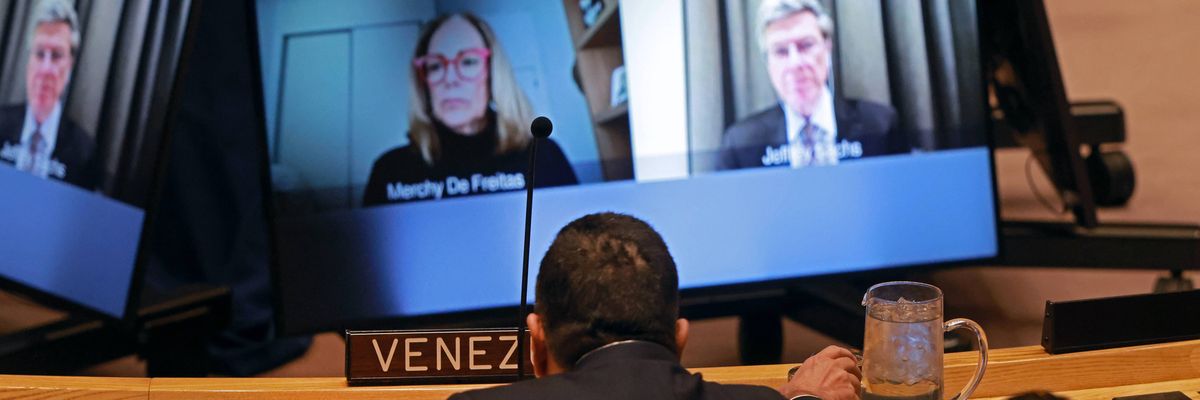
Samuel Reinaldo Moncada Acosta, the Permanent Representative of Venezuela to the United Nations arrives for a Security Council meeting at the United Nations ( concerning the situation in Venezuela on January 05, 2026 in New York City.
(Photo by Spencer Platt/Getty Images)

Jeffrey D. Sachs
Jan 05, 2026
Common Dreams


Common Dreams editor’s note: The following remarks, as prepared for presentation, were made by Jeffrey D. Sachs, president of the UN Sustainable Development Solutions Network and director of the Center for Sustainable Development at Columbia University, during an emergency meeting of the UN Security Council on Monday, January 5, 2026 in New York City.


Mr. President,
Distinguished Members of the Security Council,

The issue before the Council today is not the character of the government of Venezuela.

The issue is whether any Member State—by force, coercion, or economic strangulation—has the right to determine Venezuela’s political future or to exercise control over its affairs.

This question goes directly to Article 2(4) of the United Nations Charter, which prohibits the threat or use of force against the territorial integrity or political independence of any state.

The Council must decide whether that prohibition is to be upheld or abandoned.

Abandoning it would carry consequences of the gravest kind.

Background and context

Since 1947, United States foreign policy has repeatedly employed force, covert action, and political manipulation to bring about regime change in other countries. This is a matter of carefully documented historical record. In her book Covert Regime Change (2018), political scientist Lindsey O’Rourke documents 70 attempted US regime-change operations between 1947 and 1989 alone.

These practices did not end with the Cold War. Since 1989, major United States regime-change operations undertaken without authorization by the Security Council have included, among the most consequential: Iraq (2003), Libya (2011), Syria (from 2011), Honduras (2009), Ukraine (2014), and Venezuela (from 2002 onward).

The methods employed are well established and well documented. They include open warfare; covert intelligence operations; instigation of unrest; support for armed groups; manipulation of mass and social media; bribery of military and civilian officials; targeted assassinations; false-flag operations; and economic warfare aimed at collapsing civilian life.

These measures are illegal under the UN Charter, and they typically result is ongoing violence, lethal conflict, political instability, and deep suffering of the civilian population.

The case of Venezuela

The recent United States record with respect to Venezuela is clear.

In April 2002, the United States knew of and approved an attempted coup against the Venezuelan government.

In the 2010s, the United States funded civil society groups actively engaged in anti-government protests, notably in 2014. When the government cracked down on the protests, the US followed with a series of sanctions. In 2015, President Barrack Obama declared Venezuela to be “an unusual and extraordinary threat to the national security and foreign policy of the United States.”

In 2017, at a dinner with Latin American leaders on the margins of the UN General Assembly, President Trump openly discussed the option of the US invading Venezuela to overthrow the government.

During 2017 to 2020, the US imposed sweeping sanctions on the state oil company. Oil production fell by 75 percent from 2016 to 2020, and real GDP per capita (PPP) declined by 62 percent.

The UN General Assembly has repeatedly voted overwhelmingly against such unilateral coercive measures. Under international law, only the Security Council has the authority to impose such sanctions.

On 23 January 2019, the United States unilaterally recognized Juan Guaidó as “interim president” of Venezuela and on 28 January 2019 froze approximately $7 billion of Venezuelan sovereign assets held abroad and gave Guaidó authority over certain assets.

These actions form part of a continuous United States regime-change effort spanning more than two decades.

Recent United States global escalation

In the past year, the United States has carried out bombing operations in seven countries, none of which were authorized by the Security Council and none of which were undertaken in lawful self-defense under the Charter. The targeted countries include Iran, Iraq, Nigeria, Somalia, Syria, Yemen, and now Venezuela.

In the past month, President Trump has issued direct threats against at least six UN member states, including Colombia, Denmark, Iran, Mexico, Nigeria and of course Venezuela. These threats are summarized in Annex I to this statement.

What is at stake today

Members of the Council are not called upon to judge Nicolás Maduro.

They are not called upon to assess whether the recent United States attack and ongoing naval quarantine of Venezuela result in freedom or in subjugation.

Members of the Council are called upon to defend international law, and specifically the United Nations Charter.

The realist school of international relations, articulated most brilliantly by John Mearsheimer, accurately describes the condition of international anarchy as “the tragedy of great power politics.” Realism is therefore a description of geopolitics, not a solution for peace. Its own conclusion is that international anarchy leads to tragedy.

In the aftermath of World War I, the League of Nations was created to end the tragedy through the application of international law. Yet the world’s leading nations failed to defend international law in the 1930s, leading to renewed global war.

The United Nations emerged from that catastrophe as humanity’s second great effort to place international law above anarchy. In the words of the Charter, the UN was created “to save succeeding generations from the scourge of war, which twice in our lifetime has brought untold sorrow to mankind.”

Given that we are in the nuclear age, failure cannot be repeated. Humanity would perish. There would be no third chance.

Measures required of the Security Council

To fulfill its responsibilities under the Charter, the Security Council should immediately affirm the following actions:The United States shall immediately cease and desist from all explicit and implicit threats or use of force against Venezuela.
The United States shall terminate its naval quarantine and all related coercive military measures undertaken in the absence of authorization by the Security Council.
The United States shall immediately withdraw its military forces from within and along the perimeter of Venezuela, including intelligence, naval, air, and other forward-deployed assets positioned for coercive purposes.
Venezuela shall adhere to the UN Charter and to the human rights protected in the Universal Declaration of Human Rights.
The Secretary-General shall immediately appoint a Special Envoy, mandated to engage relevant Venezuelan and international stakeholders and to report back to the Security Council within fourteen days with recommendations consistent with the Charter of the United Nations, and the Security Council shall remain urgently seized of this matter.
All Member States shall refrain from unilateral threats, coercive measures, or armed actions undertaken outside the authority of the Security Council, in strict conformity with the Charter.

In Closing

Mr. President, Distinguished Members,

Peace and the survival of humanity depend on whether the United Nations Charter remains a living instrument of international law or is allowed to wither into irrelevance.

That is the choice before this Council today.

Thank you.


Jeffrey D. Sachs
Jeffrey D. Sachs is a University Professor and Director of the Center for Sustainable Development at Columbia University, where he directed The Earth Institute from 2002 until 2016. He is also President of the UN Sustainable Development Solutions Network and a commissioner of the UN Broadband Commission for Development. He has been advisor to three United Nations Secretaries-General, and currently serves as an SDG Advocate under Secretary-General Antonio Guterres. Sachs is the author, most recently, of "A New Foreign Policy: Beyond American Exceptionalism" (2020). Other books include: "Building the New American Economy: Smart, Fair, and Sustainable" (2017) and "The Age of Sustainable Development," (2015) with Ban Ki-moon.
Full Bio >