Monday, January 05, 2026


Can ancient viruses hidden inside bacteria defeat modern infections?


By Dr. Tim Sandle
SCIENCE EDITOR
DIGITAL JOURNAL
January 3, 2026


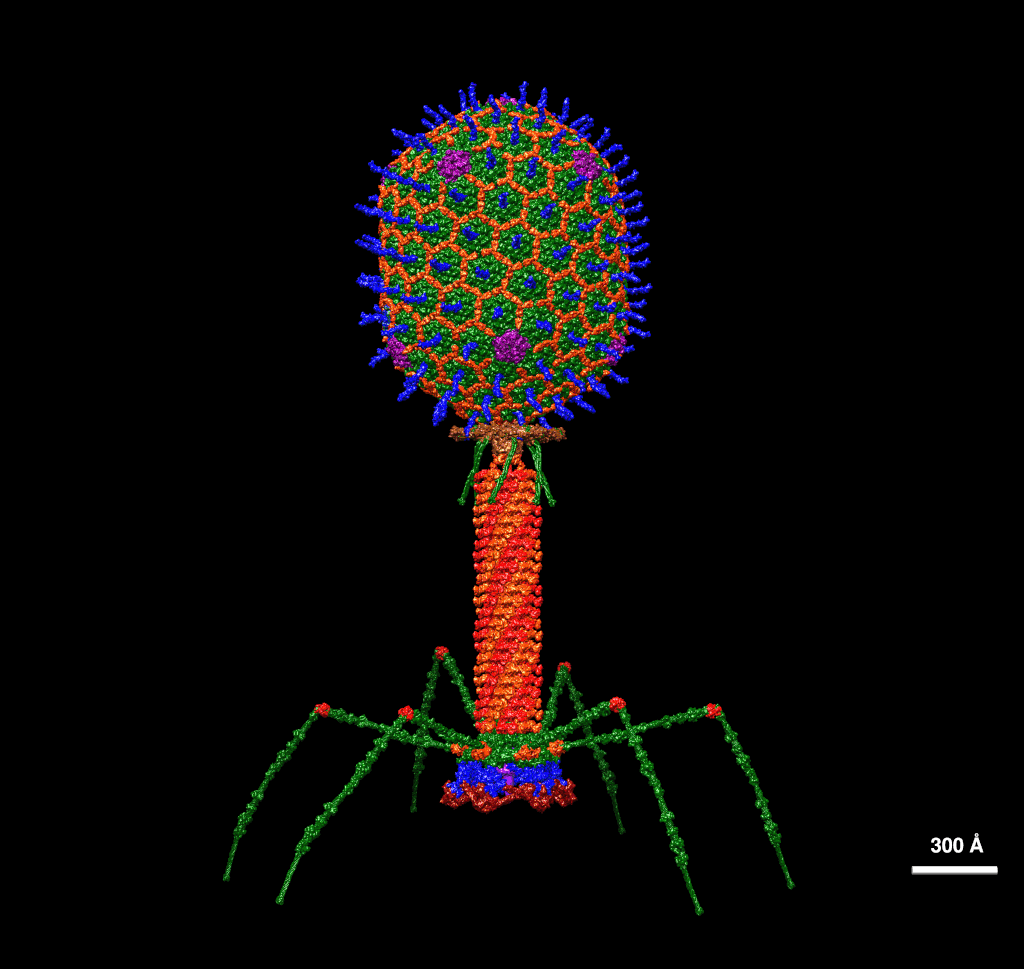
A bacteriophage is a virus that infects and replicates within bacteria. 
Image by Dr. Victor Padilla-Sanchez, PhD - Own work (CC BY-SA 4.0)

Scientists from Penn State have discovered an ancient defence where dormant viral DNA can help a bacterium to fight new viral threats. The enzyme PinQ flips bacterial genes to create protective proteins that block infection.

Understanding this mechanism could lead to breakthroughs in antivirals, antibiotic alternatives, and industrial microbiology.

Bacteria have been battling viruses for billions of years, evolving ingenious defence systems that may now hold the key to human antiviral strategies.

According to lead researcher, Thomas Wood, a professor of chemical engineering at Penn State: “There’s been a flurry of discoveries in the past few years related to antivirus systems in bacteria…Antibiotics are failing, and the most likely substitute is viruses themselves. Before using viruses as antibiotic replacements to treat human infections, however, we must understand how the bacterium defends itself from viral attack.”
Phages

Microbiologists have long known that ancient, inactive viruses known as cryptic prophages can insert their genetic material into bacterial DNA. These genetic fragments allow bacteria to use specialized enzymes and proteins to prevent new viruses – bacteriophages – from infecting the cell.

In this new study, researchers found that a protein called recombinase (an enzyme that cuts and reconnects DNA strands) can modify bacterial DNA in response to viral threats, but only if a prophage is already embedded in the genome. This recombinase acts as a rapid-response defender when the cell detects danger.

The specific recombinase identified in this system is known as PinQ. When a virus approaches the bacterial cell, PinQ triggers a DNA inversion, flipping a section of genetic code inside the chromosome. This change creates two “chimeric proteins” composed of DNA from the prophage itself. Together, these proteins — collectively called Stf — block the virus from attaching to the bacterial surface and injecting its genetic material.

As Wood explains: “It’s remarkable that this process actually produces new chimeric proteins, specifically from the inverted DNA — most of the time when you change DNA, you just get genetic mutations leading to inactive proteins. These inversions and adaptations are clear evidence that this is a fine-tuned antivirus system that has evolved over millions of years.”

Antimicrobials

The problem of antimicrobial resistance, a continuing phenomena with pathogenic bacteria, is well documented. Wood is of the view that viruses could offer a safer alternative because they target specific bacterial strains without harming others and evolve alongside their hosts.

Understanding this natural bacterial defence could help researchers harness it to develop more precise treatments and reduce antibiotic dependence.

Ancient defence mechanism

Although recombinase enzymes were previously detected near bacterial defence regions, this is the first study to show that they directly participate in virus defence.

To explore how this mechanism works, the scientists increased the production of Stf proteins in Escherichia coli bacteria and then introduced viruses to the sample. After leaving the mixture overnight, they measured its turbidity, or cloudiness, to see whether the viruses had successfully infected the bacteria. The cloudier the solution, the fewer active viruses remained.

The researchers also used computer models to simulate how viruses attach to bacterial surfaces, a process known as adsorption, confirming the accuracy of their simulations by comparing them to lab results.

“When we overproduce the protein, we initially stop the virus from landing on the cell surface,” Wood details. “After eight experimental iterations, however, the virus changes its landing proteins — how it identifies and attaches to the bacteria — and can get by this defence.”

Significance of the study


This research has improved scientific understanding of how antivirus systems operate. In turn, this can aid researchers to more effectively cultivate the bacteria used to ferment foods like cheese and yogurt, as well as improve how bacterial infections are managed in health care settings.

The study appears in the journal Nucleic Acid Research, titled “Adsorption of phage T2 is inhibited due to inversion of cryptic prophage DNA by the serine recombinase PinQ.”
Virtual museum preserves Sudan’s plundered heritage


By AFP
January 5, 2026


Sudan's national museum was plundered by looters at the start of the war in 2023 - Copyright AFP/File -

Destroyed and looted in the early months of Sudan’s war, the national museum in Khartoum is now welcoming virtual visitors after months of painstaking effort to digitally recreate its collection.

At the museum itself, almost nothing remains of the 100,000 artefacts it had stored since its construction in the 1950s.

Only pieces too heavy for looters to haul off, like the massive granite statue of the Kush Pharaoh Taharqa and frescoes relocated from temples during the building of the Aswan Dam, are still present on site.

“The virtual museum is the only viable option to ensure continuity,” government antiquities official Ikhlass Abdel Latif said, during a recent presentation of the project carried out by the French Archaeological Unit for Sudanese Antiquities (SFDAS) with support from the Louvre and Britain’s Durham University.

When the museum was plundered following the outbreak of the war between the regular army and the paramilitary Rapid Support Forces (RSF) in April 2023, satellite images showed trucks loaded with relics heading towards Darfur, the western region now totally controlled by the RSF.

Since then, searches for the missing artefacts aided by Interpol have only yielded meagre results.

“The Khartoum museum was the cornerstone of Sudanese cultural preservation — the damage is astronomical,” said SFDAS researcher Faiza Drici, but “the virtual version lets us recreate the lost collections and keep a clear record”.

Drici worked for more than a year to reconstruct the lost holdings in a database, working from fragments of official lists, studies published by researchers and photos taken during excavation missions.

Then graphic designer Marcel Perrin created a computer model that mimicked the museum’s atmosphere — its architecture, its lighting and the arrangement of its displays.

Online since January 1, the virtual museum now gives visitors a facsimile of the experience of walking through the institution’s galleries — reconstructed from photographs and the original plans — and viewing more than 1,000 pieces inherited from the ancient Kingdom of Kush.

It will take until the end of 2026, however, for the project to upload its recreation of the museum’s famed “Gold Room”, which had housed solid-gold royal jewellery, figurines and ceremonial objects stolen by looters.

In addition to the virtual museum’s documentary value, the catalogue reconstructed by SFDAS is expected to bolster Interpol’s efforts to thwart the trafficking of Sudan’s stolen heritage.

The war in Sudan has triggered a humanitarian catastrophe, killing tens of thousands and forcing more than 11 million people to flee their homes, with many seeking shelter in underdeveloped areas with scarce food and medicine.


Free civic space in France, Italy and Germany under increasing threat, new study finds


By Inês Trindade Pereira 
Published on 

These three countries, which are home to almost half of the EU's population, are now in the same category as Hungary for restrictions on civic space.

France, Germany and Italy are the three European Union countries experiencing a worsening environment for civil society, according to a report by CIVICUS, the global alliance of civil society organisations and activists.

All three member states were downgraded from "narrowed" to "obstructed" — the third-lowest of five possible categories.

The annual report tracks the state of freedom of association, peaceful assembly and expression in 198 countries and territories, rating them as open, narrowed, obstructed, repressed or closed.

Across Europe, the most frequently reported violations include the detention of protesters, disruption of demonstrations, attacks on journalists, use of excessive force and public vilification.

"Far fewer people in Europe can exercise fundamental freedoms without significant barriers, largely due to intensifying crackdowns on protests and human rights defenders in some of Europe’s largest democracies," Tara Petrović, Europe and Central Asia researcher for the CIVICUS Monitor, said.

"European leaders, particularly within the EU, must push back on these trends so that the continent remains at the forefront of protecting rights and civic space."

France's downgrade reflects an accumulation of growing restrictions on peaceful protests and freedom of expression, alongside the misuse of laws to dissolve NGOs and intimidate activists in recent years.

Meanwhile, Germany's civic space deterioration has occurred "at an alarming rate", according to the report.

The drop is due to repression of those demonstrating for climate justice, migrant rights and against austerity measures.

"German authorities have paired political pressure with heavy-handed policing to suppress free expression, from storming a relocated event with UN Special Rapporteur Francesca Albanese to monitoring students who livestreamed it," the report noted.

The situation for civil society in Italy has worsened following new laws passed in 2025 that introduced dozens of new criminal offences, including harsher penalties for peaceful protests.

In Europe, Georgia and Serbia moved to the "repressed" category, the second-worst civic space rating, while Switzerland changed to "narrowed".

This shift is largely due to intensifying crackdowns on human rights defenders and protests in some of Europe's largest democracies.

EU Commission examining concerns over childlike sexual images generated by Elon Musk’s Grok

Elon Musk attends the Choose France summit at Versailles, May 15, 2023.
Copyright Ludovic Marin/AP
By Romane Armangau
Published on 

A spokesperson for th European Commission said it was “very seriously looking into” the creation of sexually explicit images of girls – including minors – by Grok, the AI model integrated into X.

The European Commission has announced it is looking into cases of sexually suggestive and explicit images of young girls generated by Grok, the AI chatbot integrated into social media platform X, following the introduction of a paid feature known as “Spicy Mode” last summer.

“I can confirm from this podium that the Commission is also very seriously looking into this matter,” a Commission spokesperson told journalists in Brussels on Monday.

“This is not 'spicy'. This is illegal. This is appalling. This is disgusting. This has no place in Europe.”

On Sunday, in response to growing anger and alarm at the images, the social media platform said the images had been removed from the platform and that the users involved had been banned.

“We take action against illegal content on X, including Child Sexual Abuse Material (CSAM), by removing it, permanently suspending accounts, and working with local governments and law enforcement as necessary,” the X Safety account posted.

Similar investigations have been opened in FranceMalaysia and India.

The European Commission also referenced an episode last November in which Grok generated Holocaust denial content. The Commission said it had sent a request for information under the EU's Digital Services Act (DSA), and that it is now analysing the response.

In December, X was fined €120 million under the DSA over its handling of account verification check marks and its advertising policy.

“I think X is very well aware that we are very serious about DSA enforcement. They will remember the fine that they have received from us,” said the EU Commission spokesperson.


EU says ‘seriously looking’ into Musk’s Grok


AI over sexual deepfakes of minors


By AFP
January 5, 2026


Under fire: Elon Musk's xAI runs his AI tool Grok - Copyright AFP/File Lionel BONAVENTURE

The European Commission said Monday it is “very seriously looking” into complaints that Elon Musk’s AI tool Grok is being used to generate and disseminate sexually explicit childlike images.

“Grok is now offering a ‘spicy mode’ showing explicit sexual content with some output generated with childlike images. This is not spicy. This is illegal. This is appalling,” EU digital affairs spokesman Thomas Regnier told reporters.

“This has no place in Europe.”

Complaints of abuse began hitting Musk’s X social media platform, where Grok is available, after an “edit image” button for the generative artificial intelligence tool was rolled out in late December.

But Grok maker xAI, run by Musk, said earlier this month it was scrambling to fix flaws in its AI tool.

The public prosecutor’s office in Paris has also expanded an investigation into X to include new accusations that Grok was being used for generating and disseminating child pornography.

X has already been in the EU’s crosshairs.

Brussels in December slapped the platform with a 120-million-euro ($140-million) fine for violating the EU’s digital content rules on transparency in advertising and for its methods for ensuring users were verified and actual people.

X still remains under investigation under the EU’s Digital Services Act in a probe that began in December 2023.

The commission, which acts as the EU’s digital watchdog, has also demanded information from X about comments made around the Holocaust.

Regnier said X had responded to the commission’s request for information.

“I think X is very well aware that we’re very serious about DSA enforcement, they will remember the fine that they have received from us back in December. So we encourage all companies to be compliant because the commission is serious about enforcement,” he added.

Euroviews

Europe must stop pretending there was ever a truly rules-based international order

Copyright AP Photo


By MEP Henrik Dahl
Published on 
The opinions expressed in this article are those of the author and do not represent in any way the editorial position of Euronews.

The US seizure of Venezuelan leader Nicolás Maduro is not troubling because international law has once again been sidelined, but because Europeans continue to react as if this were unexpected, Danish MEP Henrik Dahl writes in an opinion article for Euronews.

There has never been a rules-based international order. What is new is admitting it.

The American arrest of Venezuela’s dictator Nicolás Maduro (and his wife), accompanied by the use of military force, has understandably prompted many in Europe to lament what they see as a breach of the rules-based international order.

The purpose of the following reflections is to place this assumption in perspective. If we confine ourselves to the permanent members of the UN Security Council, only the United Kingdom and France can be said to respect — more or less consistently — what Europeans refer to as “the rules-based international order.”

Russia is waging war in Ukraine in blatant violation of international law. China’s conduct in the South China Sea has no place within the framework of international law. And neither does the American arrest of Maduro.

In other words, the majority of the permanent members of the Security Council have — diplomatically speaking — a relaxed relationship with the UN Charter and other fundamental components of the rules-based international order.

That the United States, Russia, and China adhere to the principles of the rules-based international order only until they no longer do so is nothing new. The difference lies rather in how such violations are justified.

The US continues to legitimise its actions in a normative language of human rights, responsibility, and international order — even when the arguments are thin. Russia and China, by contrast, increasingly refer openly to spheres of influence, historical entitlement, and civilisational particularities.

Russia — and before it the Soviet Union — has a long history of invading countries within its sphere of interest that failed to fall into line.

China has been a member of the WTO for 25 years without ever genuinely respecting the organisation’s rules.

The US, for its part, has carried out a substantial number of military operations without a UN mandate since World War II.

'Normative phantom'

The question, therefore, is not when these three countries abandoned respect for the international order. The question is rather whether they ever truly embraced it in anything other than a rhetorical sense.

Upon closer reflection, one is compelled to conclude that “the rules-based international order” is, to a large extent, a normative phantom — one to which small and medium-sized European states have shown a particular fondness for rhetorical devotion. Much like their principal cooperative institution: the EU.

This is not to say that norms are without significance. Rules do matter — but they operate asymmetrically. They discipline the weak far more effectively than they constrain the strong.

In principle, I see nothing wrong with toasts to principles that are difficult to live up to on a daily basis. The point of a toast is to establish an ideal: a conception most people recognise and respect. If successful, this has two advantages.

First, it provides a norm to which one can appeal when it is violated. Even if one does not tell the full truth at all times, the norm of truthfulness is a good thing.

It offers a starting point for legitimate criticism when a specific person, in a specific situation, is not being truthful — and that is useful. Second, norms can, in fortunate cases, induce shame in those who violate them — and public shaming when they are caught in flagrante.

No society can function without such mechanisms of control and self-control. Seen in this light, there is of course nothing wrong with European countries - and the EU as a whole - professing their commitment to the rules-based international order.

The problem arises when Europeans genuinely believe that the world is in fact governed by rules, and that violations are consistently called out and sanctioned. Why?

Power over rules

Fundamentally, this has little to do with reality. What ultimately governs the course of world affairs is power. Great powers comply with rules as long as it is in their interest to do so.

The moment that interest disappears, so does compliance. Small and medium-sized states can only hope that the great powers will continue to play by the rules.

For if they do not — what then? Nothing. In practice, the rules become void, and the law of the strong prevails.

For this reason, the real problem with the American arrest of Maduro is not that international law has once again been set aside. Historically speaking, that is nothing new.

What is new is that Europeans still pretend to be surprised. That great powers recognise the “rules-based international order” only when it suits them is therefore not new.

What is new is merely that they are increasingly no longer bothering to conceal it. Sex also existed before the liberalisation of pornography. What was new was not that people suddenly began doing things they had never done before. What was new was that they no longer felt ashamed of it.

In this sense, the new international reality resembles the liberalisation of pornography more than the emergence of any genuinely new, epoch-making activities in bedrooms around the world.

In a world where strong powers act openly on the basis of interest and power, weaker actors must either build real power, align themselves with power — or accept their irrelevance.

Appeals to unenforced rules change nothing. Protests without sanctioning capacity change nothing. Moral outrage without material means changes nothing.

For Europe, this means that the question is no longer whether the rules-based international order has been violated. That question is irrelevant.

The only relevant question is which instruments of power Europe possesses - military, economic, and strategic - and whether there is political will to use them. If not, Europe will continue to speak the language of norms in a world that has moved on to the language of power. Elegant — but without effect.

Henrik Dahl (EPP) is a Member of the European Parliament (MEP) from Denmark.

Sovereignty Is A Sham: The Hypocrisy Of State Power Playing The Rules It Pretends To Follow – OpEd


 The Treaty of Penn with the Indians," by Benjamin West. Source: Wikimedia Commons


By 


World leaders claim to uphold sovereignty and international law while bending the rules to serve their own power. This is not a flaw or an exception—it is the very logic of global politics, where norms are tools, not guarantees.

The Kremlin’s declaration that Venezuela “must be guaranteed the right to determine its own future without destructive external interference, particularly of a military nature,” issued after American forces captured President Nicolás Maduro and First Lady Cilia Flores, was already freighted with contradiction. The sentence itself is almost textbook international law—sovereignty, self-determination, nonintervention. It could have been lifted from the UN Charter or the language of decolonization movements across the 20th century. And yet, spoken by a government that invaded Ukraine, leveled cities, displaced millions, and annexed territory by force, the words did not persuade. The words hovered, accusing even as they exposed the distance between what is said and what is done.

The easy response is to call the statement hypocritical and move on. Hypocrisy is a satisfying diagnosis because it preserves the underlying moral architecture. The rule is still sound; the speaker has merely violated it. The norm remains intact even if the norm-breaker does not. But this reassurance is false. What the statement reveals is not hypocrisy as a deviation, but as a structure. It shows how international norms actually function—not as shared commitments, but as instruments deployed when useful and discarded when costly.

This is not a Russian aberration. It is the condition of modern geopolitics.

Sovereignty is one of the most potent ideas ever produced by political thought. It promised an end to endless war by locating authority within borders. It gave language to the anti-imperial struggle. It offered newly independent nations a claim to dignity, autonomy, and recognition. For much of the world, sovereignty was not an abstraction but a hard-won reprieve from domination.

And yet sovereignty has always carried a second face. The same principle that shields the weak also protects the strong. The same norm that prohibits invasion can be invoked to excuse repression. From its earliest articulations, sovereignty was less a moral achievement than a political compromise—a way of stabilizing power rather than transcending it.

After the devastation of World War II, international law attempted to discipline this compromise. The United Nations Charter outlawed aggressive war. It elevated self-determination. It gestured toward a world in which force would be constrained by rules rather than sanctified by victory. After 1945, this compromise was formalized in law. Article 2(4) of the UN Charter prohibits the use of force against the territorial integrity or political independence of any state, an ambitious attempt to turn the moral intuition against conquest into a binding global rule—one that has been honored more often in rhetoric than in restraint. This legal architecture remains one of humanity’s most ambitious moral projects. Ukraine’s democracy sharpens the injustice of invasion, but it is not its source; the ban on conquest was meant to survive the imperfections of governments, not reward virtue, because once sovereignty becomes conditional, it becomes permission.

But ambition is not enforcement.

From the moment these norms were codified, they were bent. The United States defended sovereignty while orchestrating coups across Latin America and the Middle East. It invoked international law while bypassing it in Vietnam and Iraq. The Soviet Union spoke the language of socialist liberation while crushing uprisings in Hungary and Czechoslovakia. China defends noninterference while exerting relentless pressure on Hong Kong, Xinjiang, and Taiwan. Russia condemns Western meddling while redrawing borders at gunpoint.

No major power is exempt. The vocabulary changes. The justifications evolve. The structure persists.

Political theorist Stephen Krasner called this reality “organized hypocrisy,” a phrase that still unsettles because it refuses comfort. States do not fail to live up to norms accidentally; they affirm them precisely because norms confer legitimacy. Sovereignty is valuable not because it restrains power, but because it can be invoked to justify it. Norms are not abandoned when violated. They are repurposed.

This is why every intervention is framed as an exception. Every breach is temporary. Every violation is necessary. The rule is never denied—only deferred.

Liberals often resist this conclusion. Liberal internationalism depends on the belief that rules matter, that institutions restrain violence, and that progress, however fragile, is real. To admit that norms function instrumentally feels like surrendering to cynicism or realism in its crudest form. So liberal discourse clings to binaries: a rules-based order versus chaos, democracy versus authoritarianism, law versus lawlessness. Hypocrisy becomes evidence of moral failure rather than structural design.

Progressives, meanwhile, often fall into a different distortion. Deeply aware of Western imperialism, they sometimes treat sovereignty as sacred when invoked against Washington but negotiable when violated by states positioned as anti-Western. Power is condemned selectively, depending on who wields it. In early responses to Russia’s invasion of Ukraine, some Western left critiques foregrounded NATO expansion as the central explanatory frame—contextualizing Moscow’s aggression primarily as a reaction to Western policy rather than as an exercise of imperial power in its own right. The result is not internationalism, but alignment.

Both responses mistake rhetoric for reality.

Carl Schmitt, a deeply compromised thinker whose insights nonetheless haunt modern politics, argued that sovereignty ultimately resides in the power to decide when rules no longer apply. As he writes in Political Theology, the sovereign is “he who decides on the exception”—highlighting how legalism and moral language can mask this truth. Liberalism, Schmitt warned, dresses up power in norms, making the suspension of rules appear as an anomaly rather than the ultimate expression of authority. History has repeatedly vindicated him. The exception is not an anomaly; it is the mechanism through which power asserts itself.

Humanitarian intervention illustrates this with brutal clarity. The language of human rights has been used to justify rescue and ruin, protection and plunder. Some interventions have saved lives. Others have destroyed states. The distinction is rarely adjudicated by law alone. It is settled by force, narrative control, and what the world chooses to remember.

Hannah Arendt understood that when states rely heavily on moral rhetoric to justify violence, it is often because legitimacy is already fraying; power, she argued, arises from collective consent and rational persuasion rather than coercion. Violence fills the void when that consent erodes. The louder the appeal to principle, the more precarious the authority behind it.

Literature has always seen this more clearly than policy.

George Orwell warned that political language is designed to make lies sound truthful and murder respectable—to transform invasion into “intervention,” occupation into “security,” civilian death into “collateral damage.” This is not mere euphemism. It is a technology of rule, as he shows in Politics and the English Language.

Albert Camus, writing amid the wreckage of ideological violence, rejected both moral absolutism and moral relativism. He insisted that refusing injustice does not grant permission to commit it. His refusal to excuse revolutionary violence alienated him from the left and earned him suspicion from the right, but it preserved a form of moral seriousness that ideology corrodes, as he makes clear in The Rebel—a refusal to justify ends through violent means that undermines human dignity.

Poets like W.H. Auden captured the dissonance between abstract principle and embodied suffering—the way states speak in nouns while people bleed in verbs, as in his poem “Musée des Beaux Arts,” where the world “goes on” even as human suffering unfolds at its margins. Writers such as Chinua Achebe exposed how colonial power cloaked domination in the language of order and improvement, insisting that the greatest violence was not only material but epistemic: the theft of moral voice that denies whole peoples full humanity.

This is why hypocrisy endures. Not because leaders are uniquely immoral, but because norms function as currency. They legitimize action. They structure debate. Even when violated, they shape the argument. No one claims sovereignty is meaningless. They claim it applies here, not there.

The danger lies not in recognizing this, but in pretending otherwise.

For citizens of powerful democracies, selective outrage is not a personal failing so much as a systemic one. Media ecosystems, partisan identities, and moral branding encourage us to see principle everywhere except where it implicates us. Our violations are tragic necessities. Theirs reveal character.

For the left, the challenge is sharper still. Anti-imperialism loses coherence when it excuses authoritarian violence simply because it opposes Western power. Solidarity with oppressed peoples cannot stop at borders drawn by empires. To critique NATO expansion does not require endorsing invasion. To expose U.S. hypocrisy does not require minimizing Ukrainian suffering. Moral clarity is not achieved by changing uniforms.

If norms are tools, the task is not to discard them—but to refuse their monopolization.

A more honest internationalism would begin by abandoning the fantasy that law floats above power. It would treat norms as fragile achievements rather than guarantees. It would demand consistency not as an expectation, but as a political struggle—one that begins at home.

Such an ethic would resist both cynicism and sanctimony. It would hold violations wrong even when committed by “our side.” It would treat sovereignty not as a slogan, but as a lived condition requiring economic, political, and social autonomy, not just territorial integrity.

When the Kremlin speaks of Venezuela’s right to self-determination, the statement is not false. It is incomplete. It omits Ukraine. It omits history. It omits the speaker.

The real danger is not that powerful states lie about norms. It is that we continue to treat those lies as deviations rather than disclosures—and exempt our own institutions from the scrutiny we so readily apply to others.

To name this is not to abandon hope. It is to ground it. Only by confronting how norms are used can we begin the far harder work of making them mean something at all.


Martina Moneke

Martina Moneke writes about art, fashion, culture, and politics. In 2022, she received the Los Angeles Press Club's First Place Award for Election Editorials at the 65th Annual Southern California Journalism Awards. She is based in Los Angeles and New York.

The Wars That Never Ended: Tibet, Xinjiang, Taiwan—And China’s 1949 Turn – OpEd

Members of the Republic of China Army board a ship bound for Taiwan in 1949. 
Photo Credit: Unknown author, Wikipedia Commons


January 5, 2026 
By Ashu Mann

China’s ruling party calls 1949 the year of liberation. For many people living under Beijing’s rule today, it was the year their freedom ended.

When the Chinese Communist Party took power after the civil war, it promised unity and stability. What it built instead was a rigid one-party state that could not tolerate difference. From the start, the new regime rejected the idea that China could be a shared political space for many identities, beliefs, and systems.The change was not only political. It was philosophical. After 1949, disagreement became disloyalty. Culture became a problem to manage. Religion became a threat. Border regions were no longer places with their own histories, but zones to be secured.

That mindset still shapes Beijing’s actions today. Nowhere is this clearer than in Tibet, Xinjiang, and Taiwan.


1949: when control replaced consent

The China that existed before 1949 was deeply flawed. It was poor, divided, and unstable. But it was not uniform. Different regions had different relationships with the state. Local power structures, religions, and languages still mattered.

The CCP ended that space. It did not rebuild the republic imagined in 1912. It replaced it with a system where power flowed only one way. The party decided what unity meant, and anyone who did not fit that definition was treated as a danger.

From the beginning, frontier regions were handled through force, not agreement. Autonomy existed on paper. In practice, loyalty was demanded first, and rights came last.
Tibet: control without acceptance

Tibet felt this change almost immediately. Within a year of taking power, Chinese troops moved into Tibetan areas. By 1950, the People’s Liberation Army had entered Tibet itself.

Beijing says Tibet was peacefully integrated. Tibetans say the agreement that followed was signed under pressure, with no real freedom to refuse. Promises of self-rule and religious freedom were soon broken.

Resistance followed. Fighters in eastern Tibet took up arms. In 1959, a major uprising in Lhasa was crushed. The Dalai Lama fled into exile. After that came tighter control—monasteries placed under state supervision, religious practice restricted, and Tibetan identity treated as a political risk.

Despite decades of pressure, Tibet never fully accepted Chinese rule. Cultural resistance continued through language, faith, and memory. Even today, under constant surveillance, Tibetans try to protect what remains of their religious and cultural life.

In Tibet, control was enforced by force and fear. The goal was not partnership, but submission.

Xinjiang: control upgraded for a new age

In Xinjiang, the same logic has been applied with new tools.

For years, Beijing spoke of development and economic growth. But behind this language was deep mistrust of Uyghur identity and especially that of the religion. Over time, this mistrust turned into a security campaign. Under the banner of fighting extremism, Xinjiang was transformed into one of the most heavily monitored places on earth. Large numbers of Uyghurs and other Muslims were sent to detention camps. Daily life came under digital control—cameras, phone checks, biometric data, and constant monitoring.

Families were broken apart. Religious practice was restricted. Birth rates were pushed down through state policies. All of this was described as education or poverty relief.

The message was clear. Identity itself had become a crime.

This was not a new policy direction. It was an extension of the same thinking born in 1949–difference must be managed, reshaped, or erased to maintain control.


Taiwan: the place that escaped

Taiwan’s story is different because it never came under CCP rule.

After losing the civil war, the Republic of China government retreated to Taiwan. The island lived under authoritarian rule for many years. But over time, that system was dismantled. Taiwan became a democracy, with open elections, a free press, and competing political views.

That transformation is exactly why Taiwan matters so much to Beijing.

Taiwan shows that a Chinese society can govern itself without one-party rule. It challenges the CCP’s claim that its system is the only path for China’s future.

As a result, Beijing has tried to pressure Taiwan through military threats, economic pressure, and political interference. So far, these efforts have not worked. Public support in Taiwan for remaining separate has grown, especially after events in Hong Kong.
One pattern, three places

Tibet, Xinjiang, and Taiwan are often discussed separately. They should not be.

All three reveal the same pattern that began in 1949. A party-state that sees plural identities as dangers, not partners. A system that values control over consent. In Tibet, this means pressure on religion and culture.

In Xinjiang, it means mass surveillance and detention. In Taiwan, it means constant coercion from the outside.

These are not isolated problems. They are unfinished conflicts born from the same moment in history.

The struggles seen today did not begin recently. They began when power was centralised in 1949 and diversity was treated as a threat. What continues now is not rebellion against China, but resistance to a system that has never learned how to live with difference.

Ashu Mann

Ashu Mann is an Associate Fellow at the Centre for Land Warfare Studies. He was awarded the Vice Chief of the Army Staff Commendation card on Army Day 2025. He is pursuing a PhD from Amity University, Noida, in Defence and Strategic Studies. His research focuses include the India-China territorial dispute, great power rivalry, and Chinese foreign policy.