Saturday, January 10, 2026


Rental aid during pandemic boosted mental health


Program to stop evictions unintentionally improved mental health access


University of California - Riverside

Wei Kang 

image: 

Wei Kang

view more 

Credit: UC Riverside


Federal rental assistance distributed during the COVID-19 pandemic did far more than help people stay in their homes. It also improved their mental health.

A UC Riverside study published this week in the journal Health Affairs found that the Emergency Rental Assistance (ERA) program—created by Congress in 2021 to prevent evictions among low-income renters during the pandemic—also improved mental health and increased the appropriate use of mental health care. 

“Using a national dataset, we found that housing assistance helped low-income renters—who are among the most vulnerable populations—feel better and get mental health treatment when needed,” said Wei Kang, an assistant professor in UCR’s School of Public Policy who led the study. “This demonstrates the importance of government programs in a time of crisis.”

The federal government allocated $46.55 billion to two ERA programs to provide direct assistance to low-income people struggling to pay rent due to pandemic-related financial hardship. Kang’s analysis drew from the U.S. Census Bureau’s Household Pulse Survey data collected between 2021 and 2023. The survey includes questions about respondents’ mental health status and whether they had recently sought care.

Kang compared survey responses from two groups: those who had received rental assistance and those who had applied but had not yet received it. The latter served as a control group. Her findings showed that rental assistance recipients experienced a noticeable drop in symptoms of anxiety and depression and were slightly more likely to seek mental health services when experiencing symptoms.

Just under 46% of aid recipients reported symptoms of anxiety in the two weeks prior to the survey—9.1 percentage points lower than those who had not yet received assistance. Similarly, 38% of recipients reported symptoms of depression, an 8.1-point improvement over the control group.

 While the increase in treatment rates was more modest, it was still statistically meaningful. Among individuals who reported symptoms of anxiety or depression and were awaiting assistance, only 16.2% reported having seen a mental health professional for counseling or therapy at any time in the last four weeks. Care seeking rates were higher among those who had received assistance, increasing by 6.5 percentage points for those with anxiety symptoms and by 7.9 percentage points for those with depression symptoms.

To understand how the program improved mental health, Kang used a statistical method called causal mediation analysis. This allowed her to distinguish between direct and indirect effects of the rental assistance. The research found that the ERA program reduced mental distress in two ways: first, by directly alleviating the fear of eviction, and second, by freeing up financial resources for health-related needs.

The most immediate benefit was the reduction in housing insecurity. By helping renters pay off overdue balances and avoid the threat of eviction, the program relieved a major source of stress, which in turn reduced anxiety and depression. That impact was especially strong in anxiety-related symptoms, the study found, as renters no longer had to worry about losing their homes.

But the effect didn’t stop there. With rent covered, many households could redirect their limited funds toward other essentials, including co-pays for doctor visits, prescription medications, and transportation needed to reach mental health services. For those struggling to make ends meet, this shift in financial priorities proved crucial.

The findings offer strong evidence that housing aid is also a form of health care intervention, Kang said. Programs designed to promote financial stability may also serve as a lifeline for those experiencing emotional distress, particularly in times of national crisis.

The paper’s title is “COVID-19 Emergency Rental Assistance Improved Mental Health and Psychotherapy Use Among Low-Income Renters.” In addition to Kang, its UCR co-authors are Qingfang Wang, professor of public policy; Tyler Hoffman,  a research assistant; and Bruce Link, distinguished professor of public policy and sociology. 

The researchers argue that economic relief programs should be seen not only as fiscal policies but also as tools for improving public health. They also suggest that future programs should be designed to take advantage of this dual impact—perhaps by streamlining application processes and speeding up the delivery of aid, to ensure recipients can stabilize their housing and access needed care sooner.

“What’s really interesting is that people in our field often worry about the unintended consequences of government programs—and that they’ll be bad, such as fraud or waste,” Link said. “But to the contrary, here are what might be deemed ‘unintended positive consequences’ that went beyond the intended effect of helping people stay securely housed.”

A new Japanese study investigates how tariff policies influence long-run economic growth


A new study uses a two-country model to investigate the influence of tariff policies on economic growth outcomes across countries


Doshisha University


Rising trade frictions over the past decade have sparked urgent questions about their long-term impact on global economies. The U.S. now applies tariffs of 66.4% on Chinese exports, which is higher compared to the average rate of 19.3%, while China retaliates with a 58.3% import tariff on U.S. exports, higher than the average rate of 21.1%. These frictions not only disrupt regular trade flow, but also have long-term economic impacts. The geographical location of the market involved also plays an important role and is often influenced by tariff models. However, this aspect is often understudied and poorly understood.

Economists Professor Colin Davis from the Institute for the Liberal Arts, Doshisha University, Japan, and Professor Ken-ichi Hashimoto from the Graduate School of Economics, Kobe University, Japan, address this gap by adapting a two-country model to understand how a national tariff policy influences productivity growth through the link between industry location patterns and firm-level investment. While talking about the motivation behind this study, Prof. Davis mentioned, “Prof. Hashimoto and I have spent more than a decade conducting theoretical research on the impact of the structure and geographic location of industry on long-run productivity growth. Our work has focused on understanding the deep economic mechanisms linking innovation, industrial organization, and growth over time.” The two-country framework used in this study was previously developed by the authorsProf. Davis added, “The recent resurgence of import tariffs in global trade policy provided a timely and compelling real-world application for our framework. It offered an opportunity to use tools we had developed over many years to shed light on an active policy debate and to better understand the long-term growth consequences of trade interventions. In that sense, this project grew naturally out of our ongoing research agenda while responding to an important contemporary policy question.” The study was made available online on November 3, 2025, and was published in Volume 154 of the journal Economic Modelling on January 1, 2026.

The study utilizes the model of industry location, international trade, and endogenous productivity growth with two industries and two countries. The researchers have examined how unilateral import tariffs affect industry location patterns and productivity growth, and have considered the implications for welfare. They have also conducted numerical evaluations of the welfare effects of tariff policies.

The study explains why similar trade policies can lead to very different growth outcomes across countries. It provides a theoretical framework for understanding how unilateral tariff policies can affect long-run productivity growth by reshaping the location of industries and innovative activities. The results also suggest that the growth and welfare effects of tariffs depend critically on a country’s existing industrial structure, implying that similar policies may have very different outcomes across economies.

The study has multiple practical applications.  The model identifies specific mechanisms, such as firm relocation, knowledge spillovers, and changes in innovation incentives, that can be tested using data on trade policy, industrial composition, and productivity. Over the next 5 to 10 years, similar research studies on tariffs could significantly influence government perspectives on trade policy, innovation, and economic growth. By elucidating the impacts of tariffs on trade flows, industry location, and innovation, this framework can enhance economic policymaking. Improved trade and industrial policies can lead to higher productivity, increased innovation, and stronger economies, potentially avoiding policies that hinder growth or lower living standards.

Well-designed policies can support job creation in innovative sectors and improve wage growth in the long run. “Empirical studies, applying this framework, can yield insights into the long-term effects of trade interventions, fostering stable economic conditions and better outcomes for the firms, as well as the workers and consumers involved,” concluded Prof. Davis.


About Professor Colin Davis from Doshisha University, Japan
Dr. Colin Davis is a Professor at Doshisha University, Japan. He obtained his Ph.D. degree from Hokkaido University, Japan, in 2006. His primary research interests focus on understanding how the structure and geographic organization of industry affect long-run economic growth. He has received research grants from the Japan Society for the Promotion of Science. He teaches courses on microeconomics, macroeconomics, economic growth, and international economics. He has published 26 articles to date. He is an affiliated member of the Japanese Economic Association, the Japan Association for International Economics, and the International Economics and Finance Society Japan.

About Professor Ken-ichi Hashimoto from Kobe University, Japan
Dr. Ken-ichi Hashimoto is a faculty member at Kobe University, Japan. He completed his doctoral research at Osaka University, Japan. His research field comprises international macroeconomics and macroeconomic dynamics. He has received research funding for this work on international macroeconomic dynamic analysis of industrial structural change and labor market imperfections. He has collaborated with researchers from different universities and has 36 published articles to date. He has presented his work in multiple national and international seminars and has also conducted workshops discussing his work in details. 

Funding information
This research was financially supported by the Joint Usage/Research Center at ISER (Osaka University) and KIER (Kyoto University), and the Japan Society for the Promotion of Science: Grants-in-Aid for Scientific Research 20K01631, 25K05077, and 25K05086.

Media contact:
Organization for Research Initiatives & Development
Doshisha University
Kyotanabe, Kyoto 610-0394, JAPAN
E-mail: jt-ura@mail.doshisha.ac.jp

Morocco boosts military ties with Israel despite tensions

DW

Five years after the Abraham Accords, Morocco and Israel are strengthening ties diplomatically, economically and militarily. The relationship has given Morocco strategic leverage in its Western Sahara dispute.


https://p.dw.com/p/56aBB

It has been just over five years since Israel and Morocco established diplomatic relations on the basis of the US-brokered normalization agreements, the Abraham Accords.

By signing the deal, Morocco effectively abandoned the conditions of the Arab Peace Initiative formulated by Saudi Arabia in 2002. That initiative had proposed a comprehensive peace treaty between Israel and the entire Arab world, albeit conditional on several requirements, such as Israel's withdrawal from the territories occupied since the Six-Day War in June 1967, as well as the establishment of an independent Palestinian state.

Drones and air defense systems

Along with the United Arab Emirates, Sudan and Bahrain, Morocco has cultivated normal diplomatic relations with Israel for half a decade, a process initiated by the first Trump administration.

Now, both countries are taking things a step further: at their third Joint Military Committee meeting in Tel Aviv earlier in January, they signed a joint military "work plan" for 2026.

Recent talks have focused on strategic discussions, IDF unit visits, and coordination on shared security objectives, according to a statement by the Israeli army on X.


According to Steven Höfner, head of the Konrad Adenauer Foundation's office in Morocco, the meeting focused on future technologies in addition to further technological deliveries from Israel to Morocco. "Both partners now want to develop not only drones but also joint air defense systems, including joint satellite technology," he told DW, adding that "this is a significant step forward in terms of quality."

Morocco has been one of the world's biggest arms importers for years. In the global ranking by the internationally recognized research institute SIPRI for 2024, the country ranks 31st, although total imports have fallen by a good quarter in recent years. Particularly noteworthy: between 2020 and 2024, Israel was Morocco's third-largest arms supplier after the US and France.

According to SIPRI, Morocco mainly imports armored vehicles, missiles, air defense systems, and military aircraft. While American and French deliveries mainly fall into these categories, Israel primarily supplies air defense and unmanned systems. At least 51% of the defense missiles supplied to Morocco are reportedly coming from Israel. In addition, Morocco is massively expanding its drone production with Israeli support.


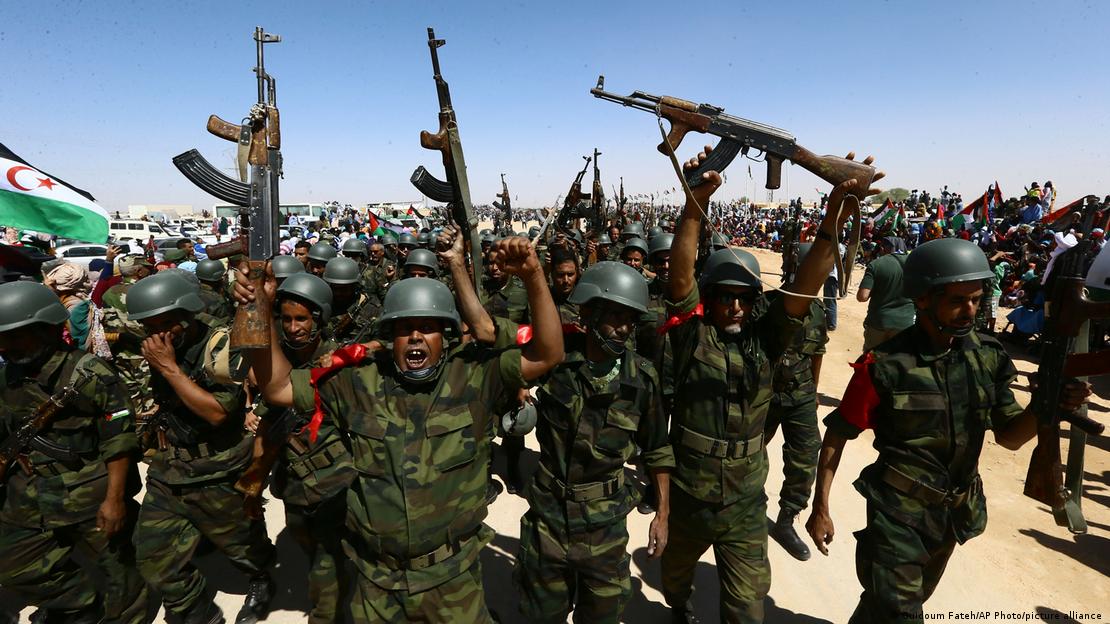
The Polisario Front is backed by Algeria in their quest for independence while Morocco's claim on the Western Sahara is increasingly backed by Western states, the UN, US and Israel
Image: Guidoum Fateh/AP Photo/picture alliance


Political and economic fallout

The cooperation between Morocco and Israel also has regional implications, says Simon Wolfgang Fuchs, an Islamic scholar at the Hebrew University of Jerusalem. He refers to the ongoing tensions between Morocco and Algeria, which are fueled by Morocco's claim on the Western Sahara region.

"Morocco consistently pursues the goal of asserting its claim to sovereignty over Western Sahara in its foreign policy," Fuchs told DW.

The Abraham Accords have dealt Rabat an important success in this regard. "The fact that Israel recognized this sovereignty, in addition to the US and several Western European countries, was an important success for Morocco," he said.

However, this has angered Algier, which supports the independence-seeking Polisario people in the Western Sahara.

Moreover, increased ties between Morocco and Israel also carry another significance, Fuchs points out. "Through imports from Israel, Morocco has also greatly modernized its military and is now clearly superior to the Algerian army," he said.

However, there are also reports that Algeria possesses Russian weapons that are intended to give the country a continued advantage over Morocco, including Iskander missiles and multi-role fighter jets.

Despite support for the Palestinians, ties between Morocco and Israel were met with little resistance five years ago
Image: Fadel Senna/AFP/Getty Images


Palestinian support

Five years ago, the new ties were met with relatively little resistance in Moroccan society, Steven Höfner said. In part, this was due to Morocco's long-standing unofficial, intensive relations with Israel. "This is due to the fact that many Israelis have Moroccan roots," he told DW.

It is also due to the fact that Morocco, unlike other Arab states in the 1950s and 1960s, never conducted a large-scale systematic expulsion of Jews. "As a result, relations between the two societies have always been less strained than elsewhere in the Arab world," says Höfner.

Nevertheless, there have been repeated large-scale protests in Morocco against Israel's war in Gaza and notable levels of solidarity with the Palestinians among the general population. The ruling royal family has had to take these factors into account, he said.

The war in Gaza also left its mark on another level, Fuchs points out. "There were high expectations for Israeli tourists in Rabat but these expectations were not fulfilled," he notes. Since the Hamas attack on Israel on October 7, 2023, and the ensuing two-year war in Gaza, direct flights between the two countries have been suspended.

But still, Israel has significant economic interests in Morocco, Fuchs said. For example, in the agricultural sector. "Israeli irrigation techniques are in high demand in Morocco, as well as methods for growing crops even in extremely dry areas," he told DW, adding that these are attractive business opportunities for Israeli companies.

Moreover, Israel is interested in Morocco's phosphate deposits, which could play an important role in fertilizer production for Israeli agriculture.

This article was originally written in German.
US balks as UK, France pledge troops to postwar Ukraine

DW


Even as France and the UK offer a written commitment to Ukraine to deploy troops in the event of a peace deal, doubts remain whether the US will back those troops in case they come under a Russian attack.


European leaders face many challenges as they try to build a long-term security architecture for Ukraine
Image: Stefan Rousseau/empics/picture alliance

As allies met in Paris to firm up security guarantees for Ukraine, the presence of peace envoys sent by Donald Trump offered hope that the US was still listening to the EU despite the president's threats to annex Greenland.

"We have largely finished the security protocols," said Steve Witkoff, one of the two emissaries, as he stood alongside the leaders of France, Germany, the UK and Ukraine at the presidential palace in Paris.

"This is important so that when this war ends, it ends forever," he said.

Even as France and the UK inked their resolve to deploy troops to Ukraine in a postwar scenario, the US did not offer to protect those troops in case Russia threatened their security.


What could deployment look like?


This week France, the UK and Ukraine signed a declaration of intent relating to the deployment of what they described as a multinational force in support of Ukraine's defense, reconstruction and strategic sustainability.

Experts said that given that the declaration was a written and signed document, it was a firmer and more formal assurance to Ukraine.

On Tuesday, German Chancellor Friedrich Merz announced that Germany could also play a military role and deploy "forces on NATO territory neighboring Ukraine," after a ceasefire has been achieved.

For the first time, Spanish Prime Minister Pedro Sanchez also expressed a willingness to send troops as part of a peacekeeping mission in Ukraine although the extent of the contribution remains unclear.

Jacob Funk Kirkegaard, a senior fellow at Brussels-based think tank Bruegel, told DW that a two-nation force is deliberately described as multinational, to allow other European but also non-Europeans, to join in.

"Who could it be? I think maybe Australia, or definitely Turkey which is a major player in the Black Sea," Kirkegaard said.

The meeting in Paris was held under the framework of the coalition of the willing, which comprises about 30 countries, minus the United States, that have decided to help Ukraine and offer some sort of security guarantees.

In a statement the grouping said they would help build "defensive fortifications" inside Ukraine without offering more detail.

Kirkegaard said that, while it is unclear exactly the kind of fortifications these would be, they could be similar to those being erected in NATO member states in Russia's vicinity. "Like in Finland," he said, it could involve "laying more mines and barbed wire" at the very least.

The statement also said the coalition would participate in a proposed US-led monitoring-and-verification mechanism after a ceasefire, to keep an eye on Russian violations of a future peace. This would involve procuring and operating equipment needed to observe activity along the contact line, such as drones, sensors and satellites.

The statement added the Ukrainians will "remain the first line of defence and deterrence" while experts told DW that coalition troops would mainly be present as trainers and not in a combat role.


Unanswered questions on deployment

Some in Europe are pushing ahead to establish a long-term security architecture for Ukraine. But, even at this stage, there are more questions than answers as details remain sketchy.

President Emmanuel Macron said France could deploy "several thousands" of troops to Ukraine. But it might be difficult for him to get France's parliament to approve the funding needed to maintain the troops abroad, especially wiith the countr mired in a political and economic crisis, Kirkegaard said.

Starmer's signature on the declaration has raised hackles among opposition leaders and experts who say Britain doesn't have enough soldiers to spare.

The UK's strategic defense review last year said the size and readiness of the Armed Forces declined as the cold war ended and the threat posed by the Soviet Union receded. The report stated that "only a small set of forces" are ready to deploy at any given moment. The fall in the number of soldiers happened in parallel with a drop in defense spending, the review noted.

While addressing the parliament, Starmer said the number of soldiers to be sent to Ukraine "will be determined in accordance with our military plans, which we are drawing up and looking to other members to support."

In Germany, the suggestion by Chancellor Merz to deploy troops to NATO countries neighboring Ukraine will also first have to be approved by the Bundestag.

Several other members of the coalition of the willing have been less clear about exactly how they will aid Ukraine, kicking the can to reveal their contributions once there was peace.

"Would all the COW (coalition of the willing) partners give a strong response if Russia attacks again? That's a hard question. I ask all of them, and I still have not gotten a clear answer," Ukrainian President Volodymyr Zelenskyy told reporters on Wednesday.

Until the security guarantees were approved by parliaments, by the US Congress, "we cannot answer the question if partners are ready to protect us," he added.

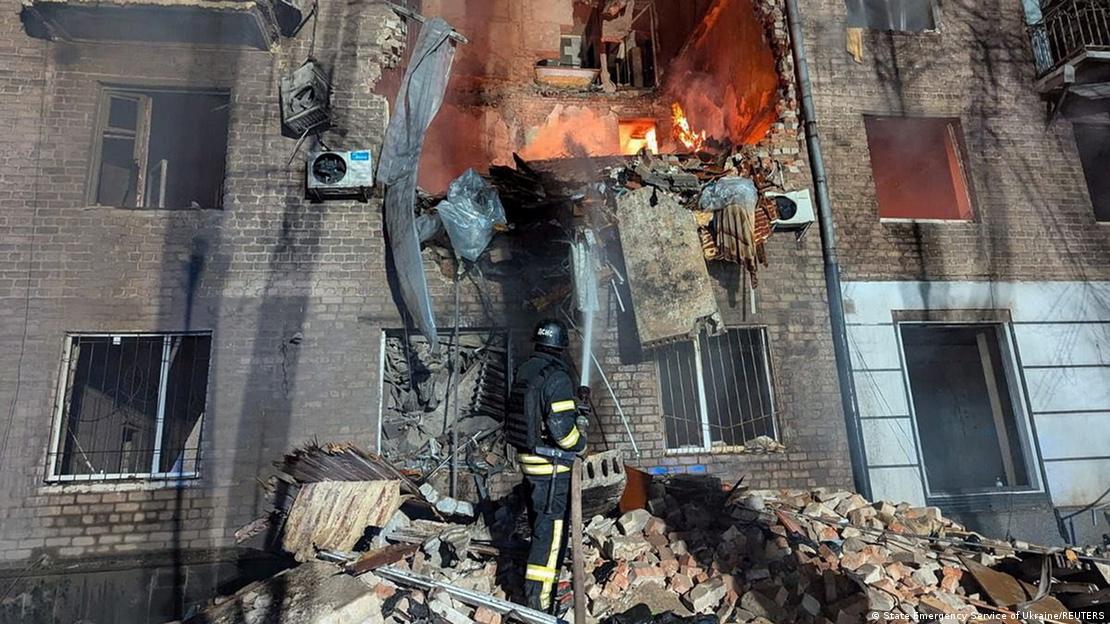
Russia continues to target Ukraine with missile strikes
Image: State Emergency Service of Ukraine/REUTERS


Absence of US remains biggest obstacle

The biggest impediment to a European presence in post-war Ukraine emanates from the bloc's once closest ally across the Atlantic.

Trump's envoys who attended the meeting in Paris did not mitigate European concerns over whether the US will come to the rescue of their troops were Russia to violate the terms of the deal.

Markus Reisner, Austrian military historian, lecturer at the Theresian Military Academy in Vienna, told DW that the core message of the adopted draft declaration in Paris was to encourage the US to commit to supporting a future European deployment.

"Without this assurance, or rather, this commitment from the US, Europe is not prepared to continue. This means it is now up to the US to make a corresponding commitment," he said.

"It currently seems inconceivable that European armed forces would establish a large-scale presence in Ukraine without US support and its specialized military capabilities, and without a guarantee of US military intervention in the event of a Russian attack."

"This is especially true as long as Russia considers Western soldiers in Ukraine to be military targets," Reisner warns.

Edited by: Andreas Illmer
Australia: State of disaster declared amid Victoria fires
DW with AFP, Reuters
10/01/2026 

Thousands of firefighters are working to douse several bush fires that are still raging in Australia's southeast. The fires erupted as a massive heat wave gripped much of the country.


The last livable house in Ruffy has become a refuge for those wanting to stay in the town

Image: Michael Currie/AAP/IMAGO


Authorities in the southeastern Australian state of Victoria declared a state of disaster on Saturday amid bush fires that have destroyed homes, caused large-scale power outages and razed huge swaths of bushland.

The fires have been described as the worst to hit the state since the Black Summer blazes of 2019-2020, which burne out 240,000 square kilometers (93,000 square miles) and killed 33 people.

Several major fires still burning in Victoria

The fires, most of which broke out earlier in the week, have so far burnt across more than 300,000 hectares (741,316 acres) of bushland, authorities said on Saturday.

They said 10 large bushfires were still burning.

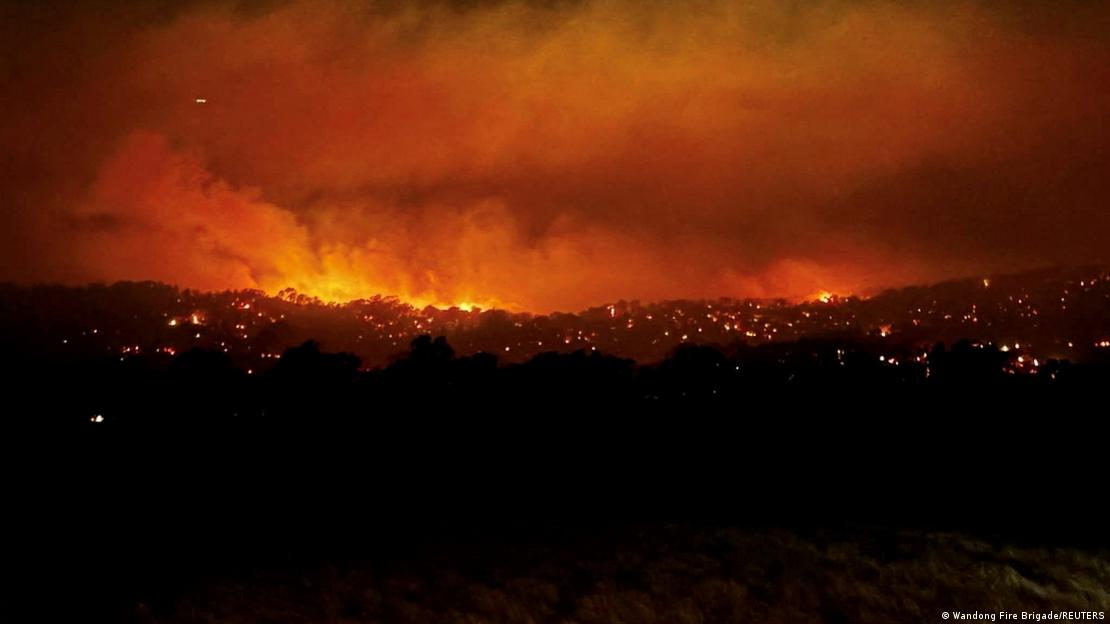
A fire near Longwood has been one of the most destructiveImage: Wandong Fire Brigade/REUTERS

Most of the worst blazes have hit sparsely populated rural areas.

The heavily forested region near the town Longwood, about 112 km (69.6 miles) north of the state capital, Melbourne, has been one of the worst affected, with a bushfire there burning across 150,000 hectares (370,000 acres).

Emergency Management Commissioner Tim Wiebusch said at least 130 structures, including houses, sheds and other buildings had been destroyed across the state.

The fires erupted amid a heat wave in the state, with temperatures surpassing 40 C (104 F).

Hundreds of firefighters from across the country have been called in to help douse the fires, which have also left around 38,000 residences ‌and businesses without power.


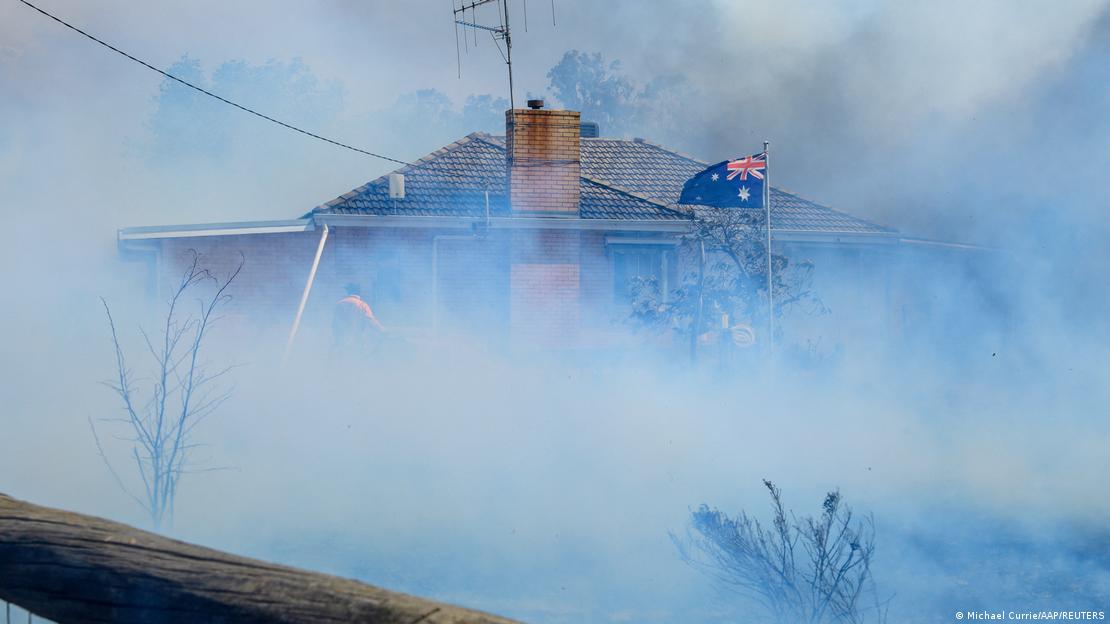
Several homes and other structures have been destroyed
Image: Michael Currie/AAP/REUTERS

Calls to evacuate

The declaration of a state of disaster by state premier Jacinta Allan gives firefighters emergency powers to force evacuations.

"It's all about one thing: protecting Victorian lives," she said. "And it sends one clear message: if you have been told to leave, go."

"Where we can, fires will be being brought under control," Allan said in a televised media conference from Melbourne.

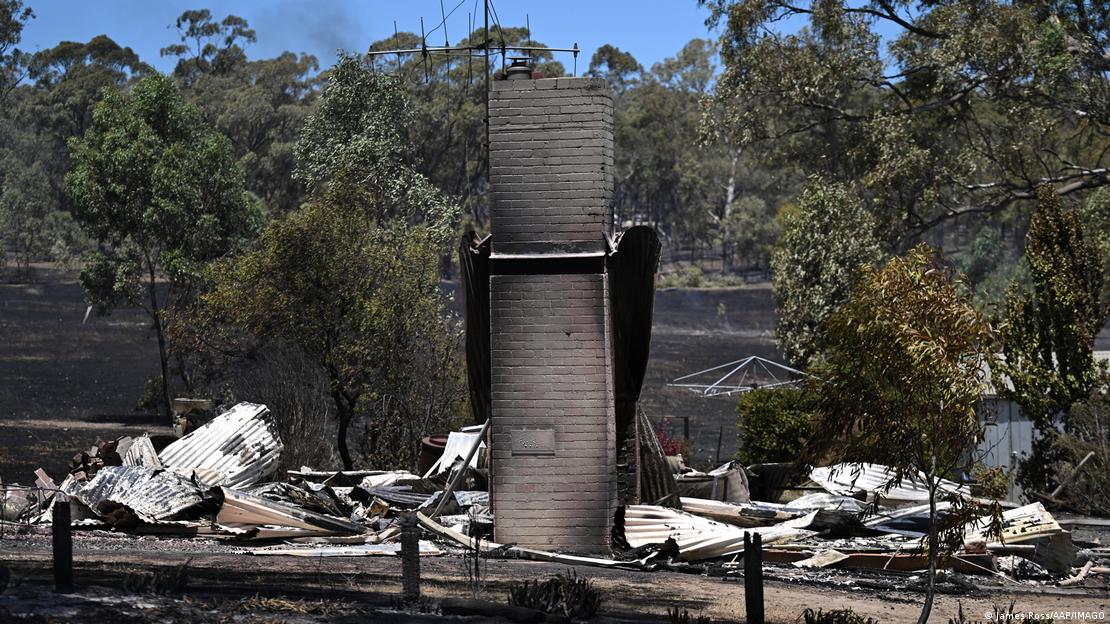
This chimney is all that is left of a house that was destroyed by the fires in HarcourtImage: James Ross/AAP/IMAGO

She said three people missing inside one of the state's most dangerous fire regions had been found.

Wiebusch, the emergency management commissioner, said the 10 blazes that are still ongoing would "continue to burn for days, if not weeks."

He added that lightning caused by the intense heat from the blazes could cause more fires on Saturday.

Extreme weather events on land and at sea have increased in frequency in Australia, whose land surface researchers say has warmed by an average of 1.51 C since 1910.

The country is still one of the world's largest producers and exporters of gas and coal, two fossil sources of energy that are key drivers of global warming.

Edited by: Karl Sexton

Timothy Jones Writer, translator and editor with DW's online news team.

G7 rescheduled so Trump can attend White House cage match
DW with AFP, dpa
10/01/2026 

The G7 summit was originally scheduled for June 14-16. The meeting, however, was reportedly moved so US President Donald Trump would be at the White House for a UFC fight on June 14, his 80th birthday.

France has reportedly postponed this year's G7 summit in the spa town of Evian-les-Bains in order not to conflict with US President Donald Trump's 80th birthday on June 14.

The meeting of G7 leaders was originally scheduled for June 14-16.

However, US magazine Politico reported that the event has been moved to June 15-17 in order to not disrupt the 47th US president's birthday celebrations. The US also marks Flag Day on June 14.

The White House this year has plans to hold a mixed martial arts fight on the grounds of the White House for Trump's entertainment. Trump is close friends with Dana White, the CEO and president of the Ultimate Fighting Championship (UFC).


The previous president in the White House, Joe Biden, also turned 80 while in office in 2022 but chose a more low-key celebration of coconut cake at brunch.
Postponement due to 'consultations with G7 partners'

French President Emmanuel Macron said the event's postponement was due to "consultations with G7 partners."

The G7 consists of the US, UK, France, Germany, Italy, Canada and Japan. Each year's annual summit is held in a different G7 country on a rotating basis.

France's decision to possibly accommodate Trump comes after the US president has frequently verbally attacked traditional US allies. In his second term in office, Trump has launched a trade war which has impacted other G7 members, with Trump also pressuring European countries and Japan to spend more on defense.

Edited by Sean Sinico

Wesley Dockery Journalist and editor focused on global security, politics, business and music
Global anger over Grok undressing women online


Issued on: 09/01/2026 
FRAHCE24
12:11 min
From the show


There's global outrage over Elon Musk's chatbot Grok, a key feature on social media platform X, which has repeatedly generated sexually explicit deepfake images of women and teenagers. Yet how social media can be used for good; Annette Young talks to Nika Kovač from My Voice, My Choice about using Instagram, TikTok and other platforms to help win a historic European Parliament vote on expanding abortion access. Plus turning the tables on gender equality; the Kenyan music academy offering training courses for women wanting to become DJs.


Egypt, from debt to prison: Women in financial difficulty face double penalty


Issued on: 09/01/2026 -
12:57 min


Egypt is one of the last countries in the world to impose prison sentences for debt. The main victims are "Gharimat": women in financial difficulty who have been forced into debt. Faced with the exploitation of these women – who are often widowed or single mothers – by unscrupulous creditors, associations are trying to help them achieve financial independence.


Debtors' prison, a punishment abolished in most countries in the 19th century, still exists in Egypt. According to the latest state census from 2021, Egyptian prisons were holding nearly 30,000 "Gharimat", women jailed for debt. NGOs say the real number is far higher.

Most "Gharimat" share the same profile. Widowed or divorced, they are solely responsible for their households, a situation faced by nearly a quarter of mothers in Egypt.

To marry off their daughters or pay for medical or school fees, many have no choice but to borrow money. Lenders then exploit their vulnerability, forcing them to sign blank cheques and threatening them with prison if they cannot repay, sometimes for debts as small as €50.

To counter this, several associations help women avoid falling into the debt trap by teaching them a profession or running workshops warning them against blank cheques. In the Delta, former prisoner Nermine al‑Bohteity has spent 15 years defending women's financial autonomy – a rare symbol in Egypt of courage and defiance against social norms.

BY: Mathilde DELVIGNE
Beyond the seized oil tanker Marinera: Growing fleet reflags to Russia


The United States announced on Wednesday that it had “seized” the Marinera, an oil tanker with links to Venezuela, in the North Atlantic. During the US pursuit of this boat, the Marinera changed its name (from the Bella 1) and swapped out its former flag for the Russian flag. Turns out, this isn’t a first: experts say that Moscow has agreed to lend its flag and its protection to other so-called “dark fleet” ships attempting to circumnavigate the US blockade.


Issued on: 09/01/2026 - 
By: The FRANCE 24 Observers/Lise KIENNEMANN


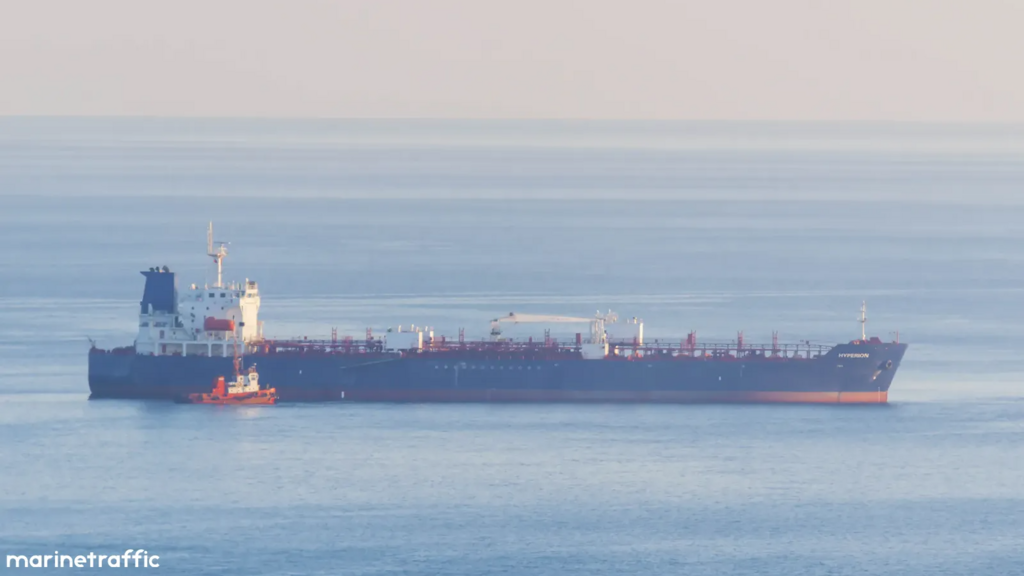
Just like the Marinera, the oil tanker Hyperion recently adopted the Russian flag. © MarineTraffic / Sergei Skriabin

The United States announced on January 7 that it had “seized” a Russian oil tanker with links to Venezuela as it sailed across the North Atlantic. This news is the latest twist in a drama that began late in December in the Caribbean.

The United States announced on December 21 that it would pursue the oil tanker, then known as the Bella 1, for trying to get around the blockade they imposed in mid-December on oil tankers under sanctions entering or leaving Venezuela.

The Bella 1 has been subject to US sanctions since June 2024 because of its apparent links to Iran and the Lebanese Shiite group Hezbollah. Maritime company Windward reported that the tanker had been participating in trading with Iran and Venezuela since 2021. Windward also tracked multiple instances of deceptive shipping practices.

TankerTrackers, a site specialised in maritime transport, reported that the tanker was not carrying oil when the United States began its pursuit. Analysts say that it was likely going to Venezuela to pick up oil.

This is the path taken by the Marinera (formerly known as the Bella 1) between November 13 and December 17, 2025, when the ship stopped transmitting its location. © Global Fishing Watch

From 'false' flag to Russian flag

The US suspected the Marinera of being part of what’s called a dark or shadow fleet. These are fraudulent or unregistered vessels that smuggle goods that are illegal or subject to sanctions.

American authorities claimed that the tanker, which was flagged to Guyana, was “falsely flagged”. If a boat is stateless or flying under a false flag, then it is not protected under international law and can be boarded. The United States used this legal argument to seize two oil tankers in mid-December as well as the oil tanker M/T Sophia on Wednesday.

The Coast Guard said that they initially attempted to intercept the Bella 1, but it continued on its path.

American authorities interviewed by the New York Times said that the crew of the recently christened Marinera had painted a crude Russian flag on the side of the ship. An officer on the ship also made contact with the Coast Guard via radio to say that the ship was now flagged to Russia.

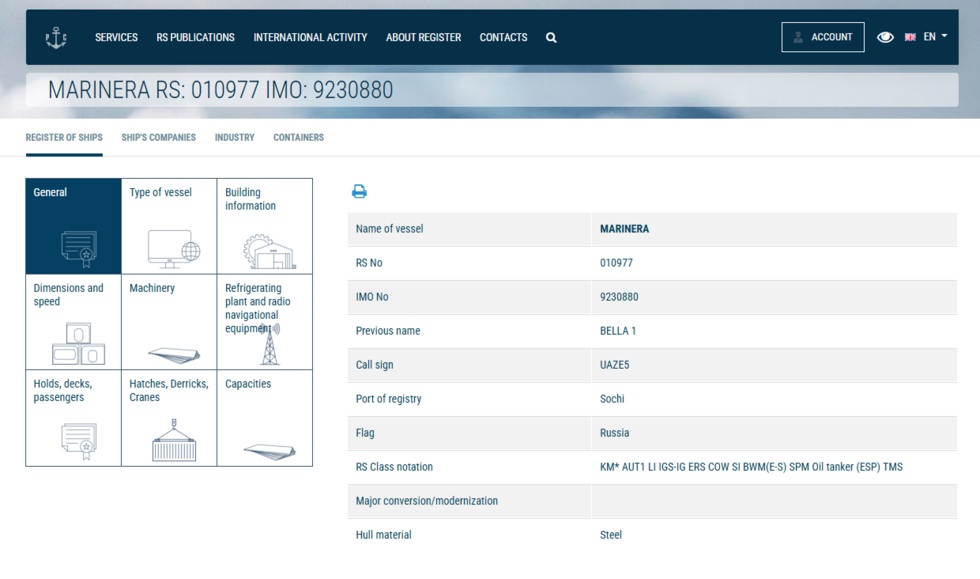
The oil tanker also now appears in the Russian maritime registry, under the name Marinera, with its home port listed as the Russian city of Sochi. The database Equasis also indicates that the ship’s owner and manager live in Russia.
The Marinera appears in the Russian maritime registry. © Russian maritime registry


The Russian government then sent a formal demand for the United States to end their pursuit of the ship, according to the New York Times.

An American official told the New York Times that the United States still considered the ship “stateless” because it was not flying a valid flag when it was approached for the first time by the Coast Guard.

Chase across the Atlantic Ocean

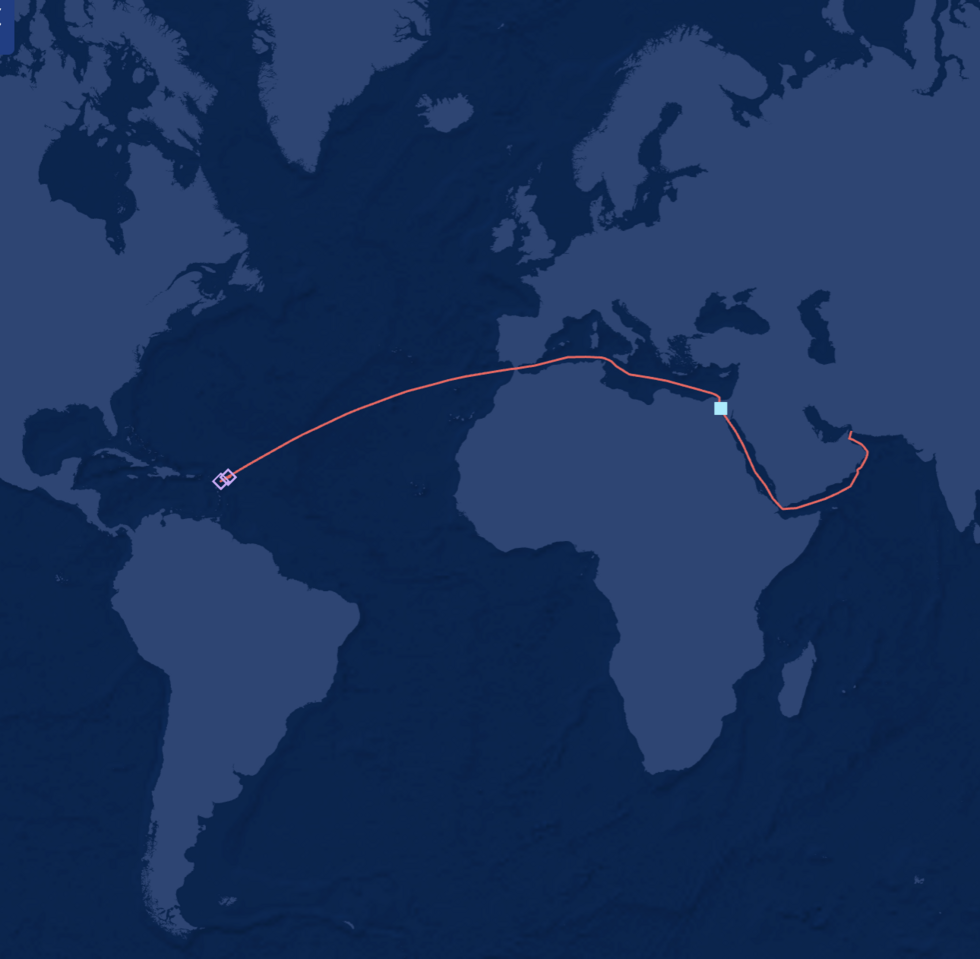
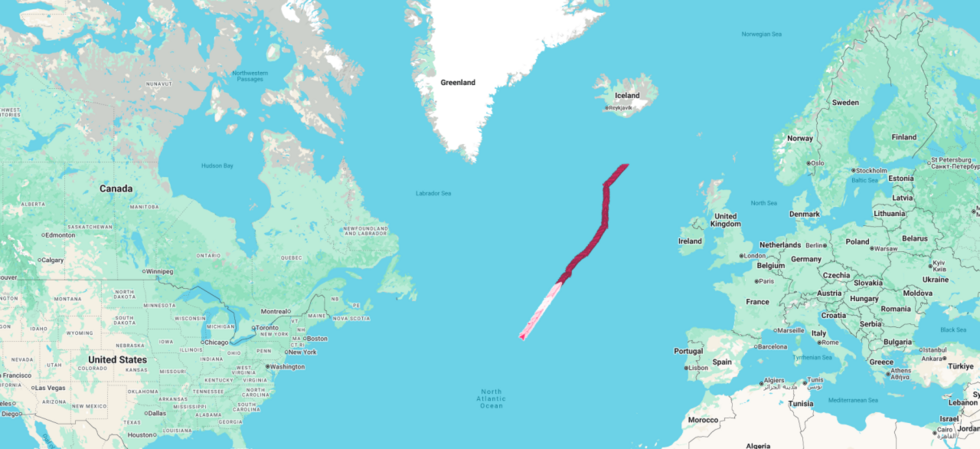
The oil tanker then headed northeast, setting out across the Atlantic Ocean. On January 7, it was located to the south of Iceland, according to information provided by Lloyd’s List Intelligence. A number of analysts interviewed by our team said they believed that the boat was heading towards a Russian port.

This map shows the Marinera’s trajectory between January 1 and 7, 2025. © Lloyd’s List Intelligence

In recent days, aviation data seemed to indicate that the Marinera was being closely surveilled by two American P-8 spy planes, who took off from Mildenhall air base in the United Kingdom.

“The vessel is being shadowed by a United States Coast Guard cutter, with supporting surveillance including an RAF Rivet Joint mission and RFA Tideforce operating in the area,” Martin Kelly, head of advisory at the British security company EOS Risk Group, told our team a few hours before the operation took place.

The RAF is an abbreviation for the Royal Air Force, the British Air Force. A Rivet Joint is a spy plane. And the RFA Tideforce is a refuelling ship that belongs to the RAF.

A video posted on January 6, 2026 by Russia Today, which was said to have been filmed by the crew of the Marinera, shows a US Coast Guard Patroller following them. It is impossible to know when and where this video was filmed.


'The United States cannot allow this to become a template for dozens of other sanctioned tankers'

The Bella 1 is not the only ship operating in Venezuela that has reflagged to Russia in recent days.

“Reflagging to Russia is increasingly being used by these tankers to allow them to continue operating and gain some sort of legitimacy and protection,” said Mark Douglas, a maritime analyst with Starboard Maritime Intelligence.

After having dropped off its cargo of Russian naphtha – used to refine crude oil – in Venezuela, the Hyperion oil tanker, which is also under sanction, dropped the false Gambian flag that it was operating under on December 25 and announced that it was now flagged to Russia, according to the publication gCaptain. It then managed to travel into the Atlantic Ocean, making it seem as if it had escaped American seizure.

The oil tanker the Premier also indicated that it had reflagged in late December, going from the Gambian flag to the Russian flag, according to Windward. On Wednesday, it was located in the Caribbean.

According to the New York Times, three other boats under sanction that were recently located in Venezuelan waters have reflagged to Russia in recent days. They are all now also listed in the Russian maritime registry.

“Over the past six months, a dozen or more of the darkest tankers operating globally have switched from open registries to Russia. This trend accelerated in December as the flag state emerged as a critical shield against drone strikes and vessel seizures,” Windward wrote.

Vessels also began to reflag to Russia in the Black Sea after Ukrainian drone attacks on oil tankers carrying false flags.

“This is ultimately about principle,” says Kelly. “The United States cannot allow this to become a template for dozens of other sanctioned tankers off Venezuela to evade enforcement by simply changing flags.”

After Venezuelan President Nicolas Maduro was arrested, US Secretary of State Marco Rubio said that the blockade on sanctioned oil tankers would remain in place.

The risk is also that other boats in the so-called dark or ghost fleet, operating in other regions, will also adopt this strategy.

“If the vessel doesn't get seized, then the remaining near 1,500 dark fleet tankers worldwide will resort to keeping a Russian flag handy in their closet,” said Samir Madani, co-founder of the site TankerTrackers.com, ahead of the US operation.
'The presence of Russian warships… significantly increases the risk of miscalculation and escalation'

However, an operation like the seizure of the Marinera is not without risk. The New York Times said Wednesday that Russia had sent a warship to escort the oil tanker.

Kelly explains:


“The presence of Russian warships ‘defending’ a vessel that now declares itself Russian-flagged significantly increases the risk of miscalculation and escalation.

The Russian warship will have specific rules of engagement and is unlikely to use force to oppose any boarding, but it may seek to disrupt or obstruct boarding operations, potentially through unsafe manoeuvring or using laser devices to target aircraft. Any Russian submarine nearby will highly likely conduct surveillance without playing an active part in the incident.”
'Russia has an interest in maintaining the shadow fleet in activity'

But why is Russia getting so involved? We spoke to Eric Orsini, global head of compliance at Lloyd's List Intelligence:


What you're seeing is sanctioned actors working together. They're forming their own little ecosystem.

Russia has been providing Venezuela with condensate or diluents [Editor’s note: like naphtha]. Venezuela's oil is heavy crude and it needs to be mixed or blended with diluents in order for it to be refined. So it’s in Russia's interest to continue the flow of their diluents to Venezuela, because Venezuela is buying it.

Russia has an interest in also keeping the shadow fleet on the water. The Marinera is a VLCC – a very large crude carrier, which has a lot of capacity to move oil. The more vessels that come out of the shadow fleet, the less capacity the sanctioned actors have to continue moving the oil and storing it.

It remains to be seen how Western countries will adapt to this new world.

“The reflagging will likely lead to an evolution of the approach taken to these vessels by the likes of Ukraine and the US as they consider what additional actions Russia might be willing to take to protect the tankers and the oil they carry,” concludes Douglas.
 WHITE SUPREMACIST 

Why the new US ambassador to South Africa could strain relations even further

Leo Brent Bozell III, the conservative activist picked by President Donald Trump to represent the United States in South Africa, is preparing to begin his new role as ambassador after being confirmed by the US Senate. A history of opposition to the country's ruling party during its struggle against apartheid makes him a controversial choice.


Issued on: 10/01/2026 - RFI

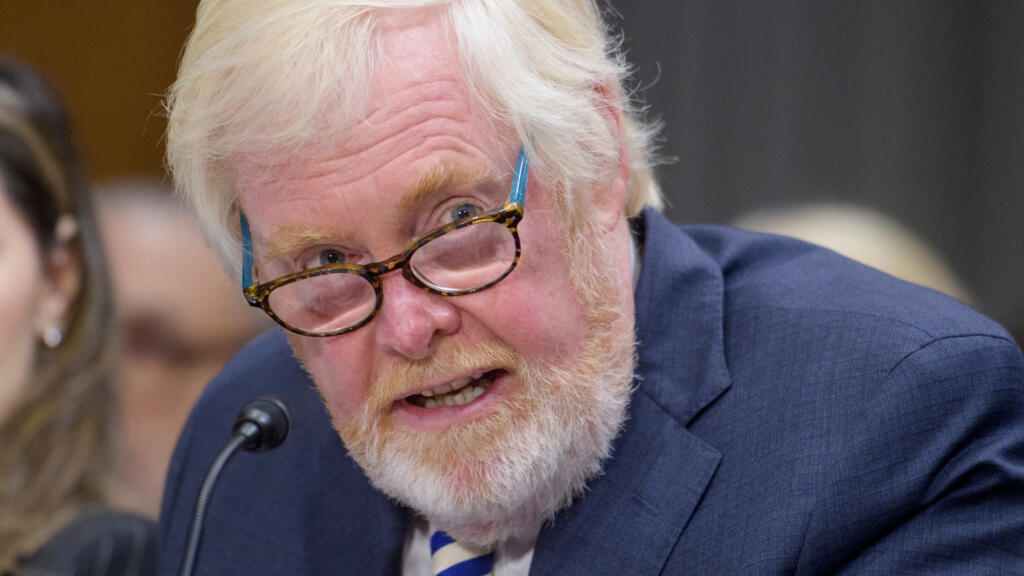
Leo Brent Bozell III before a Senate Committee on Foreign Relations hearing on his nomination to be US Ambassador to South Africa, in Washington DC on 23 October 2025. © Rod Lamkey / AP

By:Melissa Chemam with RFI

Bozell is a prominent figure on the American right and a staunch supporter of Israel.

In the 1980s, he belonged to a pressure group opposed to any negotiations with the anti-apartheid African National Congress (ANC), then led by Nelson Mandela.

As South Africa's government is still led by the ANC, in a coalition of 10 parties, relations with Bozell are expected to be anything but easy.


ANC 'terrorism'


Bozell, 69, is known for his deeply conservative views. His father was a Catholic anti-abortion activist, while his son Leo was among those who stormed the US Capitol on 6 January 2021, for which he was sentenced to nearly four years in prison.

Bozell founded several conservative groups, including the Media Research Center, which has the stated mission of identifying liberal bias.

In 1989, five years before the end of apartheid, the Media Research Center described the ANC as a "pro-communist, terrorist organisation".

All through the 1980s, Bozell was part of the "Coalition Against ANC Terrorism", an alliance of more than 30 right-wing American groups. He wrote then that he was "proud" to be a member and, in 2013, complained on Twitter that the mainstream media "mythologises" Mandela, South Africa's first democratically elected president.


Diplomatic low point


Experts see Bozell as a novice in terms of international relations and believe he has little knowledge of Africa.

He has never served in the foreign service, nor has he lived on the African continent.

Trump previously nominated him to lead the US Agency for Global Media – a now-closed organisation that oversaw Voice of America and Radio Free Europe – but later withdrew the bid to put Bozell forward as ambassador.

His confirmation comes after a year of diplomatic tension between the US and South Africa.

Trump froze aid to South Africa in February 2025, accusing the ANC-led government of mistreating the country's white minority via a land reform law that he alleges allows property to be seized from white farmers.

The following month, South Africa's ambassador to the US was recalled to Pretoria after describing American policy as "white supremacy". The post remains vacant.

The US administration also refused to participate in the G20 summit in Johannesburg last November. It has excluded South Africa from the list of countries invited to the next G20 summit, to be held in the US later this year.


Afrikaner 'refugees'


Bozell will oversee the implementation of Trump's refugee programme, which explicitly prioritises Afrikaners.

South Africa's Department of International Relations and Cooperation has rejected the scheme as resting on the "factually inaccurate" premise that white South Africans are racially persecuted.

The South African lawsuit against Israel for genocide in Gaza before the International Court of Justice is another bone of contention. Bozell has indicated that he intends to pressure the South African authorities to withdraw the case.

South African news website IOL reported that Bozell also promised to tackle what he called South Africa's "geostrategic drift" towards Washington's international rivals, including Russia, China and Iran.

Despite his confirmation in a Senate vote last month, Bozell remains the ambassador-designate and under strict diplomatic protocol, he cannot perform official acts or formally represent the US government until he presents his credentials to President Cyril Ramaphosa, who has to accept them.

He replaces the previous US ambassador to South Africa, Reuben Brigety, who was appointed by President Joe Biden.