Sunday, January 11, 2026

The Centrality of the Global South: A History


 January 8, 2026

The recent military attack on Venezuela and the kidnapping of its president and his wife make it clear once again that the people of what we currently call the Global South need a planetary anti-imperialist solidarity to live uncolonized in a capitalist world. Without that solidarity, their very lives are subject to the quest for profits that drive the nations seeking global empires. Without that solidarity, the formerly-colonized and the currently colonized peoples cannot thrive without fear of domination via economic domination and military invasion. Many have pointed out that the nature of the US attack and kidnapping was reminiscent of US actions in Latin America undertaken in the past, from the Spanish-American war to the 1965 invasion of the Dominican Republic and beyond. The attack’s blatant violation of sovereignty and military brutishness being the most obvious of those characteristics. Of course, the underlying politics and imperial illusions have never faltered, no matter what approach the US has taken. In other words, John F. Kennedy’s Alliance for Progress was seeking the same relationship with the people of Latin America as Donald Trump is.

In the first half of the twentieth century, an international organization founded and mostly located in the countries of Latin America worked toward achieving international solidarity against western (especially that of the United States) imperialism. The organization was socialist in its politics and revolutionary in its hopes. Its work used a revolutionary indigenous culture and an international network of labor, intellectual and cultural revolutionaries to raise consciousness and foment anti-capitalist social change, especially in the lands of its origin. Called the Liga Antiimperialista de Americas (LADLA), the organization was founded in January 1925 in Mexico City. Its documents and media referred to the nature of imperial extraction of local resources and situated its critique in one that emphasized anti-capitalism and western imperialism’s essential white supremacy. Using terms like “white terror” and “tropical fascism” to explain the difference between the oppression of the workers in the nations to the south of the United States in the western hemisphere. In short, these terms were understood as capsulizing the double oppression lived by indigenous and other non-white workers under the yoke of US capital. Over time, this understanding grew to include Black workers in the United States, also.

Author Anne Garland Maher’s recently published book A Wide Net of Solidarity:Antiracism and Anti-Imperialism from the Americas to the Globerelates and discusses the history of LADLA and its successors. She places the organization within the context of the international communist movement, its relationship to the Comintern before and after Stalin began to rule the USSR, and its importance to the tide of revolution and national liberation existing in the twentieth century. By beginning her text with an introduction to photographer, artist and revolutionary Tina Moldotti and her work—political and otherwise—Mahler sets a tone for her text. It’s a tone that includes a critical look at the international communist movement of the time, the roles of women in that movement, the assumptions of men, and the nature of the repression the movement faced. By establishing the fact of white supremacy and its role in western capitalism as foundational pillars of western (esp. US) colonialism and imperialism, she opens previous discussions of these topics well beyond their previous scope. In using Moldotti’s art as a foundation, Mahler does something one infrequently encounters in most contemporary histories from the Left: she places the role played by culture in revolutionary organizing in its rightful place. In other words, she acknowledges and champions its power to reach the unorganized and ideally encourage them to join the fight for liberation.

The peak for LADLA in terms of numbers and support took place in the late 1920s when it decided to support the national liberation struggle in Nicaragua. Led by Augusto Sandino (who would be honored for his role by the Frente Sandino de Liberacion Nacional(FSLN or Sandinistas later in the century), their struggle would become a focus for anti-colonial struggles around the world. In her presentation of this history, the author raises questions regarding the role of the male revolutionary hero, the shortcomings of national liberation struggles organizing across classes and under the leadership of the petty bourgeoisie, and the roles of women in this context. Never dismissive, this text presents discussions still relevant today; discussions perhaps barely even considered at the time. We would be wise to consider them as we organize against US imperialism today. A current debate amongst some leftists centers around what’s being called Western Marxism, a Marxism that is accused of focusing primarily on the issues of the rich nations of the West while mostly relegating the relationship between nations and the peoples who suffer because of western imperialism to a lesser status, a lesser concern.  Furthermore, in part because this western Marxism has its foundation in the academy its focus has become one that highlights oppressions suffered because of identities over those of class. A Wide Net of Solidarity’s emphasis on internationalism and the potentially revolutionary nature of culture injects an important piece of history into the struggle for a hopeful and socialist future, while simultaneously addressing issues of identity and class in a manner that prioritizes neither at the expense of the other.

Ron Jacobs is the author of several books, including Daydream Sunset: Sixties Counterculture in the Seventies published by CounterPunch Books. His latest book, titled Nowhere Land: Journeys Through a Broken Nation, is now available. He lives in Vermont. He can be reached at: ronj1955@gmail.com

Dear Americans, You Live in an Evil Empire


January 8, 2026

Photograph by Nathaniel St. Clair

Since the Trump regime’s recent assault on Venezuela, a lot of Americans have been talking more about the nature of their country. This is significant because most Americans have been conditioned to see their nation as both a democracy and a superpower. But the two cannot exist simultaneously. These concepts are polar opposites. Yet, this is the contradiction most Americans still hold on to.

Whether through media or Hollywood or branding or subtle messaging, Americans are inundated in the myth of its indispensable role in the world. This works so well because most Americans have never traveled abroad. It works because intellectual curiosity is stunted early. They are conditioned, from birth until death, to accept the concept of their exceptionalism.

And this is not a phenomenon which is limited to conservative sensibilities. Liberals, by and large, are almost as brainwashed as their far-right counterparts in the sense that they see their country as essentially good. This is demonstrated by their overall disinterest in egregious and brutal foreign policies carried out by Democratic administrations, the genocide in Gaza being the most recent and glaring example. While unpopular, how many liberals vigorously opposed it when it was being funded and fueled by the Biden administration? How many insisted on supporting Kamala Harris, despite the fact that she intended to continue supporting Israel as it carried out its campaign of annihilation?

Up until very recently, Americans never considered their nation to be a global empire. Even terms like “superpower” obscure the historic connotations of imperial violence. A superpower doesn’t colonize, rape natural resources, destabilize other nations or subvert democratic movements. It simply exists. As if it has always been there as a force of nature and not by ruthless intent and violence.

But one thing that the Trump regime has done which differs from its predecessors is dismantling this myth, bit by bit. The attack on Venezuela and kidnapping of its president and first lady while Trump openly boasts about running the country and taking its oil has been a wake up call. His fever dream of doing the same to Greenland, Columbia, Nigeria, Iran, Cuba and Canada have added to this.

Many who are coming to understand this now are falsely linking it to one man or to his regime. That this is just an aberration in the American project. That all will be returned to normal once he and his cohorts are removed from power. But this kind of toxic naivety is not only wrong, it is reckless.

The history of the United States is one steeped in violent conquest and expansion. But this is seldom addressed by Americans as it relates to its nature today. The annexation of Hawaii and the imprisonment of its Queen. The possession of Puerto Rico while restricting it from statehood. Or the military occupation of the Philippines. These things are rarely, if ever, discussed in the mainstream.

America was founded upon land stolen from Indigenous nations. It was built by enslaved Africans and indentured servants. Its belligerent foreign policies not only echo that of the great European empires, it expanded on them. It has interfered with, toppled, and installed proxy governments which have done its bidding or, more accurately the bidding of its ruling class. And it has 800+ military bases all over the planet. This is the very definition of empire. Yet, there are few Americans who would ever use that term to describe their nation.

Outrage among liberal Americans over the Trump regime’s crude imperialistic rhetoric and actions is welcome. But if it stops there, it is useless. Americans need to face the painful truth that they are subjects of a deadly and brutal imperial power. One which is jostling with the other imperial houses of Russia and China for control over its “sphere of influence.” One which is now in a state of decline and decay, yet still powerful enough to destroy the biosphere and end all organized human civilization on earth. Trump did not create it, he has merely demolished the benevolent facade it has hidden behind for far too long.

Kenn Orphan is an artist, sociologist, radical nature lover and weary, but committed activist. He can be reached at kennorphan.com.


AMERIKA

Goebbels’s Ghost and Miller’s Dream of a “Unified Reich.”

January 9, 2026

Photograph by Nathaniel St. Clair

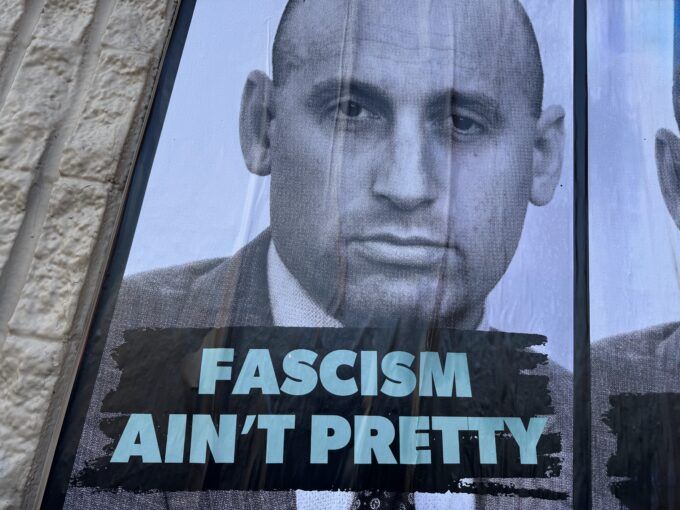
White House adviser Stephen Miller seems torn from the darkest archive of the 1930s. His ideological fever, spittle-laced tirades, compulsive lying, and theatrical rage are not excesses but instruments: performative rituals through which cruelty is normalized and racism is taught. What he stages is not only a ruthless infatuation with power and updated fascist politics but also a psychic unraveling masquerading as authority. The spirit animating his rhetoric, saturated with hate, fabrication, and manic spectacle, recalls a historical moment when cruelty became a governing principle and racism the moral grammar of the state.

Miller is a grotesque figure granted power, a carnival barker of repression whose racism operates as projection: a deep, unresolved self-loathing displaced outward and weaponized. In targeting immigrants, dissenters, Muslims, people of color, and all those outside the narrow confines of white Christian nationalism, he seeks not just power and disciplinary panopticon order but racial purification, not truth but erasure, transforming inner emptiness into a politics of cruel collective punishment. In this role, he is the archangel of a gangster state, reviving the racial cleansing and colonial violence of a prior age with an apocalyptic urgency driven by nihilism and Trump’s fevered fantasies of a unified Reich.

Miller is one of the principal architects of a fabricated “war on drugs,” a manufactured emergency used to justify extraordinary violence—from illegal boat strikes and the killing of more than one hundred people without due process to the kidnapping of Venezuela’s President Maduro and his wife. What appears as a series of discrete acts is, in fact, something far more consequential: the deliberate fusion of the so-called war on drugs with the long-standing war on terror. Under Miller’s ideological guidance, these once distinct campaigns collapse into a single, permanent state of exception in which mafia-style threats and force replace law, and violence becomes the primary instrument of both domestic and foreign policy. Miller aggressively emulates Trump’s relentless calls for militarization, normalizing a logic in which alleged criminals, political opponents, and entire populations are reclassified as enemy combatants. In this convergence, policing becomes warfare, warfare becomes governance, and the language of security is weaponized to erase due process, sovereignty, and accountability altogether.

His fear of dissent, people of color, and the very idea of law is not merely rhetorical; it is visceral. It surfaces in his permanent war mentality, his embrace of imperial aggression, and his eagerness to militarize both domestic governance and foreign policy.  His unhinged defenses of the invasion and political abduction in Venezuela, along with his casual assertion that Greenland “rightfully” belongs to the United States, reveal a fascist worldview in which legality is meaningless and sovereignty collapses before brute force. For him, law does not restrain power; it sanctifies it. This contempt for ethical and political responsibility is laid bare in his declaration on CNN that the world is governed not by justice or rights but by “strength,” “force,” and “power,” which he calls, with totalitarian assurance, the “iron laws” of history.

 Taken together, these claims form not only the language of realism; they also constitute the creed of an emerging fascist politics.  It echoes the vocabulary of Hitler and the Third Reich, where politics was reduced to struggle, morality dismissed as weakness, and domination elevated to destiny. In this worldview, force turns out to be truth, violence becomes virtue, and the rule of law is replaced by the racialized mythology of survival through conquest. In Orwell’s warning that when the clock strikes thirteen, something has gone terribly wrong, Miller’s language marks precisely that moment—when power openly declares itself the only truth, domination becomes common sense, and fascist lies no longer bother to disguise themselves as reality.

Miller’s hatred of dissent is most fully revealed in his relentless effort to seize control of public culture, not as a secondary battlefield but as the central terrain on which authoritarian power is forged and sustained. He operates with the clear understanding that domination requires more than repression, it demands the production of compliant fascist subjects and the systematic erosion of the cultural institutions capable of nurturing critique. As the chief architect of book bans, the hollowing out of schools and universities, and the destruction of culture as a site of democratic possibility, Miller wages war on the very conditions that make resistance thinkable and culture a vital sources of social change. His assault on critical consciousness, historical memory, and critical pedagogy reproduces the racial logic of colonial rule, a politics designed to manufacture terminal zones of exclusion, enforce the violence of organized forgetting, and cultivate a colonized imagination trained to mistake obedience for order and silence for civic virtue.

This systematic war on culture is not merely ideological; it is pedagogical in the deepest sense, shaping how people learn to see the world, themselves, and those marked for exclusion. What Miller models is authoritarian pedagogy at work, teaching people how to think, how to feel, and who to despise. In this way, he helps manufacture the fascist subject, training audiences to confuse domination with strength, obedience with virtue, and dehumanization with patriotism. His politics echoes the architecture of a Nazi state; this authoritarian logic is rehearsed daily, disciplining the public to accept exclusion, erasure, moral collapse, and racial terror as common sense.

Miller is not a foot soldier of authoritarianism. He is a chief instructor, a propagandist of racial fear whose power lies in shaping the cultural and psychological conditions that make fascism feel normal, necessary, and even virtuous. In that sense, Goebbels is not an exaggeration but a mirror. History is not whispering a warning here; it is returning as a scream, ripping through the present and demanding to be recognized.

Henry A. Giroux currently holds the McMaster University Chair for Scholarship in the Public Interest in the English and Cultural Studies Department and is the Paulo Freire Distinguished Scholar in Critical Pedagogy. His most recent books include: The Terror of the Unforeseen (Los Angeles Review of books, 2019), On Critical Pedagogy, 2nd edition (Bloomsbury, 2020); Race, Politics, and Pandemic Pedagogy: Education in a Time of Crisis (Bloomsbury 2021); Pedagogy of Resistance: Against Manufactured Ignorance (Bloomsbury 2022) and Insurrections: Education in the Age of Counter-Revolutionary Politics (Bloomsbury, 2023), and coauthored with Anthony DiMaggio, Fascism on Trial: Education and the Possibility of Democracy (Bloomsbury, 2025). Giroux is also a member of Truthout’s board of directors.