It’s possible that I shall make an ass of myself. But in that case one can always get out of it with a little dialectic. I have, of course, so worded my proposition as to be right either way (K.Marx, Letter to F.Engels on the Indian Mutiny)
Wednesday, January 14, 2026
A Century of American Imperialism, Culminating in Venezuela
Trump is the bold exclamation point on a century-long sentence of US imperialism, penned by presidents from both major parties
But nowhere is the continuity of American intervention more obvious than in Latin America, where Trump began destroying Venezuelan shipping boats, and – days into the new year—captured Venezuelan president Nicolás Maduro and brought him back to the US for a trial that will surely be free and fair.
If this seems out of character for the United States, consider the fact that, between 1898 and 1994, Washington intervened in Latin American affairs at least 41 times – about once every twenty-eight months for an entire century. Trump is no aberration; he is simply the latest foreman on a very old job site.
The Global Backlash: How the World Sees US Imperialism
Much like Barack Obama, who was awarded a Nobel Peace Prize and then spent eight years bombing seven countries, or George W. Bush, who entered office promising restraint only to preside over nation-building wars in Iraq and Afghanistan, Trump has simply continued a decades-long tradition of Republican and Democratic presidents insisting they do not seek war – then waging it anyway once in power.
On the surface, it might seem unprecedented for an American president to bomb a city in a country the United States claims it is not at war with, kill dozens of people on the ground, and kidnap a sitting head of state in the dead of night. But placed in historical context – especially the post-9/11 era – this is not some shocking deviation. It’s a continuation, and the “rules-based international order” Washington loves to lecture about has been shredded by its own architects.
The world has noticed.
A recent international opinion poll shows that in large parts of the globe, the United States is no longer viewed as a stabilizing force, but as one of the greatest threats to their country. According to Pew’s 2025 survey across 25 countries, the US—along with China and Russia – was the most widely viewed as an international threat, with one of them appearing in the top three responses in nearly every nation surveyed.
The Bush Era: Setting the Precedent for Endless War
There was also an element of financial geopolitics at play. In the late 1990s and early 2000s, Saddam began selling oil in euros under the United Nations’ Oil‑for‑Food Program, challenging the petrodollar system underpinning America’s global financial power. At the same time, Iraq’s vast oil reserves were an attractive prize for energy giants like ExxonMobil, Chevron, and Halliburton, which had lobbied for years to gain access to Iraq’s untapped reserves and stood to benefit immensely from war.
His death marked the end of a long chapter in Iraq’s history, but the next pages would not look much better. The country has been plagued with routine violence, poverty, and outages of water and electricity. Protests have been met with crackdowns. And in certain areas of Iraq, communities have faced devastating rates of horrifying birth defects, along with a sharp increase in leukemia cases, which may be linked to the toxic effects of US munitions. According to research cited in The Guardian, these cancer levels in Fallujah surpassed the peak effects seen in Hiroshima after the US atomic bombing, with leukemia rates rising 2,200% in a shorter timeframe.
Additionally, Chávez proposed the creation of ALBA, the Bolivarian Alliance for the Peoples of Our America, a potential bloc of nations that could operate beyond the realm of US interference, and in mid-2001, he formally requested the departure of US military forces from the Fuerte Tiuna armed forces headquarters in Caracas.
The coup was short-lived.
Chávez was briefly detained by dissident military officers, with business leader Pedro Carmona – who had reportedly met with US officials prior to the attempted overthrow – declaring himself president and immediately dissolving the National Assembly and Supreme Court. Massive demonstrations erupted, key military units refused to recognize the new regime, and Chávez was restored to office within days.
Like Saddam Hussein in Iraq, Chávez continued challenging US financial hegemony by formally creating ALBA in 2004, by establishing Petrocaribe in 2005 – a program offering subsidized oil to Caribbean and Central American nations on non-dollar terms – and by switching some oil sales to euros in 2008, thereby continuing to make Venezuela a prime target for economic sabotage.
The failed coup against Chávez didn’t mark the end of Washington’s efforts against the country, but instead, it set the template. Economic warfare, parallel governments, and bounty-style politics would later replace tanks in the streets.
In 2000, he was re-elected. Aristide’s second term was marked by his efforts to double Haiti’s minimum wage, crack down on tax evasion by business elites, and pour money into social programs. He even had the courage to demand France repay Haiti’s “independence debt” – a grotesque sum of 150 million francs that France forced Haiti to pay in 1825 as compensation for the loss of its colony after Haiti’s successful revolution. Demanded under the threat of military intervention, Haiti was forced to borrow the money from French and US banks, plunging the new nation into crippling debt that stunted its development for over a century.
These policies culminated in the February 2004 removal of Aristide, which he termed a “modern-day kidnapping”. Aristide was escorted out of the country by US Marines, removed from office, and ultimately relocated to South Africa.
By the time Bush left office, the US government had attempted a coup in Venezuela, successfully backed another one in Haiti, and had US troops occupying both Iraq, and also Afghanistan, which a Pentagon memo once termed the “Saudi Arabia of lithium”.
The Obama Era: War in a Hopeful Mask
Barack Obama was supposed to be different. Exhausted by endless war under the Bush years, many Americans easily missed warning signs that his predecessor wouldn’t be much different – such as Obama outpacing a lifelong neoconservativehawk like John McCain on campaign cash from defense companies.
In 2009, Obama’s first year in office, a military coup ousted Honduran president Manuel Zelaya. American officials studiously avoided the word “coup,” yet WikiLeaks cables later showed that the plotters were in steady contact with the US embassy and knew Washington would look the other way.
In 2011, the US shifted its toppling efforts across the ocean to Libya, where – joined by European allies – Libya would be systematically destroyed under the banner of preventing a “humanitarian catastrophe”. Not at all ironic considering how these same countries have not acted with nearly the same level of haste to stop Israel’s ongoing massacre in Gaza – infinitely worse by even a marginal comparison.
The offense of Muammar Gaddafi – who had ruled over Libya for decades, often with US and European support – was not humanitarian, but financial.
Two years prior, he had floated the idea of nationalizing the country’s vast oil reserves, coincidentally the largest in Africa, while demanding steep “signing bonuses” from western oil companies seeking to operate in the country. Gaddafi was one of the largest contributors to the African Union, investing over $300 million in the African Development Bank, which funds projects all over the continent. He proposed a gold-backed, African currency, and advocated for “a single African military force, a single currency, and a single passport” allowing Africans to move freely across the continent – what he described as the “United States of Africa”.
In April 2011, leaked cables passed to then-Secretary of State Hillary Clinton by her advisor Sidney Blumenthal revealed that French intelligence was sweating bullets over Gaddafi’s plan to back a pan‑African currency with Libya’s gold and silver reserves – a move that could have undermined France’s decades-old grip on its former colonies. Most of these countries still use the CFA franc, a currency pegged to the euro and effectively controlled by Paris, giving France enormous influence over West and Central African markets. According to the memo, this threat to French financial dominance, combined with the promise of expanded Libyan influence in Africa, was one of the prime reasons Nicolas Sarkozy decided to drag France into the war.
Matters were not helped by the fact that Gaddafi and his son publicly accused French President Nicolas Sarkozy of accepting Libyan money to fund his 2007 election campaign, an allegation that would later land Sarkozy under criminal investigation.
As such, France became one of the loudest cheerleaders for war alongside the US.
By the time he left office, the US government under Obama had expanded US drone warfare to an industrial scale, launching airstrikes across the Middle East and Africa. Weddings, funerals, and first responders were all fair game. “Double-tap” strikes ensured that those who came to help the wounded were often killed too. Obama officials reportedly held weekly meetings – nicknamed “Terror Tuesdays” – to decide who would live and who would die. Among those killed was Anwar al-Awlaki, a US citizen living in Yemen who was assassinated in 2011, his only due process arriving in the form of a drone missile. Two weeks later, his 16-year-old son Abdulrahman—never accused of anything—was killed in a separate strike.
When Trump assumed office in January 2017, he would inherit a series of precedents that allowed him to bomb, kill, spy, and torture. Without accountability for the numerous atrocities carried out under Bush and Obama, Trump was free to not only continue their horrors but build his own on top of them.
Trump’s First Term and Biden: No Breaks in the Chain
One of Trump’s first military actions resulted in the death of 8-year-old Nawar al-Awlaki in Yemen – daughter of Anwar al-Awlaki, the US citizen Obama’s drone strike had killed several years earlier.
He also established a new precedent for the American empire by openly assassinating a high-ranking Iranian officer – General Qassem Soleimani – nearly igniting a war. UN experts described the strike as illegal under international law. No evidence of an imminent threat was produced, and nobody was ever held accountable.
In Latin America, the US under Trump backed two coups. One failed. One succeeded.
First, in 2019, the Trump administration applauded the removal of Bolivian president Evo Morales, calling it a “strong signal” for “democracy” after the US-funded Organization of American States – created during the Cold War and historically used as a tool for US influence in Latin America – was invited by Bolivia to monitor the election and alleged fraud. As reported by The New York Times, the organization’s “flawed” analysis following the election fueled “a chain of events that changed the South American nation’s history” – a finding supported by independent studies debunking widespread fraud claims.
Not only had US agencies such as the National Endowment for Democracy financed Bolivian civil society and media projects that became prominent voices against Morales during the standoff, but Carlos Mesa – the electoral opponent of Evo Morales – was in direct contact with US embassy officials, discussing strategies to challenge Morales, according to a 2008 diplomatic cable revealed by WikiLeaks.
“It was a national and international coup d’état,” Morales commented at the time from Buenos Aires. “Industrialized countries don’t want competition.”
Days before the coup, Morales had cancelled a lithium deal with Germany’s ACI Systems Alemania – which makes batteries for companies like Tesla – following local protests in Potosí over low royalties and environmental risks. In response to accusations that the US backed a conspiracy against Morales for Tesla to secure its natural resources, Tesla CEO Elon Musk – who established a foothold in both Trump administrations – tweeted: “We will coup whoever we want! Deal with it.”
Bolivian Senator Jeanine Áñez declared herself interim president and gained immediate US recognition from the Trump administration. She gutted social programs, broke a decade-long trend and named a new ambassador to the US, withdrew Bolivia from ALBA, granted military forces immunity from criminal prosecution for actions taken to “restore internal order” during protests, all while letting lithium deals signed with countries like China and Germany stall out.
Guaidó—a leader of the opposition party Voluntad Popular – rose to prominence during a period in which US “democracy promotion” programs were active in Venezuela. He contested Nicolás Maduro’s 2018 re-election as illegitimate, declaring himself interim president in January 2019. Just a few weeks prior, he traveled to Washington and met with Organization of American States Secretary General Luis Almagro. On the night before announcing his presidency, US Vice President Mike Pence called Guaidó to confirm US backing. On January 23rd—the same day Guaidó declared himself president – Trump endorsed him.
Denouncing the move as a coup and alleging the US was “desperate to get its hands on our oil”, some of Maduro’s offenses in the eyes of the US included approving “oil for debt” deals with Russia and China, dedicating a portion of the country’s land for state-led mining of gold and other resources, along with strengthening ALBA alliances with non-Western powers such as China and Russia.
Meanwhile, prominent neoconservative John Bolton – who helped write the blueprint for the 2003 US war in Iraq and briefly found a home in Trump’s first-term cabinet – openly admitted on Fox News in January of that year that it would “make a big difference to the United States economically if we could have American oil companies really invest in and produce the oil capabilities in Venezuela.”
By October 2019, the US government was directly funding the “interim government” with “travel, salaries, and secure communications systems.”
He left in place Donald Trump’s 2019 recognition of opposition leader Juan Guaidó as Venezuela’s “interim president”, treating Nicolás Maduro as illegitimate while also reimposing economic sanctions against the country.
Biden continued targeting ALBA countries like Cuba with economic sanctions, along with Nicaragua’s state-owned gold mining company. Elsewhere around the world, the US under Biden maintained bombing campaigns across Yemen and Somalia, kept US troops in Syria and Iraq, and – even as he oversaw a disastrous withdrawal from Afghanistan – the legion of corporations profiting from war still found themselves turning a pretty penny in other theaters.
Over the course of his single term in office, Biden funneled billions upon billions of US-taxpayer dollars into the war in Ukraine—yet halfway through his tenure, the US empire’s depravity escalated even further. Starting in October 2023, the US under Biden began offering an endless supply of financing and weapons to Israel, along with giving diplomatic cover on the international stage to Benjamin Netanyahu and his monstrous regime as it assaulted hospitals, schools, and bakeries under the guise of rooting out Hamas while systematically reshaping the Gaza Strip bomb after bomb, earning Biden the moniker of “Genocide Joe”.
Still, none of this stopped him from making the remarkable claim during a July 2024 address to the nation that he is “the first president this century to report to the American people that the United States is not at war anywhere in the world”.
With decades of US actions around the world unchecked and unchallenged, Trump’s second term is already proving to be one with practically no restraints, revealing a US government that is pure American imperialism with the mask fully removed. Trump’s second term is not a break from the past – it is the logical extension of it.
For decades, the so-called “international community” – a group of nations that has repeatedly proven itself to be either spineless, complicit, or both – has stood by while US administrations under Republicans and Democrats alike have pillaged the world.
Now, as the US is pointing its imperial cannons at Venezuela and Iran, while adding new targets to the list, such as Greenland, the question many have started to ask is:
Where does all of this end, if it ever does, and if there is a line in the sand, where is it?
On January 3, 2026, the United States did not merely bomb a sovereign country and capture its president. It displayed, in the most unambiguous terms, a total defiance of the post-War international order that it helped create. When US special forces captured Venezuelan President Nicolás Maduro and his wife and National Assembly deputy Cilia Flores from Caracas and transported them to a Brooklyn jail, they did not simply violate Venezuelan sovereignty. They declared that sovereignty itself, for any nation that refuses subordination to US imperialism, holds no weight.
As Nicolás Maduro Guerra, the president’s son, stated before Venezuela’s National Assembly: ‘If we normalize the kidnapping of a head of state, no country is safe. Today it’s Venezuela. Tomorrow, it could be any nation that refuses to submit.’
The response to this act, regardless of one’s political orientation or views on the Maduro government, will determine whether the concepts of international law, multilateralism, and the self-determination of peoples retain any meaning in the twenty-first century. This is not a question for the left alone. It is a question for every nation, every government, and every citizen who believes that the world should not be governed by the principle that might makes right.
The Logic of Hyper-Imperialism Unveiled
What distinguishes the current phase of US foreign policy from earlier periods of intervention is its brazenness. When the CIA orchestrated the overthrow of Guatemalan President Jacobo Árbenz in 1954, Washington maintained the pretense of responding to communist subversion. When American forces invaded Panama in 1989 to capture Manuel Noriega, the justification was framed within a discourse of law enforcement. The history of US intervention in Latin America spans over forty successful regime changes in slightly less than a century, according to Harvard scholar John Coatsworth.
But Trump’s announcement that the United States would ‘run’ Venezuela represents something qualitatively different. Here there is no pretense. When asked about the operation, Trump invoked the Monroe Doctrine and said that these are called ‘Donroe Doctrine,’ signaling that the Western Hemisphere remains a zone of US dominion—an assertion clearly made in the National Security Strategy launched in November 2025. Secretary of State Marco Rubio’s subsequent clarification that the US would merely extract policy changes and oil access did nothing to soften the nakedness of the imperial project.
This represents what we at the Tricontinental: Institute for Social Research have identified as ‘hyper-imperialism,’ a dangerous and decadent stage of imperialism. Facing the erosion of its economic and political dominance and the rise of alternative centers of power—mainly in Asia—US imperialism increasingly relies on its uncontested military strength. The Chatham House analysis is unequivocal: this constitutes a significant violation of Venezuelan sovereignty and the UN Charter. There was no Security Council mandate, nor any claims to self-defense.
The post-1945 international order established the formal principle that states possess sovereign equality and that force against another state’s territorial integrity is prohibited. Article 2(4) of the UN Charter was designed precisely to prevent the powerful from treating the world as their domain, which the US has now blatantly ignored.
The Test for Global South Solidarity
The kidnapping of President Maduro poses an existential question to the discourse of ‘multipolarity.’ While the seeds of a multipolar world order may exist—China’s economic rise, the increasing political assertiveness of Global South countries, BRICS and its expansion, the increasing trade in local currencies—they have proven to be extremely limited in the face of the US unilateral use of force. This is an uncomfortable truth.
The initial responses from governments suggest the difficulty of moving from rhetorical condemnation to material constraint. Brazilian President Lulacorrectly identified the stakes when he condemned the capture as crossing ‘an unacceptable line’ and warned that ‘attacking countries, in flagrant violation of international law, is the first step toward a world of violence, chaos, and instability.’ Colombian President Petro rejected ‘the aggression against the sovereignty of Venezuela and of Latin America.’ Mexico’s President Sheinbaum declared that ‘the Americas do not belong to any doctrine or any power.’ China’s Foreign Minister Wang Yi condemned US military intervention and called for the release of President Maduro, saying that ‘We don’t believe that any country can act as the world’s police.’
The groundswell of opposition confronts a structural problem: the institutions designed to prevent such actions are incapable of constraining the permanent members of the Security Council. The United States can veto any resolution condemning its behavior. The emergency Security Council meeting convened at the request of Venezuela and Colombia produced denunciations but no enforcement mechanism.
Every government that has sought to develop independently, that has attempted to control its own natural resources, that has resisted subordination to Washington, must recognize that what has happened in Venezuela could happen to them. Trump’s threats against Cuba and Colombia underscore this point.
Sovereignty, Resources, and the Right to Self-Determination
The pattern is well established with the successive overthrowing of heads of states when they tried to implement land reform like Árbenz in Guatemala, nationalize national resources under Allende in Chile and Mosaddegh in Iran. The thread continues to the present situation in Venezuela.
Venezuela possesses the world’s largest proven oil reserves, estimated at 303 billion barrels. Trump made no effort to disguise the centrality of oil, announcing that American companies would rebuild Venezuela’s oil industry and the US would be ‘selling oil, probably in much larger doses.’ The maritime blockade preceding the military operation served the explicit purpose of strangling the country economically.
Yet the entire trajectory of the US Venezuela policy since 2001, from funding opposition groups to the 2002 coup attempt, to Operation Gideon in 2020, to the ‘maximum pressure’ sanctions, has been designed to prevent Venezuela from making free choices. The assault accelerated after Venezuela enacted its 2001 Hydrocarbons Law asserting sovereign control over oil resources.
Conclusion
The kidnapping of Nicolás Maduro and National Assembly deputy Cilia Flores should compel a fundamental reassessment of the state of the international order. The formal institutions and legal frameworks that were supposed to prevent great power aggression have failed to constrain Washington’s imperialist aggressions. This places an enormous responsibility on the governments and peoples of the Global South. The debates around multipolarity, BRICS, South-South cooperation, and de-dollarization are rendered academic if they do not translate into the practical capacity to impose costs on actions like the invasion of Venezuela. Ultimately, the imperialist aggression against Venezuela has repercussions for governments and peoples around the world, regardless of their ideological orientation or views on the Maduro government. While the real limits of ‘multipolarity’ in this stage of US hyper-imperialism have been laid bare, we must continue building our collective capacity to resist. The defense of Venezuelan people’s sovereignty, after all, is a defense of the sovereignty of all our nations.
US President Donald Trump and Secretary of State Marco Rubio have accused Maduro of ‘narcoterrorism’, but the US Justice Department admits Maduro is not head of the ‘Cartel de los Soles’ and that it does not even exist. The phrase “Cartel of the Suns” (in English) emerged in the 1990s, when Venezuelan General Ramón Guillén Davila was indicted on charges of drug trafficking. Venezuelan military generals wear sun-shaped insignia on their uniforms to denote their rank. Federal prosecutors alleged that, while heading Venezuela’s anti-drug unit, Guillén smuggled more than 22 tons of Colombian cocaine into the US and Europe for the Calí and Bogotá cartels. The Venezuelan General, like Manuel Noriega of Panama, worked for the CIA. In 1989, under US President George H.W. Bush, the US invaded Panama to arrest Noriega on charges of drug trafficking. ‘Trumped-up’ charges against Maduro and his wife are expected to follow their abduction.
The ’narco-terrorism’ label is essentially a right-wing phenomenon and refers to the intersection of drug trafficking and terrorism, where violent actions by drug traffickers are aimed at influencing government officials through intimidation and violence. It is also a US policy that can be traced back to US President Ronald Reagan’s efforts in the 1980s to link leftist guerrilla movements in Central and South America to leftist states and drug traffickers. Throughout the ‘cocaine decade’, the CIA and its right-wing allies flooded US cities with Colombian cocaine to fund various covert operations and to profit from drug trafficking. The most well-known operation, the so-called ‘Iran-Contra Scandal’ helped depose the left-wing Sandinista government in Nicaragua.
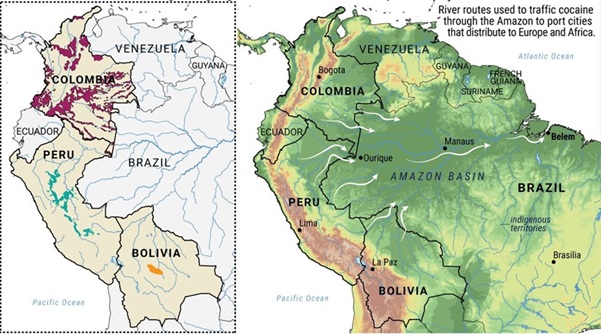
US narcoterrorism across LAC created the ‘Crystal Triangle’ of Colombia, Bolivia and Peru and neighbouring Ecuador, deeply tied to the river networks of the Amazon Basin, a history documented in Cocaine, Death Squads and the War on Terror: US Imperialism and Class struggle in Colombia. In recent narco-politics, Daniel Noboa, Ecuadorean President and Trump ally has been implicated in cocaine trafficking per police documents. Last year, Trump pardoned Juan Orlando Hernández, the former President of Honduras in support of his right-wing National party, despite his being sentenced to 45 years in a US prison for cocaine trafficking and weapons conspiracy. The Delta Force team that kidnapped Maduro is widely regarded as operating a large drug cartel and is stationed at Fort Bragg, North Carolina.
Data source: UNODC/Amazonia2030/Scientific Reports.
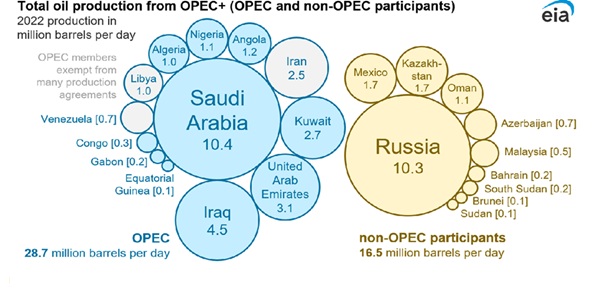
The events in Venezuela are for now front and centre in global politics and energy markets. Nobody has much of an idea what is coming next, but it is widely assumed that the kidnapping is a major negative for China who is the largest purchaser of Venezuelan crude oil, and that other oil suppliers will need to be found. Contrary to popular belief, Venezuela simply does not produce enough crude oil and China is well insulated for any supply side shocks at all.
Data source: U.S. Energy Information Administration, Short-term Energy Outlook, April 2023.
Whilst trade and energy links, crippling US sanctions and internal contradictions such as Venezuela’s historical dependency on oil are important factors, the question remains whether the interim Venezuelan president Delcy Rodríguez or any alternative leader will prove to be a reliable comprador. In any event, it would be foolish for the US to take the path of invasion, especially when considering Trump’s waning popularity among the US electorate, including his MAGA base.
China is not desperate for oil, nor does it need to fire a shot, just emerge as the ‘adult in the room’ through diplomacy, infrastructure, loans and projects which now counts 22 countries in LAC through its Belt and Road Initiative. China’s upward trajectory as a superpower requires peace and stability. The US, on the other hand, is addicted to the largest sectors of global trade: drugs, oil and war with Trump now ready to “come to the rescue” in Iran. Many forget that it was drug money worth billions of dollars which kept the financial system afloat during the Global Financial Crisis of 2008, according to the United Nations Office on Drugs and Crime (UNODC).
It remains unclear what will follow and whether Trump’s actions will serve to unify, rather than disintegrate, Venezuela. Or, whether the region will descend into conflict or “business as usual.” A return to the death squads of the 1980s is not far-fetched and in Colombia, the narcobourgeoisie still runs the show. In an interview with Madrid based newspaper El Pais, Colombian President Gustavo Petro acknowledged: “We have not conquered power, we have conquered an administrative government cornered by other powers and by economic interest, including those of the press.”
There are also global implications, as it could embolden China and Russia in the ongoing and dangerous ‘great power competition’, with the US keen to reverse its declining power with acts of criminality and right-wing narcoterrorism by state actors and criminal organisations.
The following scenarios from the political imagination are plausible- Netanyahu on a plane to the International Criminal Court or Zelensky appearing in Moscow, or a conflict breaking out over the Chinese island of Taiwan. In this era of 21st century imperialism, anything is possible and realistically dangerous. We can debate the issues, but the realities of US power and that of rising China is reasonably clear. However, the debate about whether the US is an imperialist power is well and truly over.Email
Dr Oliver Villar teaches international politics and sociology at Charles Sturt University, Australia. His work explores international relations and international political economy. His co-authored book with Drew Cottle is Cocaine, Death Squads and the War on Terror: U.S. Imperialism and Class Struggle in Colombia published by Monthly Review Press. His current research project investigates the subject of inter-imperial rivalry in the twenty-first century.
Venezuela: It’s Much More Than Oil
by Don Fitz / January 13th, 2026
As the US openly discussed schemes to add Greenland to its list of conquered territories, it became abundantly clear that “Alternative Energy” (AltE, solar, wind, hydro power) joined fossil fuels at center stage.1 Corporations which pull the puppet strings of governments are well aware that oil production will cease long before none remains in the ground. When extraction becomes so expensive that it takes more than a barrel of oil to obtain a barrel, then it will no longer be financially viable to pump it out. They must look to AltE.
AltE requires oil for its production. Solar panels, wind turbines, and hydro-dams are heavily dependent on oil to manufacture machinery, operate equipment and dispose of used products. Thus, oil is not separate from from AltE – they are both sketches in the bigger picture of energy production. Greenland is closer to Venezuela than they appear on a map.
But there is something particularly interesting about media coverage of Greenland in January 2026 – there has been virtually no coverage of campaigns directed at the actions of the US and other rich countries to exploit AltE sources in the poor world. Nothing about the brutal working conditions for those digging cobalt in the Democratic Republic of Congo. Nothing about Elon Musk’s role in the November 2019 coup for Bolivia’s lithium. Nothing said about the military, political and economic muscle used against countries across the globe whose main crime has been sitting atop rare earth minerals necessary for AltE.
It may seem strange that rich world media focuses on Greenland and ignores what has already been done so extensively to the poor world. Actually, it is not strange at all. Explanation only requires one word which the rich world is loathe to apply to itself: “Racism.” Or maybe another word or two: “Imperialism” and “Colonialism.”
No Invasion of Greenland or Africa, Asia or Latin America!
Let’s be clear: the nonchalant way the wielders of power suggest that they may march into Greenland is bad and should be opposed. It is the contrast between the outrage at threats to Greenland versus the complacency toward Africa, Asia and Latin America that reflects the unspoken assumption that plundering lands inhabited by people of color is part of “the natural order of things” – something not worthy of special attention. Wars for Energy are not separate from environmental racism, but integrally connect to it.
In order to understand what rendered Venezuela vulnerable to attack it is useful to review the intensely racist nature of its connection to colonialism. Satya Sagar wrote an article on “Why the Removal of Nicolás Maduro will not stop the Bolivarian Revolution” that lays out the essential role of cultural racism in political struggles for 500 years. This history explains why Maduro’s “removal is mourned by the marginalized while elites celebrate.”
Within a few generations of the Spanish invasion, Venezuelan social structure was rigidly divided between two groups: “Criollos (American-born Spaniards) owned the land and the enslaved. Beneath them lay the vast majority: the Pardos (mixed-race), enslaved Africans, and indigenous peoples, who formed the working class yet were systematically excluded from power.”
Criollo Simón Bolívar successfully led Venezuela’s War of Independence (1819-1825) which was fought mainly by pardos seeking emancipation. Though slavery was abolished after the victory, criollo landowners remained in power and pardos were still disenfranchised.
1989 Caracazo
Class hostility seethed for the next century and a half. Then came the 1989 Caracazo.Venezuelanalysis.com documents that for the 25 years beginning in 1977 Venezuelan income fell by a third, largely due to “liberalization” demanded by the International Monetary Fund (IMF). Venezuela was “forced to allocate 50 % of all its export earnings to the IMF.” Poverty mushroomed, leading many in Caracas slums to eat dog food. Soon after a new president took office in February 1989 he announced a new set of IMF-demanded measures. They included a wide range of price hikes, including an immediate 30% increase in public transportation. As mass demonstrations spread, the country saw “disappearances, extra-judicial killings, tortures, raids, and other police abuses throughout the week.”
Father Matias Comuñas describes torture that was used indiscriminately “A young man was tied to a window with handcuffs by one of the Metropolitan policemen … and with a lighter the policeman began setting the young man’s arm on fire. The kid fainted in pain.”
Gidilfredo Solzano recalls that “the police went above Apartment Block 22, and shoved the bodies in plastic bags, threw them below, picked them up with a truck.”
According to Richard Gott some authorities acted differently. One officer “stopped his troops shooting at protesters, asking each person where they came from, if any were from areas where there are country clubs. When people answered ‘no,’ troops were instructed that the people protesting were their brothers and sisters from the same barrios, and they should hold fire.” Depending on the account, between 300 and 3000 died in the Caracazo. Memories of the slaughter by the rich remain burned in the minds of millions.
Less than a decade later, in 1998, Hugo Chávez was elected president with a promise to use oil revenues to improve the life quality of Venezeula’s poor. Then the unthinkable happened. Rather than leaving campaign promises on the sidelines after being elected (as has happened with so many Latin American politicians) Chávez actually did what he promised to do.
The Social Revolution Is the Core Revolution
Venezuelan elites were less than happy with what they saw. In 2002 Chávez announced that he would “replace some of the bosses who controlled the state-owned oil company.” On April 12, business leaders and dissident military officers, with the aide of right-wing media and the US government, seized the presidential palace and arrested Chávez. This was the 47-hour coup. The coup plotters announced that the head of the nation’s business association would be “president.” In “less than two days…Hundreds of thousands of Venezuelans—eager to protect the gains of the Bolivarian Revolution and determined not to go back to the old ways—poured into the streets of Caracas to demand the reinstatement of Chávez.” It quickly occurred.
Changes promised by Chávez increased. Similar to Cuba, ordinary citizens had the opportunity to determine the direction of the country via participation in community councils and institutions including the military, judiciary and even the national cabinet.
Also similar to Cuba, the Chávez government increased the ability of citizens to read and write with a literacy campaign and sought to establish pride in African and indigenous heritage.
Perhaps the strongest Cuban influence was in health care. Doctors from Cuba went to the most violent urban communities and remote rural areas where Venezuelan doctors feared to tread. For the first time in their lives many Venezuelans received medical care and poor students were urged to attend medical school.
The venom of the criollos knew no bounds. The hatred of Cuba by right-wingers in the US and Venezuelans could well have contributed to 32 Cubans among the 80 murdered during the January 3 invasion. It could also contribute to the lack of medical treatment for Maduro’s wife, Cilia Flores, who was kidnapped with him. When in US custody she went “without medical assistance for almost three days” despite “fractures and possibly a severe rib hematoma.”
The way the Venezuelan elite viewed Maduro is indicated by their reference to him as “the bus driver,” confirming their contempt for anyone whose labor showed that he was not part of the in-group they felt should run the country.
They despised Chávez even more. His appearance was clearly that of a person of considerable African descent. So they referred to him as “the monkey.” These are the friends of Americans who engineered the January 3 kidnapping.
Not Another Caracazo in Venezuela or the World
Both the rich in the US and Venezuela have a preferred champion in the person of María Corina Machado, “the daughter of a wealthy steel baron, educated at elite private institutions.” Machado’s strongest allies include those who engineered the slaughter of the 1989 Caracazo, attempted the 2002 coup against Chávez, and sneered at him as a “monkey.” Her platform of privatizing the oil company (that Chávez nationalized) would leave poor Venezuelans without financing of programs for health care, education, sanitation and food.
Machado’s receipt of the 2025 Nobel Peace Prize demonstrates the European desire for Venezuela to return to the business-friendly days of the Caracazo. Those making this award appear to believe that “peace” means that the poor world must willingly sacrifice the necessities of life so the rich do not have to seize it from them.
Would they also believe that Elon Musk promotes “peace” by helping to engineer the 2019 coup against Evo Morales so he could get lithium from Bolivia for a lower price? Or were those who machinated to remove Pedro Castillo from power in Peru? Or should those be deemed “peace” advocates who removed Jacobo Árbenz from power in Guatemala in 1954 or Salvadore Allende in Chile in 1973?
Yes, Wars for Energy (Wars for Oil and Wars for AltE) are parts of the broader wars to extract natural resources from the poor world that have gone on for at least five centuries. Cultural subjugation of people of color is not merely linked to those wars – crushing of the many is a fundamental part of increasing wealth production for the few.
Corporations abhor the environmental revolutions that threatens their profits and scorn the cultural revolutions that demand equal access to resources and civil rights for all. Their politico-military counter-revolution is what globs together their environmental and cultural counter-revolutions.
That is why the solution for the War on Venezuela is more than calling for Trump to be arrested and extradited to Caracas. A genuine solution would require fundamental economic change including (a) reducing manufacture for the war machine and other destructive, unnecessary, and luxury items in the rich world so that (b) it can help the poor world increase the necessities of life. If getting rid of what is unnecessary is sufficient, it would be what many call “degrowth.”2
EN\\DNOTES:
1
This article is based on comments the author gave at the January 7, 2026 rally to defend Venezuela from US aggression and the kidnapping of its president Nicolás Maduro. Presentations were made by the Universal African Peoples Organization, African Peoples Socialist Party, Organization for Black Struggle and Green Party of St. Louis.
2
A degrowth perspective might suggest that reparations from the US government and oil companies could provide Venezuela with enough revenue to dramatically reduce oil extraction.
The U.S. Operation Absolute Resolve to capture and kidnap Venezuelan President Nicolás Maduro is quite possibly one of the most unprecedented military operations to ever be carried out. While the facts on the ground are still not completely clear, we can at least establish why the Trump administration decided to remove Nicolás Maduro from power.
“Classic U.S. Imperialism”
Conventional wisdom tells us that the primary motivation was to secure American access or control over Venezuela’s oil. Oil is a major factor — but it’s actually secondary. Venezuelan oil was used by the Trump administration to sell the intervention to a skeptical political and business class. In other words, from Donald Trump’s perspective, a military operation to oust Maduro was worthwhile because American multinationals will profit from the oil bonanza that would come afterward.
There is also no market imperative to justify an oil grab for the purpose of bringing more Venezuelan petroleum online. The global demand for oil is currently not outstripping global supply, and prices are on the decline. In fact, not only is there a glut in the international market right now, but more oil is expected to slosh around the global economy later this year. The integrity of the international oil market is safe and sound, and scarcity in global supplies of energy are nowhere near the horizon.
However, the primary motive for ousting Maduro was revealed by Secretary of State Marco Rubio in an interview he gave to NBC’s Meet the Press. “What we’re not going to allow is for the oil industry in Venezuela to be controlled by adversaries of the United States,” he said. “Why does China need their oil? Why does Russia need their oil? Why does Iran need their oil? They’re not even in this continent.”
And this is the crux of Trump’s America First foreign policy — it’s a “Hemisphere First” agenda with the U.S. at the helm. The plan is for the United States to exert complete political control — and by extension economic domination — over Latin America. It’s classic U.S. imperialism. It will not tolerate uncooperative left-wing governments (democratic or not) asserting autonomy over their own resources, or perceived adversarial foreign powers from gaining influence in the region.
“A Monroe Doctrine for the 21st Century”
The National Security Strategy published by the Trump administration in November 2025 outlines their vision. It is an updated and renewed Monroe Doctrine for the 21st century where “non-Hemispheric competitors” are sidelined. The U.S. wants to reestablish itself as the premier trading and business partner for every country in the Americas. And it seeks to curtail China’s export market share and capital investment in strategic assets like the Panama Canal and oil in Venezuela.
Venezuela’s oil production collapsed to 569,000 barrels per day in 2020, but it was able to increase output past 1 million barrels per day last year thanks to special licenses granted to Chevron and joint-venture contracts with Chinese firms who developed or controlled their oil fields. Most of Venezuela’s oil exports go to China, and a smaller share of subsidized shipments depart to Cuba, another target of the Trump administration. Cuba will feel the sting of decreased petroleum imports as it puts their already vulnerable power grid on the brink — with the Trump administration hoping to slowly strangle the country.
President Trump has been transparent about wanting American multinationals to spearhead Venezuela’s economic recovery. He believes that in 18 months, they can develop its bountiful oil reserves. China can presumably still import Venezuelan petroleum — preferably developed and sold by the U.S. or jointly with Venezuela’s state-owned oil company, PDVSA — but China would not be allowed to expand its control over Caracas’ oil reserves.
But this remains to be seen. ExxonMobil and ConocoPhillips may balk at investing in the short-term because of political instability, the lack of security guarantees, and the capital expenditures needed to update Venezuela’s oil infrastructure to get energy supplies flowing from Venezuela to international markets — in particular, to U.S. markets.
“A Test Lab for the Trump Administration”
More broadly, Venezuela is a test lab for the Trump administration. They get to see how Latin America and the rest of the world reacts to their war crimes in the Caribbean and the breach of the territorial integrity of Venezuela. An inadequate international response to uphold state sovereignty as a legal norm leaves other countries and territories vulnerable to U.S. interference if they do not acquiesce to U.S. interests.
The main pretext to justify this violation of international law and state sovereignty was ostensibly to stop the flow of drugs into the United States. However, Trump’s approach to the so-called War on Drugs is built upon an intrinsic contradiction.
Furthermore, the U.S. government is not afraid to fabricate lies. The Trump administration spent months painting Venezuelan President Nicolás Maduro as the head of a major drug cartel, Cartel de los Soles, only for the Justice Department to later admitthat no such organization exists. Trump later falsely accused Colombian President Gustavo Petro of making cocaine and Mexican President Claudia Sheinbaum of losing control of her country to cartels, making both Colombia and Mexico his potential next targets.
Many in the Latin American left have correctly viewed Maduro’s Venezuela as a liability and an albatross around their necks. A number of countries with left-wing heads of state — Brazil, Chile, Colombia, Mexico, and Uruguay — did not recognize his presidential electoral victory in 2024. Yet they all rightly condemned the U.S. military operation on principle.
A lack of accountability allows the U.S. to behave with impunity vis-à-vis international law. It marks yet another blow to state sovereignty and the so-called “rules-based” order. The U.S. can undermine and violate the territorial integrity of every Latin American country at will — all they have to do is to accuse you of being a drug trafficker (but it is only applicable to enemies, not to allies, of the Trump administration).
That’s why more governments — and social movements around the world, including in the United States — need to speak out forcefully against this invasion and call to uphold international law.
Omar Ocampo is a researcher for the Program on Inequality and the Common Good at the Institute for Policy Studies.
Faking It ‘Til We Break It
by Nolan Higdon / January 13th, 2026
“Video showing Maduro allegedly torturing Venezuelan dissidents is going viral, with 15 million views and 81k likes already. The only problem? It is actually a scene from a movie.” This tweet from journalist Alan Macleod captured just one droplet in a flood of disinformation following the U.S. capture of Nicolás Maduro. As The Guardian noted, AI-generated images of the event reaped millions of views, instantly saturating social media with fiction.
This cycle repeated days later when Renee Good was killed by an ICE agent in Minnesota. NPR reported that “AI images and internet rumors spread confusion,” fueling a rush to judgment that bypassed all evidence. Rather than awaiting verified facts, the public retreated into partisan scripts: Democrats immediately condemned the agency, while Republicans vilified the victim. This reflexive tribalism illustrates a nation that has abandoned the patience of critical analysis in favor of viral, evidence-free outrage. This reflexive rush to judgment is now weaponized by a new tool of deception: the deepfake.
The emergence of deepfakes has introduced a volatile new dimension to the challenge of disinformation. This technology preys upon systemic vulnerabilities: a widespread lack of media literacy, a ‘greed is good’ hyper-individualism, and a techno-utopian ethos that prioritizes innovation over decency, truth, and social cohesion. The result is a fractured digital landscape where ethically bankrupt creators and profit-driven platforms engineered for engagement oversee the steady demise of civil society. This marriage of cutting-edge deception and ancient tribalism has created a perfect storm where the most successful lie wins and the truth is buried under a million algorithmically-driven clicks. To survive this era of manufactured outrage, we must move beyond passive consumption and demand systemic accountability for the engines of our deception.
The Mechanics of Deception
So-called AI is just the latest tool in a Big-Tech shed that fosters and incentivizes propaganda. Studies have long shown that falsehoods spread more widely than truth on social media, not due to individual behavior, but because Big-Tech platforms are engineered to incentivize the spread of false and misleading content.
AI has complicated the problem of disinformation. Seventy years ago, AI was envisioned as the pursuit of human-like cognitive reasoning; today, that label is frequently marketed to describe technologies that bear little resemblance to those original intellectual ambitions. Modern systems of so-called AI rely primarily on massive datasets and statistical pattern recognition. As a result, they are far from intelligent, and limited in their capacity. Indeed, AI bots are prone to getting things wrong and fabricating information: One study found that AI bot summaries of news content were inaccurate 45% of the time. Other studies have found AI fabricating information from 66% to over 80% of the time.
Beyond deploying bots that circulate misinformation, Big-Tech has released AI tools that empower average users to produce highly convincing, yet entirely fabricated, content with ease. For example, more than 20 percent of videos shown to new YouTube users are “AI slop,” meaning low-quality, mass-produced, algorithmically generated content designed to maximize clicks and watch time rather than inform. These types of deepfakes shaped audience interpretations of recent conflicts such as Israel-Gaza and Russia-Ukraine.
After Maduro’s extraordinary rendition, the internet was quickly flooded with AI-generated content designed to persuade Americans that his capture was an act of justice welcomed by the Venezuelan people. These posts showed Venezuelans supposedly “crying on their knees” to thank President Donald Trump for their liberation. One such video, flagged by Ben Norton, racked up 5 million views.
Similarly, after Good was shot and killed by ICE on January 7, 2026, deepfakes circulated online falsely claiming to reveal the face of the agent involved.
However, the image did not depict the actual agent, Jonathan Ross, an Iraq War veteran with decades of experience in immigration and border enforcement, who had been wearing a mask at the time of the incident.
Ross was not the only one falsely identified; immediately after the shooting, photos circulated online claiming to be of Renee Good. In reality, the images were a confusing mix of a former WWE wrestler and another woman who had previously participated in a poetry contest with the actual victim. The digital desecration continued as users weaponized AI to undress an old photo of Good and manipulate images of her lifeless body, generating deepfakes that placed the victim in a bikini even as she lay at the scene of the shooting.
The Shield of Immunity: Section 230 and Beyond
At a time when approximately 90% of U.S. citizens have access to smartphones and 62% use so-called AI, the U.S. government has largely allowed Big Tech platforms and devices to remain unregulated. Indeed, U.S. policy has favored the tech industry for decades, prioritizing immense corporate profits over meaningful accountability for the societal impacts of these platforms.
Thanks to Section 230 of the Communications Decency Act (CDA), which protects internet platforms from legal liability for content users post, and a religious devotion to the idea that “what’s good for tech is good for America,” these companies enjoy total immunity. Similarly, Trump recently signed an Executive Order shielding the industry from AI regulations at the state level. These actions stem from a shared conviction among Big-Tech and its allies in government that regulation is the fundamental enemy of progress and innovation. The few regulations that do exist typically place the burden on users rather than on platforms, such as requiring individuals to show identification, which further contributes to the surveillance mechanisms that define these tools.
In the absence of a robust regulatory framework, many argue that media literacy education offers the most promise for mitigating the influence of misinformation on the public. In the U.S., media literacy is broadly defined as “the ability to access, analyze, evaluate, create, and act using all forms of communication.” Indeed, media literacy education has been associated with a reduction in users accepting disinformation. However, the lack of a central education authority to establish a national curriculum, combined with opposition from traditionalists resistant to new media in the classroom, has significantly hindered the spread of media literacy education. Most Americans lack access to a formal media literacy education, even though more than three-fourths of the population believe it is a critical skill that everyone should develop.
While efforts to integrate media literacy into the classroom are growing, they are increasingly dominated by the very companies they should be critiquing. Big Tech has leveraged the vast wealth gained from harvesting user data to exert an outsized role in shaping educational standards. By offering content and programs for classroom use, these corporations provide tools of “corporate indoctrination.” Their curricula emphasize the opportunities of technology while framing issues like “fake news” and bullying as individual moral failures, such as a lack of character or excessive screen time, rather than systemic results of the dopamine loops and profit models the industry intentionally built.
In contrast, critical media literacy scholars argue that a robust education must teach students to interrogate power dynamics, ownership, platform design, and profit motives. However, because their work challenges the industry, these scholars receive almost no corporate funding and must rely on nonprofits and volunteer labor.
Despite these concerns, educational institutions are leaning further into corporate partnerships. For example, the California State University system, the nation’s largest public university with nearly half a million students, recently announced a $17 million deal with OpenAI, the creator of ChatGPT. This massive investment in “Big Tech” occurred even as the CSU system was simultaneously cutting faculty and staff positions across its 23 campuses.
From Social Capital to Content Creation
While Big-Tech algorithms are complicit, they are not solely to blame. In the post-Cold War era, the United States concluded that capitalism had definitively triumphed over all other systems, treating the Cold War as a final, accurate contest of ideas. This ushered in a fundamental shift in the nation’s cultural and political compass, famously epitomized by the mantra from Oliver Stone’s Wall Street: “greed is good.” Researchers like Robert Putnam, in his influential work Bowling Alone, noted that this shift eroded the social capital and communal bonds essential for a functioning democracy. This hyper-individualistic context has profoundly shaped every generation since, leading to what Jean Twenge and W. Keith Campbell refer to as a “narcissism epidemic.” The nation has become so individualistic that even some people associated with the left, which historically has believed in collectivism, such as Matt Taibbi and Cenk Uygur, joined conservatives in outrage when New York Mayor Zohran Mamdani used the word “collectivism” in his inaugural speech this month.
The resulting culture of narcissistic individualism has engendered a generation of ethically hollow influencers and content creators who worship at the altar of Big-Tech, sacrificing collective integrity for personal profit. As commentator Krystal Ball noted, the incentives for these creators are so perverse that even when videos, such as those regarding Maduro, are debunked, users continue to share them for engagement.
Perhaps the most egregious example is influencer Nick Shirley, who went viral for ‘exposing’ alleged fraud at daycare centers in Minnesota. Although the New York Times had previously reported on a legitimate multimillion-dollar fraud case in Minnesota, where the state and federal governments under the Biden Administration were actively prosecuting individuals for embezzling childcare funds, Shirley fabricated his own distorted narrative. He produced videos alleging a deeper, hidden layer of corruption that the government was supposedly ignoring; however, he relied on a blend of fabricated evidence and baseless accusations to support a “cover-up” narrative that simply did not exist. Nonetheless, Shirley’s video has over 100 million views within a week across different platforms. It was reposted by Vice President J.D. Vance and FBI Director Kash Patel.
Beyond merely inspiring copycat content, these viral fabrications were weaponized by the Trump administration to justify freezing federal funding in five Democratic-led states. Under the guise of addressing fraud and systemic misuse, the administration withheld billions of dollars earmarked for essential childcare and social services. Simultaneously, the Department of Homeland Security deployed as many as 2,000 federal agents to Minnesota in a massive law enforcement surge that resulted in Good’s death.
Shirley reflects a broader culture where viral lies are rewarded with wealth. In this environment, deception has become a viable business model because fraud no longer carries a social stigma when used for profit. Instead, it is often rewarded. Just look at Elon Musk. He is one of the richest men on Earth and was a distributor of some of the fake online content following Maduro’s capture. At the same time, Musk is expanding his wealth in the age of AI with tools that spread baseless racist conspiracies such as the myth of white genocide in South Africa, a new version of Wikipedia that refers to Adolf Hitler simply as “The Führer,” and AI tools that enable users to create deepfake images undressing women and children.
Instead of being treated like a James Bond villain, Musk is worshipped as an aspirational figure. He embodies the ultimate “fake it ’til you make it” con man: a self-brander who convinced the world he was a self-made, intelligent inventor, when in fact he relied heavily on $38 billion in government funding, investments from his father, and piggybacked on the creations of truly brilliant inventors.
The Architecture of Hypocrisy: Why One Standard is No Longer Enough
The toxicity of narcissistic content creators and hyperpartisan figures seeking to expand their brands in the attention economy goes beyond the mere production of falsehoods; it is a symptom of a culture seemingly unable or unwilling to shame even the most glaring contradictions.
For instance, many conservatives backed Trump when he labeled the law enforcement officer who shot a woman during the January 6 Capitol riot a “thug,” yet his allies staunchly defended the agents involved in the Good incident. In fact, even before an official investigation had been launched, let alone concluded, Vice President J.D. Vance argued that Ross possessed “immunity.” Furthermore, while these same circles argue that individuals must take personal responsibility for their actions, rejecting the idea that Trump’s rhetoric created the context for January 6, they paradoxically blame leftists for creating the environment that led to Ross shooting Good.
Yet, even these double standards pale in comparison to the reaction following Charlie Kirk’s death in September 2025. In the ensuing months, conservatives frequently bemoaned a lack of empathy and decorum from the left, which criticized Kirk’s legacy of divisive rhetoric while his wife and loved ones were still grieving. However, those same voices, with notable exceptions such as Tucker Carlson, refused to extend that same grace or “decorum” to the wife and loved ones of Good.
Fox News Channel’s Jesse Watters dismissed Good’s claim that she is a poet and mocked her for listing pronouns in her online bio, a relatively mild attack compared to others. Without evidence, former President Trump called Good a “professional agitator.” Secretary of Homeland Security Kristi Noem labeled her actions an “act of domestic terrorism.” Meanwhile, Vance described Good’s death as a “tragedy of her own making.”
They accompanied these baseless claims with rhetoric directly contradicted by witnesses and video. Trump falsely claimed that Good “viciously ran over” Ross who was recovering in the hospital. In reality, Good’s car did not run over anyone, and Ross walked away from the scene unassisted. Relatedly, a Department of Homeland Security spokesperson, Tricia McLaughlin, falsely claimed that multiple ICE officers were hurt. McLaughlin also falsely accused Good of “stalking agents all day long, impeding our law enforcement.” In reality, video evidence reveals that Good had been on-site for a few minutes. She had just dropped off her now-orphaned six-year-old child at school and was not blocking the road; in fact, cars can be clearly seen passing her vehicle throughout the footage. A crowd had gathered because an ICE vehicle was immobilized in the snow. Unlike the U.S. Postal Service, which is famously expected to operate in all weather conditions—under the creed, “Neither snow nor rain nor heat nor gloom of night stays these couriers from the swift completion of their appointed rounds”—ICE was visibly struggling to function in the elements.
These fabrications and baseless accusations reveal a profound callousness toward Good’s grieving family, most notably her wife and orphaned child. This stands in stark, bitter contrast to the demands for decorum and empathy that conservatives issued following Charlie Kirk’s death. One would expect a civilized nation to extend basic sympathy whenever a citizen dies: whether they are shot during a chaotic political protest or killed and denied medical attention. Faced with such blatant double standards, the nation must finally direct Joseph Welch’s famous rebuke of McCarthyism toward itself: ‘Have you no sense of decency, sir, at long last? Have you left no sense of decency?'”
Rhetorically, most claim to view these incidents as tragedies; in practice, however, they operate with blatant double standards: empathy for one side while displaying callousness, or even cruelty, toward the other. A more sophisticated culture would remember comedian George Carlin’s wisdom: “Let’s not have a double standard. One standard will do just fine.”
Conclusion
To restore the soul of a nation fractured by digital fabrication, there must be a collective refusal to continue this cycle of reflexive tribalism. Engaging in a perpetual war of “us versus them,” where truth is sacrificed for the sake of a partisan win, ensures that everyone loses, and the country remains a casualty of its own division. It is insanity to continue entrusting the national discourse to unregulated algorithms and narcissistic creators, expecting that more of the same will somehow yield a different, more unified result.
The time has come to demand a higher standard: one that prioritizes evidence over engagement and human decency over ideological dominance. By rejecting the lure of the deepfake and the ease of the echo chamber, a path can be cleared toward a more sophisticated culture, one that values critical analysis, insists on corporate accountability, and understands that without a single standard of truth and empathy, the foundations of a functioning democracy cannot hold.

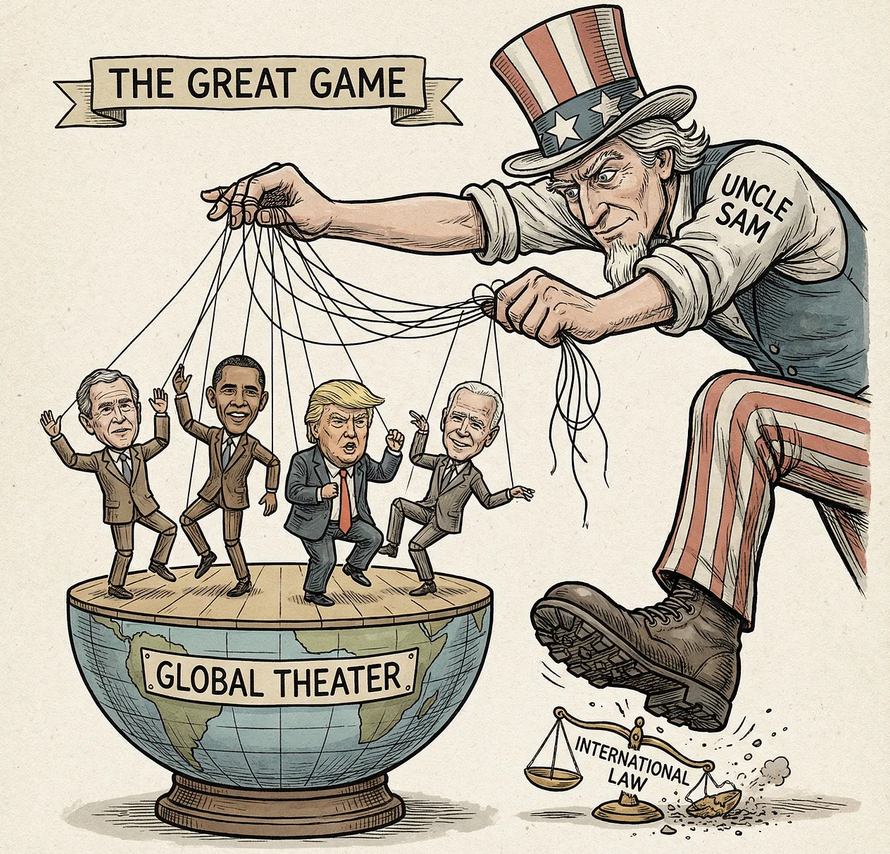
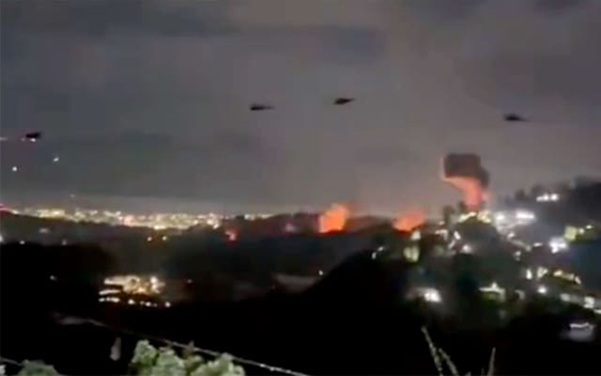 Image of Helicopters flying across the Caracas skyline as a series of explosions rock the Venezuelan capital; from \