Wednesday, January 14, 2026


Report: India Wants to Ramp Up its Warship Exports
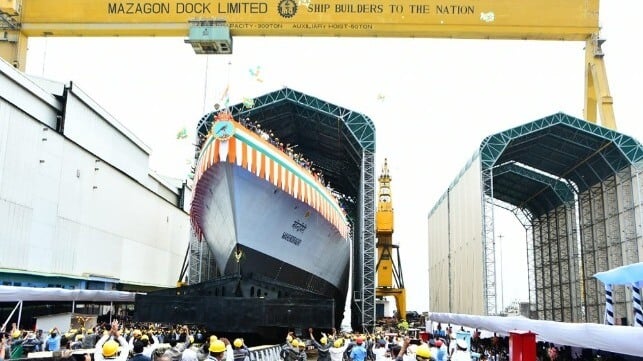
A new P-17A class frigate, Mahendragiri, at launch at Mazagon Dock (Gov't of India)

Published Jan 11, 2026 11:55 PM by The Maritime Executive


India is reportedly working to expand warship exports as part of the ongoing push to revamp its shipbuilding industry. The Ministry of Defense (MOD) has already issued directives to the state-owned shipyards, instructing the facilities to build their capacities for export orders. According to a report by the defense news site Indian Defense Research Wing, the MOD’s directive covers expansion of docking and manufacturing infrastructure in the shipyards. In addition, the shipyards are expected to customize their blueprints for naval platforms in readiness for export orders.

The targeted public sector shipbuilders include Mazagon Dock, Garden Reach (GRSE), Goa Shipyard and Hindustan Shipyard. At a time India is investing heavily to transform its shipbuilding sector, it sees an opportunity in fulfilling the massive demand for warship exports. India has already mapped this opportunity under its "Security and Growth for All in the Region" (SAGAR) vision, which seeks to assert its role as a net security provider in the Indian Ocean Region (IOR).

Under SAGAR, India has been expanding maritime cooperation with countries such as Sri Lanka, Maldives, Seychelles and Mauritius. In these markets, India has tested its capability to export smaller naval platforms. In 2014 for instance, GRSE delivered its first corvette class warship to Mauritius. Since 2015 onwards, India has also delivered fast attack craft to Seychelles and Sri Lanka. However, these exports have remained limited, with little revenue share to the Indian shipyards.

In addition, emerging regional naval powers in Southeast Asia - including the Philippines, Indonesia and Vietnam - are looking to expand their warship fleets. According to estimates, these countries require 20-30 frigates over the next decade, especially as they all try to counter Chinese expansion in the South China Sea. India has started to make inroads to these markets as well.

Back in 2023, India made a first-of-its-kind corvette donation to Vietnam, ramping up its defense ties in the South East Asia region. Moving forward, India wants to shift its focus in the region in supplying big-ticket naval platforms such as frigates and destroyers. India hopes to leverage on cost-competitiveness of its platforms, undercutting traditional defense suppliers such as Europe, where cost could exceed $800 million per warship.

But to sustain the competition, India has to achieve economies of scale in shipbuilding. While expansion of shipyards solves part of the problem, a lot of emphasis has to be on clearing inefficiencies in construction. Currently, India takes 5-7 years to deliver a warship compared to China’s 3-4 years. In this regard, MOD’s directive has mandated the public sector shipyards to adopt integrated ship construction systems. Partly, this will see simultaneous prefabrication of hull blocks, superstructures and internal systems before assembly.


 

China Begins Enforcing its Ban on Shipboard Starlink

A Starlink satellite launch (SpaceX handout image)

Published Jan 13, 2026 5:39 PM by The Maritime Executive


China does not allow the use of Starlink internet connectivity in its waters, and prefers to route all traffic through networks that are subject to its own licensing process. The restriction is unpopular with seafarers, who like Starlink's high speeds and low latency for video calls and general-purpose browsing - but Chinese authorities are beginning to enforce their rules more rigorously. P&I correspondent Oasis reports that the first known Chinese investigation related to shipboard Starlink usage was launched in December, indicating that vessel operators need to start ensuring compliance in order to avoid difficulties. 

China's Maritime Traffic Safety Law requires all vessels in Chinese jurisdiction to route their digital communications through authorized coast stations or satellite gateway stations, licensed and approved by the authorities. Satcom service providers need legal approval to operate in China, and using unapproved vendors for internet connectivity is a breach of Chinese law. Starlink - intimately connected with the U.S. defense establishment and with American-backed military operations in Ukraine - is not on China's list of approved operators.

The possible fine for noncompliance is as high as 100,000 yuan ($14,000) for serious cases, accompanied by a license suspension of up to three months. A separate set of radio regulations provides for another fine of up to 50,000 yuan, and up to 500,000 yuan ($72,000) if the radio equipment is used for illegal activities.     

China has recently increased its enforcement effort to crack down on Starlink usage, Oasis says, and the maritime safety administration for the port of Ningbo began the first known Chinese inquiry into a vessel's connectivity last month. 

To avoid problems, Oasis recommends taking proactive steps to demonstrate that Starlink is not in use. The terminal should be turned off and visibly disconnected from the ship's network before entering China's EEZ, 200 nautical miles out. Even though Chinese legal jurisdiction for surface vessels only extends to 12 miles from shore, the overcompliance is advisable, Oasis said. The time and location of shutdown should be noted in the deck log.

To make sure the terminal stays shut down, the crew should be trained on the rules, and the equipment should be labeled with reminders that it cannot be used within reach of Chinese regulators. 

Other options for connectivity exist within China, and the Starlink ban is one reason why many operators opt for hybrid networks. These multilayer solutions incorporate LEO services like Starlink or OneWeb, backed up with a GEO service like FleetXPress or Intelsat. Many incorporate terrestrial connectivity via LTE or wifi for in-port service, ideal for near-coastal operations in China. 


Egyptian Authorities Rescue Crew After Master Grounds Damaged Ship

rescued crewmembers
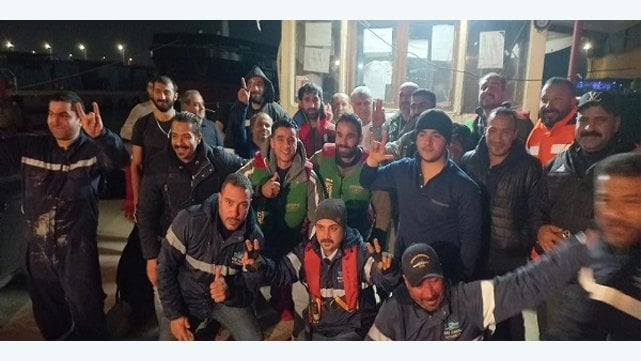
Egypt recued the crew of a damaged cargo ship after the master grounded the vessel (SCA)

Published Jan 14, 2026 2:46 PM by The Maritime Executive


Egyptian authorities are reporting that they were able to rescue a dozen crewmembers from a small cargo ship that was in danger of sinking in the anchorage near Port Said. The rescue was the successful conclusion after a series of calamities.

The Turkish-owned cargo ship Fener (4,500 dwt) had come from Turkey to load a cargo of salt at Port Said. Built in 1982, the ship is 138 meters (453 feet) in length and registered in St. Kitts and Nevis.

The Suez Canal Authority reports the ship was leaving Egypt early on Tuesday, January 13, but shortly after departing, the captain requested permission to anchor due to bad weather in the area. The intent was to wait out the weather before proceeding. 

The Fener next notified the Suez Canal Authority’s maritime salvage unit that it had a breach in one of its holds. The ship said it was taking on water and requested assistance. As a precaution, the captain, however, decided to move the ship south of the anchorage and ground it to prevent it from sinking.

At 2330 local time last night, the ship again requested assistance, issuing a distress call. The Fener had taken on a 10-degree list to starboard, and the master said they feared the ship was “coming close to sinking.”

The Suez Canal Authority dispatched two tugboats and three speedboats. They rescued the 12 crewmembers from the ship and brought them to the port for medical attention. One crewmember was reported to be suffering from a dislocated shoulder.

In relaying the details of the rescue, the Suez Canal Authority emphasized that the incident did not impede the operations of the canal. The Fener was reported to be 5 miles west of the northern entrance of the Suez Canal. The Authority said 35 vessels made the transit on Tuesday without incident, representing 1.6 million tons.

The Suez Canal Authority reports it has been using the time during the recent lull in volume to enhance its maritime and safety operations. It recently highlighted efforts to build new tugs that are being used to support operations at the ports and in the canal. They note the SCA has experience and established teams to respond to salvage, navigational safety, and pollution control incidents.


French Exploration Cruise Ship Exploris One to Hit Auction Block

expedition cruise ship
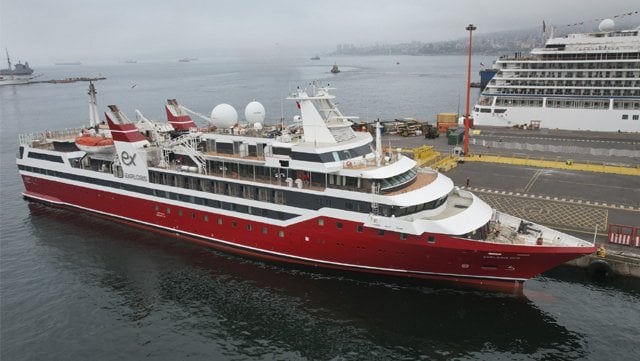
Exploris One is due to hit the auction block this month after the exploration cruise line went into liquidation (Exploris)

Published Jan 14, 2026 4:01 PM by The Maritime Executive


The small exploration cruise ship Exploris One, which had started service in 2023 for a French company of the same name, is now set to hit the auction block at the end of January. A previous attempt at a court-supervised sale of the vessel failed to proceed.

The company Exploris Croiseres & Expeditions was launched in 2023 by a former executive of another French cruise company, Ponant, and had promoted that they would be “the best an expedition cruise has to offer.” The ship was refurbished and registered in France for a launch in 2023. The website shows cruises currently scheduled from Ushuaia to the Antarctic Peninsula and Chilean fjords. It was due to transit to Europe in April. For the summer of 2026, it was scheduled to operate cruises under charter to Adventure Canada as well as trips for Exploris from Iceland.

Exploration cruising is one of the hottest segments in the cruise industry. It is enjoying rapid growth and an increased influx of luxury offerings to appeal to travelers seeking unique experiences.


Exploris One was offering a French-speaking exploration cruise product (Exploris)


Exploris acquired the ship in 2023 from Royal Caribbean Group’s Silversea Cruises. Built in 1989, the ship, which is 6,158 gross tons with accommodations for a maximum of 144 passengers, was promoted as “a global benchmark” in exploration cruising. The ship has operated under 10 different names in her career, but in 2008 was relaunched as Prince Albert by Silversea as the brand's first ice-class luxury cruise ship. In 2011, the company renamed her Silver Explorer, but she was sold in 2022 as the brand introduced new, luxury ships.

Despite the strong interest in the exploration cruise segment, media reports said Exploris operated at just 50 percent occupancy. The founder of the company told the French media they had over 2,000 passengers but were forced to cancel 500 advance bookings in September as the company fell into financial trouble. They had hoped to refinance, but said the cancelltion of the charter by Adventure Canada severely impacted cash flows.

Exploris was ordered into a court administration in September. The court rejected the refinancing plan and ordered the company into liquidation. The ship was laid up in Caen, France, where it remains.

Reports said negotiations were underway with several potential buyers for Exploris One under a court-supervised process. Bids were due to the court by late November.

The ship is now posted online in an auction with Interencheres. Bids are due by January 30, with no minimum price indicated.


Dewatering of Fire-Damaged ONE Containers Ship Completed

fire-damaged containership
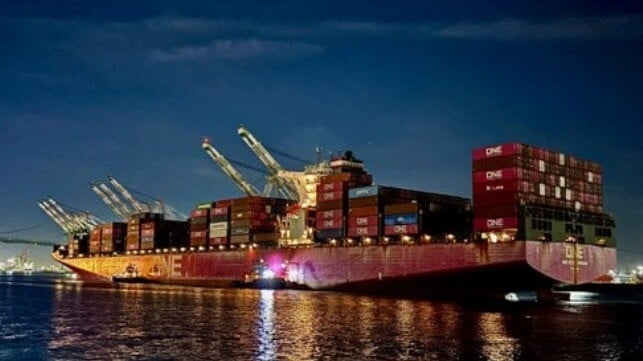
ONE Henry Hudson continues to clear cargo and fire water after returning to the dock (USCG)

Published Jan 14, 2026 6:04 PM by The Maritime Executive


Approximately eight weeks after a blaze struck the containership ONE Henry Hudson while working containers at the Port of Los Angeles, operator Ocean Network Express (ONE) is reporting progress in the recovery operation for the vessel. They report that the General Average Survey process is now underway and are highlighting the arrangements for the discharge and onward movement of the import and export cargoes.

The fire had begun on the evening of November 22 forcing the evacuation of the vessel and for a time suspending operations in the Port of Los Angeles. Sources said they believed it was an electrical fire, and it was mostly contained to the hold, but they had still decided to move the ship outside the port’s breakwall.

The ONE Henry Hudson (8,212 TEU) was moved back to the Yusen Terminal at the Port of Los Angeles after teams were confident that the fire had been extinguished. The vessel’s owners quickly declared General Average, starting the process to manage the discharge of cargo from the ship within the terms of the claims.

ONE reports that water discharge operations and the discharge of distressed cargo were completed on Monday, January 12. The removal of the firefighting water required the placement of a barge alongside the ship. Water, which was contained in the flooded cargo hold, was pumped off the vessel for treatment and disposal. The first phase of the water discharge operation was completed on December 19.

The cargo discharge is a systematic process. It started with the discharge of dry containers from the affected cargo hold that were not impacted by the fire or firefighting water. That was completed by December 26.   It moved on to the distressed containers.

Discharge operations for all the remaining containers was scheduled to start in the middle of this week. The company did not say how long it expected it would take to remove these containers.

At the same time, the GA surveyor was expected to commence surveys today, January 14. Once that is completed, ONE reports containers can be released to customers at the Yusen Terminal, or it would make rail by ONE arrangements to Oakland or arrangements for inland point destinations. The company expects to continue to arrange shipment of export cargo unless instructed otherwise.


Iran Releases Greek Tanker Seized Two Years Ago

tanker
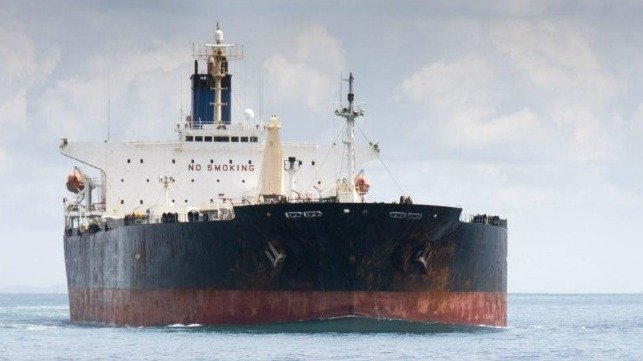
Iran released a Greek-owned tanker held for two years in retaliation against the United States (file photo)

Published Jan 13, 2026 5:20 PM by The Maritime Executive


A Greek-owned tanker that was caught in a series of back-and-forth maneuvers between the United States and Iran in 2023 and 2024 has quietly been released two years after the Iranians seized the ship and said they were taking its oil cargo. The move comes as Iran appears to be making moves to ease tensions with the West, as the regime is also facing widespread unrest inside the country.

The tracking service TankerTrackers.com broke the news on Monday, reporting on X.com that the tanker St. Nikolas (158,573 dwt) had quietly been released. It later said the tanker, which had been held since January 2024, was on its way to Oman.

Bloomberg is quoting a statement from the tanker's manager, Empire Navigation, that confirmed the ship reached Oman on January 10, and that the crew is in good health. They are reporting that the Iranians damaged some of the equipment aboard the vessel while holding it to prevent its detection. Iran initially had said it was seizing the oil cargo aboard in retaliation for a U.S. seizure, but Reuters reported months later that Iran quietly released the oil in a ship-to-ship transfer.

The release of the tanker ends more than three years of drama as the U.S. started chasing the vessel’s cargo. Then known as the Suez Raja, the ship was held off Singapore, and in 2023, the U.S. went to court, winning an order to seize the cargo. Empire Navigation agreed to assist the U.S. and pay a fine, and bring the ship to Houston, Texas, where it was offloaded. The vessel later abandoned her identity, quietly slipping away in September 2023 under the new ID of St Nikolas.

Iran had vowed retaliation and in January 2024 seized the tanker while it was outbound from the Persian Gulf with a cargo of Iraqi oil. Iranian forces directed the ship to port and took it into custody. A Greek cadet was released shortly after, and the captors permitted a crew change later in 2024.

There was no statement on what led up to the vessel’s release, but it comes as Donald Trump has threatened U.S. action if the regime acts against the protestors who have taken to the streets in Iran demanding economic reforms. Trump has been reported to be considering military action, but on Sunday night told reporters that Iran wanted to meet with the U.S. in an effort to reduce tensions. Trump has said that a meeting would be arranged, but continues to threaten unspecified actions in support of the demonstrators. Reports indicate that many have already been killed, but the Iranian government started a blackout on news over the weekend and shut down Internet access.

Iran has continued to hold several Western vessels seized during various actions in the Persian Gulf. It also holds the MSC Aries, a containership that was seized in support of the Houthis’ actions in the Red Sea. Last fall, Iran announced it was seeking a $170 million “fine” from the vessel’s owners, Zodiac Maritime, after saying the vessel was held for violating “maritime regulations.”


U.S. Coast Guard and Local Volunteers Save Crew of Grounded Crab Boat

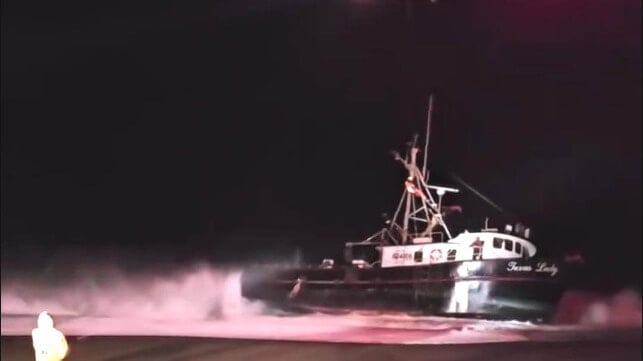
Texas Lady
Courtesy Sixes Fire Department

Published Jan 13, 2026 7:38 PM by The Maritime Executive


A combined Coast Guard and volunteer response effort resulted in the rescue of two people and two dogs from a crab boat that washed ashore at Port Orford, Oregon on Sunday, according to local accounts. 

On Sunday morning, the Coos Bay-based fishing vessel Texas Lady drifted aground on a sandy beach at Paradise Point, northwest of Port Orford. The Coast Guard responded to the scene, along with the local fire department and a volunteer search and rescue squad. In challenging conditions in the surf zone, the volunteers retrieved two dogs from the stranded vessel, and a Coast Guard helicopter aircrew helped the two crewmembers disembark. One additional crewmember self-rescued by jumping over the side and made it safely to shore. A bystander video showed the aircrew taking position over the grounded Texas Lady as she rolled in heavy surf. 

The initial wreck removal plan called for bringing in nearly 2,000 feet of towing hawser and rigging up the vessel to pull it off with a tug. Dive crews, a tug out of Coos Bay and a hawser were all sourced and en route to the scene, along with a team of 10 salvors.  

However, the plan reportedly changed as conditions on scene evolved. In an update Tuesday, local outlet Oregon Coast Explored reported that the vessel had sustained too much damage to be salvageable. Water and sand penetrated the interior, making it difficult to refloat and remediate. Instead, it will be hauled up onto the beach with heavy equipment, then demolished in place for removal. 


South Africa Rescues 21 Fishermen from a Burning Fishing Trawler

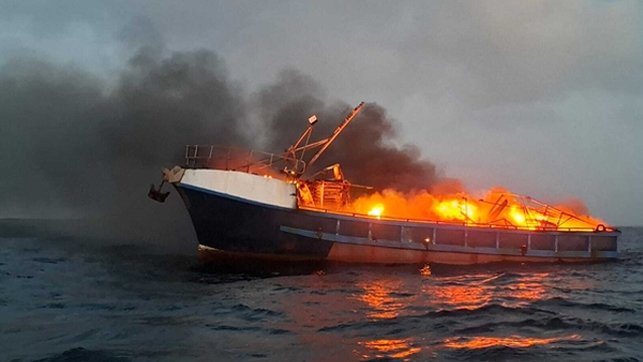
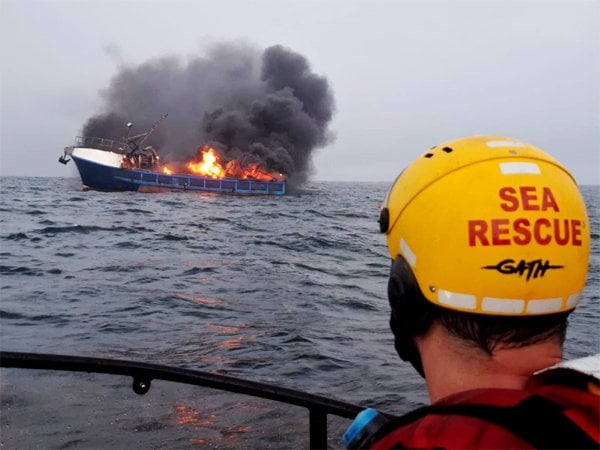
fishing boat fire rescue
Other fishing boats rushed to the rescue of the crew that had gone overboard (NSRI)

Published Jan 13, 2026 8:10 PM by The Maritime Executive


South Africa is reporting one of its most dramatic rescue operations in recent years, saving the lives of 21 fishermen who were forced to abandon ship after their trawler went up in flames Monday evening.

The National Sea Rescue Institute (NSRI) reports that multiple rescue teams were activated after it received a distress mayday call from the crew of the fishing vessel Silver Dorado. The crew said they were preparing to abandon ship as the fire overtook their vessel.

The mayday indicated the vessel was approximately one nautical mile offshore of Noordhoek, Gqeberha, in the Eastern Cape region. The fishing vessel had departed the Port of Port Elizabeth earlier in the day.

Before receiving the mayday alert, NSRI had received a call at 1752 local time on its emergency operations center from an eyewitness who raised the alarm of the burning fishing vessel. A local ski-boat club member, also called NSRI, alerting it to the fire.


Sea Rescue coordinated the effort along with other fishing boats to get the crew from the water (NSRI)


Rescue teams were activated while vessels in the area were instructed to divert to the burning trawler to assist the fishermen, all of whom had abandoned the burning vessel into the sea. Among the first responders was a local fishing vessel, Leguga, which arrived on the scene and launched its own life raft to assist the fishermen who were in the water.

NSRI reports that at least five other fishing vessels that had also intercepted the mayday distress call arrived on the scene, while the Legugu had already managed to recover 12 fishermen from their life raft and from the sea. Three of the arriving fishing vessels managed to rescue the nine remaining fishermen. All the 21 crew of the burning vessel, believed to be South African, were accounted for and said to be safe.

The fishermen on the four fishing vessels were transferred to the NSRI rescue Bay Guardian and were taken to NSRI’s rescue base at the Port of Port Elizabeth, where they were medically assessed.

The South African Maritime Safety Authority (SAMSA) and the police have initiated investigations into the cause of the fire. NSRI says that it appears that the fire of undetermined cause spread fast after being discovered onboard by the skipper.

“We believe all remaining 20 crew were in bunks resting in preparation for reaching fishing grounds. We believe the skipper alerted his crew and they were forced to abandon ship without having time to launch their own life raft, but the skipper was able to dispatch a mayday distress VHF radio call,” said NSRI.

Following the dramatic rescue, the owners of the vessel have appointed a salvage and spill response company that is monitoring and attempting to gain access to the burning vessel, but they are being hampered by the dangerous reef and darkness.

With the burning vessel still drifting in the high seas, authorities are warning of navigational hazards and are instructing vessels in the area to proceed with caution.

Chinese-Led South African Naval Exercise Slides into Diplomatic Disaster

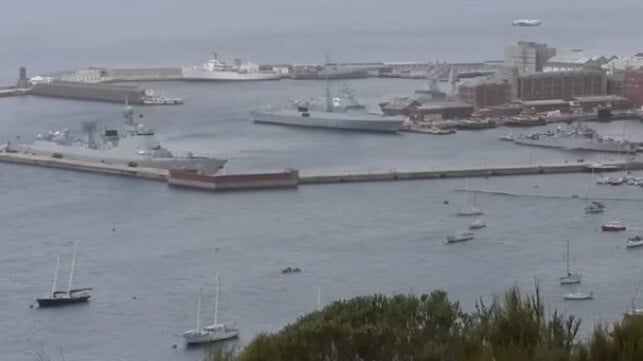
BRICs warships in South Africa
BRICs warships gathering at Cape Town (Screengrab from Times New World)

Published Jan 14, 2026 1:00 PM by The Maritime Executive


The Chinese-led BRICs Exercise "Will for Peace 2026," now taking place in Cape Town,  is turning into a diplomatic disaster for its host South Africa.

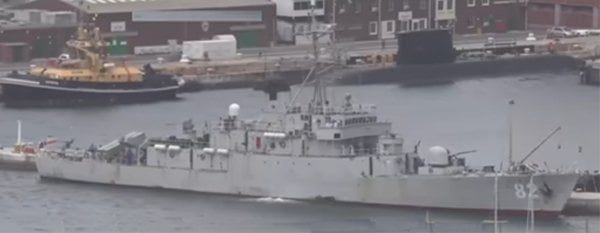
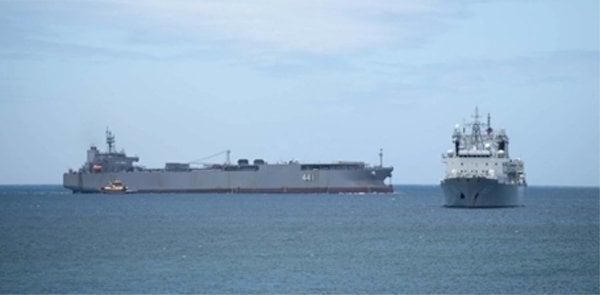
Alongside participants from Russia, China, and the United Arab Emirates, three Iranian warships arrived in False Bay to participate in the exercise, with the Bayandor Class corvette IRINS Naghdi (F82) coming alongside in the Simon’s Town Naval Base, and two converted oil tankers now serving as logistics vessels - IRINS Makran (K441) and the Islamic Revolutionary Guard Corps Navy (Nedsa, IRIS Shahid Mahdavi (L110-3) anchoring off in False Bay. Iranian personnel took part in dockside parades and inter-Navy sports events which occupied the first two days of the exercise.

But before the sea-going phase of the exercise commenced on January 13, the South African government requested that the Iranians withdraw their active participation from the exercise and become observers instead, a request to which the Iranian acceded.


The Iranian Navy corvette IRINS Naghdi (F82) alongside, with a South African diesel-electric attack Heroine Class Type 209 submarine behind (Screengrab from Times New World)


The South African move was prompted by the realization at this late stage, that diplomatically it did not look good to be aligned with an Iranian regime which by some estimates has now killed 12,000 of its own citizens in anti-government riots. The South Africans also realized that its highly favorable trade position under the African Growth and Opportunity Act was in jeopardy, with the Act is coming before the U.S. House of Representatives this week for its scheduled three-year renewal.

These dangers were already apparent back in September, when The Maritime Executive noted that South African Chief of Staff General Rudzani Maphwanya had visited Tehran to issue an invitation to the exercise, a visit not apparently approved beforehand by South African President Cyril Ramaphosa. President Ramaphosa objected to the visit, but did not fire the General for his freelancing in the political arena. Political opponents of the President said at the time that his response was weak, exceedingly so as events have turned out.


Observers are now watching the Simon’s Town Naval Base to see when the Iranian naval vessels depart – and in which direction. There is still some mystery concerning the whereabouts of the Iranian Navy’s 104th Flotilla and the Navy’s force of frigates, which are at sea somewhere. Since most ships of the Navy left Bandar Abbas Naval Harbor on about January 8, the internal security situation in Bandar Abbas city has deteriorated, with one large protest in particular occurring close to the Naval Harbor. 

The aim of Exercise "Will for Peace 2026," a highly inappropriate name for a naval exercise given the character of its participants, is to practice naval drills supporting the protection of commercial shipping in shipping lanes, including counter-terrorism rescue, counter-boarding and maritime strike operations. The exercise is scheduled to last until January 16, and is the first naval exercise to be held under the auspices of BRICS, hitherto seen as an economic bloc. The exercise director is from the PLAN.

Nedaja forward base ship IRINS Makran (K441) and PLAN replenishment ship CNS Taihu (K889) approaching Simon’s Town, January 9 (Screen grab from Sharjah TV)

With Five Shadow Fleet Tankers in Custody, U.S. Could Seize Dozens More

USCG
The seized tanker Bella 1 (Image courtesy USCG)

Published Jan 14, 2026 5:51 PM by The Maritime Executive


As the U.S. Coast Guard ushers five recently-seized shadow fleet tankers into U.S. custody, the Department of Justice is seeking warrants to capture dozens more, according to Reuters.

The legal petitions are not public, but an insider told the news agency that the administration is asking federal courts to write warrants for civil forfeiture of a large number of sanctioned tankers. The warrants would enable boarding, search and seizure missions to capture the vessels and take them to the U.S., where the government could start proceedings to take possession of the ships and cargoes for alleged sanctions violations. 

Several prior court warrants related to the tanker campaign have been unsealed, including the authorization for the seizure of the stateless vessel Bella 1. The Bella 1's case was unique: mid-voyage, with the Coast Guard behind in a low speed pursuit across the Atlantic, Bella 1 changed her name to Marinera and reflagged with the Russian register of shipping. U.S. forces boarded and captured the vessel despite the registry change, and Bella 1 is now under Coast Guard escort.

Ship spotters have identified the Bella 1 off the coast of northern Scotland, in the Moray Firth. The government of the UK understands that the vessel is anchoring in British waters briefly to take on new supplies, including food. Scottish first minister John Swinney told BBC that he was not consulted before the sanctioned tanker arrived. 

"It is not appropriate for the Scottish government to learn about these issues through media reports," Swinney told BBC. "There should be advanced briefing from the United Kingdom government and I am insisting on that."

The UK Ministry of Defense declined to comment on the Bella 1's status or its plans for ongoing operations. The vessel has not transmitted an AIS signal since January 7, making her movements harder to track without satellite imaging.