Friday, January 16, 2026


French gallery discovers 500-year-old work by German painter


dpa 14.01.2026

Photo: Rachel Sommer/dpa

A drawing by the German Renaissance artist Hans Baldung Grien has been discovered after more than 500 years.

It lay undisturbed in a wooden box and a French art gallery has now determined that it is a genuine treasure.

The portrait of a woman, created with a silver pen, dates from 1517 and has remained in the Alsatian family of the woman it portrayed, Susanna Pfeffinger, since its creation.

A Renaissance artist, Baldung is considered as significant as he is idiosyncratic. He became famous for his scenes of the Fall of Man, candid depictions of saints and dramatic witch scenes.

The high altar of Freiburg Minster in southern Germany is considered a highlight of his early work. Baldung was born in 1484 or 1485, and worked as a painter, draughtsman and copperplate engraver. He collaborated for several years with painter Albrecht Dürer in Nuremberg.

Baldung spent most of his life in Strasbourg, where he died in 1545.

Patrick de Bayser from the Paris gallery Cabinet de Bayser describes the discovery of the drawing as "a shock."

"Drawings by Baldung are extremely rare," he said on Wednesday, with only a few of them in private collections. The family approached him with a request to examine the picture, which they knew nothing about.

Now the work is to be auctioned on March 23 at Beaussant Lefèvre & Associés in Paris. De Bayser estimates its value at between €1.5 and €3 million ($1.75 - $3.5 million).

Auctioneer Arthur de Moras says that the family had numerous paintings in their extensive family archive. Several dozen of them, from more distant ancestors, had been stored in a wooden box – among them the portrait that has now been identified as a work by Baldung Grien.


Cannabis: Now you can measure how much is too much

DW
January 12, 2026

At what point does smoking weed get dangerous? A British study measured cannabis consumption in THC units and determined which amounts increase health risks. The system comes with clear risk thresholds ― and weaknesses.


THC units can make the conversation around cannabis consumption more precise
Image: Henry Romero/REUTERS


Even just a few joints a week can make a difference ― measured in milligrams of THC. A new study by researcher Rachel L. Thorne and her team provides the first concrete thresholds for the weekly dose at which the risk of cannabis use disorder increases significantly. Thorne is a research associate in the psychology department at the University of Bath, UK, whose areas of expertise include cannabis use and its consequences for youth and adult health. The study was published on Monday in the journal Addiction.
How much THC per week poses a health risk?

The researchers used data from the CannTeen study involving 85 adolescents (aged 16 to 17) and 65 adults (aged 26 to 29) who had used cannabis in the past year. One THC unit, defined as 5 milligrams, is analogous to the standard unit used to compare beer, wine and spirits in alcohol research.

Based on surveys of consumption patterns and a clinical diagnosis at the end of the study, the researchers derived thresholds that mark the difference between unremarkable consumption and cannabis use disorder.

A cannabis use disorder is present when someone can no longer control their cannabis consumption and continues to use despite clear problems in everyday life. Typical signs of the disorder are neglecting responsibilities at school, work or with family, and withdrawal symptoms such as restlessness or sleeping issues when trying to quit.

For adolescents, this threshold was around 6 THC units per week ― i.e., around 30 milligrams of THC ― and for adults, it was around 8 units, or around 40 milligrams per week. For moderate to severe disorders, the values were higher. The research team emphasized that only abstinence is completely risk-free.

THC units based on alcohol research

In alcohol research, consumption is also generally measured in standard drinks or units, and thresholds for "risky" behavior, like binge drinking, have been established.

"Threshold values are generally very useful for communicating health risks," says Jakob Manthey from the Centre for Interdisciplinary Addiction Research at the University of Hamburg.

But there is also a risk that such values can be misinterpreted.

"There is a danger that consumption below the threshold value will be interpreted as harmless or even beneficial to health," says Manthey, who was not involved in the study.

Unlike alcohol, however, cannabis contains many active ingredients whose interaction influences the drug's effects and risks. Although THC is indeed the most important risk factor, other cannabinoids produced by the plant, as well as the form of consumption ― whether via a joint, vaporizer or edible ― can significantly alter both dose and effect.

How reliable are the THC figures in the study?

One of the study’s strengths is that the researchers repeatedly asked the same individuals about their cannabis use over the course of an entire year. However, the sample size is small (150 individuals), and the actual THC content of the products consumed had to be estimated from external sources, as no lab analyses of individual samples was performed.

The figures the study quotes should therefore be understood as initial guidelines rather than hard limits. But they show, unsurprisingly, that the higher the weekly THC intake, the greater the risk of cannabis use disorder becomes.


Benefits for diagnosis, therapy and prevention in cannabis use

The new thresholds do not replace doctors or therapists for diagnosis and treatment, but they can help with preliminary screening. Specialists could, for instance, begin asking those affected how many THC units they consume per week in order to better assess risk and detect a potential disorder at an earlier stage.

In doing so, they would be following guidelines for the treatment of cannabis-related disorders, which state that frequency and quantity of consumption ― as well as the potency of cannabis consumed ― are important risk factors.

A standardized unit system could help make this information more comparable in the future. It will not, however, change consumption patterns all on its own, since availability, advertising and measures such as youth protection and advertising restrictions play a major role in that as well.

What THC units can do ― and what they can't

Practical applicability remains a key problem: Many consumers simply don’t know how much THC their products contain, especially if they are home-grown or sourced illegally.
"Under the current regulations, there will be no widespread communication of THC units, so consumers often have no reliable way of knowing the THC content of the products available," says Jakob Manthey.

British neuropsychopharmacologist David Nutt still views the new analysis as an important step.

"The data provide an estimate of a threshold of weekly consumption to eliminate dependence risk," Nutt said.

He is calling for "a regulated cannabis market with clear product quality and identification of unit amounts (as required for alcohol currently)."

The proposed THC units would clarify previously vague terms like "a lot" or "risky" when it comes to cannabis consumption. But those wanting to protect their health need more than just a weekly unit number. They also need honest information about potency, effective prevention and, when in doubt, the willingness to limit consumption or quit altogether.

This article was translated from German


Alexander Freund Science editor with a focus on archaeology, history and health
Wikipedia at 25: Of collective knowledge and its fault lines

DW
January 14, 2026

From utopian origins to AI-driven rivals, the "people's encyclopedia" has been shaped by debates over neutrality, expertise and the future of shared knowledge.


There are Wikipedia entries in more than 350 languages 
Image: Peter Byrne/empics/picture alliance

Just as human history is often divided into the eras B.C. and A.D., it's not unreasonable to imagine the Internet's story split between B.W. and A.W. — the "W" denoting Wikipedia.

When Wikipedia went online on 15 January 2001, it was the brainchild of two men: Jimmy Wales, an internet entrepreneur with a libertarian streak, and Larry Sanger, a philosopher who became its first editor-in-chief. Their collaboration lasted only a little over a year — but the tension between their visions still shapes the project today.

From the outset, Wales imagined Wikipedia as a radically open project: a place where "every single person on the planet" could contribute and have free access to "the sum of all human knowledge."

Sanger, however, was skeptical that such openness could ever guarantee neutrality — a divergence that would color Wikipedia's story.

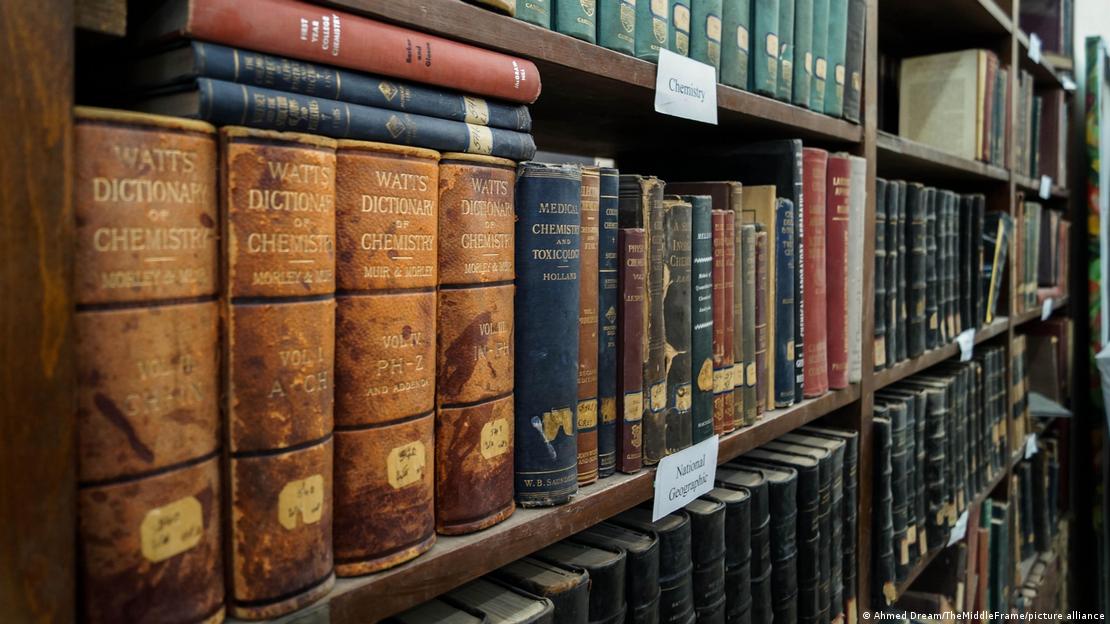
Pre-digital era research included thumbing through tomes to get information
Image: Ahmed Dream/TheMiddleFrame/picture alliance


From tomes to clicks

Previously, accessing knowledge meant navigating physical libraries and curated reference works, with experts and institutions acting as the gatekeepers of "official" information. Wikipedia inverted that hierarchy.

It created a vast, collaboratively edited platform where anyone with an internet connection could write or revise an article — shifting from centralized expert authority to a more decentralized, community‑driven model that still cites expert‑produced sources.

The growth that followed is now internet lore. By 2002, the English Wikipedia had around 25,000 entries; by 2006, it had passed one million. Today it exceeds seven million.

Powered by people, divided by philosophy

As of January 2026, there are more than 300 active language editions of Wikipedia with contributions from thousands of volunteer editors.

No one "owns" an article, and all contributions must follow the core principles of neutrality, verifiability and reliance on reputable sources. Editors debate changes on "talk pages" and reach consensus. In serious cases, conflicts are brought to the community‑run Arbitration Committee.

This model reflects Wales' belief that a global commons of knowledge can be built collectively. "Wikipedia is not a very comfortable place for extremists," he told The Guardian in 2025. "If you want to rant and be super biased, then go on, write your own blog."

For Wales, neutrality comes from grounding articles in facts: "The Hitler entry doesn't have to be a rant against Hitler. You just write down what he did, and it's a damning indictment right there."


Sanger, who drafted Wikipedia's early neutrality guidelines, has long argued that openness by itself cannot prevent bias; those who write articles should ideally be subject-matter experts.

"Neutrality is entirely possible" he told DW, adding that the gold standard is when "you cannot tell what the person thinks on any issues of controversy,"

"And I don't see how it would be ultimately possible for a project like Wikipedia to even approximate neutrality without the involvement of experts that are themselves committed to neutrality."

He has also argued that only those "who think a certain way" are permitted to edit Wikipedia, describing them as "global, academic, secular, progressive."
Of gender gaps and doom spirals

The estimated number of female Wikipedians is between 10–20%, as acknowledged by the Wikimedia Foundation. Entire categories of notable women and their works remain missing, which spurred the 2015 "Women in Red" initiative to close this gender gap.

Each Wikipedia language edition is created separately, with its own community of editors. That means an article that exists in Hindi might never be written in English, and vice versa. Tools like Wikidelta help show these gaps by mapping which topics appear in only one language.

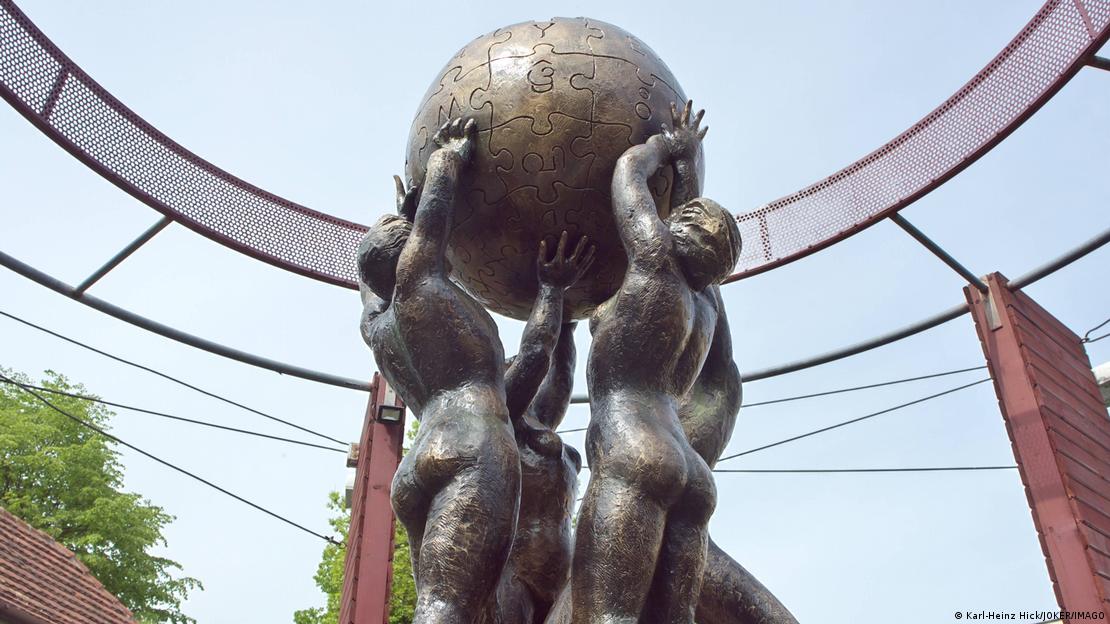
This monument honoring Wikipedia's thousands of anonymous volunteer editors was erected in Slubice, Poland in 2014
Image: Karl-Heinz Hick/JOKER/IMAGO

This matters because Wikipedia now feeds many of the digital tools people use every day. Large language models (LLMs) are trained heavily on its content, and AI‑generated text and translations are flowing back into smaller Wikipedias.

The Greenlandic edition shows how fragile this loop can be: In 2025, after it was flooded with error‑ridden AI content — which some commenters termed a "doom spiral" — its sole editor requested the site's closure due to, among others, "the risk of harm to the Greenlandic language."

Used 'more often than we pee'


Wikipedia's quirks, though, have also long spilled beyond the site itself. Its "citation needed" tag — once a simple call for verification — has become shorthand for dubious claims.

Online games like Wikiracing turn the encyclopedia into a competitive sport: Players start on one article and race, using only hyperlinks, to reach a completely unrelated target page in as few clicks and as quickly as possible.

Besides long being the go-to for research, it peppers everyday routines — settling dinner‑table disputes, guiding sports commentary or sending readers down late‑night rabbit holes.

Perhaps fashion designer Diane von Fürstenberg best captured its ubiquity when she once joked to Jimmy Wales, "We all use Wikipedia more often than we pee."

Truth wars: Grokipedia vs. Wikipedia  04:33

Grokipedia: A new challenger?


But even a platform woven into daily life is not immune to disruption. In 2025, Elon Musk's company xAI launched Grokipedia, an AI‑generated encyclopedia built on the Grok large language model.

It debuted with nearly 885,000 articles and presented itself as a "truthful and independent alternative" to Wikipedia — or, as Musk calls it, "Wokipedia" for being "extremely left-biased." Some entries are generated entirely by Grok; others are lifted from Wikipedia, sometimes lightly edited, sometimes copied almost verbatim.

Sanger sees the shift as significant. "For the first time in history, you can actually talk to an LLM and it will turn around and make an edit to an encyclopedia article," he told DW. "You're not submitting the edit to a human being. You're submitting it to a machine controlled by a corporation," which means getting answers faster.

He believes Grokipedia could eventually surpass the project he once helped create: "There's a very good chance Grokipedia will be a better encyclopedia than Wikipedia after some amount of time."

Speaking to news agency Reuters in late 2025, Jimmy Wales expressed skepticism at large language models being able to produce encyclopedic content. "Whether it's an important or meaningful competitor, remains to be seen."

Edited by: Tanya Ott

Brenda Haas Writer and editor for DW Culture
Germany's farms are failing despite high food prices
DW
16.01.2026

As Berlin's Green Week, the largest international agriculture fair, kicks off, German farmers raise the alarm over price pressure from retailers and international trade agreements like the impending EU-Mercosur deal.

Food prices are high, but German farmers do not make big profits
Image: Karl-Josef Hildenbrand/dpa/picture alliance


Agricultural policy rarely takes center stage in Germany. The worries of farmers do not often make the national headlines.

However, at the beginning of the year, there is always a reason to talk about agricultural policy: The Green Week in Berlin.

This year, the global agricultural fair celebrates its centenary. To coincide with this event, the Heinrich Böll Foundation, which has close ties to the Green Party, has published its "Corporate Atlas 2026."

The study states: In Germany, more and more small and medium-sized farms are dying out. One reason is that the domestic supply chains for milk, meat and vegetables are dominated by just four large retail chains that dictate prices and squeeze farmers out of business.

According to a survey by the Federal Association of Consumer Organizations, 68% of Germans polled say that rising living costs are most noticeable in food prices.


COVID and war in Ukraine


And the Konzernatlas study cites more reasons for the price increase: "The COVID pandemic and Russia's war of aggression against Ukraine have shown how fragile global agricultural supply chains are and how severe the effects of volatile oil and gas prices can be," the researchers write.

"Since 2020, we have seen a 35% increase in food prices, but this has not led to an increase in farmers' incomes," said Matthias Miersch, parliamentary group leader of the ruling center-left Social Democrats (SPD) in the Bundestag, during a panel discussion of leading politicians organized by the German Farmers' Association at the start of Green Week.

Large farms in the East are growing

More than half of Germany's land area is used for agriculture. There is a marked difference between agriculture in the west of the country and the eastern federal states, the area that was communist East Germany (GDR) for decades. In the GDR, collectivization gave rise to huge agricultural enterprises, which developed into today's structurally different large-scale farms after reunification.

According to the Böll Foundation's researchers, the number of farms in Mecklenburg-Western Pomerania and Saxony, two eastern German states, has risen by around half between 2010 and 2024. In all other federal states, including the traditional agricultural areas of Bavaria and Schleswig-Holstein, the number of farms has fallen dramatically.


Mercosur and global market risks

The German Monopolkommission (Monopolies Commission) is a permanent, independent advisory body of jurists, economists and entrepreneurs that advises the German federal government on competition policy and regulation. In 2024, the previous German government tasked it with investigating the concentration in the food retail sector.

Tomaso Duso, the chairman of the commission, summarized its findings: "The power of food retailers and, in some cases, manufacturers has increased significantly at the expense of consumers, while agriculture is often exposed to global market risks."

In the global market, German farmers will soon have to compete under the terms of the new Mercosur agreement. After years of torturous negotiations, the 27 member states of the European Union agreed at the beginning of the year to a free trade agreement with Brazil, Argentina, Paraguay and Uruguay. The core of the agreement: the elimination of customs duties. The EU hopes to increase exports of cars and chemical products, while the South American countries want to supply more agricultural products to Europe.

This is causing additional concern for German farmers. Many also argue that the Mercosur agreement, which the European Parliament still has to approve, could undermine the EU's high standards for environmental and animal welfare requirements.


SPD proposes a 'food basket'

The Social Democrats have proposed that supermarkets should sell the most important staple foods at reduced prices.

Agriculture Minister Alois Rainer has rejected this so-called "food basket" proposal, arguing that food should not be sold at a discount.

The chairman of "Tafel Deutschland," Andreas Stepphuhn, does not think much of the idea either. "If you want to change the social situation in this country, you have to change people's income situation," he told the Catholic news agency KNA. Politicians need to pay more attention to growing poverty, Stepphuhn said. Tafel is a nationwide network of over 970 food banks with, according to its own figures, around 1.5 million customers.

Despite all the criticism of supermarkets and their concentration, the high prices and the concerns of small farmers, Jens Spahn, leader of the ruling conservative bloc of Christian Democratic Union and Christian Social Union (CDU/CSU) in the Bundestag, remains optimistic. "Germans get the best food in human history from the best-trained farmers in human history — at prices that are relatively low in human history," he said.

The Green Week showcases global food trends, sustainable practices and innovations. It runs in Berlin from January 16-25.

This article was originally written in German.
Serbia student protests: Vucic has reason to fear elections

Sanja Kljajic
DW

After more than a year of protests, Serbia's students have shifted their focus to preparing for a parliamentary election. President Aleksander Vucic, however, is waiting for a date that will benefit him the most.


Serbia's protesting university students collected signatures in support of their demand for an early parliamentary election in Belgrade in December
Image: Darko Vojinovic/AP Photo/picture alliance

Serbia entered 2026 in full pre-election mode — even though a date for a parliamentary election has not yet been set.

After more than a year of protests, student blockades and political tension, Serbian President Aleksandar Vucic has accepted the challenge posed by students and citizens who have been demanding a snap election.

Nevertheless, just when the president will call that election remains to be seen.

Over the course of the past few months, Vucic has gradually narrowed down possible dates for a poll, moving from a vague promise that the election would take place "before the legal deadline," through information that it would be in "late 2026 or early 2027" to the latest announcement that suggests a vote could be held in October, November or December.
Could Vucic lose the election?

If the president keeps his word, he could lose that election, believes Dusan Spasojevic, professor at the Faculty of Political Sciences at the University of Belgrade.

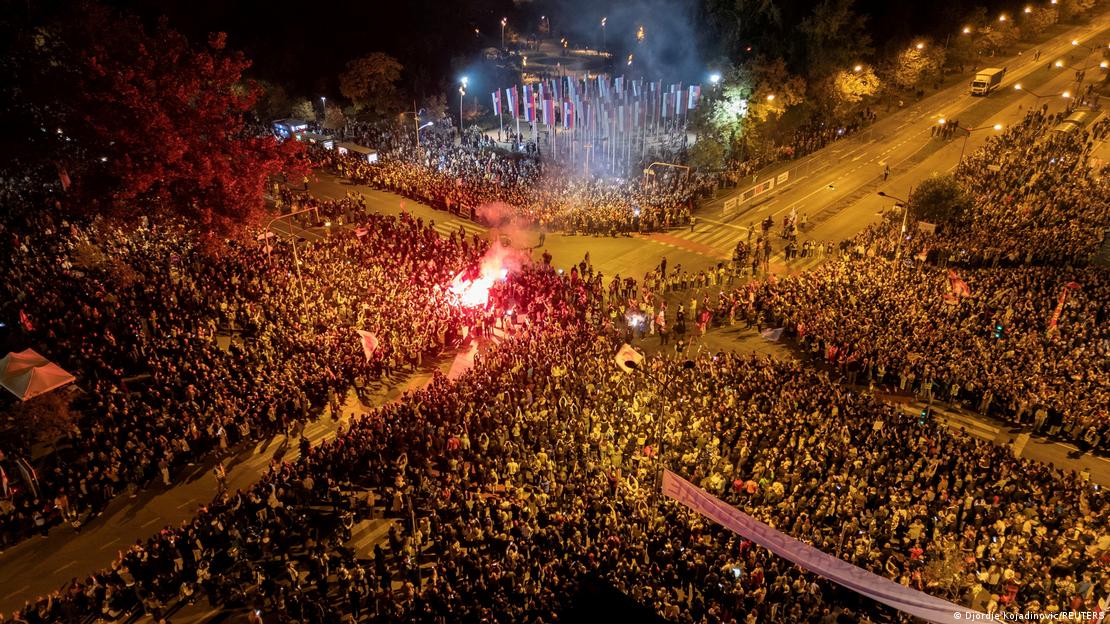
The collapse of the canopy at the entrance to the railway station in Novi Sad on November 1, 2024 killed 16 people and triggered accusations of corruption and negligence and a year of protests. Pictured here: demonstrators in Novi Sad last October
Image: Djordje Kojadinovic/REUTERS

"The greatest strength of the students and the opposition is the change we have seen in the electorate," Spasojevic told DW. "The bloc of [those in] power and the bloc of the opposition are now relatively equal, and for the first time, we will have elections in which the government not only could lose, but would probably lose."

"But that should not lull anyone into complacency," added Spasojevic. "There is still a lot of time before the elections, and the government still has enormous resources. It has repeatedly shown its ability to get out of difficult situations."
Students shift to campaign mode

By the end of 2025, the mass protests that had been taking place across Serbia since November 2024 had largely subsided: Faculty blockades were lifted, and students returned to class.

In short, the student movement entered a phase of transformation.

Instead of organizing protests, the focus shifted to preparing for an election.

After a lengthy internal process of selecting their own candidates for parliament, students are now setting up campaign headquarters, training election observers and shaping their political platform.

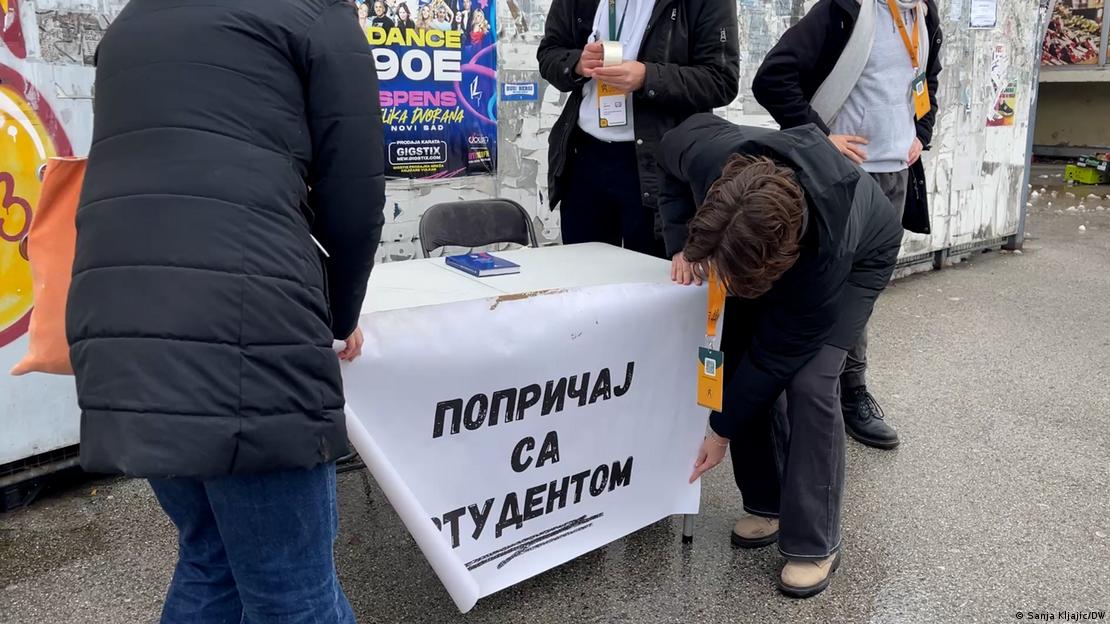
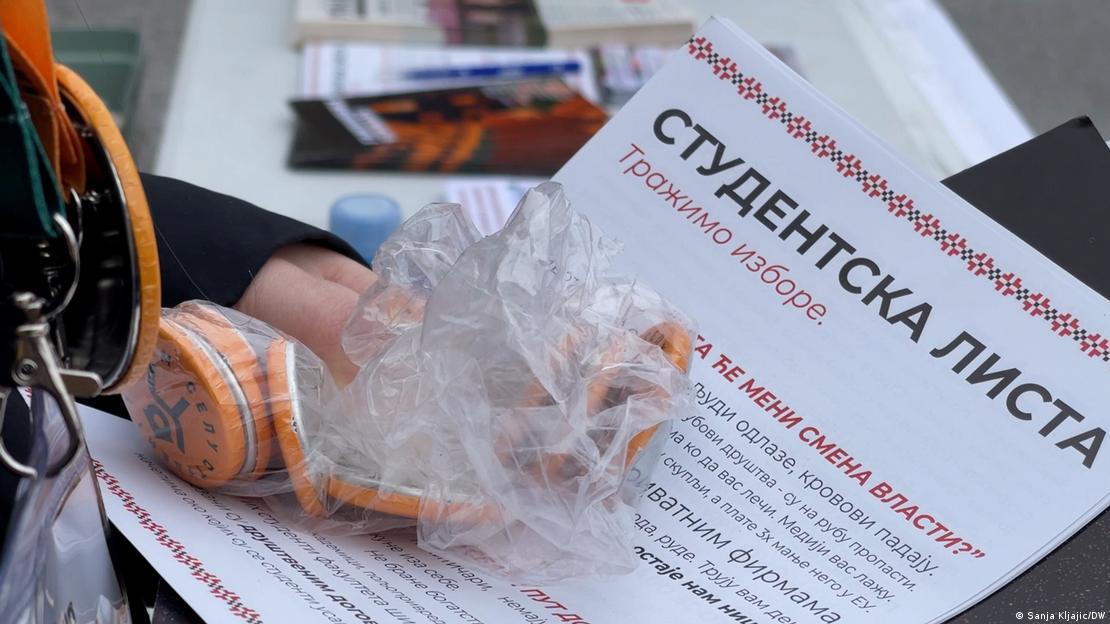
While one group of students goes door to door speaking to citizens, others are organizing actions such as "A student in every village," which sees students setting up improvised stands where they not only attempt to counter the image shaped by pro-government tabloids over the years but also to listen to people's criticism and concerns.

Mobilizing voters and building trust

Danilo Erdeljan and Sonja Hajdukovic, two students from Novi Sad, are regularly out and about, meeting citizens.

The goal, they say, is not only mobilization, but also building trust — learning about electoral rules and campaigning as they go.

\
Students are out on the streets, talking to citizens and listening to their concerns. The sign at this improvised campaign stand reads 'Talk to a student'
Image: Sanja Kljajic/DW

They firmly believe that delaying the election benefits them more than the government because their organization is growing stronger by the day, and each participation in local elections brings new experience and logistical capacity.

"The government is waiting to see whether people will get tired and give up, but at the same time, it is giving us more time to prepare," Danilo Erdeljan told DW. "We have already seen how difficult it is for the ruling coalition to organize electoral fraud at the local level, and it will be much harder to do so nationwide when parliamentary elections come. And day by day, we are becoming more prepared to confront any irregularities on election day."

Growing opportunities — and challenges


That support for students has not faded was also demonstrated on December 28, when students collected signatures of support for an early election at over 500 stands in more than 100 cities and municipalities across the country.

The students say that they collected nearly 400,000 signatures in a single day, with many citizens also leaving contact information and expressing willingness to take part in future activities.

For the students, this was clear confirmation that the potential for mass mobilization has not disappeared but has just been temporarily subdued — and that calling an election could trigger a new wave of mobilization.

Difficulties lie ahead

But as the opposition consolidates, the government, too, is closing ranks.

Under severe pressure because of the threat of US sanctions on Serbia's Russian-owned oil company NIS and the loss of support from former international partners — from the United States, through the European Union, to Russia — Aleksandar Vucic is carefully timing when to play his key election card, aiming to call the election at the moment that is politically most favorable for him.

\
Students distribute flyers with information about the students' list of candidates for the next parliamentary election and their demand for a snap poll
Image: Sanja Kljajic/DW

According to DW's sources, this means that Vucic is likely to delay the election as long as possible — even at the risk of deepening the crisis.

At the same time, there has been evidence that the government is tightening its grip within the system: There have been hundreds of dismissals in the public sector in recent months, targeting not only those who took part in protests, but also those whose family members were involved and even those who remained neutral and were not apparently outspoken enough in their support for the government.

Legal proceedings have been initiated against numerous students on charges of allegedly undermining the constitutional order. Some remain in political exile.

The pressure being exerted on universities has also been ramped up. On Thursday, one professor who supported the protesting students was dismissed from her post without due process. In addition, the state has introduced a new system that centralizes all university finances and places them under state control. As a result, faculties have lost their financial independence, effectively making them easier to control.

Students are aware that the year ahead will be long and difficult.

"But if people have endured this far, they will endure longer," says Danilo Erdeljan. "From the start, we knew this was not a sprint, but a marathon, and I believe it is possible to persist for as long as necessary."

Edited by: Aingeal Flanagan

Sanja Kljajic Correspondent for DW's Serbian Service based in Novi Sad, Serbia@SSnajaKljajic


xAI restricts Grok chatbot after sexualised AI images spark global concern


Elon Musk’s AI company xAI has imposed limits on its Grok chatbot’s image editing capabilities after hyper-realistic sexualised images – including depictions of minors – circulated online. The restrictions apply to all users, including paid subscribers, and block image generation in jurisdictions where such content is illegal.


Issued on: 15/01/2026 
By: FRANCE 24
xAI and Grok logos are seen in this illustration taken on February 16, 2025. © Dado Ruvic, Reuters

Elon Musk's artificial intelligence company xAI said late on Wednesday that it had imposed restrictions on all users of its Grok AI chatbot that limit image editing after the service produced sexualised images that sparked concerns among global regulators.

"We have implemented technological measures to prevent the Grok account from allowing the editing of images of real people in revealing clothing such as bikinis. This restriction applies to all users, including paid subscribers," the company said in an X post.

Hyper-realistic images of women manipulated to look like they were in microscopic bikinis, in degrading poses or covered in bruises began flooding social media platform X this month. In some cases, minors were digitally stripped down to swimwear, sparking broad criticism.

Grok last week began allowing only paying subscribers to use its image generation and editing features. X last week curtailed Grok's ability to generate or edit images publicly for many of its users, but the chatbot still privately produced sexually charged images on demand on Wednesday before xAI's announcement, Reuters found.

Billionaire Musk owns xAI, which in turn owns X, formerly known as Twitter.

xAI added on Wednesday that it blocks users based on their location from generating images of people in skimpy attire in "jurisdictions where it's illegal". It did not name those jurisdictions.
California officials demand answers

California's governor and attorney general said earlier on Wednesday that they were demanding answers from xAI after Musk said he was not aware of any "naked underage images" generated by Grok.

"We’re demanding immediate answers from xAI on their plan to stop the creation & spread of this content," California Attorney General Rob Bonta wrote on X. Governor Gavin Newsom called on Bonta "to immediately investigate the company and hold xAI accountable."

The comments from Newsom and Bonta were the most serious so far by US officials addressing the explosion of AI-generated non-consensual sexualised imagery on X.

The California move added to the pressure Musk is facing in the US and around the world. Lawmakers and advocacy groups have called for Apple and Google to drop Grok from app stores.

Government officials have threatened action in Europe and the United Kingdom. Indonesia temporarily blocked access to Grok.

At first, Musk publicly laughed off the controversy, posting humorous emojis in response to other users' comments about the influx of sexualised photos. More recently, X has said it treats reports of child sexual abuse material seriously and polices it vigorously.

Musk said earlier on Wednesday he was "not aware of any naked underage images generated by Grok. Literally zero."

X did not immediately respond to questions about the California announcement and Musk's comments.

xAI did not respond directly to an emailed request for comment on California officials' statements or Musk's post that he was unaware of sexualised imagery of minors. Reuters received its generic autoreply message for inquiries: "Legacy Media Lies."

(FRANCE 24 with Reuters)

SPACE/COSMOS

Franco-German space company ArianeGroup to double launches in 2026

dpa  16.01.2026

Photo: Hauke-Christian Dittrich/dpa

Franco-German space company ArianeGroup is intending to double the number of launches of its Ariane 6 rocket carrier this year.

Boss Pierre Godart said on Friday that seven or eight flights are planned after four launches in 2025.

By 2027, the company is expected to boost capacity to around 10 flights per year, he added, with further development possible if the market holds.

"We will invest if it makes economic sense," Godart said.

ArianeGroup currently has around 30 launches under contract, with some slots still available in the coming years.

In February, the company is set to launch the most powerful version of the Ariane 6 rocket with four booster engines, enabling it to carry payloads of up to 20 tonnes.

The launch is expected to carry 32 satellites for Amazon's Leo high-speed internet network into space, in the first of 18 launches commissioned by the US giant.

Godart emphasized that ramping up production would guarantee Europe its own access to space, including for the German military.

ArianeGroup is active in the military sector, manufacturing ballistic missiles for French nuclear weapons.

The chief executive is also calling for European governments and state-financed actors to instigate a preference for European-made rockets.

Godart also commented on whether Ariane is aiming to use reusable rockets. He said the matter is a question of economic efficiency, because in order to enable the rockets to return, more fuel is needed, reducing the payload by 30 to 40%.

ISS crew returns to Earth in first-ever medical evacuation

Dmytro Hubenko 
DW with AP, AFP, dpa, Reuters
15/01/2026

For the first time in the International Space Station's history, NASA safely returned a crew of four astronauts to Earth ahead of schedule due to medical issues affecting one of the group.

NASA astronaut Zena Cardman is happy to be home after the ISS crew was picked up aboard a SpaceX shipImage: Bill Ingalls/NASA/Anadolu Agency/IMAGO

A SpaceX capsule named Endeavour, carrying a four-member International Space Station (ISS) crew home from orbit splashed down safely in the Pacific Ocean off California early on Thursday.

This marked the first time NASA cut short an ISS crew's mission due to a health emergency, bringing the austronauts back a few weeks ahead of schedule.

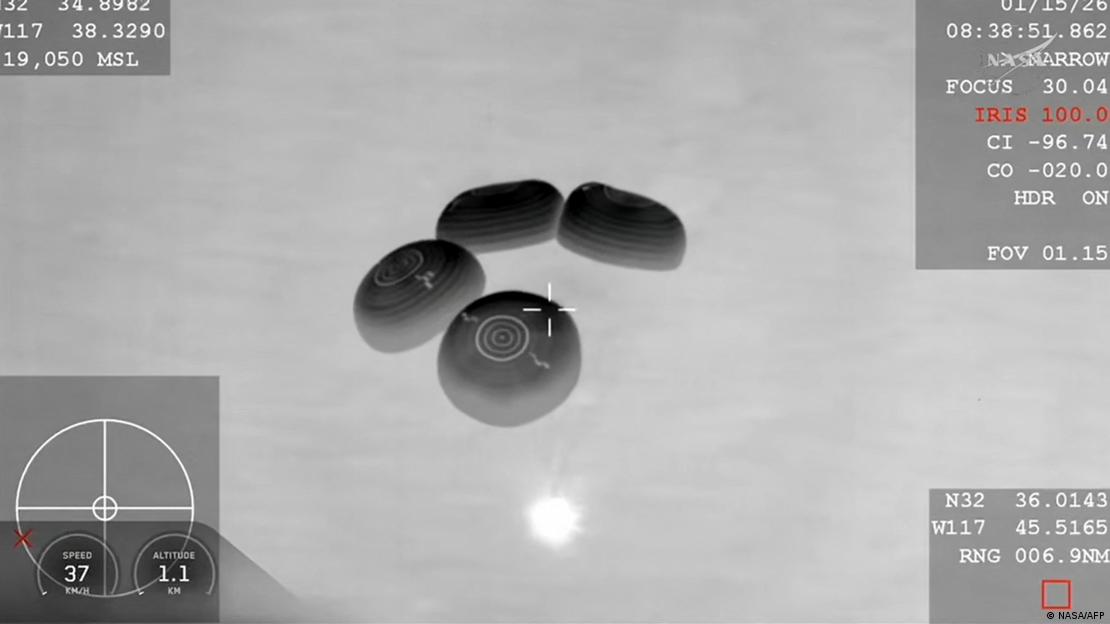
A joint NASA-SpaceX webcast presented live infrared video showing the deployment of two sets of parachutes from the nose of the free-falling capsule. The parachutes slowed the capsule's descent ra
te to about 15 miles per hour (25 kilometers per hour) before it gently hit the water.

Four parachutes slowed the capsule's re-entry through the Earth's atmosphereImage: NASA/AFP

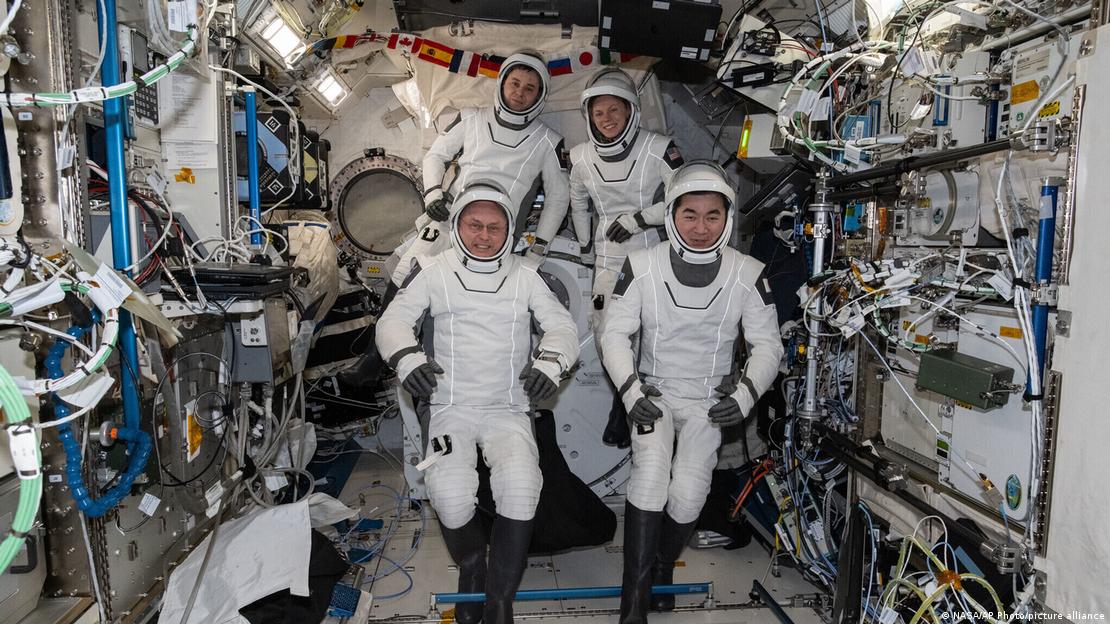
During a radio transmission to the SpaceX flight control center near Los Angeles, Endeavour's commander, NASA astronaut Zena Cardman, said, "It's good to be home." Fellow US astronaut Mike Fincke, Japanese astronaut Kimiya Yui, and Russian cosmonaut Oleg Platonov joined her on the flight home.

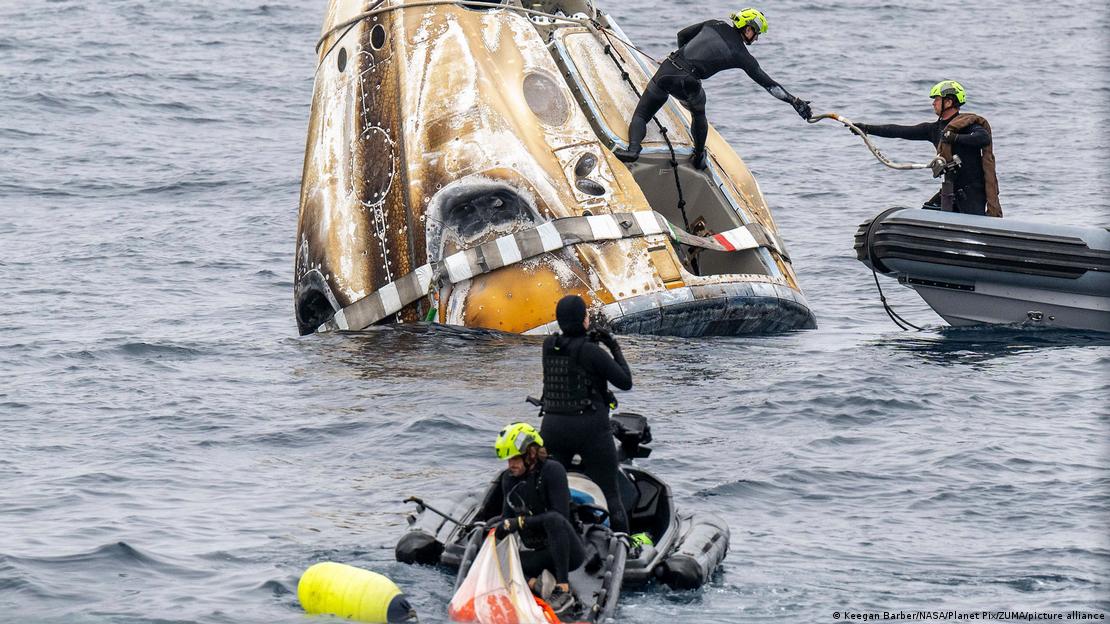
Less than an hour after splashdown, the four astronauts were helped out of the capsule one by one. They were accompanied by the cheers and applause of SpaceX employees aboard a ship.

Just under 11 hours after the astronauts left the International Space Station, SpaceX guided the capsule to splash down in the Pacific Ocean near San DiegoImage: Keegan Barber/NASA/Planet Pix/ZUMA/picture alliance

Why was the mission cut short?

The ISS crew made an early emergency return to Earth due to an undisclosed serious medical condition affecting one of the astronauts.

Last week, NASA announced that it had canceled a spacewalk at the last minute due to health concerns involving one of the crew members. On January 8, the agency announced the decision to bring all four Crew-11 members home early.

Before their return to Earth, NASA astronaut Mike Fincke, Roscosmos cosmonaut Oleg Platonov, NASA astronaut Zena Cardman and JAXA (Japan Aerospace Exploration Agency) astronaut Kimiya Yui posed for a crew portrait (clockwise from bottom left)Image: NASA/AP Photo/picture alliance

According to NASA Administrator Jared Isaacman, one of the astronauts was facing a "serious medical condition" that required immediate medical attention on the ground.

NASA officials have not disclosed which crew member was affected or described the nature of the issue, citing privacy concerns. Later, NASA Chief Health and Medical Officer James Polk said the medical emergency was not caused by an injury that occurred during operations.

Having arrived together in August from Florida, the astronauts spent 167 days aboard the International Space Station.

Edited by: Elizabeth Schumacher
Dmytro Hubenko Dmytro covers stories in DW's newsroom from around the world with a particular focus on Ukraine.

Born In Brightness, Leading To Darkness


What we know of the birth of a black hole has traditionally aligned with our perception of black holes themselves: dark, mysterious, and eerily quiet, despite their mass and influence. Stellar-mass black holes are born from the final gravitational collapse of massive stars several tens of the mass of our Sun which, unlike less massive stars, do not produce bright, supernova explosions.

Or at least, this is what astronomers had previously thought, because no one had observed in real time the collapse of a massive star leading to a supernova and forming a black hole. That is, until a team of researchers at Kyoto University reported their observations of SN 2022esa.

The Kyoto team had wondered whether all massive stars — those that are at least 30 times the mass of the Sun — die quietly without a supernova explosion, or if in some cases they are accompanied by an energetic and bright, special type of supernova explosion. The astronomers then discovered a type Ic-CSM class supernova that appeared to be an explosion of a Wolf-Rayet star, which are so incomprehensibly massive and luminous that astronomers believe them to be the progenitors of black hole formation.

To investigate the nature of this peculiar supernova, the research team utilized both the Seimei telescope in Okayama and the Subaru telescope in Hawaii. The team was able to observe and classify SN 2022esa as an Ic-CSM type supernova, demonstrating that the birth of a black hole is not necessarily quiet since this one could be observed with electro-magnetic signals.

They also discovered something else: the supernova shows a clear and stable period of about a month in its light-curve evolution, leading the team to conclude that it had been created by stable periodic eruptions of the star system once each year before the explosion. Such stable periodicity is only possible in a binary system, so the progenitor must have been a Wolf-Rayet star forming a binary with another massive star, or even a black hole. The fate of such a system, they determined, must be a twin of black holes.

“The fates of massive stars, the birth of a black hole, or even a black hole binary, are very important questions in astronomy,” says first author Keiichi Maeda. “Our study provides a new direction to understand the whole evolutional history of massive stars toward the formation of black hole binaries.”

This study also demonstrates the benefits of using two different telescopes that possess different observational properties. In this case, Seimei’s flexibility and promptness combined with Subaru’s high sensitivity proved to be an effective combination. The team plans to continue conducting research utilizing both telescopes in the coming years.

“We expect many interesting discoveries on the nature of astronomical transients and explosions like supernova,” says Maeda.

Naturally Occurring ‘Space Weather Station’ Elucidates New Way To Study Habitability Of Planets Orbiting M Dwarf Stars

Artist's rendition of the space weather around M dwarf TIC 141146667. The torus of ionized gas is sculpted by the star's magnetic field and rotation, with two pinched, dense clumps present on opposing sides of the star. CREDIT: llustration by Navid Marvi, courtesy Carnegie Science.

January 11, 2026
By Eurasia Review

How does a star affect the makeup of its planets? And what does this mean for the habitability of distant worlds? Carnegie’s Luke Bouma is exploring a new way to probe this critical question—using naturally occurring space weather stations that orbit at least 10 percent of M dwarf stars during their early lives. He is presenting his work at the American Astronomical Society meeting this week.

We know that most M dwarf stars—which are smaller, cooler, and dimmer than our own Sun—host at least one Earth-sized rocky planet. Most of them are inhospitable—too hot for liquid water or atmospheres, or hit with frequent stellar flares and intense radiation. But they could still prove to be interesting laboratories for understanding the many ways that stars shape the surroundings in which their planets exist.

“Stars influence their planets. That’s obvious. They do so both through light, which we’re great at observing, and through particles—or space weather—like solar winds and magnetic storms, which are more challenging to study at great distances,” Bouma explained. “And that’s very frustrating, because we know in our own Solar System that particles can sometimes be more important for what happens to planets.”

But astronomers can’t set up a space weather station around a distant star.

Or can they?

Working with Moira Jardine of the University of St. Andrews, Bouma homed in on a strange type of M dwarf called a complex periodic variable. They are young, rapidly rotating stars that observations show experience recurring dips in brightness. Astronomers weren’t sure if these dips in brightness were caused by starspots or by material orbiting the star.

“For a long time, no one knew quite what to make of these oddball little blips of dimming,” Bouma said. “But we were able to demonstrate that they can tell us something about the environment right above the star’s surface.”

Bouma and Jardine answered that question by creating “spectroscopic movies” of one of these complex periodic variable stars. They were able to demonstrate that they are large clumps of cool plasma that are trapped in the star’s magnetosphere—basically being dragged around with the star by its magnetic field—forming a kind of doughnut shape called a torus.

“Once we understood this, the blips in dimming stopped being weird little mysteries and became a space weather station,” Bouma exclaimed. “The plasma torus gives us a way to know what’s happening to the material near these stars, including where it’s concentrated, how it’s moving, and how strongly it is influenced by the star’s magnetic field.”

Bouma and Jardine estimate that at least 10 percent of M dwarfs could have plasma features like this early in their lives. So, these space weather stations could help astronomers learn a great deal about particles from stars contribute to planetary conditions.

Next, Bouma hopes to reveal where the material in the torus comes from—the star itself or an external source.

“This is a great example of a serendipitous discovery, something we didn’t expect to find but that will give us a new window into understanding planet-star relationships,” Bouma concluded. “We don’t know yet if any planets orbiting M dwarfs are hospitable to life, but I feel confident that space weather is going to be an important part of answering that question.”

Uganda votes under internet blackout and police crackdown

Uganda was on edge as polls opened on Thursday, with President Yoweri Museveni expected to extend his 40-year rule amid an internet shutdown and a police crackdown on the opposition.


Issued on: 15/01/2026 - RFI

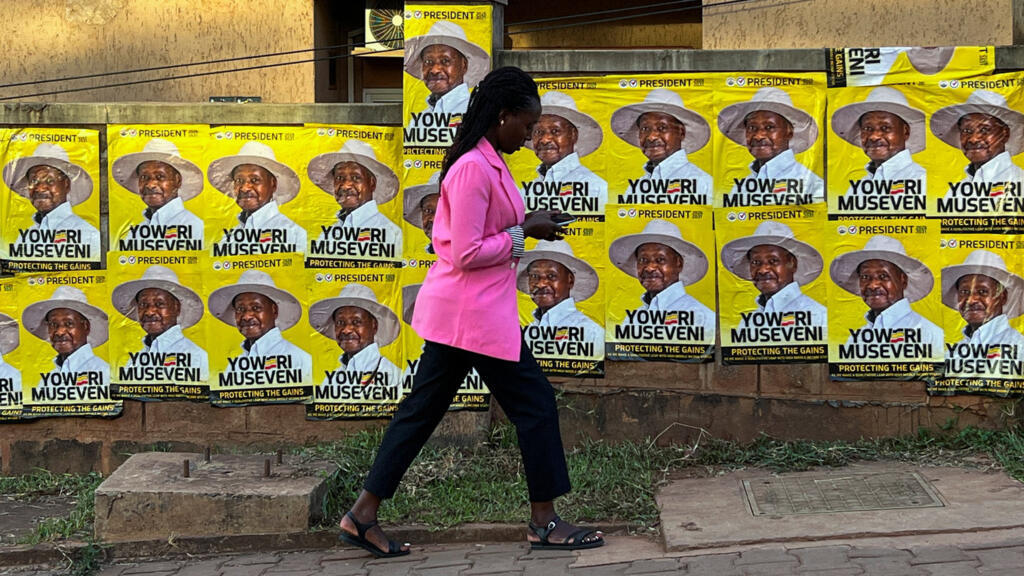
A woman uses a mobile phone as she walks past campaign posters of Yoweri Museveni, Uganda's President and presidential candidate of the ruling National Resistance Movement (NRM), ahead of the general election in Kampala, Uganda, January 14, 2026. © Thomas Mukoya / REUTERS


Polling stations were slow to open, as normal in Uganda, but voting was underway shortly after 7am local time in at least one Kampala suburb.

But in several parts of Uganda stations were still not open almost two hours after voting was due to start, AFP journalists and local sources said Thursday.

AFP reporters in several parts of the capital Kampala and the border city of Jinja said voting had yet to begin, with reports that ballot papers had not been delivered and biometric machines used to check voters' identities were not working.

There were heavy police and army patrols in the border town of Jinja, another AFP team said.

Meanwhile, despite repeated promises that it would not do so, the government shut down the internet on Tuesday for an indefinite period to prevent the spread of "misinformation" and "incitement to violence".

The United Nations called the shutdown "deeply worrying".
'I will crush them'

Western countries have often given Museveni leeway, after he swallowed their demands for neoliberal reforms in the 1980s and made himself a useful partner in the US-led "war on terror" in the 2000s, especially through troop contributions to Somalia.

Many Ugandans still praise him as the man who ended the country's post-independence chaos and oversaw rapid economic growth, even if much was lost to a relentless string of massive corruption scandals.

"Forty years doesn't even matter, we need even more," said one supporter, Banura Oliver, 41, on her way to Museveni's final rally in Kampala.

The president struck a forceful tone, saying: "Go and vote. Anybody who wants to interfere with your freedom, I will crush them."

Many in Kampala were nervous as security forces beefed up their presence for election day.

"We will not talk about elections. You can ask anything but not that," said an accountant in his thirties, who did not give his name.

The police warned the vote was "not a justification for criminal acts" and has deployed newly hired "special constables" to enforce order.

Journalists were harassed and blocked from attending Museveni's rally.

Reporters Without Borders said local journalist Ssematimba Bwegiire lost consciousness after being electrocuted and pepper-sprayed by a security officer at a Wine rally.

Human Rights Watch has denounced the suspension of 10 NGOs, including election-monitoring organisations, and said the opposition had faced "brutal repression".

(With newswires)


'He represents a population desperate for change’, Bobi Wine’s lawyer tells RFI

Uganda's election on Thursday will see incumbent Yoweri Museveni, in power since 1986, seeking a seventh mandate – at the age of 81, in a country where 55 percent of the population is under 20. Supporters of his main rival, Bobi Wine, say he embodies hope for change. Robert Amsterdam, Wine's international legal representative, told RFI of the difficulties he has faced in a campaign fraught with fear and repression.


Issued on: 14/01/2026 - RFI

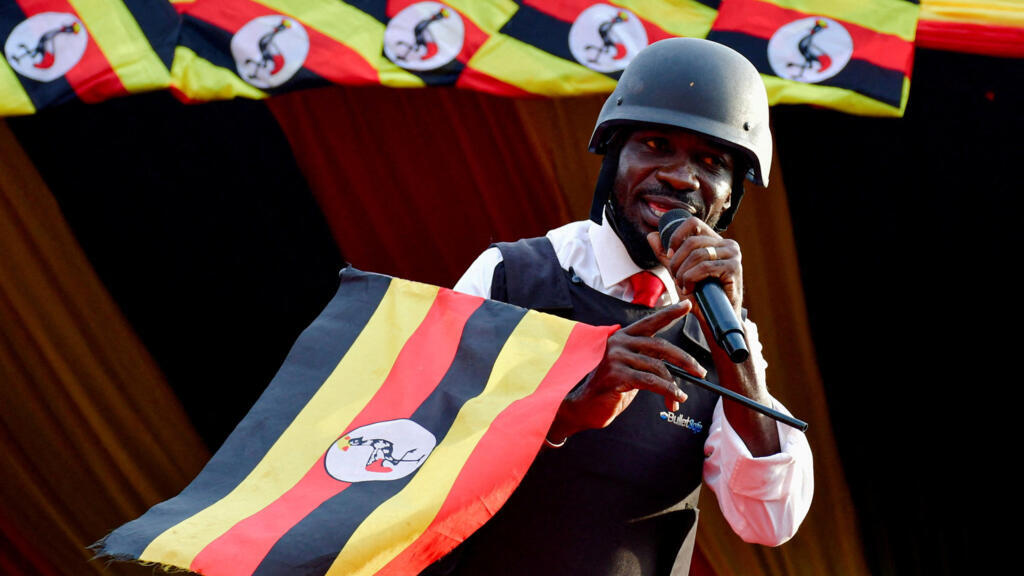
Presidential candidate Robert Kyagulanyi, known as Bobi Wine, addresses the crowd at a rally ahead of the election, Kampala, 12 January. REUTERS - Abubaker Lubowa

By: Melissa Chemam

RFI: For the opposition, and in particular for Bobi Wine, this electoral campaign has been very difficult. How would you describe it?

Robert Amsterdam: Let's be really clear: this is a man who faces death each day. I was first brought in years ago as his lawyer when Museveni tried to kill Bobi by shooting into his car. Bobi was then brutally tortured and held in jail, in a town called Arua, Uganda.

And from that time, Bobi's life has been in danger. And, unlike many, he did not flee his country. He has stood his ground, fighting for Ugandans every day. He is representative of a population that is overwhelmingly under the age of 18 and desperate for change. He is the symbol of change, of youth, not only in Uganda but in Africa. He is an important and emblematic symbol of the fight of this generation to be heard, and for the dinosaurs of previous generations to step out of the way.

The world should start being run by people who have to live in its future, not by those who created a pretty horrendous past in Uganda.

Bobi Wine's fight for democracy in Uganda continues on the big screen

Many human rights organisations have criticised the repression and brutality they say has been seen during this electoral campaign. In light of this, how do you expect the election itself will go?

Of course, it's going to impact the vote. The authorities have cut off the internet. They've divided Kampala into 14 military districts. There's a massive, unprecedented mobilisation of the military. It's absurd and obscene.

I've already had calls from people within the government, who are highly confident of the outcome and are already reaching out to me because they're worried about what the response will be if there is another stolen election. So the government is gearing up to steal another election and deprive Uganda of its vote.

Uganda orders internet blackout ahead of presidential elections

Are there legal mechanisms in place that could ensure Ugandan voters get the result they deserve?

I also represent the opposition in Tanzania, where thousands [of people] were brutally murdered in another stolen election in this part of Africa. So I would be lying if I expressed great confidence in the [possibility of removing] a military dictator.

But at the same time, before a vote, however jaded it may be, I'm not going to make these comments. I'm going to pray for Bobi's safety and for the safety of those with the courage to vote for him and against Museveni and his dynasty. Because he's going to try to put his son in after he's finished.

Do you think Ugandans can see a future where politicians like Wine can emerge? In Uganda and beyond?

He's an inspirational figure, as is Tundu Lissu in Tanzania, who's now in solitary confinement, after being shot 16 times in a prior election. I think these martyrs – and Bobi Wine is a martyr, having suffered through torture and false imprisonment – are heroes of real democracy, not failed leaders and tired policies. These are men of vision who are trying to bring their people out of desperate circumstances.

Uganda police surround opposition leader's party HQ ahead of protests

What is your advice for those parties who may have to wait months, if not years, to be able to represent their voters?

The first thing we have to do is condemn the African Union for living in the past, for making corrupt pacts with unqualified autocrats. We need somewhere in Africa to have a moral stance, and the African Union needs to be a light – not a dim reminder of the past.

And we have great political figures in parts of Africa who are doing their best. Some of them I've come to know through a life in Africa. I'm privileged to act for the Democratic Republic of Congo. And there's just a tremendous amount of inequality and despair that we need to turn around. And all of us who have invested parts of our lives in Africa, we need to not let another Ugandan election be stolen. We need to raise our voices.

Bobi Wine has promised there will be protests if the election is stolen. But can we be confident that people are going to be safe if that's the case?

Absolutely not. There's no confidence. You have a military that's corrupt and out of control. People have every legitimate right to fear for their lives, in a country that has no claim to democracy and no claim to rule of law when it comes to elections.

After 40 years of the same ruler, is change possible in Uganda?

I will never bet against a popular vote, no matter how hijacked I fear an election can be. So let's wait and see. My hopes and prayers are with the people of Uganda in this fateful 48 hours.