Saturday, January 17, 2026

What Tyranny Looks Like Now: No Crowns, No Coups Just Unchecked Power

 January 16, 2026

Photograph by Nathaniel St. Clair

In January 1776, Thomas Paine published Common Sense, a pamphlet that gave voice to the discontent of a nation struggling to free itself from a tyrannical ruler who believed power flowed from his own will rather than the consent of the governed.

Paine’s warning was not theoretical.

Two hundred and fifty years later, we find ourselves confronting the same dilemma—this time from inside the White House.

When asked by the New York Times what might restrain his power grabs, Donald Trump did not point to the Constitution, the courts, Congress, or the rule of law—as his oath of office and our constitutional republic require. He pointed to himself.

According to Trump, the only thing standing between America and unchecked power is his own morality.

If our freedoms depend on Donald Trump’s self-proclaimed morality, we are in dangerous territory.

Over the course of his nearly 80 years, Trump has been a serial adultererphilandererliar, and convicted felon. He has cheated, stolen, lied, plundered, pillaged, and enriched himself at the expense of others. He is vengeful, petty, unforgiving, foul-mouthed, and crass. His associates include felons, rapists, pedophiles, drug traffickers, sex traffickers, and thieves. He disrespects the law, disregards human life, is ignorant of the Bibleilliterate about the Constitutiontakes pleasure in others’ pain and misfortune, and is utterly lacking in mercy, forgiveness, or compassion.

Christian nationalists have tried to whitewash Trump’s behavior by wrapping religion in the national flag and urging Americans to submit to authoritarianism—an appeal that flies in the face of everything the founders risked their lives to establish.

That whitewashing effort matters, because it asks Americans to abandon the very safeguards the Founders put in place to protect them from men like Trump.

Trump speaks in a language of kings, strongmen, and would-be emperors advocating for personal rule over constitutional government. America’s founders rejected that logic, revolted against tyranny, and built for themselves a system of constitutional restraints—checks and balances, divided authority through a separation of powers, and an informed, vigilant populace.

All of their hard work is being undone. Not by accident, and not overnight.

The erosion follows a familiar pattern to any who have studied the rise of authoritarian regimes.

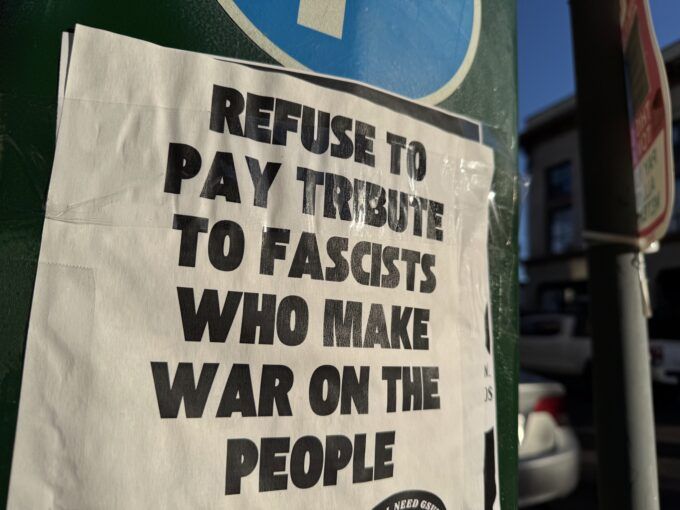
Trump and his army of enablers and enforcers may have co-opted the language of patriotism, but they are channeling the tactics of despots.

This is not about left versus right, or even about whether Trump is a savior or a villain. It is about the danger of concentrating unchecked power in any one individual, regardless of party or personality.

This should be a flashing red warning sign for any who truly care about freedom, regardless of partisan politics.

The ends do not justify the means.

History shows that once the machinery of oppression is built—surveillance systems, militarized enforcement, emergency authorities—it does not care who operates the controls. The only question is who will be targeted next.

All presidents in recent years have contributed to the rise of the American police state with executive overreach, standing armies, militarized policing, war without consent, mass surveillance, and concentrated power.

But Trump 2.0 has done more to dismantle the nation’s constitutional guardrails than at any other time in history.

Rather than adhering to the script provided by America’s founders, it’s as if the Trump administration took the grievances leveled against King George III in the Declaration of Independence and adopted them as a governing playbook.

They are unfolding now through emergency declarations, warrantless raids, speech-based detentions, unaccountable surveillance, and military actions launched without consent or constitutional authority.

With every passing day, the American police state with Trump at its helm gets more unhinged.

Consumed with visions of global conquest and military expansion, Trump has treated sovereignty as negotiable and international law as an inconvenience. He has threatened, coerced, or destabilized nations including Venezuela, Greenland, Cuba, Nigeria, Iran, and others—not through diplomacy or lawful process, but through dominance, spectacle, and unilateral force.

This is not leadership. It is lawlessness carried out by mercenaries and thugs on the government payroll.

Not content to wage war abroad, the government has systematically worked to transform America into a battlefield, setting its sights on the American people.

That transformation is almost complete.

ICE agents have been battering down doors, ramming into private homes, and carrying out warrantless militarized raids that treat constitutional protections as inconveniences and human beings as expendable obstacles.

This is the reality of Trump’s America: moral collapse, thuggery, violence, greed, and dehumanization.

Due process has become optional. Restraint has vanished. Violence has been normalized.

A government that recognizes no moral limits will recognize no legal limits.

And a nation that places its faith in the “morality” of unrestrained power will soon discover that morality—like liberty—cannot survive where law no longer rules.

Unchecked power does not protect its supporters—it eventually turns on them, too.

This is what happens when the rule of law gives way to rule by force.

Nothing about Trump’s behavior is rational or sane, even by his own standards: he’s bulldozing the White House, blitz-bombing boats, threatening to seize foreign lands by force, and plastering his name and face on every available surface.

Yet as diabolical as these distractions are, they are a sideshow to keep us from seeing the long-term plans to lock down the country being put in place by an unaccountable shadow apparatus operating behind the scenes for whom the Constitution means nothing.

We ignore them at our own peril.

Americans are being trained to accept what would have once been unthinkable: law enforcement that kills without consequence, presidents who operate above the law, wars launched without consent, and power exercised without accountability.

That normalization is the true danger.

The founders did not risk everything to replace one tyrant with another. They did not reject monarchy only to embrace executive supremacy. They did not enshrine checks and balances so that future generations could shrug and hope that those in power would restrain themselves.

They understood that freedom requires moral courage, not blind loyalty; that resistance to tyranny is not treason, but duty; and that the price of liberty is eternal vigilance—not eternal trust.

As I make clear in Battlefield America: The War on the American People and in its fictional counterpart The Erik Blair Diaries, history has already told us what happens next: when government becomes destructive of liberty, it is not only the right of the people to resist—it is their duty.

Constitutional attorney and author John W. Whitehead is founder and president of The Rutherford Institute. His latest books The Erik Blair Diaries and Battlefield America: The War on the American People are available at www.amazon.com. Whitehead can be contacted at johnw@rutherford.orgNisha Whitehead is the Executive Director of The Rutherford Institute. Information about The Rutherford Institute is available at www.rutherford.org.


Burkina Faso

The proper use of conspiracies


Friday 16 January 2026, by Paul Martial

The announcements of coup attempts, whether real or imagined, are evidence of the junta’s weakness, as it is unable to curb the advance of the jihadists.

Announced on social media by groups close to the government, then confirmed a few hours later by the Burkinabe authorities, through the voice of police commissioner Mahamadou Sana, yet another coup attempt has reportedly been foiled. This news prompted several hundred people to gather in the streets of the capital, Ouagadougou, and the country’s second city, Bobo-Dioulasso, to defend President Ibrahim Traoré.
The argument of effectiveness

According to the confession of an accomplice, the mastermind behind this coup attempt was Lieutenant-Colonel Paul-Henri Sandaogo Damiba, himself a former coup leader who was overthrown by Traoré and fled to Togo. Togo does not appear to be involved, and the accusations made by the junta are instead directed at Côte d’Ivoire, with which Burkina Faso has a conflictual relationship.
The army has always been a key player in Burkina Faso’s political life. What is new is that the justification for the sedition is now based on the ineffectiveness of security responses to the jihadist threat. Sandaogo Damiba used this argument to overthrow President Roch Marc Christian Kaboré, and Ibrahim Traoré did the same during his coup on 30 September 2022.

Given the sharp deterioration in the country’s security situation, Traoré can only be on his guard. According to the junta, plots are regularly foiled, reinforcing the idea of a besieged citadel and justifying purges and arrests within the army. For example, in October 2023, Commander Ismaël Touhogobou was arrested and executed; in January 2024, it was the turn of the former chief of staff of the gendarmerie, Lieutenant-Colonel Evrard Somda, to be abducted.

A junta obsessed with control

This repression is not limited to the army, but targets society as a whole. The abductions of journalists, lawyers, artists, trade unionists and political opponents are creating a climate of fear in the country. Informers in the main cities scrutinise the slightest statement by ordinary citizens against the government, who may find themselves overnight in prison or on the front line as Volunteers for the Defence of the Fatherland, a militia created by the government to fight Al-Qaeda and Islamic State organisations.

These coup attempts, real or imagined, and their repressive corollary are the result of a warmongering policy that refuses to tackle the social and economic problems fuelling this armed conflict. The consequences for the population are disastrous: there are approximately two million internally displaced persons and some six million people in need of humanitarian assistance.

15 January 2026

Translated by International Viewpoint from l’Anticapitaliste.

Attached documentsthe-proper-use-of-conspiracies_a9368.pdf (PDF - 904.6 KiB)
Extraction PDF [->article9368]

Burkina Faso
Burkina Faso: Junta steps up repression
Sahel: a military coup
A bleak future for the Sahel
Sahel: with or without Barkhane, a policy against the people
Sahel: towards a policy other than “security”

Paul Martial is a correspondent for International Viewpoint. He is editor of Afriques en Lutte and a member of the Fourth International in France.


FIFA Please, Revoke the Peace Prize, Reclaim the Game


In December, U.S. President Donald Trump was awarded FIFA’s newly created “FIFA Peace Prize – Football Unites the World” by FIFA President Gianni Infantino. The decision immediately sparked disbelief and criticism worldwide, raising a fundamental question: What does FIFA mean by peace?

If football is truly meant to unite the world, then this prize—and the process that produced it—must be seriously reconsidered.

The awarding of the Peace Prize did not emerge from a transparent or democratic process. It reflects a broader pattern in which the Trump administration has exerted political and diplomatic pressure on international institutions to secure legitimacy and public endorsement. In other words, bullying. FIFA, despite its claims of neutrality and independence, appears to have yielded to that pressure.

But power imposed through coercion can be reversed through organized, collective, nonviolent action. If a government can pressure a global sports institution into legitimizing its leader under the banner of peace, then global civil society must be capable of compelling that same institution to correct its course. It is not about punishment or humiliation. It is about legitimacy.

Peace Cannot Be Performed

The United States’ current posture toward the rest of the world—marked by sanctions, coercive diplomacy, military threats, and disregard for international norms—stands in open contradiction to the values the Peace Prize claims to represent. One cannot credibly speak the language of peace while practicing domination.

When intimidation succeeds without challenge, it becomes precedent. When it is challenged collectively and nonviolently, it becomes brittle.

Revoking this prize would send a clear message: peace is not a public-relations exercise, nor a political trophy extracted through pressure.

A World Cup Under Question

This controversy unfolds as the 2026 FIFA World Cup approaches. Scheduled from June 11 to July 19, it will be the first-ever 48-team tournament, featuring 104 matches across 16 cities, 11 in the United States and 5 in Canada and Mexico.

International fans, activists, and political figures are questioning whether the current U.S. political climate—particularly immigration enforcement practices, travel restrictions, and border policies—makes the country a safe and welcoming host for a global celebration meant to unite humanity.

Calls to boycott the 2026 World Cup are spreading across social media, as supporters report canceled travel plans, withdrawn ticket purchases, and growing fears of arbitrary detention, visa denials, and hostile treatment at borders. Human rights organizations have repeatedly warned about detention practices and the erosion of civil liberties—concerns that take on heightened urgency when millions are expected to cross borders for a global event.

A Nonviolent Proposal for a Global Reset

If there is one nonviolent action in 2026 with the potential to shift global consciousness, it is an international campaign demanding accountability from FIFA itself.

Such a campaign could call for:

  • the revocation of the FIFA Peace Prize awarded to Donald Trump;
  • a one-year postponement of the 2026 World Cup;
  • the relocation of the tournament to a coalition of African host countries—such as South Africa, Morocco, Egypt, and Algeria—regions with deep football traditions and long-standing exclusion from global sporting power.

This proposal is ambitious. But ambition has always been necessary for transformation.

FIFA is not a neutral body floating above politics. It is a global institution with 211 member associations, whose decisions reflect values, alliances, and power relations. What FIFA chooses to reward—and whom it chooses to honor—sends a message to billions.

Broadcasters: Withdrawing the Economic Consent

One of the most powerful nonviolent levers lies beyond stadiums and borders: broadcasting. The World Cup exists not only as a sporting event, but as a global media product. Television networks and streaming platforms pay billions in licensing fees that finance FIFA’s operations. Without those fees—and without audiences—the tournament loses its economic foundation.

A coordinated nonviolent campaign could therefore call on broadcasters to:

  • suspend World Cup coverage;
  • refuse to pay licensing fees while FIFA legitimizes coercive political power under the banner of peace;
  • publicly explain their ethical position to viewers, advertisers, and citizens.

This action would not target players, fans, or workers. It would target the financial and symbolic infrastructure that allows FIFA to operate without accountability. This is not censorship — it is ethical refusal.

A Universal Campaign: Social Media as Nonviolent Infrastructure

For such a campaign to succeed, it must be global, visible, and coordinated. That is why social media is not secondary—it is essential. Social media platforms are today’s nonviolent infrastructure. They allow millions of people to act together across borders, languages, and cultures without centralized control. When used strategically, they transform isolated actions into universal pressure.

A global campaign could:

  • coordinate shared messages, visuals, and hashtags across continents;
  • amplify testimonies from fans, players, journalists, and human rights advocates;
  • expose contradictions between FIFA’s rhetoric and its actions in real time;
  • apply sustained public pressure on FIFA leadership, broadcasters, sponsors, and advertisers.

This is how nonviolent movements grow: through visibility, participation, and persistence—until silence becomes impossible.

In order to succeed, however, this must be more than a media moment. It must become a grassroots nonviolent movement.

Football clubs, supporters’ associations, players, national federations, and fans everywhere should be called upon to stand—not against the sport, but for human dignity. This is about withdrawing consent from illegitimacy and restoring meaning to the game. Football has always been more than a game. It reflects who we are—and who we choose to become.

After all, people are not football fans first. They are human beings first.

The question now is simple: Will FIFA continue to serve power—or will it revoke the Peace Prize and reclaim the game for humanity?

This article was first published in English on Pressenza and is now available in: Spanish

David Andersson is a French-American journalist, photographer, and author who has lived in New York for over 30 years. He co-directs Pressenza International Press Agency and is the author of The White-West: A Look in the Mirror, a collection of op-eds examining the dynamics of Western identity and its impact on other cultures. Read other articles by David.
Opinion: ChatGPT Health in Australia causes worries about AI advice and lack of regulation


By Paul Wallis
EDITOR AT LARGE
DIGITAL JOURNAL
January 16, 2026


A Bernstein Research analyst says Open AI CEO Sam Altman has the power to crash the global economy or take everyone 'to the promised land' as the startup behind ChatGPT races to build artificial intelligence infrastructure costing billions of dollars - Copyright GETTY IMAGES NORTH AMERICA/AFP JUSTIN SULLIVAN

There are many points of access to ChatGPT Health with a single search. It’s a chat service that provides a range of services related to medical issues for consumers.

The recent launch of ChatGPT Health is “just” as a general information service, but the frames of reference are huge. It’s an interface for general information, which can be and has been construed as advice.

This Guardian article about ChatGPT Health spells out in clear and alarming terms what can go wrong and what has gone wrong, notably a case of someone taking sodium bromide instead of table salt.

To explain this problem a bit more succinctly:

AI draws on available data to process requests. The available data for sodium bromide is minimal and appalling. Even the manufacturers seem to have only so much information to work with.

This is what the AI would see:

General search data. It’s OK for a casual overview, but hardly at a diagnostic level. It does include safety and toxicity information.

Product information, such as it is. Note the many “No data available” entries on this info sheet.

So this guy takes sodium bromide, starts hallucinating, and winds up inthe hospital. Ironically, the toxicity information in the basic search includes hallucinations.

You can see how this works. How this guy got the idea that sodium bromide was a substitute for table salt is anyone’s guess. Maybe the fact that they both include sodium?

Now the major issue.

To coin an expression, this is “AI overreach”.

In the consumer’s case, he far overreached his own knowledge base. This kind of information simply doesn’t, can’t, and won’t translate into a quick fix for table salt or anything else.

In ChatGPT Health’s case, it’s a huge overreach. It’s one thing to simply recite factual information. To transpose that level of information into any sort of medical advice is out of the question.

One of the reasons online health has taken off is because it’s supposed to be basically the same service you’d get from a GP. It’s quick, it’s efficient, it saves time and money for both parties, and nobody has to risk their lives in traffic to treat a head cold.

AI health services like this are inevitably well out of their depth in these basic functions. They’re not subject to the same level of two-party scrutiny, either.

A GP and a patient could just both look at the same AI information and decide whether they believe it or trust it.

Sodium bromide certainly wouldn’t have passed this very basic level of scrutiny. A swimming pool disinfectant agent as table salt? Maybe not?

Regulation

Regulation could be easier than it looks, though. Under Australian law, a medical company cannot provide medical services. It’s also not a legal person. These are very important distinctions.

So how could an AI provide the same or similar services? AI isn’t a legal person, either. This could well extend to any form of medical advice.

As a therapeutic asset, AI could be regulated by the Therapeutic Goods Administration. It could only operate under general therapeutic regulations, with any number of safeguards built in. Note that the reasonable interpretation of “therapy” can easily include advisory services.

Why regulate?

Because otherwise any dangerous pseudo-medical product can enter the food chain. Because there are serious risks of major damage. Look how much fun America has with its meds, regulated or otherwise. It’s too high a risk.

Never mind “buyer beware”. Why should the buyer of anything have to beware of anything at all? What’s wrong with an obligation to market safe products?

A warning sticker saying “this product could exterminate your entire family” may be noble and uplifting and tell you what nice guys the manufacturers are, but why do you need it? Does “may contain plutonium” tell you enough?

In the case of sodium bromide, it’s a fair assumption that nobody seriously considered that it was a substitute for table salt. You shouldn’t need to be told that, but here’s a documented case of exactly that.

AI is destined to be a critical part of medicine. It needs to be safe.

Opinion: AI in advertising, or the absolute last thing you need is scripted sales spiel


By Paul Wallis
EDITOR AT LARGE
DIGITAL JOURNAL
January 14, 2026


Huge investment announcements by ChatGPT-maker OpenAI this week boosted tech optimism but there are worries that the AI-fuelled rally may have run too far - Copyright AFP SEBASTIEN BOZON

It seems that life does go on, despite the news. Life now includes helpful AI agents to help you shop. Stop cheering.

Those of us blessed with AI in its role as yet another dogmatic, time-consuming, verbose commercial procedure aren’t cheering. Particularly those of us who’ve done mountains of advertising copy and sales materials.

Consider the process. You search for something you want to buy, and you get the usual formatted search, AI overview, and a sales pitch. Paid placements are quite bad enough. The whole search gets buried under the paid placements. Now add AI.

The current AI sector theory is that AI will be “persuasive”. Nice to know anyone’s that naïve, isn’t it?

No, it isn’t.

Say you want to buy a toaster. Legends say that back in the day your family used to own a toaster.

With the insanity of middle age, you and your ego decide that you will again aspire to such lofty social goals. You mad impetuous statistic, you.

So, despite the shudders from your family, total strangers, and a few squirrels, you search for a toaster.

Now, grudgingly consider the fact that there could be nothing easier than looking up info about your searches from data brokers to your search.

It’s a lot worse than that, and your consumer mudslide starts way up the market food chain.

You get all your past searches because it’s a search engine function to remember searches anyway. Yes, the AI can access that data. You hit Shopping and go to a site.

You also get AI business strategy, market planning, etc. It looks very like More Things You Can Do With Your Expensive New Toy For Businesses. This includes marketing, branding, and market positioning. You haven’t even clicked on a product yet.

All of this is based on one search.

The toasters arise from the products page. Some of them don’t even look like toasters. They look like someone’s trying to build a new alien civilization and couldn’t be bothered to tell you.

At this point you don’t need AI. You need a therapist up there in the tree with you.

But you get the AI. To quote from The Conversation link above:

A more recent meta-analysis of eight studies similarly concluded there was “no significant overall difference in persuasive performance between (large language models) and humans.”

This just means that the AI can process you to death or a sale, whichever comes first. You probably won’t get that invaluable condescension and implication that you’re unworthy of a toaster, though.

The usual “Behold! It casts its eyes upon our products, the wretch! Send a vassal to sneer it into submission!” is unlikely. You’d only get the impression that you should be a better person before daring to buy a toaster.

The AI will just obligingly tell you everything it wants you to know. Scripted spiel with a dialog box. Never mind what you want to know. It won’t understand your whimpers.

Nevertheless, you and your family will get an heirloom $19.99 toaster, eventually.

What does this have to do with advertising, you enquire wistfully from your burrow?

Nothing. Nothing at all. Do you see any real business value? The real sales pitch and trigger for everything is your search enquiry. You’ve already sold a toaster to yourself. The AI has simply reinforced your fears.

Successful salespeople don’t waste your time or theirs with superfluous garbage. In this case, they know that you want a toaster, but they also know that you may want to sing, dance, and frolic in the fields again. So, they keep the verbosity functional.

My suggestion from years of advertising work and statutory-level consumer protection work:

You need advertising in AI like you need a third armpit.


Opinion: Is open source AI the only trustworthy long-term way to develop AI?

By Paul Wallis
EDITOR AT LARGE
DIGITAL JOURNAL
January 5, 2026


While OpenAI does not expect to be profitable before 2029, the startup's valuation keeps climbing in funding rounds baffling some financial analysts
 - Copyright AFP Kirill KUDRYAVTSEV

Unlike just about every new class of technology in history, AI has a unique ability to be universally despised. The ridiculous investment racket, combined with the actual performance and delivery of the product, makes it easy.

In coding terms, AI often looks more like slapstick comedy. The AI Keystone Codes go well with the Keystone Cops.

Inept, unreliable, farcical, and hallucinating software is nobody’s idea of a credible standard of performance. Certainly not business performance. One lousy prompt or a few random otherwise unemployable idiots can produce a MechaHitler.

This is your idea of a few trillion dollars’ worth of good investment? Ownership of this extremely expensive bad case of poultry diarrhea could be legal suicide in one process.

It’s called AI slop simply because it is sloppy.

Imagine this dialogue with an AI agent:

“What’s our current electricity load on the grid?” you ask hopefully.

“Oh, I dunno. How about a meaningless rabid political rant instead?” it replies with a simpering and generally inexcusable New York accent.

Great stuff.

No, it damn well isn’t.

Criticisms of turgid AI videos, endless repetitions of the same information, and the content curation of a dunghill are all perfectly valid and correct.

There’s no actual value in any of this garbage.

Now, let’s get a little less superficial.

This generation of ultra-smug AI isn’t and can’t be the whole story, thank god. Even allowing for the Rectal Rhapsodies of AI spruikers, it’s an interim stage before high-functioning AI can evolve.

This is where the heavy-duty professional criticism necessarily kicks in. it’s interesting to note that in the IT sector, where the real high-tech guys reproduce by fission, none of the AI BS flies at all.

These are the guys who evangelized the internet and every single electronic component since the Commodore 64 like proud parents. They know how derivative current AI is, glued on to much older software like writing and music software that is often decades older.

For the first time ever, the Ultra-Geeks and consumers are on the same page, if for some similar and some different reasons.

They agree that:

Big Tech is all about money and not about performance.

Corporate agendas are driving development for purely financial reasons.

Added ornaments like rumoured new hardware requirements for Windows 12 and everything else, and similar bric-a-brac are more obstacles than assets.

All of this is being done at a great distance from consumer needs, and the consumers don’t like it.

Why not put this externally sorta-maybe required but not consumer-essential junk on the Cloud, where it belongs?

This unsightly mess brings us elegantly if verbosely to the issue of open source AI development.

Open source development is a comparatively complex idea, but it’s essentially free. Open source has generated some of the most useful software ever developed.

The big issue for AI is that open source is also transparent. It can’t really be a corporate toy. There are overlaps, sure, but that’s inevitable. The intellectual property game, however, is very different.

Real development happens in people’s heads.

Some poor soul, floundering through cumbersome protocols and obscure IT idiocies will notice that there are workarounds. Anyone who’s ever done coding will tell you that workarounds are the main reasons that anything works at all. That’s pretty right.

Now, a bit of logic:

If corporate agendas distort efficient development, or more likely sidetrack it, open source is the way around those agendas.

Pure research, the only real gold standard for real tech breakthroughs, is unrestricted in the open source environment.

Talent isn’t and can’t be confined to a stingy 5-minute input in some useless meeting.

Open source is peer-reviewed and highly visible by definition. Its trustworthiness is based on actual performance, not some damn PR exercise.

Open source will finally free AI development. It’s that simple.

________________________________________________________

Disclaimer
The opinions expressed in this Op-Ed are those of the author. They do not purport to reflect the opinions or views of the Digital Journal or its members.


______________________________________________________________


Talk to me, Alexa: How conversational commerce is reshaping digital strategy

By Dr. Tim Sandle
SCIENCE EDITOR
DIGITAL JOURNAL
January 7, 2026


Voice assistant. Image by Tim Sandle.

Voice assistants are changing the way consumers search, discover, and buy products online. From asking questions aloud to completing purchases, conversational commerce is partly shifting its digital strategy beyond screens.

Consequently, some brands need to adapt to this new voice-driven landscape, optimising content, structuring product data, and integrating AI chat to stay visible and relevant in this emerging channel.

In 2024, the number of active voice assistants surpassed 8.4 billion globally, more than the number of people on Earth. It is estimated that voice commands drive over $3.3 billion in consumer spending, and the channel is expected to reach $45 billion by 2028.

Up to 43% of voice-enabled device owners use their device to shop, with 51% using it to research products, 22% making purchases directly, and 17% reordering items.

As voice assistants and AI chat tools become household staples, the way consumers search, discover, and buy products is evolving.

According toLouis Riat-Bonello from Optisearch, conversational commerce is transforming digital marketing, requiring brands to rethink how they appear in search, engage audiences, and drive conversions. Riat-Bonello explains more to Digital Journal.

Why Conversational Commerce Is Gaining Momentum

Voice assistants and conversational commerce refer to the use of spoken commands or chat-based interfaces to search for information, discover products, and complete purchases. Instead of typing queries or browsing traditional websites, consumers interact with AI-powered assistants, smart speakers, or on-site chat tools that guide them through the buying journey.

Monthly, Riat-Bonello says, 11.5% of smart speaker owners make purchases, equal to nearly 5.5 million US adults. 52% of owners are interested in deals and promotions, while 38% find voice ads less invasive and 39% find them more tempting than traditional ads. These behaviours show a clear opportunity for brands to reach audiences in ways traditional channels cannot.

From a marketing and commercial perspective, conversational commerce is gaining traction. Riat-Bonello says it is for the following reasons:Ease and convenience: Voice and chat remove friction by allowing users to search or shop hands-free, making it ideal for multitasking and on-the-go moments
Faster decision-making: Conversational interfaces often deliver direct answers or product recommendations, reducing the steps between intent and action
Growing consumer comfort with AI: As voice assistants and chatbots become more accurate, users increasingly trust them for everyday tasks, including shopping
Strong local and high-intent use cases: Voice searches are frequently local or transactional, creating opportunities for brands to capture customers ready to act
Seamless integration with daily life: Smart speakers, mobile assistants, and embedded chat tools make conversational commerce a natural extension of how people already use technology.

According to Riat-Bonello: “Voice search and conversational tools are changing how brands are found and how people shop online. When someone speaks to their assistant, they want a fast, accurate answer. That means businesses need to optimise content for natural, full-sentence queries, ensure product data is structured and reliable, and use AI-driven chat to guide customers to the right products.”

This is leading to adaptation. Riat-Bonello cites: “Smart brands are thinking beyond screens. Every voice query is a potential conversion, and every interaction shapes how consumers perceive your business. Voice shopping is not just a trend. It is becoming a core part of the customer journey, and businesses that adapt early will gain a real advantage.”

How Brands Can Optimise for Voice Commerce

Voice assistants like Siri, Alexa, and Google Assistant do not “browse” results. They aim to return one correct answer, not a list. For those seeking to market products using voice assistants, Riat-Bonello sees the best way to “appeal” to voice assistants is to:Ensure product and business data is fully structured using schema markup, including pricing, availability, reviews, and location details
Maintain consistent listings across Google Business Profile, Apple Maps, Amazon, and other trusted data sources used by voice assistants
Optimise content for natural, spoken queries by targeting full-sentence questions and intent-driven searches rather than short keywords
Build authoritative FAQ and support content that directly answers common “how,” “where,” and “best” queries users ask aloud
Strengthen local SEO signals, as many voice searches are location-based and action-oriented
Focus on reviews, ratings, and fulfilment reliability, which voice assistants use as confidence signals when selecting recommendations
Integrate AI-powered chat on websites to mirror conversational behaviour and guide users toward products or actions

Riat-Bonello adds that things should not simply stop here, since development is always necessary. He recommends regularly auditing product feeds, structured data, and listings to ensure accuracy as platforms and voice algorithms evolve.


Global research: Gender stereotypes reflect the division of labour across nations

By Dr. Tim Sandle
SCIENCE EDITOR
DIGITAL JOURNAL
January 16, 2026


Roles of men and women at work. Image by Tim Sandle.

Global data appears to explain why cultural beliefs about the skills and personality traits of men and women differ across the world

Researchers at Northwestern University and the University of Bern in Switzerland have conducted a cross-temporal, multinational study to compare views of gender using data collected 30 years apart.

This international study reveals that people’s beliefs about the attributes of women and men follow from the differing social roles that they typically occupy in homes and workplaces in their respective societies.

The goal driving the research was to understand the sources of stereotypes of men as assertive and ambitious and of women as the kinder and more caring gender. The study showed that these stereotypes reflect the differing social roles that are typical of women and men in homes and workplaces in nations across the world.

The researchers based their study on a Gallup public opinion poll of 22 nations from 1995, which they replicated and expanded to 40 nations in their 2023 survey. The results showed that across all nations and both time points, poll respondents reported that men are the more agentic gender, displaying qualities such ambition and competitiveness, and that women are the more communal gender, displaying qualities such as warm and caring.

The findings may seem surprising, given global trends showing the growing number of women in the paid workforce around the world. Yet, according to the researchers, a simple explanation exists.

A similar explanation accounts for how the communal stereotype of women as the kinder and more caring gender differs across nations. The researchers found that the “women are communal” stereotype was stronger in nations with greater occupational segregation of women into jobs in communal domains, such as teaching professions. In other words, stereotypes across the world reflect the roles people see women and men occupy in their societies.

Perhaps unsurprisingly, gender stereotypes about competence, such as intelligence and creativity, reflect the extent to which women and men obtain college degrees in their respective societies. As the proportion of women earning degrees has increased overall, people have come to believe that women and men are equally competent.

Taken together, this study suggests that gender stereotypes are a result of people’s observations of the roles that women and men typically occupy in their societies.


Another key finding

In nations where women had greater political power and were better represented as heads of government agencies, people ascribed more communion — but not more agency — to women than men. The likely explanation is that women tend to occupy the more communal version of roles, for example, heads of agencies pertaining to family and children, rather than financial affairs and defence.

Implications

The researchers maintained that widely shared beliefs about the traits of men and women have far-reaching consequences. Although these gender stereotypes can be helpful as shortcuts that guide thinking in everyday life, they also can foster unfair judgments of individuals who are not typical of their gender.

Stereotypes can make people who do not fit expectations appear not just surprising, but unacceptable, leading to disapproval, for example, of a woman who excels as an aerospace engineer or a man who is a caring teacher of young children. Stereotypes can also harm society as well as individuals.

In terms of how to change, policies that would support a more flexible division of labour and thereby weaken gender stereotypes include allowing parental leave for fathers and improving childcare options to enable mothers to maintain demanding careers outside the home.

The researchers also pointed out the automation of many jobs that once required heavy physical labour has opened up new opportunities for women in such areas. Stereotypes are also undermined by welcoming qualified men into female-dominated roles in childcare and other caring professions.

The study has been published in the journal PNAS, titled “Gender stereotypes across nations relate to the social positions of women and men: Evidence from cross-cultural opinion polls.”