Wednesday, January 21, 2026

CU

MONOPOLY CAPITALI$M

A Rio-Glencore Tie-Up Would Redraw the Map of Global Mining

  • Rio Tinto and Glencore are in early, non-binding talks over a possible tie-up that would create a ~$260 billion mining giant.

  • The appeal centers on copper, where demand from power grids, EVs, renewables, and data centers is rising.

  • A deal could accelerate mining-sector consolidation and open the door to spinning off Glencore’s coal assets.

A potential tie-up between Rio Tinto Group and Glencore Plc would rank among the largest transactions ever attempted in the mining sector. The combined company would be valued at roughly $260 billion and would control a broad mix of iron ore, copper, and other industrial metals at a point when supply growth across several markets is slowing.

The structure of the two companies explains why the idea continues to resurface. Rio’s iron ore business generates steady and predictable cash flow. Glencore, by contrast, has spent the past decade building one of the industry’s largest copper portfolios while maintaining a global trading operation that handles large volumes of physical metals. Together, those businesses would cover both production and distribution at scale, a combination few miners can match.

According to multiple reports, Rio Tinto and Glencore are holding preliminary discussions about a possible merger. The talks remain early and non-binding, with no formal proposal or timetable disclosed. Interest in the scenario has increased after BHP Group ruled out a competing bid.


BHP’s decision narrows the competitive field. With a market capitalization of around $168 billion, BHP was the only miner with the balance sheet and operational reach to pursue a rival transaction. With that option removed, attention shifts to whether a single Rio-Glencore deal can move forward without the uncertainty of a bidding contest reshaping valuations or delaying execution.

Copper is key here. Demand continues to rise from power grids, electric vehicles, renewable energy systems, and data centers. Supply growth remains limited. Years of underinvestment, declining ore grades, permitting delays, and higher development costs have slowed the pipeline of new projects. Glencore’s copper assets and expansion plans would materially increase Rio’s exposure to a market that is already tight.

The talks also come as the mining sector accelerates its push toward consolidation. Producers are seeking scale to manage rising costs, longer project timelines, and tighter capital conditions. A proposed tie-up between Anglo American and Teck Resources is one example, with the companies exploring a merger of equals that would create a major copper-focused producer based in Canada. Similar pressures are driving interest in larger, more diversified mining groups across the industry.

For Rio, a deal with Glencore would also bring a commercial advantage. Glencore operates one of the most powerful commodity marketing and trading businesses in the mining sector, giving it deep exposure to physical flows, regional pricing differences, and supply disruptions. Integrating that operation would add a capability Rio currently lacks, strengthening its position across copper and other metals markets.

Beyond operating scale, the structure of Glencore’s portfolio opens up options to unlock shareholder value. The company’s carbon-heavy businesses, particularly coal, generate substantial cash but continue to weigh on valuation. Separating those assets following a merger could leave a standalone metals business centered on copper, zinc, aluminium, and lithium. That mix would align more closely with producers that trade at higher valuation multiples than diversified miners with large coal exposure.

Analysts cited by the Financial Times have argued that a post-merger break-up could materially lift shareholder value by allowing the metals business to be valued on its own merits, rather than alongside coal. Rio and BHP both trade at lower multiples than copper-focused peers, while coal-heavy producers trade at an even deeper discount. Keeping those businesses separate would highlight the difference in how they are valued.

Prices seem to track with this. Copper has climbed more than 25% over the past three months and reached record levels above $13,000 a tonne on the London Metal Exchange. Inventories remain low by historical standards, while producers face higher costs across labor, energy, and equipment. New supply is expected, but much of it remains several years away from first production.

Glencore’s appeal extends beyond its mines. The company operates one of the largest metals trading businesses in the world, giving it direct exposure to physical flows, pricing differentials, and regional supply disruptions. That trading arm has long differentiated Glencore from traditional miners. Folded into Rio, it would add a commercial layer that most large producers lack, potentially reshaping how the combined group markets copper and other metals.

The talks also come as consolidation accelerates across the sector. Large miners are increasingly using scale to manage cost inflation and longer project timelines. Smaller producers face tighter financing conditions and limited flexibility when projects run over budget or encounter delays. A combined Rio–Glencore would sit firmly at the top end of the industry, with the ability to keep large projects moving through downturns that would strain less diversified peers.

Coal is the awkward part of any deal. Glencore is one of the world’s largest coal producers, and those operations generate substantial cash that has supported the company during weaker metals cycles. At the same time, coal continues to weigh on valuation as capital flows favor copper and other electrification-linked metals. Separating those assets would leave a cleaner metals business, but it would also remove a significant source of earnings.

Glencore has been here before. The company has previously reviewed options to separate its coal business, only to see shareholders decide to keep the assets because of the cash they generate. Any deal with Rio would put that question back on the table, this time tied directly to how a combined company would be valued rather than to longer-term climate positioning.

Regulators would also be involved early. Authorities in Australia and Europe would examine copper concentration, particularly in regions where both companies already have significant operations. Glencore’s trading business would draw additional scrutiny because of its role in physical markets and price setting. Any transaction would need approvals across several jurisdictions.

The two companies also run very different models. Glencore’s operations are built around trading and risk management, while Rio focuses on long-life mining assets and production discipline. Combining those approaches would require changes in oversight, internal controls, and decision-making.

Even if the talks go no further, they reflect where the industry is headed. Copper assets with long reserve lives are becoming harder to secure. Cash flow is increasingly important as project costs rise and timelines stretch. Those pressures continue to favor larger miners with the balance sheets to fund new supply and absorb delays.

By Alex Kimani for Oilprice.com

Key LME copper spread spikes to highest level since 2021 squeeze
Stock image.

Spot copper prices surged to trade at a huge premium over later-dated futures on the London Metal Exchange, with a closely watched one-day spread reaching levels not seen since an historic supply squeeze in 2021.

Copper contracts expiring Wednesday briefly traded at a $100 premium to those expiring a day later, in a structure known as backwardation that typically signals rising spot demand. The so-called Tom/next spread was at a narrow discount on Monday, and the spike was among the largest ever seen in pricing records starting in 1998.

The surge creates a fresh bout of turmoil in the LME copper market, after a breakneck rally that lifted prices to record highs above $13,400 a ton earlier this month. Traders have been piling into the market as mines have faltered and a surge in shipments to the US has drained copper supplies elsewhere, while many investors are betting on a jump in demand to power the burgeoning artificial-intelligence industry.
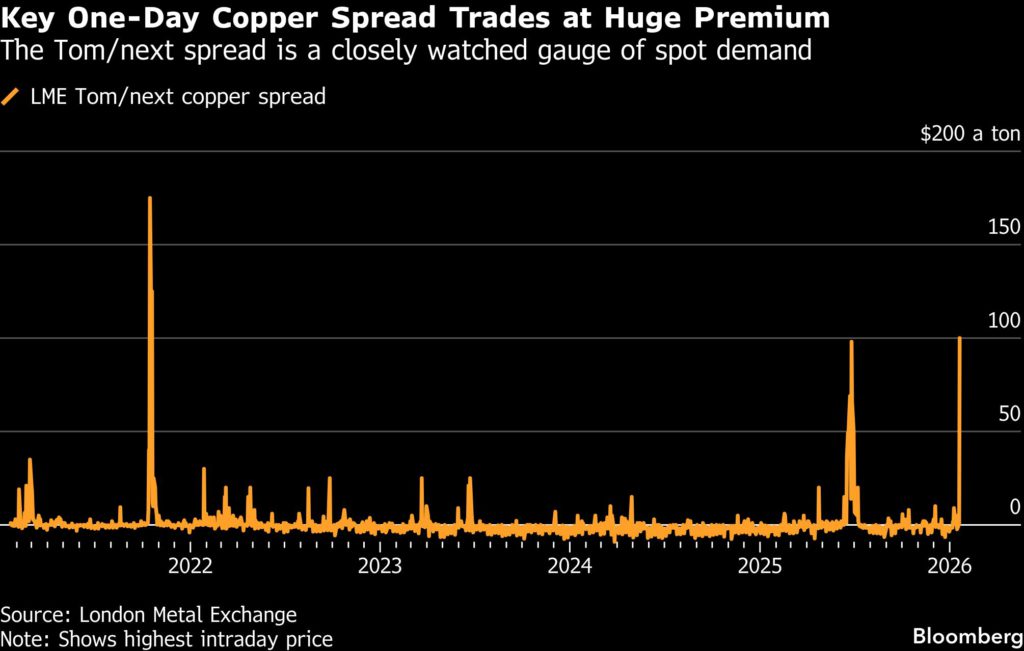
The Tom/next spread is closely watched as a gauge of demand for metal in the LME’s warehousing networking, which underpins trading in its benchmark futures contracts. The advance came ahead of the expiry of the LME’s main January contracts on Wednesday, with the Tom/next spread providing a final opportunity to trade those positions.

Data from the LME showed that there were three separate entities with long positions equal to at least 30% cumulatively of the outstanding January contracts as of Friday, and if held to expiry the positions would entitle them to more than 130,000 tons of copper — more than the amount that’s readily available in the LME’s warehousing network.

Holders of short positions, meanwhile, would need to deliver copper to settle any contracts held until expiry, and the spike in the Tom/next spread exposes them to hefty losses if they look to roll them forward instead. The move to $100 a ton took the spread to the highest level since a major supply squeeze in 2021, which prompted the LME to roll out emergency rule changes to maintain an orderly market.

Structural constraints

The Tom/next spread often flares into backwardation in the run-up to the expiry of monthly contracts, but such extremes are a rarity — partly because the LME has rules in place that force large individual holders of long positions to lend them back to the market at a capped rate.

The spread had earlier been trading at a premium of $65 a ton, which equates to 0.5% of the prior day’s official cash price. That’s the maximum level participants can lend at if they hold positions in inventories and spot contracts that are equal to between 50% and 80% of readily available stocks. The spread later fell in the final minutes of trading, and closed at $20 a ton at 12:30 p.m. London time.

While the Tom/next spread is highly volatile, copper’s broader price curve is also signaling more structural supply constraints in the broader copper industry, with backwardation seen in most monthly spreads through to the end of 2028. Many analysts and traders expect the market to be in a deep deficit by then, in a trend that could drain global inventories and push prices sharply higher.

Global inventories are at sufficient levels for now, but much of the stock is held in warehouses in the US, after traders shipped record volumes there in anticipation of tariffs. The once-in-a-lifetime trading opportunity was fueled by a surge in copper prices on New York’s Comex exchange, but the recent spike in spot prices on the LME has left US futures trading at a discount.
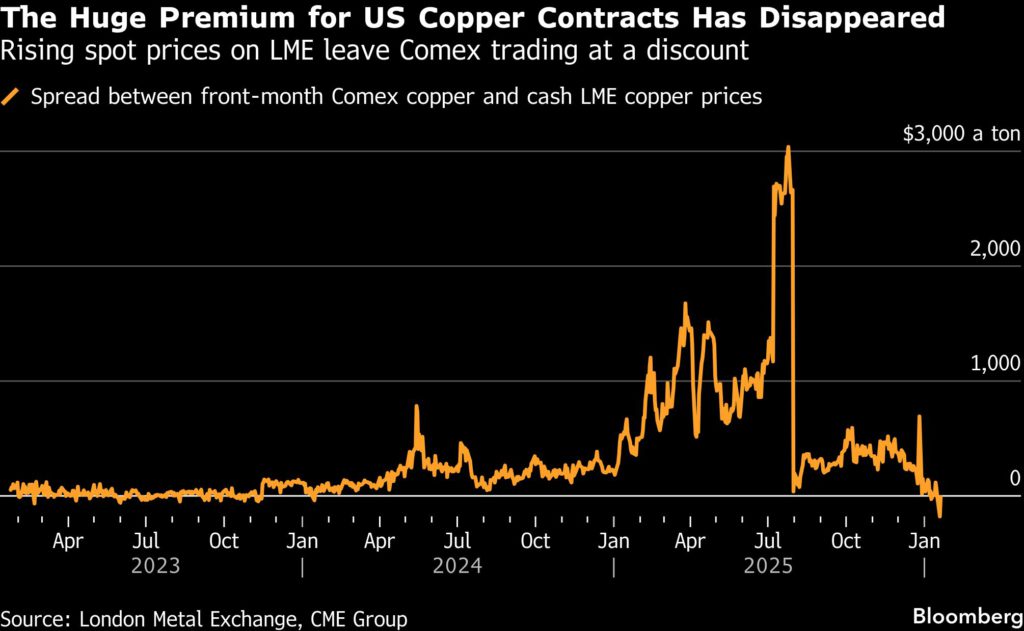
This week, there have been small deliveries of copper into previously empty LME warehouses in New Orleans, and the surge in the Tom/next spread could incentivize further deliveries into US depots. Data from the LME shows that there were about 20,000 tons of privately held copper that could be readily delivered into New Orleans and Baltimore as of Thursday, while more than 50,000 tons were also held off-exchange across Asia and Europe.

LME copper inventories rose by 8,875 tons to 156,300 tons on Tuesday, driven by deliveries into warehouses in Asia and a small inflow in New Orleans. The turmoil in price spreads had little impact on the LME’s benchmark three-month contract, with prices falling 1.6% to settle at $12,753.50 a ton as US President Donald Trump’s push to take control of Greenland sparked a broad selloff in stock markets.

(By Mark Burton)

Jiangxi Copper plans $3.6 billion bond sales to fund expansion
Jiangxi Copper Co., a leading Chinese smelter, said it planned to issue up to 25 billion yuan ($3.6 billion) of bonds that could fund an expansion of mining after prices rallied to a record.

The company will issue up to 15 billion yuan of medium-term notes, as well as 10 billion yuan in super short-term commercial paper, it said in an exchange filing. Proceeds will be used to repay debt, supplement working capital, or fund merger-and-acquisition activity, it said.

Copper hit a record above $13,000 a ton this month, supported by optimism about the outlook for demand amid the energy transition and data-center build-out. Supply snarls at mines, and concerns that the US may impose a tariff on imports have also boosted the metal.

Globally, companies are hunting for copper reserves, or seeking to combine with rivals to expand their access to the commodity. Last month, Jiangxi Copper agreed to buy Australian copper miner SolGold Plc for about $1 billion, with the smelter seeking to boost ore self-sufficiency after record low processing fees crimped margins.

This week, major Chinese miner CMOC Group Co. raised $1.2 billion from the sale of convertible bonds to expand its overseas mining and processing assets, as well as to improve working capital.

Jiangxi Copper shares in Hong Kong hit a record earlier this month.


Vale’s copper ambition is to produce 1 million tons a year
Stock image.

Vale SA’s base metals unit wants to eventually produce 1 million tons of copper by developing existing assets, exceeding an output target for 2035.

Major mining firms such as Anglo American Plc and Rio Tinto Group are racing to increase production of the metal through acquisitions. Vale Base Metals is focused on deposits it already owns in Brazil to join the ranks of the world’s largest copper suppliers.

“These assets have been talked about for decades,” Vale Base Metals chief executive officer Shaun Usmar said in an interview last week at a mining industry gathering in Riyadh. “They just haven’t been unlocked.”

While the subsidiary of the Brazilian iron ore giant has a target to approximately double annual copper production to 700,000 tons by 2035, the CEO said he’s “increasingly confident we’ve got an organic pipeline to go well beyond that.” The ambition is “to become a one million ton a year producer,” according to Usmar.

The only miners whose copper output exceeded 1 million tons in 2024 were Freeport-McMoRan Inc, BHP Group, Codelco and Zijin Mining Group Co. Ltd.

Copper is among the most coveted metals for mining executives who are anticipating significant growth in consumption driven by electrification and the wider energy transition. Prices have hit repeated records since late last year amid concerns that supply will lag demand.

Toronto-based Vale Base Metals’ other main product is nickel, which is mined at operations in Brazil, Canada and Indonesia.

Vale said last month that its base metals unit is also considering a joint copper project with Glencore Plc in Canada. It could cost as much as $2 billion to develop their neighboring properties in the Sudbury Basin, in a venture that would produce about 42,000 tons of copper a year, Vale said.

(By William Clowes)


Peru’s copper production down 11.2% year-on-year in November
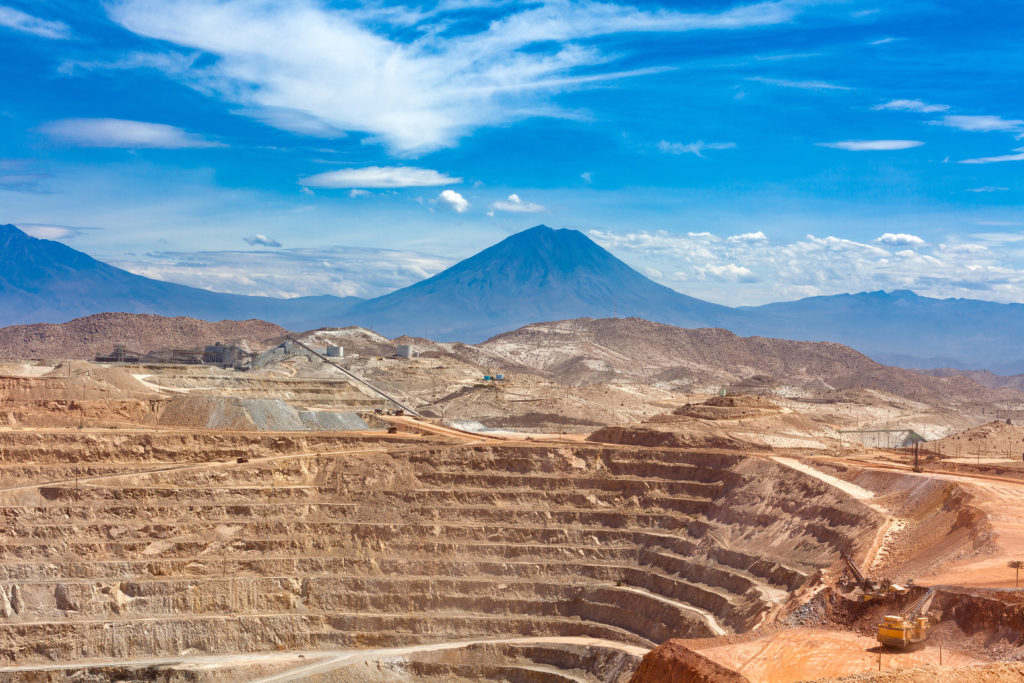

Open-pit copper mine in Peru. Stock image.

Peru’s copper production declined 11.2% year-on-year in November of 2025, reaching 216,152 metric tons, the energy and mining ministry said on Monday.

Between January and November copper production increased 1.6% compared to the same period in 2024, to 2.5 million metric tons, the ministry said in a preliminary report.

Peru, the world’s third-largest producer of the red metal, expects to produce about 2.8 million metric tons of copper in 2025, up from 2.74 million tons in 2024, according to the latest government estimates.

Copper production in Peru has remained almost stable since 2023, due to a lack of new projects and declining ore grades in large mines.

(By Marco Aqino; Editing by Cassandra Garrison)


Rio Tinto copper output rises as merger talks loom
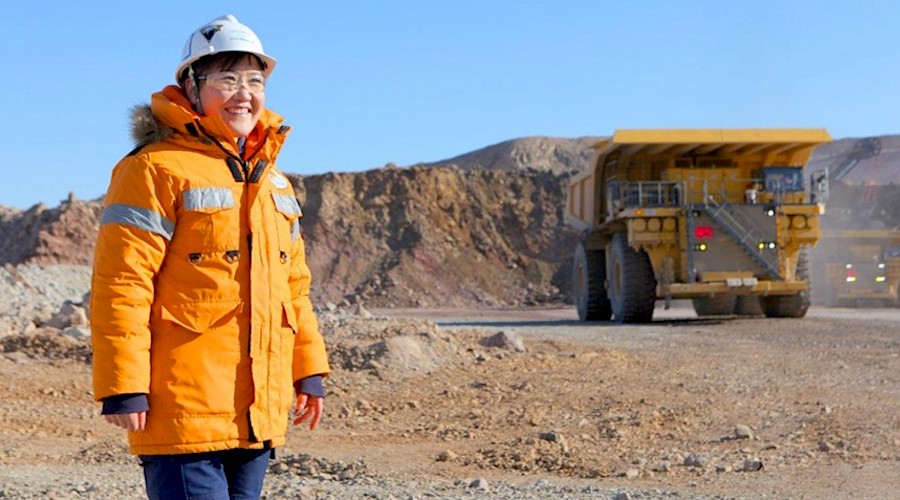

Copper production increased by 5% in Q4, driven by a surge from Mongolia’s Oyu Tolgoi underground expansion.(Image courtesy of Turner & Townsend.)

Rio Tinto’s (ASX, NYSE, LON: RIO) copper production rose 5% in the fourth quarter, as a surge from Mongolia’s Oyu Tolgoi underground expansion more than offset weaker output at Chile’s Escondida, the world’s largest copper mine.

Copper accounted for about a quarter of Rio’s half-year profit, still dwarfed by iron ore but central to its long-term growth ambitions and the strategic backdrop to its ongoing takeover talks with Glencore (LON: GLEN), with a Feb. 5 deadline to either make a firm offer or walk away. 

At Escondida, fourth-quarter production fell 10% from a year earlier due to lower grades and reduced concentrator output, but Oyu Tolgoi delivered a 57% year-on-year jump that underpinned the group’s overall copper gain. 

“Rio Tinto finished the year with a strong performance in key commodities, including fourth-quarter Pilbara iron ore up more than 4% versus our estimate, a quarterly record, and a 4% beat in copper,” BMO Capital Markets mining analyst Alexander Pearce said in a note. “However, the near-term focus remains on the potential merger with Glencore.”

The UK’s strict takeover rules also meant that Glencore’s name was absent from Rio’s production report, yet the Swiss miner’s influence hangs over the results as negotiations continue on valuation, leadership, structure and asset composition.

Among the options under discussion is a carve-out of coal assets, potentially into a separately listed Australian vehicle, echoing BHP’s (ASX, LON: BHP) South32 demerger a decade ago.

Glencore’s coal operations across NSW, Queensland, central Africa and Latin America would make up about 8% of a combined group’s $45.6 billion in EBITDA, while its trading arm, accounting for roughly 9% of earnings, remains another sensitive element.

Analysts have also floated alternatives, including a pre-deal coal spin-off by Glencore or a narrower bid by Rio focused solely on copper assets.

Market timing

Mark Freeman, managing director of the near-century-old Australian Foundation Investment Company (AFIC), has questioned the timing of chasing Glencore’s copper pipeline with prices near record highs, warning that assets often appear most attractive at the top of a mining cycle.

RBC mining analyst Ben Davis struck a similar note, arguing that the strength of the copper market has shifted perceptions around a potential tie-up. “Clearly the mining cycle is alive and well,” he wrote in a note last week. 

What was widely dismissed as speculative talk a year ago has, in his view, gathered momentum amid a strong rally and tightening resource supply, with recent share price moves signalling that investors now expect a firm offer.

The analyst added that Glencore’s copper portfolio, particularly its 44% stake in Chile’s Collahuasi mine alongside Anglo American (LON: AAL), represents the crown jewel Rio is seeking.

Iron backbone

Rio’s Pilbara iron ore operations hit a quarterly record, with shipments rising 7% to 91.3 million tonnes, while full-year exports landed at the lower end of guidance as the company recovered from weather disruptions.

The miner also began exporting from Guinea’s Simandou project and expects sales of 5 million to 10 million tonnes in 2026, compared with 323 million to 338 million tonnes forecast from the Pilbara this year. Elsewhere, aluminium output increased 2%, lithium production reached a record driven by Argentina, and titanium volumes fell 6% as Rio prepares to divest the business.

Since chief executive Simon Trott took the helm last year, Rio has moved to refocus operations, cut costs and rein in earlier ambitions in lithium. “Implementation of our stronger, sharper, simpler way of working continues, and is delivering results and creating value,” Trott said.

AU

Lupaka Gold may seize Peru state assets over unpaid $67M arbitration award


Lupaka Gold (TSXV: LPK) may look to seize certain Peruvian state-owned assets unless the South American nation pays the company its arbitration award, its chairman told Bloomberg.

Last year, the Canadian miner won an arbitration case against Peru for the government’s failure to curb community protests in 2018 that ultimately forced the closure of the company’s flagship gold project. The arbitration was launched in late 2019, with Lupaka alleging that the state had supported the protests that blockaded access to its Invicta project, located 120 kilometres north of the capital city Lima.

Before the situation escalated, Lupaka had completed 3,000 metres of underground workings, agreements from the community of Lacsanga and a 29-kilometre access road sufficient to handle 40-tonne ore trucks. The project was forecast to produce 185,000 oz. of gold equivalent over a six-year life.

$67 million unpaid

In June 2025, the International Centre for Settlement of Investment Disputes (ICSID) ruled that the Peruvian state must pay Lupaka $65 million. However, the arbitration award, now amounting to $67 million due to accumulation of interest, has yet to be paid, according to the company.

Without this payment, Lupaka said it has taken steps to identify overseas assets held by Peru as potential targets for seizure. Last November, it hired investigators to aid this process.

In a recent Bloomberg interview, Lupaka’s chairman Gordon Ellis said it has identified Peru’s national petroleum company Petroperu, which has “massive debts and pays large amounts of money on that on a regular basis,” as a potential target.

Other assets named by Ellis include ships and real estate as well as debt payments on Peru’s sovereign bonds.

Shares of Lupaka Gold have risen by over three-fold since its arbitration award win. At about C$0.25 apiece, the company has a market capitalization of C$5.7 million ($4.1 million).

Lupaka’s threats highlight the damaged relationship the Peruvian state has had with certain foreign investors. Last month, the Latin American nation was found in default in US federal court over another arbitration award totaling $91 million involving an airport contractor.

According to the Fraser Institute, Peru ranks behind some of its mineral-rich peers in the region such as San Juan, Argentina and Chile for investment attractiveness.


Caledonia secures $150M for Zimbabwe gold mine in rare international capital raise


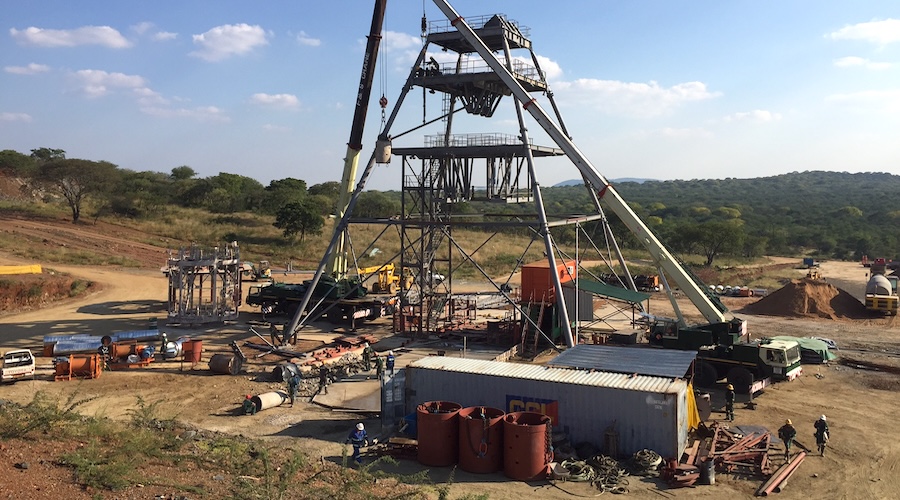
Bilboes gold project in Zimbabwe. (Image courtesy of Caledonia Mining.)

Caledonia Mining Corporation on Wednesday said it raised $150 million via a seven-year convertible bond offering to fund its Bilboes project which, once operational, will be Zimbabwe’s largest gold mine.

Zimbabwe-focused Caledonia’s debt issuance is the biggest international capital raising in over a decade for the country, which had been shunned by global investors due to economic and policy volatility.

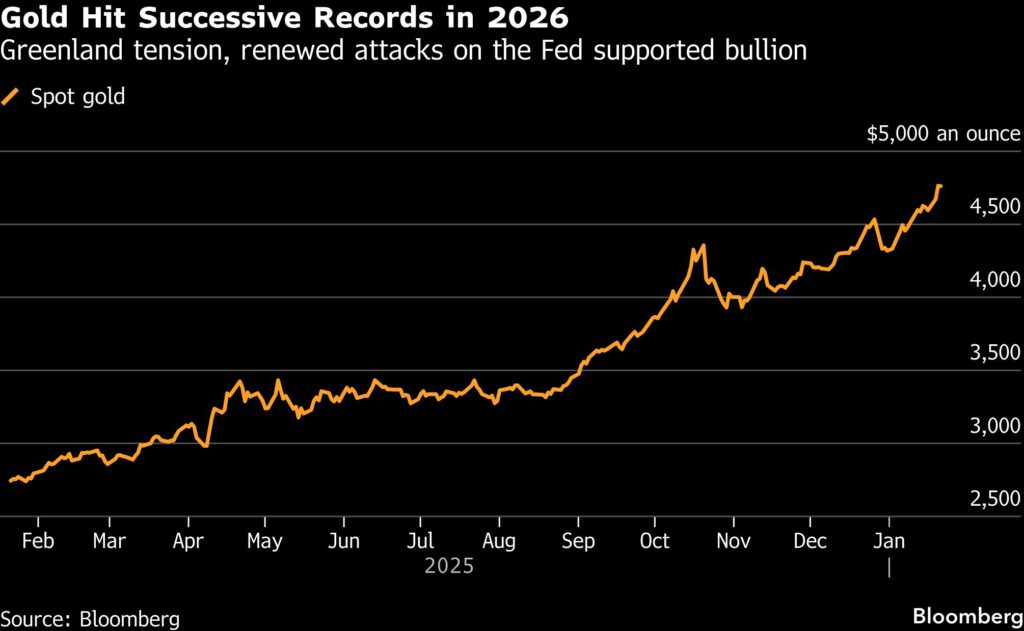
Spot gold prices surged to more than $4,800 per ounce on Wednesday, driven by investors seeking havens who are backing miners like Caledonia to lift output.

In a statement, Caledonia – which operates the 80,000-ounce-per-year Blanket mine in Zimbabwe – said demand for the offering from US institutional investors exceeded $600 million.

“Receiving more than $600 million of demand from high-quality North American investors is a tremendous endorsement of our strategy, the quality of our assets, our operational track record and the long-term prospects of the company,” Caledonia CEO Mark Learmonth said.

Caledonia said the bond issue is part of a broader strategy it is pursuing to fund Bilboes, which is expected to start production in late 2028. The mine is expected to reach annual output of 200,000 ounces from 2029 for an initial period of 10 years.

The company is also arranging a $150 million funding facility with a consortium of Zimbabwean and South African banks and will also engage regional and global lenders for Bilboes financing.

The Bilboes project has an expected total cost of $584 million and peak funding requirements of $484 million.

Zimbabwe’s gold output plunged to 3 metric tons during the height of its economic and political crisis in 2008. It has more than doubled production over the past decade to an all-time high of 47 metric tons in 2025.

(By Chris Takudzwa Muronzi; Editing by Nelson Banya and Thomas Derpinghaus)


Russia gains $216 billion in gold rally, replacing lost assets

Stock image.

Russia has reaped a windfall from a surge in gold prices since the start of its war in Ukraine, generating gains on a scale comparable to the sovereign reserves frozen in Europe over President Vladimir Putin’s invasion.

The value of the Bank of Russia’s gold holdings has increased by more than $216 billion since February 2022, according to Bloomberg calculations. At the same time, the central bank has largely refrained from both major purchases of the metal and using its gold reserves during that period, despite the loss of access to foreign securities and currencies blocked under sanctions.

In December, European Union countries approved extending a freeze on around €210 billion ($244 billion) of Russian sovereign assets held in the bloc.

The increase in the value of bullion restores most of Russia’s lost financial capacity, even if it doesn’t return the blocked reserves. While securities and cash immobilized in Europe cannot be sold or pledged, gold can still be monetized if needed.

Russia, the world’s second-largest gold producer, mines more than 300 tons of the metal a year. Since 2022, however, Russian bullion has been shut out of Western markets and is no longer accepted by the London Bullion Market Association, effectively barring it from the world’s biggest over-the-counter gold-trading hub. That complicates any potential large-scale sales by the central bank to Asian buyers, where it would also face competition from newly mined gold produced by sanctioned Russian producers that cannot currently be sold elsewhere.

Gold prices have rallied sharply over the past four years, supported by strong demand from central banks, persistent inflation concerns, heightened geopolitical risks and investors seeking safe havens from uncertainty caused by trade wars.

In 2025, gold gained around 65%, its strongest annual performance since 1979. This has significantly lifted the valuation of official holdings worldwide even without additional purchases.

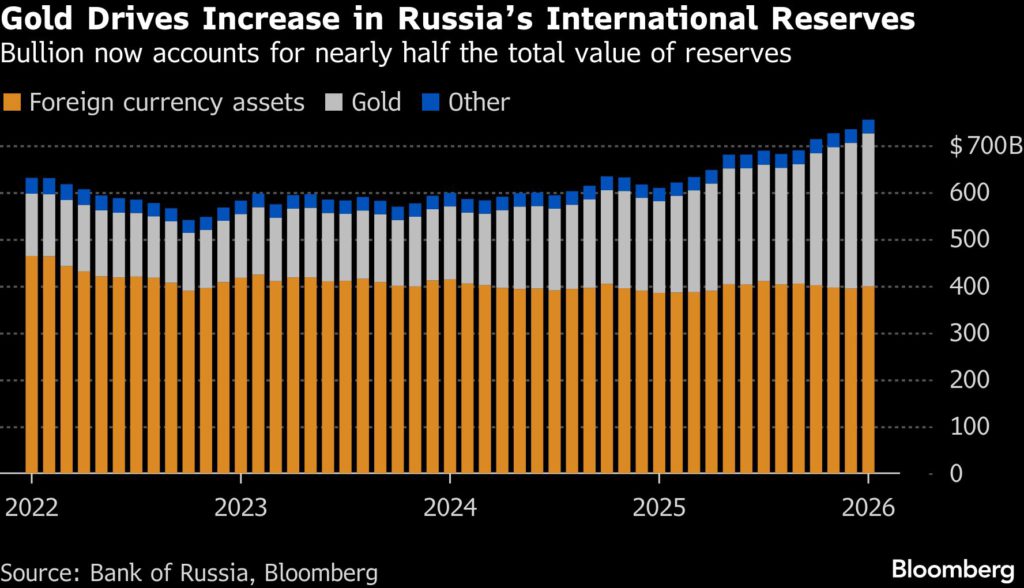
Russia’s international reserves reached $755 billion at the end of last year, including $326.5 billion held in gold, according to central bank data published on Friday. Gold prices have risen by more than 8% since then, surpassing $4,700 per ounce.

The Finance Ministry expects gold prices to keep climbing over the long term to $5,000 an ounce and higher. The current rally reflects a loss of confidence in global reserve currencies, while attempts to expropriate Russian assets are only increasing demand, Deputy Finance Minister Aleksey Moiseev said in an interview with RBC in late December.

The Bank of Russia only began drawing on its bullion toward the end of last year, with holdings falling by 0.2 million troy ounces to 74.8 million troy ounces. The decline reflected operations linked to the Finance Ministry’s sales of National Wellbeing Fund assets to finance the budget deficit.

From February 2022 through December 2025, the value of the country’s gold reserves more than doubled, while reserves held in foreign assets and currencies declined by about 14%, Bank of Russia data show. Gold accounted for 43% of total reserves compared with only 21% before the war.

Russia has stopped disclosing detailed information on its foreign currency reserves since the start of the war. As of Jan. 1, foreign currency and other non-gold assets totaled $399 billion, according to the data.

Russia’s Finance Ministry said in 2022 that roughly $300 billion of its overseas sovereign assets had been immobilized abroad.

The fate of those funds is poised to remain a subject of negotiation as talks over a potential peace settlement of the war in Ukraine continue under US leadership. EU countries have debated ways to use frozen Russian assets to provide a loan to Ukraine, but efforts to reach an agreement ultimately failed.

The Bank of Russia in response filed a lawsuit in Moscow seeking 18.2 trillion rubles ($227 billion) from Euroclear. Governor Elvira Nabiullina said the central bank doesn’t intend to drop its claim and is considering legal action in international courts.

Gold price extends record run, with $4,900 in sight

Stock image.

Gold extended its record rally to almost $4,900 per ounce on Wednesday, as geopolitical tensions surrounding Greenland and a meltdown in Japanese government debt kept safe-haven demand elevated.

Spot gold spiked as much as 2% to a record $4,887.19 per ounce before paring some gains. This marks the first time ever that gold has crossed the $4,800 threshold, and it comes a day after prices first broke past the $4,700-an-ounce level.

Gold is coming off its best annual performance since 1979, as mounting geopolitical risks and a global shift away from fiat currencies lifted the metal’s appeal, driving prices to record highs on more than 50 occasions through 2025 and into the new year.

This record-breaking rally in gold, which has risen by 75% over the past 12 months, reignited in recent days amid growing tensions between the US and its NATO allies. On Saturday, US President Donald Trump threatened tariffs on eight European nations that opposed his plan to take over Greenland, raising the specter of a damaging trade war.

Meanwhile, a meltdown in Japanese sovereign debt spilt over into bond markets worldwide earlier this week, with long-dated Treasuries and the dollar both tumbling. As well as sparking fears of the repatriation of capital to the East Asian nation as yields rise, the ructions highlighted worries about the fiscal situations of major economies that fueled the so-called “debasement trade”, where investors avoid currencies and government bonds.

The situation in Japan is spurring “fear of market-led debasement in the rest of the world,” Daniel Ghali, a senior commodity strategist at TD Securities, wrote in a note. “Gold’s rally is about trust. For now, trust has bent, but hasn’t broken. If it breaks, momentum will persist for longer.”

Gold is poised for more support from the world’s biggest reported buyer, the National Bank of Poland. The central bank approved plans to purchase another 150 tons, while Bolivia’s central bank has resumed purchases for its foreign reserves under new regulations enacted in December 2025.

“Gold remains our highest conviction,” Daan Struyven, co-head of commodities research at Goldman Sachs Group, said at a media briefing on Wednesday, citing continued purchases by central banks. He reiterated the bank’s base case scenario is for gold to climb to $4,900 an ounce, with risks to the upside.

Silver down

Meanwhile, silver retreated by over 1% after notching its all-time best $95.89 per ounce during the Tuesday session. The metal has benefitted from the gold trade and performed even better during 2025, recording a gain of 140% for the year.

As with gold, analysts remain bullish on the white metal in 2026. “Silver’s rise to a three-digit number is looking quite possible given the price momentum we are seeing, but it will not be a one-way move. There could be some correction in prices and volatility can be higher,” ANZ commodity strategist Soni Kumari said on Wednesday.

(With files from Bloomberg and Reuters)


Gold, silver premiums in India surge on import duty hike bets


India is the world’s second-largest consumer of gold and the largest consumer of silver. 


Stock image.

Gold premiums in India surged past $100 an ounce on Wednesday for the first time in more than a decade, with silver premiums at a record high, as traders priced in possible curbs on precious metals imports to shore up the rupee.

Bullion dealers charged a premium of up to $112 per ounce over official domestic gold prices – inclusive of 6% import and 3% sales levies – the highest since May 2014. Last week, dealers offered a discount of up to $12.

Silver premiums surged to $8 per ounce, surpassing the previous peak of $5 scaled in October.

India is the world’s second-largest consumer of gold and the largest consumer of silver. The rupee slipped to a record low of 91.7425 against the US dollar on Wednesday.

“People are speculating that the government may raise import duties on gold and silver to curb imports in the budget,” said Chanda Venkatesh, managing director of Hyderabad-based bullion merchant CapsGold.

“Anticipating the hike, traders are charging premiums over record prices.”

Finance Minister Nirmala Sitharaman is set to present the Union Budget for 2026/27 on February 1. She had slashed import duties on gold and silver to 6% from 15% in July 2024 to curb smuggling.

India meets most of its gold and silver demand through imports, which have surged in recent months, widening the trade deficit and putting pressure on the rupee.

Local gold prices soared to an all-time high of 158,339 rupees per 10 grams, while silver surged to a record 335,521 rupees per kilogram.

“Traders with short positions were squeezed as prices rose, forcing them to buy to close their positions,” said Prithviraj Kothari, president, India Bullion and Jewellers Association (IBJA).

While jewellery demand is down, investment in coins, bars, and exchange-traded funds has surged, Kothari said.

“Supply hasn’t kept up. This shortage is causing sellers to charge higher premiums,” said Chirag Thakkar, chief executive of Amrapali Group Gujarat, a leading importer.

The industry is concerned that the government may take steps to restrict bank funding currently used by jewellers for gold and silver imports, a move that is also lifting premiums on both metals, said Surendra Mehta, secretary, IBJA.

India’s Ministry of Commerce and Industry did not immediately respond to a Reuters request for comment.

(By Rajendra Jadhav and Aftab Ahmed; Editing by Harikrishnan Nair)

Ghana’s mining reforms risk choking investment, says industry body

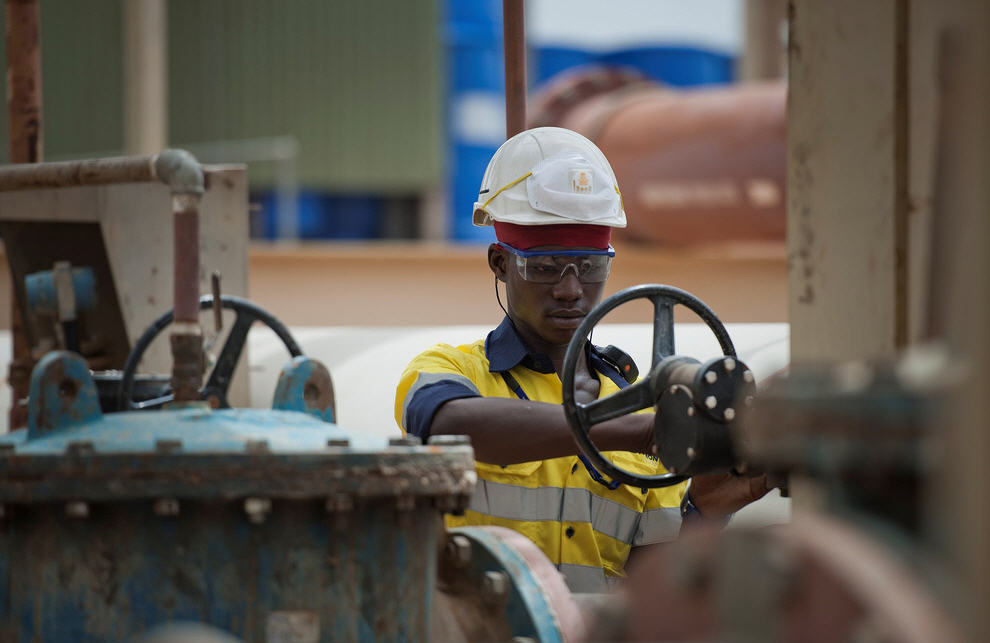
Image courtesy of Newmont Mining

Ghana’s main mining industry body said on Monday that proposed changes to how the country manages tax and royalty terms risk deterring investment and slowing output.

Reuters reported last week that Africa’s top gold producer plans to scrap long-term mining investment stability agreements and double royalties under sweeping reforms.

The changes, which the country’s mining regulator said were intended to boost state revenue and crack down on firms abusing the terms of their licenses, mean that stability agreements with Newmont, AngloGold Ashanti and Gold Fields will not be renewed.

A draft bill expected to go to parliament by March proposes royalties starting at 9% and rising to 12% if gold hits $4,500 per ounce or higher, roughly double the current 3%–5% range.

Fears of stalled projects, lost jobs

The Chamber of Mines, which represents big mining companies, said in its statement on Monday that it backed the principle of a sliding‑scale royalty system that would allow the state to earn more at higher gold prices. But it warned that the current proposal would push Ghana further up the global effective tax curve, potentially stalling projects and costing jobs.

“We understand the rationale behind a sliding scale, but the structure must strike a sweet spot where government secures sustainable revenues while the industry continues to expand and reinvest,” chief executive Kenneth Ashigbey said.

“The current proposal does not strike that balance.”

The chamber didn’t offer a counterproposal.

Ghana’s mining regulator, known as the Minerals Commission, and the Lands and Natural Resources Ministry did not immediately respond to requests for comment.

Ghana’s large‑scale miners already pay a 3% growth and sustainability levy on top of the 3-5% flat royalty rate, both levied on gross revenue rather than profit, along with a 35% corporate income tax, 8% dividend tax and the state’s 10% free carried interest, the chamber said.

Stability and development agreements should be reviewed and improved but not cancelled outright, it said.

The chamber said it welcomed ongoing consultations with Ghana’s lands and natural resources minister and said a competitive and predictable fiscal regime was essential for sustaining investment.

(By Maxwell Akalaare Adombila; Editing by Robbie Corey-Boulet and Susan Fenton)


Ghana’s Takoradi Port Receives Largest Bulker as Manganese Exports Surge

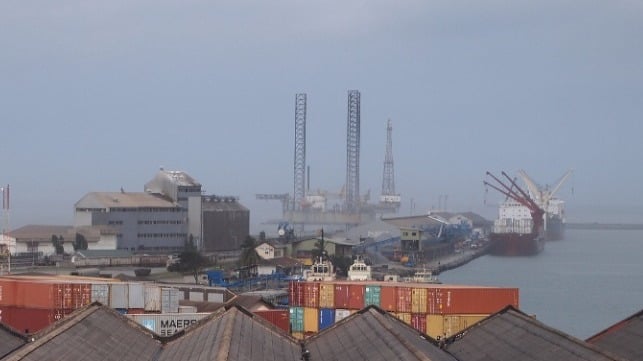
Takoradi Harbor (Banku / CC BY SA 3.0)

Published Jan 18, 2026 11:45 PM by The Maritime Executive


The dry bulk shipping market in West Africa continues to see massive transformation, as China’s appetite for minerals from the region surge. In the last few years, capsize and above loadings in West Africa have maintained a double-digit growth. In a market report last year, the investment bank Jefferies estimated that West Africa now represents 14 percent of Capesize liftings compared to six percent four years ago.

This momentum is likely to be sustained in 2026, buoyed by uptick of exports from the Guinea’s Simandou iron ore project. The first shipment of nearly 200,000 metric tons of iron ore from Simandou arrived in Majishan port in East China on Saturday. A second shipment left Guinea in late December, which is part of the planned 120 million tons’ yearly production in Simandou.

Again, Ghana has signaled increase for its manganese exports to China this year. The move will see the country for the first time in history receive an ultra-capsize bulk carrier. Last week, Ghana Manganese Company (GMC) said that the 300,000 DWT bulk carrier MV CBS Years is set to arrive at the Port of Takoradi on January 27.

The deployment of the vessel to Takoradi also involves other partners including Cosco Shipping Lines and the Ghana Ports and Harbors Authority (GPHA). A welcome ceremony will be held next week commemorating berthing of the largest bulk carrier in West African waters. In preparation for the arrival, some members of GPHA’s marine operations team, including marine pilots, have been sent to China for advanced simulation in berthing capsize vessels.

“MV CBS Years’ call at Takoradi marks a significant business turning point for the GMC, in line with the company’s 10 million tons export target in 2026,” said Kofi Gyetsua Ankuma, GMC Administrative Superintendent. Ghana has almost doubled its manganese export target, with production in 2024 hitting five million tons. This has seen the country retain its third position as Africa’s largest manganese producer after Gabon and South Africa.

GMC has also partnered with China’s Tianyuan Manganese Industry (TMI) to build Ghana’s first national manganese refinery. The project is budgeted to cost $450 million, although it has been facing delays since 2024.

London Gateway Posts Strong Growth and Is Poised to Be UK’s Largest Port

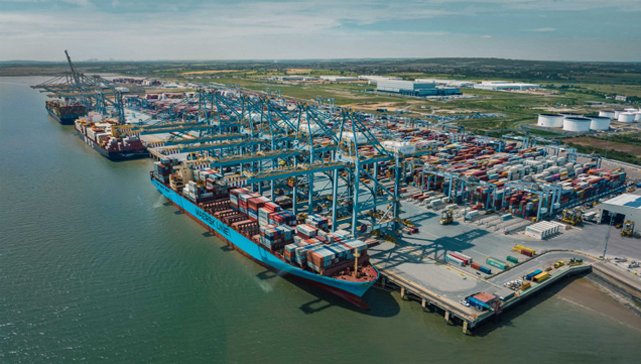
London UK Gateway container terminal
DP World's London Gateway topped 3 million TEU and is poised to claim the top spot in the UK (DP World)

Published Jan 19, 2026 5:52 PM by The Maritime Executive


DP World’s London Gateway Port, located on the Thames, reported strong growth in 2025 as it continues to expand its operations. The Times (London) asserts that the terminal, which has been in operation for a little more than a decade, is on track to claim the top spot in the UK, and become the largest UK container port.

Today’s announcement of year-end data highlights that London Gateway port achieved a more than 52 percent growth in its container throughput in 2025, reaching more than 3 million TEU. The Times points out that Hutchison’s Felixstowe container port does not release data, but it speculates the port has slipped from its public assertion of more than 4 million TEU annual down to around the 3.6 million TEU the port was believed to have handled in 2024.

The achievement is especially notable as London Gateway only started operations in November 2013. It was an effort launched by the former P&O Group to revive the Port of London, which had been in a long decline with the death of breakbulk cargo, replaced by containers. Felixstowe had opened its first container terminal in 1967-1968 and saw rapid growth through the 1970s to the 1990s. Its last major expansion opened a decade ago in 2015.

Driving in part London Gateway’s rapid growth was the addition of a fourth berth. The port was also successful in wooing the newly launched Gemini Cooperation between Maersk and Hapag-Lloyd to base UK operations in London instead of Felixstowe. The port also opened its second rail terminal in 2025.

DP World highlights that construction is underway on two all-electric berths for London Gateway as part of a further £1 billion investment. In addition to expanding to six berths, DP World highlights that it will be spending a further £170 million over the next two years for the construction of a new BOXBAY container handling system. They call it an intelligent High Bay Storage (HBS) system that increases efficiency by eliminating the need to reshuffle boxes while also increasing capacity.

The company highlights that its total UK operations topped 5 million TEU in 2025 when factoring in the more than 2 million TEU throughput handled at Southampton. It points out that it now has more than half the total UK market, which is estimated at just over 9 million TEU.

The Times highlights that London Gateway is likely “stealing” market share from Felixstowe as it shifts the center of the container import-export trade to London. The paper also reports that the UK’s giant grocery and general merchandiser TESCO is set to become one of the biggest tenants at London Gateway.

The company also highlights the strength of the transshipment operations. With the addition of the Gemini vessels, London has become a gateway for vessels arriving from Asia. 

While DP World’s focus remains on the strong growth at London Gateway, the company highlights that it is also making large investments in DP World Southampton. As part of a £60 million investment, the operation in Southampton is scheduled to receive the first of its new quay cranes later this year. DP World says it will form the tallest quay crane fleet in Europe as it moves to futureproof the operations at Southampton.


AD Ports Buys Spanish Shipyard Astilleros Balenciaga

Spanish shipyard
AD Ports is expanding tis shipbuilding capabilities acquiring a Spanish shipyard specializing in the offshore energy sector (Astilleros Balenciaga Shipyard)

Published Jan 20, 2026 8:38 PM by The Maritime Executive


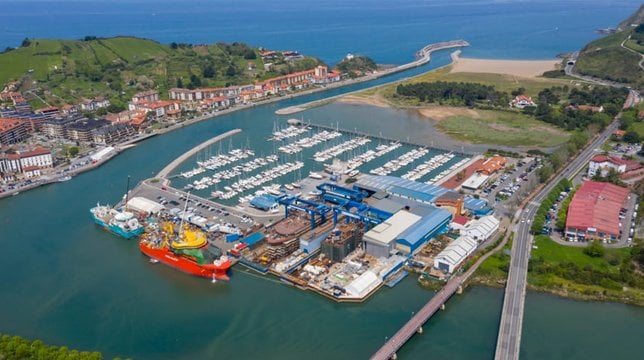
The Abu Dhabi-based AD Ports acquired a Spanish shipyard as part of its effort to expand in the Mediterranean and serve the offshore operations sector. The reports indicate that it paid €11.2 million ($13.1 million) for 100 percent ownership of Astilleros Balenciaga, based on the northern coast of Spain near Bilbao.

The shipyard, which traces its origins to 1921, will now be known as Balenciaga Shipyard. AD Ports acquired the yard for its Safeen Drydocks subsidiary, which is part of its Noatum Maritime group. The yard has both shipbuilding and repair facilities.

For AD Ports, the acquisition is an opportunity to further expand its presence in the offshore services sector and specifically offshore wind. The company recently announced a partnership with Masdar, the state-owned renewable energy company that is investing in the European offshore wind sector. Safeen will develop and deliver offshore wind projects for the partnership with Masdar.

Safeen Drydocks was launched in June 2023 as a joint venture 51 percent owned by AD Ports and working with Premier Marine Engineering Services, which was developing a shipyard at the Khalifa Port. It is a 45,000 square meter facility with a 350-meter (1,150-foot) berth for vessel repairs. The yard also has a floating dry dock.

The Balenciaga Shipyard has two dry docks, a 105-meter slipway, and a fabrication factory, as well as a cutting plant. The company recently invested in an expansion of its facilities.

The Spanish shipyard works with tug boats, offshore support vessels, fishing vessels, cargo vessels, and product carriers. Safeen highlights its capabilities in structural prefabrication of large modules for offshore projects, which it looks to leverage to further develop its presence in the offshore market. The shipyard is one of the few yards in Spain specializing in the construction of Service Operation Vessels (SOVs) as well as research vessels, offshore support vessels, and specialized tugs.

AD Ports Group highlights that it will further consolidate its operations in Spain and the Mediterranean region. 


Sanctioned Russian Military Cargo Ship Shows Up in Libya

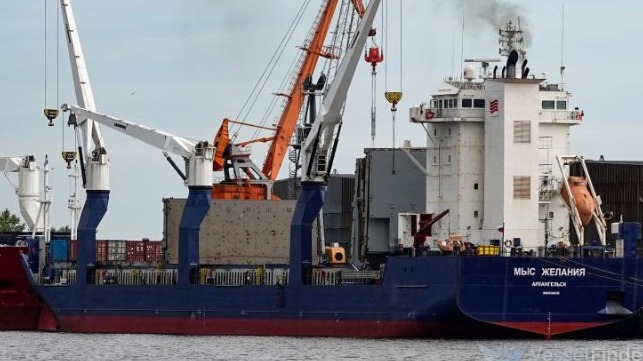
Mys Zhelaniya at Archangelsk, 2024 (VesselFinder)

Published Jan 20, 2026 7:49 PM by The Maritime Executive


A sanctioned Russian military cargo vessel has appeared in Libya after a closely-watched voyage through the Baltic and the English Channel. The Mys Zhelaniya, a 17,000 dwt geared freighter, has been spotted by satellite alongside at Tobruk, a port controlled by the militia forces of Libyan-American warlord Khalifa Haftar. 

Mys Zhelaniya started her voyage at the port of Baltiysk in the Russian exclave of Kaliningrad. Baltiysk is an important naval base for the Russian Baltic Fleet, and its port activity is dominated by military operations. She departed in convoy with a notorious sanctioned Russian vessel, the Sparta IV, escorted by the Udaloy-class destroyer Severomorsk - a high-end warship, potentially signifying a high-end cargo shipment. 

The Mys Zhelaniya called at Tobruk, while Sparta IV continued onwards to Syria - a familiar run for the "Syria Express," the sustainment service that provided arms and supplies for Russia's now-defunct naval presence at Tartus. Both ships broadcast their positions via AIS throughout most of the voyage, with only limited attempts to obfuscate their movements: they initially broadcast their destination as Port Said, but were generally assumed to be headed to Syria. 

Mys Zhelaniya is sanctioned by the U.S. Treasury for her relationship with Transstroy LLC, a Russian shipping company connected to sanctioned energy projects on Russia's Arctic coastline. 

Russia supported Haftar's militia in its fight for control of Libya, and remains on friendly terms. The militia's control of Tobruk, and the occasional port calls of Russian military vessels at the port, have inspired speculation that the harbor might become a replacement base for the Russian Navy in the Mediterranean. In the interim, it is believed to be a transfer point for military cargoes destined for Russia's Africa Corps - a nationalized successor to the Wagner Group's mercenary operation in Africa, which has been rebranded and absorbed into the Russian military hierarchy. The Africa Corps has operated in support of Haftar's ambitions in southern Libya since 2024, according to Bloomsbury Intelligence. 

Russia operates out of a string of Libyan bases in the region and has reactivated disused facilities to further its reach, notably the abandoned Matan al-Sarra base - a remote, forsaken outpost near the border with Chad. Its runways are visibly cracked by the sun and half its buildings buried in the desert sand, but clear signs of life have sprung up in a nearby support camp. These far-reaching operations are supported by cargo shipments through Tartus, analysts say. 

Top image: Mys Zhelaniya at Archangelsk, 2024 (VesselFinder)