It’s possible that I shall make an ass of myself. But in that case one can always get out of it with a little dialectic. I have, of course, so worded my proposition as to be right either way (K.Marx, Letter to F.Engels on the Indian Mutiny)
Bruce C project 'would boost GDP by CAD238 billion'
The proposed 4,800 MW Bruce C new nuclear project would contribute CAD238 billion (USD172 billion) over its lifetime to Canada's economy, according to a new study.
The Bruce site (Image: Bruce Power)
The figures come in the summary of findings of the Bruce C Economic Impact Assessment study by the Ontario Chamber of Commerce for Bruce Power and the Nuclear Innovation Institute.
It says that during the proposed plant's 80-year lifespan, it would contribute more than CAD217 billion to the province of Ontario's gross domestic product. During site preparation and construction it would create or support 18,900 jobs nationally, of which 15,900 would be in Ontario. During operations those figures are put at 6,700 jobs nationally and 5,900 in Ontario.
Stephen Lecce, Ontario Minister of Energy and Mines, said: "Ontario's nuclear advantage is powering our future and showcasing the very best of Canadian technology, resources, and workers … it is clear that Bruce Power C is essential to Ontario’s energy and economic future, as we build on-time and on-budget."
James Scongack, Bruce Power's Chief Operating Officer and Executive Vice-President, said: "The Ontario Chamber of Commerce independent economic impact analysis confirms what our communities already know - Bruce C has the potential to be a once‑in‑a‑generation economic engine."
Luke Charbonneau, Bruce County Warden and Mayor of the Town of Saugeen Shores, said: "The economic benefits, training opportunities, and long-term jobs will make life better for families and businesses throughout our region for decades."
Background
The Bruce site, 18 kilometres north of the town of Kincardine in Bruce County, is home to eight operating Candu units: units 1-4 are known together as Bruce A and units 5-8 as Bruce B. The new project would be sited within the existing 932-hectare site, with new intake and discharge structures in Lake Huron. Alternative cooling strategies will be evaluated as part of the impact assessment process.
Bruce Power formally notified Canadian regulators of its intention to launch an Impact Assessment process for up to 4,800 MWe of new capacity at the Bruce site in October 2023. The federal government announced CAD50 million of funding in February 2024 to support pre-development feasibility work. In August 2025 the Impact Assessment Agency of Canada, in collaboration with the Canadian Nuclear Safety Commission, issued the formal Notice of Commencement of Impact Assessment under the country’s Impact Assessment Act.
With nuclear currently responsible for 50% of Ontario's total generation and hydro contributing 24%, Ontario already has one of the cleanest grids in the world and the Energy for Generations plan published in June 2025 sees nuclear power - including required new capacity - "continuing to serve as the backbone of the province's electricity system providing the 24/7 baseload power the province's economy requires" as demand continues to rise.
Government funding for Saskatchewan SMR test facility
Western Canada's first Small Modular Reactor Safety, Licensing, and Testing Centre at the University of Regina is to receive nearly CAD6 million (USD4.3 million) in funding from the federal and provincial governments.
The funding was announced on 19 January - speaking is SaskPower CEO Rupen Pandya (Image: SaskPower)
The facility - the SMR-SLT - will be located at the Innovation Saskatchewan Research and Technology Park. It will house two test loops that simulate a part of a small modular reactor (SMR), modelling water-cooled systems using electrical heat, allowing researchers to test components under conditions similar to those in operating reactors.
The funding was announced by Buckley Belanger, Canada's Secretary of State (Rural Development), on behalf of Minister of Emergency Management and Community Resilience and Minister responsible for Prairies Economic Development Canada Eleanor Olszewski. The federal government is investing CAD1.96 million (USD1.4 million) in the SMR-SLT through Olszewski's department, PrairiesCan - a federal government department supporting business growth, innovation and community economic development across Alberta, Saskatchewan and Manitoba.
Provincial government support for the project is through SaskPower, the principal supplier of electricity in Saskatchewan, and a Crown Corporation - a commercial entity owned by the Government of Saskatchewan. It will be investing CAD4 million in the SMR-LT.
"Small modular nuclear reactors represent a fantastic opportunity for clean, low-emitting power, for good jobs, and for long-term economic growth right across the nuclear supply chain and across Saskatchewan," Belanger said. "Our province is already home to some of the largest uranium reserves on the planet, and Saskatchewan has huge potential to establish itself as a leader in Canadian nuclear power - but none of that happens unless we get the first step right. Making sure nuclear development can happen safely, responsibly, and under strong regulation is essential, and that's exactly what this investment in the University of Regina's SMR Safety, Licensing and Testing centre is all about."
"The Testing Centre will help to further establish Saskatchewan as a hub for nuclear excellence, advancing nuclear research, and supporting a local nuclear workforce and supply chain," said Jeremy Harrison, Minister Responsible for SaskPower. "Nuclear power is central to our Government's energy security strategy, which is why we are making the necessary investments to support industry readiness in the province."
Innovation Saskatchewan is contributing CAD1 million plus an in-kind contribution of the leased space at the Innovation Saskatchewan R+T Park for the first three years of operation. Canadian Nuclear Laboratories (CNL) will also provide in-kind design support. The centre will be led by University of Regina researchers, with the Global Institute for Energy, Minerals and Society (GIEMS) partnership between the University of Regina, University of Saskatchewan, and Saskatchewan Polytechnic playing a key role to ensure all three institutions have access to the test loops for training and research, SaskPower said.
The government of Saskatchewan signalled its commitment to incorporating nuclear capacity into its provincial electricity system in a long-term policy document released last year. SaskPower has previously selected GE Hitachi Nuclear Energy's BWRX-300 SMR for potential deployment in the province in the mid-2030s and has identified two potential sites for SMR deployment, both in the Estevan area in the south-east of the province.
According to PrairiesCan, the new test centre project will create 18 direct jobs, support 10 small businesses, and train a highly skilled workforce, while advancing Saskatchewan's preparation for the estimated 2,500 to 3,500 jobs required to build and operate nuclear power plants by the mid-2030s.
Arthur Situm, Canada Research Chair in SMR Safety and Licensing at the University of Regina, said the facility will help train the next generation of nuclear professionals by providing hands-on experience with safety systems and processes that define modern nuclear technology.
"Together, this work positions the University of Regina and Saskatchewan as a leader in safe, responsible, small modular reactor research with a global impact," he said on YouTube.
Tepco restarts Kashiwazaki-Kariwa reactor
Japan's Tokyo Electric Power Company announced it has begun the process of restarting unit 6 at its Kashiwazaki-Kariwa nuclear power plant, which has been offline for almost 14 years.
The Kashiwazaki-Kariwa plant (Image: Tepco)
"Today, we received approval from the Nuclear Regulation Authority (NRA) to begin test operation of the reactor to confirm the integrity of the equipment, including a pre-operational operator inspection to be conducted after reactor startup," the company said. "After submitting a pre-operational inspection change application on 24 December 2025, we proceeded with preparations for reactor startup, and at 19:02 [local time] today, we withdrew the control rods and started up the reactor."
Tokyo Electric Power Company (Tepco) had planned to restart Kashiwazaki-Kariwa 6 on Tuesday, but on Monday announced that it had postponed the restart due to an issue with a safety alarm, which has since been rectified.
The seven-unit Kashiwazaki-Kariwa plant was unaffected by the March 2011 earthquake and tsunami which damaged Tepco's Fukushima Daiichi plant, although the plant's reactors were previously all offline for up to three years following the 2007 Niigata-Chuetsu earthquake, which caused damage to the site but did not damage the reactors themselves. While the units were offline, work was carried out to improve the plant's earthquake resistance. All units have remained offline since the Fukushima Daiichi accident.
Although it has worked on the other units at the Kashiwazaki-Kariwa site, Tepco is concentrating its resources on units 6 and 7 while it deals with the clean-up at Fukushima Daiichi. These 1356 MWe Advanced Boiling Water Reactors began commercial operation in 1996 and 1997, respectively, and were the first Japanese boiling water reactors to be put forward for restart. Tepco received permission from the Nuclear Regulation Authority to restart units 6 and 7 in December 2017. Restarting those two Kashiwazaki-Kariwa units - which have been offline for periodic inspections since March 2012 and August 2011, respectively - would increase the company's earnings by an estimated JPY100 billion (USD633 million) per year.
The governor of Japan's Niigata Prefecture, Hideyo Hanazumi, gave his approval for the restart of Kashiwazaki-Kariwa units 6 and 7 in November last year, with the Prefectural Assembly backing his decision in December.
Tepco is prioritising restarting Kashiwazaki-Kariwa unit 6, where fuel loading was completed in June last year. The company has until September 2029 to implement anti-terrorism safety measures at unit 6. Kashiwazaki-Kariwa 6 would become the first reactor owned by Tepco to restart following the Fukushima Daiichi accident.
"We will continue to confirm the integrity of the plant equipment while actually using steam, and will respond diligently to the NRA's inspection," Tepco said. "As this is the first operation in approximately 14 years, we will carefully proceed with each step of the plant equipment integrity check. We will take appropriate action if we notice any issues and will provide thorough information on the status of each startup process."
International safety assessments of Finnish, French SMRs
Nuclear safety authorities from the Czech Republic, Finland, Poland, Sweden, and Ukraine are conducting a Joint Early Review to assess the safety of Steady Energy's LDR-50 reactor for district heating. Meanwhile, the third phase of a review of safety options for France's Nuward SMR has been started by eight European nuclear regulators.
A multiple LDR-50 unit plant (Image: Steady Energy)
The Finnish Radiation and Nuclear Safety Authority (STUK) conducted a preliminary safety assessment of the LDR-50 last year. In June, STUK said the draft concept assessment for Steady Energy's LDR-50 found that "nuclear and radiation safety, security arrangements, emergency arrangements and nuclear material safeguards solutions are such that they can be designed to meet safety requirements". Concept assessment is a procedure proposed in the new Nuclear Energy Act in which STUK assesses whether the power plant could meet safety requirements in general terms. It is separate to the construction permit process for the nuclear power plant. STUK said it used the draft concept as a basis for its assessment.
STUK is now coordinating an international safety assessment of the LDR-50, together with the Czech State Office for Nuclear Safety (SÚJB), Poland's National Atomic Energy Agency (PAA), the Swedish Radiation Safety Authority (SSM), and the State Nuclear Regulatory Inspectorate of Ukraine (SNRIU). Participating authorities will base their examination of the LDR-50 plant based on STUK's earlier work while conducting their own evaluations based on their national regulations.
As part of the review, experts will conduct a preliminary assessment of the key design assumptions of the LDR-50 reactor, such as the adopted design basis and safety objectives, the method of ensuring safety functions, the approach to defence-in-depth, and protection against internal and external threats. Solutions relevant to operation and emergency preparedness will also be verified.
Poland's PAA said a key element of the initiative was to examine the extent to which an assessment conducted by a nuclear regulator in one country can provide valuable support for safety assessments conducted by regulators in other countries, while maintaining the full autonomy of national regulatory competences. "These activities are part of broader international efforts to harmonise and standardise the regulatory approach to new nuclear technologies," it noted.
The Joint Early Review (JER) process began in October last year and is scheduled to run until May 2026. The first technical meeting under this project took place in December. The aim of the review is not to form a joint regulatory position - national findings will be compiled into a summary report, which will be delivered to Steady Energy.
"Early examination of the LDR‑50's safety solutions offers insight into how the design aligns with different national regulatory environments and helps Steady Energy and national regulators gain valuable experience in applying international expertise to national processes," Steady Energy said. "For Steady Energy, the project offers a chance to engage in structured dialogue with multiple nuclear authorities at once. Each participating country is highly relevant from both regulatory and market perspectives, making early feedback especially valuable. Every pre‑licensing step advances the path toward formal licensing process and strengthens overall project readiness in each country."
Steady Energy was spun out of Finland's VTT Technical Research Centre in 2023. The LDR-50 SMR, with a thermal output of 50 MW, is designed to operate at around 150°C. Unlike most SMRs being developed around the world, it is not designed to generate electricity - or electricity and heat. Instead, it is designed to only produce heat and is focused on district heating, as well as industrial steam production and desalination projects.
The company has already signed agreements for 15 reactors in Finland, with its reactor design currently being assessed by STUK. The aim is for construction of the first plant - to be the clean energy source for a district heating scheme - to begin in 2029.
"The Joint Early Review process allows Steady Energy to be better prepared for the formal licensing process in each of these countries once we get projects ongoing," said Juho Vierimaa, Steady Energy's Head of Licensing.
Nuward review progresses
France's Autorité de Sûreté Nucléaire et de Radioprotection (ASNR) has announced the launch of the third phase of the joint review of safety options for the Nuward reactor.
A rendering of a Nuward SMR plant (Image: Nuward)
In June 2022, EDF announced that the Nuward design would be the case study for a European early joint regulatory review led by the ASNR with the participation of Finland's STUK and the Czech Republic's SÚJB. The six areas covered during the year-long joint early review were: the general safety objectives; the list of design basis conditions and design extension conditions; the use of passive cooling systems; the development plan for computer codes; the integration of two reactor units in a single facility; and the Probabilistic Safety Assessment approach. The three regulators published their report on the first phase of the review in September 2023.
A second phase of the review was joined by Poland's PAA, Sweden's SSM and the Netherlands' Authority for Nuclear Safety and Radiation Protection (ANVS). This second phase built upon the successes of the pilot phase - particularly the work of reviewing a specific project and establishing a direct dialogue with the designer - while evolving to address new challenges, notably broader participation. During the second phase, the scope of the assessment was extended to new technical topics, including: management of extended design conditions; assessment of containment and radiological effects; architecture of electrical systems and measurement, control and management systems; and criticality risk management. The final report of the second phase was published in December last year.
The third phase has now been launched. In addition to the participation of the Dutch (ANVS), Polish (PAA), Swedish (SSM), Finnish (STUK), and Czech (SUJB) authorities, the initiative now includes Belgium's Federal Agency for Nuclear Control (FANC) and Italy's National Inspectorate for Nuclear Safety and Radiation Protection (ISIN). The evaluation of regulators during this third phase will focus on new themes: the approach to preventing the failure of main components, the approach to classifying the safety of equipment and the approach taken to take into account scenarios of loss of external power supply.
The conclusions of this review, expected by the end of 2026, will inform the ASNR's deliberations on the harmonisation of safety requirements and authorization processes for new reactors.
The Nuward project - launched in September 2019 by the French Alternative Energies and Atomic Energy Commission, EDF, Naval Group and TechnicAtome - is for a pressurised water reactor with a thermal power of 1,150 MW, which can be converted into up to 400 MWe and 115 MWt.
In September last year, a pre-licensing assessment of the EAGLES-300 lead-cooled small modular reactor was launched by the Belgian, Italian and Romanian nuclear regulators. Four European nuclear technology organisations launched the Eagles Consortium in June 2025 to develop and commercialise the EAGLES-300 SMR with the aim of delivering a first demonstration by 2035.
Cooling system tests at RA-10 multipurpose reactor
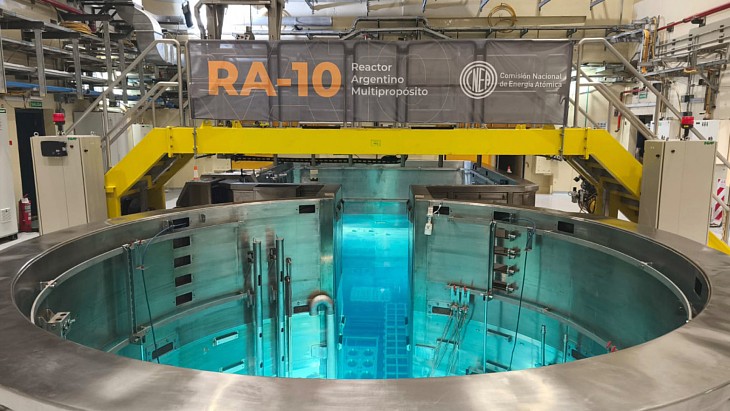
The commissioning of the first pump in the primary cooling circuit of the RA-10 multipurpose reactor has taken place as part of preparations for cold testing.
(Image: CNEA)
Argentina's National Atomic Energy Commission (CNEA) said the commissioning "allowed, for the first time, the observation of coolant circulation through the reactor's primary circuit. This milestone enables the comprehensive verification of the system's hydraulic performance and its compliance with design and safety parameters, an essential condition for proceeding with reactor commissioning".
Tests are to continue over the next two months to complete the functional validation of the reactor's primary cooling system.
Dummy fuel elements, supplied by the Fuel Element Manufacturing Plant for Research Reactors (ECRI), have allowed the configuration of the RA-10 core.
CNEA said: "This configuration allows for the necessary cold tests to be carried out to verify the performance of the cooling circuit under conditions representative of the operating configuration."
The RA-10 multipurpose reactor is a 30 MWt open pool type reactor. The project was approved by the government and officially started by CNEA in June 2010. Argentina's Nuclear Regulatory Authority granted a construction licence for RA-10 in November 2014. The civil works for the reactor began in 2016. Nuclear technology firm Invap is involved in the design and construction of the reactor facility and related installations, playing the role of main contractor.
The assembly of the RA-10 pool - which will house the core of the reactor - was completed in August 2018. The RA-10 will replace the RA-3 reactor on the same site, a 10 MWt pool-type reactor which began operations in 1967. The RA-10 will also have associated facilities such as the Argentine Neutron Beam Laboratory and the Laboratory for the Study of Irradiated Materials.
Argentina says the facility will guarantee self-sufficiency in radioisotopes for medical use and allow for exports to cover up to 20% of global demand. It will also enable the production of doped silicon for industrial applications as well as facilitating new research in a range of areas and training.
KHNP takes stake in TerraPower
South Korea's SK Innovation has transferred part of its stake in US small modular reactor developer TerraPower to Korea Hydro & Nuclear Power.
(Image: SK Innovation)
In May 2022, SK Group signed a memorandum of understanding with TerraPower to jointly develop "next-generational technologies" needed for small modular reactors (SMRs). In the August of that year, SK Inc and SK Innovation - both affiliates of SK Group, Korea's second-largest conglomerate - announced they had invested USD250 million in TerraPower, becoming the company's second-largest shareholder. SK Inc is a holding company of SK Group with specialisation in investment activities. Its strategic investment areas include advanced materials, biopharmaceutical, green energy and digital technologies. SK Innovation is an SK Group intermediate holding company in energy, petrochemical, lubricants, exploration and production, e-mobility battery, information and electronic materials businesses along with eight major subsidiaries.
TerraPower announced in April 2023 that it had signed a collaboration agreement with SK and Korea Hydro & Nuclear Power (KHNP) supporting the demonstration and commercialisation of its Natrium reactor and integrated energy system.
SK Innovation has now announced that it has transferred part of its stake in TerraPower to KHNP, "strengthening the three-way partnership to advance the global SMR market". It added: "This marks the first time a Korean public energy enterprise has directly invested in a world-leading SMR developer."
"SK Innovation aims to combine its global competitiveness in energy and materials with KHNP's world-class expertise in nuclear power plant construction and operation," the company said. "Together, they plan to establish SMR ecosystems for data centres and other industrial sites in Korea and overseas, and deliver customised integrated energy solutions to address the power supply challenges of the AI era."
KHNP and TerraPower successfully completed the US Committee on Foreign Investment review process in December 2025, "establishing a regulatory foundation for its entry into the global SMR market".
"KHNP joins TerraPower's current investors in supporting the first Natrium plant being built in Wyoming, along with the company's plans to rapidly deploy additional units in the US and abroad," TerraPower said. "This investment will accelerate ongoing efforts to explore both South Korean and other opportunities."
TerraPower's Natrium technology features a 345 MWe sodium-cooled fast reactor with a molten salt-based energy storage system. The storage technology can temporarily boost the system's output to 500 MWe when needed, enabling the plant to follow daily electric load changes and integrate seamlessly with fluctuating renewable resources. TerraPower began non-nuclear construction for its first Natrium plant, in Kemmerer, Wyoming, in June 2024, and expects construction of the plant - which it says will be the first commercial-scale, advanced nuclear project in the USA - to be complete in 2030. The first Natrium project is being developed through the US Department of Energy's Advanced Reactor Demonstration Program. The Natrium reactor is a TerraPower and GE Vernova Hitachi Nuclear Energy technology.
"We have strong relationships with multiple Korean entities across the nuclear energy supply chain, and today's announcement is one more step to realising the Natrium technology's promise to deliver next generation nuclear power not just in the United States, but around the world," said TerraPower President and CEO Chris Levesque. "TerraPower, SK and KHNP have been advancing our strategic collaboration for years, and I'm proud to add KHNP to our committed investor base."
Park In-sik, Executive Vice President and Head of the Export Business Division at KHNP, added: "This investment is a major milestone for KHNP in supporting the global deployment of next-generation nuclear energy. By combining our 50 years of experience in nuclear plant construction and operation with SK Innovation's competitiveness in energy and TerraPower's technology, we will play a leading role in expanding the advanced nuclear market. The three companies plan to sign definitive commercialisation agreements this year to establish a foundation for global projects."
"KHNP's investment in TerraPower solidifies our three-way collaboration in the global advanced nuclear business," said Moohwan Kim, Executive Vice President and Head of Energy Solution Business Division at SK Innovation. "SK Innovation will work closely with KHNP to support the Wyoming project, pursue new nuclear opportunities, and achieve innovative outcomes including localisation of key materials and components."
LR Launches Cross-Sector Nuclear Propulsion Consortium
Participants include Rolls-Royce's Advanced Modular Reactors division, which has designed a high temperature gas reactor like the illustration above (US DOE file image)
As the world looks for alternatives to bunker fuel, nuclear propulsion, by contrast, offers some attractive features. Regular bunkering is not required, so there is no need to build up a global fuel network. The basic concept of a shipboard reactor is established, and there is a community of engineers who understand the requirements. And the price of modern modular reactors - when looking at total cost of ownership - could be competitive. The latest serious entrant into the nuclear-power arena is Lloyd's Register: the world's first class society has convened a working group of professionals from the engineering, regulatory and insurance fields to piece together all of the requirements for a merchant-vessel reactor program.
The partners in the program include Rolls-Royce's Advanced Modular Reactors division, which has designed a gas-cooled particle fuel reactor in an appropriate power range for many merchant shipping applications. Rolls-Royce is one of a handful of companies with experience in building and servicing naval reactors, and it has powered Britain's nuclear submarine fleet since the Cold War.
Other participants include UK defense conglomerate Babcock, which has experience in shipbuilding and nuclear submarine design; Global Nuclear Security Partners, a specialized consultancy focused on nuclear threat reduction; law firm Stephenson Harwood, which has an established nuclear project legal team; and insurer NorthStandard, one of the largest P&I clubs.
The objective is to move quickly into the market with a British solution for nuclear propulsion. There are early efforts under way elsewhere, and LR sees opportunity in being a first mover. The nation that develops a nuclear-propulsion industrial ecosystem will benefit for the long term, LR suggests.
"Decarbonization demands cleaner power, higher standards and a duty to the generations that follow. Nuclear is ready to meet that test," said Nick Brown, CEO of Lloyd’s Register. "Used safely in naval fleets for decades, the next generation of advanced modular reactors brings tougher safeguards and the chance to bring nuclear power into everyday commercial shipping."
Next steps include pursuing UK regulatory approval for a site-licensed advanced modular reactor, a stepping stone known as a Statement of Design Acceptability. The consortium will also develop a class framework combining the requirements for nuclear and maritime regulation, and will define the security requirements needed for the reactor.
“With the right people applying the right standards and joined up regulation, maritime nuclear power can become a transformative force – advancing decarbonization, supporting commercial viability, and guiding the shipping industry towards net-zero emissions," said NorthStandard head of external affairs Mike Salthouse.
After a Record 2025, LNG Enters a Year of Political Risk
Geopolitics is colliding with LNG markets early in 2026, as the EU freezes a major U.S. trade deal—including energy purchases—after Trump threatens tariffs linked to the Greenland dispute.
Europe remains the largest buyer of U.S. LNG, taking over half of American exports in 2025, but weak industrial demand and political tensions could cap further growth.
Asia is set to absorb any surplus LNG, with new global supply likely pushing prices lower and reviving demand in China.
After a record year for liquefied gas trade in 2025, most forecasts for the new year were upbeat, save for a worry about a possible glut. Two weeks into 2026, however, and one of the biggest markets for liquefied gas is in a geopolitical dispute with its biggest supplier and has put a major energy trade deal on hold. This year is early on turning out to be an anything-can-happen one.
The European Union this week put its trade deal with the Trump administration on hold, stopping short of triggering what it calls the “bazooka” of a mechanism that would wreak havoc on U.S.-European trade relations. The move followed Trump’s declaration of 10% tariffs for eight countries that, according to the U.S. president, are trying to stop him from purchasing Greenland.
The countries in question sent military personnel to Greenland last week to demonstrate that European powers can take care of the island’s security. The tariffs will go up to 25% later in the year if Denmark, Norway, Sweden, France, Germany, the United Kingdom, the Netherlands, and Finland don’t give up and let the United States take over Greenland.
In further escalation and in response to the tariff announcement, Brussels said it would put the massive trade deal that Commission President Ursula von der Leyen closed with President Trump last year on hold. That is the same trade deal that features a commitment on the European Union’s part to purchase $750 billion worth of U.S. energy commodities over three years. It was never going to happen because the EU simply cannot absorb the amount of oil and LNG the sum entails. But it did step up its U.S. LNG buying in 2025—so much, in fact, that it drove the record in global LNG sales with a 25% annual increase in its total LNG imports.
Europe is the biggest market for American liquefied natural gas right now. Well over 50% of all U.S. LNG exports go to the old continent, even as LNG imports from Russia—soon to be banned—also hit a record in 2025. The annual increase in U.S. LNG imports by European countries last year hit a massive 60%, according to Kpler data cited by Reuters’ Gavin Maguire last week.
This should fit in with the bullish forecast context for the industry, but some analysts note that European industrial activity remains weak, as does economic growth—and these are the two driving forces of LNG demand. In other words, European LNG demand could disappoint those with great expectations. And that was before the Greenland affair even began.
Asia, meanwhile, remains the robust LNG market it has been for years, with all the largest LNG importers there rather than in Europe. Last year, 64% of all the world’s LNG for export went to Asian buyers, again according to Kpler data. However, the Asian portion of global LNG exports in 2025 represented an annual decline, to the tune of 5%, Reuters’ Maguire reported. In China, the decline was especially marked, at 15%. That was the result of a combination of factors, including higher domestic natural gas production and higher pipeline imports, notably from Russia.
Kpler earlier this month reported that this year could see LNG capacity additions of 37 million tons annually. That would come on top of new capacity additions totaling 51 million tons commissioned last year. This, according to the analytics firm, would pressure prices, and that would in turn whet buyers’ appetite in Asia, notably in China. These potentially lower prices would see Chinese LNG import demand to rise to 73 million tons this year, Kpler said. This would be up from 68.43 million tons in 2025.
Europe, meanwhile, imported well over 100 million tons of liquefied natural gas last year. For this year, Kpler had forecast a further strong boost to shipments, for a total of some 145 million tons in full-2026 imports. Yet the geopolitical situation could make this difficult to achieve, although it would be harder for the EU to use LNG as a weapon against the United States than vice versa. A souring of bilateral relations across the Atlantic would drive LNG prices lower, which is bad news for producers but bad news with a silver lining—demand from Asia would recover faster.
Among other challenges facing the global LNG trade industry this year is Japan’s restart of more nuclear reactors as energy security trumped any worries about a hypothetical repeat of the Fukushima disaster, and China’s continued drive to boost domestic natural gas output. China’s total gas production for 2025 could reach 263 billion cu m, rising to 278.5 billion cu m this year, thanks to growing shale gas production, Kpler forecast earlier this year. LNG imports into India, meanwhile, also marked a decline last year, highlighting the price sensitivity of many large LNG buyers.
By Irina Slav for Oilprice.com
IEA Raises Forecast of Global Oil Demand Growth in 2026
The world’s oil demand growth is set to rise by 930,000 barrels per day (bpd) in 2026, thanks to lower oil prices and a normalization of economies after the 2025 tariff chaos, the International Energy Agency (IEA) said on Wednesday, raising its demand growth estimate by 70,000 bpd from last month.
Oil demand is forecast to grow by an average 930,000 bpd this year, accelerating from 850,000 bpd in 2025, the agency said in its closely-watched Oil Market Report for January.
In the December report, the IEA had expected global oil demand growth at 860,000 bpd for 2026.
The upgrade reflects a recovery in feedstock demand in the petrochemicals industry, on top of expectations of normalized economic conditions after the unpredictable and chaotic tariff policy of the Trump Administration last year.
The tariff threats haven’t gone away, but global trade and economies appear to have overcome the initial shock.
Despite lower output from Kazakhstan and a number of Middle Eastern OPEC producers in recent weeks, global oil supply is now projected to rise by 2.5 million bpd this year to 108.7 million bpd, following a jump of 3 million bpd in 2025, according to the IEA.
Yet, the implied surplus on the global oil market would be lower compared to last month’s estimate. In December, the IEA expected an implied surplus of 3.84 million bpd, while in the January report the implied glut is 3.69 million bpd, mostly due to the increase in the IEA’s demand growth forecast.
Inventories are rising, in both crude and products, and weigh on global oil prices, despite brief spikes driven by geopolitical developments in Venezuela and Iran, the Paris-based agency noted.
“Indeed, benchmark crude oil prices remain $16/bbl lower than a year ago, reflecting the large global supply surplus that built up over the past 12 months, in line with our forecasts,” the IEA said.
Observed global oil stocks rose by 1.3 million bpd on average in 2025, visible in the surge in oil on water, higher Chinese crude stocks, and a rise in U.S. gas liquids inventories, the agency noted.
“For now, bloated balances provide some comfort to market participants and have kept prices in check,” the IEA said.
USGS estimates 28.3 Tcf of gas and 1.6 billion barrels of oil are technically recoverable in the deep Woodford and Barnett shales, challenging claims that U.S. shale resources are nearing exhaustion.
Commercial viability remains uncertain, as the formations are deeper, hotter, more gas-prone, and technically complex.
The discovery comes amid weak shale conditions, with low oil prices, falling rig counts, and rapid well decline rates forcing producers to drill aggressively just to maintain output.
A new discovery in the Permian Basin is challenging the narrative that shale oil and gas in the United States is declining.
The United States Geological Survey (USGS) has released its assessment of undiscovered gas and oil in the Woodford and Barnett shales in the Permian Basin, assessing that there are technically recoverable resources of 28.3 trillion cubic feet of gas — enough to supply the United States for 10 months at the current rate of consumption — and 1.6 billion barrels of oil, or 10 weeks’ supply.
If that doesn’t sound like much, consider that since the 1990s, the Woodford and Barnett shales have only produced 26 million barrels of oil, the equivalent of one day’s consumption. From the Jan. 14 USGS news release:
The Permian Basin has long been one of the most abundant sources of U.S. energy. The organic-rich shales of the Woodford and Barnett occur up to 20,000 feet below the surface, at greater depths than other resources in the Permian. Advances in unconventional production – hydraulic fracturing and horizontal drilling – now make it possible to produce energy resources from previously inaccessible and technically challenging formations, such as the Woodford and Barnett.
However, there are challenges in recovering the oil and gas trapped in this particular shale rock. Toti Larson, principal investigator at the Bureau of Economic Geology's Mudrock Systems Research Laboratory at the University of Texas, which specializes in shale research, told the Houston Chronicle that the reserves are deeper than the formations where companies traditionally drill, and hotter, meaning they contain more associated gas. In the Barnett there is more clay, which poses drilling hazards.
“And then the other complexity is just really trying to identify the sort of sweet spots,” Larson said. “Where across the Permian Basin is the Woodford most likely going to produce oil? And so I think that’s what makes the Woodford still an exploration target.”
The discovery in the Permian Basin, which straddles West Texas and New Mexico, comes at a challenging time for US shale.
The Department of Energy is organizing the sale of about 50 million barrels of oil that the United States seized from Venezuelan tankers.
Today’s oil market is already saturated, faced with a persistent global oil glut, and oil companies can’t afford for prices to dip much lower than their current levels of around $60 per barrel. Production is already projected to exceed demand in 2026, thanks in large part to OPEC’s reversal of production cuts over the last year, without even factoring in a Venezuelan oil renaissance.
Against this backdrop and from where US shale producers are standing, a flood of cheap oil and gas onto the global market is a nightmare scenario. The number of operating rigs in Texas oil country is already down nearly 15% this year as producers anxiously wait for prices to climb back up. As a result, the economy is already slowing down across West Texas. “It has really cast a shadow over the Permian,” Ben Shepperd, president of the trade group Permian Basin Petroleum Association, recently told the Wall Street Journal.
Shale wells decline fast, forcing constant drilling—the “Red Queen” effect—with many losing 70–90% of output in three years.
The International Energy Agency (IEA) says global fields are depleting faster than thought, so most spending now just fights decline.
Shale oil wells are gushers in their first year, then deplete rapidly. Shale companies, therefore, have to keep ploughing more money into production just to keep output flat, a phenomenon known as the “Red Queen Syndrome,” named after Lewis Carroll’s ‘Alice’s Adventures in Wonderland’. Shale wells typically bleed off 70 to 90% in their first three years and drop by 20 to 40% a year without new drilling.
A recent IEA report confirms this, stating that the world’s oil and gas fields are declining at a faster rate than previously thought, leaving the energy sector facing a costly battle to maintain output.
In fact, since 2019 oil and gas groups have spent $500,000 on oil and gas production, nearly 90 percent of annual investment, simply to arrest the decline in existing fields.
“The situation means that the industry has to run much faster just to stand still,” IEA boss Faith Birol was quoted saying.
By Andrew Topf for Oilprice.com
India Deepens Energy Ties With the Gulf While Balancing Russian Oil Risk
India is pursuing a diversified energy strategy, locking in long-term LNG and nuclear deals with partners like the UAE while continuing to buy discounted Russian crude.
Energy ties with the UAE are deepening, with new LNG supply agreements, expanded nuclear cooperation under India’s SHANTI Act.
Despite rapid renewables growth and falling coal use last year, India will remain a major consumer of oil and coal for decades.
India’s energy strategy is increasingly defined by balance rather than allegiance. As demand surges and geopolitical pressure mounts, New Delhi is locking in long term supply wherever it can, from gas in the Gulf to discounted crude from Russia, alongside nuclear partnerships that promise reliable baseload power. The approach reflects a broader effort to insulate economic growth from volatility, even as global energy markets fracture along political lines.UAE President Sheikh Mohamed bin Zayed Al Nahyan concluded his visit to India’s Prime Minister Narendra Modi on Monday, with the two countries signing a long-term LNG supply deal and agreeing to double bilateral trade to over $200 billion by 2032. The Abu Dhabi National Oil Company (Adnoc) will supply India’s Hindustan Petroleum Corporation with 500,000 tonnes of liquefied natural gas (LNG) per annum in a deal valued at $3 billion, over 10 years beginning in 2028. The deal will deepen energy ties between the two countries, with Adnoc having closed a long-term LNG supplydeal with Indian Oil Corp. for 1.2 million tons annually worth between $7 billion and $9 billion, for a period of 15 years. The two countries also agreed to expand cooperation on nuclear energy, including both small modular reactors and larger conventional projects. The collaboration is supported by India’s recently passed SHANTI Act, which opens parts of the nuclear sector to private participation and foreign partnerships. For New Delhi, the move fits with a broader push to expand low-carbon baseload power as electricity demand continues to rise. For the UAE, it builds on experience gained from the Barakah nuclear plant and supports a longer-term strategy to remain a key energy supplier even as global demand gradually shifts away from oil.
Meanwhile, India continues to buy substantial volumes of Russian oil.
U.S. President Donald Trump recently threatened to slap the country with more tariffs for buying Russian oil, saying, "They do trade, and we can raise tariffs on them very quickly," Trump said about India's Russian oil purchases. Likewise, Republican Senator Lindsey Graham told reporters, "If you are buying cheap Russian oil, (you) keep Putin's war machine going. We are trying to give the President the ability to make that a hard choice by tariffs."
Graham has proposed punitive tariffs of up to 500% on countries that continue to buy Russian oil. Last year, Reliance Industries, India's largest private refiner, significantly reduced purchases after the Trump administration slapped sanctions on Russian energy giants Rosneft and Lukoil in late 2025. The sanctions targeted shippers and traders, causing initial drops in overall Russian oil imports, which were later offset by purchases by state-owned refiners (PSUs). PSUs such as Indian Oil (IOC), Bharat Petroleum (BPCL), and Hindustan Petroleum (HPCL) have maintained or even increased their intake of Russian crude, often through non-sanctioned intermediaries, using long-term contracts.
India is expected to contribute the majority of global oil demand growth in the coming years, leading all other nations, thanks to rapid economic expansion, industrialization, increasing car ownership and rising incomes.
Indeed, India could account for nearly half of all new oil demand by 2035, with the International Energy Agency (IEA) projecting the country’s energy demand will grow at a 3% annual clip through 2035, the fastest in the world. And, a lot of that growth will come from renewable energy. Last year, India and China recorded the first drop in coal use in more than 50 years, highlighting their ongoing clean energy transition. According to an analysis by the Centre for Research on Energy and Clean Air (CREA), India’s coal-powered electricity generation fell 3.0% year-on-year to 57 terawatt hours while China’s fell 1.6% Y/Y to 58 TWh, marking the first decline since 1973. Faster clean-energy growthaccounted for 44% of the reduction in coal and gas consumption; milder weather accounted for 36% while 20% was due to slower underlying demand growth. According to CREA, this is the first time that renewables are playing a significant role in displacing coal from India’s energy mix.
However, India will continue buying and using coal for the foreseeable future, driven by rising energy demand and the need for reliable baseload power, despite significant growth in renewables. India's growing economy and increasing power consumption necessitate coal for grid stability, with plans for more thermal capacity and a projected increase in overall coal demand to 1.5 billion tonnes by 2030. By Alex Kimani for Oilprice.com
Indian Refiners Boost Middle East Supply To Offset Lost Russian Oil
Indian state-run refiner Bharat Petroleum Corporation Limited (BPCL) has awarded tenders to buy Iraqi and Omani crude on the spot market, as India’s refiners are raising supply of crude from the Middle East to offset in part the volumes they lost from Russia following the U.S. sanctions.
BPCL has awarded one-year tenders to buy Iraq’s Basrah Medium and Oman crude to global commodity trader Trafigura, refining and trade sources told Reuters on Wednesday.
Additionally, BPCL is scouring the market for spot cargoes of Murban crude from the United Arab Emirates (UAE) in a separate tender, according to Reuters’ sources.
Over the past weeks, India’s refiners have significantly raised purchases of non-Russian oil supplies as they want to avoid angering the United States amid difficult India-U.S. trade negotiations.
All Indian refiners have said they would comply with the U.S. sanctions on Rosneft and Lukoil, and Russian supply to India has plunged to a three-year low these days.
Indian firms are scouring the globe for favorably priced crude to replace the Russian supply they have lost following the U.S. sanctions on Russia’s top producers Rosneft and Lukoil.
India’s refiners have halted imports from the now-sanctioned entities and turned to non-sanctioned Russian supply and alternative cargoes from the Middle East, the Americas, and, to a lesser extent, West Africa, arbitrage permitting.
State-run Mangalore Refinery and Petrochemicals Limited (MRPL) is now exploring potential purchases of crude from Venezuela after stopping imports of Russian oil.
MRPL currently meets about 40% of its crude needs with purchases of Middle Eastern crude. It also buys cargoes on the spot markets and refines domestically produced oil.
The refiner is actively weighing the opportunity to buy Venezuelan crude oil if the commercial terms, including freight rates, are favorable, MRPL’s head of finance Devendra Kumar said on an analyst call last week.
Kurdistan says Baghdad has transferred only ~41% of its owed budget since 2023, threatening salary payments, debt servicing to oil firms, and basic governance.
Despite resuming limited exports via the ITP and transferring oil and non-oil revenues to Baghdad, the KRG says promised payments and investment funding have not materialized, eroding trust and leverage.
With Iraq’s leadership in flux and foreign oil firms still owed over $1 billion, Erbil is pressing its case now.
The Kurdistan Region of Iraq (KRI) is once again edging toward a fiscal breaking point. Officials in its Erbil-based semi-autonomous regional government (KRG) say they are receiving only a fraction of the budget transfers they are owed under the current oil-for-budget payments arrangement with the Federal Government of Iraq (FGI) in Baghdad. This revives the same dispute that triggered the collapse of the deal in March 2023 and shut down the crucial Iraq-Turkey Pipeline (ITP) for more than two years. Erbil argues that Baghdad’s shortfalls are not technical delays but a structural breach that threatens its ability to pay public salaries, service debts to international oil companies, and maintain even the basic functions of regional governance. With the ITP still operating far below capacity and trust between the two sides eroded, Kurdistan’s economic stability — and its leverage within the federal system — is once again in question.
Broadly, the deal at the centre of the KRG’s current complaints — and a source of constant dispute since its inception in late 2014 — involves the Kurdistan Region sending oil from its own oil fields and from Kirkuk to the Federal Government’s State Oil Marketing Organization (SOMO), in return for which it receives a percentage of the FGI’s budget after sovereign expenses each month. The contours of this latest dispute are painfully familiar, echoing the 2014 budget freeze, the 2017 post-referendum squeeze, the 2020 pandemic-era cuts, and the 2023 ITP shutdown — all unfolding along the same axis of mistrust and asymmetry, as analysed in full in my latest book on the new global oil market order. The pattern is consistent: Baghdad uses legal ambiguity and fiscal pressure to reassert control over the Kurdistan Region’s oil revenues; Erbil insists on predictable transfers to meet its payroll and other obligations; and the absence of a functioning oil export route leaves the KRG with no leverage beyond political brinkmanship.
In this latest case, Erbil said just over a week ago that its total constitutional entitlement between 2023 and 2025 amounted to IQD58.3 trillion (USD44.4 billion), while actual receipts did not exceed IQD24.3 trillion. This represents just 41% of the KRI’s financial rights and about 3.9% of the FGI’s total federal budget. Erbil also says that although the Federal Government allocated IQD165 trillion for investment spending nationwide, the Kurdistan Region received no funding for investment projects, resulting in the suspension of key infrastructure schemes. The KRG added that since oil exports resumed late last year, it has pumped 19.5 million barrels through the Federal Government’s State Oil Marketing Organisation (SOMO) in addition to transferring IQD919 billion in non-oil revenues to the FGI’s Treasury during 2025, despite continued delays in receiving its own entitlements.
All this flies in the face of the broad agreement reached in August/September that led to the re-opening of the ITP. At that point it was agreed that up to 190,000 barrels per day (bpd) of crude oil would flow though the ITP from Kirkuk to Ceyhan, with plans to increase this to the 230,000-bpd level seen just before the pipeline’s closure in 2023, and then back to even earlier higher levels over time. Before the shutdown in March 2023, around 450,000 bpd of oil was flowing through the ITP, comprised of approximately 350,000-375,000 bpd of KRG crude (Kurdish Blend) and about 75,000-100,000 bpd of Federal Iraqi crude (Kirkuk grade). As previously reported by OilPrice.com, US$16 of the sales price per barrel would be transferred to an escrow account and distributed proportionally to the KRI’s oil producers, with the rest going to SOMO. This effectively acted as a subsidy for production costs incurred by international oil companies operating in the KRI and replaced the previous offer of USD7.90 per barrel that was rejected by the KRG.
However, even at that point last August/September, potential problems were already beginning to surface, including from foreign oil firms that were collectively still owed over US$1 billion by the KRG for oil produced and then sold previously. Norway’s DNO and its joint venture partner Genel Energy had long made it clear that they would not fully re-engage with crude oil exports through the ITP until they received assurances from the KRG that it would properly address the US$300 million or so of debt to the two firms. The eight other foreign oil producers that signed the initial agreement to restart ITP exports to Turkey were to have met within the 30 days following the recent resumption of flows to flesh out a mechanism with the KRG for settling these debts. For Erbil, however, any such mechanism depended on the FGI keeping up its budget payments to the Kurdistan Region as promised. Foreign oil firms operating in the KRI at that stage also stressed the need for future export payments that were consistent with each company’s existing, legally valid contracts, and for payments to be transparent and prompt, either in cash or through in-kind transfers of crude-oil entitlements.
With these pressures mounting, and no new Iraqi prime minister yet appointed following the 11 November general elections, the KRG may well judge that now is an opportune moment to raise these issues again. Mohammed Shia’ al-Sudani had taken a hardline approach to what the FGI perceives as its ‘Kurdish Problem’ for much of his recent prime ministerial tenure. This was broadly aligned with the strategy of China and Russia to remove all independence from it and to roll it into a single unified Iraq more aligned with Beijing, Moscow, and Tehran. As underscored exclusively to OilPrice.com some time ago by a senior energy source who works closely with Iran’s Petroleum Ministry, China’s and Russia’s view is that: “By keeping the West out of energy deals in Iraq, the end of Western hegemony in the Middle East will become the decisive chapter in the West’s final demise.” On the other side of the geopolitical equation, the U.S. and its key allies want the Kurdistan Region (and Iraq more broadly) to terminate all links with Chinese, Russian and Iranian companies connected to the Islamic Revolutionary Guards Corps over the long term. The U.S. and Israel also have a further strategic interest in utilising the Kurdistan Region as a base for ongoing monitoring operations against Iran. Following al-Sudani’s very recent decision to suspend his bid for a second term — effectively opening the way for the head of the State of Law Coalition, Nuri al-Maliki — another layer of urgency has been added for Erbil. Al-Maliki has long-standing ties to Tehran, having spent years in exile both there and in Syria, and favours a stronger federal Iraq, with Baghdad controlling all parts of it. So, raising the dispute now allows Erbil to press its case while the political landscape in Baghdad remains unsettled and before a new Al-Maliki-led administration consolidates its position.
_80308.jpg)
_19812.jpg)
_84846.jpg)
_59286.jpg)
_21cbb9a8.jpg)
_25097.jpg)