Wednesday, January 21, 2026


Trump says US and NATO reach framework for Greenland deal, suspends tariffs on Denmark

Trump says US and NATO reach framework for Greenland deal, suspends tariffs on Denmark
Donald Trump in Davos meetings has changed directions on Greenland. / bne IntelliNews
By bne IntelliNews January 21, 2026

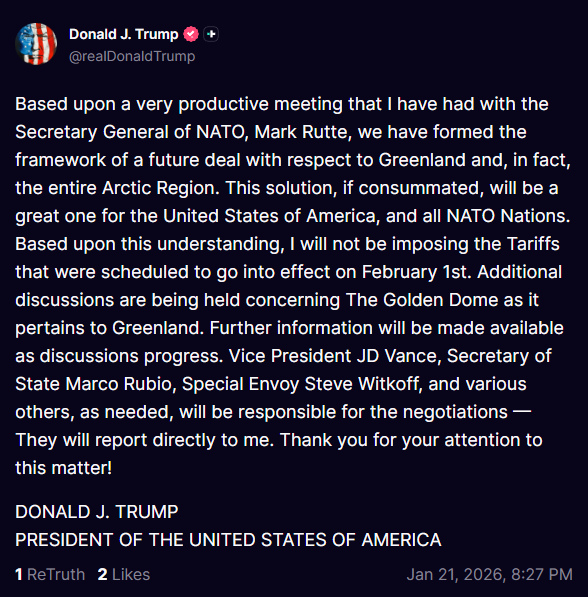
US President Donald Trump announced the United States and NATO have formed the "framework of a future deal" regarding Greenland and the Arctic region following a meeting with NATO Secretary General Mark Rutte, stating he will not impose tariffs on Denmark that were scheduled for February 1.

"This solution, if consummated, will be a great one for the United States of America, and all NATO Nations," Trump said in a statement posted on social media, Truth Social, on January 21.

Trump said additional discussions are being held concerning "The Golden Dome as it pertains to Greenland" and that Vice President JD Vance, Secretary of State Marco Rubio, Special Envoy Steve Witkoff and various others will be responsible for negotiations, reporting directly to him.

The announcement represents a significant development in Trump's pursuit of acquiring Greenland, an autonomous Danish territory, which he has repeatedly expressed interest in controlling for strategic and resource reasons.

The president said the framework emerged from what he described as a "very productive meeting" with Rutte. Trump did not provide specific details about the nature of the agreement or timeline for finalising the deal.

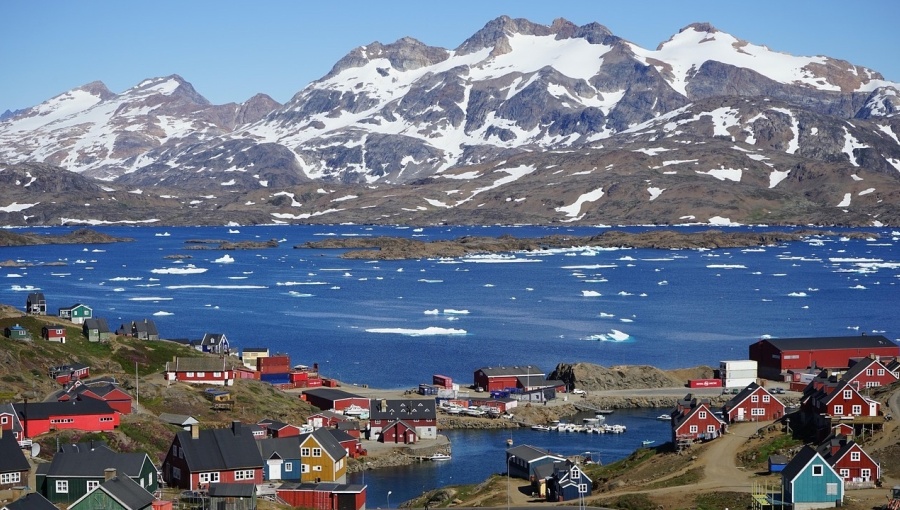
Greenland, home to a major US military installation at Thule Air Base, has strategic importance for Arctic operations and contains significant mineral resources. The island has been part of the Kingdom of Denmark since 1721, though it gained home rule in 1979 and expanded self-governance in 2009.

Danish officials have previously rejected Trump's interest in purchasing Greenland, with former Prime Minister Mette Frederiksen calling the idea "absurd" in 2019 during Trump's first term.

Trump's decision to suspend the planned tariffs on Denmark comes as his administration has threatened trade measures against various countries. The president did not specify what tariffs were scheduled for February 1 or provide details about trade disputes with Denmark.

Trump suspends European tariffs after 'framework' Greenland deal agreed

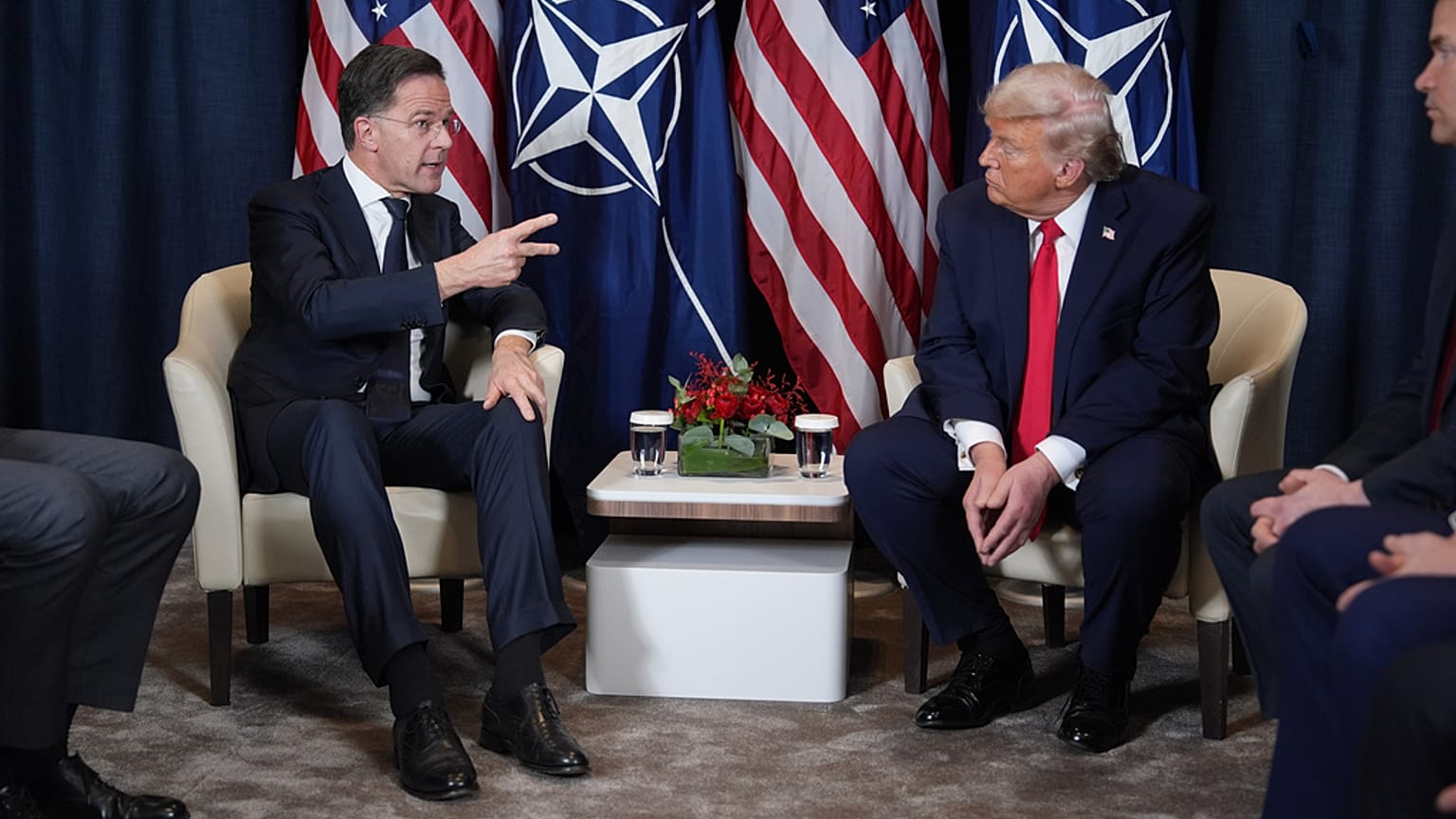
US President Donald Trump meets with NATO Secretary General Mark Rutte during a meeting at the World Economic Forum in Davos, 21 January 2026
Copyright AP Photo

By Aleksandar Brezar
Published on 

The announcement came hours after Trump's Davos speech, where repeated the US needed Greenland for national and global security, and said NATO members they could agree to US control and "we'll be very appreciative."

US President Donald Trump announced late Wednesday he would not impose tariffs on eight European nations scheduled to take effect on 1 February, citing progress in talks with NATO Secretary-General Mark Rutte on Greenland in Davos.

Trump said the two leaders reached "the framework of a future deal with respect to Greenland" during what he described as productive discussions, and declared the potential agreement would benefit the US and all NATO members.

"Based upon this understanding, I will not be imposing the tariffs that were scheduled to go into effect on 1 February," Trump wrote on Truth Social.

The tariffs, announced days before the World Economic Forum, were set to start at 10% on goods from France, Germany, the United Kingdom, Denmark, Sweden, Norway, the Netherlands and an eighth country, with rates climbing to 25% by June.

Trump had demanded the levies remain until European nations supported US acquisition of Greenland from Denmark.

Trump said US Vice President JD Vance, Secretary of State Marco Rubio, Special Envoy Steve Witkoff and other officials would handle negotiations, reporting directly to him.

The announcement came hours after Trump's Davos speech, where repeated the US needed Greenland for national and global security, and said NATO members they could agree to US control and "we'll be very appreciative."

Trump also excluded the possibility of the US using force to take control of the Arctic island.

Rutte had urged "thoughtful diplomacy" during his own Davos remarks Wednesday, acknowledging tensions within the alliance whilst expressing commitment to finding solutions on Greenland.

Trump had earlier this week published a private message from Rutte pledging to work toward a resolution.

The tariff threats had triggered emergency EU meetings scheduled for Thursday and discussions of retaliatory measures. French President Emmanuel Macron had advocated activating the EU's anti-coercion instrument, while European Commission President Ursula von der Leyen warned the bloc's response would be "unflinching, united and proportional."

Trump's Greenland campaign has opened the deepest rift between Washington and its European allies in decades.


 Tariff threat over Greenland risks spillover to Central and Southeast Europe

Tariff threat over Greenland risks spillover to Central and Southeast Europe
US President Donald Trump plans to impose tariffs on European countries that oppose his demand for Washington to take control of Greenland.
By bne IntelliNews January 21, 2026

A fresh transatlantic trade confrontation triggered by US President Donald Trump’s threat to impose sweeping tariffs on European allies over Greenland is raising concerns about economic fallout across the European Union, with Central and Southeast European member states likely to feel the impact indirectly through weaker demand from Germany and broader financial market turbulence.

Trump has vowed to “100%” follow through on his threat to impose tariffs on European countries that oppose his demand for Washington to take control of Greenland, a semi-autonomous territory of Denmark. European allies have rallied behind Denmark’s sovereignty, with Copenhagen’s foreign minister warning that the US president “cannot threaten his way to ownership” of the Arctic island.

On January 19, Trump declined to rule out the use of force and said he would proceed with tariffs on goods arriving in the United States from EU members Denmark, Finland, France, Germany, the Netherlands and Sweden and fellow European countries Norway and the UK. 

The eight countries had issued a joint statement on January 18, warning of escalation following US tariff threats. 

He wrote on his Truth Social platform: “Greenland is imperative for National and World Security. There can be no going back — On that, everyone agrees!”

Trump has said he will impose a 10% tariff “on any and all goods” sent from the eight countries from February 1, rising to 25% from June 1, unless Denmark agrees to sell Greenland to Washington.

Denmark has warned that any US military action in Greenland would spell the end of Nato. Several European countries have in recent days sent small troop contingents to Greenland in a largely symbolic show of solidarity.

German Chancellor Friedrich Merz said the tariffs would benefit no one and expressed hope of meeting Trump during the World Economic Forum in Davos.

“We do not want this escalation. We do not want a trade dispute with the United States of America,” Merz told a press conference on January 19, newswires reported.

The European Union is set to hold an emergency summit in Brussels on January 22 to discuss its response. EU foreign policy chief Kaja Kallas told the European Parliament the bloc had “no interest to pick a fight, but we will hold our ground”.

“But trade threats are not the way to go about this,” she added. “Sovereignty is not for trade.”

Global markets sold off sharply on January 20 as investors feared a renewed US-EU trade war, recalling the economic damage caused by previous tariff disputes in 2025.

The S&P 500 fell 2.1%, its worst day since October, while the Nasdaq dropped more than 2.4% and the Dow Jones lost around 870 points. European markets also declined for a second day, with Germany’s DAX down 1% and the pan-European STOXX 600 falling 0.7%.

In 2025, earlier rounds of US-EU tariffs weighed on export-oriented economies across Europe, cutting growth forecasts, raising costs for manufacturers and weakening business confidence. This had an effect on Central and Eastern Europe, which is deeply embedded in German-led supply chains.

Fitch Ratings said in a report on January 19 that Germany would be the economy hardest hit by any new round of tariffs, with knock-on effects for its regional trading partners.

“The threat of Greenland-related US tariffs on European allies and European retaliatory measures … signifies a serious upsurge in transatlantic tensions, posing risks to trade and growth,” the rating agency said.

Fitch estimates that a 10% tariff could reduce European GDP by about 0.5% by end-2027, and that a 25% tariff would roughly double that impact. For Germany, GDP could be 0.8-0.9% lower under a 10% tariff scenario, and nearly twice that under a 25% shock.

“Germany, where we forecast GDP growth of 1.2% this year and 1.4% in 2027, would be hardest hit,” Fitch said.

Think tank Bruegel said in a statement that Trump’s move amounted to economic coercion. “It is difficult to think of a clearer case of economic coercion in breach of international law,” Bruegel said.

Fitch also said implementation was uncertain, as Trump would likely rely on the International Emergency Economic Powers Act (IEEPA), which is currently under review by the US Supreme Court.

Beyond trade, Fitch warned that the biggest long-term risk was geopolitical.

“Outside the trade and growth hit from tariffs, the main potential sovereign credit impact … is from the implications for the viability of Nato and the credibility of its collective defence commitment,” it said, adding that tensions could raise defence spending pressures across Europe and increase vulnerability to hybrid threats from Russia.

Impact in CEE and SEE

For Central and Southeast Europe, the damage would come mainly through Germany, which is the region’s largest export destination and a key hub in automotive, machinery and electronics supply chains.

Baltic states

Although Latvia, Lithuania and Estonia were not among the eight European countries that issued the joint statement on January 18, they have publicly aligned themselves with the message supporting Denmark.

Support for the joint position was confirmed on social media by Latvian Prime Minister Evika Siliņa, Lithuanian President Gitanas Nauseda and Estonian Prime Minister Kristen Michal, signalling Baltic solidarity with Denmark and wider European partners.

For Estonia, Latvia and Lithuania, any escalation would be felt mainly through indirect channels. While direct exports to the United States are limited, the Baltic economies are tightly integrated into EU supply chains, meaning tariffs could weaken demand from key partners such as Germany and weigh on manufacturing and growth. Previous US-EU tariff disputes, including measures imposed during the Trump administration, increased costs for exporters and undermined business confidence, with some estimates suggesting a full-scale tariff conflict could cut up to 0.5 percentage points from Lithuania’s GDP growth.

As small, open economies, the Baltic states continue to favour a coordinated EU response and negotiated solutions, but the episode highlights their exposure when trade tensions intensify between larger powers. 

Bulgaria

A EU-US trade conflict over Greenland could have a knock-on effect on Bulgaria through its integration into European supply chains, even though the United States is not a major trading partner. Any escalation would hit Bulgarian exporters indirectly, as key partners such as Germany and Italy could face higher costs or weaker demand, weighing further on Bulgaria’s already strained trade balance.

Previous US tariffs have had a measurable impact on Bulgaria. Bulgaria’s economy ministry last year put the total hit to exports at about €620mn, with direct losses of €468mn and significant spillovers from EU trade. Exports to the United States were expected to fall by nearly one-third, shaving around 0.35% off GDP in 2025, despite the US accounting for only 3.3% of Bulgarian exports. The larger risk lies in prolonged disruption to EU demand, as elevated US tariffs on European goods dampen growth prospects for export-oriented economies like Bulgaria.

Defence Minister Atanas Zapryanov said on January 21 that Sofia does not plan to send Bulgarian military personnel to participate in the exercise in Greenland, Bulgarian National Radio reported.

Croatia 

Croatian Prime Minister Andrej Plenković said on January 20 that Croatia supports dialogue with the United States and stands in solidarity with Denmark over initiatives related to Greenland, warning that careless rhetoric could harm transatlantic relations.

Speaking after his first day at the World Economic Forum in Davos, Plenković said Croatia’s position was “solidarity with Denmark and a reasonable solution through dialogue with the United States of America”. 

The previous round of tariffs did not have a significant direct impact on Croatia, which is less dependent on manufactured exports than many of its regional peers, given its large tourism and services sector. However, it may be affected via a broader European slowdown, particularly in key partners such as Germany.

Czechia

The Czech finance ministry recently upgraded its 2026 growth forecast to 2.4%. However, the figures were released on January 19 just as the latest escalation in the trade wars between the US and EU began to pick up. Trade war escalation led to a series of worsening forecasts for the export-oriented Czech economy last spring, and this could be repeated in 2026 if a tariff war is not averted.

Czechia’s populist Prime Minister Andrej Babiš downplayed the Greenland dispute, saying he had bought a globe for for CZK15,000 (€618) to “exactly know where Greenland is” and that “arguments of President Trump about China and Russia are relevant, and agreement needs to be made.”

Hungary

Hungary, which has sought to cultivate strong political and economic ties with Washington, has refused to endorse a joint EU stance on the escalating diplomatic tensions over Greenland, marking a break with its EU partners on the issue.

Foreign Minister Peter Szijjarto said Budapest views the matter as a bilateral issue that should be resolved through direct negotiations between Washington and Copenhagen. The government has not responded to Trump’s threats to impose higher tariffs on more than half a dozen EU countries for opposing his ambition to take control of Greenland.

In line with Washington, Budapest has criticised the US-EU trade agreement reached last year as unfavourable to the bloc. Existing tariffs, including a 25% duty on vehicles and other products, have weighed on Hungary’s export-oriented economy, particularly the automotive sector, though their impact has been mostly indirect. Hungary’s direct exports to the United States remain limited, with negative effects felt primarily through the slowdown in the German economy.

Poland

Poland has avoided sending troops to Greenland and has sought to maintain close ties with Washington. Warsaw has been careful to avoid any direct rebuke of the US and instead stressed Poland’s focus on alliance cohesion.

“Poland looks after what is essential for our security, which is cooperation among allies with the US at the forefront. There is no Nato without the US Poland’s role is to connect,” Deputy Prime Minister Władysław Kosiniak-Kamysz said.

Denmark, “which we respect very much”, has exclusive rights over Greenland and should reach an understanding with Washington, Kosiniak-Kamysz also said. 

“Among friends, there can be differences of opinion and emotions, but there must be no differences about the goal, which is building security,” the minister added.

But the US’ new security strategy, published in December, rattled Poland by apparently plotting to weaken the EU by breaking it up merely into a group of “sovereign nations”. 

Poland has long relied on the US as its foremost security partner, having hosted US troops on its soil and spent tens of billions of złoty on American equipment.

“Dear American friends, Europe is your closest ally, not your problem … Unless something has changed,” Prime Minister Donald Tusk addressed the US on social media at the time.

Romania

In line with the position of President Nicusor Dan, Foreign Minister Oana Toiu avoided taking sides in the conflict between the European Union and the United States, prompted by Trump’s decision to take over Greenland “one way or another” — a conflict in fact not mentioned by either Toiu or Dan in their public communications. 

Security and subsequent macroeconomic stability (cost of financing) impacts of the developments outweigh the trade implications of tariffs mentioned by Trump.

For Romania, which hosts US military assets on its territory and largely depends on the security provided by the alliance, given its proximity to Russia and weak military endowment, a weakening of the alliance followed by a weaker stance on the Eastern Flank is a worst case scenario to be avoided at any cost.  Macro-economically, the first transmission channel is the cost of financing and the fiscal consolidation gains under these circumstances, more than economic implications.

"From our perspective, Romania's next steps must be de-escalation steps. Romania has a very clear interest in strengthening Nato, it has a very clear interest in the transatlantic relationship, both in terms of security and economic components,” Toiu told Euronews.

In a brief and ambiguous message posted on X, Dan reacted to the rising tensions between the United States and its European partners related to the transfer of Greenland from Denmark to the US. 

“I am deeply concerned by the escalation in public statements between transatlantic partners and allies regarding recent developments. We have to resume talking directly to each other, at the appropriate diplomatic levels,” Dan tweeted. 

Slovakia

The escalation of trade wars between EU countries and the US is expected to inflict a further blow on the Slovak economy, which has already been hit by US-imposed tariffs on imported goods, and which is dependent on Germany as its largest trading partner.

Slovakia is the largest car producer per capita worldwide and Germany is a key destination for its robust car industry.

“We don’t export some of the parts made in the automobile industry directly to the US, but export those to countries such as Germany, which the assemble cars and export those to the US, and would be negatively affected as well,” if Germany was targeted by the new US tariffs, Ján Oravec, chairman of the Inštitút slobody a podnikania (Freedom and Business Institute) was quoted as saying by the state broadcaster STVR. 

Prime Minister Robert Fico, a political ally of Trump, has so far avoided direct criticism of the tariff threat after visiting Trump at his Mar-a-Lago residence. Foreign Minister Juraj Blanár said Slovakia preferred “diplomacy and peace, not tensions or fights”, while reiterating that Greenland was part of Denmark under international law.

Slovenia

US announcements about introducing additional tariffs on the European Union or individual member states are not in the interest of transatlantic relations, Slovenian Prime Minister Robert Golob said, RTV SLO reported.

“Announcements of additional tariffs against the EU or its member states do not contribute to good transatlantic relations. I believe the EU will respond to any possible measures in a unified way,” the Prime Minister’s Office said.

Foreign Minister Tanja Fajon said it was crucial for both the European Union and the European Commission to react clearly and decisively.

“This is a common market, and every step will be extremely important,” Fajon said, warning that the situation could set a dangerous precedent, particularly in relation to Greenland.

Contributions from reporters in Belgrade, Bucharest, Budapest, Prague, Skopje, Vilnius and Warsaw. 
Trump Tariff Threats Drive UK Closer to EU

  • Economists from Capital Economics have warned that President Trump's proposed 10 per cent tariffs on UK goods, tied to the dispute over Greenland, could trigger a recession if the £22 billion impact is felt immediately.

  • The geopolitical fallout from the tariff threat could push the UK to side with the EU, driving a wedge through transatlantic relations and potentially damaging NATO.

  • Market analysts suggest the episode is less about Greenland and more about investors repricing a geopolitical risk premium across global currencies and capital flows due to increased policy unpredictability.

President Trump’s latest tariff package could plunge the UK economy into a recession, top economists have warned, upping the stakes for Keir Starmer as he responds to threats against Greenland. 

The US president warned leading European nations, including the UK, he would slap additional 10 per cent tariffs on goods imports if a deal for Greenland’s annexation was not agreed. 

Analysts at Capital Economics have warned that the new tariffs could trigger a recession for the UK economy if the impact is felt “all at once”. 


The tariff hit could amount to up to 0.75 per cent of UK GDP, equivalent to around £22bn. 

“With the UK economy currently growing by 0.2 to 0.3 per cent a quarter, if this hit came all at once it could trigger a recession,” Capital Economics chief UK economist Paul Dales said. 

“But it’s likely to be spread over many quarters.”

Recession warning issued by City

Economists suggested that there could be an immediate growth spurt in January as firms rushed to boost exports before the 1 February deadline in the same way manufactures kicked into gear ahead of last April’s tariff deadline.

But it remains unclear whether Trump’s new tariffs would ‘stack’ on top of existing ones or whether they applied to all products and undermine the US-UK trade deal. 

Dales added there were questions over whether tariffs were legal pending a US Supreme Court decision on trade, which could be revealed as soon as Tuesday.

The UK’s response to tariffs would also be crucial in calculations around the economic impacts, he said.

“Any attempt by the US to seize Greenland would drive a wedge through transatlantic relations and inflict potentially irreparable damage on NATO.

“In that scenario, it’s hard to imagine the UK not siding with the EU. Arguably, then, the latest tariffs could nudge the UK closer to the EU and further away from the US.”

On Monday, Starmer urged allies to engage in “calm discussion” on trade and diplomatic approaches to Greenland, suggesting risks to the UK were “more direct now than at any time we can remember”. 

Market analysts are weighing up the impacts of Trump’s new geopolitical threats, with eToro’s Lale Akoner suggesting that his threats could deepen “policy unpredictability” and contribute to lowered investment levels. 

“For investors, this episode is less about Greenland and more about a geopolitical risk premium being repriced across currencies, equities and cross-border capital flows in the days ahead,” Akoner said.

By City AM 

Why Greenland Matters Even If Its Resources Don’t Pay

  • Despite holding estimated oil, gas, and critical mineral reserves, the resources in Greenland are extremely expensive and challenging to extract due to a lack of infrastructure, harsh climate, and high costs.

  • Following 50 years of unsuccessful and sporadic exploration, Greenland abandoned its quest for oil in 2021, and analysts state the island is not comparable to resource-rich Venezuela.

  • Greenland’s greatest asset and primary importance is its geostrategic location in the High North, making control of the island a key factor in the global race for Arctic dominance and shorter trade routes.


The renewed U.S. interest in taking control over Greenland – one way or another – has placed the Arctic island back in the spotlight a year after U.S. President Donald Trump first suggested the United States should buy Denmark’s autonomous territory.  

The Trump Administration’s reasons and intensified pressure on NATO allies aside, is Greenland really worth it?

The island, which is the size of about a fourth of the continental U.S., is estimated to hold oil and gas resources, as well as critical minerals and rare earth elements—all of which could be great assets to its holders. 


But that’s only in theory. 

In practice, Greenland’s resources are extremely expensive and hard to extract. The lack of energy infrastructure or any processing capabilities puts in doubt the feasibility and economic rationale of trying to mine rare earths and critical minerals, analysts say. 

Oil Resources 

According to one estimate from the U.S. Geological Survey (USGS), Greenland’s offshore area, East Greenland Rift Basins Province, likely contains a mean estimate of 31.4 billion barrels equivalent of oil, natural gas, and natural gas liquids. Of the five assessed assessment units (AUs), North Danmarkshavn Salt Basin and the South Danmarkshavn Basin are estimated to contain most of the undiscovered petroleum resources, a 2007 report from the USGS says.

A more recent estimate from 2023 by the USGS on the West Greenland-East Canada Province put the undiscovered, technically recoverable mean conventional resources there at 7.8 billion barrels of oil and 91.9 trillion cubic feet of gas. 

Greenland had seen oil exploration since the 1970s involving major oil firms, including ExxonMobil, Shell, and Eni. None has resulted in a major discovery.

Following 50 years of unsuccessful and sporadic exploration in the inhospitable Arctic climate and waters, Greenland abandoned the quest for oil in 2021. Back then, the government of Greenland said that it considered that the environmental concerns were far greater than the potential benefits of becoming an oil producer.  

Greenland may have potential undiscovered resources, but it’s nothing like Venezuela, which holds the world’s largest proven crude reserves, has decades of oil exploration and production, and is a founding member of OPEC. 

“Despite its hydrocarbon and critical mineral potential, Greenland is not Venezuela 2.0.,” Wood Mackenzie’s top analysts say, noting that the large island is remote, inhospitable, underexplored, difficult to explore, and very high cost. 

Major oil companies have seen harsh operating environments, but Greenland is on another level, WoodMac’s Simon Flowers and Gavin Thompson wrote. 

Short summers, thick ice requiring ice breakers and specialized offshore equipment for surveys or exploration, and fewer than 100 miles of paved roads, although its territory is about 25% of the size of the continental U.S., discourage resource development offshore and onshore Greenland. 

Throughout its decades-long history of exploration, Greenland has seen just 25 exploration wells drilled, predominantly in the Southwest basin. Each was unsuccessful, Wood Mackenzie notes. 

The 2021 ban on new exploration is in place, but extensions have been approved for three existing licenses in the Jameson Land Basin, held by London-listed company 80 Mile. The firm last year signed a deal with U.S. investment firm March GL under which March GL will fund 100% of the costs associated with up to two exploration wells, designed to delineate the hydrocarbon potential of the Jameson project. 

Critical Minerals and Rare Earths Resource   

The National Geological Survey of Denmark and Greenland (GEUS) says that the Greenland Ice Sheet covers about 80% of the island, making it difficult to study the underlying geology and potential mineral resources in detail.

Still, a recent assessment has shown that 24 of the 34 critical raw materials on the list of critical raw materials for the EU are found in Greenland. Rare earth elements (REE), along with lithium, tantalum, niobium, and zirconium, are thought to be present. 

In November 2025, Amaroq Ltd, an independent Greenland-focused mining company, announced it had identified conventional rare earth element-bearing mineralization within its Nunarsuit mineral license area in South Greenland. 

But as of January 2026, there are two active mines in Greenland—a gold mine in South Greenland, and an anorthosite (feldspar) mine in the fjord of Kangerlussuaq, West Greenland. 

Any additional mining operation would need infrastructure (remember, fewer than 100 miles of paved roads), power supply, skilled workforce, and huge investments in the potential processing of any minerals dug out of the areas that are accessible. 

“The US goal of opening alternative REE supply chains to China is understandable, but given its harsh conditions and high costs, few miners are likely to put Greenland high on the list of options,” Wood Mackenzie’s analysts say. 

The Biggest Prize

Greenland’s greatest asset is its geostrategic location and potential military importance. Winning the race with Russia and China for Arctic dominance and shorter trade routes with the help of Greenland’s strategic position would be the biggest advantage of the country that controls it. Denmark, a NATO member and a U.S. ally for decades, is the one that has control over Greenland, and declines any U.S. advances or offers of purchase of the island as a piece of real estate.   

“For all the hype around Greenland’s natural resources, it is its strategic High North location that holds the key to what happens next,” analysts at WoodMac note.    

By Tsvetana Paraskova for Oilprice.com 

National targets for new nuclear 'far exceed a tripling of global capacity'


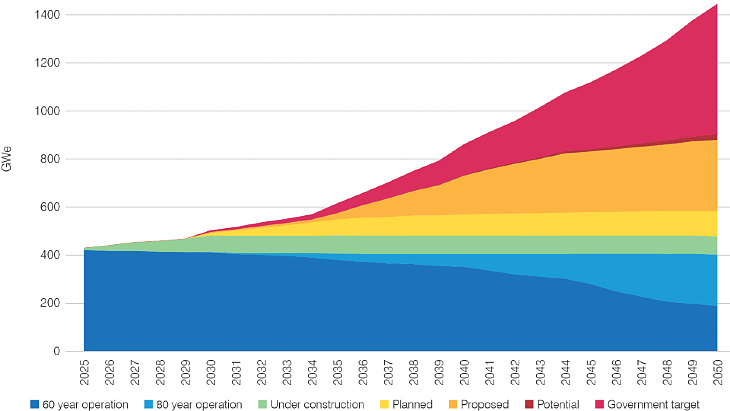
Global generating capacity could reach 1,446 GWe by 2050 if governments hit their targets for new nuclear, far exceeding the 1,200 GWe goal set in the Declaration to Triple Nuclear Energy, according to a new World Nuclear Association report.
 
Global nuclear capacity 2025-2050 (GWe gross) (Image: World Nuclear Association)

There are currently about 440 nuclear power reactors with a combined capacity of almost 397 GWe (net) operating in 31 countries, with at least 70 power reactors under construction, which will add another 77 GWe. Nuclear generation reached an all-time high of 2,667 TWh in 2024. The goal of at least tripling global nuclear capacity by 2050 has been endorsed by more than 30 countries since the United Nations Climate Change Conference (COP28) in Dubai in December 2023.

In its inaugural World Nuclear Outlook Report, World Nuclear Association (WNA) has compiled national government targets and goals for nuclear capacity for 2050 and assessed them alongside plans for continued and extended operation of existing reactors, completion of those under construction, and realisation of planned and proposed projects. It has found that they would more than meet the tripling target.

"Global nuclear capacity would expand significantly to 2050 if the continued operation of existing reactors and the deployment of new nuclear build meet targets set by governments for national nuclear capacity," the report says. "When all operable, under construction, planned, proposed, and potential reactors are combined with government targets, the total global capacity could reach 1,446 GWe by 2050."

The association notes: "Most growth to 2030 stems from reactors currently under construction; planned projects drive expansion to 2035; and proposed, potential, and government-driven programmes account for the increase in capacity after 2035."

It adds: "The 542 GWe of additional capacity associated with government targets beyond projects assessed as planned, proposed or potential is not yet supported by identified projects, and the level of commitment through policy or other governmental measures varies significantly from country to country."

The report says that achieving the projected 2050 capacity requires scaling annual grid connections from 14.4 GWe per year in 2026-2030, to 22.3 GWe per year in 2031-2035, to 49.2 GWe per year in 2036-2040, 51.6 GWe per year in 2041-2045 and 65.3 GWe per year in 2046-2050. It notes that the required 65.3 GWe per year during 2046-2050 is "roughly double the historic peak build rate seen in the 1980s".

In conclusion, the World Nuclear Outlook Report says: "National nuclear capacity goals to 2050 exceed the global tripling target and reflect strong alignment between national objectives and global decarbonisation needs. Achieving these ambitions will require unprecedented construction rates, strategic lifetime extension of existing reactors, and significant policy and market reforms. If nations deliver on their commitments, nuclear power would play a critical role in ensuring secure, affordable, and net-zero-compatible energy for a rapidly expanding and electrified global economy."

However, the report says that governments must "take immediate and sustained action" to deliver on their own national targets for nuclear capacity. "To secure a clean, reliable, and resilient energy future for all, governments must take action now implementing clear execution plans that can realise policy promises," it says. "Experienced countries, multilateral development institutions and the global nuclear industry should collaborate to support emerging economies interested in deploying nuclear energy for the first time."

The association recommends that governments recognise that nuclear energy is a central pillar in meeting global climate goals and that it should be integrated into long-term decarbonisation and energy security planning. It calls for them to set "durable, actionable nuclear policies and industrial strategies to enable long-term investment and to maintain industrial capabilities, workforce and supply chains". They should also support the continued operation of existing reactors to 60-80 years "where technically feasible". Electricity markets should be reformed to ensure equitable treatment of nuclear energy alongside other low-carbon sources. Governments should also support the acceleration of licensing, siting, and financing mechanisms to facilitate an increase in construction rates."

With regards to financial institutions, World Nuclear Association recommends they implement technology-neutral lending and environmental, social and corporate governance (ESG) policies to ensure nuclear and other low-carbon sources are evaluated using equivalent criteria. They should also support the deployment of nuclear in emerging economies.

The association calls for the nuclear industry itself to expand manufacturing and supply chain capacity, including fuel cycle infrastructure, while optimising series build to reduce costs and shorten build times. In addition, it should develop large-scale deployment strategies to meet post-2035 demand, including for non-grid applications utilising novel reactor technologies.

Speaking from the World Economic Forum Annual Meeting 2026 in Davos, World Nuclear Association Director General Sama Bilbao y León said: "Our analysis indicates that governments have ambitions that exceed the goal to triple nuclear capacity by 2050. Now, forward-thinking governments, global industry leaders, and civil society need to work together and take timely action to turn those ambitions into action. This is our chance to deliver a cleaner, more secure energy future for everyone everywhere, powered by affordable 24/7, low-carbon nuclear energy."