‘It’s Venezuela Today. It Will be South Africa Tomorrow’, Warns its Largest TU

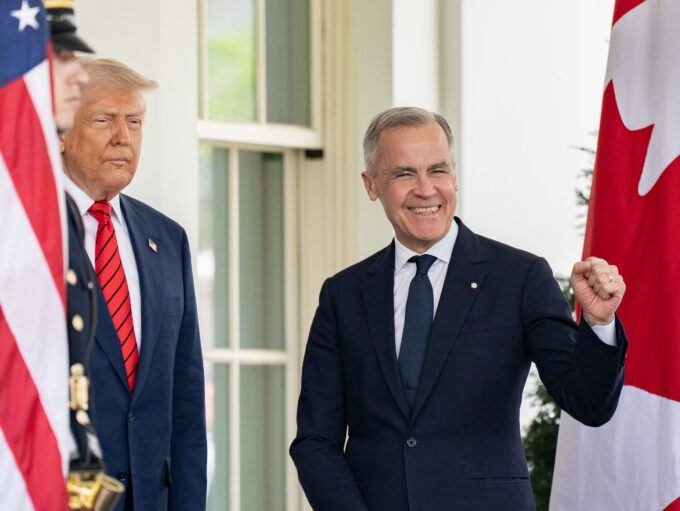
NUMSA march to US consulate in solidarity with Venezuela. Photo: NUMSA
Demanding the release of Venezuela’s President Nicolás Maduro and First Lady Cilia Flores, South Africa’s largest trade union marched to the US consulate in Johannesburg on Saturday, January 24.
“In defending Venezuela, we defend the sovereignty of all nations,” concluded the memorandum read aloud outside the consulate by Irvin Jim, general secretary of the over 460,000 members-strong National Union of Metalworkers of South Africa (NUMSA).
“It is Venezuela today … It will be South Africa tomorrow,” Jim warned in his address to the demonstration. US President Donald Trump, who has bombed parts of Nigeria after concocting a false story about a “Christian Genocide” in the country, has also been spinning tales about a “White Genocide” underway in South Africa.
“This is not a joke,” NUMSA warned in a statement. “Donald Trump can easily use the lie of a White genocide in South Africa to invade South Africa, capture South Africa’s president and transport him to a jail in the US, and declare that he is now in charge of our country and all its natural wealth, whilst controlling all trade and natural wealth … After the US criminal military invasion of Venezuela, it is foolish to ignore” this threat to South Africa.
“There is a madman in the White House”
“There is a madman in the White House. There is a fascist in the White House,” NUMSA’s president, Andrew Chirwa, said in his opening address to the demonstration. “Today, it is Venezuela that was attacked by this international criminal. Tomorrow it is” Cuba, Iran, Nigeria, South Africa. “All over the world this man” is baying “for blood.”
In parallel, the Trump administration is also attempting to strangle South Africa’s economy, threatening to exclude it from the African Growth and Opportunity Act (AGOA), which provides tariff-free access to the US market, on which the country’s automotive sector is heavily dependent.
“Our members and workers across various sectors are losing jobs” because “he has imposed 30% tariffs against South Africa,” Jim added in his speech.
Stressing the need for “an anti-imperialist front to mobilize the workers” across party and union affiliations, Jim said that NUMSA “will soon be convening a political colloquium”, inviting all progressive political parties. “It is about time to unite the working class … behind a revolutionary agenda,” as South Africa faces increasing US aggression.
South Africa punished for taking the genocidal state of Israel to the ICJ
South Africa, the union maintains, “is being punished by Trump for taking the genocidal state of Israel to the International Court of Justice (ICJ).” Reaffirming that “this was the correct position … in defense of the people of Palestine,” NUMSA called on the South African government not to cave in to the pressure by Leo Brent Bozell III, Trump’s new ambassador to South Africa.
At his Senate confirmation hearing, he had stated that if appointed, “I would press South Africa to end proceedings against Israel,” and the ICJ itself to stop what he deemed a “lawfare” against Israel.
“If he continues to insult our national sovereignty … by demanding that South Africa must withdraw its case in the ICJ against Israel,” NUMSA insists, “the South African government must act swiftly, and ensure that he packs his bags and leaves the country.”
The South African government must also “continue to demand the release of Venezuela’s President Nicolás Maduro and Comrade Cilia Flores in all international forums,” added the memorandum, which was also copied to the Minister of International Relations.
Demanding that the football governing body “cancel all World Cup matches in the US this year,” a copy of the memorandum was also sent to the FIFA President.
It further called on the African Union (AU) and the BRICS to urgently convene and formulate a coordinated and collective response to the US imperialist aggression.
“No country is safe from America’s greedy appetite”
Recalling the European leaders defending unipolarity under the cover of “rules-based order” at last year’s G20 summit in South Africa, the US had boycotted Alex Mashilo, spokesperson of the South African Communist Party (SACP) said in his address to the protest: “Little did they know that just after a few weeks, that unipolar power will turn against them and demand Greenland.”
Under “the mad Trump administration”, NUMSA emphasized in its statement, “no country is safe from America’s greedy appetite”.
The US is a danger to itself
The US has now even “become extremely dangerous to itself” and “its citizens”, with Trump “brutalizing the American people daily” using “his personal ‘Gestapo’ police commonly known as ICE.”
Expressing “solidarity with American citizens who are being brutalized by ICE,” NUMSA insisted, “This is a moment when all people of the world, including well-meaning US citizens and all South Africans, must unite” against imperialism.
Courtesy: Peoples Dispatch
How Venezuela Grew Poor With More Oil Than Saudi Arabia
Photograph by Nathaniel St. Clair
Following the dramatic seizure of Venezuelan President Nicolás Maduro on January 3, 2026, Trump’s comments about taking control of Venezuela’s oil industry quickly triggered accusations of “neo-imperialism”. Critics argued that pledges to share profits with Venezuela were little more than cover to protect the interests of America’s major oil companies. Yet despite the allure of Venezuela’s reserves, many of those major oil firms have been notably cautious, citing uncertainty over the country’s political trajectory and the durability of legal and financial protections.
Venezuela sits atop more than 300 billion barrels of proven crude reserves, constituting roughly 17 percent of the global total. This is more than Saudi Arabia’s reserves, which is the world’s most recognizable oil power. The two countries have comparable population sizes, yet Saudi citizens rank among the wealthiest in the world, while Venezuela has become one of the poorest countries in the Americas.
The contrast can be partly explained by geology. Most Venezuelan oil is considered heavy and sour, meaning it is dense and high in sulfur. Extracting, transporting, and refining this oil is more expensive and technically demanding than the Saudis’ light, sweet crude, which flows more easily and requires less processing.
Saudi Arabia’s oil is also easier to access. Much of it lies close to the surface and on land, lowering extraction costs. Venezuela’s deposits are, meanwhile, often deep underground or offshore, complicating extraction and transportation.
Despite these constraints, Venezuela was one of the world’s leading oil producers by the mid-20th century and a major supplier to the United States. Oil revenues supported a relatively prosperous, urbanized society, and following the leverage gained by producer states after the 1973 oil shock, there was both elite and public support for greater national control over the industry. In 1976, the Venezuelan government nationalized the oil industry, creating Petróleos de Venezuela, S.A. (PDVSA).
The nationalization process was orderly, with U.S. and European oil companies compensated and the transition carefully negotiated. For years afterward, PDVSA operated with significant autonomy and technical competence, maintaining ties with foreign firms and continuing to develop its industry.
The politicization of PDVSA, however, proved fatal for it. After a period of market opening in the 1990s, Hugo Chávez was elected as the president of Venezuela in 1998 on a platform built around redistributing oil wealth and reasserting state control over the economy, particularly the oil sector. He quickly consolidated political control over PDVSA, and after a wave of labor strikes in 2002–2003, his government replaced roughly 20,000 experienced workers with political loyalists who often lacked the technical expertise and skills needed to do the job.
From that point, PDVSA increasingly functioned as a fiscal arm of the state. Political decisions overrode commercial logic, and revenues were diverted away from maintenance and reinvestment toward social programs and short-term spending.
Unlike the 1976 nationalization, Chavez’s approach rewrote established agreements, undermining foreign confidence and operations. Western energy companies reduced their exposure or exited altogether, taking capital, technology, and expertise with them. This was especially damaging because U.S. Gulf Coast refineries were uniquely suited to process heavy crude, having adapted to it over decades. American refiners replaced Venezuelan oil with Canadian heavy crude and domestic shale production, weakening Venezuela
During the oil boom of the 2000s, this appeared sustainable, with the country’s per capita income rebounding and Chavez’s social programs winning broad popular support. However, the policies also steadily hollowed out the oil industry’s capacity, while hundreds of thousands of the country’s skilled workers emigrated. The “oil strikes” in Venezuela to overthrow Chavez in 2002 and 2003 led to the country facing large layoffs in PDVSA. “This was the beginning of the large brain drain in Venezuela when many highly skilled industry workers left their home country to work for multinational corporations like ExxonMobil and Chevron,” according to the Borgen Project
Political conditions worsened sharply in the 2010s, as Venezuela drifted further toward Moscow and Beijing. After Maduro took office in 2013 following Chavez’s death, the U.S., under former President Obama, began targeting Venezuelan officials with sanctions in 2015. The sanctions later expanded under Trump to reduce PDVSA’s access to financial markets, insurance, spare parts, and technology. Cut off from the West, Venezuela leaned more heavily on Chinaand Russia, often accepting discounted deals that provided short-term liquidity but little long-term investment or capacity expansion.
When oil revenues collapsed mid-decade, the government resorted to money printing to cover deficits, fueling hyperinflation in the late 2010s that wiped out savings, wages and purchasing power. Strict currency controls also required export earnings to be converted at artificial exchange rates and deprived PDVSA of dollars. With demand from China and other countries never replacing that of the United States, Venezuela’s oil industry was effectively cannibalized to sustain the state. “Until 2017–2018, national access to international wealth was subsidized at the expense of PDVSA’s viability. Since then, through monetized credit from the Central Bank and the reorientation of the exchange rate policy, an attempt is being made to save the oil company at the cost of an abrupt internal adjustment,” stated a 2025 study in the journal Resources Policy.
Venezuela’s deterioration shows the limits of relying on large oil reserves. “Proved” reserves only count what is economically recoverable under current prices and technology. Venezuela’s reported total oil reserves soared from roughly 80 billion barrels in 2005 to more than 300 billion by 2014 largely because higher prices made more of its oil viable to extract. Both Saudi Arabia and Venezuela (as well as many major producers) restrict independent verification of their reserve figures. Venezuela is also an example of why resource management matters just as much as quantity.
Saudi Arabia nonetheless has taken a markedly different path from Venezuela over the last few decades. Its state oil company, Saudi Aramco, remained insulated from short-term political demands and internal disputes, and consistently reinvested in capacity, maintenance, and technological upgrades. By prioritizing reliability and indispensability, the company has maintained relations with its traditional partners, as well as diversified its customer base by targeting major emerging economies.
Partial privatization of Saudi Aramco in the 2020s further reinforced investor confidence. And aside from periodic tensions with the Houthis in neighboring Yemen, which have now eased, Saudi foreign policy has avoided geopolitical confrontations that might threaten its revenues.
Macro policy has played a role as well. Saudi Arabia has been an integral figure in the informal dollar-linked system known as the petrodollar, which guaranteed steady oil exports and dollar inflows while earning Washington’s protection in return for reliable supplies. A large sovereign wealth fund, fiscal buffers, and a commitment to long-term planning have helped the kingdom weather oil price drops without letting production fall apart.
The Future of Venezuela’s Oil Reserves
By the time of the Maduro raid, Venezuela’s oil infrastructure was in advanced decay for years. Refineries are operating at under 20 percent capacity due to equipment failures, power shortages, and lack of feedstock. Pipelines have corroded, storage tanks have failed, and production has collapsed from 3.5 million barrels per day in 1970 to less than 1 million per day by 2025.
The Trump administration’s actions could revive Venezuela’s oil industry, but only if the government cedes control to American companies, which will reduce profits for Venezuela. After seizing Maduro, Trump announced plans to invite American firms back to rehabilitate infrastructure and raise output. Major American refiners with heavy crude processing facilities, including Gulf Coast facilities operated by Phillips 66, have indicated they could process Venezuelan oil again.
While Venezuelans aspire to the wealth of the Saudis and Trump has provided them with a possible opening, any optimism should be cautious. Rebuilding Venezuela’s oil sector after decades of neglect would require stable legal frameworks and political stability, as well as hundreds of billions of dollars over the next decade or more, which helps explain the apprehension of American oil companies to reenter the country.
The global market environment is also less favorable than in the past. The U.S. has been a net oil exporter since 2020, reducing Venezuela’s chance to underpin recovery on its historical market. Europe continues to cut oil consumption, while a global oil glut further limits profitability.
Where Venezuelan oil may matter most is geopolitically. A meaningful rise in production could help suppress global prices, putting pressure on Russian energy revenues. Washington’s recent seizures of tankers carrying Venezuelan oil—tied to disrupting the shadow fleet used by Venezuela, Russia, and Iran to transport crude while avoiding sanctions—demonstrate how control of oil flows is an increasingly common strategy for the Trump administration. A more cooperative Venezuela could strengthen America’s hand, with some potential benefits for Caracas, such as sanctions relief and foreign investment.
Venezuela’s reserves alone, even with U.S. assistance, won’t be enough to save its economy. But given its lack of immediate alternatives, restoring some degree of functionality to its oil sector may still offer limited relief. The contrast with Saudi Arabia shows that oil export dependency does not inevitably doom a country, but it has to be backed by strong institutions and disciplined long-term planning, otherwise resource wealth can quickly evaporate. Saudi Arabia’s Vision 2030 initiative is already expanding non-oil growth and reducing dependence on hydrocarbons, showing a country actively managing the resource curse while Venezuela contemplates the struggle of repairing what it once had.
This article was produced by Economy for All, a project of the Independent Media Institute.
Being There – In Venezuela
I have now been in Caracas for 48 hours and the contrast between what I have seen, and what I had read in the mainstream media, could not be more stark.
I drove right through Caracas, from the airport through the city centre and up to posh Las Mercedes. The next morning I walked all through and weaved my way within the working class district of San Agustin. I joined in the “Afrodescendants festival”, and spent hours mingling with the people. I was made extremely welcome and invited into many homes – this from a district they tell you is extremely dangerous.
I must admit I had great fun at this bit.
After this I continued on for miles walking through the residential area and through the heart of the city centre, including Bolivar Square and the National Assembly.
In all of this I have not seen one single checkpoint, whether police or military. I have seen almost no guns; fewer than you would see on a similar tour taking in Whitehall. I have not been stopped once, whether on foot or in a car. I have seen absolutely zero sign of “Chavista militia” whether in poor, wealthy or central areas. I drove extensively round the opposition strongholds of Las Mercedes and Altamira and quite literally saw not a single armed policemen, not one militia man and not one soldier. People were out and about quite happily and normally. There was no feeling of repression whatsoever.
Again, nobody stopped me or asked who I am or why I was taking pictures. I did ask the Venezuelan authorities whether I needed a permit to take photos and publish articles, and their reply was a puzzled “why would you?”
The military checkpoints to maintain control, the roving gangs of Chavista armed groups, all the media descriptions of Caracas today are entirely a figment of CIA and Machado propaganda, simply regurgitated by a complicit billionaire and state media.
Do you know what else do not exist? The famous “shortages.” The only thing in short supply is shortage. There is a shortage of shortage. There is no shortage of anything in Venezuela.
A few weeks ago I saw on Twitter a photo of a supermarket in Caracas which somebody had put up to demonstrate that the shelves are extremely well stocked. It received hundreds of replies, either claiming it was a fake, or that it was an elite supermarket for the wealthy and that the shops for the majority were empty.
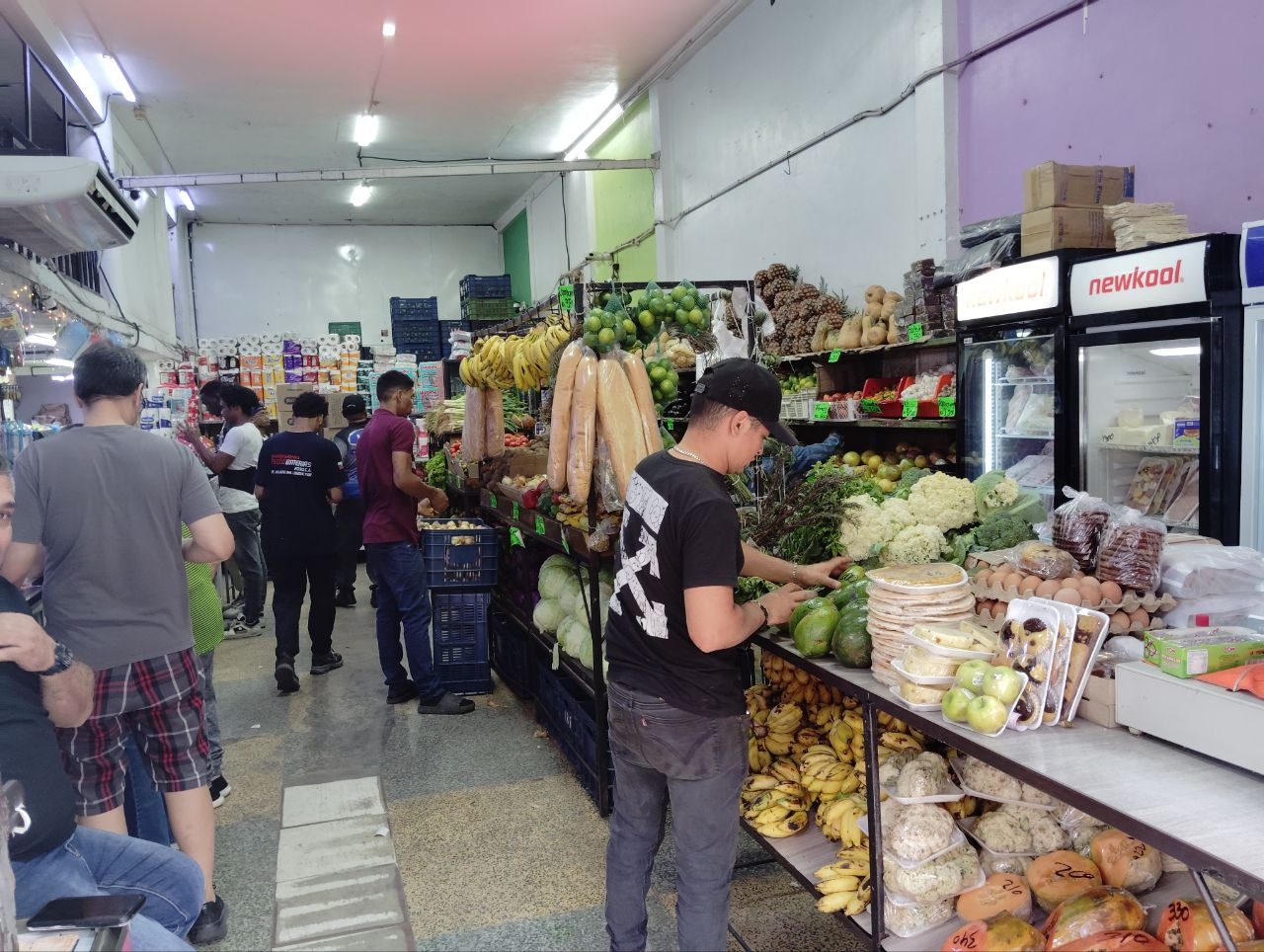
So I made a point, in working-class districts, of going into the neighbourhood, front room stores where ordinary people do their shopping. They were all very well stocked. There were no empty places on shelves. I also went round outdoor and covered markets, including an improbably huge one with over a hundred stalls catering solely for children’s birthday parties!
Everyone was quite happy to let me photograph anything I wanted. It is not just groceries. Hardware stores, opticians, clothes and shoe shops, electronic goods, auto parts. Everything is freely available.
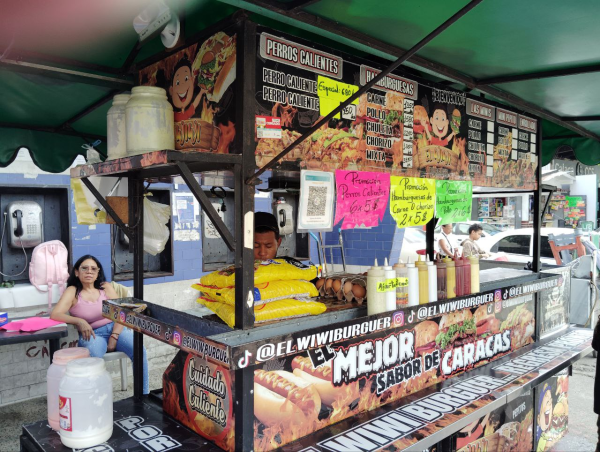
There is a lack of physical currency. Sanctions have limited the Venezuelan government’s access to secure printing. To get round this, everybody does secure payment with their phones via QR code using the Venezuelan Central Bank’s own ingenious app. This is incredibly well established – even the most basic street vendors have their QR code displayed and get their payments this way. Can you spot the QR codes on these street stalls?
To get a Venezuelan phone and sim card for the internet I went to a mall which specialises in phones. It was extraordinary. Four storeys of little phone and computer shops, all packed with goods, organised in three concentric circles of tiered balconies. This photo is just the inner circle. I picked up a phone, sim card, lapel microphones, power bank, multi-system extension lead and ethernet to USB adapter, all in the first little store I entered.
Registering the sim was quick and simple. There is good 4G everywhere I have been in Caracas, and some spots of 5G.
“Relaxed” is a word I would use for Venezuelans. You could forgive paranoia, the country having been bombed by the Americans just three weeks ago and many people killed. You might expect hostility to a rather strange old gringo wandering around inexplicably snapping random things. But I have experienced no sense of hostility at all, from people or officials.
The African festival was instructive. A community event and not a political rally, there were nevertheless numerous spontaneous shouts and chants for Maduro. The Catholic priest giving the blessing at the festivities suddenly started talking of the genocide in Gaza and everybody prayed for Palestine. Community and cultural figures continually referenced socialism.
This is the natural environment here. None of it is forced. Chavez empowered the downtrodden and improved their lives in a spectacular manner, for which there are few parallels. The result is genuine popular enthusiasm and a level of public working-class engagement with political thought that it is impossible to compare to the UK today. It is the antithesis of the hollowed out culture that has spawned Reform.
I am very wary of Western journalists who parachute into a country and become instant experts. Although the stark contradiction between actual Caracas and Western-media Caracas is so extreme that I can bring it to you immediately.
Pretty well everything that I have read by Western journalists which can be immediately checked – checkpoints, armed political gangs, climate of fear, shortages of food and goods – turns out to be an absolute lie. I did not know this before I came. Possibly neither did you. We both do now.
I had lived for years in Nigeria and Uzbekistan under real dictatorships and I know what they feel like. I can tell sullen compliance from real engagement. I can tell spontaneous from programmed political expression. This is no dictatorship.
I am, so far as I can judge, the only Western journalist in Venezuela now. The idea that you should actually see for yourself what is happening, rather than reproduce what the Western governments and their agents tell you is happening, appears utterly out of fashion with our mainstream media. I am sure this is deliberate.
When I was in Lebanon a year ago, the mainstream media were entirely absent as Israel devastated Dahiya, the Bekaa Valley, and Southern Lebanon, because it was a narrative they did not want to report.
Disgracefully, the only time the BBC entered Southern Lebanon was from the Israeli side, embedded with the IDF.
The BBC, Guardian or New York Times simply will not send a correspondent to Caracas because the reality is so starkly different from the official narrative.
One narrative which the Western powers are desperate to have you believe is that Acting President Delcy Rodríguez betrayed Maduro and facilitated his capture. That is not what Maduro believes. It is not what his party believes, and I have been unable to find the slightest indication that anybody believes this in Venezuela.
The security services house journal, the Guardian, published about their fifth article making this claim, and flagged it as front-page lead and a major scoop. Yet all of the sources for the Guardian story are still the same US government sources, or Machado supporters from the wealthy Miami community of exiled capitalist parasites.
What is interesting is why the security services wish you to believe that Delcy Rodríguez and her brother Jorge, Speaker of the National Assembly, are agents for the USA. Opposition to US Imperialism has defined their entire lives since their father was tortured to death at the behest of the CIA when they were infants. They are both vocal in their continuing support for the Bolivarian Revolution and personally for Maduro.
The obvious American motive is to split and weaken the ruling party in Caracas and undermine the government of Venezuela. That was my reading. But it has also been suggested to me that Trump is pushing heavily the line that Rodríguez is pro-American in order both to claim victory, and to justify his lack of support for Machado. Rubio and many like him are keen to see Machado installed, but Trump’s assessment that she does not have the support to run the country seems from here entirely correct.
A variation on this that has also been suggested to me is that Trump wants to portray Rodríguez as pro-American to reassure American oil companies it is safe to invest (though exactly why he wants that is something of a mystery).
Meanwhile of course the USA seizes, steals and sells Venezuelan oil with no justification at all in international law. The proceeds are kept in Qatar under Trump’s personal control and are building up a huge slush fund he can use to bypass Congress. For those with long memories, it is like Iran/Contra on a massively inflated scale.
I am trying to get established in Venezuela to report to you and dive much deeper into the truth from Venezuela. I am afraid I am going to say it takes money. I am looking to hire a local cinematographer so we can start to produce videos. The first may be on what happened the night of the murderous US bombings and kidnap.
I did not want to crowdfund until I was sure it was viable to produce worthwhile content for you. The expenses of getting and living here, and building the required team, to produce good work do add up. I was very proud of the content we produced from Lebanon, but ultimately disappointed that we could not crowdfund sufficiently to sustain permanent independent reporting from there.
So we now have a Venezuela reporting crowdfunder. I have simply edited the Lebanese GoFundMe crowdfunder, because that took many weeks to be approved and I don’t want to go through all that again. So its starting baseline is the £35,000 we raised and spent in Lebanon.
I do very much appreciate that I have been simultaneously crowdfunding to fight the UK government in the Scottish courts over the proscription of Palestine Action. We fight forces that have unlimited funds. We can only succeed if we spread the load. 98% of those who read my articles never contribute financially. This would be a good moment to change that. It is just the simple baseline subscriptions to my blog that have got me to Venezuela, and that remains the foundation for all my work.
Anybody is welcome to republish and reuse, including in translation.
Because some people wish an alternative to PayPal, I have set up new methods of subscription payment including a Patreon account and a Substack account if you wish to subscribe that way. The content will be the same as you get on this blog. Substack has the advantage of overcoming social media suppression by emailing you direct every time I post. You can if you wish subscribe free to Substack and use the email notifications as a trigger to come for this blog and read the articles for free. I am determined to maintain free access for those who cannot afford a subscription.
Subscriptions to keep this blog going are gratefully received.
The Barr Doctrine, Noriega, and Maduro
The Gangster’s Brief
US President Donald Trump might leave an impression of violent novelty, at least for the leader of a nominal liberal democracy, soiling international relations with the gangster’s touch. This sense of iconoclasm is misplaced. While his conduct regarding the abduction of Nicolás Maduro certainly dumps mightily on the precepts of international law, legal advisors in the US government have been constructing, with a mixture of deviousness and disingenuousness, the rationale for just that very thing over decades. Ditto the justifications for torture that will forever blight the administration of George W. Bush, and theories that elevate the presidential office above the scrutiny of Congressional and courts.
During his tenure as Assistant Attorney General between 1989 and 1990, when he led the Department of Justice Office of Legal Counsel, William J. Barr, who went on to serve as Attorney General twice, wrote classified memoranda that amounted to something of a doctrine, and a nasty one at that. Legitimising the abduction of the troublesome General Manuel Noriega and the US invasion of Panama in 1989, the doctrine is inherently undemocratic, more in keeping with the blood girdled traditions of Nazi jurisprudence than the enlightened jottings of Thomas Paine. But its product is also axiomatic to the exercise of imperial power which, as it grows, becomes less accountable and more erratic. When the US ceased to be a small, manageable republic along the lines of Montesquieu’s ideal state, enlarging its borders through purchase, dispossession and conquest, the centralisation of power made the executive hungry and rebellious. This culminated in what Arthur M. Schlesinger, Jr. called in 1973 the Imperial Presidency, a system of rule contemptuous of constitutionalism in embracing “a conception of presidential power so spacious and peremptory as to imply a radical transformation of the traditional polity.”
The documents in question have been made available at the peerless National Security Archive. Research fellow Arturo Jimenez-Bacardi, in discussing them, makes the case that they disclose a “Barr Doctrine”, one that asserts the “inherent constitutional authority” of the President to conduct foreign policy on a unilateral footing, be it using military force, authorising covert actions, or law enforcement operations.
In June 1989, Barr opined in a memorandum to the Attorney General that the President, when acting through the Attorney General, “has the inherent constitutional authority to deploy the FBI to investigate and arrest individuals for violating United States law even if those actions contravene customary international law.” Law enforcement operations of an extraterritorial nature “authorized by domestic law are not barred even if they contravene unexecuted treaties or treaty provisions, such as Article 2(4) of the United Nations Charter.” Furthermore, an arrest breaching international law did not violate the Fourth Amendment [prohibiting unreasonable searches and seizures], nor did such an arrest “abridge the Fourth Amendment.” In these words, the imperial brute, cold to international custom and hot to instinctive violence, can be discerned.
In November, Barr’s legal meditations again made an appearance, this time on the extraterritorial effect of the Posse Comitatus Act of 1878. Despite the Act barring the deployment of the military in the name of law enforcement, it had “no relevance to law enforcement efforts conducted outside the territory of the United States” and was applicable only to the relationship between the military and “domestic civil authority”. Barr engages in various lexical contortions to find that, in the absence of any clear stipulation on extraterritorial effect, “the Act has a strongly domestic orientation.”
A still classified OLC opinion by Barr is said to outline the rationale for overthrowing a foreign government even if it resulted in the death of the head of state at the hands of coup plotters or rebels. This is alluded to by Jonathan Fredman, who worked as a lawyer for the Central Intelligence Agency during the operation against Noriega. Writing for the CIA’s in-house journal Studies in Intelligence, Fredman mentions a classified legal opinion from the Justice Department “examining whether the provision of US support to a planned coup against a repressive regime would necessarily violate the E.O. [Executive Order 12333 barring assassination] if there was no specific intent to kill the foreign leader but the plotters contemplated the use of force and the likelihood of violence were great.” Barr, in keeping with his other memoranda, was in the mood to please his superiors: Executive Order 12333 “would not necessarily preclude the US from assisting in such a plan but cautioned that the legality of any particular proposal has to be evaluated on its own merits.”
The parallels with Maduro’s fate are chilling and unavoidable, and it is clear that Barr’s ideas were used with gratitude by the current Assistant Attorney General T. Elliot Gaiser. Regarding whether a President “may lawfully order military personnel to assist law enforcement in forcibly removing Maduro from Venezuela to the United States for prosecution”, Gaiser’s answer submitted on December 23, 2025 was reassuring to the Trump administration. Such extraordinary rendition, an act nothing less than kidnapping, “would not endanger any subsequent US prosecution.” The President could unilaterally authorise such operations, “as the amount of force involved serves important national interests and involves a use of force that he could reasonably conclude does not rise to the level of war in a constitutional sense.” When done in the name of national interests, the crime vanishes.
Gaiser offers a mild qualification to the sweep of his opinion in noting that a “definitive conclusion about how international law would apply to ABSOLUTE RESOLVE” had not been reached. But this was not deemed necessary given existing OLC precedents, with Barr’s views being instrumental on this subject.
In interviews with various outlets explaining the rationale for Maduro’s abduction, Barr reiterated the view “that this kind of action, targeted action to deal with a particular threat, is within the discretion of the president.” While congress had the authority to declare war, “responding to particular threats, using force, is something that historically virtually all presidents have done.”
American political culture remains legal and incurably sanctimonious. It’s encased in a carapace of rhetoric that professes an appreciation of international rules when convenient, and their execration, when otherwise. As Barr’s life in the Justice Department shows, there are always legal courtiers at hand to offer briefs and explanations to their presidential overlords explaining why might is supremely right, while international law and restraints on imperial power is the stuff of effete sissies.