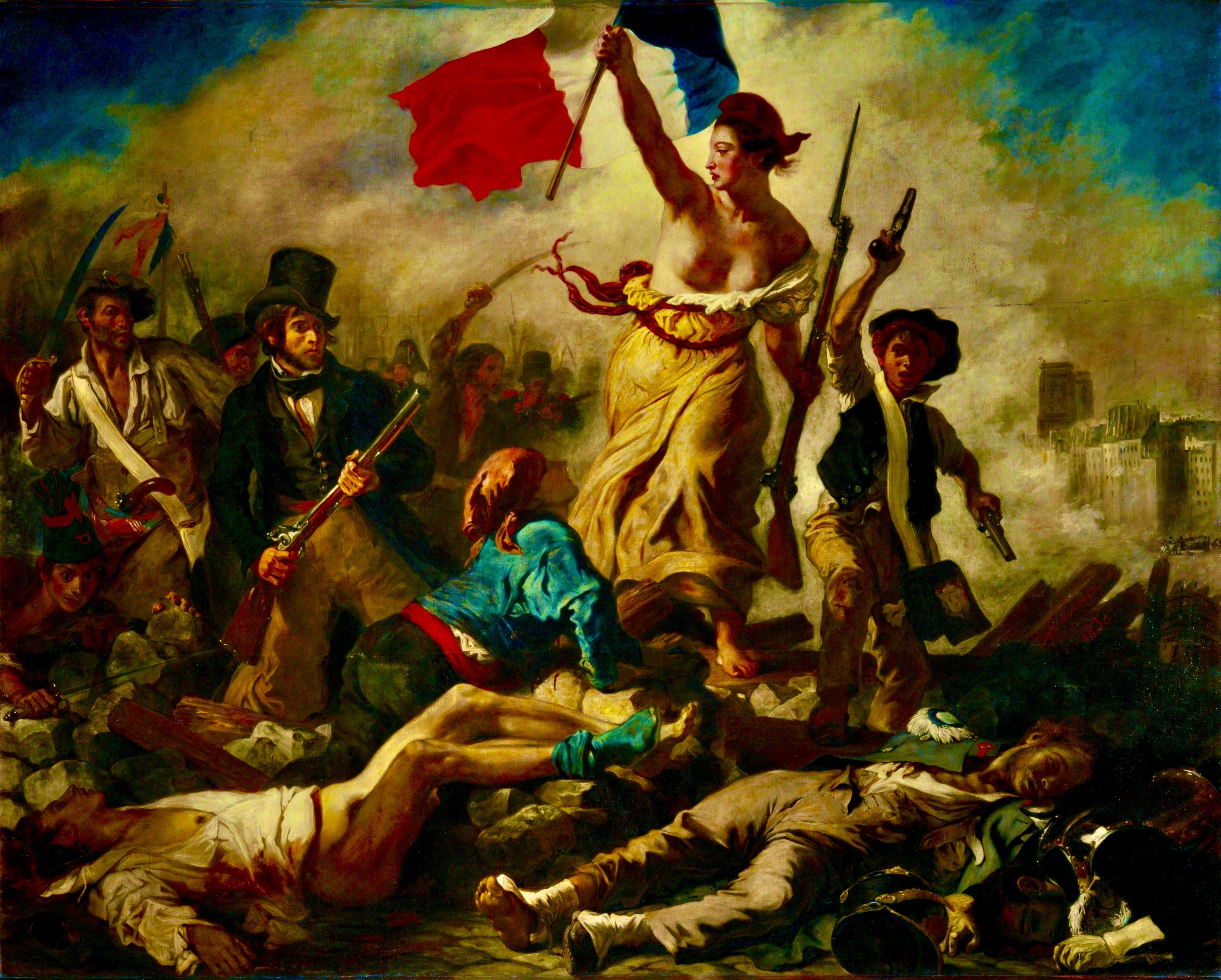
ICE is Out of Control
January 26, 2026
ICE is out of control, ignoring the law and our Constitution. Congress must vote NO on any additional funding for DHS.
Further, here is SOME of what else we must do:
+ Get ICE, CBP and the rest of Trump’s domestic army out of Minnesota and Maine NOW
+ No more warrantless arrests, no more stopping people based on race or because of the languages they speak
+ End qualified immunity for ICE and CBP agents to ensure Americans’ constitutional rights are protected
+ Unmask ICE and CBP agents and require clear identification
+ End detentions and deportations of U.S. Citizens
+ Investigate and prosecute every single DHS officer who broke the law and require DOJ and DHS to cooperate with states and cities investigating immigration agents who broke the law
+ Repeal the $75 billion for ICE and the nearly $65 billion for CBP in Trump’s One Big Beautiful Bill and restore funding to health care
+ Impose strict standards on all detention centers and hold them accountable for their human rights abuses
Will D.H.S. Destroy Free Speech In Minnesota?
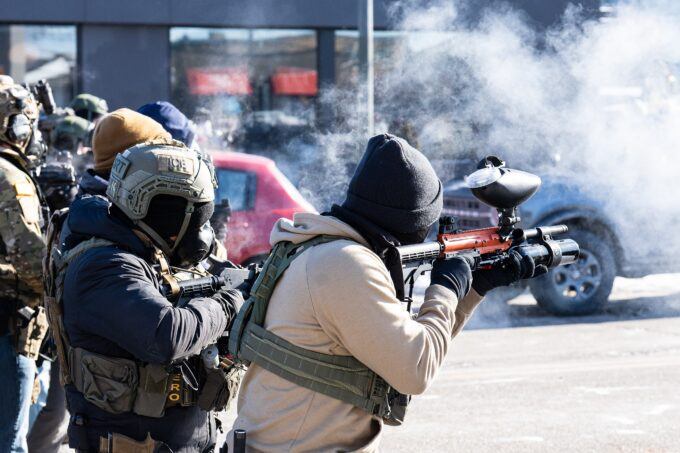
ICE and Border Patrol agents on Nicollet Avenue on January 24, 2026. This follows the shooting death of Minneapolis resident Alex Pretti. Photograph Source: Chad Davis – CC BY 4.0
DHS Secretary Kristi Noem calls for Minneapolis to “set up a peaceful protest zone so that these individuals can exercise their First Amendment rights and do so peacefully.” Since 9/11, “free speech zones” have been one of the biggest constitutional shams around.
Both major political parties have used “free speech zone” restrictions to seek to totally silence dissent. As I wrote in 2004 in the Baltimore Sun, the Democratic National Convention that year was downright bizarre:
In Boston, police and convention organizers aimed to restrict protesters to a large patch of asphalt in a dank and dark area below an elevated subway line, nearby highways overhead. Internet blogger Gan Golan described the area: “It’s like a scene from some post-apocalyptic movie — a futuristic, industrial detention area from a Mad Max film. You are surrounded on all sides by concrete blocks and steel fencing, with razor wire lining the perimeter. Then, there is a giant black net over the entire space.”
Federal judge Douglas Woodlock declared that the designated protest area looked like “an internment camp.” Convention organizers justified covering the area with netting because of the danger that protesters might throw something at convention delegates. The possibility that one demonstrator might throw one apple at one delegate justified preemptive caging of all demonstrators. Unfortunately, the U.S. government does not use the same stringent standard when bombing foreign countries.
The Boston “free speech zone” illustrated how Democrats adopted one of Mr. Bush’s most repressive trademarks. At a 2003 speech by Bush in St. Louis, the ACLU’s Denise Lieberman complained: “No one could see [the protestors] from the street. In addition, the media were not allowed to talk to them. The police would not allow any media inside the protest area and wouldn’t allow any of the protesters out of the protest zone to talk to the media.” Protestors were also severely restricted at the 2004 Republican convention in New York City.
Congressman Ron Paul and 11 House colleagues sent a letter to President Bush in 2003 condemning the administration’s crackdowns on demonstrators:
As we read the First Amendment to the Constitution, the United States is a “free speech zone.” In the United States, free speech is the rule, not the exception, and citizens’ rights to express it do not depend on their doing it in a way that the president finds politically amenable. . . . We ask that you make it clear that we have no interest as a government in “zoning” constitutional freedoms, and that being politically annoying to the president of the United States is not a criminal offense.
Back in Minneapolis, Mayor Jacob Frey responded to Noem: “First Amendment speech is not limited to one park or one section of the city. You are allowed to protest, so long as you’re doing it peacefully. And by the way, we’ve got tens of thousands of people in Minneapolis… peacefully expressing their First Amendment rights.”
DHS is seeking to enforce a “cone of silence” over all its operations – including information that has already been publicly disclosed. On Face the Nation, host Margaret Brennan asked Noem: “Tell me about the officer, Jonathan Ross.” Noem was outraged at the question: “Don’t say his name! I mean, for heaven’s sake, we shouldn’t have people continue to dox law enforcement.”
When did the names of federal agents reach holy par with the name Jehovah in the Monty Python “Life of Brian” movie?
It would be absurd to expect DHS to show good faith on “free speech zones” when the feds have already proclaimed that it is a crime for citizens to videotape ICE officers in public. As Fox News’ Minneapolis reported, “A DHS bulletin issued last June identified the use of cameras, live-streaming interactions with officers, and video recording at protests as ‘unlawful civil unrest’ tactics and ‘threats.’” DHS’s Assistant Secretary for Public Affairs asserted last summer that “videotaping ICE law enforcement and posting photos and videos of them online is doxing our agents… [We] will prosecute those who illegally harass ICE agents to the fullest extent of the law.” An ongoing lawsuit claims that Noem “established, sanctioned, and ratified an agency policy of treating video recording of DHS agents in public as a threat that may be responded to with force and addressed as a crime.” Going back almost a decade, federal appeals courts have unanimously ruled that “there is a First Amendment right to record police activity in public.”
Protesting federal abuses doesn’t entitle angry citizens to commit violence or trespass. Some Minnesota protestors deserve to be arrested—the same way that a smattering of the protestors who destroyed property or assailed police on January 6, 2021 at the U.S. Capitol deserved arrest. Simply because some protesters are assholes doesn’t mean everyone else within city limits loses their constitutional rights.
Free speech zones are a pre-emptive strike against American freedom. To designate a free speech zone is to delegitimize free speech everywhere outside the pen. It is absurd to presume that no one has the right to get close enough to holler at a politician. If federal policymakers cannot stand to hear angry protests, they should commit fewer outrages.
An earlier version of this piece was published by the Libertarian Institute.
Democrats Must Stop Enabling ICE
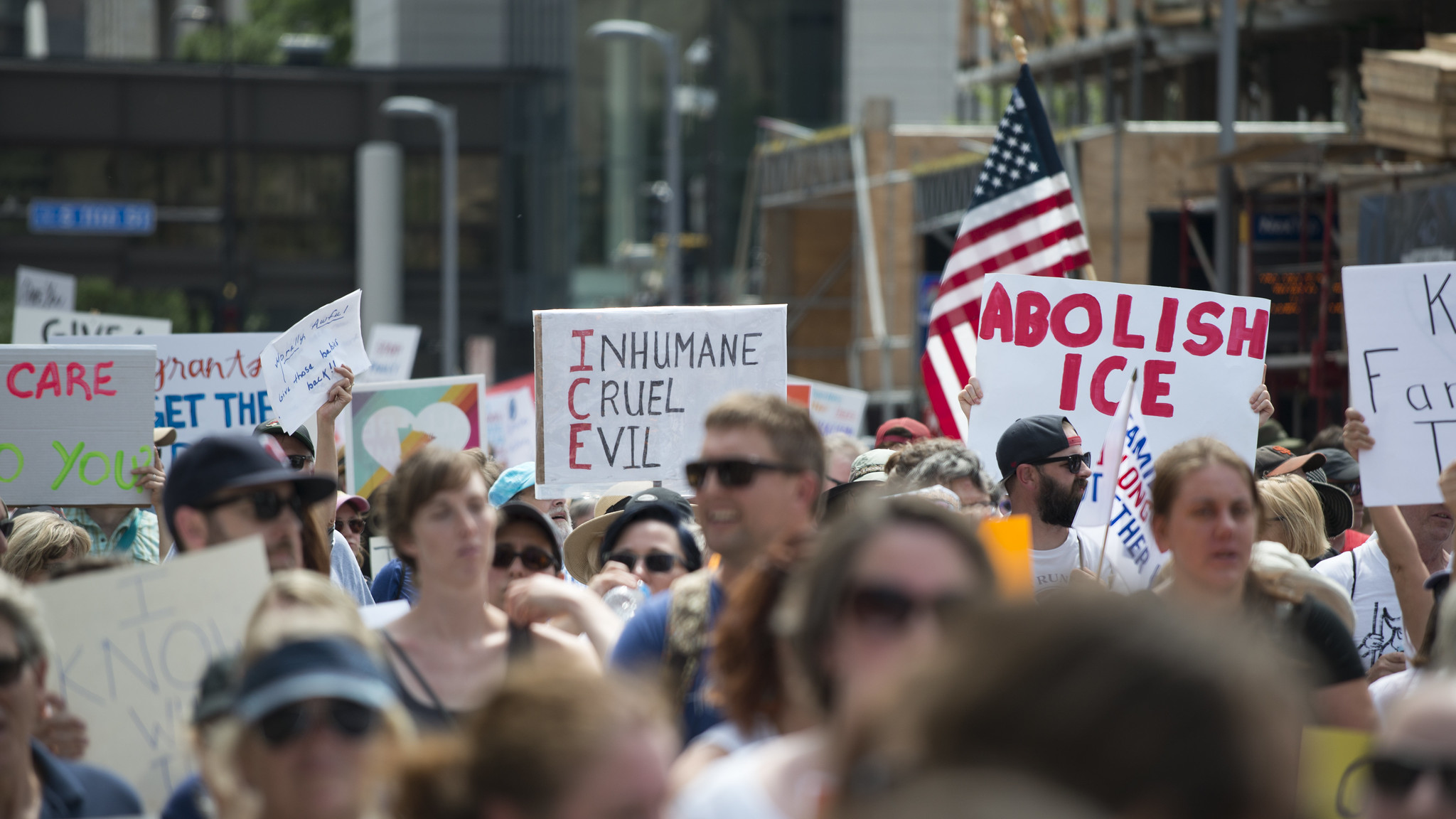
As Immigration and Customs Enforcement terrorizes cities and literally murders people, a tycoon-funded Democratic think tank is criticizing those saying lawmakers should reduce the agency’s funding — all while Democrats provide enough congressional votes to keep ICE flush with cash.
This may seem like an exaggeration — but that’s what’s happened in the last two weeks:
- ICE murdered a Minneapolis woman and then murdered another person in the same city yesterday morning.
- Meanwhile, the Searchlight Institute — bankrolled by real estate moguls and run by former John Fetterman staffers — pumped out a memo criticizing those calling for abolishing ICE. The memo declares that the past “furor over ‘defund’ diverted attention from other reforms . . . sucked all the oxygen out of efforts at reform” and then concludes that “Democrats should embrace an aggressive plan to rebuild ICE.” As polling data show a plurality of Americans now want ICE abolished, Searchlight insists that cause is “at odds with the American public.”
- Days later, congressional Democrats provided enough votes to continue funding ICE. House Democratic Leader Hakeem Jeffries refused to whip votes against the measure.
It’s difficult to come up with the right metaphor to describe this dynamic. I usually revert to the Cheeto lock: authoritarianism is at the door, Democrats should be a thick Kryptonite Lock keeping it closed, but are instead a flimsy Cheeto.
But at this point, that metaphor understates what’s happening. The Harlem Globetrotters-Washington Generals comparison is more apt.
MAGA are the high-flying Globetrotters posterizing everyone on the court. The Democratic professional class — politicians, pundits, think tankers, and operatives — are the Washington Generals, paid a lot of money to be pantsed.
And somehow — even as this all reeks of staged kayfabe — many rank-and-file liberals lobotomized by social media and cable TV remain card-carrying members of the Washington Generals Fan Club, rather than angry sports fans demanding that their team make wholesale ownership and roster changes.
To know that it doesn’t have to be this way, just consider how Republicans would be acting in the counterfactual. As Matt Stoller reminds us:
If a Democratic president were occupying and harassing red states as Trump is doing, Republican governors would put up bitter, fierce resistance. They’d investigate the Feds. They file lawsuits. They’d threaten jail. Greg Abbott fought with Biden over shutting the border!
Instead, a powerful Democratic faction is still working hard to prevent a unified opposition. Take a look at this Politico story detailing what Democratic US Rep. Haley Stevens (D-MI) and Michigan Rep. Mallory McMorrow (D-Royal Oak) are throwing at Democratic US Senate candidate Abdul El-Sayed after he called to abolish ICE:
El-Sayed said in an interview that calling to abolish ICE is “not saying there is not a responsibility to secure our border and even to undergo certain kinds of immigration enforcement — but this ain’t it.”
Stevens hit back in a brief interview Thursday, saying Trump’s immigration tactics are “clearly an abuse of power. ICE is out of control, and we need to get answers and rein it in.” But as for abolishing the agency, she said, “I don’t believe that.” McMorrow, meanwhile, told Politico that Congress should use its budgetary powers to “reform the agency.”
Even if you perceive yourself as a “moderate” Democrat, you should at this point be able to imagine a different, better reality than this dystopia.
Even if you don’t support abolishing ICE, you should be able to admit that it’s not great that a well-funded Democratic think tank is spending its time sh–tting on those trying to create a vanguard against the agency. You should be able to admit it would be better for those resources to be spent on fortifying a real opposition.
Similarly, even if you believe in “law and order,” you should be able to admit that it’s pretty bad that Democratic lawmakers are providing votes to help fund Donald Trump’s chaotic and lawless assault on American cities. You should be able to admit it would be better for there to be a truly unified opposition to what’s happening.
But that better reality will not happen until rank-and-file Democratic voters relinquish their membership in the Washington Generals Fan Club, start holding their team accountable, and force them to be a real opposition.
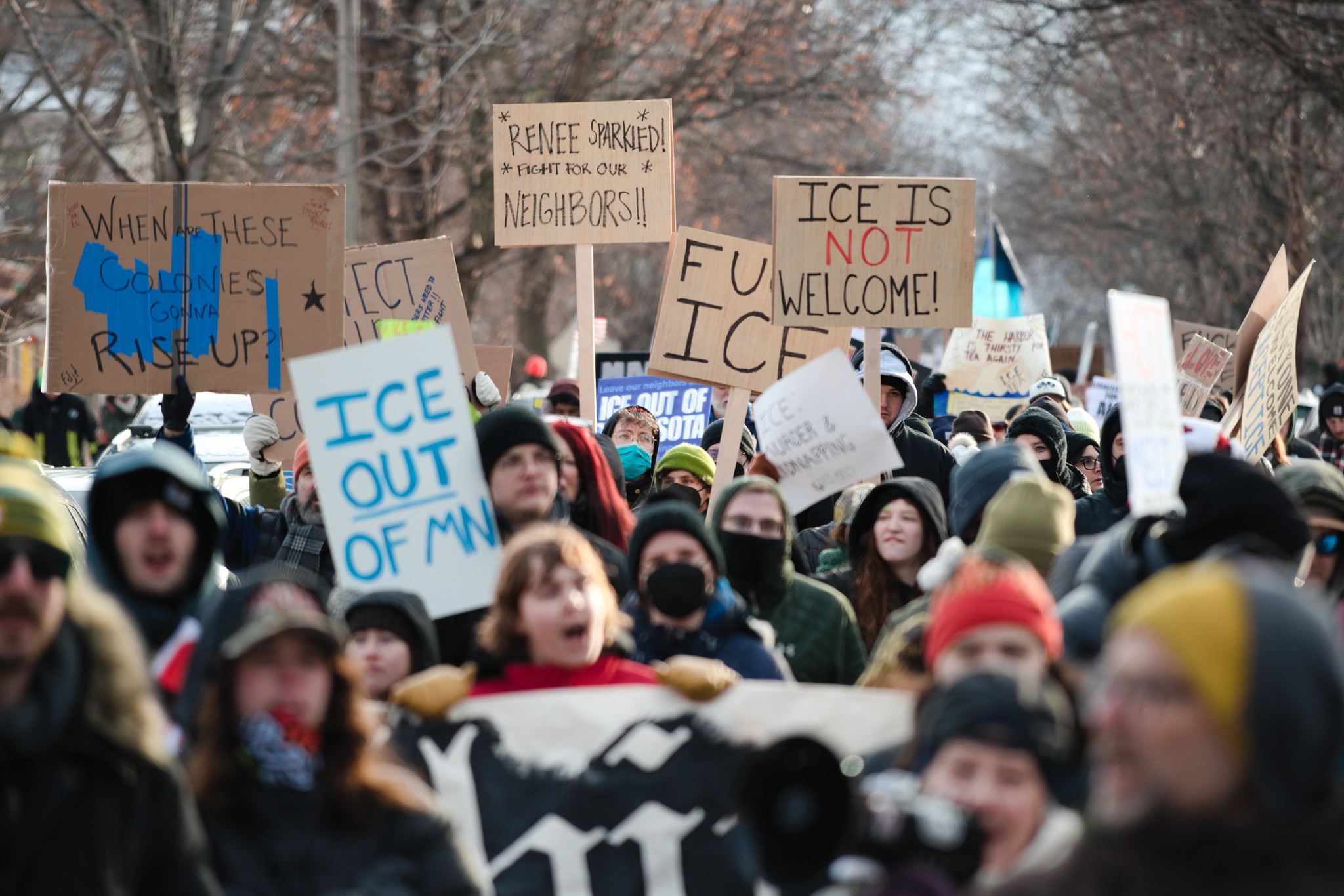
Alex Pretti was an intensive care unit nurse at a Veterans’ Affairs hospital in Minneapolis. One of his colleagues there told the New York Times that the “default look on his face was a smile.”
Now he’s dead at the age of thirty-seven — the same age as Renee Good, who was murdered a little over two weeks earlier in the same city. Both were American citizens. Both were shot to death by federal agents in the streets of Minneapolis while they were unarmed.
Subsequent statements by the Department of Homeland Security (DHS), which includes ICE and the Border Patrol, have emphasized that Pretti had a gun on him at the beginning of the altercation. But Minneapolis police chief Brian O’Hara has said that Pretti, who had no criminal record, had a valid permit to carry the gun. And the video evidence is decisive. He never tried to pull it, and it had already been confiscated before they killed him.
Homeland Security Secretary Kristi Noem said, “I don’t know of any peaceful protester that shows up with a gun and ammunition rather than a sign.” But this is extraordinarily disingenuous, and not just because openly brandishing guns is very common in protests held by the American right. And even if it had still been on his person when he was shot, it would have been entirely irrelevant. We haven’t repealed the Second Amendment and passed a law mandating that anyone caught with a handgun can be executed on the spot, even if they never draw it.
He was holding neither a gun nor a protest sign but a phone. He was there as a legal observer, using his phone to record what the agents were doing and deter them from committing abuses — a form of civic engagement that’s entirely legal under the First Amendment. The agents only found the gun after he’d been knocked to the ground and brutalized for the crime of trying to help a woman who’d been knocked over and pepper-sprayed near him moments before.
It’s worth emphasizing that we know all this because the murder occurred on a crowded street in broad daylight, filmed by multiple people. The DHS’s statement, never quite claiming he had drawn the gun but vaguely gesturing at a “violent” struggle and the officer who shot him supposedly fearing for “his life and the lives and safety of fellow officers,” is unlikely to be believed by anyone who watched any of those videos.
Indeed, one of the most striking parts of all this is that these particular lies don’t exactly seem to be intended to be believed. Instead, it feels like the point is just to give the hardcore supporters of the current administration something to hang their hat on when a “libtard” tries to give them a hard time about this. Better to say something anyone with access to the internet can see for themselves isn’t true than to be left with nothing to say at all. But this feels like a few steps from simply bragging about killing Pretti for being an annoying, disobedient thorn in the agents’ side.
After Renee Good was murdered, opinion polls showed that only about a third (and in some polls far less than a third) of the public believed the administration’s story. That didn’t stop Vice President J. D. Vance from relentlessly smearing Good, a mother who was shot while trying to drive herself and her wife and the family dog away from the scene, as a “domestic terrorist.” It didn’t stop several ICE agents in the ensuing weeks, some of whom seem to have known they were being filmed, from chiding protesters and observers for not learning their “lesson” after what happened to Good, clearly insinuating that it might be time for a repeat performance.
In any normal administration, the public relations catastrophe following Good’s murder would have led to some attempt to draw back and do damage control. The Trump administration had the opposite reaction, seemingly wanting to push the spiral of escalation further and further down the road to chaos.
Thus far, the restraint and unity shown by the overwhelming majority of the protesters in Minneapolis is remarkable. There have been mass demonstrations, an impromptu strike called by local organized labor, and an abundance of people filming ICE and the Border Patrol and letting them know that they aren’t welcome and that no one plans to make it easy for them to drag away their friends and neighbors. But there seems to be a widespread understanding that giving them an excuse for further mayhem would be a very bad idea.
Even so, the more lawless and violent the behavior of masked and therefore totally unaccountable ICE agents become, and the more the Trump administration pours gasoline on the fire by smearing anyone and everyone they victimize as a “terrorist,” the more likely it is that some misguided individuals will meet violence with violence. What comes next is anyone’s guess. Trump is already talking about the Insurrection Act. If we’ve learned anything from recent weeks, when the Trump administration has done everything from brazenly kidnapping a foreign head of state (and openly saying that they did it in part in order to gain control of his country’s oil) to threatening to seize territory from a NATO ally by force to calling a murdered mother a “domestic terrorist,” it should be the simple and frightening truth that no one knows what limits they are or aren’t willing to go to.
We know that the Trump administration is driving the country to the edge of a cliff. We know that they’ve pressed the gas pedal all the way to the floor of the car. We don’t know what’s waiting for us at the bottom of the cliff. But there’s every chance we’re going to find out.
ICE Is Not an Accident: What Would Martin Luther King Jr. Do Now
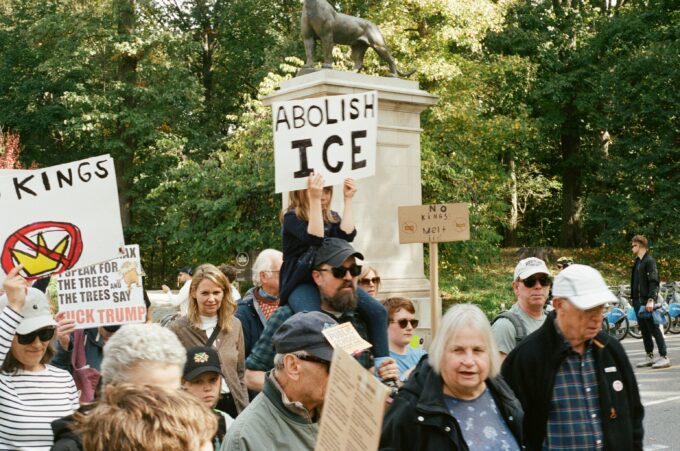
Image by Bradley Andrews.
I was thirteen when I watched the Rodney King beating on the evening news with my father. The grainy footage was relentless and impossible. I credit that evening as my political awakening. I asked countless questions and received hours of patient answers. What has stayed with me is not only the horror of what was shown, but the collective astonishment that accompanies recurring episodes of graphic violence. The lesson in outrage is familiar: society confronts violence only when the public bears witness to its spectacular and undeniable reality.
In 1944, at age 15, returning by bus from an oratorical contest in Dublin, Georgia. King and his teacher, Mrs. Bradley, were seated when white passengers boarded. The bus driver enforced the cruelty of Jim Crow laws and ordered Black passengers—including King—to give up their seats. He stood up and obeyed the unjust law. He later described this moment as one of the angriest of his life, saying he was “the angriest I have ever been in my life,” and that the humiliation stayed with him for years. We all have memories that imprint into our souls.
Seeing ICE terrorize neighborhoods and detain innocent people—citizens and noncitizens alike—should be as morally jarring as “whites only” counters, hospitals, and water fountains once were. It is the kind of injustice that, when explained plainly, still shocks the conscience—especially of children, who have not yet learned to treat cruelty as normal. It will not be forgotten anytime soon.
Recent events make clear that this is not an aberration. In the past week alone, federal officials have doubled down on an enforcement strategy that prioritizes speed, visibility, and volume over preparation or restraint. The resulting violence is treated as unfortunate fallout rather than foreseeable consequence. That framing is not just misleading—it is false. What we are witnessing is not a failure of execution, but the execution of a plan.
I feel the cycle repeating. Shock, grief, and calls for accountability emerge immediately. One case involves police officers beating a limp body: another, a federal agent firing “defensive” shots through a driver’s-side window. King’s experience of racist America and our observations of 5-year-olds abducted in their driveways are the same; the state makes excuses, talks about the law, and blames victims. Coverage fixates on physical details, evidence, and personal histories.
Public violence demands resistance—it is part of our moral economy—but the selectivity of that attention is troubling. We are fluent in responding to abrupt emergencies and far less equipped to confront the slow boil of cultural and structural violence. King would praise the whistles in Minnesota while condemning the dog whistles from MAGA republicanism.
We should trust our eyes. There is nothing “self-defense” about the ICE shootings, and the administration’s claims that the victims are domestic terrorists (or anything else) are false. But the fatal shots were delivered months earlier, when the administration intentionally produced predictable suffering. Who did this? Why?
The answer is not found at the moment a trigger is pulled. It begins earlier, in offices where executive orders are drafted, training timelines shortened, and numerical targets elevated over human judgment. When preparation is compressed, oversight weakened, and escalation rewarded, violence is no longer accidental—it is structural. The question is not whether harm will occur, but who will be blamed when it does. When “defensive shots” were fired, again, in the morning hours of Jan. 24th Governor Walz responded: “Minnesota has had it. This is sickening. The President must end this operation. Pull the thousands of violent, untrained officers out of Minnesota. Now.”
Focus will be rightly placed on questions like, he was on the ground, how is that defensive? But how did thousands of agents of the state end up there? How is it that 85% of MAGA Republican and 64% of non-MAGA Republicans say ICE is “Just Right” or “Not Aggressive Enough?” Will there be another clear cover up?
Martin Luther King Jr. insisted that state violence must be judged by the conditions that make it normal, not merely by the individuals who carry it out. He resisted narrowing moral judgment to individual perpetrators because doing so allowed institutions to deflect responsibility onto “bad apples.” Decades of promises about body cameras and training have served as distractions from administrative recklessness and policy design. In what society, King would ask, is this behavior considered normal?
In Beyond Vietnam, King warned that a society reveals its moral commitments not through slogans, but through budgets and policy. A nation that “continues year after year to spend more money on military defense than on programs of social uplift,” he argued, “is approaching spiritual death.” The same logic applies here: priorities hardened into legislation produce predictable harm. As King put it, “We as a nation must undergo a radical revolution of values.”
This outcome was produced by an administration that turned neighborhoods into war zones for political purposes. Choosing escalation at every opportunity yields predictable results. Bureaucracy and executive orders kill far more effectively than individuals animated by avarice or malice. Valuing order over justice and privileging loyalty over morality is no longer an inflection point; it is openly rewarded.
This violence is bureaucratic before it is physical. Sending armed agents into neighborhoods without adequate training is not an accident—it is policy. Calling resulting deaths “failures” or “oversights” sanitizes decisions made in advance, for political gain, at the expense of human life. ICE in 2026 resembles the Birmingham Police Department in 1963. Kristi Noem and Bull Connor share the same playbook of state power suppressing dissent through intimidation and force. When 5,000 children walked out of school to protest segregation, Connor unleashed snarling dogs and fire hoses. Many children carried toothbrushes, knowing arrest was likely.
In the margins of a newspaper, King penned Letter from Birmingham Jail. Denied proper writing implements while held in solitary confinement, he wrote on scraps of paper—napkins and toilet paper among them. His message on the urgency of nonviolent direct action could not wait. “Injustice anywhere is a threat to justice everywhere,” he wrote, calling on people to break unjust laws and accept the consequences.
Donald Trump has not pulled the trigger, but his immigration policies cause needless pain, suffering, and death. They are grossly unpopular: a 2025 PRRI survey reports that only three in ten Americans support his immigration agenda. That unpopularity helps explain the strong reactions from neighbors, friends, and community members. Training adds another layer of risk. What once took roughly five months has been reduced to forty-seven days. Increased operational complexity paired with reduced preparation is a recipe for disaster. If a parent gives a four-year-old a gun, they are blamed. When an administration sends undertrained agents into the streets, it should be blamed as well.
All elected officials must be held to account. Softened language—“accidents happen” or “nothing we could do”—lets everyone off the hook. Minneapolis Mayor Jacob Frey did not mince words, telling ICE, “Get the F___ out!” Leaders can defund reckless operations, demand proper training, and insist on accountability. Citizens deserve competence, not excuses. Split-second decisions about detention and lethal force unfold in real time; adequate preparation is essential to protect both civilians and agents.
Cutting corners to staff the streets was a bureaucratic choice driven by headlines and numbers. Policies and procedures are violent in themselves, and they can be reversed—but that reality is missing from much of the coverage. Armed agents terrorizing neighborhoods is a serious problem, but focusing only on those who pull the trigger will not prevent future harm. Real change requires confronting the policies that put those agents and their weapons in neighborhoods in the first place.
King was a moral authority and a tactician, but above all, he was a man of action. In 2026, he would make clear that ICE is not part of the promise of any American Dream. The promise of opportunity revoked by a society that blocks justice while demanding law and order, King repeatedly warned, creates the conditions under which violence becomes more likely—not because people are impatient, but because justice has been systematically denied.
King did not respond to state violence by asking for better public relations or gentler rhetoric. He demanded disruption. He organized boycotts, marches, and mass refusal. He forced institutions to confront the cost of maintaining unjust systems. If he were alive today, he would not ask ICE to behave more humanely while carrying out inhumane policies. He would demand that those policies be stopped—and he would insist that elected officials choose between order and justice, knowing they cannot have both.
Structural violence is slow, often invisible, and lethal. Spectacle cannot be our measure of accountability. To prevent harm, we must confront not just bullets, but bureaucracy—the policies and political calculations that set violence in motion. Only then can outrage become action: defunding reckless operations, restoring meaningful training, and rejecting policies that treat communities as testing grounds for political theater.