Resisting the Empire Next Door, Protests in Mexico Grow
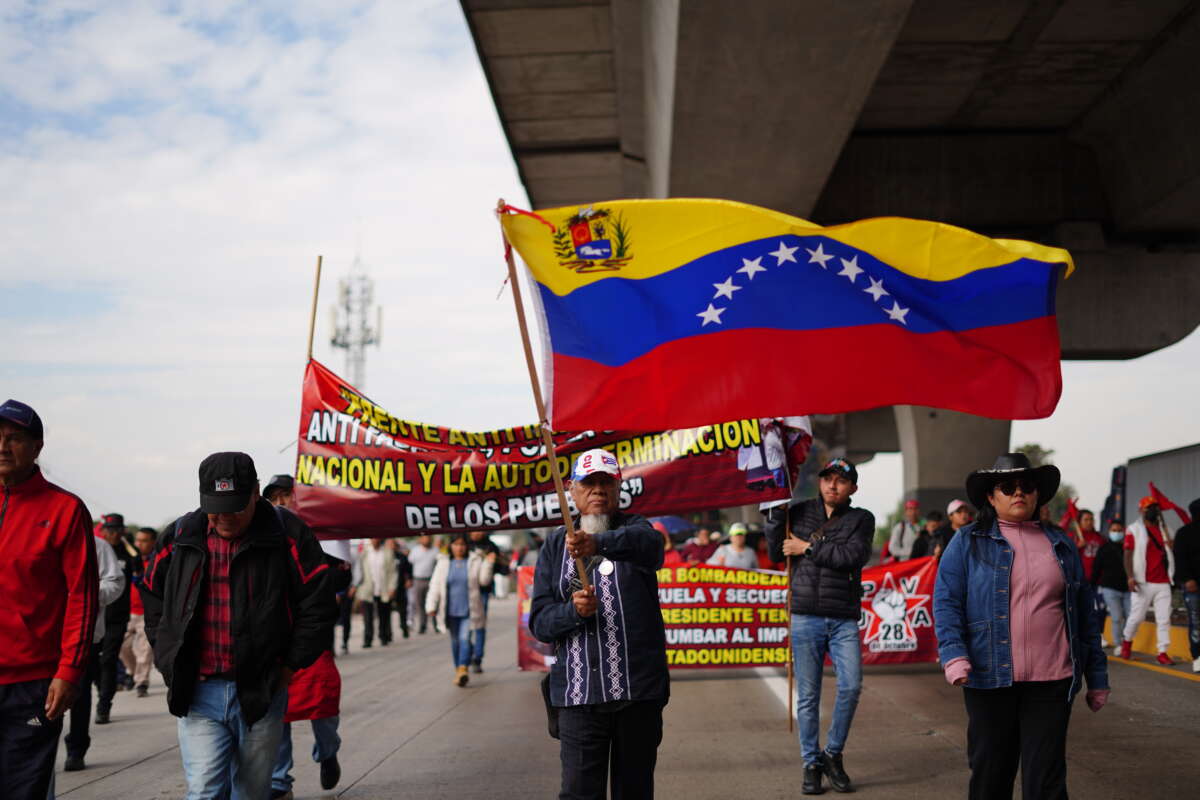
An anti-imperialist movement is building in Mexico, where the U.S. invasion of Venezuela has been seen as an act of intimidation for all of Latin America. Protests are swelling in response to this latest blow after decades of political and economic subjugation by its neighbor to the north.
Across the country, larger-than-usual marches on January 3 and 10 condemned the U.S. attacks on Venezuela. The marches included some pro-Morena groups (the governing party) as well as students, workers, farmers, and Indigenous groups that are critical of Morena.
Over a hundred organizations met in university union offices in Mexico City and collectively
condemned the U.S. intervention in Venezuela, calling for anti-imperialist action around the continent, as “Latin American sovereignty is at stake.” The Zapatistas also released a statement, supported by around 170 organizations in Mexico, in solidarity with the Venezuelan people and denouncing “big capital’s wars of conquest.”
In Mexico City, unions, environmentalists, feminists, sexual diversity activists, students, movements for housing rights, and anti-racists chanted “Yankees out of Latin America” and held banners that read “Down with the Monroe Doctrine.”
Here in Puebla, thousands of street vendors, small farmers, university workers, students, solidarity groups, and revolutionary organizations chanted, “We don’t want to be a colony.” The local anti-imperialist front was created on January 12.
“The day the U.S. bombed Venezuela, we mobilized in Puebla … and we condemned the aggression and denounced that this would be the start of something bigger,” Rubén Sarabia Sánchez, known as Simitrio, tells Truthout. The founder and general advisor of the UPVA 28 de Octubre, which organizes thousands of market and street vendors in Puebla, he has been a political prisoner twice and his daughter was murdered in 2017 as part of the repression of the group.
The front also called for another protest on January 21. That day, some 10,000 people shut down a major highway and marched along it for six kilometers (3.7 miles). “We’re not heard unless the circulation of goods are affected,” Simitrio said.
Other fronts have been formed around the country, including in Guanajuato, where civil society groups are calling for the withdrawal of all U.S. troops from Latin America. In Sinaloa, the new front has held protests in Culiacán, rejecting the U.S. attacks on Venezuela and defending self-determination throughout the continent.
“The sentiment in the marches has been ‘if it happens to them, it could happen to us.’ It seems like the U.S. president has no limits now,” Axel Hernández tells Truthout. He is part of the Journalism Cooperative in Mexico City, which has been documenting police abuse at protests and observing movements against gentrification, for water rights, and against the upcoming World Cup to be held in Mexico City, among other venues.
“With the supposed ceasefire in Gaza, the mobilizations for Palestine became smaller, but now we are seeing huge numbers of people coming into the street, for some of the biggest mobilizations in the past year … including unions, housing organizations, and even some members of Morena, and some of its leaders like the writer Paco Ignacio Taibo,” Hernández said. Formal political parties like Morena, PRI, PAN, etc. aren’t typically welcome in most mobilizations, such as demonstrations for women’s rights or for the forcibly disappeared.
Mexico’s National Education Workers Union (CNTE), with an estimated 350,000 members, condemned the attack on Venezuela, saying it confirmed Trump’s “monopolizing ambitions towards Latin America” and his “determination to use his military power for the capitalist interests of his empire.” Rural Indigenous organizations also released statements of solidarity, noting “Trump thinks the whole world is his village … but we understand that it is the people’s time … to wake and unite more.”
At the same time, a few right-wing figures in the country celebrated the attacks on Venezuela, with billionaire and media mogul Ricardo Salinas Pliego calling it a “victory” and source of “hope” for Mexico.
President Donald Trump’s direct threats and attacks against Mexico and Latin America have continued since the U.S. kidnapping of Venezuelan President Nicolas Maduro, with the U.S. selling stolen Venezuelan oil on January 14. The next day, The New York Times reported that the U.S. was intensifying pressure on Mexico to allow U.S. military forces into its territory, allegedly to dismantle fentanyl labs. Trump has also said the U.S. could strike land targets to combat cartels in Mexico. Then, on January 16, the Federal Aviation Administration issued a 60-day-long warning urging airlines to “exercise caution” over Mexico, Central America, Ecuador, and Colombia due to “military activities.”
“January 3 was a bigger blow in a war that has been going on for many years,” Miguel Guerra Castillo, an organizer of a new anti-imperialist front in Puebla and national leader of the Popular Socialist Party of Mexico, told Truthout. “But it was a warning and Mexicans are realizing this threat affects us.”
U.S. Pressures Mexico With Calls for Boots on the Ground
While Trump paved the way for military intervention in Venezuela by first bombing boats in the Caribbean under the pretext that they were supposedly trafficking drugs, his threats against cartels may also be laying the groundwork for actions in Mexico. Many U.S. companies depend on Mexico for nearshoring, low-paid labor, and access to land, water, and energy that is cheaper than in the U.S. Trump “wants to take control of” Mexico’s petroleum, water, and lithium, said Simitrio.
Trump designated six Mexican cartels as foreign terrorist organizations in February 2025. Nearly a year later, on January 7, 2026, he called for a US$1.5 trillion military budget for 2027, up from $901 billion for this year. The next day, he suggested that the U.S. military could launch land strikes on drug cartels in Mexico. “We’ve knocked out 97 percent of the drugs coming in by water. And we are going to start now hitting land, with regard to the cartels,” Trump said, adding, “The cartels are running Mexico, it’s very sad to watch and see what’s happened to that country.”
Anti-imperialist organizers in Mexico see Trump’s statements as a cover for U.S. imperialism.
“Drug trafficking is the pretext, the reality is that they want to impose their policies of domination on Mexico,” said Guerra.
Simitrio agreed. “Yes, it’s a pretext, a construct created by the United States to justify aggression whenever they want something.”
Mexico has already lived through a U.S.-led so-called “War on Drugs,” with disastrous consequences for the country. In 2006, then-president Felipe Calderón launched a military offensive against cartels, heavily supported by U.S. funding and strategy through the Merida Initiative. Conflict and violence between security forces and armed groups led to more violence, and organized crime groups bloomed, growing from just a handful in 2006 to reportedly over 400 by 2021, “many of them with ties to the U.S,” Business Insider noted. Further, the vast majority of cartels’ guns come from the U.S. now. From 2006 to 2020, there were over 250,000 narco-related deaths in Mexico — with homicides in Mexico tripling in the first six years of the “War on Drugs.”
On January 14, three U.S. congresspeople introduced the No Unauthorized War in Mexico Act to prohibit taxpayer funds being used for military invasion of Mexico. However, its passage is unlikely, as a resolution to limit the future use of U.S. military force in Venezuela has already failed.
Bilateral “Collaboration” Amid Fear and Intimidation
The attack on Venezuela demonstrated that the U.S. under Trump is ready for escalation. The attack “was also to plant fear, to demobilize us,” said Guerra, “It’s an intolerable pressure, that we can’t ignore or assume nothing will happen. Nor should we see it as a done deal. The United States has global military supremacy. It is the international police, and with the latest policies, they have declared themselves the owners of the Americas.”
Nearby, Cubans are also anxious, as Trump has said Venezuelan oil supplies — a lifeline to the country — will be cut. The U.S. is saying Cuba has to make a deal before it’s “too late,” but Cuba is refusing.
“The threats regarding supplies have people worried, but at the same time, they’re used to it … from friends, I’m getting angry resignation. More worrying, is the idea of military intervention, though many don’t think that is likely, since Cuba doesn’t have oil or key resources. But with Trump, anything is possible,” Catriona Goss told Truthout from Havana.
Mexican President Claudia Sheinbaum has offered to mediate dialogue between the U.S. and Cuba, and this month she has consistently responded to Trump’s pressure on Mexico with rhetoric about “coordination” and “cooperation.” She has also stressed the Mexican government’s “positive results” in capturing key criminal leaders and destroying drug laboratories. However, if drugs are just a pretext, as was the case in Venezuela (Trump has only talked about and sold oil since the intervention), then such “collaboration” by Mexico will have its limits.
Just over the past year, the U.S. has canceled CBP One appointments and left thousands of migrants and refugees stranded in Mexico. Mexico has sent troops to its north and south borders to appease U.S. anti-migrant policies, and the U.S. has forced Mexico to continue to “cooperate” via tariffs as threats or punishments.
Mexican officials have reported that in every call between Trump and Sheinbaum, the U.S. president has raised the specter of troop deployment. As a result, the government is reassessing its assumptions that obedient economic and security policies are sufficient to protect Mexico from unilateral U.S. action.
“The U.S. has never stopped attacking our continent — with weapons or economically, it’s always there, protecting its economic and geopolitical interests,” said Hernández.
Transnationals Are Prioritized as Trade Talks Approach
Sheinbaum and Trump also disagree on the United States–Mexico–Canada Agreement (USMCA) — the new version of NAFTA that went into effect in 2020 — which is due for review in July. Trump said on January 14 that the USMCA is “irrelevant” without any “real benefits,” while Sheinbaum believes it is important, given the highly integrated economies between the three participating countries. But while major automakers have said they depend on it, Mexican people and the environment do not benefit in the long term. The USMCA promotes extractivism and mining and protects transnational miners over Indigenous communities’ rights and the Mexican environment. It also permits extreme wage inequality between U.S. and Mexican workers who are doing exactly the same work for the same company.
Trump is only against the USMCA because he wants to be able to use tariffs to extort, Simitrio explained. The agreement includes a no-tariffs policy for products that meet certain requirements and are largely made in North America.
“I don’t think there is real sovereignty here, because economic interests take precedence. The law, or the Mexican state, always come down in favor of transnational companies,” Hernández said, agreeing with Estrada that, “Everything changed with NAFTA, now the USMCA. I was born after NAFTA, but all the uncles and parents always talk about how things were different before it.”
NAFTA opened Mexico up much more to imports and exports, and U.S. multinationals quickly set up hundreds of factories to exploit Mexican labor and resources. NAFTA provisions forced Mexico to tolerate most pollution and environmental consequences of these factories, as the government could be sued if environmental regulations negatively impacted transnationals’ profits. NAFTA reorganized Mexico’s economy, replacing local products and food traditions with U.S. products, and millions lost their jobs and land.
As a continuation of this approach, under USMCA, U.S. corn exports to Mexico (where Indigenous people created modern corn) are protected, Mexico can’t ban genetically modified crops from the U.S., and private pharmaceutical corporations are prioritized over public health.
“United States imperialism is in our veins — it’s not just this external thing where they crush and pressure you from the outside, it’s also within the economy,” said Simitrio. He believes the Mexican government uses sovereignty as a “disguise for subordination to the United States,” and describes how transnationals are often the main beneficiaries of fuel, energy, and other resources, even when petroleum is extracted and managed by a state company.
Coca-Cola for example, uses 419.7 million cubic meters of water a year, leaving many Chiapas residents without water, and private car manufacturing has increased its energy consumption (provided by the publicly-owned CFE) by 75 percent over the past decade.
The three countries in USMCA will also host the World Cup in June and July this year. The event is bringing other issues to the forefront, Hernández said, as the Mexican government is spending a lot of money and time on tourism, while urgent social issues are sidelined.
“Processes of colonization that have been denounced and protested for a while are more visible now,” he said, referring to displacement of Indigenous and other local communities and the diversion of resources for gentrification, multinational construction, and transnationals like FIFA and Airbnb. Protesters argue that the proliferation of Airbnb and other types of gentrification are increasing the rent of locals and leading to mass evictions by landlords, while legislation fails to protect renters and Mexico City has an agreement with Airbnb to promote tourism.
Protesters outside the U.S. embassy on January 18 called for a boycott of U.S. chains like Walmart and McDonald’s because they “finance wars” and for a boycott of the World Cup because the government is prioritizing it and the needs of tourists over the needs and demands of movements.
“Younger people in Mexico haven’t known any life other than being under the thumb of an empire,” Juan Francisco Estrada García tells Truthout. He is a university professor and general secretary of SUNTUAP, the University of Puebla Workers’ Union that was a key convener of the recent anti-imperialist marches in Puebla.
“What happened (in Venezuela) is a continuation of history, of the U.S. tradition of ruling over the governors — imposing its will through local leaders,” said Estrada. “It’s a system that was established a very long time ago. The U.S. is present everywhere in Mexico, it owns half the country, it is meddling in everything.”


.jpg)