Friday, January 30, 2026


Scarlett Johansson, Cate Blanchett among 800 artists calling AI training 'theft'

FILE - Scarlett Johansson poses for photographers upon arrival at the premiere for the film 'Transformers One' o, Sept. 19, 2024, in London.
Copyright Photo by Scott A Garfitt/Invasion

By Euronews
Published on 

There are around 60 ongoing lawsuits in the US where creators and rightsholders are suing AI companies.

Some 800 artists have signed an open letter accusing technology companies of "theft" of copyrighted work to train their artificial intelligence (AI) models.

Writers, musicians, and actors—including Scarlett Johansson, Cate Blanchett, the band R.E.M., and Breaking Bad creator Vince Gilligan—are among the signatories of the open letter from the Human Artistry Campaign's Stealing Isn't Innovation movement.

The letter demands that companies engage in "ethical" partnerships rather than "stealing."

AI companies are facing multiple copyright lawsuits brought by artists and their representatives over the unauthorised use of copyrighted works to train AI models—with mixed results in the cases heard or settled so far.

"America's creative community is the envy of the world and creates jobs, economic growth, and exports," the open letter reads.

"But rather than respect and protect this valuable asset, some of the biggest tech companies, many backed by private equity and other funders, are using American creators' work to build AI platforms without authorisation or regard for copyright law."

There are around 60 ongoing lawsuits in the US where creators and rightsholders are suing AI companies. Similar cases are also underway in Europe.

AI companies train their models by feeding vast amounts of data—including text, images, music, and video—into their systems. These models learn patterns from this data to generate new content.

But much of this training material is scraped from the internet without permission from copyright holders, including books, articles, artwork, photographs, and music. Companies argue this practice falls under "fair use," while artists contend it's unauthorised copying that undermines their livelihoods and intellectual property rights.

In 2024, OpenAI faced backlash from Scarlett Johansson after its Advanced Voice feature sounded similar to the actor's voice in the 2013 film "Her." Legal representatives for Johansson sent OpenAI letters claiming the company did not have the right to use a voice resembling hers. OpenAI subsequently paused the "Sky" voice.


‘It’s the newest form of victimisation’: Paris Hilton joins the fight against AI deepfakes

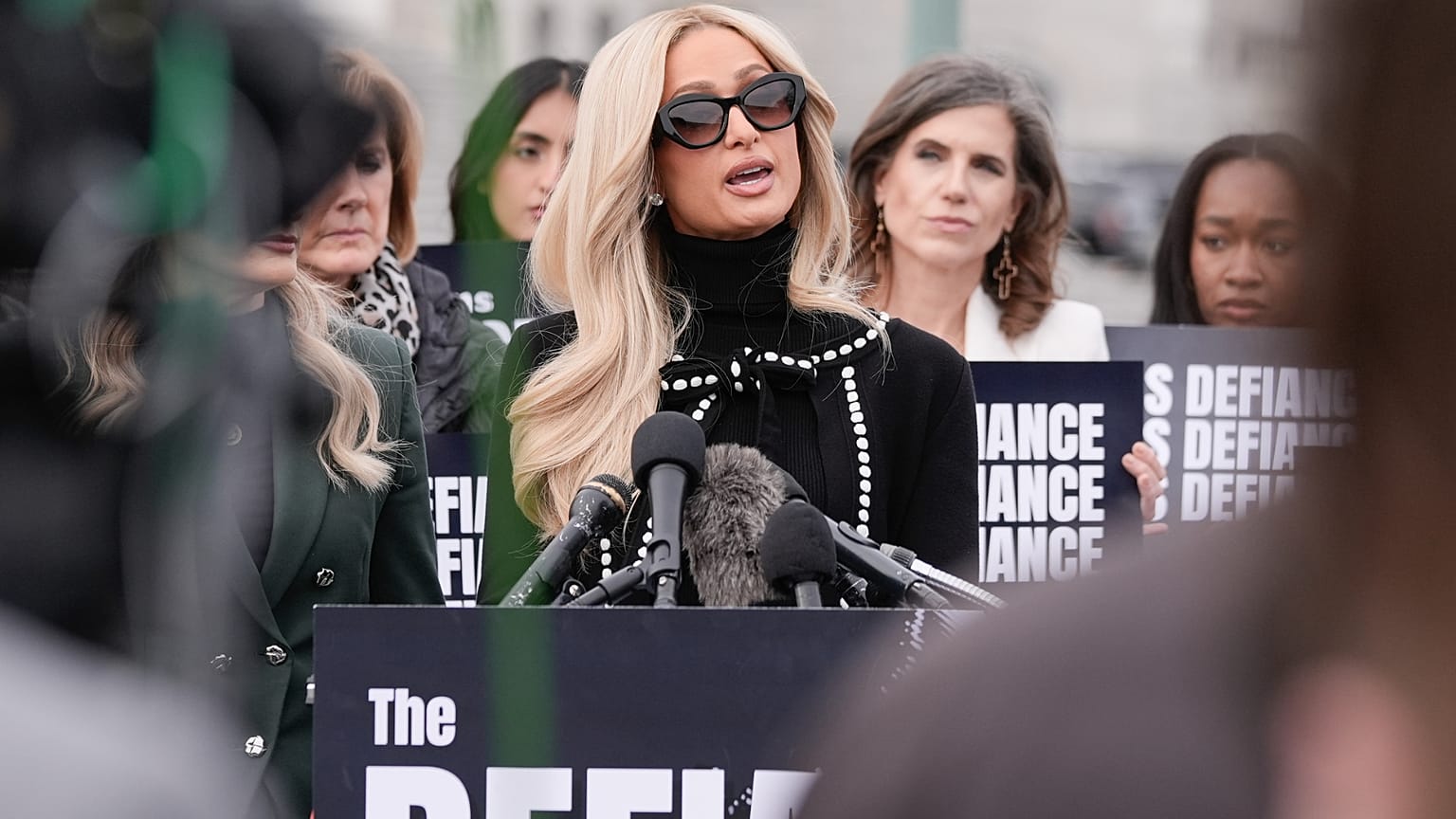
Paris Hilton speaks during a news conference promoting the passage of the Defiance Act on Capitol Hill, Thursday, Jan. 22, 2026, in Washington.
Copyright AP Photo/Mariam Zuhaib


By Anca Ulea
Updated 

Socialite and hotel heiress Paris Hilton joined US congresswoman Alexandria Ocasio-Cortez to advocate for legal protections for victims of AI deepfake porn.

A sex tape released without her consent helped make Paris Hilton a household name in the early 2000s.

The hotel heiress and businesswoman compared what happened to her then to the deepening artificial intelligence (AI) deepfake pornography crisis now targeting women and girls around the world.

In recent weeks, global regulators have urgently addressed a growing wave of sexually-explicit deepfakes targeting women and minors without their consent, with Elon Musk's chatbot Grok at the centre of the backlash.

Responding to user prompts, Grok generated hundreds of thousands of images that "undress" real women and, in some cases, girls. While xAI said it "implemented technological measures" to prevent the chatbot from editing these images, researchers found those safeguards could be bypassed.

"Deepfake pornography has become an epidemic," Hilton told a crowd outside the US Capitol building on Thursday. "It's the newest form of victimisation happening at scale – to your daughters, your sisters, your friends, and neighbours".

Hilton was 19 years old when a nude video of her spread like wildfire online, catapulting her to infamy in an era defined by predatory tabloids that exploited young women in the public eye.

"People called it a scandal – it wasn't. It was abuse. There were no laws at the time to protect me, there weren't even words for what had been done to me," Hilton said, speaking publicly for the first time about the 2004 incident.

"I lost control over my body, over my reputation. My sense of safety and self-worth was stolen from me, and I've fought hard to get those things back," she added.

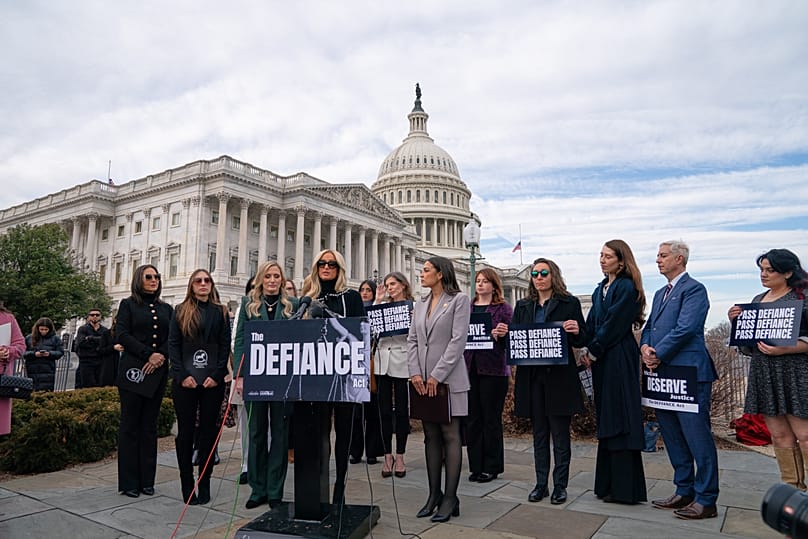
Paris Hilton speaks at a news conference promoting the passage of the DEFIANCE Act at the Capitol, Thursday, Jan. 22, 2026, in Washington. AP Photo/Allison Robbert

The 44-year-old said she now wants to use her story to help other young women and girls who are being exploited online by abusers using AI tools.

That's why Hilton said she joined US congresswomen Alexandria Ocasio-Cortez and Laurel Lee to advocate for the Disrupt Explicit Forged Images and Non-Consensual Edits (DEFIANCE) Act.

The bill, which passed unanimously in the Senate last week and must now be brought before the House of Representatives, would give victims of AI-generated deepfakes a legal pathway to press charges against their abusers.

"This isn't about just technology, it's about power," Hilton said. "It's about someone using someone's likeness to humiliate, silence and strip them of their dignity. But victims deserve more than after-the-fact apologies, we deserve justice".

Hilton said that she has also been targeted by 100,000 sexualised AI deepfakes.

"Not one of them is real, not one of them is consensual. And each time a new one appears, that horrible feeling returns, that fear that someone somewhere is looking at it right now and thinking it's real," she said.

Reining in abusive AI tools

The DEFIANCE Act comes on the heels of the TAKE IT DOWN ​​Act, which was signed into law in May 2025 as the first US federal law limiting the use of AI in ways that can be harmful to individuals.

TAKE IT DOWN, which stands for "Tools to Address Known Exploitation by Immobilising Technological Deepfakes on Websites and Networks Act," requires online platforms to remove unauthorised intimate images and deepfakes when notified. It comes into effect in May 2026.

"TAKE IT DOWN gave us removal, and DEFIANCE will give us recourse and restitution," said Ocasio-Cortez, co-sponsor of the DEFIANCE Act.

"Once the bill is signed into law, and it will be signed into law, survivors will have the ability to hold their abusers accountable and seek financial and reputational damage for the harm they have caused," she added.

The bipartisan DEFIANCE Act would give survivors the right to sue individuals who knowingly produce, distribute, solicit, or receive nonconsensual sexually-explicit digital forgeries. It also targets those who possess the content with the intent to distribute.

In Europe, the Digital Services Act (DSA) and AI Act offer some protection against deepfakes, by requiring platforms to label AI-generated content. Deepfake pornography is not explicitly addressed, leaving the enforcement up to individual member states.

Countries such as France, Denmark, and the United Kingdom have passed lawsprotecting victims from sexually-explicit deepfakes – targeting distributors of nonconsensual AI deepfakes with hefty fines and even prison sentences.


New calculator shows exactly how much environmental damage is behind your internet searches

A close-up shot of a man typing on a laptop.
Copyright Glenn Carstens-Peters via Unsplash.


By Liam Gilliver
Published on 

9,000 monthly searches on YouTube.com uses 10 litres of water – enough for a capuchin monkey to survive for 77 days.

The internet is responsible for 3.7 per cent of global carbon emissions, outpacing air travel. If the internet were a country, it would be the fourth-largest polluter in the world.

It’s why scientists have created an innovative tool to shed light on how our internet activity is impacting nature.

Developed by climate experts at the University of Exeter in partnership with Madeby.studio, Digital Impact for Species is able to analyse any website and reveal its hidden environmental costs beyond the standard metrics of CO2 emissions, water and energy consumption.

“When we visit a website, we rarely think about the environmental impact,” says project lead Dr Marcos Oliveira Jr of Exeter's nature and climate impact team.

“But there is a high cost, from the energy consumed as the information makes its way from the data centre to your computer or smartphone, to the water used to cool servers.”

Are websites killing the planet?

To calculate the impact of any website you visit, all you have to do is paste the URL into the tool’s search bar. It will then present an overall rating from A+ to F, along with how much the search is impacting nature.

For example, YouTube.com, which processes billions of searches every month, is ranked C - meaning improvements could be made in its environmental impact. Each page view of this popular site generates 0.249g of CO2, uses 0.0011 litres of water, and 0.62Wh of energy.

For every 9,000 monthly visits, 10 litres of water is needed – enough for a capuchin monkey to survive for 77 days. Based on this number of monthly visits, nature would need an Amazon rainforest tree working for 41 days to absorb the levels of CO2 produced.

9,000 monthly visits also uses 6kWH of energy, equivalent to 1,000 anna’s hummingbirds’ daily energy use for 332 days.

“This is not about naming and shaming websites with high environmental footprint, but engaging people and prompting discussion as to how we might build a more sustainable internet,” Dr Oliveira Jr adds.

How is our website footprint calculated?

The tool uses Google PageSpeed Insights to measure the exact size of all resources loaded when you open a website page. If PageSpeed is unavailable, it will rely on the industry average page weight.

This is the total size of all files loaded when you visit a webpage, such as images, text, and video. Larger pages require more energy to transmit and process, resulting in higher emissions.

The tool then uses data from the Green Web Foundation to determine if the website is hosted on servers that are powered by renewable energy or fossil fuels.

Using the Sustainable Web Design Model, calculates CO2 emissions, energy usage and water consumption for each page view.

It translates these metrics into “relatable nature comparisons”, using a database of scientifically-sourced species data.

How can we lower our website footprint?

Consumers can only really slash their website footprint by searching less, pushing the onus onto website hosts.

Researchers say that using fewer images, limiting font use, making navigation simple and avoiding the use of videos when possible are all quick ways to reduce the internet’s environmental impact.

Using a green web host that uses renewable energy instead of fossil fuels will also help, as well as removing extra code and following search engine optimisation (SEO) guidelines to make sure people find the right pages faster.

Clean steel in the making: inside Europe's future green metallurgical plants

Copyright Hydnum Steel
By Julian GOMEZ
Published on 23/01/2026

This is the story of how a small European Union family business has grown to become a global game changer in the ultracompetitive sector of clean steel. A technological challenge… made in Europe.

Now a global competitor, the Russula Group has designed 130 steel factories and industrial waste water treatment plants in 35 countries worldwide.

The European steel sector is their next big target. The managers estimate that the European Union is short by roughly 10 million tonnes of steel each year. They think Europe has now the knowhow to lead the way in the production of clean steel, in both profitable and sustainable ways.

“This reindustrialization in the 21st century is absolutely sustainable because the technology we Europeans have developed in recent years is completely environmentally friendly”, says Eva Maneiro, CEO at Russula Group. “There's no excuse. And is it profitable? Very profitable.”

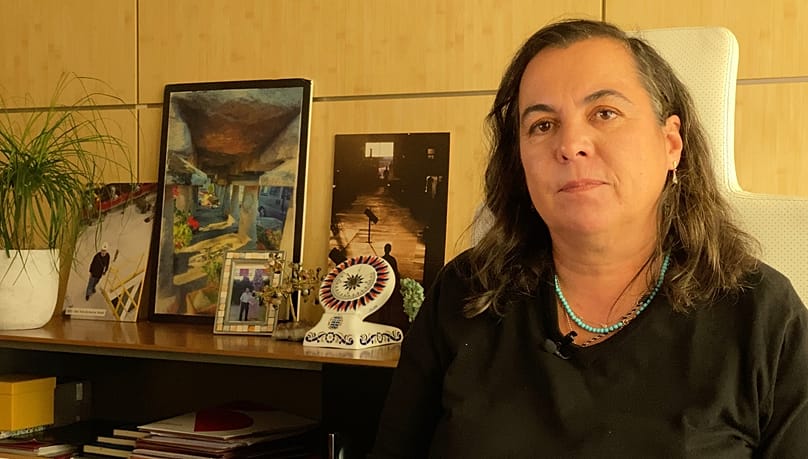
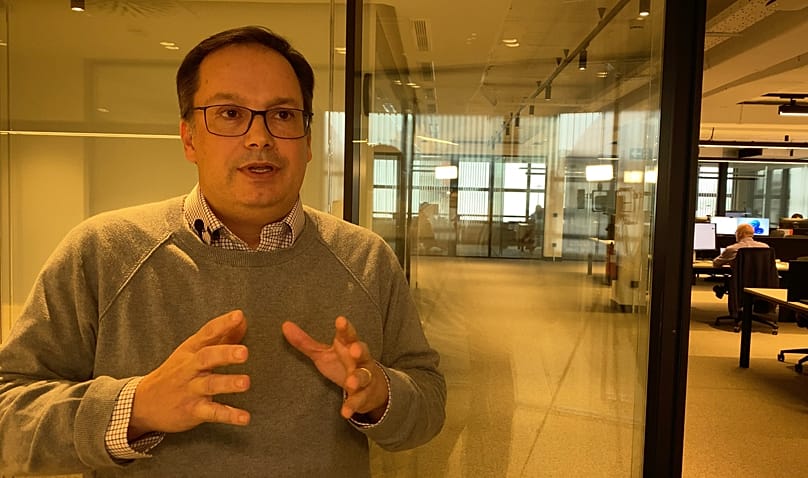
Eva Maneiro, CEO at Russula Group Euronews

To show the example, the company will soon be starting the construction of its own new ultraeficient factory of clean steel in Central Spain. An initial investment of 1.6 billion euros. The main raw material will be ferrous scrap. The factory will run on renewable energy, including green hydrogen. Managers claim steel manufactured here will emit 98% less emissions of CO2 than in ordinary steel factories.


3D modelling of the future green steel factory in Puertollano, Spain Hydnum Steel

“Today we consider that the steel industry is responsible for almost 10% of the total greenhouse emissions in the world. So we understand that it is extremely necessary to begin the transition and use these new technologies that can save millions of tons of CO2”, says Fernando Pessanha, Chief Strategy Officer at Hydnum Steel. “For instance, in our facility, the amounts of CO2 we are avoiding equals the full city of full emissions of all the cars in the city like Madrid. So it's a massive amount and it's paramount to push the green transition.”

Fernando Pessanha, Chief Strategy Officer at Hydnum Steel Euronews

They hope to produce 1.6 million tons of flat roll steel products in a first phase, and to double the production consequently. Managers claim the factory will create some 1,000 direct jobs when fully operational, with thousands more indirect jobs on the pipeline.

Sustainable Innovation will be key to ensure a competitive future for the European steel industry, managers here conclude.

Engineering work at Russula Group Euronews

“Sectors like automotive, infrastructure, and renewable energy have already committed to decarbonization, and for this, they need the entire value chain, all their production processes, to be decarbonized”, says Daniel Sánchez, Chief Operating Officer at Russula Group. “Steel plays a very important role, and it all comes down to decarbonization along its supply chain”

Engineers make up 60% of the company´s staff. They are giving the last finishing details to the new steel factory plant, while working on many other projects worldwide.

Green electricity: Which EU countries are using the most?


By Alessio Dell'Anna & Léa Becquet
Published on 

Total use from renewable sources across the EU has nearly reached 50%, driven by hydro and, increasingly, by solar.

Austria tops the EU for renewable electricity use, with the highest share of power coming from green source

According to Eurostat, the country placed first with nearly a 90% green electricity use rate, boosted by its 16 hydroelectric power plants.

Sweden comes a close second at 88%, powered mainly by wind and water, while another Nordic country, Denmark, follows third with 80%, thanks to its extensive onshore and offshore wind farm network.

Rates significantly over 50% were also registered in Portugal (66%), Spain (60%) and Croatia (58%), while Italy and France placed in the bottom half, 18th and 21st respectively in the EU.

The lowest proportions of green electricity use were found in Malta (11%), the Czech Republic (18%), Luxembourg (20.5%), Hungary and Cyprus (24%).

These figures cover all electricity coming from renewable sources, including that imported from abroad.

Green electricity use across the European Union has surged over the past two decades.

In 2004, it accounted for just 16% of total electricity consumption. Some 10 years later, that figure climbed to nearly 29%, and today it stands at 47.5%.

Will solar overtake hydro as the main green electricity source?

Wind energy currently accounts for the largest share of renewable sources used to produce electricity, with 38% of the total, followed by hydro at 26%.

The fastest growing one, however, is solar, which went from just 1% in 2008 to over 23% in 2024, with 304 TWh.

Bruegel's energy expert Ben McWilliams told Europe in Motion that "it is almost certain that solar will overtake hydro in the next few years".

"Developers continue to build solar plants at a record pace, whilst hydro deployment does not increase," he said, adding that the more solar Europe can install, the better for energy security.

"Every new solar panel reduces oil, gas and coal dependency, and these dependencies are the true threats to European energy security," McWilliams said.

EU's solar reliance on China not a long-term issue, say experts

Although the vast majority of solar panels installed in the EU are made in China, McWilliams ruled out the idea that it makes Europe more fragile amid geopolitical tensions.

"Solar panels are a stock not flow; once the EU has installed a panel from China, it is there forever," he said. " If — for whatever reasons — solar panel imports from China stopped, it would just slow the build-out of new solar and supply would grow elsewhere (including domestically) over a two-three year period."

According to Solar Power Europe, there are currently 166 companies in the EU active in the photovoltaic, or light energy, chain.

The vast majority of them are in Germany, although the most solar energy capacity per capita is produced in the Netherlands, with around 1,044 W yearly.


Women lose 75 million years of healthy life annually – yet receive only 6% of health funding

Underfunding women's health costs 75 million years of life.
Copyright Cleared


By Marta Iraola Iribarren
Published on 


Collectively, women lose approximately 75 million years of healthy life each year – equivalent to a week of health lost per woman annually, according to a new report.

Women and girls make up 49 percent of the global population, and while they live longer than men, they spend 25 percent more of their lives in poor health or living with a disability.

Yet investment in women's health remains disproportionately low and narrowly focused on just a handful of therapeutic areas.

Women's health receives only six percent of total private healthcare investment, and companies focused exclusively on women’s health attract less than one percent, according to a new report by the World Economic Forum (WEF) and Boston Consulting Group (BCG).

“Gender equality has advanced, yet the gap between health outcomes for men and women remains substantial”, Trish Stroman from BCG and Shyam Bishen from WEF wrote in the report.

In health tech, the gap is broader. An analysis by international financial services firm Alantra found that women’s health companies captured just two percent of the $41.2 billion (€35.1 billion) in venture health-tech funding in 2023.

Research by BCG showed that proper screening and better care for women in the United States, focusing only on four conditions – menopause, osteoporosis, Alzheimer’s disease, and cardiovascular disease– could unblock more than $100 billion (€85 billion) in market value.

Limited investment, combined with research design, clinical data and access to care, continues to entrench this divide. “The result is not only a public-health shortfall but a market inefficiency on a historic scale,” reads the report.

A disproportionate disease burden

Many diseases affect women uniquely, differently and disproportionately. Women suffer from gender-specific conditions such as endometriosis, menopause, polycystic ovarian syndrome, and certain cancers.

Collectively, women lose around 75 million years of healthy life each year, equivalent to a week of health lost per woman, per year, according to the report.

Five gender-specific conditions – endometriosis, maternal health, premenstrual syndrome (PMS), menopause, and cervical cancer – account for 14 percent of the female disease burden but have received less than one percent of relevant research funding in recent years.

Women on the sidelines of healthcare funding

There is a clear misalignment between private-sector funding flows and disease burden, the new report says.

Between 2020 and 2025, total healthcare private-sector funding totalled $2.87 trillion (€2.45 trillion). Of this, women’s health received $175 (€149 billion) – six percent.

Funding remains heavily concentrated in reproductive health, women’s cancers and maternal care, which account for roughly 80 percent of identified funding events and 90 percent of identified capital between 2020 and 2025.

By contrast, high-prevalence, women-specific conditions – such as endometriosis, menopause, polycystic ovary syndrome and menstrual health – represent less than two percent of the identified women’s health budget

When considering therapeutic areas that affect women differently and disproportionately, including mental health, endocrine, and cardiovascular conditions, the disparity is even clearer.

Across these areas combined, only approximately one percent of identified funding events and even less than that of identified capital flows, went to women’s health.

How to move forward

The report identifies robust evidence as the main driver to fuel innovation and investment.

Realising the full potential of women’s health will require targeted, cross-sector leadership.

To identify evidence-based investment opportunities, it is essential to develop a deeper understanding of women’s health conditions, which requires them to be studied, researched, and analysed in clinical trials.

However, reality shows this is easier said than done.

Despite regulatory mandates and policy initiatives, women remain systematically underrepresented in clinical trials across major disease areas.

Harvard Medical School researchers analysing 1,433 clinical trials involving 302,664 participants, found that women comprised only 41.2 percent of participants on average – below their representation in most disease populations.​

Yet, the path doesn’t end there.

“The challenge is that you have to translate science and evidence into policy and then policy into pilots and then pilots into scalable delivery”, said Sania Nishtar, from Gavi, the Vaccine Alliance, during a panel on women’s health at the World Economic Forum in Davos 2026.

She added that innovation has to be matched with delivery capability and if you do not have that delivery capability and the sustainable financing, you're unable to use innovations for the impact that they're intended to have.

Ukraine raises concerns with SpaceX over Russian use of Starlink


Ukraine said Thursday it was in contact with Elon Musk’s SpaceX over allegations that Russian drones were using Starlink satellite internet during attacks on Ukrainian cities, raising concerns that Western technology may be aiding Moscow’s strikes.


Issued on: 30/01/2026 
By:FRANCE 24

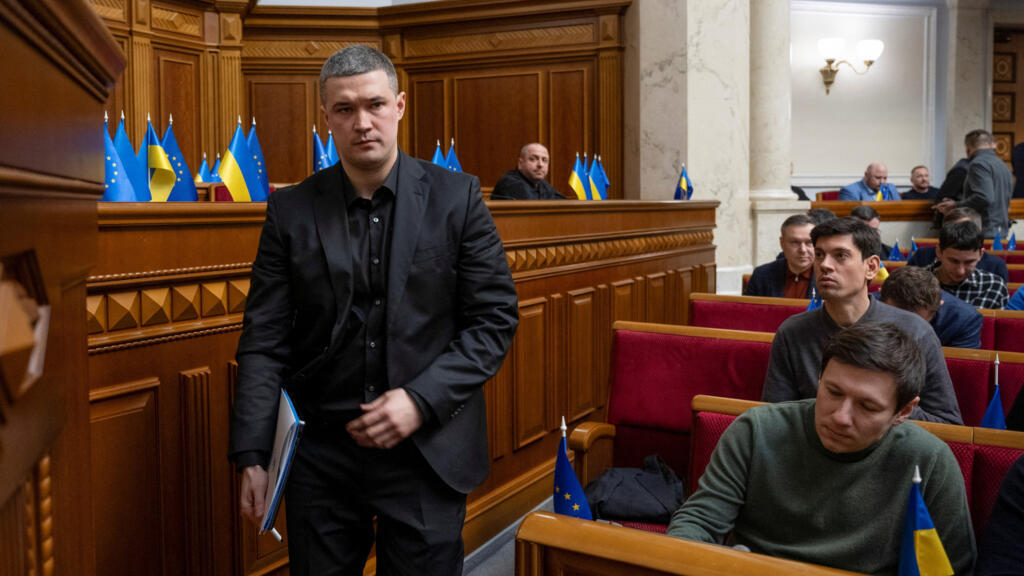
Newly appointed Defence Minister Mykhailo Fedorov attends a session of Ukrainian parliament, in Kyiv, Ukraine on January 14, 2026. © Andrii Nesterenko, Reuters

Ukraine's Defence Minister Mykhailo Fedorov said on Thursday Kyiv was in contact with Elon Musk's SpaceX over allegations that Russian drones were using internet from Starlink satellites during attacks on Ukrainian cities.

"Within hours of Russian drones with Starlink connectivity appearing over Ukrainian cities, the Ministry of Defence team promptly contacted SpaceX and proposed ways to resolve the problem," Fedorov said on social media.

"I'm grateful to SpaceX President Gwynne Shotwell and personally to Elon Musk for their swift response."

Fedorov and the US-based Institute for the Study of War said earlier this week that the Russian army used Starlink satellites to guide its drone attacks deep into Ukraine.

Russia has been battering the country's energy grid as temperatures tumble below freezing and the invasion's fourth anniversary looms.

The ISW said that "Russian forces are increasingly using Starlink satellite systems to extend the range of BM-35 strike drones to conduct mid-range strikes against the Ukrainian rear".

Starlink is also widely used by the Ukrainian army for communications.

"Elon Musk's decision to urgently activate Starlink and send the first batch of terminals to Ukraine at the start of the full-scale invasion was critically important for our country's resilience," Fedorov said.

"Western technologies must continue to support the democratic world and protect civilians, not be used for terror and the destruction of peaceful cities."

(FRANCE 24 with AFP)
American TikTok users claim app is censoring 'Epstein' and ICE criticism


Issued on: 28/01/2026 -
04:13 min


TikTok recently changed hands in the US, giving a consortium of mainly American investors – run by Trump ally Larry Ellison – control of its US operations. Since then, American TikTok users claim that they're unable to write the word "Epstein" in messages on the app, and accuse TikTok of suppressing content critical of President Donald Trump, as well as censoring videos about ICE raids in Minneapolis. Vedika Bahl goes through what we know in Truth or Fake.


Gavin Newsom accuses TikTok of suppressing content critical of Trump


California Governor Gavin Newsom has accused TikTok of suppressing content critical of President Donald Trump and has launched a review into whether the platform’s moderation practices violate state law. The move follows TikTok’s announcement that its Chinese owner, ByteDance, has finalised a deal to avoid a potential US ban.


Issued on: 27/01/2026 
By: FRANCE 24

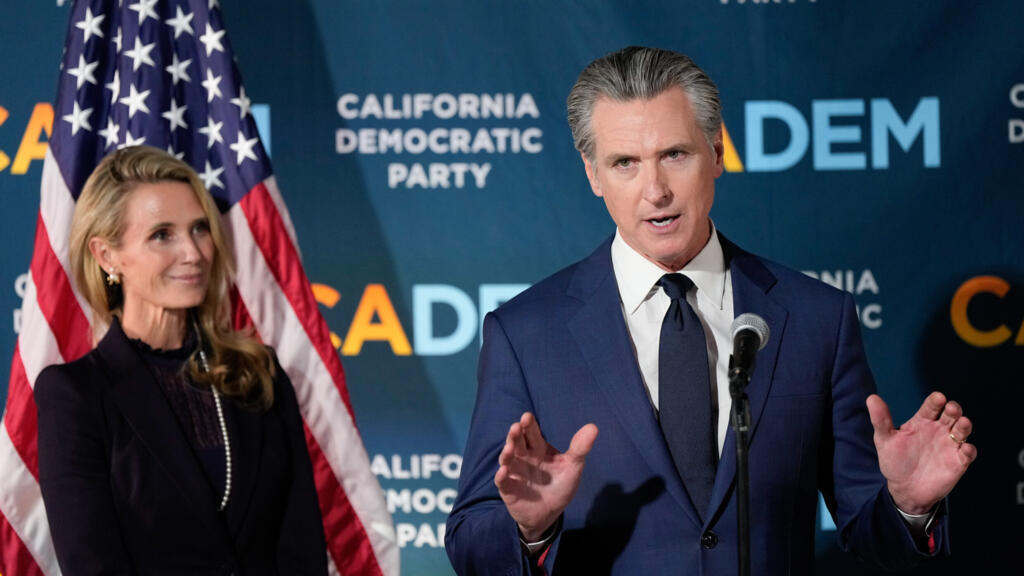
File photo of California Governor Gavin Newsom speaking during an election night press conference at a California Democratic Party office on November 4, 2025, in Sacramento.
 © Godofredo A. Vasquez, AP

California Governor Gavin Newsom accused TikTok on Monday of suppressing content critical of President Donald Trump as he launched a review of the platform’s content moderation practices to determine whether they violated state law.

The step comes after TikTok’s Chinese owner, ByteDance, said it had finalised a deal to set up a majority US-owned joint venture that will secure US data, to avoid a US ban on the short video app used by more than 200 million Americans.

“Following TikTok’s sale to a Trump-aligned business group, our office has received reports, and independently confirmed instances, of suppressed content critical of President Trump,” Newsom’s office said on X, without elaborating.

“Gavin Newsom is launching a review of this conduct and is calling on the California Department of Justice to determine whether it violates California law,” it added.

The White House and TikTok did not immediately respond to a request for comment.

Newsom, a Democrat, and Trump, a Republican, have long been critical of each other.

Last week’s TikTok deal was a milestone for the firm after years of battles with the US government over Washington’s concerns about risks to national security and privacy under Trump and former president Joe Biden.

ByteDance said TikTok USDS Joint Venture LLC would secure US user data, apps and algorithms through data privacy and cybersecurity measures, in a deal praised by Trump.

With more than 16 million followers on his personal TikTok account, Trump credited the app with helping him win the 2024 election.

The deal provides for American and global investors to hold 80.1 percent of the venture, while ByteDance will own 19.9 percent.

Each of the joint venture’s three managing investors – cloud computing giant Oracle, private equity group Silver Lake and Abu Dhabi-based investment firm MGX – will hold a stake of 15 percent.

The US and Chinese governments had signed off on the deal, a White House official said.

(FRANCE 24 with Reuters)


TikTok settles landmark social media addiction lawsuit ahead of trial


TikTok has agreed to settle a major lawsuit claiming its platform deliberately addicted and harmed children, just days before the trial was set to begin. The case, which also involves Meta’s Instagram, Google’s YouTube and Snap, could influence hundreds of similar lawsuits targeting social media companies over youth mental health and safety.


Issued on: 28/01/2026 
By: FRANCE 24


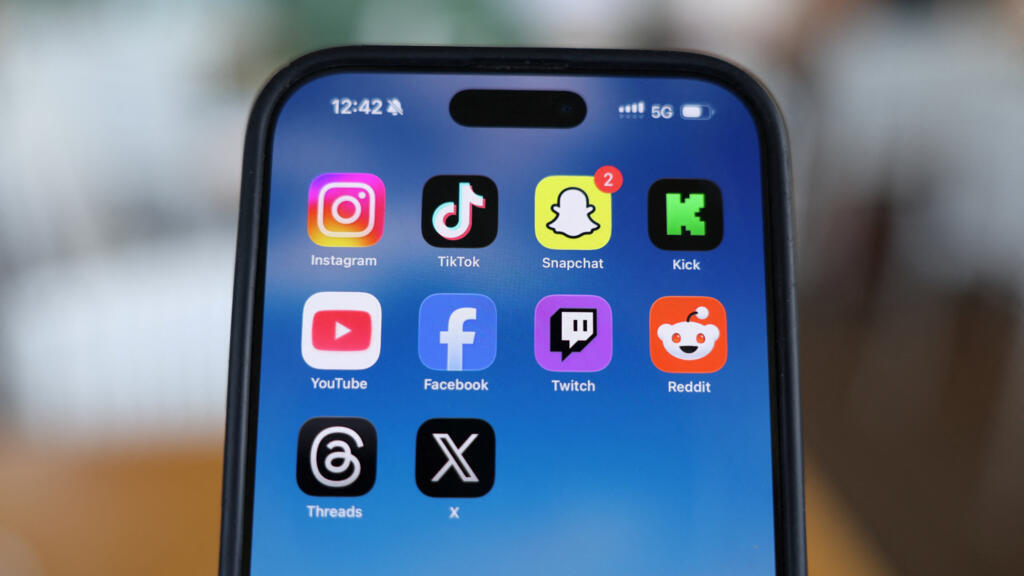
Instagram, TikTok, Snapchat, Kick, YouTube, Facebook, Twitch, Reddit, Threads and X applications displayed on a mobile phone on December 9, 2025. © Hollie Adams, Reuter

TikTok agreed to settle a landmark social media addiction lawsuit just before the trial kicked off, the plaintiff’s attorneys confirmed.

The social video platform was one of three companies – along with Meta’s Instagram and Google’s YouTube – facing claims that their platforms deliberately addict and harm children. A fourth company named in the lawsuit, Snapchat parent company Snap Inc., settled the case last week for an undisclosed sum.

Details of the settlement with TikTok were not disclosed, and the company did not immediately respond to a request for comment.

At the core of the case is a 19-year-old identified only by the initials “KGM”, whose case could determine how thousands of other, similar lawsuits against social media companies will play out. She and two other plaintiffs have been selected for bellwether trials – essentially test cases for both sides to see how their arguments play out before a jury and what damages, if any, may be awarded, said Clay Calvert, a nonresident senior fellow of technology policy studies at the American Enterprise Institute.

Joseph VanZandt, co-lead counsel for the plaintiff, said in a statement Tuesday that TikTok remains a defendant in the other personal injury cases, and that the trial will proceed as scheduled against Meta and YouTube.

Jury selection starts this week in the Los Angeles County Superior Court. It's the first time the companies will argue their case before a jury, and the outcome could have profound effects on their businesses and how they will handle children using their platforms. The selection process is expected to take at least a few days, with 75 potential jurors questioned each day through at least Thursday.

“This was only the first case – there are hundreds of parents and school districts in the social media addiction trials that start today, and sadly, new families every day who are speaking out and bringing Big Tech to court for its deliberately harmful products,” said Sacha Haworth, executive director of the nonprofit Tech Oversight Project.

KGM claims that her use of social media from an early age addicted her to the technology and exacerbated depression and suicidal thoughts. Importantly, the lawsuit claims that this was done through deliberate design choices made by companies that sought to make their platforms more addictive to children to boost profits. This argument, if successful, could sidestep the companies' First Amendment shield and Section 230, which protects tech companies from liability for material posted on their platforms.

“Borrowing heavily from the behavioural and neurobiological techniques used by slot machines and exploited by the cigarette industry, Defendants deliberately embedded in their products an array of design features aimed at maximising youth engagement to drive advertising revenue,” the lawsuit says.

Executives, including Meta CEO Mark Zuckerberg, are expected to testify at the trial, which will last six to eight weeks. Experts have drawn similarities to the Big Tobacco trials that led to a 1998 settlement requiring cigarette companies to pay billions in health care costs and restrict marketing targeting minors.

“Plaintiffs are not merely the collateral damage of Defendants’ products,” the lawsuit says. “They are the direct victims of the intentional product design choices made by each Defendant. They are the intended targets of the harmful features that pushed them into self-destructive feedback loops.”

The tech companies dispute the claims that their products deliberately harm children, citing a bevy of safeguards they have added over the years and arguing that they are not liable for content posted on their sites by third parties.

“Recently, a number of lawsuits have attempted to place the blame for teen mental health struggles squarely on social media companies,” Meta said in a recent blog post. "But this oversimplifies a serious issue. Clinicians and researchers find that mental health is a deeply complex and multifaceted issue, and trends regarding teens' well-being aren't clear-cut or universal. Narrowing the challenges faced by teens to a single factor ignores the scientific research and the many stressors impacting young people today, like academic pressure, school safety, socio-economic challenges and substance abuse."

A Meta spokesperson said in a statement Monday the company strongly disagrees with the allegations outlined in the lawsuit and that it's “confident the evidence will show our longstanding commitment to supporting young people.”

READ MOREWill France be next to introduce an Australian-style social media ban for children?

José Castañeda, a Google Spokesperson, said Monday that the allegations against YouTube are “simply not true.” In a statement, he said “Providing young people with a safer, healthier experience has always been core to our work."

TikTok did not immediately respond to a request for comment Monday.

The case will be the first in a slew of cases beginning this year that seek to hold social media companies responsible for harming children's mental well-being. A federal bellwether trial beginning in June in Oakland, California, will be the first to represent school districts that have sued social media platforms over harms to children.

In addition, more than 40 state attorneys general have filed lawsuits against Meta, claiming it is harming young people and contributing to the youth mental health crisis by deliberately designing features on Instagram and Facebook that addict children to its platforms. The majority of cases filed their lawsuits in federal court, but some sued in their respective states.

TikTok also faces similar lawsuits in more than a dozen states.

In New Mexico, meanwhile, jury selection begins next week for trial on allegations that Meta and its social media platforms have failed to protect young users from sexual exploitation, following an undercover online investigation. Attorney General Raúl Torrez in late 2023 sued Meta and Zuckerberg, who was later dropped from the suit.

Prosecutors have said that New Mexico is not seeking to hold Meta accountable for its content but rather its role in pushing out that content through complex algorithms that proliferate material that can be harmful, saying they uncovered internal documents in which Meta employees estimate about 100,000 children every day are subjected to sexual harassment on the company’s platforms.

Meta has said it uses sophisticated technology, hires child safety experts, reports content to the National Center for Missing and Exploited Children, and shares information and tools with other companies and law enforcement, including state attorneys general, to help root out predators.

(FRANCE 24 with AP)


Paris steps up training for childcare staff on sexual abuse, as reports increase

Faced with an increase in reports of sexual abuse in after-school programmes, Paris authorities are stepping up training for staff to help children speak out. They had come under fire in recent months, accused of doing too little, too late on the issue.


Issued on: 29/01/2026 - RFI

Reports of sexual abuse of children in after-school programmes are increasing. LOIC VENANCE / AFP
"Now, more than ever, every child must be listened to, believed and protected. This abuse must not only be reported, but also made public," Patrick Bloche, deputy mayor of Paris, announced on Wednesday, during a progress report two months after Paris City Hall launched a plan to combat sexual abuse of children.

In 2025, around 40 youth workers were suspended in Paris, including 20 on suspicion of sexual offences, against a backdrop of reports from distraught parents.

Beginning in January, the directors of extracurricular activities at some 620 Parisian schools have been required to undergo training designed to give them a better understanding of the mechanisms of sexual abuse.
Sébastien Brochot, a prevention specialist at the Resource Centre for Professionals Working with Sexual Offenders (CRIAVS) told French news agency AFP: "This violence exists everywhere, regardless of country, social background or level of education."

He added: "The challenge is to raise awareness among youth workers so that they can better identify, report and manage all situations in which a child may be a victim of violence."

Common misconceptions

The training also aims to dispel common misconceptions, including the idea that there is a minimum age for victims, the perception of differing impact on girls and boys before puberty, and the idea that women are not among the perpetrators.

It also addresses the fact that half of all assaults are committed between minors.

"This helps to put things into perspective," says Stéphane, who has been an after-school programme manager for 25 years. Since September, he has made three reports of suspected domestic violence.

According to the Commission on Sexual Violence Against Children (Ciivise), one in 10 children is a victim of sexual abuse, most often within the family.

In a bid to address this, the training will also emphasise identifying profiles that are overrepresented among perpetrators – such as those who are vulnerable, depressed or suffering from low self-esteem.

According to Brochot, when a child who is a victim of sexual abuse asks an adult for help, the adult does nothing "in half of all cases".

The majority of children also find it difficult to realise that they have been victims.

"Children rarely clearly verbalise what they are going through. Instead, they alert adults through their behaviour," he said. Sudden changes in attitude, weight gain or loss and bed-wetting are all warning signs.

For Sophie Fady-Cayrel, director of the Department of School Affairs (Dasco): "The priority is to put the child's interests before all other considerations."

This is particularly true when a child's words incriminate a staff member who has been at the school for a long time.

Staff are also encouraged not to "paraphrase a child's words" and even to "bypass" their superiors if they think "they won't do the job".

Politically motivated

In addition to training, the action plan also includes setting up a helpline for parents, the recruitment of activity leaders in pairs and mandatory two-day training for temporary staff before they take up their posts.

Despite the announcement, unions remain critical.


"These measures are largely insufficient and extremely late," says Nicolas Léger of the Paris administrative staff union SUPAP-FSU, who points to "a lot of communication to reassure families without additional human resources".

He also criticised the fact that training is only being provided to extracurricular activity directors, who are then responsible for "passing it on to the 12,000 activity leaders based on what they have retained".

Élisabeth Guthmann, co-founder of the SOS périscolaire collective against violence against children in after-school programmes, which provides support for parents and activity leaders, believe the move is politically motivated.

"For four years, Mr Bloche has been saying that violence is isolated, whereas we consider it to be systemic. Things are moving forward, but in the context of an election campaign."

(with AFP)
French Senate rejects assisted dying law after heated debate

France’s Senate has rejected a government-backed draft law on assisted dying – billed as one of the country’s most important social reforms in more than a decade.


Issued on: 29/01/2026 - RFI

A palliative care unit in Paris. REUTERS/Philippe Wojazer

The bill had easily passed the lower National Assembly last year but was heavily amended in the upper house after often angry and chaotic debate led by right-wing and centrist senators.

Supporters said the changes stripped the text of its purpose.

"The debate, which should have remained dignified and deeply humanist, has turned into a dogmatic and political battle," Patrick Kanner, head of the Socialist Party in the Senate, said ahead of Wednesday's vote.

Centrist senator Loic Herve said opponents of assisted dying could not be expected to support the text.

“You can’t ask senators who are opposed to euthanasia and assisted suicide to vote for an article like” the one adopted by the National Assembly, he said. The Senate rejected the amended bill by 181 votes to 122. The version put to the vote made no mention of assisted dying.


Next steps


The draft law is set to return next month to the National Assembly. The government could allow the lower chamber to pass the legislation definitively without the Senate’s approval.

Laurent Panifous, the minister for relations with parliament, said the constitution gives the final word to the lower house.

President Emmanuel Macron promised to bring forward an assisted dying law after winning a second term in 2022. He has said a referendum could be held if the bill becomes blocked in parliament.

The proposed change has been seen as one of the most significant social reforms since France legalised same-sex marriage in 2012.

A 2023 report found that most French citizens support legal end-of-life options in cases of extreme suffering. Polls show support has increased steadily over the past 20 years.

Assisted dying is legal in the Netherlands, Belgium, Switzerland and Canada. A similar law is currently being debated by the British parliament.