Saturday, January 31, 2026


Maine clergy form spiritual 'shield' outside workplaces to protect immigrants from ICE

(RNS) — Like religious leaders in cities such as Minneapolis, Chicago and elsewhere, local clergy were quick to muster resistance to the rapid influx of immigration enforcement agents, even as they wrangle with the unusual geography of Maine.


Clergy and others demonstrate against U.S. Immigration and Customs Enforcement, Jan. 28, 2026, in Portland, Maine. (Photo by Sam Woodward)


Jack Jenkins
January 29, 2026
RNS


(RNS) — For the past week or so, every morning at around 7:15, the Rev. Jane Field, a Presbyterian Church (USA) minister and executive director of the Maine Council of Churches, drives out to a business in the greater Portland area. Once there, she and several of her fellow clergy — usually around two dozen — line up along the street near the exit to the business.

The goal, she said, is to form a visual and spiritual “shield” between the employees leaving their shift — the majority of whom are immigrants — and Department of Homeland Security agents who have surged into the state. The rotating band of clergy has gotten used to staring down agents during what has become a twice-daily ritual, she said, with officials often driving by or sometimes lingering in the parking lot.

“ICE has been there almost every time,” Field said.

It’s part of the faith-led efforts in Maine to resist “Operation Catch of the Day,” the latest in President Donald Trump’s series of mass deportation campaigns launched in cities across the U.S. over the past year. Like religious leaders in cities such as Minneapolis, Chicago and elsewhere, local clergy were quick to muster resistance to the rapid influx of immigration enforcement agents, even as they wrangled with the unusual geography of Maine.

And while reports emerged on Thursday (Jan. 29) that DHS may be ending its targeted campaign there, faith leaders say their work continues.

The Rev. Tara Humphries, who oversees Allen Avenue Unitarian Universalist Church in Portland, said faith-led pushback to DHS and Immigration and Customs Enforcement efforts began before the administration launched its targeted campaign last week. Religious leaders have been gathering every Wednesday for weeks, they said, to participate in a vigil at the Cumberland County Jail, where ICE detainees were being held. In addition to the recurring vigil, Humphries said faith leaders had developed relationships with people being detained, exchanging letters back and forth and helping to raise money for legal fees.

But then Operation Catch of the Day was announced Jan. 21, which drew a swift rebuke from the local county sheriff. Within 24 hours, Humphries said, the detainees in the jail had vanished.


Clergy and others demonstrate against U.S. Immigration and Customs Enforcement, Jan. 28, 2026, in Portland, Maine. (Photo by Sam Woodward)

“The federal government and ICE responded by — in the middle of the night — removing all the ICE detainees and sending them out of state,” Humphries said. They added that while faith leaders have been able to track down some of the detainees, the whereabouts of others remain unknown.

“It’s worse than it’s being reported, which is heartbreaking,” Humphries said.

The pastor has joined various Signal groups dedicated to pushing back against the DHS surge. The raw number of volunteer reports of agent activity in the town, Humphries said, has been staggering. According to the Department of Homeland Security, at least 100 people were detained in the first three days of the surge, and faith leaders say detentions have continued unabated since.

“The scope is absolutely horrifying,” Humphries said.

Humphries noted locals in Portland have sometimes struggled to muster the same kind of “rapid response” efforts that have cropped up in other cities where DHS agents are highly visible. In urban environments such as Minneapolis, it has become commonplace to see volunteers tracking suspected DHS vehicles and quickly responding to sightings of agents by recording their activities on phones and blowing whistles to alert the surrounding community.

But in Maine, where cities are small and the divide between rural and urban is sometimes hard to discern, unique challenges have emerged.

“Because Maine is Maine and because our city is small and also spread out, it’s not like a lot of people could necessarily get there in 30 seconds,” Humphries said.

Even so, volunteers have pressed on. Humphries said that in Lewiston, which is home to a large Somali American population targeted by DHS, it has been “tons of Somali women” who have begun serving as rapid responders.


Clergy talk during a demonstration against U.S. Immigration and Customs Enforcement, Jan. 28, 2026, in Portland, Maine. (Photo by Sam Woodward)

Faith leaders have sought to push back in other ways as well. Over the weekend, hundreds of faith leaders, politicians, activists and others packed into the Agora Grand Event Center in Lewiston to voice outrage over ICE. Among the speakers was Amran Osman, head of Generational Noor, a local nonprofit that serves immigrant communities.

“You belong in your neighborhoods,” Osman said. “You belong in the safe spaces that have been filled with joy, learning and care. You belong here. This is your country — it’s your country as much as it is everyone else’s.”

Field also spoke, flanked by roughly 80 fellow faith leaders, as did the Rev. Jodi Hayashida, a Unitarian Universalist minister who leads Multifaith Justice Maine and was one of the organizers of the event.

In her remarks, Field invoked the biblical story of the Good Shepherd, who leaves behind 99 sheep who are safe to protect one sheep who is at risk of being hunted by wolves.

“Well friends, the wolves have arrived here in Maine,” Field said. “And they’re wearing ICE agent clothing.”

Field then gestured behind her, adding: “These good shepherds — these faith leaders of Maine — are here to show that they will go to the margins and stand with our immigrant neighbors, working with them to fight off the vicious wolves and chase them — chase ICE — out of our great state.”

Field also told Religion News Service that a delegation of religious leaders from the state recently returned from a convening in Minneapolis, where more than 600 pastors from across the country were trained on how to resist DHS. The leaders, she said, are planning to “debrief” fellow clergy on what they learned.

In the meantime, religious communities have worked to put pressure on their elected officials. On Tuesday, a group of roughly 30 faith leaders — including Humphries — staged a protest outside of the office of Maine’s Sen. Susan Collins. The clergy, who sang religious songs and read from Scripture during the demonstration, said they were calling on the moderate Republican to “use her power to end funding to ICE and put an end to their campaign of terror.” Ultimately, nine of the faith leaders were arrested during the demonstration.

Representatives for Collins’ office did not respond to multiple requests for comment about the protest, but the senator announced on Thursday that White House officials told her that the surge of DHS agents has ended in the state.

“There are currently no ongoing or planned large-scale ICE operations here,” Collins said in a statement. “I have been urging Secretary Noem and others in the Administration to get ICE to reconsider its approach to immigration enforcement in the state.”

Reached via text message on Thursday, Humphries signaled caution about Collins’ announcement, suggesting that because of Collins’ past decisions and votes, “I have lost trust in her words.”

However, Humphries argued that if DHS has halted or scaled back its operation, it “has everything to do with the incredible organizing, support, and applied pressure on officials of faithful, dedicated everyday Mainers.”

Similarly, Field said that she welcomed the news in the short term but that she and other religious leaders “remain guarded and realistic about the possibility of more attacks on our immigrant neighbors resuming at any time.” She signaled that a “reprieve” in Maine is unlikely to dampen growing religious outcry to ongoing mass deportation efforts across the country.

“It is entirely unacceptable for us in Maine to be satisfied with a withdrawal here while the attack on Minnesotans continues unabated,” Field said. “As Dr. (Martin Luther) King put it, we are inextricably bound together in one fabric, or as Paul put it, when one suffers, we all suffer.”

She added: “The only truly acceptable outcome is for Congress to intervene and put a stop to indiscriminate and lawless surges of ICE and Homeland Security agents everywhere in this nation.”
Why conservative Mormon women derailed Republicans in Utah


Shutterstock Asset id: 1918280681

January 28, 2026 
ALTERNET

The Guardian reports it was largely the work of a hyper-conservative group of Mormon women who derailed Republican efforts to gerrymander a new Republican district in Utah this year.

The Pew Research Center reveals that Mormons, also known as members of the Church of Jesus Christ of Latter-day Saints, were among Trump’s strongest supporters in 2016, with about 61 percent of church members backing him, making the group his second-largest religious support base.

But in 2018, the Mormon Women for Ethical Government (MWEG) helped gather enough signatures to pass Utah’s Proposition 4, with 50.34 percent of the vote. This created an independent state commission to draw state and congressional maps using nonpartisan criteria, rather than let legislators cherry-pick their own voters.

But in 2020, state Republican lawmakers told MWEG to take a hike and repealed Proposition 4. Then they redrew maps that split Salt Lake County – Utah’s youngest, most diverse and bluest region – into four districts. This packed urban Democratic votes into red outlying regions and entrenched GOP dominance for the next election. The MWEG group sued their state government along, arguing that the Republican-led legislature violated the state constitution when it altered a legitimate voter-approved proposition.

“Last summer, the women’s groups won,” reports the Guardian. “Now state lawmakers must draw new maps that could pave the way for a Democratic congressional seat in the 2026 midterm elections.”

“I live in a district that’s likely going to become Democratic,” said MWEG Founder Emma Petty Addams. “I’ll lose a Republican representative I respect, and I’m 100 percent OK with that if it means my neighbors get representative government.”

Defying lawmakers was not easy, said Addams, a mother of three and a piano teacher. But the legal battle was necessary to deal with “an overreach of power” that Utah voters opted to protect with “guardrails”.

“People want to see Mormon women as either the secret wives or as a trad wife,” Addams said. “We’re neither of those.”

The organization’s is already saddling up for its next fight, however, as the Utah Republican Party pushes to repeal Proposition 4. In an effort to gerrymander Utah to protect Trump’s narrow House GOP majority, the party is seeking 141,000 signatures by February to place the repeal on the November ballot.

Trump posted on Truth Social, urging Utah residents to repeal the proposition and let politicians pick their own voters. This follow his nationwide effort to restructure districts to enshrine his majority for the foreseeable future — some with more success than others.

“Organizers had gathered around 56,000 signatures as of 26 January,” reports the Guardian. “The Utah Republican party did not respond to a request for comment about its repeal efforts.”

Read the Guardian report at this link


Republican politics is killing the modern-day church: analysis


Photo by Edward Cisneros on Unsplash
January 22, 2026 
ALTERNET

Over the years, traditional religious practice has declined in both the United States and globally, according to one political scientist.

Speaking to The New York Times' "Interesting Times" podcast, Ryan Burge, an ordained Christian minister who became a professor, analyzed data trends for his new book, "The Vanishing Church: How the Hollowing Out of Moderate Congregations Is Hurting Democracy, Faith, and Us."

The number of people declaring they aren't affiliated with any church appears to have stalled, Burge said, but this has not benefited traditional Christian churches.

Burge argues that polarization and sorting are central to the trend, with moderate, mainline Protestant churches hollowing out while more intense, ideologically defined communities remain. White evangelical congregations on the right remain comparatively stable.

Burge emphasizes that "nones" are not secretly spiritual seekers in disguise. Many are neither religious nor particularly spiritual. Instead, they reject the institutions themselves, reflecting a broader anti-establishment sentiment in the U.S.

"I think education, social trust, and institutional trust are all locked together in this matrix of things that make you either more willing to engage in polite society, or less willing to engage in polite society. Educated people have a level of trust that less educated people do not," Burge said on the podcast.

One consistent theme is that "dropping out begets dropping out." Those who drop out of church also have lower educational attainment rates. Only about 25 percent have four-year college degrees.

"So they're dropping out of education, they're dropping out of religion, and they're dropping out of politics. They're basically isolating themselves from American society," Burge said.

Unlike in previous decades, politics is shaping the religious mindset of those who do not return to the churches in which they were raised. While churches were once places where Democrats and Republicans could sit in the same pews, today people seek out others who are largely similar to themselves. Families are seeking out churches based on political alignment rather than other factors.

"What's happened in America, especially with white Christianity, is that it is coded as Republican — and that's not always been the case," Burge said. "I think this is a point that people forget: Even in the 1980s, among the white evangelical church, the share who were Republicans and the share who were Democrats was the same."

The sorting of people by similar beliefs has increased the decline of politically mixed, moderate congregations, while reinforcing the perception that white evangelical churches are an extension of the Republican Party.

"So what we're seeing here is a unique moment. The number one predictor of whether you're going to be religious or not in America — besides the religion question itself — is: What is your political ideology? If you're a liberal, there's a 50-50 chance you're a nonreligious person. If you're a conservative, it's about a 12 percent chance that you're a nonreligious person," Burge said.

Young people are most affected by political ideologies in determining religious behavior.

"Young people think, 'I'm a liberal, so I'm going to be irreligious,'" Burge said. "They don't even accept the possibility that you can be a liberal Christian anymore."

Burge noted that responses to right-wing churches have included setting up left-wing alternatives. However, mainline church members want a completely non-political space. While the Covid lockdown brought many people to watch services online, once it ended, Burge said people wanted in-person attendance. He has observed this with young people as well: only 15 percent preferred online learning, and 15 percent had no preference. The rest preferred to meet in person.

Burge concluded by saying, "Listen, religion's endured for all of Western civilization because it works for lots and lots of people. And no matter how much we try to remake it with technology and A.I. and the internet, showing up on an average Sunday with a bunch of people and singing some songs and saying some creeds and hearing a sermon is transformative and will be for all of human history, as far as I can tell."

Read or listen to the full interview here.

Op-Ed


“This Is Not America” Is the Most Dangerous Lie We Keep Telling Ourselves

The idea that large-scale state violence and repression are foreign to US soil is a dangerous fiction.
January 28, 2026


A gunshot perforation can be seen in a window in front of a makeshift memorial for Alex Pretti on January 26, 2026, in Minneapolis, Minnesota.ROBERTO SCHMIDT / AFP via Getty Images

Americans are once again searching for historical analogies to explain what is unfolding around us.

As authoritarianism accelerates — as government-sanctioned violence becomes more overt in immigration enforcement, in policing, in the open deployment of federal force against civilians, and in the steady erosion of civil rights — people are scrambling for reference points.

But instead of reckoning with the long and violent architecture of U.S. history, much of this searching collapses into racialized tropes and xenophobic reassurance: This isn’t Afghanistan. This isn’t Iran or China. This is America. We have rights. This is a democracy. This isn’t who we are.

These statements are meant to comfort. They are meant to regulate fear, to calm the nervous system with the promise that no matter how bad things get, this country is somehow exempt from the logic of repression. Instead, they reveal how deeply many people still misunderstand both this country and the nature of authoritarian power.

They rest on a dangerous fiction: that large-scale state violence, political terror, and repression belong somewhere else — to “failed states,” to the Global South, to places imagined as perpetually unstable. This is not only historically false; it is how people in the U.S. have been trained not to recognize what is being built in front of them.


After Davos Speech, Trump Tells the World, “Sometimes, You Need a Dictator”
Polling from August indicates that most Americans already view Trump as a “dangerous” leader seeking to be a dictator. By Chris Walker , Truthout January 22, 2026


The truth is simpler and more unsettling: The U.S. has always governed through violence.

It has always relied on surveillance, containment, displacement, and force to manage the populations it deemed threatening. From slavery to Indigenous genocide, from Jim Crow to Japanese internment camps, from COINTELPRO to the “war on terror” and the modern surveillance state, repression is not an aberration in U.S. history. It is a throughline.


Repression is not an aberration in U.S. history. It is a throughline.

What is changing now is not the presence of state violence. It is the shrinking number of masks it bothers to wear.

What we’re witnessing under the second Trump administration is an acceleration and magnification of policies and processes put in place — or left to grow — under previous administrations. The consolidation of executive power, the normalization of political revenge, the open celebration of cruelty, the expansion of militarized enforcement, and the convergence of the processes of governance and punishment are not isolated developments. Together, they form a coherent project: an empire that governs through fear, spectacle, and coercion — and calls it order.

Faced with this, people reach for historical parallels. That instinct makes sense. When reality becomes disorienting, we look for maps. We want to know where we are in the arc of things. We want to know what comes next.

But the way these comparisons are so often framed reveals something more troubling than confusion. When people say, “This isn’t Iran. This isn’t who we are,” what they are really saying is: This kind of violence belongs to other people. Other countries. Other kinds of societies.

This way of talking treats repression and state terror as natural features of non-Western life — tragic, perhaps, but expected — while preserving the fantasy that the United States is fundamentally different: a country that insists on seeing itself as innocent and as the world’s savior.

This alibi does two kinds of damage at once.

First, it erases the fact that the United States has spent the last century actively producing the very conditions people now point to as evidence of what “happens elsewhere” — through war, occupation, sanctions, coups, counterinsurgency, resource extraction, and proxy violence. Afghanistan and Iraq did not become the political shorthand we reach for when we want to name violence and instability by accident. And the “Middle East” did not become our knee-jerk cultural reference for endless war by happenstance. These associations were produced through sustained U.S. intervention.

Second, it trains people to misread the danger until it is too entrenched to ignore.

The United States does not need to become something new in order to govern brutally. It already knows how.

It knew how when it built an economy on enslavement and enforced it through patrols, terror, and law. It knew how when it cleared Indigenous land through military campaigns and forced removals. It knew how when it incarcerated Japanese Americans in camps and called it national security. It knew how when it ran surveillance and disruption campaigns against civil rights and liberation movements. It knew how when it built a global regime of detention and torture after 9/11 and taught the public to call it protection.

In every era, the language changes. The targets shift. The justifications evolve. But the structure remains intact: a state that decides some people are threats, some lives are disposable, and some rights are conditional — and then builds entire bureaucracies to make that violence feel normal.

One of the most consistent features of this system is denial.

“This isn’t who we are,” people say, as if saying it has ever stopped the government from doing what it wants to do. “This isn’t America,” they insist, as if the U.S. were not a place that has repeatedly refined its methods of control while keeping its hierarchies intact.

The claim is not new. It has appeared whenever violence needs cover: Reconstruction. The Red Scare. Jim Crow. The “war on terror.” It always sounds the same: This is an exception. This is temporary. This is not the real America.

This is precisely the story that allows the machinery of repression to keep moving while much of the public remains psychologically unprepared to name it.

Today, that machinery is no longer subtle. It does not need to be. We see it in the open embrace of mass detention and deportation. In the criminalization of protest. In the expansion of police and federal enforcement powers. In the use of state violence as political theater. In the steady collapse of any meaningful boundary between punishment and governance.

And still, many people find it easier to imagine that the country is becoming something unrecognizable than to admit we are moving deeper into patterns that have always been here.

This is not a failure of information. It is a failure of narrative. And narrative failures are not neutral — they shape what people prepare for, what they demand, and what they believe is even possible.

As long as authoritarianism is imagined as something that happens elsewhere, people will keep waiting for a clearer sign, a more obvious rupture, a more undeniable transformation. They will keep telling themselves that what they are seeing is not quite serious enough yet. Meanwhile, the ground continues to shift beneath them.

The question before us is not whether the U.S. is “turning into” something else.
The question is whether we are finally willing to tell the truth about how power has always worked here — and what it costs to keep pretending otherwise.

Because clarity is not an intellectual exercise. It is a political necessity.

If we treat this moment as an exception, we will look for solutions that restore a past that never existed. If we understand it as part of a longer pattern, we can begin to ask better questions: What would safety look like without punishment? Order without domination? Belonging without exclusion? And what would it require to protect one another — not from some imagined future, but from the systems that have always been with us?

History does not only warn. It instructs.

It tells us that repression rarely announces itself as tyranny. It arrives as management. As security. As common sense. It tells us that waiting for things to become unmistakably unbearable is a losing strategy. And it tells us that the most dangerous myths are the ones that convince people they are immune.

“This is not America” has never been the reassurance people want it to be.

It has always been the alibi.


This article is licensed under Creative Commons (CC BY-NC-ND 4.0), and you are free to share and republish under the terms of the license.

Rashida James-Saadiya
Rashida James-Saadiya is a cultural educator and Executive Director of the Muslim Power Building Project, a national leadership collective that supports emerging Muslim organizers in build
Rubio Dodges Accountability at Senate Hearing as Deadly Boat Strikes Continue

The families of two men killed on a small boat targeted by the US military filed a wrongful death lawsuit this week.

By Mike Ludwig , TruthoutPublishedJanuary 29, 2026

U.S. Secretary of State Marco Rubio testifies at a Senate Foreign Relations Committee hearing on U.S. policy toward Venezuela on January 28, 2026, at the Capitol in Washington, D.C.
Demetrius Freeman / The Washington Post via Getty Images

As former colleagues fumed about the administration’s failure to consult Congress, Secretary of State Marco Rubio defended President Donald Trump’s rapid escalation of the “war on drugs” in the Caribbean and Latin America before the Senate Foreign Relations Committee on January 28. Rubio testified for almost three hours in his first congressional hearing since U.S. forces invaded Venezuela and abducted President Nicolás Maduro and his wife, Cilia Flores, in a deadly raid on January 3.

“This is the first public hearing we’ve had. Two hundred folks who were on secret designated combatant lists have been killed, U.S. troops have been injured, hundreds of millions of dollars have been spent, an armada amassed, and the announcement of a new Monroe doctrine which does not land well in the Americas,” said Sen. Tim Kaine (D-Virginia), noting operations began nearly five months ago. “Democrats have asked over and over again, can we have a public hearing?”

After months of U.S. military belligerence in international waters without congressional oversight, Rubio claimed the U.S. is not at war with Venezuela but is at war with drug smugglers, which he called “enemy combatants” with advanced weapons. However, Rubio distanced himself from dozens of airstrikes on small boats that have killed at least 126 people since September, deferring questions to Defense Secretary Pete Hegseth, despite Rubio’s double role as Trump’s national security advisor. Rubio’s prepared remarks did not mention the boat strikes.


The administration has claimed the boats are operated by “designated terrorist groups” and transporting drugs but has not provided evidence to the public. Democrats are continuing to demand the White House declassify intelligence privately shared with lawmakers, including a video of a controversial follow-up strike that killed two survivors clinging to wreckage of a boat in September, which some Democrats have described as deeply disturbing.

Since October, the administration has pointed to a secret Office of Legal Counsel memo equating drugs with weapons of war and stating that the U.S. is in “non-international armed conflict” with unspecified smuggling groups. Legal experts have said Trump’s boat strikes amount to extrajudicial assassinations since the targets are civilians, not military, despite the administration’s posturing. But even if the administration’s justifications for treating the boats as military targets were taken at face value, legal scholars say the September follow-up strike was a likely war crime.

“Even five months in there is a lot we can’t talk about,” said Sen. Tim Kaine (D-Virginia) during the hearing on Wednesday. “If it’s such a righteous operation, then why is the administration and the majority in this Senate so jealously protecting the details about it from being revealed to the American public?”

Rubio’s testimony came one day after the families of two Trinidadian men killed in a U.S. boat strike on October 14 filed a landmark wrongful death lawsuit against the Trump administration in federal court. Chad Joseph, 26, and Rishi Samaroo, 41, were among the six people killed when a U.S. missile struck a boat returning to Trinidad and Tobago from nearby Venezuela, where the men worked on farms and fishing boats to support their families, according to the lawsuit.

“We know this lawsuit won’t bring Chad back to us, but we’re trusting God to carry us through this, and we hope that speaking out will help get us some truth and closure,” said Lenore Burnley, Joseph’s mother, in a statement.

A massive naval deployment under U.S. Southern Command has continued to blow up small boats across the Caribbean Sea and off Latin America’s Pacific coast. The death toll from the international bombing campaign reached at least 126 on January 23, as the U.S. military reported that the latest strike destroyed a speedboat with three people on board. Two people were killed, and the U.S. Coast Guard suspended its search for the lone survivor a few days later.

Echoing many experts, the lawsuit argues there is no legal justification for the boat strikes, videos of which quickly became content for the Trump administration’s social media propaganda. “These are lawless killings in cold blood; killings for sport and killings for theater, which is why we need a court of law to proclaim what is true and constrain what is lawless,” said Baher Azmy, legal director of the Center for Constitutional Rights, a group representing the Trinidadian families, in a statement on January 27.

“It is absurd and dangerous for any state to just unilaterally proclaim that a ‘war’ exists in order to deploy lethal military force,” Azmy said.

At the Senate hearing, Kaine said the committee was unable to properly discuss the fatal boat strikes because the administration is keeping the intelligence behind them classified and out of public view — including any evidence that the people on the boats were smuggling drugs rather than fishing or traveling from one place to another as the families of Joseph and Samaroo have said.

“I would like to talk about the complete weakness of the legal rationale about striking boats in international waters, but I can’t, because the administration has only shared it with members in a classified setting,” Kaine said. “I can’t tell you the domestic rationale is hollow and the international rationale is hollow.”

Kaine was among the select members of Congress who attended private briefings that included classified videos of the strikes, including the “double tap” strike that killed two survivors in early September. He said the public deserves to know the “grim details of the murder of survivors” but the administration has refused to declassify the video, preventing lawmakers from discussing the attack outside of a classified setting.

Before Rubio had a chance to respond, the conversation shifted to the future of Venezuela’s lucrative oil reserves — and Trump’s desire to control them on behalf of U.S. oil companies. The drug trade loomed in the background, with members of both parties pressing Rubio on the decision to invade and bomb Venezuela and abduct Maduro and Flores without consulting Congress. After being captured by U.S. forces on January 3 in a high-risk raid that killed dozens of people, Maduro and his wife were taken to the U.S. where they have been indicted with cocaine trafficking in federal court, among other charges. Both pleaded not guilty.

“There is no war against Venezuela, and we did not occupy a country,” Rubio said.

GOP Sen. Rand Paul of Kentucky asked Rubio whether it would be an act of war if a foreign nation attacked and abducted the U.S. president. Rubio said Maduro is a drug trafficker and no longer recognized as head of state by the U.S. because he is accused of stealing the last election in Venezuela. While Maduro’s victory may be a farce, Paul pointed out that Trump has called into question U.S. elections and also accused President Joe Biden of being illegitimate.

“But would it be an act of war if someone did it to us? Nobody dies, a few casualties, they are in and out and boom, it’s a perfect military operation,” Rand said. “Would that be an act of war? Of course it would be an act of war!”

In his prepared remarks during the Senate hearing, Rubio accused Maduro of running the “Cartel de los Soles,” a so-called drug trafficking ring the Trump administration has repeatedly claimed operates within the Venezuelan security establishment, despite the fact that the Department of Justice indictment of Maduro backs off that claim entirely. “Cartel de los Soles” is a general euphemism for corruption, not an actual organization.

“Maduro is an indicted drug trafficker, not a legal head of state,” Rubio said.

A former GOP senator, Rubio has long promoted U.S. intervention against the socialist governments of Cuba and Venezuela. During the hearing, Rubio repeated his claim that the abduction of Maduro was a “law enforcement” operation aided by the U.S. military and echoed Trump-style rhetoric blending the “war on drugs” with the “war on terror.”

When Sen. Tammy Duckworth (D-Illinois) said voters are worried Trump has started another “forever war” in Latin America, Rubio said the U.S. is “confronting terrorist and criminal organizations” smuggling drugs in the Western hemisphere without identifying any specific groups besides Tren de Aragua, a Venezuelan prison gang that experts say has a smaller presence in the U.S. than the administration has repeatedly claimed.

“We know that in President Trump’s mind, opposing Maduro was not about stopping the flow of fentanyl or drugs in the United States,” said Sen. Chris Van Hollen (D-Maryland), pointing to the fact that Trump had previously pardoned former Honduran President Juan Orlando Hernández, who was serving a federal sentence in the U.S. on drug charges. Rubio said he was not involved in the decision to pardon the former Honduran president.

As the top official at the State Department, Rubio also appeared to distance himself from the boat strikes and repeatedly deferred questions from members of both parties about the legal justification to the Department of Defense, where Hegseth reportedly ordered the strikes under Trump’s authority.

However, in a separate exchange with Sen. Jacklyn Rosen (D-Nevada), Rubio said “my job is to coordinate the interagency function of foreign policy” as Trump’s national security advisor. Rosen had asked about the rotating cast of characters making allegedly corrupt deals overseas on behalf of the White House, including real estate developer Steve Witkoff and Trump’s son-in-law Jared Kushner. From overseas tech deals running alongside foreign policy to cryptocurrency, a recent investigation by The New York Times reveals a “culture of corruption” within the administration.

“No single individual other than the president has the ability to dictate our foreign policy,” Rubio said.

The Constitution gives Congress the power to declare war, not the president, but this standard has eroded over decades of U.S. imperialism and the “war on drugs.”

During Rubio’s testimony, lawmakers in both parties expressed frustration with the administration’s unwillingness to inform them about the military action in Latin America, including the large naval armada amassed off the coast of Venezuela. Sen. Rand Paul (R-Kentucky) and a handful of other Republicans broke with Trump over the invasion.

On January 14, the Senate’s GOP majority narrowly blocked a war powers resolution that would have required the president receive permission from Congress before taking further military action. Republicans also blocked an resolution to prohibit the deadly boat strikes and reign in Trump’s war on drug cartels shortly before breaking for the holidays in December.


Op-Ed


The Gaza Ceasefire Is a Minefield Shallowly Masquerading as a Truce


Since this “ceasefire” started, I’ve witnessed two strikes on my camp in Gaza.

January 27, 2026


Palestinians mourn after three members of the Al-Rjodi family were killed in an Israeli strike in Deir al-Balah in the central Gaza Strip on January 21, 2026.Bashar Taleb / AFP via Getty Images


Truthout is a vital news source and a living history of political struggle. If you think our work is valuable, support us with a donation of any size.

Since the supposed “ceasefire” in Gaza came into effect on October 10, 2025, I have personally borne witness to two ceasefire breaches in my refugee camp.

One was on October 19, when Israeli forces bombed a café — a space to breathe away from scenes of destruction, a place to work or study with a reliable internet connection, a meeting point for displaced friends, a brief chance to enjoy the moment. I could have been there. I was juggling my studies ahead of a musculoskeletal exam for medical school, planning to go to the café for a stable internet connection. But something held me back. I stayed home.

Midway through taking my exam in my refugee camp, an explosion shook the ground, and billowing smoke blurred our vision. Back then, I did not have the luxury of knowing where it fell or exactly what it hit. But I heard the crowds screeching. My mind was racing as I relentlessly tried to stay focused on answering my exam questions.

Then it turned out to be the Twix Café I used to visit — the strike left six patrons killed and many injured. Their only crime was choosing to live, to breathe, to thrive. But Israeli bombs were already woefully closer.

Then, Israeli media announced that the Israeli military had ended its escalation in Gaza and achieved its targets. People were left with nothing but to believe in this fragile truce.


Israel Is Quietly Expanding Its Occupation of Gaza Under Cover of “Ceasefire”
For us here in Gaza, this “ceasefire” is a fiction. The bombing has continued as Israel moves its Yellow Line.By Dalia Abu Ramadan , Truthout  December 4, 2025


The second ceasefire breach that touched me personally occurred on November 22, when the Israeli military committed a massacre in my neighborhood against an entire family. Members of the Abushawish family were gathered in the hall, opening a humanitarian aid parcel when the airstrike hit. Only their eldest daughter survived because she had happened to step into her room just minutes before the airstrike. The family had survived many attacks before, but this one tore them into pieces, inflicting devastation beyond repair.

The airstrike also further weakened the already perilous shelters in my camp and damaged water and sewage infrastructure — systems that had been repaired and re-repaired after every previous bombardment. In an instant, Israel wiped out an entire family, tearing them apart and leaving only one survivor — alone, cold, speechless, carrying muffled memories inside a shattered home.

This Sham Ceasefire Follows Decades of Other Broken Promises


The falsity of the current “ceasefire” in Gaza should perhaps come as no surprise given all the other broken promises we have endured over the years.

A ceasefire that does not halt killing, does not stop the targeting of buildings, does not mandate the withdrawal of Israeli military forces, and continues to block food cannot, by any definition, be called a ceasefire.

In 1993, Palestinians hoped the Oslo Accords, signed between the Palestine Liberation Organization and the Israeli occupation, would bring an end to Israel’s expansionist, settler-colonial project and entrench Palestinians’ right to self-determination and sovereignty over their own land — at the cost of relinquishing armed resistance. Nearly three decades later, this decree — branded as a “peace process” — was preserved, yet it has never yielded peace of any kind. Oslo was neither a perfect nor an optimal solution to the Palestinian struggle, but it was believed (perhaps desperately) that it might mitigate decades of apartheid and oppression. Instead, Israeli forces reneged on their promises, further entrenching Palestinian statelessness. Since then, more than six wars have been unleashed on Gaza City, punctuated by countless shorter aggressions.

After two years of genocide, Donald Trump advanced a so-called 20-point peace plan, unveiled at the White House, with Israeli Prime Minister Benjamin Netanyahu standing beside him. The plan sidelined Palestinian sovereignty and proposed the establishment of foreign forces to control Gaza, while Palestinian technocrats would be responsible for day-to-day governance under severely limited authority.


Violence is imposed whenever Israeli leaders choose, paused when convenient, and resumed explicitly without charge.

This was hardly surprising. Purveyors of genocide have long mastered the choreography of violence: When the fire turns against them, they mask their language as salvation; when it serves them, they ignite it and rebrand devastation as a world-changing necessity. The proposal purported to end the bloodshed in Gaza and guarantee a lasting peace in the Middle East.

Yes, ultimately, a ceasefire was declared in October 2025. But so far, it has failed to amount to an actual ceasefire. At best, it has produced “reduced fire” or “slow fire.” A ceasefire that does not halt killing, does not stop the targeting of buildings, does not mandate the withdrawal of Israeli military forces, and continues to block food, medicine, and fuel from entering except in insufficient quantities cannot, by any definition, be called a ceasefire. Rather, it is a transformed form of death — one that operates in the shadows, not in broad daylight — while the world convinces itself that a chapter of today’s atrocities has been closed and numbly moves on to the next eye-catching catastrophe.

According to the Gaza Government Media Office, Israel committed 969 ceasefire violations within 80 days of the ceasefire taking effect, resulting in the killing of 418 Palestinians, the injury of 1,141 others, and the detention of 45 people. Among these violations, 289 cases were documented as direct gunfire, 54 as military incursions, and 455 incidents involved shelling and the deliberate targeting of civilians and their homes.

Since 1948, the pattern has been glaringly obvious: Israel has never reliably complied with treaties, kept promises, or abided by international law. It wreaks havoc as though the world were not governed by any order, embarking on genocide now justified as a response to October 7 — without mentioning the decades spent killing and dispossessing Palestinians, when neither October 7 nor resistance factions even existed to be blamed. Violence is imposed whenever Israeli leaders choose, paused when convenient, and resumed explicitly without charge, only for them to be praised as possessing “the most ethical military in the world” — shielded from accountability and trusting that time alone will be enough for the world to forget.


What usually happens in occupied Palestine is that Palestinians cease, and Israelis fire.

The late, dear Dr. Refaat Alareer, a poet, writer, and lecturer in the English Literature Department at the Islamic University of Gaza, put it plainly as early as 2021, before he was killed in 2023, reasserting that the ceasefire is more a façade than a truce. He said that what usually happens in occupied Palestine is that Palestinians cease, and Israelis fire. Indeed.


The “Ceasefire” Is a Smokescreen for the Ongoing Genocide


There is no peace in this “ceasefire.” It is a minefield, masquerading shallowly as a truce.

In mid-December, a wedding ceremony was turned into a bloodbath, killing at least six people and severely wounding dozens more. Back then, people were fooled too by the illusion of a ceasefire, naively believing that this would be the last breach. Instead, violence continues unabated in myriad forms, seemingly designed not merely to kill Palestinians but to deny us any attempt at living.


Violence continues unabated in myriad forms, seemingly designed not merely to kill Palestinians but to deny us any attempt at living.

The “ceasefire” has become a hollow claim, a smokescreen for a concealed, ongoing genocide. Western media outlets turn their backs and endorse Trump’s plans as if they are unfolding effectively, all while they are buried under the weight of silence. Even Amnesty International declared in November that Gaza’s genocide is far from over.

As of December 2025, evacuation orders were issued in Gaza City’s Al-Tuffah neighborhood, aimed at expanding the Yellow Line and consolidating control over Gaza.

People outside of Gaza are still misled into believing that the genocide has ended, that starvation has vanished, and recovery has begun.

Meanwhile, during this supposed “ceasefire,” Israeli forces attacked young girls in Khan Younis, claiming they posed a threat, and the menacing drone flying overhead continues to fill us with dread.

The sound of explosions targeting what remains within the Yellow Line has stripped me of any sense of safety. The complete blockade, the restrictions imposed on aid trucks and humanitarian organizations, and the systematic denial of medication have shattered any illusion of ceasefire.

The bombs may be reduced in number, but they are still falling.


This article is licensed under Creative Commons (CC BY-NC-ND 4.0), and you are free to share and republish under the terms of the license.


Hend Salama Abo Helow
Hend Salama Abo Helow is a researcher, writer and medical student at Al-Azhar University in Gaza. She is also a writer with We Are Not Numbers and has published in the Washington Report on Middle East Affairs, Institute for Palestinian Studies, Mondoweiss and Al Jazeera. She believes in writing as a form of resistance, a silent witness to atrocities committed against Palestinians, and a way to achieve liberation.
THE FIRST VICTIM

TikTok Restricts Gaza Journalist Bisan Owda’s Account Mere Days After US Deal

Owda’s account had 1.4 million followers, she said.
PublishedJanuary 29, 2026


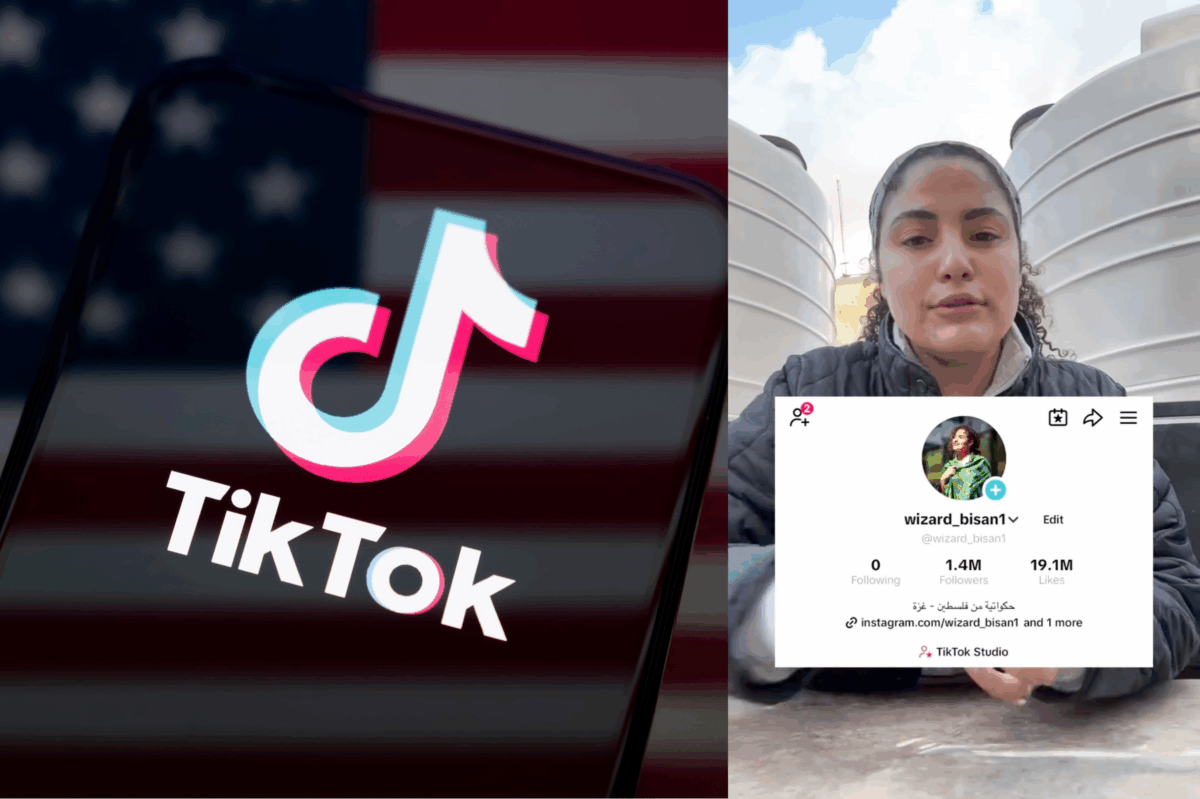
Users have been accusing TikTok of censorship since the transfer to U.S. ownership. (L) Samuel Boivin / NurPhoto via Getty Images; (R) Screenshot of Bisan Owda's Instagram

Update: After publication, Owda reported that she regained access to her account, but with heavy censorship. TikTok told her many of her posts have been labelled as “ineligible for recommendation,” and her account doesn’t show up in the search bar unless her full username is typed out. Owda said she believed the restoration was done after international outcry over her ban. The intentional censorship of the account contradicts the company’s narrative about “technical issues.”

Well-known Gaza journalist Bisan Owda has been banned from TikTok, she says, just days after the finalization of the company’s sale to U.S. investors — including a firm headed by the notoriously pro-Israel Larry Ellison.

Owda announced the censorship of her account in a video on Instagram on Wednesday, saying that TikTok had banned her permanently. She had 1.4 million followers on the platform, she said, as a result of years of audience-building under Israeli occupation and genocide.

“I had 1.4 million followers there. I have been building that platform for four years now,” she said.

The account did appear to be banned on Wednesday and Thursday. However, late Thursday afternoon Eastern Time, Owda’s account appeared to be restored, but restricted. Some content seemed to not be available, and a banner appeared at the top of her feed that read: “Posts that some may find uncomfortable are unavailable.”

The Palestinian journalist has spent years documenting life in Gaza under Israeli occupation and, recently, amid Israel’s genocide. Her series with Al Jazeera’s AJ+ has won numerous awards, including a Peabody Award, an Edward R. Murrow Award, and even an Emmy. At the same time, pro-Israel voices have sought to silence Owda, including in a campaign in 2024 to pressure her Emmy nomination to be withdrawn.

In her Instagram video, Owda said that the ban was “expected” due to pressure from high-powered figures to censor Palestinian voices from TikTok.

She overlaid a video of Israeli Prime Minister Benjamin Netanyahu’s remarks at the UN General Assembly in September, in which he named TikTok as a “number one” priority of Israel.

She also shared a video with the company’s U.S. CEO, Adam Presser, saying that the company made a change to designate critically labelling someone as a “Zionist” as hate speech. “Over the course of 2024, we tripled the amount of accounts that we were banning for hateful activity,” Presser bragged at a conference last year.

Indeed, pro-Palestine advocates have said that TikTok’s role in exposing users to Israel’s genocide in Gaza is the reason that lawmakers and world leaders have sought its censorship — stretching back to Congress’s original bill to force its sale from Chinese owners in 2024.

On Thursday, that campaign finally reached its endpoint as the transfer to U.S. leadership was finalized. TikTok’s parent company, ByteDance, still retains 20 percent ownership, while 80 percent is now owned by investors. This includes Oracle, a tech company co-founded and still led by Ellison, a vehement advocate for Israel and billionaire who has spent recent years amassing more and more power over the American mediascape.

The censorship of Owda’s account lends credence to accusations by users in recent days that the app’s owners began restricting activities on their accounts nearly immediately after the app’s transfer. Users have said that they are being restricted from uploading content critical of Immigration and Customs Enforcement (ICE), in favor of Palestinian rights, or generally opposed to the Trump administration. The owners, however, have blamed bugs and a power outage at a U.S. data center.
New US TikTok Spinoff Will Be Controlled by Trump-Aligned Billionaires


Trump-aligned tech barons are now set to control nearly all major US social media platforms.
PublishedJanuary 28, 2026

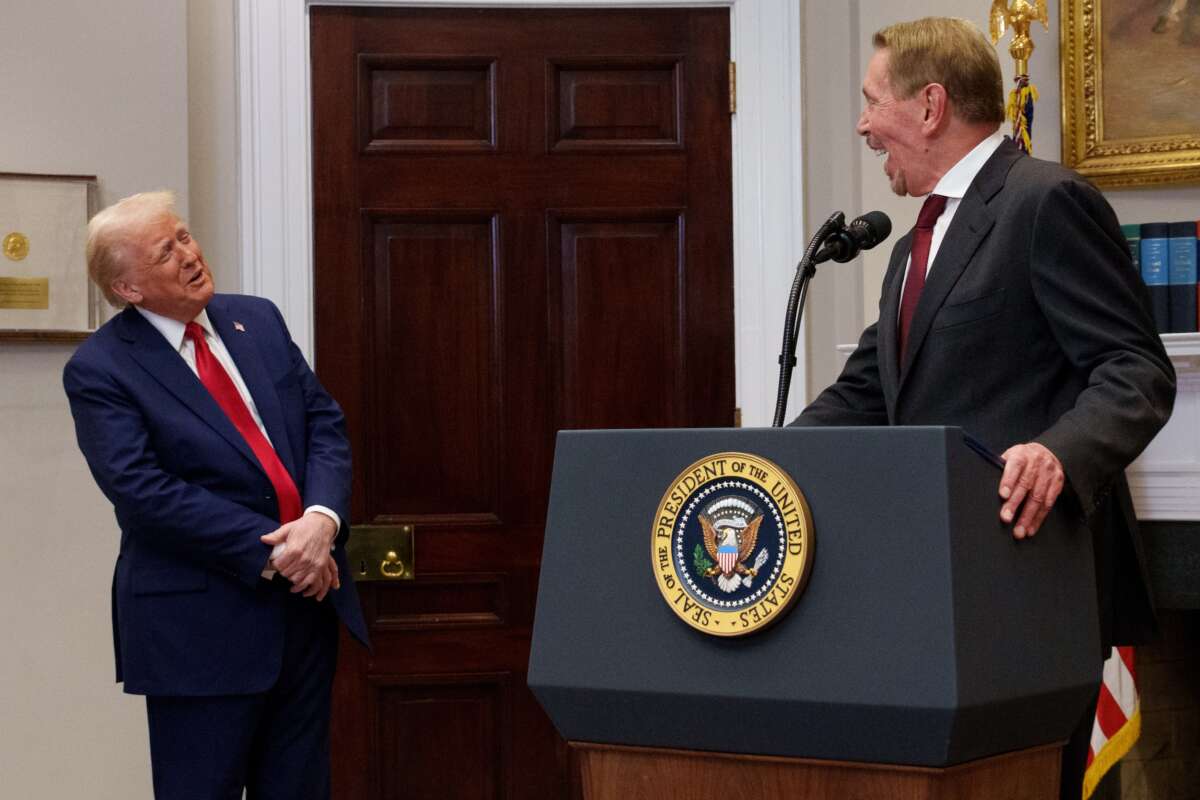
Oracle co-founder, CTO, and Executive Chairman Larry Ellison speaks during a news conference with Donald Trump in the Roosevelt Room of the White House on January 21, 2025, in Washington, D.C.Andrew Harnik / Getty Images


Honest, paywall-free news is rare. Please support our boldly independent journalism with a donation of any size.

After years of bipartisan attacks on TikTok and its parent company ByteDance, which for a time included an effort to potentially ban the social media app in the U.S., a new U.S. TikTok spinoff has been announced, set to be owned and overseen by a tight-knit consortium of tech and financial megabillionaires, many of whom have had direct business relationships with Trump and members of his administration and family.

The deal puts Trump-aligned tech barons — Oracle’s Larry Ellison, X’s Elon Musk, Meta’s Mark Zuckerberg — in firm control of virtually all major U.S. social media platforms.

In addition to its ominous bodings for media freedom in the U.S. — one-fifth of Americans get their news from TikTok — the deal comes as many TikTok users are already alleging censorship of content ranging from criticisms of federal immigration agents’ killing of Alex Pretti to rebuttals of the Department of Homeland Security’s rationales for entering homes without judicial warrants.

Moreover, many of the key owners of the new U.S. TikTok spinoff have professed and demonstrated commitments to Israel and its Prime Minister Benjamin Netayahu and have donated prolifically to pro-Israel groups — a fact worth noting since U.S. politicians have openly criticized TikTok for exposing users to Israel’s genocide in Gaza, in addition to the prime rationale behind the attacks on TikTok tied to inter-imperial rivalry with China.
TikTok’s New Algorithm Oligarch

A coterie of U.S. megabillionaires — including three of the world’s very wealthiest oligarchs, whose combined wealth is inching toward a half-trillion dollars — sit atop the new TikTok spinoff.


From AI to TikTok to TV, This Pro-Israel Billionaire Is Expanding Power in US
One of Trump’s advisers once called megabillionaire Larry Ellison a “shadow president of the United States.”  By Derek Seidman , Truthout October 11, 2025


First among them is Larry Ellision, the Trump-tied tech mogul whose conglomerate, Oracle, has a 15 percent stake in U.S. TikTok and a seat on its seven-member board.

Most critically, Ellison and Oracle will oversee U.S. TikTok’s algorithms and data management. The New York Times put it bluntly: “The new venture will moderate content in TikTok’s feed, deciding which posts to leave up and which to take down.”

No person will have more power “deciding which posts to leave up and which to take down” than Ellison.

Ellison is a close ally of Donald Trump and has significant influence with the president. As Truthout previously noted, he has personally hosted Trump fundraisers and was called a “shadow president of the United States” by one Trump adviser.

Ellison helped Trump claim a win early in his second term by partnering with OpenAI and SoftBank to invest $100 billion in the Stargate AI infrastructure project, which Trump announced with great fanfare immediately after his inauguration, calling it a venture that will “[build] the physical and virtual infrastructure to power the next generation of advancements in AI” as his administration seeks “AI dominance.” Oracle’s billionaire former CEO and current board member, Safra Catz, donated over $130,000 to Trump in 202.

Ellison is already a media baron, having recently acquired Paramount Global, overseen by his son, David Ellison. The father-son duo immediately signaled the company’s rightward, Trump-aligned turn by hiring Bari Weiss to run CBS News, whose new rollout has faced intense ridicule for its ineptitude and fawning attitude toward the Trump administration.

Ellison is currently worth around $223 billion. He owns luxurious properties across the world, including virtually an entire Hawaiian island, and a collection of superyachts, private jets, and invaluable art works. While Oracle began as a database software company whose first customer was the CIA, it’s boomed into a massive conglomerate with major business in cloud services and AI.

Now firmly at the helm of TikTok’s algorithms, Ellison’s sway over the news and entertainment content of tens of millions of people is only set to expand.
Trump-Tied Megabillionaire Owners

Another pro-Trump megabillionaire, Jeff Yass, worth around $65 billion, is set to profit big from the new U.S. TikTok.

Yass is the cofounder and CEO of Susquehanna International Group, an investment firm with a 15 percent stake in ByteDance, TikTok’s parent company. The Wall Street Journal reported in 2023 that Yass has a 7 percent personal stake in ByteDance worth $21 billion.

In 2024, Yass reportedly played a direct and pivotal role in reversing Trump’s previous support for a U.S. ban of TikTok. Yass started donating to Trump after his November 2024 reelection, having since given millions of dollars to Trump’s White House ballroom, presidential transition and the Trump-aligned MAGA Inc. super PAC.

Indeed, Yass is one the most prolific donors in U.S. politics. Like Ellison, he supports a pro-corporate, right-wing agenda, with his prime issue being school privatization and so-called education reform, which he’s splurged tens of millions on nationally.

Given Yass’s preexisting stake in ByteDance, it appears that he’ll be profiting from the new U.S. TikTok from two sides: first, through Susquehanna’s subsidiary, Vastmere Strategic Investments, which is part of the new U.S. TikTok consortium; and second, through ByteDance, which will have a 19.9 percent stake in U.S. TikTok.

Another tech mogul joining the ownership consortium of U.S. TikTok is Michael Dell, chairman and CEO of Dell Technologies.

Dell is among the world’s richest people, worth around $133 billion. His wealth skyrocketed over the past decade through a series of business deals. His investment firm, the Dell Family Office, is part of the new TikTok consortium, and his close business ally, the private equity firm Silver Lake, has a 15 percent stake in U.S. TikTok, with its co-CEO Egon Durban sitting on its new seven-member board.

Like Ellison and Yass, Dell has enamored himself to Trump — in his case, by donating $6.25 billion last December into “Trump accounts,” investment accounts for U.S. children created by Trump’s “One Big Beautiful Bill” Act, which critics accuse of being new tax shelters for the wealthy and potential rationales for stripping away social safety protections.
Web of Trump Family Deal Makers

Many of the remaining U.S. TikTok investors are tied to Trump and to each other through a knotty web of alliances, further suggesting that the new TikTok spinoff will be run by a tight-knit clique.

MGX, an Emirati investment firm focused on tech and AI, will have a 15 percent stake in U.S. TikTok and a seat on its board. MGX has been involved in business deals tied to the Trump family. For example, it used a stablecoin backed by World Liberty Financial, the Trump family’s cryptocurrency firm, in a $2 billion deal with Binance, the world’s largest cryptocurrency exchange. It also has partnerships with a range of powerhouse U.S. companies, including Nvidia, Microsoft, BlackRock, OpenAI, and Elon Musk’s xAI. MGX, like Dell Technologies, also has close interlocks with Silver Lake, a private equity firm overseeing $116 billion in assets.

The ties between MGX, Silver Lake, and other U.S. TikTok consortium members are manifold. For example, Silver Lake’s Durban serves on the board of G42, a “foundational partner” of MGX, and Silver Lake and MGX have partnered on major business deals. Silver Lake’s Durban currently sits on the board of Dell Technologies. A Silver Lake-owned data center firm has partnered with Ellison’s Oracle.

U.S. TikTok’s new owners also have long histories of partnering with Trump’s son-in-law Jared Kushner and his family.

In 2025, Durban and Silver Lake made the largest-ever private equity buyout — of video games corporation Electronic Arts for $55 billion — in partnership with Jared Kushner. (Silver Lake also owns the parent company of Ultimate Fighting Championship [UFC] and World Wrestling Entertainment [WWE] — favorites of Donald Trump).

Another U.S. TikTok backer, Yuri Milner, invested $850,000 in 2015 in a real estate startup established by Kushner.

Private equity giant TPG Global, overseeing $286 billion in assets, is also represented on U.S. TikTok’s seven-person board. TPG’s billionaire CEO Jon Winkelried previously served as a strategic adviser and partner at Thrive Capital, a venture firm run by billionaire Josh Kushner, Jared Kushner’s brother.

Additionally, Vice President JD Vance was previously a partner at another U.S. TikTok consortium member, the venture firm Revolution.
Pro-Israel Ties

The driving political rationale around the TikTok deal has revolved around U.S. imperial rivalry with China, but a key factor has also involved claims — repeated by U.S. politicians from former secretary of state Hillary Clinton and Rep. Josh Gottheimer, to Marco Rubio and Sen. Josh Hawley — that TikTok was responsible for fomenting protest against Israel by showing viewers content of Israel’s genocide in Gaza.

Israeli Prime Minister Benjamin Netanyahu bluntly acknowledged this in 2025 when he called negotiations over TikTok “the most important purchase going on right now” and stated that “we have to use the tools of battle” and that “the most important ones” today were “on social media.” Anti-Defamation League President Jonathan Greenblatt claimed in late 2023 that “we really have a TikTok problem, the Gen-Z problem.”

That “TikTok problem” could now be addressed: Core owners of the new U.S. spinoff are starkly aligned with the Israeli regime.

Ellison, who will have more power than anyone over U.S. TikTok’s algorithms, is extremely close with Netanyahu, who has vacationed on Ellison’s Hawaiian island, and who Ellison has supported during his corruption trials.

Ellison has spoken of his “deep emotional connection to the State of Israel” and said Oracle will “do everything we can to support the country of Israel.” Israeli-born former Oracle CEO Safra Catz worked to create pro-Israel TV shows to influence U.S. public opinion.

Ellison is also a massive donor to the Friends of the Israel Defense Forces (FIDF), a U.S. nonprofit that effectively subsidizes the Israeli military. Ellison’s reported donations to the FIDF include $10 million in 2014 and $16.6 million in 2017.

Michael Dell also gave $1.8 million to the FIDF in 2014, and in 2024 he gave $250,000 to the Israel on Campus Coalition, an Israeli-tied group that has targeted pro-Palestine activists and supported Canary Mission, which “outs” pro-Palestine organizers and whose database has reportedly been used by the Trump administration to flag activists for potential deportation. Dell has also had a decades-long business relationship with Israel and its military.

Another investor in the U.S. TikTok consortium, Yuri Milner, is also an FIDF donor; and Yass has donated to pro-Israel groups and is a benefactor of “a conservative Israeli think tank at the helm of the country’s rightward lurch,” according to The Intercept.
Surveillance and Propaganda

The new reality for TikTok users in the U.S. could not be starker: Their feeds will now be overseen and shaped by a clique of billionaire oligarchs firmly committed to a Trump-aligned agenda.

Worries that Ellison will bend the U.S. TikTok’s algorithms to align with MAGA’s political agenda are compounded by his excitement about tech surveillance. In 2024, speaking about AI, Ellison shockingly said out loud that “citizens will be on their best behavior because we are constantly recording and reporting everything that’s going on.”

The agenda and alliances of the billionaire clique ruling over the U.S. TikTok spinoff are causing fears of a potential dual threat from the new app. First among them is the concern that its algorithms, now under the purview of Ellison, will be altered to support the Trump administration and Ellison’s own agenda to limit or censor content.

“My worry all along is that we may have traded fears of foreign propaganda for the reality of domestic propaganda,” Georgetown University professor Anupam Chander told The New York Times.

Second, and perhaps more ominously, there’s growing alarm over the app’s collection of personal data, which precedes the new spinoff deal. App disclosures, which are required by state privacy laws, have said TikTok can gather data such as location data and data on “sexual life or sexual orientation,” “status as transgender or nonbinary,” and “citizenship or immigration status,” leading to fears that such data could be weaponized to operate as a veritable arm of the Trump regime’s apparatus of detention, deportation and repression, now that the app will be overseen by close Trump allies who are on record as openly praising tech surveillance.

“I worry about all online services collaborating with the administration, and when one is friendly, you have greater concerns,” David Greene, senior counsel for Electronic Frontier Foundation, a digital rights group, told Truthout. “Given the political affiliations of the new owners and the current administration’s data practices itself in terms of sharing — what we’ve seen with ICE enforcement, seeking information from all available sources, even if there are supposed to be legal barriers protecting it, to identify base targets — we don’t see a lot of respect for data privacy administration or those who work with it.”
LEGAL INTERPRETATION

Philip Glass' latest work is a direct 'warning' about Trump: legal scholar


Philip Glass at Teatro degli Arcimboldi in Milan, Italy on September 20, 2008 (MITO SettembreMusica/Wikimedia Commons)

January 29, 2026
ALTERNET


President Donald Trump's influence on Washington D.C.'s Kennedy Center for the Performing Arts (which the president has added his name to) has now spread to legendary composer Philip Glass. Earlier this week, Glass announced that his "Symphony Number 15: Lincoln" will not debut at the venue. One legal scholar is arguing that Glass' symphony is actually about Trump.

"Lincoln' was inspired by President Abraham Lincoln, who served as the United States' first Republican president before he was assassinated on April 15, 1865 near the end of the American Civil War. And in a biting op-ed published by The New Republic on January 29, former federal prosecutor Harry Litman argues that "Lincoln" can serve as a "warning" about Trump.

"Donald Trump responded to Philip Glass' withdrawal of his 'Lincoln' symphony from the Kennedy Center the way he usually does when confronted by someone of real stature: with a sour-grapes, self-aggrandizing rant," Litman observes. "The tirade was petty, frivolous, and quickly forgotten. But the episode itself deserves attention because Trump’s insult, unsurprisingly, missed the broader point of Glass' gesture. Glass, 89, a towering figure in modern composition whose place in the history of music is secure, did not merely pull a much-anticipated work that is likely his last symphony. He pointedly sounded the symphony’s theme as a direct protest to the dangerous authoritarian rule under Trump."

Litman notes that Glass' "Lincoln" is "centrally" drawn from Abraham Lincoln's Lyceum Address of 1838.

"Lincoln delivered the address to a group of young professionals in Springfield, Illinois, when he was just 28 — an age when Trump was still shining his father's shoes," Litman explains. "Trump, who one suspects has never read the Lyceum speech or listened to a Glass symphony, viewed the gesture, as he invariably does, as a personal affront. In fact, it was far more. It incorporated Lincoln's prescient warning about democratic collapse, a warning that lands with unsettling accuracy on the dangers of Trumpian rule. In the Lyceum, Lincoln was already grappling with the question of how republics fail."

Litman continues, "He begins by asking where the danger to American self-government will come from. Not from abroad, he insists. No foreign army, no invading conqueror, no modern Bonaparte. If destruction comes, Lincoln says, 'it must spring up amongst us.'” If the republic falls, 'we must ourselves be its author and finisher'…. Lincoln warned that contempt for law is the republic’s gravest danger. Trump, without intending to, has demonstrated exactly why."

Harry Litman's full article for The New Republic is available at this link.