Saturday, January 31, 2026

Top EU official voices ‘shock’ at Minneapolis violence

By AFP
January 30, 2026

European Commission vice president Teresa Ribera described the images coming out of Minneapolis as 'terrifying' - Copyright AFP Nicolas TUCAT


Raziye Akkoc and Adrien de Calan

Top EU official Teresa Ribera on Friday described her “shock” at the “terrifying” images of violence in Minneapolis where two American citizens were shot dead by federal agents enforcing an immigration crackdown.

“I don’t want that for my country or my continent,” the European Commission vice president said in an interview with AFP in her 12th floor office in Brussels.

“For me, it was terrible — the shock of seeing how Renee Good, Alex Pretti, and small children, women, and men are treated with such senseless violence, especially because it’s anonymous,” she added, naming the Americans killed.

Minneapolis has been gripped by weeks of protests against the roundup of undocumented migrants by masked and heavily armed federal agents.

Both 37-year-old Americans had been demonstrating against the sweeps when they were shot dead by officers.

Ribera’s comments contrasted with the extremely cautious line of the European Commission, which has declined to condemn the killings and called the violence in Minneapolis an “internal” US matter.

“This happened in a country founded on an ideal of freedom, the protection of rights, and respect for individuals,” the commissioner said.

She added she was counting on the Congress and the courts, on “American society’s ability to react” and on “the federal administration” to restore “normality”.

Ribera has often been a rare dissenting voice in the European Commission’s top team led by president Ursula von der Leyen and last year condemned Israel’s war in Gaza as a “genocide” against Palestinians, in the strongest public remarks by an EU official.

Since Pretti’s death, she has made a string of posts to her Bluesky account, endorsing Barack Obama’s warning his killing was a “wake-up call” and sharing Bruce Springsteen’s song written in response.


– ‘Unjustified threats’ –


Relations between the European Union and the United States, its ally and top trading partner, have entered a tumultuous period since Donald Trump returned to the White House a year ago.

But Trump’s vow to seize Greenland from EU and NATO member Denmark cast the transatlantic alliance into its deepest crisis in years — before the US leader backed off his threat last week.

Ribera acknowledged the transformation of the transatlantic relationship.

“We received this very harsh and very threatening message” on Greenland, Ribera said, which showed “how important it is to react in a clear and united way”.

While the immediate danger has been averted — and Trump’s tariff threats on European countries rescinded — Ribera called on Europe to remain united.

Greenland “was also a clear incentive to take note of how clear and united we need to be on issues that can be considered unjustified threats,” she said.

Ribera is also the EU’s most senior antitrust official, and despite US threats of retaliation, she has insisted Brussels will not be swayed from acting against American Big Tech where necessary.

She criticised the “attacks” by the US administration against Europeans involved in tech regulation, including former EU commissioner Thierry Breton, who was among five people the US State Department said it would deny visas to.

“We’ve all experienced things we didn’t expect,” she said of the United States.

In the face of the changes, Europe “must hold on to our core principles”, she said, including the “ability to be firm when necessary”.
OPINION

The 'theology of showing up' is making Minneapolis a holy place

(RNS) — The people of Minneapolis, too, are responding and resisting in unspeakably brave, radically loving ways that we will speak of for years to come.

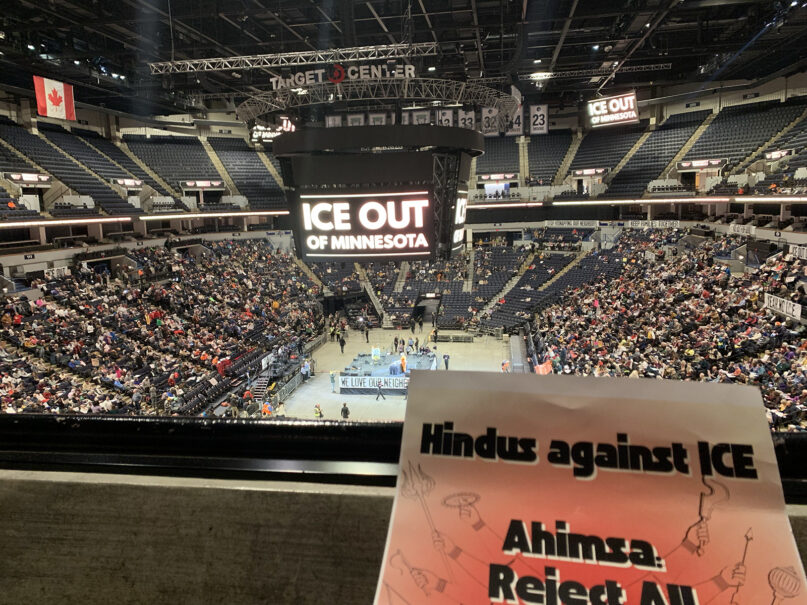
Thousands of people attend a rally at the Target Center after a large march on Friday, Jan. 23, 2026, in Minneapolis. (Photo courtesy of Hindus for Human Rights)

Sunita Viswanath
January 25, 2026
 RNS

(RNS) — I arrived in Minneapolis on Wednesday (Jan. 21). I had come because local organizers said people were being disappeared: kidnapped off the street, detained, shot in plain daylight. I went because there was a cry for help from a devastated community.

Nothing prepared me for what I saw. The city was a battleground where U.S. Immigration and Customs Enforcement feels like an occupying force.

A Hindu organizer and activist, I went as an ally of a 50-strong Rabbis for Ceasefire delegation, some of whom I knew from our trip to Israel and the Palestinian territories in August, to see the effects of the Gaza war. I saw there firsthand what occupation looks like. Minneapolis felt occupied, too.

The people of Minneapolis are responding and resisting in unspeakably brave, radically loving ways that we will speak of for years to come.

Our first stop was a “convergence” of faith leaders, organized by a long-standing local coalition, MARCH (Multifaith Antiracism, Change and Healing). After two days of education, training in nonviolent resistance and immersion into this moment in Minneapolis, MARCH had one ask: Go back to our communities and share what we witnessed.

On Friday we participated in Minneapolis’ citywide day of action, a general strike, for which hundreds of local businesses chose to close. Some gave free food and drink to people participating. Tens of thousands of people — faith leaders among them — marched to abolish ICE in spite of frigid temperatures. The march culminated in a huge rally in an indoor stadium, where local faith leaders, union leaders and elected officials offered speeches and prayers of defiance and resilience.

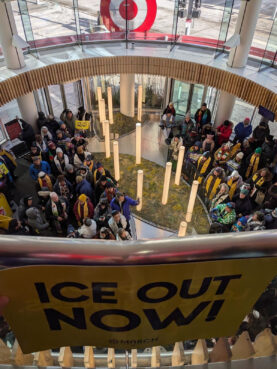
Within that larger strike, our faith convergence took part in actions of defiance organized by MARCH. At Minneapolis-St. Paul International Airport, some 100 clergy were arrested, while an estimated 600 local community members and out-of-town clergy stood witness. Later, I joined a group of multifaith clergy in song, prayer and presence at the B.H. Whipple Federal Building, where Minnesota’s ICE offices are headquartered. More a sprawling compound than a single building, it was an ugly, stomach-turning place: streams of protesters, anti-ICE graffiti and the heavy feeling of power concentrated behind concrete walls.

After praying there, we did what many local residents do when they aren’t working or caring for their families: patrol the streets. This is what Renee Nicole Good and Alex Pretti, both Minnesota residents shot to death by ICE agents, were doing when they were killed.

We drove for hours in the car of a local friend, Bonnie, watching her communicate with “dispatch” — a volunteer who takes in reports of ICE activity and sends people to witness and protest. From 5 a.m. to midnight every day, locals drive the streets, communicating with dispatch, watching for ICE vehicles and activity, documenting license plates and recording what they see. In just three hours, dispatch never went quiet. There were three abductions during that short time.

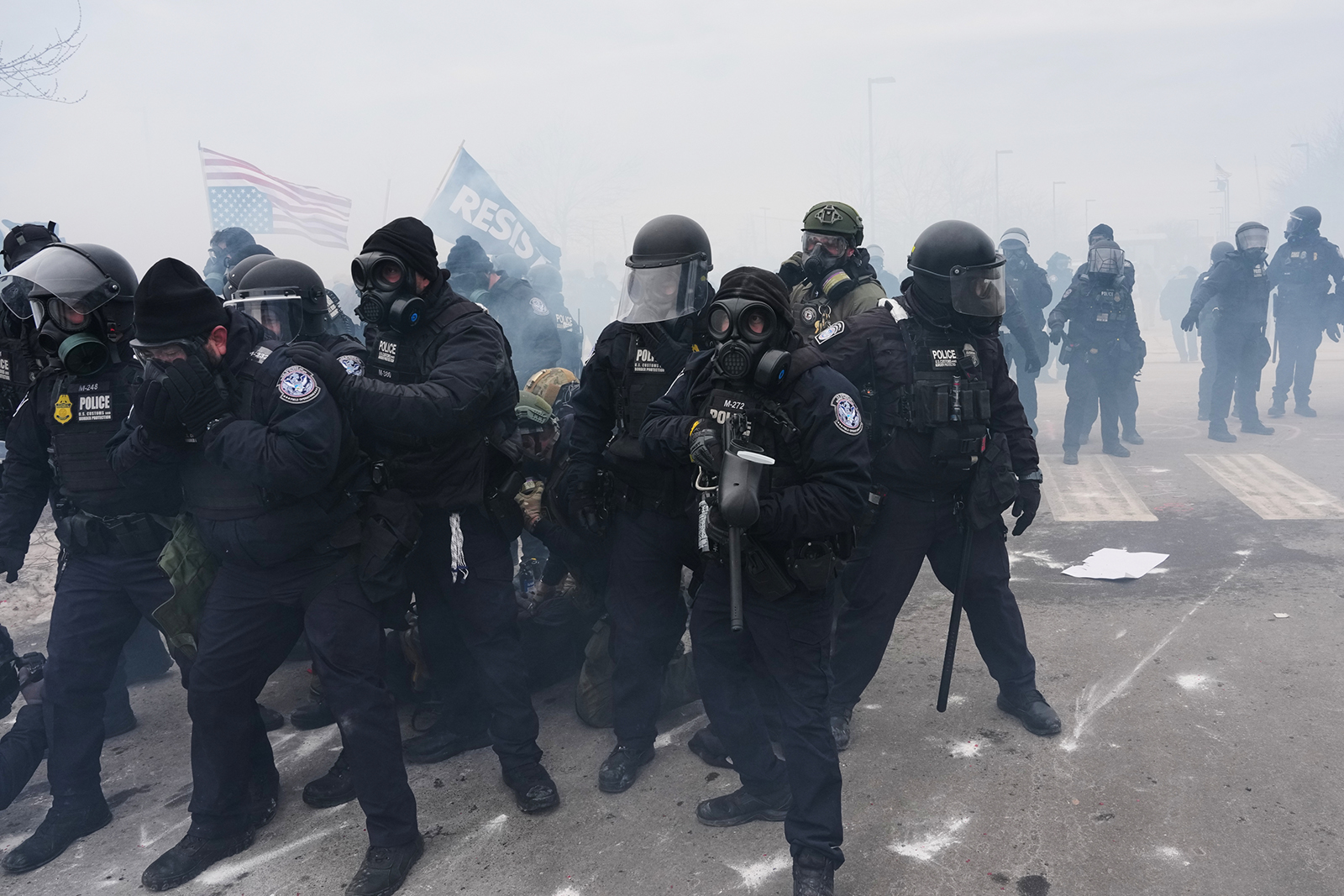
We saw ICE agents and vehicles across the city, and almost always a group of residents nearby: shouting, shaming, filming. We got out of the car several times to join them. Once, agents were harassing someone in a car some 50 yards away and one deployed tear gas. Instantly, our eyes burned, our throats constricted and we struggled to breathe. We rushed back to our car. Our friend, who had stayed inside, felt the effects just from our clothes and skin.


Hindus for Human Rights’ interfaith group visits a memorial for Renee Nicole Good, near the area where she was killed, in Minneapolis. (Photo courtesy of Hindus for Human Rights)

Back in India, my aunt would tell me that a pilgrimage had to be hard. You had to suffer. She took me to small street temples where you walked barefoot on ice to access the shrine. Our main family deity is worshipped in a famous temple atop a huge hill, and we would often walk up the hill rather than drive. When my aunt was in crisis and her prayer felt like a weight, she would do pradakshinas, circumambulating the shrine by rolling on the ground.

The moments of not being able to breathe, while thankfully brief, felt like the hardship that made this a pilgrimage. And Minneapolis, for me, a holy place.

I was devastated throughout my days in the city, but the only time I was personally frightened was when someone threw a snowball — an iceball, in the below-freezing temperatures that week — at an ICE agent. He turned in anger, scanning for the culprit, looking like he could have done anything. When he turned away, I tried to breathe a sigh of relief and remembered I was still choking.

Every Minnesotan I met thanked us for coming so far to stand with them, and many expressed solidarity with us, because they believe this wave of cruelty, hate and madness is coming for us all, no matter where in the country we live.

That conviction showed up everywhere, in small human moments and in harder truths. One Somali cab driver was so amazed someone would travel from New York to stand with his city that he wanted to buy me coffee. (He couldn’t waive the cab fee because it was a Lyft.) The Somali cabbie who drove me to the airport at 4:30 a.m. was irate. “What is wrong with Americans? Do they want this?” he ranted. “Why did they vote for this? What is so special about Trump that he isn’t behind bars? When will this end? What kind of democracy allows this?”

Bonnie, who drove us for hours to show us what patrol is like, told us she’s in therapy for post-traumatic stress disorder after a group of heavily armed ICE agents pointed their guns at her at an intersection near where Renee Good was killed. She continues to patrol every day because, as a person of relative privilege, she feels “responsible.” Another friend, a Minnesota local who traveled with me to Palestine, chauffeurs a group of immigrant kids to school, kids whose parents are terrified to leave their house.


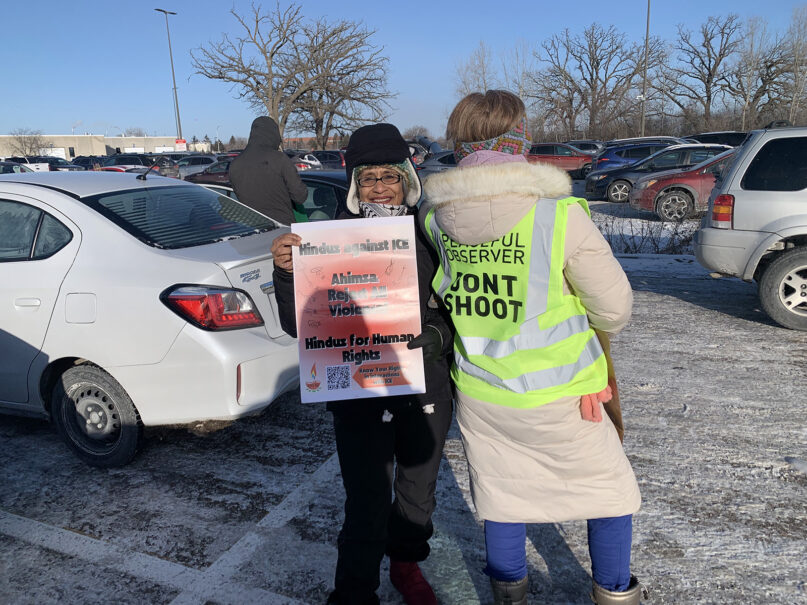
Author Sunita Viswanath, left, and a fellow demonstrator in Minneapolis.
 (Photo courtesy of Hindus for Human Rights)

At the convergence, one speaker insisted she wasn’t an activist. She was simply a neighbor worried about an immigrant family across the street. That concern helped create a mutual-aid network, one of many in Minneapolis. Participants donate money and resources so that people in need can pay rent, buy groceries and access health care. She said $300,000 had already passed through her network. “If someone gives, take it. If someone needs, give it. If you have space, share it.”

Since people in Minneapolis believe the hell they are facing is bound for all our hometowns, they kept offering not just grief but guidance, whatever they think will get the rest of us through when our time comes.

Over and over, I heard the same imperatives: Unite across differences, especially ideological differences, and join hands to resist an authoritarian takeover. Give freely, share what we have, and do what we can to keep each other safe. Act now, because there isn’t time for long, drawn-out planning. And know this is coming for you. Don’t assume it’s someone else’s problem.

They also kept insisting that we learn history — not as an academic exercise, but as a survival skill. Whether it is the genocide of Indigenous people or the catastrophic history of slavery and Jim Crow, the history of this country leads us here. Throughout our history, only mass uprisings have brought change. We have to take strategic inspiration from the nonviolent civil disobedience of the Civil Rights Movement.

They were blunt about what that demands: Resistance cannot be symbolic. Acts of resistance must go beyond symbolism into non-cooperation. Protest cannot be law-abiding when there is no law and order.

Tonight I will close my eyes in a safe, cozy home back in New York. But Minneapolis taught me we are in an emergency beyond comprehension. We may be afraid — how could we not be? — but fear has to propel us, not paralyze us. Fear lessens when we unite with many, and when we ground every action and decision in unconditional kindness: love. We need to get uncomfortable, share every resource we have, risk danger, make the crisis our house of worship, and pilgrimage there to pray with our feet.

(Sunita Viswanath is the executive director of Hindus for Human Rights. The views expressed in this commentary do not necessarily reflect those of Religion News Service.)
One year after she urged Trump to have mercy, Bishop Budde leads clergy protests in Minneapolis

MINNEAPOLIS (RNS) — 'I don't think a year ago we could have fathomed how quickly and how dramatically this country would change,' Budde told RNS in Minneapolis.


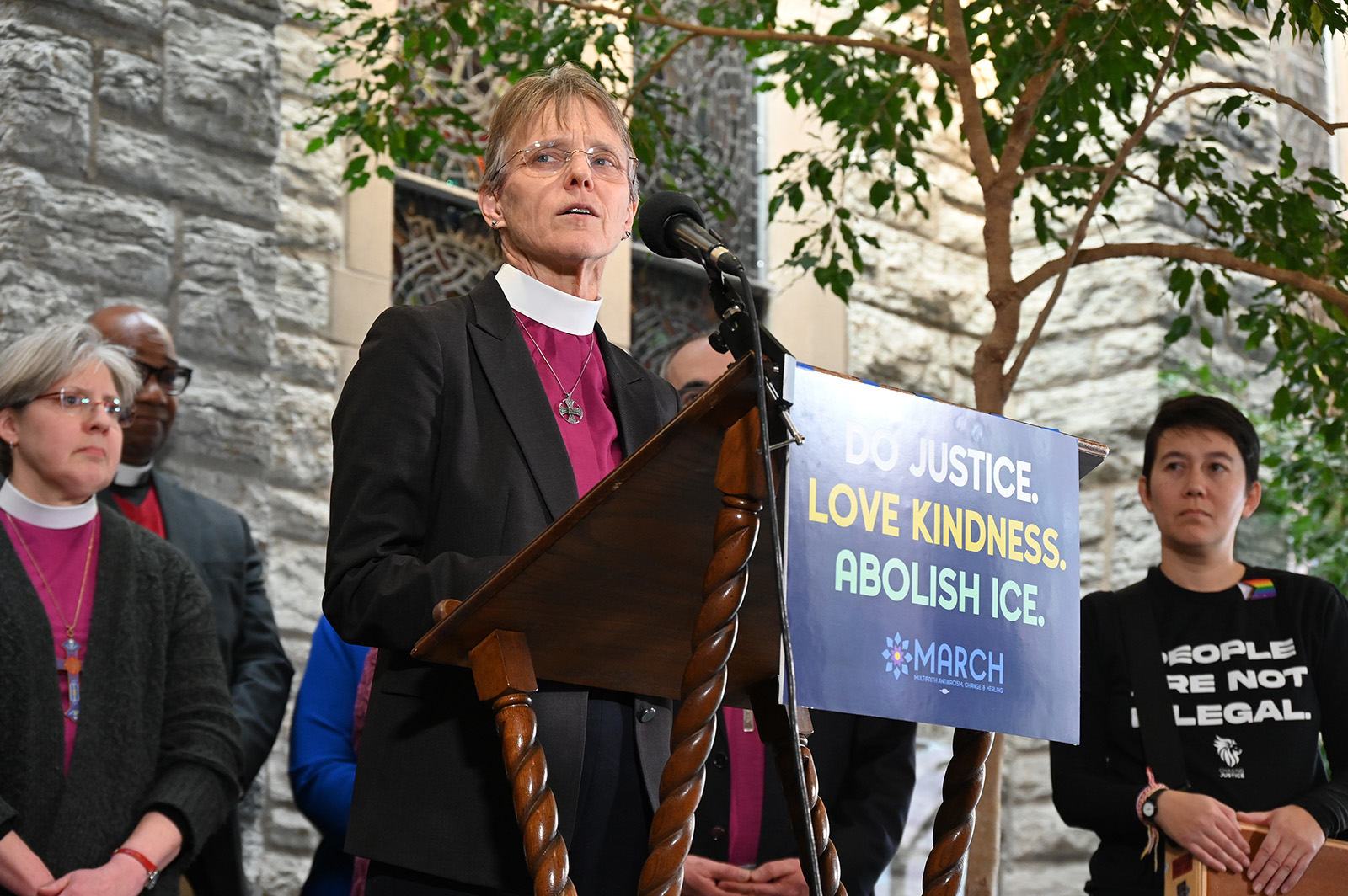
Bishop Mariann Budde, the Episcopal bishop of Washington, speaks during a press conference by clergy about immigration actions, Thursday, Jan. 22, 2026, in Minneapolis. (RNS photo/Jack Jenkins)

Jack Jenkins
January 23, 2026
RNS

MINNEAPOLIS (RNS) — Almost exactly a year ago, the Rt. Rev. Mariann Budde, the Episcopal bishop of Washington, stood in a pulpit in front of the newly inaugurated President Donald Trump and preached a sermon that called on the commander in chief to have “mercy” on immigrants and other communities.

The sermon quickly drew backlash from the president himself, who called her “a Radical Left hard line Trump hater,” and Speaker of the House Mike Johnson, who called her message “radical.”

But if Budde’s message was radical, it’s one that has resonated nonetheless. A year later, she stood in another church in Minneapolis, this time surrounded by an array of clergy who represented the hundreds of faith leaders who flocked to the city this week to protest the administration’s mass deportation campaign.

“In our varied and united faith traditions, love of neighbor is not optional,” Budde declared.

The bishop sat down with Religion News Service shortly after that appearance on Thursday (Jan. 22) to reflect on the year that has passed since her barn-burning sermon and on what she expects will be even more faith-based activism on behalf of immigrants.

This interview has been edited for length and clarity.
What brought you out here? Why did you want to be a part of this particular convening?

The call was issued. This is my home state — where I raised my family. I saw how the ICE raids across the country have been happening — they seem to be increasing in intensity and in vitriol and brazenness. It just seemed like whenever there’s a possibility to show up and cast a light on that and shine a national spotlight, that felt really important.
You’re about a year removed from your sermon, in which you called on this administration to have mercy. JD Vance is actually here right now talking while we’re here. Do you have any reflections on that sermon now that you’re here with hundreds of clergy who are issuing a similar call that you did a year ago?

I don’t think a year ago we could have fathomed how quickly and how dramatically this country would change. The degree to which the goals and aspirations of the Trump administration as they came into office, how soon they would actually come into being and what it has cost the country. And then also, as has been said today, history is calling us to step up. I’m doing this for the country that I’m passing on to those coming up behind me and for the people who are here. It feels like a generational struggle. I wish it weren’t so, but here we are. And it’s our country to preserve and protect. It’s heartbreaking, but here we are.


Clergy members sing the hymn “We Rise” at a memorial honoring Renee Good, who was fatally shot by an ICE officer, near the site of the shooting in Minneapolis, Friday, Jan. 9, 2026. (RNS photo/Jack Jenkins)

Some of your fellow bishops — in New Hampshire, in Minnesota — have called on clergy to “get their wills in order” and to be willing to put their bodies on the line to resist these mass deportation tactics. And we’ve seen clergy during protests hit with pepper balls and tear gas, even arrested. You talk about being brave; that sounds like a really difficult thing when the risks are this high.

I think people show up with courage in their own way, and we don’t all have to do the same thing. I think that’s really important. Most acts of courage are small and local and very relational. So I want to just say, that is probably the fabric that holds us all together. And then every once in a while people either step into a moment of great danger or more often than not they get swept up into it. Jonathan Daniels wasn’t planning on getting killed when he was out, he was buying a coke, right? Renee Good wasn’t planning on getting killed. She was driving her kid to school, right? So you don’t choose these moments, but you find yourself in them. And that, I suspect, is the price of being alive in certain moments of history. Thank goodness they’re mostly rare.

I would say to my people don’t be naive but also be safe. I want you to be here on the other side, right? And so that’s what I’m saying to my people. Be brave but be wise. And stand in solidarity with other people. And if things happen, we’ll cross that bridge when we come to it, but I’m not gonna go looking for it.

You serve DC, where there’s still troops on the streets. Are you pulling lessons from your own experience over the last year?

Right, ICE is also in Washington and in Maryland, and I have driven by people pulled out of their cars and arrested, young men just standing or driving somewhere being detained. That’s happening. People in our congregations and our immigrant congregations are as nervous about all the things you’re seeing here (in Minneapolis). It’s not the same scale, but it’s the same fear. And so I would say we’re watching the escalation of this process and this agency — that has been given more money and more opportunities for recruitment and brazen training that suggests they are immune from any accountability — being unleashed across our country. We’re seeing what it looks like when it’s given full license in one place. And that should give us all pause.

As you’ve been in conversations with clergy and congregations that you serve, is there a question or a concern that comes up a lot that you don’t see talked about often?

We are awash in a culture of contempt that is encouraging us to treat one another, particularly those with whom we might disagree, in the most dehumanizing and degrading ways. We’re all being socialized to do that. It’s infecting everything, whether we realize it or not. No matter where you stand on the spectrum, politically or theologically, we can all agree that is really killing us as a country, right? We don’t know how to have honest and respectful conversations across differences with a baseline of dignity. I think that we would go a long way in clearing out the real issues from the exacerbated ones that keep us on edge, like, all the time.

I need to be talking more to people who see the world differently. But it’s impossible if they look at me and I look at them through the lens of contempt and disregard.

It’s at the highest levels, but it’s also in our families. And we have more control over that than perhaps we realize. That’s what I’m encouraging my people to work on. Because not everyone agrees with what I just said today. I get that.

I have people whose families are in law enforcement and in the military. We all come from our perspectives. But if we can’t talk about these things in a way that brings us together as a country, if we don’t get those muscles back, our ability to come back from the most extremes of violence is diminished every day. So that’s what I’m kind of dedicating my life to.
Inside the effort to organize clergy nationwide to resist ICE

(RNS)— Hundreds of clergy from around the country gathered in Minneapolis to learn from Minnesota faith leaders how to protest against ICE enforcement. Then they took to the streets and helped block the city's airport.


Clergy members lead a demonstration against U.S. Immigration and Customs Enforcement tactics in the departures area of Terminal 1 of the Minneapolis-St. Paul International Airport, Friday, Jan. 23, 2026, in St. Paul, Minn. (RNS photo/Jack Jenkins)

Jack Jenkins
January 23, 2026
RNS

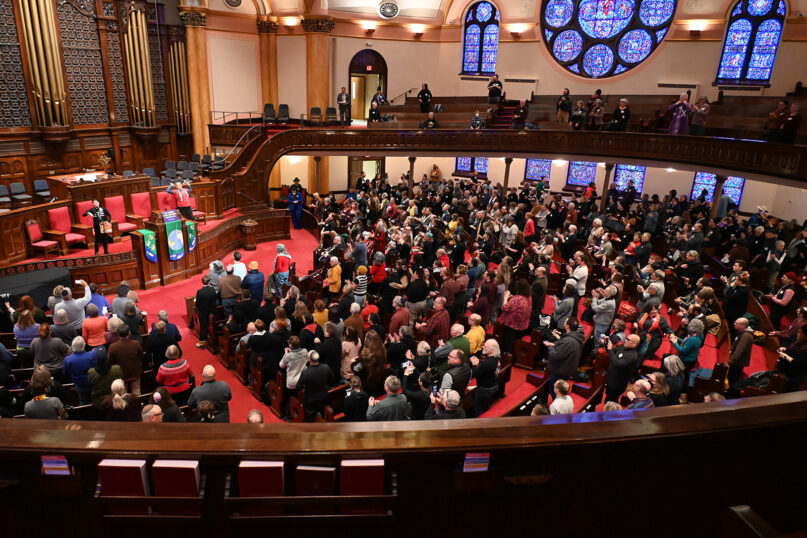
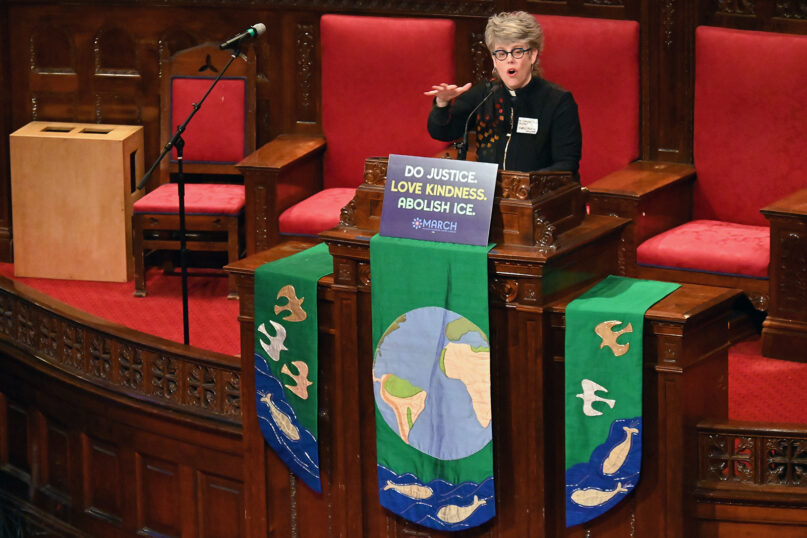
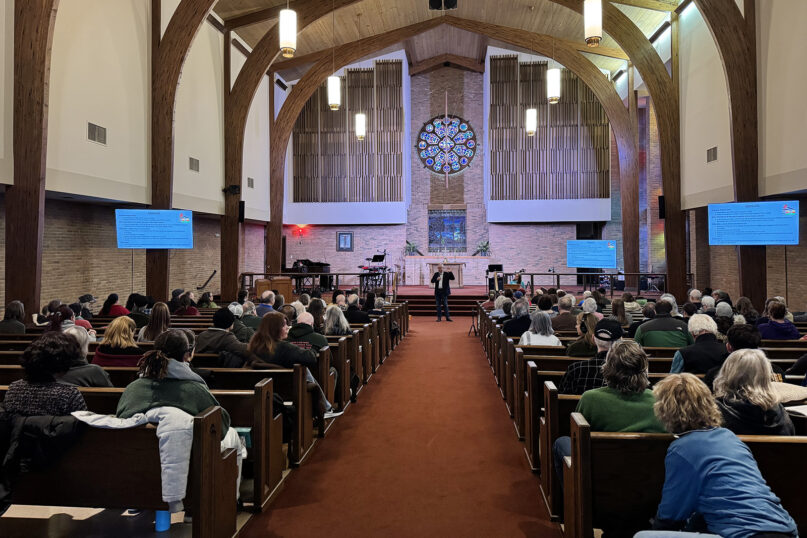
MINNEAPOLIS (RNS) — As she stood at the pulpit at Westminster Presbyterian Church on Thursday (Jan. 22), the Rev. Rebecca Voelkel, a United Church of Christ minister, looked out at the packed sanctuary with tears in her eyes.

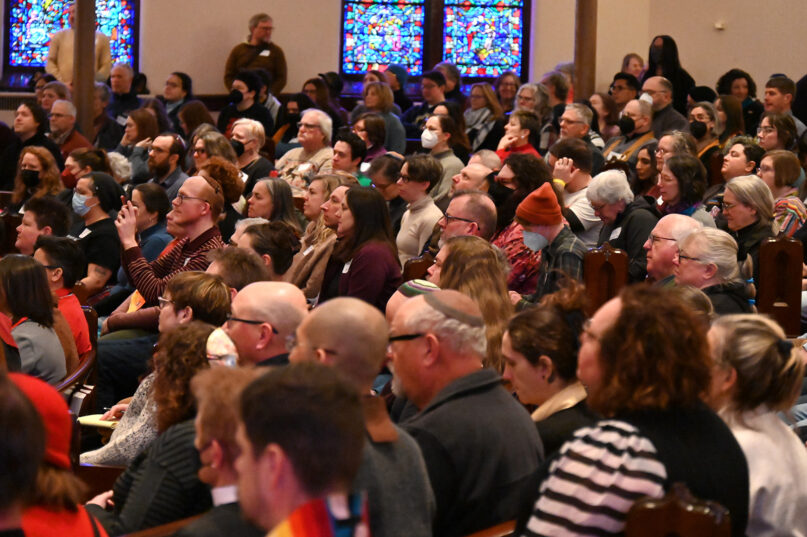
Far from the typical flock of Presbyterian worshippers who frequent the church on Sundays, the more than 600 people who filled the pews represented a wide range of faiths — Christians of all kinds as well as Buddhists, Jews, Muslims and Indigenous practitioners, among others.

All were religious leaders who had traveled to Minnesota on short notice, spurred by their faith to oppose President Donald Trump’s mass deportation campaign in the city.

“In the face of all the pain and suffering in our cities and our country, you are a beautiful, beautiful sight,” Voelkel said.

Beneath her, on the pulpit, sat a sign that referenced Scripture from the biblical book of Micah, but added a decidedly timely twist.

“Do justice. Love kindness. Abolish ICE.”


Hundreds of clergy convene at Westminster Presbyterian Church, Thursday, Jan. 22, 2026, in downtown Minneapolis, Minn. (RNS photo/Jack Jenkins)

The moment marked the beginning of a remarkable two-day religious gathering in Minneapolis, taking place amid the Trump administration’s aggressive immigration enforcement campaign. Constructed as a mix of activist trainings, spiritual revival and direct-action protests, Minnesota faith leaders who have been actively resisting Immigration and Customs Enforcement agents used the assembly as an opportunity to pass along lessons to clergy from other parts of the country. Amid prayers, songs and protest chants, the gathering heralded the emergence of a vast, faith-based network set on resisting the administration’s mass deportation effort.

Religion News Service was one of only three outlets given access to the conference, which was largely organized by the local religious advocacy group Multifaith Antiracism, Change and Healing, known as MARCH. The size of the event was striking, given how quickly it came together: The public invitation was published on MARCH’s website only a week before the event began, and organizers said so many clergy wanted to take part that they eventually had to halt applications due to logistical concerns.

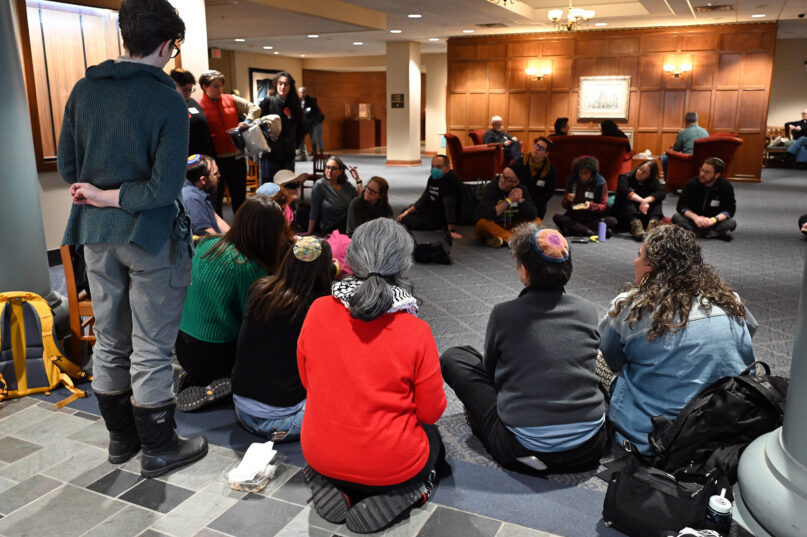
Many of those in the church wore shirts and buttons with the slogan “Abolish ICE,” and attendees proudly displayed liberal leanings. The event was promoted as overtly “pro-queer,” and attendees wore rainbow stoles and other symbols of LGBTQ+ inclusion. Some of the roughly 100 rabbis in the crowd wore yarmulkes designed to resemble watermelons — a symbol of support for Palestinians.

While the attendees, who had flown from as far away as Massachusetts, California, Tennessee and Alaska, were deeply critical of ICE, most had yet to encounter Department of Homeland Security agents in their cities. They were eager to learn from faith leaders in Minneapolis, where a massive influx of roughly 3,000 federal agents has sparked a sprawling organized resistance among locals.


The Rev. Rebecca Voelkel speaks to clergy at Westminster Presbyterian Church, Thursday, Jan. 22, 2026, in downtown Minneapolis, Minn. (RNS photo/Jack Jenkins)

At the session in the Westminster sanctuary, the assembled clergy belted out an opening song with the refrain “No one is getting left behind this time.” That was followed by remarks from Junauda Juanita Petrus-Nasah, the poet laureate of Minneapolis, and Jim Bear Jacobs, an Indigenous leader who said ICE has also detained people from his community.

“Y’all, we kind of have some opinions about all this conversation about who’s illegally occupying who,” Jacobs said to laughter and applause.

Voelkel then laid out a goal for the gathering: “We have learned so much from our religious kindred in Chicago and LA and Portland,” Voelkel said, referring to faith leaders in those cities. “And we want to share with you what we are learning from our experience.”

The Rev. Elizabeth Haralam Shuba of Lancaster, Pennsylvania, who was one of more than 100 Unitarian Universalist ministers to make the trip, spoke to RNS in the back of a bus, riding with roughly 200 other clergy who were deploying to the streets of Minneapolis.

“We have no doubt that there will be plenty of opportunity for ICE to show up in our community soon,” she said. “Part of why I answered the call was that there was a significant element of training to take back into our own communities.”


Hundreds of clergy convene at Westminster Presbyterian Church, Thursday, Jan. 22, 2026, in downtown Minneapolis, Minn. (RNS photo/Jack Jenkins)

Becky Silverstein stood on an icy street corner in Minneapolis, looking for ICE agents while explaining that the trainings would be useful for the communities he serves back in Boston. New England has also seen an uptick in ICE activity, he said, and local faith leaders have staged regular vigils at a DHS facility in the region.

“What’s happening here is a testing ground for what’s gonna happen in the rest of the country,” Silverstein said.

The Rev. James Galasinski, who leads a Unitarian Universalist congregation in Canton, New York, was one of several clergy who saw federal agents confront a woman in front of a strip mall and demand she provide them with citizenship papers.

“I’m becoming radicalized,” Galasinski told RNS later that day. “I mean, demanding papers? I never thought I would live in a country like this.”

Haralam Shuba and others noted that MARCH’s call to clergy invoked the historic Civil Rights protest in Selma, Alabama, where at least two Unitarian Universalists — one pastor and one layperson — were among those killed by racists in the days surrounding the march.


Clergy members meet at Westminster Presbyterian Church, Thursday, Jan. 22, 2026, in downtown Minneapolis, Minn. (RNS photo/Jack Jenkins)

At the opening assembly, an organizer listed a series of major recent protest movements and asked attendees to raise their hands if they had been a part of them. Hundreds of hands were raised when the organizer mentioned Standing Rock, an Indigenous rights protest, or the activism that followed the murder of George Floyd by a police officer. Finally, when the organizer mentioned the famous Selma march, one participant’s arm slowly went up. The sanctuary exploded into applause.

Selma inspired others at the convening as well, albeit less directly. Two of the participants in the gathering — the Rev. Becca Girrell, a United Methodist pastor in Vermont, and Rabbi David Fainsilber, who traveled from Vermont — said they had both participated in a civil rights tour last November. The pair made a pact to help “dismantle racism together” while standing on the Edmund Pettus Bridge in Selma, Girrell said.

Girrell noted that she also identifies as queer, and that Renee Good — the 37-year-old mother who was killed by an ICE agent in Minneapolis earlier this month — was married to a woman.


Protesters against Federal law enforcement agents gather at Target, Friday, Jan. 23, 2026, in Minneapolis. (Photo by Jennifer Hosler)

“If we’re keeping track, we’ve already come for Jewish people, we’ve already come for people of color, and now we’re coming for white, queer and nonbinary people,” Girrell said, riffing on a famed poem by German pastor Martin Niemöller. “There’s no one left to come when it’s your turn.”

In addition to learning how to observe and document ICE agents, attendees flocked to a wide range of breakout sessions throughout the day on Thursday. One focused on training for legal observers. Another on maintaining spiritual care amid sustained periods of protest. Down the hall, four-part harmonies drifted out of a room labeled “Skills for sit-ins and song leading.”

Roaming the halls at Westminster were prominent religious leaders such as the Rev. Sofía Betancourt, president of the Unitarian Universalist Association, as well as the Episcopal bishop of Washington, the Rt. Rev. Mariann Budde, who led a press conference with local faith leaders decrying DHS’ mass deportation efforts and pointing out that Washington, had also seen an influx of federal agents.

Standing in the back of the sanctuary during the opening symposium, donned in a clerical collar and overalls, was the Rev. David Black. The Presbyterian Church (USA) minister made headlines late last year after he was shot in the head with pepper balls by a federal agent as the pastor prayed outside of a Department of Homeland Security facility.

On Friday, clergy trekked to Dios Habla Hoy, a church in Minneapolis, where they assisted with the church’s massive efforts to provide food to local immigrants who are refusing to leave their homes out of fear of ICE. Others participated in a singing protest at the headquarters of corporations such as Target; the store chain has sparked anger from activists who say DHS agents often stage out of its parking lots.

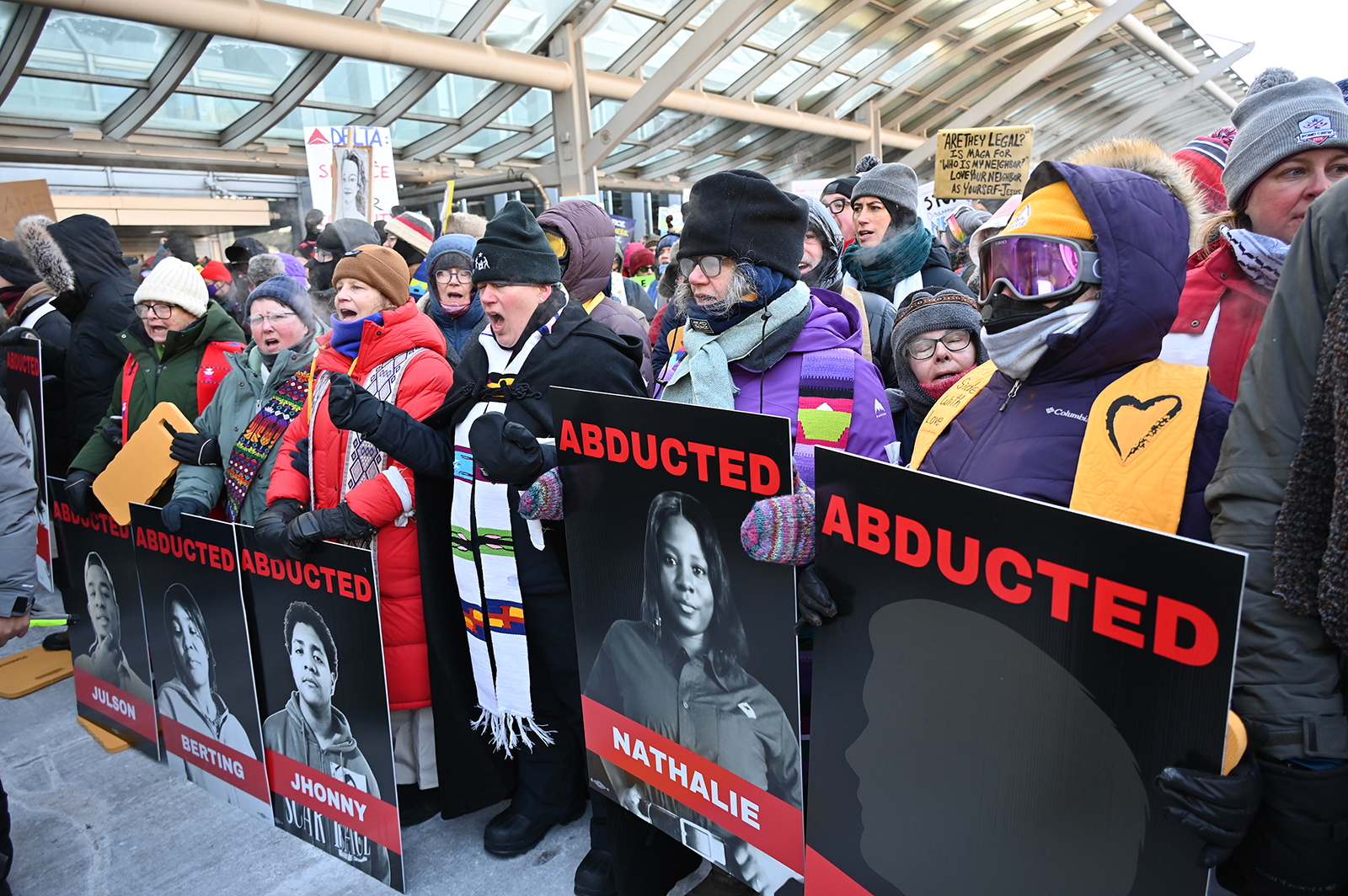
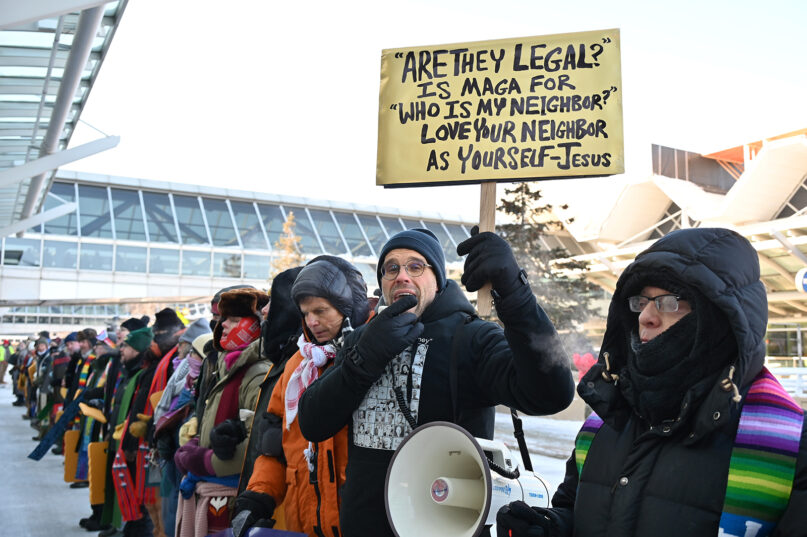
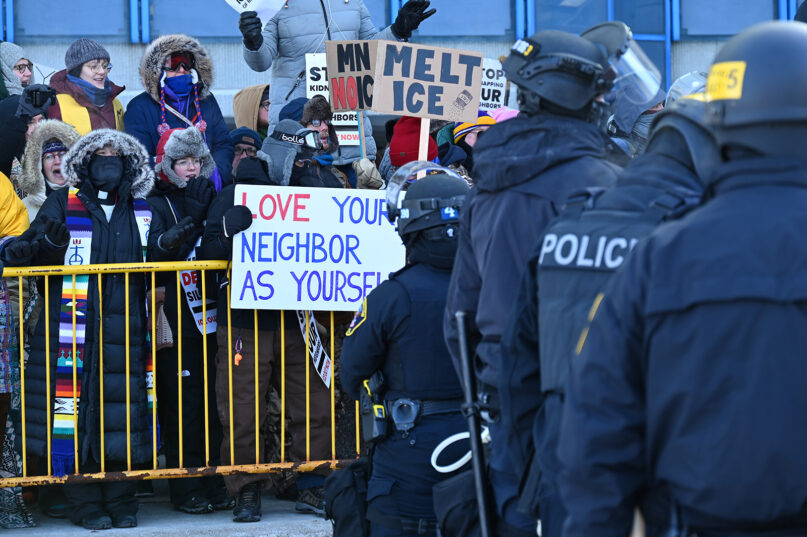
The largest protest by far was a boisterous demonstration at the Minneapolis-Saint Paul International Airport. Hundreds of faith leaders staged a protest just outside one of the terminals, decrying ICE activity at the airport that has resulted in the detention of some workers. Despite an extreme weather warning in effect and temperatures dropping well below zero, hundreds briefly took over the street in front of the terminal.


Faith leaders demonstrate against ICE tactics, in the departures area of Terminal 1 of the Minneapolis–Saint Paul International Airport, Friday, Jan. 23, 2026, in St. Paul, Minn. (RNS photo/Jack Jenkins)

Most of the out-of-town clergy returned to the sidewalk, but a line of primarily local faith leaders remained in the road, singing and praying.

The Rev. Karen Larson, who said she worships at Hennepin Avenue United Methodist Church in Minneapolis, spoke to RNS as she knelt on the ground in prayer, cheered on by hundreds of others on the sidewalk who sang songs such as “Down to the River to Pray.”

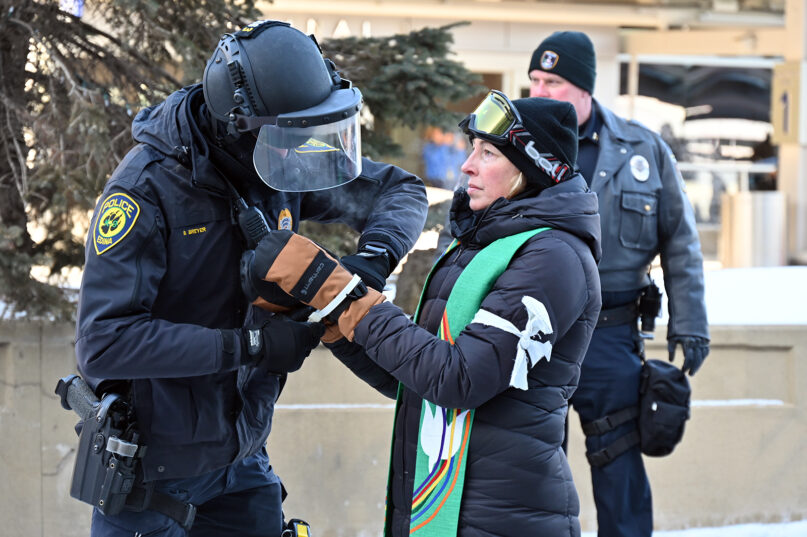
As local police began to calmly arrest clergy down the line from her — the airport police department confirmed that around 100 were arrested in all — Larson said her role as a faith leader compelled her to resist ICE.

“We cannot stand silent and stand aside as people are being attacked and separated from their families and disappeared,” she said. “They’re beloved children of God, and we are with them — that is our call.”


Police arrest the Rev. Ingrid Rasmussen outside of the Minneapolis–Saint Paul International Airport, Friday, Jan. 23, 2026, in St. Paul, Minn. (RNS photo/Jack Jenkins)

If Friday’s protest is any indication — and if the Trump administration continues to expand its mass deportation effort — it’s a defiant spiritual message that is likely to show up in other cities across the country.

As Larson and faith leaders were led away by police, their stoles and other religious vestments flapping in the brisk wind, a roar went up among the crowd. After a pause, the masses — most trained as religious leader and, now, as activists primed to mount righteous resistance against ICE — burst into a new chant.

They shouted: “Let them pray. Let them pray. Let them pray.”


Faith leaders demonstrate against ICE tactics, in the departures area of Terminal 1 of the Minneapolis–Saint Paul International Airport, Friday, Jan. 23, 2026, in St. Paul, Minn. (RNS photo/Jack Jenkins)


As Springfield's 15,000 Haitians brace for deportations, local churches train to resist ICE

SPRINGFIELD, Ohio (RNS) — Over a year since Donald Trump and JD Vance spread falsehoods about the city's migrants eating pets, Haitians’ temporary protected status is set to run out Feb. 3.


Attendees role-play scenarios of interacting with immigration agents during a rapid response training organized by G92 at Central Christian Church, Saturday, Jan. 24, 2026, in Springfield, Ohio. Faces blurred by RNS. (RNS photo/Kathryn Post)
Kathryn Post
January 26, 2026
RNS


SPRINGFIELD, Ohio (RNS) — “We have orders of deportation,” said a volunteer in a raised voice, posing as an Immigration and Customs Enforcement agent and pounding on the sanctuary door. “What you’re doing is harboring.”

Inside the sanctuary, hundreds of trainees blocked the large wooden double doors. One called out, “We’re exercising our First Amendment right to freedom of worship.”

The handful of faux ICE agents moved to a different entryway. As they pried open the side door to the sanctuary, some trainees held up phones to record the encounter while others blew whistles.

The scenario was part of a roleplay exercise at a rapid response training in Springfield, Ohio, on Saturday (Jan. 24). Despite the winter storm in the forecast, nearly 200 people from in and around Springfield gathered at Central Christian Church for the event organized by G92, a new Springfield-based coalition of pro-immigrant churches and advocates named after the 92 times the Hebrew word “ger,” which means stranger or sojourner, appears in the Hebrew Bible.

“For many people, this isn’t just a political issue, it’s also a spiritual issue,” said Central Christian pastor and G92 founder The Rev. Carl Ruby as he welcomed trainees earlier that day.

Community organizers at the G92 training told attendees they’d received “verified reports” from “many sources” that ICE would be arriving in Springfield on Feb. 3 or 4, and “staying for 30 or more days.” The timing coincides with the potential end of temporary protected status for Haitians — roughly 12,000 to 15,000 of whom call Springfield home.


The Rev. Carl Ruby, center, speaks to trainees at Central Christian Church, Saturday, Jan. 24, 2026, in Springfield, Ohio. (RNS photo/Kathryn Post)

It’s a community that has already faced national scrutiny when, in 2024, then-candidate Donald Trump and his running partner, JD Vance, spread false claims during their campaign, saying Springfield’s Haitian migrants were “eating the pets of the people that live there.”

Unless delayed by a court ruling, Haitians’ TPS, which grants them temporary legal stay and work authorization, is scheduled to terminate on Feb. 3, leaving the country’s nearly 350,000 Haitians vulnerable to deportation.

In preparation, Springfield’s faith groups are mobilizing. They’re hosting rapid response and “know your rights” trainings, coordinating food deliveries for Haitians fearful of leaving their homes, planning a week of fasting and praying, and securing passports for Haitian children born in the U.S. Some congregations, like Central Christian, are readying themselves to become places of sanctuary when ICE arrives.

“We’ve been praying for the best, but we’ve also been preparing for the worst,” said Viles Dorsainvil, executive director of the Springfield-based Haitian Community Help & Support Center. “So it’s not a type of passive faith, it’s a type of active faith.”


Viles Dorsainvil is executive director of the Haitian Community Help & Support Center. (RNS photo/Kathryn Post)

Haitians like Dorsainvil are, many longtime residents told RNS, integral to the Springfield community. The city, which had struggled with closing factories and a declining population at the tail-end of the 20th century, launched a concerted effort to open new businesses and create thousands of jobs in the 2010s. That was also around the time Haitian migrants, fleeing the political turmoil and gang violence in their home country, began to arrive to Springfield. The vast majority of Haitians in Springfield are here legally, many as recipients of TPS due to Haiti’s conditions.

“The Haitians have been really good for our economy. We had a severe lack of workers for our businesses,” said Steve Schlather, a member of First Baptist Church Springfield who attended the G92 training. “There are businesses who have depended on the Haitian folks to keep their operations going, and I’m very concerned about what will happen if they do, in fact, ship these people away.”

The Rev. Adam Banks, pastor of First Baptist Church, acknowledged that the city’s schools and medical facilities had to adapt to accommodate the sudden influx of migrants, but also told RNS that the Haitians have brought blessings. His congregation has welcomed Haitian families who serve as worship leaders and Scripture readers and who handle audio-visual equipment. Central Christian Church has about 40 Haitian congregants and has been offering services in Creole since August.

In the Central Christian Church board room on Friday afternoon, Viles, who recently became an elder at the church, told RNS it’s good to be part of a congregation where his voice is heard. As Springfield prepares for what’s next, he said one of the biggest challenges is the uncertainty.

“Anything can happen. And this is where faith matters,” he said. “This immigration crackdown, the way it has been unfolding, there is no due process. There is no respect for human rights or human dignity, and your detention is based on your skin color or your country of origin or the language you speak. It’s crazy. So you can just rely on God for a type of divine intervention. This is the only hope that you can have.”

RELATED: ‘Haitians are not eating pets’: Springfield faith leaders stand with embattled migrants


Not knowing what Springfield’s reality will look like after Feb. 3, faith groups are employing a range of tactics. The Springfield location of Catholic charity St. Vincent de Paul, led by executive director and lifelong Springfield resident Casey Rollins, specializes in walk-in emergency assistance. Rollins met with RNS in her home Friday evening at the end of a long week and described feeling “under siege.”

“Today was just another day in mayhem. We were surrounded by wonderful people who have tremendous needs, their young families needing passports, young families frightened to death, needing food, needing to know what’s next for them, many of them not speaking any of the language,” she told RNS.

When Rollins first stepped into the volunteer executive director role a decade ago, the Haitian community was largely in need of finding jobs and accessing interpreters. Now, as the end of TPS looms, Haitian community members are also losing those jobs as work permits are cut. St. Vincent de Paul, which helps anyone who needs aid, is providing food and funds for rent and utilities to both American citizens and immigrants in Springfield.

Rollins has also been raising the alarm about another implication of potential mass deportations: the over 1,200 U.S.-born Haitian children and infants under age four living in the city who could be separated from detained parents.

“That’s frightening to think that those children will be in limbo,” said Rollins. “We’re not trying to fight the government … We’re just trying to make it easier for everyone to protect children.”

St. Vincent de Paul has been working to ensure those children obtain passports so they can be identified as U.S. citizens if their parents are detained and would be able to travel outside the country if their parents leave the U.S. The Catholic organization has been aided in its efforts by volunteers and funders across the faith spectrum, from Latter-day Saints and Muslims to local churches and secular organizations. “I have never felt more protected and loved and cared for by people from all different walks,” Rollins said.


The Rev. Michael Young. (RNS photo/Kathryn Post)

A different Springfield group made up largely of Black churches, Interdenominational Ministerial Fellowship, has been attentive to the spiritual dimensions of what’s at stake with the looming TPS terminations. The Rev. Michael Young, who leads IMF, told RNS the organization has called for a week of fasting and praying starting on Jan. 28. He said he would be praying for the softening of the hard hearts of “people in this administration who profess to be Christians,” and for “divine intervention.” Banks, whose congregation is also participating in the fast, described it as a way to “remain in affiliation and intimate connection with those who are constantly experiencing precarity.”

Through G92, other churches are strategizing for ICE’s arrival. Central Christian Church, for example, is one of a handful of congregations gathering supplies in case Haitians need to seek sanctuary in their buildings. Immigration officers had long been restricted from arresting migrants in houses of worship until Trump rescinded those restrictions a year ago. Despite the change, Central Christian has received donated air mattresses, a refrigerator and a washing machine for migrants who might shelter there long-term.

“Our top priority is for taking care of our own families, so that if they feel threatened, they have a place to go,” said Ruby. “So I meet with them regularly and share that message. If you are scared, anything scares you, come to Central, and we will open the doors. You can come in, and we will stand between you and ICE.”

G92 has also offered rapid response trainings that focus on nonviolence and “love for your enemies.” At Saturday’s training, attendees learned calming techniques, how to respond when ICE arrives and what roles to take on the scene. They also learned tactics for using whistles, treating tear gas and getting useful video documentation.

After a pizza lunch, attendees were given four different hypothetical scenarios to implement in their training. During the first roleplay, news broke of another ICE fatality in Minneapolis, with the fatal shooting of Alex Pretti, who was acting as an ICE observer. As attendees checked their phones, the update underscored the risks that could come with the work they were training for.

But for those who’ve been standing alongside the Haitian community since Trump’s comments in 2024, risks aren’t new. In 2024, neo-Nazi and white supremacist groups descended on Springfield, distributing racist flyers and staging protests in front of the mayor’s home. In February, the city of Springfield sued Blood Tribe, a neo-Nazi group whose leader, the suit says, took credit on social media for spreading the false claims about Haitians in Springfield. The lawsuit accuses the group of engaging in a campaign of hatred and intimidation that culminated in death threats, bomb threats and harassment.

Ruby has found accusatory signs posted on his church doors condemning his support of the Haitians — state homeland security has advised Ruby on how to take precautions for his safety. Rollins, one of the plaintiffs in the city’s lawsuit, told RNS that American culture has trivialized hate rhetoric “to the point where for many people, it’s almost like a spiritual charism.”

When reflecting on her work with Springfield’s Haitian community, Rollins, who is Catholic, acknowledged the weightiness.

“I am a very faithful person, but what I’ve found is that this has deeply challenged my faith daily,” she said. “Ironically, it’s been the immigrants that have continuously brought me back to my faith.”

 Opinion

Which threatens American Christianity more: ICE or Cities Church protesters?
(RNS) — American Christians need a more robust sense of sacred connection to one another.
Federal immigration officers confront protesters outside Bishop Henry Whipple Federal Building, Jan. 15, 2026, in Minneapolis. (AP Photo/Adam Gray)


(RNS) — When worship services at Cities Church in Minneapolis were interrupted by protesters demanding the resignation of a lay pastor at the church who is involved in U.S. Immigration and Customs Enforcement work, some faith leaders and Trump administration officials were quick to label the protests a threat to religious liberty. President Donald Trump himself argued that the protesters should face harsh penalties. Two of the group have since been arrested.

The church, a Southern Baptist congregation, condemned the demonstration, saying protesters had “accosted members of our congregation, frightened children, and created a scene marked by intimidation and threat.” Other Christian leaders also rebuked the protesters, calling their actions “unspeakably evil,” and an activist siege against America by the political left.

Kevin Ezell, the president of the Southern Baptist Convention’s North American Mission Board, defended Cities Church in more measured terms: “No cause — political or otherwise — justifies the desecration of a sacred space or the intimidation and trauma inflicted on families gathered peacefully in the house of God,” Ezell said in a statement.


Ezell has a point, and insofar as Christian critics of the protest are upset about the disruption of Christian worship and communal life by outside forces, they make an important point too. Nobody wants their family or kids to be terrified in church.  

But as I read and watched various responses to the protest, all I could think about was how numerous other churches the nation over have experienced threats and intimidation, not from a handful of yelling protesters, but from masked government agents with guns. In the United States today, the overwhelming threat to the church and Christian community is not protest of ICE, but ICE itself.

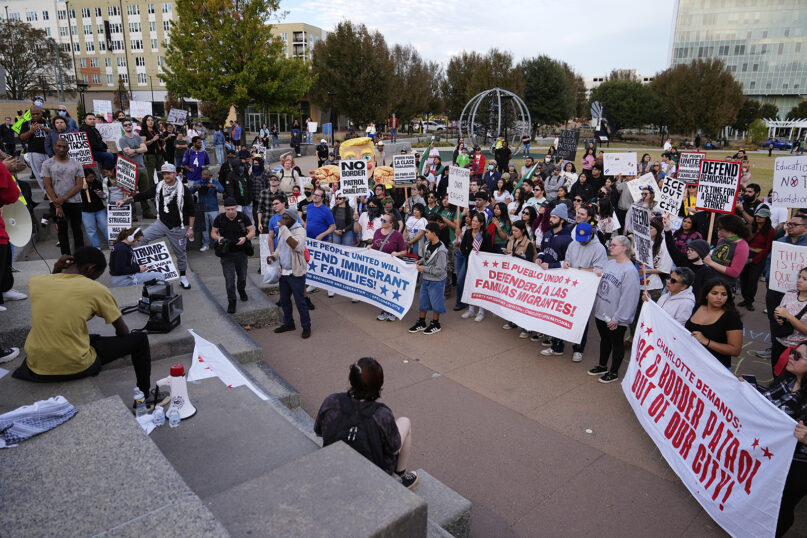
Consider one story, emblematic of many others. In November, a church volunteer workday in Charlotte, North Carolina, was raided by federal agents. The agents showed no identification, took one man away and attempted to grab other attendees, who escaped only by running into nearby woods. Women and children inside the church sobbed in fear, and the church suspended future services until congregants felt safe. “Right now, everybody is scared. Everybody,” the pastor said.

People protest against federal immigration enforcement, Nov. 15, 2025, in Charlotte, N.C. (AP Photo/Erik Verduzco)

Other churches have reported massive decreases in attendance by immigrant members when ICE is rumored to be in town. One pastor of a majority immigrant church in Minneapolis noted the consequences of ICE’s aggressive presence: “We usually have two full services on the weekend, we’ve been having only one service, half empty,” he said. “Even people that are born here are scared to go out. They don’t want their kids to go through the trauma, stopped by ICE, that kind of thing.”

Yet the Christians who typically bemoan the government’s threats to authentic Christian faith are mostly silent about this rampant ecclesial distress in communities targeted by ICE. Instead, echoing the views of the Trump administration, they persist in casting the popular Christian narrative of aggressive immigration enforcement as biblically justified.


To more fully understand the threat posed to Christian worship and communal life today, American Christians need a better understanding of the church. We need a more robust sense of our sacred connection to one another.

Though we worship in local congregations, Christians believe we are bound together in the body of Christ and that this connection transcends the claims of nationality, ethnicity, family and other earthly allegiances. This fellowship does not vitiate these claims, which can be sources of goodness and meaning. Nor does it mean Christians should live with no respect for earthly allegiances (even the ones we might find suspect). It just means that, at a fundamental level, we see the waters of baptism as more determinative for our identity than anything else.

As the Apostle Paul famously said in his Letter to the Galatians, “There is neither Jew nor Gentile, neither slave nor free, nor is there male and female, for you are all one in Christ Jesus.” It’s precisely this powerful notion that has led Christians, at their best, to engage in mission and service across cultures and national boundaries. Our common Christian bond isn’t the full story of Christian service or politics, of course, but it’s an important starting point for naming our deepest allegiances.

Indeed, this is what Cities Church itself claimed in a public statement following the protest. The church said it welcomed respectful dialogue about challenging public issues, but pointed to a more fundamental commitment: their allegiance to Jesus Christ. Jesus “offers a love that transcends cultures, borders, policies, and politics. … we will not shrink from worshiping Jesus, nor will we stop ‘teaching and proclaiming the good news that Jesus is the Messiah,’” the church wrote, quoting the Book of Acts.

Amen. This is precisely why Christians across the country (and around the world) should ask hard questions about the work of ICE and its harmful impact on Christian communities who worship the same Lord. Christians should reject double standards when we identify threats to Christian worship and community in this country. In striving to deepen our connection and accountability to our brothers and sisters, especially those on the margins, Christians can challenge xenophobic beliefs and violent policies.

To be clear, this sense of connection, borne out of allegiance to Christ, doesn’t offer a particular social strategy or mode of policy engagement, on immigration or anything else. The church simply is a social ethic. We are a community of truth-telling about God and God’s purposes for the world, which happen to also be a rebuke to the idolatry of nationalism and its pathetic renderings of peace through violence.

As Christians, with this sense of confidence and connection, let’s notice when our brothers and sisters don’t show up to worship. Let’s notice the patterns of intimidation and fear in the American church. Let’s confess our sins of failing to notice and love our vulnerable neighbors and our fellow believers.

And let’s respond by doubling down on the work of hospitality and public witness that exposes injustice, defying anything that stands in the way of us perceiving and receiving Jesus in “the least of these.” In doing this, we can offer something constructive to a broken world: a witness to the good news of God’s kingdom, where those who follow Jesus are all one.

(Aaron Griffith is assistant professor of American church history at Duke Divinity School. He is also the author of “God’s Law and Order: The Politics of Punishment in Evangelical America.” The views expressed in this commentary do not necessarily reflect those of Religion News Service.)